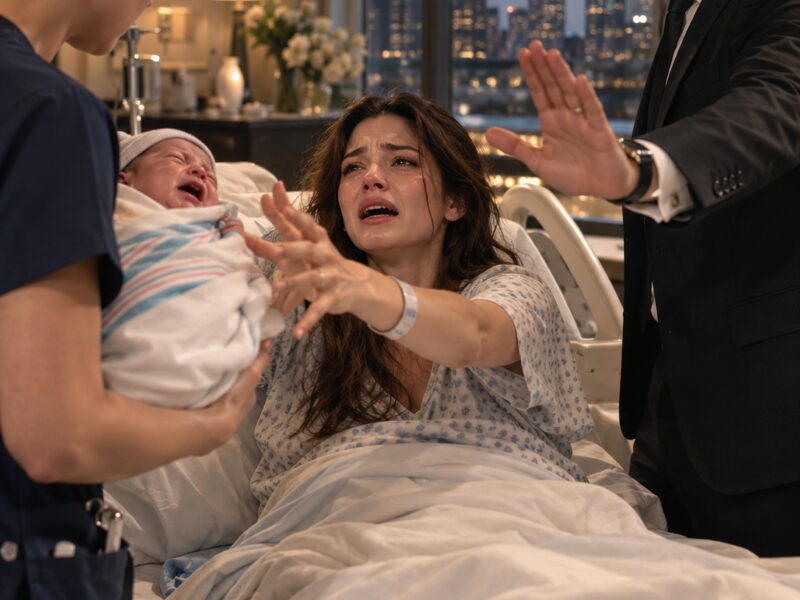
MY HUSBAND WOULDN’T LET ME HOLD OUR NEWBORN SON—THREE DAYS LATER, HE WALKED INTO MY HOSPITAL ROOM AND BEGGED ME TO TAKE HIM

Three minutes after Claire Whitmore gave birth to her son, she reached for him.
Her husband said no.
Not wait.
Not the doctor needs to check him first.
Not you’re too weak right now.
Just one quiet, controlled word that somehow cut through the monitors, the nurses, the rain against the windows, and the newborn cry filling the private maternity suite.
“No.”
Claire stared at Graham Whitmore as though she had misunderstood him.
She had been in labor for twenty-one hours.
Her dark hair was plastered to her temples. Her lips were colorless. One hand still trembled against the white hospital sheet while Dr. Aaron Vale worked beside the bed, checking the bleeding and speaking quietly to a nurse.
Across the room, their son screamed inside a warmed blanket.
Claire lifted both arms.
“Give him to me.”
Graham didn’t move.
He stood beside the bassinet in a charcoal dress shirt with the sleeves rolled once at the wrists, looking almost offensively untouched by the violence of the last day. He had been awake nearly as long as Claire, but exhaustion sat differently on a man who had not been the one pushing a human being into the world.
“Claire, you need to rest.”
“I need my baby.”
“He’s being taken upstairs.”
The room seemed to shrink.
Claire blinked.
“What?”
Graham glanced at the maternity nurse.
“Take him to the nursery.”
The nurse, Denise Rowan, didn’t move.
Neither did anyone else.
For one strange second, every person in that expensive hospital suite seemed to understand what was happening except the man who had ordered it.
Claire gave a breathless laugh.
It wasn’t amusement.
It was disbelief.
“I haven’t even held him.”
“You’ll see him after you’ve recovered.”
“I’m his mother.”
“And he needs proper care.”
Dr. Vale looked up.
“She can hold him.”
Graham’s jaw tightened.
“Aaron—”
“There is no medical reason to separate them right now.”
“I wasn’t asking for a medical opinion.”
“You’re in a hospital,” Dr. Vale said. “Unfortunately, most of my opinions here are medical.”
Claire would remember that sentence years later.
She would remember the monitor blinking beside her.
The metallic click of an instrument being set onto a tray.
The tiny white cap covering her son’s head.
And Graham’s mother, Margaret Whitmore, standing silently near the window.
Margaret had arrived twelve hours earlier in a camel-colored coat and pearls, carrying herself with the serene authority of a woman who had spent thirty-five years entering rooms where people already knew her last name.
She said nothing.
That silence would matter later.
For now, Claire only saw her baby.
“Graham.”
Her husband’s eyes finally met hers.
“Please.”
Something flickered across his face.
For half a second, she thought she had reached him.
Then it disappeared.
“We discussed this.”
“No. You discussed it. I disagreed.”
“You’re exhausted.”
“Then put him on my chest and let me be exhausted with him.”
“Claire.”
“Give me my son.”
The baby cried again.
Claire’s entire body responded to the sound.
She reached.
Denise instinctively moved one step toward the bed.
Graham stepped between them.
“Take him upstairs.”
Dr. Vale’s expression hardened.
“Graham, I strongly recommend—”
“I said take him.”
Denise looked at Claire.
The nurse’s face was full of apology.
That was somehow worse.
Claire watched her turn.
She watched the blanket move toward the door.
She watched one tiny fist escape from the swaddle.
Five fingers.
Red.
Perfect.
Searching for nothing.
Claire tried to sit up.
Pain tore through her abdomen.
“Wait.”
Nobody did.
“Please.”
The door opened.
“Graham!”
The baby disappeared into the hallway.
His cries remained for several seconds after the door closed.
Then they grew fainter.
And fainter.
Until Claire could hear only the monitor beside her bed and her own breathing.
She turned toward her husband.
There were tears running into her hair.
“I will never forget this.”
Graham’s face changed.
Only slightly.
But she saw it.
Perhaps some part of him finally understood that he had not won an argument.
He had crossed a line.
Still, he straightened his shoulders.
“You’ll understand when you’re stronger.”
Claire stared at him.
“No,” she whispered. “I think you’re the one who’s going to understand.”
And for the first time since Graham Whitmore had inherited a billion-dollar family company, nobody in the room believed he was the most powerful person in it.
The Whitmores had been wealthy for four generations.
Not internet-famous wealthy.
Not private-jet photographs and champagne-on-yachts wealthy.
They were quieter than that.
Their name appeared on hospital wings, university buildings, museums, scholarship funds, and the brass plaques outside old corporate headquarters in Boston.
Whitmore Capital had started with shipping.
Then rail.
Then commercial real estate.
Then private equity.
By the time Graham became CEO at thirty-six, the company controlled assets his great-grandfather could not have imagined.
But money wasn’t the most important thing the Whitmores inherited.
Rules were.
A Whitmore did not embarrass the family.
A Whitmore did not complain publicly.
A Whitmore did not allow emotion to interfere with responsibility.
And the firstborn son did not belong entirely to his parents.
He belonged, in a way nobody ever stated plainly, to the future.
Claire had learned that slowly.
When she married Graham six years earlier, she thought his discipline was one of the things she loved about him.
He remembered everything.
Anniversaries.
Appointments.
The wine her father liked.
The name of her childhood dog.
He never raised his voice during arguments. He never disappeared after fights. He never flirted carelessly at parties.
When Claire’s mother underwent surgery, Graham canceled meetings in London and sat beside Claire for seven hours.
When Claire lost her first pregnancy at seventeen weeks, he slept on the bathroom floor because she couldn’t bear to be alone.
That was the Graham she had loved.
But grief changed them differently.
Claire became afraid to hope.
Graham became obsessed with preventing uncertainty.
When she became pregnant again eighteen months later, he turned the pregnancy into a project.
At first, Claire mistook it for devotion.
He hired a private maternal-fetal specialist.
He replaced the staircase railing at their Beacon Hill home.
He installed a medical-grade air filtration system.
He researched pediatricians before Claire reached her second trimester.
At twenty-four weeks, he hired a newborn-care specialist.
At twenty-six weeks, he began interviewing nannies.
At twenty-eight weeks, he showed Claire the nursery.
She stood in the doorway and knew immediately something was wrong.
It was beautiful.
That was the problem.
Everything was beautiful.
Custom millwork.
Hand-painted walls.
A crib imported from Denmark.
A cream wool rug.
An antique rocking chair restored by a craftsman in Vermont.
Books already arranged by age group.
A discreet camera system built into the ceiling.
A second room for the night nurse.
A third for future security personnel.
Claire walked slowly through it.
“Where’s the bassinet?”
Graham looked up from his phone.
“What bassinet?”
“The one for our room.”
“He won’t sleep in our room.”
She thought he was joking.
“Of course he will.”
“We have an entire nursery suite.”
“On another floor.”
“With staff twenty-four hours a day.”
Claire stared at him.
“Graham, he’s a baby.”
“I know.”
“Then why are you talking about him like we’re opening a hotel?”
He sighed.
“Don’t do that.”
“Do what?”
“Make responsible planning sound cold.”
“I want him beside me.”
“You’ll need sleep.”
“I’ll decide what I need.”
“The newborn specialist agrees—”
Claire turned.
“You already discussed this with her?”
“Of course.”
“Without me?”
“I was gathering information.”
“No. You were making decisions.”
Graham put down his phone.
The irritation in his face was small, but Claire recognized it.
It was the expression he used in board meetings when someone was slowing down a conclusion he had already reached.
“We’re not improvising our son’s first months.”
“Our son.”
“Yes.”
“Not Whitmore Capital’s son.”
“Claire.”
“Not your father’s grandson. Not your board’s future chairman. Our son.”
Graham’s voice became quieter.
“That distinction won’t always be as clean as you want it to be.”
She remembered staring at him.
“What does that mean?”
“He will inherit responsibilities.”
“He hasn’t even been born.”
“That doesn’t change who he is.”
Claire placed a hand over her stomach.
The baby moved beneath her palm.
“No,” she said. “But apparently it changes who you are.”
The argument never truly ended.
It only went underground.
And on the night their son was born, Graham finally settled it the way powerful men often settled arguments they could not win.
He made the decision while Claire was too weak to stop him.
Their son was named Noah James Whitmore.
Claire did not know that until four hours after his birth.
A nurse told her.
Graham had completed the hospital paperwork.
When Claire heard the name, she closed her eyes.
They had chosen Noah together.
James had been Claire’s father’s name.
That should have comforted her.
Instead, it felt like Graham had taken one more intimate thing and processed it without her.
At 2:13 a.m., she asked Denise to bring Noah down.
At 2:46, Denise returned alone.
“Mr. Whitmore wants him to remain in the nursery tonight.”
Claire stared at the ceiling.
“Did my husband give birth?”
Denise hesitated.
“No.”
“Then why are people treating him like the patient?”
“Claire—”
“I want my baby.”
“I know.”
“Then bring him.”
Denise lowered her voice.
“There are… complications about who has authorization to move him from the private nursery floor.”
Claire turned her head.
“What complications?”
“Your husband arranged security.”
Claire almost laughed.
Of course he had.
The Whitmore name could buy many things.
Apparently it could also buy enough procedure to separate a mother from a child inside the same hospital.
“Is Noah okay?”
“Yes.”
“Has he eaten?”
“Some.”
“Some?”
“Newborns can take time.”
“I want to nurse him.”
“I told them.”
“And?”
Denise’s silence answered.
Claire looked toward the rain-darkened windows.
“Get me my phone.”
At 3:04 a.m., she called her older sister, Evelyn.
Evelyn answered on the second ring.
“Claire?”
“I had him.”
“Oh my God.”
Claire heard sheets rustling, then Evelyn’s husband murmuring in the background.
“Is he okay? Are you okay?”
“He’s beautiful.”
“You held him?”
Claire said nothing.
Evelyn’s voice changed.
“Claire?”
“He won’t let me.”
There was a pause.
“Who?”
“Graham.”
“What do you mean, he won’t let you?”
Claire pressed the heel of her hand against her eyes.
“He took him upstairs.”
Evelyn became completely awake.
“I’m coming.”
“No.”
“Yes.”
“Not tonight.”
“Claire—”
“I need you to do something else.”
“What?”
“When Dr. Vale clears me to leave, I want to come to your house.”
Another pause.
This one was longer.
“For how long?”
“I don’t know.”
“And Noah?”
Claire turned toward the empty bassinet beside her bed.
It had been rolled into the corner.
Unused.
“He comes with me.”
By morning, Claire stopped asking for her son.
That frightened Denise more than the crying had.
At 7:20, Graham entered carrying coffee.
He placed it on the side table.
“How are you feeling?”
Claire looked out the window.
Boston was gray beneath the rain.
“Fine.”
“You don’t look fine.”
“I pushed a seven-pound human being out of my body yesterday. Adjust your expectations.”
Graham ignored the edge in her voice.
“Noah had a reasonable night.”
Claire looked at him then.
“How much did he eat?”
Graham hesitated.
She saw it.
“How much?”
“The nurses are monitoring him.”
“That wasn’t my question.”
“He’s taking some formula.”
“Some.”
“Yes.”
“How much is some?”
“I don’t have the exact number.”
Claire’s laugh was soft and bitter.
“You built an entire command center upstairs, and you don’t have the number?”
“He’s fine.”
“Bring him to me.”
Graham looked away.
“No.”
Something inside Claire became very still.
She had spent the previous night devastated.
Now devastation began hardening into something else.
“Why?”
“We’ve talked about this.”
“No. You’ve given orders. I’m asking why.”
“You’re recovering.”
“Dr. Vale says I can hold him.”
“He also says you need rest.”
“Stop using half a doctor’s sentence to justify what you already wanted.”
Graham moved toward the window.
Claire watched his shoulders.
“Are you afraid I’ll drop him?”
“No.”
“Are you afraid I’ll hurt him?”
“Of course not.”
“Then what?”
He didn’t answer.
Claire’s voice lowered.
“What are you afraid of?”
Graham turned.
And there it was.
Not cruelty.
Not exactly.
Fear.
“I don’t want the first months to become a battle every time the nurses need to take him.”
Claire stared.
He continued, apparently believing explanation would make it better.
“You’ve been very emotional about the nursery arrangements.”
“I’m his mother.”
“And I’m his father.”
“Then act like one.”
His expression hardened.
“I am.”
“No. You’re acting like his chairman.”
“That’s unfair.”
“You removed a three-minute-old baby from his mother because you were afraid I might become too attached.”
“I didn’t say that.”
“You didn’t have to.”
Graham was silent.
Claire felt something break with astonishing quietness.
Not love.
Love was more stubborn than that.
Something beneath love.
Trust, perhaps.
The assumption that when she was weakest, he would stand between her and the world instead of becoming the thing she needed protection from.
“Get out.”
“Claire.”
“Get out.”
“Don’t make permanent decisions while you’re exhausted.”
She looked at him.
“Interesting advice.”
He flinched.
Then he left.
Upstairs, Noah was not fine.
The first sign was feeding.
He would take a little, then turn his face away.
The newborn specialist, Melissa Park, had cared for infants for nineteen years. She was calm, meticulous, and not easily alarmed.
She changed bottles.
Changed positions.
Changed formula.
Checked temperature.
Burped him.
Waited.
Tried again.
Noah drank, but never enough.
Dr. Vale examined him late that morning.
Graham stood beside the window while Melissa described the feedings.
“Is something wrong with him?” Graham asked.
“Maybe not,” Dr. Vale said.
“That’s not an answer.”
“It’s the only responsible answer right now.”
“What do we do?”
“We keep monitoring him.”
“And?”
Dr. Vale looked directly at him.
“Take him to Claire.”
Graham’s face closed.
“We discussed this.”
“No. You informed me.”
“Melissa is one of the best newborn-care specialists in Massachusetts.”
“She is.”
“Then what’s the problem?”
Dr. Vale glanced around the room.
There were two nurses.
A warmer.
Monitoring equipment.
Imported blankets.
A leather chair that cost more than some families’ cars.
Everything money could arrange.
“Graham,” he said quietly, “your son has everything you purchased.”
Graham frowned.
“He does not necessarily have everything he needs.”
For the first time, Melissa looked away.
Graham understood.
“No.”
“Claire wants to nurse him.”
“She has never breastfed.”
“No first-time mother has.”
“If it doesn’t work?”
“Then we adjust.”
“He needs expertise.”
“He needs feeding. He needs regulation. He needs contact. And yes, there can be value in being close to his mother.”
Graham crossed his arms.
“Continue with the current plan.”
Dr. Vale stared at him.
“You asked for my medical judgment.”
“And I’ve heard it.”
“No. You heard the part you intend to ignore.”
Graham left.
That afternoon, Margaret Whitmore visited the nursery.
She stood over Noah’s crib for several minutes.
“He looks like Graham did.”
Melissa smiled politely.
Margaret touched the edge of the blanket.
“Graham was taken to the nursery immediately too.”
Dr. Vale, who had been reviewing Noah’s chart, looked up.
“For how long?”
Margaret seemed surprised by the question.
“Most of the time.”
“Why?”
“That was how things were done.”
“By whom?”
“Our pediatric staff.”
“Was there a medical reason?”
Margaret’s posture changed.
“I don’t remember.”
“You remember.”
Her eyes sharpened.
Dr. Vale closed the chart.
“Surviving a childhood practice does not make it good medicine.”
Margaret’s voice cooled.
“You’re overstepping.”
“Possibly.”
He nodded toward Noah.
“But at least I’m overstepping toward the baby.”
That night, Noah cried for hours.
By morning, he barely cried at all.
And that was worse.
Melissa called Dr. Vale before sunrise.
He examined Noah and ordered blood work.
Then he walked directly downstairs.
He found Graham in the family lounge answering emails.
“Put the phone down.”
Graham looked up.
Something in the doctor’s face made him obey.
“What happened?”
“Your son is becoming dehydrated.”
Graham stood.
“How bad?”
“Bad enough that we’re intervening more aggressively.”
“What does that mean?”
“It means his intake is inadequate.”
“Then start an IV.”
“We may.”
“Do it.”
Dr. Vale’s face tightened.
“Listen to yourself.”
“My son needs fluids.”
“Your son needs you to stop turning every problem into a transaction with a solution you can purchase.”
Graham stepped closer.
“Don’t lecture me.”
“Then don’t make me.”
“What do you want?”
“You know exactly what I want.”
“No.”
“Bring him to Claire.”
Graham looked toward the hallway.
“We can get another lactation specialist.”
Dr. Vale almost laughed.
“Unbelievable.”
“Or donor milk.”
“Graham.”
“I can have someone here within an hour.”
“You would rather mobilize half the city than take an elevator downstairs.”
Graham’s jaw clenched.
“You don’t understand my family.”
“No. I understand your patient.”
“My son.”
“Then start behaving like those words mean something.”
The door opened.
Margaret stood there.
She had heard enough.
“Graham,” she said, “perhaps Aaron is right.”
He turned sharply.
“You agreed with the nursery arrangement.”
Margaret went still.
“I know.”
“Then don’t change sides because things are difficult.”
The sentence struck her in a way Graham did not understand.
She looked suddenly older.
“I didn’t say I was changing sides.”
Her voice was quieter now.
“I said perhaps I chose the wrong one.”
Before Graham could answer, the door opened again.
Denise stood there.
“Claire knows.”
Graham’s face drained.
“Who told her?”
“I did.”
“You had no authorization—”
“She is his mother.”
The words stopped him.
Denise looked almost angry now.
“She asked whether her child was healthy. I answered truthfully.”
Graham left without another word.
He found Claire sitting upright in bed despite the pain.
Her face was pale.
Her eyes were not.
“Bring him to me.”
“We have another specialist coming.”
“Bring him to me.”
“He’s being monitored.”
“Bring. Him. To. Me.”
Graham stopped at the foot of the bed.
Claire’s voice cracked.
“He isn’t eating?”
“Not enough.”
“And you still won’t let me try?”
“We don’t know that nursing will fix it.”
“I never said it would.”
“Then—”
“I said let me try.”
He looked away.
Claire stared at him as if seeing a stranger wearing her husband’s face.
“You’d rather bring another woman into this hospital to feed my baby than let me touch him.”
“That’s not fair.”
“Fair?”
She almost choked on the word.
“He is two days old.”
“I am trying to protect him.”
“From what?”
Graham had no answer.
Claire’s eyes filled.
“From me?”
“No.”
“Then say it.”
“What?”
“Say what you are protecting him from.”
Silence.
Claire’s tears spilled now.
“You are so afraid that I might love him in a way you can’t control that you would rather watch him struggle.”
“That’s not true.”
“Then prove it.”
He didn’t move.
That was his answer.
Claire slowly leaned back against the pillows.
Something in her face disappeared.
“I understand.”
“Claire—”
“No.”
Her voice became almost gentle.
“That was the last time I will beg you for my own child.”
Graham stood there another moment.
Then he left.
He would spend years remembering that sentence.
At 4:12 the next morning, Graham woke in a chair beside Noah’s crib.
For several seconds, he didn’t know what had awakened him.
Then he realized.
Nothing had.
The room was silent.
He stood so quickly the chair tipped backward.
Melissa was already beside the crib.
Noah was breathing.
But he looked terribly small.
Smaller than yesterday.
His lips were dry.
His skin had lost some of its newborn flush.
Dr. Vale arrived minutes later.
He examined him.
Listened.
Checked his mouth.
Checked his pulse.
Then he straightened.
“Enough.”
Graham didn’t speak.
“Take him downstairs.”
Graham looked at the crib.
“Will it help?”
Dr. Vale stared at him.
It was the first time Graham had ever seen genuine disgust on his friend’s face.
“It might.”
He stepped closer.
“And if you’d listened to me two days ago, perhaps we wouldn’t be standing here asking that question.”
Graham closed his eyes.
Nobody spoke.
Finally, he dismissed security.
Then the nurses.
Melissa remained near the door.
Graham walked to the crib.
For two days, someone else had lifted Noah whenever Graham wanted to see him.
Someone else had changed him.
Fed him.
Wrapped him.
Recorded his temperature.
Measured his intake.
Graham had overseen everything.
He had controlled everything.
Except he had barely touched his son.
Now he slid one hand beneath Noah’s head and the other beneath his body.
“Like this?” he whispered.
Melissa stepped closer.
“Support his neck.”
Graham adjusted.
“That’s it.”
He lifted his son.
And froze.
Noah weighed almost nothing.
Of course, Graham knew his weight.
Seven pounds, two ounces at birth.
Less now.
He had read the numbers.
Numbers were not the same as holding them.
His son fit against his chest as if the entire future Graham had planned could be carried in two shaking hands.
Noah made a faint sound.
Graham looked down.
“Hey.”
His voice broke.
Nobody in the room moved.
“Hey, buddy.”
Noah’s eyes remained closed.
Graham’s throat tightened.
“I’ve got you.”
The words nearly destroyed him.
Because for the first time, he understood that he hadn’t.
Not really.
He had secured Noah.
Scheduled Noah.
Protected Noah.
Planned Noah.
But he had not simply held him.
Graham walked out of the nursery.
The hallway outside was quiet.
His shoes made soft sounds against the polished floor.
Security started toward him.
He shook his head.
Nobody followed.
At the elevator, Graham looked at his reflection in the mirrored doors.
CEO of Whitmore Capital.
Fourth-generation heir.
Trustee of three foundations.
A man who had negotiated acquisitions worth billions.
And in his arms was a newborn who did not care about any of it.
The doors opened.
Graham stepped inside.
He pressed the button for Claire’s floor.
As the elevator descended, he looked down at his son.
Noah’s tiny hand had escaped the blanket.
The fingers opened once.
Graham placed one finger into his palm.
Noah closed around it.
Barely.
But enough.
Graham began to cry.
Not dramatically.
There was no collapse.
No sound.
Just tears moving silently down a man’s face while every certainty he had inherited began coming apart.
The elevator opened.
Graham walked toward Claire’s room.
He remembered his father’s voice.
An heir must understand responsibility before affection makes him weak.
He remembered being six years old and shaking his father’s hand after returning from boarding school.
He remembered being eleven and crying after breaking his wrist, only to be told Whitmore men did not frighten easily.
He remembered being seventeen at his grandfather’s funeral while his father whispered that everyone was watching.
He remembered mistaking control for strength.
Distance for discipline.
Loneliness for preparation.
Then he remembered Claire reaching for Noah.
Give me my baby.
And himself saying no.
Graham stopped outside her door.
His son barely moved against his chest.
Suddenly every rule he had inherited looked monstrous.
He opened the door.
Claire was awake.
She saw him.
Then she saw the bundle.
Her entire face changed.
“What happened?”
Graham couldn’t answer.
She pushed herself upright.
“Graham, what’s wrong with him?”
He walked toward the bed.
“Claire.”
“Give him to me.”
Two days earlier, those words had sounded like a challenge.
Now they sounded like salvation.
Graham reached the bedside.
Then, slowly, he lowered himself onto one knee.
Claire stared at him.
The man who had never bent publicly to anyone was kneeling beside her hospital bed with their newborn son trembling against his chest.
“Please,” he whispered.
Her expression changed.
Graham’s voice broke completely.
“Please take him.”
Claire did.
Immediately.
There was no victory in it.
No satisfaction.
No punishment.
Only instinct.
She gathered Noah against her chest and kissed the top of his head.
“Oh, baby.”
Her tears fell into his hair.
“Oh, my sweet boy. Mommy’s here.”
Graham bowed his head.
Those three words hurt more than anything Claire could have said to him.
Mommy’s here.
She had always been there.
He was the one who had kept them apart.
Dr. Vale entered quietly.
A lactation consultant followed.
Nobody celebrated.
Nobody promised a miracle.
They worked.
Noah was weak.
The first attempt failed.
Claire’s face crumpled.
“He can’t.”
“Give him a minute,” the consultant said.
“What if he can’t?”
“Then we help him another way. But give him a minute.”
Claire breathed slowly.
Noah tried again.
Nothing.
Again.
Then finally, briefly, he latched.
Claire froze.
Dr. Vale watched the clock.
“Good.”
Nobody dared say more.
Noah stopped.
Rested.
Tried again.
It wasn’t enough.
But it was something.
Two hours later, they supplemented his feeding.
Four hours later, he tried again.
By afternoon, his mouth was less dry.
By evening, his cry was stronger.
Dr. Vale examined him and finally released a slow breath.
“I’m cautiously optimistic.”
Claire closed her eyes.
Graham stood across the room.
He had never felt smaller.
For the next forty-eight hours, Noah improved.
Not magically.
Slowly.
Clinically.
He received fluids.
His weight stabilized.
His feeding strengthened.
His color returned.
Claire barely slept.
Graham barely left.
But he did not give orders anymore.
When nurses entered, he asked what they needed.
When Claire held Noah, Graham did not interrupt.
When Noah cried, Graham learned to pick him up.
The first time, he looked at Claire for permission.
She noticed.
She nodded once.
Nothing more.
On the fifth evening, Noah slept in the bassinet beside Claire’s bed.
The expensive private nursery upstairs was empty.
Graham sat near the window.
Claire watched their son breathe.
Finally, Graham said, “I owe you an apology.”
Claire did not look at him.
“I know.”
“One that isn’t enough.”
“That too.”
He swallowed.
“I thought I was protecting him.”
Claire turned.
“From whom?”
Graham couldn’t answer.
“From me?”
“No.”
“But that’s what you did.”
“I know.”
“You knew I had already lost one baby.”
His face tightened.
“I know.”
“You knew what this pregnancy cost me.”
“I know.”
“You watched me give birth to him.”
“Claire—”
“And three minutes later, you decided I was the danger.”
“I didn’t think you were dangerous.”
“Then what did you think?”
Graham rubbed both hands over his face.
“I thought if you bonded with him immediately, you’d fight every decision.”
Claire stared at him.
“He was three minutes old.”
Graham lowered his hands.
“What?”
“Our son.”
Her voice was calm.
“That baby was three minutes old, Graham.”
He looked toward the bassinet.
“And you were already preparing to teach him that being a Whitmore mattered more than being loved.”
The sentence landed.
Claire continued.
“You weren’t protecting him from me.”
She looked at him with exhausted sadness.
“You were protecting your system from a mother.”
Graham’s eyes filled.
“My father—”
“I know.”
“He raised me to believe—”
“I know.”
“Then you understand.”
“No.”
Claire shook her head.
“I understand where it came from. That isn’t the same as excusing what you did with it.”
Graham stared at the floor.
For a long time, neither spoke.
Then Claire said, “Were you happy?”
He looked up.
“Growing up.”
He didn’t answer.
“Were you happy, Graham?”
“I had everything.”
“That wasn’t my question.”
His mouth opened.
Closed.
Claire watched him.
“You don’t even know how to answer.”
The door opened quietly.
Margaret stood outside.
She had heard enough to know she should leave.
Instead, she entered.
“Because I taught him not to.”
Graham turned.
“Mom?”
Margaret closed the door.
For once, she wore no pearls.
No tailored coat.
No armor.
She looked at Claire.
“The same thing happened to me.”
Claire went still.
Margaret’s eyes moved to Noah.
“When Graham was born, they took him away.”
Graham stared at her.
“What?”
“Your grandfather insisted.”
“No.”
“Yes.”
“You never told me that.”
“There were nurses. A separate nursery. Feeding schedules. Rules about when I could see you.”
Graham stood.
“Why?”
Margaret gave a small, broken laugh.
“Because affection was considered indulgence.”
Graham looked stunned.
“You agreed with me.”
“I did.”
“Why?”
Margaret’s eyes filled.
“Because if I admitted what you were doing to Claire was cruel, then I had to admit what was done to me was cruel too.”
Nobody moved.
Margaret looked at her son.
“I spent thirty-six years calling a wound a tradition because the alternative was admitting I had allowed it to happen.”
Graham’s face collapsed.
Not visibly enough for anyone outside the family to notice.
But Claire saw it.
Margaret stepped closer to the bassinet.
“Your father believed distance made men strong.”
Her voice shook.
“I believed surviving it proved him right.”
She looked at Noah.
“It didn’t.”
Graham sat down.
Margaret’s tears came silently.
“I handed you my wound and called it an inheritance.”
For the first time, Graham understood.
He had spent his life protecting something that had never protected him.
And in doing so, he had almost handed the same emptiness to his son.
A week after Noah’s birth, Dr. Vale cleared Claire to leave.
Graham arrived that morning expecting to take them home.
Instead, he found two suitcases beside the door.
He stopped.
Claire was dressing Noah.
“What’s this?”
She didn’t look up.
“I’m going to Evelyn’s.”
“For a few days?”
“I don’t know.”
Graham stood motionless.
“And Noah?”
Claire finally looked at him.
“With me.”
Six days earlier, he would have argued.
He would have mentioned security.
The pediatrician.
The nursery.
The staff.
The Whitmore residence.
Instead, he looked at his son.
Then at his wife.
“All right.”
Claire’s expression changed slightly.
Perhaps she had expected a fight.
Graham picked up one suitcase.
“I’ll have the car brought around.”
“No security convoy.”
He nodded.
“Okay.”
“No staff at Evelyn’s unless I ask.”
“Okay.”
“No private nurse.”
“Okay.”
Claire studied him.
“And you don’t come without calling.”
That one hurt.
Graham nodded anyway.
“Okay.”
At the hospital entrance, photographers waited behind barriers.
Someone had leaked the birth.
Graham immediately stepped between the cameras and Claire.
For once, he did not give a statement.
He didn’t announce the heir.
Didn’t release a portrait.
Didn’t speak about legacy.
He simply opened the car door and helped Claire inside.
Before she closed it, Graham looked at Noah.
“Can I…?”
He stopped.
Claire waited.
“Can I say goodbye?”
She shifted the blanket so he could see him.
Graham touched one finger to Noah’s hand.
“Bye, buddy.”
Then he stepped back.
The car left.
Graham remained on the curb long after it disappeared.
The nursery at Beacon Hill stayed empty.
He never dismantled it.
He simply stopped entering.
For the first few weeks, Graham saw Noah only when Claire invited him.
At Evelyn’s house, there were no staff uniforms.
No security stationed outside the nursery.
No temperature-controlled formula cabinet.
No antique furniture.
No family portraits.
No plaques bearing the Whitmore name.
There was a secondhand rocking chair near a window.
A stack of diapers beside the couch.
Coffee mugs everywhere.
Laundry that never seemed finished.
And Noah slept better there than he ever had in Graham’s perfect nursery.
The first time Graham visited, he arrived carrying three bags.
Claire looked inside.
Diapers.
Wipes.
A bottle warmer.
Two kinds of formula.
A blanket.
Six onesies.
A baby monitor.
She looked at him.
“You’re doing it again.”
His face fell.
“What?”
“Trying to solve anxiety by buying things.”
He stared at the bags.
Then, unexpectedly, he laughed.
A tired, embarrassed laugh.
“You’re right.”
Claire almost smiled.
Almost.
“What does he actually need?” Graham asked.
She handed him a burp cloth.
“Right now?”
“Yes.”
“He needs you to hold him for twenty minutes while I shower.”
Graham looked toward Noah.
“That’s it?”
“That’s it.”
He sat down.
Claire placed the baby in his arms.
Graham adjusted him carefully.
Noah opened his eyes.
For several seconds, father and son simply stared at each other.
Claire stood in the doorway.
Months earlier, Graham would have interpreted holding his firstborn as a right.
Now he understood it as trust.
That difference changed everything.
Almost everything.
Graham began therapy.
He did not tell Claire immediately.
He did not use it as evidence.
He did not say, See? I’m changing.
He simply went.
He reduced his hours at Whitmore Capital.
He changed the family leave policy after discovering how little time many employees received.
He removed his father’s old “leadership principles” from the executive training program.
He stopped allowing the family foundation to use Noah’s image.
When Margaret asked whether they should announce a christening, Graham said, “Claire decides.”
When the board asked when the future Whitmore heir would be introduced publicly, Graham replied, “He’s four months old. He doesn’t have shareholders.”
It was the first time Margaret laughed at a board dinner in years.
Claire saw the changes.
That was what made everything harder.
If Graham had remained arrogant, leaving him would have been simple.
If he had blamed her, simple.
If he had become cruel, simple.
Instead, he became the man she had needed five minutes after Noah was born.
Only months too late.
One winter afternoon, Graham arrived at Evelyn’s house while snow gathered on the porch railing.
Claire sat beside the fireplace.
Noah was awake in her arms.
He was five months old now.
Healthy.
Round-cheeked.
Curious.
Graham took off his coat.
Noah saw him and kicked both legs.
Graham smiled.
“Hey, buddy.”
Claire noticed.
“You know him.”
Graham glanced at her.
“What?”
“He knows when you walk in.”
Something moved across Graham’s face.
Joy.
Then grief.
“Yes.”
Claire looked down at Noah.
“Would you like to hold him?”
Graham hesitated.
Months earlier, he would never have hesitated.
“If he’s comfortable.”
“He is.”
She placed Noah in his arms.
Graham settled into the chair opposite her.
Noah grabbed his shirt collar.
“No,” Graham murmured. “That’s Italian.”
Claire looked up.
“What?”
“This shirt.”
For one second, she stared.
Then she laughed.
A real laugh.
Graham did too.
It was the first time they had laughed together since the birth.
The sound faded.
What remained was warm and terrible.
Because for one brief moment, they looked like the family they might have been.
Graham looked at Claire.
“I miss you.”
She lowered her eyes.
“I know.”
“I don’t expect that to change anything.”
“Good.”
He nodded.
The fire cracked softly.
Noah yawned against his chest.
“I became a better father,” Graham said.
Claire looked at him.
“You did.”
“I wish I’d become one before I hurt you.”
“So do I.”
“Do you think you’ll ever forgive me?”
Claire was quiet for a long time.
Finally, she said, “I already have.”
Graham looked up.
Hope appeared so quickly in his face that Claire almost hated what she had to say next.
“But I’m not coming home.”
The hope vanished.
“Claire—”
“Forgiving you isn’t the same as trusting you with the same part of me again.”
“I can keep changing.”
“I hope you do.”
“For you?”
“No.”
She looked at Noah.
“For him.”
Graham swallowed.
“And for yourself.”
He stared into the fire.
“What if I become the man you needed?”
Claire’s eyes filled.
“That would be wonderful.”
“Then why—”
“Because I needed him that night.”
Silence.
Graham closed his eyes.
Claire’s voice softened.
“I was bleeding. I was shaking. I had just given birth after losing a baby before him. And I reached for our son.”
Her tears slipped free.
“You looked at me and said no.”
Graham bowed his head.
“I know.”
“There are moments in a marriage that tell you what everything else means.”
She wiped her cheek.
“That was ours.”
“I would give anything to undo it.”
“I know.”
“Anything.”
“I know.”
Noah stirred between them.
Graham held him closer.
Claire watched him.
“You’re a good father now.”
Graham’s mouth trembled.
“But not your husband.”
Claire shook her head.
“No.”
He nodded.
It hurt because it was true.
Their divorce was finalized the following spring.
There was no war.
No tabloid battle.
No fight over money.
No attempt by Graham to use the Whitmore name against her.
Claire received primary physical custody.
Graham received generous parenting time.
They made decisions together.
Sometimes badly.
Usually better.
On Noah’s first birthday, they stood beside each other while he destroyed a small cake with both hands.
Margaret took pictures.
Evelyn cried.
Dr. Vale sent a wooden toy ambulance with a note that read:
For the patient who taught everyone something.
Graham read it twice.
Then folded it into his wallet.
Years passed.
Noah grew.
At three, he loved dinosaurs.
At five, he hated formal shoes.
At seven, he asked why his parents lived in different houses.
Claire and Graham told him the truth in the gentlest language they could.
They had loved each other.
They still cared about each other.
But sometimes adults hurt one another in ways that change what a relationship can be.
Noah thought about that.
Then asked whether he could have pancakes.
Children were merciful that way.
When Noah was nine, Graham took him through Whitmore Capital headquarters for the first time.
Employees smiled when they saw them.
Someone joked, “Future CEO?”
Graham looked down at his son.
Noah was staring at an enormous aquarium in the lobby.
“No,” Graham said.
The employee laughed uncertainly.
Graham didn’t.
“He’s Noah.”
That night, Margaret called him.
“I heard what you said.”
Graham leaned against his kitchen counter.
“Was I wrong?”
“No.”
She paused.
“I wish your father had said that about you.”
Graham closed his eyes.
“So do I.”
When Noah was twelve, he found the photograph.
It had been taken in the hospital.
Claire asleep.
Noah in Graham’s arms.
Graham’s face wet with tears.
“Dad?”
Graham looked over.
“What happened?”
He considered lying.
Then he sat beside his son.
“I made a terrible mistake when you were born.”
Noah frowned.
“What kind?”
“The kind that taught me something too late.”
“Did Mom get mad?”
Graham smiled sadly.
“Yes.”
“Is that why you got divorced?”
“Partly.”
Noah looked at the photograph.
“Were you a bad dad?”
The question hurt.
Graham answered carefully.
“For your first few days, I wasn’t the father you deserved.”
Noah leaned against him.
“But you got better.”
“I tried.”
Noah nodded.
Then, with the brutal simplicity of a child who had never learned to confuse love with pride, he said, “Good.”
That night, after Noah went upstairs, Graham sat alone with the photograph.
He no longer lived in the Beacon Hill house.
He had sold it years earlier.
The nursery was gone.
The Danish crib.
The custom walls.
The cameras.
The antique chair.
All of it belonged to someone else.
But Graham kept one thing.
The hospital blanket.
Not framed.
Not displayed.
Folded in a drawer.
Sometimes he touched it and remembered how light Noah had felt in his arms that morning.
How frightened he had been.
How every portrait, dollar, rule, and expectation had become meaningless beside the possibility of losing his son.
He had once believed legacy meant preserving what came before.
Now he understood that sometimes legacy meant being brave enough to end it.
Claire never remarried quickly.
Neither did Graham.
Their lives moved forward without becoming neat.
There were awkward holidays.
Missed calls.
New relationships that didn’t last.
Arguments about school.
Arguments about screen time.
Arguments about whether twelve was too young for a phone.
Ordinary problems.
Beautiful problems.
Problems belonging to two parents rather than an heir and his custodians.
On Noah’s eighteenth birthday, Claire and Graham stood together at the edge of a crowded backyard while their son laughed with friends.
He was tall now.
Taller than Claire.
Almost as tall as Graham.
He had Graham’s eyes and Claire’s stubbornness.
Margaret sat nearby beneath a blanket.
Age had softened her.
Or perhaps truth had.
Noah walked over.
“Picture.”
Claire groaned.
“You’ve taken fifty.”
“One more.”
He put an arm around each parent.
Someone lifted a phone.
Graham felt Claire’s shoulder against his.
For one second, the years folded.
Hospital lights.
A crying newborn.
A closed door.
A man saying no.
Then another morning.
A weak baby.
A kneeling father.
Please take him.
The camera clicked.
Noah walked away.
Claire remained beside Graham.
“You did it,” she said.
He looked at her.
“What?”
“You became the father he deserved.”
Graham watched their son laughing across the yard.
“Eventually.”
“Yes.”
He nodded.
After a moment, he said, “You were right.”
Claire smiled faintly.
“About which thing? There were several.”
He laughed.
Then his expression softened.
“That becoming a better father and remaining your husband were two different things.”
Claire looked toward Noah.
“Yes.”
“I hated you for being right about that.”
“I know.”
“Not anymore.”
She glanced at him.
“No?”
“No.”
The evening sun slipped through the trees.
Graham put his hands into his pockets.
“Forgiving me was more than I deserved.”
Claire shook her head.
“That’s not how forgiveness works.”
“How does it work?”
She considered the question.
“Maybe it means what happened doesn’t get to poison everything that comes after.”
Graham looked at her.
“But it doesn’t erase what happened.”
“No.”
“Or restore what was lost.”
“No.”
He nodded.
“I think I finally understand.”
Claire’s smile was sad but peaceful.
“I know.”
Across the lawn, Noah called for them.
“Mom! Dad!”
They both turned.
No hesitation.
No argument.
No family rule telling either of them who had the greater claim.
They simply walked toward their son.
Years earlier, Graham Whitmore had believed an heir belonged first to the name he would inherit.
He had surrounded his newborn with everything money could buy.
The finest room.
The finest specialists.
The safest equipment.
A future already planned before the child had opened his eyes.
And still, Noah had begun to fade.
Only then had Graham carried him down a hospital corridor toward the one person he had deliberately kept away.
Claire had begged him once.
Give me my baby.
He had refused.
Two days later, Graham had stood beside her bed with that same child frighteningly still in his arms.
This time, he had been the one begging.
Please take him.
Claire had taken Noah.
She had eventually forgiven Graham too.
But she never gave him back the marriage he had broken.
And perhaps that was the final lesson Graham’s father had never taught him.
Love could survive an apology.
A person could change.
A wound could heal.
A man could become kinder than the traditions that made him.
But healing did not mean history disappeared.
Some consequences were not punishments.
They were simply the shape left behind after trust had been broken.
Years later, when Graham looked across a summer yard and saw his grown son laughing beside the woman he had once loved badly, he no longer wished for the old life back.
He wished only that he had understood sooner.
A child was not a legacy.
A wife was not an obstacle.
Love was not weakness.
And the people we love do not belong to us simply because our name is attached to theirs.
Noah turned and waved for his parents again.
Claire walked first.
Graham followed.
Not as the head of the Whitmore family.
Not as an heir.
Not as a husband asking for another chance.
Just as a father whose son was waiting for him.
And this time, Graham did not make him wait.









