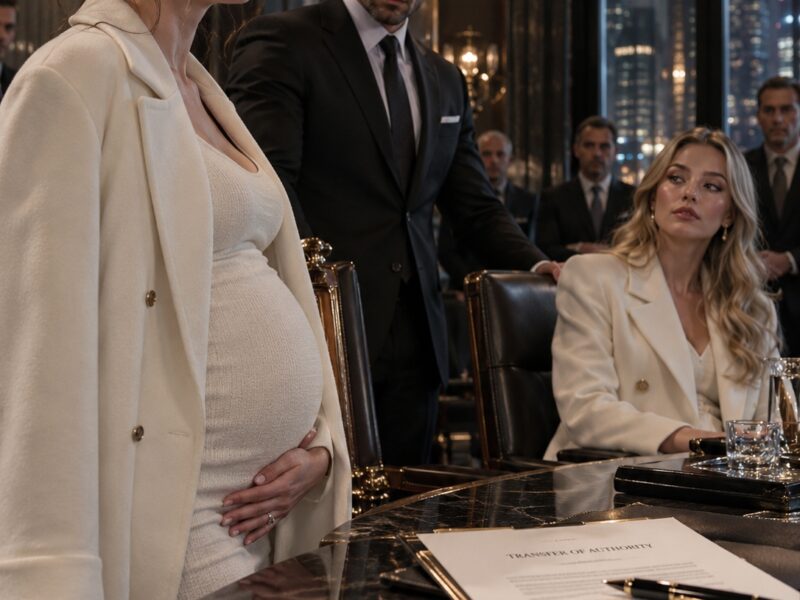
MY MAFIA HUSBAND GAVE MY PLACE TO MY SISTER—HE DIDN’T KNOW I WAS CARRYING HIS TWINS

The cruelest thing Dante Vascari ever did to his wife was not betray her.
It was looking bored while he did it.
Serena Vale Vascari stood in the doorway of the council chamber with rain darkening the shoulders of her coat, one hand still curled protectively over the secret beneath her ribs, and watched her husband sign the document that erased four years of her life.
He did not look up.
Not at first.
Her younger sister did.
Celeste stood beside him wearing Serena’s white ceremonial coat—the one embroidered with the Vascari seal, the one Dante himself had placed around Serena’s shoulders on their wedding night.
For one terrible second, Serena noticed something absurd.
The coat fit Celeste perfectly.
Same height.
Same narrow shoulders.
Same dark hair.
Almost as though someone had been measuring.
Almost as though someone had known.
“Serena,” Celeste said softly.
She smiled.
It was not the smile of a sister caught doing something shameful.
It was the careful smile of a woman who had rehearsed this moment until she knew exactly where to put her hands.
That was when Dante finally raised his eyes.
Serena had spent four years learning that face.
She knew the slight tightening beside his mouth when he was angry. She knew the stillness that came over him when someone lied. She knew the almost invisible lowering of his eyelids when he had already made a decision and was waiting for everyone else in the room to understand that arguing was useless.
Tonight, there was no surprise.
No guilt.
No panic.
Only control.
And Serena understood.
He knew.
He had known she was coming home.
Maybe he had not expected her tonight, but this was no emergency meeting she had accidentally interrupted.
This had been planned.
On the oak table before him lay a council resolution bearing seven signature lines.
Six had already been signed.
Dante held the pen over the seventh.
Serena had returned from Geneva carrying the biggest diplomatic victory the Vascari organization had achieved in years.
She had also returned carrying Dante’s children.
Twins.
Two heartbeats she had heard for the first time nine days earlier in a private clinic thousands of miles from home.
She had imagined telling him tonight.
She had imagined, foolishly perhaps, that the news might make Dante Vascari lose control for one beautiful second.
Instead, she looked at her sister wearing her coat and asked the only question that mattered.
“What are you signing?”
Nobody answered.
So Serena crossed the room and took the document herself.
Silas Ror, the sixty-four-year-old chairman of the family council, shifted in his chair.
“Mrs. Vascari—”
“Don’t.”
One word.
Silas stopped.
Serena read.
The resolution was elegantly written. That almost made it worse.
There was no crude accusation, no obvious insult. Men like Silas did not destroy people with vulgar language. They destroyed them with paragraphs.
The document removed Serena as primary diplomatic representative of the Vascari organization and transferred her authority, ceremonial standing, and council privileges to Celeste Vale.
Her sister.
The justification cited Serena’s “independent operating style,” her extended international absences and, most offensively, her failure to consult the council before completing the Aldermach partnership.
The partnership she had spent two years building.
The agreement she had closed eight hours ago.
Serena slowly placed the document back on the table.
Her hands did not shake.
Later, she would be proud of that.
“You knew,” she said.
Dante’s gaze remained on hers.
“The council has been reviewing the diplomatic structure for months.”
“That wasn’t my question.”
Silence.
Serena could hear rain striking the tall windows.
She looked around the table at men whose fortunes she had protected, whose disasters she had quietly cleaned up, whose international partners trusted the Vascari name largely because Serena had spent four years making sure that name meant something beyond fear.
Then she looked at her husband.
“Is this what you want?”
Silas began, “The interests of the organization—”
“I asked my husband.”
Dante’s jaw tightened.
For one second, Serena thought he might stand.
Might cross the room.
Might finally remember that she was not one of his lieutenants or a line item on an operational report.
He did neither.
“The council made the determination,” he said. “I supported it.”
Serena stared at him.
“That still isn’t what I asked.”
Another silence.
Dante’s eyes did not leave hers.
“What’s best for the organization,” he finally said.
Something inside Serena closed.
Quietly.
Not shattered.
Not exploded.
Closed.
And beneath the pain came something colder.
Clarity.
For four years, she had mistaken sacrifice for partnership.
She had negotiated deals under Dante’s name. She had built relationships across Europe, North America and the Middle East. She had prevented disputes from becoming wars and financial exposures from becoming collapses.
When she succeeded, the organization succeeded.
When she worked eighteen-hour days, Dante was praised for his discipline.
When foreign partners trusted her, the Vascari name received the credit.
She had told herself recognition did not matter.
That marriage was not a competition.
That power shared privately was still power.
Standing there, watching Celeste wear her coat, Serena finally understood the flaw in that logic.
Power that someone else could revoke without asking her had never been hers.
She reached inside her coat.
Dante’s expression changed when he saw the silver authentication key in her hand.
Only slightly.
But Serena saw it.
“What is that?” one of the council members asked.
“My personal guarantee key.”
Silas frowned.
Serena set it on the table.
“Every international partnership I negotiated during the last four years contains a secondary security layer tied to my personal credentials. I built it after the Marcetti breach.”
Silas looked toward Dante.
Dante did not look back.
Serena almost smiled.
“Did the council know?”
No answer.
“Of course not.”
She picked up the key again.
“The guarantees don’t transfer with my title. They don’t transfer to Celeste. They don’t even transfer to Dante.”
Celeste’s face lost some of its color.
“Serena—”
“They belong to the person whose biometric profile authenticates them.”
She placed her thumb against the device.
A small blue light appeared.
Dante stood.
“Serena.”
There.
At last.
Not boredom.
Not control.
Concern.
Perhaps even fear.
She looked at him.
“You wanted my position.”
Her eyes moved to Celeste.
“You can have it.”
Then she looked around the council table.
“But you don’t get my work.”
Her thumb pressed down.
The blue light turned red.
Dante moved around the table.
“Wait.”
“Seventeen international guarantees,” Serena said. “Aldermach. Harlow. Meridian Shipping. Fontaine. All of them now enter their contractual thirty-day review periods.”
Silas shot to his feet.
“You cannot do that.”
Serena looked at him.
“I just did.”
“The Fontaine exposure alone—”
“Three hundred forty million dollars.”
Nobody moved.
Even Dante looked stunned.
Serena tilted her head.
“You didn’t know?”
Silas went gray.
One of Dante’s lieutenants pulled out his phone.
Serena continued, almost gently.
“I’ve been covering a liability gap in the Fontaine structure for eighteen months. Quietly. Because fixing problems before they reach Dante’s desk used to be part of my job.”
She looked at Celeste.
“Congratulations on the promotion.”
Then she turned toward the door.
“Serena.”
Dante’s voice stopped her.
She stood with her back to him.
For nine days, she had carried the words inside her.
I’m pregnant.
Twins, Dante.
Two babies.
Your son and daughter, perhaps. We don’t know yet.
She had imagined his face.
She had imagined his hand against her stomach.
She had imagined telling him that for the first time in years, she wanted something that had nothing to do with the organization.
A family.
Their family.
But now seven people were watching her.
Seven people who had just demonstrated exactly how they measured human value.
And Serena understood that the moment she told them she carried the next Vascari heirs, the children would become assets.
Succession.
Leverage.
Bloodline.
Power.
Anything except babies.
So she swallowed the words.
“What?” she asked.
Dante stared at her.
Whatever he had intended to say disappeared.
Serena waited.
He said nothing.
She nodded once.
Then she walked out.
She did not slam the door.
That would have sounded like heartbreak.
She refused to give them even that.
Her legs failed three corridors later.
She reached the east stairwell, sat hard on the third step and pressed both palms against her knees.
Breathe in for four.
Hold.
Out for four.
Her mother had taught her that when Serena was eight.
Back when grief first taught her that falling apart was a luxury some people were rarely allowed.
She gave herself four minutes.
At the end of four minutes, Serena stood.
And began planning her disappearance.
She could not stay at the estate.
Hotels were useless. Dante’s security network would search every respectable property in the city before sunrise. Friends were worse. Every person close enough to Serena to offer shelter was close enough to the Vascari organization to be watched.
Then she remembered the tunnel.
The estate had been built in 1887, when wealthy families understood that walls were useful only if you also knew how to escape them.
Three years earlier, Serena had discovered an old service passage running beneath the east wing from the wine cellar to a drainage building beyond the perimeter wall.
She had mentioned it to Dante.
He had called it structurally unreliable and forgotten about it.
Serena had not.
She rarely forgot useful information.
Twenty minutes later, she was walking through darkness beneath the Vascari estate, one hand holding her phone, the other protecting her stomach.
The tunnel smelled of groundwater and old stone.
Her shoes slipped twice.
She kept moving.
Behind her was the house where she had spent four years learning to disappear while remaining physically present.
Ahead of her was nothing.
For the first time, nothing felt safer.
She emerged behind overgrown hedges on a residential street, walked three blocks in the rain and hailed an ordinary cab.
The driver barely glanced at her.
“Where to?”
Serena opened her mouth.
She had no answer.
Then a name surfaced.
Roman Crow.
She had met him three times.
He was not a friend.
That was exactly why he might be useful.
Roman controlled a logistics network powerful enough that Dante could not simply walk through the front door and demand Serena back. More importantly, Roman had no reason to love the Vascari council.
He was a rival.
A dangerous one.
Serena gave the driver an address on the north side.
Only when the Vascari estate disappeared behind rain and distance did she finally allow herself to touch her stomach.
“I’m sorry,” she whispered.
She did not know whether she was apologizing to the babies, to herself, or to the woman who had boarded the plane believing she was going home.
Back at the estate, Dante discovered Serena was gone twenty-seven minutes later.
He also discovered the financial consequences of her authentication revocation.
The first call came from Fontaine.
The second from Zurich.
The third from an attorney in London asking whether the Vascari organization had undergone an unreported governance change.
By midnight, Dante had six senior people in the council chamber, three phones ringing simultaneously and Silas insisting the situation could be contained.
Dante barely heard him.
He kept seeing Serena standing in the doorway.
Rain on her shoulders.
No screaming.
No begging.
That was what disturbed him most.
She had looked at him as if something had ended.
Not might end.
Had.
“Find her,” Dante said.
His security chief hesitated.
“We’ve checked the airport, train stations and hotels.”
“Then check again.”
Silas watched from the other end of the table.
“She’ll go to Roman Crow.”
Dante turned.
“Why?”
“Because she’s intelligent.”
Silas folded his hands.
“She needs territory outside your network. Someone powerful enough to refuse you. Someone with an incentive to protect information valuable to him.”
Dante stared.
“Information?”
“Serena knows everything.”
The sentence landed differently than Silas intended.
Everything.
Every weakness.
Every contract.
Every quiet compromise.
Every secret Dante had allowed her to manage while rarely acknowledging that managing them was power.
If Serena went to Roman, she would no longer merely be his estranged wife.
She could become a rival intelligence asset.
Silas continued speaking, but Dante stopped listening.
Because another possibility had occurred to him.
“Why did you push Celeste?”
Silas went still.
Dante’s voice lowered.
“How long?”
Silas said nothing.
Dante looked toward the breakfast room where Celeste sat alone.
He walked away.
She was holding coffee she had not touched.
The white ceremonial coat was gone.
Without it, she looked younger.
Less victorious.
More like Serena’s little sister.
“She’ll come back,” Celeste said.
Dante stopped across from her.
“Why would she?”
Celeste looked up.
“She just needs time.”
“No.”
Dante sat.
“I made sure she has no reason to come back.”
“Dante—”
“How long has Silas been talking to you?”
Celeste froze.
“That isn’t relevant.”
“How long?”
Her eyes dropped.
“Eight months.”
Dante felt the room change.
Eight months.
Before Serena left for Geneva.
Before Aldermach reached its final stage.
Before the council supposedly became concerned about Serena’s “independent operating style.”
Silas had been preparing Celeste long before the reasons for removing Serena existed.
“What did he promise you?”
“He said the family needed someone more visible. Someone willing to participate directly in council leadership.”
“And you believed him.”
“I wanted to matter.”
Dante’s expression hardened.
“Your sister made you matter.”
Celeste flinched.
“She made all of us matter.”
“Stop.”
“You wore her coat.”
Tears appeared in Celeste’s eyes.
“Stop.”
“You stood beside me while I signed her out of the organization she helped build.”
“I said stop.”
Dante leaned back.
His anger disappeared.
What replaced it frightened Celeste more.
“Serena is pregnant.”
Celeste stared.
“What?”
“She was pregnant last night.”
“How do you know?”
Dante’s jaw flexed.
A private physician connected to the Geneva clinic had contacted Vascari medical security after Serena disappeared, concerned that her records might need transferring.
Fourteen weeks.
Twins.
Dante had received the report twenty minutes earlier.
He had read the same page three times.
Celeste’s face collapsed.
“I didn’t know.”
“Neither did I.”
The words came out flat.
But Dante felt them like glass.
She had walked into that room carrying his children.
She had looked at him.
She had chosen not to tell him.
And the worst part—the thing Dante could not stop thinking about—was that she had been right.
Had Serena announced her pregnancy in front of the council, Silas would have immediately transformed two unborn children into leverage.
Serena had assessed the danger faster than Dante had.
His wife had protected their children from his own organization.
From him.
Dante rose.
“Where are you going?”
“To find out what Silas actually built.”
“What about Serena?”
He stopped.
For the first time in his life, Dante Vascari had no strategy for getting back something he wanted.
Because Serena was not territory.
Not a contract.
Not an employee.
And he was only beginning to understand that this had been his mistake from the beginning.
“She left because of me,” he said.
Then he walked out.
Serena met Roman Crow in a twenty-four-hour diner at 2:17 in the morning.
Not in his headquarters.
Not in some dramatic underground club.
A diner.
Roman arrived wearing a charcoal overcoat over a white shirt with the sleeves rolled once at the wrists. He was forty-one, broad-shouldered, controlled, with the expression of a man who disliked surprises almost as much as Dante did but handled them better.
He slid into the booth opposite her.
“You look terrible.”
Serena almost laughed.
“Good morning to you too.”
“You called me from a prepaid phone at one-thirty in the morning and asked for protection from your husband. I assumed politeness had been suspended.”
“I’m not asking for protection.”
Roman looked at the overnight bag beside her.
“No?”
“I’m proposing an exchange.”
That interested him.
Serena pushed a folder across the table.
Roman opened it.
Inside were summaries of three international shipping agreements, none containing classified Vascari information but all demonstrating the depth of Serena’s operational knowledge.
“You’re showing me your résumé?”
“I’m showing you what I can do.”
“I already know what you can do.”
“Then this should be quick.”
Roman closed the folder.
“What do you want?”
“Temporary neutral territory. No information about my location leaves your organization. No contact with Dante unless I authorize it. Medical privacy.”
Roman’s eyes sharpened at the last phrase.
Serena saw him understand.
He said nothing.
She appreciated that.
“And in return?”
“I help you fix the humanitarian supply network you’ve been losing twelve percent on for eighteen months.”
Roman stared at her.
“That figure isn’t public.”
“No.”
“How do you know it?”
“Because your routing problem is visible from the outside if you understand customs timing.”
For the first time, Roman smiled.
Barely.
“You really did build half of Dante’s empire.”
“No.”
Serena met his eyes.
“I built my half.”
Roman extended his hand.
“Then let’s make sure nobody steals this one.”
Serena looked at his hand.
Then shook it.
That was the beginning.
Not of a romance.
Of something more important.
A place where Serena’s competence belonged to Serena.
Over the next several weeks, she lived in a modest brownstone owned through one of Roman’s independent holding companies. It had unreliable heating, an ugly kitchen and a radiator that knocked at night like someone trapped inside the wall.
Serena loved it.
Nobody entered without knocking.
Nobody moved her belongings.
Nobody summoned her to meetings.
She worked at the kitchen table in sweaters and socks, reorganizing Roman’s humanitarian distribution network while simultaneously building a legal map of the Vascari council’s authority.
The deeper she looked, the worse it became.
The resolution removing her had not been an isolated betrayal.
It had been one move inside a much larger architecture.
Silas Ror had spent years expanding the council chairman’s authority through obscure amendments, emergency provisions and procedural changes most family members had barely read.
One provision terrified her.
It dated back to 1923.
Under specific circumstances involving “organizational instability,” custody of unborn or minor heirs could temporarily fall under council guardianship.
Serena read it twice.
Then a third time.
Her hand moved instinctively over her stomach.
“No,” she whispered.
The babies kicked for the first time that evening.
Not strongly.
Barely more than fluttering.
Serena sat alone at the kitchen table with legal documents spread around her and began to cry.
Not because she was afraid.
Because she finally understood.
Silas had never wanted Celeste.
Celeste was a tool.
Serena’s removal was a tool.
Even Dante was a tool.
And her children might be the final lock on a structure Silas had spent years constructing.
Her phone rang at midnight.
Celeste.
Serena almost ignored it.
Then answered.
For several seconds, neither sister spoke.
Finally Celeste said, “I need to tell you something.”
Serena’s voice was cold.
“You’ve already told me plenty.”
“I know.”
Celeste sounded exhausted.
“I’m not asking you to forgive me.”
“Good.”
“I mean it. What I did—wearing your coat, standing there—I knew what it meant.”
Serena closed her eyes.
“Then why did you do it?”
A pause.
“Because I spent my whole life being your little sister.”
Serena said nothing.
“You were smarter. Mom trusted you with everything. People listened when you spoke. Then you married Dante and suddenly you weren’t just Serena anymore. You were Serena Vascari. Every room changed when you entered.”
“So you wanted my room?”
“I wanted one room where people looked at me first.”
The honesty hurt more than an excuse would have.
Celeste inhaled shakily.
“Silas knew that.”
“Yes.”
“He used it.”
“Yes.”
“I let him.”
Serena looked at the papers covering her kitchen table.
“Why are you calling?”
“Because Silas told me what happens after the babies are born.”
Serena stopped breathing.
Celeste continued.
“He isn’t planning to give custody to Dante.”
“What?”
“He intends to use the temporary guardianship clause to place the children under council authority.”
Serena stood so quickly her chair scraped backward.
“Under whose authority?”
“His.”
The room seemed to tilt.
“He said the children would secure his chairmanship regardless of what Dante did.”
Celeste’s voice broke.
“He talked about them like they were collateral.”
Serena pressed a hand against her stomach.
There it was.
The final piece.
Silas had not been protecting a dynasty.
He had been trying to own one.
“What else do you know?” Serena asked.
“Enough to help you destroy him.”
Serena closed her eyes.
“Celeste—”
“I know this doesn’t fix what I did.”
“No.”
“I know.”
“Then don’t do it to fix us.”
Silence.
“Do it because it’s right.”
Celeste whispered, “Okay.”
The next morning, Serena called Dante.
It was the first time they had spoken since she left.
He answered on the first ring.
“Serena.”
No hello.
Just her name.
She hated that hearing his voice still did something to her.
“We need to meet.”
“Where?”
“I’ll send the location.”
“I’ll come alone.”
“That wasn’t a request.”
A pause.
Then, quietly, “Understood.”
They met in a private conference room at a neutral law office.
Dante looked different.
Not physically.
Men like Dante did not visibly unravel.
But Serena could see exhaustion behind his eyes.
He looked at her stomach before he could stop himself.
The movement was tiny.
She saw it anyway.
“So you know,” she said.
“Yes.”
“How?”
He explained.
Serena’s mouth hardened.
“I’ll deal with the clinic.”
“I already did. Your medical records are sealed.”
“Thank you.”
The formality between them was almost unbearable.
Dante looked at her.
“Twins.”
“Yes.”
“Are they—”
“Healthy.”
His shoulders lowered a fraction.
Serena hated herself for noticing.
He sat across from her.
“I am not going to ask why you didn’t tell me.”
“Good.”
“Because I know why.”
That caught her.
Dante placed both hands on the table.
“You believed telling me would make them less safe.”
Serena held his gaze.
“Would I have been wrong?”
He did not answer quickly.
“No.”
The word cost him something.
She could see that too.
“I signed that resolution,” he said. “I can give you explanations. Silas manipulated the council. The financial reports were altered. He framed your independence as exposure. All of that is true.”
“But?”
“But I still signed it.”
Serena said nothing.
Dante continued.
“I had every opportunity to ask you. I didn’t.”
“No.”
“I had every opportunity to look at what you built instead of assuming it belonged to me because you were my wife.”
“Yes.”
“I didn’t.”
“No.”
He swallowed.
“I am sorry.”
Serena felt anger rise unexpectedly.
“You don’t get to say that yet.”
Dante went still.
“You don’t get to put two words on the table and make me carry them home like they’re enough.”
“I know.”
“No, Dante. I don’t think you do.”
Her voice shook now.
She let it.
“I spent four years wondering whether asking you to see me would make me needy. Four years telling myself that being indispensable was better than being acknowledged. Do you know what it feels like to realize your own husband thought of you as infrastructure?”
His face changed.
Serena leaned forward.
“You didn’t betray me with another woman.”
She laughed once, bitterly.
“That might have been easier.”
Dante did not move.
“You betrayed me with a system. And the sickest part is that I helped build it.”
Silence filled the room.
Then Dante said, “Tell me what you need.”
“Nothing from you.”
His eyes lowered.
“Not personally,” Serena clarified. “Not now.”
She pushed the 1923 provision across the table.
“But your children need something.”
Dante read it.
The air around him changed.
When he reached the guardianship clause, his face went completely still.
“Silas?”
“Yes.”
Dante looked up.
“I’ll kill him.”
“No.”
The answer came instantly.
Dante blinked.
Serena leaned closer.
“That is exactly the kind of thinking that built this mess. One powerful man solves a problem by removing another powerful man, and everyone calls it justice until the next powerful man becomes the problem.”
“What do you want?”
“I want evidence.”
“We have evidence.”
“Not enough.”
“I can get enough.”
“Legally.”
His jaw tightened.
“Serena.”
“If you want to help me, then for once you do it my way.”
He stared at her.
For years, people had waited for Dante Vascari to speak and then rearranged reality around his answer.
Now his wife was asking him to surrender control.
Finally, he nodded.
“Your way.”
That was the first useful apology he gave her.
Not words.
Obedience to a boundary.
They began building the case.
Serena brought in Evelyn Marsh, an attorney who had spent three decades studying the founding charters governing the nine major families.
Roman provided logistics records.
Celeste quietly copied Silas’s communications.
Dante opened internal Vascari financial systems to federal investigators.
Each decision cost him power.
Serena noticed that he made them anyway.
Then the evidence became uglier.
Humanitarian shipments had been diverted.
Money moved through brokerage accounts linked to Silas.
Council amendments had been ratified through invalid voting procedures.
The guardianship provision had been deliberately revived months before anyone knew Serena was pregnant—suggesting Silas had been preparing a succession mechanism long before the crisis he claimed to be solving.
And then, eight months into Serena’s pregnancy, everything detonated.
The call came at 7:21 p.m.
Roman’s voice.
“There’s a situation at the community school.”
Serena was already standing.
“What kind?”
“Two armed men inside. Eleven children trapped in the second-floor program room.”
Her blood went cold.
The school operated through a foundation connected to Roman’s logistics network.
Silas.
She knew before anyone said it.
Dante arrived at the brownstone four minutes later.
Serena opened the door.
For half a second, they simply looked at each other.
Months earlier, he would have told her to stay behind.
Tonight he asked, “Are you coming?”
“Yes.”
“Then let’s go.”
They reached the school in rain.
Police cruisers blocked the intersection.
Parents gathered behind barriers.
Roman stood beside his security chief, Petra, issuing clipped instructions.
“Two men,” he told Serena. “Armed. Eleven kids upstairs. No demands yet.”
“They don’t want anything,” Dante said.
Everyone looked at him.
His face was flat.
“This isn’t a hostage operation.”
Serena understood immediately.
“It’s documentation.”
Roman’s eyes narrowed.
Dante nodded.
“Silas needs a recorded crisis at a facility connected to you. He creates evidence that your organization is a threat environment, then uses that to challenge Serena’s custody protection and move jurisdiction.”
Roman looked toward the building.
“So if this becomes a prolonged hostage event—”
“He gets exactly what he wants,” Serena finished.
She studied the windows.
Second floor.
East side.
She had walked past this building twice.
She remembered the layout.
“There’s an emergency corridor on the east side.”
Petra looked at her.
“The door opens outward because of fire code. If they move the children, they’ll use that route to avoid the police line.”
Petra was already reaching for her radio.
Serena turned to Roman.
“Who owns the building?”
“A foundation.”
“Your name public?”
“On the board.”
“Then issue a statement now.”
Roman stared.
“Before the negotiator arrives. Before cameras establish the first narrative.”
“What statement?”
“That your organization is cooperating fully with police. That the armed men are acting against the foundation and its interests. Release the federal cooperation agreement Dante filed. Make the organizational connection transparent before Silas can weaponize it.”
Roman understood.
“Flip the narrative before he sets it.”
“You have minutes.”
He made two calls.
At 7:43, police negotiators established contact.
At 7:51, the armed men made their first demand.
They wanted Roman’s organization to issue a statement accepting liability for building-use violations.
Not money.
Not transportation.
A document.
Exactly as Dante had predicted.
Exactly as Serena feared.
At 8:04, the men attempted to move the children through the east corridor.
Petra’s team heard the emergency mechanism.
Eleven minutes later, both men were in custody.
No shots fired.
No children injured.
At 8:17, the front doors opened.
The first child ran out.
Then another.
Then another.
Serena stood across the street in the rain.
Her back ached.
Her ankles were swollen.
Her coat was soaked through.
She counted.
One.
Two.
Three.
A little boy ran into his father’s arms.
Four.
Five.
A mother collapsed to her knees when her daughter reached her.
Six.
Seven.
Eight.
Serena’s hand covered her stomach.
Nine.
Ten.
Eleven.
Only then did she breathe.
Dante stood beside her.
Not in front.
Not touching.
Not directing.
Just beside her.
“It’s over,” he said quietly.
“This part.”
He nodded.
“This part.”
His phone rang.
He listened.
Then looked at Serena.
“They arrested Silas.”
She said nothing.
“He was destroying records when federal agents reached the estate.”
Serena closed her eyes briefly.
“There’s more.”
She opened them.
“Celeste gave Agent Fitch the access codes to Silas’s private files.”
“When?”
“Six o’clock.”
Before the school.
Before Celeste knew whether helping Serena would benefit her.
Serena looked toward the children being reunited with their parents.
Her sister had betrayed her.
That fact remained.
But people were not arithmetic.
One good act did not erase a terrible one.
A terrible act did not necessarily erase every possibility of becoming better.
Serena would decide what Celeste meant to her later.
Tonight, eleven children were alive.
For once, that was enough.
Three weeks later, Serena went into labor.
Theo Vascari arrived at 11:43 on a cold Thursday morning.
Mara followed fifteen minutes later, furious at the world and apparently determined to inform everyone about it.
Dante waited downstairs for four hours.
Serena had permitted him to remain in the house.
She had not permitted him into the room.
He accepted the distinction.
At 3:00 p.m., Serena finally told him he could come upstairs.
Dante stopped in the doorway.
Theo slept against Serena’s chest.
Mara lay awake beside her, staring at the ceiling with solemn fascination.
For perhaps the first time since Serena had known him, Dante Vascari looked completely unprepared.
“Come in,” she said.
He did.
His eyes moved between the babies.
“Which—”
“That’s Mara.”
He nodded as though receiving instructions about explosives.
Serena almost smiled.
“Sit.”
He obeyed.
“You can hold her.”
Dante’s face changed.
“Are you sure?”
“No,” Serena said. “But sit still.”
She placed Mara in his arms.
The feared head of the Vascari family held his daughter as though she were made from breath.
“Support her head.”
“I am.”
“More.”
He adjusted instantly.
Mara stared past him.
Dante whispered, “She isn’t looking at me.”
“She’s four hours old.”
“What is she looking at?”
“Everything.”
He sat there for a long time.
Then his eyes filled.
He did not cry.
Dante had probably trained himself out of crying before adulthood.
But Serena saw how close he came.
“I’m sorry,” he said.
She looked at him.
He kept his eyes on Mara.
“I’m not asking you to forgive me. I’m not asking for anything.”
Good, Serena thought.
“I know what I owe you can’t be settled in a sentence. I just needed to say it here. Somewhere it isn’t strategy.”
Serena watched the man she had loved.
Perhaps some part of her still did.
Love did not disappear cleanly just because trust had been destroyed.
That would have been convenient.
Life was rarely that polite.
“I heard you,” she said.
It was not forgiveness.
It was not reconciliation.
It was the truth.
For the moment, that was enough.
Four months later, the Nine Families Tribunal convened.
Silas Ror entered under federal escort.
Serena entered carrying three binders of evidence.
She spoke for two hours and forty minutes.
No theatrics.
No shouting.
She did not need either.
She presented the 1923 provision.
The illegal amendments.
The diverted humanitarian shipments.
The brokerage accounts.
Celeste’s testimony.
Federal findings.
The custody scheme.
And finally the evidence that Silas had manipulated the Vascari council for years while presenting himself as its protector.
On the second day, the tribunal delivered its ruling.
Silas’s amendments were invalidated.
His chairmanship was revoked.
The guardianship claim over Theo and Mara was declared void.
Then came the ruling Serena had not expected.
Evelyn had discovered a clause in the original 1887 Vascari charter.
If a family head deliberately used organizational authority to cause documented harm to a lawful spouse, unilateral authority could be forfeited.
Power would transfer to a co-equal structure.
The tribunal chairman looked directly at Serena.
“Mrs. Vascari, under the founding charter, you are entitled to co-equal constitutional authority over the Vascari organization.”
The room went silent.
Months earlier, Serena might have dreamed of this moment.
Dante’s power.
Her power.
Equal at last.
Everything returned.
Everything acknowledged.
She looked across the room at Dante.
He did not move.
He did not plead with his eyes.
He simply waited.
Serena looked down at the old charter.
Then closed it.
“I decline.”
Chairs shifted.
Someone whispered.
The chairman frowned.
“Mrs. Vascari?”
“I decline the authority.”
“Do you understand what is being offered?”
“Yes.”
Serena stood.
“That is why I’m refusing it.”
She looked around the chamber.
“A structure that allows one person to hold this much inherited power is the same structure that allowed Silas Ror to do what he did. Giving that power to me does not fix the problem.”
Silence.
“It only gives the problem a different name.”
She placed another document on the table.
“I will chair a one-year transition council. Independent oversight. Rotating membership. Transparent authority. Auditable financial controls. No hereditary guardianship power over children. No unilateral ability to remove a spouse, representative or officer without documented review.”
One of the family heads stared at her.
“You’re proposing to dismantle two centuries of tradition.”
“No.”
Serena met his eyes.
“I’m proposing to make sure it survives the next one.”
The framework passed after four hours of deliberation.
Silas was escorted away.
Dante remained seated.
When Serena walked past him, he said quietly, “You could have taken everything.”
She stopped.
“No.”
He looked up.
“I could have taken what you had.”
She glanced toward the door.
“I finally understand the difference.”
Then she walked out.
Autumn arrived quietly.
Serena moved Theo and Mara into a house with a yard.
Roman helped her find it and then, to her amusement, refused to offer opinions about curtains, furniture or childcare unless specifically asked.
Their relationship never became the romance other people expected.
Maybe someday.
Maybe never.
Serena discovered that not every meaningful connection needed to become possession.
Roman was the person she could call at midnight without calculating the cost.
For now, that was enough.
Celeste testified against Silas.
She and Serena spoke occasionally.
Carefully.
There were things between sisters that apologies could not immediately repair.
Serena did not punish her forever.
She also did not pretend trust grew back simply because someone regretted cutting it down.
They started with coffee.
Then phone calls.
Small things.
Dante came every Sunday.
Three hours.
Never late.
He brought no extravagant gifts.
He made no speeches.
He sat on Serena’s living-room floor while Theo climbed his shoulders and Mara pulled at his shirt collar.
The first time Mara fell asleep against his chest, Dante remained motionless for forty-three minutes because he was afraid moving would wake her.
Serena watched from the kitchen.
There had been a time when she would have taken that tenderness as proof that everything could be repaired.
She knew better now.
A good father was not automatically a good husband.
Regret was not restoration.
Love was not permission.
Still, change deserved to be observed honestly.
So she observed it.
One Sunday in November, Dante sat at her kitchen table while Mara crawled under a chair and Theo slept on the couch.
“The Fontaine restructuring closed,” he said.
“I know.”
“No remaining exposure.”
“Good.”
He looked down at his coffee.
“We had to rebuild the guarantee architecture.”
“I assumed you would.”
“It isn’t as good as yours.”
Serena looked at him.
Dante gave a faint, humorless smile.
“I spent four years not saying things that were true because saying them would have required admitting how much I depended on you.”
Serena said nothing.
“So I’m trying to say true things now.”
“That sounds uncomfortable.”
“It is.”
She almost smiled.
Dante looked toward Theo.
Then back at her.
“I don’t have the right to ask you for anything.”
“No.”
“I know.”
He breathed slowly.
“But there’s something I want to tell you.”
Serena waited.
“I thought our life belonged to me.”
Her expression changed.
Dante continued.
“The organization. The house. The partnerships. Even the marriage. I thought because I was responsible for protecting them, they were mine.”
His voice lowered.
“And I thought you were part of that structure.”
Serena felt an old pain move through her.
Not sharp anymore.
A scar remembering the knife.
“I didn’t understand that every day you stayed was a choice.”
Dante looked at her.
“Until you chose not to.”
The room was quiet except for the refrigerator and Mara’s hands patting the floor.
“I understand now.”
Serena held his gaze.
“Understanding something after you destroy it doesn’t rebuild it.”
“I know.”
“And being sorry doesn’t obligate me to return.”
“I know.”
“And the fact that I believe you’ve changed doesn’t mean I know whether I’ll ever love you that way again.”
Dante’s face tightened.
But he nodded.
“I know.”
Serena studied him.
The old Dante would have negotiated.
Pressed.
Offered terms.
Promised outcomes.
This man sat quietly and accepted uncertainty.
She did not know whether that was enough.
But it was real.
“I believe you,” she said.
His eyes lifted.
“That’s all I have right now.”
Dante waited.
“I believe you understand what you did. I believe you regret it. I believe you’re trying to become someone who wouldn’t do it again.”
She glanced toward their children.
“I don’t know what comes after that.”
He nodded slowly.
“Okay.”
“I’m not closing the door.”
Dante went completely still.
Serena immediately raised a hand.
“Don’t turn that into more than I said.”
“I won’t.”
“I’m leaving the door exactly where it is.”
A small breath left him.
“Okay.”
“And we see what the next year looks like.”
Dante nodded.
“Okay.”
Mara chose that moment to discover a bright piece of plastic beneath the kitchen table and attempted to put it in her mouth.
Both parents moved simultaneously.
Their hands collided.
For a second, Serena and Dante looked at each other.
Then Serena laughed.
She could not remember the last time she had laughed with him.
Dante smiled.
Not triumphantly.
Not hopefully.
Just because the moment was funny.
And Serena realized that perhaps healing did not always announce itself.
Sometimes it was simply the absence of fear in a room where fear used to live.
A month later, on a cold December evening, Serena stood beside the river twenty minutes from her house.
She came there sometimes after Theo and Mara were asleep.
The water asked nothing from her.
It carried whatever fell into it without deciding whether the thing deserved saving.
Serena wore a dark green coat she had bought herself.
No family crest.
No embroidered seal.
No symbol of whose wife she was.
Just a coat.
She put her hands into its pockets and watched the current.
She thought about the woman who had entered the Vascari estate four years earlier believing she was walking toward something permanent.
She thought about the woman who returned from Geneva carrying two secret heartbeats and found her sister standing in her place.
She thought about the third stair in the east stairwell.
Four minutes.
That was all she had allowed herself.
Four minutes to break.
Then she stood.
She thought about the tunnel.
The cab.
The diner.
Roman sitting across from her at two in the morning.
Celeste’s midnight phone call.
Dante sitting downstairs while she gave birth.
The tribunal offering her the very throne people had once humiliated her by taking away.
And herself saying no.
There had been a time when Serena thought winning meant getting everything back.
Her marriage.
Her title.
Her place.
Dante’s love.
The council’s respect.
Her sister’s loyalty.
She understood now that some things did not need to be returned.
Some things needed to be outgrown.
The river moved steadily through the darkness.
Her phone vibrated.
A photograph from Roman.
A piece of flat-pack furniture lay half assembled on his floor.
His message read:
I have concluded the instructions are wrong. This is the only rational explanation.
Serena laughed.
Another message arrived.
This one from Dante.
Theo finally went back to sleep. Mara is still negotiating. I believe she intends to win.
Serena smiled.
She slipped the phone back into her pocket.
She had Theo.
She had Mara.
She had work carrying her own name.
She had a sister she might someday trust again, but only if trust earned its way home.
She had Roman, whose friendship required no surrender.
She had Dante, somewhere outside the boundary she had drawn, finally learning that love did not give him the right to cross it.
Maybe that boundary would move one day.
Maybe it would not.
For the first time, Serena did not need to know.
That was freedom too.
She looked at the black water and thought of all the years she had spent trying to become indispensable to people who benefited from pretending she was replaceable.
She had believed strength meant carrying more.
More responsibility.
More silence.
More disappointment.
More forgiveness.
More weight.
But strength, she had learned, was also knowing what to put down.
The marriage she once had was gone.
She did not mourn it anymore.
The woman she had been inside that marriage was gone too.
She mourned her sometimes.
That woman had loved fiercely.
Worked quietly.
Asked for little.
She had believed that if she made herself useful enough, loyal enough, patient enough, eventually the people she loved would understand her value without being told.
They had not.
And perhaps that had been the final lesson.
Your worth was a dangerous thing to leave in someone else’s hands.
Serena stood beside the river until the cold reached through her coat.
Then she turned toward home.
Toward the house with the imperfect radiator.
Toward two sleeping children who would grow up knowing that nobody—not a council, not a bloodline, not a father, not even their mother—owned their future.
Toward a life that was messier than the one she had once imagined.
Harder.
Less certain.
And entirely hers.
Behind her, the river kept moving.
Serena did not look back.
Not because the past no longer mattered.
But because it no longer needed to follow her everywhere.
Once, Dante Vascari had signed a piece of paper believing he could erase his wife from the world they had built together.
He had been wrong.
Serena had never disappeared.
She had only stopped standing behind him.
And when she finally stepped into her own life, everyone—including Serena herself—discovered just how much of the world had been standing on her shoulders all along.









