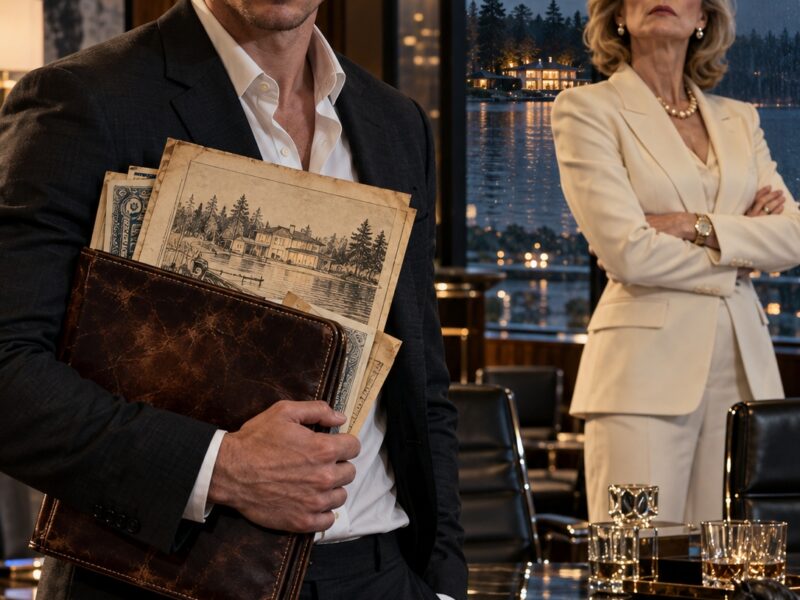
MY MOTHER DISOWNED ME AND GAVE ME A CONDEMNED LAKEHOUSE TO HUMILIATE ME—BUT WHEN I BROKE THROUGH MY GRANDFATHER’S SECRET WALL, I FOUND THE ONE THING THAT COULD DESTROY HER ENTIRE EMPIRE.

The first time I understood that my mother was afraid of me, she was holding a gold pen over two documents that would end her life as she knew it.
Rain struck the forty-second-floor windows behind her, turning Manhattan into a gray blur of glass and headlights. Patricia Hayes had spent thirty years making powerful men lower their voices when she entered a room. She had ruined competitors over lunch, fired executives before breakfast, and once forced a bank president to apologize to her in front of his own board.
But that afternoon, her hand was shaking.
Across the table, my older brother Preston looked worse.
His face had gone pale beneath the expensive haircut and tailored suit. He kept glancing toward the mahogany doors as though federal agents might burst through them at any second.
Maybe they would.
My attorney, Harrison Cole, stood beside me without speaking.
On the glass table between us sat a leather binder thick enough to break a toe if someone dropped it.
Inside were copies of documents my mother had spent most of her adult life believing no longer existed.
Ledgers.
Contracts.
Bank records.
Insurance records.
Photographs.
Transcripts from old microcassettes.
And one handwritten statement from a dead man who had known Patricia Hayes better than anyone alive.
Her father.
My grandfather.
Henry Hayes.
My mother looked at me as if I were a stranger.
“What do you want?”
A year earlier, I would have given anything to hear her ask me that question.
I would have asked for an apology.
For my job back.
For my family back.
For one sentence acknowledging that I had not imagined what they had done to me.
Now I looked at the woman who had given birth to me and realized there was almost nothing left inside me that needed anything from her.
“Everything,” I said.
Her mouth tightened.
Preston whispered my name.
I ignored him.
I pushed the first document across the table.
Then the second.
“You sign,” I said, “and this ends one way.”
My mother stared at the pages.
“And if I don’t?”
I looked toward the rain running down the windows.
“Then it ends another.”
She swallowed.
That was when I remembered another rainy day.
Another table.
Another envelope.
And the moment my mother had looked me in the eye and told me I was dead to her.
Twelve months earlier, I had walked into the Hayes Holdings boardroom believing the truth would save my family.
I was twenty-eight years old.
I still believed things like that.
The evidence had taken me nearly four months to assemble.
At first, the discrepancies were small.
A vendor payment routed twice.
A property-management invoice that didn’t correspond to any property we owned.
Consulting fees paid to an LLC registered in Delaware.
Then I found another.
And another.
I worked in acquisitions and financial analysis for Hayes Holdings, the commercial real estate company my grandfather had founded and my mother now controlled. I had been trained to recognize patterns in numbers.
What I found wasn’t sloppy accounting.
It was theft.
Millions of dollars were being drained through shell companies.
The authorization trail led back to Preston.
My brother.
The golden son.
The future of Hayes Holdings, according to my mother.
I hired a private investigator with my own money because I needed to know whether there was an explanation before I accused my brother of something that could destroy us.
There was an explanation.
It was worse than theft.
Preston had gambling debts.
Large ones.
He had borrowed against company-controlled entities, shifted funds through offshore accounts, and used corporate money to settle debts with people whose names never appeared on legitimate invoices.
My investigator photographed him leaving private poker rooms.
Meeting bookmakers.
Entering hotels with men whose backgrounds would have terrified our lenders.
The final bank statements made the truth impossible to deny.
Or so I thought.
I scheduled a private meeting with my mother.
She invited Preston.
That should have warned me.
The boardroom doors closed behind me at 10:03 on a Monday morning.
Patricia sat at the head of the glass table in a cream suit, her dark hair pulled into the same immaculate knot she wore for investor meetings.
Preston sat to her right.
He wasn’t nervous.
He was smiling.
I placed the documents on the table.
“Before either of you says anything, read them.”
My mother didn’t touch them.
“Tell me what you think they say.”
“They say Preston has stolen at least three-point-seven million dollars from the company in eighteen months.”
Preston laughed softly.
I looked at him.
“You think this is funny?”
“I think you sound dramatic.”
“There’s a federal reporting issue attached to at least two of these accounts.”
Mom’s eyes narrowed.
I continued.
“If the IRS looks closely enough, they’re going to see it. If our lenders see it first, they’ll freeze our credit. If the board discovers we’ve been filing inaccurate disclosures—”
“Enough.”
My mother didn’t raise her voice.
She never needed to.
I stopped.
She finally opened the folder.
She flipped through three pages.
Four.
Five.
Her face revealed nothing.
For one stupid second, relief rushed through me.
I thought she was processing it.
I thought she was going to look at Preston.
I thought she was going to ask him how he could do this to us.
Instead, she closed the folder.
Then she looked at me.
“You’ve always hated him.”
The words were so unexpected I actually glanced toward Preston, wondering if I’d misunderstood.
“What?”
“You heard me.”
“Mom, these are bank records.”
“You’ve resented your brother since you were children.”
I stared at her.
Preston leaned back in his chair.
That smile returned.
“You’re jealous,” Patricia continued. “You always have been.”
I felt something cold move through my stomach.
“I’m trying to keep us out of prison.”
“No. You’re trying to destroy your brother because you cannot tolerate being second.”
I pushed the folder toward her.
“Look at the wire transfers.”
“I have.”
“The accounts belong to him.”
“According to a private investigator you hired to spy on your own family.”
“Because company money was disappearing.”
“You manufactured a scandal.”
I actually laughed.
It came out broken.
“Are you listening to yourself?”
Her expression hardened.
“You hired strangers to follow my son.”
“I’m your son.”
Silence.
It lasted perhaps two seconds.
It felt much longer.
Then Patricia said, “That has never entitled you to sabotage this family.”
Something inside me cracked.
Not loudly.
There are things that break without making a sound.
Preston adjusted his cuff links.
“Maybe you should just take whatever Mom is offering.”
I looked at him.
“What she’s offering?”
Patricia reached beside her chair.
There was a manila envelope waiting there.
Prepared before I entered.
That was the moment I finally understood.
This wasn’t a meeting.
It was an execution.
She slid the envelope across the glass.
“You are terminated from Hayes Holdings effective immediately.”
I didn’t touch it.
“You’re firing me?”
“You will also be removed from the family trust.”
My throat tightened.
She continued as if reading a grocery list.
“The company has paid the remaining month on your apartment lease. Your corporate phone and vehicle privileges terminate today. Your personal belongings will be delivered to you.”
“Mom.”
“Do not call me that right now.”
That hurt more than it should have.
I looked at Preston.
He wouldn’t meet my eyes anymore.
So he had known.
Maybe for hours.
Maybe days.
Maybe longer.
I turned back to Patricia.
“You know he’s stealing.”
Her jaw tightened.
That was all.
A tiny movement.
But I knew my mother.
I had spent twenty-eight years studying the weather of her face.
And suddenly I understood the thing that frightened me more than anything else.
She believed me.
She had always believed me.
She simply chose him anyway.
“Open the envelope,” she said.
I did.
Inside was a deed.
The paper was yellowed around the edges.
I recognized the property immediately.
Henry Hayes’s lakehouse.
My grandfather had owned it in upstate New York, on a remote stretch of woodland not far from Lake Ontario. He had spent summers there when I was young.
After his death, no one maintained it.
A decade of storms, snow and neglect had left the property effectively condemned.
I looked at my mother.
“You’re giving me Grandpa’s cabin?”
“Giving is generous.”
“The county assessed it as unsafe.”
“Then tear it down.”
Preston smiled again.
“Could make a nice campsite.”
I ignored him.
“Why?”
Patricia stood.
“Because despite everything you’ve done, I am not putting you on the street with nothing.”
I almost admired the cruelty of that sentence.
She had stripped away my job, trust, housing, professional references and family.
Then she wanted credit for mercy.
“Consider it your final payout,” she said.
She placed a severance waiver beside the deed.
“Sign that. Take the property. And after today, do not contact us again.”
I looked at her.
She met my eyes without blinking.
“You are dead to me, Declan.”
No one moved.
Outside, New York traffic crawled through the rain far below us.
I signed.
Not because I agreed with her.
Because there are moments when a person becomes too exhausted to keep begging someone to love them.
I took the deed.
And I walked out.
Two weeks later, I was standing ankle-deep in mud, staring at the place where my mother expected me to disappear.
The lakehouse was worse than I remembered.
Much worse.
The roof sagged in the center.
Half the shingles were gone.
Moss had climbed the cedar siding in thick green streaks. The porch leaned toward the ground like a drunk. Two windows were broken, three were boarded, and something had nested inside the chimney.
An old Chevrolet pickup sat half swallowed by weeds near the tree line.
The woods had grown so thick around the property that the lake was barely visible.
I checked my bank account.
$420.17.
That was everything I had.
My phone service had already been disconnected from the family plan.
My professional contacts stopped returning calls within forty-eight hours of my firing.
That part taught me something useful about wealthy families.
When powerful people exile one of their own, everyone assumes the exile must have deserved it.
I carried my duffel bag inside.
The smell hit me first.
Mildew.
Wet wood.
Animal droppings.
Old fabric.
The front door dragged across the warped floor with a scream.
Something small ran behind the kitchen cabinets.
“Great,” I muttered.
My voice echoed.
There was an old canvas chair in the living room.
I sat down.
The fabric released a cloud of dust.
And then, for the first time since the boardroom, I stopped moving.
That was a mistake.
My mother’s words came back immediately.
Parasite.
Jealous.
Dead to me.
I covered my face.
I had spent most of my childhood trying to understand why Preston could make mistakes and remain lovable while I had to be useful to earn a seat at the table.
When Preston wrecked his first car at seventeen, Mom bought him another.
When I got into Cornell, she asked why it wasn’t Harvard.
When Preston dropped out of an MBA program, she said he was “too entrepreneurial for classrooms.”
When I graduated near the top of mine, she told me not to embarrass him by mentioning my ranking at dinner.
I had spent years calling those things differences in personality.
Sitting alone in that ruined house, I finally gave them their correct name.
Cruelty.
That night I slept in a forty-dollar sleeping bag on the living-room floor.
Rain leaked through the ceiling into rusty pots I positioned beneath the worst holes.
At 2:17 a.m., something scratched inside the wall.
At 3:40, the temperature dropped enough that I could see my breath.
I considered leaving.
There was nowhere to go.
That realization should have destroyed me.
Instead, sometime before sunrise, it changed me.
I woke to pale light spilling through a cracked window.
The storm had passed.
Dust floated in the beam.
I stood in the middle of the wreckage and imagined my mother explaining my disappearance to people.
Declan couldn’t handle pressure.
Declan was unstable.
Declan was always jealous of Preston.
Maybe she’d tell them I had moved somewhere quiet.
Maybe she’d pretend to worry.
I looked at the sagging ceiling.
“No.”
The word came out before I consciously decided to say it.
I wasn’t going to disappear.
If Patricia Hayes wanted me buried, she was going to have to watch me climb out.
That morning I drove twenty-seven miles to Oak Haven, a fading little town of brick storefronts, a diner, two gas stations and a hardware store called Sullivan’s Supply.
I spent almost half of what I had left.
Sledgehammer.
Crowbars.
Work gloves.
Respirator.
Contractor bags.
Bleach.
Nails.
A used drill.
The man behind the counter was somewhere in his sixties, broad shouldered, gray beard, flannel shirt.
He looked at my cart.
“You tearing down a house?”
“Trying not to.”
He glanced at my hands.
Office hands.
Soft.
Unscarred.
He looked at the supplies again.
“You know what you’re doing?”
“No.”
He nodded as though that was the answer he’d expected.
“Name’s Sullivan.”
“Declan.”
He pointed toward a shelf.
“Put those screws back. They’re overpriced garbage.”
That was the beginning of the first honest relationship I had had in months.
For three months, I rebuilt the house because rebuilding myself was harder.
I learned roofing from library books.
Foundation repair from construction videos watched over free diner Wi-Fi.
Electrical work from Sullivan, who threatened to break my fingers if I touched the breaker panel without him.
I learned that wet insulation is heavier than it looks.
That raccoons are far less afraid of humans than humans would prefer.
That cedar splinters can penetrate almost any glove.
That exhaustion can be merciful.
My body changed.
I lost fifteen pounds.
My shoulders hardened.
My palms became rough and split.
At night, I fell asleep too tired to replay the boardroom.
Sometimes.
By October, cold came down from Canada and settled over the lake.
I had repaired enough of the roof to stay dry and enough of the windows to keep the wind out, but the master bedroom remained nearly uninhabitable.
It had been my grandfather’s room.
I remembered visiting him there when I was eight or nine.
Henry Hayes had been nothing like Patricia.
He was quiet.
Patient.
He repaired things instead of replacing them.
Once, when I broke an antique fishing reel, I hid it because I was terrified he would tell my mother.
He found me crying behind the boathouse.
“Did you break it on purpose?” he asked.
“No.”
“Then why are you acting like you committed murder?”
“Mom gets mad when things break.”
Grandpa Henry had studied me for a long moment.
Then he said something I wouldn’t understand until years later.
“Your mother confuses control with love.”
I never forgot it.
Now I stood inside his old bedroom with a crowbar in my hands.
Water damage around the stone fireplace had destroyed the paneling.
Everything had to come out before winter.
I tore away the first section.
Mold-blackened insulation dropped onto the floor.
I pulled it out.
Then stopped.
Something was wrong.
I aimed my flashlight into the exposed wall.
The cavity was too deep.
Much too deep.
I tapped the back with the crowbar.
Thud.
Hollow.
I moved to the next stud bay.
Same thing.
Another.
Same.
I stepped backward.
The entire wall beside the fireplace had been built almost three feet into the room.
A false wall.
Why would anyone sacrifice that much space?
I grabbed the sledgehammer.
One strike cracked the plywood.
The second opened a fist-sized hole.
Cold air rushed through it.
Not outdoor air.
Trapped air.
Old air.
I widened the opening.
My flashlight beam entered a narrow hidden chamber.
For several seconds, I simply stared.
There was something on the floor.
A bundle wrapped in yellowed oilcloth.
Beside it sat a heavy iron lockbox secured with an enormous brass padlock.
My heartbeat changed.
I pulled the bundle through the opening.
It landed heavily on the floor.
The rope around it disintegrated beneath my knife.
Inside was a leather ledger.
Under the ledger were stacks of paper secured with old bands.
I lifted one.
United States Treasury bearer bond.
$10,000.
I looked at another.
Same.
Another.
Same.
There were dozens.
My mouth went dry.
But the money wasn’t what frightened me.
Beneath the bonds was a rolled architectural drawing.
I spread it across the floor.
The original blueprint of the lakehouse.
Six red X’s had been drawn across it.
One marked the fireplace.
Five others marked different locations around the property.
I picked up the ledger.
The first page was written in my grandfather’s unmistakable hand.
Sharp.
Precise.
Controlled.
I read the opening sentence.
Then read it again.
“If you are reading this, I am dead.”
My hands began to shake.
I continued.
“And if my daughter Patricia has found this room, God help us all.”
I stopped breathing.
The next lines were worse.
“The money she built her empire on is soaked in blood. I have hidden the evidence and the true fortune where her arrogance will never allow her to look.”
Then came the sentence that changed everything.
“I leave this to the one who rebuilds what she destroyed.”
I sat down on the floor.
Rain whispered against the windows.
For months, I had believed my mother had sent me here because the house was worthless.
Now I looked at the red X’s on the blueprint.
Five remained.
And suddenly I wondered whether my grandfather had been waiting for me long before I knew I needed saving.
I didn’t sleep.
At sunrise, I started digging.
The second X led me to the collapsed boathouse.
I spent three hours waist-deep in mud, tearing apart rotten decking until my crowbar struck concrete.
Inside a hollow cavity was a sealed PVC tube.
It contained a brass key.
And another page from Henry’s records.
This one documented money my mother had quietly moved from company accounts years earlier to cover Preston’s earliest gambling debts.
He had been doing it far longer than I knew.
And she had been protecting him.
The third X was behind an iron grate in the basement.
I found contracts.
Original ones.
The fourth was hidden beneath a false bottom in an old cedar wardrobe in the attic.
Bank numbers.
Swiss accounts.
Transfer instructions.
The fifth gave me cassette tapes.
The sixth nearly destroyed what remained of my understanding of my family.
By the end of the week, my living room looked less like a construction site than an FBI evidence room.
I had found additional bearer bonds.
Nearly $4.5 million in total face value.
Offshore funds my grandfather had moved beyond Patricia’s reach.
Original corporate agreements.
Recorded conversations.
Insurance documents.
And proof that Patricia had not inherited Hayes Holdings in the way she claimed.
She had taken it.
Henry had resisted transferring control.
Patricia had threatened him with fabricated evidence suggesting he had committed tax fraud.
She had manipulated board members.
Altered agreements.
Forced him out.
Then rewritten the story.
All my life, I had heard how Patricia Hayes had saved the family company after her father’s “decline.”
She hadn’t saved it.
She had stolen it.
But there was still the iron lockbox.
The brass key from the boathouse fit.
The lock resisted.
I sprayed lubricant into it.
Twisted.
Nothing.
Again.
Click.
I opened the lid.
Inside was a velvet pouch.
I loosened the cord.
Diamonds caught the work light.
Emeralds.
A Cartier bracelet.
A necklace I recognized from childhood photographs of my grandmother.
My mother had told everyone the collection had been stolen.
There had been an insurance payout.
A very large one.
Under the jewelry was an envelope.
My name was written on it.
DECLAN.
I sat down before opening it.
For some reason, that frightened me more than everything else.
The letter began:
“My dearest Declan.”
I had to stop.
No one in my family had called me “dearest” in years.
I continued.
“I watched you grow up in the shadow of your mother’s cruelty and your brother’s greed.”
My vision blurred.
“I knew they would cast you out the moment you became dangerous to their lies.”
I pressed my thumb against the paper.
Grandpa had known.
All those years when I thought no one noticed.
Someone had.
“I left you this property because Patricia would never understand its value. She sees only appearances. If something looks broken, she believes it is worthless.”
I laughed once through tears.
That sounded exactly like him.
Then came the final lines.
“She thinks this house is a tomb.
I am giving you a kingdom.
Rebuild the house.
Rebuild yourself.
And when you are ready, take back what belongs to us.”
I cried then.
Not because I had millions.
Not because I could destroy Patricia.
I cried because a dead man had reached across decades and told me something I had needed to hear my entire life.
I wasn’t crazy.
I wasn’t jealous.
I wasn’t weak.
I had simply grown up in a family where telling the truth made me dangerous.
For the first few weeks after discovering Henry’s cache, I told almost no one.
Not even Sullivan knew everything.
I hired an attorney in Syracuse through an intermediary.
He referred me to a forensic accountant.
The accountant referred me to Harrison Cole.
Harrison was the kind of corporate litigator whose silence cost more per hour than most people’s speech.
He came to the lakehouse on a freezing December morning.
He removed his coat.
Looked at the evidence covering my dining table.
Then looked at me.
“Where did you get this?”
“Inside the house.”
“All of it?”
“Mostly.”
He picked up one contract with gloved fingers.
“Does your mother know?”
“No.”
“Your brother?”
“No.”
“Anyone at Hayes Holdings?”
“No.”
Harrison slowly sat down.
“Good.”
That was the first time revenge stopped feeling like an emotion and became a strategy.
Harrison refused to let me confront them.
“Angry men reveal evidence,” he told me. “Patient men decide when evidence becomes valuable.”
So I waited.
I restored the house.
Sullivan became my lead contractor when I finally had enough money to pay him properly.
He stared at the first check.
“This legal?”
“Yes.”
“Mostly legal?”
“Yes.”
He squinted at me.
“Rich uncle die?”
“Something like that.”
He handed the check back.
“You overpaid me.”
“No.”
“Yes.”
“You carried me on credit when I had forty dollars.”
“You paid it back.”
“Then consider this interest.”
Sullivan looked at me for a long time.
Then folded the check.
“Fine. But I’m still charging you wholesale for lumber.”
The lakehouse changed month by month.
New cedar siding.
A reinforced roof.
Restored oak floors.
Insulation.
Plumbing.
A kitchen where there had once been rot and mouse nests.
Floor-to-ceiling windows facing the lake.
I preserved the fireplace.
And I preserved part of the false wall.
Not because I needed it.
Because I wanted to remember.
The money changed things, but not in the way I expected.
I didn’t buy a Ferrari.
I bought tools.
Land adjoining the property.
Professional advice.
Time.
Most importantly, leverage.
Through shell companies Harrison established legally, we began acquiring distressed debt connected to Hayes Holdings.
Because while I was rebuilding, Preston was still stealing.
And the empire was beginning to crack.
The IRS noticed discrepancies.
Then lenders did.
Then auditors.
Credit lines tightened.
Subpoenas appeared.
Preston started moving money faster, which only created more evidence.
Patricia tried to plug every hole.
But you cannot save a sinking ship by drilling new holes to release the water.
Almost one year after she disowned me, Hayes Holdings entered the worst crisis in its history.
That was when Harrison called.
“They’re vulnerable.”
I was standing on the lakehouse deck.
Snow had melted from the shoreline.
“What does vulnerable mean?”
“Their primary tower debt is trading.”
I understood immediately.
“How much?”
He told me.
I looked across the water.
“Buy it.”
There was silence.
“All of it?”
“As much as they’ll sell.”
“Declan.”
“Yes?”
“This is the moment when I am professionally obligated to ask whether you’re making an emotional decision.”
I thought about the envelope sliding across the boardroom table.
I thought about sleeping beneath a leaking roof.
I thought about Henry’s letter.
“No,” I said. “I made the emotional decision a year ago.”
“What are you making now?”
“A business decision.”
Three weeks later, I owned enough debt to control the building where my mother had told me I no longer belonged.
I returned to Manhattan on another rainy afternoon.
The city looked smaller than I remembered.
Maybe cities don’t change.
Maybe people do.
I wore a charcoal suit Harrison had insisted I buy.
“You cannot walk into a restructuring meeting dressed like a lumberjack.”
“I own a tie.”
“You own something that once aspired to be a tie.”
So I let him choose the suit.
But I wore my grandfather’s watch.
The receptionist at Hayes Holdings recognized me.
Her eyes widened.
“Mr. Hayes.”
“Hi, Amanda.”
“I—your mother is in a meeting.”
“I know.”
“Should I call—”
“No.”
Harrison walked beside me.
Nobody stopped us.
When I reached the mahogany doors, I remembered standing outside them twelve months earlier with a folder of evidence and the naive belief that truth automatically mattered.
Then I opened them.
Preston dropped his phone.
Patricia stared.
For a moment, nobody spoke.
I almost didn’t recognize my brother.
He had lost weight.
His face was gray.
His expensive suit hung from him.
My mother looked older too.
Not fragile.
Patricia Hayes would never allow herself fragility.
But exhausted.
There were legal documents spread across the table.
Red notices.
Bank correspondence.
Emergency financing proposals.
Exactly what Harrison had predicted.
Patricia recovered first.
“What are you doing here?”
I walked into the room.
“Good to see you too.”
Her eyes moved to Harrison.
Recognition changed her face.
“Why is Harrison Cole with you?”
“Because he represents me.”
Preston laughed nervously.
“Represents you in what?”
I looked around.
“The room seems smaller.”
Patricia stood.
“Get out.”
I kept walking.
“Security!”
“I wouldn’t.”
Her eyes flashed.
“You are trespassing.”
“No.”
“This is private property.”
“Technically, the building belongs to an entity whose majority debt was acquired at nine this morning.”
Silence.
Patricia stared at me.
I let her understand it.
Then I said, “My entity.”
Preston’s mouth opened.
Mom shook her head.
“No.”
“Yes.”
“You don’t have that kind of money.”
I smiled.
“You’re right.”
Something flickered behind her eyes.
“You were living in that condemned shack.”
“Grandpa Henry’s shack.”
Her face changed.
Only slightly.
But Harrison saw it too.
Fear.
Real fear.
I reached the table.
“You should have checked the architectural plans before giving me the deed.”
Patricia stopped breathing.
Preston looked between us.
“What does that mean?”
Neither of us answered him.
I continued.
“Or maybe you should have asked yourself why your father refused to let anyone renovate that property while he was alive.”
“Declan.”
My mother said my name differently now.
Not angrily.
Carefully.
“What did you find?”
There it was.
The first honest question she had asked me in years.
Harrison placed the leather binder on the table.
Thud.
Patricia flinched.
“What is that?”
I put my hand on the cover.
“The history of Hayes Holdings.”
“We have corporate archives.”
“Not this history.”
I opened it.
Henry’s handwriting appeared on the first page.
My mother’s knees seemed to weaken.
Preston leaned closer.
“Is that Grandpa’s?”
I turned another page.
Original contracts.
Another.
Bank records.
Another.
Insurance documents.
Then transcripts.
My mother closed the binder.
Hard.
“These are fake.”
Harrison finally spoke.
“No.”
She looked at him.
His voice remained almost bored.
“Two forensic handwriting experts have authenticated the original documents. Financial records have been cross-referenced against surviving institutional archives. Audio has been professionally restored and verified.”
Patricia’s eyes snapped toward me.
“You gave him the originals?”
“I gave him access.”
“You stupid little—”
“Careful.”
She stopped.
I had never interrupted her like that.
Not once.
I leaned toward her.
“That’s the mistake you keep making.”
Her breathing quickened.
“You still think I’m the boy you can frighten into apologizing.”
Preston opened the binder again.
He read.
His expression changed.
“Mom.”
She ignored him.
He turned another page.
“Mom.”
“What?”
His voice cracked.
“The jewelry.”
Patricia went still.
“What jewelry?”
“Grandma’s Cartier collection.”
He looked at her.
“You said it was stolen.”
She said nothing.
Preston read the insurance documentation.
Then the photographs of the collection inside Henry’s lockbox.
His eyes widened.
“You collected insurance money?”
“Shut up.”
“You told me Grandpa accused you because he was senile.”
“Preston.”
“You said you built this company.”
“I said shut up!”
Her scream filled the room.
For a moment, even the rain seemed quieter.
And there it was.
The thing Preston and I had spent our lives pretending wasn’t true.
Our mother didn’t love winners.
She loved control.
Preston had merely been easier to control because praise worked on him.
Fear had worked on me.
Until it didn’t.
Patricia turned toward me.
“You have no idea what your grandfather was.”
“Actually, he left quite detailed notes.”
“He was vindictive.”
“Maybe.”
“He hated me.”
“Maybe.”
“He would have destroyed this company.”
I looked around the boardroom.
“Interesting argument, considering its current condition.”
Preston sank into a chair.
Patricia pointed at me.
“You think you can walk in here with old papers and take what I built?”
“No.”
I waited.
Then added, “I walked in here with old papers, nearly five million dollars in hidden assets, ownership leverage over this building, evidence already reviewed by counsel, and enough documentation to make several federal agencies extremely curious.”
Her face drained.
Harrison adjusted his glasses.
“A redacted package has already been transmitted to appropriate counsel for preservation.”
Patricia stared at him.
“Federal agencies?”
He didn’t answer directly.
He didn’t need to.
She looked back at me.
“What have you done?”
The strange thing was, I felt no triumph.
I had imagined this moment hundreds of times while tearing out rotten drywall.
In those fantasies, I shouted.
I accused.
I made her understand every night I had spent freezing because of her.
But standing there, I felt tired.
“You asked me once why I was trying to destroy this family.”
She said nothing.
“I wasn’t.”
I tapped Henry’s ledger.
“I was trying to save it.”
Her mouth twisted.
“From your brother?”
“From what you allowed him to become.”
Preston stood.
“Don’t put this all on me.”
I looked at him.
“I’m not.”
He swallowed.
“You think you’re better than us?”
“No.”
“Then why are you doing this?”
“Because somebody has to stop pretending consequences are cruelty.”
His face collapsed.
For the first time, I saw my brother not as the golden child but as a forty-story building with no foundation.
Our mother had protected him from every fall.
So he had never learned gravity existed.
“Declan,” he whispered, “I’m your brother.”
A year earlier, those words might have destroyed me.
Now they merely made me sad.
“You were my brother when I walked into this room with evidence that could have saved the company.”
He looked away.
“You were my brother when she fired me.”
Silence.
“You were my brother when she told me I was dead.”
His eyes filled.
“You said nothing.”
“I was scared.”
“So was I.”
“I didn’t know she’d actually—”
“You smiled.”
That stopped him.
He remembered.
So did I.
“Take the envelope, little brother.”
His own words.
He lowered his head.
Patricia’s voice became quiet.
“What do you want?”
And that brought us back to the moment I had imagined for a year.
I removed two documents from my portfolio.
“Everything.”
I slid the first toward her.
“A full relinquishment of your controlling interest in Hayes Holdings.”
She stared at me.
“You’re insane.”
“Possibly.”
“You expect me to give you my company?”
“Grandpa would dispute the word ‘my.’”
Her nostrils flared.
I slid the second document forward.
“And this is a sworn disclosure regarding Preston’s embezzlement and your knowledge of it.”
Preston stepped forward.
“Wait.”
I ignored him.
“You both resign from all corporate positions.”
Patricia laughed.
It sounded brittle.
“And if I refuse?”
I looked at Harrison.
He opened his briefcase.
There were three sealed evidence packets inside.
Patricia understood.
“Insurance fraud,” I said. “Extortion. Forged amendments. The recordings.”
Her eyes fixed on the envelopes.
“You wouldn’t.”
“That’s what you said about me surviving the lakehouse.”
“Declan, I am your mother.”
I almost smiled.
“No.”
The word came softly.
“You’re the woman who gave birth to me.”
She recoiled.
“There is a difference.”
For the first time, Patricia Hayes looked wounded.
I hated that some part of me still noticed.
I hated even more that some tiny, buried piece of the boy I had been wanted to comfort her.
I didn’t.
“If you sign, Harrison keeps the additional historical evidence in privileged custody unless legally compelled otherwise. You still answer for whatever investigators independently establish regarding Preston’s current fraud. I am not obstructing an investigation for you.”
Her eyes narrowed.
“Then this offer gives me nothing.”
“It gives you one thing.”
“What?”
“A chance to stop making it worse.”
She stared at me.
Then at the documents.
Then at Preston.
He was crying now.
Not elegantly.
Not quietly.
He dropped into a chair and covered his face.
“Mom.”
She didn’t look at him.
That was when I finally understood something about her.
Even at the end, she wasn’t thinking about her son.
Either son.
She was calculating.
Assets.
Exposure.
Years.
Risk.
Control.
Always control.
Her hand moved toward the gold Montblanc pen beside her.
Then stopped.
“You planned this.”
“No.”
She looked up.
“My grandfather planned part of it.”
“And the rest?”
I thought about Sullivan.
The freezing nights.
The bleeding knuckles.
The library books.
The rotten roof.
The first wall I repaired badly and had to tear apart and repair again.
“I rebuilt it.”
Her eyes filled with something I had never seen there before.
Not love.
Not remorse.
Recognition.
Perhaps for the first time in her life, Patricia Hayes saw me clearly.
And she realized she had created the man sitting across from her.
Not by loving him.
By forcing him to survive her.
She signed the first document.
The pen scratched across the paper.
She signed the second.
Then she put the pen down.
Nobody spoke.
Harrison collected the documents.
Preston stared at me.
“What happens to me?”
I looked at him.
“I don’t know.”
“You’re the owner now.”
“That’s not what I mean.”
His lower lip trembled.
“Are you going to help me?”
There are questions whose answers reveal who you have become.
For a second, I saw him at ten years old.
Me at six.
He had fallen through thin ice near Grandpa’s boathouse.
I had crawled onto my stomach and grabbed his coat while Henry pulled both of us back.
Preston had hugged me afterward.
Before competition.
Before money.
Before our mother’s approval became the currency we fought over.
I remembered that boy.
I couldn’t find him in the man before me.
“I’ll pay for treatment,” I said.
He blinked.
“Treatment?”
“For the gambling.”
Hope appeared.
“And the charges?”
“No.”
It disappeared.
“You’ll face whatever you have to face.”
“Declan—”
“I’ll help you get well.”
I looked him directly in the eyes.
“But I will never help you escape consequences again.”
He started crying harder.
Patricia looked at me with disgust.
“You always were weak.”
I turned toward her.
“No.”
I nodded toward Preston.
“This is the first time anyone in this family has loved him enough to stop saving him.”
She had no answer.
I left the boardroom.
Harrison followed.
At the elevators, he asked, “How do you feel?”
I considered lying.
Instead I said, “Nothing.”
“That will change.”
“Is that legal advice?”
“No.”
The elevator doors opened.
“Unfortunately, it’s human advice.”
An hour later, I was driving north.
I could have stayed in Manhattan.
There were meetings waiting.
Board votes.
Restructuring.
Press releases.
Lawyers.
Employees frightened about their jobs.
The company still needed saving, and revenge was not a business plan.
I knew that.
But not that day.
That day I needed the lake.
Traffic thinned.
Buildings became warehouses.
Warehouses became suburbs.
Suburbs became fields.
Then trees.
By late afternoon, I cracked the truck window.
Cold air filled the cab.
For twenty-eight years, I had thought freedom would feel dramatic.
It didn’t.
It felt quiet.
That surprised me.
I stopped once at Sullivan’s.
He was behind the counter.
He looked at the suit.
Then at me.
“Funeral?”
“Something like that.”
“Yours?”
“No.”
He nodded.
“Coffee?”
“Please.”
He poured two cups from a pot that had probably violated several health codes.
We stood beside the register.
He didn’t ask what happened.
That was another thing I loved about Sullivan.
People who genuinely care about you don’t always demand access to your pain.
Sometimes they just give you coffee.
After a while, he said, “House looks good.”
“Yeah.”
“Still got work.”
“Always.”
He nodded.
“That’s houses.”
I smiled.
“People too.”
“Didn’t say people.”
“You implied it.”
“I absolutely did not.”
For the first time that day, I laughed.
Then I drove home.
Home.
I hadn’t realized when the word changed.
The sun was setting when I turned onto the gravel road.
The lake appeared through the trees, bright gold beneath the lowering sky.
And there stood the house.
Not a mansion.
Not a monument.
A home.
Cedar siding glowed amber in the evening light.
The roofline was straight.
Smoke curled from the chimney.
The porch no longer leaned.
I parked beside the old Chevrolet I still hadn’t bothered to remove.
Some ruins deserve to remain.
They remind you what survival looked like before it became beautiful.
I climbed the steps.
Solid wood beneath my boots.
Inside, the house was warm.
Quiet.
I removed my grandfather’s watch and placed it on the kitchen counter.
Then I walked into the master bedroom.
The fireplace was restored.
Beside it, behind a removable cedar panel, I had preserved a small section of the hidden chamber.
The bonds were gone.
The documents were secured elsewhere.
But Henry’s original letter remained.
I took it out.
I read the last lines again.
“Rebuild this house.
Rebuild yourself.”
For months, I had thought the second sentence was a metaphor.
Now I understood it wasn’t.
A house doesn’t become strong because someone paints over rot.
You have to expose the damage.
Tear things open.
Remove what cannot be saved.
Brace what remains.
Replace what failed.
Sometimes the process makes the structure look worse before it gets better.
People are not so different.
I folded the letter.
Outside, darkness settled over the lake.
My phone vibrated.
A message from Harrison.
Documents executed.
Board notified.
Emergency vote tomorrow, 9:00 a.m.
Then another message arrived.
This one from an unknown number.
For one irrational second, I thought it might be Preston.
It wasn’t.
It was my mother.
Only six words.
I hope you’re happy now, Declan.
I stared at them.
A year earlier, I would have written paragraphs.
I would have explained myself.
Defended myself.
Begged her to understand.
Instead, I typed three words.
I am learning.
I didn’t send them.
I deleted the message entirely.
Then I blocked her number.
Not out of hatred.
Hatred still gives someone a room inside you.
I simply didn’t want to live in that room anymore.
I walked onto the deck.
The night was cold enough that my breath showed.
Across the water, the last strip of sunset burned orange beneath the clouds.
For the first time, I allowed myself to wonder what Henry had truly intended.
Had he known Patricia would eventually give me the house?
Had he arranged the deed so she could?
Had he predicted that her contempt would become the mechanism of her own undoing?
Or had he simply hidden the truth and hoped that someday one decent person would be stubborn enough to look behind a broken wall?
I would never know.
Maybe that was better.
Because the greatest thing my grandfather left me wasn’t four and a half million dollars.
It wasn’t the jewelry.
It wasn’t Hayes Holdings.
It wasn’t even the evidence.
It was a ruined house no one else wanted.
A place where I had been forced to discover what remained when my job, my money, my status and my family’s approval disappeared.
At first, I thought the answer was nothing.
Then I learned how to repair a roof.
How to lift a foundation.
How to survive winter.
How to accept kindness without suspecting a transaction.
How to recognize manipulation.
How to stop confusing forgiveness with surrender.
How to love someone without rescuing them from every consequence.
And, eventually, how to stop measuring my worth by whether Patricia Hayes could see it.
The following morning, I would drive back to Manhattan.
I would enter the same tower that had once thrown me out.
I would sit at the head of the same glass table where my mother had called me a parasite.
But I would not run Hayes Holdings the way she had.
The company would be audited completely.
Dirty contracts would be terminated.
Employees who had protected Preston’s schemes would answer for their choices.
People who had simply been afraid would get a chance to tell the truth.
The Hayes name might survive.
It might not.
For once, I didn’t care about the name.
Names are strange things.
Families use them like chains.
Companies use them like monuments.
But a name means nothing if you have to destroy yourself to deserve it.
Behind me, the lakehouse settled with a soft wooden creak.
Once, that sound had terrified me.
Now it sounded almost alive.
I looked back through the glass doors.
Warm light filled the rooms where rain had once fallen through the ceiling.
The wall where I found Henry’s secret looked ordinary again.
Nobody visiting would ever know that it had once held a fortune.
That seemed appropriate.
The most valuable things are often hidden behind what everyone else has already decided is worthless.
My mother looked at that house and saw rot.
She looked at my grandfather and saw an obstacle.
She looked at Preston and saw an heir she could protect forever.
She looked at me and saw the son she could discard without consequence.
She was wrong four times.
And in the end, that was what destroyed her.
Not me.
Not Henry.
Not the binder.
Not the IRS.
Her certainty.
I stayed on the deck until the last light disappeared.
Then I went inside and closed the door.
For twenty-eight years, I had wanted my mother to choose me.
That night, standing inside the house she had given me as an insult, I finally understood the choice had never belonged to her.
It belonged to me.
And for the first time in my life—
I chose myself.









