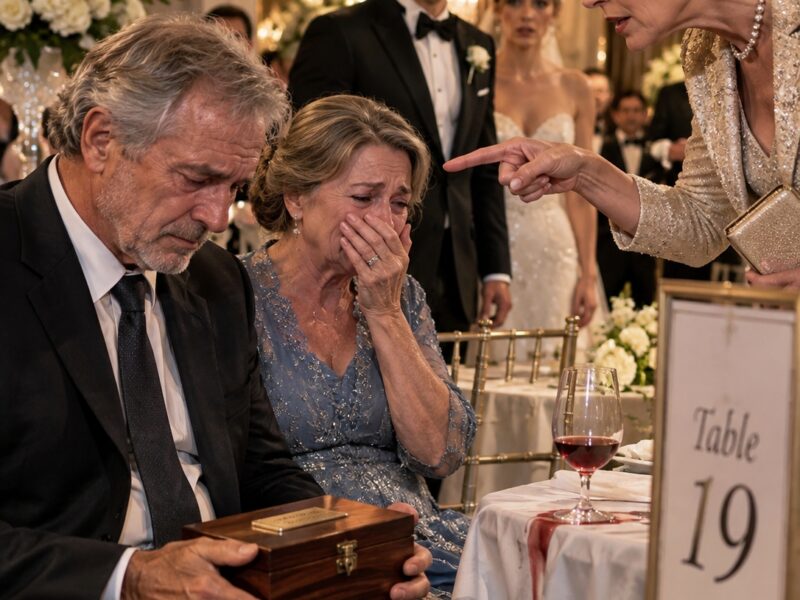
MY MOTHER-IN-LAW SEATED MY PARENTS BY THE KITCHEN BECAUSE SHE THOUGHT THEY WERE POOR—THEN THE HOTEL MANAGER TOOK THE MICROPHONE
My mother-in-law looked my father up and down at my wedding reception, pointed toward the kitchen doors, and said five words I would never forget.
“Where people like you belong.”
Dad didn’t argue.
He didn’t tell her who he was.
He simply picked up the small wooden wedding gift he had made with his own hands, took my mother’s arm, and walked toward Table 19.
That was the moment I almost broke my promise.
Because Diane Whitfield had no idea the “poor farmer” she was humiliating in front of three hundred guests owned the hotel she was standing in.
And my father had made me swear not to tell her.
Three months earlier, I had driven home to my parents’ place outside Lexington, Kentucky, with an engagement ring receipt folded in my wallet and a secret sitting so heavily in my chest that I barely tasted dinner.
My name is Ethan Brooks.
I was thirty-one years old, an architect, and I had spent most of my adult life trying to build a career without using my last name as a shortcut.
That wasn’t easy.
The Brooks name meant nothing to most people.
But Brookstone did.
Brookstone Hotels had started thirty-five years earlier as a twenty-eight-room roadside motel my father built with borrowed money, secondhand tools, and the kind of stubbornness that makes reasonable people nervous.
By the time I was born, there were four properties.
By the time I graduated high school, there were seventeen.
Now there were luxury hotels, resorts, conference properties, and boutique developments across the country.
My father, Harold Brooks, was the founder and chairman.
Almost nobody knew what he looked like.
Dad hated interviews. He refused magazine covers. He attended openings through side entrances and sometimes spent hours talking to maintenance workers before executives even realized he was in the building.
He still drove a twenty-six-year-old Ford pickup.
My mother, Martha, still planted tomatoes behind the house.
And when people asked Dad what he did, his answer was always the same.
“Bit of construction. Fixing things, mostly.”
Technically, it wasn’t a lie.
That evening, he was sitting at our old oak kitchen table when I told them.
“I asked Chloe.”
Mom froze with a serving spoon halfway between the casserole dish and her plate.
Dad looked over his reading glasses.
“And?”
“She said yes.”
Mom screamed.
Actually screamed.
Then she came around the table so quickly her chair nearly tipped over.
“Oh, honey.”
She wrapped both arms around me.
“About time.”
Dad stood more slowly.
He wasn’t a man who showed emotion easily. He shook my hand first, because that was his way.
Then he pulled me into a hug.
“Good choice,” he said quietly.
“You barely know her.”
“I know the way you talk about her.”
Mom immediately wanted details.
When had I proposed?
Where?
Had Chloe cried?
Had I cried?
Was there a photographer?
What kind of ring?
Dad sat back down and watched me with a small smile.
He knew there was something else.
He always did.
Finally, I said, “There’s one thing.”
Mom stopped asking questions.
“Her mother wants to meet you.”
Dad nodded.
“Reasonable.”
“At their country club.”
The silence changed.
Not dramatically.
Just enough.
Mom returned to her chair.
Dad folded his napkin once.
I rubbed my thumb along the edge of the table.
“Dad, Diane cares a lot about appearances.”
“So do most people.”
“No. I mean really cares.”
He waited.
I had been dating Chloe Whitfield for almost two years. I loved her because she could spend Saturday morning volunteering at an animal shelter and Saturday night attending a charity gala without becoming a different person between the two.
But her mother was different.
Diane Whitfield categorized people almost immediately.
Clothes.
Cars.
Schools.
Addresses.
Jobs.
Family names.
She had an invisible filing cabinet inside her head, and everyone she met was placed somewhere before the first conversation ended.
Useful.
Impressive.
Acceptable.
Embarrassing.
I had never told her about Brookstone.
Neither had Chloe.
At first, there had been no reason.
Later, there had been too much reason.
I looked at Dad.
“Maybe this time we just tell them.”
Mom’s eyes moved toward him.
“About the company,” I added.
Dad leaned back.
“Why?”
“Because I’m marrying their daughter.”
“And?”
“And Diane is going to make assumptions.”
“She already has.”
I stared at him.
Dad smiled faintly.
“Son, people always make assumptions.”
“She might insult you.”
“Wouldn’t be the first person.”
“This is different.”
“How?”
“Because she’ll be family.”
Dad’s smile disappeared.
That landed exactly where I knew it would.
For a moment, he said nothing.
Then he looked down at his hands.
They were large hands. Scarred knuckles. Thick fingers. A pale line near his left thumb from a roofing accident before I was born.
Hands that had signed contracts worth hundreds of millions of dollars.
Hands that still fixed broken fence posts himself.
“Ethan,” he finally said, “we’ve never lied about who we are.”
“I know.”
“We just don’t lead with what we have.”
I exhaled.
“If they’re good people,” he continued, “it won’t matter.”
“And if they’re not?”
Dad met my eyes.
“Better we find out before the wedding.”
Mom glanced at him.
“Harold.”
“What?”
“They’re already engaged.”
He shrugged.
“Still cheaper than finding out after.”
I laughed despite myself.
Mom didn’t.
Neither did I for long.
Dad leaned forward.
“Not a word about Brookstone.”
“Dad.”
“Promise me.”
I hesitated.
Then I said, “I promise.”
At the time, I thought he was protecting himself from being treated differently because of money.
I didn’t understand yet that he was protecting me.
The country club sat on two hundred acres of clipped grass and old money.
Chloe met us near the entrance.
She looked beautiful and nervous.
That should have warned me.
She hugged Mom warmly.
Then Dad.
“You made it.”
“Wouldn’t miss it,” Dad said.
Her eyes moved toward the parking lot.
Dad’s Ford sat between a Mercedes SUV and a new Range Rover.
There was a faint patch of rust near the rear wheel.
Chloe smiled.
Then her mother appeared.
Diane Whitfield was elegant in the way some people turn elegance into armor.
Cream suit.
Pearls.
Perfect blond hair.
A smile designed to be seen across a ballroom.
She hugged Chloe, kissed my cheek, greeted Mom, then looked past us.
Her eyes landed on the truck.
“Is that… yours?”
Dad followed her gaze.
“Yes, ma’am.”
Diane blinked.
Dad smiled proudly.
“Twenty-six years, and she still runs like a dream.”
“How… charming.”
That was the first cut.
Small enough to deny.
Sharp enough to feel.
Mom touched Dad’s arm.
He didn’t react.
Inside, we met Chloe’s father, Richard Whitfield.
Richard was easier to like than Diane.
He owned a commercial development company and had built a successful business, although Chloe once admitted that the last few years had been difficult.
Richard shook Dad’s hand.
“Harold. Good to finally meet you.”
“You too.”
Lunch began politely.
For almost four minutes.
Then Diane started talking about the wedding.
“We’ve booked the Ashford Grand.”
Mom’s eyebrows rose.
“That’s lovely.”
“Lovely?” Diane smiled. “It’s nearly impossible.”
I looked down at my water.
The Ashford Grand was Brookstone’s flagship property in Kentucky.
Dad had personally supervised its restoration.
Diane continued.
“Two-year waiting list.”
Richard grinned.
“I know people.”
Dad took a sip of iced tea.
“I hear the owner started with nothing.”
Diane gave a short laugh.
“Well, people who start with nothing usually end with nothing.”
My fork stopped.
Chloe whispered, “Mom.”
“What? I’m complimenting ambition.”
Dad’s expression didn’t change.
Richard tried to redirect the conversation.
“So, Harold. What is it you do?”
Dad wiped his mouth with his napkin.
“Bit of construction.”
“What kind?”
“Fixing things, mostly.”
Richard nodded.
“Contractor?”
“Something like that.”
Diane tilted her head.
“Brooks.”
“Yes, ma’am.”
“Not like Brookstone, I suppose?”
I nearly choked on my water.
Dad looked at her.
Then he looked down at his work shirt.
“Do I look like a hotel man to you?”
Diane laughed.
“Of course not.”
Chloe’s hand found mine beneath the table.
She squeezed hard.
Dad saw it.
So did Mom.
Richard leaned forward.
“Funny you mention Brookstone. Nobody has even seen the man.”
“The man?”
“Founder. Harold Brooks.”
Dad raised an eyebrow.
“Is that right?”
“No photos. No interviews. Nothing.”
“Maybe he’s shy.”
Richard laughed.
“Maybe.”
Then his expression became serious.
“But I finally have a meeting with him.”
Dad’s eyes sharpened.
“When?”
“The week after the wedding. Took me two years.”
“With Brooks?”
“With his office. But supposedly the man himself will be there.”
Richard leaned closer.
“If we land that contract, we’re set for ten years.”
Dad nodded slowly.
“Then I hope he’s a fair man.”
“So do I.”
Diane had already moved on.
She was listing wedding guests.
The Hendersons.
A hospital board chairman.
A judge.
A retired governor.
The senator’s wife.
Then she said something that made the entire lunch suddenly make sense.
“So at the wedding, let’s keep things polished.”
Chloe stiffened.
“Mom.”
“What?”
“Ethan’s parents are sitting with us.”
Diane smiled at Mom.
“Of course.”
But it was the kind of “of course” that meant absolutely not.
That night, Chloe and I argued for the first time about our wedding.
“Tell her,” I said.
She stood at my apartment window.
“I will.”
“When?”
“I don’t know.”
“Chloe.”
She turned.
“You don’t understand her.”
“No. I understand her perfectly.”
“She’s not evil.”
“I didn’t say she was.”
“She spent my whole life telling me that one mistake could change how people see you.”
“That sounds exhausting.”
“It is.”
“Then stop living that way.”
Her eyes filled.
“You make it sound easy.”
“It isn’t.”
I walked toward her.
“But we’re about to be married. At some point, you have to decide whether your mother’s approval matters more than your own judgment.”
“That’s not fair.”
“Neither is letting her treat my parents like they’re beneath her.”
Chloe looked away.
I immediately regretted how hard I had said it.
But I didn’t take it back.
Because underneath everything else, I was scared.
Not of Diane.
Of Chloe’s silence.
Dad understood that before I did.
When I told him about the argument, we were in his workshop.
He was sanding a piece of walnut.
“She’s not cruel,” he said.
“You barely know her.”
“I mean Chloe.”
I leaned against the workbench.
“She’s afraid of her mother.”
Dad ran his thumb over the wood.
“Then we’ll see which is stronger.”
“What?”
“Her fear.”
He looked at me.
“Or her heart.”
The wedding planning continued.
And Diane’s behavior became worse.
She never insulted my parents in a way dramatic enough for Chloe to confront directly.
Instead, she erased them one detail at a time.
Mom’s name disappeared from a luncheon invitation.
Dad was excluded from a planning dinner.
A family photograph schedule somehow placed my parents in a separate time slot.
Then, three days before the wedding, Dad received a phone call from Daniel Price, general manager of the Ashford Grand.
Daniel had worked for Brookstone for nineteen years.
“Sir,” he said carefully, “the Whitfield wedding you asked me to fit in…”
Dad waited.
“They’ve put you at Table 19.”
“Where’s that?”
“By the kitchen.”
Silence.
Daniel continued.
“They also removed your toast from the program.”
Dad’s hand tightened around the phone.
“Why?”
“Mrs. Whitfield says the senator’s wife needs the time.”
Dad closed his eyes.
Daniel hesitated.
“There’s more.”
“What?”
“The event planner said Mrs. Whitfield specifically requested that your table be outside the main photography angles.”
Dad looked through the workshop window.
Mom was in the garden.
“And what did the planner say?”
“She said, ‘Nobody photographs that corner.’”
Daniel waited.
“Would you like me to change it?”
Dad could have changed everything with one sentence.
Instead, he said, “Leave it.”
“Sir?”
“Table 19.”
“Mr. Brooks—”
“Leave it, Daniel.”
Another pause.
“And don’t tell anyone who I am.”
“Yes, sir.”
“Not until I say so.”
Dad hung up.
He never told me about the call.
I learned about it much later.
On the morning of my wedding, he stood in front of his bedroom mirror tying a plain navy tie while Mom adjusted his collar.
“You sure about this?” she asked.
He looked at her reflection.
“No.”
“That’s reassuring.”
He smiled.
“It’s Ethan’s day.”
“And if Diane humiliates us?”
“She can only humiliate us if we borrow her opinion of us.”
Mom stared at him.
“You practiced that.”
“A little.”
She laughed.
Then she kissed his cheek.
At the Ashford Grand, Diane Whitfield saw my parents arriving through the main entrance and immediately stepped toward them.
“Deliveries are around the side—”
Then she recognized Dad.
“Oh.”
Dad smiled.
“Good afternoon, Diane.”
Her face recovered instantly.
“You look… nice.”
“So do you.”
Mom squeezed his hand.
A coordinator approached.
Diane didn’t even lower her voice.
“Table 19.”
The coordinator blinked.
“Mrs. Whitfield?”
“Mr. and Mrs. Brooks. Table 19.”
Then she walked away.
My parents stood beneath a chandelier Dad had chosen twelve years earlier.
Neither said a word.
The ceremony itself was beautiful.
When Chloe appeared at the end of the aisle, everything else disappeared.
For a few minutes, there was no Brookstone.
No Diane.
No money.
No Table 19.
Just Chloe.
She reached me.
Her hands were trembling.
Mine were worse.
When it was time for vows, she looked directly into my eyes.
“I promise to stand by you,” she said, “in every room, in front of everyone.”
Something inside me tightened.
“And I promise to always see you. Not what you have. Just you.”
Dad heard those words from the front row.
So did Diane.
One of them believed Chloe meant them.
The other was about to find out.
After the ceremony, guests moved into the ballroom.
A young server checked my parents’ place card.
“This way.”
They followed him.
Past the center tables.
Past the floral installations.
Past the dance floor.
Past the bar.
Mom slowed.
“Are you sure?”
The server looked embarrassed.
“Yes, ma’am.”
They kept walking.
The sound of the ballroom changed near the back.
Music softened beneath the metallic rhythm of kitchen doors opening and closing.
Plates clattered.
Servers rushed through carrying trays.
Then they reached Table 19.
Mom stared at it.
“By the kitchen?”
Before the server could answer, Diane appeared behind them.
“Is there a problem?”
Dad turned.
“No.”
Mom did.
“We were told immediate family would be near the front.”
Diane smiled.
“Seating is complicated.”
“There are empty seats near Ethan.”
“They’re reserved.”
“For whom?”
Diane’s smile disappeared.
Then came the sentence.
The sentence I would remember years later.
“Table 19 is perfectly appropriate.”
She looked at Dad’s old suit.
At Mom’s simple dress.
At the handmade wooden box Dad was carrying.
Then she said quietly:
“Where people like you belong.”
Dad looked at her for a long moment.
Mom’s face went pale.
But Dad simply pulled out her chair.
“Come on, love.”
They sat.
The kitchen doors swung open behind them.
A waiter rushed past.
Mom whispered, “Harold.”
“I know.”
“It’s not the table.”
“I know.”
“It’s what she meant.”
Dad reached across and held her hand.
“I know.”
Then a server bumped the edge of their table.
A glass of red wine tipped.
It spilled across the white cloth and splashed Mom’s sleeve.
“Oh my God,” the server gasped.
Mom stood.
Dad grabbed napkins.
Diane glanced over.
“It’s only wine, love.”
Mom looked at her.
“It’s not the wine.”
For the first time that day, Diane had no answer.
Then the photographer called for family pictures.
“Families of the couple, please!”
Mom brightened slightly.
Dad stood.
They started toward the front.
Diane intercepted them.
“Oh—immediate family first.”
Dad stopped.
“I’m his father.”
“We’ll call you.”
Mom looked toward me.
I was surrounded by groomsmen and relatives and hadn’t yet understood what was happening.
The photographer rearranged people.
Diane waved toward my parents.
“You’re in the shot.”
They moved again.
My father had built the hotel.
My mother had painted the sign on his first motel.
And at their son’s wedding, they were being moved like furniture.
Then Diane saw Dad’s gift.
It was a handmade walnut box.
Inside was a brass key.
She frowned.
“What is this?”
“A wedding gift.”
Diane touched it with two fingers.
“Did someone bring something from a garage sale?”
Mom’s eyes flashed.
Dad caught her wrist gently.
Diane called the planner.
“Simone, put this somewhere less… visible.”
That was when I saw it.
Dad’s box being carried away.
Mom standing near the kitchen.
Dad pretending everything was fine.
And something inside me snapped.
I crossed the ballroom.
“Dad.”
He looked at me.
“Enough.”
His eyes warned me immediately.
“I’m telling them.”
“Not yet.”
“I promised you, but this is ridiculous.”
“Ethan.”
“She called your gift junk.”
“I heard.”
“She put you by the kitchen.”
“I noticed.”
“Then why are you letting her do this?”
Dad looked across the ballroom.
At Chloe.
She was standing beside her mother.
Nervous.
Watching us.
“Because today isn’t about us.”
“It became about us the moment she—”
“No.”
His voice was quiet but firm.
“Let her show you who she is.”
I stared at him.
Dad nodded toward Chloe.
“And let Chloe show you who she is.”
Before I could answer, the microphone came alive.
“And now,” the emcee announced, “a few words from the mother of the bride, Mrs. Diane Whitfield.”
Applause filled the room.
Diane stepped onto the small stage.
She raised her champagne glass.
“To my beautiful daughter.”
Chloe smiled nervously.
Diane continued.
“A daughter who deserves only the best.”
Dad’s jaw tightened.
“The best venue.”
More applause.
“The best people.”
Richard shifted in his chair.
“The best families.”
That did it.
Dad stood.
Mom whispered, “Harold.”
He picked up his glass.
“I’m going to congratulate my son.”
They started walking toward the front.
Diane saw them.
Her smile vanished.
Richard murmured, “Please. People are staring.”
Dad reached our table.
“I only want to congratulate my son.”
Diane lowered the microphone.
“You’ve had a long day.”
“So have they.”
“Perhaps you should go home.”
The ballroom quieted.
Diane looked toward the planner.
“Simone?”
The planner approached.
“Could security help Mr. and Mrs. Brooks to their… truck?”
A ripple went through the room.
Dad went still.
Mom’s hand tightened around his.
A security guard took one reluctant step forward.
“Sir. This way, please.”
Then Chloe stood.
“Mom.”
Diane ignored her.
“Chloe.”
“Stop.”
Every head turned.
Diane’s face hardened.
“Sit down.”
“No.”
“Chloe, you’re making a scene.”
My wife looked at her mother.
And something changed.
Maybe fear has a limit.
Maybe humiliation does too.
Maybe courage isn’t something you have.
Maybe it’s something you finally become when staying silent hurts worse than speaking.
“No, Mom,” Chloe said.
“You made the scene.”
Diane stared at her.
“What are you talking about?”
“Three months ago.”
Chloe’s voice shook.
“And every day since.”
I stopped breathing.
“I watched you insult them.”
“Chloe—”
“I watched you exclude them. Move them. Talk down to them.”
“I was trying to protect you.”
“From what?”
Diane looked toward my parents.
Chloe followed her gaze.
“From them?”
Diane said nothing.
Chloe’s eyes filled with tears.
“I was too scared to say it.”
She looked at me.
Then at Dad.
Then back at her mother.
“I’m not anymore.”
The ballroom was silent.
“If they leave…”
She reached for my hand.
“…I leave.”
Diane’s face drained.
Chloe tightened her fingers around mine.
“And so does my husband.”
Dad closed his eyes.
Just for a second.
That was the moment the test ended.
Chloe didn’t know about Brookstone.
She didn’t know about the hotels.
She didn’t know the man standing beside the kitchen doors was worth more money than almost everyone in the ballroom combined.
She thought she was defending two ordinary people.
That was exactly why it mattered.
Mom walked to the back, retrieved the walnut box from the side table where Simone had hidden it, and brought it forward.
“This belongs on the table.”
She placed it directly in front of Chloe.
“Right in the middle.”
Diane stepped forward.
“I am paying for this event.”
A voice came from behind her.
“No, ma’am.”
Everyone turned.
Daniel Price, general manager of the Ashford Grand, stood near the ballroom entrance.
Diane blinked.
“What?”
“Nobody is escorting anyone.”
Her face reddened.
“Excuse me?”
Daniel walked forward.
“Ms. Price.”
Simone froze.
“You moved the groom’s family to the kitchen door.”
Simone looked at Diane.
Daniel continued.
“And removed his father’s toast.”
“I was following instructions.”
“In my hotel?”
Diane laughed sharply.
“Your hotel?”
Daniel looked at her.
“You won’t be planning events here again.”
Diane stepped closer.
“Who do you think you are?”
“The general manager, ma’am.”
Then Daniel turned toward my father.
“But I’m not the one you should be worried about.”
Dad sighed.
“Daniel.”
“Sir.”
He held out the microphone.
“May I?”
Dad looked at Chloe.
Then at me.
Then at Mom.
Finally, he nodded.
Daniel walked onto the stage.
“Ladies and gentlemen.”
The room fell silent.
“There is one toast missing from tonight’s program.”
Diane looked confused.
Richard looked suddenly uneasy.
“The father of the groom.”
Daniel turned toward Table 19.
“The founder and chairman of Brookstone Hotels…”
Richard’s face changed first.
Not Diane’s.
Richard understood the name.
He understood the meeting scheduled for Monday.
He understood the building around him.
Daniel smiled.
“Mr. Harold Brooks.”
For several seconds, nobody moved.
Then someone gasped.
A woman near the front whispered, “Oh my God.”
Richard stared at Dad.
Diane looked from Daniel to the chandeliers, to the Brookstone emblem embossed on the menus, and finally back to the man she had tried to have removed from his own hotel.
“Harold?”
Dad walked forward.
He took the microphone.
Before he could speak, a woman near the center table stood.
“Harold?”
Dad looked over.
His face brightened.
“Margaret.”
She laughed.
“I didn’t know you’d be here.”
“Good to see you.”
Diane looked like the floor had disappeared beneath her.
Dad faced the guests.
“Thirty-five years ago,” he began, “I laid the first brick of a little roadside motel.”
He held up his hands.
“With these.”
The room was utterly still.
“Martha painted the sign because we couldn’t afford to hire anyone.”
Mom smiled through tears.
“Our front desk was a folding table.”
Laughter moved gently through the room.
“Our first ice machine broke every Thursday.”
More laughter.
“And for the first two years, I fixed every toilet myself.”
Even Richard smiled.
Dad’s expression softened.
“I didn’t come here today as chairman of anything.”
He looked at me.
“I came as a father.”
Then he looked toward Table 19.
“And I sat where I was told.”
Diane lowered her eyes.
Dad didn’t attack her.
That made it worse.
He turned to Chloe.
“Come here, sweetheart.”
Chloe walked toward him.
She was crying.
Dad took her hand.
“Today you stood up for two old farmers.”
A few people laughed softly.
Dad smiled.
“Before you knew a single thing about what we have.”
Chloe wiped her cheek.
“That’s the only test that ever mattered.”
He squeezed her hand.
“And you passed it.”
Then Dad looked toward Mom.
“The box.”
Mom brought it forward.
Dad handed it to Chloe.
“Open it.”
She lifted the lid.
Inside was a brass key.
She looked confused.
Dad nodded toward me.
“Ethan once designed a house.”
I froze.
“Dad.”
“For a family he didn’t have yet.”
Chloe turned toward me.
Years earlier, during architecture school, I had designed a farmhouse as a personal project.
Wide porch.
Big kitchen.
Reading window.
Two children’s bedrooms upstairs.
A workshop in back.
I had forgotten I ever showed Dad the drawings.
Dad smiled.
“We built it.”
I stared at him.
“What?”
“It’s yours.”
Chloe covered her mouth.
Dad placed the key in her palm.
“A home isn’t walls.”
His voice broke slightly.
“It’s the people you refuse to leave behind.”
Chloe threw her arms around him.
Dad hugged her.
Mom joined them.
I stood there for half a second before Chloe grabbed my sleeve and pulled me in.
Behind us, Diane whispered, “But… we booked this place.”
Daniel heard her.
“Yes, ma’am.”
“Richard knew people.”
Daniel looked almost sympathetic.
“There is a two-year waiting list.”
Diane nodded quickly.
“Exactly.”
“Mr. Brooks moved your date himself.”
She stared at him.
“For his son.”
Richard closed his eyes.
Everything Diane had used as evidence of her own importance had been a gift from the man she considered beneath her.
Then Richard stood.
“Mr. Brooks.”
Dad turned.
“I—”
Richard swallowed.
“Our meeting next week.”
Diane looked horrified.
I almost felt sorry for him.
Almost.
Dad studied Richard for a moment.
Then said, “Your work is good.”
Richard blinked.
“Monday.”
Dad handed Daniel the microphone.
“Nine a.m.”
Richard exhaled.
Dad hadn’t destroyed his business because of his wife.
He hadn’t used power to humiliate a man who had not personally humiliated him.
That was my father.
Justice mattered to him.
So did proportion.
Then the photographer appeared again.
“Families of the couple, please!”
Diane immediately moved toward us.
The photographer raised a hand.
“Oh—immediate family first, ma’am.”
The room erupted in restrained laughter.
Diane stopped.
Daniel glanced toward the back.
“Mrs. Whitfield.”
She looked at him.
“You were very worried about who sits in the front.”
Diane said nothing.
“Table 19 is free now.”
More laughter.
Daniel smiled.
“I’m told it has a lovely view of the kitchen.”
Even Dad laughed at that.
Diane didn’t.
She walked slowly toward the back.
For the first time all day, nobody rearranged themselves to make room for her.
Later, I found Mom standing alone on the terrace.
The city lights stretched beneath us.
Diane approached.
She looked smaller without an audience.
“Martha.”
Mom turned.
“I didn’t know who you were.”
Mom studied her.
“That’s just it, Diane.”
Diane’s eyes filled.
“You shouldn’t have needed to know.”
No shouting.
No revenge speech.
Just one sentence.
And somehow it carried the weight of the entire day.
Diane looked through the windows.
Chloe was dancing with Dad.
I was laughing with Richard.
Guests had begun drifting between tables.
The wedding had survived her.
Maybe that was the hardest part for her to understand.
“I’m sorry,” Diane whispered.
Mom nodded.
But she didn’t say it was okay.
Some apologies deserve to be heard before they deserve to be accepted.
A little later, I found Dad near the entrance.
His jacket was over one arm.
“Can I ask you something?”
“Sure.”
“Why didn’t you just tell them?”
Dad looked through the glass doors.
Outside, a valet was bringing his old Ford around.
“Because the day you show people your money…”
He paused.
“…you stop learning who they really are.”
I looked back at the ballroom.
At Chloe.
At Diane.
At Table 19.
He was right.
Money had not changed anyone that day.
It had simply removed their masks.
The valet pulled the truck to the front entrance.
A young employee hurried toward Dad.
“Mr. Brooks, I can have one of the executive cars brought around.”
Dad looked offended.
“What’s wrong with my truck?”
“Nothing, sir.”
“Exactly.”
Mom climbed into the passenger seat.
Dad opened the driver’s door.
Then he stopped.
“Almost forgot.”
He looked back through the entrance.
“Richard.”
Chloe’s father approached cautiously.
Dad pointed toward an empty chair.
“Sit down.”
Richard did.
Dad rested one hand on the back of the chair.
“Let’s talk about your wife.”
Richard’s face fell.
I laughed.
Dad winked at me.
Then he climbed into his twenty-six-year-old truck and drove away from the luxury hotel he owned.
For months afterward, people talked about the wedding.
They talked about Diane.
They talked about Table 19.
They talked about the moment Daniel Price announced my father’s name.
But that was never the moment I remembered most.
I remembered Chloe standing.
Her hands were shaking.
Her mother was ordering her to sit down.
Hundreds of people were watching.
Chloe had everything to lose in the only world she had ever known.
And as far as she knew, there was nothing to gain.
No fortune.
No hotel empire.
No house waiting behind a brass key.
Just two older people sitting beside a kitchen because someone richer-looking had decided that was where they belonged.
And Chloe chose them anyway.
That was why my father smiled before Daniel ever touched the microphone.
He already knew what I was still learning.
The secret was never that Harold Brooks owned Brookstone Hotels.
The real secret was why he had hidden it.
He wasn’t waiting to discover whether Diane Whitfield respected a billionaire.
Anyone can respect a billionaire.
He was waiting to discover whether the woman marrying his son would defend a man she believed had nothing.
She did.
Years later, the walnut box still sits in our living room.
The brass key is inside it.
Chloe refuses to put it in a drawer.
Our children know the story now, although they know a simpler version.
They know Grandpa Harold once went to a fancy wedding in an old truck.
They know someone made him sit near the kitchen.
They know Grandma Martha got wine on her sleeve.
They know their mother got angry.
And they know Grandpa owned the hotel.
What they don’t fully understand yet is why we keep telling them the story.
Someday they will.
Someday someone will walk into their lives wearing the wrong shoes.
Driving the wrong car.
Speaking with the wrong accent.
Working the wrong job.
Sitting at the wrong table.
And the world will quietly invite them to decide what that person is worth.
When that day comes, I hope they remember their grandfather.
Not the chairman.
Not the founder.
Not the wealthy man standing beneath the chandeliers of a hotel carrying his name.
I hope they remember the man sitting beside the kitchen doors with wine on his tablecloth and his wife’s hand in his.
The man who could have ended the humiliation with one sentence but chose instead to wait.
Because character becomes difficult to measure once people know there is a reward for displaying it.
That was the lesson Diane learned too late.
And it was the lesson Chloe learned just in time.
The morning after our wedding, Chloe and I drove to the house Dad had built from my old drawings.
The sun was barely up when we arrived.
There was still dew on the grass.
Chloe stood on the porch holding the brass key.
For a long time, she didn’t unlock the door.
“What’s wrong?” I asked.
She looked at me.
“I almost failed him.”
“No.”
“I stayed quiet for months.”
“You stood up when it mattered.”
“I should’ve done it sooner.”
I didn’t argue.
Because she was right.
Courage arriving late does not erase the harm caused by silence.
But sometimes arriving late is still the beginning of becoming someone better.
Chloe looked down at the key.
“Your dad knew, didn’t he?”
“Knew what?”
“That my mother would do something like that.”
I thought about his words in the workshop.
Then we’ll see which is stronger. Her fear, or her heart.
“I think he suspected.”
“And he still came?”
“He came for us.”
Chloe looked toward the sunrise.
A tear moved down her cheek.
“I wish I’d been braver.”
I put my arm around her.
“So be braver next time.”
She nodded.
Then she unlocked the door.
Years have passed since then.
Dad still drives that truck.
Mom still complains about it.
Richard got his Brookstone contract—not because Dad felt sorry for him, but because his company earned it.
Diane changed more slowly.
Real change usually does.
She never became humble overnight.
She still cared too much about appearances.
She still sometimes mentioned who had been invited somewhere before mentioning whether she enjoyed being there.
But after the wedding, she stopped asking what people did for a living within the first five minutes of meeting them.
Maybe that sounds small.
It wasn’t.
Some people transform through revelation.
Others change one ugly habit at a time.
Dad never demanded an apology.
Mom never pretended the insult hadn’t happened.
Chloe learned to disagree with her mother without shaking.
And I learned something uncomfortable too.
I had spent years believing the secret of my family’s wealth was mine to reveal whenever it became useful.
Dad understood something I didn’t.
Truth used as a weapon can become another kind of vanity.
He could have walked into that country club and announced himself.
He could have arrived at the wedding in a chauffeur-driven car.
He could have made Diane polite.
But politeness purchased by status isn’t kindness.
It’s obedience.
He wanted to know the difference.
So he sat at Table 19.
And he waited.
Sometimes I still think about what would have happened if Chloe had stayed seated.
Dad never told me.
I never asked.
Maybe some questions are better unanswered.
Because the answer would have changed everything.
Instead, when the moment came, Chloe stood.
Not for Brookstone.
Not for inheritance.
Not for a house.
Not because anyone important was watching.
She stood for two people she believed the room considered unimportant.
And in the end, that was why she belonged in our family.
Not because she married me.
Because when the room told her who mattered, she chose for herself.
The chandeliers, the flowers, the senator’s wife, the country club memberships, the hotel contracts—all of it faded.
Table 19 remained.
A cheap tablecloth.
Two chairs.
Kitchen doors swinging open and closed behind them.
A place Diane Whitfield believed could tell the world what Harold and Martha Brooks were worth.
She had been right about one thing.
That table did reveal exactly who everyone was.
Just not the people she intended.









