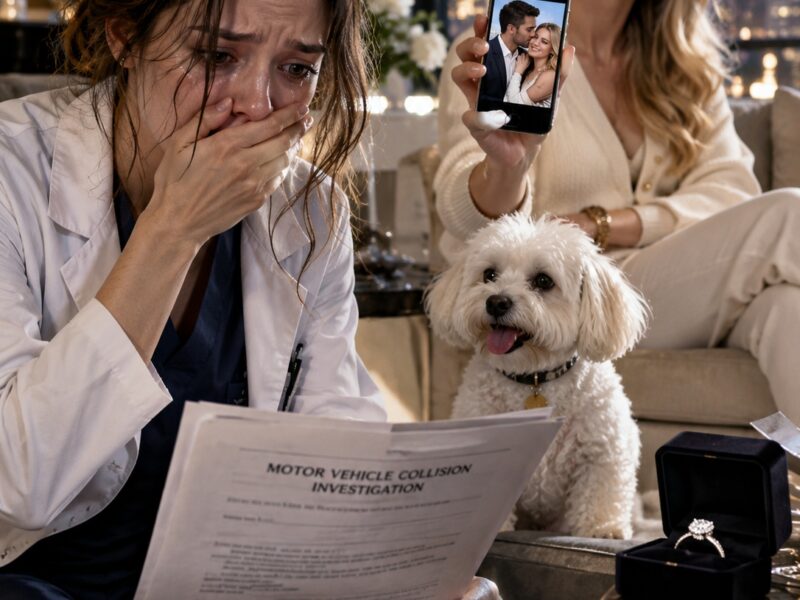
MY PATIENT SHOWED ME A PHOTO OF HER HUSBAND—IT WAS MY BOYFRIEND OF FIVE YEARS. THEN I FOUND MY MOTHER’S DEATH FILE IN THEIR HOME

The first time I saw the photograph of my boyfriend kissing his wife, I was wearing a white coat and holding her surgical consent form.
She was sitting three feet away from me.
Smiling.
Complaining that her husband loved her too much.
And I was the doctor scheduled to operate on her.
For several seconds, I forgot how to breathe.
The woman across my desk couldn’t have been more than twenty-four. She had glossy dark hair pulled into a careless ponytail, a cream cashmere sweater that probably cost more than my first car payment, and the relaxed confidence of someone who had never once wondered whether the person she loved would come home.
Her name was Tiffany Mercer.
She had been referred to me for a myomectomy after months of worsening symptoms, and she spent most of our consultation talking about the man who apparently treated her minor surgery like a national emergency.
“It’s ridiculous,” she said, signing the bottom of the consent form. “He was in London negotiating some insane deal, and the second he heard I might need surgery, he dropped everything.”
She rolled her eyes.
“A hundred-million-dollar deal, Dr. Reed. For this.”
I forced a professional smile. “Some people worry.”
“Worry?” She laughed. “Ethan doesn’t worry. Ethan mobilizes.”
My pen stopped.
Ethan.
There were millions of men in America.
Thousands in New York.
The name meant nothing.
It had to mean nothing.
Then I looked down at the emergency contact line.
Ethan Hayes — Husband.
My boyfriend’s name.
I stared at it long enough for Tiffany to notice.
“Everything okay?”
“Fine.”
My voice sounded normal.
Years of surgical training had taught me how to remain calm while someone’s blood pressure collapsed, while alarms screamed, while an operating room filled with people waiting for me to make the next decision.
Apparently, that training also helped when your life collapsed quietly on a piece of paper.
Tiffany leaned back.
“Are all Ethans like this?”
“Like what?”
“Obsessive.” She grinned. “Mine is stage-five clingy.”
I almost laughed.
My Ethan?
Clingy?
The Ethan Hayes I knew was controlled to the point of emotional frostbite.
He ran Hayes Meridian Technologies with the same disciplined detachment he brought into everything else. He scheduled dinners. He scheduled vacations. He scheduled intimacy around conference calls.
Five years together, and sometimes I still felt as if I needed an appointment to miss him.
“He sounds devoted,” I managed.
“You have no idea.”
Her phone lit up.
She glanced at it and groaned affectionately.
“See? That’s him again.”
Then, without thinking, she turned the screen toward me.
“Look at this man.”
I looked.
And the room disappeared.
Ethan was standing on a beach in a white linen shirt, one arm around Tiffany’s waist.
He was smiling.
Not the controlled half-smile he used in business magazines.
Not the polite expression he wore when my father told one of his terrible jokes.
A real smile.
Open.
Warm.
Happy.
The kind of smile I had spent five years believing he simply wasn’t capable of giving anyone.
His mouth was pressed against Tiffany’s temple.
Her hand rested on his chest.
There was a wedding band on his finger.
My heart made one hard, painful beat.
Then another.
“Dr. Reed?”
I lowered my eyes to the chart.
“Sorry. Long morning.”
She took the phone back.
“Tell me about it. Ethan wanted to sit in on the appointment, but I told him absolutely not. I wanted three peaceful hours without him hovering over me.”
I couldn’t feel my fingertips.
“When did you get married?”
The question escaped before I could stop it.
Tiffany brightened.
“May ninth last year.”
May ninth.
My mother’s death anniversary.
The date burned through me.
That morning, one year earlier, I had sat alone on the floor beside my mother’s grave in Queens with rain soaking through my coat.
I had called Ethan six times.
He didn’t answer.
At 2:17 p.m., he finally texted.
Clara, I’m sorry. I really can’t get away today.
Then:
When things settle down, I’ll go with you to visit your mom.
I had stared at those words until the screen blurred.
I had told myself he was under pressure.
I had defended him when my father quietly asked why the man who supposedly loved me couldn’t spare one hour on the worst day of my year.
Now I knew where Ethan had been.
He hadn’t been trapped in a boardroom.
He hadn’t been negotiating.
He hadn’t been too busy.
He had been getting married.
To her.
“You okay?” Tiffany asked.
I realized my hand was trembling beneath the desk.
I curled it into a fist.
“Yes.”
She smiled again.
“We were ridiculous about it. I was still finishing school at Columbia, and Ethan suddenly decided we couldn’t wait. He kept joking that if he didn’t lock me down immediately, someone smarter would steal me.”
My stomach turned.
Five months earlier, I had asked Ethan whether we should start talking seriously about marriage.
He had kissed my forehead.
“Why rush something that’s already good?”
I had believed that was maturity.
Now another woman was telling me he had been terrified of waiting.
I looked down at her chart.
“Your allergy records aren’t attached.”
“Oh.”
She slapped her forehead.
“I left the full file at home. I had a premarital physical, and everything should be in there.”
“We need it before scheduling surgery.”
“I can have someone bring it.”
A thought formed.
It wasn’t rational.
It wasn’t professional.
But I needed to know.
Not because I still hoped the photograph was fake.
I needed to know how much of my life had been fake.
“I’ll come with you,” I said.
Tiffany blinked.
“You don’t have to do that.”
“The sooner I review everything, the sooner we can move forward.”
She smiled.
“You’re officially my favorite doctor.”
Twenty minutes later, I was sitting in the passenger seat of a customized Mercedes G-Class while Tiffany drove through Manhattan and cheerfully narrated my own destruction.
She told me about St. Barts.
Paris.
A private villa in Turks and Caicos.
Restaurants where reservations took months unless Ethan called personally.
“He pretends he hates traveling,” she said, “but he’s actually adorable once you drag him somewhere.”
I stared through the window.
Ethan had always told me he hated vacations.
Too inefficient.
Too many disruptions.
For our fourth anniversary, I had suggested Italy.
He had answered without looking up from his laptop.
“Maybe next year.”
Tiffany laughed at something on her phone.
I watched Manhattan smear past the rain-streaked glass.
Every sentence she spoke seemed to retrieve some little disappointment from my past and give it a different meaning.
He hadn’t hated vacations.
He hadn’t hated flowers.
He hadn’t hated domestic life.
Maybe he had never been emotionally unavailable.
Maybe he had simply been unavailable to me.
The Mercedes slowed.
I looked up.
Sutton Tower.
For years, Ethan and I had joked about buying a penthouse there someday.
Not seriously at first.
We had been younger then, living in a cramped rental where the radiator screamed every winter and the kitchen drawer jammed if you pulled it too far.
One night, I had opened the Sutton Tower floor plan on my tablet and redesigned the entire thing.
A reading nook near the windows.
Warm oak instead of marble everywhere.
Hidden storage in the bathroom.
A small ledge beside the toilet because I was always dropping my phone on the floor.
Ethan had listened while I talked.
I thought he was indulging me.
Tiffany handed her keys to the valet.
“We’re here.”
I couldn’t move.
“Dr. Reed?”
“Coming.”
The elevator opened directly into the apartment.
My stomach dropped.
Warm oak floors.
Cream walls.
A curved staircase.
The reading nook.
The recessed shelves.
The kitchen island I had moved six inches on a floor plan because I thought the original layout made the room feel crowded.
I knew this apartment.
I had designed it.
“This is beautiful,” I whispered.
Tiffany smiled proudly.
“Ethan did most of it.”
Of course he did.
“He knows exactly what I like.”
She led me toward the powder room.
“Look at this.”
My eyes landed on a narrow stone ledge beside the toilet.
“I always leave my phone everywhere, so he added that for me.”
My mouth went dry.
That stupid little ledge.
My idea.
I remembered sitting cross-legged on our old couch eating Chinese takeout, showing Ethan my sketch.
“If we ever get a place like this, I need one thing.”
He had glanced over.
“What?”
“A shelf beside the toilet.”
He had laughed.
“That’s your dream feature?”
“Don’t judge me.”
“I’m dating a surgeon whose architectural ambition is somewhere to put her phone.”
I had thrown a pillow at him.
For years, that memory had made me smile.
Now another woman was standing inside it.
“Dr. Reed?”
I realized Tiffany had moved ahead.
I followed her upstairs.
A door opened.
A small white poodle shot into the hallway.
“Casper!”
The dog raced toward Tiffany, then suddenly stopped.
Its head turned toward me.
My knees nearly buckled.
“Casper?”
The dog exploded with excitement.
He ran straight at me, whining, tail whipping violently as he jumped against my legs.
I dropped to my knees.
“No.”
My voice broke.
The dog licked my hands.
There was a tiny crescent-shaped scar beneath his left ear.
I knew that scar.
I had sat beside him at an emergency veterinary clinic until two in the morning when he got it.
Tiffany laughed.
“Wow. He really likes you.”
I could barely speak.
“How long have you had him?”
“Two years.”
“Where did you get him?”
“Ethan.”
She scratched behind Casper’s ears.
“He said a friend couldn’t keep him anymore.”
A sound escaped me.
Not quite a laugh.
Not quite a sob.
Casper had belonged to me.
My grandmother gave him to me before she died.
I raised him from a puppy.
Three years earlier, he vanished from the fenced yard behind my father’s house.
I printed flyers.
Called shelters.
Drove through neighborhoods until midnight.
For a week, I barely slept.
Ethan held me one night while I cried into his shirt.
“Don’t do this to yourself, Clara.”
“I should’ve watched him.”
“It wasn’t your fault.”
“What if he’s scared?”
Ethan kissed my hair.
“I’ll always be here.”
He knew.
He had known exactly where Casper was.
Because he had taken him.
And given him to Tiffany.
Something inside me changed then.
Until that moment, I had been devastated.
Now I became cold.
Because cheating could be weakness.
Lying could be cowardice.
But this?
This required planning.
This required watching me grieve something he had deliberately taken and choosing to comfort me instead of confessing.
Tiffany walked toward the bedroom.
“I know the medical folder is here somewhere.”
Casper refused to leave me.
He followed at my heel.
On the bedroom wall hung a whiteboard.
Monday through Sunday.
Laundry.
Groceries.
Dry cleaning.
Casper’s grooming.
Replace flowers.
Clean kitchen.
Meal prep.
The handwriting was Ethan’s.
I stared.
“What’s that?”
“Oh, Ethan’s weekly list.”
“His?”
“Yeah.”
She rolled her eyes.
“I hate strangers in the apartment, so he handles most things himself.”
I nearly smiled at the absurdity.
The man who couldn’t put his own coffee cup in the dishwasher when he stayed with me was apparently folding laundry for his wife.
Tiffany opened a drawer.
“Found it.”
She handed me the medical folder.
I opened it.
Every form requiring a spouse’s information carried the same name.
Ethan Hayes.
Sometimes typed.
Sometimes signed.
I knew that signature.
I had seen it on birthday cards, contracts, checks, hotel receipts.
There was no possibility left.
“Everything okay?” Tiffany asked.
“Yes.”
I closed the folder.
“I have what I need.”
Thunder rolled outside.
My shoulders jerked automatically.
Tiffany noticed.
“You’re scared of storms too?”
I looked toward the windows.
The rain had become violent, but inside the apartment there was almost no sound.
“Too?”
“I’m terrified of thunder.”
She laughed.
“But Ethan basically turned this place into a bunker. Had the windows and walls upgraded for sound insulation.”
I stared at her.
“When?”
“Right after he found out.”
Something sharp moved through my chest.
I had been afraid of thunderstorms since I was eleven.
A highway accident during a storm left me trapped inside a crushed car for nearly forty minutes.
Even decades later, certain sounds could pull me straight back there.
Ethan knew.
Once, during a severe storm, I called him because my hands wouldn’t stop shaking.
He had sighed.
“Clara, you’re safe.”
“I know.”
“Then breathe.”
“I just wanted to hear your voice.”
“I’m about to join a call with Singapore.”
Then, amused:
“You just miss me.”
The line went dead three minutes later.
That night, I sat on my bathroom floor with a blanket wrapped around me until the storm passed.
For years, I had told myself he didn’t understand.
Standing inside Tiffany’s soundproof apartment, I finally understood.
He understood perfectly.
He simply hadn’t cared enough to do anything about it for me.
Tiffany touched my arm.
“Stay for dinner.”
“No, I should—”
“Please. Ethan cooks this ridiculous braised beef. You have to try it.”
Ethan cooked?
I almost asked her to repeat herself.
Instead, she was already calling him.
He answered on the second ring.
“Where did you disappear to?”
His voice filled the room.
I had heard that voice in bed.
In elevators.
At funerals.
On Christmas morning.
But I had never heard it sound like this.
Warm.
Playful.
Alive.
“I was waiting outside the hospital with roses like an idiot,” he said. “My little troublemaker escaped.”
Tiffany laughed.
“Stop buying flowers.”
“Never.”
“Come home. I brought my doctor with me.”
“A doctor?”
“She’s staying for dinner.”
He laughed.
Actually laughed.
“Then I’d better impress her.”
I sat on the couch and stared at my hands.
Five years.
Not once had Ethan bought me roses himself.
One birthday, a bouquet arrived from his office.
The card said, Love, Ethan.
His assistant had called later to ask whether I liked them.
That was how I learned she had ordered them.
The first crack of lightning illuminated the room.
I reached automatically for the glass of water on the coffee table.
My fingers slipped.
Water splashed across several documents.
“Oh my God.”
I grabbed tissues.
“I’m sorry.”
“It’s fine,” Tiffany said. “Old paperwork.”
I lifted one page.
Then froze.
MOTOR VEHICLE COLLISION INVESTIGATION.
The format was familiar.
Painfully familiar.
I looked at Tiffany.
“What is this?”
She barely glanced at it.
“My cousin’s accident.”
My heartbeat slowed.
“What accident?”
“A few years ago. He was drunk and hit a woman.”
The tissue stopped moving in my hand.
Tiffany kept talking.
“It got messy. Honestly, I told my family they should let the courts handle it. But my uncle freaked out because of his political career.”
“What happened?”
“Ethan helped.”
I looked at her.
She shrugged.
“I don’t know exactly what he did. My uncle asked him for help, and suddenly everything went away.”
My hands turned numb.
“May I see this?”
“Sure.”
I picked up the report.
Location.
Time.
Vehicle.
Weather.
Then I saw the victim’s name.
Margaret Reed.
My mother.
For a moment, I couldn’t hear anything.
Not Tiffany.
Not the muted storm.
Not even my own breathing.
I was standing again beside a steel table in a hospital basement while someone asked me to identify my mother’s body.
I remembered her blue scarf.
One shoe missing.
The bruise near her temple.
The detective saying they were sorry.
The official report eventually called it a minor collision complicated by an unfortunate fall.
But I knew that wasn’t what happened.
A witness had told us the driver struck my mother, panicked, reversed, and hit her again while fleeing.
Then the witness changed his statement.
Security footage disappeared.
The toxicology information vanished from the case file.
Calls stopped being returned.
My father received threats.
Someone painted our front door red.
And every time I tried to keep fighting, Ethan held me.
“We can’t beat people like this,” he told me.
“This world is darker than you understand.”
I had believed he was protecting me.
Now I was holding proof that he had been protecting them.
“Clara?”
Tiffany’s voice sounded far away.
I looked up.
She had called me Clara.
I realized she had read my first name from my hospital badge.
I smiled.
It was astonishing how calm I suddenly felt.
“Your cousin’s name?”
She told me.
It matched.
“And your uncle?”
She told me that too.
State Assemblyman Richard Mercer.
A man whose photograph had appeared in the newspaper beside speeches about integrity and public service.
My mother’s death had been buried to protect his family.
And Ethan had helped dig the grave.
I placed my phone beside my thigh and started recording.
Then I asked Tiffany questions.
Not enough to frighten her.
Just enough.
She answered casually because she believed I was curious.
Her uncle had approached Ethan.
Ethan had lawyers contact people.
Records changed.
The family paid someone.
She didn’t know details.
She hadn’t wanted to know.
But Ethan “handled everything.”
I photographed the report while pretending to dry it.
Then I sent the images and audio to Samuel Goldman, the attorney who had once represented my father and me.
My message contained six words.
I think we finally found it.
Goldman responded almost immediately.
Do not confront anyone. Leave safely. Call me.
I stared at the message.
Then the lock turned.
The front door opened.
Ethan walked inside carrying two dozen red roses.
He didn’t see me.
Not immediately.
His entire face softened when Tiffany approached him.
“There you are.”
He bent down and kissed her.
Tenderly.
Naturally.
The flowers brushed against her shoulder.
Tiffany pushed his chest.
“Behave. We have company.”
Then Ethan looked past her.
He saw me.
The bouquet slipped from his hand.
Red roses scattered across the pale floor.
No one moved.
I stood.
“Ethan.”
His face emptied.
Tiffany looked from him to me.
“Wait.”
I tilted my head.
“When did you get married?”
Ethan said nothing.
“I would’ve sent a gift.”
“Clara—”
Tiffany’s smile disappeared.
“You know her?”
I looked at Tiffany.
“Apparently not as well as you do.”
Her eyes sharpened.
“What does that mean?”
Ethan finally moved.
“Tiffany, listen.”
She stepped away from him.
“No. You listen. Who is she?”
He swallowed.
“Someone from my past.”
I almost admired the speed of the lie.
“Past?”
I unlocked my phone.
The last message Ethan had sent me was from that morning.
Dinner tonight? Miss you. Love you.
I turned the screen toward Tiffany.
Her face drained of color.
Ethan stared at me.
“Clara.”
“Tell her.”
“Don’t do this.”
“Tell your wife why you told me you loved me this morning.”
Tiffany snatched my phone.
She scrolled.
One message.
Another.
Photos.
Reservations.
His promises.
Her breathing changed.
“Ethan.”
He reached for her.
She slapped his hand away.
“You told me she was in the past.”
“It was complicated.”
“Five years is complicated?”
“Tiffany—”
“Were you sleeping with both of us?”
Silence.
That silence answered everything.
She stepped backward as if he smelled rotten.
“I’m divorcing you.”
Something changed in Ethan’s face.
For the first time, he turned his anger toward me.
“Why did you come here?”
I stared at him.
He actually sounded offended.
“You’ve destroyed everything.”
I almost laughed.
“I destroyed it?”
“You knew what would happen.”
“I found out you were married three hours ago.”
“I never promised you marriage.”
There it was.
The cruelty people reveal when love is no longer useful.
His jaw tightened.
“Didn’t you understand? Five years, Clara. If I wanted to marry you, I would have.”
The sentence should have destroyed me.
Instead, it finished something.
I looked at the man I had loved since I was twenty-three.
He seemed smaller.
Not physically.
Morally.
“You know what’s strange?” I said quietly. “An hour ago, hearing that would’ve broken me.”
He looked uncertain.
“But you already did something worse.”
I reached into my bag.
Pulled out the photographed report I’d printed from Tiffany’s scanner while she wasn’t looking.
Ethan saw the heading.
His expression changed instantly.
Tiffany looked between us.
“What is that?”
I stepped closer.
“My mother’s accident report.”
Ethan’s lips parted.
I watched fear replace arrogance.
“Clara.”
“Why was it here?”
No answer.
“My mother met you.”
“Clara, not here.”
“She cooked for you. She bought you Christmas gifts. She told me you were the first man I’d brought home who looked at me like I mattered.”
His eyes dropped.
“And while I was begging investigators to reopen her case, you were helping the people who killed her bury it.”
Tiffany stared at him.
“Ethan?”
He rubbed both hands over his face.
“It’s not what you think.”
“Then explain it.”
“My uncle asked you for help?” Tiffany whispered.
He didn’t answer.
She understood.
“Oh my God.”
Ethan looked at me.
“Richard Mercer was powerful. He came to me personally. There were business relationships involved.”
“My mother was dead.”
“I know.”
“You held me while I cried.”
His voice broke.
“I was trying to protect you.”
“From what?”
“From a fight you couldn’t win.”
“You made sure I couldn’t win.”
Silence.
Outside, lightning flashed behind soundproof glass.
For once, I didn’t flinch.
Ethan lowered his voice.
“I had no choice.”
I studied him.
People always say that after making a choice that benefited them.
“You had hundreds of choices.”
“Clara—”
“You chose your company. You chose the Mercer family. You chose Tiffany.”
His eyes hardened.
“When I love someone, I do everything for her.”
The words hung between us.
Tiffany slowly turned toward him.
I almost pitied her.
Because she finally understood what he had just admitted.
Not only that he had betrayed me.
That he believed destroying another person’s life was proof of love.
I laughed softly.
Tears filled my eyes, but they weren’t the tears he expected.
“I spent years wondering why I wasn’t enough.”
“Don’t.”
“I wondered why you wouldn’t marry me. Why you forgot birthdays. Why you hated traveling with me. Why you never had time.”
I looked around the apartment.
“My apartment design.”
Casper sat near my feet.
“My dog.”
Then I looked toward the silent windows.
“My fear of thunderstorms.”
I met his eyes.
“You took everything I told you I wanted and gave it to someone else.”
He looked away.
“And somehow that still wasn’t the worst thing you took from me.”
I folded the accident report.
“You took justice from my mother.”
Ethan stepped toward me.
“What are you going to do?”
That question told me everything.
Not I’m sorry.
Not How can I fix this?
What are you going to do?
I smiled.
“Something I should’ve done years ago.”
His face tightened.
“Clara.”
“My lawyer already has the recording.”
Tiffany looked at me.
“What recording?”
“The one where you explained how Ethan made your cousin’s drunk-driving case disappear.”
Her mouth opened.
Ethan went white.
“You recorded her?”
“I documented evidence concerning my mother’s death.”
“You have no idea what you’re starting.”
“No.”
I picked up my coat.
“I know exactly what I’m finishing.”
I walked toward the door.
Casper followed me.
I stopped.
The dog stared up at me.
For a terrible second, I wanted to take him.
But he wasn’t evidence.
He wasn’t property in the emotional war Ethan had created.
He was an animal who had already been moved between homes because human beings treated love like possession.
I crouched and kissed his head.
“You’re okay, buddy.”
Casper whined.
I stood.
Then I left.
My father called while I was in the car.
“Clara?”
Hearing his voice almost broke me.
“What time are you coming home?”
I pressed my fist against my mouth.
“Dad.”
He became silent.
Fathers sometimes hear things children haven’t said.
“Come home,” he said gently.
I closed my eyes.
“I’m coming.”
“Whatever happened, we’ll deal with it.”
The tears finally came.
He waited.
Then he said the words I had needed far more than any promise Ethan ever made.
“Your mother may be gone, sweetheart. But you still have me.”
I cried all the way to Queens.
The next morning, Samuel Goldman spread the documents across his conference table.
He had aged since the first case.
So had I.
He studied the accident report for a long time.
Then the recording.
Then metadata from the photographs.
Finally, he removed his glasses.
“Where did you get this?”
“In Ethan’s wife’s apartment.”
“She knew what it was?”
“Enough.”
“And she identified the family connection?”
“On the recording.”
Goldman leaned back.
For years, this man had been the one telling us what evidence we didn’t have.
Now his expression was different.
“Clara.”
My stomach tightened.
“What?”
“We can work with this.”
I didn’t move.
“Don’t give me hope unless you mean it.”
“I mean it.”
He placed his palm over the file.
“This doesn’t automatically prove every part of the original cover-up. But it gives us something we never had before: a path back into the people involved.”
I looked down at my mother’s name.
“Then follow it.”
“We will.”
Ethan began texting that afternoon.
First came anger.
You crossed a line.
Then negotiation.
We need to talk before lawyers make this worse.
Then apology.
I never wanted your mother hurt.
Then nostalgia.
Whatever happened, what we had was real.
I blocked him.
He found another number.
Clara, please.
Blocked.
Another.
I know I made unforgivable mistakes.
Blocked.
Then:
I finally understand you were the person who truly loved me.
I stared at that sentence for several seconds.
Then deleted it.
For five years, I had mistaken endurance for devotion.
I had treated crumbs like evidence of a feast because admitting I was hungry felt more humiliating than pretending I was full.
That realization hurt.
But it also freed me.
The Mercer case began unraveling quietly.
Goldman found a former investigator who had retired to Pennsylvania.
Then a clerk who remembered receiving instructions to replace a supplemental report.
Then financial records surfaced.
People who had once been untouchable suddenly discovered that loyalty becomes fragile when subpoenas arrive.
The case was reopened.
Richard Mercer publicly denied wrongdoing.
Ethan’s attorneys insisted his involvement had been limited and misunderstood.
I stopped reading the coverage.
For the first time, I understood that justice did not require me to watch every second of punishment.
I had already spent enough of my life looking backward.
My father noticed before I did.
One Sunday morning, he placed pancakes in front of me and said, “Go somewhere.”
I blinked.
“What?”
“Take a vacation.”
“I have work.”
“You’ve always had work.”
“I’m a surgeon.”
“And I’m your father.”
He pointed his fork at me.
“Your mother used to say you could turn breathing into a responsibility.”
I laughed despite myself.
“That sounds like her.”
“Go somewhere nobody knows Ethan Hayes.”
Two weeks later, I landed in Paris.
I expected loneliness.
Instead, I found silence.
Good silence.
I walked without telling anyone where I was going.
I drank coffee alone.
I sat beside the Seine and watched strangers pass without wondering whether one of them was hiding another life.
Nobody needed anything from me.
Nobody knew my mother had died.
Nobody knew my boyfriend had married someone else.
Nobody knew I had spent years loving a man who helped bury evidence in my mother’s case.
For the first time in years, I was simply Clara.
Then Goldman called.
I answered from a bench overlooking the river.
“Tell me.”
“The court granted the motion.”
I stood.
“What does that mean?”
“It means the original findings are being formally overturned and the matter is moving forward on the new evidence. Your mother is no longer going to be remembered in that file as the victim of some minor accident.”
My hand covered my mouth.
Goldman’s voice softened.
“You did it, Clara.”
“No.”
I looked at the water.
“We did.”
After the call, I sat there until sunset.
“Mom,” I whispered.
People walked past.
Boats moved across the river.
Paris continued being Paris.
“You finally got heard.”
The strange thing about getting what you have wanted for years is that sometimes there is no explosion.
No music.
No perfect speech.
Just an exhausted woman sitting beside a river realizing she can finally stop fighting.
A few days later, I lost my wallet.
And my phone.
Within ten minutes, all my newfound serenity disappeared.
I emptied my bag twice outside a café.
“Looking for something?”
I turned.
The man standing behind me was tall, dark-haired, and annoyingly amused.
“My wallet.”
“That’s usually an important one.”
“And my phone.”
“More important.”
“I’m aware.”
He raised both hands.
“Sorry. Bad time for jokes.”
His accent caught me.
“You’re American.”
“So are you.”
“New York?”
He smiled.
“Guilty.”
His name was Alex Winter.
He was an architect from Manhattan finishing a project in Paris.
Instead of treating my problem like an opportunity to impress me, he simply helped.
Police station.
Café.
Hotel desk.
Back through the streets I’d walked.
We eventually found both items beneath the chair where I’d eaten lunch.
I nearly hugged the waiter.
Then I turned to Alex.
“Coffee.”
He frowned.
“Coffee?”
“I’m buying you one.”
“After two hours of detective work?”
He pretended to consider it.
“Dinner.”
I laughed.
“You’re negotiating?”
“I’m an architect. Half my job is convincing people their original offer is unreasonable.”
Dinner lasted three hours.
Alex didn’t ask whether I was single.
He didn’t ask why I was traveling alone.
He didn’t try to turn kindness into a debt.
We talked about buildings.
New York.
Food.
The terrible coffee in certain American hospitals.
When he learned I was a surgeon, he asked questions about my work instead of making jokes about doctors being too busy to date.
The next day, he texted.
Found a bookstore you might like. No detective work required.
I went.
Then we walked.
Over the next few weeks, Paris became a map of conversations.
A bakery near Montmartre.
A tiny courtyard behind an old church.
A bridge where Alex insisted the best view was behind us, not ahead.
He was warm without being invasive.
Interested without being possessive.
And when I became quiet, he didn’t demand an explanation.
That felt almost revolutionary.
One evening, my hotel phone rang.
“Clara.”
I recognized Ethan instantly.
I closed my eyes.
“How did you get this number?”
“That doesn’t matter.”
“It matters to me.”
“Tiffany filed for divorce.”
I said nothing.
“The company’s getting destroyed. Her family is coming after me. They’re blaming everything on me.”
“Ethan.”
“I have evidence against them too.”
“Why are you telling me?”
Silence.
Then:
“Because I need you to understand.”
“No.”
“What?”
“You need me to care.”
I looked through the window at Paris glowing below.
“I don’t.”
“Clara, please.”
“I’m going to say this once. Whatever happens between you and Tiffany, whatever happens to your company, whatever happens to the Mercer family—it has nothing to do with me anymore.”
“We were together five years.”
“Exactly.”
My voice remained calm.
“I already gave you five years.”
Then I hung up.
He called from another number the next day.
And another.
His messages changed from desperate to romantic to angry and back again.
I stopped reading them.
A month after arriving in Paris, I flew home.
Alex happened to be returning to New York the same week.
We sat together on the flight.
Somewhere over the Atlantic, I woke and found a blanket over me.
I looked at Alex.
He was reading.
“You did that?”
“You were cold.”
“How do you know?”
“You stole half my blanket.”
I smiled.
He didn’t say anything else.
That was the difference.
Care didn’t always announce itself.
At JFK, I discovered Ethan waiting outside baggage claim.
He looked terrible.
His beard had grown in unevenly.
His expensive suit hung loosely.
For a moment, I barely recognized him.
Then he rushed toward me.
“Clara.”
My body stiffened.
Alex noticed.
“Clara, please. Just listen.”
Ethan grabbed my wrist.
“Let go.”
“I came here to tell you everything.”
“You’re hurting me.”
“Just give me five minutes.”
His grip tightened.
Then Alex stepped between us.
“She said let go.”
Ethan released me.
His eyes moved over Alex.
“Who the hell are you?”
Alex didn’t answer.
Ethan looked at me.
“Is this why?”
I stared at him.
“Why what?”
“Why you won’t give me another chance.”
I almost laughed.
“Do you hear yourself?”
“The company lost almost half its value. Tiffany and her family sabotaged me. I’ve lost everything.”
“And?”
“And now I understand.”
He moved closer.
“You’re the one who was right for me.”
I felt something colder than anger.
“Right for you.”
“There’s only one woman who should’ve become Mrs. Hayes.”
He reached for me again.
I stepped back.
“Don’t.”
“I’ll marry you tomorrow.”
That finally made me laugh.
People nearby turned.
Ethan stared at me.
“You think that’s what I wanted?”
“Clara—”
“You think I spent five years waiting for a wedding?”
My voice dropped.
“I was waiting for honesty.”
He looked wounded.
“You destroyed that long before Tiffany.”
“I made mistakes.”
“No. You made decisions.”
His face hardened.
“I loved you.”
“You loved what I gave you.”
He flinched.
“Stability. Loyalty. Forgiveness. Someone who never asked enough questions.”
I pointed toward the terminal behind him.
“You chose another life. Live with it.”
“Is he your boyfriend?”
Alex glanced at me but stayed silent.
I appreciated that.
He understood the answer belonged to me.
“Maybe someday,” I said.
Ethan’s face twisted.
“You moved on that fast?”
I stepped closer.
“Don’t project your behavior onto me.”
He went silent.
“And even if I had fallen in love with someone else the day after leaving you, it still wouldn’t be your business.”
I took my suitcase.
“We’re over.”
“Clara.”
“You’re someone I chose to leave behind.”
I walked away.
In the car, Alex didn’t ask questions.
So I told him.
Everything.
Ethan.
Tiffany.
Casper.
My mother.
The cover-up.
Five years of wondering why I could never make a man love me in the way I needed.
When I finished, tears were running down my face.
Alex stared through the windshield for a while.
Then he said, “I wish I’d met you earlier.”
I looked at him.
“Why?”
“Maybe you wouldn’t have had to go through all of that alone.”
Something tightened in my chest.
He exhaled.
“I’m going to say something, and you’re allowed to pretend I never said it.”
“That sounds ominous.”
“I’m almost thirty. My family has been trying to introduce me to women for years.”
I smiled faintly.
“Poor you.”
“Tragic.”
Then his expression became serious.
“I kept saying I hadn’t met the right person.”
My smile disappeared.
He looked at me.
“I think I might have.”
“Alex.”
“I’m not asking you for an answer today.”
He paused.
“But I’d like a chance.”
I stared at him.
He smiled.
“Not unlimited time, obviously. I’m extremely desirable.”
I laughed through my tears.
“There it is.”
“I needed to recover some dignity.”
On the way home, I asked the driver to stop at my mother’s cemetery.
Alex came with me but stayed twenty yards away.
He didn’t stand beside me.
Didn’t place a hand on my shoulder.
Didn’t turn my grief into an opportunity to become important.
He simply waited.
I knelt in front of my mother’s grave.
For the first time, I told her everything.
“I’m sorry it took so long.”
Wind moved through the trees.
“I thought loving him meant trusting him.”
My fingers brushed the stone.
“I was wrong.”
I cried.
Then I smiled.
“But we got there, Mom.”
When I finally stood, Alex was exactly where I had left him.
That was when something inside me shifted.
Safety wasn’t someone promising never to leave.
Sometimes it was someone who knew when not to come closer.
Dad was waiting when I arrived home.
He saw Alex.
Then he saw me.
His eyebrows lifted.
I knew that expression.
“No,” I warned.
“I didn’t say anything.”
“You don’t have to.”
Alex extended his hand.
“Mr. Reed.”
Dad ignored the hand and pulled him inside.
“You’re eating.”
“Dad.”
“What?”
“He probably has plans.”
Alex glanced at me.
“I did.”
Dad looked disappointed.
“But I just canceled them.”
Traitor.
Dinner lasted until almost midnight.
My father liked Alex immediately.
Of course he did.
Alex listened to his stories.
Complimented his cooking.
Asked about my mother without turning the conversation sad.
After Alex left, Dad washed one plate and looked at me.
“That one.”
I groaned.
“Dad.”
“I’m just saying.”
“You met him four hours ago.”
“I’m old. We get efficient.”
I laughed.
Then his expression softened.
“Clara.”
“What?”
“That man looks at you when you’re talking.”
I became still.
Dad dried his hands.
“Ethan always looked at the room.”
That sentence stayed with me.
The next morning, flowers arrived.
Not roses.
Wildflowers.
A note was tucked inside.
Your father said roses are overrated. I agree with your father because I would like him to approve of me. — Alex
I laughed so hard I had to sit down.
Then I returned to work.
For months, the hospital had been the one place where my personal life disappeared.
Now it became something else.
A place where I remembered who I had been before Ethan.
Dr. Clara Reed.
Surgeon.
Daughter.
Friend.
A woman whose life had value even when nobody was choosing her.
Ethan still appeared occasionally.
Outside my apartment.
Near the hospital.
Calling from unfamiliar numbers.
One night, he shouted from the sidewalk until neighbors opened their windows.
“Clara! I’m not leaving until you talk to me!”
I closed the curtains.
Years earlier, that kind of persistence might have looked romantic.
Now it looked exactly like what it was.
A man refusing to respect an answer because he believed his feelings mattered more than my boundary.
After a week, he disappeared.
I assumed he had finally stopped.
I was wrong.
Two weeks later, my team successfully completed a difficult new surgical procedure we had spent months preparing for.
My colleagues dragged me to dinner.
We were halfway through dessert when someone at the table said, “Did you hear about Ethan Hayes?”
The name landed differently now.
Like the name of someone I used to know in school.
“No.”
My colleague lowered her voice.
“The divorce got ugly.”
I continued stirring my coffee.
“Tiffany was trying to claim a huge portion of the marital assets. Hayes fought everything. Apparently they were accusing each other of fraud, infidelity, financial misconduct—the whole thing.”
Someone else leaned in.
“Then he went to confront her.”
I looked up.
My colleague hesitated.
“He found her with another man.”
Silence settled over our end of the table.
“There was a fight. Ethan was stabbed.”
My hand stopped.
“Is he alive?”
“Technically.”
The answer came softly.
“The surgeons saved him, but the neurological damage was catastrophic. He’s being kept alive on machines.”
Nobody spoke.
“Tiffany disappeared right after. Police arrested the other man. They’re still trying to locate her.”
Someone touched my arm.
“Clara, are you okay?”
I looked toward the restaurant window.
New York glittered beyond the glass.
Once, news like that would have destroyed me.
I would have rushed to the hospital.
I would have stood beside his bed.
I would have told myself that five years meant I owed him one final act of love.
Instead, I felt sorrow.
Not love.
Not satisfaction.
Just sorrow.
For the man he could have been.
For the woman I had been.
For my mother.
For Tiffany, who had believed being chosen meant being safe.
For everyone Ethan had hurt while convincing himself he was protecting the people he loved.
“No one deserves that,” I said quietly.
And I meant it.
But I didn’t go to him.
Some endings don’t need witnesses.
After dinner, I walked alone toward the hospital entrance.
The September air had turned cool.
A black car waited by the curb.
The window rolled down.
Alex leaned across the passenger seat.
“Dr. Reed.”
I smiled.
“Mr. Winter.”
“Need a ride?”
“Depends.”
“On?”
“Where you’re going.”
He pretended to think.
“Your father’s house.”
I raised an eyebrow.
“Why?”
“He invited me for dinner.”
“When?”
“This morning.”
“My father has your number?”
“He asked.”
I laughed.
“Of course he did.”
Alex got out and opened the passenger door.
Before getting in, I looked back at the hospital.
Five years earlier, I had believed home was a person.
Then Ethan taught me how dangerous that belief could become when you handed someone else the responsibility for your entire sense of belonging.
Home wasn’t Ethan.
It wasn’t Alex either.
Home was my father’s terrible pancakes.
My mother’s name finally cleared in an official record.
Casper recognizing me after years apart.
A hospital corridor at six in the morning.
Paris with no itinerary.
The ability to hear thunder and know that fear would eventually pass.
It was the life I had nearly abandoned while begging someone else to choose me.
Alex waited without rushing me.
I got into the car.
As we pulled away, lightning flickered far beyond Manhattan.
A storm was coming.
Once, that would have been enough to make my hands shake.
I watched the clouds gather.
Then I noticed something strange.
I wasn’t afraid.
Not because the thunder had changed.
Not because somebody had soundproofed the world for me.
But because I finally understood that surviving a storm did not require pretending it wasn’t there.
Sometimes you heard every terrible sound.
Sometimes everything you trusted broke at once.
Sometimes the person holding you while you cried was the same person who caused the wound.
And sometimes, after all of it, you discovered the life waiting beyond the wreckage had been yours all along.
Alex glanced at me.
“You okay?”
I watched New York slide past the window.
Then I smiled.
“Yeah.”
And this time, when I said it, I wasn’t trying to convince anyone.
I was telling the truth.









