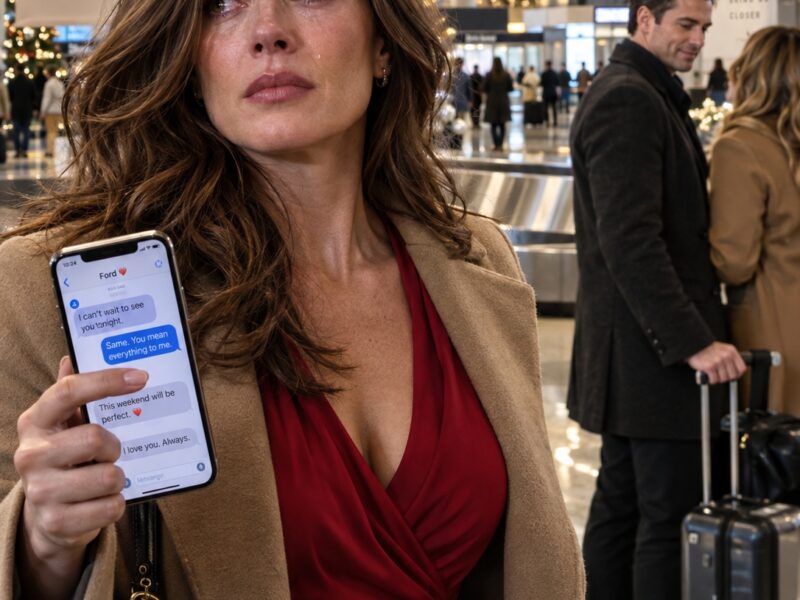
MY SON SAW HIS FATHER WITH ANOTHER WOMAN AT JFK—BUT SHE WASN’T THE WORST BETRAYAL

The moment Sloane Mercer’s marriage ended, nobody screamed.
No glass shattered. No wedding ring hit the floor. No furious wife crossed an airport terminal to slap her husband while strangers lifted their phones to record the spectacle.
Instead, beneath the enormous Christmas tree in Terminal 4 at JFK, her nine-year-old son squeezed her hand and whispered five words that hurt more than anything his father could have said.
“He forgot how to be Dad.”
Sloane looked down at Beckett.
He was wearing the navy wool coat she had buttoned for him before sunrise in their Chicago apartment. One shoelace was already coming loose. His cheeks were pink from the overheated terminal, and twenty minutes earlier he had been bouncing on the balls of his feet because he believed they were about to give his father the greatest Christmas surprise imaginable.
Now he was completely still.
Sloane followed his eyes across the baggage claim.
Ford Ashby stood beside carousel six in a charcoal wool coat, one hand tucked into his pocket, his Montblanc pen clipped exactly where it always was inside his jacket.
He looked handsome.
That was the first cruel thing.
The second was that he looked happy.
Not polite. Not professionally charming. Not wearing the composed expression he had perfected over eleven years of marriage.
Happy.
He was laughing with a dark-haired woman in a camel coat, a younger woman who carried an expensive weekender bag over one shoulder.
Then Ford placed his hand on the small of her back.
Sloane forgot to breathe.
There were gestures you could explain away if you were desperate enough.
A hug could be friendly.
A hand on an arm could be accidental.
Dinner could be business.
A hotel receipt could be a misunderstanding.
A late-night phone call could be work.
But Sloane had been married to Ford for eleven years.
She knew the difference between a man touching a woman and a man touching a woman he believed belonged in his private world.
The woman leaned toward him.
Ford lowered his head and said something near her ear.
She smiled.
The Christmas music overhead seemed obscenely cheerful.
Sloane felt the paper coffee cup buckle under her fingers.
“Mom?”
Beckett looked up at her.
She had imagined this moment differently during the entire flight from O’Hare.
Ford turning.
Ford freezing in delighted disbelief.
Beckett running toward him.
The three of them hugging beneath the Christmas lights while hurried strangers moved around them.
She had even worn the red wrap dress Ford once said made her look “like herself again.”
She had wondered what that meant.
Now she understood.
It meant there had been a version of her he preferred remembering to the woman actually standing in front of him.
Beckett looked back toward his father.
“He doesn’t know we’re here, does he?”
Sloane swallowed.
“No.”
“Should I go say hi?”
The question nearly broke her.
She looked at Ford again.
He was smiling at the woman the way he had not smiled at Sloane in years.
And suddenly something inside her became very calm.
“No,” she said.
Beckett studied her face.
“Why?”
Sloane put her arm around his shoulders.
“Because we’re going home.”
She turned them toward the exit before Ford could look across the terminal.
Each step felt strangely unreal.
Eleven years of marriage did not feel like something that should be able to disappear between a baggage carousel and an automatic glass door.
Yet by the time cold December air hit her face outside JFK, Sloane knew something she had resisted knowing for months.
Maybe years.
The marriage had not died at the airport.
The airport was simply where she stopped lying to herself about the body.
She ordered a car.
Beckett climbed into the backseat and pressed his forehead against the window.
Sloane sat beside him instead of in front.
For most of the ride, neither of them spoke.
When they were halfway to the hotel where they had planned to surprise Ford, Beckett said quietly, “Are we still staying tonight?”
“No.”
“Are we flying home?”
“Yes.”
“Tonight?”
“Yes.”
Another silence.
Then Beckett asked the question Sloane had feared.
“Does Dad love that lady?”
Sloane looked at her son.
Nine years old.
Old enough to recognize betrayal.
Too young to be responsible for understanding it.
“I don’t know what Dad feels,” she said carefully. “And you don’t have to figure it out.”
“Do you love Dad?”
She stared at the passing lights.
“I’ve loved your father for a very long time.”
“That’s not what I asked.”
Despite everything, she almost smiled.
He had inherited that from her.
The refusal to accept an answer designed to sound complete.
Sloane reached over and fixed his collar.
“I know.”
He waited.
She could not lie.
Not after what he had already seen.
“I don’t know what I feel right now.”
Beckett nodded.
Then, after almost a minute, he said, “I still love him.”
Sloane’s chest tightened.
“You’re allowed to.”
He looked relieved.
That was when Sloane understood the first rule of surviving whatever came next.
She would not make Beckett carry her hatred.
Even if she eventually had enough for both of them.
They changed their return flights and were back in Chicago before midnight.
Sloane carried Beckett upstairs after he fell asleep in the car, though he was almost too heavy now.
His head rested against her shoulder the same way it had when he was three.
She got him into bed, pulled the comforter over him and stood there longer than necessary.
Then she walked into the kitchen.
The apartment was dark except for the stove clock.
12:41 a.m.
Her phone remained silent on the counter.
Ford had no idea they had flown to New York.
No idea his wife had stood forty feet away.
No idea his son had watched him place his hand on another woman.
Sloane poured a glass of water.
She drank half.
Then she stared at Ford’s contact on her phone.
For eleven years, confrontation had always been his territory.
Ford was a corporate attorney. He made arguments for a living. He could turn words until the other person began doubting the original shape of the truth.
Sloane had spent years entering disagreements certain of what she felt and leaving them apologizing for how she had expressed it.
Not tonight.
She put the phone face down.
For once, Ford would not be given the advantage of knowing what she knew.
What Sloane did not know was that the woman beside him at JFK already knew exactly who she was.
And she was only one piece of a plan that had begun long before that December afternoon.
Sloane Mercer had not always been cautious.
At twenty-six, she had been the kind of woman who knocked down walls in rental apartments without asking landlords first.
She studied interior architecture at the University of Illinois, built a thesis project that earned attention from a regional design magazine, and spent her twenties filling notebooks with sketches of spaces she had not yet been hired to create.
Her first Chicago apartment was four hundred square feet in Wicker Park.
She furnished it with secondhand chairs, salvaged wood and paint colors landlords would have hated.
She had almost no money.
She had never felt poor.
Then she met Ford Ashby at a gallery opening in River North.
He was thirty-four.
Corporate attorney.
Manhattan.
Gray suit, no tie.
He talked about property law as if he were explaining philosophy.
Sloane thought he was slightly arrogant.
Ford thought she was the only person in the room who had not tried to impress him.
They argued about a sculpture for twenty minutes.
He asked for her number.
She said, “You spent half an hour telling me I was wrong.”
He smiled.
“You stayed for half an hour.”
That had been Ford then.
Sharp without being cruel.
Confident without yet seeming controlling.
Eight months later, when his temporary assignment in Chicago ended, he asked Sloane to move to New York.
She was twenty-nine.
She said yes.
Years later she would wonder why she had treated that decision as proof of love rather than a negotiation between two lives.
Ford did not offer to stay.
She offered to leave.
At first, she was happy.
They rented an apartment in Manhattan. Ford introduced her at dinners as “the talented one.” He bought her an expensive drafting table for their first anniversary.
She tried rebuilding her design work.
New city.
No network.
No referrals.
Ford encouraged her until encouragement became advice, and advice became practical suggestions, and practical suggestions slowly became explanations for why her ambitions needed to wait.
Then Beckett was born.
Everything paused.
Ford’s salary covered the bills.
Sloane stayed home.
“It’s only for a little while,” he told her.
She believed him.
One year became three.
When she eventually began taking clients again, she worked from the dining table between preschool pickups, pediatric appointments and grocery deliveries.
Ford traveled more.
He became a partner.
Then managing partner.
His hours stretched later.
His phone stayed face down.
There were depositions.
Clients.
Emergency calls.
Flights.
Sloane learned not to ask too many questions because asking questions produced sighs, and sighs produced arguments about trust.
The strangest thing about disappearing inside a marriage was how ordinary it felt while it was happening.
No one woke up one morning and thought, I have surrendered most of myself.
You gave up Tuesdays.
Then dinners.
Then a project.
Then an opinion.
Then the right to complain about how much you had already given up.
By thirty-nine, Sloane had become excellent at maintaining peace.
She had also become deeply unhappy.
Six months before the airport, she moved back to Chicago with Beckett.
Officially, Beckett had been struggling at school in New York.
That was true.
But it was not the whole truth.
Chicago was also the city where Sloane remembered who she had been before every decision required Ford’s approval.
She rented a modest apartment.
Then she signed a lease on twelve hundred square feet in Lincoln Square and opened Mercer Design.
Ford agreed to “temporarily” remain in New York because of work.
They spoke every night at eight.
Their conversations sounded like marriage.
They did not feel like one.
“How was Beckett?”
“Fine.”
“School?”
“Fine.”
“Studio?”
“Busy.”
“You need anything?”
“No.”
“All right. I have an early meeting.”
“Okay.”
“Love you.”
“You too.”
Sometimes Sloane would stare at the dark phone afterward and try to remember the last time Ford had asked a question whose answer mattered to him.
The night before she moved out of their New York apartment, she had found a hotel receipt in his coat pocket.
The Beekman.
One room.
Two guests.
She sat on the edge of their bed holding the paper.
Ford was showering.
For perhaps thirty seconds, Sloane considered walking into the bathroom.
Instead she folded the receipt and put it back.
That choice embarrassed her afterward.
But fear did not always look like fear.
Sometimes it looked like exhaustion.
Sometimes it looked like deciding you did not have the energy to confirm what your body already knew.
Sloane moved to Chicago the next morning.
For months she buried herself in Mercer Design.
Clients came.
Not enough to make her rich.
Enough to make her proud.
Then, in early November, six weeks before JFK, she opened their joint bank account.
The balance looked wrong.
Sloane stared.
Then she downloaded eight months of statements.
There were transfers.
Several thousand here.
Two thousand there.
Five thousand.
Thirty-eight hundred.
They looked deliberately unremarkable.
Together, they came to almost thirty thousand dollars.
Every payment had gone to an account Sloane did not recognize.
She called Ford.
He answered on the second ring.
“Hey.”
“There are transfers out of our joint account.”
Silence.
Only two seconds.
But after eleven years, Sloane knew the length of Ford’s natural pauses.
This one had calculation inside it.
“What transfers?”
“Almost thirty thousand dollars over eight months.”
“Oh. That.”
She waited.
“I hired an outside accountant to manage some investments.”
“Why didn’t I know?”
“I thought I told you.”
“You didn’t.”
“Sloane, I’m walking into a call.”
“What accountant?”
“I’ll send you the information.”
“Ford.”
Another pause.
“What?”
“Whose account ends in 7742?”
His voice changed.
Only slightly.
“Why are you interrogating me?”
And there it was.
Not an answer.
A reversal.
The old move.
Sloane looked at the statements on her laptop.
“I’m asking about thirty thousand dollars of our money.”
“I said I’ll explain it.”
“When?”
“Later.”
“Tonight?”
“Sloane—”
“Tonight.”
He exhaled.
“Fine.”
He never called.
At nine thirty, Sloane wrote the destination account number on the corner of a grocery bag.
The next morning, she called the bank.
They could not identify the receiving account.
But the representative confirmed Ford had authorized every transfer.
Then Sloane asked a question she did not know she needed to ask.
“Does my husband need my approval to move that amount?”
The woman on the phone paused.
“Not under the current authorization structure.”
“What does that mean?”
“Mr. Ashby is listed as the sole authorizing signatory for external transfers.”
Sloane stopped breathing.
“Since when?”
Keyboard tapping.
“Fourteen months.”
“I never approved that.”
Another pause.
“I can only tell you what appears in the account record.”
Sloane hung up.
Across the kitchen, Beckett had taped a drawing to the refrigerator.
A purple house.
Yellow door.
Three stick figures.
And in the corner, a question mark where he said their future dog would go.
Sloane stared at the question mark.
Three days later, a certified letter arrived at Mercer Design.
She opened it standing near the sample library.
By the time she finished reading, her hands had gone cold.
A lien had been filed against Mercer Design LLC.
Forty-one thousand dollars.
Unpaid business loan.
Sloane read it again.
Then again.
She had never taken out that loan.
She called her accountant, Gloria, immediately.
“Could this be a mistake?”
Gloria was silent long enough to frighten her.
“Sloane.”
“What?”
“Someone filed a change of registered agent for Mercer Design eleven months ago.”
Sloane gripped the edge of her desk.
“To who?”
“A company called Ashby Holdings Group.”
The name landed like a door locking.
“Ford?”
“I don’t know who owns it yet.”
“I do.”
The forged loan documents arrived by secure email twenty minutes later.
Sloane opened the first page.
Her signature was at the bottom.
It looked exactly like hers.
The looping S.
The pressure mark where she crossed the final letter.
Someone had studied her signature.
Copied it.
Used it.
She stared until the letters seemed to swim.
Then she checked the Mercer Design operating account.
Frozen.
Eighteen thousand dollars sat inside it.
Payroll.
Rent.
Vendor deposits.
Money she could see but could not touch.
Sloane called the only person she still believed she could trust completely.
Wren Calloway.
They had been friends for fifteen years.
Wren had known Sloane before Ford.
Before Beckett.
Before New York.
Before she learned to make herself smaller.
Wren answered immediately.
“Sloane? It’s seven thirty. Is everything okay?”
“No.”
Sloane told her everything.
The airport.
The woman.
The transfers.
The lien.
The forged signature.
Wren listened.
When Sloane finished, there was silence.
Then Wren said softly, “Oh, honey.”
Sloane closed her eyes.
It was the tenderness that nearly broke her.
“Can I come over?”
A hesitation.
Tiny.
Half a second.
Sloane noticed it.
Then dismissed it.
“Of course,” Wren said. “Come now. I’ll make coffee.”
Wren’s Lincoln Park condo looked exactly the way it always did.
Cream sofa.
Glass coffee table.
Expensive candle burning near the window.
A kitchen so clean it looked staged.
Wren hugged her.
Sloane let herself be held.
For two hours, Wren listened.
She poured coffee.
Asked careful questions.
Touched Sloane’s hand when she spoke about Beckett.
“What are you going to do?” Wren asked.
“I don’t know.”
“You should confront him.”
“No.”
Wren’s eyes flickered.
“Why?”
“Because I don’t know what I’m confronting yet.”
“You know enough.”
“No,” Sloane said. “I know he has another woman. I know money moved. I know someone forged my signature. I don’t know how those things connect.”
Wren reached for the coffee pot.
“Maybe they don’t.”
Sloane looked at her.
“Maybe.”
Something passed between them.
So quickly Sloane almost missed it.
Fear.
Not Sloane’s.
Wren’s.
Still, when Sloane left at noon, she felt less alone.
That feeling lasted eleven minutes.
At a red light on Fullerton, her phone displayed a notification from the shared notes app she used with Beckett to track school schedules and grocery reminders.
Sloane tapped it.
A message thread appeared.
Not hers.
A synchronization glitch, perhaps.
The contact was displayed only as a phone number.
She recognized it immediately.
Ford.
Sloane pulled over.
The most recent message had been sent from Wren’s device at 11:42 the previous night.
After Sloane had already called her.
She read it once.
Then again.
SHE FOUND THE ACCOUNT. SHE DOESN’T KNOW THE REST YET. YOU HAVE TIME. DON’T CONTACT DELPHI THIS WEEK.
Traffic passed outside the car.
Sloane could hear horns.
An ambulance.
The click of her turn signal, still blinking though she was parked.
She read the message a third time.
Wren knew.
Not suspected.
Knew.
Sloane’s closest friend had been sitting across from her that morning, pouring coffee and asking sympathetic questions while already communicating with her husband.
Sloane thought of the hesitation when she asked to come over.
Half a second.
Sometimes betrayal announced itself with lipstick on a collar.
Sometimes it lived inside half a second.
Her phone rang.
Wren.
Sloane watched the name glow.
She did not answer.
For the first time since JFK, she did not feel heartbroken.
She felt hunted.
And that changed everything.
Sloane spent the next three days doing something Ford had never expected her to do.
Nothing.
She did not accuse him.
She did not confront Wren.
She did not post vague messages online.
She did not tell mutual friends.
She became quiet.
Then she began collecting paper.
Bank statements.
Loan documents.
Business records.
Screenshots.
The hotel receipt she had photographed months earlier without knowing why.
Every email from Ford about Mercer Design.
Every transfer.
Every text.
She created folders.
Dates.
Timelines.
At night she worked until her eyes burned.
During the day she designed restaurants and living rooms for clients who had no idea the woman showing them tile samples was privately documenting the dismantling of her own life.
Then Ford made his next move.
A hold appeared on the Mercer Design operating account.
The lien holder had initiated legal enforcement.
Sloane sat staring at the screen.
Eighteen thousand dollars.
Locked.
Three months of rent.
Payroll.
Vendor deposits.
Everything she had built since returning to Chicago was suddenly balanced on someone else’s signature.
At three that afternoon, she picked Beckett up from school.
He climbed into the backseat.
Normally, he talked before the door was fully closed.
That day, nothing.
Sloane watched him in the mirror.
“You okay?”
He looked out the window.
“Is Dad coming for Christmas?”
The question entered the car softly.
Sloane tightened her hands on the steering wheel.
“I don’t know.”
Beckett nodded.
Then he said, “That’s okay.”
She turned slightly.
“Why is that okay?”
He shrugged.
“I think you’re doing a lot.”
That was all.
He looked back out the window.
Sloane made it to the parking garage beneath their apartment building.
She waited until Beckett went upstairs with a neighbor.
Then she stayed in the car.
She cried for eleven minutes.
Exactly eleven.
She counted because counting gave the grief walls.
At twelve minutes, she wiped her face.
Opened Google.
And searched:
CHICAGO HIGH-CONFLICT DIVORCE ATTORNEY HIDDEN ASSETS FORGERY CUSTODY.
Theodore Vance appeared on the third result.
Sloane recognized the name.
Years earlier, Ford had mentioned him after losing a negotiation.
“The only attorney in Illinois who genuinely scares me.”
At the time, Ford had laughed.
Sloane did not.
She called.
Before Vance could return the message, another person did.
Wednesday.
9:17 a.m.
Sloane sat cross-legged on the studio floor reviewing upholstery samples when her phone rang.
“Hello?”
“Sloane.”
The voice was older.
Controlled.
She recognized it immediately.
“Constance?”
Ford’s mother.
Sloane had spoken to Constance Ashby perhaps forty times in eleven years.
Every conversation had been correct.
Never intimate.
Birthday cards.
Holiday dinners.
Brief questions about Beckett.
Constance existed at the edge of Ford’s world like a locked room no one discussed.
“Are you somewhere private?” Constance asked.
“Yes.”
“Good.”
Sloane stood.
“What happened?”
A pause.
Then Constance said, “I know about Delphi Crane.”
Sloane felt her spine stiffen.
“Who is Delphi Crane?”
“The woman you saw with Ford.”
“How do you know I saw her?”
“I know more than I should have allowed myself to know.”
Sloane’s mouth went dry.
Constance continued.
“I know about the transfers from your joint account. I know about the loan against Mercer Design. And I know what my son has been doing.”
Sloane sat back down.
“Why are you telling me this?”
“Because there is something else.”
Constance inhaled.
“I am not calling because I am a good person, Sloane.”
The bluntness startled her.
“I am calling because silence eventually becomes participation, and I have been silent too long.”
“About what?”
“My husband’s will.”
Reginald Ashby had died four years earlier.
Founder of Ashby & Crown.
Ford’s father.
A difficult, old-fashioned man who had nevertheless treated Sloane with a kind of quiet respect.
“What about his will?”
“The version filed after his death was not the original.”
Sloane stood again.
“What are you saying?”
“I have a certified copy of Reginald’s original will.”
Constance’s voice changed slightly.
“Forty percent of Ashby & Crown was left to you.”
Sloane did not understand the sentence.
“What?”
“To you, Sloane. Personally.”
“No.”
“Yes.”
“That makes no sense.”
“Reginald admired you.”
“Ford said his father left everything to him.”
“Ford said many things.”
The studio seemed suddenly too quiet.
Constance continued.
“Reginald told me you were the only person in Ford’s life who still told him the truth. He wanted you protected. Especially if the marriage ever failed.”
Sloane pressed a hand to her mouth.
“What happened to the will?”
“The filed version removed your inheritance.”
“Who changed it?”
Constance did not answer immediately.
She did not need to.
Sloane whispered, “Ford.”
“Yes.”
Her knees weakened.
Forgery against her company was one thing.
But altering his dead father’s will?
Stealing from his wife before she even knew there was something to steal?
“How long have you known?”
“Long enough to hate the answer.”
“Why now?”
Constance was silent.
When she finally spoke, the precision in her voice was gone.
“Delphi is pregnant.”
Sloane closed her eyes.
Constance continued.
“Ford told her to handle it quietly. He arranged documents. A clinic. Money. I realized I was watching my son destroy another woman while he was still finishing what he started with you.”
A cold stillness spread through Sloane.
“Do you have proof?”
“Yes.”
“I need everything.”
“I know.”
“Will you testify?”
Constance took several seconds.
Then she said, “Yes.”
Sloane looked at the fabric samples scattered around her feet.
Yesterday they had felt important.
Now they looked like objects from someone else’s life.
“I’m calling a lawyer.”
“I expected you would.”
“Theodore Vance.”
For the first time, Constance almost sounded amused.
“Oh.”
“What?”
“Ford hates him.”
“I know.”
“That,” Constance said, “is an excellent choice.”
Theodore Vance’s office occupied the thirty-first floor of a building on Wacker Drive overlooking the Chicago River.
The furniture was old.
Not vintage.
Not curated.
Simply old.
His office seemed to belong to someone who had never needed expensive objects to make clients believe he was powerful.
Vance was sixty-one.
White hair.
Dark suit.
No visible diplomas.
He shook Sloane’s hand once.
“Mrs. Mercer.”
“Sloane.”
“Sloane, then.”
He gestured to a chair.
“Tell me everything. In order. Don’t edit because you think something is irrelevant. People in trouble are very bad at deciding what is irrelevant.”
Sloane opened the folder she had built.
“The airport first?”
“The first thing that made you understand something was wrong.”
“That was before the airport.”
Vance looked at her.
“Good. Start there.”
So she did.
The hotel receipt.
The separate move to Chicago.
The transfers.
The bank authorization.
The lien.
The forged signature.
Wren.
JFK.
Delphi.
Constance.
The original will.
Vance asked very few questions.
When Sloane finished, he pulled the folder toward him.
“The message from Ms. Calloway?”
“Screenshot and export.”
“The original will?”
“Constance is overnighting the certified copy.”
“Loan documents?”
“Here.”
He examined Sloane’s signature.
“You didn’t sign this.”
“No.”
“Good.”
Sloane frowned.
“Good?”
“Not good that it happened. Good that your answer is unequivocal.”
He turned a page.
“Do you know Ashby Holdings Group?”
“No.”
“I suspect your husband does.”
“He’s an attorney.”
“So am I.”
Something in Vance’s tone settled her.
Then he leaned back.
“Now I’m going to tell you what happens next.”
Sloane waited.
“Ford Ashby has already started trying to make you look financially unstable.”
Her pulse quickened.
“He created the instability.”
“That is precisely the point.”
Vance folded his hands.
“The lien makes your company appear insolvent. Frozen funds make you appear unable to maintain business obligations. If he controls the narrative, he will argue you are overwhelmed, financially irresponsible, possibly emotionally unstable.”
“For what?”
Vance looked directly at her.
“Custody.”
Every part of Sloane’s body went cold.
“No.”
“He will file.”
“You don’t know that.”
“I do.”
“How?”
“Because men who manipulate money often understand that children are leverage.”
Sloane stood.
“He can’t take Beckett.”
“Sit.”
“I’m not—”
“Sloane.”
His voice was quiet.
She sat.
Vance continued.
“He will likely file an emergency petition within weeks. He’ll position himself as the high-income parent with access to stable housing and resources. He may claim your studio is failing.”
“It isn’t.”
“I know.”
“He barely knows Beckett’s teacher’s name.”
“We’ll document that.”
“He missed his last dentist appointment. He missed the school conference. He missed—”
“Document all of it.”
Sloane stopped.
Vance leaned forward.
“He is counting on you reacting as a wife.”
“What does that mean?”
“Angry. Emotional. Public. He needs screenshots. Text messages. Witnesses who can say you were unstable after discovering an affair.”
Wren.
Sloane understood.
“The declaration.”
“Exactly.”
“What do I do?”
“You stop being his wife.”
Vance tapped the folder.
“You become my client.”
Then he reached for his phone.
“And we move first.”
Three days later, Ford filed for emergency temporary custody of Beckett.
The papers were delivered to Mercer Design in a thick cream envelope.
Sloane read them standing beside her desk.
FINANCIAL INSTABILITY.
BUSINESS INSOLVENCY.
ERRATIC BEHAVIOR FOLLOWING MARITAL STRESS.
An unnamed third party described her as “emotionally volatile.”
Sloane called Vance.
“Wren.”
“Yes,” he said.
“You sound very certain.”
“I’m often paid to be.”
“I want to call her.”
“No.”
“I want her to hear my voice.”
“No.”
“She sat in my kitchen—”
“No.”
“She watched Beckett grow up.”
“Which is precisely why Ford wants you furious. Don’t give them what they ordered.”
Sloane closed her eyes.
“What do you need?”
“School records. Medical records. Pickup history. Teacher statements. Daily schedule. Evidence of your involvement. And silence.”
“Anything else?”
“Yes.”
“What?”
“Sleep.”
She almost laughed.
“I’m serious.”
“I haven’t slept properly in a month.”
“Then start tonight.”
“I don’t think I can.”
“Try. Courtrooms punish exhaustion.”
That weekend, Sloane built a second file.
Beckett’s attendance.
Grades.
Soccer registrations.
Dental visits.
Pediatric records.
Emails with teachers.
Every parent conference Ford had missed.
Every emergency contact form listing Sloane’s number first because Ford rarely answered during business hours.
Sunday evening, Beckett sat at the kitchen table building a model for a class project about Chicago architecture.
He held up a cardboard section.
“How do you spell cantilever?”
Sloane spelled it.
He wrote carefully.
Then he asked without looking up, “Is Dad trying to take me?”
The glue stick froze in Sloane’s hand.
“Why would you ask that?”
“I heard you talking to the lawyer.”
She set the glue down.
“Beckett.”
“I wasn’t listening on purpose.”
Sloane moved to his side of the table.
“Your dad and I are working through some adult problems.”
“That means yes.”
He stared at the model.
“I don’t want to go.”
“Nobody has decided anything.”
“I don’t want to go.”
Sloane’s throat tightened.
She took his hands.
“Listen to me. You don’t have to solve this.”
“What if the judge asks?”
“Then you tell the truth.”
“What if Dad gets mad?”
“That belongs to Dad.”
“What if you get mad?”
“I won’t.”
He studied her.
“You promise?”
“I promise.”
Beckett nodded.
Then he squeezed her hand.
“I trust you.”
Sloane turned her face away for one second.
Just one.
When she turned back, Beckett said, “I’m not going anywhere either.”
The emergency custody petition was denied Monday morning.
Vance’s filing documented seventeen instances in two years when Ford had failed to attend major school, medical or parenting obligations.
At 4:26 p.m., Ford called.
Sloane had not heard his voice since before JFK.
“Hello?”
“You hired Vance.”
No greeting.
“Yes.”
“That was stupid.”
Sloane stood at her studio window.
“What do you want?”
“You think he can protect you?”
“I think I’m done asking you to.”
Ford lowered his voice.
“You have no idea what you’re doing.”
“You forged my signature.”
Silence.
“You don’t understand those documents.”
“You changed your father’s will.”
A longer silence.
Then Ford said, “Be very careful.”
Sloane’s skin prickled.
“Is that a threat?”
“It’s advice.”
“From my husband?”
“From someone who understands how ugly this can become.”
Sloane looked down at the river.
“You made it ugly before I knew there was a fight.”
“You’re being manipulated.”
“By who?”
“Vance. My mother. Anyone who benefits from turning you against me.”
Sloane almost laughed.
“You brought another woman to JFK.”
“That’s not what you think.”
“I watched you touch her.”
“Sloane—”
“Our son watched you.”
Ford stopped.
“What?”
There.
The first genuine shock.
“We were in New York.”
“When?”
“December eighteenth.”
Another silence.
“You saw me?”
“Yes.”
“Why didn’t you say anything?”
That question told Sloane more than any confession could have.
Because Ford was not asking whether she was hurt.
He was asking why she had denied him time to prepare.
“I’ve already made enough mistakes,” she said. “Staying quiet wasn’t one of them.”
She disconnected.
That night, after Beckett went to bed, Sloane received an alert from the parental-control app connected to his iPad.
Unknown contact.
She opened it.
HEY, BUD. IT’S DAD. DON’T TELL MOM WE’RE TALKING, OKAY? THIS IS MY NEW NUMBER.
Sloane’s stomach dropped.
Then she saw Beckett’s reply.
I DON’T KEEP SECRETS FROM MY MOM. YOU CAN CALL HER IF YOU WANT TO TALK TO ME.
Four minutes later, he had sent another.
I MISS YOU. BUT I’M NOT GOING TO LIE FOR YOU.
Sloane put the phone down.
For several seconds she could hear nothing but the refrigerator motor.
Then she forwarded screenshots to Vance.
His answer arrived twelve minutes later.
DO NOT RESPOND TO FORD. SAVE EVERYTHING. WE ADD THIS TO THE FILE.
The next morning, Sloane sat across from Beckett at breakfast.
“I saw the messages.”
He stopped chewing.
“Am I in trouble?”
“No.”
“I didn’t answer wrong, did I?”
Her heart broke at the question.
“There was no right answer you were responsible for giving.”
Beckett looked down.
“I miss him.”
“You’re allowed to miss him.”
“But he feels like a different person.”
Sloane considered lying.
Instead she said, “Sometimes adults make choices that change how people see them.”
“Is it my fault?”
“Never.”
She answered so quickly Beckett finally looked up.
“Never,” she repeated.
He nodded.
Then, after several bites of cereal, he said, “Can we get the dog when this is over?”
Sloane laughed.
A real laugh.
Unexpected.
Almost painful.
“Yes.”
“Big dog?”
“Negotiable.”
“Medium big.”
“Very negotiable.”
For twelve seconds, they were simply a mother and son talking about a dog.
Neither of them knew that forty minutes away, in a hotel room near O’Hare, Delphi Crane was recording a conversation that would destroy what remained of Ford Ashby’s career.
Delphi was not what Sloane expected.
When she walked into Vance’s office the following Thursday, she carried no luxury bag.
Only a canvas bookstore tote.
Her hair was pulled into a loose knot. Her eyes were red around the edges.
Twenty-nine.
Exhausted.
Pregnant.
She sat across from Sloane and twisted her fingers together.
“I need to tell you something before we start.”
Sloane said nothing.
Delphi swallowed.
“I didn’t know.”
“About me?”
“I knew you existed.”
Sloane’s jaw tightened.
Delphi continued quickly.
“He told me you’d been separated for almost two years. He said you’d moved to Chicago because the marriage was over and that you were delaying paperwork because of business assets.”
“And Beckett?”
“He said you had already agreed on custody.”
Sloane stared at her.
“You believed him.”
“Yes.”
“That’s convenient.”
Delphi flinched.
Vance did not interrupt.
Sloane continued.
“Did you ask why he was still married?”
“Yes.”
“And?”
“He said lawyers move slowly when their own finances are involved.”
Sloane looked away.
It sounded exactly like Ford.
Sophisticated enough to appear plausible.
Delphi reached into the tote.
“When I told him I was pregnant, things changed.”
She placed an iPhone on the desk.
“He became very organized.”
“What does that mean?”
“He gave me a list.”
Sloane looked back.
“A list?”
“Appointments. A clinic. An NDA. Payment arrangements. He kept saying we needed to ‘manage exposure.’”
Vance’s expression hardened.
“Did he pressure you regarding the pregnancy?”
Delphi lowered her eyes.
“Yes.”
Sloane felt something unexpected.
Not forgiveness.
Recognition.
Delphi continued.
“I had already been recording him.”
“Why?” Sloane asked.
“Because two weeks before I told him, I heard him talking about your company.”
The room became still.
“What did he say?”
“That by the time you understood what had happened, you wouldn’t have anything left to fight over.”
Sloane felt the words physically.
Delphi unlocked the phone.
“I have three weeks of conversations. Some are clear. Some aren’t.”
Vance held out his hand.
Delphi hesitated.
Then gave him the phone.
“There’s something else.”
“What?”
“I found out Ford did something similar before.”
Sloane frowned.
“Before me?”
“Not exactly the same. But the same pattern.”
“What woman?”
“I don’t know all of it yet.”
Delphi looked at her.
“But there’s a name in the recordings you’ll recognize.”
Vance connected the phone to a speaker.
He pressed play.
Restaurant noise.
Glasses.
Traffic.
Ford’s voice emerged.
Relaxed.
Confident.
Then:
“Wren’s been handling communication. She’s kept Sloane from asking the right questions for three years.”
Sloane stopped breathing.
Another voice answered.
Wren.
“She’ll figure it out eventually. Sloane isn’t stupid.”
Ford laughed softly.
“By the time she does, it won’t matter. The business will have the lien. The joint account will be clean. I’ll have the custody filing ready. She’ll be so busy trying to survive she won’t have the energy to fight.”
A pause.
Glass against table.
Then Wren:
“What do I get when this is done?”
Ford answered.
“What you were promised.”
The recording ended.
No one spoke.
Fifteen years.
Fifteen birthdays.
Fifteen Christmases.
Wren had held newborn Beckett.
Wren had helped Sloane choose her wedding shoes.
Wren had sat on the bathroom floor with her through food poisoning in Barcelona.
Wren had given a toast at their tenth anniversary party about friendship surviving every version of life.
And all the while, at some point, she had crossed over.
Sloane looked at Delphi.
“How long?”
“I don’t know.”
Vance answered.
“At least three years, based on that statement.”
Sloane stood.
Walked to the window.
Pressed both palms against the glass.
She wanted rage.
Rage would have felt clean.
Instead she felt grief.
Grief for a friendship that had apparently died long before anyone informed her.
Behind her, Vance said, “This recording changes the case.”
Sloane turned.
“How?”
“Corroboration. Financial fraud. Coordinated interference with custody. Potential conspiracy. Combined with the forged business documents and the will, this is no longer simply a hostile divorce.”
Delphi spoke softly.
“I’ll testify.”
Sloane looked at her.
“You don’t owe me that.”
“I know.”
“Then why?”
Delphi glanced at the phone.
“Because I thought I was the woman he chose.”
Her eyes filled, but she did not cry.
“Then I realized I was just the woman who hadn’t been destroyed yet.”
Sloane understood that sentence too well.
Vance closed the file.
“We build for six weeks.”
“Six?” Sloane asked.
“Approximately.”
She picked up her bag.
“I’ve been holding myself together for eleven years.”
She looked at Ford’s voice frozen as a waveform on Delphi’s screen.
“Six weeks is manageable.”
What none of them understood was that Ford Ashby, for all his planning, was becoming afraid.
Fear made careful people reckless.
And reckless people talked when they should have stayed silent.
Two weeks before the hearing, Sloane met Callum Bryce because her printer ran out of toner.
It happened on an ordinary Thursday.
Forty pages of legal documents needed printing.
Delivery due by noon.
Replacement cartridge delayed.
Sloane stood in the hallway staring at the architecture firm across from Mercer Design.
BRYCE & HOLLOWAY.
She knocked.
A man opened the door holding a coffee mug with two pencils tucked behind his ears.
Tall.
Late forties.
Gray at the temples.
Flannel shirt.
Dark trousers.
He looked more like someone who had been inspecting a construction site than someone who belonged thirty floors above the Chicago River.
“Hi,” Sloane said. “I’m sorry. This is ridiculous, but is your printer working?”
He glanced over his shoulder.
“Miraculously, yes.”
“I need forty pages.”
“Then you have come to the correct miracle.”
He moved aside.
“Come in.”
The office smelled of coffee, paper and cedar.
Scale models filled one wall.
Young architects worked quietly at drafting tables.
No one appeared stressed.
Sloane had forgotten spaces could feel that way.
Callum pointed to the printer.
“Send it to that address.”
“Thank you.”
“No problem.”
He returned to his desk.
He did not ask what she was printing.
Did not hover.
Did not attempt conversation while she stood there staring at documents that contained every private wound of the previous month.
The pages emerged.
Sloane gathered them.
“Thank you again.”
“Anytime.”
At the door, she turned.
“I’m Sloane. Mercer Design.”
“Across the hall.”
“You knew?”
“I know everyone across the hall. I just apparently never introduce myself.”
“Very efficient social strategy.”
He smiled.
“Callum Bryce.”
She nodded.
“Nice to meet you.”
That night, after Beckett fell asleep, Sloane realized she had smiled twice that day.
Once when Beckett told her his architecture model needed “better spatial logic.”
And once in Callum’s office.
She filed the thought away.
Two days later, Callum appeared in her doorway holding two coffees.
“Client meeting canceled. They ordered for six people. We had five.”
Sloane looked at the cup.
Oat milk.
No sugar.
Exactly how she drank it.
She raised an eyebrow.
“You guessed?”
“I asked your assistant.”
“I don’t have an assistant.”
Callum looked toward the hallway.
“Then I apparently asked someone who knows a lot about you.”
For the first time in weeks, Sloane laughed without guilt.
It frightened her almost as much as everything else.
The first major hearing took place in December.
Sloane wore a charcoal blazer.
Vance sat beside her.
Ford arrived eleven minutes later with three attorneys from a Manhattan firm.
He saw Vance.
For half a second, the confidence slipped.
Wren entered behind them.
Hair tied back.
Cream blouse.
Black coat.
Professional.
Controlled.
She and Sloane had not spoken since the morning in Lincoln Park.
For fifteen years they had never gone more than ten days without contact.
Now they passed within twenty feet of each other like strangers.
The hearing lasted four hours.
Vance began with the will.
Constance testified.
She did not look at Ford.
“Yes,” she said when asked whether the document was genuine.
“Yes, Reginald signed it.”
“Yes, Sloane Mercer was a forty-percent beneficiary of his ownership interest.”
Ford’s attorney objected repeatedly.
The judge overruled most of them.
Then came the Mercer Design loan.
A forensic document examiner testified that the signature had likely been simulated from Sloane’s existing signatures.
Then the money.
Transfers.
Ashby Holdings Group.
Finally Delphi.
When Ford saw her enter the courtroom, something changed in his face.
Delphi told the truth without drama.
How they met.
What Ford said about his marriage.
The pregnancy.
The NDA.
The recordings.
Then Ford’s voice filled the courtroom.
“By the time she understands what happened, there won’t be anything left to fight over.”
Sloane did not look at him.
She looked at the judge.
Then Vance projected emails between Ford and Wren.
Dates.
Instructions.
Payments.
Strategies for controlling what Sloane knew.
The words appeared enormous on the white wall.
One email from Wren read:
SHE’S ASKING ABOUT THE BEekman RECEIPT AGAIN. I TOLD HER SHE’S PROBABLY OVERTIRED.
Another:
IF YOU WANT HER TO MOVE TO CHICAGO, STOP PUSHING. SHE NEEDS TO BELIEVE IT’S HER IDEA.
Sloane closed her eyes.
That one hurt.
Chicago.
Her escape.
Even that had been anticipated.
The judge called a thirty-minute recess.
In the hallway, Vance spoke quietly.
“The court now has independent support for the forgery.”
“What happens?”
“Ford’s attorneys offer settlement.”
“What do I say?”
“Nothing without me.”
Sloane looked down the corridor.
Ford stood near the elevators surrounded by his legal team.
His lead attorney, Grayson Park, spoke close to him.
Ford’s face was rigid.
Wren stood twenty feet away, alone.
For one brief second, Wren looked toward Sloane.
Their eyes met.
Sloane had imagined this moment.
She imagined hatred.
Accusation.
Triumph.
Instead she felt only the terrible distance between who Wren had been and what she had chosen.
Wren looked away first.
Four days later, Vance called.
“I found something.”
Sloane had learned that when Theodore Vance sounded mildly interested, someone else should be very worried.
“What?”
“Courthouse security footage.”
“Why?”
“A bailiff mentioned there’s audio pickup near the elevator.”
Sloane sat down.
“And?”
“Ford said something during recess.”
“What?”
Vance read from his notes.
“‘The Calloway woman needs to disappear from this. Whatever it costs.’”
Sloane’s stomach tightened.
“He was going to blame Wren.”
“Yes.”
“Can you use it?”
“Not directly in the way you’re hoping.”
“Then why does it matter?”
“Because Wren doesn’t know he said it.”
Sloane understood.
Vance contacted Wren through counsel.
Not as a friend.
Not as a witness.
As a person exposed to civil conspiracy allegations whose supposed partner had just discussed making her “disappear” from the case.
The result came quickly.
Wren hired an attorney Tuesday.
Her attorney contacted Vance Wednesday.
Deposition Monday.
Sloane was not present.
When Vance called afterward, his voice was flat.
“She gave us everything.”
Sloane sat beside the studio window.
“What is everything?”
“Payments from Ford over three years.”
Her stomach turned.
“How much?”
“Enough.”
“What else?”
“Communication strategy. Manipulation of information. Encouraging your Chicago move because physical separation improved Ford’s custody and financial planning.”
Sloane closed her eyes.
“And the plan?”
A pause.
“It began almost two years before you left New York.”
Something inside her broke quietly.
Not because she loved Ford.
That part had already died.
Because memory itself suddenly became unreliable.
Two years.
Every dinner.
Every holiday.
Every time he kissed her forehead before leaving.
Every promise.
Ford had been planning an exit while Sloane was still trying to save a marriage he had already converted into strategy.
“He knew,” she whispered.
“Yes.”
“He was leaving before I knew there was something to leave.”
“Yes.”
Sloane looked at the Chicago River.
A barge moved slowly beneath the bridge.
“What happens to Wren?”
“She’s cooperating. That helps her.”
“Does it save her?”
“No.”
“Her career?”
Vance paused.
“I wouldn’t speculate. But once the emails become public, clients may make their own decisions.”
Sloane expected satisfaction.
She felt none.
“I thought revenge would feel better.”
Vance’s voice softened almost imperceptibly.
“This isn’t revenge.”
“No?”
“No. Revenge is about making someone hurt.”
He paused.
“This is about preventing them from continuing to hurt you.”
Eleven days later, the custody ruling arrived.
PRIMARY RESIDENTIAL CUSTODY AWARDED TO SLOANE MERCER.
SUPERVISED VISITATION FOR FORD ASHBY PENDING FURTHER REVIEW.
Sloane read the lines three times.
Then called Vance.
“Congratulations,” he said.
“That’s a strange word.”
“Court makes many normal words strange.”
She called her mother in Indianapolis.
Her mother cried before Sloane finished the first sentence.
Then Sloane went to school.
She picked Beckett up herself.
She did not tell him in the car.
She waited until they were home.
Coats off.
Backpack down.
Apple juice on the kitchen table.
Then she sat across from him.
“The judge made a decision.”
Beckett’s fingers tightened around the glass.
“You’re staying with me.”
His shoulders dropped.
Just slightly.
Then he reached for his backpack.
“I wrote something.”
“What?”
“In case the judge asked me.”
He pulled out a folded sheet of notebook paper.
“I know nobody asked. But I wanted to remember.”
Sloane unfolded it.
Large, uneven handwriting.
I WANT TO LIVE WITH MY MOM BECAUSE SHE SHOWS UP.
SHE SHOWS UP WHEN I’M SICK AND WHEN I’M NOT SICK.
SHE SHOWS UP WHEN SHE’S TIRED.
SHE SHOWS UP WHEN SHE’S SAD EVEN WHEN SHE THINKS I DON’T KNOW.
MY DAD STOPPED SHOWING UP.
I DON’T KNOW WHY.
BUT MY MOM NEVER DID.
Sloane pressed her palm flat against the paper.
For weeks, she had refused to cry in front of him.
This time she could not stop it.
“You saved us, baby.”
Beckett shook his head.
“No.”
He got out of his chair.
“You saved us first.”
Sloane stood and wrapped her arms around him.
He held on.
Nine years old.
Too observant.
Too brave.
Asked to understand things no child should have needed to understand.
Across Chicago, at almost that exact moment, Ford Ashby was being served with notices connected to a criminal investigation.
Within days, the Attorney Registration and Disciplinary Commission suspended his ability to practice.
Ashby & Crown called an emergency board meeting.
Ford’s name had once appeared in polished letters beneath the firm logo.
By Monday, he was gone.
The criminal case moved faster after Delphi’s recordings and Wren’s cooperation.
Forgery.
Wire fraud allegations.
Conspiracy.
Ford’s Manhattan attorneys stopped talking about defeating the case and began talking about limiting damage.
The forty-percent interest Reginald had originally left to Sloane became the subject of separate civil litigation.
Ashby & Crown’s remaining partners wanted distance.
Vance wanted valuation.
Sloane wanted one thing.
An end.
Wren settled the civil claim.
Her PR firm terminated her contract when the emails became public.
Several clients left.
People called Sloane expecting her to enjoy that.
She didn’t.
One mutual friend said, “After what she did, I hope she loses everything.”
Sloane answered, “I don’t.”
The friend sounded surprised.
“Why?”
“Because I know what losing everything feels like.”
“You forgive her?”
“No.”
“Then what do you feel?”
Sloane thought about it.
“Finished.”
That was different.
Ford eventually entered a negotiated plea that included document forgery and wire fraud.
The deal spared him a trial.
It did not spare his career.
His law licenses in Illinois and New York were lost.
Probation followed.
Financial penalties.
Civil settlements.
The man who had built his identity around controlling rooms now had lawyers telling him when to speak.
Sloane learned most of it through Vance.
She never searched Ford’s name online.
She never read comments.
She never visited gossip pages.
One night Beckett asked, “Is Dad a criminal?”
Sloane set down the book she was reading.
“He broke laws.”
“Does that mean yes?”
“Yes.”
Beckett processed the answer.
“Is he a bad person?”
That question was harder.
Sloane moved closer.
“Your dad made serious choices that hurt people.”
“That isn’t what I asked.”
Again.
The refusal.
Sloane took a breath.
“I don’t think people are only one thing.”
Beckett frowned.
“So he can be bad and still be my dad?”
“Yes.”
“And I can love him?”
“Yes.”
“And be mad?”
“Yes.”
“At the same time?”
“Yes.”
He seemed relieved.
“Okay.”
Then he opened his book.
Children were sometimes better at complexity than adults.
Adults wanted verdicts.
Children wanted permission to feel everything.
In February, the court restored Sloane’s financial interest in Ashby & Crown.
Vance presented three options.
Keep the stake.
Sell it.
Use it as leverage.
Sloane chose to sell.
“Are you certain?” he asked.
“Yes.”
“This could appreciate considerably.”
“I don’t want Ford’s father’s firm.”
“It is legally yours.”
“I know.”
“Then why sell?”
Sloane looked at the appraisal.
“Because I don’t want the rest of my life financed by the building where he learned how to lie.”
Vance nodded once.
“Fair enough.”
The sale changed everything.
The fraudulent lien against Mercer Design was discharged.
The frozen account reopened.
Legal fees were paid.
Sloane had enough capital to stop worrying about rent every month.
She sat in the parking garage after signing the final paperwork.
Same Toyota.
Same concrete level.
Months earlier, she had cried there for eleven minutes because she believed her life was collapsing.
This time she cried because she finally understood it had not collapsed.
It had opened.
In March, Mercer Design hired two new designers.
One was twenty-four, recently graduated from the Illinois Institute of Technology and so enthusiastic that Sloane occasionally had to remind him buildings did not need a philosophical manifesto for every light fixture.
The other was fifty-two.
A woman named Dana who had run her own design company for two decades before a brutal business dissolution forced her to start over.
During the interview, Dana said, “I know I look overqualified.”
Sloane smiled.
“You look experienced.”
“I don’t want anyone to think I’m here temporarily.”
“Are you?”
“No.”
“Then neither do I.”
Sloane hired her that afternoon.
By spring, Mercer Design had four new projects.
Then a restaurant group hired them for three Chicago locations and one in Nashville.
The kind of job Sloane used to imagine receiving when she was twenty-six.
She stayed late.
Beckett sometimes did homework at a spare desk.
He offered opinions on materials.
“Too beige,” he said one Friday.
“It’s limestone.”
“Beige rock.”
Dana covered a laugh.
Sloane stared at the sample.
He was not wrong.
Constance Ashby began calling once a week.
Their conversations were not warm in the usual sense.
Constance did not suddenly become sentimental.
But the pauses changed.
One afternoon she asked, “How is Beckett?”
“Good.”
“And the studio?”
“Busy.”
A pause.
“Have you met anyone?”
Sloane nearly dropped her phone.
“Constance.”
“What?”
“That was almost personal.”
“I am seventy-two. I’m experimenting.”
Sloane laughed.
“There’s someone across the hall.”
“Oh?”
“Architect.”
“Divorced?”
“Widowed.”
“Children?”
“One daughter. College.”
“Kind?”
Sloane looked through the glass wall of her studio.
Across the corridor, Callum was standing inside his office arguing with a scale model.
“Quietly.”
Constance said, “Quietly kind is underrated.”
Sloane agreed.
Callum never asked for details about Ford unless Sloane offered them.
He never called her strong as though strength were a compliment she should be grateful to receive after being forced to use it.
He simply appeared.
Coffee.
Lunch.
A book about adaptive reuse because she mentioned wanting to read it.
One evening they stayed in the building until nine discussing a building in Barcelona they both loved.
Callum walked her to the elevator.
“You know,” he said, “we’ve had coffee four times.”
“Five.”
“That proves my point.”
“What point?”
“I would like to take you to dinner.”
Sloane’s first instinct was panic.
Her second was guilt.
Her third was strangely close to hope.
“I’m not ready for anything complicated.”
Callum pushed the elevator button.
“Dinner is pasta.”
“That’s your argument?”
“Potentially risotto.”
She smiled.
“I mean it.”
“So do I.”
He looked at her.
“I’m not asking you to be ready for anything except dinner.”
The elevator opened.
Sloane stepped inside.
“Okay.”
“Okay?”
“Dinner.”
Callum nodded.
“Dinner.”
The doors began closing.
Then Sloane stopped them with her hand.
“One thing.”
“Yes?”
“If you lie to me about anything, including whether you like the restaurant, I’m leaving.”
Callum considered this solemnly.
“What if the tiramisu is mediocre?”
“Especially then.”
“Understood.”
The doors closed.
Sloane stood alone in the elevator smiling.
She was not ready.
But she was beginning to understand that not ready was not the same as never.
Their first dinner lasted three hours.
Nothing dramatic happened.
That mattered.
No declarations.
No promises.
No electric kiss in the rain.
Callum told her about losing his wife six years earlier to a fast-moving cancer.
Sloane told him she had forgotten what it felt like to make decisions without anticipating someone else’s reaction.
He did not tell her to heal.
He did not tell her she deserved better.
He simply listened.
At the end of the night, outside her building, Callum said, “I’d like to do this again.”
Sloane looked at him.
No manipulation.
No performance.
No urgency.
“I think I would too.”
He smiled.
“Good night, Sloane.”
“Good night.”
Then he left.
Beckett was waiting inside with the babysitter.
He looked at his mother.
“Did you have fun?”
“Yes.”
“With Printer Guy?”
Sloane stared.
“Printer Guy?”
“That’s what Dana calls him.”
“I need to speak to Dana.”
“Do you like him?”
Sloane hung up her coat.
“I think I might.”
Beckett nodded gravely.
“He shows up.”
The words stopped her.
“What?”
“He came to my soccer game.”
“He was already nearby.”
“No, he wasn’t.”
“How do you know?”
“I asked.”
Sloane looked at her son.
Beckett shrugged.
“He seems like a person who shows up.”
Months passed.
Ford moved to Phoenix after the legal cases concluded.
His supervised contact with Beckett continued under court arrangements.
Sometimes Beckett returned sad.
Sometimes angry.
Once he came home quiet and placed his backpack by the door.
“How was it?” Sloane asked.
“Fine.”
She did not press.
Twenty minutes later, he appeared in the kitchen.
“Dad said you ruined his career.”
Sloane put down the knife she was using to cut vegetables.
“What do you think?”
“I think he did.”
She nodded.
Beckett leaned against the counter.
“Why would he say that?”
“Because accepting responsibility is hard.”
“Do you hate him?”
Sloane looked at the knife.
At the carrots.
At the ordinary kitchen around them.
“No.”
“Really?”
“Really.”
“How?”
She took a moment.
“Hating someone keeps you facing them.”
Beckett frowned.
“I don’t understand.”
“You will.”
She slid the chopped carrots into a bowl.
“I’d rather face us.”
That spring, they finally got the dog.
Medium-sized.
Brown.
One white paw.
Rescue organization estimated three years old.
Beckett named him Ferris because, according to him, “If we live in Chicago, the dog should have a Chicago name.”
Sloane refused to explain that Ferris Bueller was not technically a city landmark.
Ferris slept at the foot of Beckett’s bed.
He stole socks.
Hated delivery trucks.
Loved Callum.
This last fact irritated Sloane because Ferris had ignored her for three weeks before deciding she was useful.
Callum received immediate devotion.
“Traitor,” Sloane told the dog.
Callum scratched Ferris behind the ears.
“He recognizes architectural integrity.”
“He eats cardboard.”
“Exactly.”
In late April, an email arrived at Mercer Design.
Architectural Digest.
Feature inquiry.
Sloane assumed it was spam.
Dana read it.
“It’s not spam.”
“Could be sophisticated spam.”
“Sloane.”
“They want what?”
“A feature.”
“On who?”
“You.”
“No.”
Dana turned the monitor toward her.
“Read.”
Sloane read.
Then sat down.
Years earlier, before Ford, before Beckett, before New York, before she had ever learned to shrink herself, twenty-six-year-old Sloane Mercer had once bought a copy of Architectural Digest and taped a handwritten note above her desk.
SOMEDAY.
She had forgotten.
Apparently the woman she used to be had not.
The feature ran in October.
Six pages.
The opening photograph showed the restaurant project Sloane had designed in warm amber tones.
Curved banquettes.
Soft lighting.
Custom glass fixtures from Michigan.
A dining room designed around one principle:
People should feel held when they enter.
Sloane found the magazine in the lobby of her building.
She stood there with a coffee cup in one hand.
MERCER DESIGN, CHICAGO.
Her name.
Her work.
No mention of Ford.
No mention of scandal.
No mention of surviving.
Just what she had built.
She bought three copies.
One for the studio.
One for her mother.
One for Beckett, who claimed he did not need his own and then took it to school.
That Saturday, Sloane stood on the sideline of Beckett’s soccer field with Callum beside her.
Ferris sat between them wearing a bandana Beckett insisted made him “team management.”
Constance stood several feet away holding coffee and pretending she was not deeply invested in ten-year-old recreational soccer.
Beckett scored.
He looked toward the sideline.
Sloane raised both arms.
Callum shouted.
Constance clapped once before apparently deciding enthusiasm had limits.
Beckett grinned.
For one strange second, Sloane remembered JFK.
The Christmas tree.
The camel coat.
Ford’s hand on Delphi’s back.
Beckett’s tiny voice.
He forgot how to be Dad.
She remembered believing that moment represented the destruction of her family.
She had been wrong.
The family had changed shape.
That was not the same thing as disappearing.
Delphi eventually sent Sloane a message.
Not long.
I DON’T KNOW IF CONTACTING YOU IS APPROPRIATE. I JUST WANTED TO SAY I’M DOING OKAY. THANK YOU FOR NOT TREATING ME LIKE I WAS THE PERSON WHO DID THIS TO YOU.
Sloane stared at it.
Then replied.
I HOPE YOU BUILD SOMETHING GOOD FROM HERE.
Delphi answered with a heart.
They never became friends.
They did not need to.
Some women entered your life not because they were meant to remain there, but because for one terrible moment you both stood inside the same truth.
Wren sent no message.
For a long time, Sloane expected one.
An apology.
An explanation.
Anger.
Anything.
Nothing came.
Then, almost a year after JFK, an envelope appeared at Mercer Design.
No return address.
Wren’s handwriting.
Sloane held it for an entire afternoon.
She almost threw it away.
Then she opened it.
One page.
Sloane,
There is no version of what I did that becomes acceptable because I explain it.
Ford first paid me for consulting work. Then for information. I told myself the information was harmless. Schedules. Questions you were asking. Things you already told me as a friend.
By the time I understood what I had become, I was already being paid enough to need the lie.
That is not an excuse.
You were my friend before you were his wife. I knew exactly where you were vulnerable because you trusted me.
I used that.
I am sorry.
I know sorry does not repair anything.
I also know you may never forgive me.
You shouldn’t feel obligated to.
Wren
Sloane read the letter twice.
Then folded it.
She expected emotion.
Instead there was quiet.
Callum found her sitting at the studio table later.
“You okay?”
She showed him the envelope.
He did not reach for it.
“Do you want to talk?”
“No.”
“Okay.”
He sat across from her.
That was all.
After a minute, Sloane said, “She apologized.”
Callum nodded.
“Does it help?”
“I don’t know.”
Another minute.
“I spent so long wanting to understand why.”
“And now?”
“I think I understand enough.”
“What does that mean?”
Sloane looked toward her studio.
Dana arguing with a vendor on the phone.
Samples covering the table.
A junior designer measuring a drawing.
A normal Tuesday.
“It means sometimes people betray you for reasons that are disappointingly ordinary.”
Callum waited.
“Money. Fear. Self-interest. Cowardice.”
She looked down at the letter.
“I wanted there to be some giant reason. Something proportionate to the damage.”
“There rarely is.”
“No.”
Sloane folded the letter again.
Then put it into a drawer.
She did not burn it.
She did not frame it.
She simply stopped carrying it.
The following December, one year after JFK, Chicago received its first heavy snow three days before Christmas.
Sloane woke early.
The apartment was quiet.
Ferris slept under the kitchen table.
Beckett, now ten, had left a soccer jersey over the back of a chair despite being reminded twice.
Architectural Digest lay open beside Sloane’s coffee.
Callum had spent the previous evening with them and gone home after dinner.
They were moving slowly.
No one seemed afraid of that.
Outside, the city looked clean beneath fresh snow.
Sloane stood at the window.
For years, she had believed healing would feel like triumph.
Like winning a case.
Like watching Ford lose his career.
Like recovering stolen money.
Like seeing Wren exposed.
But none of those moments had felt like healing.
Justice, perhaps.
Relief.
Protection.
Closure.
Healing was quieter.
It was Beckett sleeping through the night again.
It was payroll going out on time.
It was opening the studio every morning.
It was discovering she liked oat milk in coffee.
It was saying no without preparing an explanation.
It was Callum asking, “Do you want company?” instead of assuming she did.
It was Constance learning to end phone calls with “I love you” and sounding slightly uncomfortable every single time.
It was Ferris stealing a glove and running through the apartment while Beckett chased him.
Healing did not look like returning to the woman Sloane had been before Ford.
That woman was gone.
And for once, Sloane did not mourn her.
She had been young.
Brave.
Ambitious.
But she had also believed love required surrender.
The woman standing at the window now understood something the younger Sloane had not.
Love that required you to disappear was not made stronger by your sacrifice.
It simply became more comfortable for the person benefiting from your absence.
Beckett walked into the kitchen rubbing his eyes.
“You’re up.”
“So are you.”
“I smelled coffee.”
“You don’t drink coffee.”
“I smelled breakfast potential.”
Sloane laughed.
He opened the refrigerator.
“There’s no bacon.”
“Correct.”
“That feels hostile.”
“There are eggs.”
“Eggs are not bacon.”
Ferris appeared.
Beckett dropped to scratch his ears.
“Callum coming over?”
“Later.”
“Grandma Constance?”
“At three.”
“Actual Grandma?”
“Four.”
“That’s too many grandparents.”
“You have two.”
“Still.”
Sloane watched him.
A year earlier, he had stood in JFK and watched his father become someone else.
A child should never have needed that memory.
But he had survived it without becoming hard.
Sloane considered that a miracle.
“Mom?”
“Yeah?”
“You’re staring.”
“Sorry.”
“You do that.”
“I know.”
He poured cereal.
Then he glanced at the magazine on the table.
“Are you still keeping that open to your article?”
“It happens to be open.”
“You literally moved it there.”
“Eat your breakfast.”
Beckett smiled.
Sloane picked up her coffee.
A notification appeared on her phone.
For one second, out of old instinct, her body tensed.
Then she looked.
Callum.
GOOD MORNING. ROADS ARE TERRIBLE. I’LL BE LATE. DON’T WAIT FOR ME TO START BREAKFAST.
She typed:
WE HAVE CEREAL. YOU’RE NOT MISSING MUCH.
He replied:
DEVASTATING.
Sloane smiled.
Beckett saw.
“Printer Guy?”
“Eat.”
He laughed.
Outside, snow kept falling.
For the first time in years, there was nowhere else Sloane wished she were.
She thought about the airport one last time.
Not Ford.
Not Delphi.
Not the woman in the camel coat.
She thought about herself standing there in the red dress, holding a paper coffee cup too tightly while eleven years dissolved inside her.
That woman had believed she was witnessing the worst thing that could happen.
She had not known about the forged loan.
The stolen inheritance.
Wren.
The custody petition.
The recordings.
The hearings.
She had not known there would be months when fear followed her into every room.
But she also had not known about Vance.
Or Constance.
Or Dana.
Or Callum.
Or the restaurant project.
Or the magazine.
Or Ferris asleep beneath her table.
She had not known her son would write the sentence that would stay with her forever.
My mom shows up.
Sloane looked across the table.
Beckett was reading the cereal box.
Ferris had placed his head on Beckett’s foot.
Chicago morning light came gray and clear through the windows.
Once, Sloane believed she needed Ford to come back.
Then she believed she needed him punished.
Eventually she understood she needed neither.
She needed her name on the door of something she had built.
She needed money no one could secretly move.
She needed friends who did not sell access to her vulnerabilities.
She needed a home where her son did not have to keep secrets.
She needed a love that entered quietly and never demanded she become smaller to make room for it.
Most of all, she needed the life in front of her to belong entirely to her.
And now it did.
Sloane took another sip of coffee.
Beckett looked up.
“What?”
“You’re staring again.”
She smiled.
“Nothing.”
He narrowed his eyes.
“You look weird.”
“Thank you.”
“You know what I mean.”
Sloane looked around the kitchen.
At the mess.
At the dog.
At the snow.
At her son.
At the life she had once believed would never exist.
“I’m just happy.”
Beckett considered that.
Then shrugged.
“Okay.”
He returned to his cereal.
Sloane smiled into her coffee.
There had been a time when happiness meant being chosen.
By Ford.
By clients.
By friends.
By someone.
Now she understood.
Sometimes happiness was not being chosen at all.
Sometimes it was finally choosing yourself—and discovering that the life waiting on the other side of that decision had been waiting far longer than you knew.









