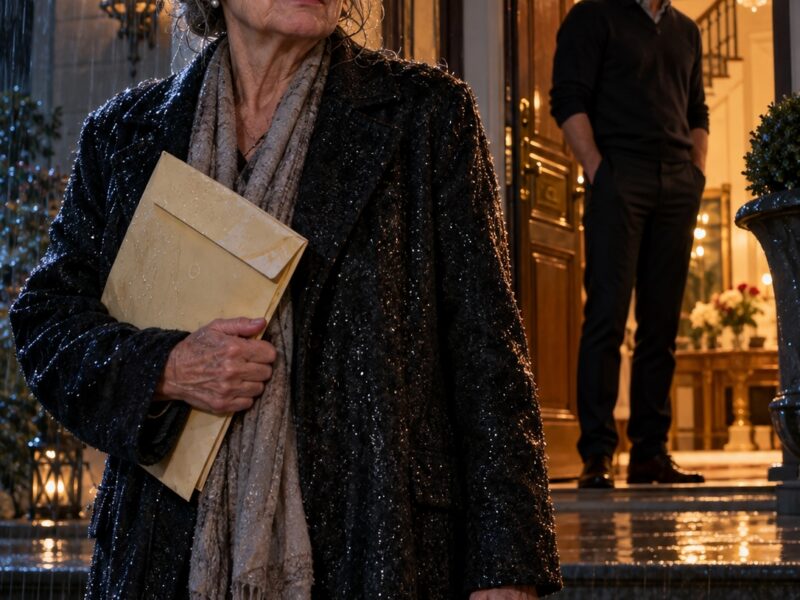
MY SON THREW ME OUT INTO THE FREEZING RAIN—THEN HE DISCOVERED I WAS WORTH $17 MILLION

The cruelest thing my son ever said to me wasn’t I don’t love you.
It was quieter than that.
“Mom, I’ve had enough. You can’t stay here anymore.”
Michael Carter said it while standing beneath the warm light of the house where I had raised him.
I was standing on the other side of the doorway with one hand wrapped around the handle of an old suitcase.
Behind him, the fireplace was burning.
Behind me, freezing rain was beginning to fall.
For several seconds, I honestly believed I had misunderstood him.
“Michael?”
He wouldn’t look directly at me.
His jaw tightened as though he were the one being asked to endure something unbearable.
“You heard me.”
The suitcase beside my leg contained two sweaters, three blouses, my medication, an old photograph of Michael’s father, and a small cream envelope I had carried unopened in my handbag for nearly four months.
Michael didn’t know about the envelope.
He didn’t know about the man who had visited me the previous week.
And he certainly didn’t know why I had been going to the bank every month.
All he knew was that his sixty-eight-year-old mother was standing in his doorway.
And he wanted her gone.
“Your father promised me I would always have a home here,” I whispered.
That finally made him look at me.
For a moment, I saw the little boy who used to crawl into my bed during thunderstorms.
Then his expression hardened.
“Dad is gone, Mom.”
The words landed harder than they should have.
“Things have changed.”
Yes.
Things had changed.
But not in the way Michael understood.
Three years earlier, my husband, Daniel, had died from a heart attack while trimming the rosebushes behind our home outside Philadelphia. One moment he had been complaining that I made the coffee too weak. The next, I was kneeling beside him in wet grass, screaming his name while the garden shears lay open near his hand.
Forty-two years of marriage ended before the ambulance reached the hospital.
After Daniel died, silence moved into the house with me.
Michael began visiting more often.
At first, I thought grief had brought my son home.
He fixed leaking faucets. He carried groceries. He called every evening.
“Did you eat, Mom?”
“Did you take your medicine?”
“Do you need anything?”
I thanked God for him.
Eventually Michael suggested that he and his wife, Laura, move into the house.
“You shouldn’t be alone,” he told me.
I believed him.
Perhaps that was my first mistake.
Or perhaps a mother believing her child loves her should never be called a mistake.
For nearly two years, we made it work.
Then the questions started.
Small questions.
Questions disguised as concern.
“How much did Dad leave you?”
“Do you still have that investment account?”
“Why do you keep going downtown?”
“Who was that man who came by yesterday?”
I answered some questions.
I avoided others.
Not because I was hiding something shameful.
Because Daniel had taught me something Michael had apparently forgotten:
Money reveals people faster than hardship does.
That evening, as rain tapped against the porch railing, I searched my son’s face.
“What did I do?”
His eyes flickered.
“It’s not about what you did.”
“Then what is it about?”
Michael exhaled.
“I just don’t want this responsibility anymore.”
Responsibility.
I had become a responsibility.
Not his mother.
Not the woman who had worked double shifts at a school cafeteria when his father was temporarily laid off.
Not the woman who had sat beside his hospital bed for four nights when he was nine.
Not the woman who sold her grandmother’s bracelet so he could pay the deposit for his first semester of college.
A responsibility.
I nodded slowly.
“Do you remember when you were seven and you broke your arm?”
Michael frowned.
“Mom, don’t.”
“You cried the entire way to the hospital.”
“Please don’t do this.”
“You kept asking whether I would leave.”
He rubbed his forehead.
“And I told you, ‘A mother doesn’t leave her child when he’s scared.’”
Laura appeared several feet behind him.
She said nothing.
But she watched me.
I could never decide whether Laura disliked me or simply disliked the possibility that I possessed something she couldn’t calculate.
I looked at Michael again.
“Just let me stay tonight.”
His shoulders stiffened.
“The rain is freezing.”
Silence.
“I’ll leave tomorrow morning. I promise.”
For one foolish second, hope rose inside me.
Michael looked past me at the dark street.
Then he said, “I’m sorry, Mom.”
I waited.
“The answer is no.”
Something inside me became very still.
I didn’t beg again.
I picked up my suitcase.
It felt heavier than it had five minutes earlier.
Maybe because luggage weighs differently when you don’t know where you’re taking it.
At the bottom of the porch steps, I turned around.
Michael was still standing in the doorway.
“I raised you with all my heart,” I said.
His face changed.
Just slightly.
But he didn’t call me back.
The door closed.
And the lock clicked.
I stood there listening to that sound.
Forty-two years in that house.
Christmas mornings.
Birthdays.
Michael’s first day of kindergarten.
Daniel dancing badly with me in the kitchen.
Arguments.
Apologies.
Funerals.
Laughter.
A thousand ordinary nights I had never understood were precious because I assumed there would always be another one.
And now one click of a lock had separated me from all of it.
I walked.
I didn’t know where.
Rain soaked through my coat within minutes.
My shoes filled with water.
Cars passed without slowing.
Eventually I reached a bus shelter near a closed pharmacy and sat beneath the narrow roof.
The wind pushed rain sideways anyway.
I put the suitcase between my knees and stared at my hands.
They looked old.
That surprised me.
Grief does strange things to time. Inside, I still sometimes felt thirty-five, rushing Michael to soccer practice while Daniel shouted from the kitchen that someone had stolen his keys.
But my hands told the truth.
Sixty-eight years.
And nowhere to sleep.
I opened my handbag.
The cream envelope was still there.
Across the front, written neatly in black ink, were the words:
MRS. ELEANOR CARTER — PRIVATE & CONFIDENTIAL
I touched it.
Then closed my handbag.
“Not tonight,” I whispered.
What I didn’t know was that, less than three miles away, my son was already talking about that envelope without ever having seen it.
Laura stood at the living-room window watching the rain.
“Did you really send her away?”
Michael poured himself a drink.
“She’ll manage.”
Laura turned.
“You sound pretty sure.”
Michael said nothing.
Then she asked the question that changed the temperature in the room.
“Do you still think your mother is hiding money?”
His hand stopped above the glass.
“I know she is.”
“How?”
“She goes to the bank every month.”
“So?”
“And that man who visited her last week.”
Laura folded her arms.
“The man in the gray Mercedes?”
“Exactly.”
Michael looked toward the hallway where my bedroom door remained open.
“She has something.”
“How much?”
“I don’t know.”
“And if you’re wrong?”
Michael stared into his drink.
“I’m not.”
Neither of them knew I had heard similar questions before.
Neither knew why I had kept silent.
And neither knew that Daniel had once made me promise never to use money to purchase our son’s love.
That promise was about to become much harder to keep.
By the time Sophie Bennett saw me, I had been sitting beneath the bus shelter for nearly forty minutes.
She drove past first.
Then stopped.
Her brake lights glowed red through the rain.
The car reversed.
A young woman stepped out holding an umbrella.
She couldn’t have been older than twenty-eight.
“Ma’am?”
I looked up.
“Are you okay?”
“I’m fine, dear.”
It was the automatic lie people use when the truth would require too much explanation.
Sophie looked at my soaked coat, suitcase, and shaking hands.
“No, you’re not.”
Despite everything, I almost smiled.
“You shouldn’t be sitting here alone.”
“I just need somewhere to go.”
She hesitated for perhaps two seconds.
Then she said something my own son had refused to say.
“Come with me.”
I blinked.
“What?”
“You can stay at my place tonight.”
“I don’t even know you.”
“You don’t have to.”
She extended the umbrella toward me.
“You just need help.”
I should have refused.
Every sensible instinct told me not to enter a stranger’s car.
But cold has a way of stripping pride down to survival.
“I don’t want to be a burden.”
Sophie shook her head.
“You’re not a burden.”
Those words nearly broke me.
Because only an hour earlier, my son had called me exactly that without using the word.
Sophie lived in a modest apartment above a bakery.
Nothing matched.
The couch had a patched arm.
There were three mugs on the kitchen shelf, all different colors.
A secondhand dining table leaned slightly toward one side.
And yet the moment she switched on the lamp, I felt something I hadn’t felt in my beautiful house for months.
Warmth.
Not temperature.
Warmth.
She handed me a towel.
“Dry your hair. I’ll make soup.”
“You don’t have to.”
“I know.”
That answer stayed with me.
People reveal themselves not through what they are required to do, but through what they choose to do when nobody is watching.
Twenty minutes later, I sat at Sophie’s tiny kitchen table holding a bowl of chicken soup.
She pretended not to notice that my hands were trembling.
“What happened?” she finally asked.
I looked into the steam.
“My son threw me out.”
Sophie stopped moving.
“Tonight?”
I nodded.
“In this weather?”
Another nod.
Her expression tightened.
“Why?”
I tried to answer.
Nothing came.
“I loved him with all my heart,” I finally said. “I never expected this.”
Sophie reached across the table.
Her hand covered mine.
“I’m here with you.”
That was all.
No lecture.
No judgment.
No promise that everything would magically improve.
Just presence.
“You’re not alone.”
I looked at this stranger and wondered how someone who owed me nothing could offer what my own child had withheld.
“Why are you doing this?”
Sophie leaned back.
“My grandmother raised me.”
Her expression softened.
“She used to say that when someone is standing in the rain, you don’t interview them about how they got wet. You bring them inside first.”
I smiled through tears.
“She sounds like a wonderful woman.”
“She was.”
Later, while Sophie prepared blankets on the couch, my handbag slipped from the chair.
The cream envelope fell onto the floor.
Sophie picked it up.
“What’s this?”
My heart tightened.
I took it gently from her.
“Something I should have dealt with a long time ago.”
The next morning, I made a phone call.
“Thomas?”
There was silence on the line.
Then a familiar voice.
“Mrs. Carter?”
“Yes.”
“I’ve been waiting for you.”
I looked across Sophie’s apartment. She was asleep beneath a blanket in the chair because she had insisted I take her bedroom.
“I think I’m finally ready.”
Thomas Hale’s law office occupied the twenty-third floor of a glass tower overlooking downtown Philadelphia.
Sophie offered to drive me.
“You don’t need to come inside,” I told her.
“I know.”
There was that answer again.
But she came anyway.
Thomas met us personally.
He was in his early sixties, silver-haired, careful, and discreet. He had handled several legal matters for Daniel years earlier.
When we entered his office, a thick file was already waiting on the conference table.
Thomas looked at Sophie.
“Family?”
I glanced at her.
“No.”
Then, after a pause, I added, “A friend.”
Sophie lowered her eyes.
Thomas opened the file.
“Mrs. Carter, before we proceed, I need to make certain you understand the situation.”
“I do.”
“I’m not sure you understand all of it.”
He pushed several documents toward me.
“Your distant relative, Edward Bennett, died several months ago.”
I knew the name.
Edward had been my mother’s cousin.
A quiet man who built a logistics company, never married, and gradually disappeared from family gatherings as his business grew.
“I hadn’t spoken to Edward in almost fifteen years.”
“He apparently remembered you.”
Thomas removed another document.
“He left the majority of his estate to you.”
Sophie looked at me.
I remained silent.
Thomas continued.
“After taxes, liabilities, and several designated gifts, the portion assigned to you is currently valued at approximately seventeen million dollars.”
Sophie inhaled sharply.
I stared at Thomas.
“Seventeen million?”
“Approximately.”
The number felt absurd.
Too large to connect to anything human.
Seventeen million dollars could buy houses.
Cars.
Security.
Influence.
But the previous night, none of it had bought me a dry coat.
“I don’t want that much money.”
Thomas sighed.
“We’ve discussed this.”
“I know.”
“You previously instructed me that you wanted most of the inheritance donated.”
“Yes.”
“To housing programs, women’s shelters, senior assistance, and several charities Daniel supported.”
“Yes.”
He leaned back.
“You understand that once those transfers are completed, reversing them would be extremely difficult.”
“I don’t intend to reverse them.”
Sophie stared at me.
“Why?”
I turned toward her.
“Because last night I learned what it feels like to have nowhere to go.”
The room became silent.
I thought that was the end of the matter.
It wasn’t.
Because Thomas’s office had been trying to contact me.
And when they couldn’t reach me, someone in the administrative process called the house.
Michael answered.
“This is Michael Carter.”
“Mr. Carter, we’re attempting to reach your mother regarding a significant inheritance.”
Michael straightened.
“What inheritance?”
There was a pause.
Then came the number.
“Approximately seventeen million dollars.”
Michael nearly dropped the phone.
“Seventeen million?”
Laura looked up from across the kitchen.
“What?”
Michael covered the receiver.
“My mother inherited seventeen million dollars.”
Laura’s face went pale.
For several seconds, neither spoke.
Then Michael grabbed his coat.
“We have to find Mom.”
Laura stared at him.
“Why?”
He looked at her as if the answer were obvious.
“She’s worth seventeen million dollars.”
The sentence hung between them.
And for the first time, even Laura looked disgusted.
“She was your mother yesterday.”
Michael froze.
Laura stood.
“You threw her into freezing rain when you thought she had nothing.”
“That’s not what happened.”
“Isn’t it?”
“I was frustrated.”
“You said she was a responsibility.”
Michael looked away.
Laura’s voice dropped.
“And now that she’s rich, suddenly she’s family again?”
He grabbed his phone.
“I’m finding her.”
He called me eleven times.
I didn’t answer.
Then fifteen.
Then twenty-three.
By afternoon, he began searching places he thought I might go.
Church.
My doctor’s office.
The library.
An old friend’s house.
Finally he discovered that someone matching my description had been picked up near the pharmacy.
A bakery employee remembered Sophie.
Michael arrived at her apartment before sunset.
He knocked hard.
Sophie opened the door.
“Can I help you?”
“I’m looking for my mother.”
She recognized him immediately from the photograph beside my bed.
Her expression changed.
“Eleanor?”
“Yes. Did she come here?”
“She did.”
“Where is she?”
Sophie stared at him.
“You threw her out.”
Michael swallowed.
“I made a mistake.”
“Some mistakes hurt people forever.”
“I know.”
“No. I don’t think you do.”
His voice cracked.
“Please.”
Sophie studied him.
“Why are you looking for her now?”
Michael didn’t answer quickly enough.
That hesitation told Sophie everything.
“The money?”
His face changed.
“I just need to speak to her.”
“She gave most of it away.”
Michael blinked.
“What?”
Sophie stepped closer.
“Most of the inheritance. She donated it.”
His mouth opened.
No words came.
Something happened then that Sophie hadn’t expected.
Michael didn’t ask how much remained.
He didn’t ask whether the transfers could be stopped.
He sat down on the hallway steps.
And began to cry.
Not loudly.
Not theatrically.
He covered his face with both hands.
“I threw my mother out.”
Sophie remained by the doorway.
“Yes.”
“I actually threw my mother out.”
This time, the words sounded different.
Perhaps because there was no longer seventeen million dollars behind them.
Only the truth.
That evening, I agreed to see him.
We met in Thomas’s office because I wasn’t ready to return home.
Michael entered alone.
He looked exhausted.
“Mom.”
I said nothing.
He sat opposite me.
For several seconds, he stared at the carpet.
Then he whispered, “I’m sorry.”
I had imagined that apology many times in the previous twenty-four hours.
In every version, I thought hearing it would make me feel better.
It didn’t.
“Are you sorry for what you did,” I asked, “or for what you thought you lost?”
Michael closed his eyes.
“That question kept me awake.”
“And?”
“At first?”
He swallowed.
“At first, it was the money.”
Pain moved through me, but I appreciated the honesty.
He continued.
“When I heard seventeen million dollars, all I could think was that I’d made the biggest financial mistake of my life.”
I looked away.
“But then Sophie told me you’d given most of it away.”
His voice shook.
“And something terrible happened.”
“What?”
“I realized I was still scared.”
I looked at him.
“Not because the money was gone.”
His eyes filled.
“Because you might be gone.”
Neither of us spoke.
“I kept thinking about Dad,” he said. “About what he’d say if he saw me standing in that doorway.”
I knew what Daniel would have said.
Michael probably did too.
“I became someone I don’t recognize.”
“No,” I said quietly. “You became someone you didn’t want to recognize.”
That hurt him.
It was supposed to.
Forgiveness without truth is only permission.
“I can give you another chance, Michael.”
His head lifted.
“But listen carefully.”
He nodded.
“I will never give you money as proof of my love.”
“I understand.”
“If you visit me, it cannot be because you expect an inheritance.”
“I understand.”
“If you help me, I will not pay you for being my son.”
“I know.”
“And if I ever hear you call loving me a responsibility again—”
“I won’t.”
“Don’t promise.”
He went silent.
“Prove it.”
Michael nodded.
Then he said something I desperately wanted to believe.
“I don’t need your money, Mom.”
His voice broke.
“I just want my mother back.”
I looked at him for a long time.
Then I said, “Then prove it by being the son I raised.”
Change did not happen the next morning.
That’s not how real change works.
There was no dramatic hug that erased everything.
I did not immediately move back home.
For several weeks, I stayed in a small furnished apartment Thomas helped me arrange.
Michael called.
Sometimes I answered.
Sometimes I didn’t.
He came by with groceries once.
I told him I didn’t need them.
“I know,” he said.
That phrase reminded me of Sophie.
So I let him put them away.
He drove me to a doctor’s appointment without asking about the estate.
He repaired a broken cabinet and left before dinner.
He began attending counseling.
Laura came to see me too.
She apologized for remaining silent at the door.
“I could have stopped him.”
“Maybe.”
“I should have tried.”
“Yes.”
Some apologies shouldn’t be softened.
They need to remain uncomfortable long enough to change the person making them.
Months passed.
One Sunday, Michael arrived carrying a cardboard box.
“What is that?”
“Your things.”
Inside were objects I’d left behind.
Daniel’s watch.
My recipe book.
Family photographs.
The chipped ceramic bird Michael made in third grade.
And the photograph of Daniel and me on our twenty-fifth anniversary.
Michael placed it on the table.
“I used to think Dad left me a house.”
I touched the frame.
“He didn’t.”
Michael looked around my small apartment.
“No.”
“He left you an example.”
Michael nodded.
“I wish I’d understood that sooner.”
“So do I.”
He smiled sadly.
For the first time, I believed we might actually survive what happened.
Not return to what we had been.
Something broken doesn’t become unbroken simply because people regret breaking it.
But sometimes it can become something different.
Something repaired honestly enough that the cracks remain visible.
I completed the charitable transfers.
A large portion went toward emergency housing programs for older adults.
Another portion funded temporary shelter for women displaced by family conflict.
I kept enough to live comfortably and independently.
Michael never asked how much.
That mattered more than he knew.
Sophie refused every offer I made to repay her.
“You fed me,” I told her.
“It was soup.”
“You gave me your bed.”
“It was one night.”
“You stopped for me.”
She smiled.
“That was free.”
Eventually I persuaded her to help me choose organizations that needed support.
Not because she wanted anything.
Because she understood something many wealthy people never learn:
Sometimes the distance between despair and survival is simply one person opening a door.
A year after Michael threw me out, we stood together outside a newly renovated transitional housing center.
A small plaque near the entrance carried Daniel’s name.
Michael read it silently.
Then he looked at me.
“Do you forgive me?”
It was the first time he had asked directly.
I thought carefully.
“Yes.”
His shoulders relaxed.
“But forgiveness isn’t forgetting.”
“I know.”
“And trust doesn’t return because someone apologizes.”
“I know.”
“It returns because their behavior becomes an apology they keep making.”
Michael looked toward the building.
“I’ll keep making it.”
I believed he meant it.
Whether people truly change isn’t decided during one emotional conversation.
It’s decided afterward.
On ordinary Tuesdays.
During inconvenient phone calls.
When there is no inheritance.
No audience.
No reward.
Only another human being needing you.
Sometimes I still remember that freezing night.
The suitcase.
The rain.
The porch light.
My son’s face disappearing behind the closing door.
For a long time, I thought that was the night I lost my home.
I understand differently now.
A house is walls, windows, deeds, locks, and addresses.
A home is where love does not calculate your value before deciding whether you may enter.
Michael nearly lost me because he believed money could measure what mattered.
I nearly lost my son because I feared the man greed had allowed him to become.
Seventeen million dollars exposed both of us.
It showed Michael the ugliest part of himself.
It showed me that forgiveness can exist without surrendering dignity.
And it showed both of us something Daniel had understood long before either of us did.
Money can make a room warmer.
It can keep rain off your shoulders.
It can put food on a table and a lock on a door.
It can buy almost any house you can imagine.
But on the coldest night of my life, seventeen million dollars wasn’t what saved me.
A stranger who had almost nothing opened her door.
My son, who lived in my beautiful house, closed his.
And that is how I finally learned the difference.
Money can buy a house.
Only love can make it a home.









