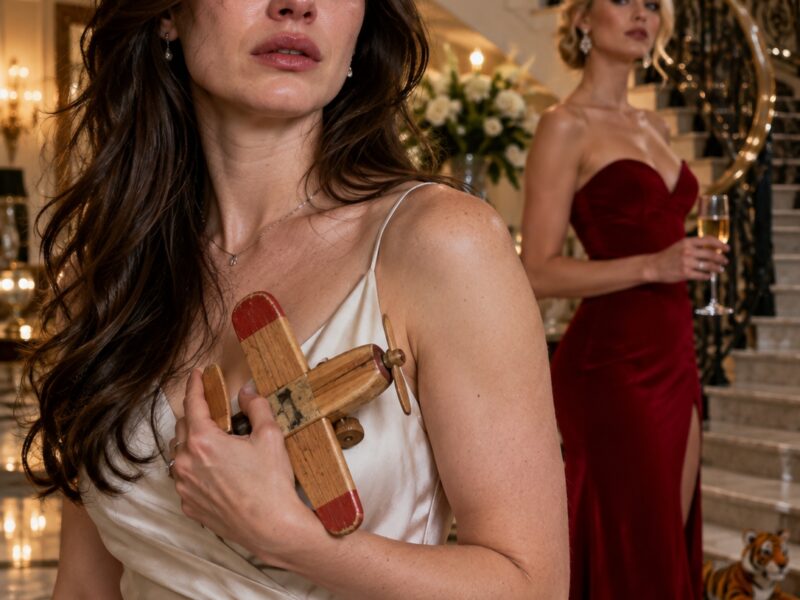
MY SON TOLD ME TO LEAVE SO HIS FATHER COULD GIVE MY PLACE TO ANOTHER WOMAN—FOUR YEARS LATER, HE RAN INTO MY DAUGHTER’S SCHOOL CRYING, “THAT’S MY MOM”

The day my divorce became final, my seven-year-old son called another woman “Mom” in front of me.
Three hours later, I was sitting on a train with one suitcase, forty-three dollars in my checking account, and a promise that I would never trouble the Moretti family again.
I thought that was the cruelest thing that would happen to me that day.
I was wrong.
The train had barely cleared the city when a little girl sitting beside me tugged on my sleeve and whispered, “Miss… my mommy got off the train without me.”
That was how I lost one child.
And found another.
My name is Ivy Hart.
Four years earlier, I had been Ivy Moretti.
People in Chicago knew the Moretti name even if they pretended they didn’t. It was the kind of name that changed a maître d’s expression, made cops suddenly become polite, and caused businessmen to reconsider sentences before finishing them.
Old money.
Older enemies.
Restaurants, construction firms, shipping companies, real estate, political favors, and other businesses people knew better than to ask too many questions about.
And Luca Moretti had been born at the center of it.
I had not.
I grew up in a small town where everybody knew who planted tomatoes too early and whose dog had gotten loose overnight. My grandmother raised me in a weather-beaten white house with a sagging porch, six apple trees, and a kitchen table my grandfather had built before I was born.
The Morettis entered our lives because of something that happened decades before me.
When Luca’s grandmother, whom everyone called Nona, was young, she had been caught in a violent feud between two families. My grandmother helped get her home alive.
Nona never forgot.
Every Christmas afterward, a package appeared on our porch.
Sometimes expensive wine Grandma gave away because she didn’t drink.
Sometimes Italian pastries.
Sometimes cash hidden in an envelope that Grandma always sent back.
“You don’t put a price on doing the right thing,” she would say.
But when I was accepted into college in Chicago, Grandma finally asked the Morettis for one favor.
Look after Ivy.
That was all.
I was eighteen when I stepped out of Union Station dragging two suitcases and carrying a backpack so overloaded the zipper had split.
Luca Moretti was waiting beside a black SUV.
He was twenty.
Tall.
Dark hair.
Black coat.
A phone in one hand.
Two men in suits stood several feet behind him, and even at eighteen I understood they weren’t friends from college.
Luca glanced up.
“You Ivy?”
That was our romantic beginning.
Two words.
Not exactly Shakespeare.
“Yes.”
He looked at my suitcases.
“You moving into the entire university?”
“I like options.”
For half a second, the corner of his mouth moved.
Then he took the heavier suitcase.
I fell in love with him sometime between that moment and the next four years.
Luca did not fall in love with me.
Not then.
There was already Serena DeLuca.
Beautiful Serena.
Elegant Serena.
Serena, whose father played golf with Luca’s father and whose mother had been Nona’s closest friend for twenty years.
She and Luca had grown up together.
Their relationship seemed impossible to define from the outside.
They fought.
Separated.
Reconciled.
Ignored each other for months.
Then Serena would appear at a Moretti charity gala wearing Luca’s jacket, or Luca would leave some party because Serena had called.
Everyone assumed they would eventually marry.
Including me.
Especially me.
So I stayed in my lane.
I studied computer science.
Worked internships.
Called Grandma every Sunday.
Accepted the occasional groceries or winter coat Nona insisted on sending me.
And loved Luca quietly enough that I could pretend it wasn’t happening.
Sometimes the Morettis asked him to bring something to me.
That was how we became friends.
Or something close to friends.
He would drop off a package and stay ten minutes.
Then twenty.
Then sometimes an hour.
Luca was surprisingly easy to talk to when no one else was around.
He hated loud restaurants.
He drank coffee black.
He secretly liked old westerns.
He remembered everything people said even when he acted like he wasn’t listening.
By junior year, I had landed an internship at a software company on the opposite side of Chicago.
The commute was brutal.
One afternoon Luca found me half asleep in a campus café.
“You look terrible.”
“Thank you.”
“Compliment.”
“I’d hate to hear your insults.”
He sat across from me.
“What’s wrong?”
I told him about the commute.
Nothing happened.
At least, I thought nothing happened.
Three days later Nona called.
“We have an apartment twelve minutes from your office.”
“I can’t afford a Moretti apartment.”
“I didn’t ask whether you could afford it.”
“Nona—”
“It is empty.”
I should have refused.
Instead I moved in.
Only after unpacking did I realize Luca used the apartment sometimes.
His books were there.
His coffee.
Two jackets.
A watch in the bedroom drawer.
I called him immediately.
“I can leave.”
“Why?”
“Because this is your apartment.”
“I have six.”
I went silent.
Luca sighed.
“Ivy, stay.”
So I did.
I took the guest room.
I kept my shampoo in a toiletry bag.
I wiped the kitchen counter after every meal.
I lived as though leaving no evidence of myself might somehow make my feelings harmless.
Then Serena broke Luca’s heart.
I never knew exactly what happened.
Nobody told me.
One night I came home after eleven and found him asleep—or passed out—on the couch.
An empty whiskey glass sat on the floor.
“Luca?”
No response.
I stood there longer than I should have.
Then I got a blanket.
The moment I leaned over him, his eyes opened.
“Ivy?”
“Yes.”
His voice was rough.
“You shouldn’t be here.”
“I live here.”
He stared at me.
Something in his expression changed.
He reached for me.
I should have stepped away.
I didn’t.
What happened afterward was messy, adult, consensual, and impossible to take back.
In the morning Luca remembered.
That somehow made it worse.
He sat on the edge of the bed with both hands clasped between his knees.
“Ivy.”
“I know.”
“I was drunk.”
“I know.”
“Serena and I—”
“I know.”
He looked at me then.
Maybe he saw how hard I was trying not to break.
He stopped talking.
I dressed.
Went to work.
And spent the next six weeks pretending nothing had happened.
Then I discovered I was pregnant.
Leo changed everything.
Nona cried when she found out.
Luca’s father stared at Luca for a full thirty seconds before leaving the room.
Serena disappeared from our lives.
And Luca asked me to marry him.
Not romantically.
There was no restaurant.
No candlelight.
No knee on the floor.
He came to my apartment, put a ring box on the table, and said, “Our child deserves stability.”
I stared at the box.
I knew exactly what he was offering.
Responsibility.
Protection.
A surname.
Everything except the one thing I wanted.
“Do you love me?”
His jaw tightened.
That should have been my answer.
Instead he said, “I will take care of you.”
At twenty-two, I convinced myself that love could grow where duty had been planted.
So I said yes.
For a while, I almost believed I had been right.
Leo was born during a thunderstorm.
Luca held him before I did because I was shaking too badly.
I remember watching this powerful, frightening man cradle a seven-pound baby like Leo was made of glass.
Something changed in Luca that night.
He kissed my forehead.
“You did good.”
Three words.
I treasured them for years.
The Moretti mansion never became my home.
It was too polished.
Too quiet.
Too full of people who knew Serena had been supposed to occupy my chair.
At family dinners, nobody insulted me.
They didn’t need to.
Politeness can be colder than cruelty.
But Leo loved me.
When he was two, he refused to sleep unless his fist was tangled in my shirt.
When he was three, he followed me everywhere.
If I closed the bathroom door, his fingers appeared underneath it.
“Mommy?”
“I’m here.”
“You coming back?”
“Yes.”
“Promise?”
“Promise.”
I never understood why he needed that reassurance.
Until years later.
Luca was gone often.
Business.
Meetings.
Trips.
Problems nobody explained.
So Leo became my world.
When he got pneumonia, I slept beside his hospital bed for three nights.
When he wanted a wooden airplane he had seen in an old movie, I tried building one myself.
I sliced my palm open with a carving knife.
Leo cried harder than I did.
“Mommy hurt!”
“Mommy’s fine.”
He kissed the bandage.
I thought nothing could make that little boy stop loving me.
Then Serena came back.
At first, she was simply around.
A charity dinner.
Nona’s birthday.
Christmas.
Serena had a gift for making herself seem inevitable.
She never openly challenged me.
That would have been crude.
Instead she remembered which wine Luca preferred.
She knew childhood stories I had never heard.
She understood family jokes before anyone explained them.
And Leo adored her.
Serena never told him no.
Candy before dinner?
Of course.
Another toy?
Why not?
Stay up until midnight?
Daddy won’t mind.
I became the parent who said brush your teeth.
Finish your vegetables.
Do your homework.
No more candy.
Serena became Disneyland in heels.
I tried not to compete.
A mother shouldn’t have to audition for her own child.
But children don’t understand sacrifice.
They understand who gives them what they want.
Slowly, Leo changed.
“Serena lets me.”
“Serena says it’s okay.”
“Serena said you’re too strict.”
At first I laughed.
Then I stopped laughing.
One afternoon I caught him hiding chocolates under his pillow.
“Leo.”
His little face hardened.
“Give them to me.”
“No.”
“You already had enough.”
“Serena bought them.”
“That doesn’t matter.”
His eyes narrowed.
“I hate you.”
Every parent hears those words eventually.
That’s what I told myself.
Then Luca walked into the room.
“What happened?”
“She took my candy.”
Luca looked at me.
“It’s just candy.”
“He’s already had enough sugar to make himself sick.”
“Then let him learn.”
“He’s six.”
Luca shrugged.
Leo saw it.
Children always see where power lives.
The next time I said no, he looked past me toward his father.
And Luca overruled me again.
Tiny fractures.
That was how our family broke.
Not one explosion.
A thousand hairline cracks.
Then came the day that finished me.
Luca took Leo out.
Serena went with them.
I wasn’t invited.
They returned after dark.
Leo came running into the foyer carrying a huge stuffed tiger.
“Look!”
I smiled despite myself.
“Wow. Where did you get that?”
“Serena won it for me.”
“That’s nice.”
“She’s better than you.”
My smile disappeared.
“Leo.”
“She lets me do everything.”
He hugged the tiger.
Then, with the casual cruelty only a child can manage, he said, “I don’t want you to be my mom anymore.”
I thought I had misheard him.
“What?”
“I want Serena to be my mom.”
Luca stopped behind him.
Serena stood beside Luca.
Nobody spoke.
Leo looked directly at me.
“You don’t deserve to be my mom.”
My heartbeat became strangely slow.
“Leo, don’t say things you don’t understand.”
“I understand.”
“No, you don’t.”
“Get out.”
Serena finally moved.
“Leo—”
He jerked away from her.
“This is my house!”
I looked at Luca.
That was the moment that mattered.
Not what a six-year-old said.
What his father did.
Luca stood there.
Silent.
He didn’t tell Leo to apologize.
He didn’t come to me.
He didn’t say, This is your mother’s home too.
Nothing.
I understood the truth in his silence.
I had spent years trying to earn a place nobody had ever intended to give me.
That night I slept in the guest room.
Three months later, I filed for divorce.
Luca didn’t fight it.
That hurt more than if he had.
The Moretti attorneys handled everything quickly.
I asked for almost nothing.
No house.
No settlement worth mentioning.
No company shares.
Only a simple child-support arrangement structured through Luca’s account so I could continue contributing to Leo’s expenses.
Everyone thought that was ridiculous.
Maybe it was.
But I had spent years being accused—quietly, elegantly—of marrying above myself.
I wasn’t leaving with their money.
On the morning the divorce became final, the butler called as my train was preparing to leave.
“Mrs. Moretti—”
“It’s Hart now.”
A pause.
“Ms. Hart. You still have belongings at the house.”
“Throw them away.”
“Madam—”
“All of them.”
Another silence.
Then he lowered his voice.
“Young Master Leo has been crying for his mother.”
I closed my eyes.
Through the train window, Chicago blurred beneath a gray morning.
“He’ll have another mother soon enough.”
“Ms. Hart…”
“The one he’s always wanted.”
My throat tightened.
Leo truly was Luca’s son.
They both wanted Serena.
For years I’d wondered why I wasn’t enough.
That morning I finally stopped asking.
“Tell Mr. Moretti he can stop worrying,” I said.
“About what?”
“That I won’t bother him again.”
The conductor announced departure.
“Not as long as I live.”
I hung up.
Removed the SIM card.
Dropped it into the station trash can.
And boarded the train.
The little girl beside me was maybe four.
Dark hair.
Serious eyes.
Her mother spent most of the ride shouting into her phone.
The girl never complained.
Never asked for anything.
I noticed because Leo had never spent ten quiet minutes in his life.
I put on headphones.
Closed my eyes.
And sometime later felt a tiny hand tugging my sleeve.
“Miss?”
I opened my eyes.
The aisle seat was empty.
The little girl looked at me.
“My mommy’s gone.”
I sat up.
“What do you mean?”
“She got off.”
“When?”
The girl’s lower lip trembled.
“I don’t know.”
I found the conductor.
Then transit police.
They checked cameras and confirmed what none of us wanted to believe.
Her mother had gotten off several stations earlier.
Alone.
Worse, footage showed the woman looking back repeatedly before leaving the platform.
Making sure her daughter hadn’t followed.
Passengers began whispering.
“What kind of mother—”
“Poor thing.”
“Heartless.”
The little girl heard everything.
She didn’t cry.
That was what broke me.
A four-year-old should cry when her mother disappears.
This child sat perfectly straight with both hands folded in her lap, as though abandonment was something she had prepared for.
I crouched in front of her.
“What’s your name?”
She hesitated.
The police officer told me later that the child gave conflicting answers.
They found no reliable identification.
No family member could immediately be located.
At the next station, child services would take custody.
I looked at that tiny face.
Then I heard myself say, “Can she stay with me temporarily?”
The officer blinked.
“Ma’am?”
“I have identification. A permanent address. You can verify everything.”
“Do you know this child?”
“No.”
“Then why?”
I looked at her.
Because somebody should choose her.
I didn’t say that.
I simply answered, “Because she’s alone.”
By the time I arrived in my hometown, I had the same suitcase, the same nearly empty bank account, and one unexpected passenger holding my hand.
Eventually, I called her Joy.
It felt like a ridiculous name at first.
There was nothing joyful about either of us.
But perhaps that was why I chose it.
No relative came.
No mother returned.
Six months later, after investigations, home visits, background checks, and court hearings, a judge signed the adoption papers.
Joy Hart.
My daughter.
The first night it became official, she stood in the doorway of my bedroom wearing pajamas covered in little yellow stars.
“Mom?”
The word hit me so hard I couldn’t answer immediately.
“Yes?”
“Why did you pick me?”
I swallowed.
She stared at the floor.
“I’m a kid nobody wanted.”
I got out of bed.
Kneeled.
“That’s not true.”
“My other mom left me.”
I couldn’t lie.
So I touched her hair.
“I was lonely.”
She looked up.
“So was I.”
“Maybe we found each other because we were both tired of being lonely.”
Joy considered that.
Then I asked, “Will you stay with me?”
“How long?”
“As long as you want.”
She thought very seriously.
“Forever?”
My voice cracked.
“If you want.”
She nodded hard.
“Okay. Forever.”
Life became small.
And beautiful.
I cleaned Grandma’s overgrown yard.
Planted tomatoes.
Restored the apple trees.
Hung Grandpa’s photograph above the fireplace.
I had studied computer science because at eighteen I wanted skyscrapers, promotions, money, and a life impressive enough to prove leaving home had been worthwhile.
At twenty-seven, I opened a tiny restaurant.
Six tables.
One chalkboard menu.
I cooked.
I served.
I washed dishes.
Somehow tourists discovered us.
Then someone posted a video.
Suddenly people were driving forty miles for my chicken pot pie and rosemary bread.
Joy grew.
Preschool.
Kindergarten.
First grade.
She remained serious.
Observant.
Too mature.
Once I got the flu, and I woke to find six-year-old Joy standing on a stool heating canned soup.
“What are you doing?”
“You’re sick.”
“You’re going to burn yourself.”
“I used the small burner.”
“Joy.”
She sighed like a forty-year-old accountant.
“You need to eat, Mom.”
I laughed until I cried.
Sometimes I thought about Leo.
Usually at night.
I wondered whether he still hated vegetables.
Whether he’d lost his front teeth.
Whether Serena had become his mother.
I never contacted him directly.
I kept sending the agreed support payment every month.
I told myself that was enough.
Four years passed.
Then one Tuesday afternoon, Joy’s school called.
“Ms. Hart?”
“Yes?”
“This is Mrs. Bennett.”
My stomach tightened automatically.
“Is Joy okay?”
“She is physically fine.”
Nobody says physically fine when things are fine.
“What happened?”
“There was an altercation.”
“With Joy?”
“Yes.”
I actually checked the phone screen.
“Joy Hart?”
The teacher almost laughed.
“Yes.”
Joy didn’t fight.
Joy barely participated in arguments because, according to her, most children “didn’t have enough evidence.”
I drove to school.
Mrs. Bennett met me near the entrance.
“The other student is new.”
“What happened?”
She hesitated.
“Mrs. Bennett.”
“The boy saw a photograph Joy keeps in her pencil case.”
A photo of Joy and me at the county fair.
“So?”
“He accused her of stealing his mother.”
I stopped walking.
The hallway seemed to tilt.
“What did you say?”
Mrs. Bennett’s expression changed.
“His name is Leo.”
My lungs forgot how to work.
No.
There were thousands of Leos.
Millions, probably.
Then she added quietly, “His father is here.”
I already knew.
The office door opened.
Joy sat at a small table doing homework, one knee bouncing beneath the chair.
She was angry.
Across the room stood a boy.
Eleven now.
Taller.
Dark hair.
Luca’s eyes.
My mouth went dry.
Leo saw me.
Everything in his face changed.
“Mom!”
He ran.
I caught him instinctively.
His arms went around me.
For one terrible second, my body remembered him before my mind could protect me.
His baby smell.
His feverish forehead.
Tiny fingers under the bathroom door.
Mommy, you coming back?
Then I remembered.
I want Serena to be my mom.
Get out.
This is my house.
I gently removed his arms.
“Hey, kiddo.”
Leo stared at me.
I forced a smile.
“You’ve got the wrong person.”
His face collapsed.
I looked over his shoulder.
Luca stood by the window.
Older.
Harder.
Still devastatingly familiar.
Our eyes met.
Neither of us moved.
I walked to Joy.
Put her books in her backpack.
Then faced Luca.
“Hello.”
His jaw tightened.
“I’m Joy Hart’s mother.”
I saw the blow land.
Good.
Joy walked toward me.
Leo grabbed my sleeve.
“Mom, wait.”
I looked down.
He had tears in his eyes.
“Please don’t be mad.”
I touched his hair because some reflexes survive even divorce.
“I’m not mad.”
“I know I was wrong.”
My fingers froze.
Across the room, Luca watched me.
There was too much history in that silence.
I turned to Joy.
“Go wait at the restaurant.”
Joy looked at Leo.
Then Luca.
Then me.
“Are you sure?”
“Yes.”
She slung her backpack over one shoulder.
As she passed Leo, he whispered, “She’s my mom.”
Joy stopped.
“No.”
Her voice was cold.
“She’s mine.”
Then she walked out.
Luca and I stood alone at the end of the hallway.
Late-afternoon sunlight filled the windows.
Four years.
Four years, and the first thing I wanted to ask was whether he still drank his coffee black.
I hated myself for that.
Luca broke the silence.
“You wanted to talk.”
“What have you been telling Leo?”
His eyebrows drew together.
“About what?”
“Me.”
“Nothing.”
“We’ve been divorced four years.”
“I know.”
“I disappeared exactly the way you wanted.”
His eyes sharpened.
“I never said I wanted you to disappear.”
“You didn’t have to.”
“Ivy—”
“I send money every month. I don’t call. I don’t visit. I don’t interfere with Serena or whatever life you’ve built.”
His face changed at Serena’s name.
I noticed.
I hated that I noticed.
“Children forget,” I continued. “Especially young children. Leo barely wanted me when I lived with him. He wouldn’t remember me this clearly unless somebody kept reminding him.”
Luca looked toward the window.
That told me I was right.
“Who?”
“Nona.”
Of course.
I almost laughed.
“And the transfer?”
He didn’t answer.
“Luca.”
“He asked.”
“You transferred the heir to the Moretti family from Chicago to a public school in a town with one stoplight because an eleven-year-old asked?”
“He didn’t ask.”
Luca finally looked at me.
“He refused to stop asking.”
Something uncomfortable moved through my chest.
I crushed it.
“He’ll get bored.”
“Ivy.”
“He will.”
“You don’t know him anymore.”
“And he doesn’t know me.”
I picked up my purse.
“Once he spends enough time around me, he’ll remember why he wanted me gone.”
Luca stared at me.
“Is that what you think happened?”
I stopped.
“What is that supposed to mean?”
But he was already shutting down.
The old Luca.
A locked door wearing a human face.
“Nothing.”
I laughed once.
“Still excellent at communication.”
I walked away.
The next afternoon, Leo appeared at my restaurant.
Two bodyguards waited outside.
He sat at table six.
The same table he chose the next day.
And the day after that.
He did his homework quietly.
Ordered apple juice.
Watched me work.
I didn’t ask him to leave.
I also didn’t mother him.
When he wanted dessert before dinner, I said, “Ask your father.”
“I want to ask you.”
“Why?”
“Because you’re my mom.”
I kept wiping the counter.
“You have a father.”
“I know.”
“Then ask him.”
Leo’s voice became small.
“Do you hate me?”
My hand stopped.
“No.”
“Then why won’t you say you’re my mom?”
Because you taught me not to.
I didn’t say it.
Instead I told him, “Eat your dinner.”
He smiled.
The little manipulator.
“Okay.”
Joy hated the arrangement.
She didn’t throw tantrums.
That would have been easier.
She simply became quieter.
One evening, after Leo left, she helped me stack chairs.
“You like him.”
“He’s my son.”
“So?”
I looked at her.
Joy kept stacking.
“People leave children they don’t like all the time.”
That sentence made my chest ache.
I took the chair from her hands.
“Look at me.”
She refused.
“Joy.”
Finally she did.
“You are my daughter.”
“He’s your real kid.”
“So are you.”
“No. I mean real-real.”
I crouched.
“Blood isn’t the only thing that makes something real.”
“Then why do you look sad every time he leaves?”
Children.
They find the knife you hid and hand it back to you.
“Because I missed years of his life.”
Joy swallowed.
“Are you going back?”
“No.”
“To him?”
“No.”
“To his dad?”
“No.”
She searched my face.
“Promise?”
That word.
Again.
Always that word.
I took her hands.
“I promise nobody is replacing you.”
Joy nodded.
But she didn’t look convinced.
Neither was I.
Leo kept coming.
Then Luca started coming too.
Not every day.
Enough.
He sat near the window.
Ordered coffee.
Black.
Of course.
We barely spoke.
The townspeople noticed the expensive SUVs.
The men in suits.
The beautiful stranger who looked like he owned whatever room he entered.
Rumors spread.
I ignored them.
Then Serena arrived.
It was raining.
I was carrying a tray when the restaurant door opened.
She stepped inside wearing a cream trench coat.
Four years had barely touched her.
Leo stood so quickly his chair scraped the floor.
My stomach twisted.
Here it was.
The reunion I’d expected.
His real choice.
Serena smiled.
“Leo.”
He didn’t move toward her.
Her smile faltered.
“Sweetheart.”
Leo looked at me.
Then back at Serena.
“I told Dad I didn’t want you here.”
Silence fell across the restaurant.
Serena’s face went white.
Luca stood.
“Leo.”
“What?”
“Outside.”
“No.”
I set down the tray.
“Leo.”
He looked at me immediately.
“Go with your father.”
The obedience was instant.
Serena noticed.
So did Luca.
Leo walked outside.
Luca followed.
Serena and I were alone.
Almost.
Every customer in the restaurant suddenly became fascinated by their plates.
Serena removed her gloves.
“You look well.”
“So do you.”
“I heard you adopted.”
My body went cold.
“Her name is Joy.”
“She seems lovely.”
“She is.”
Serena studied me.
“I didn’t come to fight.”
“Then you drove three hours for terrible timing.”
“I came because Leo needs to stop blaming me.”
I almost smiled.
“For what?”
Serena looked toward the rain-streaked window.
“Did Luca never tell you?”
“No.”
She closed her eyes briefly.
“That sounds like him.”
Something inside me tightened.
“Tell me what?”
“After you left, Leo asked when I was moving in.”
I forced myself to breathe.
“And?”
“I told him I wasn’t.”
My fingers curled around the edge of the table.
“He said he wanted you as his mother.”
“He was six.”
“You encouraged it.”
Her eyes flashed.
“Yes.”
The admission stunned me.
Serena looked down.
“I liked being loved by him. I liked winning something from you.”
There it was.
Ugly.
Human.
Real.
“But I didn’t want Luca.”
I stared at her.
“You expect me to believe that?”
“I wanted him once.”
“Everyone knew.”
“Yes. And then we grew up.”
She looked at me.
“Luca never told you why we ended?”
“No.”
“I cheated on him.”
The restaurant noise disappeared.
“At twenty-one. Once. He found out. We tried to repair it, but he never trusted me again.”
“Then why were you always around?”
“Our families.”
She gave a humorless smile.
“And because sometimes two people are too proud to admit something is dead.”
I thought about every dinner.
Every glance.
Every insecurity.
“You let me believe—”
“Ivy, Luca let you believe.”
That hurt worse.
Serena continued.
“After you left, Leo kept asking when I would marry Luca. Eventually I told him the truth.”
“What truth?”
“That his father didn’t love me.”
My throat tightened.
Serena watched me carefully.
“And that I was never the reason his mother left.”
I couldn’t speak.
“He didn’t understand.”
She took a breath.
“So I explained it in words a child could understand.”
“What did you tell him?”
“That his mother left because everyone in that house—including him—made her believe she wasn’t wanted.”
I stood very still.
Outside, Leo was arguing with Luca under the awning.
Serena’s voice softened.
“He remembered what he said to you.”
No.
“He started having nightmares.”
No.
“He would wake up crying that you were gone because he told you to leave.”
“Stop.”
“He asked Luca to find you.”
“Stop.”
“Luca refused at first.”
That made me look at her.
“Why?”
Serena’s mouth tightened.
“Because you asked to be left alone.”
The anger came fast.
“How noble of him.”
“It wasn’t noble.”
For the first time, bitterness entered Serena’s voice.
“He was terrified.”
“Of me?”
“Of what you’d say if he found you.”
I laughed.
“He has never been afraid of anything in his life.”
“He was afraid you’d tell him you were happy without him.”
The door opened.
Luca stood there.
Rain on his shoulders.
His expression told me he had heard enough.
Serena picked up her gloves.
“Tell her the rest.”
“Serena.”
“No.”
She faced him.
“You’ve hidden behind silence long enough.”
Then she walked out.
I stared at Luca.
“The rest?”
He said nothing.
Of course.
I grabbed my coat.
“Get out.”
“Ivy.”
“Get out of my restaurant.”
Leo appeared behind him.
“Mom?”
I froze.
His face was wet.
Rain or tears.
Maybe both.
“I heard Serena.”
My anger vanished.
Leo stepped inside.
“I made you leave.”
“No.”
“Yes.”
He started crying.
“I told you to get out.”
I crossed the room before I could think.
He backed away.
“I didn’t mean it.”
“Leo—”
“I was stupid.”
“You were six.”
“I wanted candy!”
A broken laugh escaped me.
He sobbed harder.
“I thought Serena was better because she let me do anything. I didn’t know moms are supposed to say no.”
Something inside me shattered.
Leo pressed both hands over his face.
“When you didn’t come back, I waited.”
I couldn’t breathe.
“I thought you’d come home when you stopped being mad.”
He looked at me.
“Then Dad said you weren’t coming.”
I turned toward Luca.
His face was stone.
Leo continued.
“I asked if you died.”
Oh God.
“Nona showed me pictures.”
His shoulders shook.
“She told me stories about you because I was scared I’d forget your face.”
I knelt.
“Leo.”
“I remembered.”
He threw himself at me.
This time I hugged him.
Really hugged him.
My son had gotten so tall.
His arms could reach all the way around my shoulders.
“I remembered you,” he cried.
I closed my eyes.
“I know.”
“No, you don’t.”
He pulled back.
“I remember when I was sick and you slept on the floor.”
My tears came.
“I remember the airplane.”
“Leo…”
“I still have it.”
That destroyed me.
The ugly wooden airplane.
My blood dried beneath one wing because I’d cut my hand making it.
He still had it.
“I wanted to find you before,” he whispered. “Dad wouldn’t let me.”
I looked at Luca.
Leo immediately corrected himself.
“He said you wanted us to leave you alone.”
That was true.
Damn him.
“I kept asking.”
Leo wiped his face.
“Then last year I found the bank transfers.”
My heart stopped.
“What transfers?”
“The money you sent.”
Luca closed his eyes.
Leo continued.
“I thought you forgot me.”
“I never—”
“I thought you didn’t care.”
“Leo, no.”
“Then I saw your name every month.”
His voice broke.
“You didn’t forget.”
I pulled him against me.
“No.”
Four years of pain collapsed into one word.
“No.”
That night Leo stayed for dinner.
Joy barely spoke.
Afterward I found her sitting beneath the apple tree behind our house.
I sat beside her.
“You hugged him.”
“Yes.”
“For a long time.”
“Yes.”
She picked grass between her fingers.
“Are you his mom now?”
“I always was.”
Her face tightened.
“And mine?”
“Yes.”
“You can’t be both.”
“Why?”
“Because people pick.”
I understood then.
Joy wasn’t jealous of Leo.
She was back on that train.
Four years old.
Watching her first mother make a choice.
“Come here.”
She didn’t.
So I moved closer.
“Joy, look at me.”
Her eyes were wet.
“You didn’t get me because Leo disappeared.”
She blinked.
“You didn’t replace him.”
“But—”
“And Leo doesn’t replace you.”
“What if he wants you back?”
“He doesn’t own me.”
“What if his dad wants you back?”
I almost laughed.
Then I saw how serious she was.
“That doesn’t matter.”
“Why?”
“Because I’m not luggage.”
Joy sniffed.
“You kind of have a lot of luggage.”
I laughed.
She smiled despite herself.
Then I opened my arms.
Joy climbed into them.
For several minutes we sat beneath the tree.
Two people who had been abandoned in different ways.
Two people who had promised forever.
The next morning, Luca was waiting outside my restaurant before sunrise.
I nearly locked the door again.
“We need to talk.”
“I’ve heard that before.”
“About the divorce.”
“No.”
“Ivy.”
“No.”
“You believe I didn’t fight because I wanted you gone.”
“You signed everything in forty-eight hours.”
“Because my attorney told me fighting would keep you trapped.”
I stared at him.
“You could have spoken to me.”
“Yes.”
One word.
No defense.
“Yes.”
That surprised me.
He looked exhausted.
“I should have.”
“That’s four years late.”
“I know.”
I unlocked the restaurant.
He followed.
“Coffee?”
I stopped.
“What?”
“I’ll make it.”
“You don’t know how to use my machine.”
“I can operate an espresso machine.”
“You own people who operate espresso machines.”
His mouth twitched.
It almost made me angry.
Almost.
We sat in the empty restaurant.
Luca placed something on the table.
A small wooden airplane.
My breath caught.
One wing was crooked.
The nose was too blunt.
A dark stain remained beneath the left wing.
My blood.
“Leo wouldn’t let anyone throw it away,” Luca said.
I touched it.
“You kept this?”
“He did.”
“Why bring it?”
“Because there’s something else you don’t know.”
I looked up.
Luca’s expression had changed.
“After the divorce, Leo stopped speaking for almost two months.”
I stared at him.
“What?”
“Not completely. He answered teachers. Nona sometimes. But not me.”
“You never told me.”
“You changed your number.”
“You knew where I was.”
“No.”
I frowned.
“The Morettis can find anyone.”
“Yes.”
“Then don’t lie.”
“I knew how to find you.”
He held my gaze.
“I chose not to.”
“Why?”
“Because you told the butler I could stop worrying. That you would never trouble me again.”
“That wasn’t permission to erase me from my son’s life.”
“I know.”
His voice dropped.
“I thought you hated us.”
I laughed bitterly.
“So you protected yourself.”
“Yes.”
Again.
No excuse.
Just yes.
That was somehow harder to hate.
“I was angry,” he said. “And ashamed.”
“You?”
“Ivy, the last time you looked at me in our house, Leo had just told you to leave.”
His jaw tightened.
“And I stood there.”
Finally.
The sentence I’d waited years to hear.
“You did.”
“I kept thinking I would fix it later.”
“Later.”
“I thought I’d talk to Leo. Then you. Then Serena. Then somehow put everything back where it belonged.”
“Families aren’t furniture, Luca.”
“I know that now.”
“You knew it then.”
He didn’t argue.
Outside, dawn was beginning to color the street.
“I loved you.”
The words were so quiet I almost missed them.
I looked at him.
“No.”
“I did.”
“No.”
“Ivy—”
“You married me because I was pregnant.”
“Yes.”
“You were in love with Serena.”
“No.”
“You couldn’t even answer me when I asked whether you loved me.”
“Because I didn’t know.”
I laughed.
“How convenient.”
“I knew how to protect people. Provide for them. Control problems. I didn’t know how to say what I felt.”
“Then maybe you didn’t feel it.”
He stared at the airplane.
“After you left, I slept in the guest room.”
I went silent.
“The room you used when you first moved into my apartment.”
“Why?”
“Because it was the only place in that house that didn’t feel like I’d failed you.”
My anger shifted.
Not gone.
Never that easily.
But shifted.
“Why Serena?”
“She was familiar.”
“You chose her constantly.”
“I chose avoiding conflict.”
“That is a choice.”
“Yes.”
“And every time you undermined me with Leo?”
“A choice.”
“Yes.”
“And when he told me to get out?”
Luca looked at me.
“The worst one I ever made.”
Silence.
Then the kitchen timer rang.
Life has terrible timing.
I stood.
“I have bread in the oven.”
“Ivy.”
“I heard you.”
“That’s all?”
“What do you want?”
“I don’t know.”
For once Luca Moretti genuinely looked lost.
I opened the kitchen door.
“Good.”
His brow furrowed.
“You spent years making everyone else live with uncertainty.”
I looked back.
“Maybe it’s your turn.”
Leo stayed in town.
The Morettis rented a house nearby.
Apparently “rented” meant buying an eight-bedroom property through a holding company because Luca considered normal leases inefficient.
Leo came to my restaurant every afternoon.
At first, he tried too hard.
He cleared dishes without being asked.
He complimented every meal.
He agreed with everything I said.
One afternoon I caught him eating broccoli with the expression of a condemned prisoner.
“You hate broccoli.”
“No, I don’t.”
“You’ve hated it since you were two.”
“I love broccoli.”
“Leo.”
He swallowed heroically.
“It’s my favorite.”
I put down my fork.
“Stop.”
Fear flickered in his eyes.
My heart broke.
“You don’t have to earn me.”
His lips parted.
“You don’t have to be perfect so I won’t leave.”
He looked down.
“I wasn’t perfect before.”
“You were a child.”
“I was mean.”
“You were six.”
“I hurt you.”
“Yes.”
He flinched.
I reached across the table.
“You did hurt me.”
His eyes filled.
“But parents aren’t supposed to make children spend the rest of their lives paying for something they said at six.”
He whispered, “You’re not mad?”
“I’ve been mad.”
“At me?”
“At everyone.”
“Still?”
“Sometimes.”
“Will you leave?”
“No.”
“Promise?”
There it was again.
I squeezed his hand.
“I promise I won’t disappear without telling you.”
He frowned.
“That’s not the same.”
“No.”
“Why can’t you promise forever?”
Because I had learned something Joy and Leo had not.
Forever is not a time period.
It is a promise people make when they’re terrified of change.
So I told him the truth.
“I can’t promise nothing will ever change. I can promise you will never have to wonder whether I love you.”
Leo thought about that.
Then nodded.
“Okay.”
Joy and Leo became something like siblings.
Not easily.
Joy remained suspicious.
Leo remained spoiled.
He complained that our Wi-Fi was slow.
Joy told him, “Read a book.”
He asked why our television wasn’t bigger.
She said, “Because we have windows.”
He brought a gaming console.
She beat him at every game.
Their first real breakthrough happened when another student asked Joy whether Leo was her boyfriend.
Joy looked horrified.
Leo said, “Gross. She’s my sister.”
Joy stared at him.
Later that night, she pretended the comment meant nothing.
But I saw her smiling while brushing her teeth.
Nona arrived two weeks later.
She was eighty now.
Smaller than I remembered.
Still terrifying.
She walked into my restaurant using a silver cane and immediately criticized the curtains.
“They make the room dark.”
“Hello to you too.”
She hugged me.
Hard.
Then slapped my arm.
“Ow.”
“You disappeared.”
“You knew where I was.”
“I respected your wishes.”
“Apparently that’s a Moretti family disease.”
She laughed.
Then cried.
So did I.
Nona stayed until closing.
She told me things Luca never had.
Leo had kept my photograph under his pillow.
He’d asked every birthday whether I might call.
He had once packed a suitcase because he thought he could walk to my hometown.
“You let me believe he hated me.”
Nona looked ashamed.
“I thought Luca would fix it.”
“That was your first mistake.”
“Yes.”
“Your second?”
“Trusting men.”
I laughed despite myself.
Then she took my hand.
“Ivy, there is one thing you misunderstand.”
I sighed.
“Please don’t tell me Luca loved me.”
“He did.”
“Nona.”
“I didn’t say he deserved you.”
That silenced me.
She squeezed my fingers.
“Love is not absolution.”
I looked at her.
“A man can love you and still fail you.”
That sentence stayed with me.
Because for years I’d needed Luca not to love me.
If he didn’t love me, everything made sense.
If he had loved me…
Then love alone had never been enough.
That was harder.
Winter arrived.
Leo divided his time between Chicago and our town.
Joy learned to tolerate bodyguards.
I learned that Serena had moved to Boston and gotten engaged to a pediatric surgeon.
Luca stopped trying to talk about us.
Instead, he simply existed nearby.
He fixed the loose porch railing.
I told him I could hire someone.
“I know.”
He repaired it anyway.
He started bringing groceries.
I made him take them home.
He started ordering takeout from my restaurant instead.
Technically harder to reject.
Infuriating man.
Then, one January night, everything changed again.
Leo disappeared.
I received Luca’s call at 9:17 p.m.
“Ivy.”
One word.
I knew.
“What happened?”
“He’s gone.”
My blood turned cold.
“What do you mean gone?”
“He left the house.”
“Bodyguards?”
“He waited for shift change.”
Of course he did.
Moretti child.
“Phone?”
“Here.”
“Why would he leave?”
Silence.
“Luca.”
“We argued.”
“About what?”
“You.”
I closed my eyes.
“What did you say?”
“He asked when we were getting back together.”
Oh God.
“And?”
“I told him that wasn’t his decision.”
“Good.”
“He said it was my fault you weren’t coming home.”
My stomach dropped.
“What did you say?”
Luca hesitated.
“I told him he was right.”
“You idiot.”
“I know.”
I hung up.
Joy appeared in the hallway already wearing her coat.
“Leo?”
“Yes.”
“I’m coming.”
“No.”
“Mom.”
“No.”
She looked at me.
“He’s my brother.”
That word again.
Brother.
I exhaled.
“Get your boots.”
We searched everywhere.
Restaurant.
School.
Park.
Train station.
Then Joy suddenly said, “The apple tree.”
I looked at her.
“What?”
“When I’m scared you’re leaving, I sit under Grandpa’s apple tree.”
We drove home.
Leo was there.
Curled beneath the bare branches.
Snow dusted his coat.
I ran.
“Leo!”
He looked up.
“Mom?”
I grabbed him.
“You scared ten years off my life.”
“Sorry.”
“What were you thinking?”
He started crying.
“I ruined it again.”
“No.”
“You and Dad.”
“Leo—”
“If I hadn’t said those things when I was little, you’d still be married.”
I held his face.
“Listen to me.”
He shook his head.
“No.”
“Listen.”
Joy stood nearby.
Luca arrived seconds later.
I made Leo look at me.
“My divorce was not your fault.”
“But—”
“You were six.”
“I told you to leave.”
“And your father and I were adults.”
Luca stopped behind me.
I continued.
“We made mistakes. Big ones. Those belonged to us.”
“But if I hadn’t—”
“No.”
I kissed his forehead.
“A child cannot destroy a healthy marriage by asking for candy and saying something cruel.”
Leo sobbed.
“You didn’t leave because of me?”
“I left because I had forgotten who I was.”
He looked confused.
I smiled sadly.
“I loved you so much that I let losing your approval convince me I had no value.”
Joy stepped closer.
I looked at both children.
“That was my mistake.”
Leo leaned against me.
Then he whispered, “Are you ever going to love Dad again?”
Luca looked away.
I almost smiled.
“I never stopped.”
Luca’s head snapped toward me.
Leo’s eyes widened.
“But loving someone doesn’t mean you have to live with them.”
That disappointed him.
Good.
Children deserve truth more than fairy tales.
We walked back toward the house.
Luca stayed behind.
I knew he would.
After getting the children warm, I returned outside.
He was still beneath the tree.
“You meant it?”
“Yes.”
Snow fell between us.
“You still love me?”
“Yes.”
His eyes closed.
“But that’s not an invitation.”
“I know.”
“I’m not going back to Chicago.”
“I know.”
“I’m not becoming Mrs. Moretti again.”
“I know.”
“You don’t get to buy a house and wait until I surrender.”
“I know.”
I crossed my arms.
“Could you stop agreeing?”
“No.”
I laughed.
He smiled.
It was the first time in years I’d seen the young man from Union Station.
The one who had looked at my ridiculous luggage and asked whether I was moving into the entire university.
“What do you want, Luca?”
He took a long time answering.
“A chance to become someone you could choose.”
Not take me back.
Not forgive me.
Choose.
That mattered.
“What if I never do?”
“Then I’ll still be Leo’s father.”
“And?”
“And I’ll still fix your porch when you pretend it isn’t falling apart.”
“It wasn’t falling apart.”
“The railing came off in my hand.”
“You pulled too hard.”
He laughed.
I had forgotten that sound.
We didn’t reconcile that night.
Or the next month.
Life isn’t a movie.
Pain doesn’t disappear because someone finally says the correct sentence.
Luca returned to Chicago.
Then came back.
He went to therapy.
That shocked everyone.
Nona claimed it proved miracles existed.
He learned to apologize without adding explanations.
I learned that forgiveness and reconciliation were different things.
Leo learned mothers could say no and still love him.
Joy learned love could expand without dividing.
And I learned something too.
I had spent years believing I had been replaced.
By Serena.
By another life.
By the Moretti family.
But nobody had replaced me.
Not really.
Leo had been a confused child.
Luca had been a cowardly man.
Serena had been an insecure woman playing a role she didn’t truly want.
And I had been someone who believed love was something I had to earn by enduring enough pain.
A year after Leo first appeared at Joy’s school, I was closing the restaurant when Luca walked in.
“No bodyguards?”
“Outside.”
“Progress.”
He placed something on the counter.
A train ticket.
I stared at it.
Chicago to my hometown.
One way.
I looked up.
“What is this?”
“The ticket you took when you left.”
My heart stopped.
“You kept it?”
“The butler found it in paperwork from the divorce.”
He slid it toward me.
“I thought you should have it.”
I picked it up.
The paper was faded.
That ticket had once felt like proof that my life was over.
Now it looked incredibly small.
A rectangle of paper.
Nothing more.
Luca watched me.
“I have dinner with Leo tomorrow.”
“I know.”
“Joy invited herself.”
“I know that too.”
“She said I’m paying.”
“Smart girl.”
He turned toward the door.
“Luca.”
He stopped.
I looked at the ticket.
Then at him.
“Coffee?”
He didn’t move.
“Black?”
I asked.
His expression softened.
“Still remember?”
“Unfortunately.”
He came back.
I made two cups.
We sat at table six.
No promises.
No ring.
No dramatic declaration.
Just two people who had once loved each other badly learning whether they could someday do it better.
Through the front window, I could see Joy and Leo outside arguing over something.
Leo said something.
Joy shoved his shoulder.
He shoved hers back.
Then both started laughing.
I smiled.
“What?” Luca asked.
“Nothing.”
But it wasn’t nothing.
Four years earlier, I had boarded a train believing I had lost my family.
I had looked at a little abandoned girl and recognized something in her that I could not yet recognize in myself.
We had both been waiting for someone else to tell us we were worth keeping.
Joy taught me otherwise.
Leo eventually did too.
And maybe even Luca.
But most importantly, somewhere between that train ride and this little restaurant, I learned it for myself.
I folded the old ticket once.
Then again.
I walked to the trash can.
Luca watched silently as I dropped it inside.
“You sure?”
I looked at him.
“Yes.”
I didn’t need proof of the day I left anymore.
The woman who had boarded that train was gone.
She had believed being unwanted was the same as being unworthy.
She had believed losing a husband meant losing a future.
She had believed one child’s rejection could erase years of motherhood.
She had been wrong.
Outside, Leo opened the restaurant door.
“Mom!”
Both Joy and I answered.
“Yes?”
For one second, everyone froze.
Then Joy rolled her eyes.
Leo started laughing.
Luca laughed too.
And I stood behind the counter in my grandmother’s hometown, surrounded by a family that looked nothing like the one I’d once begged life to give me.
It was complicated.
Imperfect.
Sometimes painful.
But it was mine.
Leo came toward me holding the battered wooden airplane.
One wing had broken again.
“Can you fix it?”
I took it carefully.
The wood was worn smooth from years of small hands.
The dark stain beneath the wing was still there.
A scar from another life.
“I can try.”
Leo smiled.
“You always fix things.”
I looked at Luca.
Then Joy.
Then the old airplane.
“No,” I said softly.
“I don’t.”
Leo frowned.
I touched his cheek.
“Some things shouldn’t be fixed back into what they were.”
Luca understood before the children did.
His eyes met mine.
I smiled.
“Sometimes you build something new.”
Outside, snow began falling over the little town.
Joy complained that Leo had stolen her gloves.
Leo swore he hadn’t.
Luca found them in Joy’s own coat pocket.
I laughed until my stomach hurt.
And for the first time in a very long time, forever didn’t sound like a promise someone might break.
It sounded like an ordinary evening.
A warm restaurant.
Two children arguing near the door.
Coffee cooling across from me.
A crooked wooden airplane waiting to be repaired.
And four people who had finally stopped asking who belonged to whom.
We simply belonged.
Not because blood demanded it.
Not because marriage required it.
Not because an old family name said so.
Because after everything we had lost, misunderstood, and broken…
we were still there.
And this time, none of us was asking anyone else to leave.









