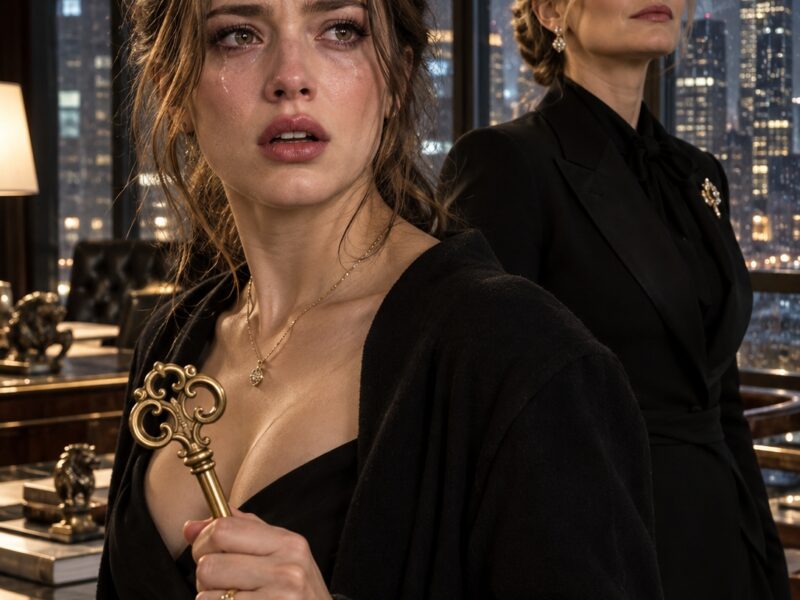
My Stepmother Inherited My Father’s Billion-Dollar Empire—He Left Me a Condemned House. Five Days Later, She Offered Me $50,000 to Give It Back.

When a billionaire dies, the vultures do not wait for the body to cool.
They hire lawyers.
They change locks.
They call emergency board meetings.
And sometimes, if they are very confident they have won, they make one small mistake.
My stepmother’s mistake was believing the worthless house my father left me was actually worthless.
I didn’t understand that on the afternoon his will was read.
All I understood was that my father had given her everything.
And left me a ruin.
Three days after Richard Caldwell died, I sat in a mahogany conference room sixty floors above Manhattan and listened to a lawyer explain how completely my father had erased me from his life.
Rain struck the floor-to-ceiling windows behind Thomas Abernathy’s desk.
Usually, the view from his office was spectacular—Lower Manhattan spreading beneath you in steel, glass, traffic, and money.
That afternoon, there was only gray.
Thomas had been my father’s attorney for nearly thirty years.
He had negotiated acquisitions with him.
Fought lawsuits beside him.
Drunk bourbon with him after impossible deals.
He had been at our house for Christmas more times than I could count.
And now he couldn’t look me in the eye.
That frightened me before he read a single word.
Across from me sat Victoria Caldwell.
My stepmother.
Forty-two years old. Immaculate. Controlled.
Twenty years younger than the man she had buried three days earlier.
She wore a black Dior mourning suit, pearl earrings, and the exact expression she had worn at the funeral: dignified grief performed with such precision that nobody could accuse her of enjoying herself.
Her eyes ruined the performance.
They were dry.
Beside her sat Harrison, her son from her first marriage.
He was scrolling through his phone.
My father was dead.
We were about to divide the remains of his life.
And Harrison was playing some game with the sound turned off.
I remember staring at his thumb moving across the screen.
For some reason, that tiny movement made me want to scream.
Thomas cleared his throat.
“Shall we begin?”
Victoria lowered her eyes.
“Please.”
I said nothing.
My hands were clasped so tightly in my lap that my fingernails had left half-moons in my palms.
Thomas began reading.
There were formal phrases first. Debts. Instructions. Charitable provisions. Funeral expenses.
Then came the part everyone had been waiting for.
“To my loving wife, Victoria Caldwell…”
Victoria did not move.
“…I leave the entirety of my controlling shares in Caldwell Global Shipping, my primary residence on Park Avenue, the coastal property in Nantucket, and the liquid assets held in my primary accounts.”
For several seconds, I thought I had misunderstood.
The rain continued hitting the windows.
Harrison looked up from his phone.
Not at me.
At his mother.
Victoria closed her eyes.
Just briefly.
Anyone else might have interpreted it as grief.
I saw relief.
Thomas kept reading.
The words began to lose shape.
Controlling shares.
Park Avenue.
Nantucket.
Primary accounts.
Caldwell Global Shipping.
The company.
That was the one that hurt.
My father had started Caldwell Global with one aging cargo ship, a borrowed office, and a payroll he once told me he had covered by selling his Corvette.
Thirty-eight years later, Caldwell ships entered ports on four continents.
Thousands of people worked for him.
Our name was painted on freighters longer than football fields.
For the last five years, he had been preparing me to take over the logistics division.
Not because I was his daughter.
He had made that painfully clear.
Because I had earned it.
I had spent nights in Newark terminals at two in the morning.
I had sat through labor negotiations.
I had learned manifests, insurance exposure, fuel hedging, customs compliance and every boring piece of machinery behind the glamorous word “shipping.”
Once, at 1:17 in the morning after an eighteen-hour day, Dad had pushed a cup of terrible coffee toward me and said, “One day, this chair is yours.”
I had laughed.
“Your chair smells like old leather and bad decisions.”
“Then make better decisions.”
That was my father.
He did not say I love you often.
He said things like that instead.
And now his will said Victoria got the chair.
Thomas continued.
“To my stepson, Harrison…”
Harrison finally locked his phone.
“…I leave the vintage automobile collection and the trust previously established in his name.”
Victoria touched Harrison’s knee.
He smiled.
Actually smiled.
Then Thomas stopped.
His eyes remained on the document.
I knew what came next.
My name.
Still, he hesitated.
That hesitation frightened me more than anything I had heard.
“And to my daughter, Genevieve Caldwell…”
He looked at me.
The pity in his face was unbearable.
“…I leave, in its entirety, the deed to Harrow Gate House in the Hudson Valley.”
Silence.
I waited.
Thomas turned the page.
There was nothing else.
I stared at him.
“That’s it?”
His jaw tightened.
“Genevieve—”
“That’s it?”
Victoria exhaled softly beside me.
“Oh, Genevieve.”
I turned toward her.
Her face had arranged itself into sympathy.
It almost made me hate her more.
“I’m so sorry,” she whispered. “Richard could be terribly sentimental.”
Harrow Gate House.
I knew the name.
Everyone in the family did.
My father had purchased it nearly twenty years earlier during a period when he had been buying distressed properties throughout New York.
Most had been renovated or resold.
Harrow Gate had been neither.
It was a decaying 1912 manor buried in the Hudson Valley woods.
The roof leaked.
The foundation had structural problems.
Historical-preservation restrictions made demolition nearly impossible.
Renovation would cost more than the building was worth.
The property had sat abandoned for years collecting taxes, violations, mold, and probably wildlife.
My father had just given Victoria a global shipping empire.
He had given me a condemned building.
I looked back at Thomas.
“Is there a trust attached to it?”
“No.”
“Maintenance fund?”
“No.”
“Money for the taxes?”
His silence answered before he did.
“No.”
I swallowed.
“How much?”
“Genevieve…”
“How much does the property owe?”
“A little over one hundred thousand dollars, including liens and penalties.”
Harrison gave a low whistle.
Victoria shot him a look.
He returned to his phone.
I felt strangely detached from my body.
Three days earlier I had stood beside my father’s coffin.
Now I was sitting in an attorney’s office discovering that the last legal act of his life had been to leave me debt.
Victoria stood.
“Well.”
She smoothed the front of her black skirt.
“I suppose that concludes things.”
Thomas looked up sharply.
“Victoria—”
“I’ll have my office coordinate the corporate transition.”
Then she turned toward me.
“Genevieve, I’ve instructed the Park Avenue staff to pack your belongings.”
I stared at her.
“What?”
“The apartment is mine now.”
“You’re throwing me out?”
“I wouldn’t use such an ugly phrase.”
“What phrase would you use?”
Her mouth tightened.
“I intend to renovate. It will be easier for everyone if you relocate.”
“My father died three days ago.”
“And life does not stop because someone dies.”
There it was.
Not cruelty exactly.
Something colder.
Efficiency.
“When?” I asked.
“Tomorrow evening.”
I looked at Thomas.
He looked sick.
Victoria picked up her handbag.
At the door, she paused.
“I truly am sorry about Harrow Gate.”
Then she smiled.
Barely.
“Perhaps your father thought you needed something to keep you busy.”
The door closed behind her.
Harrison followed without saying goodbye.
For several seconds, I heard nothing but rain.
Then I turned to Thomas.
“What happened to him?”
He removed his glasses.
“Genevieve—”
“No.”
My voice cracked.
I hated that it cracked.
“You knew my father. You knew what he wanted. He spent five years training me. He promised me the logistics division. Three weeks ago, he was asking me about the Singapore expansion. Now I get a building the county wants condemned?”
Thomas stared at his hands.
“Tell me what happened.”
His shoulders fell.
“In the last six months, Victoria increasingly isolated your father.”
I went still.
“She dismissed two private nurses. She became more involved in his medical schedule. She assumed power of attorney during periods when his medication affected his judgment.”
“Then challenge the will.”
“I tried to challenge the changes before he signed them.”
“And?”
“He refused.”
“That makes no sense.”
“I know.”
“You’re telling me she manipulated him.”
“I’m telling you the signatures are legally valid.”
“Was he competent?”
Thomas took too long to answer.
“Sometimes.”
My stomach turned.
My father had become ill months earlier.
Nothing dramatic at first.
Fatigue.
Tremors.
Confusion.
Then cardiac problems.
Victoria told everyone it was age and stress.
He had still called me.
Still asked about work.
But our conversations became shorter.
Victoria was always nearby.
Then, three days after signing the revised will, Richard Caldwell suffered a massive cardiac event.
Victoria found him.
Victoria called the paramedics.
Victoria had been alone with him.
I heard myself ask, “Why Harrow Gate?”
Thomas looked up.
“What?”
“If she controlled him, why leave me anything?”
“I don’t know.”
“She could have made him leave me a dollar.”
“Yes.”
“So why the house?”
Something changed in his expression.
Not understanding.
Memory.
He opened a drawer.
From it, he removed a tarnished brass key.
He placed it on the desk between us.
“He insisted on that provision.”
I stared at the key.
“Specifically?”
“Yes.”
“He specifically said Harrow Gate goes to me?”
Thomas nodded.
“Even after Victoria pushed the other revisions, he insisted the property remain yours.”
“Why?”
“I asked him.”
“And what did he say?”
Thomas looked toward the rain.
“He said, ‘Genevieve will understand eventually.’”
A chill moved across my skin.
“Understand what?”
“He wouldn’t tell me.”
I picked up the key.
It was heavier than it looked.
Thomas leaned back.
“It may mean nothing.”
“Nothing seems to be all he left me.”
“Go see it.”
I laughed bitterly.
“I have three thousand dollars in my account and a hundred-thousand-dollar tax lien.”
“Then assess the land. Perhaps a developer will buy it. Pay the taxes. Give you enough to start again.”
Start again.
Twenty-six years old.
No home.
Soon no job.
My father gone.
His company in Victoria’s hands.
A brass key in my palm.
I stood.
Thomas said my name as I reached the door.
I looked back.
He seemed to be struggling with something.
Finally he said, “Your father made many mistakes.”
I waited.
“But he never did anything without a reason.”
Twenty-four hours later, I was driving north in my ten-year-old Honda Civic.
Everything I still owned was in the trunk.
Clothes.
Laptop.
Two boxes.
Three framed photographs.
One showed Dad and me standing beside a Caldwell freighter when I was fourteen.
The Park Avenue staff had packed everything neatly.
Victoria had not been there.
She had changed the access code before I finished loading the car.
By late afternoon, Manhattan had disappeared behind me.
The road narrowed.
Cell service weakened.
Trees pressed closer.
Then the fog came.
Harrow Gate House emerged through it like something the forest had tried and failed to digest.
I stopped the car.
“Oh, Dad.”
The manor was enormous.
And dying.
Dark stone.
Steep gables.
Narrow windows.
Ivy had swallowed most of the eastern wing.
Several gutters hung loose.
Plywood covered the front doors.
A faded county notice warned that portions of the second floor were structurally unsafe.
The circular driveway had become mud and weeds.
I sat behind the steering wheel for a full minute.
Then I laughed.
Not because anything was funny.
Because if I didn’t laugh, I was going to cry.
“This is what you left me?”
The house gave no answer.
I spent almost an hour removing the plywood from the entrance.
The brass key Thomas gave me fit the lock.
When the door opened, cold air rolled out.
It smelled of wet wood, mold and abandonment.
The foyer must once have been beautiful.
A double staircase curved upward beneath a ruined chandelier.
Half the steps had collapsed.
Water stains spread across old wallpaper.
Leaves had blown into corners.
Something small and fast disappeared beneath a cabinet.
“Absolutely not,” I whispered.
My voice echoed.
That first night, I slept on a camping cot in the old library.
It was the only ground-floor room whose ceiling seemed intact.
I made a fire.
Ate canned soup.
Wrapped myself in three blankets.
And watched the flames until two in the morning.
Every few minutes the house made a noise.
A groan.
A knock.
A scrape inside a wall.
At first I was frightened.
Eventually I became angry.
Anger was easier.
I imagined Victoria drinking wine in my father’s penthouse.
Sitting in his chair.
Calling executives who used to report to him.
Removing my name from company documents.
The next morning, I received an email.
My access to Caldwell Global’s internal network had been suspended.
By noon, another arrived.
Emergency board review Friday.
I knew what that meant.
Victoria was going to remove me formally.
I deleted neither email.
I just stared at them.
Then I put on work gloves and began clearing broken glass.
For four days, I survived.
That was all.
I carried firewood.
Covered windows.
Swept debris.
Boiled water.
Spent money I didn’t have at the nearest hardware store.
Every debit-card notification felt like a countdown.
$2,714.
$2,481.
$2,309.
On the fourth night, I found myself holding one of the photographs of Dad.
“You knew she’d do this,” I whispered.
His frozen smile offered nothing.
“You knew she’d take everything.”
The fire cracked.
“Why didn’t you warn me?”
Silence.
Then I said the question I had been afraid to say aloud.
“Why did you leave me here?”
The answer arrived the next morning.
Not from my father.
From Victoria.
At 10:17 a.m., a black Mercedes G-Wagon rolled up the muddy driveway.
I was carrying rotten boards out of the foyer.
I put them down.
The vehicle stopped.
A man stepped out.
Gray suit.
Italian shoes.
Leather briefcase.
He looked at the mud as if it had personally insulted him.
I grabbed the iron fireplace poker.
He saw it and smiled.
“Genevieve Caldwell?”
“Depends who’s asking.”
“Richard Finch.”
He approached slowly.
“I represent a private real-estate conglomerate in Manhattan.”
He offered his hand.
I didn’t take it.
His smile survived.
“May I have a moment?”
“If you’re here about county fines, I don’t have the money.”
“Quite the opposite.”
He opened his briefcase.
“I’m here to give you money.”
That got my attention.
Finch removed a folder.
“My client specializes in distressed historical properties. We’re aware you recently inherited Harrow Gate House.”
“Fast research.”
“Property records are public.”
“Funeral records too?”
His smile thinned.
“We also understand the property carries substantial tax liabilities.”
“How substantial?”
“More than one hundred thousand dollars.”
I said nothing.
“We’re prepared to satisfy the liens.”
My grip loosened slightly on the poker.
“And?”
“And pay you fifty thousand dollars.”
I stared at him.
“Cash consideration at closing,” he clarified. “You sign the deed over. We absorb the liabilities. You walk away.”
Fifty thousand dollars.
For a moment, the number felt enormous.
An apartment deposit.
Months of living expenses.
Time to find another job.
Time to breathe.
No leaking roof.
No freezing library.
No county liens.
No Victoria.
I looked behind Finch at the house.
It seemed to sag in the morning mist.
Take it, I thought.
Take this nightmare.
Then another thought came.
Why?
I looked at Finch again.
“What company?”
“I’m sorry?”
“Who do you represent?”
“Vanguard Holdings.”
The name touched something in my memory.
I had spent five years around corporate finance.
Names mattered.
Connections mattered more.
Vanguard Holdings.
Private.
Underwriting relationships.
Rothschild.
Victoria’s cousin.
Senior managing partner.
My heartbeat changed.
I lowered the poker.
Finch interpreted it as surrender.
He opened the folder.
“I have preliminary documents here.”
“Did Victoria send you?”
He froze.
Only for a fraction of a second.
But I saw it.
“I don’t know a Victoria.”
“Of course.”
“Miss Caldwell, my client simply sees an acquisition opportunity.”
“Five days after I inherit a condemned house?”
“We monitor distressed assets.”
“Then you know the house isn’t worth the taxes.”
“That is our risk.”
“No.”
His smile disappeared.
I stepped down from the porch.
Mud soaked the edges of my boots.
“My father owned this place for twenty years. Nobody cared. He dies. He leaves it specifically to me. Less than a week later, someone connected to my stepmother offers to pay six figures in debt plus fifty thousand cash to take it off my hands.”
“I think grief is causing you to see conspiracies where—”
“Why does she want the house?”
“Victoria Caldwell is not my client.”
“Then tell whoever is paying you that the answer is no.”
Finch stared at me.
“You should think carefully.”
“I just did.”
“Winter is approaching. This property is not habitable.”
“I noticed.”
“You have no reliable electricity.”
“I noticed that too.”
“You have limited resources.”
That one was different.
I looked directly at him.
“How do you know that?”
Silence.
There.
The mistake.
Not his.
Victoria’s.
He closed the folder.
“Fifty thousand is a generous offer.”
“If this house is worthless, why are you trying so hard?”
His jaw tightened.
“The offer expires in forty-eight hours.”
“It expired thirty seconds ago.”
“Miss Caldwell—”
“Tell Victoria something for me.”
“I already told you—”
“If she wants my house…”
I raised the iron poker and rested it against my shoulder.
“…she can come up here and take it herself.”
Finch’s expression changed.
The salesman disappeared.
For one brief second, I saw hostility.
Real hostility.
Then the professional mask returned.
“You may regret this.”
“I already regret meeting you.”
I pointed toward the Mercedes.
“Get off my property.”
He did.
I stood in the driveway until the black vehicle vanished behind the trees.
Then I ran.
Not away.
Inside.
I locked the door behind me and leaned against it, breathing hard.
The house felt different.
Yesterday it had been punishment.
Today it was evidence.
Victoria had inherited the company.
The apartment.
Nantucket.
The bank accounts.
Hundreds of millions in visible wealth.
Why would a woman with all that care about this?
She wouldn’t.
Unless Dad had left me something she had missed.
I thought about Thomas.
He insisted on Harrow Gate.
Genevieve will understand eventually.
I grabbed my flashlight.
“Okay, Dad.”
My voice shook.
“What am I supposed to understand?”
I searched for six hours.
Closets.
Cabinets.
Floorboards.
The library.
The dining room.
The ground-floor study.
I pulled rotting tapestries from walls.
Opened drawers swollen shut by damp.
Dragged furniture until my shoulders burned.
Nothing.
By sunset, frustration had replaced adrenaline.
Maybe I was wrong.
Maybe Finch really represented some developer.
Maybe Victoria simply wanted to make sure I had nothing.
That sounded like her.
I sank onto the library floor.
My flashlight rolled away.
Its beam struck an old metal filing cabinet.
I had already opened it.
Mostly receipts and ancient building records.
Still, something bothered me.
I crawled over.
Pulled the bottom drawer completely out.
Behind it was a roll of paper.
Blueprints.
I spread them across the floor.
Original architectural plans.
Elias Vander Viden.
I followed the rooms.
Foyer.
Parlor.
Library.
Then stopped.
The library dimensions were printed clearly.
Forty feet.
I looked around.
“No.”
I stood.
Measured roughly by pacing.
Thirty-four.
Again.
Thirty-four.
I checked the blueprint.
Forty.
Six feet were missing.
I stared at the fireplace.
Heavy carved oak panels surrounded the stone hearth from floor to ceiling.
My pulse began pounding.
I took the poker.
Wedged it into a seam.
Pulled.
Nothing.
Again.
The wood groaned.
“Come on.”
I put my entire weight against it.
A hinge screamed somewhere behind the panel.
I stopped breathing.
Pulled again.
The panel moved.
Behind it was darkness.
I grabbed the flashlight.
And saw steel.
Not an old safe.
Not a hidden cupboard.
A vault door.
Modern.
Reinforced.
Massive.
The kind of door that belonged beneath a bank, not behind a fireplace in a condemned Hudson Valley mansion.
My flashlight moved across the rotary dial.
Then stopped.
An envelope had been taped to the center.
Cream-colored.
Clean.
Protected from the damp.
My hands began shaking before I touched it.
Because I knew the handwriting.
Sharp.
Impatient.
Unmistakable.
My father’s.
Three words were written across the front.
For Genevieve. Finally.
I sat down on the floor.
For several seconds, I couldn’t open it.
Two weeks of grief suddenly pressed against my ribs.
Then I broke the seal.
Inside was a card.
Numbers.
A sequence.
I looked at the dial.
“No way.”
I entered the combination.
Nothing.
Tried again, slower.
A heavy metallic click came from inside the wall.
I jumped back.
The locking mechanism released.
The vault opened.
Cold, dry air touched my face.
Lights came on when I found the switch.
The room beyond was pristine.
Climate-controlled.
Protected.
A polished oak desk stood in the center.
On it were three things.
An encrypted laptop.
A thick red leather binder.
And another letter.
Four black transit cases lined the rear wall.
I walked to the desk.
My knees felt weak.
The envelope carried my name again.
This time I opened it immediately.
My dearest Genevieve,
If you are reading this, I am dead.
And Victoria believes she has won.
I stopped.
Read it again.
Then continued.
I am writing this during one of the increasingly rare periods when my mind is clear.
For eight months, Victoria has been poisoning me.
My hand flew to my mouth.
The room seemed to tilt.
I read on.
He believed Victoria had replaced his prescribed medication with dangerous doses of digitalis.
Slowly.
Carefully.
Enough to damage him.
Enough to cause confusion.
Enough, eventually, to trigger the kind of cardiac event that could look natural in an older man with existing health problems.
I remembered his shaking hands.
His confusion.
The days Victoria said he was “too tired” to speak to me.
The nurses who suddenly disappeared.
The revised will.
Dad wrote that by the time he understood what was happening, Victoria had already positioned herself to challenge his competency.
If he accused her without proof, she could have claimed his illness had made him paranoid.
She could have pushed for control.
Cut me off.
Moved faster.
So he did something I had never expected.
He let her believe she was winning.
He signed the will.
He gave her the assets she knew existed.
He gave her the apartment.
The public accounts.
The controlling shares.
And he gave me Harrow Gate.
Because Harrow Gate was never the inheritance.
It was the lock around the inheritance.
I read faster.
For years, my father had quietly moved significant portions of his wealth outside the holdings everyone associated with Caldwell Global.
The four cases contained hundreds of millions of dollars in bearer instruments and secure storage devices connected to additional offshore assets.
I looked over my shoulder.
Four black cases.
My legs nearly gave out.
But Dad’s letter told me not to focus on them.
The money is a tool, he wrote.
The weapon is the red binder.
I looked at it.
Red leather.
No title.
No markings.
I opened it.
Wire transfers.
Dates.
Corporate entities.
Account numbers.
Signatures.
Shipping routes.
Trust records.
Three years of transactions.
My father called it the ghost ledger.
According to him, Victoria had been using Harrison’s trust structure and related shell entities to move illegal kickbacks connected to sanctioned oligarchs.
Caldwell vessels had been used to bypass trade restrictions.
Companies had been layered through intermediaries.
Money had been routed through entities Victoria believed could never be traced back to her.
Except Dad had traced them.
Every one.
I turned page after page.
Her signatures were there.
Harrison’s trust.
Vanguard Holdings.
I stopped.
Vanguard.
Richard Finch.
The man on my porch.
The offer.
Victoria had discovered something after Dad died.
Maybe not the vault.
But enough to know Harrow Gate mattered.
That was why she wanted the deed.
The letter continued.
Harrow Gate had not been purchased because my father made a bad real-estate investment.
He had chosen it.
The geological conditions beneath the estate interfered with certain scanning methods.
The abandoned property gave him privacy.
The preservation restrictions discouraged redevelopment.
Nobody looked twice at a ruin.
Especially Victoria.
Dad’s final paragraph was short.
I gave you the ruin because I knew her arrogance would blind her to its value.
Do not become me.
Do not let anger make every decision for you.
But stop her.
Protect what we built.
Love,
Dad.
I stared at his signature until it blurred.
Then I cried.
Not gracefully.
Not silently.
I folded over the desk and cried until I couldn’t breathe.
I had spent two weeks believing my father had abandoned me.
For five days, I had cursed him inside this house.
And all along, the ruin had been his final attempt to protect me.
But love and forgiveness are not the same thing.
He had known he might die.
He had known I would be thrown out.
He had known I would believe he rejected me.
And he had still chosen secrecy.
Part of me wanted to forgive him immediately.
Another part wanted him alive so I could scream at him.
That was the cruelty of grief.
Dead people leave you with questions they no longer have to answer.
Eventually, I wiped my face.
Then I opened the first black case.
Bearer bonds.
More wealth than I could comprehend sat inside a container smaller than my suitcase.
I closed it.
The money did not make me feel powerful.
The binder did.
Because money could rebuild a life.
Evidence could destroy a lie.
I looked at the last line of Dad’s letter again.
Protect what we built.
At 4:11 the next morning, I drove toward Manhattan.
I left the vault secured.
Took the red binder.
The encrypted laptop.
Copies of the letter.
And one number from my father’s contacts.
I bought a prepaid phone at a gas station.
At 6:23 a.m., I called.
A gravelly voice answered.
“Declan Harrington.”
“Mr. Harrington?”
“Who is this?”
“My name is Genevieve Caldwell.”
Silence.
Then his voice changed.
“Where did you get this number?”
“My father.”
Another silence.
“My father left me a red leather binder.”
This silence was longer.
When Declan finally spoke, every trace of sleep was gone.
“Where are you?”
“Driving south.”
“Do not go home.”
“I don’t have one.”
“Do not go to Caldwell Global. Do not call Thomas. Do not call anyone from the company. Do you understand?”
“Yes.”
“Is the binder with you?”
“Yes.”
“Then listen very carefully.”
An hour later, I was in a private hotel suite near Wall Street.
Declan Harrington looked exactly like the kind of man powerful people paid to make terrifying problems disappear.
Late forties.
Tall.
Tailored charcoal suit.
No wasted movement.
Dad had retained him years earlier after Declan left government service and built a corporate-intelligence practice.
He read the first twenty pages without speaking.
Then twenty more.
Finally he leaned back.
“Jesus Christ.”
I sat opposite him wearing the same sweater I had slept in.
“How bad?”
He laughed once.
There was no humor in it.
“Your father was terrifying.”
“People keep telling me that after he dies.”
Declan tapped one page.
“This transfer alone could trigger a federal investigation.”
He turned another.
“This is sanctions evasion.”
Another.
“Wire fraud.”
Another.
“Potential racketeering exposure.”
He looked at me.
“And if his allegation about the digitalis is supported by medical evidence, we have an entirely different investigation.”
“Murder.”
“Yes.”
The word sat between us.
I looked away.
Declan closed the binder.
“What do you want?”
“To stop Victoria.”
“That’s the emotional answer.”
“It’s also the practical one.”
“Try again.”
I thought about it.
“I want the company protected.”
“From her?”
“From everybody.”
His expression sharpened.
“My father built it. Thousands of people work there. Victoria is treating it like something she won in a divorce settlement.”
Declan nodded.
“She scheduled an emergency board meeting at two.”
I looked at him.
“How do you know?”
“I know many things.”
“What’s the meeting about?”
He slid a document toward me.
Acquisition proposal.
Sale of Caldwell Global’s logistics division and major fleet assets to a rival conglomerate.
My throat tightened.
“She’s selling it?”
“Trying to.”
“Why?”
“Cash. Speed. And because dismantling the division you ran eliminates your remaining influence.”
I read the signature page.
Victoria’s name waited at the bottom.
“She’s going to sign today?”
“At two.”
I looked at the clock.
9:08.
Declan watched me.
“What do you want to do?”
My father’s old words came back.
Then make better decisions.
I closed the contract.
“We’re going to the board meeting.”
Declan almost smiled.
“We?”
“I need federal agents.”
“That takes more than a phone call.”
“You said this binder is enough.”
“It’s enough to start.”
“Start faster.”
His eyebrows rose.
For the first time, I saw something like recognition in his face.
Maybe he saw Dad.
I wasn’t sure I liked that.
Then he reached for his phone.
At 1:57 p.m., Victoria Caldwell sat at the head of my father’s boardroom.
I learned later that she had arrived early.
She liked making other people enter rooms she already controlled.
Twelve executives sat around the marble table.
Harrison sat beside her.
Again, he was looking at his phone.
Some people never recognize history while it is happening.
The acquisition contract lay in front of Victoria.
At 2:03, she uncapped my father’s Montblanc pen.
“By liquidating the logistics division,” she told the board, “we remove inefficient legacy assets and create immediate shareholder value.”
Legacy assets.
My father’s ships.
My division.
Our history.
“Unless there are objections,” she said, “I’ll sign.”
There were none.
Of course there weren’t.
Then the doors opened.
“I object.”
Every face turned.
I walked in.
That morning, Declan’s assistant had found me a black suit.
Nothing extravagant.
But it fit.
For the first time since Dad died, I didn’t feel like someone things were happening to.
Declan walked beside me.
Four federal agents followed.
Victoria froze.
Only for a moment.
Then she recovered.
“Genevieve.”
She said my name like something unpleasant had appeared on her shoe.
“Security was instructed not to admit you.”
“They tried.”
I glanced behind me.
“Federal credentials made the conversation shorter.”
Harrison finally put his phone down.
Victoria stood.
“What is this performance?”
Declan walked to the table.
Then dropped the red binder onto the marble.
The sound echoed through the room.
One board member jumped.
Victoria stared at it.
And I saw it.
Recognition.
Not of the binder itself.
Of what it might contain.
Declan rested one hand on the cover.
“This,” he said, “is why nobody in this room should sign anything today.”
An older director named Alistair stood.
“What exactly are you alleging?”
Declan opened the binder.
“Fraud. Sanctions violations. Misappropriation of trust assets. Illegal shipping activity. Multiple shell entities. Potential racketeering.”
Victoria laughed.
Too loudly.
“This is absurd.”
Then she looked at me.
“My stepdaughter was disinherited and apparently decided humiliation wasn’t enough.”
I walked toward her.
She watched me approach.
For years, Victoria had been able to make me feel younger than I was with a single look.
Not that day.
“You were right about one thing,” I said.
“Oh?”
“Harrow Gate is a terrible house.”
Her face changed.
Just slightly.
I continued.
“The roof leaks. The second floor is dangerous. There’s mold in the east wing. And I’m pretty sure something died behind the kitchen wall.”
Nobody moved.
“But the library is interesting.”
Victoria’s fingers tightened around the pen.
I saw it.
“So was the man you sent to buy it.”
“I have no idea what you’re talking about.”
“Richard Finch.”
Nothing.
“Vanguard Holdings.”
Harrison turned toward his mother.
That was the first time I saw fear in his face.
I looked at him.
“Recognize that name?”
“No.”
“Interesting. Because Vanguard traces back through entities connected to your trust.”
Harrison’s mouth opened.
Victoria snapped, “Don’t answer her.”
Too late.
The board heard it.
I looked at Victoria.
“You realized Dad had hidden something.”
She shook her head.
“You sound insane.”
“You just didn’t know what.”
“Genevieve—”
“So you offered me fifty thousand dollars.”
“Enough.”
“For a condemned house with a six-figure tax problem.”
I leaned closer.
“That was your mistake.”
She stared at me.
“What did you find?”
The room went silent.
Victoria realized what she had asked.
I smiled without feeling anything.
“There you are.”
Her face drained.
I put my hand on the red binder.
“My father didn’t leave me a ruin.”
Nobody breathed.
“He left me a vault.”
Harrison whispered, “Mom?”
Victoria ignored him.
I continued.
“Inside were assets you never knew existed.”
Her eyes flickered toward Declan.
“And records.”
I tapped the binder.
“Three years of records.”
“You forged them.”
“Wire transfers.”
“Forgery.”
“Shell companies.”
“Forgery.”
“Shipping manifests.”
“Stop.”
“Kickbacks.”
“I said stop.”
“Sanctioned entities.”
Her hand slammed against the table.
“STOP!”
The sound shocked even her.
Her composure cracked.
For the first time since I had met Victoria Caldwell, everyone in the room saw the person underneath.
Terrified.
Furious.
Cornered.
I lowered my voice.
“Dad knew.”
Her breathing became shallow.
I saw the moment she understood what I meant.
Not the money.
Not the fraud.
Something else.
I stepped closer.
“He knew about the digitalis.”
Victoria went white.
Alistair knocked over his water glass.
Someone whispered, “What?”
Harrison stared at his mother.
“Digitalis?”
Victoria pointed at me.
“She is lying.”
“My father documented his suspicions before he died.”
“You bitter little—”
“He knew you were changing his medication.”
“You have no medical evidence.”
The room changed.
Even Victoria heard it.
I hadn’t said what evidence existed.
Yet she had answered as if she already knew what kind would matter.
Declan’s gaze sharpened.
One of the agents stepped forward.
Victoria looked around the room.
Nobody was helping her.
She tried another strategy.
“You think these people will follow you?”
She laughed.
“You?”
Her voice trembled.
“You’ve been sleeping in a condemned house. You have no liquidity. No controlling interest. No authority. The government will tear this company apart before you can touch it.”
Maybe the old Genevieve would have defended herself.
Instead, I looked at the pen in her hand.
My father’s pen.
Then back at her.
“There were four cases in the vault.”
Her eyes narrowed.
“Three hundred million dollars in bearer instruments.”
Silence.
“And additional assets.”
Declan had advised me not to disclose details.
I didn’t.
I didn’t need to.
Victoria understood.
For the first time, the woman who had spent months reducing my father’s life to assets and signatures looked at me and saw something she could not control.
Capital.
Evidence.
And time.
One of the federal agents approached her.
“Victoria Caldwell.”
She backed away.
“No.”
“We need you to come with us.”
“No.”
The agent continued speaking.
Wire fraud.
Sanctions violations.
Financial crimes.
An active investigation into the circumstances surrounding Richard Caldwell’s death.
Victoria’s eyes locked onto mine as the handcuffs appeared.
“This is your father’s company too,” she hissed. “You think they’ll spare it?”
I said nothing.
“They’ll seize everything.”
Harrison stood so quickly his chair rolled backward.
“Mom, what did you do?”
Victoria turned on him.
“Sit down.”
“What did you do?”
“Harrison!”
He looked at the red binder.
At the agents.
At me.
Then at his mother.
Something in his face collapsed.
Perhaps he had known about the money.
Perhaps he had signed things he never bothered to understand.
Perhaps he truly had spent his entire life assuming somebody else would clean up the consequences.
I never found out exactly where ignorance ended and complicity began.
That became a question for lawyers.
Victoria struggled when the agent reached for her wrist.
“You have nothing!”
The cuff closed.
“You hear me, Genevieve? Nothing!”
The second cuff clicked.
“You think that house makes you Richard Caldwell?”
That hurt.
Not because she meant it to.
Because part of me had been wondering the same thing.
I walked closer.
“No.”
Victoria stopped struggling.
“I don’t want to be him.”
Her expression shifted.
That answer frightened her more than any threat could have.
The agents led her toward the door.
She twisted around.
“I gave that man everything!”
“No,” I said.
“You took everything he let you see.”
The doors closed behind her.
Silence filled the boardroom.
I stood there listening to my heartbeat.
For days I had imagined this moment differently.
I had imagined triumph.
Satisfaction.
Revenge so complete it would feel like justice.
Instead, I felt tired.
My father was still dead.
Nothing in the vault changed that.
No amount of money could buy back the morning calls I would never receive.
No arrest could undo the months he had spent afraid inside his own home.
No board vote could erase the fact that he had believed secrecy was the only way to save me.
Victory, I discovered, was not the opposite of grief.
Sometimes they occupied the same chair.
I looked around the table.
Twelve executives stared at me.
Some had known me since I was a teenager.
Some had watched Victoria push me out and said nothing.
Some had been prepared, ten minutes earlier, to dismantle my father’s company because resistance was inconvenient.
Alistair cleared his throat.
“Genevieve…”
I looked at him.
He stopped.
I walked to the head of the table.
Victoria’s chair.
Before sitting, I noticed Dad’s Montblanc pen lying where she had dropped it.
I picked it up.
Everyone watched.
Then I placed it carefully on the table.
Not in the trash.
It had been my father’s.
His mistakes did not erase what he had built.
His love did not erase his mistakes.
Both could be true.
I sat down.
“The acquisition is canceled.”
Nobody objected.
“Effective immediately, no significant asset moves without independent review.”
Declan remained near the door.
I continued.
“We cooperate fully with federal investigators. If Caldwell ships were used illegally, we find out how, we identify who knew, and we fix it.”
One executive shifted.
“That could expose the company to enormous liability.”
“It could.”
“And shareholders?”
“Will hear the truth.”
Another said, “Your father would never have—”
I turned toward him.
“My father is dead.”
He stopped.
I looked around the table.
“We are not going to save his reputation by repeating his worst habit.”
Nobody asked what I meant.
Secrecy.
That was the inheritance I did not want.
“We protect the employees. We protect legitimate operations. We cooperate with investigators. And if that costs us money, it costs us money.”
Alistair studied me.
“And your position?”
“I don’t have one yet.”
Confusion moved around the table.
They expected me to declare myself CEO.
To claim the throne.
That was what people like Victoria understood.
Power had to look like a chair.
“I’m not taking my father’s title because we share DNA.”
I closed the acquisition contract.
“I’ll earn whatever comes next.”
For the first time that day, Declan smiled.
Very slightly.
Then I looked at the twelve executives.
“Now.”
I pushed Victoria’s unsigned contract away.
“Let’s get back to work.”
The investigation lasted months.
Nothing happened as cleanly as revenge stories make it sound.
Federal agents searched offices.
Lawyers multiplied.
Reporters camped outside Caldwell buildings.
Several senior employees resigned.
Others were fired.
Harrison’s trust became part of the investigation.
Victoria was indicted on multiple financial charges while prosecutors continued examining the circumstances surrounding my father’s death.
Medical records were reopened.
Prescriptions were reviewed.
People who had worked in our home were interviewed.
The truth moved slowly.
Real truth usually does.
It has paperwork.
And delays.
And lawyers arguing over what everyone thought had already been proven.
Caldwell Global survived.
Smaller.
Bruised.
More transparent.
I sold some nonessential assets and brought in outside compliance leadership.
The logistics division stayed.
So did most of the fleet.
I did not move back into the Park Avenue penthouse.
I couldn’t.
Victoria’s perfume still seemed to live in the hallway.
My father’s study still looked like he might walk into it.
So I sold it.
Nantucket too.
People thought that was strange.
They thought reclaiming an empire meant keeping every room someone had tried to steal from you.
I learned otherwise.
Sometimes reclaiming your life means deciding which pieces you no longer want.
Harrow Gate was different.
I kept it.
Everyone told me not to.
The engineers said restoring it would cost a fortune.
The historical board made every repair exhausting.
The western roof needed replacement.
The plumbing was prehistoric.
One contractor looked at me and said, “Miss Caldwell, with respect, the rational thing would be to walk away.”
I laughed.
“I’ve heard that before.”
We stabilized the structure.
Repaired the roof.
Saved the library.
The hidden vault remained.
But I removed the money.
And eventually, I removed the door.
That surprised Declan.
“You know what that thing cost?”
“Yes.”
“And you’re destroying it?”
“Yes.”
“Why?”
I looked at the steel door.
Because my father had spent his last months hiding behind locked things.
Accounts.
Documents.
Plans.
Fear.
He had saved me.
But I did not want to spend my life confusing safety with secrecy.
“I don’t need it anymore.”
The door came out in pieces.
A year after Dad died, I returned to Harrow Gate alone on an October evening.
Rain had started.
Almost exactly like the rain outside Thomas Abernathy’s office the day the will was read.
The library fireplace was burning.
The walls had been repaired, but we had left sections of the old stone exposed.
Not everything needed to look new.
On the desk beside me sat the original cream-colored envelope.
For Genevieve. Finally.
I had kept it.
I sometimes wondered why he chose that word.
Finally.
Maybe he knew I would spend days hating him before finding the vault.
Maybe he had wanted to tell me everything while he was alive and never found the courage.
Maybe “finally” was an apology.
I would never know.
That was the part nobody told you about losing someone.
You don’t just lose the person.
You lose the possibility of clarification.
I walked outside.
The rain was light.
Scaffolding still covered part of the eastern wing.
Work lights glowed through repaired windows.
The house no longer looked dead.
But it did not look finished either.
I liked it that way.
My phone vibrated.
A message from the office.
Singapore route numbers.
A decision needed Monday.
Normal problems.
I put the phone away.
For once, Monday could wait.
At the edge of the property stood the same old oak tree where I had heard a crow on my first afternoon.
I remembered sitting in my Honda with three thousand dollars to my name, looking at the ruined manor and believing my father had left me the worst thing he owned.
I had been wrong.
But not in the way people might think.
The greatest thing inside Harrow Gate had not been the money.
It had not been the bearer bonds.
It had not even been the ghost ledger that brought Victoria down.
It was the truth.
Not simply the truth about Victoria.
The truth about my father.
About me.
About inheritance.
Richard Caldwell had spent his life building an empire because he believed enough money could make a person untouchable.
In the end, it couldn’t protect him inside his own bedroom.
Victoria believed ownership meant victory.
It didn’t.
I had believed being chosen to inherit the company would prove my father loved and respected me.
It wouldn’t have.
All three of us had mistaken possessions for something they could never become.
Proof.
Of love.
Of worth.
Of power.
The rain gathered in my hair.
I looked back at Harrow Gate.
One upstairs window still had no glass.
A blue tarp snapped in the wind.
There was mud everywhere.
The east wing needed another six months of work.
It was still imperfect.
Still expensive.
Still inconvenient.
Still mine.
For the first time, that word did not mean ownership.
It meant choice.
I could stay.
I could leave.
I could rebuild.
I could tear something down.
I could keep my father’s company without becoming my father.
I could remember him without forgiving every decision he made.
And I could hate what Victoria had done without allowing hatred to become the only thing she left me.
I reached into my coat pocket.
The old brass key Thomas had given me was still there.
It no longer opened anything.
We had replaced the front lock months ago.
I held it in my palm anyway.
A useless key to a door that no longer existed.
Once, it had been all I had left.
Now it was only a reminder.
Sometimes the thing that looks like the end of your life is simply the last locked door before the truth.
I closed my fingers around the key.
Then I went back inside before the rain became heavy.
Behind me, Harrow Gate stood quietly in the dark—no longer a tomb, not yet a home, its broken places visible beneath the new stone.
I did not turn around again.
For the first time since my father died, I did not need to know what he had hidden behind the next wall.
Whatever came next would not be his final move.
It would be mine.









