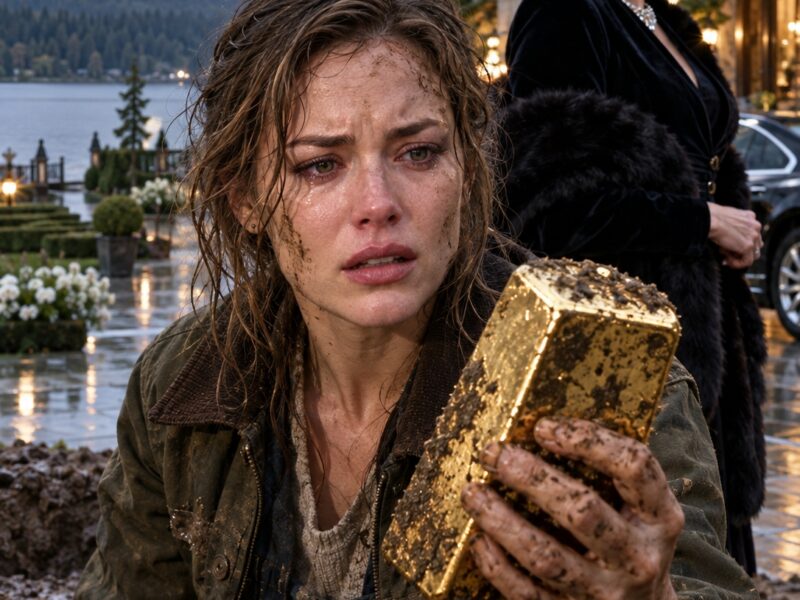
My Stepmother Left Me a Condemned Barn—Then I Found What My Father Buried Beneath It
The day my father’s estate was divided, my stepmother inherited fourteen million dollars.
I inherited a barn with rats in the walls.
Margaret Witmore smiled when the attorney read it aloud.
Not a polite smile. Not the restrained expression of a grieving widow trying to survive an uncomfortable family moment.
She smiled the way people smile when a door finally locks behind someone they have spent years trying to destroy.
Then she leaned back in her leather chair, glanced at the diamond-encrusted Cartier watch on her wrist, and said something I would remember long after everything else about that afternoon blurred.
“Your father always said you were drawn to the dirt, Abigail.”
I stared at her.
She tilted her head.
“So I suppose it’s fitting.”
Two months later, federal agents would put handcuffs around those same jeweled wrists in front of half of Portland society.
But on that afternoon, I had no idea that was coming.
I thought Margaret had won.
More importantly, she thought so too.
And neither of us knew yet that my father had spent the final years of his failing mind building a trap beneath six inches of dirt.
It began with rain.
Lake Oswego rain—not the gentle kind that makes people romanticize Oregon, but the cold, relentless October rain that turns grass black at the roots and makes expensive shoes sink into cemetery mud.
It fell in sheets the morning we buried Raymond Preston.
My father.
I stood near the edge of the canopy with a damp tissue crushed in one hand and watched droplets run down the polished mahogany lid of his casket.
I was thirty-two years old.
I had slept perhaps four hours in three days.
And I had not heard my father’s voice in six months.
That was the part no one at the funeral knew.
People kept touching my shoulder.
“I’m so sorry, Abigail.”
“He was a wonderful man.”
“Your father talked about you all the time.”
That last one nearly broke me.
Because if he had talked about me all the time, why hadn’t I been allowed to talk to him?
Across the grave stood Margaret.
Raymond Preston’s second wife.
My stepmother.
A hired assistant held a massive black umbrella above her while rain blew sideways onto everyone else. Margaret wore a fitted designer dress, black gloves, pearl earrings, and an expression of controlled devastation so convincing that I almost admired the performance.
Almost.
Beside her stood Leo, her biological son and my stepbrother.
He was thirty-four, dressed in a tailored charcoal suit, and scrolling through his phone while the pastor spoke about mortality.
At one point, he yawned.
Margaret noticed me noticing.
Her eyes met mine across my father’s coffin.
For half a second, the grieving-widow mask disappeared.
There was no sadness in her face.
Only warning.
Then someone turned toward her, and she lowered her head beautifully.
Three years earlier, my father had begun forgetting names.
Not important names at first.
The waiter at his favorite restaurant.
A neighbor he had known for six years.
An accountant who had worked for Preston Auto Supply since I was in college.
Then came appointments.
Passwords.
Directions.
One afternoon, he drove to the grocery store and called me from a gas station twenty miles away because he could not remember how to get home.
That was when the neurologists began using words we had both been afraid to say.
Early-onset dementia.
Progressive.
Irreversible.
My father had built a chain of successful Pacific Northwest auto-parts stores from almost nothing. He could walk through a warehouse and tell you from the sound of a forklift engine which cylinder was misfiring.
Then suddenly he could not remember where he had left his coffee.
Margaret became indispensable.
At least, that was what she told everyone.
“She needs to manage the stress around him,” one nurse explained to me after Margaret restricted my visits.
Then the nurse disappeared.
So did another one.
My father’s phone number changed.
The locks changed.
Margaret said he needed “controlled stimulation.”
Then she told me my visits agitated him.
I hired an attorney.
I contacted adult protective services.
I requested medical reviews.
Every time I pushed, Margaret produced another document.
Another doctor.
Another explanation.
Another polished professional willing to say Raymond Preston was being cared for appropriately by his devoted wife.
And every month, my father became harder to reach.
The last time I saw him alive, he stood behind the glass doors of the Lake Oswego mansion while Margaret told security not to let me through the gate.
He looked thinner.
Smaller.
He raised one hand.
I raised mine.
Then Margaret closed the curtain.
Six months later, he was dead.
At the funeral, I kept looking at her hands.
I hated those hands.
The manicured nails.
The wedding ring.
The silk handkerchief touching eyes that had produced no tears.
I imagined what those hands had signed while my father forgot the date.
I imagined what they had taken.
I had no idea how close I was to the truth.
Two days after the burial, Thomas Abernathy summoned us to his downtown Portland office for the reading of the will.
Thomas had been my father’s estate attorney for more than twenty years.
When I was twelve, he sent me a birthday card with twenty dollars inside.
When I graduated from college, he came to the ceremony.
He was not family.
But he belonged to the category of people who had been around so long that you stopped remembering when they entered your life.
That afternoon, he would barely look at me.
That frightened me before he said a word.
Margaret sat across the conference table with one leg crossed elegantly over the other.
Leo chewed peppermint gum.
Thomas adjusted his glasses.
“Let’s get this over with,” Margaret said. “I have a meeting with the developers at three.”
My father had been buried forty-eight hours earlier.
I looked at her.
“Developers?”
She didn’t even turn toward me.
Thomas cleared his throat.
“Margaret.”
“What?”
“Nothing.”
He opened a thick leather binder.
I watched his fingers.
They trembled slightly.
Then he began reading.
The first several minutes were legal language. Executors. Beneficiaries. Corporate holdings. Residual estate.
Then the meaning became impossible to misunderstand.
The Lake Oswego mansion went to Margaret.
The investment portfolio went to Margaret.
My father’s vintage automobile collection went to Margaret.
His ownership interests in Preston Auto Supply and its related companies went to Margaret, with provisions eventually transferring control to Leo.
Property.
Cars.
Accounts.
Businesses.
Everything my father had spent forty years building.
Everything my mother had helped him build before she died.
Margaret.
Margaret.
Margaret.
Each repetition felt like another shovel of dirt landing on the coffin.
I stopped listening until Thomas suddenly paused.
His eyes found mine.
Something in his expression changed.
“To my biological daughter, Abigail Preston…”
Margaret’s mouth tightened.
Thomas continued.
“…I leave the property known as the Miller tract, including the existing structure, free and clear of any encumbrances.”
Silence.
I blinked.
“The Miller tract?”
Thomas lowered the document.
“Yes.”
I knew the property.
Two acres on the rural outskirts of the county.
A washed-out dirt road.
Blackberry brambles.
Poison oak.
No utilities.
No commercial frontage.
And one collapsing barn from the 1920s that the county had condemned five years earlier.
I actually laughed.
Not because anything was funny.
Sometimes the body chooses the wrong reaction when the correct one would destroy you.
“That’s it?”
Thomas looked down.
“Abby—”
“He left me a condemned barn?”
Margaret laughed.
A sharp, delicate sound.
“Well.”
I turned toward her.
She lifted one shoulder.
“Your father always said you were drawn to the dirt. Remember? You used to come home filthy while Leo was at fencing lessons.”
Leo smirked without looking up from his phone.
Margaret continued.
“You and Raymond used to spend hours out there playing with those dreadful radios.”
“Ham radios,” I said.
“Whatever they were.”
She smiled.
“Perhaps he was feeling sentimental.”
Something hot moved through my chest.
“You manipulated him.”
Leo finally stopped chewing.
Margaret’s smile vanished.
“He had dementia,” I said. “He didn’t know what he was signing.”
“Be careful.”
“Half those businesses were started with my mother’s money.”
“Abigail.”
Thomas’s voice was quiet.
But I was past quiet.
“You isolated him. You fired his nurses. You changed his phone number. You stopped me from seeing him.”
Margaret leaned forward.
The grieving widow was gone.
Her voice dropped so low that Thomas had to stop moving papers to hear her.
“Three independent physicians certified Raymond’s competency when this will was executed.”
“He couldn’t remember my birthday.”
“And yet he remembered enough to decide what you deserved.”
The words hit exactly where she intended them to.
I stood.
Thomas stood too.
“Abby.”
Margaret reached into her handbag.
“Sit down.”
I stared at her.
She removed one sheet of paper and slid it across the table.
“I’m willing to be generous.”
I almost laughed again.
“What is that?”
“A waiver.”
Thomas’s face hardened.
“Margaret, we discussed this.”
“And now I’m discussing it with Abigail.”
She tapped the paper with one red nail.
“Relinquish your right to contest the will.”
I looked at Thomas.
He did not nod.
That told me enough.
“And if I don’t?”
Margaret’s eyes became very still.
“The Miller tract has outstanding taxes and estate-related expenses. Sign, and I’ll make sure those obligations are handled so the property transfers cleanly to you.”
“And if I refuse?”
“I liquidate it.”
My throat tightened.
“You can’t.”
“As executor, I can petition to use nonessential property to satisfy administrative costs.”
Thomas interrupted.
“It would be challenged.”
Margaret turned toward him.
“And how long would that challenge take?”
No one answered.
She looked back at me.
“Months? Years?”
Then she smiled.
“How much money do you have left, Abigail?”
That was the real question.
She knew.
I was a freelance graphic designer renting a studio apartment in Portland.
I had spent almost everything I had on lawyers trying to get access to my father.
My savings account was nearly empty.
My credit cards were not.
Margaret had corporate attorneys.
I had a Honda Civic with 168,000 miles and an eviction warning I had not yet told anyone about.
She knew that too.
“You contest this,” she said softly, “and my legal team will bury you in fees until you’re living in a cardboard box.”
Thomas pushed his chair back.
“Enough.”
Margaret ignored him.
“Or you sign, take your little barn, and we never have to see each other again.”
I looked at the paper.
Then I remembered being nine years old.
My father was underneath an old tractor at the Miller barn, only his boots visible.
“Hand me the nine-sixteenths, Abby.”
I gave him the wrong wrench.
He slid out, grease on his forehead.
“This one.”
“How am I supposed to know?”
“You learn.”
“I don’t like getting dirty.”
He grinned.
“That’s unfortunate. Everything worth fixing gets your hands dirty.”
I had forgotten that afternoon for years.
Now I could smell the oil.
Hear the cicadas.
Feel my father lifting me onto a hay bale because I had scraped my knee.
The Miller tract was worthless.
But it was the only thing in that room that still felt like him.
I picked up Thomas’s silver pen.
“Don’t,” he whispered.
Margaret’s eyes flashed.
Thomas leaned closer.
“Abby, let me fight this.”
“With what?”
“We’ll find a way.”
“I already tried finding a way.”
My voice cracked.
“I spent three years finding ways to see my own father.”
Thomas said nothing.
A tear landed on the waiver.
I signed through it.
Margaret snatched the paper away almost before the ink dried.
“Smart girl.”
I stood.
She smiled up at me.
“Have fun in the mud.”
I walked out before she could see me cry.
Two weeks later, I received my final eviction notice.
Without the money my father had occasionally slipped into my account, I could no longer afford my Portland apartment.
So at thirty-two years old, grieving, broke, and carrying almost everything I owned in the back of a dented 2012 Honda Civic, I drove to the only property left in my name.
The Miller tract.
The sky was gray enough to make three in the afternoon look like evening.
When I turned onto the dirt road, blackberry branches scraped both sides of my car.
Then I saw the barn.
I stopped.
For several minutes, I simply sat behind the wheel.
It was worse than I remembered.
The structure leaned visibly to the left.
Most of the red paint had disappeared, leaving gray wood exposed beneath it.
Several corrugated roof panels were missing.
Ivy had swallowed one wall.
Blackberry bushes formed a thorny barricade around the entrance.
My inheritance.
Fourteen million dollars to Margaret.
This to me.
I put my forehead against the steering wheel.
“Very funny, Dad.”
The words came out broken.
Then I cried.
Not elegantly.
Not one cinematic tear.
I cried until my ribs hurt.
For the funeral.
For the will.
For six months without him.
For the fact that the last memory I had of my father was his hand behind glass.
Eventually there were no tears left.
So I opened the car door.
“Fine,” I whispered.
Rain began tapping the windshield.
“Let’s see what you left me.”
I had brought a tent, sleeping bag, propane heater, gloves, tools, bottled water, canned food, and the cheapest camping stove I could find.
My plan was humiliatingly simple.
I would live inside the barn temporarily.
Then I would salvage whatever antique wood remained, sell it to furniture makers, and scrape together enough for a security deposit.
That was my future.
Dismantling my inheritance one plank at a time.
It took three hours with a machete and pruning shears just to reach the doors.
When I finally shoved one open, the barn screamed.
Dust rolled toward me.
The air smelled of mold, old hay, rust, mouse droppings—and something else.
Machine oil.
For one second, I was ten years old again.
“Dad?”
Only rain answered.
Inside sat decades of junk.
Rusted barrels.
Broken pallets.
Hand tools.
Collapsed shelving.
And in the center of everything, the skeletal remains of an ancient Fordson tractor.
I touched its hood.
A memory surfaced.
My father laughing.
His hands guiding mine around a wrench.
Then it disappeared.
I made camp in the driest corner.
For three days, I worked until exhaustion silenced my thoughts.
I pulled nails.
Sorted scrap metal.
Dragged rotten boards outside.
My palms blistered.
My back cramped.
At night, rain hit the roof while I lay inside my sleeping bag listening to rodents move behind the walls.
Sometimes I thought about Margaret sleeping in my father’s bedroom.
Sometimes I wondered whether she had already thrown away his clothes.
Sometimes I imagined driving back to Lake Oswego and screaming until security dragged me off the property.
Instead, every morning I put on my gloves.
Everything worth fixing gets your hands dirty.
On the fourth day, a thunderstorm rolled across the county.
Rain hammered the roof so violently that conversation would have been impossible even if someone else had been there.
I was trying to move an old cast-iron wood stove.
It seemed half buried in the floor.
I shoved it.
Nothing.
“Come on.”
I wedged a steel crowbar beneath its base.
I leaned my entire weight onto the bar.
The stove still did not move.
Then—
CRACK.
The crowbar vanished downward.
I fell forward into the dirt.
For a second, I just lay there.
“Perfect.”
I rolled onto my back.
“Absolutely perfect.”
Then I heard something.
Not wood.
Not stone.
Metal.
I sat up.
The crowbar had punched almost two feet into the floor.
I grabbed it and pulled.
It came free with a grinding sound.
I stared into the hole.
Something was wrong.
The ground beneath the barn was hollow.
I found an old shovel.
Ten minutes later, dirt gave way to smooth concrete.
My heartbeat changed.
I kept digging.
Three feet.
Four.
The concrete continued.
Then my shovel struck iron.
I dropped to my knees and cleared the remaining soil with my hands.
An iron ring appeared.
Then hinges.
Then the outline of a trapdoor.
I stopped.
Rain thundered above me.
The trapdoor was built into a poured concrete slab hidden beneath the dirt floor.
Heavy iron.
Reinforced hinges.
Industrial brass padlock.
This was not a root cellar.
I touched the metal.
Cold came through my glove.
And suddenly I remembered one of my father’s stories.
Arthur Preston.
My great-grandfather.
The respectable family version said Arthur had made money in shipping before losing almost everything in the 1929 crash.
The version Dad told after two glasses of bourbon was different.
Arthur had been a rum-runner.
During Prohibition, he smuggled Canadian whiskey down the Oregon coast.
Boats.
Trucks.
False manifests.
Bribed officials.
Hidden warehouses.
Millions in illegal liquor.
According to family legend, the fortune vanished.
I stared at the trapdoor.
“What did you do, Arthur?”
Then another thought came.
What did Dad know?
I ran through the rain to my Honda.
Bolt cutters.
Back inside.
I positioned the jaws around the lock.
The brass was thick.
I squeezed.
Nothing.
Again.
My arms shook.
“Come on.”
I put one boot against the concrete and threw my weight into it.
The lock snapped.
The sound echoed through the barn.
I froze.
Then I removed it.
The iron ring resisted both hands.
I pulled harder.
The door lifted an inch.
Freezing air touched my face.
Not damp air.
Dry air.
Stale.
Underground.
I pulled again.
The trapdoor groaned upward and crashed onto its hinges.
Darkness waited below.
Concrete stairs disappeared into it.
I stood at the edge holding my flashlight.
Every sensible instinct told me not to go down.
I went down.
The rain became quieter with each step.
At the bottom, my flashlight hit steel.
A vault door.
Not metaphorically.
An actual bank-style vault door stood embedded in reinforced concrete.
A brass dial.
A massive wheel.
Locking bolts thick enough to stop a truck.
I laughed once.
Of course.
I had discovered a secret bunker under my condemned barn, and whatever was inside was locked behind a door I could never open.
I put my hand against the steel.
Then my flashlight beam passed over the concrete beside it.
Scratches.
Numbers.
I leaned closer.
My breathing stopped.
April 18, 1955.
My mother’s birthday.
“No.”
I touched the numbers.
Dad had carved them there.
Or someone had.
But there was no chance that date was accidental.
My hands shook as I turned the dial.
Left.
Right.
Left.
I grabbed the wheel.
Nothing happened.
I closed my eyes.
“Please.”
Then I pulled.
Deep inside the door, something moved.
A mechanical click rolled through the concrete.
The locking bolts retracted.
I stumbled backward.
The vault opened.
For the first time since my father died, I was too shocked to feel grief.
I stepped inside.
A pull string hung from an old porcelain fixture.
I tugged it.
One bulb flickered.
Then another.
Then an entire row.
Amber light filled the room.
And I forgot how to breathe.
Wooden crates covered one wall.
Three enormous industrial safes stood in the center.
Metal shelves lined the opposite side.
I approached the nearest crate.
Faded lettering remained visible.
PROPERTY OF THE CANADIAN DISTILLERY COMPANY.
I pried it open.
Straw.
Glass.
Bottles.
Dozens of them.
Perfectly sealed Prohibition-era whiskey.
Another crate.
More bottles.
Another.
More.
Hundreds.
I whispered, “Oh my God.”
But the whiskey was not the secret.
The first safe was unlocked.
I pulled the door open.
Canvas bags filled it from floor to ceiling.
I dragged one out.
The bag was unbelievably heavy.
I loosened the rope.
Something metallic rolled onto the concrete.
Then another.
Then twenty.
Gold coins.
I stared.
Behind them were bars.
Solid gold.
For several seconds, my brain refused to understand what my eyes were seeing.
I picked up one bar.
It was heavier than I expected.
Stamped.
Real.
The second safe contained stacks of historic gold certificates sealed inside protective packaging.
But that was not what frightened me.
The plastic was modern.
Someone had been here recently.
I turned toward the third safe.
Inside sat a small steel lockbox.
And on top of it—
an envelope.
My name was written across the front.
Not Abigail.
Abby.
My father was the only person who still called me that.
I sat down hard on the concrete.
For a long time, I could not touch it.
Then I opened the envelope.
The letter was dated two years earlier.
Before Margaret completely isolated him.
My dearest Abigail,
If you are reading this, it means my mind finally gave out, and Margaret showed you who she really is.
My vision blurred.
I wiped my eyes.
I continued.
I am sorry I couldn’t protect you in the open.
I had to let her believe she was winning.
Margaret has been stealing from Preston corporate accounts for years. When I first became ill, I hired investigators because numbers were disappearing in ways I could no longer explain. They traced transfers through shell companies and accounts connected to Leo.
I stopped breathing.
The room seemed to tilt.
She thought my illness meant I couldn’t see what she was doing.
She was wrong.
I read faster.
My father explained everything.
Margaret had embedded herself inside the companies.
Accounts.
Management.
Legal authority.
Corporate relationships.
If he openly accused her or attempted a rushed divorce while his cognition was deteriorating, she would attack his competency and trap the estate in litigation.
So Raymond Preston had done something I never imagined my father capable of doing.
He pretended to lose.
The businesses Margaret desperately wanted were drowning in leveraged debt.
The corporate empire looked valuable from the outside, but years of borrowing and Margaret’s own theft had hollowed it out.
My father knew exactly what he was leaving her.
A beautiful sinking ship.
Then came the sentence that made me put the letter down.
The true Preston family wealth is beneath your feet.
I looked around.
Gold.
Whiskey.
Certificates.
History.
Arthur Preston had not lost his fortune.
He had hidden it.
And over the final years of my father’s life, Raymond had quietly consolidated what remained of the family’s private assets here.
At the Miller tract.
The worthless property.
The barn Margaret laughed at.
The dirt she forced me to accept.
I kept reading.
Inside the lockbox is a flash drive containing the investigative records. Transfers. Forged signatures. IP logs. Account information. Everything I could preserve.
Use it.
Not for revenge alone.
For the truth.
Reclaim our name.
Then, at the bottom:
I love you, my brave girl.
Never let them see you bleed.
Dad.
I pressed the letter against my chest.
The sound that came out of me was not a sob at first.
It was something deeper.
Months of helplessness.
Three years of being told my father did not want me.
Six months believing he had forgotten me.
The funeral.
The will.
Margaret’s smile.
Have fun in the mud.
I folded forward until my forehead touched the concrete.
“He didn’t forget me.”
I said it aloud because I needed to hear it in another human voice, even if the voice was mine.
“He didn’t forget me.”
For three years, I thought Margaret had slowly taken my father away.
In reality, while his memory failed him piece by piece, he had been using whatever remained to protect the one thing he could.
Me.
I opened the lockbox.
The flash drive was there.
Silver.
Ordinary.
Small enough to disappear inside my fist.
I stared at it.
Then at the gold.
Something inside me changed.
Not into cruelty.
Not even revenge.
It was simpler than that.
For the first time in years, I was no longer powerless.
The following morning, Thomas Abernathy’s receptionist tried to stop me.
“Ms. Preston, Mr. Abernathy is with—”
I pushed through the glass doors.
Thomas looked up.
“Abby?”
I must have looked insane.
Mud on my jeans.
Hair tangled.
No makeup.
No sleep.
I dropped a canvas bag onto his mahogany desk.
THUD.
He stared at it.
“What is that?”
I unzipped it.
Three gold bars caught the office light.
Thomas slowly removed his glasses.
“What the hell?”
I put the flash drive beside them.
Then my father’s letter.
Thomas looked from the gold to me.
“Where did you get this?”
“From my inheritance.”
His face changed.
“The barn?”
I nodded.
Thomas stood.
“What was under it?”
I looked him directly in the eyes.
“My father.”
He frowned.
“Not literally.”
I pushed the flash drive toward him.
“Everything Margaret thought dementia made him too weak to understand.”
Thomas sat back down.
I had never seen him afraid before.
“Abby…”
“Call the FBI.”
He looked at the drive.
Then at the gold.
“Before we do anything, we need forensic—”
“Then get me the best forensic accountant in the Pacific Northwest.”
“Do you understand what you’re saying?”
“Yes.”
I thought about Margaret’s waiver.
Her smile.
Her Cartier watch.
Have fun in the mud.
“We’re going to war.”
Six weeks later, Margaret Witmore threw a charity gala at the Preston estate.
Ten thousand dollars a plate.
String quartet.
Champagne.
State senators.
Real-estate developers.
Portland socialites.
Local celebrities.
Margaret wore scarlet Valentino.
The mansion glowed beneath thousands of warm lights strung through the trees.
From the outside, she looked like a woman celebrating her coronation.
She had no idea the kingdom was already collapsing.
Investigators had spent six weeks tracing the records on my father’s drive.
The evidence was worse than even Raymond had known.
Millions moved through shell entities.
Forged authorizations.
False invoices.
Transfers routed through offshore accounts.
Leo’s name appeared again and again.
So did Margaret’s digital fingerprints.
Meanwhile, accountants opened the books of the companies she had inherited.
Debt.
More debt.
Collateralized obligations.
Personal guarantees.
Corporate liabilities.
The businesses were not worthless.
That would have been too simple.
They were dangerous.
They contained just enough value to make Margaret believe she was rich and enough debt to make ownership catastrophic once the fraud surfaced.
My father had not disinherited me.
He had separated me from the blast radius.
Margaret had inherited exactly what she wanted.
Control.
And with control came responsibility.
At 8:17 that evening, a matte-black Rolls-Royce Phantom passed through the iron gates of the Preston estate.
I sat in the back seat.
Thomas sat beside me.
Three federal agents followed in another vehicle.
I looked through the window at the house where I had grown up.
For months, I had dreamed about returning.
In every version, I screamed at Margaret.
Tonight, I felt strangely calm.
The car stopped.
The driver opened my door.
I stepped onto the gravel.
The quartet missed a note.
Conversations died one by one.
Margaret saw me.
I watched recognition fail to reach her face for almost two seconds.
I wore an emerald silk gown.
Around my neck rested my mother’s diamond pendant.
Margaret had searched the mansion for it after Dad died.
She had never known Raymond moved it to the vault.
Her face went white.
“Abigail?”
I walked toward her.
Leo appeared beside her.
Margaret recovered quickly.
People like Margaret always did.
“What is the meaning of this?”
I said nothing.
“You are trespassing.”
Still nothing.
She snapped her fingers.
“Security.”
Two guards approached.
One federal agent stepped forward and displayed his badge.
“Federal Bureau of Investigation. Stand down.”
The lawn went silent.
Not quiet.
Silent.
Margaret stared at the badge.
Then at Thomas.
“What is this?”
Thomas’s voice carried across the terrace.
“Federal warrants.”
Leo laughed.
It sounded wrong.
Too high.
“For what?”
I finally looked at him.
“Wire fraud.”
His smile disappeared.
“Systematic embezzlement. Tax evasion. Money laundering.”
Margaret’s wineglass trembled.
“You’re insane.”
“Am I?”
“Raymond left me everything.”
“Yes.”
She stopped.
I smiled.
“The will is valid, Margaret.”
Confusion crossed her face.
“You’re not contesting it?”
“No.”
I took another step.
“I wouldn’t dream of it.”
Thomas almost smiled.
Margaret looked between us.
I continued.
“You own the companies.”
Her breathing changed.
“And Leo is CEO.”
Leo looked at his mother.
“So congratulations.”
I let the silence hold.
“You are now the primary corporate officers responsible for approximately thirty-five million dollars in leveraged debt.”
Someone behind Margaret gasped.
Her lips parted.
“No.”
“The IRS and federal investigators have already begun freezing relevant assets.”
“No.”
“The corporate accounts you were expecting to use?”
She stared at me.
“Gone.”
“No.”
“Most of the legitimate liquid reserves were moved long before you finished isolating Dad. What remained was drained by you.”
Margaret stumbled backward.
A waiter caught her elbow.
She shook him off.
“You’re lying.”
“I thought that too.”
My voice stayed quiet.
“I thought he had forgotten everything.”
I looked around at the mansion.
“At first, I thought you stole my father from me.”
Her eyes narrowed.
“In fact, you gave him the one thing he needed.”
“What?”
“Time.”
Her face changed.
Just slightly.
But I saw it.
Fear.
I stepped closer.
“He knew.”
“No.”
“He knew about the offshore transfers.”
“No.”
“He knew about the forged signatures.”
“He was sick.”
“He knew about Leo.”
Leo turned pale.
Margaret shook her head violently.
“Three doctors certified him.”
“And the will is valid.”
“Then this is mine!”
She gestured wildly at the mansion.
“The businesses. The estate. Everything.”
“Yes.”
I almost whispered it.
“That’s the problem.”
She stared.
I could see her mind trying to find the hidden door.
There wasn’t one.
“You inherited the liabilities too.”
Then I said the words I had waited six weeks to say.
“He gave you exactly what you asked for.”
Margaret looked at me as if seeing my father standing behind me.
I touched my mother’s pendant.
“And he gave me the Miller tract.”
Her eyes flickered.
I knew the moment she remembered.
The barn.
The waiver.
Her laughter.
Have fun in the mud.
“What did you find?”
For the first time, Margaret’s voice was barely audible.
I didn’t answer immediately.
“What did you find, Abigail?”
“Something Dad knew you would never want.”
Her face drained.
“Dirt.”
“No.”
“History.”
“No.”
“And enough private family assets to make everything you stole look embarrassingly small.”
Leo whispered, “Mom?”
Margaret ignored him.
“How much?”
I looked at her.
She asked again.
“How much?”
“Enough.”
“How much?”
“Current estimates put the physical assets at more than fifty million.”
The glass fell from her hand.
It shattered.
No one moved.
Margaret looked toward the mansion.
Then back at me.
“You knew.”
“I didn’t.”
“You tricked me.”
“I signed exactly what you put in front of me.”
Her breathing became ragged.
“You forced me to give you that property.”
“No.”
I shook my head.
“You forced me to keep it.”
Something animal entered her expression.
“You little bitch.”
Her hand came up.
The agent caught her wrist before she touched me.
In one movement, he turned her around.
Her scarlet gown twisted.
“What are you doing?”
“Margaret Witmore, you are under arrest.”
“No!”
The handcuffs clicked.
That sound was quieter than I expected.
Two small pieces of steel closing.
That was all.
After three years of lawyers, locked gates, unanswered calls, medical excuses, manipulated documents, and nights wondering whether my father still remembered my name, Margaret’s reign ended with a click.
Leo ran.
He actually ran.
Across the lawn.
Past the ice sculpture.
Toward the garden.
He made it perhaps twenty yards before two agents tackled him into the rhododendrons.
Guests began leaving immediately.
Not slowly.
Not discreetly.
People who had spent an hour telling Margaret how radiant she looked suddenly could not reach their Bentleys and Mercedes fast enough.
Margaret screamed my name.
“ABIGAIL!”
I watched the agents lead her away.
Mascara ran down her cheeks.
The hem of her Valentino gown dragged through wet soil.
For a moment, I expected triumph.
I had imagined this scene in so many ways.
I thought revenge would feel hot.
It didn’t.
It felt cold.
Heavy.
Almost sad.
Margaret stopped beside the federal vehicle.
She turned.
“You think he loved you?”
The agent tried to move her.
She resisted.
“You think this proves anything?”
I said nothing.
“He used you!”
Still nothing.
“He used everyone!”
Her voice cracked.
Then she screamed the cruelest thing she could still reach.
“He died confused, Abigail! He died and you weren’t there!”
That one landed.
Of course it did.
Some wounds remain open even when you win.
I walked toward her.
Thomas said my name behind me.
I kept going.
Margaret smiled through her ruined makeup because she saw that she had finally hurt me.
I stopped a few feet away.
“You’re right.”
Her smile faltered.
“I wasn’t there.”
I swallowed.
“I’ll live with that for the rest of my life.”
She stared.
“But you know what you’ll live with?”
I touched the pendant.
“He remembered my mother’s birthday.”
Margaret froze.
“The combination to the vault.”
Her eyes widened.
“April eighteenth, 1955.”
I saw it then.
The final realization.
Not that she had lost the money.
Something worse.
Raymond had hidden an entire plan inside the parts of his memory she had dismissed as useless.
“He remembered her,” I said.
Then I looked directly into Margaret’s eyes.
“And he remembered me.”
The agent put her in the car.
I watched the door close.
I never spoke to Margaret Witmore again.
The legal aftermath lasted almost a year.
The companies were restructured, sold, dissolved, or absorbed depending on their debt positions.
Investigators untangled the offshore transfers.
Assets were seized.
Victims and creditors were paid where the courts required.
Leo’s signatures tied him directly to multiple accounts.
Margaret’s attorneys fought aggressively.
They challenged evidence.
They blamed accountants.
They blamed employees.
At one point, they even tried blaming Raymond’s dementia.
But dementia could not explain IP records.
It could not explain offshore accounts.
It could not explain forged signatures.
It could not explain millions of dollars moving in patterns established years before Raymond’s diagnosis.
The evidence my father collected survived him.
Margaret eventually received fifteen years in federal prison.
I did not attend sentencing.
Thomas asked whether I wanted to.
I told him no.
“Are you sure?”
“Yes.”
“After everything she did?”
“Especially after everything she did.”
I had spent too much of my life watching Margaret.
I did not want freedom to become another way of watching her.
A year after the gala, I woke before sunrise at the Miller tract.
The barn was gone.
Not completely.
I couldn’t bring myself to erase it.
We salvaged the strongest beams and much of the old wood, incorporating them into a new house overlooking a small private lake.
The original barn doors became a wall inside the study.
The Fordson tractor remained too.
Restored.
Not because it was valuable.
Because Dad once taught me the difference between a half-inch and a nine-sixteenths wrench beside it.
The blackberry thickets were cleared.
Grass covered the fields.
The underground vault remained exactly where it had always been, though now it had modern security and climate systems.
Most of the historic whiskey and artifacts were professionally cataloged.
Some were sold.
Some were donated.
Some I kept.
The gold was handled legally, carefully, with enough accountants and attorneys involved to make Arthur Preston roll in his grave.
I established a foundation in my parents’ names.
Not Raymond and Margaret.
Raymond and my mother.
Some people called that petty.
Maybe it was.
Healing does not always make us saints.
That morning, I sat on the wraparound porch with coffee.
The Oregonian rested on the table.
Margaret’s sentencing was on the front page.
I read the headline once.
Then folded the newspaper.
In my pocket was one of Arthur Preston’s old gold coins.
I carried it sometimes.
Not because I needed to remember that I was wealthy.
Money had stopped feeling like the important part surprisingly quickly.
I carried it because of its weight.
A physical reminder that things could exist beneath the surface for decades without anyone seeing them.
Fortunes.
Crimes.
Love.
Regret.
Plans.
Truth.
I turned the coin between my fingers.
Thomas had given me another box several months earlier.
Personal effects recovered from my father’s study.
Most were ordinary.
Pens.
Receipts.
An old watch.
A pocketknife.
At the bottom was a photograph.
I was nine.
Sitting on a hay bale inside the old Miller barn.
My knees were filthy.
My hair was tied badly behind my head.
Dad sat beside me holding a radio component.
On the back, in his handwriting, were seven words.
Abby never quits when something is broken.
I had stared at that sentence for almost an hour.
For years, I believed the tragedy of my father’s illness was that he had slowly forgotten me.
Maybe, toward the end, sometimes he did.
Dementia is cruel enough that I will never pretend otherwise.
Perhaps there were mornings when he woke and could not place my face.
Perhaps there were nights when Margaret said my name and it meant nothing.
I will never know.
But love is not only what the mind can retrieve in its final hours.
Sometimes love is what someone builds while they still can.
A deed.
A birthday carved into concrete.
A letter hidden underground.
A plan designed so carefully that even forgetting could not destroy it.
I used to think my inheritance was the gold.
Then I thought it was the truth.
Eventually, I understood it was neither.
My father had left me proof that during the period when I felt most abandoned, I had not been abandoned at all.
The wind moved through the grass.
Somewhere near the restored tractor, a loose piece of metal tapped softly in the morning breeze.
For an instant, the sound took me back twenty-three years.
Dust in sunlight.
Grease on Dad’s hands.
My legs swinging from a hay bale.
“Hand me the nine-sixteenths, Abby.”
I closed my eyes.
“I know which one now, Dad.”
There was nobody there to answer.
That hurt.
It probably always would.
I opened my hand.
The old gold coin caught the morning sun.
Then I set it on the porch railing and walked down into the field.
My boots sank slightly into the damp Oregon soil.
Once, Margaret had believed dirt was the cruelest thing she could leave me.
She had been wrong.
Dirt had held my father’s last secret.
It had held my family’s buried history.
And, when everything else had been taken from me, it had given me somewhere to stand.
Behind me, the house glowed in the early light.
Ahead of me, the grass was still wet with rain.
I kept walking.
And for the first time since my father raised his hand behind that locked glass door, I no longer felt as though I was trying to get back to him.
I understood that he had already found his way back to me.









