MY STEPMOTHER LEFT ME A RUINED MANSION—THEN I FOUND WHAT MY FATHER BURIED BENEATH IT
The first thing my stepmother stole from me was my father.
The second was his company.
The third was supposed to be my future.
What Cynthia Rivera never understood was that my father had known exactly what she would take.
And he had built his final move around her greed.
I just didn’t know it yet.
The day Richard Rivera’s will was read, rain hammered the windows of Rivera Global’s forty-second-floor boardroom hard enough to make downtown Chicago disappear behind the glass.
I remember staring at those gray windows because looking anywhere else meant looking at Cynthia.
She sat across from me in black silk and pearls, one hand resting delicately over the other. Her makeup was flawless. Her posture was flawless.
Even her grief looked professionally managed.
Beside her, her son Grant leaned back in his chair and checked his phone.
My father’s body had been buried less than forty-eight hours earlier.
Grant was smiling at something on his screen.
That was when I knew something was wrong.
Not emotionally wrong.
Structurally wrong.
The kind of wrong that had been planned before anyone entered the room.
Arthur Pendleton, my father’s longtime corporate attorney, sat at the head of the mahogany table with a leather folder open in front of him.
He wouldn’t look at me.
That frightened me more than Cynthia’s smile.
“Arthur,” I said. “Read it.”
His fingers tightened around the pages.
“Ashley—”
“Read it.”
He inhaled.
“The final will and testament of Richard Alejandro Rivera, executed three weeks prior to his death—”
“Three weeks?”
My voice sounded too loud.
Arthur stopped.
“My father changed his will three weeks ago?”
Cynthia lowered her eyes.
“Ashley, please.”
I looked at her.
“Don’t.”
She blinked.
“Don’t what?”
“Don’t use my name like we’re sharing grief.”
Grant finally looked up.
“Jesus. We’re thirty seconds in.”
I ignored him.
My father had died aboard his yacht on Lake Michigan from what the preliminary report described as sudden cardiac failure.
He was sixty-three.
He exercised five mornings a week.
He had controlled hypertension, took medication religiously, drank one glass of bourbon on Saturdays, and once fired a senior executive for smoking inside a warehouse.
None of it made sense.
But grief makes you stupid.
It teaches you to accept impossible things because the alternative requires energy you don’t have.
So I had accepted the heart attack.
For two days.
Then Arthur began reading.
Cynthia received my father’s controlling interest in Rivera Global.
Grant received significant voting shares and operational authority.
Together, they received the Chicago penthouse, the liquid investment accounts, multiple overseas holdings, the vehicles, the yacht, and nearly everything associated with the Rivera family trust.
I sat very still.
For eleven years, I had worked inside Rivera Global.
Not as Richard Rivera’s daughter.
At least, not only as his daughter.
I started in compliance.
Then domestic operations.
Then international routing.
I’d spent Christmases in warehouses, birthdays in airports, and one entire Thanksgiving arguing with customs officials over refrigerated medical cargo stranded in Newark.
My father had promised me nothing.
That was one reason I trusted him.
He used to say, “If you want my chair, Ashley, earn the right to hate sitting in it.”
I thought I had.
Apparently, I had earned something else.
Arthur turned the page.
“To my daughter, Ashley Rivera…”
For the first time, Cynthia looked directly at me.
And smiled.
Not much.
Just enough.
“…I leave the entirety of the Highfield property in western Massachusetts, including the manor house, all existing structures, and approximately sixty acres of surrounding land, to do with as she sees fit.”
Silence.
I stared at Arthur.
“Highfield?”
He said nothing.
I laughed once because my brain couldn’t decide whether to scream.
“Highfield Manor?”
“Yes.”
“That place has been abandoned for twenty years.”
Grant covered his mouth, badly hiding a grin.
I turned toward him.
“Something funny?”
“No.”
“Then share it.”
“Ashley,” Cynthia murmured.
I looked back at Arthur.
“The roof is collapsing.”
He nodded slightly.
“The county nearly condemned it.”
Another silence.
“It’s not an inheritance,” I said. “It’s a liability.”
Cynthia finally spoke.
“Your father became very nostalgic near the end.”
There it was.
Near the end.
Three innocent words designed to establish something much uglier.
Mental decline.
“Did he?” I asked.
“He talked about simpler things. Land. History. Family.”
Grant leaned forward.
“You always said you wanted something that was really yours.”
I looked at him.
He smiled.
“Congratulations.”
I wanted to throw the water glass in his face.
Instead, I asked Arthur, “Where is the original trust?”
His expression changed.
Barely.
But I saw it.
Cynthia saw it too.
“Ashley,” she said softly, “this isn’t the time.”
“Actually, this is exactly the time.”
I leaned toward Arthur.
“Dad established succession provisions twelve years ago. I know because I sat in two of the planning meetings. Where are they?”
“The amended testamentary documents supersede certain provisions.”
“Based on what?”
Arthur hesitated.
Grant’s chair creaked.
Cynthia’s voice hardened.
“Your father made a decision.”
“Three weeks before he died.”
“Yes.”
“While you were controlling access to him.”
Her face didn’t move.
But something behind it did.
I saw it.
So did Arthur.
And that was the moment I understood.
This wasn’t inheritance.
It was a coup.
I stood.
Grant laughed.
“Where are you going?”
“To find my own lawyer.”
His smile widened.
“With what money?”
I stopped.
That sentence landed harder than the will.
I pulled out my phone and opened my banking app.
My primary account showed restricted access.
I tried another.
Restricted.
My company card.
Declined.
I looked at Arthur.
“What did you do?”
“Certain accounts are tied to the family trust and subject to temporary probate controls.”
“Temporary?”
Cynthia’s sympathetic expression returned.
“You’ll have enough to manage, darling.”
I looked at her.
She wanted me angry.
She wanted me screaming.
She wanted witnesses to remember Richard Rivera’s unstable daughter losing control after learning she hadn’t inherited Daddy’s empire.
So I smiled.
It was difficult.
But I smiled.
“Enjoy the penthouse, Cynthia.”
Her expression flickered.
I picked up my coat.
“And Grant?”
“Yeah?”
“Enjoy my father’s chair.”
He grinned.
“I intend to.”
I nodded.
“That’s what worries me.”
Arthur called my name before I reached the door.
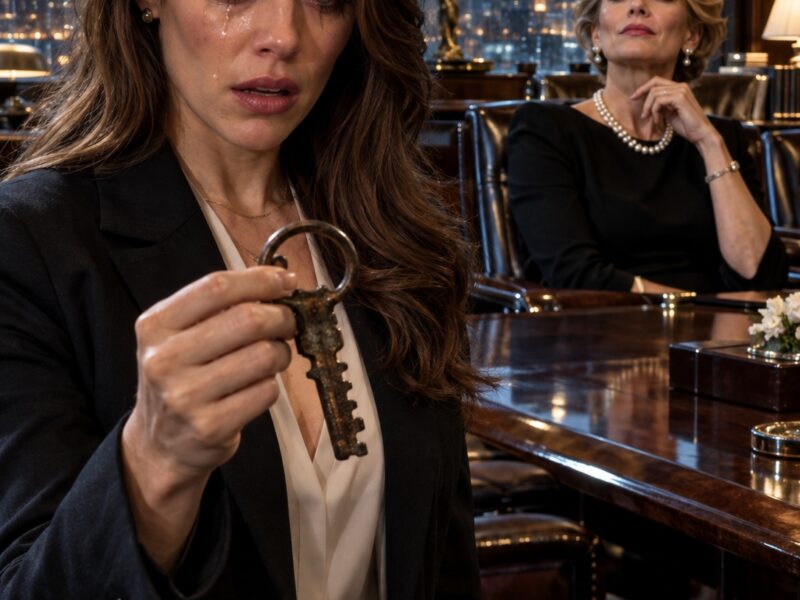
When I turned, he was holding out an old iron key ring.
Three keys hung from it.
Two ordinary brass keys.
One ugly, rusted piece of iron.
“Highfield,” he said.
I took them.
For half a second, Arthur’s fingers stayed around mine.
His eyes finally met me.
There was something there.
Fear.
Or guilt.
Maybe both.
Then he let go.
Two days later, I drove into the Berkshire Mountains carrying everything I still personally owned in the back of a rented sedan.
The road to Highfield Manor was barely a road.
Rain had turned it into two muddy tracks between walls of skeletal trees. Bare branches scraped the car doors as if the forest itself wanted me gone.
My phone lost service six miles from the nearest town.
Then the trees opened.
And I saw my inheritance.
Highfield Manor stood on a ridge beneath a sky the color of dirty steel.
Calling it abandoned felt generous.
The three-story Victorian house looked as though nature had spent twenty years trying to swallow it.
Ivy strangled the stone facade.
Several upstairs windows were boarded over.
One chimney leaned slightly.
The wraparound porch sagged in the center.
Dead leaves had piled against the front steps.
I sat behind the steering wheel and stared.
Then I laughed.
Not because it was funny.
Because sometimes humiliation is so complete that laughter is the only sound your body can make without breaking.
“Thanks, Dad.”
The words fogged the windshield.
I didn’t mean them.
Not then.
The front door resisted until I put my shoulder into it.
Inside smelled of mildew, old wood, and decades of trapped air.
Furniture sat beneath yellowing sheets.
Wallpaper peeled from the walls in long curls.
Dust covered the floor except for the marks made by mice.
There was no electricity.
No heat.
Barely any water.
I walked through rooms large enough to host weddings and tried not to imagine Cynthia sleeping in my father’s penthouse overlooking Lake Michigan.
By dusk, the temperature inside had dropped sharply.
I set up in the old parlor with a camping lantern, blankets, bottled water, and crackers.
That was my first dinner as the sole owner of Highfield Manor.
Crackers.
My phone.
And sixty acres of financial ruin.
I found an old photograph on the mantel before dark.
My father.
Much younger.
Standing on Highfield’s porch beside my mother.
My real mother.
She had died when I was twelve.
Dad had his arm around her waist.
She was laughing.
I had forgotten that photograph existed.
For the first time since the funeral, I cried.
Not elegantly.
Not quietly.
I sat on the dusty floor holding that picture and cried until my throat hurt.
“You should’ve told me,” I whispered.
I wasn’t sure what I meant.
About the will.
About Cynthia.
About dying.
About any of it.
Eventually I fell asleep in an armchair wrapped in two wool blankets.
Sometime after midnight, the house woke me.
Not with a bang.
With a vibration.
I felt it through my boots first.
A faint trembling beneath the floor.
I opened my eyes.
The lantern flame wasn’t moving.
Outside, rain tapped the windows.
Then I heard it.
Hmmmmmmmm.
Low.
Steady.
Mechanical.
I sat upright.
The sound stopped.
I waited.
Nothing.
Then—
Hmmmmmmmm.
I stood.
Every instinct told me to stay upstairs.
I picked up my flashlight anyway.
The vibration grew stronger near the back hallway.
I followed it past the grand staircase and through what had once been the servants’ corridor.
At the end stood the basement door.
It hung slightly open.
I pushed it wider.
Stone steps descended into darkness.
And warm air touched my face.
I froze.
The house was forty degrees.
The basement air was warm.
Not damp.
Not stale.
Warm and dry.
And underneath the smell of old brick was something else.
Ozone.
Hot metal.
I went down.
The cellar stretched beneath the house in brick arches and empty wine alcoves.
The deeper I walked, the louder the humming became.
Until my flashlight reached the far wall.
I stopped breathing.
Set into nineteenth-century stone was a brushed titanium door.
Six inches thick, maybe more.
Reinforced frame.
No handle.
No keyhole.
Just a digital keypad glowing red.
I walked toward it.
Placed my palm against the metal.
The vibration traveled straight through my bones.
Whatever was behind that door was alive.
Powered.
Running.
Yet Highfield Manor had been disconnected from the electrical grid since 1998.
I stood there for a long time.
Then something my father used to say returned to me.
When people are greedy, Ashley, don’t watch what they take.
Watch what they leave behind.
I stared at the door.
Cynthia had taken the company.
Grant had taken the shares.
They had taken the penthouse, the accounts, the cars, the yacht.
They had laughed when I inherited Highfield.
Because they believed it was worthless.
And suddenly I understood something that made my skin go cold.
Maybe Dad had wanted them to believe that.
At eight the next morning, I walked into the county clerk’s office in Oakridge carrying the Highfield deed.
Leonard Brooks looked like a man who had spent forty years watching government forms reproduce.
He adjusted his glasses.
“Highfield Manor?”
“Yes.”
“Thought that place would’ve fallen over by now.”
“Apparently it’s stubborn.”
“So was the last owner.”
“My father?”
Leonard glanced at me.
“Richard Rivera was your father?”
I nodded.
His attitude changed.
Not dramatically.
Enough.
“I need every permit associated with the property for the last five years.”
“There shouldn’t be any.”
“Check.”
He typed.
I watched his expression shift.
“Huh.”
“What?”
“That’s strange.”
“Leonard.”
He leaned toward the monitor.
“Three years ago. Zoning variance.”
“For what?”
“Environmental stabilization.”
“Who filed it?”
“Not Richard Rivera.”
My stomach tightened.
“Then who?”
He read the screen.
“Aegis Subterranean Solutions.”
I had never heard the name.
But I knew my father’s business.
Rivera Global worked with secure transportation contractors, defense subcontractors, private ports, and enough shell corporations to hide a navy.
“What did they build?”
“No plans.”
“What?”
“Private inspector signed off. Historical-artifact preservation exemption. Says off-grid environmental control system.”
“Off-grid?”
“That’s what it says.”
“How large?”
“No dimensions.”
“Electrical?”
“Nothing.”
“Excavation?”
Leonard looked again.
Then slowly leaned back.
“Whatever they did, somebody worked very hard to make sure the county knew as little as legally possible.”
That was the second time I knew my father had left me something intentional.
The first had been the door.
I needed someone who could open it.
Leo Carmichael was recommended by a hardware-store owner who described him with exactly one sentence.
“If Leo can’t open it, it was built to stay closed.”
He was sixty-one, broad-shouldered, gray-bearded, and suspicious of anyone wearing shoes cleaner than his.
“I don’t work for Chicago money,” he told me.
“I don’t have Chicago money anymore.”
“Everybody says that.”
I removed my watch.
Cartier.
Platinum.
Diamond markers.
My father had given it to me when I graduated Northwestern.
Leo stared at it.
“That’s worth more than my truck.”
“Probably.”
“You sure?”
“No.”
I placed it in his hand.
“But I’m sure about the job.”
Two hours later, we stood in the cellar.
Leo’s reaction to the titanium door was the first thing that made me truly afraid.
He didn’t whistle.
Didn’t joke.
He simply stared.
“Who built this?”
“Aegis Subterranean Solutions.”
“Never heard of them.”
“Can you open it?”
He examined the frame.
“This isn’t a vault door.”
“What is it?”
“A blast door.”
He ran a gloved hand along the steel.
“Anchored into bedrock.”
“Meaning?”
“Meaning if somebody wanted to get through with explosives, the house would probably come down before this did.”
He inspected the keypad.
“Biometric-capable. Hardwired. Probably independent power.”
“The estate has no electricity.”
“Something does.”
The hum surrounded us.
Leo looked toward the floor.
“Industrial cooling.”
“For what?”
“Servers. Medical storage. Art. Weapons. Pick something expensive.”
I didn’t like any of those answers.
“Open it.”
He looked at me.
“If I trigger the wrong fail-safe, I could lock it permanently.”
“Open it.”
He started removing the keypad housing.
I paced.
Why build this here?
Why let Highfield rot above it?
Why leave the property to me while handing Cynthia everything worth fighting over?
My phone rang.
Blocked number.
I answered.
“Ashley.”
Grant.
I stopped walking.
“What?”
“Nice to hear your voice too.”
“How did you get this number?”
He laughed.
“You still think the family company doesn’t know your phone number?”
I looked toward Leo.
He was focused on the wiring.
“What do you want?”
“Mother and I were reviewing some old ledgers.”
My stomach tightened.
Grant continued casually.
“Looks like Dad may have routed certain company assets through Highfield.”
There it was.
“Interesting.”
“Accounting mistake, probably.”
“Probably.”
“We’re sending someone.”
I stared at the steel door.
“You’re doing what?”
“An investigator. Mitchell Ford. He’ll inventory anything belonging to Rivera Global.”
“Highfield belongs to me.”
“Don’t be difficult.”
“I’m not being difficult. I’m telling you that anyone entering this property without permission is trespassing.”
Grant’s voice changed.
The amusement disappeared.
“You have no money, Ashley.”
I said nothing.
“No lawyers. No security. No company. You have a condemned house in the mountains and whatever cash is left in your purse.”
Still nothing.
“Mitchell is already driving there.”
My blood went cold.
“Why are you scared, Grant?”
Silence.
Just one second.
But it was enough.
“I’m not.”
“Then why are you sending a private investigator to an abandoned house?”
He hung up.
I turned to Leo.
“How long?”
“Depends.”
“We don’t have depends.”
He looked up.
“What happened?”
“Someone’s coming.”
“Police?”
“Worse.”
“How long?”
“Maybe thirty minutes.”
Leo swore.
He exposed a cluster of wires.
“Twelve-digit release sequence.”
“I don’t have one.”
“Birthdays?”
We tried Dad’s.
Red.
Mine.
Red.
My mother’s.
Red.
Rivera Global’s incorporation date.
Red.
Leo stared at the keypad.
“Three attempts left before hard lockdown.”
I closed my eyes.
Think.
Dad didn’t leave instructions.
Or maybe he did.
I reached into my coat pocket.
The keys.
I pulled out the ring Arthur had handed me.
Two brass keys.
And the strange iron one.
I had assumed it belonged to some antique door.
Under Leo’s flashlight, I finally noticed the edges.
They weren’t teeth.
They were markings.
Tiny grooves.
Numbers.
“Leo.”
He took it.
“Son of a bitch.”
“What?”
“This isn’t a key.”
He cleaned the metal.
A sequence appeared.
Twelve digits.
My pulse jumped.
“Enter it.”
“You sure?”
“No.”
“Good enough.”
He entered the sequence.
Red.
Then amber.
Then—
Green.
A hydraulic hiss tore through the cellar.
Steel bolts withdrew inside the wall one after another.
CLUNK.
CLUNK.
CLUNK.
Leo looked at me.
I looked at him.
Then tires crunched across gravel outside.
A vehicle door slammed.
Heavy footsteps crossed the porch.
Leo whispered, “Your friend?”
“No.”
The basement door upstairs crashed open.
“MS. RIVERA!”
A man’s voice.
Mitchell Ford.
Leo grabbed his tools.
The titanium door began opening.
Only eighteen inches.
“Inside,” I whispered.
Leo squeezed through.
I followed.
Mitchell’s flashlight swept across the basement.
“What the hell—”
I found a green interior button.
Pressed it.
The blast door closed.
Mitchell ran.
He almost reached us.
Almost.
The door sealed between us with a violent metallic impact.
His fists struck the other side.
“OPEN THIS DOOR!”
Then the interior lights came on.
One row.
Then another.
Then another.
Leo slowly turned.
I forgot Mitchell existed.
The underground chamber stretched farther than my flashlight had ever reached.
It was enormous.
Climate-control systems lined one wall.
Server racks glowed behind protective panels.
Steel shelving disappeared into the distance.
And in the center stood glass display cases.
Dozens.
The first contained a jeweled golden egg.
The next contained a painting.
Leo walked toward it.
“Oh my God.”
“What?”
He pointed.
I read the identification plate.
Rembrandt.
Christ in the Storm on the Sea of Galilee.
My mouth went dry.
“No.”
“What?”
“That painting was stolen.”
“From where?”
“The Gardner Museum.”
I moved closer.
“It disappeared in 1990.”
A crash hit the door behind us.
Mitchell was trying to break in.
Leo walked toward a crate.
“Ashley.”
His voice sounded wrong.
I joined him.
Inside were sealed packets of uncut diamonds.
Another container held bearer bonds.
Another contained antiquities.
Objects governments had been searching for.
Objects museums had mourned publicly for decades.
Objects worth hundreds of millions of dollars.
Maybe billions.
I backed away.
“My father was a criminal.”
I barely recognized my own voice.
Leo didn’t answer.
Then I saw the ledger.
Brown leather.
Worn corners.
My father’s handwriting.
I opened it.
Dates.
Ships.
Containers.
Offshore accounts.
Cargo routes.
Shell corporations.
Transfers.
For fifteen years.
The evidence seemed undeniable.
My father had been moving stolen property.
I felt physically sick.
Everything I had believed about him began collapsing.
Maybe Cynthia hadn’t stolen Rivera Global.
Maybe Dad had known investigators were closing in.
Maybe Highfield wasn’t an inheritance.
Maybe it was where he’d hidden his crimes.
Then I reached an entry from five years earlier.
And everything reversed.
CYNTHIA—CONFIRMED.
I stopped breathing.
I read faster.
Grant had altered shipping manifests.
Cynthia had used charitable foundations and private collectors to broker illicit antiquities.
Rivera Global’s international network had been turned into a pipeline for a European criminal syndicate.
Dad had discovered it.
But he couldn’t prove it.
Not yet.
So he did something insane.
He began stealing the stolen cargo.
He rerouted containers.
Faked losses at sea.
Intercepted shipments.
Built Highfield’s underground facility.
Stored the physical evidence.
Recorded every transaction.
Every buyer.
Every bribe.
Every route.
Every name.
My father hadn’t built a treasure vault.
He had built a case.
Another impact shook the door.
Leo shouted something.
I couldn’t hear him.
I had reached the final page.
The entry was dated four weeks before Dad died.
The handwriting was shaky.
Cynthia knows something.
I swallowed.
The syndicate is demanding the Gardner pieces. She believes I moved them to Geneva.
Next line.
My heart medication tastes bitter.
My fingers stopped.
No.
I read it again.
Then the last lines.
If I don’t survive this week, Ashley must receive Highfield.
She is the only one I trust.
The page blurred.
I touched my father’s handwriting.
For two days, I had believed he’d abandoned me.
For one night, I’d hated him.
Now I understood.
Dad knew Cynthia would manipulate his estate.
So he gave her exactly what she wanted.
The glamorous assets.
The penthouse.
The company.
The money.
And he gave me the one thing she would never fight for.
A rotting house.
Because underneath it was everything capable of destroying her.
I wiped my face.
“Leo.”
He turned.
“We need a computer.”
We found the terminal behind the server racks.
Three monitors.
Satellite uplink.
Independent power.
The password screen appeared.
I entered the twelve digits from the iron key.
Unlocked.
One folder appeared.
PROTOCOL: ENDGAME
I clicked.
My father appeared on-screen.
For one impossible second, I forgot he was dead.
“Ashley.”
His voice filled the bunker.
My hand flew to my mouth.
He looked exhausted.
Pale.
But he was smiling.
“If you’re seeing this, then Cynthia succeeded.”
My knees weakened.
“I’m sorry.”
He looked directly into the camera.
“I am so sorry.”
I started crying.
“I couldn’t tell you. Knowing would have put you in danger. Cynthia wanted the company, the accounts, the penthouse. I needed her to believe she had won.”
Dad paused.
“That is why I left you Highfield.”
Another crash sounded outside.
Richard continued.
“The servers contain shipping logs, communications, financial records, tracking data, and evidence linking Cynthia and Grant to the syndicate.”
He explained the system.
One command.
One transmission.
Federal authorities.
International investigators.
Journalists.
Multiple copies.
No single person could bury it once sent.
Then Dad leaned closer.
And smiled the smile I remembered from childhood.
“She believes power is what she can possess.”
His eyes hardened.
“Teach her what evidence can take away.”
The recording ended.
On-screen appeared one command.
EXECUTE TRANSMISSION?
YES.
NO.
Leo stood beside me.
“Ashley.”
Mitchell slammed something against the door.
“Do it.”
I placed my hand on the mouse.
For years, I had imagined taking over Rivera Global.
I had imagined Dad watching me enter his office.
I had imagined earning his approval.
Now he was dead.
His wife may have killed him.
And the empire he’d spent his life building had become evidence in a criminal investigation.
There would be no victory that restored what I had lost.
That mattered.
Revenge stories lie about this.
They tell you justice feels like getting something back.
It doesn’t.
Sometimes justice is simply choosing what deserves to survive after nothing can be restored.
I clicked.
EXECUTE.
The server fans roared.
Twenty percent.
Mitchell pounded harder.
Forty-three percent.
A warning appeared.
Satellite connection stable.
Sixty-eight percent.
I stared at the screen.
Eighty-nine.
Ninety-six.
One hundred.
TRANSMISSION COMPLETE.
Then the pounding stopped.
Not gradually.
Instantly.
Leo and I looked at each other.
I opened the security-camera feed.
Mitchell stood outside the vault with his phone pressed against his ear.
His face had gone white.
I activated the intercom.
“Mitchell.”
He spun around.
My voice filled the cellar.
“If I were you, I’d leave.”
He stared at the door.
“The FBI has the files.”
Nothing.
“Interpol has them too.”
He lowered his phone.
“And journalists have copies.”
Mitchell’s shoulders dropped.
“Your employers can’t put this back in the box.”
I leaned toward the microphone.
“You should decide whether you’re going to be arrested for them.”
He ran.
We watched his SUV disappear down the mountain.
Seventy-two hours later, federal agents entered Rivera Global’s Chicago headquarters.
Cynthia was arrested inside the same boardroom where she’d smiled while Arthur read my inheritance.
Grant was arrested trying to leave through the private garage.
News cameras captured everything.
The investigation spread across countries.
Warehouses were searched.
Accounts were frozen.
Collectors were questioned.
Members of the syndicate began turning on one another.
The evidence recovered at Highfield became one of the largest art-crime discoveries in recent memory.
And my father’s death was reopened as a suspected homicide.
I returned to Chicago once.
Only once.
The boardroom smelled exactly the same.
Arthur Pendleton stood by the windows.
He looked twenty years older.
“You knew,” I said.
His eyes dropped.
“Not everything.”
“But you knew Highfield mattered.”
“Richard made me promise that regardless of what happened, those keys went directly into your hand.”
“Why didn’t you tell me?”
“He said if I told you anything, Cynthia would know from your reaction.”
I looked toward my father’s empty chair.
“So you let me think he abandoned me.”
Arthur’s voice cracked.
“He believed anger would keep you alive longer than knowledge.”
I hated that answer.
Mostly because I understood it.
Cynthia and Grant’s inheritance claims collapsed under the criminal proceedings and subsequent litigation.
Eventually, control of Rivera Global returned to me.
People expected me to move into the penthouse.
I sold it.
I sold the yacht too.
I couldn’t look at it without imagining my father reaching for medication that someone may have poisoned.
The museums received their art back.
Investigators took the ledger.
Governments took evidence.
Families recovered pieces they’d believed lost forever.
And Highfield remained mine.
I hired Leo Carmichael to restore it.
The first time I told him my budget, he laughed.
“You realize it’d be cheaper to build another house?”
“I don’t want another house.”
So we saved this one.
Stone by stone.
Window by window.
The rotten porch was rebuilt.
The Victorian woodwork was restored.
Electricity returned to rooms that had been dark for decades.
One winter morning, nearly two years after the night I found the vault, I stood on the restored porch watching snow fall over the Berkshire Mountains.
Inside, the fireplace was burning.
Somewhere downstairs, Leo was arguing with a plumber.
The house smelled like cedar and coffee instead of mildew.
Highfield was alive again.
But I still kept the old iron key.
Not in a safe.
Not behind glass.
On my desk.
Rust and all.
Sometimes visitors asked why.
I never told them the whole story.
How could I?
How could I explain that the ugliest thing I inherited had been the only gift that mattered?
My father had left Cynthia everything she could see.
Money.
Buildings.
Cars.
Status.
Control.
He left me something buried.
A truth.
A choice.
And one final lesson.
People like Cynthia spend their lives looking upward—toward penthouses, boardrooms, headlines, and bigger numbers on financial statements.
They rarely look beneath their feet.
That was her mistake.
She thought she’d buried me in Highfield.
She thought she’d given me a ruined house because ruins were what remained after powerful people took everything worth having.
She never understood that sometimes a ruin is only camouflage.
Sometimes what looks like exile is protection.
Sometimes losing everything visible is the only way to discover what someone desperately hoped you’d find.
I picked up the iron key that morning and turned it between my fingers.
For years, I had wanted my father’s company.
Then, for a few terrible days, I wanted revenge.
In the end, neither was the thing I carried with me.
It was his voice.
Watch what they leave behind.
Outside, snow gathered silently on the rebuilt steps of Highfield Manor.
Below me, behind reinforced concrete and a titanium door, the empty vault remained.
The paintings were gone.
The diamonds were evidence.
The servers had been dismantled.
Nothing valuable remained underground.
At least, nothing anyone else would call valuable.
But I never removed the door.
Because sometimes late at night, when the house settles and the mountain wind moves through the trees, I walk downstairs and place my hand against that cold metal.
There is no mechanical hum anymore.
No servers.
No hidden treasure.
Just silence.
And somehow, in that silence, I can still remember exactly what it felt like to stand there believing my father had left me nothing.
Then I look at the rusted key in my hand.
And I remember the truth.
He hadn’t left me nothing.
He had left me the one thing Cynthia Rivera could never inherit.
The chance to finish what he started.









