My Town Sold Me to a Mountain Giant for Six Wagons of Meat—Then My Husband Told Me Why He Really Chose Me
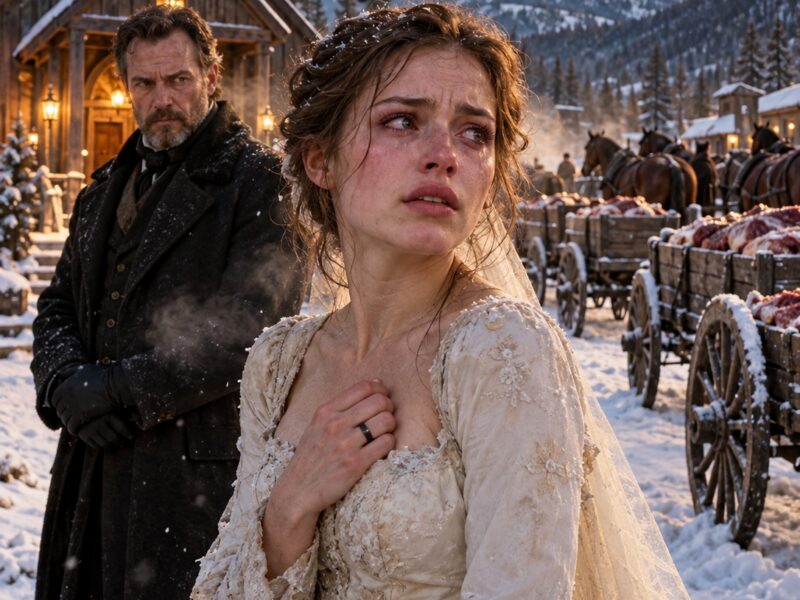
On my wedding day, six wagons of dead elk were worth more to Oak Haven than my entire life.
No one tried to hide it.
The wagons were parked directly outside the chapel so everyone could see what they had received in exchange for me.
Six wooden wagons.
Nearly three thousand pounds of salted meat.
Enough to keep children alive through the worst winter our valley had seen in twenty years.
And me.
Twenty-one years old.
Orphaned.
Unmarried.
Useful enough to scrub floors, wash sheets, mend coats, haul water, and clean other people’s houses.
But apparently not useful enough to belong to myself.
Snow moved across the churchyard in thin white sheets as I stood beneath the gray December sky wearing a dead woman’s wedding dress.
The dress had belonged to Mrs. Harrow.
She had died of fever the previous spring.
Her sister had kept the gown folded in a cedar chest until Mayor Cobb decided there was finally an occasion important enough to bring it out.
My sale.
Someone had shortened the sleeves.
Someone else had tightened the waist.
Nobody had managed to make the shoulders fit.
The ivory fabric hung awkwardly from my body, carrying the faint smell of cedar, old lavender, and another woman’s life.
My fingers trembled around a bouquet of dried winter flowers tied together with twine.
No veil.
No family.
No mother adjusting my collar.
No father walking me toward the chapel.
Just six wagons of meat behind me.
And the man standing beside them.
Lucien Holt.
Even from across the churchyard, he looked less like a man waiting to marry than something the mountain itself had sent down.
He was enormous.
Nearly seven feet tall, people claimed, though no one had ever been foolish enough to stand beside him with a measuring stick.
His shoulders stretched the seams of a weathered dark coat. His boots were crusted with snow. Thick black hair brushed his collar, and a jagged scar ran from beneath his left ear toward the corner of his jaw.
But it was his eyes people remembered.
Pale.
Gray, perhaps.
Or blue.
Cold enough from a distance that nobody seemed interested in discovering the exact color.
The children of Oak Haven called him the mountain giant.
Their mothers used his name when ordinary threats stopped working.
Eat your supper or Lucien Holt will come down from the mountain.
Get inside before dark or Lucien Holt will find you.
Don’t wander into the northern woods. That’s where Holt buries men.
I had heard stories since I was a child.
Men who entered his wilderness and never returned.
Hunters who found enormous footprints in the snow.
A trapper who claimed Lucien had once lifted an injured horse enough to free a man’s leg from beneath it.
Another swore he had watched Lucien kill a wolf with his bare hands.
Every winter the stories grew.
Every year Lucien Holt became less human.
And now he was going to be my husband.
“Stand straight, Sadi.”
Mayor Cobb’s voice came from behind me.
I stiffened automatically.
He stepped closer and pulled my borrowed shawl higher over my shoulders, not gently enough to be mistaken for affection.
“People are watching.”
I almost laughed.
People had been watching me my entire life.
Watching me carry their wash.
Watching me kneel beside their floors.
Watching me eat scraps in kitchens where I had prepared full meals for other families.
But this was apparently the first time my dignity concerned Mayor Cobb.
I turned my head.
“Wouldn’t want anyone thinking this wasn’t a proper wedding.”
His fingers stopped on my shawl.
“Sadi.”
“What?”
His mouth tightened.
“Don’t make this harder than it needs to be.”
I looked past him toward the wagons.
Two men were already checking the barrels of cured meat as if Lucien might have hidden stones beneath the top layer.
I could smell salt and smoke even from where I stood.
“What part is supposed to be easy?”
Mayor Cobb lowered his voice.
“You know what this means for Oak Haven.”
“I know exactly what it means.”
His expression hardened.
“Then act like it.”
A gust of wind moved through the churchyard.
I pulled the shawl tighter around myself.
Across the snow, Lucien Holt was watching us.
He was too far away to hear.
At least I thought he was.
Mayor Cobb followed my gaze.
His voice dropped another degree.
“You should be grateful.”
That made me look at him.
“Grateful?”
“We fed you.”
Something inside me went very still.
He continued before I could answer.
“We put a roof over your head after your parents died. People in this town gave you work. Mrs. Wilkins let you sleep above her washroom for almost six years.”
“After I washed clothes for twelve hours a day.”
“Nobody owed you anything.”
“I was eleven.”
His face changed.
Only slightly.
But enough.
He didn’t like the reminder.
People rarely did.
Mayor Cobb adjusted his gloves.
“This town kept you alive.”
I stared at him.
Behind him, men unloaded meat that had purchased my future.
“Then I suppose we’re even.”
His eyes narrowed.
“What did you say?”
“I said we’re even.”
Before he could answer, the chapel bell rang once.
Reverend Ellis stood in the doorway.
It was time.
Mayor Cobb leaned toward me.
“Do not embarrass this town.”
Then he walked away.
I remained where I was for one more second.
Just one.
Long enough to look at every face gathered around the chapel.
Mrs. Wilkins was there.
I had washed her husband’s shirts for eight years.
She looked down.
Mr. Taylor, the blacksmith, stood beside his wife. I had nursed Mrs. Taylor through pneumonia two winters earlier because they couldn’t afford a doctor.
He studied his boots.
Reverend Ellis had watched me scrub candle wax from the chapel floor every Saturday since I was thirteen.
He suddenly seemed fascinated by the Bible in his hands.
Near the back stood Finn Mercer.
Seventeen years old.
Thin.
Red-haired.
His little sister, Molly, had been sick from hunger for nearly a week.
I had given the girl half my last potato two nights before.
Finn’s eyes met mine.
For a moment, I saw something I hadn’t seen on the others.
Shame.
His lips parted.
I waited.
Say something.
Anything.
Tell them this is wrong.
Tell them a starving town doesn’t become righteous because the person it sacrifices has no parents.
Finn looked toward the wagons.
Then back at me.
His mouth closed.
That was when I understood.
Nobody was coming.
Not because they hated me.
That would have been easier.
They simply needed the meat more than they needed to believe I was a person.
So I walked toward the chapel.
Three weeks earlier, Oak Haven had still pretended everything would be fine.
Winter always came hard to our valley, but people had survived hard winters before.
Then the railroad stopped.
At first, everyone said it would be three days.
Then five.
Then a week.
Snow buried the tracks east of the pass.
Another storm took the wagon road.
A supply train never arrived.
By the second week, flour disappeared from Mr. Grady’s store.
Coffee vanished next.
Then sugar.
Then dried beans.
People who had never spoken to one another without contempt began trading candles for potatoes and firewood for cornmeal.
Children stopped running in the streets.
That frightened me more than anything.
Hungry children don’t waste energy playing.
One morning, I entered the Wilkins house to find Mrs. Wilkins standing over an empty frying pan.
She was scraping the burned flour from its surface with a knife.
Her two youngest boys sat at the table.
“Breakfast,” she told them.
She divided the blackened crumbs between two plates.
Neither child complained.
That afternoon, I went home and cried where nobody could see me.
Three days later, Lucien Holt came down from the mountains.
People heard the wagons before they saw them.
Heavy wheels grinding through snow.
Chains rattling.
Horses snorting clouds of steam into the frozen air.
Everyone came outside.
Lucien drove the first wagon himself.
Five more followed, pulled by teams he had somehow managed to guide through roads other men considered impassable.
When the canvas coverings were pulled back, Oak Haven went silent.
Elk.
Salted.
Smoked.
Preserved.
Enough meat to save the town.
Mayor Cobb nearly ran down the street.
“Mr. Holt!”
Lucien climbed from the wagon.
He was even larger than the stories suggested.
Children hid behind their mothers.
Men unconsciously moved their hands toward rifles.
Lucien ignored them.
Mayor Cobb extended his hand.
“Sir, you’ve arrived at a fortunate time.”
Lucien looked at the hand.
Then at the mayor.
He didn’t take it.
Mayor Cobb slowly lowered his arm.
“I understand you’re a practical man.”
Lucien said nothing.
“We can pay.”
Still nothing.
“Not immediately, perhaps. But Oak Haven has credit.”
Lucien looked toward the storehouse.
Then toward the children standing nearby.
Mayor Cobb cleared his throat.
“How much?”
Lucien’s voice was so deep that people leaned closer simply to make sure they had heard him.
“No money.”
The mayor blinked.
“Land, then.”
Lucien shook his head.
“We have acreage south of the creek. Good grazing land once spring—”
“No.”
Mayor Cobb’s patience thinned.
“Then what do you want?”
Lucien looked across the crowd.
I was standing near the edge with a basket of wet laundry against my hip.
His gaze passed over the married women.
Then the unmarried ones.
Then me.
“A wife.”
Nobody moved.
For several seconds, even the wind seemed to disappear.
Mayor Cobb laughed nervously.
“A wife?”
Lucien said nothing.
The mayor glanced at the women.
One stepped backward.
Then another.
Mrs. Price grabbed her daughter’s arm.
Someone whispered, “Dear God.”
Lucien remained still.
Mayor Cobb’s eyes traveled across the crowd.
Then they found me.
I knew before he spoke.
Perhaps I had always known.
“Sadi.”
My stomach dropped.
“No.”
It came out quietly.
Mayor Cobb pretended not to hear.
“Sadi, come here.”
I set down the basket.
“No.”
People began looking at me.
Mayor Cobb’s smile disappeared.
“Come inside.”
“I don’t need to.”
His jaw tightened.
“Now.”
He took me into the storehouse.
The door had barely closed before I turned on him.
“You can’t.”
He folded his arms.
“I can’t what?”
“You can’t give me to a stranger.”
“No one said anything about giving.”
“What would you call it?”
“A marriage.”
I laughed.
It sounded ugly even to me.
“You don’t know him.”
“Neither do you.”
“That’s supposed to make this better?”
He stepped closer.
“Listen to me carefully. There are families in this town who have been eating broth for four days.”
“I know.”
“Children are starving.”
“I know.”
“Then you understand.”
“No.”
His expression sharpened.
“You don’t have a husband.”
I stared at him.
“You don’t have children.”
I said nothing.
“No family depending on you.”
Each sentence was delivered calmly.
As though he were listing inventory.
One unmarried woman.
No parents.
No brothers.
No sisters.
No children.
Minimal community loss.
Mayor Cobb continued.
“Holt has provisions. A cabin. Land. From everything we know, he’s capable of supporting a wife.”
“From everything we know?”
“He hasn’t caused trouble here.”
“People say men disappear around him.”
“People say foolish things.”
“They said foolish things yesterday too. You believed them then.”
He looked away.
There it was.
The first crack.
He knew.
He knew exactly what he was asking.
“What happens if I refuse?” I asked.
Mayor Cobb walked toward the small window.
Outside, a little boy was trying to lick snow from his mitten.
The mayor pointed.
“Look.”
I didn’t.
“Sadi.”
“No.”
“Look at them.”
“I’ve been looking at them all winter.”
“Then you tell me.”
His voice softened.
That was worse than anger.
“What do I tell their mothers when the food runs out?”
My throat tightened.
He turned toward me.
“What do I tell Finn Mercer when his little sister dies?”
“Stop.”
“What do I tell Mrs. Wilkins when her boys—”
“Stop.”
“Would you rather watch them starve?”
I closed my eyes.
There are threats that sound like threats.
And there are threats disguised as moral choices.
The second kind leave deeper scars.
Mayor Cobb knew exactly where to place the knife.
When I opened my eyes again, he was waiting.
Not for my consent.
For my surrender.
“How soon?” I whispered.
His shoulders relaxed.
“Three weeks.”
That was how Oak Haven saved itself.
Not with courage.
Not with sacrifice shared equally.
With me.
The wedding ceremony lasted four minutes.
Reverend Ellis stood before us with a Bible shaking slightly in his hands.
Lucien stood at my right.
He smelled faintly of pine smoke, leather, and cold air.
I could feel the entire town watching.
Reverend Ellis cleared his throat.
“We are gathered here today—”
No one needed the speech.
Not even him.
He skipped most of it.
When he finally looked at me, there was pity in his eyes.
I hated him for that.
Pity was cheaper than courage.
“Sadi,” he said softly, “do you accept Lucien Holt as your lawful husband?”
I looked up.
Lucien’s hands hung at his sides.
Enormous hands.
Scarred knuckles.
Callused palms.
Hands people said had killed wolves.
Hands that could probably close around my wrist with room to spare.
He wasn’t reaching for me.
I looked into his pale eyes.
For the first time, I wondered what he saw when he looked back.
A bride?
A servant?
Payment?
Property?
“I do,” I whispered.
Reverend Ellis turned to him.
“Lucien Holt, do you accept Sadi—”
“Yes.”
The word vibrated through his chest.
Reverend Ellis hesitated.
Lucien reached into his coat.
Several people shifted nervously.
He pulled out a ring.
Not gold.
Not silver.
Iron.
Simple and dark, polished smooth around the edges.
He held it between two thick fingers.
Then he looked at me.
Not at Reverend Ellis.
At me.
“May I?”
The question startled me so badly that I almost didn’t answer.
He was asking permission.
For the ring.
At our wedding.
I nodded.
Lucien took my left hand.
I braced myself.
His touch was astonishingly careful.
He slid the iron band onto my finger.
It fit.
“Done,” he said.
Reverend Ellis looked uncertain whether that counted as a vow.
Apparently it did.
“You may kiss—”
“No.”
Lucien’s answer came immediately.
Every head turned.
Reverend Ellis blinked.
Lucien released my hand.
“Not necessary.”
A few people exchanged glances.
I stared at him.
He didn’t look embarrassed.
He didn’t look angry.
He simply stepped back.
Nobody applauded.
Nobody cried.
There was no celebration afterward.
Within minutes, men were moving toward the wagons.
Mayor Cobb approached Lucien with the expression of a businessman satisfied with his negotiation.
He extended his hand.
This time, Lucien took it.
“Oak Haven thanks you.”
Lucien’s face revealed nothing.
Mayor Cobb looked at me.
“Your trunk is ready.”
My entire life fit inside one wooden trunk.
Three dresses.
Two aprons.
A comb.
A sewing kit.
My mother’s handkerchief.
A Bible I rarely opened anymore.
And a small wooden bird my father had carved before he died.
Lucien picked up the trunk as though it weighed nothing.
Mayor Cobb caught my arm before I could follow.
His fingers tightened.
“Remember what this town has done for you, girl.”
I looked down at his hand.
Then toward the wagons.
Men were already cutting strips of elk meat.
Mrs. Wilkins was crying now.
Not for me.
From relief.
Finn carried a bundle toward his little sister.
The girl tore into it before they reached home.
I looked back at Mayor Cobb.
“For once,” I said, “I don’t think I’ll ever forget.”
I pulled my arm away.
Then I followed my husband into the snow.
I expected Lucien Holt to become cruel as soon as Oak Haven disappeared behind us.
That was the story I had prepared myself to survive.
Cruelty, at least, was familiar.
I understood men who shouted.
I understood women who slapped.
I understood people who smiled while explaining why I should be grateful for being used.
What I did not understand was Lucien.
We walked north for nearly six hours.
He led one horse loaded with supplies.
I walked behind him.
At first, his stride was too long for me.
Every few steps, I had to hurry.
After perhaps ten minutes, he looked back.
He said nothing.
But his pace changed.
Slower.
Shorter.
Matched to mine.
I noticed.
I wished I hadn’t.
It would have been easier to hate him if he had behaved like the monster everyone promised me he was.
By sunset, the temperature had dropped sharply.
We sheltered beneath a rocky overhang surrounded by pine trees.
Lucien built a fire.
I sat as far from him as I could without freezing.
He unpacked dried meat, beans, and a small iron pot.
I watched his hands.
Every movement seemed deliberate.
Controlled.
He could split firewood with one swing of an axe, yet when he placed the pot over the flames, he did it without making a sound.
Night settled around us.
The cold became vicious.
I wrapped my shawl around myself.
It wasn’t enough.
My teeth began chattering.
Lucien looked over.
“I’m fine,” I said immediately.
He frowned.
“I didn’t ask.”
“I know.”
He reached behind him.
My muscles tightened.
Then he removed the enormous buffalo robe from around his shoulders.
He crossed the space between us.
I backed against the rock.
Lucien stopped.
His expression changed.
Not anger.
Recognition.
He understood what I thought was about to happen.
Without moving closer, he held out the robe.
“You’ll need this.”
I stared at it.
“What about you?”
“I’ve slept colder.”
“I don’t want—”
“Sadi.”
I flinched at my name.
His voice softened.
“Take it.”
I reached out.
The robe was heavy and warm.
I pulled it around my shoulders.
Within minutes, heat returned to my fingers.
Lucien moved to the opposite side of the fire.
He slept there.
Without the robe.
I stayed awake for a long time.
Waiting.
Nothing happened.
Near midnight, I woke again.
The fire had burned low.
Lucien was curled slightly toward it, arms folded against the cold.
I looked down at the buffalo robe covering my entire body.
For reasons I couldn’t explain, that frightened me more than if he had taken it back.
Because monsters were simple.
Kind men were not.
The next morning, we continued north.
By midday, my boots began to fail.
They had belonged to Mrs. Wilkins’s daughter before me.
The leather was old.
A seam split near the heel.
Then the sole started separating.
I said nothing.
Pain was an old companion.
By afternoon, every step burned.
I kept walking.
Lucien stopped suddenly.
I nearly walked into him.
“What?”
He looked down.
My skirt covered most of my boots.
“Sit.”
“I’m fine.”
“Sit.”
There was enough command in his voice that I obeyed.
He knelt in the snow.
When he reached toward my ankle, I jerked away.
Lucien froze.
Our eyes met.
Slowly, he withdrew his hand.
“Your boot.”
I looked down.
A dark red stain had spread into my stocking.
I hadn’t realized the bleeding was visible.
“It’s nothing.”
“No.”
He removed his pack and began searching inside.
“What are you doing?”
He pulled out a pair of rabbit-fur moccasins.
Thick.
Soft.
Hand-stitched.
He placed them beside me.
“Put these on.”
I stared.
“They’re yours.”
“Not anymore.”
“What will you wear?”
He glanced at his heavy boots.
I felt foolish.
“They won’t fit me.”
“They will.”
“How do you know?”
For the first time, he hesitated.
Then he looked away.
“I guessed.”
Something about that answer stayed with me.
He turned his back while I changed.
Not because I asked.
Because my skirt had to be lifted above my calves.
That evening, he made stew.
When he filled our bowls, he handed me the larger portion.
I compared them.
“This is too much.”
“No.”
“You barely ate this morning.”
“I’m bigger than you.”
“Exactly.”
His brow furrowed as though my logic irritated him.
I took my spoon and transferred a piece of meat into his bowl.
Lucien stared at it.
Then at me.
I added another.
“Stop.”
“No.”
His eyes narrowed.
For one terrifying second, I thought I had finally found his temper.
Then something moved at the corner of his mouth.
Almost a smile.
It disappeared too quickly to be certain.
I added one more piece.
“There.”
Lucien looked into his bowl.
“You always this stubborn?”
“Nobody’s ever asked.”
He ate the meat.
On the second night, I woke to a sound beyond the fire.
A branch snapping.
Lucien was upright instantly.
One moment he had been asleep.
The next, he was standing between me and the darkness with a rifle in his hands.
I stopped breathing.
Something moved among the trees.
Lucien’s entire body changed.
The quiet man who had given me his robe disappeared.
In his place stood the creature Oak Haven had warned me about.
Huge.
Silent.
Dangerous.
“Stay behind me,” he said.
Two eyes reflected the firelight.
A wolf.
Then another.
I grabbed the edge of the robe.
Lucien didn’t fire.
He simply stood there.
The wolves watched him.
He watched them.
Eventually, they disappeared into the trees.
Only after several minutes did he lower the rifle.
“You could have killed them,” I whispered.
“No reason.”
“They might come back.”
“Then I’ll deal with them if they do.”
He sat down again.
I stared at him.
“People say you kill wolves with your hands.”
He looked at me.
“People are stupid.”
I nearly laughed.
Nearly.
The sound caught in my throat because I had forgotten what laughter felt like.
Lucien seemed to notice.
But he didn’t say anything.
On the third evening, we camped beside a frozen creek.
The sky was clear enough to reveal thousands of stars.
Oak Haven had always felt crowded to me.
Not with people.
With judgment.
Every window had eyes.
Every door had an opinion.
Every favor became a debt.
Out here, the wilderness didn’t care who my parents had been.
The mountain didn’t know I was an orphan.
The stars didn’t know I had been traded.
For the first time in years, the silence felt larger than other people’s expectations.
Lucien sat across the fire sharpening a knife.
The blade moved steadily across the stone.
I watched him for several minutes.
“Can I ask you something?”
“Yes.”
“Will you answer?”
“If I can.”
That wasn’t the answer I expected.
I pulled the buffalo robe tighter around myself.
“Why me?”
The sharpening stopped.
Lucien looked at the blade.
Then into the fire.
Seconds passed.
I wondered if I had crossed some invisible line.
Finally he said, “Cobb showed me the women.”
My stomach tightened.
“What do you mean?”
“When I asked.”
“For a wife.”
“Yes.”
He resumed sharpening the knife once.
Then stopped again.
“They looked at me.”
“Everyone looks at you.”
“I know.”
There was no vanity in the answer.
Only exhaustion.
“How did they look?”
He lifted his eyes.
“Like they already knew what I was.”
I thought of Mrs. Price pulling her daughter backward.
I thought of the stories mothers told children.
“They were afraid.”
“Yes.”
“So was I.”
“I know.”
That startled me.
I looked at him across the fire.
“Then why did you choose me?”
The flames cracked between us.
Lucien’s expression changed.
It was subtle.
A tightening around his eyes.
Something almost sad.
“Because you were afraid,” he said, “and still looked me in the eye.”
I didn’t know what to say.
He returned the knife to its sheath.
“Sleep.”
“That’s all?”
“For tonight.”
For tonight.
Those words followed me into sleep.
The next afternoon, the mountains closed around us.
Pines grew taller.
Snow deepened.
The path became so narrow that I could no longer imagine wagons traveling it.
“How much farther?” I asked.
“Not far.”
“You said that an hour ago.”
Lucien looked over his shoulder.
“I was wrong.”
I stared at him.
“Did you just admit you were wrong?”
“Don’t tell anyone.”
I laughed.
This time the sound escaped.
It startled both of us.
Lucien stopped walking.
I covered my mouth.
He looked at me.
“What?”
“Nothing.”
“You’re staring.”
“I’ve never heard you laugh.”
My smile disappeared.
“Maybe I haven’t had much reason.”
He turned away.
“No.”
There was something in that single word.
Something heavy.
We walked another mile.
Then the trees opened.
I stopped.
A clearing spread beneath the mountain.
At its center stood a log cabin.
Not a shack.
Not the filthy wilderness den I had imagined.
A real home.
Smoke rose from a stone chimney.
Wood had been stacked beneath a covered lean-to.
A small stable stood nearby.
There were traps hung neatly along one wall, barrels beneath the porch, and even a fenced patch of ground that must have been a garden in summer.
Lucien watched my face.
“This is it.”
I didn’t move.
“Your home?”
He looked at me.
“Ours.”
The word struck harder than I expected.
He carried my trunk inside.
The cabin was warm.
Clean.
Almost painfully clean.
A fire burned in the stone hearth.
Shelves lined one wall, filled with dried beans, preserved fruit, herbs, flour, salt, and jars of vegetables.
There were books.
That surprised me.
A dozen, perhaps more.
A table stood near the window.
Two chairs.
Two.
I stared at them.
Lucien placed my trunk beside the wall.
“You hungry?”
I barely heard him.
There were small details everywhere.
A second cup beside the washbasin.
A new comb.
Folded towels.
A wool shawl.
A pair of slippers.
None looked used.
I walked toward the shelves.
“How long have these been here?”
Lucien stiffened.
“What?”
“The second cup.”
He didn’t answer.
“The towels.”
Silence.
“The slippers.”
His jaw tightened.
“Lucien.”
“Eat first.”
“No.”
His eyes met mine.
For the first time since leaving Oak Haven, I felt the old fear return.
Not because he looked angry.
Because he looked caught.
I turned.
Then I saw the bed.
One room.
One bed.
Large enough for two people.
My pulse accelerated.
Everything else disappeared.
The warm cabin.
The food.
The books.
The second cup.
The kindness.
This was what I had been waiting for.
This was why he had paid.
I had been foolish enough to forget.
I heard Lucien move behind me.
My body went rigid.
He stopped immediately.
I couldn’t turn around.
Here, nobody would hear me scream.
Oak Haven was days away.
No sheriff.
No neighbors.
No Reverend Ellis pretending not to see.
Just a mountain.
A cabin.
And a man nearly twice my size who had bought me with enough food to make an entire town surrender its conscience.
Lucien’s voice came quietly.
“Bed’s yours.”
I turned.
He pointed toward the bed.
Then he picked up a folded blanket.
He carried it to the hearth.
I stared as he lowered his enormous body onto the floor.
“You’re sleeping there?”
“Yes.”
“But—”
He looked up.
“But what?”
“We’re married.”
His eyes moved to the iron ring on my finger.
Something passed across his face.
Pain.
Real pain.
“A ring doesn’t give me the right to frighten you.”
I stood motionless.
He arranged the blanket beneath his head.
“You can lock the door.”
I almost laughed.
“You’re inside.”
“There’s a latch on the bedroom screen.”
Only then did I notice a folding wooden partition near the bed.
He had built privacy into a one-room cabin.
“Why?”
Lucien frowned.
“Why what?”
“Why is there a screen?”
“For you.”
“Before you even knew I’d come?”
Silence.
My heart began beating faster.
“Lucien.”
He sat up.
“What?”
“Those slippers.”
His face hardened.
“The towels. The cup. The comb.”
He didn’t answer.
“You prepared this place for someone.”
“Yes.”
“For me?”
Another silence.
“Yes.”
Cold moved through me despite the fire.
“You said you chose me when Mayor Cobb showed you the women.”
Lucien stood.
I stepped backward automatically.
He saw it.
And stopped.
“You already knew who I was.”
It wasn’t a question anymore.
His eyes lowered.
“Yes.”
The room seemed to tilt.
“How?”
He didn’t answer.
“How did you know me?”
“Sadi—”
“Don’t.”
My voice broke.
I hated that.
I swallowed.
“Don’t say my name like you’re trying to calm an animal. Tell me the truth.”
He stared at me.
“Not tonight.”
A bitter laugh escaped me.
“Of course.”
“It’s been a long journey.”
“Three days ago, my town handed me to a stranger for meat.”
His face tightened.
“I know.”
“I stood in a dead woman’s dress while people I’d worked for since childhood watched a man put a ring on my finger.”
“I know.”
“And now I discover that stranger knew who I was before he supposedly chose me.”
Lucien said nothing.
“Do you understand why I might not sleep very well without an answer?”
“Yes.”
“Then answer me.”
He looked toward the fire.
“No.”
That single word changed everything.
I stepped toward my trunk.
“What are you doing?”
“Leaving.”
His head snapped toward me.
“Tonight?”
“Yes.”
“You’ll freeze.”
“I’ll take my chances.”
“No.”
I spun around.
“You don’t get to say that.”
His jaw tightened.
“I mean you can’t survive the trail alone at night.”
“Then maybe you should have thought about that before lying to me.”
“I didn’t lie.”
“You let me believe something that wasn’t true.”
“That’s not the same.”
“It is to the person being deceived.”
His face went still.
I had hit something.
Good.
I wanted him to hurt.
I wanted somebody besides me to hurt.
“Was Mayor Cobb part of this?”
“No.”
“Reverend Ellis?”
“No.”
“Mrs. Wilkins?”
“No.”
“Then who?”
“No one.”
“You expect me to believe you arranged all of this alone?”
“Yes.”
“Why?”
He said nothing.
My anger broke through the fear.
I crossed the room.
“Why me?”
Lucien’s shoulders seemed to become even larger as he inhaled.
“You asked me that.”
“And you didn’t answer.”
“I answered what I could.”
“Then answer the rest.”
“No.”
I stared at him.
“Was it because I’m an orphan?”
His eyes flashed.
“No.”
“Because nobody would come looking for me?”
“No.”
“Because Mayor Cobb told you I was obedient?”
His expression darkened.
“He didn’t.”
“Because I’m poor?”
“No.”
“Because you thought I would be grateful?”
“No.”
“Then what?”
Lucien’s voice rose for the first time.
“Because you needed to leave!”
The cabin went silent.
I stopped breathing.
Lucien seemed almost shocked by his own volume.
He turned away.
I stared at his back.
“What?”
He pressed one hand against the mantel.
“Go to sleep.”
“No.”
“Sadi.”
“No.”
I stepped closer.
“You don’t get to shout something like that and then tell me to sleep.”
His hand curled against the wood.
“Why did I need to leave?”
No answer.
“What do you know about Oak Haven?”
Still nothing.
“What do you know about me?”
Lucien turned.
There was something in his face I hadn’t seen before.
Not anger.
Fear.
The mountain giant was afraid.
That frightened me more than anything else.
I whispered, “What aren’t you telling me?”
He looked at the door.
Then the window.
As though making certain nobody could be outside.
“Lucien?”
“Tomorrow.”
“No.”
“Tomorrow.”
“Why?”
“Because you’re exhausted.”
“I’m not a child.”
“I know.”
“Then stop deciding what I can handle.”
His eyes closed briefly.
When they opened again, some of the resistance had disappeared.
“You want the truth?”
“Yes.”
“You may not like it.”
“I haven’t liked much of anything that’s happened this month.”
His mouth tightened.
I waited.
He looked at the iron ring.
Then at me.
“Your father.”
Every thought in my head stopped.
“What?”
Lucien didn’t move.
“I knew your father.”
For a moment, I couldn’t hear anything except the fire.
Then I laughed.
It was not amusement.
It was disbelief.
“My father died ten years ago.”
“I know.”
“You knew him?”
“Yes.”
“How?”
Lucien looked toward the flames.
“He came north.”
“No.”
“He did.”
“My father worked timber south of Oak Haven.”
“Mostly.”
I felt suddenly sick.
“Mostly?”
Lucien walked toward a wooden chest beneath the shelves.
He knelt.
Opened it.
Then stopped.
Whatever was inside, he decided against showing me.
He closed the lid.
“What are you doing?”
“Nothing.”
“What is in there?”
“Something that belongs to you.”
“Then give it to me.”
“Not yet.”
My anger returned.
“Stop doing that.”
“Doing what?”
“Deciding when I deserve pieces of my own life.”
His face changed.
Slowly, Lucien stood.
“You’re right.”
The admission disarmed me.
He opened the chest again.
This time he removed a small cloth bundle.
He held it for several seconds.
Then placed it on the table between us.
My hands trembled as I opened the cloth.
Inside was a knife.
Old.
Bone-handled.
A tiny letter H had been carved near the base.
I knew that knife.
I had watched my father sharpen it outside our house when I was a little girl.
I had watched him cut apples with it.
I had once sliced my thumb trying to use it when I was six.
My father had wrapped my hand in his shirt and carried me half a mile to the doctor.
After he died, I had asked Mayor Cobb where the knife was.
He said it had been lost.
I touched the handle.
My knees nearly gave way.
“Where did you get this?”
Lucien’s voice was quiet.
“From him.”
I looked up.
“When?”
“Before he died.”
My throat closed.
“Why?”
Lucien stared at me.
“He asked me to keep it.”
“For ten years?”
“Yes.”
“Why?”
His silence returned.
I slammed my palm against the table.
“Why?”
Lucien didn’t flinch.
“Because he was afraid.”
“Of what?”
His eyes met mine.
“Oak Haven.”
The room seemed suddenly too small.
I shook my head.
“No.”
“Sadi—”
“No.”
“You wanted the truth.”
“My father loved Oak Haven.”
“He loved you.”
“That’s not an answer.”
“It’s the only one that matters.”
I picked up the knife.
My father’s knife.
Ten years of memories collapsed into questions.
Mayor Cobb had told me my father died in a logging accident.
A tree fell.
Two men brought his body back.
The town buried him beside my mother.
That was the story.
It had always been the story.
“Did my father die in an accident?”
Lucien’s face became unreadable.
My stomach dropped.
“Lucien.”
He looked away.
That was answer enough.
I backed away from the table.
“No.”
“I didn’t say—”
“You didn’t have to.”
“You don’t know what happened.”
“Then tell me.”
“I wasn’t there when he died.”
“But you know something.”
“Yes.”
“What?”
He rubbed a hand across his scarred jaw.
“Your father came to my cabin three times during his last winter.”
“Why?”
“To trade.”
“For what?”
“At first? Supplies.”
“And later?”
Lucien hesitated.
“Information.”
“What kind?”
“He believed someone was stealing from the winter stores.”
I stared.
“Who?”
“He never gave me a name.”
“You’re lying.”
“I’m not.”
“He must have suspected someone.”
“Yes.”
“Who?”
“He wouldn’t tell me.”
“Why?”
“Because he had a daughter.”
The words struck me like a slap.
Lucien continued.
“He told me if anything happened to him, I was to stay away from you unless you were in danger.”
My grip tightened around the knife.
“Why would he trust you?”
Lucien almost smiled.
Not happily.
“He didn’t.”
That answer sounded more like my father than anything else Lucien had said.
“He trusted that I owed him.”
“For what?”
Lucien touched the scar along his jaw.
“He saved my life.”
I stared.
“How?”
“Another story.”
“Tell me.”
“Not tonight.”
I almost shouted.
Then I stopped.
Because suddenly I understood something.
The cabin.
The slippers.
The second cup.
The moccasins that somehow fit.
The way Lucien had looked at me in Oak Haven.
He hadn’t chosen a random woman.
He had come for me.
The question was why now.
“If my father asked you to stay away,” I said, “why didn’t you?”
Lucien’s eyes hardened.
“Because things changed.”
“What things?”
“The winter.”
“That doesn’t make sense.”
“It does.”
“Explain it.”
He looked at the knife in my hand.
“Oak Haven was starving.”
“I noticed.”
“But not everyone was.”
I frowned.
“What?”
He didn’t continue.
I stepped closer.
“What do you mean?”
Lucien shook his head.
“I don’t know enough yet.”
“You know enough to buy me.”
Pain flashed across his face.
“I didn’t buy you.”
I laughed bitterly.
“Six wagons were outside the church.”
“I know.”
“I wore a wedding dress.”
“I know.”
“Mayor Cobb shook your hand.”
“I know.”
“You asked for a wife.”
His voice dropped.
“I know what I did.”
“Then don’t insult me by pretending it wasn’t a trade.”
Lucien stood absolutely still.
I had never seen a man his size look smaller.
Finally he said, “You’re right.”
The anger inside me faltered again.
“I made a trade.”
I swallowed.
“For me.”
“Yes.”
“Why?”
He looked toward the floor.
“Because Cobb would never have let you leave otherwise.”
The sentence stayed between us.
I tried to understand it.
“Mayor Cobb doesn’t own me.”
Lucien looked up.
“Doesn’t he?”
My mouth opened.
Nothing came out.
Images moved through my mind.
Every job arranged through Cobb.
Every room I had been allowed to sleep in.
Every time someone reminded me Oak Haven had “taken care of me.”
Every time I considered leaving and was told the roads were dangerous, wages elsewhere were worse, respectable young women didn’t travel alone.
Every invisible chain I had mistaken for circumstance.
Lucien walked back toward the hearth.
“I came to Oak Haven last spring.”
I remembered.
People had talked about seeing him near the trading post.
“I saw you carrying laundry.”
“So?”
“You were limping.”
I looked down.
An old injury in my hip sometimes hurt after long days.
“You were carrying more weight than some men.”
I said nothing.
“Cobb stopped you outside the store.”
My memory returned slowly.
Mayor Cobb had demanded I clean the meeting hall that evening despite already working since dawn.
I had argued.
He had threatened to remove me from Mrs. Wilkins’s room.
Lucien had been there?
“I heard what he said.”
“Why didn’t you do anything?”
His eyes met mine.
“Because your father told me not to.”
The answer hurt more than I expected.
“So you watched.”
“Yes.”
“All these years?”
“No.”
“How long?”
“Long enough.”
“That’s not an answer.”
“Two years.”
I stared.
“You’ve been watching me for two years?”
“From a distance.”
“That’s supposed to sound better?”
“No.”
I wrapped my arms around myself.
Suddenly the cabin no longer felt warm.
“Why this winter?”
Lucien was silent.
I looked toward the food lining his shelves.
Then something clicked.
The elk.
Six wagons.
Three thousand pounds.
He had not killed and cured that much meat in a single afternoon.
“You prepared the meat.”
“Yes.”
“Before Mayor Cobb agreed.”
“Yes.”
My heart began pounding.
“You knew he would.”
Lucien didn’t answer.
“You knew he would trade me.”
His face hardened.
“I suspected.”
“How?”
“Because I knew what kind of man he was.”
I shook my head.
“No. That’s not enough.”
“Sadi.”
“You knew.”
“I knew hunger would reveal him.”
The words chilled me.
“You let the town starve?”
Lucien’s head snapped toward me.
“No.”
“You had food.”
“I brought food as soon as the roads became impassable.”
“But you asked for me.”
“Yes.”
“Why not just give them the meat?”
His jaw clenched.
“Because then you would still be there.”
I stared at him.
There it was.
The terrible simplicity of it.
He had seen a town desperate enough to reveal exactly what value it placed on me.
And he had forced it to name the price.
“You used starving children.”
Lucien looked as if I had struck him.
“I know.”
“Finn’s sister could have died.”
“I know.”
“Mrs. Wilkins’s boys—”
“I know.”
His voice broke against the walls.
Then he lowered it.
“I brought enough food before anyone reached that point.”
“You couldn’t know that.”
“No.”
“Then why?”
He turned toward me.
And for the first time, the mountain giant looked completely helpless.
“Because every other way I thought of required me to take you without your town agreeing.”
I stared.
“And I would not kidnap you.”
A bitter laugh escaped me.
“So you married me instead.”
“Yes.”
“That is an extraordinary distinction.”
“I know.”
“Do you?”
“Yes.”
He stepped closer.
I didn’t retreat this time.
His voice became quieter.
“I know what it looked like.”
“What it looked like?”
“What it was.”
That stopped me.
Lucien looked down at his hands.
“I stood in front of a starving town and asked for a woman in exchange for food.”
His jaw tightened.
“I know exactly what that makes me look like.”
“What does it make you?”
He considered the question.
“A man who couldn’t find a clean way to do something he believed had to be done.”
I looked at my father’s knife.
“And you expect me to forgive you?”
“No.”
The answer came instantly.
I looked up.
“No?”
“No.”
“Then what do you expect?”
“Nothing.”
That word again.
Nothing.
The same thing he had demanded on the trail.
Nothing.
No gratitude for the robe.
No payment for the shoes.
No obedience for the food.
No body for the marriage.
Nothing.
And somehow that made everything harder.
I sat on the edge of the bed.
My legs had begun shaking.
Lucien remained near the fire.
After a while, I asked, “Am I free to leave?”
He turned.
“Yes.”
“Tomorrow?”
“If you want.”
“Back to Oak Haven?”
His face darkened.
“If that’s what you choose.”
“You’ll take me?”
He was silent for several seconds.
Then he nodded.
“Yes.”
Even though every line in his face said he hated the answer.
“Would you stop me?”
“No.”
“Would you tell them I’m your wife?”
“Only if you wanted me to.”
“Would you demand the meat back?”
“No.”
“Why?”
“Because hungry children shouldn’t pay for what adults did.”
I stared at him.
“Then what was the marriage for?”
Lucien looked at the ring.
“Protection.”
“From whom?”
He didn’t answer.
My heart sank.
“Mayor Cobb?”
Lucien stared into the fire.
“Maybe.”
“Maybe?”
“I don’t know how much he knows.”
“About my father?”
“About what your father discovered.”
A terrible thought occurred to me.
“If someone killed my father—”
“I didn’t say that.”
“You didn’t have to.”
“Don’t build certainty from suspicion.”
“Then tell me what you know.”
Lucien looked tired.
Not physically.
Older.
“My father died ten years ago,” I whispered. “I have spent ten years believing he was careless.”
Lucien’s expression softened.
“He wasn’t.”
“Then tell me.”
“He was trying to protect people.”
“From what?”
“I don’t know.”
“You keep saying that.”
“Because it’s true.”
“What did he discover?”
“He never told me everything.”
“Why not?”
“Because he knew I would try to help.”
“And?”
“He didn’t want me involved.”
I looked at the scar on Lucien’s face.
“Why?”
Lucien’s fingers touched it unconsciously.
“Because helping your father had already nearly killed me once.”
Silence swallowed the room.
There were suddenly more questions than answers.
Every truth opened another door.
Behind every door waited something worse.
I looked around the cabin again.
At the second chair.
The unused cup.
The slippers.
The folded towels.
This wasn’t the home of a man who had suddenly decided he wanted a wife.
This was a place someone had been preparing.
Waiting.
“For how long?” I asked.
Lucien frowned.
“This cabin.”
“What about it?”
“How long have you been preparing it for me?”
He didn’t answer.
“Lucien.”
“A year.”
My chest tightened.
“A year?”
“Yes.”
“Before this winter.”
“Yes.”
“Before the railroad stopped.”
“Yes.”
“Before Oak Haven needed your meat.”
“Yes.”
I stood slowly.
“Then you didn’t decide to save me because the town was starving.”
“No.”
“You were already planning to get me out.”
“Yes.”
“Why?”
His face became unreadable again.
I hated that expression now.
It meant a locked door.
“Why?”
He looked toward the window.
Night had settled fully over the mountain.
Snow struck the glass.
Finally he said, “Because last winter I went to Oak Haven to trade furs.”
“So?”
“I heard Cobb talking.”
“About what?”
“You.”
My skin went cold.
“What did he say?”
Lucien didn’t answer.
“What did he say about me?”
“He was speaking with two men behind the storehouse.”
“Who?”
“I didn’t know them.”
“What did he say?”
Lucien’s hands curled into fists.
I realized then that his silence wasn’t protecting himself.
It was protecting me.
That made me angrier.
“Tell me.”
“He said your father’s debt was almost paid.”
I stared.
“My father had no debt.”
“I know.”
“What else?”
“He said once winter passed, you could be sent south.”
“Sent where?”
“I don’t know.”
“Why?”
“I don’t know.”
“To whom?”
“I don’t know.”
My voice rose.
“Then what do you know?”
Lucien turned toward me.
“I know your father left me a knife and told me that if Oak Haven ever tried to decide your future for you, I was to remember what I owed him.”
I looked down at the bone handle.
My father’s hand had once held it.
“Why didn’t you tell me at the wedding?”
“Would you have believed me?”
I wanted to say yes.
But we both knew the answer.
I had spent twenty-one years hearing that Lucien Holt was a monster.
If he had approached me in Oak Haven and whispered that Mayor Cobb might be dangerous, I would have run directly to the mayor.
The realization made me feel sick.
Lucien had known that too.
“So you made yourself the monster,” I whispered.
His eyes lifted.
“What?”
“You knew I wouldn’t trust you.”
“No.”
“So you didn’t try.”
“I tried the only thing I thought Cobb would understand.”
“A bargain.”
“Yes.”
“Six wagons of meat.”
“Yes.”
“For me.”
His eyes stayed on mine.
“For your freedom.”
I laughed bitterly.
“Freedom?”
I raised my hand between us.
The iron ring caught the firelight.
“You call this freedom?”
Lucien looked at it for a long moment.
Then he crossed the room.
My body stiffened.
He stopped several feet away.
“If you want it off,” he said, “take it off.”
I stared at him.
“What?”
“The ring.”
He swallowed.
“Take it off.”
My fingers moved toward it.
Lucien watched.
“If you want to leave tomorrow, I’ll take you wherever you choose.”
“Oak Haven?”
“If you insist.”
“Somewhere else?”
“Anywhere I can safely get you.”
“And then?”
“Then I come back here.”
“Alone?”
His eyes flickered.
“Yes.”
There was no demand hidden beneath the answer.
No trap.
No condition.
I touched the ring.
I could remove it.
For the first time since Mayor Cobb had called my name outside the storehouse, somebody was giving me a choice.
A real one.
And I didn’t know what to do with it.
That was the cruelest part.
I had spent so long dreaming of freedom that when it finally appeared, I discovered freedom wasn’t a road.
It was a terrifying absence of instructions.
I could go back.
Back to Mrs. Wilkins’s washroom.
Back to Mayor Cobb.
Back to people who had watched me stand in a dead woman’s wedding dress while six wagons determined my value.
Or I could stay with a man who had manipulated a starving town into giving me to him because he believed he was rescuing me.
Neither truth was clean.
Neither man was innocent.
But only one of them had ever asked permission before touching my hand.
I let go of the ring.
Lucien noticed.
He said nothing.
“Don’t misunderstand,” I said.
“I won’t.”
“I’m not saying I forgive you.”
“I know.”
“I’m not saying I’m your wife.”
His eyes dropped briefly.
“I know.”
“I’m saying it’s snowing.”
A strange expression crossed his face.
“Yes.”
“And I’m tired.”
“Yes.”
“And tomorrow, I want answers.”
“You’ll get them.”
“All of them.”
“As many as I have.”
I pointed toward the hearth.
“And you’re sleeping there.”
For the first time, I saw it clearly.
Lucien smiled.
Barely.
But definitely.
“Yes, ma’am.”
I almost smiled back.
I didn’t.
Not yet.
That night, I lay beneath thick blankets while Lucien slept beside the fire.
For hours, I stared at the roof beams.
My father’s knife rested on the small table beside the bed.
Every few minutes, I touched it just to make certain it was real.
Outside, wind moved through the pines.
The mountain groaned beneath the storm.
Lucien slept quietly.
I thought about Oak Haven.
About Mayor Cobb’s hand gripping my arm.
Remember what this town has done for you.
I remembered Mrs. Wilkins lowering her eyes.
Reverend Ellis clutching his Bible.
Finn standing silent because his sister was hungry.
For years, I had believed belonging meant being needed.
Oak Haven always needed me.
Needed its laundry washed.
Its floors scrubbed.
Its clothes mended.
Its sick cared for.
Its children watched.
And when winter came, Oak Haven needed something else.
Me.
The truth was almost funny.
I had spent my life being grateful to people who considered my usefulness proof of their generosity.
Then the man they called a monster had given me his warmest robe and slept cold.
I turned onto my side.
Across the cabin, Lucien shifted.
“You’re awake,” I said.
“So are you.”
“I thought you were sleeping.”
“I was.”
“Then how did you know?”
“You move a lot when you’re thinking.”
I stared at the dark shape of him beside the dying fire.
“Lucien?”
“Yes?”
“Did you really choose me because I looked you in the eye?”
A long silence followed.
“That was part of it.”
“So that wasn’t the truth.”
“It was a truth.”
I frowned.
“That’s a dangerous distinction.”
“I know.”
“What’s the rest?”
He sat up slowly.
The fire cast orange light across his scar.
For several seconds, neither of us spoke.
Then I asked the question I should have asked from the beginning.
“Why did you really ask Mayor Cobb for a wife?”
Lucien looked at me.
Regret moved across his face.
Not shame.
Not guilt alone.
Something deeper.
The expression of a man who knew that even the right intention could become an unforgivable act if carried out the wrong way.
He rose.
Slowly.
Carefully.
He remained on the other side of the room.
Far enough away that I never had to wonder whether I could reach the door.
“I need you to understand something,” he said.
“What?”
“I never wanted Cobb to think you were worthless.”
My throat tightened.
“Then you chose a strange way to prove it.”
“I know.”
“He gave me away.”
“I know.”
“For meat.”
“I know.”
“Six wagons.”
Lucien nodded.
“Six wagons.”
I looked down at the iron ring.
“Was that what I was worth?”
His face changed.
“No.”
“Then what was I worth?”
“More than I had.”
The answer silenced me.
Lucien stepped toward the window.
Snow swirled outside.
“When your father saved my life, I promised him I would repay the debt.”
“You said he didn’t trust you.”
“He didn’t have to.”
Lucien rested one hand against the window frame.
“He made me promise that if the day ever came when Oak Haven treated you like something it owned, I wouldn’t stand by and watch.”
I couldn’t breathe.
“He said that?”
“Yes.”
“When?”
“The last time I saw him alive.”
My eyes burned.
I looked away.
“What exactly did he say?”
Lucien’s voice softened.
“He said, ‘My girl thinks being useful will make people love her.'”
I closed my eyes.
That sounded like my father.
Too much.
Lucien continued.
“He said, ‘Someday she’s going to learn there are people who only love what they can take from you.'”
A tear slipped down my cheek.
I wiped it away angrily.
“He told me if that day came, I should help you leave.”
“You waited ten years.”
“You were a child.”
“And later?”
“You were surrounded by people you trusted.”
“I trusted them because I didn’t know any better.”
“I know.”
“Why didn’t you tell me?”
“Because I was Lucien Holt.”
I looked at him.
“The man mothers threatened their children with.”
His mouth twisted.
“Exactly.”
I almost laughed through the tears.
Almost.
“So you waited.”
“Yes.”
“Watched.”
“Yes.”
“Prepared this cabin.”
“Yes.”
“Made the moccasins.”
He glanced toward my feet.
“Yes.”
That startled me.
“You made them?”
“I guessed your size.”
“You guessed very well.”
“I’ve seen your boots.”
“That’s disturbing.”
“I know.”
Despite everything, a tiny laugh escaped me.
It vanished quickly.
“And when winter came?”
“I knew Cobb would become desperate.”
“So you loaded the wagons.”
“Yes.”
“And asked for me.”
“Yes.”
“Knowing he might agree.”
Lucien looked directly at me.
“Knowing he would.”
The certainty in his voice hurt.
“How?”
“Because I’d watched the way Oak Haven treated you.”
I wanted to defend them.
Some old instinct still lived inside me.
Mrs. Wilkins had given me soup when I was sick.
Reverend Ellis had once found a coat for me.
Mr. Taylor had repaired a broken bucket without charging me.
Mayor Cobb had arranged work after my parents died.
But suddenly every kindness came with another memory attached.
Soup after fourteen hours of washing.
A coat donated by someone else.
A bucket repaired because I carried water for the blacksmith’s wife.
Work that had begun when I was eleven.
Kindness should not require lifelong repayment.
I had simply never known that.
Lucien watched understanding arrive on my face.
He didn’t look pleased.
That mattered.
He could have said I told you so.
Instead, he looked sorry that I had finally seen it.
“You knew they would give me away,” I whispered.
“Yes.”
“That must have made you feel clever.”
“No.”
“Powerful?”
“No.”
“Vindicated?”
His jaw tightened.
“No.”
“Then what?”
Lucien looked toward the fire.
“Sick.”
The word was barely audible.
I stared at him.
“When Cobb said your name,” he continued, “I wanted to put the meat back on the wagons.”
“Why didn’t you?”
“Because then you would have stayed.”
“And you decided leaving was better.”
“Yes.”
“Even if I hated you.”
“Yes.”
“Even if everyone thought you’d bought me.”
“Yes.”
“Even if I thought it too.”
He turned.
“Especially then.”
I frowned.
“Why?”
“Because fear of me could keep you alive until you learned whether you wanted to stay.”
I stared at him.
“What does that mean?”
“If you believed I was dangerous, you wouldn’t wander into the mountains alone. You wouldn’t try to cross the pass in winter. You would wait.”
“For what?”
“Until you understood you had choices.”
The answer left me speechless.
It was manipulative.
Arrogant.
Infuriating.
And somehow filled with a kind of care I had never experienced.
Not the gentle kind.
Not the clean kind.
A brutal kind of protection.
The kind that didn’t ask to be loved for what it had done.
“Lucien.”
“Yes?”
“You could have asked me.”
“I know.”
“Not Cobb. Me.”
“I know.”
“That was your mistake.”
He looked at me for a long time.
Then nodded.
“My worst one.”
The simplicity of his admission broke something inside me.
I had spent my life around people who could explain every cruelty until it became my responsibility.
Mayor Cobb never made mistakes.
Mrs. Wilkins never took advantage.
Oak Haven never used me.
They helped.
They provided.
They sacrificed.
I owed.
Always I owed.
Lucien Holt had done something enormous and morally ugly because he believed it would save me.
And when I called it ugly, he didn’t ask me to rename it.
He simply said:
I know.
“Will you ever do something like that again?” I asked.
“No.”
“How can I believe you?”
“You can’t yet.”
“Then how do I know?”
“Watch me.”
Two words.
No promise that demanded trust.
No speech.
Watch me.
I looked at the bed.
Then at the fire.
“You should sleep.”
“So should you.”
“Tomorrow we talk about my father.”
“Yes.”
“Everything.”
“Everything I know.”
“And Mayor Cobb.”
“Yes.”
“And the men behind the storehouse.”
“Yes.”
“And whatever you think was happening in Oak Haven.”
Lucien nodded.
“Yes.”
I lay back down.
He returned to his blanket.
For several minutes, neither of us spoke.
Then I whispered into the darkness.
“Lucien?”
“Yes?”
“Thank you for the moccasins.”
Silence.
Then:
“You’re welcome.”
I closed my eyes.
Sleep came slowly.
Before it did, I realized something that frightened me more than wolves, mountains, or the enormous stranger sleeping beside the fire.
For the first time since my father died, I was inside a house where nobody had told me what I owed for being allowed to stay.
The next morning, I woke to the smell of coffee.
Real coffee.
I opened my eyes.
For one disoriented second, I didn’t know where I was.
Then I saw the log walls.
My father’s knife.
The iron ring.
Lucien stood beside the stove.
He had already dressed.
Snowlight filled the cabin.
“Morning,” he said.
I sat up.
“You have coffee?”
“Some.”
“You gave Oak Haven six wagons of meat but kept coffee?”
“I have priorities.”
I stared at him.
Then, despite myself, smiled.
He placed a cup on the table.
I wrapped my hands around it.
The warmth sank into my fingers.
Lucien sat opposite me.
For the first time, the two chairs made sense.
“Are you going back?” he asked.
The question came without warning.
“To Oak Haven?”
“Yes.”
I looked through the window.
Snow had covered our tracks.
Somewhere beyond those mountains, the town would be eating.
Children would wake without stomach pain.
Mothers would cook meat.
Mayor Cobb would congratulate himself.
Maybe Mrs. Wilkins would wash the dead woman’s dress and fold it back into the cedar chest.
Maybe Reverend Ellis would preach about sacrifice.
Maybe Finn would wonder whether he should have spoken.
And perhaps, in years to come, Oak Haven would tell the story differently.
They would say Sadi volunteered.
That would make everyone feel better.
They would say Lucien Holt had demanded a bride and brave little Sadi had sacrificed herself for the town.
They might even call me a hero.
People like clean stories.
Especially when the truth makes them ashamed.
“No,” I said.
Lucien didn’t move.
“Not today.”
Something in his shoulders loosened.
I noticed.
“So I’m staying,” I continued, “until the weather clears.”
He nodded.
“Until I know what happened to my father.”
Another nod.
“Until I understand what Mayor Cobb knew.”
“Yes.”
“And after that, I decide.”
Lucien looked at me.
“You decide.”
Not we.
Not your husband.
You.
I took another drink of coffee.
The iron ring felt heavy on my finger.
But for the first time, it didn’t feel like a chain.
Not yet a promise either.
Just evidence.
Evidence of the worst day of my life.
Evidence that the people who claimed to love me had placed a price on my body.
Evidence that the man they called a monster had committed his own terrible wrong while trying to pull me out of theirs.
Maybe that was the truth nobody in Oak Haven would understand.
Good people can betray you while believing themselves righteous.
And frightening people can save you without becoming saints.
Life was crueler and more complicated than the stories Reverend Ellis told on Sundays.
I looked across the table.
Lucien was watching me.
“What?” I asked.
“Nothing.”
“You’re staring.”
“So are you.”
“You’re difficult.”
“I’ve been told.”
“By whom?”
A shadow of humor entered his eyes.
“Mostly people who don’t come back.”
I froze.
Lucien stared at me for half a second.
Then his mouth twitched.
“That was a joke.”
I threw a piece of bread at him.
He caught it.
For the first time in years, I laughed without immediately wondering who might hear.
And for the first time since Oak Haven traded me for food, I allowed myself to imagine that perhaps my life had not ended outside that chapel.
Perhaps it had begun there.
Not because Lucien Holt had saved me.
I wasn’t ready to give him that much.
Maybe I never would be.
But because when every person I had known decided my future could be negotiated, something inside me had finally started asking a question I should have asked years ago.
What did I want?
I looked toward the snow-covered mountains.
I didn’t know the answer.
Not yet.
There were still too many secrets between us.
My father’s knife.
His mysterious death.
Mayor Cobb’s strange talk of a debt.
The unknown men behind the storehouse.
Lucien’s ten-year promise.
A cabin prepared for me before I knew I needed somewhere to escape.
And a husband I had been taught to fear who had spent three nights refusing to touch me.
Nothing was simple.
Nothing was forgiven.
But that morning, as snow covered the trail back to Oak Haven, I understood one thing with perfect clarity.
The town had believed six wagons of meat were the price of getting rid of me.
Mayor Cobb believed he had made a bargain.
The people believed Lucien Holt had bought a bride.
Even I had believed it.
But Lucien had known something none of us did.
The meat wasn’t payment for my body.
It was the price required to expose the people who had spent ten years convincing me I belonged to them.
That evening, after the light began to fade, I stood near the hearth while Lucien added another log to the fire.
I looked at the iron ring again.
“Lucien?”
He lifted his head.
There was one question still burning inside me.
The question beneath all the others.
The question I had asked on the trail but had never truly understood.
“Why did you really ask Mayor Cobb for a wife?”
Lucien remained crouched beside the fire.
For a long moment, he said nothing.
Then he rose.
Slowly.
His enormous frame filled the firelight, but he kept the same careful distance he had kept since the moment we left Oak Haven.
His pale eyes moved from the ring to my face.
And suddenly I saw something there that no story about the mountain giant had ever mentioned.
Regret.
Not regret for choosing me.
Regret for the way he had been forced—or had chosen—to do it.
His voice was low when he finally spoke.
“I didn’t trade six wagons of meat to own you, Sadi.”
My breath caught.
Outside, wind moved through the pines.
Inside, the fire cracked once between us.
Lucien held my gaze.
“I traded them to get you away from Oak Haven.”
And standing there in a cabin hidden beneath a mountain, wearing the iron ring of a man everyone had taught me to fear, I finally understood the most terrifying truth of all.
For twenty-one years, I had been afraid of the wrong monster.









