Nine Days After Our Wedding, My Husband Paid Me $1 to Write His Proposal to Another Woman
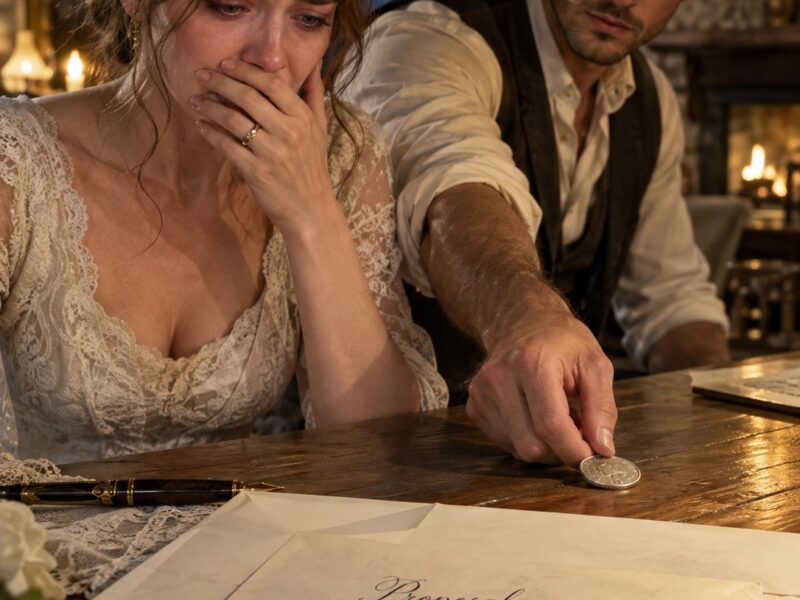
Nine days after marrying Lynette Keech, Merrick Dace placed a silver dollar on the kitchen table and asked his wife to help him propose to another woman.
For several seconds, Lynette said nothing.
The coin lay between them in the yellow light of the kerosene lamp, bright and absurd against the scarred pine table.
Outside, wind dragged dust across the Oregon ranch yard. Somewhere in the darkness, a loose hinge on the barn complained every few seconds.
Inside, Merrick sat across from her with both enormous hands locked together.
He looked miserable.
That was almost worse.
Lynette stared at the dollar.
Then she looked at her husband.
“I’m sorry,” she said quietly. “I believe I misunderstood you.”
Merrick swallowed.
His face was already red.
“You didn’t.”
Lynette waited.
He pushed the coin toward her another inch.
“I need a letter written.”
“You have asked me to write three letters this week.”
“I know.”
“One to the feed merchant. One to the bank. One to Mr. Colson about the broken fence.”
“I know.”
“And now?”
Merrick stared at the table.
“A marriage proposal.”
Something cold moved through her chest.
She had been Merrick Dace’s wife for nine days.
Nine days.
She had traveled hundreds of miles because of a badly written advertisement placed by a lonely rancher seeking a respectable woman willing to become his wife and partner.
Nine days earlier, she had stood beside him before a preacher.
Nine nights earlier, she had unpacked her dresses into the small wardrobe in his house.
Nine mornings earlier, she had begun waking to the sound of his boots crossing the kitchen before dawn.
And now he wanted her to write a marriage proposal.
For someone else.
Lynette slowly folded her hands in her lap.
“Who?”
Merrick looked as though he wished the floor would open beneath him.
“Sylvie Ashford.”
The name meant something.
Everyone in the valley knew the Ashfords.
Horus Ashford owned more land than any other rancher for miles, but land was not what made men lower their voices when they spoke his name.
Water did.
The Ashford property controlled the headgate feeding the irrigation channel that ran down through the lower bench.
Including Merrick’s ranch.
Including nearly a dozen smaller ranches beyond his.
Lynette looked again at the dollar.
Something was beginning to take shape in her mind.
She did not like its shape.
“You are married.”
“I know.”
“To me.”
“I know that too.”
“And you want to propose marriage to Sylvie Ashford.”
Merrick’s jaw tightened.
“Yes.”
There were moments when anger came like fire.
This was not one of them.
This anger came like ice.
Lynette’s voice became almost unnaturally calm.
“Then perhaps you should explain why.”
Merrick stood abruptly and crossed to the window.
For a large man, he had a strange habit of trying to make himself smaller whenever emotion entered a room.
He rubbed one hand over the back of his neck.
“The water’s worse than I told you.”
Lynette said nothing.
“Much worse.”
“How much worse?”
“If Ashford closes the headgate, we lose the south field first. Then the hay. Probably the cattle after that.”
“And the other ranches?”
Merrick stared into the darkness.
“They go too.”
“How many?”
“Eleven families below us.”
Lynette felt her anger shift.
Not disappear.
Shift.
Merrick continued.
“Ashford’s been telling people he’ll guarantee the water to the man who marries Sylvie.”
Lynette stared at him.
“He is using his daughter as payment?”
Merrick winced.
“That isn’t how he says it.”
“How does one politely describe selling a daughter in exchange for irrigation rights?”
“He says he needs someone to take responsibility for the Ashford property when he dies.”
“And apparently the only responsible man in Oregon must first marry his daughter.”
Merrick turned toward her.
“I know how it sounds.”
“No. I don’t think you do.”
He lowered his eyes.
That stopped her.
There was no defensiveness in him.
No arrogance.
Only shame.
“I married you before I knew how bad things were,” he said. “I swear that to you.”
Lynette’s fingers tightened beneath the table.
“Would it matter if you had known?”
He looked at her then.
The question struck him harder than she expected.
“I don’t know.”
It was a terrible answer.
It was also an honest one.
And that, Lynette would later understand, was the problem with Merrick Dace.
He was almost incapable of giving a comforting lie.
“I thought the spring would hold,” he continued. “It didn’t. The upper channel’s nearly dry. Ashford knows it. Everyone knows it.”
“So you intend to divorce me.”
Merrick flinched.
“I don’t know how.”
“But you intend to find out.”
Silence.
“Yes.”
There it was.
A clean blade.
Lynette felt it enter.
She had not married Merrick because she loved him.
That was what she reminded herself.
They had never spoken of love.
Their marriage had begun with an advertisement, several letters, a train ticket, and an agreement between two adults who were old enough to understand that romance did not always arrive before necessity.
Merrick needed a wife.
Lynette needed a future.
That had been the bargain.
Nothing more.
Except nine days had been enough for something more to begin.
And until that moment, she had not realized how much.
She looked down at the silver dollar.
“You want to pay me?”
Merrick’s face reddened again.
“You’re good with words.”
“I am aware.”
“I’m not.”
“I am also aware of that.”
“I thought it would be fair.”
“Fair.”
She nearly laughed.
Merrick seemed to hear the cruelty of the word only after it had left his mouth.
“Lynette—”
She raised one hand.
He stopped.
She needed a moment.
Because if she spoke too quickly, she might say something she could never take back.
Finally, she touched one finger to the coin and pushed it back across the table.
“I won’t take your dollar.”
His shoulders fell.
“But I did not say I wouldn’t write the letter.”
Merrick stared at her.
Neither of them knew it yet, but that sentence would change every life in the valley.
Including their own.
Lynette Keech had spent nine years making other people’s words legible.
Before coming west, she had worked as a clerk and copyist in a Portland law office.
She copied contracts.
Petitions.
Wills.
Property disputes.
Love letters occasionally disguised as legal instructions.
Legal threats occasionally disguised as polite correspondence.
By twenty-seven, she understood something many people twice her age never learned:
Beautiful words were not necessarily true.
In fact, beautiful words were often where lies dressed themselves best.
That was why she had answered Merrick Dace’s advertisement.
Because it was terrible.
His spelling was inconsistent.
His punctuation seemed accidental.
His sentences were so blunt they were almost embarrassing.
“Rancher, thirty-two years. Good land. Sound house. No drink. Need wife willing for work and quiet life. I am not handsome in speech but keep my word.”
Lynette had read it three times.
Then she had laughed.
Then, inexplicably, she had written back.
Every other advertisement she had considered sounded polished.
Men described themselves as prosperous, cultivated, respected, affectionate.
Merrick described himself as “not handsome in speech.”
A man capable of inventing a more flattering version of himself probably would have.
Merrick had not.
That clumsiness had felt safer than charm.
And when she arrived, she discovered that the advertisement had been exactly accurate.
Merrick was not charming.
He was not graceful.
He did not know what to do when she smiled at him unexpectedly.
But he rose before sunrise.
He worked until his hands split.
He fed an injured dog that technically belonged to a neighbor.
He repaired the widow Talbot’s wagon without charging her.
He always gave Lynette the warmer side of the stove.
On their third morning, she found a small shelf installed beside her bed because he had noticed she kept stacking her books on the floor.
He never mentioned building it.
She never thanked him directly.
That was how their first nine days went.
Tiny kindnesses pretending not to be tenderness.
Then came the dollar.
That night, Lynette lay awake in the narrow bedroom and stared at the ceiling.
She could leave.
That was the sensible thing.
She had enough money for passage back to Portland if she was careful.
She could return to copying other people’s contracts.
Return to rented rooms.
Return to evenings when nobody’s boots stood beside hers near the door.
The thought should have comforted her.
It did not.
Instead, she remembered Merrick standing by the window.
Eleven families.
Dry fields.
Dead cattle.
Children watching their parents lose land they had worked for years.
And behind all of it, one frightened old man controlling a headgate.
Lynette turned onto her side.
She hated the situation.
She hated Horus Ashford for creating it.
For several painful minutes, she hated Merrick too.
But beneath that anger was another question.
What did Merrick actually feel?
He said he had to court Sylvie.
He said he had to marry her.
But necessity and desire were not the same thing.
Lynette knew words well enough to understand that people often used the wrong ones for their own hearts.
And Merrick was worse with words than anyone she had ever met.
By dawn, she had made her decision.
She would write his proposal.
But she would not invent it.
At breakfast, Merrick found her sitting at the kitchen table with paper, ink, and a sharpened pen.
He stopped in the doorway.
“You’re doing it?”
“Yes.”
He approached cautiously.
Lynette pointed to the chair across from her.
“Sit.”
Merrick sat.
“Tell me about Sylvie.”
His mouth opened.
Nothing came out.
Lynette waited.
“Well?”
“She’s… nice.”
Lynette stared at him.
“That should certainly bring her running to the altar.”
Merrick frowned.
“She is.”
“What do you admire about her?”
“She rides well.”
“Excellent. We have nearly completed the proposal.”
He shifted uncomfortably.
“She’s pretty.”
“So are several horses in this valley. Try again.”
“Lynette.”
“I am being serious.”
“So am I.”
“No, Merrick. You are attempting to hire me to convince a woman to marry you. I will not write a lie merely because you lack the courage to tell one yourself.”
His expression hardened slightly.
“It isn’t a lie.”
“Then tell me what is true.”
That silenced him.
Lynette leaned forward.
“Why do you want a wife?”
He blinked.
“I already have one.”
The answer came so naturally that neither of them reacted at first.
Then Merrick looked away.
Lynette’s heartbeat changed.
She ignored it.
“Why did you advertise for one?”
He considered.
“The house was too quiet.”
She wrote nothing.
“What else?”
“I needed help.”
“What kind?”
“Everything.”
“That is not an answer.”
He sighed.
“Someone to share things with.”
“Work?”
“Yes.”
“Only work?”
A long silence.
“No.”
Lynette finally lowered the pen to paper.
“What else?”
Merrick stared at his hands.
“Supper.”
She almost smiled.
“Supper.”
“Not cooking it. Just…”
His brow tightened as he fought for language.
“Having someone there.”
The pen stopped.
Merrick continued.
“You work all day and something happens. Maybe a calf gets through a fence. Maybe rain finally comes. Maybe nothing happens. But you come inside and…”
“And?”
“It seems foolish if there’s nobody to tell.”
Lynette looked at him.
“No,” she said softly. “It doesn’t.”
That became the first line worth keeping.
Not the words exactly.
The truth beneath them.
That evening they tried again.
Then the next.
And the next.
What Merrick had imagined would require an hour became something stranger.
Lynette refused to let him hide behind Sylvie.
Every time he tried to describe what he believed a woman wanted to hear, Lynette stopped him.
“What are you afraid of?”
“What does that have to do with marriage?”
“Everything.”
He frowned.
“Answer.”
“Losing the ranch.”
“Why?”
“My father built it.”
“That explains history. Not fear.”
Merrick stared at her.
She waited.
Finally, he said, “Because if I lose it, everyone below me knows what comes next.”
Lynette’s expression changed.
He continued.
“The Talbots lose theirs. Colson too. The Greer boys have four little ones. They mortgaged their herd last year. They won’t survive another dry season.”
“So you aren’t protecting a ranch.”
Merrick looked at her.
“What am I protecting?”
“People.”
He went very still.
Lynette wrote.
Night after night, she asked questions no one had ever asked him.
What did loyalty mean?
What made a house feel like home?
What did he remember about his mother?
Why had he waited so long to marry?
What frightened him about growing old?
When had he been loneliest?
At first Merrick resisted.
Then, slowly, he began to answer.
And once he began, something opened.
He spoke of winter mornings after his father died.
Of eating alone at a table built for six.
Of working until exhaustion because exhaustion was easier than silence.
Of wanting children but being ashamed to admit it.
Of wanting someone beside him who did not need him to pretend strength every hour of every day.
“Someone who can tell when I’m being a fool,” he said one night.
Lynette’s mouth twitched.
“That narrows the candidates considerably.”
“I walked into that.”
“You did.”
Merrick smiled.
It transformed him.
Lynette looked down too quickly.
By the third evening, she began to understand.
By the fifth, understanding became dangerous.
By the seventh, she was certain.
Merrick Dace was dictating a love letter.
But not to Sylvie Ashford.
The woman he described was patient.
Sylvie was famously impatient.
The woman understood silence.
Sylvie filled every silence with laughter.
The woman he wanted could sit across from him after a hard day and make the room feel less empty without needing to entertain him.
The woman could challenge him.
See through him.
Put words to things he could only feel.
The woman could make a house feel inhabited simply by leaving a book on a chair.
On the seventh night, Merrick said, “I suppose I want someone who makes me want to come home before dark.”
Lynette’s pen froze.
Because for the past week, Merrick had been coming home before dark.
Before she arrived, according to the neighbors, he often worked until there was no light left.
Now he came in early.
Sometimes only by fifteen minutes.
Sometimes thirty.
But he came.
Lynette looked at him.
Merrick seemed unaware of what he had said.
“Write that,” he told her.
She lowered her eyes.
“I already did.”
That night she cried for the first time.
Quietly.
Furiously.
Because there was something almost unbearable about being loved by a man who did not know he loved you.
Worse was helping him give that love to someone else.
She could sabotage the letter.
The thought came at two in the morning.
It was simple.
Make the language colder.
Make Merrick sound calculating.
Make Sylvie understand immediately that the proposal was about water.
Sylvie would refuse.
Merrick’s plan would collapse.
Perhaps he would remain married to Lynette because he had nowhere else to go.
The temptation lasted nearly a minute.
Then Lynette hated herself for it.
She had spent nine years writing other people’s words faithfully.
Truth was the only possession she had never allowed poverty or loneliness to take from her.
She would not become dishonest merely because honesty hurt.
So she wrote the best proposal she had ever written.
And every beautiful sentence became another cut.
Merrick changed too.
He began dreading the completion of the letter.
He did not understand why.
“Another page tomorrow,” he would say.
“We could finish tonight.”
“No.”
“Why?”
“Tired.”
He was never tired.
Lynette knew it.
So did he, somewhere beneath consciousness.
He lingered after their work was done.
He found reasons to refill the stove.
To check the window latch.
To ask whether she needed more tea.
Once, their hands touched when both reached for the same page.
Merrick jerked his hand back as though burned.
Neither spoke for several minutes.
On the tenth evening, Lynette asked, “What would you miss most if your marriage ended?”
Merrick stared at her.
She regretted the question instantly.
But he answered.
“This.”
Her breath caught.
“This?”
He gestured vaguely toward the table.
“The talking.”
“Oh.”
“And breakfast.”
“Breakfast?”
“You make coffee stronger than I do.”
Lynette smiled despite herself.
“A compelling basis for matrimony.”
Merrick did not smile.
“I’d miss hearing you moving around upstairs.”
The room became very quiet.
He seemed surprised by his own confession.
Lynette lowered her eyes.
“Anything else?”
Merrick looked at her for a long time.
“Yes.”
She waited.
But he shook his head.
“I can’t say it.”
She nearly whispered, Then how am I supposed to write it?
Instead she said, “Tomorrow.”
“Tomorrow,” he agreed.
Neither slept well.
On the fourteenth evening, the proposal was finished.
Fourteen nights.
Fourteen drafts.
Dozens of pages scratched through, rewritten, folded, unfolded, argued over and read aloud.
The final letter was only three pages long.
Lynette sat beside the lamp and read it to Merrick.
She read of loyalty.
Of loneliness.
Of two people making hard work lighter simply by carrying it together.
Of a house becoming home because another person was inside it.
Of finding, unexpectedly, someone whose presence made silence peaceful instead of empty.
Halfway through, her voice failed.
She cleared her throat.
Merrick pretended not to notice.
Near the end, she had to stop again.
This time Merrick looked away.
When she finished, neither spoke.
The letter lay between them.
Merrick finally said, “It’s beautiful.”
Lynette wanted to scream.
Instead she placed the pages neatly together.
“It is honest.”
“Yes.”
That was the tragedy.
Every word was honest.
Only the intended recipient was wrong.
Merrick would ride to the Ashford property the next morning.
If Sylvie accepted, he would begin whatever legal process was necessary to end his nine-day-old marriage.
Lynette would return to Portland.
And another woman would receive the most intimate description of love Lynette had ever written.
A description created from evenings spent between Lynette and her husband.
She went upstairs.
She closed her door.
And for the first time in years, Lynette Keech allowed herself to weep without trying to stop.
Morning came anyway.
It always did.
Lynette dressed before sunrise.
She prepared coffee.
Then she sat alone at the kitchen table and began making the final fair copy.
Her handwriting was flawless.
She copied each sentence exactly.
No sabotage.
No bitterness.
No small revenge hidden inside a phrase.
At last she reached the final paragraph.
There was one blank space.
They had left it blank through all fourteen drafts.
The name.
Lynette dipped her pen.
Sylvie Ashford.
Three words.
That was all she had to write.
Instead, the pen remained suspended above the page.
She thought of Merrick saying he wanted someone who made him come home before dark.
She thought of the shelf beside her bed.
The stronger side of the coffee.
His boots beside hers.
His awkward smile.
Fourteen nights across a kitchen table.
She lowered the pen.
And wrote:
Lynette.
Her own name.
She stared at it.
Black ink.
One word.
A truth sitting where a lie had been expected.
Her heart pounded.
“No,” she whispered.
She had not meant to do it.
She reached for the blotter.
She would erase it.
Copy the page again.
Write Sylvie.
Do the honorable thing.
Then the kitchen door opened.
Merrick entered.
“Morning.”
Lynette froze.
He removed his hat.
Then he saw her face.
“What happened?”
“Nothing.”
Merrick came closer.
“Lynette.”
“I made an error.”
She tried to turn the page over.
He was faster.
His hand stopped it.
“What error?”
“Merrick, please.”
He looked down.
His eyes found the name.
Lynette.
Neither moved.
Outside, a horse stamped in the yard.
The clock ticked.
Merrick read the name again.
Then his eyes moved upward.
He began reading the letter.
Not glancing at it.
Reading it.
Truly reading it.
With her name inside it.
Lynette stood beside him, unable to breathe.
Every sentence changed.
The woman who made a house feel like home.
Lynette.
The woman who understood silence.
Lynette.
The woman who could make a hard life worth sharing.
Lynette.
The woman whose presence made loneliness disappear.
Lynette.
Merrick’s face changed.
She saw confusion first.
Then recognition.
Then something close to horror.
Not horror at her.
Horror at himself.
He slowly lowered the page.
“Oh, God.”
Lynette stepped back.
“I’m sorry.”
He looked at her.
“I meant to change it.”
“Don’t.”
“I should never have—”
“Don’t change it.”
His voice was different.
Low.
Certain.
She had never heard Merrick Dace sound certain about anything involving his own heart.
Lynette’s eyes burned.
“Merrick.”
He put one hand over hers.
“The name is right.”
She stopped breathing.
He looked at the pages again.
“I’m a fool.”
“Merrick—”
“No. Let me finish before I lose the words.”
His hand tightened slightly around hers.
“I thought I was telling you what I wanted in Sylvie.”
Lynette said nothing.
“I barely know Sylvie.”
“I know.”
“I’ve spoken to her maybe six times.”
“I know.”
“But everything in here…”
His eyes returned to the letter.
“I know this woman.”
Lynette’s tears came before she could stop them.
Merrick looked at her.
“It’s you.”
She closed her eyes.
“It has been for some time.”
He stared.
“You knew?”
“Not at first.”
“When?”
“Third evening, I suspected.”
Merrick looked stunned.
“Fifth, I was afraid.”
“And after that?”
“After that, I was writing your heart while you were breaking mine.”
Merrick recoiled as though she had struck him.
Lynette immediately regretted saying it.
But it was true.
And truth had brought them this far.
She would not abandon it now.
“I’m sorry,” he whispered.
“I know.”
“I never meant—”
“I know.”
“I thought I was saving the ranch.”
“I know.”
Merrick sank into the chair.
For one impossible minute, happiness seemed close enough to touch.
Then Lynette looked toward the dry fields outside.
And reality returned.
“The water,” she said.
Merrick’s expression fell.
The water.
Love had solved nothing.
Eleven families could still lose everything.
Horus Ashford still controlled the headgate.
And Horus Ashford still expected his daughter’s marriage in exchange for opening it.
Merrick stood.
“I won’t marry her.”
Lynette studied him.
“You said eleven families depend on that water.”
“I know.”
“So what happens to them?”
“I’ll find another way.”
“What way?”
“I don’t know.”
“That is not good enough.”
His eyes flashed.
“What do you want me to do? Marry her now?”
“No.”
“Then what?”
Lynette sat.
She pulled a fresh sheet of paper toward herself.
Merrick stared.
“What are you doing?”
“Finding out what Horus Ashford actually wants.”
“He wants a husband for Sylvie.”
“No.”
“He said—”
“I know what he said.”
She looked up.
“People frequently say one thing when they mean another. You, of all men, should understand that by now.”
Merrick almost laughed.
Almost.
Lynette continued.
“Why does he want Sylvie married?”
“No son.”
“Exactly.”
Merrick frowned.
“He’s old. The Ashford property is enormous. The water rights are complicated. If he dies, Sylvie inherits everything.”
“So?”
“So he is frightened.”
Merrick slowly sat across from her.
Lynette’s mind was moving now with the precision it had possessed in the Portland law office.
“He is not bargaining for romance. He is bargaining for security.”
“He wants someone to protect the property.”
“And his daughter.”
“Yes.”
“Then give him that.”
“How?”
“Not with one husband.”
Lynette dipped her pen.
“With an entire valley.”
Merrick stared at her.
And for the second time in fourteen days, Lynette began writing a proposal that would change their marriage.
This one was not addressed to Sylvie.
It was addressed to her father.
The plan was audacious.
Every rancher receiving water from the Ashford headgate would sign a binding compact.
In exchange for guaranteed equitable water access, the lower-bench ranchers would collectively protect the Ashford claim.
They would maintain channels.
Share repair costs.
Defend access rights.
Provide labor during emergencies.
And guarantee that after Horus died, Sylvie would not be left alone trying to manage a complicated water system surrounded by desperate men.
Merrick read the first draft.
“This could work.”
“It needs something.”
“What?”
“Sylvie.”
“What about her?”
“She doesn’t want to marry you.”
Merrick blinked.
“You know that?”
“Everyone with eyes knows that.”
“Why?”
“Because she is in love with someone else.”
Merrick stared.
“Who?”
“The young surveyor.”
“Elias?”
“Yes.”
“Ashford hates him.”
“Because he’s poor.”
“And because Ashford believes poverty means he cannot protect the estate.”
Lynette smiled faintly.
“What profession did you say he has?”
Merrick’s eyes widened.
“Surveyor.”
“Precisely the kind of man who understands water boundaries, channels and headgates.”
For the first time since the dollar crossed the table, Merrick laughed.
Not politely.
Not nervously.
He laughed until he had to lean back in his chair.
Lynette watched him.
“What?”
“You’ve been here less than a month.”
“Yes.”
“I’ve lived here thirty-two years.”
“Yes.”
“And somehow you understand everybody better than I do.”
“That is because you spend most of your time speaking to cattle.”
“They’re straightforward.”
“So are you.”
His laughter faded.
Their eyes met.
The silence between them was no longer empty.
Merrick reached across the table.
This time when his hand touched hers, he did not pull away.
Neither did she.
Three days later, every rancher on the lower bench had signed.
Some signed immediately.
Others argued.
One cried.
Another asked what would happen if Ashford refused.
Lynette answered, “Then at least we will have asked him for what he truly needs instead of surrendering to what fear made him demand.”
Merrick rode to the Ashford property carrying the compact.
Lynette remained behind.
Waiting was worse than writing.
One hour passed.
Then two.
Then four.
By sunset, she could no longer pretend to read.
She stood at the kitchen window.
The fields beyond the house looked tired.
Brown at the edges.
Waiting for water.
Like everything else.
Finally, she saw a rider.
Merrick.
He dismounted slowly.
Lynette could not read his face.
She opened the door before he reached it.
“Well?”
Merrick removed his hat.
“Horus called you meddlesome.”
Her stomach dropped.
“He called me an idiot.”
“That part I believe.”
“He called the compact sentimental nonsense.”
Lynette gripped the doorframe.
“And?”
Merrick looked at her.
“And then he signed it.”
She stared.
“What?”
“He signed.”
Lynette covered her mouth.
Merrick smiled.
“The headgate opens tomorrow.”
For a second she could not move.
Then all the tension left her body at once.
She laughed.
A broken, disbelieving sound.
Merrick stepped toward her.
“There’s more.”
“What?”
“Sylvie came into the room.”
Lynette lowered her hand.
“She told her father about Elias.”
“Oh.”
“In considerable detail.”
Lynette smiled.
“How considerable?”
“Horus threw a cup.”
“That sounds promising.”
“Then Elias was called in.”
“And?”
“He spent twenty minutes explaining the headgate better than Horus’s own foreman.”
Lynette laughed again.
“Horus still hates him.”
“Of course.”
“But now he hates him while considering giving him a job.”
“Progress.”
Merrick’s smile softened.
“Lynette.”
“Yes?”
“You saved them.”
“We saved them.”
“No.”
He shook his head.
“I brought you a problem. You found the truth inside it.”
She looked at him.
Merrick stepped closer.
“I nearly sent you away.”
“You did.”
“I nearly destroyed the best thing that ever happened to me because I was so busy being responsible for everyone else that I never asked what I wanted.”
“And what do you want?”
Merrick opened his mouth.
Then stopped.
Lynette almost smiled.
There he was.
The man who had filled fourteen drafts and still could not speak when the words mattered most.
But this time she did not rescue him.
She waited.
Merrick looked at the woman who had spent two weeks giving language to his heart.
Then he said nothing.
Not yet.
Three evenings later, Lynette entered the kitchen and found the fourteen drafts stacked on the table.
They were tied together with string.
Beside them sat a silver dollar.
Her heart stopped.
Merrick stood near the stove.
“What is this?”
He picked up the dollar.
Then seemed to reconsider.
He put it into his pocket.
“No.”
Lynette raised an eyebrow.
“No?”
“I’m not paying you this time.”
“For what?”
Merrick crossed the room.
His hands were trembling.
That frightened her more than confidence would have.
“I practiced this.”
“Oh, dear.”
“Please don’t make fun of me.”
“I’ll try.”
“I practiced in the barn.”
“With the cattle?”
“They were no help.”
“I told you.”
“Lynette.”
She fell silent.
Merrick looked at the drafts.
“I married you because I needed a wife.”
Her smile disappeared.
“I thought a marriage could be an arrangement. Two decent people doing work together.”
He swallowed.
“I thought that would be enough.”
Lynette’s eyes began to burn.
“It was more than I expected to have.”
He continued.
“Then I asked you to write me a proposal to another woman.”
“That was not your finest day.”
“No.”
His mouth twitched.
“Possibly the stupidest thing any man in Oregon has ever done.”
“Possibly?”
“I’m trying not to exaggerate.”
“Continue.”
Merrick breathed in.
“You asked me questions.”
Lynette waited.
“And I answered them.”
“Yes.”
“I thought I was telling you why another woman should marry me.”
His voice shook.
“But every answer was about you.”
A tear slipped down Lynette’s cheek.
Merrick saw it.
He almost lost his nerve.
Then he looked at the fourteen drafts.
And kept going.
“I don’t have your words.”
“I know.”
“I’ll never have them.”
“You don’t need them.”
“I know that now.”
He stepped closer.
“I love you, Lynette Keech.”
Her breath caught.
“Not because you saved the ranch.”
Another step.
“Not because you write beautifully.”
Another.
“Not because you keep the house or make strong coffee or understand contracts.”
He was close enough now that she could see fear in his eyes.
“I love the woman who sits across from me and refuses to let me lie to myself.”
Lynette pressed her lips together.
“I love hearing you upstairs.”
He smiled nervously.
“I love your books on the chair even though I built you a shelf specifically so you wouldn’t leave books on the chair.”
She laughed through her tears.
“I love coming home before dark because you’re here.”
Her face crumpled.
“And I know I married you once already.”
Merrick lowered himself onto one knee.
Lynette stared at him.
“But I married you before I had the sense to understand what I had been given.”
“Merrick…”
“So I am asking again.”
His voice broke.
He did not look away.
“No letter.”
He glanced at the drafts.
“No borrowed words.”
He looked back at her.
“No bargain.”
His next sentence was almost a whisper.
“Would you marry me again?”
Lynette covered her mouth.
“For love this time?”
Merrick nodded.
“If you can forgive a man foolish enough to spend fourteen nights writing a love letter to his own wife while believing he was proposing to somebody else.”
Lynette, who had made a living from language, could not find a single clever sentence.
So she gave him the simplest one.
“Yes.”
Merrick closed his eyes.
She laughed.
“Yes, you ridiculous man.”
He stood.
She threw her arms around him.
For the first time since arriving in Oregon, Lynette stopped guarding herself against disappointment.
And Merrick kissed his wife as though he had only just married her.
Perhaps, in the way that mattered, he had.
The Ashford headgate opened the following morning.
Water moved through the channel slowly at first.
A silver thread.
Then a stream.
Then a rushing sheet that spilled into the lower ditches and spread across fields that had been waiting under the sun.
Children ran beside it.
Men stood with shovels over their shoulders and watched.
One old rancher knelt and put both hands into the water.
Merrick stood beside Lynette.
Neither said anything.
They did not need to.
Within the year, Sylvie Ashford married Elias, the surveyor.
Horus complained throughout the engagement.
He complained during preparations.
He complained on the wedding morning.
Then he cried harder than anyone when he gave his daughter away.
The valley never forgot what had happened.
Neither did Merrick and Lynette.
They married again that spring.
Not because the first ceremony was invalid.
Because they wanted one memory that belonged to choice rather than necessity.
Nearly every family from the lower bench attended.
Sylvie and Elias sat near the front.
Horus Ashford pretended not to wipe his eyes.
When the preacher asked whether the bride and groom wished to say anything, everyone expected Lynette to speak.
After all, words belonged to her.
Instead, Merrick stepped forward.
Several ranchers exchanged worried glances.
Lynette smiled.
Merrick took her hands.
“I’m not good at this.”
A few people laughed.
He looked at his wife.
“But I learned something.”
The laughter faded.
“A fine sentence can hide a lie.”
His thumb moved across Lynette’s knuckles.
“And a clumsy sentence can tell the truth.”
Lynette’s eyes filled.
“So I won’t try to sound fine.”
He swallowed.
“I’ll just tell you the truth.”
The entire valley seemed to become quiet.
“You are my home.”
Lynette had written thousands of sentences in her life.
None ever meant more.
They kept the fourteen drafts.
Lynette tied them with a blue ribbon and placed them inside the drawer of the same kitchen table where Merrick had once pushed a dollar toward her.
Years passed.
The ranch prospered.
The water compact became something larger than anyone expected.
Families who had once guarded their claims began sharing maintenance.
When one ranch suffered, the others came.
When the Ashford headgate broke during a spring flood, men from every property worked through the night repairing it.
The document Lynette had drafted to save them from one crisis became a promise the valley kept long after Horus Ashford was gone.
And Lynette?
She became the person people visited when something important needed saying.
A young man would appear at her door because he wanted to propose and could not find the words.
A mother would come because she had not spoken to her daughter in six years.
A rancher would arrive carrying news he did not know how to give his brother.
Lynette helped them.
But she always asked questions first.
“What are you actually trying to say?”
Sometimes people became irritated.
Sometimes they cried.
Sometimes they discovered they had come to ask her to write one letter and needed an entirely different one.
She rarely charged them.
Whenever Merrick complained that she was giving away good work, Lynette opened the kitchen drawer and showed him the old silver dollar.
She had kept it.
Not because she valued the coin.
Because she valued what it represented.
The worst request anyone had ever made of her had led to the truest words either of them had ever found.
They had daughters eventually.
Lynette taught them to write.
Merrick taught them horses, fences and irrigation.
And when the girls became old enough to understand the story of the fourteen letters, they found it hysterical.
“You asked Mama to propose to another woman for you?”
Their father would groan.
“Yes.”
“While Mama was already your wife?”
“Yes.”
“And you paid her?”
“I attempted to.”
The girls would collapse into laughter.
Merrick would point at Lynette.
“Your mother could have stopped me.”
“I considered it,” Lynette would say.
“You did?”
“Frequently.”
“Why didn’t you?”
And every time, Lynette gave the same answer.
“Because I wanted to know what was truly in your heart.”
Merrick would look at her across the table.
Even after twenty years, that look remained.
“And apparently,” she would add, “it took fourteen drafts to find out.”
The children eventually grew.
The valley changed.
New roads appeared.
Old fences disappeared.
Horus Ashford died.
Sylvie and Elias took over the property.
The compact remained.
Merrick’s hair went gray.
Lynette needed spectacles to write.
But the kitchen table stayed.
So did the drawer.
So did the letters.
On winter evenings, when snow pressed against the windows and the house became quiet, Merrick sometimes took out the fourteen drafts.
He would read a line.
Then another.
Sometimes they laughed.
Sometimes they did not.
Because beneath the absurdity was something tender and almost painful.
Those pages preserved two lonely people at the exact moment before they understood they were no longer lonely.
They preserved a woman writing down the love she feared belonged to someone else.
They preserved a man describing the person sitting directly in front of him and being too frightened, too distracted and too responsible for everyone else to recognize her.
One winter night, many years after that first terrible dollar, Merrick reached into his pocket.
Lynette was sitting at the kitchen table writing a letter for one of their neighbors.
He placed a silver coin on the wood.
She looked at it.
Then at him.
Merrick kept a perfectly straight face.
“Mrs. Dace.”
“Yes?”
“I need to hire your services.”
Lynette removed her spectacles.
“What kind?”
“A proposal.”
She narrowed her eyes.
“For whom?”
“Another woman.”
Lynette stared at him.
Merrick managed to remain serious for almost three seconds.
She pulled a clean sheet of paper toward herself.
“All right.”
She dipped her pen.
Merrick watched.
“Don’t you need to ask me questions?”
“No.”
“Why not?”
“I already know what is in your heart.”
She wrote one word.
Then folded the page.
She slid it across the table.
Merrick opened it.
In the center of the white paper, written in the same elegant hand that had once almost broken both their hearts, was a single name.
Lynette.
Merrick laughed.
Lynette did too.
Then the laughter softened.
He reached across the table and took her hand.
For a moment they were young again.
The frightened law clerk who had traveled west expecting disappointment.
The lonely rancher who had believed marriage could be merely practical.
The silver dollar.
The dying fields.
The fourteen drafts.
The wrong woman.
The right name.
Everything that might have ended them had somehow become the road that brought them together.
And in the end, Lynette understood something she had spent most of her life learning.
Words were powerful.
But not because they were beautiful.
Not because they could persuade.
Not because they could make an ordinary man sound eloquent.
Their greatest power was simpler.
Sometimes words could make visible what the heart already knew.
Sometimes they could expose a lie.
Sometimes they could save a valley.
And sometimes, if two frightened people were very lucky, a single name written in the wrong place could reveal that it had been the right name all along.
Merrick squeezed her hand.
Lynette looked at the man who had once offered her one dollar to help him marry another woman.
Then she looked down at the page between them.
Her own name was still there.
Exactly where the beloved belonged.
Where, perhaps, it had belonged from the beginning.









