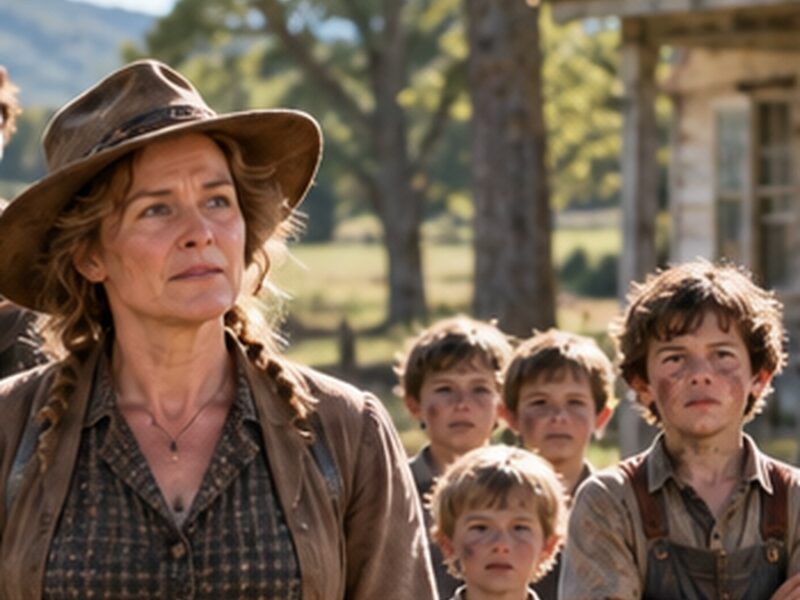
NINE HOUSEKEEPERS RAN FROM THE WIDOWER’S FIVE WILD SONS—THEN A HOMELESS WIDOW ARRIVED WITH SIX BOYS OF HER OWN
The ninth housekeeper fled Owen Kirk’s ranch without even stopping to collect her hat.
Behind her, five motherless boys were laughing over a kitchen floor flooded with well water.
And somewhere two counties away, a penniless widow with six sons of her own was about to make a decision that would change all twelve of their lives.
Owen stood in the doorway, one hand braced against the weathered frame, watching the woman hurry down the road.
Her carpetbag struck her knees with every desperate step.
“You couldn’t pay me enough, Mr. Kirk!” she shouted over her shoulder. “Not if you doubled it. Not if you tripled it!”
She never looked back.
Owen watched until the dust raised by her boots settled over the wagon ruts. Then he closed his eyes.
From somewhere behind him came another splash.
A wooden bucket hit the kitchen wall with a hollow crack.
Five boys erupted into laughter.
Owen didn’t turn around.
“Pete.”
The laughter stopped.
“Whichever one of you did that, I want the floor dry before supper.”
A pause followed.
Then his eldest son’s voice came from the kitchen, carrying the wounded dignity of a boy who had never once admitted to a crime while the evidence was still wet.
“Wasn’t me, Pa.”
Owen opened his eyes.
Pete was thirteen, sharp-eyed, stubborn, and blessed with a remarkable gift for inventing trouble where none had existed five minutes earlier.
He had also become, over the past year, the unofficial commander of the five Kirk boys.
The younger children followed his lead with the confidence of soldiers who had never questioned their general’s judgment.
Unfortunately, their general possessed very little judgment when it came to anything involving water, livestock, furniture, or adults.
Owen looked down at the missing housekeeper’s hat.
It lay beside the porch steps, abandoned in her haste.
He picked it up, brushed off the dust, and hung it on a peg inside the front door.
Nine housekeepers.
Nine women who had arrived with promises of order, discipline, and good Christian patience.
Nine women who had eventually walked, ridden, or run away.
And Owen could hardly blame them.
He had once believed himself capable of running a respectable household. He owned land, kept his accounts, repaired his own fences, and knew how to bring a difficult horse under control.
But horses were simple compared with grieving children.
A horse resisted because it was frightened or stubborn.
A child could be both at once, and still be desperate for someone to hold him when the lights went out.
That was something Owen had learned the hardest possible way.
His wife had been dead for almost a year.
Before her death, the house had been noisy, but the noise had belonged to ordinary family life. There had been arguments about boots left on the stairs, spilled milk, missing socks, and which boy had stolen the last biscuit.
She had known how to settle those disputes without making the boys feel they were being punished for being children.
Owen had never understood how much work lay behind that ease.
After the funeral, silence had settled over the house for a few days.
Then the noise returned.
Louder.
Wilder.
Almost defiant.
Pete stopped asking permission before leaving the yard. Frankie, ten, began hiding things for no particular reason. The younger boys followed whatever entertainment their older brothers devised.
And little Danny, only five, sometimes crawled into Owen’s bed in the middle of the night without saying a word.
Owen had tried talking to them.
He had tried raising his voice.
He had tried assigning chores, taking away privileges, and insisting that supper would not be served until everyone washed properly.
Some days those methods worked.
Other days the boys seemed to consider every rule an invitation to invent a cleverer way around it.
But the worst moments came afterward.
When the kitchen was quiet.
When the boys slept.
When Owen sat alone at the table and saw the empty chair where his wife once sat.
That was when he wondered whether he was failing them.
Not because he didn’t love them.
Because he did.
And love, he was discovering, did not automatically teach a man how to be two parents.
That night, after spending most of the evening helping the boys repair the mess in the kitchen, Owen sat at his desk beneath the yellow light of an oil lamp.
He pulled out a fresh sheet of paper.
For the tenth time, he wrote to the placement agency in Helena.
He explained his situation plainly.
Five sons.
A working ranch.
Fair wages.
Private accommodations.
A home requiring a capable housekeeper willing to remain despite the difficulties.
He did not conceal the fact that nine women had already left.
There seemed little point.
Three weeks later, the reply arrived.
It was brief.
Mr. Kirk,
We regret that we have no one further to send.
Please do not write again.
Owen read the letter twice.
The words did not change.
He folded it carefully and laid it beside the lamp.
Upstairs, a floorboard creaked.
One of the boys turned over in bed.
Outside, the Montana wind moved against the house.
Owen remained seated long after the lamp began burning low.
At last, he put the letter away.
He had not lost hope all at once when his wife died.
It had been taken from him in smaller pieces.
A missed meal.
A broken window.
Another school shirt ruined beyond repair.
A little boy crying for a mother who wasn’t coming back.
Nine housekeepers abandoning the same porch.
And now a letter from Helena telling him that nobody else was willing to try.
He sat in the lamplight wondering how much longer he could keep everything together.
He had no idea that two counties away, a woman named Harriet Bo was facing a different kind of ruin.
Harriet had buried her husband that spring.
Then she had watched the bank take the farm he left behind.
She had argued over figures written in a ledger. She had asked for more time. She had counted what little money remained and tried to make it stretch farther than arithmetic allowed.
But the men handling the debt had no interest in her determination.
There were documents.
There were obligations.
And there was a date beyond which the property would no longer belong to her.
When that day came, Harriet packed what she could.
Six boys watched her from the yard.
The oldest, Jack, was fourteen and already believed himself responsible for matters considerably beyond his years.
The youngest was four, round-faced and still young enough to assume that if his mother said they would find a place, then a place must exist.
Between them were four other sons, each carrying the same restless energy that had exhausted half the adults who knew them.
Harriet loved them all.
She also knew exactly how much trouble six healthy boys could create in an afternoon.
On the morning a neighbor came to visit, they had taken a wagon wheel apart.
Not because it was broken.
Because they wanted to understand how it worked.
Harriet stood at the doorway watching the boys spread spokes and tools across the dirt.
“Jack.”
Her eldest looked up.
“Will that wagon be able to move before supper?”
Jack considered the pieces.
“Yes, Ma.”
“Then see that it does.”
The neighbor, a woman who had recently returned from working at the Kirk ranch, watched the exchange with an expression of disbelief.
“Mrs. Bo, those boys of yours don’t frighten you at all, do they?”
Harriet gave her a tired look.
“They’ve never been strangers to me.”
The neighbor hesitated.
Then she told Harriet about Owen Kirk.
She told her about the ranch.
The wages.
The room.
The five motherless boys who had apparently made a sport of driving grown women to desperation.
“Nine housekeepers,” the neighbor said.
Harriet raised an eyebrow.
“Nine?”
“And I was fortunate to last four days myself.”
“What happened?”
The woman looked uncomfortable.
“Enough.”
Harriet waited.
The neighbor finally sighed.
“There are eleven boys between your house and his, Mrs. Bo. Eleven. It cannot be done. I mean that plainly. It cannot.”
Harriet glanced toward the yard.
Jack was arguing with one of his brothers over the proper position of the wheel hub.
Another boy was trying to help by holding a hammer in precisely the wrong place.
The youngest sat beside the scattered spokes, contentedly drawing circles in the dirt.
Harriet considered the wages.
Then the room.
Then the food.
She thought about the farm she had lost.
She thought about six children who had nowhere permanent to sleep.
And she thought about a widower who had apparently run out of people willing to help him.
“We’ll see about that,” she said.
The neighbor stared.
“Harriet, I’m warning you.”
“I heard you.”
“He has five boys.”
“I can count.”
“And yours make six more.”
“I can count that, too.”
The neighbor shook her head.
But Harriet was already looking toward the wagon.
A woman with six sons and no home did not have the luxury of waiting for a perfect opportunity.
Sometimes she had to take the one everyone else was frightened to touch.
On Tuesday morning, a wagon appeared on the road leading toward the Kirk ranch.
Owen heard it before he saw it.
The wheels rattled over the hard ground. A horse snorted. Somewhere in the yard, one of his boys shouted that somebody was coming.
He stepped onto the porch.
After the letter from Helena, he expected very little from unexpected visitors.
Perhaps a neighbor borrowing equipment.
Perhaps someone looking for directions.
Certainly not a solution to his household.
The wagon came through a cloud of dust and rolled to a stop before the house.
A woman sat on the driver’s bench.
Her hat had seen better seasons. Her dress was plain and practical, and the hands holding the reins belonged to someone accustomed to doing her own work.
Behind her, packed among trunks, blankets, a sack of flour, and a rocking chair tied securely with rope, sat six boys.
Owen stared.
One boy was nearly grown.
Another was small enough to fall asleep leaning against the flour sack.
The remaining four looked around with the alert curiosity of children preparing to explore unfamiliar territory.
From the barn, Owen’s five sons came running.
They assembled in the yard with Pete in front.
Their shirts were dirty.
Their hair needed combing.
Their boots carried enough mud to plant a respectable garden.
The woman climbed down.
She took one look at Owen’s sons.
Then she looked at the house.
Then the porch.
Then Owen himself.
“I was told it was bad.”
Owen opened his mouth.
Nothing useful came out.
The woman glanced again at the boys.
“Five boys in a house that’s merely muddy?”
A faint crease appeared between her eyebrows.
“I’ve seen worse before breakfast.”
Owen blinked.
“Ma’am?”
She removed her gloves.
“My name is Harriet Bo. I buried my husband this spring, and the bank took our farm. I’ve got six sons, the oldest fourteen and the youngest four, and nowhere left to put any of us.”
Her voice remained steady.
There was no attempt to make him pity her.
She was presenting facts.
“I was told you needed a housekeeper.”
Owen looked past her at the wagon.
Six boys.
His own five.
Eleven.
Somehow, his mind kept returning to that number.
“Mrs. Bo, I’m not certain you’ve been given a full account of what goes on here.”
“I was told it was the worst position in Montana Territory.”
“That’s not entirely unfair.”
“Then we’re beginning with an honest understanding.”
Behind Harriet, Jack climbed down from the wagon.
He caught sight of Pete.
Pete looked him up and down.
Jack returned the inspection.
Neither smiled.
Both appeared to recognize an immediate challenge to his authority.
Owen, still watching the two boys, felt a headache beginning behind his eyes.
“Mrs. Bo—”
“Harriet.”
“Harriet, I must tell you that the last woman left only three weeks ago. She didn’t finish her first month.”
“I heard.”
“The woman before her lasted even less.”
“I heard that, too.”
“And the boys have not been easy since their mother passed.”
For the first time, Harriet’s expression changed.
Not into pity.
Something quieter.
She looked toward the five boys standing in the yard, and Owen noticed that she was no longer examining their dirty clothes.
She was looking at their faces.
“All right,” she said.
Owen waited.
“Well,” he finally managed, “welcome, Harriet.”
She nodded once.
Then she rolled up her sleeves.
“Show me the kitchen. I understand there’s a wall that wants scrubbing.”
Owen stared at her for another moment.
Then, unexpectedly, he laughed.
It had been a long time since laughter came so easily.
He stepped aside and held the door open.
Harriet walked in as though she had been expected all along.
By the second morning, all eleven boys were standing in a line beside the water pump.
They had been arranged from youngest to oldest.
Several looked offended by the idea.
Pete looked particularly offended.
Jack looked as though he were calculating the advantages of open rebellion.
Harriet stood before them holding a wooden spoon.
She tapped it once against the porch rail.
The sound was sharp enough to cut through the morning chatter.
“Hands and faces washed before breakfast.”
Nobody moved.
She waited.
Then she pointed to the youngest.
“You first.”
The little boy stepped forward.
One after another, the children washed.
By the time Pete reached the pump, he had decided the entire proceeding required a protest.
“We didn’t have to line up yesterday.”
“No,” Harriet said. “You had to be told six times, and then half of you still came to the table with dirt on your faces.”
Pete opened his mouth.
Harriet lifted the spoon.
Not threateningly.
Simply reminding him who was holding it.
“Wash.”
Pete washed.
From the porch, Owen watched in astonishment.
He had tried arranging the boys at the pump.
He had tried setting a schedule.
He had tried promising extra biscuits.
Nothing had ever worked with such quiet efficiency.
At breakfast, he asked Harriet how she had managed it.
She set a bowl of porridge before the smallest child.
“I run a regiment, Mr. Kirk. Not a nursery.”
Owen glanced at the eleven boys occupying both sides of the long table.
“For the first time, I believe I understand the difference.”
Harriet almost smiled.
“Boys need to know what’s expected. More importantly, they need to know someone means what she says.”
“And if they refuse?”
“Then they learn that refusing doesn’t make the work disappear.”
It sounded simple.
The next week proved otherwise.
Pete began the campaign.
He found a small garter snake and slipped it into Harriet’s flour bin.
Then he gathered two of his brothers and waited near the kitchen door.
Harriet opened the bin.
She paused.
For one beautiful second, Pete believed he had succeeded.
Then Harriet reached inside, lifted the snake by its tail, and carried it toward the back door.
“Pete.”
His face fell.
“Yes, ma’am?”
“My Jack tried that two winters ago.”
Pete blinked.
“He did?”
“Same kind of snake.”
She released it into the grass.
“Now sift the flour and clean the bin.”
Frankie took the next turn.
He hid Harriet’s best scissors.
It had taken previous housekeepers days to recover missing objects, if they ever recovered them at all.
Harriet found the scissors before noon.
She had begun by thinking about where a ten-year-old boy would hide something he wanted to keep out of an adult’s reach.
Her own Sam had once hidden an entire ham for three days.
Compared with that, scissors were hardly a challenge.
The youngest Kirk twins tried crying when assigned chores.
Harriet knelt beside them.
She wiped their wet cheeks with her apron.
“Are you hurt?”
They shook their heads.
“Are you frightened?”
Another shake.
“Then I imagine you’re disappointed.”
One nodded.
“That is allowed,” Harriet said. “You may be disappointed as much as you please.”
She stood.
“The chores still need doing.”
By the end of the first week, eleven boys had discovered that Harriet possessed an unnerving familiarity with every trick they knew.
She recognized false innocence.
She understood whispered conspiracies.
She could tell when a missing object had been hidden and when it had genuinely been lost.
She did not mistake noise for wickedness.
And she had no intention of permitting cruelty simply because children were capable of inventing it.
One evening, Pete approached his father while Owen was mending a harness.
“Pa?”
“Yes?”
“She’s not scared of us.”
Owen looked toward the house.
Harriet was crossing the yard with an armful of shirts, calling instructions to two boys near the woodpile without slowing her stride.
“No,” he said.
“I don’t imagine she is.”
Pete was quiet for a moment.
Then he asked, “Is she staying?”
Owen looked at him.
It was the first time one of his sons had asked that question without sounding eager for the answer to be no.
“I hope so.”
Pete looked toward the house again.
He said nothing further.
But when Harriet called for the firewood, he went without being asked twice.
By the third week, the household had developed a rhythm Owen scarcely recognized.
Breakfast began on time.
The younger boys washed before coming to the table.
Shirts were mended before they became useless.
Chores were divided according to size, strength, and the likelihood that a particular boy would find an ingenious way to avoid them.
There were still arguments.
There were broken dishes.
There was mud everywhere when it rained.
But the house no longer felt as though it were losing a battle with itself.
One evening, Owen sat at the head of the table.
Eleven boys passed biscuits from hand to hand.
Someone asked for butter.
Someone else complained that his brother had taken the larger potato.
Harriet settled the dispute without interrupting her conversation with Owen.
And suddenly Owen realized something.
He was sitting down for supper.
Not eating at the kitchen counter between chores.
Not standing beside the stove while trying to stop an argument.
Actually sitting at his own table.
He looked along the rows of boys.
Then at Harriet.
Something warmed inside him.
It was such an ordinary thing.
A family eating supper.
He had spent months believing he might never see it again.
After the boys went upstairs, he remained at the table while Harriet wiped it clean.
“I never managed to get them all sitting down at once,” he said.
She glanced at him.
“Even before?”
“No. Not since their mother died.”
He turned the empty cup between his hands.
“I tried. It always became a fight about something.”
Harriet continued wiping.
“Eleven boys scattered around a house make eleven separate messes. Eleven boys sitting together become company.”
Owen considered that.
“They do seem to enjoy it.”
“Children like belonging to something, Mr. Kirk. Even when they’d rather die than admit it.”
He watched her fold the cloth.
For the first time, he wondered what it had cost Harriet to bring her own boys here.
She had left behind more than land.
She had left the last place where she had lived with her husband.
He understood that kind of loss.
And yet she had arrived at his doorstep without asking anyone to handle her gently.
She had simply gone to work.
“Harriet?”
“Yes?”
“I’m glad you came.”
Her hands slowed.
For a moment, she did not turn around.
Then she said, “So am I.”
And that was all.
But Owen carried those three words with him long after the lamp was extinguished.
Harriet, meanwhile, had begun noticing things about Owen that she had not expected.
He was quieter than her late husband had been.
He did not announce every useful task as though the household owed him applause.
He repaired what needed repairing.
He worked long hours.
And when one of the boys came crying, he never acted as though a child’s hurt was beneath his attention.
She discovered this one afternoon near the barn.
She had been looking for Sam when she found Owen crouched in the dirt with Danny’s small boot in his lap.
The little boy sat on an overturned bucket, sniffling.
Owen was working a splinter from the damaged leather.
“Hold still,” he murmured.
Danny gripped the edge of the bucket.
“Will it hurt?”
“Not much. It’s the boot we’re fixing, not your foot.”
The child considered that.
“All right.”
Harriet stopped beside them.
“You didn’t have to do that yourself,” she said. “I could have mended it.”
Owen did not look up.
“I know.”
He eased the splinter loose.
“But he came to me crying, and it seemed a poor thing to send him off to someone else just because there’s a woman in the house now.”
He turned the boot in his hands, checking the worn seam.
“Their mother used to say a father who won’t fix his own son’s boot isn’t much of a father.”
He smiled faintly.
“I’ve tried to remember that. Even on the hard days.”
Danny put the boot back on.
Then he hopped down and ran toward the house.
Owen called after him to watch where he was going.
Harriet remained beside the bucket.
In all her married years, she could not remember once seeing a father stop his work simply because a little boy needed comfort over a damaged boot.
It was a small thing.
Hardly worth remarking upon, perhaps.
But it settled somewhere deep inside her.
“Well,” she said.
Owen looked up.
“Well what?”
She shook her head.
“Nothing.”
Then she returned to the house.
For the rest of the afternoon, she found herself remembering the sight of him kneeling in the dirt.
The patience in his hands.
The way he had spoken about his late wife without bitterness.
The quiet conviction that his sons’ smallest troubles still deserved his attention.
Harriet had come to the Kirk ranch because she needed work.
For the first time, she began wondering whether she had found something she hadn’t known to look for.
The first serious fight between Pete and Jack happened on a Sunday.
No one later agreed about what had started it.
Perhaps Pete believed he should lead the expedition to the creek.
Perhaps Jack had grown tired of accepting orders from someone a year younger than himself.
Perhaps both boys had simply reached the end of their patience with sharing authority.
Whatever the cause, Harriet heard shouting behind the barn.
By the time she arrived, the two eldest boys were rolling in the dirt.
Pete had a bloody lip.
Jack’s shirt was torn at the shoulder.
The younger boys stood in a circle, shouting conflicting encouragement.
“Enough!”
Harriet caught Pete by his collar.
Then Jack.
She hauled them apart.
Both boys froze.
She looked from one to the other.
“You will not tear this household apart fighting over who gets to command it.”
Pete wiped his mouth.
“He started—”
“I did not ask who started it.”
Jack glared at the ground.
“There is room enough in this house for two eldest sons,” Harriet continued. “But there has never been room in any family for two eldest sons who refuse to work together.”
Neither answered.
She marched them to the pump.
Washed the blood and dirt from their faces.
Then pointed toward a damaged stretch of fence.
“You two will mend that together.”
Pete stared.
“Together?”
“Shoulder to shoulder.”
Jack began to protest.
Harriet raised one finger.
“Before sunset.”
From the porch, Owen watched the boys carry tools toward the fence.
He crossed his arms.
“They’ll murder each other before that fence is finished.”
Harriet stood beside him.
“Watch.”
For the first hour, Pete and Jack barely spoke.
By the second, they were arguing about the best way to set a post.
By the third, they were laughing at something Owen could not hear.
At supper, they sat beside each other.
The following morning, Harriet caught them whispering near the barn.
Whatever they were planning involved an overturned bucket, a length of string, and a suspiciously cooperative younger brother.
Owen looked at them with a mixture of alarm and reluctant admiration.
“Together,” he murmured, “those two could run this entire valley by the time they’re twenty.”
Harriet followed his gaze.
“They probably will.”
“And make life miserable for everyone who gets in their way.”
She gave him a sideways look.
“You sound almost proud.”
“I am,” Owen admitted. “That’s what worries me.”
Their laughter drifted from the barn.
Owen turned toward Harriet.
For a moment, the easy humor between them gave way to something more uncertain.
He had been aware of it for days.
The way his eyes searched for her when he came in from the fields.
The quiet comfort of hearing her moving through the kitchen after the boys were asleep.
The discovery that there were things he wished to tell her even when they had nothing to do with household business.
He hadn’t intended to seek another attachment.
Part of him still felt guilty for recognizing the possibility.
He loved his late wife.
He always would.
But lately he had begun to understand that remembering one person did not necessarily mean shutting every door against another.
Harriet seemed to sense his hesitation.
She folded her arms.
“What?”
Owen looked down, then back at her.
“I was thinking.”
“That’s usually dangerous around here.”
He smiled.
“About what comes next.”
“For the boys?”
“For all of us.”
Harriet’s expression softened.
It was not an answer.
Not yet.
But neither of them walked away.
They remained standing beside the porch while eleven boys’ laughter carried through the evening.
And something neither had quite dared to name began taking shape between them.
Then the fever came.
It began with one of the younger Kirk twins.
A burning forehead.
A sore throat.
A rash spreading across his chest like fine red sand.
Harriet noticed it while helping him dress.
By noon, another boy was complaining of chills.
By evening, two more had taken to their beds.
Owen rode for the doctor.
When the physician arrived, he examined the children carefully.
His expression grew grave.
“Scarlet fever.”
The words seemed to change the air in the room.
Harriet felt Owen go still beside her.
The doctor continued examining the boys.
By the time he finished, it was clear that the illness had spread beyond the first child.
There were eleven children in the house.
Eleven chances for the disease to take hold.
The doctor advised separating the sick where possible and maintaining the cleanest conditions they could manage. He instructed them to keep the children drinking, watch their breathing, and send for him if any worsened.
“I’ll return every other day,” he said.
Then he closed his bag.
“I’ve seen children recover from this, Mr. Kirk. But I won’t tell you there’s no danger.”
Owen nodded.
He remembered another sickroom.
Another doctor.
Another promise nobody had been able to give him.
He looked toward the stairs.
His boys were upstairs.
Harriet’s boys were upstairs.
And there was nothing he could do to make himself less afraid.
That first night, Harriet began organizing the rooms.
She moved bedding.
Set aside water and cloths.
Prepared broth.
Then she sat with the youngest children while Owen carried firewood and checked the older boys.
They worked until the house grew quiet.
By morning, more children were ill.
Before the week was out, their orderly household had become a place of muffled coughing, whispered reassurance, and footsteps moving through dim hallways.
Harriet and Owen began taking shifts.
She watched the small hours before dawn.
He covered the long stretch from afternoon into evening.
They met in the kitchen to exchange reports.
“Frankie drank half a cup.”
“Good.”
“Jack’s fever seems lower.”
“Pete asked whether he could go outside.”
“That sounds promising.”
“Danny?”
Harriet paused.
“Still warm.”
Owen nodded.
Neither said what both were thinking.
The days blurred.
Cloths were rinsed and wrung out.
Broth simmered.
Children who usually fought over who could shout the loudest became quiet and listless.
Harriet found herself longing to hear them argue.
Owen learned to recognize each boy’s footsteps even when illness slowed them.
Sometimes he sat beside a bed and told stories of the ranch.
Sometimes he held a frightened child’s hand until sleep finally came.
He grew so tired that words occasionally escaped him halfway through a sentence.
Harriet would take over without asking.
She understood exhaustion.
She had spent years raising six children through illnesses, injuries, bad harvests, and winter shortages.
But eleven sick boys tested even her endurance.
At the end of the second week, the first child began recovering.
Then another.
Then a third.
Hope returned cautiously.
No one dared trust it too quickly.
By the time the fever began loosening its hold on most of the household, ten boys were showing signs of recovery.
But Danny was not.
He was five years old.
Small for his age.
Usually the first child to laugh when something amusing happened and the last to admit he was tired.
Now he lay beneath his blankets with flushed cheeks and dry lips.
His breathing had grown quick and shallow.
On the ninth night of his worst fever, Harriet touched his forehead and felt a frightening heat beneath her palm.
She changed the cloth.
Waited.
Changed it again.
Nothing seemed to help.
Owen sent for the doctor.
The physician came through the darkness, examined Danny, and remained by the bed longer than either parent found comforting.
When he finally stepped into the hallway, Owen followed.
Harriet stayed beside Danny, but the door was not fully closed.
She heard Owen ask the question.
“Is he going to live?”
Silence.
Then the doctor answered quietly.
“I’ve done what I know to do.”
Owen gripped the doorframe.
“There must be something else.”
“I wish there were something I could promise you.”
The old man’s voice was gentle.
“But I won’t lie to you, Mr. Kirk. Tonight will tell us a great deal.”
Owen stood there after the doctor left.
A floorboard creaked beneath his boot.
From inside the room came the faint sound of Danny struggling for another breath.
Owen went back in.
He sat beside the bed.
Took his son’s small hand.
And did not move.
Harriet found him there sometime after midnight.
The lamp had burned low.
His face looked gray beneath the exhaustion.
He was still holding Danny’s hand.
Harriet came to the other side of the bed.
She dipped a fresh cloth into cool water, wrung it out, and laid it across the child’s forehead.
Then she settled into the chair opposite Owen.
For a long time, neither spoke.
At last, Owen looked up.
“You don’t have to do this.”
Harriet continued adjusting the cloth.
“Do what?”
“Stay.”
She glanced at him.
“Owen—”
“He’s not yours, Harriet.”
The words came out rougher than he intended.
“You have your own boys to worry about. You’ve hardly slept in days. Go and rest. I’ll sit with him.”
Harriet was quiet.
She looked at Danny.
At the small hand resting inside Owen’s larger one.
At the boy’s lashes lying dark against his fevered cheeks.
Then she spoke.
“I decided he was mine during the first week.”
Owen stared at her.
“What?”
“The day he cried over that splinter in his boot.”
She adjusted the blanket near Danny’s shoulder.
“I watched you stop your work to help him. You didn’t hand him off to me because I was the woman in the house.”
Owen lowered his eyes.
“I remember.”
“And I remember thinking that was a man who knew how to love his boys properly.”
Her voice softened.
“Somewhere between that afternoon and now, they became my boys, too.”
Owen said nothing.
Harriet looked directly at him.
“I don’t stop claiming a child because the nursing becomes difficult. That’s not how I was raised, and it isn’t how I intend to finish.”
Owen’s mouth tightened.
For nine days he had held himself together because somebody needed to.
He had answered the doctor’s questions.
Carried water.
Comforted frightened children.
Kept his voice steady even when his hands trembled.
But now, across the narrow bed of his sick son, Harriet was offering him something he had not known how to ask for.
The certainty that he was not alone.
He looked away.
“I don’t know what I’d have done this year without you,” he said.
Harriet watched him.
“I mean that more plainly than I’ve ever meant anything.”
“You’d have managed.”
“I don’t know.”
“Men generally do.”
She reached for another cloth.
Then added, “But I’m glad you didn’t have to find out.”
Owen laughed once.
The sound was small and unsteady.
Harriet rested her hand beside Danny’s.
And they stayed.
The lamp burned.
Outside, the night grew colder.
From another room came a boy’s sleepy cough.
The wind pressed gently against the window.
Owen told Harriet about the first time Danny had tried to follow his brothers into the barn.
Harriet listened.
Then she told him about the day her youngest had fallen asleep inside an empty grain sack while his brothers searched the yard for him.
For a moment, both smiled.
Then Danny stirred.
They leaned toward him.
His breathing remained shallow.
Harriet touched his forehead.
Still hot.
Hours passed.
Owen lost track of how many times he checked his son’s face.
He had been afraid before.
He had buried his wife.
He knew what it meant to walk into a room after someone was gone and feel the shape of their absence.
He could not bear the thought of returning to that darkness with Danny.
Harriet watched his face.
She understood enough of what he was thinking not to tell him everything would be all right.
Instead, she remained.
Sometimes the greatest comfort another person could offer was the refusal to leave.
Near three in the morning, Danny’s breathing changed.
At first Owen thought he had imagined it.
The breaths came less rapidly.
A small sigh escaped the boy’s lips.
Harriet reached toward his forehead.
She paused.
Then touched his neck.
The terrible dry heat had begun to ease.
Sweat dampened his hair.
She looked at Owen.
“Owen.”
He raised his head.
“Feel.”
He touched Danny’s forehead.
His hand trembled.
For several seconds, he said nothing.
Then Danny’s eyelids fluttered.
He looked vaguely toward his father.
“Pa?”
Owen leaned forward.
“Yes, son.”
The boy swallowed.
His voice was hoarse.
“I’m thirsty.”
Owen made a sound that began as a laugh and ended dangerously close to a sob.
Harriet was already reaching for the cup.
“Then water you shall have,” she whispered.
Owen helped his son drink.
Just a little at first.
Then another small sip.
Danny closed his eyes again.
But his breathing remained easier.
Owen sat back.
Across the bed, he looked at Harriet.
Neither spoke.
The relief was too deep for ordinary words.
For weeks, they had worked side by side because eleven children depended on them.
Now they understood something else.
They had become people who could face the worst night of their lives together.
By the end of the following week, Danny was recovering.
The other ten boys had already begun protesting the constant broth.
Soon Frankie complained that he was hungry for real food.
Pete announced that staying in bed was making him weaker.
Jack argued that he could already work outside.
Harriet refused to release any of them from rest before she was satisfied they were strong enough.
When the first unauthorized pillow fight broke out, she stood in the doorway with her hands on her hips.
She should have been furious.
Instead, she had to turn away to hide a smile.
Their mischief had returned.
After weeks of listening for every cough and frightened breath, it sounded almost beautiful.
The preacher came out to the ranch the following Sunday.
He had heard about the fever spreading through eleven children and wanted to see how the household had survived.
Owen met him on the porch.
The preacher studied his drawn face.
“You look as though you’ve aged ten years.”
“Feels closer to twenty,” Owen said.
“And the children?”
“Come see.”
Inside, eleven boys gathered around the long table.
Their faces were thinner.
Their movements slower.
But every one of them was sitting upright.
Harriet stood near the stove, ladle in hand.
Owen took his place at the opposite end of the table.
At Harriet’s instruction, the boys bowed their heads.
Pete and Jack knelt shoulder to shoulder.
The youngest mumbled the prayer a little behind the others.
The preacher stood in the doorway watching them.
When the grace was finished, the boys sat up and reached for their spoons.
The preacher remained silent.
Finally, he shook his head.
“Well.”
Harriet looked at him.
“Is something wrong?”
“Not a thing.”
He surveyed the table again.
“I came expecting a house half destroyed by fever. Instead, I find the most orderly congregation in this valley.”
Pete smiled.
Jack elbowed him.
The preacher’s eyes traveled from Harriet to Owen.
“A widow and a widower running a household together as though they’ve done it all their lives.”
Harriet felt a sudden warmth rise into her cheeks.
Owen cleared his throat.
The preacher was smiling now.
“Eleven boys are a fine beginning.”
He waited.
“But it seems to me there might be one matter left unsettled.”
Owen looked at Harriet.
Harriet looked back.
The preacher continued.
“You’ve made yourselves a family in practice. Perhaps, one day soon, you’ll allow me to make it one on paper as well.”
The boys fell silent.
Then Pete looked at Jack.
Jack grinned.
Owen felt every pair of eyes turn toward him.
He could have laughed it away.
He could have said the preacher was speaking too soon.
He could have reminded everyone that Harriet was there as his housekeeper, that their arrangement had begun with wages and a room.
But none of those explanations would have described what had happened between them.
Not anymore.
He looked at Harriet.
She stood beside the stove with the ladle still in her hand.
Her expression was careful.
Hopeful, perhaps.
But careful.
Owen thought of her arriving in the yard with six boys and a rocking chair.
He thought of the first supper when every child had sat at the table.
He thought of her standing beside him while Pete and Jack laughed at the fence.
And he thought of a sickroom at three in the morning, when she had claimed his youngest son as her own.
“I believe,” he said slowly, “that might be worth doing.”
Harriet’s lips parted.
For a moment, the woman who could command eleven unruly children with a wooden spoon appeared to have misplaced every word she knew.
Then she smiled.
“I believe it might.”
The room erupted.
Eleven boys began cheering.
Someone knocked over a spoon.
Someone else nearly upset a bowl.
Pete slapped Jack on the shoulder.
Jack shouted something about having known all along.
The preacher laughed.
Harriet covered her face for a moment.
Owen stood at the other end of the table, smiling with the helpless astonishment of a man who had believed happiness was something his life had already spent.
Later, when the excitement settled and the boys had been sent outside, Owen found Harriet standing near the kitchen window.
“Harriet.”
She turned.
“I hope you didn’t feel put upon.”
“No.”
“I ought to have spoken to you privately.”
“Yes,” she said.
He winced.
Then she smiled.
“But I’ve had practice dealing with men who don’t always think before they speak.”
Owen laughed softly.
“I’d like to ask you properly.”
Harriet folded her hands.
He stepped closer.
“Would you marry me?”
For once, he did not try to explain.
He did not speak about needing help with the children.
Or what it would mean for the ranch.
Or how they might arrange their responsibilities.
He simply stood before her.
A tired man who had loved deeply, grieved honestly, and somehow found room in his life to love again.
Harriet looked into his face.
She thought of the farm she had lost.
Her husband buried beneath the spring earth.
Six frightened boys riding toward an uncertain future.
A stranger on a porch who had welcomed all seven of them when he had every reason to be afraid.
“Yes, Owen.”
She reached for his hand.
“I would.”
The wedding took place in the Kirk front yard on a bright autumn morning.
The grass had been trampled into a narrow aisle.
The fence had been repaired.
The house stood behind them, its windows shining in the clear light.
Eleven boys had been scrubbed and combed with an attention to cleanliness they found unreasonable.
Every one of them had been assigned a place.
Every one of them had promised to behave.
Harriet knew better than to expect perfection.
Pete and Jack stood at the front together.
They looked pleased with themselves.
In fact, they had the appearance of two young men who had carefully planned something their parents had not authorized.
Harriet noticed.
She raised an eyebrow.
Pete straightened his collar.
For once, he offered no explanation.
The preacher stood waiting near Owen.
Neighbors gathered beside the fence.
The doctor and his wife had come.
Even the neighbor who had publicly declared the whole arrangement impossible was there.
He had once insisted at the mercantile that no woman could manage eleven boys and win a widower’s heart besides.
Now, in full view of half the valley, he paid the wager he had lost.
The doctor’s wife took the money with a smile.
The neighbor grumbled that he had never been so pleased to lose a bet.
At the appointed moment, Harriet stepped toward the aisle.
And Pete moved forward.
He offered her his arm.
Harriet stopped in surprise.
“Pete?”
The boy lifted his chin.
“Somebody ought to do this properly.”
He spoke with such solemn dignity that Harriet nearly laughed.
Then he added, more quietly, “And I figured it ought to be family.”
Harriet’s expression changed.
She looked at the thirteen-year-old boy who had once helped drive nine housekeepers away.
The boy who had refused orders, concealed evidence, and considered a snake in the flour bin the height of entertainment.
He was standing before her now, offering to walk her toward his father.
Not because someone had ordered him.
Because he wanted to.
Harriet took his arm.
“I’d be honored.”
Pete swallowed.
Then led her carefully across the grass.
At the front, Owen was waiting.
His eyes shone.
The preacher began the service.
Eleven boys stood around them in a ragged but determined line.
Some were too young to understand the full meaning of the promises being spoken.
The older boys understood enough.
They knew that this house, once filled with grief, had changed.
They knew there would still be chores.
There would still be rules.
There would still be arguments and difficult mornings.
But the people who had cared for them through sickness and sorrow were promising to remain together.
For children who had already lost so much, that promise mattered.
When the preacher came to the vows, Owen took Harriet’s hand.
He spoke steadily.
So did she.
There was no grand speech about destiny.
No claim that grief had disappeared.
Neither pretended their first marriages had been erased.
They stood before the people who knew them and promised to share whatever years remained.
The ordinary days.
The difficult days.
The nights when children were sick.
The mornings when the fence needed repairing.
The winters when money was short.
The summers when work seemed endless.
The small joys that could disappear unnoticed unless someone took the trouble to cherish them.
At last, the preacher called for the rings.
Harriet glanced toward Owen.
A smile moved slowly across her face.
“I was told it was bad,” she whispered.
Owen leaned closer.
“Was it?”
She looked beyond him.
At Pete and Jack standing together.
At the younger boys watching with barely contained excitement.
At the house that had once seemed like one more desperate place to try.
Then she looked back at the man holding her hand.
“Not for a single day since.”
Owen smiled.
The preacher was still finishing his words when Harriet leaned forward and kissed him.
Eleven boys whooped.
The sound startled birds from the fence.
Someone began clapping before the preacher had even completed the blessing.
Owen laughed against Harriet’s cheek.
And for one bright autumn morning, the Kirk ranch sounded more disorderly than it ever had under nine defeated housekeepers.
Harriet did not mind.
She had never wanted a silent house.
She had wanted a home.
A place where children could be noisy without being abandoned.
Where a man could grieve without spending the rest of his life alone.
Where a woman who had lost her land and buried her husband could find that she still had something to give, and something worth receiving.
The bank had taken her farm.
It could not take what she had built here.
Owen had once believed that keeping his family together meant carrying every burden himself.
Now, watching Harriet laugh while eleven boys crowded around them, he understood how wrong he had been.
His sons had not needed a woman to replace their mother.
They had needed people willing to love them without pretending their loss had never happened.
And Harriet’s boys had not needed a wealthy benefactor to rescue them.
They had needed a place where they could belong.
Together, they had found both.
When the wedding guests began moving toward the tables, Pete caught Jack’s sleeve.
The two boys exchanged a look.
Owen noticed immediately.
“What are you two planning?”
“Nothing,” Pete said.
“Absolutely nothing,” Jack added.
Harriet raised one eyebrow.
Both boys began laughing.
Owen shook his head.
“Eleven boys,” he murmured.
Harriet slipped her hand into his.
“Eleven good boys.”
He looked at her.
“You’re being generous.”
“No,” she replied. “I’m being their mother.”
Owen held her hand a little tighter.
Beyond the fence, the autumn sunlight stretched across the Montana hills.
Inside the house, supper would soon need preparing.
There were clothes to mend.
Tools to put away.
A hundred ordinary tasks waiting for tomorrow.
Their life would never be quiet.
It would never be easy.
And neither Owen nor Harriet would have traded it for any other.
Because the greatest thing that happened on the Kirk ranch was not that a widow managed to bring eleven unruly boys into line.
It was that twelve people who had each lost some part of their world found a way to build another one together.
And this time, no one had to face it alone.









