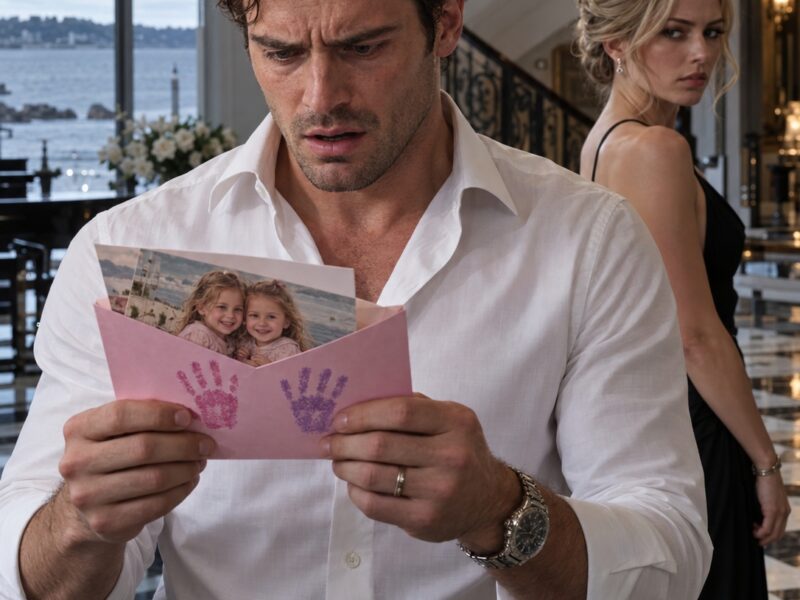
ON HIS 35TH BIRTHDAY, A PINK ENVELOPE ARRIVED—INSIDE WERE PHOTOS OF THE TWINS HE NEVER KNEW HE HAD
On the morning of his thirty-fifth birthday, Adrian Sutton learned that he had two seven-year-old children.
He learned it from a pink envelope.
There were two tiny crayon handprints on the back.
One blue.
One purple.
And beneath them, written in the uneven block letters of a child:
HAPPY BIRTHDAY.
Adrian stood barefoot in the marble foyer of his Newport mansion, still wearing the white dress shirt he had slept in after another fourteen-hour day at Sutton Maritime.
Outside the floor-to-ceiling windows, Narragansett Bay was gray beneath an October sky. Wind bent the ornamental grasses along the terrace. Somewhere beyond the cliffs, a foghorn sounded.
His house was enormous.
Quiet.
Immaculate.
And completely empty.
It had been that way for years.
Adrian slid one finger beneath the envelope flap.
A photograph fell onto the black marble console.
Two children stood beside a red lighthouse.
A boy and a girl.
They were laughing into the wind.
The girl had dark curls whipping across her face and one front tooth missing. The boy was holding a strawberry cupcake with both hands.
Adrian stared at the boy.
Then he stopped breathing.
The eyes.
His eyes.
Not similar.
Not close.
His.
And the boy’s left hand was touching his left ear.
Adrian unconsciously lifted his own hand.
Touched the same place.
Something cold moved through him.
He turned the photograph over.
Three words were written in a handwriting he had spent years trying to forget.
Maya and Leo. Seven.
His knees nearly gave out.
He knew that handwriting.
For eight years, he had searched for it.
He opened the card.
Inside was a message.
Adrian,
Today Maya and Leo turned seven.
Same day as you.
I don’t know if you ever think about me anymore. I don’t know if you ever wanted to know them. I told myself I wouldn’t write again after what you sent last year.
But seven feels important.
Leo has your eyes.
Maya laughs the way you used to when you forgot who you were supposed to be.
They’re healthy. They’re happy. They love the ocean.
That’s all I ever wanted you to know.
—Julia
Adrian read it once.
Then again.
By the third time, the words blurred.
“What the hell?”
The voice came from behind him.
Adrian turned.
Yuna Caldwell stood beneath the archway leading from the kitchen, holding two cups of coffee.
She was elegant even at eight in the morning—cream trousers, cashmere sweater, dark hair pinned neatly behind her head. At thirty-four, she was executive vice president of Sutton Maritime, the daughter of one of Rhode Island’s most connected banking families, and in exactly thirteen days, she was supposed to become Adrian’s wife.
She looked at the photograph.
Then at the envelope.
For less than a second, the coffee cup in her right hand trembled.
Most people would have missed it.
Adrian didn’t.
“Who sent that?” she asked.
He didn’t answer.
He was looking at her face now.
“Adrian?”
He lifted the photograph.
“Someone who’s supposed to be in Georgia.”
Yuna’s expression barely changed.
But something behind her eyes did.
“Our wedding is in two weeks,” she said carefully. “Don’t do this to yourself again.”
“Do what?”
“Chase ghosts.”
Adrian looked down at the photograph.
The little boy was still touching his ear.
“Ghosts don’t turn seven.”
Yuna went still.
Adrian raised his eyes.
“And ghosts don’t mail photographs of my children.”
Eight years earlier, Julia Wood had arrived in Newport, Rhode Island, with one suitcase, three hundred and eighty dollars, and a promise to herself that she would stay exactly one school year.
She was twenty-five.
She had grown up outside Atlanta, lost her father before college, and buried her mother after a short battle with ovarian cancer the previous winter.
There was nothing waiting for her in Georgia except an empty apartment and grief that had learned how to sit quietly beside her.
So when a private elementary school in Newport offered her a teaching position, Julia said yes.
She rented a second-floor apartment over a florist.
She bought a used Honda.
And on weekends, she baked.
Baking had been her mother’s language.
Butter meant comfort.
Vanilla meant somebody was coming home.
Strawberries meant summer birthdays on the back porch.
Julia’s dream was to open a bakery someday.
Not a famous one.
Not an expensive one.
Just a little place near the water where people could walk in feeling terrible and leave carrying something warm.
She met Adrian Sutton on a windy Saturday in October.
Julia had promised one of her students a strawberry cake for her tenth birthday.
She was carrying it along the harbor wall toward the girl’s family picnic when a gust of Atlantic wind ripped the cardboard box out of her hands.
“Oh, no—”
The box flew sideways.
A man in a gray wool coat caught it less than a foot from the water.
He stared down at the crooked pink frosting.
Then at Julia.
“Please tell me that’s not somebody’s wedding cake.”
She pressed both hands to her chest.
“Birthday.”
“Then I may have saved a childhood.”
“You definitely saved my job.”
The stranger smiled.
Not politely.
Actually smiled.
Julia would later learn that people at Sutton Maritime considered Adrian Sutton’s smile almost mythical.
But that afternoon he laughed when she opened the box and discovered that one strawberry had landed upside down.
He didn’t tell her his last name.
He introduced himself simply as Adrian.
She didn’t recognize him.
That fascinated him.
He was the only son of Margaret Sutton, chairwoman of Sutton Maritime Holdings, one of the largest privately controlled shipping and logistics companies on the East Coast.
The Sutton family owned terminals from Providence to Savannah, warehouses in six states, waterfront real estate, hotels, and enough political influence that newspapers described their annual charity gala as if it were a diplomatic summit.
Adrian had grown up inside rooms where everyone knew what his surname was worth.
Julia didn’t.
She handed him the fallen strawberry.
“For saving the cake.”
He ate it.
“Best payment I’ve gotten all week.”
That was how it started.
Not with a yacht.
Not with champagne.
With a damaged strawberry cake beside a red lighthouse.
For the next seven months, that lighthouse became theirs.
Julia taught Adrian how to make buttermilk biscuits the way her grandmother had taught her.
Adrian taught Julia to sail badly.
She laughed at the way he touched his left ear whenever he was nervous.
He laughed when she talked to dough as if it had feelings.
He took her to diners instead of private clubs.
She took him grocery shopping and discovered that a thirty-year-old multimillionaire did not know how much a gallon of milk cost.
One rainy Sunday, they sat inside his car near the lighthouse eating fries from a paper bag.
Julia asked, “What are you afraid of?”
Adrian looked toward the windshield.
“That’s a dangerous question.”
“So is sailing in weather you called ‘interesting.’ Answer me.”
He rubbed his left ear.
She smiled.
“There. You’re doing it.”
“Doing what?”
“Your nervous thing.”
“I don’t have a nervous thing.”
“You absolutely do.”
He caught her hand.
She stopped laughing.
For a moment neither spoke.
Then Adrian said, “I’m afraid that everything in my life was chosen before I was old enough to know I could choose.”
Julia’s smile faded.
“Your company?”
“My company. My friends. The people I’m supposed to know. The woman I’m eventually supposed to marry.”
“There’s already a woman?”
“No.”
“Good answer.”
“I’m serious.”
“So am I.”
He turned toward her.
“What about you?”
Julia watched rain move across the harbor.
“I’m afraid of being left.”
Adrian’s fingers tightened around hers.
“I won’t leave you.”
Julia looked at him.
“Don’t make promises because the weather is romantic.”
“I’m not.”
“You barely know how to buy milk.”
“I know how to keep a promise.”
A month later, he drove her up Bellevue Avenue and stopped outside a newly renovated shingle-style house overlooking the water.
He handed her a photograph.
On the back, he wrote an address.
17 Seaview Hill.
“My new house,” he said.
Julia looked through the iron gate.
“It’s ridiculous.”
“That’s not the reaction I hoped for.”
“It has more windows than my entire elementary school.”
“Someday,” he said, “maybe it’ll be ours.”
She looked at him.
Adrian immediately touched his ear.
Julia laughed.
“Oh, you’re terrified.”
“I’m not terrified.”
“You’re practically scratching your ear off.”
He kissed her before she could tease him again.
On October 8, Adrian’s twenty-eighth birthday, Julia baked him strawberry cream cake.
They ate it beside the lighthouse.
At sunset, Adrian stood behind her with his arms around her waist.
“Next year,” he said, “I’m going to ask you something important right here.”
Julia leaned her head against his shoulder.
“How important?”
“The kind where I might throw up beforehand.”
She turned around.
“Adrian Sutton, are you trying to propose to me one year in advance?”
“No.”
“You’re touching your ear.”
He shoved both hands into his coat pockets.
Julia laughed so hard she nearly dropped the cake plate.
Then she kissed him.
“I’ll be here.”
“Promise?”
“I promise.”
She kept that promise.
Adrian just never knew.
The following spring, Julia stood inside the bathroom of her tiny apartment holding a pregnancy test.
Two pink lines.
She sat on the edge of the bathtub.
Then she laughed.
Then she cried.
Then she laughed again.
Her first thought was Adrian.
Her second was her mother.
She wished desperately that she could call both.
Julia put the test in her apron pocket and reached for her phone.
Before she could dial, someone knocked.
She expected Adrian.
Instead, Margaret Sutton stood outside.
Adrian’s mother was sixty-two then, tall and perfectly composed in a camel coat and pearls.
Behind her stood Yuna Caldwell.
At the time, Yuna was Adrian’s executive assistant.
Julia had met her twice.
Both times, Yuna had been professionally polite.
That morning she carried a thick cream envelope.
“May we come in?” Margaret asked.
It wasn’t really a question.
Julia stepped aside.
Margaret didn’t sit.
She placed a magazine on Julia’s kitchen table.
Adrian was on the cover.
Yuna stood beside him at a Manhattan charity gala.
The headline referred to a rumored engagement between two prominent New England families.
Julia stared at it.
“This isn’t real.”
Margaret’s expression remained calm.
“My son asked me to handle this privately.”
Julia looked at Yuna.
Yuna lowered her eyes.
Margaret continued.
“Adrian left for New York this morning. There are matters involving the company that require his attention.”
“He would have told me.”
“Would he?”
Julia reached for her phone.
Margaret said, “His number has changed.”
Julia froze.
“Why?”
“Security.”
“Then give me the new one.”
Margaret looked almost sad.
“Julia, my son enjoyed his time with you. But enjoyment and a future are different things.”
Julia’s face burned.
“Get out.”
Yuna placed the envelope on the table.
It landed with a heavy slap.
Julia stared at it.
“What is that?”
“Enough for you to begin somewhere else,” Margaret said.
Julia opened it.
Cash.
More money than she had ever seen outside a bank.
Her hand instinctively moved toward her apron pocket.
Toward the pregnancy test.
Margaret noticed.
Her eyes narrowed.
And then she said the sentence Julia would remember for the rest of her life.
“If you are pregnant, do not imagine that a child will give you leverage over my son.”
Julia slowly lifted her head.
Margaret stepped closer.
“If you ever return with a baby and attempt to use that child to enter this family, my attorneys will make sure the child grows up under a Sutton roof.”
Julia’s blood went cold.
“Are you threatening to take my baby?”
“I am explaining reality.”
Julia picked up the envelope.
Yuna watched.
For one second, satisfaction flickered across her face.
Then Julia shoved the envelope into Margaret’s hands.
Hard.
“Here’s reality,” Julia said. “I loved your son when I thought he was just an arrogant man who couldn’t bake biscuits. I never asked him for his company. I never asked him for this house. And I don’t want one dollar of your money.”
Margaret stared at her.
Julia opened the door.
“Get out.”
Neither woman moved.
Julia’s voice broke.
“Get out of my home.”
They left.
Julia called Adrian seventeen times.
Disconnected.
She drove to Sutton Maritime headquarters in Providence.
Security stopped her in the lobby.
“I need to see Adrian Sutton.”
“I’m sorry, ma’am.”
“He knows me.”
“I’m sure he does.”
“Call him.”
The guard looked uncomfortable.
“I’m under instructions.”
“Whose instructions?”
He didn’t answer.
Julia looked beyond him.
Across the marble lobby, Yuna stood near the elevators.
Their eyes met.
Julia lifted her phone helplessly.
Yuna stared at her.
Then slowly shook her head.
No.
The elevator doors closed.
Julia never saw Adrian.
Across the country, Adrian was hearing a different story.
Margaret had sent him to New York before dawn because of what she described as a crisis involving one of Sutton Maritime’s lenders.
His company phone had been replaced.
His personal number had been suspended after what security claimed was a breach.
Three days later, Margaret arrived at his hotel.
“Julia is gone,” she said.
Adrian stared at her.
“What?”
“She took the money.”
“What money?”
Margaret told him.
He didn’t believe her.
Not at first.
He flew back to Rhode Island.
Julia’s apartment was empty.
Her school said she had resigned.
The florist downstairs said she hadn’t seen Julia in days.
Adrian flew to Atlanta.
He hired investigators.
He searched employment records.
Rental records.
Social media.
Hospitals.
He found dozens of women named Julia Wood.
None were her.
Because Julia had never returned to Georgia.
There was no mother waiting for her there anymore.
No family home.
And beneath her fear, anger, and humiliation lived one stubborn thought.
Adrian might come back.
So Julia moved twenty minutes away.
Not across the country.
Twenty minutes.
She rented a small apartment in a working-class neighborhood near the coast.
Two weeks later, an ultrasound technician smiled at her.
“Well.”
Julia looked at the monitor.
“What?”
“You’re having twins.”
Julia stared at the screen.
Two heartbeats.
She covered her mouth.
The twins arrived early.
October 8.
Adrian’s birthday.
Leo came first.
Maya followed eleven minutes later.
They were tiny.
Furious.
Perfect.
Julia held them beneath the fluorescent lights of a hospital room while rain struck the windows.
She thought of a red lighthouse.
Somewhere else that same day, Adrian Sutton stood beside that lighthouse from sunrise until sunset.
He had written Julia a letter from New York.
He had sent it through Yuna because he didn’t trust his mother’s story.
I don’t believe her.
If you still love me, meet me at the lighthouse on my birthday.
I’m bringing the ring.
I’ll wait all day.
Adrian waited.
Julia never came.
Because the letter never reached her.
And while Adrian stood in the October wind believing the woman he loved had chosen money over him, Julia lay three miles away giving birth to his son and daughter.
Neither knew.
That was the cruelty of it.
They were never separated by an ocean.
Only by people.
Seven years passed.
Julia became a mother before she had time to understand what motherhood required.
She slept in ninety-minute pieces.
She graded papers while warming bottles.
She learned which grocery store marked meat down on Thursdays.
She learned how to smile when other mothers asked about the twins’ father.
And she learned fear.
Margaret’s warning never left her.
So when Maya and Leo began school, Julia used her late grandmother’s surname.
Brooks.
Maya Brooks.
Leo Brooks.
No Wood.
No Sutton.
Nothing searchable.
Nothing that could lead Margaret Sutton to them.
Julia eventually left teaching and rented a narrow storefront near the beach.
She painted the walls pale pink.
Denise Carter, her best friend from the school, painted a crooked gold anchor above the register.
They called it Sugar Harbor.
The bakery barely survived its first year.
Then people discovered Julia’s strawberry cake.
Soon there were lines on Saturdays.
Julia baked birthday cakes for children whose fathers arrived carrying balloons.
She piped Happy Birthday, Daddy onto cakes ordered by wives.
She smiled.
She handed over boxes.
Then she went upstairs to the tiny apartment above the bakery and tucked Maya and Leo into bed.
Leo had Adrian’s eyes.
He also touched his left ear whenever he was nervous.
Maya had Adrian’s laugh.
The first time Julia heard it clearly, she had to leave the room.
But Julia did one thing every October 8.
She wrote Adrian a birthday card.
The first included a photograph of two babies.
They’re one today.
I don’t know what your mother told you.
I don’t want money.
I only think you deserve to know.
She mailed it to Sutton Maritime.
No answer.
The second year:
Leo has your eyes.
No answer.
The third:
Maya asks why the moon follows our car.
Nothing.
The fourth:
They started preschool.
Silence.
The fifth:
They can both read now.
Still nothing.
The sixth:
Leo asked me whether his father likes strawberries.
No answer.
Julia never mailed anything to 17 Seaview Hill.
She remembered the house.
She remembered Adrian saying someday it might be theirs.
But after seeing that magazine cover, she assumed it belonged to Adrian and Yuna now.
She would not send photographs of two secret children to another woman’s home.
So every letter went to his office.
Every photograph went through Sutton Maritime’s mailroom.
And every October, Yuna Caldwell personally checked Adrian’s correspondence.
Six pink envelopes disappeared.
Then, after the sixth birthday, something finally came back.
Official Sutton Maritime stationery.
Typed.
Julia,
Please stop writing.
I have my own life now.
Do not contact me again.
T.
Julia read it in Sugar Harbor’s storeroom.
She locked the door so Maya and Leo wouldn’t hear her crying.
She sat on a bag of flour and pressed the letter against her chest.
For six years, she had told herself silence could mean anything.
Maybe the cards had been lost.
Maybe Adrian was afraid.
Maybe Margaret had intercepted them.
Maybe he didn’t know how to find her.
But this?
This had his company’s letterhead.
It mentioned the cards.
It knew she was writing.
And it told her to stop.
So Julia did.
Almost.
On the twins’ seventh birthday, she wrote one final card.
She stared at it for twenty minutes.
Then she couldn’t mail it.
She put it in the drawer beneath the register along with the old photograph of herself and Adrian at the lighthouse.
She thought that was where it would stay.
She had forgotten one important fact about seven-year-olds.
They find everything.
Maya found the card while searching for birthday candles.
Underneath it was the photograph.
“Leo.”
Her brother came running.
Maya studied the picture.
Their mother looked younger.
Beside her stood a tall man in a gray coat.
On the back was an address.
17 Seaview Hill.
Maya read the unfinished birthday card.
Then she whispered, “Mommy’s friend has our birthday.”
Leo looked at the photograph.
“Who’s he?”
“I don’t know.”
“Maybe he likes cake.”
That seemed important.
Maya carefully copied the Seaview Hill address onto the envelope.
Leo drew a pink bakery on the back.
He added a cupcake.
Then, in crooked letters:
SUGAR HARBOR. MOM’S SHOP. COME TO OUR PARTY.
They colored their palms with crayons and pressed two little handprints beside the drawing.
At school, they gave the envelope to Denise.
“Miss Denise, can you mail this?”
Denise was buried under spelling tests.
“Does your mom know?”
Maya nodded with the absolute confidence available only to children who are technically telling the truth about something adjacent to the question.
Denise smiled.
“Okay.”
She put on a stamp.
And dropped it into the mailbox.
She never looked at the address.
For seven years, Julia’s letters had gone to Adrian’s office.
Yuna had been waiting.
This one went to his house.
Nobody intercepted it.
And on October 8, Adrian Sutton opened the first birthday card Julia had ever successfully sent him.
By nine that morning, he had canceled every meeting.
By ten, Sutton Maritime’s private security team was searching for Julia Wood.
Nothing.
No current Rhode Island address.
No children named Wood.
No twins named Sutton.
At eleven-thirty, Adrian sat inside his black Range Rover overlooking the harbor.
He stared at the photograph again.
Seven.
He had missed seven years.
First words.
First steps.
First days of school.
Fevers.
Christmas mornings.
Lost teeth.
Nightmares.
Birthday candles.
He didn’t even know which child had been born first.
He turned the card over.
The crayon bakery.
Sugar Harbor.
Adrian sat upright.
Twenty minutes later, he found it.
Pink awning.
Gold lettering.
A line of balloons tied outside.
Inside Sugar Harbor, Julia was frosting the twins’ cake.
Seven strawberries.
Seven candles.
Denise was stacking cupcakes when she suddenly stopped.
“Jay.”
Julia kept piping frosting.
“What?”
“The kids gave me an envelope Monday.”
Julia’s hand stopped.
“What envelope?”
“I don’t know. They asked me to mail it.”
The piping bag slipped from Julia’s fingers.
She looked toward the drawer beneath the register.
No.
She crossed the room.
Opened it.
The card was gone.
So was the photograph.
“Denise.”
Her friend went pale.
“What?”
“Who was it addressed to?”
“I didn’t look.”
Julia whispered, “That card was never supposed to leave this drawer.”
The bell above the bakery door rang.
Julia turned.
The entire room seemed to lose its sound.
A tall man stood beneath the doorway.
Dark suit.
Gray eyes.
A pink envelope in his hand.
Seven years older.
Harder around the mouth.
But unmistakable.
Adrian.
Leo sat at a small table coloring a boat.
He looked up.
Saw the stranger.
And touched his left ear.
At exactly the same moment, Adrian touched his.
Julia closed her eyes.
There are moments when a person’s entire life divides itself into before and after.
This was hers.
“Mom?” Maya whispered.
Adrian looked at Julia.
His face had gone white.
“Julia.”
She hadn’t heard him say her name in eight years.
Denise understood before the children did.
“Come on, birthday monsters,” she said quickly. “I need help with balloons.”
She guided Maya and Leo toward the party room.
Leo kept looking back.
Adrian watched him disappear.
Then he looked at Julia.
“Those are my children.”
It wasn’t a question.
Julia’s throat tightened.
“Come with me.”
She led him into the kitchen and shut the door.
For several seconds, neither spoke.
The refrigerators hummed.
A mixer clicked as it cooled.
Outside, children laughed.
Adrian held up the pink envelope.
“You hid my children under another name for seven years.”
Julia stared at him.
Of all the things she had imagined him saying, she had not expected accusation.
Something inside her hardened.
“I hid them?”
“Brooks. Security searched for Wood. They searched for Sutton. You made them disappear.”
“I wrote you every birthday.”
Adrian froze.
Julia stepped closer.
“Six cards. Six photographs.”
“I never received a card.”
“Don’t.”
“I’m telling you—”
“Don’t lie to me in my own kitchen.”
“I’m not lying.”
“And then last year you finally answered.”
“What?”
“You told me to stop.”
“I never—”
Julia yanked open a drawer.
She pulled out the folded Sutton Maritime letter.
Slapped it onto the stainless-steel table.
“Then who wrote that?”
Adrian unfolded it.
He read the first line.
Then the second.
The color drained from his face.
“This isn’t mine.”
Julia laughed once.
There was no humor in it.
“Of course.”
“Julia, look at me.”
“No.”
“I never wrote this.”
“It’s your company stationery.”
“I never sign anything ‘T.'”
“You expect me to believe—”
“I searched for you!”
The words exploded out of him.
Julia stopped.
Adrian’s voice dropped.
“I searched every state where investigators found a Julia Wood matching your age. I went to Atlanta myself.”
Her lips parted.
“My mother told me you took her money.”
“I threw it at her.”
“I know that now.”
“No, you don’t.”
“Julia—”
“She came into my apartment while I was pregnant and threatened to take my child.”
Adrian stared at her.
“Pregnant?”
“I found out that morning.”
He slowly sat down.
“You knew?”
“I was going to call you.”
His face twisted.
“You knew when you left?”
“I didn’t leave.”
Silence.
Julia pointed toward the wall as if distance itself could testify.
“I moved twenty minutes away.”
Adrian looked at her as though she had struck him.
“What?”
“Twenty minutes, Adrian.”
“No.”
“I never went back to Atlanta.”
“My investigators—”
“Looked in America for Julia Wood. I was here. The children were Brooks.”
He stood again.
“Why didn’t you come to the house?”
“Because I thought you were living there with Yuna.”
“We were never engaged.”
Julia stared at him.
“The magazine.”
“My mother arranged it.”
“She said you asked her to handle me.”
“She told me you took the money.”
Julia’s eyes filled.
For eight years, she had hated him in small, survivable pieces.
It was how she had managed.
She hated him when Leo asked about fathers.
She hated him when Maya had pneumonia and Julia spent two nights alone in the hospital.
She hated him every October when no answer came.
Hate was easier than grief because hate gave the abandoned person someone to blame.
Now Adrian was standing in her kitchen telling her something far more painful.
Maybe neither of them had abandoned the other.
Maybe someone had stolen eight years.
“Why are you marrying Yuna?” Julia whispered.
Adrian looked down.
“Because eventually I believed you were gone.”
Her face crumpled.
“I was twenty minutes away.”
“I know.”
“No, you don’t understand.”
“I know.”
“You could have driven from your house to mine before your coffee got cold.”
Adrian’s eyes shone.
“And I was searching fourteen hundred miles away.”
Neither spoke.
Outside the kitchen, someone began singing Happy Birthday.
Seven children’s voices.
Then more.
Julia turned toward the door.
Her twins were blowing out candles while their father stood ten feet away hearing the song for the first time.
Adrian covered his mouth.
“What time were they born?”
Julia looked at him.
“Leo at 6:42 in the morning.”
He swallowed.
“Maya?”
“6:53.”
“October eighth.”
“Yes.”
Adrian shut his eyes.
“I was at the lighthouse.”
Julia went still.
“What?”
“That whole day.”
He opened his eyes.
“I wrote you from New York. I sent the letter back through Yuna. I told you I didn’t believe my mother.”
Julia stared at him.
“I never got a letter.”
“I asked you to meet me at the lighthouse.”
Her hand found the edge of the table.
“I said I’d bring a ring.”
Julia couldn’t breathe.
Adrian’s voice broke.
“I waited until dark.”
A terrible realization entered the room.
Julia whispered, “If you never got my cards…”
Adrian finished it.
“And you never got my letter…”
They looked at each other.
For the first time, the question was no longer why they had abandoned each other.
It was who had made sure they believed they had.
That afternoon, Adrian drove to the modest home of Walter Park, the man who had driven the Sutton family for nearly thirty years.
Walter was seventy-two now.
Retired.
He opened the door and took one look at Adrian’s face.
Then he said, “You finally found her.”
Adrian felt the ground shift beneath him.
“You knew?”
Walter closed his eyes.
“Come inside.”
They sat at an old oak table.
Adrian placed Julia’s forged letter between them.
“Tell me everything.”
Walter’s hands trembled.
“Eight years ago, I drove your mother and Miss Caldwell to Miss Wood’s apartment.”
“Yuna was there.”
“Yes.”
“My mother said Julia took money.”
Walter shook his head.
“When they came downstairs, Mrs. Sutton still had the envelope.”
Adrian’s jaw tightened.
“It was full?”
“Yes.”
“Every dollar?”
“From what I saw.”
Adrian stood.
“Why didn’t you tell me?”
“I worked for your father. Then your mother. I had two daughters in college. A mortgage. I was a coward.”
“Walter.”
“I’m sorry.”
Adrian turned toward the window.
“Six birthday cards disappeared.”
Walter was silent.
Adrian slowly looked back.
“You know about those too.”
“Every piece of personal correspondence sent to your office passed through Miss Caldwell’s executive desk.”
“Why?”
“She insisted after the security incident in New York.”
Adrian felt sick.
Walter continued.
“Every October, she came down herself.”
“Why October?”
“I didn’t know.”
Now they both did.
Walter rubbed his hands together.
“There’s something else.”
Adrian waited.
“Miss Caldwell keeps a locked drawer in her office.”
“So?”
“She never throws paper away.”
Walter looked at him.
“She used to say paper was power.”
At six-fifteen that evening, Adrian walked into Yuna Caldwell’s office without knocking.
She stood behind her desk.
“You can’t just come in here.”
Adrian closed the door.
“Apparently I can.”
“What happened?”
He didn’t answer.
He walked toward the credenza.
Yuna moved between him and it.
“Adrian.”
“Move.”
“This is my office.”
“It’s my company.”
Her face hardened.
He took out the executive master key.
For the first time, fear appeared in her eyes.
“Don’t.”
Adrian looked at her.
One word.
“Why?”
Yuna said nothing.
He unlocked the drawer.
Inside was a gray archival box.
Adrian lifted the lid.
Pink.
That was the first thing he saw.
Six pink envelopes.
All addressed to him.
All stamped around October 8.
All unopened.
Adrian stopped breathing.
He picked up the first.
A photograph slid halfway out.
Two babies.
He picked up another.
Toddlers.
Another.
Leo missing a tooth.
Another.
Maya holding a book.
Seven years of his children’s faces had been sitting twenty steps from his office.
His hands began shaking.
“Why?”
Yuna stood behind him.
She said nothing.
Adrian lifted the box.
Something white lay underneath.
An old envelope.
Addressed to Julia Wood.
His handwriting.
He knew what it was before he opened it.
The letter from New York.
Eight years ago.
He unfolded it.
I don’t believe my mother.
Meet me at the lighthouse on my birthday.
I’m bringing the ring.
I’ll wait all day.
Adrian read the words he had written as a twenty-eight-year-old man who still believed love could survive if two people simply showed up.
Then he looked at Yuna.
“You had it.”
She folded her arms.
“I was protecting you.”
“From what?”
“Her.”
“She was carrying my children.”
“I didn’t know that then.”
“You knew later.”
Yuna said nothing.
“Six years of cards.”
Still nothing.
“You knew.”
Her face changed.
The professional mask disappeared.
“I stood beside you for eight years.”
Adrian stared at her.
“What?”
“I fixed every crisis. I sat in hospitals with your mother. I flew overnight when you needed someone in London. I covered for you with the board. I gave you everything.”
“So you stole my mail?”
“You were obsessed with a woman who didn’t belong in your world.”
“That’s not your decision.”
“Your mother agreed.”
“My mother lied once. You turned it into eight years.”
Yuna’s eyes filled, but she refused to cry.
“You would have thrown your entire life away for her.”
“My life?”
Adrian held up the photographs.
“This was my life.”
Yuna flinched.
“You had a chance with someone who understood you.”
“You forged a letter telling the mother of my children that I wanted nothing to do with them.”
“Because she kept writing!”
Adrian went very still.
Yuna realized too late what she had admitted.
He whispered, “You wrote it.”
She looked away.
“Answer me.”
“Yes.”
The word barely carried across the room.
Adrian nodded slowly.
The kind of nod a person gives when something inside them has finally broken beyond repair.
“Our wedding is canceled.”
“Adrian—”
“Effective immediately, you’re suspended from Sutton Maritime pending an investigation.”
“You can’t do this.”
“I can.”
“I gave this company eight years.”
“And you stole eight years from me.”
He tucked the box beneath his arm.
At the door, Yuna said, “She isn’t going to become the woman you remember.”
Adrian stopped.
Yuna’s voice shook now.
“Eight years changes people.”
He looked back.
“I know.”
Then he glanced at the box containing photographs of two children growing up without him.
“That’s the problem.”
The next morning, Julia woke to camera flashes outside Sugar Harbor.
By seven-thirty, three television vans had parked along the curb.
By eight, her phone had 147 missed calls.
By eight-fifteen, Denise came running upstairs.
“Don’t go online.”
Julia was already holding her phone.
The headline stared back at her.
SHIPPING BILLIONAIRE’S SECRET TWINS: BAKER ALLEGEDLY PAID MILLIONS TO DISAPPEAR.
Another website had published what appeared to be a receipt.
Three million dollars.
Julia Wood.
Signature.
It was fake.
But convincing.
Her children’s names were public.
Her bakery address was public.
Photographs of Maya and Leo taken from school social media pages were already circulating.
Julia sank onto the sofa.
“No.”
Denise took the phone.
“Who did this?”
Julia knew.
Downstairs, someone pounded on the bakery door.
“Ms. Wood! Did the Sutton family pay you?”
“Did Adrian Sutton know about the twins?”
“Are you demanding money now?”
Maya appeared in the hallway.
“Mom?”
Julia stood immediately.
“Hey.”
“Why are there cameras?”
Julia forced a smile.
“They’re confused.”
“About us?”
Her heart cracked.
“No, sweetheart. About grown-up things.”
Leo came behind his sister.
“Did we do something bad?”
Julia crossed the room and knelt.
“No.”
She pulled them against her.
“Listen to me. Neither of you did anything wrong.”
Downstairs, the pounding continued.
By nine, Julia had had enough.
She told Denise to keep the twins upstairs.
Then she walked down.
Opened the bakery door.
Microphones surged toward her.
“How much money did you receive?”
“Is that your signature?”
“Did you deliberately conceal Mr. Sutton’s children?”
Julia lifted one hand.
“Please leave my children out of—”
A black sedan stopped at the curb.
The reporters turned.
Adrian stepped out.
Walter Park emerged behind him carrying the gray box.
Then another door opened.
Margaret Sutton stepped onto the sidewalk.
For once, the most powerful woman in Newport looked old.
The cameras erupted.
Adrian walked toward Julia.
She expected him to stand in front of her.
To shield her.
Instead, he stood beside her.
It mattered.
He opened the gray box.
He held up six pink envelopes.
“This woman never accepted a penny from my family.”
The reporters shouted questions.
Adrian continued.
“She raised our children alone. She attempted to contact me every year on their birthday.”
He held up the envelopes.
“These letters were intercepted before they reached me.”
Julia looked at him.
Adrian’s jaw tightened.
“The document circulating online is fraudulent. Our attorneys have already referred the matter to law enforcement.”
Someone shouted, “Who intercepted the letters?”
Adrian looked directly into the cameras.
“A former executive of Sutton Maritime.”
Then Margaret stepped forward.
Adrian looked at his mother.
For a second Julia saw something pass between them.
Not forgiveness.
Permission.
Margaret faced the cameras.
Her hands trembled.
“Eight years ago, I visited Julia Wood.”
The sidewalk became silent.
“I offered her money to leave my son.”
Julia’s breath caught.
Margaret continued.
“She refused.”
Camera shutters clicked wildly.
“She returned the money to me. I later told my son that she had accepted it.”
Adrian stared straight ahead.
Margaret swallowed.
“I believed I was protecting my family.”
She looked at Julia.
“I was protecting my pride.”
Then Margaret Sutton—the woman who had once stood inside Julia’s tiny apartment and threatened to take her unborn child—bowed her head.
“I’m sorry.”
Nobody spoke.
Julia had imagined this moment.
In some versions, she screamed.
In others, she walked away.
Sometimes she imagined telling Margaret exactly what it had cost.
The premature birth.
The unpaid bills.
Leo crying because other fathers attended school events.
Maya asking whether her father knew she existed.
Six birthdays without answers.
The storeroom floor where Julia had cried over a forged letter.
There was no apology large enough.
So Julia didn’t pretend there was.
She simply said, “Your grandchildren are upstairs.”
Margaret lifted her head.
“They are?”
“They like strawberry cake.”
Something in Margaret’s face collapsed.
Not dramatically.
Quietly.
Like an old wall finally surrendering to weather.
Julia stepped aside.
That did not mean forgiveness.
It meant the children would not be forced to inherit every war their parents had survived.
There was a difference.
Yuna’s company access records, mailroom logs, forged correspondence, and the fabricated payment document were turned over to investigators.
Sutton Maritime publicly terminated her employment.
The news cycle shifted.
Within days, the story was no longer about a gold-digging baker.
It became about six stolen letters.
A mother who had kept writing.
A father who had kept searching in the wrong place.
And two children who accidentally succeeded where adults, investigators, money, and power had failed.
But public vindication did not repair a family.
That part was slower.
Adrian didn’t move into Sugar Harbor.
Julia didn’t pretend eight years could be erased because the villain had been identified.
He came on Tuesday afternoon.
He sat at a small bakery table while Maya questioned him like a prosecutor.
“What’s your favorite animal?”
“Dogs.”
“Wrong. It’s dolphins.”
“Apparently dolphins.”
“Favorite cake?”
“Strawberry.”
Maya narrowed her eyes.
“Mom told you.”
“No. Your mother knows because she used to make it for me.”
Maya looked at Julia.
Julia busied herself with coffee.
Leo said almost nothing.
He watched Adrian.
Finally, Adrian asked, “Do I make you nervous?”
Leo touched his ear.
Adrian smiled sadly and touched his own.
Leo stared.
“Why do you do that?”
“I don’t know.”
“I do it too.”
“I noticed.”
“Mom says I got it from somebody.”
Adrian’s eyes moved toward Julia.
“Yeah.”
His voice softened.
“You did.”
The following Saturday, Adrian took them to an aquarium.
Julia came too.
Not because she trusted him completely.
Because trust was not a switch.
It was a bridge rebuilt plank by plank.
Adrian learned Maya hated tomatoes.
Leo loved maps.
Maya talked when she was afraid.
Leo became quiet.
Both children slept with the hallway light on.
He learned their shoe sizes.
Their teachers’ names.
Their favorite cereal.
The exact song Julia sang when thunderstorms frightened them.
Each fact felt precious.
Each fact hurt.
One evening, Adrian sat alone at 17 Seaview Hill.
The six pink envelopes were spread across his dining table.
He opened them in order.
One year.
Two.
Three.
Four.
Five.
Six.
He watched his children grow in photographs.
At one, Leo was asleep against Julia’s chest while Maya stared suspiciously at the camera.
At two, both were covered in frosting.
At three, Maya wore rain boots on the wrong feet.
At four, Leo had a bandage over one eyebrow.
At five, they held handmade signs.
At six, they stood outside Sugar Harbor.
Adrian read every word Julia had written.
There was no demand for money.
No accusation.
No threat.
Only updates.
Tiny pieces of life.
Leo hates peas.
Maya believes every dog is lonely.
They asked why they don’t have a dad at school pickup.
That sentence stopped him.
He folded the card.
Walked into the bathroom.
And cried where nobody could see him.
For years, Adrian had believed Julia had chosen to disappear.
Now he understood the harder truth.
She had kept a door open.
Someone else had been standing behind it, locking every message outside.
A week after the pink envelope arrived, the four of them went to the red lighthouse.
The morning was bright and cold.
Wind rolled in from the Atlantic.
Denise drove separately with Walter and stayed near the parking lot, both of them pretending not to watch.
Maya ran ahead.
Leo followed.
Adrian walked beside Julia.
Neither spoke for a while.
At the lighthouse, Adrian stopped.
“This is where we met?” Maya asked.
Julia smiled.
“Near here.”
“With the cake?”
“Yes.”
“And Dad saved it?”
Adrian looked offended.
“Your mother told you that?”
“She said you almost dropped it.”
“Historical revisionism.”
Julia laughed.
For one second, Adrian heard the twenty-five-year-old woman from the harbor wall.
He looked at her.
She noticed.
Her smile disappeared.
There were still ghosts between them.
They simply weren’t controlling every room anymore.
Adrian knelt in front of the twins.
Maya immediately asked, “Are we in trouble?”
“No.”
“Mom says adults kneel when they’re about to say serious things.”
Julia covered a smile.
Adrian looked at both children.
“I missed seven birthdays.”
Leo watched him.
Adrian’s voice became rough.
“I can’t fix that.”
Julia looked at him.
He didn’t promise to make up for everything.
That mattered too.
Some things could not be made up.
Only carried honestly.
“But if you’ll let me,” Adrian said, “I won’t miss another one.”
Maya looked at Leo.
Leo touched his ear.
Adrian did the same.
The boy smiled.
“Okay.”
One word.
Adrian nearly lost his composure.
Maya crossed her arms.
“What about Christmas?”
Adrian laughed.
“Christmas too.”
“School plays?”
“Yes.”
“Soccer?”
“If you play soccer.”
“I might.”
“Then yes.”
“What if it’s boring?”
“Maya,” Julia said.
Adrian shook his head.
“Especially if it’s boring.”
Maya considered that.
Then hugged him.
Adrian closed his eyes.
Leo joined them a moment later.
Julia turned toward the ocean.
She needed a second.
When she turned back, Adrian was standing.
He reached inside his coat.
Julia’s expression changed.
“Adrian.”
He pulled out a small velvet box.
“No.”
He stopped.
Julia stared at it.
“Don’t do this because you feel guilty.”
“I’m not.”
“Don’t do it because you think this fixes something.”
“I don’t.”
“Eight years happened.”
“I know.”
“We’re different people.”
“I know.”
“I don’t even know if I trust you yet.”
“I know.”
Julia blinked.
Adrian stepped closer.
“This isn’t the question I was going to ask eight years ago.”
She looked at him.
“That man thought love meant promising nothing could separate us.”
Wind moved through Julia’s hair.
Adrian looked toward Maya and Leo.
“I know better now.”
He opened the box.
Inside was a ring.
Simple.
Old-fashioned.
Julia recognized it.
“The same one?” she whispered.
Adrian nodded.
“I carried it here on my twenty-eighth birthday.”
Her eyes filled.
“I stood here from sunrise until sunset.”
“I was in the hospital.”
“I know.”
“You were three miles away.”
“I know.”
Julia laughed once through her tears.
It was almost unbearable how much history could fit inside two words.
I know.
Adrian didn’t kneel.
Not yet.
He simply held the box between them.
“I don’t want the woman you were eight years ago.”
Julia stared at him.
“I want to know the woman you became.”
Her mouth trembled.
“And I don’t expect you to trust the man I used to be just because we finally know what happened.”
He took a breath.
“So I’m not asking you to erase eight years.”
Then he knelt.
“I’m asking whether you’ll let me be there for the next ones.”
Julia looked at the ring.
At Adrian.
At the lighthouse.
At the two children arguing behind him about whether seagulls could recognize faces.
For years she had imagined what she would say if Adrian ever returned.
She had imagined anger.
Indifference.
Cruelty.
She had never imagined that the truth would hurt more than abandonment.
Because abandonment had given her a clean wound.
This was messier.
He had loved her.
She had loved him.
They had both waited.
And still, they had lost eight years.
No ending could give those years back.
That was the part fairy tales lied about.
Finding the truth did not reverse time.
It only gave you a choice about what to do with the time that remained.
Julia wiped a tear from her cheek.
“You told me you’d ask me something important here.”
Adrian smiled.
“I’m a little late.”
“You’re eight years late.”
“Technically seven. I was here the first time.”
She laughed despite herself.
“That’s a terrible defense.”
“I’ve had a difficult week.”
Julia looked at Maya.
Then Leo.
Then back at Adrian.
“Yes.”
He didn’t move.
“What?”
“Yes.”
“Yes what?”
She laughed through tears.
“Don’t ruin this.”
Adrian stood so quickly he nearly dropped the ring.
Maya screamed.
Leo shouted, “She said yes!”
From the parking lot, Denise began crying.
Walter pretended to inspect the sky.
Julia held out her hand.
But before Adrian put the ring on her finger, she stopped him.
“One condition.”
His face became serious.
“Anything.”
“No secrets.”
“Agreed.”
“No deciding what’s best for me without me.”
“Agreed.”
“No Sutton family lawyers making decisions about our children.”
“Absolutely.”
“And if your mother ever threatens to take one of my babies again—”
“Julia.”
“I’m serious.”
“So am I.”
He smiled faintly.
“She’ll have to get through me.”
Julia shook her head.
“No.”
Adrian frowned.
Julia looked at him steadily.
“She’ll have to get through me.”
For a moment Adrian said nothing.
Then he smiled.
“There you are.”
He slipped the ring onto her finger.
It still fit.
That afternoon, Julia sat in the administrative office of Maya and Leo’s school.
A student information form lay in front of her.
For seven years, she had written the same surname.
Brooks.
It had protected them.
It had hidden them.
It had become a wall built from fear.
Julia stared at the line.
STUDENT NAME: MAYA BROOKS.
She crossed out the surname.
Then she paused.
Adrian sat beside her.
“You don’t have to change it.”
Julia looked at him.
He meant it.
That was important.
“They can keep Brooks,” he said. “Or Wood. Or Sutton. Whatever makes them comfortable.”
Julia smiled.
“We’ll ask them.”
Maya, sitting across the office, immediately said, “Can I have three last names?”
Leo said, “That’s too many.”
“Nobody asked you.”
“I have the same form.”
Julia laughed.
Eventually they settled on Wood-Sutton.
Not because Adrian had claimed them.
Because Julia refused to erase the name of the woman who had raised them.
Maya Wood-Sutton.
Leo Wood-Sutton.
Adrian watched Julia write the names.
His eyes filled.
He didn’t hide it.
Outside the office window, October leaves scraped across the pavement.
Maya was explaining to Leo that hyphenated names were “fancier.”
Leo disagreed.
Julia looked down at the old surname she had crossed out.
For seven years, Brooks had kept her children invisible.
It had done its job.
She touched the ring on her finger.
Then she remembered the pink envelope.
Two crayon handprints.
A badly drawn bakery.
A child’s invitation.
Come to our party.
Adults had built the lie.
Adults had protected it with money, fear, lawyers, locked drawers, forged letters, private security, and silence.
Two seven-year-olds had destroyed it with a stamp.
Years later, Julia would still keep that envelope.
Not in a vault.
Not in Adrian’s corporate archive.
Not behind glass.
She framed it and hung it in Sugar Harbor beside the register.
The crayon had faded slightly.
The handprints remained.
Sometimes customers asked about it.
Julia usually smiled and said it was a birthday card.
Nothing more.
Because how could she explain what it really was?
It was seven missing birthdays.
It was a father waiting beside a lighthouse while his children were being born three miles away.
It was a mother crying in a bakery storeroom because she believed the man she loved had finally told her to disappear.
It was six stolen photographs in a locked gray box.
It was a grandmother’s pride.
A woman’s obsession.
A family’s silence.
And two children who didn’t understand that they were doing something brave.
They only thought someone should be invited to their birthday.
On the twins’ eighth birthday, Adrian arrived at Sugar Harbor before sunrise.
He carried balloons.
Too many balloons.
Julia opened the door and stared at him.
“What happened?”
“What do you mean?”
“Why does it look like a party store exploded in your car?”
“I missed seven birthdays.”
“So your strategy is to celebrate all of them simultaneously?”
“Basically.”
Julia shook her head.
“You understand they’re going to expect this every year now.”
Adrian touched his left ear.
Julia smiled.
“Still doing that.”
“Doing what?”
She laughed.
For a second, neither of them was thirty-six.
There was no corporation.
No scandal.
No lost time.
Just a woman standing inside a pink bakery and a man holding ridiculous balloons.
Adrian looked toward the framed envelope beside the register.
His smile faded.
“I still think about it.”
Julia followed his gaze.
“So do I.”
“What if Maya hadn’t opened the drawer?”
Julia didn’t answer.
“What if Denise had looked at the address?”
“Adrian.”
“What if the mailman had—”
She took his hand.
There were questions with no useful answers.
They both knew that now.
Outside, morning light was beginning to touch the harbor.
In another hour, Maya and Leo would come running downstairs.
There would be strawberry cake.
Margaret would arrive awkwardly carrying gifts she had been explicitly told not to make extravagant.
Denise would complain that Adrian had bought too many balloons.
Walter would quietly take photographs.
Life would become noisy.
Imperfect.
Ordinary.
Exactly what Julia had once wanted.
She leaned against Adrian’s shoulder.
Across the street, beyond the rooftops, the ocean caught the first thin line of sunlight.
Somewhere farther down the coast stood the red lighthouse where two people had once promised to meet again.
They had.
Just not when they expected.
Julia looked at the little pink envelope framed on the wall.
For most of her adult life, she had believed the deepest kind of heartbreak was discovering that someone you loved had stopped looking for you.
She knew better now.
Sometimes the cruelest truth was discovering they had been looking the entire time.
Sometimes two people could spend years blaming each other while the real betrayal lived quietly between them.
And sometimes the truth didn’t arrive with lawyers or investigators or powerful families admitting what they had done.
Sometimes it arrived in crooked handwriting.
With a cupcake drawn in crayon.
With two tiny handprints on the back.
And with four words written by a little boy who had no idea he was about to change all of their lives:
Come to our party.









