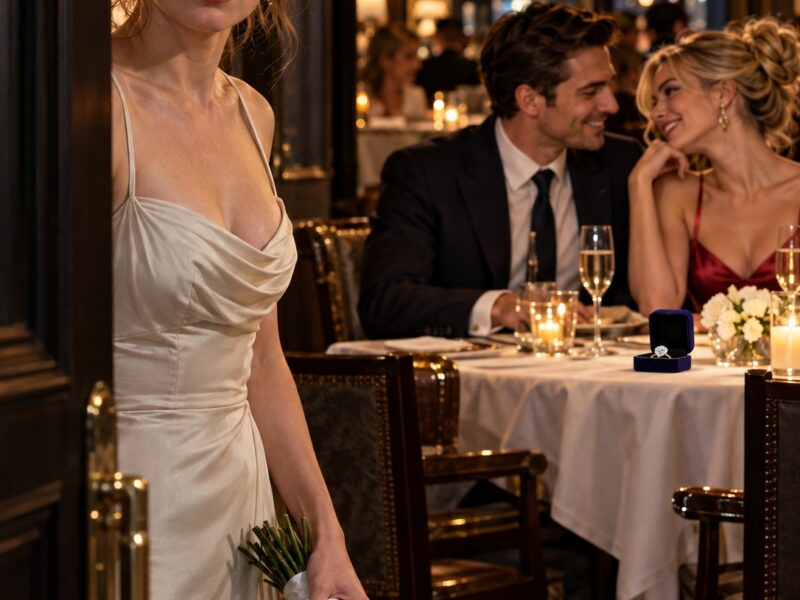
ON OUR ANNIVERSARY, I FOUND MY HUSBAND HOLDING HIS 24-YEAR-OLD ASSISTANT’S HAND—THEN THE BILLIONAIRE I REJECTED FOUR YEARS AGO WALKED BACK INTO MY LIFE
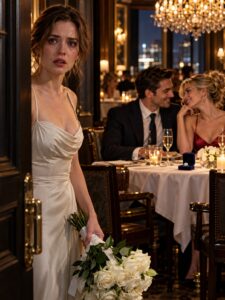
The first time Julian Cross asked Clara Bennett to stay, she chose another man.
Four years later, beneath the awning of a hotel overlooking a rain-black harbor, Clara stood in front of him with tears cooling on her cheeks and finally understood how badly she had misunderstood that moment.
“I need to tell you something,” she said.
Julian didn’t move.
Rain hammered the stone beyond the awning. Behind them, through the tall glass doors of the Crosswell Grand, hundreds of guests moved beneath chandeliers while waiters carried champagne across a lobby Clara had designed herself.
It should have been the proudest night of her career.
Instead, her hands were shaking.
“I’m not asking you to save me.”
“I know.”
“I’m not asking you to replace him.”
“I know.”
Clara stared at the man she had once rejected because she had been terrified that his money would swallow her life whole.
Then she said the words she had spent four years being too afraid to say.
“I’m asking you to stay.”
For the first time all evening, Julian’s composure broke.
But that wasn’t where Clara Bennett’s story began.
It began months earlier with another man, another velvet box, and a bouquet of flowers dying on the floor outside a private dining room.
It began on the night Clara discovered that being married to someone did not necessarily mean he was still choosing you.
And the cruelest part was that she had arrived carrying flowers.
White garden roses.
Adrien’s favorite.
Clara had spent nearly forty minutes choosing them at her mother’s flower shop because she wanted their fourth anniversary to feel like the beginning again instead of another obligation squeezed between Adrien’s meetings.
She had even changed her dress twice.
That embarrassed her later.
Not because the dress mattered, but because she remembered standing in front of the bedroom mirror smoothing the dark green fabric over her hips and wondering whether Adrien would notice.
There had been a time when he noticed everything.
The earrings she wore.
The way she cut her hair.
A new shade of lipstick.
Whether she was tired.
Whether she had eaten.
Lately, Clara could have disappeared from a room and Adrien might only have noticed because his coffee cup remained empty.
Still, she had told herself marriages had seasons.
People got busy.
People became distracted.
Love changed shape.
That was what mature women understood, wasn’t it?
So when Adrien called that afternoon and told her he would be working late, Clara decided not to be disappointed.
Instead, she turned it into a surprise.
Their anniversary wasn’t officially until the following day, but she booked a table at Bellamy House, the small elegant restaurant where Adrien had proposed four years earlier.
She called his office.
His assistant told her Adrien had left.
Clara assumed he was heading home.
She drove to the restaurant anyway.
She arrived carrying flowers.
The hostess recognized her.
“Mrs. Bennett.”
Clara smiled. “Hi, Emma.”
“Are you joining Mr. Bennett?”
The question stopped her.
“Adrien is here?”
The hostess hesitated.
Only for a second.
But sometimes one second is enough to divide a life into before and after.
“Yes,” she said carefully. “He’s in the private room.”
Clara felt something cold move through her stomach.
“He must have planned something.”
Maybe he had.
She almost laughed at herself.
Of course.
Perhaps Adrien had remembered after all.
Perhaps the late meeting had been a lie for a good reason.
Perhaps she had spent months quietly mourning a marriage that was only tired, not dying.
She followed the hostess down the narrow hallway.
The carpet softened every footstep.
Music drifted from the main dining room.
Somewhere behind the kitchen doors, a glass shattered and someone laughed.
Everything felt ordinary.
That was what Clara would remember most.
Disaster rarely announces itself with thunder.
Sometimes it waits behind a half-open door while a woman walks toward it carrying flowers.
The hostess reached for the handle.
Clara saw inside first.
Adrien sat with his back partially toward her.
Across from him was Vanessa Cole.
Twenty-four years old.
His executive assistant.
Clara had met her once.
Vanessa had worn a cream-colored dress at a charity dinner and complimented Clara’s earrings.
“You’re even prettier than your pictures,” she’d said.
Clara had liked her.
That detail would bother her for months.
Adrien was laughing now.
Not the polite laugh he used with investors.
Not the distracted sound he gave Clara when she tried to tell him something while he answered emails.
A real laugh.
The kind she remembered from when they were dating.
His hand was beneath the table.
So was Vanessa’s.
Their fingers were intertwined.
Clara stopped breathing.
Then she noticed the box.
Dark blue velvet.
Small.
Open.
Sitting on the chair beside Vanessa.
Clara knew the dimensions of a ring box.
Every married woman did.
Vanessa leaned closer.
She whispered something.
Adrien smiled.
Clara waited for rage.
It never came.
Instead, something inside her became terrifyingly quiet.
She stepped backward.
The hostess saw her face.
“Mrs. Bennett?”
Clara placed the bouquet carefully on a small table beside the door.
“Don’t tell him I was here.”
“Ma’am—”
“Please.”
Then Clara walked away.
She didn’t remember driving home.
She remembered red lights.
She remembered gripping the steering wheel.
She remembered a man in the car beside hers singing along to the radio.
She remembered thinking how obscene it was that the world could remain normal when hers had just split open.
At home, she filled a vase with water.
Then she went back outside, because somewhere along the way she had apparently carried the flowers with her after all.
She placed the white roses in the vase.
One stem was broken.
She trimmed it.
That small act almost destroyed her.
Her husband was sleeping with another woman, and Clara Bennett was standing in her kitchen cutting flower stems because she didn’t know what else to do with her hands.
At 11:47 p.m., the garage door opened.
Adrien entered through the kitchen.
He loosened his tie.
Dropped his keys into the ceramic bowl by the door.
Looked at Clara.
“You’re still awake?”
He didn’t notice the flowers.
Of course he didn’t.
Clara sat at the kitchen table.
“Who is Vanessa to you?”
Adrien froze.
It was tiny.
Almost invisible.
But Clara knew him.
She had slept beside that face for four years.
She knew the fraction of a second his eyes stopped moving.
She knew the way his jaw tightened when he was deciding how much truth to give someone.
“Clara.”
“Who is she?”
He took off his coat.
“This isn’t what you think.”
Clara almost smiled.
It was such an ordinary sentence.
Men had probably been saying it since betrayal was invented.
“Then tell me what I should think.”
Adrien remained standing.
She looked at his left hand.
His wedding ring was still there.
That somehow made it worse.
“Sit down,” he said.
“No.”
“Clara—”
“Answer me.”
Silence filled the kitchen.
The refrigerator hummed.
Rainwater dripped from Adrien’s coat onto the hardwood floor.
Finally, he sat.
“I’ve been seeing her.”
Clara heard the words.
They seemed to come from very far away.
“How long?”
“A few months.”
“Three?”
He looked down.
“Longer.”
“Six?”
Another silence.
Clara swallowed.
“How long?”
“Almost eight.”
Eight months.
Clara thought about eight months.
Christmas.
Her birthday.
His father’s retirement dinner.
The weekend in Boston when Adrien had told her he was too exhausted to leave the hotel.
The morning Clara had driven forty minutes to bring him the presentation folder he’d forgotten.
Eight months contained an astonishing number of ordinary betrayals.
“Do you love her?”
Adrien rubbed both hands over his face.
“I don’t know.”
“That wasn’t difficult.”
“I’ve changed, Clara.”
She stared at him.
He continued because silence frightened him.
“My life changed. The company changed. Everything became bigger. There are expectations now. Vanessa understands that world.”
“And I don’t?”
“I didn’t say that.”
“You didn’t have to.”
“That’s not fair.”
The words almost made her laugh.
Fair.
Clara looked toward the flowers.
“Was the ring for her?”
Adrien’s face changed again.
There it was.
The answer before the answer.
“Yes.”
Something inside Clara closed.
Not shattered.
Closed.
Perhaps there were betrayals too large for screaming.
She stood.
Adrien stood too.
“Clara, wait.”
“You bought another woman a ring while you were still wearing mine.”
“It wasn’t—”
“What?”
He stopped.
“What possible sentence comes after that?”
Adrien looked suddenly exhausted.
Not ashamed.
Not devastated.
Exhausted.
As if his betrayal had become an administrative problem he was tired of managing.
“I didn’t know how to tell you.”
Clara nodded slowly.
“You could have started before you bought jewelry.”
“I never wanted to hurt you.”
“Then you were remarkably careless for someone with such a clear objective.”
“Clara.”
She walked past him.
He caught her wrist.
Not violently.
Just automatically.
As if she were something leaving a place where she belonged.
Clara looked down at his hand.
Adrien released her.
“Don’t make decisions tonight.”
That sentence stayed with her.
Not because it persuaded her.
Because of what it revealed.
Even now, Adrien believed the decision was still waiting to be made.
He didn’t understand.
He had already made it.
The next morning Clara packed two suitcases.
Adrien followed her from room to room.
“Where are you going?”
“My mother’s.”
“For how long?”
“I don’t know.”
“We can work through this.”
Clara stopped folding a sweater.
“Are you ending things with Vanessa?”
Adrien hesitated.
That was enough.
Clara continued packing.
“Clara, please.”
She opened the jewelry drawer.
Her wedding ring caught the morning light.
She removed it.
For four years, the small circle had represented certainty.
Now it looked like an object belonging to somebody else.
She placed it in the drawer.
Adrien watched.
His face finally showed fear.
“You’re leaving your ring?”
“Yes.”
“That means something.”
“It should.”
She left the expensive furniture.
The framed wedding photographs.
The dishes they had chosen together.
The linen napkins they’d never used.
She left almost everything.
But beside the bedroom door was an old framed sketch.
Clara had drawn it during the first year of their marriage.
A small house.
Wide windows.
Flowers along the porch.
Nothing grand.
Nothing impressive.
At the bottom, in pencil, she had written:
Home is the place where you are chosen.
She took that.
Three weeks later, Clara was living in the apartment above her mother’s flower shop.
At thirty-one years old, she slept in a bedroom barely larger than the walk-in closet she had shared with Adrien.
And strangely, she could breathe there.
Her mother, Eleanor, wanted war.
“I can accidentally drive my van through his office.”
“Mom.”
“Very slowly.”
“No.”
“I’ve been driving thirty-eight years. People would believe me.”
Despite herself, Clara laughed.
It was the first time since Bellamy House.
Eleanor softened.
Then she sat beside her daughter.
“I hate what he did to you.”
“I know.”
“You don’t have to be graceful about this.”
“I’m not trying to be graceful.”
“What are you trying to be?”
Clara looked around the little apartment.
At the unpacked boxes.
At the framed sketch leaning against the wall.
“At peace.”
Her mother took her hand.
“I want my life back,” Clara whispered. “I don’t want revenge. I don’t want him ruined. I don’t want Vanessa humiliated. I just want to remember who I was before I started measuring my worth by whether my husband looked up from his phone.”
That proved harder than she expected.
Her design studio had suffered while she spent years supporting Adrien’s expanding career.
She had turned down projects because his schedule was unpredictable.
Skipped networking events to attend his corporate dinners.
Moved client meetings because he needed her somewhere else.
None of those decisions had seemed like sacrifices individually.
Together, they formed a pattern Clara could finally see.
She had not disappeared all at once.
She had vanished by inches.
Then, on a rainy Tuesday afternoon, the bell over the flower shop door rang.
Clara was downstairs helping her mother because one of the employees had gone home sick.
She was trimming white roses.
A man’s voice behind her said, “You still arrange those by height.”
Her scissors stopped.
There were voices memory never forgot.
Clara turned.
Julian Cross stood near the door.
He carried no umbrella despite the rain.
Water darkened the shoulders of his charcoal coat.
He was thirty-six now.
Four years had sharpened him.
The Julian she remembered had already been successful, but there had been an openness to him then, an impatience beneath his confidence.
The man standing in the flower shop had learned stillness.
His dark hair was shorter.
His expression harder to read.
But his gray eyes were exactly the same.
“Julian.”
“Hello, Clara.”
For several seconds neither moved.
Then Clara glanced toward the window.
“You know umbrellas exist.”
“I’ve heard rumors.”
She almost smiled.
Almost.
“What are you doing here?”
“I need flowers.”
“You own assistants.”
“I’ve heard rumors about those too.”
“Julian.”
His smile disappeared.
“I heard about Adrien.”
Clara stiffened.
“Who told you?”
“Belmir isn’t Chicago. People talk.”
“I don’t need sympathy.”
“I didn’t come to offer sympathy.”
“Then why are you here?”
He glanced at the white roses.
“I need a designer.”
Clara stared at him.
“For flowers?”
“For a hotel.”
Of course.
Julian Cross had founded Crosswell Holdings in his late twenties.
By thirty-six, business magazines estimated his holdings in numbers Clara had stopped trying to comprehend.
Hotels.
Commercial properties.
Restored historic buildings.
Luxury developments along both coasts.
Four years earlier, he’d been merely very rich.
Now he was the kind of rich that turned his surname into a brand.
“You have designers.”
“I have people who know how to make expensive rooms look expensive.”
“That sounds useful for an expensive hotel.”
“I don’t want expensive.”
“What do you want?”
Julian looked around the flower shop.
At the mismatched shelves.
The old brass register Eleanor refused to replace.
Glass jars filled with flowers.
A wooden stool worn smooth by twenty years of use.
“I want people to walk inside and feel like someone expected them.”
Clara stopped.
Julian continued.
“The Crosswell Grand. Coastal property. Restoration is nearly finished. The interiors are technically excellent and completely dead.”
“And you thought of me?”
“I’ve thought of your work for years.”
The sentence landed between them.
Clara looked away first.
Four years earlier, before Adrien had become her husband, Julian had offered her a position designing one of his private resorts.
The job had been real.
So had everything underneath it.
They had met through a commercial renovation.
Julian admired her work.
Then her stubbornness.
Then apparently her.
He never behaved improperly.
Never asked her to cheat.
Never tried to buy her affection.
But weeks before Clara’s wedding, he had told her the truth.
“I love you.”
She had been twenty-seven.
Engaged.
Terrified.
Julian’s world had frightened her almost as much as his feelings.
Private aircraft.
Boardrooms.
People who discussed millions of dollars as casually as Clara discussed paint samples.
She had imagined herself becoming an accessory in his life.
Someone grateful.
Someone dependent.
Someone slowly losing the ability to tell where his choices ended and hers began.
So she chose Adrien.
The safe man.
The ordinary man.
The man who seemed to want the same kind of life she did.
Julian had accepted it.
No argument.
No punishment.
No dramatic goodbye.
He simply disappeared from her life.
Until now.
“I need a designer,” Julian said.
Clara crossed her arms.
“Not a wife?”
His eyes flickered.
Then, surprisingly, he laughed.
“No.”
“Good.”
“I learned not to make that mistake.”
Her chest tightened.
“That isn’t fair.”
“No,” Julian said. “It probably isn’t.”
Rain tapped against the windows.
Clara lowered her voice.
“I hurt you.”
“Yes.”
The honesty surprised her.
“I’m sorry.”
“I’m not here for an apology.”
“Then why do I feel like you’re waiting for something?”
Julian was quiet.
Because that was what he did when the truth mattered.
Finally he said, “Four years ago, you were the one person I wanted who didn’t want me back. I had to learn how to live with that.”
Clara looked down.
“And did you?”
“Mostly.”
“Mostly?”
His mouth moved faintly.
“I said I learned. I didn’t say I became a saint.”
She laughed.
A real laugh.
Then hated herself for how good it felt.
Julian placed a folder on the counter.
“Look at the project.”
“Julian—”
“No obligation.”
“You know I’m getting divorced.”
“Yes.”
“You know I’m vulnerable.”
“Yes.”
“And you still think this is appropriate?”
His expression became serious.
“I think deciding you’re too emotionally damaged to be trusted with professional work would be considerably more insulting.”
Clara stared at him.
There he was.
The man she remembered.
Not softer.
Just precise.
She opened the folder.
And three days later, Clara Bennett walked into the Crosswell Grand.
The building stood above a rocky stretch of coastline, its pale stone façade facing a gray northern sea.
It had been built in 1928.
Crosswell Holdings had spent two years restoring it.
The bones were magnificent.
The soul was missing.
Clara stood in the unfinished lobby while architects discussed imported marble.
Then she pointed at the center of the room.
“Take it out.”
Everyone stopped.
The lead architect blinked.
“The marble?”
“Yes.”
“It’s Italian.”
“I’m sure Italy will survive.”
Someone coughed.
Julian stood near the staircase.
“What replaces it?”
“Wood.”
The architect looked offended.
“In the lobby of a Crosswell property?”
Clara turned.
“Do you want people impressed or comfortable?”
“Both.”
“Then stop making them afraid to touch anything.”
Julian looked at the architect.
“Change it.”
That was how it began.
He trusted her.
Not theatrically.
Not because he wanted her grateful.
He simply gave her authority and expected her to use it.
When she disagreed with him, he listened.
When she changed a lighting plan after midnight, he approved the cost.
When she rejected furniture selected by an internationally famous designer, Julian asked why.
“Because nobody will sit in it.”
“It costs eleven thousand dollars.”
“That doesn’t make it comfortable.”
He stared at the chair.
Then sat.
Thirty seconds later he stood.
“I hate this chair.”
Clara laughed.
“So does every human spine.”
“Burn them.”
“We can return them.”
“Less satisfying.”
Working beside him became dangerous in ways Clara hadn’t anticipated.
Not because Julian flirted.
He didn’t.
That was almost worse.
He remembered things.
She hated lilies because they reminded her of funerals.
She took her coffee with cinnamon but no sugar.
She preferred old wood because scratches made furniture feel inhabited.
She worked through lunch when anxious.
She went silent when angry.
He noticed.
But he never used those details as proof that she owed him intimacy.
One evening, Clara found him alone near an unfinished suite overlooking the ocean.
He had removed his jacket.
His tie was loose.
“You work too much,” she said.
“So do you.”
“I have an excuse.”
“What?”
“I’m rebuilding my life.”
Julian looked at her.
“That isn’t an excuse.”
“No?”
“It’s a reason.”
She leaned against the window frame.
Below them, waves struck the rocks.
“Is there a difference?”
“Excuses help us avoid things. Reasons help us survive them.”
Clara looked at him.
“Since when did you become philosophical?”
“Since my therapist started charging enough that I felt obligated to remember something.”
She laughed.
Julian smiled.
Then his expression changed.
He was looking at her as though the sound mattered.
Clara stopped laughing.
For one dangerous second, the room became too quiet.
She stepped away.
“Good night, Julian.”
“Good night, Clara.”
Neither mentioned it.
Then Adrien came back.
Clara found him in the hotel lobby on a Thursday afternoon.
He looked thinner.
His expensive suit was wrinkled.
For a moment, she saw the man she had married instead of the man who had betrayed her.
That frightened her more than anger would have.
“Can we talk?”
“About what?”
“Us.”
“There isn’t an us.”
“Please.”
People moved around them.
Construction workers.
Design staff.
Hotel employees preparing for opening.
Clara didn’t want a scene.
“Five minutes.”
Adrien followed her into an empty conference room.
He closed the door.
“Vanessa and I ended things.”
Clara said nothing.
Adrien waited.
Apparently he had expected more.
“Did you hear me?”
“Yes.”
“That’s all?”
“What would you like me to say?”
He ran a hand through his hair.
“I made a mistake.”
“No.”
Adrien frowned.
“You made a choice.”
“I know.”
“You made hundreds of choices.”
“Clara—”
“You called her. You met her. You lied to me. You booked restaurants. You bought a ring. Every one of those required a separate decision.”
“I know.”
“Stop saying that.”
His shoulders dropped.
“She wasn’t who I thought she was.”
Clara almost felt sorry for him.
Almost.
“What did you think she was?”
“Someone who understood me.”
“And?”
“She cared about the lifestyle.”
Clara stared at him.
“You left your wife for a twenty-four-year-old employee, and you’re surprised she was impressed by your money?”
Adrien winced.
“That’s cruel.”
“No. Cruel was letting me trim anniversary flowers while you came home from giving another woman a ring.”
He looked down.
“She started asking for things. An apartment. Trips. She wanted me to restructure the company. She talked about marriage immediately.”
“The ring probably encouraged her.”
Adrien closed his eyes.
“I’m trying to tell you I understand now.”
“No. You’re telling me Vanessa disappointed you.”
“Is there a difference?”
“Yes.”
Clara stepped closer.
“A very large one.”
He looked at her for a long time.
Then his gaze moved toward the glass wall and the enormous hotel beyond it.
“Cross.”
Clara’s body tightened.
“What about him?”
“He’s using you.”
She laughed once.
It contained no humor.
“For what?”
“You know he’s always wanted you.”
“That doesn’t mean he’s using me.”
“You don’t know what he’s capable of.”
Clara stared at the man she had once trusted with everything.
“Neither did you, apparently.”
Adrien recoiled.
“I deserved that.”
“Yes.”
“I still love you.”
There it was.
The sentence she had once thought could fix almost anything.
And for one heartbreaking moment, Clara remembered him at twenty-nine, standing outside her tiny studio in the rain holding a paper bag of pastries.
She remembered him driving two hours through a storm because she’d forgotten her portfolio.
She remembered dancing barefoot in their first apartment because they couldn’t afford furniture.
She remembered believing that version of him was permanent.
Then she remembered Vanessa’s hand.
The velvet box.
Eight months of lies.
“I loved you,” Clara whispered.
Adrien’s eyes filled.
“Loved?”
“I don’t know if I love the man you became.”
“I can become someone else.”
Clara shook her head.
“Do it for yourself.”
She opened the door.
“Clara.”
She stopped.
“If he weren’t here,” Adrien asked, “would you come back?”
She turned.
The question told her everything.
Adrien still believed another man was the reason she could leave.
He could not imagine Clara choosing herself.
“No,” she said.
And walked away.
That night Julian stood outside the hotel near the seawall.
Clara joined him.
“You saw him?” Julian asked.
“Yes.”
“What did he want?”
“Another chance.”
Julian’s face revealed nothing.
“Are you going to give him one?”
Clara hated that she didn’t immediately know the answer.
“I don’t know.”
Julian nodded.
That was all.
She looked at him.
“You aren’t going to tell me not to?”
“No.”
“Why?”
“Because it isn’t my marriage.”
“He betrayed me.”
“Yes.”
“You hate what he did.”
“Yes.”
“And?”
“And you’re still the person who has to decide.”
Clara stared at him.
“Why are you always so calm?”
Julian looked toward the dark water.
“I’m not.”
“You seem calm.”
“That is because four years ago I learned something unpleasant.”
“What?”
He turned toward her.
“Wanting someone doesn’t give you the right to keep them.”
Clara couldn’t answer.
The divorce became final six weeks later.
She expected relief.
Instead she cried in her car outside the courthouse.
Not because she wanted Adrien back.
Because endings could be correct and still hurt.
Four years had become a signature.
A marriage had become paperwork.
Promises had become property divisions and forwarding addresses.
When Clara returned to the hotel, Julian didn’t ask why her eyes were swollen.
He placed coffee on her desk.
Cinnamon.
No sugar.
Then he left.
That kindness hurt more than questions would have.
The Crosswell Grand neared completion.
And Julian began avoiding her.
At first Clara thought she imagined it.
Their breakfasts disappeared.
He stopped walking through the property with her.
He no longer appeared beside her desk with coffee.
Messages became short.
Professional.
Approved.
Proceed.
Looks good.
Thank you.
Finally, Clara cornered him in an unfinished ballroom.
“Are you avoiding me?”
Julian stopped.
“No.”
“You’re terrible at lying.”
“That is objectively untrue. I’m excellent at it.”
“Julian.”
He sighed.
“Yes.”
“Why?”
He looked at her for several seconds.
“Because you’re free now.”
“That should make things easier.”
“For you, perhaps.”
“For whom is it difficult?”
“Me.”
Clara’s anger disappeared.
Julian looked away.
“I made myself a promise.”
“What promise?”
“That I would never ask you for anything while you were married.”
“You didn’t.”
“I know.”
“Then what’s the problem?”
“You aren’t married anymore.”
Her heart beat harder.
Julian’s voice dropped.
“I spent four years learning how not to want a life that belonged to someone else.”
“Julian—”
“Now you don’t belong to him.”
“I never belonged to him.”
He looked at her.
“Exactly.”
Silence.
Then Julian said, “And I’m trying very hard not to mistake your freedom for an invitation.”
Clara’s eyes burned.
He continued quietly.
“I loved you when you chose another man.”
She looked down.
“I survived it.”
“Julian.”
“I can survive this too.”
“You shouldn’t have to.”
His smile was sad.
“Neither should you.”
That night Clara lay awake in the apartment above the flower shop.
The framed sketch sat beside her bed.
Home is the place where you are chosen.
For years she had thought the sentence meant finding someone who chose her.
Now she wondered if she’d written only half the truth.
What if home was also the place where you remained free enough to choose back?
That thought terrified her.
Because Clara finally understood what had frightened her about Julian four years earlier.
It wasn’t really his money.
It wasn’t his hotels.
His cars.
His influence.
It was that Julian did not need her.
Adrien had once needed Clara’s encouragement, her savings, her stability, her belief in him.
Being needed had made her feel safe.
Julian offered something far more frightening.
He wanted her without requiring her.
There was nowhere to hide inside that kind of love.
No obligation to confuse with devotion.
No dependence to mistake for permanence.
She would have to choose him simply because she wanted him.
And Clara had spent so many years being useful that she had forgotten how to want.
Then Vanessa Cole walked into the Crosswell Grand.
It happened during opening week.
Clara was reviewing flower arrangements when she heard heels approaching.
“Mrs. Bennett?”
She turned.
Vanessa stood ten feet away.
For an instant Clara was back at Bellamy House.
Velvet box.
Joined hands.
Adrien laughing.
Vanessa looked different now.
Less polished.
More tired.
“What do you want?”
“To talk.”
“I don’t think we have anything to discuss.”
“Adrien came to see me.”
Clara froze.
Vanessa noticed.
“He didn’t tell you.”
“No.”
“He probably wouldn’t.”
Clara set down the clipboard.
“Say whatever you came to say.”
Vanessa looked around.
“You think Julian Cross loves you?”
The question was so unexpected Clara almost laughed.
“I don’t know.”
“He does.”
Clara’s expression didn’t change.
Vanessa studied her.
“He doesn’t love easily.”
“Neither do I.”
Vanessa’s smile vanished.
“Adrien contacted me three weeks ago.”
Clara waited.
“He told me he wanted you back.”
“Congratulations on receiving his newsletter.”
Vanessa flinched.
“I deserve that.”
“Yes.”
“I also deserve worse.”
Clara said nothing.
Vanessa inhaled.
“He asked me to talk to you.”
“Why?”
“He wanted me to tell you our relationship had been meaningless. That I manipulated him. That he was confused.”
Clara felt something cold spread through her chest.
“Was it?”
Vanessa laughed bitterly.
“No.”
The answer surprised her.
“He pursued me,” Vanessa said. “I knew he was married. I’m not pretending I’m innocent. But he told me your marriage had been dead for years. He told me you stayed because of money.”
Clara nearly laughed.
“My money helped start his company.”
Vanessa’s face changed.
“He didn’t tell me that.”
“I assumed not.”
“He said you didn’t understand him.”
“He told me you did.”
Vanessa looked embarrassed.
Clara almost felt sorry for her.
Almost.
“Why are you telling me this?”
“Because after we broke up, he started calling again.”
Clara went still.
“He told me he missed me. Then he told me he loved you. Then he asked me to help convince you that he’d changed.”
“That doesn’t make sense.”
“I know.”
Vanessa looked directly at her.
“That’s when I realized it wasn’t about either of us.”
Clara’s throat tightened.
“What was it about?”
“Losing.”
The word landed softly.
“He can’t stand that you left him. He couldn’t stand that I left either. He wanted both doors unlocked.”
Clara looked away.
Suddenly every conversation with Adrien rearranged itself.
His warnings about Julian.
His insistence that Vanessa had used him.
His question about whether Clara would return if Julian disappeared.
It had never been entirely about love.
It had been about control.
About making sure Clara’s life still revolved around his decisions.
Vanessa reached into her purse.
For one horrible second Clara expected another velvet box.
Instead she produced her phone.
Messages.
Adrien’s name.
Dates.
Promises.
Contradictions.
Clara read only enough.
Then she handed it back.
“I believe you.”
Vanessa looked startled.
“You do?”
“Yes.”
“Why?”
“Because I’ve heard him tell me the other half of the same lies.”
Vanessa’s eyes filled.
“I am sorry.”
Clara looked at the woman who had helped destroy her marriage.
For months she had imagined what she might say if they ever stood face-to-face.
She had expected fury.
Instead she felt tired.
“You knew he was married.”
“Yes.”
“You knew who I was.”
“Yes.”
“You sat across from me at that charity dinner and complimented my earrings.”
Vanessa closed her eyes.
“I remember.”
“That was cruel.”
“I know.”
Clara studied her.
“But you aren’t the reason my husband betrayed me.”
Vanessa opened her eyes.
“He is.”
“Yes.”
Clara picked up her clipboard.
“And I’m done letting either of you occupy more of my life than you’ve already taken.”
That evening she found Adrien in the private lounge.
Waiting.
Of course.
“You asked Vanessa to speak to me.”
He stood.
“Clara—”
“Did you?”
“She misunderstood.”
“No.”
Clara closed the door behind her.
“You did.”
Adrien stepped toward her.
“I was desperate.”
“That doesn’t make manipulation romantic.”
“I wanted my wife back.”
“I am not your wife.”
“You were.”
“Yes.”
His face tightened.
“And you destroyed that.”
“I know.”
“No. I don’t think you do.”
She walked closer.
“I spent years believing being chosen by someone was the greatest proof of love.”
Her voice trembled now.
She let it.
“I thought if I worked harder, understood more, complained less, supported you enough, then whatever happened between us could be repaired because we had chosen each other once.”
Adrien stared at her.
“But I was wrong.”
“Clara—”
“Love isn’t a decision you make at a wedding and then use as permission for everything afterward.”
He reached toward her.
She stepped back.
His hand remained suspended between them.
Clara looked at it.
Then at him.
“You want to know what I finally learned?”
Adrien lowered his hand.
“Love is also knowing when to choose yourself.”
His eyes filled.
“I lost you.”
“Yes.”
Two words.
No triumph.
No revenge.
Only truth.
Clara walked away.
She passed through the lobby she’d built from wood, light, books and flowers.
Guests were arriving for the opening reception.
Music drifted beneath the chandeliers.
People smiled at her.
Someone congratulated her.
She kept walking.
Outside, rain covered the harbor.
Julian stood beneath the awning.
He looked at her face.
He didn’t ask what happened.
He simply opened his umbrella.
That small gesture nearly broke her.
Clara walked toward him.
“I need to tell you something.”
Julian waited.
“I am not asking you to save me.”
“I know.”
“I am not asking you to replace Adrien.”
“I know.”
She breathed.
“I don’t need your money.”
“I know that too.”
“I was afraid of it once.”
Julian’s mouth moved slightly.
“I remember.”
“I thought your world would make me smaller.”
Rain ran from the edge of the awning like a curtain.
Clara stepped closer.
“I thought if I entered it, eventually I would stop knowing which parts of my life belonged to me.”
Julian said nothing.
“But I was wrong about something.”
“What?”
“You never asked me to enter your world.”
His eyes softened.
“No.”
“You kept asking me to build my own.”
“Yes.”
Clara’s voice cracked.
“And I think that’s why you scared me.”
Julian looked away briefly.
“Clara—”
“I’m asking you to stay.”
His composure broke.
Only slightly.
But she saw it.
Four years of restraint disappeared from his eyes.
“You don’t know how long I’ve wanted to hear that.”
“I think I do.”
He stepped closer.
“Are you sure?”
Clara almost laughed through her tears.
“You’re asking me that now?”
“Especially now.”
“Why?”
“Because I won’t accept gratitude as love.”
The words struck deep.
“Good.”
“I won’t accept loneliness either.”
“Good.”
“And I won’t be your revenge against Adrien.”
Clara shook her head.
“You aren’t.”
“What am I?”
She looked at him.
“A choice.”
Julian closed his eyes.
Just for a second.
When he opened them, Clara saw something she had never understood about powerful people until that moment.
Power did not eliminate vulnerability.
Sometimes it merely taught people how to hide it better.
“You don’t have to become part of my world,” he said.
“I don’t want to.”
He laughed softly.
“Good start.”
“I want to build one with you.”
Julian stared at her.
Then Clara reached for his hand.
He didn’t seize hers.
He let her fingers find his.
Only then did he close his hand around them.
Carefully.
As if he understood exactly what she had given him.
Not surrender.
Choice.
Months later, the Crosswell Grand became one of the most talked-about openings of the year.
Critics expected extravagance.
Clara gave them warmth.
The lobby had old wood beneath restored stone arches.
Fresh flowers stood in imperfect ceramic vases.
Books filled shelves people were actually encouraged to touch.
There were deep chairs by fireplaces.
Sunlight crossed the floors in the morning.
Nothing screamed wealth.
Everything whispered welcome.
One design critic wrote that the hotel felt less like somewhere wealthy people came to be seen and more like somewhere tired people came to remember themselves.
Clara kept that review.
Not because it praised her.
Because it understood.
At the center of the lobby hung one framed drawing.
A small house.
Flowers.
A porch.
Julian had seen the sketch once in her apartment.
“You should put that in the hotel,” he’d said.
“No.”
“Why?”
“It’s personal.”
He never asked again.
Two months later, Clara brought it herself.
Julian found her standing beneath it one morning.
“You finally kept it.”
Clara smiled.
“I finally understood it.”
He read the handwritten sentence beneath the drawing.
Home is the place where you are chosen.
“Does that mean this is home?” he asked.
Clara looked around.
Staff members were preparing breakfast.
Someone was arranging flowers.
A child was asleep on a sofa while his father read nearby.
Sunlight moved slowly across the wood floor.
“Not because you bought it.”
Julian laughed.
“Excellent. That would be an extremely expensive definition of home.”
Clara turned toward him.
“You know what I got wrong?”
“What?”
“I thought being chosen meant someone deciding they wanted you.”
“And now?”
“It means they keep leaving you enough freedom to choose them back.”
Julian looked at her for a long time.
Then he took her hand.
“I can live with that.”
A year later, they stood on the rooftop terrace.
The city shimmered below.
The harbor was almost black beneath the night sky.
Clara was talking about replacing several terrace tables when Julian reached inside his coat.
She immediately narrowed her eyes.
“If that’s another contract, I’m leaving.”
He laughed.
“No contract.”
“Budget revision?”
“No.”
“Then why do you look terrified?”
“I don’t look terrified.”
“You absolutely do.”
Julian removed a small velvet box.
Clara stopped breathing.
For a fraction of a second, memory betrayed her.
Bellamy House.
Adrien.
Vanessa.
A velvet box on a chair.
Julian saw the change in her face.
He didn’t open it.
Instead he lowered his hand.
“We don’t have to do this tonight.”
Clara stared at him.
That was the difference.
Even now.
Even here.
He was willing to close the box.
She touched his wrist.
“Open it.”
Julian did.
Inside was a simple ring.
No enormous diamond.
No spectacle.
A delicate band.
Clara lifted it carefully.
Inside were four engraved words.
CHOOSE ME FREELY.
She looked up.
“You waited a long time.”
“I would have waited longer.”
“Julian.”
“Yes?”
“Ask me.”
His eyes softened.
No audience.
No photographers.
No champagne hidden nearby.
Just wind.
City lights.
Two people who had already survived choosing wrongly and waiting patiently.
“Clara Bennett,” he said, “will you stay?”
Tears blurred her vision.
“Yes.”
Julian exhaled.
She laughed.
“You really were terrified.”
“Keep that information private.”
“I might tell the board.”
“I’ll deny everything.”
He slipped the ring onto her finger.
Clara looked at it.
Once, a ring had represented the promise that somebody would never leave.
Now she understood that wasn’t the promise she wanted.
People could leave.
People could change.
Love could end.
No piece of jewelry could prevent that.
What mattered was something harder.
Staying while remaining free.
Choosing while allowing the other person to choose too.
Years later, Clara sometimes walked past Bellamy House.
She never went inside.
Never looked through the windows.
Never wondered whether that private room had changed.
She didn’t need to.
Some places belong to versions of ourselves we no longer have to rescue.
She remembered the woman who had once stood outside that door holding white roses.
That Clara believed the worst thing that could happen was losing her husband’s love.
She hadn’t understood yet.
The greater danger had been losing herself while trying to keep it.
Adrien had not destroyed her life.
He had destroyed the life she thought she was supposed to want.
There was a difference.
Vanessa had not stolen her husband.
Adrien had made his choices.
Julian had not rescued Clara afterward.
Clara had rebuilt herself.
And Julian had done something far rarer.
He had stood beside the rebuilding without trying to put his name on it.
That was why, when Clara eventually married him, she kept her design studio.
She kept her own accounts.
She kept making decisions he disagreed with.
They argued.
They occasionally went to bed angry.
Julian still worked too much.
Clara still changed design plans at impossible hours.
Their life wasn’t perfect.
That was precisely why she trusted it.
Perfection had once been something Clara performed while her marriage quietly died.
With Julian, love had room for disagreement.
Room for silence.
Room for separate rooms and separate ambitions and mornings when one person needed to walk alone.
Most importantly, it had room for doors.
Open ones.
Years after the Crosswell Grand opened, Clara stood in its lobby one winter morning watching a young couple beneath the framed sketch.
The woman read the words aloud.
“Home is the place where you are chosen.”
Her husband smiled.
“That’s nice.”
Clara almost corrected them.
She almost walked over and explained that the sentence wasn’t complete.
Not really.
But she didn’t.
Some truths had to be lived before they could be understood.
Julian approached from behind her carrying two coffees.
He handed one to her.
Cinnamon.
No sugar.
“You’re staring at your drawing again.”
“I’m allowed.”
“You are.”
“Do you regret putting it here?”
“Never.”
Clara looked at him.
Silver had begun appearing near his temples.
There were lines beside his eyes now.
Time had softened some things and sharpened others.
“Do you remember the first time you asked me to stay?”
Julian became quiet.
“Yes.”
“I said no.”
“I remember that part especially well.”
She smiled.
“I thought you were asking me to give something up.”
“I probably was.”
Clara tilted her head.
Julian shrugged.
“I was younger. Richer in confidence than wisdom.”
“You were already obscenely rich.”
“I meant emotionally.”
She laughed.
Then Julian looked at the sketch.
“I would’ve done things differently.”
“How?”
“I would have asked what you were afraid of.”
Clara’s smile faded.
“And if I told you?”
“I would have listened.”
“Would you have waited?”
Julian considered the question.
“I don’t know.”
The honesty made her love him more.
“I’d like to tell you I would have been exactly the man you needed. But I was thirty-two, in love, and accustomed to getting what I wanted. Maybe losing you was part of what taught me not to treat love like acquisition.”
Clara looked down at her ring.
Choose me freely.
“So Adrien wasn’t the only one who changed.”
“No.”
“Neither was I.”
“No.”
Outside the hotel windows, snow began falling over the harbor.
Clara watched it gather along the stone terrace.
For years, people had told her she was lucky.
Lucky Julian came back.
Lucky a billionaire still loved her.
Lucky her husband’s affair had somehow led her toward a better life.
Clara disliked that version of the story.
It made betrayal sound like a gift.
It wasn’t.
Betrayal was betrayal.
There was nothing beautiful about sitting in a kitchen at midnight asking your husband whether the ring beside another woman’s hand was meant for her.
There was nothing romantic about divorce paperwork.
Nothing magical about waking alone above your mother’s flower shop and realizing half your adult life no longer existed.
Pain didn’t become good merely because something good eventually followed it.
But pain could become useful.
It could strip away illusions.
It could reveal the difference between being wanted and being valued.
Between being needed and being loved.
Between possession and partnership.
Adrien had once asked Clara to stay because losing her meant losing something he believed belonged to him.
Julian asked her to stay while reminding her she could leave.
That distinction changed everything.
Clara lifted her coffee.
“You forgot something.”
Julian frowned.
“What?”
She pointed at the cup.
“No cinnamon.”
He looked genuinely horrified.
“Impossible.”
She handed it to him.
He tasted it.
His expression fell.
Clara laughed.
“After all these years.”
“This is a serious failure.”
“Should I call your board?”
“Please don’t.”
“Maybe Adrien was right. Maybe I never really knew you.”
Julian looked at her.
The joke faded gently between them.
Then he smiled.
“No,” he said. “You know me.”
Clara glanced again at the drawing.
The little house.
The flowers.
The sentence written by a younger woman who thought she understood what home meant.
She had been close.
Home was the place where you were chosen.
But home was also the place where nobody needed to lock the door to make you stay.
Julian reached for her hand.
Clara let him take it.
Outside, snow disappeared into the dark harbor.
Somewhere across town stood the restaurant where another velvet box had once ended the life Clara thought she wanted.
She no longer hated that place.
She no longer feared it either.
It belonged to another woman now.
A woman carrying white roses.
A woman waiting for a husband who had already chosen someone else.
A woman who did not yet know that the most important choice of her life would not be between Adrien Bennett and Julian Cross.
It would be between the person she had trained herself to become for someone else’s love…
and the woman she was finally brave enough to become for herself.
Clara squeezed Julian’s hand.
He looked at her.
“Ready?”
She smiled.
“Yes.”
And they walked toward the door together.
Not because Clara needed somewhere to go.
Not because Julian had rescued her.
Not because betrayal had magically become destiny.
But because years earlier, Clara Bennett had learned something she would never again forget:
The right person does not make you stay.
They build a life in which you are free to leave—
and then give you reasons to choose it again tomorrow.
Outside, the snow kept falling.
Julian opened the door.
Clara stepped through first.
And this time, when he followed her, neither of them had to ask the other to stay.









