ON THEIR WEDDING NIGHT, THE DUKE TOLD HIS BRIDE TO LOCK THE DOOR—THEN REVEALED WHY HE HAD LET LONDON BELIEVE A LIE
“Lock the door.”
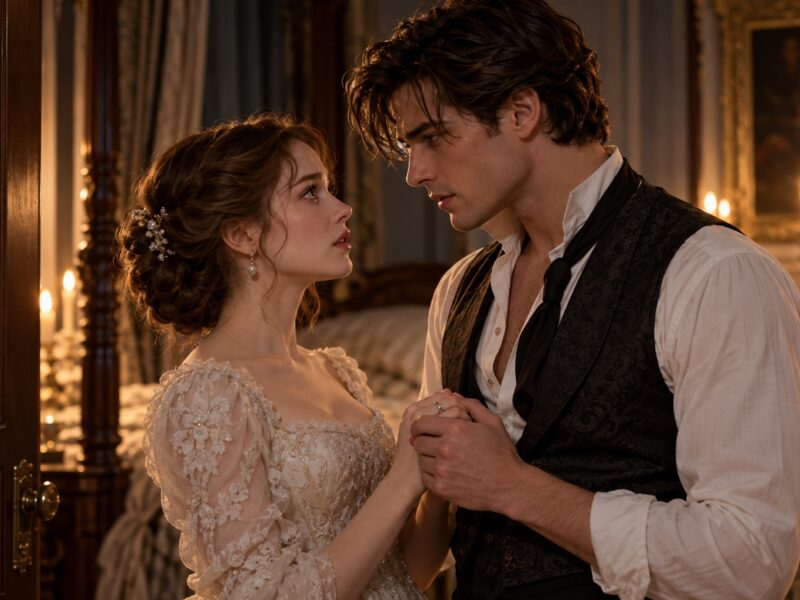
Lady Evelyn Hart stopped with her hand on the brass handle, her wedding ring catching the candlelight.
When she turned, the Duke of Ravenwood was watching her from beside the bed—and there was something in his expression that made her wonder whether every warning she had received about her husband had been wrong.
The bedroom was enormous, its high ceiling disappearing into shadow above a carved four-poster bed. Heavy velvet curtains framed the tall windows, beyond which the grounds of Ravenwood House lay silent beneath a moonless sky. A fire burned in the marble hearth. Somewhere in the adjoining corridor, a clock struck the quarter hour.
Evelyn had expected the room to be cold.
She had expected her husband to be colder.
Instead, he stood with his formal coat discarded over a chair, his black waistcoat slightly loosened, and his ivory shirt unbuttoned at the throat. His cravat hung crookedly around his neck. A lock of dark hair had fallen across his forehead, disturbing the severe perfection he had maintained throughout the wedding ceremony.
He looked younger without the elaborate restraint of his public appearance.
He also looked considerably less indifferent.
“Why?” she asked.
The duke glanced toward the door.
“Because I should prefer not to be interrupted.”
The answer was so simple that Evelyn could only stare.
During the carriage journey from the wedding breakfast, they had exchanged perhaps a dozen sentences. He had asked whether she was comfortable. She had thanked him for arranging the carriage cushions. They had discussed the rain, the condition of the road, and whether she wished for tea upon arriving.
They had not discussed the marriage.
And they certainly had not discussed what might happen tonight.
Her aunt had supplied plenty of opinions on that subject.
Do not expect affection, Evelyn. Men like Ravenwood marry because duty eventually becomes inconvenient to avoid.
One cousin had been less charitable.
You might count yourself fortunate if he never comes near your bed.
Another had whispered what everyone in London apparently considered established fact: the Duke of Ravenwood had no interest in women.
Evelyn had heard the rumor so often that she had eventually stopped questioning it.
Now she looked at the man standing beside their marriage bed and wondered what, precisely, she was supposed to believe.
“You needn’t look so alarmed,” he said.
“I am not alarmed.”
His eyes moved briefly to the hand she still held against the door.
“Then why are you gripping that handle as though you intend to escape?”
Evelyn released it.
“I was merely considering whether you meant to lock it yourself.”
A corner of his mouth lifted.
“An entirely reasonable distinction.”
She was startled by the faint humor in his voice. At dinner parties, Ravenwood seldom smiled. When addressed, he replied politely but briefly, as though conversation were an obligation best completed without unnecessary effort.
Tonight there was something almost playful about him.
It made him far more difficult to understand.
He approached her slowly.
Evelyn stepped backward before she could stop herself.
He noticed.
The amusement vanished from his face.
“Are you frightened of me?”
“No.”
“Evelyn.”
It was the first time that evening he had spoken her name without the formality of a title.
She lifted her eyes.
“I am not frightened of you,” she said carefully. “I simply do not know what you expect.”
He stopped, leaving several feet between them.
“Then perhaps we ought to begin there.”
She waited.
“What do you imagine I expect?”
The question was unfairly difficult.
A husband might expect obedience. Companionship. An heir. A wife who would manage his household, appear at his table, and refrain from embarrassing him in public.
Her family had explained all of those duties.
But Evelyn had never been told what she might reasonably expect in return.
“I understand the obligations of marriage,” she answered.
“That was not my question.”
She looked toward the fireplace.
“I know what people say about you.”
“I should be surprised if you did not.”
“They say you never wanted a wife.”
“True.”
The immediate admission hurt more than she expected.
She had not married him for love. She had understood the arrangement from the beginning. Still, hearing him confirm that he had never desired marriage made the room feel suddenly unfamiliar.
Then he continued.
“I never wanted the sort of wife society was determined to give me.”
Evelyn frowned.
“I do not understand.”
He folded his hands behind his back.
“I had no particular wish to marry a woman because her father owned three estates, her mother coveted a duchess’s coronet, or her brothers required a wealthy relative to settle their debts.”
“That is generally how marriages are arranged.”
“Precisely. Which is why I found the entire business so tiresome.”
She almost smiled.
“You make marriage sound like an unpleasant commercial transaction.”
“In most drawing rooms, that is exactly what it is.”
“Yet you married me.”
“Yes.”
“Why?”
For the first time since she had entered the room, he seemed to consider his answer rather than simply deliver it.
“Because I met you.”
Evelyn stared.
“Me?”
“Yes.”
“You hardly know me.”
“I know rather more than you suppose.”
Something in the way he spoke unsettled her.
Not because it sounded threatening, but because he seemed entirely sincere.
“When did you first notice me?” she asked.
“At Lady Pembrook’s musical evening.”
Evelyn remembered the gathering.
She had been invited because her aunt considered it necessary that she attend fashionable entertainments. The room had been crowded, the music competent, and the conversation exhausting.
She had spent much of the evening near the far wall, grateful that almost nobody asked her to dance.
“I wore blue,” she remembered.
“Did you?”
Her face warmed.
“You have just said you noticed me.”
“I noticed you, Evelyn. I did not claim to possess an inventory of your wardrobe.”
She gave a reluctant laugh.
He smiled properly then, and the transformation surprised her.
“I remember that you spent a remarkable amount of time trying not to be seen,” he said.
“That is hardly flattering.”
“I intended it as a compliment.”
“Most gentlemen compliment a woman’s gown or her appearance.”
“Most gentlemen have very little imagination.”
She looked at him, uncertain whether to be offended or amused.
He went on more quietly.
“You were the only young woman in that room who seemed entirely uninterested in attracting my attention.”
“I did not think you had any attention to give.”
“Ah. So you had heard the stories even then.”
“Everyone had.”
“I suppose that explains a great deal.”
He held out his hand.
Evelyn hesitated only a moment before placing hers in it.
His fingers closed gently around her own.
There was nothing possessive about the gesture. He held her hand as though he understood that she might withdraw it and had no intention of preventing her.
His thumb moved once across her knuckles.
The gold wedding band felt unfamiliar against her skin.
“You have been wondering,” he said, “whether I intend to kiss you tonight.”
Evelyn looked up so quickly that she almost lost her balance.
“Your Grace—”
“We are married. I believe you may call me something other than Your Grace when we are alone.”
She swallowed.
“I assumed you would prefer separate rooms.”
“Did you?”
“Yes.”
“Because of the rumors?”
She wished he would not make her say it aloud.
But she had spent too many years being silent merely because silence was convenient for other people.
“Yes.”
For several moments he said nothing.
Then he lifted her hand and pressed a light kiss against her knuckles.
“Then you have been misled.”
Her breath caught.
He lowered her hand but did not release it.
“For months,” he said, “I have listened to people describe me as cold, unnatural, incapable of affection, and entirely uninterested in taking a wife.”
“That must have been dreadful.”
“On the contrary. It was extraordinarily useful.”
She blinked.
“Useful?”
“Every ambitious mother in London stopped attempting to introduce me to her daughters. Every gentleman with an impoverished estate ceased inviting me to dinner. The letters proposing alliances became wonderfully infrequent.”
Evelyn stared at him.
“You allowed those rumors to circulate?”
“I did.”
“Knowing what people believed?”
“Quite.”
She looked at his composed face, then began to laugh.
It escaped before she could restrain it.
“You deliberately encouraged half of London to think you were unsuitable for marriage?”
“Nearly all of London, I should think.”
“That is outrageous.”
“It was effective.”
She shook her head.
“And Lord Ashkam?”
“My oldest friend?”
“Yes.”
“What of him?”
She looked uncomfortable.
“People have always suggested that your friendship was rather more than a friendship.”
Ravenwood sighed.
“Ashkam and I attended university together. He prefers classical history, inexpensive wine, and complaining about Parliament. Our friendship has endured because neither of us expects the other to become more interesting.”
Evelyn covered her mouth.
He watched her with evident satisfaction.
“Have I finally amused you, Duchess?”
“A little.”
“An encouraging beginning.”
He stepped nearer, though still not close enough to make her retreat.
“Whatever people may imagine about Ashkam, he is my friend. And the woman I have wished to know better has been standing before me for several minutes.”
Her laughter faded.
“You mean that?”
“I rarely say things I do not mean.”
“Then why me?”
The question emerged more quietly than she intended.
For most of her life, Evelyn had been treated as an adequate but unremarkable member of her family. Her cousins were praised for beauty, music, or wit. Her aunt found fault with her quietness. Her uncle considered her useful when documents needed sorting and forgettable when guests required entertaining.
No one had ever implied that she might be deliberately chosen.
The duke studied her.
“Because you are kind when nobody is watching.”
She lowered her eyes.
“That is hardly an accomplishment.”
“It is when kindness offers no advantage.”
He paused.
“And because you are clever.”
“My family would disagree.”
“Then your family has failed to pay attention.”
She tried to laugh, but something in her chest tightened.
“You do not know them.”
“I know what I have observed of you.”
He lifted his free hand toward her face, then stopped.
“May I?”
Evelyn looked at his hand.
No gentleman had ever asked permission before touching her cheek.
She nodded.
His fingers brushed her skin.
The contact was so gentle that it unsettled her far more than the prospect of a commanding husband ever had.
“And,” he added, his voice softer, “you have a rather distinctive habit of biting your lower lip when you are angry.”
Her eyes widened.
“I do not.”
“You do.”
“When have you seen me angry?”
“Several times.”
“I am rarely angry in public.”
“You are rarely permitted to express it. That is not the same thing.”
She became very still.
The duke lowered his hand.
“I notice more than you think, Evelyn.”
Beyond the windows, rain began tapping against the glass.
She had imagined this night many times during the weeks leading to the wedding. None of those imaginings had included a husband who appeared to understand her better than the people who had raised her.
He glanced toward the door.
“You may leave whenever you wish.”
Her throat tightened.
“Even tonight?”
“Especially tonight.”
“Would you truly allow it?”
“Immediately. I should see that you had a comfortable room.”
“Why?”
He looked at her for a long moment.
“Because I would prefer you to choose me.”
The words stayed between them.
All her life, decisions had been made for Evelyn.
Her aunt had decided which gowns she wore. Her uncle had determined which invitations she accepted. The possibility of marrying Ravenwood had been presented as an opportunity too advantageous to refuse.
She had agreed because refusing would have created an uproar she lacked the resources to withstand.
Now the man who possessed every legal and social advantage in their marriage was offering her the one thing her family had never considered necessary.
A choice.
She took one step toward him.
“I should like to stay.”
His expression changed.
“Are you certain?”
“Yes.”
“Evelyn.”
“I am certain.”
He lowered his head slowly enough that she could have drawn away.
She did not.
Their first kiss was hesitant.
Not awkward exactly, but careful, as though each were learning how much the other wished to give.
Evelyn rested one hand against his waistcoat. Beneath the dark fabric, she felt his heart beating faster than she expected.
It was an astonishing discovery.
The great Duke of Ravenwood, whose composure had survived Parliament, family scandals, and half a dozen seasons of London gossip, was nervous.
The realization gave her courage.
She moved closer.
His arm settled around her waist, and the kiss deepened.
When they finally separated, he rested his forehead briefly against hers.
“You are not at all what I expected,” she whispered.
“Neither are you.”
“I thought you disliked women.”
“I dislike being pursued for my title. There is a distinction.”
She laughed against his shoulder.
“I suspect society would be furious to discover you have deceived them.”
“Then it is fortunate that society is not invited into our bedroom.”
He kissed her again.
For a little while, Evelyn forgot the wedding breakfast, the speeches, the smirking cousins, and the dreadful anticipation that had accompanied her upstairs.
She knew only the warmth of his hand at her back and the surprising peace of being allowed to move at her own pace.
Eventually he drew away.
“I fear I owe London an apology.”
“For what?”
“Encouraging such a profound misunderstanding of my character.”
“You certainly possess a talent for deception.”
His expression altered.
The change was slight, but Evelyn felt it immediately.
The warmth did not vanish. Something colder simply appeared beneath it.
“Speaking of deception,” he said.
Evelyn straightened.
“What is wrong?”
He released her and crossed toward a writing desk standing beside the fireplace.
For several moments he searched among the papers.
Then he withdrew a folded sheet.
“I found this in my study yesterday.”
He offered it to her.
Evelyn unfolded the paper.
Four questions had been written in a neat, unfamiliar hand.
Where does the Duke keep his private correspondence?
Who enters the west study after midnight?
Does he maintain accounts without the steward’s knowledge?
Has he mentioned the railway contracts?
She read them twice.
Then a third time.
The room seemed to grow colder.
“I do not understand,” she said.
Ravenwood watched her.
“I believe you may recognize them.”
Her eyes lifted sharply.
“Are you accusing me?”
“No.”
The answer was immediate.
“Then why show them to me?”
“Because I believe someone expected you to provide the answers.”
Evelyn looked down again.
The handwriting was not hers. She had never seen the paper.
Yet the questions were familiar.
Not because she had asked them.
Because other people had.
Three days before the wedding, her uncle had asked where Ravenwood kept his confidential papers.
Her aunt had wanted to know whether the household steward was trustworthy.
Lord Harrow, who had played a conspicuous role in arranging the marriage, had inquired whether the duke maintained private accounts.
At the time, Evelyn had found the questions peculiar but not alarming.
A great estate had accounts. A duke conducted business. His correspondents naturally included men of influence.
Now she remembered how each inquiry had been introduced casually, separated by conversation about gowns, travel, and wedding arrangements.
“They were asking me,” she whispered.
Ravenwood nodded.
“Who?”
“My uncle. My aunt. Lord Harrow.”
His jaw tightened.
“And did you answer?”
“Only that I did not know.”
He exhaled quietly.
She looked at him.
“Why would they ask me such things?”
“I have reasons to suspect someone wants access to the private affairs of my household.”
“And they thought I could obtain it?”
“Yes.”
Evelyn felt an unfamiliar bitterness rising in her throat.
“They used my marriage.”
“It appears so.”
She looked at the wedding ring she had admired only minutes before.
It felt heavier now.
“They thought I would be too foolish to understand what I was doing.”
Ravenwood stepped toward her.
“They underestimated you.”
She swallowed.
“You cannot possibly know that.”
“I am beginning to know it rather well.”
His hand rose toward her chin, but he stopped when he saw her expression.
She was no longer frightened.
She was angry.
“Did you know any of this before we married?” she asked.
“I suspected that certain members of your family were involved in matters they preferred to keep private.”
“And you did not tell me?”
“I had no proof of what they intended to ask of you.”
“That is not quite the same thing.”
“No,” he admitted. “It isn’t.”
For a moment the tenderness between them became complicated.
Evelyn understood his reasons for caution. But she had spent her entire life being protected from decisions that everyone else felt entitled to make.
She could not endure more of the same merely because her husband spoke gently.
“If I am to be involved,” she said, “I want to understand what is happening.”
He regarded her carefully.
“You have every right to ask.”
“Then tell me the truth.”
“I intend to.”
She looked at the paper once more.
A final line appeared beneath the questions, written close to the fold.
She had missed it the first time.
Find the ledger before the Duke realizes what we are doing.
Her fingers went cold.
“The ledger.”
Ravenwood went still.
“What ledger?”
Evelyn raised her eyes.
“My uncle mentioned something before the wedding.”
“What?”
“He said you possessed a blue ledger.”
For the first time that night, she saw genuine alarm on her husband’s face.
“Where did he tell you to look?”
“The west study.”
The duke turned toward the door.
At that exact moment, a floorboard creaked in the corridor.
Both of them froze.
A second sound followed.
Footsteps.
Slow, cautious footsteps approaching the bedroom.
Ravenwood moved in front of Evelyn.
“Stand back.”
She obeyed, though the impulse to ask another question was almost unbearable.
The door handle moved.
Once.
Then again.
Evelyn stared at the brass lock.
She had turned the key herself.
Someone outside was attempting to open it.
The duke reached beneath his waistcoat.
His hand closed around a concealed pistol.
A soft metallic click broke the silence.
And the bedroom door began to open.
The duke did not shout.
He did not retreat.
He simply stepped toward the narrow opening and said, with a calmness that frightened Evelyn more than anger would have, “Come in.”
A man in dark clothing slipped into the room.
He barely crossed the threshold before Ravenwood seized him by the collar and forced him against the wall.
The intruder gasped.
“Your Grace!”
“Who sent you?”
“No one, Your Grace. I was merely—”
“You have entered my private chambers in the middle of the night. I suggest you choose your next words carefully.”
The man struggled.
Ravenwood held him firmly, his pistol still concealed close against his body.
Evelyn stood beside the fireplace, trying to make sense of the intruder’s face.
There was something familiar about him.
The narrow nose. The receding hairline. The pale scar above his eyebrow.
She had seen him before.
“Wait,” she said.
Ravenwood glanced toward her.
“I know that man.”
The stranger’s expression changed.
Evelyn stepped nearer.
“He works for Lord Harrow.”
The intruder looked toward the open door.
It was a small movement.
But it told Ravenwood enough.
“What were you sent to find?”
“Nothing.”
“Nothing?”
“I swear it.”
“Then why come here?”
The man hesitated.
His gaze darted toward Evelyn, then back to the duke.
“The ledger,” he muttered.
Evelyn’s pulse lurched.
Ravenwood’s eyes narrowed.
“What ledger?”
The intruder closed his mouth.
“An interesting choice,” the duke observed. “You have confirmed that such a ledger exists and now decline to explain it.”
He called toward the corridor.
Two household servants appeared.
At Ravenwood’s instruction, they escorted the intruder downstairs to be held until further arrangements could be made.
When the footsteps faded, the duke closed and locked the bedroom door again.
Evelyn stared at him.
“You knew someone might come.”
“I knew it was possible.”
“And you did not warn me?”
He looked weary for the first time.
“I had hoped I was mistaken.”
“About the danger?”
“About how quickly they would act.”
She moved toward the chair where his discarded coat lay.
Her hands trembled, but she folded them together so he would not see.
It did not help.
“Is this what our marriage will be?” she asked. “Strangers entering our rooms? Secrets I am expected not to question?”
“No.”
“Then what will it be?”
He approached carefully.
“That depends upon what we decide together.”
Evelyn looked up.
“Together?”
“Yes.”
He hesitated, then continued.
“Your family believed they could arrange this marriage and use you as a means of entering my household. They believed you would be too unobservant to notice what they were doing.”
“I have heard enough about what my family believes.”
“Then perhaps you ought to hear what I believe.”
She waited.
“I believe you recognized questions that were intended to pass unnoticed. You remembered who asked them. You identified a servant I did not know had ties to Harrow. And you connected the west study to a ledger you had never seen.”
He reached for her hand.
“Your family has spent years mistaking quietness for stupidity.”
Evelyn’s eyes filled unexpectedly.
“That is a rather severe judgment.”
“Is it inaccurate?”
She thought about her uncle’s impatient dismissals. Her aunt’s remarks about her lack of charm. The countless occasions when her opinions had been ignored until someone else repeated them.
“No,” she said.
“Then I shall stand by it.”
A tear slipped down her cheek.
She wiped it away impatiently.
“I dislike crying.”
“You are allowed to.”
“I would rather be useful.”
“You already have been.”
She gave a weak laugh.
“You scarcely know me, yet you seem determined to credit me with extraordinary abilities.”
“I am crediting you with ordinary intelligence. It is your family who consider that extraordinary.”
Despite herself, Evelyn smiled.
The duke raised her hand to his lips.
“Do you trust me?” he asked.
She considered the question.
Only an hour earlier, she might have answered out of politeness.
Now she understood that trust was something more difficult.
It required the freedom to disagree.
“I think I can,” she said. “Provided you stop deciding which truths I am permitted to hear.”
His expression softened.
“That is fair.”
“Then tell me what is in the blue ledger.”
He did not answer immediately.
Instead, he guided her toward the fireside chairs.
They sat opposite one another, with the mysterious paper between them on a small table.
“The ledger contains names,” he said.
“Whose names?”
“Men of influence. Men who have been purchasing far more than land.”
Evelyn frowned.
“For nearly two years, I have been following a network of landowners, merchants, and politicians who use forged debts, manipulated contracts, and false correspondence to acquire estates and ruin people who refuse to cooperate.”
“Railway contracts?”
“Among other things.”
“And Lord Harrow?”
“One of the intermediaries.”
“My uncle?”
Ravenwood’s expression told her the answer before he spoke.
“Another.”
She closed her eyes.
There had always been money in her uncle’s house. Not abundance exactly, but enough to sustain a respectable position and the impression of more. His business affairs were seldom discussed with the women of the family.
She had never questioned that arrangement.
Now she wondered how much had been hidden behind it.
“They arranged my marriage because they wanted access to your study,” she said.
“Yes.”
“They thought I would search your papers.”
“Yes.”
“And give them what they wanted.”
“That appears to have been their expectation.”
Her face burned.
“I was to steal from my own husband.”
“Evelyn—”
“And if I refused, I suppose they would remind me who had arranged the marriage and whose generosity I ought to thank.”
He said nothing.
He did not need to.
She knew her family too well.
“I hate that they made me part of this.”
“They involved you without your knowledge. That does not make you responsible for their actions.”
She shook her head.
“You do not understand. Everything in my life has been decided by someone else. Where I live. Whom I visit. Whom I marry. And now I discover that even my wedding was useful to people who cared nothing for my happiness.”
Her voice broke on the final word.
Ravenwood moved from his chair and knelt beside hers.
“I cannot undo what they have done.”
She looked at him.
“But I can promise that I will not continue it.”
“What do you mean?”
“You can leave Ravenwood tomorrow if you wish.”
She stared.
He continued before she could interrupt.
“I will arrange a carriage, provide whatever you need, and see that you are settled somewhere safe. There need be no public explanation until you are ready.”
“And what happens to you?”
“I will deal with Harrow and the others.”
“Alone?”
“I have people I trust.”
“And what happens to our marriage?”
“That is a question we need not answer tonight.”
Evelyn searched his face.
“You would let me go?”
“Yes.”
“Even after everything you have told me?”
“Especially after everything I have told you.”
She looked toward the door, then the window.
For years she had wanted a way out of her uncle’s household. She had imagined freedom as a distant place beyond the reach of his demands.
Now she was being offered another departure.
Another opportunity to walk away from a life someone else had arranged.
But something had changed.
“No,” she said.
Ravenwood looked at her.
“No?”
“I do not wish to leave.”
“You understand the danger?”
“I understand that danger exists whether I stay or go. I also understand that my uncle has relied upon my obedience for far too long.”
She sat straighter.
“I am tired of allowing other people to decide what happens to me.”
The duke remained silent.
“I want to help you.”
He looked at her for a long moment.
Then he nodded.
“Very well.”
Evelyn exhaled.
“And what shall we do?”
His mouth curved faintly.
“I believe, Duchess, we shall give your uncle precisely what he thinks he wants.”
The following morning, Ravenwood introduced Evelyn to the first stage of his plan.
The real evidence had already been secured elsewhere. What remained was to create a document convincing enough to draw their enemies into making a mistake.
He had prepared a false ledger.
Evelyn examined it in the west study, where daylight spilled across the polished writing desk and illuminated rows of carefully written figures.
At first glance, the book looked entirely authentic.
The binding was worn. The pages bore the faint discoloration of age. Each entry appeared methodical, precisely arranged, and suitably dull.
“It is too perfect,” she said.
Ravenwood looked up from a letter.
“Too perfect?”
“Yes.”
“That is an unusual complaint.”
“Look at the handwriting.”
He came around the desk.
“What about it?”
“It belongs to your steward, does it not?”
“He prepared the entries.”
“My uncle has seen his handwriting.”
Ravenwood glanced down.
Evelyn pointed to a figure near the bottom of the page.
“If this ledger reaches him, he will recognize the hand. He will know it has been deliberately prepared.”
The duke studied the book.
Then he looked at her with an expression she could not quite identify.
“What?” she asked.
“That,” he said, “is why I married you.”
Evelyn raised an eyebrow.
“Because I criticize handwriting?”
“Because you notice what other people neglect.”
“I suspect there are more romantic explanations available.”
“I shall endeavor to provide one.”
She smiled despite herself.
They spent much of the morning examining the false ledger and discussing the likelihood that Harrow had informants among the servants.
It was the first time Evelyn had been invited to participate in such work.
At her uncle’s home, men had spoken about business behind closed doors while the women occupied themselves with embroidery, calls, and dinner arrangements.
Here, Ravenwood listened when she spoke.
More remarkable still, he sometimes changed his mind.
By afternoon, their false ledger had been revised.
Evelyn stood beside the window, flexing the fingers she had strained with writing.
Ravenwood approached carrying two cups of tea.
“You have been rather quiet.”
“I am considering whether I ought to be nervous.”
“About tonight?”
“Yes.”
“That would be sensible.”
She accepted a cup.
“How reassuring.”
He smiled.
They drank in companionable silence.
Then he said, “There is something I ought to tell you.”
She looked over.
“I refused seven proposals before yours.”
Evelyn almost spilled her tea.
“Seven?”
“Seven.”
“I had heard you were difficult, but that seems excessive.”
“I am informed I have a disagreeable temperament.”
“I am beginning to see why.”
He laughed.
She had never heard him laugh so freely.
“Why was my proposal different?” she asked.
His expression softened.
“Do you remember where you stood during Lady Pembrook’s musical evening?”
“Against the wall.”
“Behind a curtain, for some of it.”
Her cheeks warmed.
“You saw that?”
“You had a book.”
She looked down into her tea.
“I was hiding.”
“I know.”
“From everyone.”
“I suspected as much.”
She glanced at him.
“And yet you noticed me.”
He set down his cup.
“I went looking for you.”
“Why?”
“Because I found myself wishing to speak with the one person in the room who seemed perfectly content not to speak with me.”
Evelyn smiled.
“You are an odd man, Ravenwood.”
“So I have been told.”
“And now?”
“Now I find myself very glad I went looking.”
She reached for his hand.
For several moments they stood together beside the window, their fingers intertwined.
For the first time since the wedding, Evelyn was not thinking about the rumors surrounding her husband.
She was thinking about the quiet relief of being seen.
Their trap was ready by evening.
Evelyn deliberately mentioned the false ledger within earshot of a servant she suspected of passing information to Harrow.
She made the remark casually, as though discussing an unimportant household matter, and included the location where the book would be kept.
The west study.
Ravenwood had already arranged for trusted men to observe the entrances.
Near midnight, two figures entered the study.
They found the false ledger where Evelyn had said it would be.
And they took it.
Ravenwood allowed them to leave the estate before following.
Evelyn waited through the night.
She tried reading but found herself returning to the same sentence. She tried sewing and misplaced her needle. Eventually she sat beside the window, watching the darkness slowly surrender to the gray light of dawn.
She had not realized how anxious she had become until she heard footsteps outside the room.
The door opened.
Ravenwood entered.
He looked tired, his coat damp and his hair disordered.
But in his hand was a packet of papers.
Evelyn rose immediately.
“Did it work?”
He placed the documents upon the table.
“Yes.”
She stared.
“What are those?”
“Letters. Payment records. Signed admissions. Enough to establish connections that certain gentlemen have spent years concealing.”
Evelyn approached the table.
“These came from Harrow’s associates?”
“Yes.”
“And you have what you need?”
“I believe so.”
A smile spread across her face.
“We did it.”
Ravenwood looked at her.
“We did.”
For a moment he said nothing else.
Evelyn glanced up.
“What?”
“Nothing.”
“You are staring.”
“I know.”
“Why?”
He looked down at the papers, then back at her.
“I have been trying to remember when the prospect of exposing these men ceased to be the principal reason I was eager to have you beside me.”
Her smile faded.
He took her hand.
“I cannot identify the moment.”
“Ravenwood—”
“Perhaps it was when you told me the truth about your uncle. Perhaps when you corrected that dreadful imitation of a ledger.”
She gave a shaky laugh.
“Not a particularly romantic memory.”
“I disagree.”
He stepped closer.
“I think I fell in love with you somewhere between those two moments.”
Evelyn could not speak.
Her eyes filled before she had time to turn away.
“Are you certain?”
He considered the question with characteristic seriousness.
“No.”
She stared at him.
Then laughed through her tears.
“That is a terrible declaration.”
“It is the most certain uncertainty I have ever experienced.”
He touched her cheek.
“I know that when I thought you might leave Ravenwood, I discovered I feared losing you more than I feared losing everything else.”
Evelyn leaned against his hand.
“I do not want to leave.”
“I am glad.”
He kissed her.
This time, there was none of the hesitation of their wedding night. They knew each other’s touch now. More importantly, they had begun to understand what trust might look like when neither person was required to surrender the right to choose.
For a brief moment, the danger outside their marriage seemed far away.
Then the door opened sharply.
A servant stood upon the threshold, breathless.
“Your Grace.”
Ravenwood turned.
“What is it?”
“Lord Harrow has arrived in London.”
The duke’s expression hardened.
“And?”
“He is telling everyone that the marriage is a fraud.”
Evelyn went still.
The servant hesitated.
“He is repeating the rumors, Your Grace. About your marriage. About your supposed unwillingness to have a wife.”
Ravenwood dismissed the servant and turned toward Evelyn.
“We can ignore him.”
She shook her head.
“No.”
“His gossip cannot alter what exists between us.”
“I know.”
“Then why give him the satisfaction?”
“Because he has spent years assuming I would remain silent whenever he chose to humiliate me.”
Ravenwood watched her.
“I will not hide,” she said.
That evening, they attended a dinner hosted by Lord Pembrook.
The drawing room was crowded with familiar faces. Crystal glasses glittered beneath the chandeliers. Fine silk gowns swept across polished floors, and conversation softened conspicuously when the Duke and Duchess of Ravenwood were announced.
Evelyn heard the whispers almost immediately.
An unusual marriage.
Surely she knows.
He was never interested in taking a wife.
She had been trained to pretend not to hear such things.
Tonight she heard every word.
Ravenwood offered his arm.
She took it.
They had barely entered the main drawing room when Lord Harrow approached.
He wore the expression Evelyn remembered from countless family gatherings: a pleasant smile that never reached his eyes.
“Your Grace. Duchess.”
Ravenwood inclined his head.
“Harrow.”
The older gentleman looked at Evelyn.
“I trust married life has been treating you kindly, my dear.”
“Very kindly, thank you.”
“How fortunate.”
He glanced toward the surrounding guests.
“I suppose one must make certain allowances in a marriage as unusual as yours.”
Conversation ceased nearby.
Evelyn felt Ravenwood’s arm stiffen beneath her hand.
She touched his sleeve gently.
He looked at her.
She gave the smallest shake of her head.
Then she faced Harrow.
“You ought to be careful.”
His smile widened.
“About what, my dear?”
“Repeating rumors you cannot prove.”
Harrow gave a soft laugh.
“Come now, Evelyn. Everyone knows the duke never wanted you.”
The words landed heavily in the silence.
For a heartbeat, Evelyn felt herself becoming the young woman she had been in her uncle’s drawing room—quiet, embarrassed, and desperate not to cause a scene.
Then she looked at her husband.
He was watching her.
He did not interrupt.
He did not rush to rescue her from the conversation.
He simply waited, trusting that she could answer for herself.
Evelyn turned back to Harrow.
“You are right.”
A murmur passed through the surrounding guests.
Harrow’s expression became triumphant.
“The duke did not want the woman everyone else believed he ought to marry,” she continued. “He wanted me.”
Harrow’s smile faltered.
“And I wanted him.”
She took Ravenwood’s hand.
The room fell silent.
The duke stepped beside her.
“The rumors were convenient for a time,” Evelyn said. “But they are no longer necessary.”
Ravenwood produced a packet of papers.
He turned toward their host.
“Lord Pembrook, I believe these may interest you.”
Pembrook accepted them with a puzzled expression.
“What is this?”
“Certain records concerning contracts and payments associated with several gentlemen of our acquaintance.”
Harrow’s face lost its color.
The first letter was opened.
Then another.
Names appeared. Payments. Forged contracts. Correspondence that connected Harrow to transactions he had plainly expected never to be exposed.
The atmosphere changed.
Men who had greeted Harrow warmly only minutes earlier began withdrawing from his side.
He stared at the papers.
Then at Ravenwood.
Finally, his gaze settled on Evelyn.
“You little fool.”
The words were familiar.
For years, they had been spoken in different ways whenever she offered an opinion he disliked or questioned an arrangement he had made.
But tonight they sounded different.
Not because his contempt had softened.
Because it no longer possessed the power to silence her.
“No,” Evelyn said.
Her voice was calm.
“That is what you always believed.”
She tightened her hand around Ravenwood’s.
“And that was your mistake.”
Harrow had no answer.
Under the attention of the assembled guests, arrangements were made to escort him away and place the documents into the appropriate hands.
Evelyn watched without triumph.
She had imagined that exposing her uncle would bring some great rush of satisfaction.
Instead, she felt tired.
And relieved.
The man who had once controlled so much of her life was leaving the room, while she remained standing exactly where she had chosen to stand.
Beside her husband.
Later that night, Evelyn returned to the bedroom where their marriage had begun.
She removed her earrings and placed them carefully upon the dressing table.
Ravenwood stood behind her, watching her reflection.
“You were magnificent.”
She smiled faintly.
“I was terrified.”
“So was I.”
She turned.
“The great Duke of Ravenwood was frightened?”
“Only while you were speaking.”
She laughed.
“That seems rather insulting.”
“I assure you, my fear was entirely for Harrow.”
He stepped closer.
Evelyn studied his face.
The stern duke London had considered cold and untouchable looked almost boyish when he smiled at her.
“Do you still intend to keep separate rooms?” she asked.
“No.”
“Why not?”
“Because my wife has developed a habit of involving herself in extremely dangerous affairs, and I suspect someone ought to remain nearby.”
“Your wife?”
“My wife.”
She reached for his loosened cravat.
“And does the Duke of Ravenwood still have no interest in women?”
He lowered his eyes toward her lips.
“I regret to inform you that society has been terribly misinformed.”
She laughed, and he drew her into his arms.
There were still difficult matters ahead.
The evidence would have to be examined. The men involved would attempt to protect themselves. Evelyn would eventually have to confront the fact that her own family had treated her marriage as another transaction.
None of that could be resolved by a kiss.
But something important had already changed.
She no longer needed to make herself small to preserve the comfort of others.
She no longer believed that being quiet meant she had nothing worth saying.
And she no longer needed to measure her value by the opinions of people who had never troubled themselves to know her.
Ravenwood kissed her gently.
When she looked up at him, she remembered the first words he had spoken after bringing her into this room.
Lock the door.
She had obeyed because she thought she was entering a life in which her husband would make every decision.
Instead, behind that closed door, she had been offered the freedom to make one of her own.
Being underestimated had never truly been her weakness.
It had allowed her to observe, to understand, and at last to recognize exactly who she wished to become.
And when Evelyn reached for her husband’s hand, she did so not because she had been given to him.
But because she had chosen him.
And he had chosen her.









