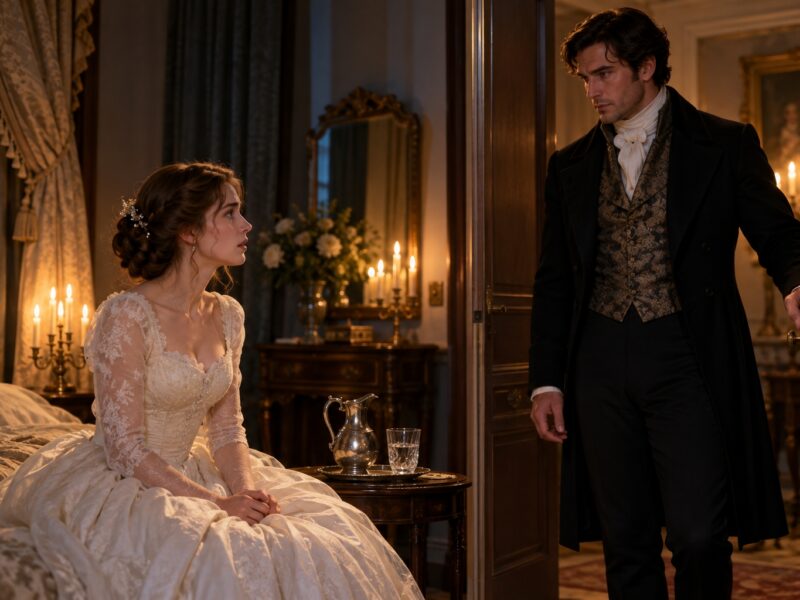
ON THEIR WEDDING NIGHT, THE DUKE TOLD HIS TERRIFIED BRIDE HE NEVER WANTED HER—THEN HANDED HER A LEDGER THAT COULD DESTROY HIS OWN FAMILY
The Duke had been Clara Whitmore’s husband for exactly seven hours when he entered their bedroom and told her he had never wanted to marry her.
She had spent the entire day preparing herself to obey a stranger. Instead, he placed a glass of water beside her trembling hands, stepped away, and began telling her a truth that could ruin them both.
Before the following morning, the frightened daughter of a penniless merchant would discover something in an old household ledger that the Duke’s own advisers had failed to see for two years.
Clara heard his footsteps before the door opened.
They were slow, measured footsteps, heavy enough to carry through the polished floorboards of the long corridor. She had been listening for them for nearly an hour, sitting rigidly on the edge of a bed so enormous that she felt lost upon it.
Her wedding gown spread across the coverlet in folds of ivory silk. One of the flowers pinned into her hair had come loose, but she had not dared remove the others. Her fingers were twisted into the blanket, and the pressure had left little white marks across her knuckles.
Beyond the windows, the grounds of Hail House lay silent beneath the night sky.
She was now the Duchess of Hail.
The title ought to have meant something magnificent. Her mother had spoken it with reverence for months, as though four words could restore everything their family had lost when Clara’s father died.
But sitting alone in that unfamiliar room, surrounded by expensive furniture and candles that smelled faintly of beeswax, Clara could think only of the instruction her mother had whispered at the church door.
“Endure your husband. That is a wife’s duty.”
Her mother had repeated it in the carriage after the ceremony, while the wheels rattled over the cobblestones and Clara struggled to keep her veil from blowing across her face.
Then she had said it once more that morning, while pinning the final white flowers into Clara’s hair.
Three times.
Clara had mistaken the repetition for reassurance.
Now she wondered whether her mother had been trying to warn her.
The footsteps stopped.
For several seconds, there was no sound at all. Then the handle moved, and the door opened.
Edmund, the Duke of Hail, stood on the threshold.
He was tall and broad-shouldered, his dark formal coat still buttoned, although his cravat had loosened slightly at the throat. Candlelight fell across his face, revealing a weariness that Clara had not noticed during the ceremony.
She had met him only three times before their wedding.
At each meeting, he had been courteous, reserved, and almost painfully quiet. He had asked after her health, spoken briefly about the weather, and listened when her mother answered questions Clara would have preferred to answer herself.
He was not unkind. At least, she had seen no evidence of unkindness.
But she knew almost nothing about him.
Clara rose so quickly that the room tilted.
“Your Grace.”
The words emerged thin and breathless.
Edmund’s gaze moved immediately to her face. His hand remained on the door.
“Please sit down,” he said. “You look as though you might faint.”
She obeyed because her legs were already trembling.
He did not approach the bed.
That was the first thing she noticed.
Instead, he crossed to a small table beside the window and poured water from a silver jug into a glass. He carried it to a chair near her, set it within reach, and retreated several steps.
There was nothing commanding about the gesture.
Somehow, that made it more unsettling.
“Drink a little,” he said quietly. “Your hands are shaking.”
Clara stared at the glass.
She had prepared herself for a cold husband. For impatience, for disappointment, perhaps for the sort of casual cruelty her married aunts discussed in lowered voices over tea.
She had imagined being told where to stand, what to say, when to speak, and when to remain silent.
She had not imagined being offered water.
“I am not afraid,” she said.
It was such an obvious lie that she felt ashamed as soon as she spoke.
A faint, tired smile crossed Edmund’s face.
“If I were in your position, I should be terrified.”
Clara looked up.
He seemed to consider his next words carefully.
“I think it best that I tell you the truth tonight. You may decide afterward what you think of me.”
Something cold gathered beneath her ribs.
“Have I done something wrong?”
“No.”
His answer came immediately.
“Nothing at all.”
He pulled a chair away from the bed and sat, leaving a considerable distance between them. For a moment, he rested his elbows on his knees and studied his hands.
Then he drew a breath.
“Clara, I did not want this marriage.”
The words seemed to change the temperature of the room.
She felt heat rush into her cheeks, followed by a sickening chill.
Of course he had not wanted her.
He was a duke, the owner of a vast estate, a man who could have married the daughter of an earl or a marquess. She was merely Clara Whitmore, whose father had once been a respectable merchant and whose death had left his widow with debts, dwindling savings, and a daughter with no fortune.
She had understood from the beginning that their marriage was an arrangement.
Understanding it had not made hearing the truth any easier.
Her eyes lowered to the wedding ring on her finger.
“Then why am I here?”
Edmund did not answer immediately.
“Because I was cornered,” he said at last. “And because, when the decision was placed before me, I chose you.”
She looked at him sharply.
“Those two things may sound impossible together. But both are true.”
Clara pressed her hands into her lap.
“Then I should like to understand.”
“So should I, if I were you.” He hesitated. “Will you allow me to explain without interruption? I fear that if I stop, I may find it difficult to begin again.”
She nodded.
Outside, wind brushed against the windowpane.
Edmund leaned forward.
“My father died two years ago. He left me this house, the title, and more debt than I had imagined possible.”
Clara knew that the former Duke had died, but the circumstances of the estate had never been discussed in her presence.
“Every farm is mortgaged,” Edmund continued. “The rents are not enough to satisfy the interest. There are servants whose wages must be paid, tenants whose livelihoods depend upon the estate, and families in the village who have nowhere else to turn.”
He looked toward the dark window.
“From the outside, this house appears prosperous. Inside, we are borrowing against things that have already been borrowed against.”
Clara’s fingers loosened around the blanket.
She understood debt.
She remembered her father’s face after an unsuccessful trading season, the hours he spent beneath the shop lamp with columns of figures spread before him. She remembered how carefully he had protected his wife and daughter from the worst of his worries.
“What happened?” she asked softly.
“My uncle Harold offered to help.”
Edmund’s expression altered.
“At first, I was grateful. He had always been involved in family affairs, and he understood the estate better than I did. When he proposed lending me money, I accepted.”
He paused.
“Then came another loan. And another.”
Clara watched his hands.
“Each time, there were papers requiring my signature. Each time, he assured me that the arrangements were necessary. Last spring, I began reading them more carefully.”
“And?”
“I discovered that the loans were gradually placing the management of the estate in his hands.”
He looked directly at her.
“One farm at a time.”
Clara felt an unpleasant certainty forming.
“Was that what he intended?”
“I believe it was.”
Edmund stood and walked a short distance toward the fireplace, then turned back.
“My father’s will contains a provision concerning my thirtieth birthday. If I remain unmarried at that age, Uncle Harold may assume authority as head of the family.”
Clara stared at him.
“He wanted you married before then.”
“Yes. But not merely married.”
He returned to his chair.
“He wanted a wife who would cause no difficulty. Someone without powerful relatives, without the confidence to challenge him, and without a fortune that might allow her to act independently.”
The room fell silent.
Clara no longer needed him to explain the remainder.
Nevertheless, she waited.
“Harold approached your mother last winter.”
She lifted her head.
“My mother?”
“Yes.”
Her voice scarcely rose above a whisper.
“She knew?”
“I learned of their conversations only last week, when one of the clerks mentioned something he had assumed I already understood.”
Edmund’s face tightened with discomfort.
“I do not believe your mother knew everything Harold intended. But she knew he was encouraging the marriage. She knew there was money involved. And she knew I had scarcely met you.”
Clara looked down at her dress.
The silk was beautiful. Her mother had wept when she saw it.
All at once, Clara remembered those tears differently.
Her mother had insisted upon the match with an urgency Clara had not understood. Whenever she expressed uncertainty, she had been reminded of the advantages of becoming a duchess.
A secure home.
A respectable position.
A husband wealthy enough, in appearance at least, to provide whatever she required.
“She thought she was saving me,” Clara murmured.
“I believe so.”
“From poverty.”
“Yes.”
Clara looked at the pale band of skin beneath her wedding ring.
“And she sent me here without telling me what she knew.”
Edmund did not defend her mother.
For that, Clara was grateful.
“I am sorry,” he said. “I wanted you to hear the truth from me before someone else used it against you.”
She sat with the revelation for several moments.
Her mother had not been telling her to endure because marriage required patience.
She had been telling her to endure because silence was part of the bargain.
Clara felt something inside her change.
Not break.
Change.
“You said you chose me,” she said.
Edmund looked up.
“Yes.”
“Was that another part of the arrangement?”
“No.”
“Then explain it.”
For the first time that evening, he looked almost embarrassed.
“Harold gave me the names of three young women. He suggested that I choose whichever seemed least likely to interfere in family affairs.”
Clara’s mouth tightened.
“How considerate of him.”
Edmund glanced at her.
It was the first hint of sharpness she had allowed herself, and he seemed to recognize it.
“Quite,” he said.
He continued.
“I found the suggestion so offensive that I decided to learn something about each of you myself.”
“You could have asked me questions.”
“I could have. I should have.”
His admission was so straightforward that Clara had no answer.
“But I had grown suspicious of everyone around me,” he continued. “And I wanted to know how these young women behaved when they were not trying to impress a duke.”
He paused.
“I visited your father’s old house last autumn.”
Clara frowned.
“Last autumn?”
“I came under the pretense of asking about a business matter.”
She searched her memory.
There had been many visitors during those unsettled months.
“You were standing near the kitchen yard,” he said. “It had been raining.”
Something stirred in her mind.
Rain on cobblestones.
A muddy path.
A stranger in a dark coat waiting near the gate.
“You remember,” Edmund said.
“Perhaps.”
“There was a young servant girl. Nell, I believe her name was.”
Clara straightened.
“Nell.”
“She was ill.”
“She had a fever. The cook insisted she could finish her work before going home.”
Edmund nodded.
“You sat beside her on an overturned bucket and wrapped your shawl around her shoulders.”
Clara remembered the girl’s shaking hands.
“She was freezing.”
“You carried her washing. Then you went into the kitchen and argued with the cook until Nell was allowed to leave.”
Clara stared at him.
“You saw that?”
“Yes.”
“I was rather rude to the cook.”
“You were very determined.”
“She was ill.”
“I know.”
Edmund’s expression softened.
“You did not know I was watching. You did not expect gratitude, and you certainly did not expect that helping a sick servant might influence your future.”
Clara felt her throat tighten.
“I remained at the gate for nearly ten minutes,” he said. “And by the time I left, I had made my decision.”
She looked away, suddenly unable to meet his eyes.
“Why?”
“Because I was being asked to choose a wife from a list, as though I were purchasing another piece of furniture.”
His voice grew quieter.
“I thought that if I must marry, I would rather marry someone who showed kindness when there was nothing to gain by it.”
He leaned forward slightly.
“I did not want a silent wife, Clara. I wanted someone I might trust.”
For several seconds, she could not speak.
Then tears slipped down her cheeks.
She brushed them away quickly, angry at herself for crying.
Edmund remained where he was.
“Uncle Harold wants you to be quiet,” he said. “I would prefer that you speak.”
Clara gave an unsteady laugh.
“You may regret that.”
“Perhaps.”
There was warmth in his voice now.
“But I should like the opportunity.”
She looked toward the glass of water he had left beside her.
For much of her life, other people had spoken about her future as though she were not in the room. Her mother had decided which invitations she should accept, which acquaintances were suitable, and which opinions ought never to be expressed before gentlemen.
Clara had learned to be agreeable.
It had taken considerably less effort than trying to be heard.
Edmund seemed to sense that she was still struggling.
“There are several promises I wish to make,” he said.
She looked up.
“I shall never ask you to give anything you do not freely choose to give.”
Clara held very still.
“This bedroom may remain yours for as long as you wish. I shall sleep in the dressing room tonight, and on any other night you prefer.”
She had not known how frightened she was of the hours ahead until he said those words.
Her breath left her slowly.
“You will be treated as my equal in this house,” Edmund continued. “Not as my servant, and certainly not as my possession.”
Clara’s eyes filled again.
“And should you ever wish to leave, I will help you do so safely.”
“Even if that would embarrass you?”
“Even then.”
She studied him for a long moment.
He looked exhausted, uncomfortable, and profoundly serious.
It was not a romantic declaration.
Somehow, it meant more to her than one.
“My mother taught me that a good wife does not burden her husband with her opinions,” she said.
Edmund’s mouth tightened.
“I disagree with your mother.”
“So do I,” Clara replied.
The words startled her.
Then, for the first time that day, she smiled.
“I have opinions, Your Grace.”
“Edmund,” he corrected gently.
“Edmund.”
He inclined his head.
“Then I hope you will share them.”
She drew a breath.
“When my father was alive, I kept the books for his shop.”
Edmund’s expression changed.
“You kept the accounts?”
“Yes.”
“How old were you?”
“Fifteen when he first taught me. He believed I had a talent for figures.”
Clara glanced toward the window.
“We used to sit together after supper. He would explain the invoices, and I would check the columns. Sometimes he made small mistakes on purpose to see whether I would find them.”
She smiled at the memory.
“He was very proud when I did.”
Edmund was watching her intently now.
“After he died,” she continued, “my mother sold the business. She said there was no further need for me to concern myself with numbers. A lady, she told me, ought to know how to manage a household, not a merchant’s accounts.”
“And did you agree?”
“Not for a moment.”
His answering smile was genuine.
“I have missed it terribly,” Clara admitted. “The ledgers, the figures, the satisfaction of discovering why a column does not balance. I know it sounds foolish.”
“It does not.”
Edmund sat a little straighter.
“Clara, would you be willing to look at something?”
“What sort of thing?”
He rose and crossed to the table near the window.
A folded cloth lay beside the silver jug.
He lifted it.
Beneath was a thick leather-bound book with a cracked spine and corners worn smooth from handling.
Clara recognized it immediately.
“A ledger?”
“The household accounts.”
Edmund gave a short, embarrassed laugh.
“I brought it upstairs because I could not sleep. I have read it so often that I believe I could recite entire pages, but I still cannot understand what is wrong.”
He carried it toward her.
“Every account appears correct. Every payment has an explanation. Mr. Dawson, my steward, insists the figures are in order.”
“Yet the debts continue to grow.”
“Exactly.”
Clara extended her hand.
Edmund hesitated.
“It is our wedding night. I would understand if you preferred not to spend it examining household expenses.”
She looked at the worn leather cover.
For the first time since her mother had informed her of the proposed marriage, something entirely her own lay within reach.
“Give it to me.”
Edmund placed the book in her hands.
Its familiar weight brought back her father’s shop, the smell of ink, the rough paper beneath her fingers, and the quiet satisfaction of finding an error everyone else had overlooked.
She opened the cover.
Then a violent knock struck the bedroom door.
Clara flinched.
Edmund turned sharply.
“Edmund!”
The voice outside was harsh and impatient.
“I know you are in there!”
Clara saw the color leave her husband’s face.
“Harold,” he whispered.
The knocking came again.
“The transfer papers, boy! I require your signature tonight. The lawyers leave in the morning.”
Edmund looked toward the ledger in Clara’s lap.
His uncle continued speaking through the door.
“You have enough to occupy you now that you are married. Leave the accounts to me. There is no sense burdening a new husband with such matters.”
Clara watched Edmund struggle with an old, familiar instinct.
For two years, his uncle had instructed him, advised him, and placed documents before him with the expectation that they would be signed.
Tonight, however, Edmund was not alone.
Clara gave him a small nod.
He crossed the room and opened the door only wide enough to stand within the gap.
“Uncle.”
“At last.” Harold’s voice sharpened. “I have been waiting.”
“It is my wedding night.”
“I am perfectly aware of that.”
“Then you will understand why I do not wish to discuss business.”
“This cannot wait.”
“It can,” Edmund said.
Clara watched his shoulders settle.
“And it will.”
There was silence outside.
“I shall review every page before putting my name to anything,” Edmund continued. “Bring the papers to the study in the morning.”
“Edmund—”
“My wife and I shall examine them together.”
The silence that followed was distinctly different.
“Your wife?”
Harold spoke the words as though they were absurd.
“She is a quiet girl, surely. I doubt she wishes to trouble herself with estate affairs.”
Clara closed the ledger.
She rose, crossed the room, and stood beside her husband.
Then she gently opened the door a little wider.
Uncle Harold was a heavy man dressed in expensive velvet. His eyes were small and watchful, and the smile he wore seemed to belong to the lower half of his face alone.
Clara looked directly at him.
“Good evening, Uncle Harold.”
His gaze flickered between her and Edmund.
“Your Grace,” he said stiffly.
“I shall be delighted to see the papers tomorrow,” she continued. “In fact, I am very much looking forward to reading them.”
For one brief moment, Harold appeared unable to form a reply.
Then his smile returned.
“Of course.”
He adjusted his coat.
“In the morning, then.”
“Good night,” Edmund said.
Harold turned and walked away.
The sound of his footsteps diminished along the corridor.
Edmund closed the door.
For several seconds, he leaned against it without moving.
Then he released a breath that sounded as though he had been holding it for months.
Clara returned to her chair and opened the ledger.
“Shall we begin?”
Edmund stared at her.
“Now?”
“I cannot possibly sleep.”
A quiet laugh escaped him.
“Nor can I.”
He brought a second chair beside hers, leaving a courteous distance between them, and lit another candle.
The room settled into an unexpected peace.
Clara turned the first page.
She examined the columns slowly, following the entries with one fingertip. The figures were beautifully written, each amount aligned with almost unnatural precision.
At first glance, nothing appeared wrong.
The household was expensive to maintain. Coal, grain, wages, repairs, stabling, and provisions accounted for enormous sums. Yet each page had been balanced, and every total agreed with the figures beneath it.
Clara turned another page.
Then another.
Edmund watched without interrupting.
On the fifth page, her finger stopped.
“Edmund.”
“Yes?”
“Look at the coal.”
He leaned forward.
“The coal?”
“It was paid for in October.”
“Naturally.”
“And again in November.”
He studied the entry.
“And in December,” Clara continued.
“Coal is delivered regularly.”
“Of course. But look at the amounts.”
Edmund bent closer.
Clara moved her finger down the column.
“Exactly the same.”
He frowned.
“That may simply be the agreed monthly charge.”
“Perhaps. But the grain is different.”
She turned the page.
“There are two payments each month, both under the same name.”
Edmund read aloud.
“Gray.”
“Yes.”
She returned to the coal entries.
“Gray appears here as well.”
Edmund’s brow furrowed.
“I do not know a supplier named Gray.”
“Has he ever called at the house?”
“Not to my knowledge.”
Clara turned several more pages.
The same name appeared again and again, attached to payments that seemed ordinary when considered separately.
But the entries had a peculiar regularity.
The amounts repeated.
The intervals repeated.
Even the handwriting seemed to follow a pattern.
Clara took a breath.
“I think someone has been making the accounts look correct rather than recording what was actually spent.”
Edmund looked at her.
“Explain.”
“If a payment is entered twice, the totals will still balance, provided the money leaving the account is recorded accordingly.”
She pointed to the entries.
“The book tells you that the money was spent. It does not prove the goods were delivered.”
Edmund said nothing.
“And if the additional spending is used to justify larger loans, the debt increases while the accounts appear perfectly reasonable.”
Her voice became steadier as she worked.
“These figures are too regular. I would want to see the receipts, the names of the suppliers, and the original orders before trusting them.”
Edmund stared down at the book.
For two years, he had read those pages as a man searching for an explanation of his own failure.
Clara had opened them as someone trained to notice patterns.
At last, he spoke.
“I have looked at these accounts a hundred times.”
“Then perhaps you have been looking too long.”
He gave a disbelieving little laugh.
“Perhaps.”
Clara closed the ledger carefully.
“We have found something suspicious,” she said. “But we must prove it.”
Edmund nodded.
“Mr. Dawson keeps the old receipts in the cellar room. We shall examine them at first light.”
“Together?”
He met her eyes.
“Together.”
The word settled between them.
It was not a promise of love.
Not yet.
But it was the beginning of something Clara had never expected to find in marriage.
Trust.
They continued examining the accounts until the candles burned low.
Eventually, Clara’s eyes grew heavy. She attempted to follow another column, lost her place twice, and finally fell asleep in the chair with the ledger resting open upon her lap.
Edmund noticed the moment her hand became still.
He did not wake her.
Instead, he gently settled his coat around her shoulders and left her undisturbed.
Then he went into the dressing room, as he had promised.
He lay awake for a considerable time.
The debts had not vanished. His uncle’s influence remained, and the estate was still in danger.
But for the first time in two years, the house no longer seemed to be closing around him.
Morning arrived in pale gold.
When Clara opened her eyes, she was lying in the enormous bed beneath a warm blanket.
The wedding flowers had been removed from her hair, and the ledger stood open upon the desk near the window.
For a moment, she forgot where she was.
Then she remembered everything.
The wedding.
Her mother’s warning.
Edmund’s confession.
The ledger.
And the unexpected discovery that her husband had no intention of making her afraid of him.
She sat up slowly.
The room was quiet.
For the first time since the marriage had been proposed, she did not dread the coming day.
An hour later, the Duke and Duchess of Hail sat together at the long desk in Edmund’s study.
A stack of old receipts lay between them.
Mr. Dawson stood nearby, visibly uncomfortable.
The steward had served the household for years. His hair was gray, his manner usually composed, and his knowledge of the estate’s daily operations extensive.
Yet the moment Clara mentioned Mr. Gray, his expression changed.
“Gray, Your Grace?”
“Yes,” Clara said. “The name appears repeatedly in the household accounts. I should like to know which goods he supplies.”
Dawson glanced toward Edmund.
“I do not deal directly with every supplier, Your Grace.”
“Then who does?” Edmund asked.
The steward swallowed.
“Some arrangements are handled by Lord Harold.”
Clara opened the ledger.
“These payments?”
Dawson looked at the page.
His face grew paler.
“Yes, Your Grace.”
“Have you seen the receipts?”
“Some of them.”
“And have you verified the deliveries?”
The steward hesitated.
Clara waited.
At last, Dawson lowered his gaze.
“I was instructed not to question payments authorized directly by Lord Harold.”
Edmund’s expression hardened.
“By whom?”
“Lord Harold himself, Your Grace.”
The answer left a heavy silence in the study.
Clara looked toward her husband.
She did not smile.
There was no satisfaction in discovering how readily a man could exploit another man’s trust.
But the pieces were beginning to fit together.
They arranged the suspicious entries beside the older receipts, marking repeated payments and separating those that could be independently checked from those that could not.
Edmund’s uncle had always presented himself as the one person willing to save the estate.
Now his instructions appeared throughout the accounts that had helped drive it deeper into debt.
Then footsteps sounded in the corridor.
Harold entered carrying a substantial stack of papers.
He stopped immediately.
His eyes moved from the receipts to the open ledger, then to Clara sitting beside Edmund.
Neither rose.
“Good morning, Uncle,” Edmund said.
Harold’s gaze returned to the figures spread across the desk.
“What is this?”
There was a slight crack in his voice.
Edmund folded his hands.
“A conversation we should have had long ago.”
Harold looked toward Mr. Dawson.
The steward kept his eyes lowered.
“Edmund, I have brought the transfer documents. They must be signed before—”
“Sit down, Uncle.”
Harold stiffened.
“I beg your pardon?”
“Please sit.”
The old Duke’s son had spent two years listening to his uncle explain what was necessary.
Now he spoke with a calm authority that left little room for argument.
Harold slowly lowered himself into the chair opposite the desk.
Edmund turned toward his wife.
“Clara has some questions.”
She opened the ledger to the page they had examined the previous night.
Harold’s gaze followed her hand.
“How many questions?” he asked, attempting a small smile.
“Eleven,” Clara replied.
She rested her finger beside the first suspicious entry.
“Let us begin with Mr. Gray.”
Harold did not answer.
For the first time since Clara had met him, the man who had arranged her marriage seemed to have nothing prepared to say.
The conversation that followed would be a difficult one. The estate’s debts remained, and the accounts would require further examination.
Clara understood that uncovering a suspicious pattern was not the same as resolving every financial problem.
But something important had already changed.
Edmund was no longer willing to sign without understanding.
Mr. Dawson was no longer able to hide behind instructions.
And Harold could no longer assume that the young woman he had chosen for her silence would remain silent.
Later that evening, Clara sat at a smaller writing desk with a sheet of cream-colored paper before her.
She had been thinking about her mother all day.
There were things she wished to say in anger.
She remembered the months of persuasion, the assurances that she would be fortunate beyond measure, and the whispered instructions to endure whatever her husband required.
But she also remembered her mother counting the money left in the household purse.
She remembered the careful repairs to worn dresses, the anxiety whenever a bill arrived, and the frightened determination with which her mother had searched for a secure future.
Fear did not excuse everything.
Clara knew that now.
But she could understand how it had shaped her mother’s choices.
She dipped her pen into the ink.
Then she began to write.
She explained that she understood her mother’s fear of poverty. She acknowledged that the marriage had been presented as a means of securing her future.
But she also made something clear.
She would not live her life according to advice that required her to disappear.
She would not mistake obedience for goodness.
And she would no longer believe that gratitude for security meant surrendering the right to think, speak, or choose.
When the letter was finished, she read it once.
There was no insult in it.
No dramatic accusation.
Only the quiet firmness of a woman who had finally discovered the sound of her own voice.
She signed her name.
Clara Whitmore had become Clara, Duchess of Hail, that morning.
Yet when she set down the pen, she felt more herself than she had in years.
Across the room, Edmund sat reading.
He looked up as she folded the paper.
Their eyes met.
He smiled.
It was a small smile, almost private, and it asked nothing of her.
Clara smiled back.
She thought of the night before, when she had sat alone on the edge of the bed with her wedding dress gathered around her and her mother’s warning echoing in her ears.
She had believed that marriage meant entering a stranger’s life and making herself small enough to fit within it.
Instead, her husband had offered her a glass of water.
Then he had offered her the truth.
And when she had told him she understood numbers, he had placed the most troubling book in his household into her hands.
The estate was not yet saved. The debts remained, and neither of them knew how difficult the months ahead might become.
But Clara no longer faced that uncertainty as a frightened girl waiting for permission to speak.
She had been told all her life that a good woman endured what was chosen for her.
No one had prepared her for the possibility that she might be asked what she wanted.
The marriage that was supposed to be endured had become the first thing in Clara’s life that she had truly chosen.









