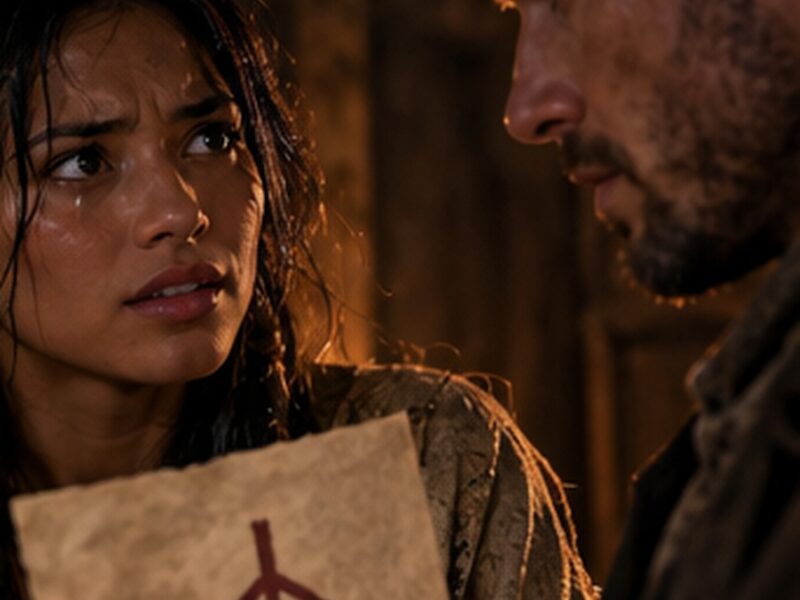
PLEASE, LET ME FEEL IT,” THE APACHE WOMAN BEGGED THE COWBOY—BUT WHEN HE TOOK HER NUMB HANDS, HE DISCOVERED A SECRET THAT COULD GET THEM BOTH KILLED
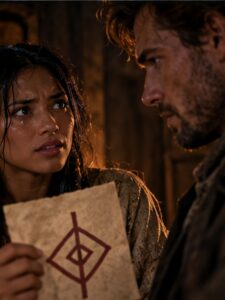
He found her tied to a cottonwood tree as the river rose around her knees.
She could barely feel her hands, and the men who had left her there were still hunting her.
Five days later, she discovered their symbol hidden beneath his cabin floor.
PART 1 — THE WOMAN WHO COULDN’T FEEL
“Please… don’t leave me here.”
Caleb Morgan almost missed the voice beneath the thunder.
He had been riding along the San Pedro River for nearly an hour, trying to reach his cabin before the storm swallowed the trail. Rain battered his hat, soaked the shoulders of his canvas coat, and turned the ground beneath his horse into a slick ribbon of mud.
Then he heard it again.
“Please.”
Caleb pulled the reins so sharply that his gelding stumbled. Beneath a twisted cottonwood on the opposite side of a narrow inlet, a young woman knelt in the rising water.
Her dress was torn at one shoulder. Blood had dried along her temple, only to be washed away by the rain. Her dark hair hung across her cheeks, and both hands rested motionless in her lap.
But the thing that made Caleb dismount was the rope.
It was wrapped twice around her right ankle and secured to the tree.
Someone had deliberately left her there.
“Don’t come closer!” she shouted when she saw him.
Caleb stopped with one boot in the mud. “My name’s Caleb Morgan. I’m not here to hurt you.”
Her eyes moved from his face to the revolver at his hip. She looked about twenty-four, but there was an exhausted hardness in her expression that belonged to someone who had survived far more than twenty-four years should contain.
“Then go away.”
“The river’s coming up.”
“I can see that.”
“You’ll be underwater before morning.”
“Better than going with another white man.”
Caleb didn’t answer immediately.
He had heard anger in that voice, but beneath it was something worse: the certainty that rescue might only be another form of captivity.
Slowly, he unbuckled his revolver and set it on a rock. Then he removed his rifle from the saddle scabbard and laid it beside the gun.
“There,” he said. “Now you’ve got one less reason to worry.”
She watched him carefully.
“What do you want?”
“Right now? To get that rope off your leg.”
Water rushed around her thighs.
The woman glanced toward the river, and for the first time Caleb saw fear break through her defiance.
He drew his hunting knife.
She recoiled so violently that the rope tightened around her ankle.
“Just the rope,” he promised. “You can watch my hands.”
He approached slowly, crouched in the water, and cut through the soaked fibers. The rope fell away, leaving an angry red groove above her ankle.
“Can you stand?”
“I don’t need your help.”
She pushed herself upright.
Her legs immediately buckled.
Caleb caught her beneath the shoulders before her face struck the muddy bank. A cry tore out of her, and he almost released her.
“Did I hurt you?”
“My hands.”
He looked down.
Her fingers hung strangely, neither fully curled nor completely open.
“What happened to them?”
She stared past him.
“I cannot feel them.”
“Not at all?”
“Sometimes they burn. Sometimes they hurt.” Her lips trembled. “Sometimes I touch something and it is as though my hands belong to someone else.”
Caleb carefully moved his grip away from her injured arms.
“What should I call you?”
She hesitated.
“Naya.”
“All right, Naya. My horse is close. I have a cabin about three miles from here. There’s a stove, blankets, and dry clothes.”
She turned toward the river.
“Why would you help me?”
He glanced at the rising water.
“Because somebody should have helped you before it came to this.”
Something passed across her face. Disbelief, perhaps, or the memory of a time when she might have trusted those words.
Then her eyes rolled backward.
Caleb caught her weight before she fell.
By the time he reached the cabin, dusk had settled into the folds of the mountains.
He carried Naya inside, laid her on his narrow bed, and covered her with two wool blankets. After building up the fire, he set a pot of water on the stove and returned to check the bruise near her temple.
She woke when he approached.
Her eyes opened wide.
“Where am I?”
“My cabin.”
She pushed against the mattress with her elbows, trying to sit up. Her hands failed to support her, and she fell backward with a sharp breath.
“Don’t touch me.”
Caleb stepped away.
“All right.”
“Where are my clothes?”
“On you. I only took off your wet boots and put a blanket over you.”
She looked down, confirming it.
“The door isn’t locked,” he added. “When you’re strong enough to travel, you can leave.”
Naya followed his gaze toward the door.
“And if I don’t believe you?”
“Then you can watch me open it.”
He crossed the room, lifted the wooden latch, and pushed the door outward. Cold air swept into the cabin, carrying the smell of wet earth and creosote.
He left it open until she told him to close it.
Only then did he return to the stove.
Naya studied every movement.
Caleb had the broad shoulders and sun-darkened face of a man accustomed to hard labor. A pale scar crossed the knuckles of his left hand. His brown hair needed cutting, and there were faint lines around his eyes that deepened whenever he looked toward the empty chair beside the fireplace.
Nothing about him appeared gentle.
Yet he moved carefully around her, as though afraid that even the sound of his boots might send her running.
He poured warm water into a tin cup.
“Can you drink?”
Naya reached for it.
Her fingers closed around the handle.
For one brief instant, she held it.
Then the cup slipped.
It struck the floor, splashing water across the boards.
Naya stared at her empty hands.
Caleb bent to retrieve it.
“It’s only water.”
“I know what it is.”
He paused.
“I didn’t mean—”
“I used to weave baskets,” she whispered.
The anger in her voice had vanished.
“My grandmother taught me when I was small. She said I pulled the fibers too tightly because I was afraid the world would come apart if I loosened my grip.”
Caleb remained kneeling beside the spilled water.
“I could tell willow from sumac with my eyes closed. I could braid my little cousin’s hair while she slept. I could hold a sleeping bird without frightening it.”
She raised her hands.
“Now I cannot even hold a cup.”
Caleb placed the cup on the table.
“Can you tell me what happened?”
Naya looked toward the fire.
For so long that he assumed she would refuse, she said nothing.
Then she spoke.
“Three weeks ago, armed men came to our camp.”
Her voice was flat at first, the way people sometimes spoke about suffering they could not yet bear to feel.
“We were near the eastern foothills. My family had stopped beside a dry wash. We were preparing to move before soldiers or cattlemen found us.”
She drew the blanket closer.
“It was still dark when the shooting began.”
Caleb pulled out the other chair but did not sit until she gave a small nod.
“The horses broke their ropes. One wagon overturned. My little cousin, Tomas, was trapped beneath the sideboard. I tried to lift it.”
Her breathing changed.
“A wounded horse fell against me. I remember its weight. The smell of blood. The ground moving when it struggled.”
She swallowed.
“I was pinned until after sunset.”
“Was the boy hurt?”
“He escaped. My grandmother took him.” Naya’s eyes hardened. “I don’t know where they went afterward.”
“And your hands?”
“When I woke, I could barely move them. At first I thought it was the cold. Then the burning began.”
Caleb glanced toward her neck and shoulders.
“Did anyone examine you?”
“There was no one left to examine me.”
He lowered his eyes.
Naya continued.
“I found our camp abandoned. I walked for days, following water whenever I could. Then three men caught me near the river.”
“The men who tied you to the tree?”
She nodded.
“Why?”
Her face changed so suddenly that Caleb sat straighter.
“Because I saw what they were carrying.”
“What was it?”
Naya shook her head.
“If I tell you, they may come for you too.”
Caleb looked at the rain beating against his window.
“Whoever they are, they already left you for dead. I don’t think keeping their secret will make them kinder.”
“No,” she whispered. “But perhaps it will keep someone else alive.”
He wanted to ask more.
Instead, he poured another cup of water and held it while she drank.
That night, Caleb slept beside the fireplace, his boots within reach and his rifle propped against the wall.
Naya woke several times.
Once, the wind knocked a branch against the roof, and she jerked upright with a cry. Caleb rose immediately but remained where he was until she recognized him.
“Just the wind,” he said.
She nodded.
Another time, she found him standing by the window.
“What are you looking for?”
“Nothing I want to find.”
She watched him until he returned to his chair.
For reasons she could not explain, she slept more peacefully after that.
By morning, the storm had passed.
Sunlight moved across the cabin floor, revealing the ordinary evidence of a solitary life: a chipped blue plate, a pair of work gloves drying beside the stove, a saddle in need of repair, and a small framed photograph of an older man standing with his hand resting on a horse’s neck.
Caleb was heating breakfast when Naya emerged from the bed.
She had managed to pull her boots on, though the effort had left her pale and shaking.
“You should be resting.”
“I have rested.”
“You nearly drowned yesterday.”
“And you talk too much.”
He glanced at her.
It was the first time she had spoken without fear or grief in her voice.
Caleb hid a smile and handed her a bowl of oatmeal, keeping his hands beneath it until she had settled it securely in her lap.
After breakfast, he laid several objects on the table.
A river stone.
A scrap of wool.
A wooden spoon.
A feather.
Naya regarded them suspiciously.
“What is this?”
“An experiment.”
“Are you a doctor?”
“No.”
“Then perhaps you should leave doctoring to someone who is.”
“Fair enough.”
He began putting the objects away.
Naya watched him for a moment.
Then she sighed.
“Wait.”
Caleb stopped.
She held out her hands.
“What do I do?”
He placed the stone in her palm.
“Tell me what you notice.”
“Nothing.”
He exchanged it for the wool.
“Anything?”
“No.”
Then the spoon.
She tried to curl her fingers around it.
The wood slipped from her grasp and struck the floor.
Her face tightened.
“Stop.”
Caleb immediately withdrew his hand.
Naya stared at the spoon.
“Stop pretending this will change.”
He sat across from her.
“My father was trapped beneath a timber in a mine when I was sixteen. Crushed his right leg badly enough that the doctor wanted to take it.”
She looked up.
“Did he?”
“No. But he never walked properly afterward. Some days he could hardly stand.”
“What happened to him?”
“He learned to ride again.”
“That isn’t the same as walking.”
“No,” Caleb said. “It isn’t.”
He allowed the distinction to remain between them.
“My father hated being helped. Hated needing a hand to climb onto a horse. But after a while, he figured out that being different from the man he’d been didn’t mean he was finished being a man.”
Naya looked at her palms.
“And if my hands never return?”
“Then you decide what matters to you, and we work out another way.”
“You make it sound simple.”
“It won’t be.”
For some reason, that answer comforted her more than a promise of healing would have.
Over the next several days, Caleb began making small adjustments around the cabin.
He wrapped the handle of a cup with strips of leather so Naya could grip it more easily. He carved a broad wooden spoon that rested against the side of her hand. He tied cloth loops to the buttons of an old jacket so she could dress without spending half an hour fighting the fabric.
He did not call these things gifts.
He simply left them where she would find them.
On the third day, Naya stood beside the stove and stirred a pot of beans without dropping the spoon.
Caleb was repairing a broken harness at the table.
“I did it,” she said.
He looked up.
The spoon remained in her hand.
“Well, I’ll be.”
She narrowed her eyes.
“Don’t sound so surprised.”
“Wouldn’t dream of it.”
But when she turned toward the stove, he smiled.
Later that afternoon, he found her sitting outside with a coil of willow strips beside her boots.
She had gathered them near the creek.
The strips lay scattered around her, too slippery for her stiff fingers to control.
Caleb crouched several feet away.
“Making a basket?”
“Trying.”
“Want some help?”
“No.”
He nodded and began repairing the porch step.
After twenty minutes, he heard a small, furious sound.
Naya had thrown the willow strips across the yard.
Caleb kept hammering.
Eventually, she spoke.
“You may help gather them.”
He set down the hammer without comment.
Together, they picked up the willow.
She showed him how to keep the fibers damp, how to bend rather than force them, and how to recognize when a strip was about to split.
Caleb was terrible at it.
His first attempt resembled a bird’s nest that had survived a thunderstorm.
Naya looked at the crooked shape in his enormous hands.
Then she laughed.
It surprised both of them.
The sound was brief, almost frightened, but Caleb found himself laughing too.
For several minutes, the cabin and the hills around it seemed like ordinary places where ordinary people might live.
On the fifth morning, Caleb returned from the creek with a small yellow desert flower.
Naya was sitting near the window.
He held it out.
“Thought you might like this.”
She accepted it with both hands.
The stem trembled between her fingers.
For a moment she stared at it.
Then her expression changed.
“Caleb.”
He turned.
“What?”
She touched the petals again.
“Wait.”
He crossed the room.
“Does it hurt?”
“No.”
Her voice became very small.
“I think I can feel it.”
Caleb knelt beside her chair.
She brushed the flower across her thumb, concentrating so fiercely that she barely breathed.
“Soft,” she whispered.
Then she looked at him.
“I can feel something soft.”
Tears gathered in her eyes.
“Please,” she said, holding the flower toward him. “Let me feel it again.”
He steadied the stem while she moved her fingertips across the petals.
This time, she was certain.
The sensation was faint, almost lost beneath the familiar numbness, but it was there.
Naya began to cry.
Caleb said nothing.
He simply held the flower until her hands stopped trembling.
That afternoon, for the first time since arriving, Naya told him about her grandmother without being asked.
She described the songs the older woman sang while weaving. The way Tomas always stole the sweetest roasted corn. The smell of wet earth after the first summer rain.
Caleb told her about his father.
About the orchard they had tried to grow on stubborn land.
About the winter his mother died and the silence that settled over the house afterward.
They spoke until the sun disappeared.
For a little while, Naya allowed herself to imagine that she might stay long enough to learn the shape of this new life.
Then Caleb went outside to split firewood.
Naya noticed a loose floorboard beneath the small chest beside his bed.
She had seen Caleb step over it several times, always with an almost unconscious care.
At first, she thought the board was simply warped.
When she pressed it with her boot, one end lifted.
Beneath it was a leather pouch.
Naya hesitated.
She knew she was searching through the belongings of the man who had saved her.
But the pouch was hidden deliberately, and Caleb had been watching the hills every night.
Using both hands, she pulled it free.
Inside lay a tarnished silver badge, an old photograph, and a folded document.
She opened the paper against the tabletop.
Her stomach tightened.
In one corner was a symbol burned into the page: a small star enclosed by a broken circle.
Naya knew that mark.
She had seen it on the saddle skirts of the men who attacked her camp.
On the wagon carrying stolen blankets.
And on the leather cuff of the man who tied her to the cottonwood.
Her breathing quickened.
She unfolded the rest of the document.
Across the top were the words:
TERRITORIAL RANGERS — SPECIAL DEPUTY AUTHORIZATION
Beneath them was Caleb Morgan’s name.
At the bottom, among several other signatures, appeared the name she remembered hearing shouted across the ruined camp.
Silas Vane.
The door opened.
Caleb entered carrying an armful of firewood.
He stopped when he saw her.
The logs fell from his arms.
Naya stood beside the table, the document trembling between her numb fingers.
“Where did you get this?” she demanded.
Caleb’s eyes moved to the pouch.
Then to the badge.
Then to her face.
“Naya.”
“Do not say my name.”
He remained still.
“Tell me why you have this.”
His jaw tightened.
“I can explain.”
“Then explain.”
Caleb looked at the broken-circle symbol.
For a moment, the only sound was the fire shifting behind the iron stove door.
Then he spoke.
“I know the men who did this to you.”
Naya backed toward the door.
“How?”
He swallowed.
“Because I used to ride with them.”
She looked down at his name on the document.
When she raised her eyes again, he understood what she was thinking.
And he did not know how to tell her that the truth was worse than the paper suggested.
Because the man who commanded the attack had once been his closest friend.
And Caleb had already helped put him in a position of power.
PART 2 — THE BADGE BENEATH THE FLOOR
“Were you there?”
Naya’s question was so quiet that Caleb almost wished she had shouted.
He stood by the fallen firewood.
“No.”
“Were you there when they shot at my family?”
“No.”
“When they burned our shelters?”
“I wasn’t there.”
She looked at the silver badge.
“But you belonged to them.”
Caleb slowly nodded.
“I was a territorial deputy. Three years ago.”
“Then you wore this.”
“Yes.”
“And you expected me to trust you?”
He did not try to approach her.
“No. I didn’t expect that.”
Naya looked toward the open doorway.
She wanted to run.
Her body was still weak, and she could barely fasten her own coat, but every instinct told her to get away from the man standing between her and the outside world.
“Move.”
Caleb stepped aside.
She reached the porch before the cold wind struck her face.
Beyond the clearing, the hills rose in long, dark folds.
There was nowhere to go without passing through miles of dangerous country.
But she would rather face the wilderness than discover she had placed herself willingly into the hands of another captor.
Caleb remained inside.
“Your horse,” she said.
“What?”
“I need one.”
He nodded.
“The bay mare is gentler than my gelding. She’s in the lower corral.”
“Give me the saddle.”
“You’re not strong enough to ride far.”
Naya turned.
“Do not tell me what I am strong enough to do.”
Caleb accepted the rebuke.
He went to the barn, brought out the mare, and saddled her. Then he placed a canteen, a folded blanket, and a small bag of food behind the saddle.
Naya watched from the porch.
When he finished, he stepped away.
“She’s yours if you want her.”
Naya approached the horse.
She managed to take the reins but could not tighten her grip.
The leather slipped through her fingers.
She tried again.
A sharp pain shot up her forearm.
The reins fell.
Her face burned with humiliation.
Caleb did not move.
She pressed her palms against the saddle and attempted to lift herself.
Her right arm gave way.
She stumbled against the mare.
For a terrible moment, she thought she might fall beneath the animal.
Caleb caught the saddle before it shifted.
Not her.
The saddle.
“There’s a mounting block by the barn,” he said.
Naya turned away, tears filling her eyes.
“I hate you.”
He looked at the ground.
“I know.”
But she had expected him to argue.
That made his silence harder to bear.
She stood beside the horse until her breathing steadied.
Then she said, “Tell me what happened. Everything.”
Caleb led the mare back to the corral.
When they returned to the cabin, he left the door unlatched.
He placed the photograph from the pouch on the table.
It showed five men standing outside a crude territorial outpost. One was Caleb, several years younger, his face leaner and his expression less guarded.
Beside him stood a tall man with pale eyes and a dark mustache.
“That man is Silas Vane,” Caleb said.
Naya stared at the photograph.
She recognized him immediately.
The man had stood beside a burning wagon and ordered his riders to search the bodies.
He had smiled when one of his men said the survivors would not dare return.
“That is him.”
Caleb closed his eyes briefly.
“I was afraid it would be.”
He sat opposite her.
“Silas and I worked together after a series of cattle thefts along the border. At first, we were chasing armed gangs. People were getting killed, and families were losing everything they owned.”
Naya said nothing.
“Then Silas began receiving money from ranchers who wanted land cleared. He started calling every Apache family he encountered hostile, whether they’d threatened anyone or not.”
“And you helped him.”
“I signed reports that I knew were wrong.”
The admission hung heavily between them.
Caleb’s voice roughened.
“I told myself I was keeping the peace. That if I stayed, I could stop the worst of it. It was easier than admitting I was afraid to turn against men who carried the same badge.”
Naya examined his face.
“What changed?”
“My father.”
Caleb touched the edge of the photograph.
“He saw a wagon full of seized belongings at an outpost. Blankets, cooking pots, children’s shoes. He asked whose they were.”
His throat tightened.
“Silas told him they belonged to thieves. My father looked at a pair of baby moccasins and said, ‘Then you’ve got some very small criminals.’”
Naya’s gaze dropped.
“Silas didn’t like being questioned. They argued. A week later, my father’s barn caught fire.”
Caleb looked toward the empty chair by the stove.
“He was inside trying to save the horses.”
Naya watched him struggle to continue.
“The official report said lightning. It hadn’t rained in eleven days.”
“Did Silas kill him?”
“I can’t prove who started the fire. But I know who ordered the investigation closed.”
He pointed to the folded authorization.
“After that, I gathered whatever I could. Copies of seized-property lists. Payment records. Names of families driven away. I thought I had enough to expose him.”
“What happened?”
“My commanding officer disappeared. One witness turned up dead. I resigned before they could arrest me on a fabricated theft charge.”
Naya looked at the badge.
“You hid.”
Caleb did not resist the word.
“Yes.”
“For three years.”
“Yes.”
“While they continued.”
He nodded.
She leaned back, suddenly exhausted.
“Then my family paid for your silence.”
The words struck him harder than anything else she had said.
Because he could not tell her she was wrong.
That evening, Naya ate almost nothing.
Caleb set dinner near her chair and withdrew to the porch.
He remained there until well after dark.
Inside, Naya unfolded the document again.
There were marks she could recognize even though the written words were difficult for her to read.
The broken circle.
The name Vane.
A series of numbers.
She remembered the wagon.
The one the raiders had guarded more carefully than their horses.
After the attack, she had hidden beneath a shelf of rock while three men divided stolen supplies. She had heard one of them complain that Vane had promised payment when the survey was finished.
The survey.
She whispered the word.
Caleb looked up when she called him inside.
“There was a wagon at our camp.”
He sat down.
“An army wagon?”
“No. Smaller. Covered with dark canvas. They loaded papers into it.”
“What kind of papers?”
“I don’t know. But I heard them speak of a survey and a spring.”
Caleb became very still.
“What spring?”
Naya closed her eyes.
“Cedar Hollow. That is what one man called it.”
Caleb stood so abruptly that his chair scraped the floor.
“Are you sure?”
She stared at him.
“Yes.”
He went to the chest and removed a rolled map.
When he spread it across the table, Naya saw narrow black lines marking property boundaries and mountain trails.
Caleb pointed toward an area east of the river.
“Cedar Hollow is part of a proposed freight route. Two years ago, Silas helped investors buy claims around it.”
“Why?”
“Water. A reliable spring makes the land valuable to anyone driving livestock or hauling goods across this country.”
Naya stared at the map.
“Our families used that spring long before those men came.”
“I believe you.”
She shook her head.
“No. You don’t understand. We did not simply stop there. My grandmother knows where the old camps stood. Our people have returned to that water for generations.”
Caleb looked toward the authorization.
“If Silas can convince territorial officials that no one lives or travels there, he can help his investors secure the surrounding land.”
“And the attack?”
Caleb’s voice was low.
“A way to make the truth disappear.”
Naya remembered the men’s laughter.
The burning shelters.
The wounded horse falling across her arms.
Then she remembered something else.
“There was a red ledger.”
Caleb looked at her.
“One man carried it beneath his coat. When the wagon overturned, it fell into the wash. He was afraid to lose it.”
“What happened to it?”
“I took it.”
Caleb went silent.
Naya looked down at her hands.
“I thought it might contain the names of those who paid them. I had seen Silas write in it before the shooting stopped.”
“Where is it?”
She hesitated.
“I hid it under stones near the broken wagon.”
Caleb leaned forward.
“Can you find the place again?”
“I can.”
He ran a hand over his mouth.
For three years, he had lived with copies, suspicions, and a dead man’s unanswered questions.
Now, sitting in his cabin, was a woman who might have seen the one thing capable of proving the larger conspiracy.
But before he could speak, Naya raised her head.
“If I take you there, you will help me find my family first.”
Caleb nodded.
“Yes.”
“You will not take the ledger to another man wearing that badge without telling me.”
“No.”
“And if the government claims my people’s land again, you will not call that justice merely because it is written on paper.”
He met her gaze.
“No.”
Naya watched him for a long moment.
Then she held out her injured hand.
Not in forgiveness.
In agreement.
Caleb accepted it carefully.
Her fingers were cool.
But when his thumb rested against the base of her palm, she flinched.
He immediately released her.
“Did I hurt you?”
Naya stared at her hand.
“No.”
“What happened?”
She pressed her fingertips together.
“I felt your hand.”
It was not a full sensation. Only pressure along the edge of her palm, accompanied by a strange tingling that ran toward her elbow.
Still, it was more than she had felt the day before.
Caleb smiled faintly.
Naya almost smiled too.
Then three sharp knocks struck the cabin door.
Both turned.
Outside, a man’s voice called through the darkness.
“Morgan. Open up.”
Caleb’s expression changed.
He reached for the rifle.
“Who’s there?”
“Deputy Harlan Pike. Territorial business.”
Naya went pale.
She recognized the voice.
At the river, that man had tightened the rope around her ankle.
Caleb saw the terror on her face.
And understood.
He lowered his voice.
“Back room. Now.”
Naya moved toward the narrow storage room behind the kitchen.
Caleb followed just long enough to lift a loose plank near the rear wall.
“There’s a crawlspace under the house. If I tell you to go, take the opening behind the flour barrels and keep moving until you reach the dry wash.”
She stared at him.
“What about you?”
“I’ll give you time.”
Before she could protest, the man outside struck the door again.
“Morgan!”
Caleb turned toward the front room.
Then he opened the door.
Harlan Pike stood beneath the porch roof with rainwater dripping from his hat.
Behind him were two mounted men.
Pike smiled.
“Evening, Caleb.”
Caleb rested one hand on the doorframe.
“What do you want?”
Pike’s eyes moved past him into the cabin.
“Looking for a missing woman.”
“What woman?”
“Apache. Mid-twenties. Dark hair. Injured hands.”
Caleb kept his expression steady.
“Haven’t seen her.”
Pike glanced at the second cup on the table.
Then at the two blankets drying beside the stove.
His smile widened.
“That’s a shame.”
He stepped closer.
“Because Mr. Vane says she’s carrying something that belongs to him.”
Caleb did not move.
Pike lowered his voice.
“And he says if you help her hide it, you’ll burn beside her.”
PART 3 — THE THINGS HIS FATHER LEFT BEHIND
Caleb had faced angry men before.
He knew the difference between a threat made for pleasure and one made by someone who had already decided what would happen.
Harlan Pike had the second kind of voice.
Caleb kept his body between Pike and the cabin.
“Silas still sending other men to do his talking?”
Pike smiled.
“You always were a sentimental fool.”
“What happened to the last man who took one of Silas’s jobs?”
Pike’s smile faded.
Behind him, one of the riders shifted in his saddle.
Caleb noticed the movement.
He also noticed that the man’s rifle remained inside its scabbard.
Not everyone who came with Pike was eager to kill.
Pike leaned closer.
“We know she survived the river. We found the rope cut clean. There were fresh horse tracks.”
“Lots of horses travel this valley.”
“Not many people come through here anymore.”
Caleb shrugged.
“Then maybe you should search somewhere else.”
Pike’s eyes drifted toward the storage-room door.
A board creaked.
For one terrible instant, Caleb thought Naya had stumbled.
Pike heard it too.
“Got someone back there?”
“My house is old.”
Pike placed a boot on the threshold.
Caleb did not step aside.
“You have a warrant?”
The deputy laughed.
“You think that little word matters out here?”
“It might matter to the man who signs your pay.”
Pike’s face hardened.
He reached for the revolver at his hip.
Caleb moved first.
He drove his shoulder into Pike’s chest, shoving him backward off the porch. Pike fell into the mud, dragging his revolver halfway from its holster.
Caleb raised his rifle.
“Hands where I can see them.”
The two riders started forward.
“Stay in your saddles,” Caleb warned.
For several seconds, no one spoke.
Then Pike laughed from the ground.
“You really think you’ll get away with this?”
“No,” Caleb said. “I think you’ll ride back to Silas and tell him exactly what happened.”
Pike slowly stood.
His face had changed.
The easy cruelty was gone, replaced by something quieter.
“You should’ve left the girl in the water.”
Caleb’s finger tightened against the rifle stock.
Pike saw it.
For the first time, uncertainty crossed his face.
“Get off my land.”
The deputy backed toward his horse.
Then he smiled again.
“Silas will come himself next time.”
Caleb waited until all three riders disappeared among the cottonwoods.
Only then did he lower the rifle.
His hands were shaking.
Inside, Naya emerged from the back room.
“I heard everything.”
Caleb closed the door.
“Then you know we have to leave.”
She looked at the place where Pike had stood.
“He was there when they tied me to the tree.”
“I know.”
“He said he hoped the water would reach my mouth before the wolves did.”
Caleb looked away.
Naya noticed.
“You knew he was capable of that.”
“Yes.”
“And you still let him leave.”
“He has two men with him, and I don’t want a gunfight with you standing ten feet away.”
She pressed her lips together.
He continued more quietly.
“If I kill him without giving him a chance to surrender, Vane gets to call me an outlaw. Then every deputy between here and Tucson comes looking for us.”
Naya looked toward the window.
“And if you don’t?”
“He comes back.”
Neither spoke.
Then she moved to the table and began gathering the map and documents.
“Then we leave before sunrise.”
They spent the night preparing.
Caleb packed food, ammunition, a lantern, and his father’s old survey compass. Naya wrapped the small yellow flower in a piece of cloth and placed it inside the leather pouch.
When Caleb saw her struggling with the knot, he held out his hand.
“May I?”
She hesitated.
Then nodded.
He tied the pouch closed.
Their fingers brushed.
This time, Naya felt warmth.
Faint.
Uncertain.
But unmistakable.
She looked at her hands.
Caleb followed her gaze.
“Something?”
“A little.”
He didn’t celebrate.
He simply nodded, as though they were both beginning to understand that small victories deserved room to breathe.
Before dawn, he saddled the horses.
Naya insisted on mounting the mare herself.
It took three attempts.
Caleb stood nearby without touching her.
On the third, she settled into the saddle and gripped the horn.
Her expression was fierce.
“Not one word.”
He lifted both hands.
“Wouldn’t dare.”
They rode east, avoiding the main trail.
By noon, the mountains had turned blue beneath the heat.
Naya guided them through a narrow canyon, past a dry watercourse and a ridge of pale stone where juniper trees clung to the slopes.
Every familiar landmark seemed to hurt her.
Here, she had gathered willow with her grandmother.
There, Tomas had chased a lizard into a crack between two boulders.
Farther on, they passed the remains of a cooking fire.
Naya dismounted.
The ashes were old.
But someone had placed three stones beside them in a familiar arrangement.
She crouched.
Caleb remained on his horse.
“What does it mean?”
“A sign from my grandmother.”
“Is she alive?”
Naya touched the stones.
“She was when she made this.”
Her voice changed.
“She’s telling anyone from our family who passes here that they went north.”
Caleb looked toward the mountains.
“Then there’s hope.”
Naya stared at the small stones.
For weeks she had imagined that she was the only one left.
Now, in the dust of an abandoned campsite, she had found evidence that the people she loved might still be moving beneath the same sky.
She covered her mouth with her hand.
Caleb looked away to give her privacy.
When she stood, her eyes were wet but steady.
“First the ledger,” she said. “Then my family.”
By late afternoon, they reached the ruined camp.
Burned timber lay scattered across the wash.
A wagon wheel protruded from the sand.
Naya stopped so abruptly that the mare tossed her head.
Caleb rode beside her.
“We don’t have to do this today.”
She shook her head.
“Yes, we do.”
She dismounted and walked into the remains of her former home.
There were places Caleb recognized from years of riding through damaged settlements.
A fire pit.
Broken pottery.
A child’s carved toy half buried in dust.
But he had never walked through such a place beside someone who could tell him whose belongings he was looking at.
Naya picked up a small wooden bird.
“Tomas made this.”
Her fingers struggled to hold it.
Caleb stood nearby.
“Is that your cousin?”
She nodded.
“He carved the wings too short. My grandmother told him birds needed room to fly.”
Naya turned the toy over.
“Everyone laughed because he said this one was too stubborn to fly anyway.”
She tucked the bird carefully into her pouch.
Then she led Caleb to the broken wagon.
“Here.”
They moved stones from beneath the wreckage.
Naya searched until her injured fingers began to ache.
Caleb lifted the heaviest rock.
Beneath it was a narrow opening.
Naya knelt.
She reached inside.
For a moment, she found nothing.
Then her fingers struck leather.
She pulled out a small red ledger wrapped in oilcloth.
Caleb stared.
“That’s it?”
Naya nodded.
But when she opened the cover, she frowned.
Several pages had been torn out.
Only the middle section remained.
Caleb took the book with her permission and turned its stiff pages.
Names.
Dates.
Payments.
Property claims.
And beside several entries, the same broken-circle symbol.
He found Silas Vane’s signature.
Then another name he recognized.
Charles Whitcomb.
Caleb’s face drained of color.
Naya noticed.
“Who is he?”
“A land agent in Tucson. He helped Silas file the claims.”
“Is that bad?”
Caleb shook his head slowly.
“It’s worse than I thought.”
He turned another page.
There, beside a series of payments, was a familiar name written in dark ink.
Elias Morgan.
His father.
Caleb stared at the entry.
Naya moved closer.
“What is it?”
He couldn’t answer immediately.
The ledger recorded a payment to Elias Morgan only four days before the barn fire that killed him.
The amount was substantial.
And beside the payment was one short description.
Final settlement — Cedar Hollow survey.
Naya watched Caleb struggle to breathe.
“Caleb?”
He closed the ledger.
For years, he had believed his father died because he tried to expose Silas.
Now the book suggested Elias Morgan had been paid to help the very men he opposed.
Caleb looked down at the stained pages.
And for the first time since rescuing Naya, he felt the ground beneath his life begin to give way.
They took shelter that evening in a shallow cave above the wash.
Caleb built a small fire hidden between stones.
Naya sat beside it, watching him study the ledger.
He had read the same entry six times.
Finally she spoke.
“Your father is dead.”
Caleb nodded.
“But the paper cannot explain why he took that money.”
“It’s a record.”
“It’s only part of a record.”
Caleb looked at her.
“You’re saying I should keep looking.”
“I am saying you told me not to decide my hands were useless because they failed me once.”
He lowered his eyes.
Naya continued.
“Perhaps you should offer your father the same kindness.”
Caleb looked toward the darkness outside the cave.
He had spent three years building his life around guilt and an unfinished promise.
Now Naya was offering him something he had rarely allowed himself.
The possibility that he didn’t know the whole story.
He opened the ledger again.
This time he examined the entries before and after his father’s name.
A pattern emerged.
Several payments were recorded twice.
Others were paired with freight shipments that never appeared in official territorial records.
And beneath the settlement entry was a notation in Elias Morgan’s handwriting.
Caleb recognized the slanting letters immediately.
Original copy retained.
He sat upright.
Naya leaned forward.
“What?”
“My father kept something.”
“Where?”
Caleb considered the words.
Then he remembered the little framed photograph on his cabin mantel.
The picture of his father standing beside a horse.
There had always been a faint line scratched across the back of the wooden frame.
As a boy, Caleb had asked about it.
His father had laughed and said some things were safer when no one knew where they had been placed.
Caleb had assumed he meant money.
Now he wasn’t so certain.
He closed the ledger.
“We have to go back to the cabin.”
Naya stared at him.
“Pike will be watching it.”
“I know.”
“Then why?”
Caleb met her eyes.
“Because I think my father left the rest of the evidence there.”
Before Naya could answer, a rifle shot cracked across the canyon.
Stone shattered above their heads.
Caleb threw himself across the fire and dragged her behind the rocks.
A second shot struck the cave wall.
Then a voice echoed from the darkness below.
“Morgan!”
Silas Vane.
Caleb knew the voice before he saw the man.
“Bring me the ledger,” Silas called, “and I’ll let the woman walk away.”
Naya looked at Caleb.
He shook his head.
Silas laughed.
“Don’t make this hard. You know what happens when I have to come looking.”
Caleb checked the rifle.
Only four cartridges remained in its magazine.
Outside, he could hear horses.
At least five.
Perhaps more.
Naya reached for his wrist.
“Caleb.”
He looked at her.
Her face was pale, but her eyes were steady.
“I know another way out.”
He glanced toward the rear of the cave.
Nothing but darkness.
Naya pressed her hand against the stone.
“When I was little, Tomas and I used to hide here. There’s a narrow passage behind those rocks.”
“Does it lead outside?”
“To the upper ridge.”
Caleb listened.
Below, Silas called again.
“Last chance, Morgan.”
Caleb looked at Naya.
“Can you climb?”
She flexed her fingers.
The movement hurt.
But this time, they obeyed.
“I’ll find out.”
PART 4 — THE PRICE OF THE TRUTH
They crawled through the passage on their stomachs.
The rock scraped Caleb’s shoulders and tore the sleeve of his coat. Ahead of him, Naya moved slowly, pausing whenever pain shot through her injured arms.
He wanted to push her forward.
Instead, he followed at a distance that allowed her to choose her own pace.
Behind them, boots scraped against stone.
Silas’s men had entered the cave.
A lantern flared.
Caleb could hear their voices.
“Empty.”
“Fire’s still warm.”
Then Silas spoke.
“Find the passage.”
Naya reached a narrow opening overlooking the ridge.
Moonlight silvered the rocks.
Below, the horses stood tethered near the wash.
She looked toward Caleb.
“We can follow the ridge north.”
“And the horses?”
“Leave them. They know how to find water.”
Caleb knew she was right.
He also knew that on foot, with Naya still recovering, they could not outrun mounted men for long.
They needed somewhere to hide.
He remembered the old survey route cutting through the western ridge.
“There used to be a prospector’s shaft beyond that hill,” he whispered. “My father showed it to me. We can shelter there until daylight.”
Naya nodded.
They descended the ridge cautiously.
Twice, Caleb heard shouts from behind them.
Once, a rifle flashed in the darkness.
The shot passed far above their heads.
They reached the abandoned shaft shortly before midnight.
Caleb found the entrance half concealed by thornbrush.
Inside, the passage smelled of dust and old timber.
Naya sank against the wall.
Her arms shook uncontrollably.
Caleb knelt beside her.
“You’re hurting.”
“Yes.”
“Both hands?”
“Both arms.”
He examined her wrists in the lantern light without pulling at them.
The sensation in her fingers had been returning unevenly, but she still struggled to straighten several of them. The injury was more complicated than either had hoped.
“You need a proper doctor.”
Naya gave a weary smile.
“Now you remember you’re not one?”
“I’m slow, but I do learn.”
She laughed softly.
Then the smile vanished.
“What if this is all I get back?”
Caleb looked at her hands.
“I don’t know.”
She swallowed.
“I keep thinking about the baskets. About all the things I could do before.”
He sat down beside her.
“I know.”
“No. You know what it is to lose someone. But you don’t know what it is to wake up and find that your own body has become a stranger.”
Caleb considered her words.
“You’re right.”
She looked at him.
He continued.
“I can’t promise you’ll recover. I can’t tell you what your hands will be able to do in a year. But I can take you to someone who knows more than I do.”
“And if nothing changes?”
“Then it doesn’t change what you’re worth.”
Naya turned away.
For a while, she watched the small lantern flame.
Then she spoke.
“My grandmother used to tell me that hands remember what the heart refuses to release.”
Caleb smiled faintly.
“What did she mean?”
“She never explained. She always said I would understand when I was older.”
“Do you?”
Naya looked at her palms.
“Not yet.”
She leaned her head against the wall and closed her eyes.
Caleb remained beside her until she slept.
At dawn, they made their way toward a small homestead several miles west.
The place belonged to Ruth Ellis, a widowed nurse who had spent years treating injured miners, ranch hands, and families living far from town.
Caleb had known her since childhood.
She opened her door with a shotgun.
Then she recognized him.
“Caleb Morgan. You look terrible.”
“Morning, Ruth.”
Her gaze moved to Naya.
The shotgun lowered.
“Good Lord. Get her inside.”
Ruth examined Naya’s arms carefully.
She asked where the pain began, which fingers could move, whether she could distinguish warmth from cold, and whether weakness extended into her shoulders.
Naya answered reluctantly at first.
Then, when she realized Ruth was listening to her rather than speaking over her, she became more direct.
Ruth worked gently.
“These injuries can happen when nerves are compressed or stretched,” she explained. “Sometimes feeling returns. Sometimes it doesn’t. And recovery can take months, not days.”
Naya stared at her.
“Months?”
“Perhaps longer.”
“Will I weave again?”
Ruth set down the cloth she was using.
“I can’t promise that.”
Naya’s face fell.
“But I can tell you that the changes you’ve already noticed are encouraging. You need rest, protection from further injury, and careful practice. You also need a physician to examine you when we can get you to town safely.”
She glanced at Caleb.
“And you, young man, should stop making her climb mountains while she’s healing.”
Caleb opened his mouth.
Naya spoke first.
“He didn’t make me.”
Ruth raised an eyebrow.
“Then I suppose you both need better judgment.”
For the first time that morning, Naya smiled.
Ruth gave them food, clean bandages, and a place to rest.
Then Caleb told her about Silas.
Her face tightened.
“I wondered when that man would come back around.”
“You’ve heard something?”
“Three families passed through last month. Said riders were clearing camps east of Cedar Hollow.”
Naya leaned forward.
“Apache families?”
“Two were. The third was a Mexican shepherding family. All frightened. All said the same thing.”
“Where did they go?”
“North. Toward the Dragoon Mountains.”
Naya gripped the edge of the table.
“My grandmother may be with them.”
Ruth looked at her gently.
“Then we should find out.”
That afternoon, a rider arrived at Ruth’s homestead.
He was young, dusty, and frightened.
Caleb recognized him as one of the men who had accompanied Pike to the cabin.
The young man stopped several yards from the house and raised both hands.
“My name’s Daniel Reed,” he called. “I don’t want trouble.”
Caleb came onto the porch with his rifle.
“What do you want?”
Daniel swallowed.
“Pike’s dead.”
Caleb remained still.
“What happened?”
“Silas shot him last night. Said he was careless for letting you live.”
Inside, Naya heard the words and closed her eyes.
Daniel continued.
“Vane says you murdered Pike. He’s got men riding toward Tucson with the story.”
Caleb’s expression hardened.
“Why are you telling me this?”
Daniel looked at the ground.
“Because I was at the camp.”
Naya appeared behind Caleb.
Daniel saw her.
His face crumpled.
“I didn’t shoot anyone,” he whispered.
Naya stepped onto the porch.
“But you watched.”
The young man nodded.
“I was hired to guard the supply wagon. I didn’t know what Silas planned until the shooting started.”
“Did you stop it?”
“No.”
“Did you help anyone escape?”
Daniel’s eyes filled.
“No.”
Naya looked at him for a long moment.
“Then don’t ask me to make you feel better.”
He lowered his head.
“I wasn’t going to.”
Caleb studied him.
“What changed?”
Daniel reached into his coat and withdrew a folded sheet of paper.
“When Silas killed Pike, he told us we’d all share the same fate if we talked. I took this from his saddlebag while he was sleeping.”
Caleb took the paper.
It was a letter bearing Charles Whitcomb’s signature.
It instructed Silas to secure the Cedar Hollow claims before the next territorial survey hearing, regardless of the expense.
Attached was a list of payments to deputies, clerks, and freight contractors.
At the bottom was a note.
E. Morgan original survey must not surface.
Caleb looked up.
“Where is the rest?”
Daniel shook his head.
“I don’t know. But Vane thinks your father hid it.”
Naya exchanged a glance with Caleb.
The photograph.
The cabin.
The old frame.
Caleb folded the paper.
“Will you testify?”
Daniel looked frightened.
“Against Silas?”
“Yes.”
“He’ll kill me.”
“He may kill you anyway.”
Daniel stared at the porch boards.
Then Naya spoke.
“People died while you watched.”
The words were quiet.
“Now you can decide whether you will keep watching.”
Daniel looked at her.
After a long silence, he nodded.
“Yes.”
They left Ruth’s homestead shortly before sunset.
Ruth insisted on accompanying them as far as the nearest settlement, where she could send word to a physician and contact a former magistrate she trusted.
Daniel rode behind Caleb.
Naya led the way along an old trail she remembered from childhood.
By midnight, they reached Caleb’s cabin.
The front door hung open.
Furniture lay overturned.
The chest had been smashed.
Silas’s men had searched the house.
Caleb stood in the doorway, surveying the damage.
Then he crossed to the mantel.
The photograph was gone.
For several seconds, he did not move.
Naya approached.
“Caleb?”
He looked at the empty space.
“They found it.”
Daniel stepped inside.
“Vane ordered us to take every picture, every letter, every piece of paper. He said the old man had hidden something in the house.”
Caleb turned slowly.
“Where did they take it?”
“His camp at Cedar Hollow.”
Naya looked toward the eastern hills.
Silas had returned to the place where the attack began.
To the land he wanted to steal.
To the water he wanted to own.
And now he possessed the final piece of evidence Caleb had spent years searching for.
Caleb turned toward the door.
Naya caught his arm.
This time, her fingers closed firmly around his sleeve.
He looked down.
She was holding on.
Not perfectly.
Not without pain.
But she was holding on.
“We don’t go alone,” she said.
Caleb looked into her eyes.
And for once, he listened.
PART 5 — THE MAN WHO OWNED THE VALLEY
Two days later, Silas Vane rode into Cedar Hollow expecting to meet a frightened former deputy.
Instead, he found witnesses.
Ruth Ellis stood beside a wagon carrying medical supplies and sealed testimony.
Daniel Reed waited near the spring, his hands trembling against his saddle horn.
Beside him were two freight drivers who had transported supplies under Vane’s orders and had finally agreed to give statements.
And on the far side of the clearing stood a gray-haired Apache woman with a little boy beside her.
Naya saw them first.
She stopped walking.
The boy looked up.
His mouth opened.
“Naya?”
The world seemed to narrow around his voice.
“Tomas?”
He ran.
Naya fell to her knees as the child threw himself against her.
His arms closed around her neck.
She held him awkwardly, her injured hands struggling to find a secure grip.
But she held him.
His hair smelled of dust and woodsmoke.
His cheek was warm.
“Naya,” he whispered. “Grandmother said you might be alive.”
Naya began to sob.
The older woman approached slowly.
Her face carried the marks of exhaustion and grief.
Naya rose unsteadily.
“Grandmother.”
The woman took Naya’s face between her hands.
For a long moment, neither spoke.
Then her grandmother pressed her forehead against hers.
“You found your way.”
Naya closed her eyes.
“No,” she whispered. “Someone found me.”
Across the clearing, Caleb looked away.
He had imagined this moment many times during the ride.
In none of those imaginings had he understood how much it would cost Naya to stand there.
Her grandmother touched Naya’s hands.
“What happened?”
Naya looked down.
“They were hurt.”
“Can you use them?”
“A little.”
The older woman nodded.
“Then we will learn what a little can become.”
Naya began crying again.
Tomas took her hand.
She felt the pressure of his small fingers against her palm.
Not everywhere.
But enough.
And for a moment, that was everything.
The reunion ended when a rider appeared on the southern trail.
Then another.
Then six more.
Silas Vane emerged from behind a stand of cottonwoods with his revolver resting against his thigh.
He surveyed the clearing.
His smile faded.
“What is this?”
Caleb stepped forward.
“People you’ve been trying to keep apart.”
Silas looked from Ruth to Daniel, then toward the Apache families gathered near the spring.
His eyes narrowed.
“You’ve been busy.”
Caleb held up the red ledger.
“And you’ve been careless.”
Silas laughed.
“You think a book changes anything?”
“It’s a start.”
“Do you know how many men have signed papers against me? How many officials owe their jobs to the money that land will make?”
Caleb didn’t move.
“More than I wanted to believe.”
Silas’s gaze shifted toward Naya.
Recognition flashed.
“Well,” he said softly. “The river didn’t do its work.”
Naya stepped forward.
“No.”
Silas smiled.
“Should’ve made sure myself.”
Caleb moved slightly, but Naya raised one hand.
She wanted to speak.
Not because she believed Silas deserved her words.
Because she had spent weeks hearing his voice in her sleep, and she was tired of leaving her own unspoken.
“You killed people who were preparing breakfast,” she said. “You burned shelters where children were sleeping.”
Silas shrugged.
“I was following orders.”
Naya looked at the men behind him.
“So were they.”
A few lowered their eyes.
Silas’s expression hardened.
“You think these hills care who slept where? This land belongs to whoever can hold it.”
“No,” Caleb said.
He drew out a second document.
“The claims you filed depend on an altered survey. My father surveyed Cedar Hollow before you came here. He recorded the spring, the established trails, and the families who used them.”
Silas stared at the paper.
For the first time, uncertainty crossed his face.
“Where did you get that?”
Caleb looked toward the wagon.
“From a man who should’ve spoken up long ago.”
Daniel Reed stepped forward.
He held a wooden photograph frame.
The backing had been carefully removed.
Inside, folded behind the original photograph, Caleb’s father had hidden a copy of his survey notes and a signed statement describing Whitcomb’s falsified records.
Daniel’s hands shook.
“Vane had us tear apart the Morgan cabin,” he said. “I found the papers, but I didn’t give them to him.”
Silas slowly turned.
“You little bastard.”
Daniel swallowed.
“I’ve done enough for you.”
Silas raised his revolver.
The shot came without warning.
Daniel fell backward.
Caleb lunged toward him.
A second shot struck the wagon wheel.
Screams erupted.
Horses reared.
Silas’s men drew their weapons, but several hesitated when they saw Daniel bleeding on the ground.
Caleb dropped beside the young man.
A dark stain spread across his shoulder.
Ruth hurried forward.
“Get him behind the wagon!”
Caleb pulled Daniel to cover.
Silas aimed again.
Then Naya stepped into the open.
“Silas!”
He turned.
She stood a few yards from the spring, holding the leather pouch against her chest.
Inside was the red ledger.
“You want this?”
Caleb’s head snapped toward her.
“Naya, get back!”
She did not move.
Silas smiled.
“Give it here.”
Naya held the pouch out.
“Come take it.”
For a moment, Silas seemed amused.
Then he saw the expression on her face.
It was not the terror he remembered.
It was resolve.
“You think I’ll bargain with you?”
“No,” Naya said. “I think you will finally look at the person you’ve been trying to erase.”
Silas stepped toward her.
Behind him, several riders had lowered their weapons.
They had come expecting to help arrest a fugitive deputy.
Now they had witnessed Silas shoot a man who had tried to testify.
A second gunshot would make the truth harder to bury.
Silas understood it too late.
Caleb rose from behind the wagon with his rifle aimed at Silas’s chest.
“Drop the gun.”
Silas looked at him.
Then at Naya.
Then at the gathered witnesses.
“You won’t shoot me,” he said.
Caleb’s voice remained steady.
“Don’t make me.”
Silas turned the revolver slightly.
Caleb fired.
The bullet struck Silas high in the right arm.
His revolver fell into the dust.
He staggered backward, cursing.
Before he could reach it, two of his own riders dismounted and restrained him.
Ruth hurried toward the wounded men.
Caleb lowered his rifle.
He looked across the clearing.
Naya was still standing.
Her face had gone pale.
But she had not dropped the pouch.
Caleb approached slowly.
“Are you hurt?”
She shook her head.
He stopped an arm’s length away.
“You scared me.”
Naya looked down at the pouch.
“I scared myself.”
Then, with careful movements, she opened her hand.
The leather remained in her palm.
She flexed her fingers.
They responded.
Not entirely.
But enough.
Caleb looked at her.
She gave a shaky laugh.
“I suppose terror can be very persuasive.”
He didn’t smile.
Instead, he lifted his hand.
“May I?”
Naya nodded.
He took her fingers gently.
For a moment, neither moved.
Then she whispered, “I can feel you.”
Caleb looked into her eyes.
She squeezed his hand.
Only a little.
But he felt it.
And he knew she did too.
PART 6 — WHAT REMAINED AFTER THE FIRE
Justice did not arrive all at once.
It came in pieces, carried by frightened witnesses, damaged records, and men who had spent years pretending not to see what was happening around them.
Silas Vane survived his wound.
He was taken into custody after Ruth arranged for an official unconnected to Whitcomb’s land interests to receive the testimony.
Daniel Reed survived as well, though the bullet left his shoulder permanently weakened.
He testified about the attack at Cedar Hollow, the stolen supplies, and the payments that had bound deputies to private investors.
Caleb testified about his own years of service.
He did not hide the false reports he had signed.
He did not pretend that resignation had erased them.
When an attorney asked why he had remained silent after leaving the territorial force, Caleb looked across the room toward Naya.
“Because I was afraid,” he said. “And because being ashamed was easier than doing something that might cost me.”
The courtroom remained quiet.
The testimony did not restore the lives lost at Cedar Hollow.
Nor did it undo the years of displacement that Naya’s family had endured.
The records did, however, expose the fraudulent surveys and payments behind the land scheme. Whitcomb’s claims were challenged, Vane’s authority was stripped away, and further investigations began.
Caleb understood that a court could punish a criminal without repairing everything the criminal had destroyed.
Naya understood it even more deeply.
She returned to her grandmother’s camp after the hearings.
Caleb did not ask her to stay.
He knew that would make his cabin another place where a man decided what her future should look like.
Instead, he accompanied her as far as the river crossing.
She sat on the bay mare, the leather reins looped around her hands.
Her fingers were stronger now.
Some mornings they moved almost normally.
On others, she woke with pain that made even fastening her dress difficult.
Recovery had not followed a straight path.
Ruth had helped arrange visits with a physician who confirmed that Naya’s symptoms were consistent with a serious nerve injury. Neither could promise full recovery, but both encouraged her to continue gentle rehabilitation while avoiding further strain.
Naya had also begun weaving again.
Her first basket was crooked.
Its base leaned to one side, and several willow strips escaped the pattern.
She kept it anyway.
At the crossing, Caleb stood beside the mare.
“Your grandmother says the family plans to move north before winter.”
Naya nodded.
“We may.”
“Will you be safe?”
She looked toward the hills.
“Safer than before. That is not the same as safe.”
Caleb accepted the answer.
He reached into his coat and withdrew a small parcel wrapped in cloth.
Naya took it carefully.
Inside was the yellow desert flower, dried between two pieces of paper.
Beside it lay a small carved wooden shuttle, shaped to help her guide weaving fibers with less pressure on her fingers.
Caleb looked embarrassed.
“I thought it might make the work easier.”
Naya examined the shuttle.
“You made this?”
“Three of them. The first two were terrible.”
She smiled.
“I believe that.”
He watched her turn it in her hands.
“I don’t know where you’ll go,” he said. “But if you ever need help, you know where to find me.”
Naya looked at him.
“And if I don’t need help?”
Caleb smiled faintly.
“Then perhaps you’ll come because you want to.”
She said nothing for a moment.
Then she reached down.
Caleb took her hand.
It felt different from the first time.
Warmer.
Stronger.
More certain.
“Goodbye, Caleb.”
“Goodbye, Naya.”
He stepped back.
She rode across the river.
He remained there until the trees hid her from view.
Winter arrived early that year.
Caleb repaired his cabin, replanted part of the orchard, and began helping Ruth transport supplies to remote settlements.
He had learned that doing the right thing once could not erase years of doing too little.
But it could become a habit.
Sometimes, at night, he looked toward the empty chair by the stove.
He thought about the woman who had slept there beneath two blankets.
About her anger.
Her stubbornness.
The way she laughed when he ruined a willow basket.
And the moment she held a yellow flower as though it were the most precious object in the world.
He missed her.
But he had promised himself that missing her would not become another reason to claim something that was not his.
In early spring, someone knocked on his door.
Caleb opened it.
A woman stood on the porch.
Her black hair was neatly braided, and a woven basket rested against her hip.
She wore a blue shawl, dusty riding boots, and an expression he remembered better than his own reflection.
“Naya.”
She smiled.
“Your porch step is still crooked.”
Caleb looked down.
“I fixed it.”
“Not very well.”
He laughed.
Then he noticed the basket.
The weave was uneven in places, but the rim was firm, the pattern intricate, and the base carefully reinforced.
Naya held it out.
“For you.”
Caleb accepted it.
“You made this?”
“Most of it. My grandmother helped with the tightest parts.”
He ran his thumb along the willow.
“It’s beautiful.”
She raised an eyebrow.
“Don’t sound so surprised.”
He looked up.
Their eyes met.
For a moment, neither spoke.
Then Caleb stepped aside.
“Would you like to come in?”
Naya looked past him at the little cabin.
The stove.
The familiar table.
The empty chair near the fire.
“I would.”
She entered.
Caleb closed the door against the spring wind.
Naya placed her basket on the table, then turned toward him.
“My grandmother is well. Tomas has grown so much he thinks he’s a man already. We have a new place to stay near the foothills.”
Caleb smiled.
“That’s good.”
“And my hands…”
She held them up.
He waited.
“They still hurt sometimes. I still drop things. But I can weave for a little while most days. I can braid hair again if the person sits still.”
Caleb nodded.
“That’s wonderful.”
She looked down.
“And I wanted you to know.”
He crossed the room slowly.
“I’m glad you came.”
Naya looked toward the old framed photograph, now returned to the mantel.
“Your father would have been proud of you.”
Caleb’s expression changed.
“I hope so.”
“He left you evidence because he believed you would eventually do the right thing.”
Caleb looked at the photograph.
“Eventually,” he repeated.
She stepped closer.
“That matters.”
He turned back toward her.
Naya hesitated.
Then she held out her hands.
“Caleb?”
“Yes?”
“Will you help me with something?”
“Of course.”
Her eyes shone.
“I want to know whether I can feel the difference between a promise and the truth.”
He looked puzzled.
She smiled.
“Take my hands.”
He did.
Her fingers closed around his.
She could feel the calluses on his palms.
The warmth of his skin.
The slight tremor in his fingers.
Caleb looked at her.
“What do you feel?”
Naya swallowed.
“Someone who stayed when he didn’t have to.”
He lowered his head.
“And someone who left when she needed to.”
She smiled.
“Yes.”
Then she moved a little closer.
“I came back because I wanted to.”
Caleb raised one hand toward her face and stopped, silently asking permission.
Naya answered by leaning into his palm.
He kissed her gently.
Outside, spring sunlight spilled across the mountains.
Inside, beside a crooked little basket and an old photograph, two people stood holding the lives they had nearly lost.
Naya’s hands would never be exactly what they had been before.
The dead would not return.
And the past could not be made harmless simply because two people found one another afterward.
But the world had not ended at the cottonwood tree.
It had changed.
And so had they.
When Caleb finally released one of her hands to reach for the kettle, Naya laughed.
“Careful, cowboy.”
He looked at her.
“Why?”
She took the kettle from him and set it on the stove herself.
“Because I can do that now.”
Caleb grinned.
“Yes, ma’am.”
She turned back toward him.
And this time, when she reached for his hand, she did not need help finding it.









