SEVEN MONTHS PREGNANT, HER HUSBAND THREW HER OUT—BUT THE $950 FARMHOUSE HELD A SECRET THAT WOULD CHANGE EVERYTHING
Her husband abandoned her seven months into her pregnancy.
His mother called her unborn daughter a stranger and locked the door.
But inside a forgotten Kentucky farmhouse, someone had hidden something worth protecting for nearly forty years.
PART 1 — THE HOUSE NOBODY WANTED
Rebecca Whitaker was standing on her mother-in-law’s porch when she realized her marriage had ended without her husband even having the courage to tell her himself.
“Have that baby wherever you want,” Evelyn Whitaker said, gripping the brass doorknob. “We don’t need somebody else’s child.”
Rebecca stared at the woman who had once promised to treat her like a daughter. Behind Evelyn, through the narrow opening, she could see the pale yellow nursery she had spent six weekends painting, a small wooden crib beneath the window, and the stuffed rabbit Daniel had bought the day they learned they were having a girl.
“She’s Daniel’s daughter,” Rebecca whispered.
Evelyn’s expression didn’t change.
“That’s something you keep saying.”
Then the door closed.
For several seconds, Rebecca stood beneath the gray Kentucky sky with one hand pressed against her stomach and the other gripping the handle of a battered blue suitcase. The baby moved beneath her palm, a small rolling motion that made her throat tighten.
“You’re all right, sweetheart,” she whispered.
She wasn’t sure whether she was speaking to her daughter or herself.
Three days earlier, her husband had told her he was working late at the equipment dealership outside Lexington. He had kissed her forehead that morning, complained about the coffee being too strong, and asked whether she could remember to pay his truck insurance.
That evening, he never came home.
By midnight, Rebecca had called seventeen times.
The following afternoon, she received a photograph from a number she didn’t recognize. Daniel was sitting beside a younger woman at a restaurant, his arm resting across the back of her chair. He wasn’t smiling for the camera, but his hand was on the woman’s thigh.
Rebecca recognized her immediately.
Her name was Lauren Hayes.
She worked in the dealership’s accounting department.
When Rebecca finally reached Daniel, he sounded irritated rather than ashamed.
“Rebecca, please don’t make this harder than it already is.”
She stood in the kitchen holding the phone against her ear. A pot of soup sat untouched on the stove, and the baby’s ultrasound photograph was attached to the refrigerator with a sunflower magnet.
“You’re having an affair?”
A long silence followed.
“Things haven’t been right between us for a while.”
“You were helping me choose baby names on Sunday.”
“That doesn’t mean everything was fine.”
Rebecca closed her eyes.
“Then come home and tell me what happened.”
“I can’t do that tonight.”
“Daniel.”
“Mom will explain everything.”
The call ended.
Twenty minutes later, he sent one final message.
Stop calling. Mom will explain everything.
And now his mother had explained.
Rebecca’s marriage, her daughter’s nursery, and nearly five years of promises had been reduced to one sentence spoken through a doorway.
She picked up the suitcase and walked toward the road.
Nobody came after her.
Her friend Hannah Porter lived in a small apartment above a pharmacy in Georgetown. When Rebecca arrived that evening, Hannah took one look at her swollen ankles and trembling hands and stepped aside.
“Come in.”
Rebecca tried to explain what had happened, but she couldn’t get beyond Daniel’s name. Hannah put a glass of water in her hand, guided her to the couch, and sat beside her until the words finally came.
At some point, Rebecca began apologizing.
Hannah stopped her.
“You’re not apologizing for needing somewhere to sleep.”
“I know, but your apartment is so small.”
“Then we’ll be crowded.”
Rebecca looked down at the little rabbit she had managed to slip into her suitcase.
“She doesn’t even have a crib anymore.”
Hannah’s eyes filled, but her voice remained steady.
“Then we’ll find her another one.”
For two nights, Rebecca slept on Hannah’s couch beneath a quilt that smelled faintly of lavender detergent. She woke whenever a car passed outside, expecting Daniel’s headlights, even though she knew he wasn’t coming.
On the third morning, she began searching for somewhere to live.
A one-bedroom apartment cost more than she could manage. Most landlords wanted a deposit and the first month’s rent. One asked whether she had a husband who could sign the lease.
She closed the listing without answering.
Her savings amounted to $1,417.63.
She had earned the money through part-time bookkeeping, selling handmade quilts, and putting aside small amounts from grocery money. She had planned to buy the crib mattress, a car seat, and the other things a newborn would need.
Now the money had to buy her something far more basic.
A place where she could lock a door and know nobody else could order her to leave.
On Sunday afternoon, Hannah’s mother, Ruth, came by carrying a casserole and a folded newspaper.
“I heard about a place,” she said carefully.
Hannah glanced up from the kitchen table.
“Mom, if this is another apartment—”
“It’s not an apartment.”
Ruth unfolded the newspaper and pointed to a notice from a county surplus-property sale.
An abandoned farmhouse sat on four acres of land in the hills outside Mill Creek, Kentucky. The county had acquired it after years of unpaid taxes and a failed estate transfer. Several attempts to sell it had attracted no bidders.
The current asking price was $950.
Rebecca read the notice twice.
“Nine hundred and fifty dollars?”
Ruth nodded.
“The roof needs work. There’s no electricity connected, and the road floods when the creek rises. Folks say the well hasn’t been used in years.”
Hannah stared at her mother.
“She’s seven months pregnant.”
“I know how pregnant she is, Hannah.”
“Then why would you bring her a house without electricity?”
Ruth hesitated.
“Because she asked for somewhere that belongs to her.”
Rebecca kept looking at the photograph.
The farmhouse was ugly in the way abandoned things often become ugly. Its white paint had peeled away in long strips. One porch post leaned slightly, vines climbed the exterior walls, and a sagging metal roof gave the building the appearance of an exhausted animal.
Yet there was something about the front door.
It was still standing.
And behind it, unlike the door at Evelyn Whitaker’s house, nobody was waiting to tell her she didn’t belong.
The next morning, Hannah drove her out to see it.
The road narrowed beyond the last group of houses, twisting between pastures and old stands of oak. The farmhouse appeared at the end of a gravel lane, half-hidden behind waist-high weeds.
Rebecca stepped out of the car.
The autumn air smelled of damp leaves and distant woodsmoke.
Hannah looked at the cracked porch steps.
“Rebecca, this place is barely standing.”
But Rebecca was staring through a dusty window.
Inside, morning light fell across worn pine floors, a long kitchen table abandoned against the wall, and an enormous stone fireplace that stretched almost to the ceiling.
The chimney was built from irregular gray limestone, each stone carefully fitted against the next.
Everything else in the house seemed tired.
The fireplace looked as though it had been waiting.
Rebecca walked around the building slowly, testing the porch railing, examining the roofline, counting broken windows. She knew almost nothing about restoring houses, but she knew how to read numbers, keep accounts, and work until her hands hurt.
She also knew what it meant to be frightened.
She had been frightened every day since Daniel left.
Buying a ruined house wouldn’t change that.
But it might give her somewhere to be frightened without someone else deciding whether she could stay.
“I want it,” she said.
Hannah turned toward her.
“Becky.”
“I know.”
“The baby could come early.”
“I know.”
“What happens if the roof falls in?”
Rebecca looked back at the fireplace.
“Then I’ll find a way to fix it.”
She signed the purchase documents three days later.
After the recording and administrative fees, she had less than $400 left.
The county clerk, a gray-haired woman named Mrs. Bell, slid the deed across the counter.
“You’re aware the property is being sold as-is?”
“Yes, ma’am.”
“And nobody from the county has inspected the well?”
“Yes.”
Mrs. Bell studied her for a moment.
“Most folks your age don’t buy a house like this.”
Rebecca placed one hand over her stomach.
“Most folks my age have somewhere else to go.”
The clerk’s expression softened.
She stamped the final page and handed Rebecca the documents.
“Well, then. It’s yours.”
Rebecca took the deed with both hands.
She had never owned anything that significant before.
For the first time in weeks, she felt her daughter move without immediately wondering where they would sleep.
The farmhouse had no working plumbing, and the old electrical service was disconnected. But Ruth knew a retired electrician who agreed to inspect the wiring, while Hannah borrowed a portable generator from her uncle.
Rebecca spent her first afternoon sweeping broken plaster into piles.
By evening, her back ached so badly she had to sit on an overturned bucket. She watched dust drift through a shaft of golden light and wondered whether she had made the worst mistake of her life.
Then someone knocked on the doorframe.
An elderly man stood outside wearing faded overalls and a brown felt hat. He had a weathered face, broad shoulders bent by age, and a grocery sack in one hand.
“You’re the young woman who bought Miller’s place?”
Rebecca stood carefully.
“Yes, sir.”
“Frank Lawson. Farm up the ridge.”
He held out the sack.
“Eggs. A jar of peach preserves. My granddaughter said I ought to bring something besides opinions.”
Rebecca almost smiled.
“That’s very kind.”
Frank looked past her into the house.
His eyes stopped at the stone fireplace.
For a moment, something moved across his face that Rebecca couldn’t identify.
“You know who built that?” he asked.
“No.”
“Matthew Miller. Did most of it himself back in the seventies.”
Frank stepped inside and removed his hat.
“Good carpenter. Better stoneworker. Quiet man, though. After his wife died, he kept mostly to himself.”
“What happened to him?”
“Passed away years ago. His affairs got tangled up, nobody wanted the property, and eventually the county ended up with it.”
He ran his fingers along a section of limestone.
“Matthew always said this house was waiting for somebody.”
Rebecca glanced around at the damaged ceiling.
“Somebody who didn’t mind a little hard work?”
Frank didn’t smile.
“Maybe.”
Over the following two weeks, Frank became a familiar sight at the farmhouse.
He repaired the porch steps, showed Rebecca how to check the chimney draft safely, and helped Hannah’s uncle install a small solar-powered light over the kitchen table.
He also arranged for a local contractor to inspect the roof, though the price of repairs left Rebecca staring at the estimate long after the man had driven away.
One afternoon, she found Frank standing in front of the fireplace.
He appeared to be counting stones.
“Something wrong?” she asked.
Frank lowered his hand.
“No. Just remembering.”
“Remembering what?”
He looked toward the window.
“Matthew had a boy once. Thomas. Smart kid. Good with his hands.”
Rebecca waited.
“Thomas died young. After that, Matthew changed. Never quite came back to himself.”
“That’s terrible.”
Frank nodded.
“He’d already buried his wife by then. Losing the boy nearly finished him.”
Rebecca looked at the empty room.
There was something especially painful about imagining a house built for a family that had gradually become a monument to everybody who was gone.
“Did he have anyone left?” she asked.
Frank hesitated.
“Not that anybody could find.”
A few days later, the first serious autumn rain arrived.
Rebecca woke to water dripping into a metal cooking pot beside her bed. By morning, another leak had appeared over the kitchen sink.
She cried for the first time since buying the house.
Not loudly.
She simply sat on the edge of the mattress, pressing the heels of her hands into her eyes while the roof dripped around her.
Then she dried her face, pulled on Daniel’s old flannel shirt, and went to find another bucket.
By noon, Frank was on the porch with a tarp and two neighbors.
Nobody mentioned seeing her cry.
They worked through the afternoon, securing a temporary covering over the worst section of roof. When Frank climbed down from the ladder, Rebecca was waiting with a thermos of coffee.
“I can’t pay you,” she said.
“Didn’t ask.”
“I’ll pay you when I can.”
He accepted the coffee.
“Get that little girl here safely. We’ll discuss the rest afterward.”
That evening, Rebecca lit a small fire after Frank had checked the flue.
She sat beside the hearth with her swollen feet resting on a cushion, listening to the rain strike the roof.
The room smelled of damp stone and burning oak.
As she reached for a fallen piece of kindling, her fingers brushed a narrow seam near the base of the fireplace.
One stone seemed slightly different from the others.
The mortar around it was smoother.
Rebecca leaned closer.
At first, she thought it was an old repair. But the seams formed a faint rectangle, roughly eighteen inches wide.
She tapped the stone with the handle of a screwdriver.
A dull sound answered.
She tapped the stone beside it.
Solid.
She returned to the first.
Hollow.
Rebecca sat back on her heels.
For several minutes, she stared at the wall.
Then she retrieved a putty knife from the kitchen.
The mortar loosened more easily than she expected. After nearly half an hour, two stones shifted forward, revealing a dark opening behind them.
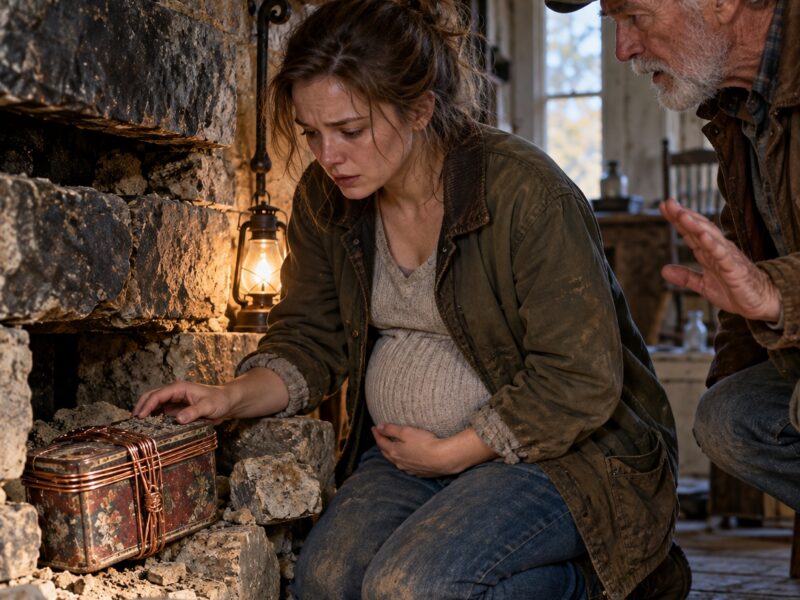
Inside was a small metal candy tin.
Someone had wrapped it tightly with copper wire.
The tin was dusty, but remarkably dry.
Rebecca carried it to the kitchen table.
The copper had darkened with age, and a strip of faded fabric was caught beneath one corner.
She almost pulled the wire loose.
Instead, she stopped.
Perhaps it belonged to Matthew Miller. Perhaps it held nothing more interesting than old coins or a dead man’s letters.
Whatever it contained, someone had deliberately hidden it inside the only part of the house that had survived untouched.
She placed it in the center of the table and went to bed.
At dawn, she called Frank.
“I found something in the fireplace.”
He was silent.
“A box?”
“An old candy tin.”
Another silence followed.
“Is it wrapped with copper wire?”
Rebecca looked at the table.
“Yes.”
She heard Frank inhale sharply.
“Rebecca, listen carefully.”
“Frank?”
“Don’t open it yet.”
“Why?”
His voice had lost its usual warmth.
“Because I helped Matthew put that box there.”
Rebecca looked down at the copper-wrapped tin.
Frank spoke again, more quietly this time.
“And before he died, Matthew made me promise that if someone ever found it, I’d tell them why he hid it.”
PART 2 — THE SECRET INSIDE THE STONE
Frank arrived twenty minutes later.
He hadn’t buttoned his coat properly, and his old pickup truck was still running when he stepped onto the porch. Rebecca opened the door before he reached it.
His eyes went directly to the kitchen table.
For a long moment, neither of them spoke.
Then Frank pulled out a chair.
“May I sit?”
Rebecca nodded.
He removed his hat and held it between his hands.
“Matthew Miller wasn’t a rich man,” he began. “He worked with stone, repaired barns, and took whatever jobs people would pay him for. But his wife, Eleanor, came from a family that owned land farther east.”
Rebecca sat opposite him.
“What does that have to do with the box?”
“More than you might think.”
Frank looked toward the fireplace.
“After Eleanor died, Matthew found out there were papers missing from her family’s estate. Old mineral-rights documents. Surveys. Deeds. Things that mattered to men with more money than him.”
Rebecca glanced at the tin.
“Did he steal them?”
“No.” Frank’s voice sharpened. “He was trying to keep somebody else from stealing what didn’t belong to them.”
He paused, then continued.
“Back in 1987, a company started buying mineral rights from families around here. Some people understood what they were signing. Others didn’t. There was a man named Charles Mercer who handled a lot of the transactions.”
“Was he dishonest?”
Frank rubbed his jaw.
“He had a gift for making legal paperwork look ordinary.”
Rebecca thought of the county deed folded inside her handbag.
“Matthew found discrepancies in Eleanor’s family records. A survey that didn’t match a deed. A signature entered after the person who supposedly signed it had already died.”
“Did he report it?”
“He tried.”
Frank looked down.
“Thomas was helping him sort the records. A month later, Thomas died in a truck accident.”
Rebecca felt the baby shift.
“Was it really an accident?”
“I never had proof it was anything else.”
Frank’s hands tightened around his hat.
“Matthew didn’t either. That’s part of what destroyed him. He couldn’t prove what he feared, and he couldn’t stop fearing it.”
Rebecca studied the tin.
“So he hid the papers?”
“Some of them. He wanted to protect the original records until he could find someone he trusted to examine them.”
“Why didn’t he give them to a lawyer?”
“He tried. The lawyer retired before anything was settled, and Matthew ran out of money. After that, he became convinced certain people were watching him.”
Rebecca looked at Frank.
“And you believed him?”
“I believed he was frightened. I also knew he had documents that didn’t match what the county had recorded.”
Frank nodded toward the tin.
“There’s a piece of paper beneath the lid. Matthew asked me not to read it. Said it wasn’t meant for me.”
Rebecca looked at the wire.
“Who was it meant for?”
“He said the next person who truly needed the house.”
Outside, the wind moved through the trees.
Rebecca felt an unexpected irritation rise in her chest.
“Frank, I’m not trying to be rude, but I don’t need a mystery. I need running water, a safe roof, and somewhere to bring my daughter home.”
“I know.”
“I don’t want trouble with some company over papers that are forty years old.”
“I know that too.”
Frank’s eyes settled on her stomach.
“But if Matthew was right, those papers might help you keep this place.”
That changed something.
Rebecca slowly reached for the tin.
Frank took a small pair of wire cutters from his pocket.
“I brought these.”
They unwound the copper carefully.
Inside the box were three folded documents, a small cloth pouch, a yellowed photograph, and an envelope sealed with dark blue wax.
The photograph showed a younger Matthew standing beside his wife and their son in front of the farmhouse.
Eleanor had one arm around Thomas.
All three were smiling.
Rebecca stared at the picture longer than she meant to.
It was painful to see a family frozen at a moment when none of them knew how much they stood to lose.
Frank turned the picture over.
In Matthew’s handwriting were five words.
Before the house became quiet.
Rebecca swallowed.
She opened the envelope.
The letter was dated November 14, 1989.
To the person who finds this,
If Frank Lawson is still alive, listen to him. He has been a better friend to me than I deserved.
I built this house for Eleanor. I thought good walls could keep the cold out and a strong roof could keep my family safe. I learned there are things a man cannot protect his family from, no matter how well he builds.
The papers in this box belong to the land and to the truth. I have spent years trying to make someone listen, but I am tired, and I am afraid my anger has made me careless.
Do not assume these papers make you rich. They may not be worth a dollar. Have someone honest examine them.
There is another document beneath the third stone on the eastern side of the hearth. I could not bring myself to keep it with the others.
If this house has found someone who needs it, I hope it offers shelter instead of sorrow.
Matthew Miller.
Rebecca lowered the letter.
For a moment, the only sound came from the small refrigerator humming on the generator.
“There’s another document?”
Frank stared at the fireplace.
“Matthew never told me that.”
They found the stone after nearly an hour.
Behind it was a narrow metal sleeve containing a deed, a survey map, and a notarized statement signed by Eleanor Miller shortly before her death.
Rebecca spread the papers across the kitchen table.
She understood numbers and accounts, but the legal descriptions meant little to her.
Frank pointed to one paragraph.
“This is what he was trying to protect.”
The farmhouse property had originally been part of a much larger tract. The documents referred to a reservation of mineral rights and an easement running toward an old limestone quarry beyond the creek.
“Does that mean I own the quarry?” Rebecca asked.
“Not necessarily. These papers alone don’t establish what rights passed through later sales. We’d need a title examiner.”
Rebecca felt a strange mixture of hope and exhaustion.
“Could it cost money?”
“Probably.”
“Then I can’t do anything.”
Frank looked at her for a long moment.
“Let me speak to my granddaughter.”
His granddaughter, Allison Lawson, worked as an attorney in Lexington. She specialized in real estate disputes and had spent years reviewing complicated property transfers.
When Frank called her, she agreed to look at scans of the papers.
She didn’t promise anything.
Two days later, Allison drove to the farmhouse carrying a laptop, a folder, and a worried expression.
Rebecca served coffee in mismatched mugs while Allison spread the papers across the table.
“First, I need you to understand something,” Allison said. “Finding old deeds doesn’t automatically mean you own everything mentioned in them.”
Rebecca nodded.
“I understand.”
“But some of these records are unusual.”
Allison pointed to an old survey.
“The legal description includes a narrow strip of land along Miller Creek. According to the county’s current mapping system, that strip is attached to a neighboring commercial tract.”
“Could that be a mistake?”
“Possibly. Or the land could have been transferred later. We need to examine the full chain of title.”
She turned another page.
“What’s particularly interesting is that Eleanor’s notarized statement references a retained interest in the quarry access road.”
Frank leaned forward.
“The old quarry?”
Allison nodded.
“The county recently approved preliminary discussions about reopening limestone extraction in that area. A development company has been assembling nearby property rights.”
Rebecca looked toward the window.
Beyond the trees lay hills, fields, and an old creek she had barely explored.
“I bought this place for $950.”
Allison offered a small smile.
“That doesn’t tell us what it’s legally worth.”
For the first time in months, Rebecca allowed herself to imagine that the house might become something more than a desperate gamble.
Then Allison’s expression grew serious.
“There’s another matter.”
She opened a printed copy of a recent filing.
“Someone applied for a correction to the property boundary six weeks ago.”
Rebecca stared at her.
“Before I bought it?”
“Yes.”
“Who?”
Allison glanced at Frank.
“The applicant was Mercer Land Holdings.”
Frank slowly put down his coffee.
“Charles Mercer’s family?”
“His grandson operates the company now.”
Rebecca felt the warmth leave her face.
Allison continued.
“They’re claiming that a section of the old Miller property belongs to their commercial tract. But the application hasn’t been finalized.”
“Can they take my house?”
“Not simply by filing a correction. But I want to review every document before you sign anything or speak to them.”
Rebecca folded her hands over her stomach.
“Why would they care about a falling-down farmhouse?”
Allison tapped the map.
“Because the most practical access route to the proposed quarry may run through your land.”
That evening, Rebecca sat beside the fireplace after Allison and Frank had gone.
The baby kicked steadily.
She placed the old photograph on the mantel.
Matthew Miller had built a house for his family, then spent the rest of his life watching that family disappear. She wondered whether he would be pleased or horrified that his secrets had resurfaced in the hands of a pregnant woman who could barely afford groceries.
Her phone vibrated.
For a moment, she thought it was Hannah.
Instead, Daniel’s name appeared.
Mom says you bought some condemned property. What are you trying to prove?
Rebecca stared at the message.
She hadn’t heard from her husband in almost a month.
She typed three words.
I’m not proving anything.
Then she erased them.
She put the phone face down and returned to folding a small stack of donated baby clothes.
Five minutes later, another message arrived.
We need to talk about the divorce.
Rebecca closed her eyes.
She had known that conversation was coming.
Knowing didn’t make it easier.
The following morning, a black SUV pulled into her driveway.
A man in a tailored charcoal coat stepped out carrying a leather portfolio.
He introduced himself as Richard Mercer.
“I understand you’re the new owner.”
Rebecca stood in the doorway, one hand resting on the frame.
“Yes.”
“I’m here on behalf of Mercer Land Holdings.”
He glanced over her shoulder at the damaged interior.
“Quite a project you’ve taken on.”
“What can I help you with?”
Richard smiled.
“Our company is interested in purchasing your property.”
Rebecca remembered Allison’s warning.
“I’m not selling.”
“You haven’t heard the offer.”
“I’m still not selling.”
Richard looked toward the old well, then back at the house.
“One hundred and twenty thousand dollars.”
Rebecca forgot to breathe.
The sum was so enormous compared with what she’d paid that for a moment it didn’t seem real.
With that money, she could rent a safe apartment, buy everything her daughter needed, and live without counting every dollar at the grocery store.
Richard watched her reaction.
“Cash offer. Quick closing. We can handle the paperwork.”
Rebecca swallowed.
“I need to speak to my attorney.”
His smile tightened.
“That would be unnecessary. It’s a very straightforward transaction.”
“Then she shouldn’t have any trouble reviewing it.”
Something cold entered his expression.
“You should understand, Mrs. Whitaker, that this property has serious structural and access problems. You may be facing expenses you can’t imagine.”
“I already know it needs repairs.”
“Keeping it might not be in your best interest.”
Rebecca felt her daughter move.
For months, men had been telling her what was best for her.
Her husband had decided their marriage was over.
Her mother-in-law had decided her baby didn’t belong.
Now a stranger had appeared at her door to explain why she should surrender the only thing she owned.
She tightened her grip on the frame.
“Please leave.”
Richard stared at her for another second, then closed his portfolio.
“I hope you don’t come to regret that.”
He returned to his SUV.
Rebecca stood in the doorway until he disappeared down the lane.
Only then did her knees begin trembling.
She called Allison immediately.
The attorney listened without interrupting.
Then she said, “Rebecca, whatever happens, don’t accept any offer until I’ve finished the title review.”
“I wasn’t going to.”
“Good. And I need to ask you something.”
“What?”
“Has anyone besides Frank and Hannah been inside the house since you found the documents?”
Rebecca thought for a moment.
“No.”
“Are you certain?”
“Yes.”
Allison was quiet.
“Because someone contacted the county clerk’s office this morning asking whether the hidden records had been recovered.”
Rebecca looked toward the fireplace.
“Who?”
“That,” Allison said, “is what I’m trying to find out.”
Three days later, Frank discovered something worse.
Someone had cut the chain on the old gate at the bottom of Rebecca’s driveway.
Fresh tire tracks led around the farmhouse toward the creek.
Rebecca was standing beside him when he crouched to examine them.
“Could it have been hunters?” she asked.
“Not with tires like these.”
Frank stood slowly.
“Call Allison. And call the sheriff’s office so there’s a record.”
Rebecca looked toward the woods.
For the first time, the farmhouse no longer felt entirely safe.
That afternoon, Allison returned with the results of her preliminary title search.
She set a thick folder on the table.
“Rebecca, I found something that changes the situation.”
Rebecca lowered herself into a chair.
Allison opened the folder.
“The old quarry-access interest appears to have survived several later transactions. If the original documents hold up, your property may control an important piece of the route.”
“How important?”
“Important enough that the development company would probably rather buy it than litigate.”
Rebecca pressed her hand to her forehead.
“So what happens now?”
“First, we verify the records with the county and the title insurer. Then we commission a survey. After that, we can discuss your options.”
Frank leaned against the kitchen counter.
“And Mercer?”
Allison looked at him.
“He may have a legitimate competing claim, but his company has submitted a document that concerns me.”
She slid a photocopy across the table.
It was a land-transfer affidavit bearing Eleanor Miller’s name.
Rebecca compared the date with Matthew’s letter.
“What’s wrong with it?”
Allison pointed to the signature.
“According to Eleanor’s death certificate, she died eleven months before she supposedly signed this.”
The room went silent.
Frank took off his glasses.
For nearly forty years, Matthew Miller had insisted that someone altered his wife’s records.
And now Rebecca was staring at what appeared to be the evidence he had hidden his entire life trying to preserve.
But before Allison could speak again, Rebecca’s phone rang.
It was Hannah.
Her voice sounded strained.
“Rebecca, there’s something you need to know.”
“What happened?”
“Daniel was at my mother’s house this morning.”
Rebecca closed her eyes.
“Why?”
“He was asking questions about the farmhouse.”
Rebecca gripped the phone.
“What kind of questions?”
Hannah hesitated.
“He wanted to know whether you’d found anything valuable inside.”
Rebecca looked up at Frank and Allison.
Then Hannah said the words that made the room seem to tilt beneath her.
“He wasn’t alone, Becky. Richard Mercer was sitting in Daniel’s truck.”
PART 3 — THE PEOPLE WHO CAME BACK
Rebecca’s first instinct was to call Daniel.
She wanted to demand an explanation, to hear his voice stumble over whatever lie he had prepared. Her hand was already reaching for the phone when Allison placed a folder in front of her.
“Don’t call him yet.”
Rebecca looked up.
“He’s working with the man who wants my property.”
“We don’t know what their arrangement is.”
“Why else would they be together?”
“I don’t know. But if we start accusing people without facts, it could make everything harder.”
Rebecca pushed back from the table.
Her stomach felt tight, though she couldn’t tell whether it was anger or the baby shifting.
“I was married to that man for almost five years.”
Allison’s face softened.
“I understand.”
“No, you don’t. He wouldn’t even come home to tell me he’d found someone else. He sent his mother to throw me out. And now he’s driving around with someone who wants the only place I have left.”
Frank moved toward the stove without speaking.
He filled the kettle, then turned it on.
Rebecca pressed her hands against the table.
“I just want one thing in my life that they can’t take away.”
Allison waited until she sat down again.
“Then we’re going to protect your ownership properly.”
Over the next week, Allison ordered certified historical records, commissioned a survey, and formally notified Mercer Land Holdings that Rebecca disputed the proposed boundary correction.
She also helped Rebecca connect with a family-law attorney named Caroline Brooks.
Rebecca hadn’t wanted to spend money on legal fees when she still needed a safe roof. But Caroline agreed to a limited initial consultation and explained that Rebecca could pursue temporary support and protect herself from unexpected claims.
The meeting took place in a small office overlooking a parking lot.
Rebecca sat across from Caroline with a folder of bank statements, medical bills, and screenshots of Daniel’s messages.
Caroline read quietly.
“Did your husband ever tell you he believed the baby wasn’t his?”
“Never. Not once.”
“Did he ask for a paternity test?”
“No.”
“Then why did his mother make those accusations?”
Rebecca looked toward the window.
“I think she wanted me gone.”
Caroline made a note.
“We’ll deal with the legal questions through the proper process. But you should know something: your mother-in-law doesn’t get to decide whether your husband has responsibilities.”
Rebecca exhaled.
It was the first time someone had stated that so plainly.
Two days later, Daniel appeared at the farmhouse.
Rebecca was sorting tiny cotton socks when she heard his truck.
For one awful second, her heart reacted before her mind did.
She remembered that engine turning into their driveway after work, remembered how she’d once gone to the window because she was happy he was home.
Then she remembered the empty nursery.
She walked onto the porch.
Daniel stood beside his truck in a pressed blue shirt and clean jeans. He looked almost exactly as he had on the morning he left, and that ordinary familiarity hurt more than Rebecca expected.
He looked at her stomach.
“You’re getting big.”
Rebecca said nothing.
He shifted his weight.
“Can we talk?”
“Here.”
Daniel glanced toward the house.
“You really bought this place?”
“Yes.”
“Becky, the roof looks terrible.”
“I’ve had it inspected.”
“That’s not what I mean.”
“Then say what you mean.”
He rubbed the back of his neck.
“I heard you might be getting some money out of it.”
Rebecca felt the muscles in her face stiffen.
“From who?”
“People talk.”
“Richard Mercer talks?”
Daniel looked away.
And that was answer enough.
Rebecca stepped down onto the first porch stair.
“Did you tell him about the house?”
“He already knew about it.”
“Then why were you asking Hannah’s mother whether I’d found something?”
Daniel sighed.
“Because I was worried about you.”
She almost laughed.
The sound never made it past her throat.
“You were worried about me?”
“Rebecca, come on.”
“I spent two nights on somebody’s couch while you were living with Lauren.”
His face reddened.
“You don’t know everything.”
“I know enough.”
“Lauren and I have been having problems.”
Rebecca stared at him.
There it was.
The opening she had once prayed for.
A crack in the relationship he’d destroyed their marriage to pursue.
Three weeks earlier, she might have mistaken it for hope.
Now it only made her tired.
“That’s between you and Lauren.”
Daniel stepped closer.
“Maybe we should think about what happens after the baby’s born.”
Rebecca’s hand moved instinctively to her stomach.
“What happens is that she’ll be cared for.”
“I meant us.”
“There isn’t an us, Daniel.”
His expression changed.
For the first time since arriving, he appeared genuinely surprised.
“I made a mistake.”
“You made several choices.”
“People make mistakes.”
“Yes,” Rebecca said. “And sometimes other people have to live with them.”
Daniel stared at her for a long moment.
Then his voice hardened.
“You know, Mom said you’d start acting like this once you got a little money.”
Rebecca felt something settle inside her.
It wasn’t anger.
It was clarity.
“I don’t have money, Daniel. I have a house that needs repairs and a daughter due in less than two months.”
“Then you ought to think carefully before turning down a good offer.”
“Is that why you’re here?”
He didn’t answer.
Rebecca walked back toward the door.
“Caroline Brooks is handling the divorce. If you need to discuss anything about the baby, you can contact her.”
“Rebecca.”
She stopped.
Daniel’s voice dropped.
“Mercer says those old documents aren’t worth fighting over.”
She looked back.
“Then why does he want them so badly?”
Daniel had no answer.
That evening, Rebecca sat on the bedroom floor and cried.
Not because she wanted her husband back.
She cried because she’d finally understood how long she’d been waiting for him to become the man she’d believed she married.
She had loved Daniel.
That was the part nobody could erase.
For years, he’d been gentle in ordinary ways. He warmed her car before winter shifts. He remembered she hated onions in her sandwiches. He used to leave notes inside her lunch bag.
Those memories were real.
So was his betrayal.
Rebecca leaned against the wall until her breathing steadied.
Then she folded the last pair of baby socks and put them into a cardboard drawer beside the bed.
The next morning, she went back to work.
Allison’s survey confirmed that the four-acre tract included a narrow but legally significant strip along the creek. The historical deed and a later recorded exception supported Rebecca’s position that an access interest had not transferred to Mercer Land Holdings.
That didn’t make Rebecca the owner of an entire quarry.
It did make her property valuable.
The proposed redevelopment depended on a practical route for construction equipment and, later, heavy trucks. An alternative access road could be built, but engineers estimated it would require extensive grading, additional permits, and a much longer route.
Allison arranged for an independent valuation.
The report was more complicated than Rebecca expected.
Her land still had major problems. The house required structural work. The old well needed testing, and the low-water crossing would have to be improved before the property could support regular commercial traffic.
But the verified access rights had a potential value far beyond the farmhouse itself.
When Allison explained the numbers, Rebecca sat very still.
“You’re saying they might pay hundreds of thousands of dollars?”
“Possibly, depending on the final development plan and what rights they actually need. But that’s not a guaranteed price, and we won’t make decisions based on estimates alone.”
Rebecca looked at her hands.
She remembered standing outside Evelyn’s house with $1,400 and a suitcase.
She remembered choosing between the farmhouse and a crib.
She remembered Hannah’s expression when she said she wanted to buy a house without electricity.
“Does that mean I have to sell it?”
“No,” Allison said. “It means you have choices.”
Rebecca had to turn her face toward the window.
Choices.
She had almost forgotten what that word felt like.
Then, just as negotiations began, another problem arrived.
A county environmental assessment raised concerns about disturbing the creek corridor during quarry development. A local conservation group questioned whether heavy-truck access would harm the stream and nearby farms.
Mercer Land Holdings wanted a quick agreement.
Rebecca refused.
She wasn’t going to trade away the place she’d fought to keep only to watch trucks tear through the creek and destroy the land around it.
Allison brought in a land-use attorney to review the proposals.
Frank listened quietly as Rebecca studied the maps.
One route cut across the meadow where she had imagined planting apple trees.
Another passed close to the old well.
“No,” she said.
Richard Mercer, seated across the conference table, folded his arms.
“Mrs. Whitaker, you’re making this unnecessarily difficult.”
Rebecca looked at him.
“I’m asking what happens to the water and the road.”
“We have consultants for that.”
“Then they can answer my questions.”
Mercer glanced at Allison.
“Your client may not understand the scale of this project.”
Rebecca straightened in her chair.
“I understand what happens when somebody wants something badly enough that they stop listening to the person who owns it.”
Allison said nothing.
She didn’t need to.
The proposed agreement was revised.
Rebecca rejected the first two versions.
The third provided a significant payment for a limited, conditional easement, required independent environmental oversight, placed restrictions on heavy-truck use near the farmhouse, and included financial security for road maintenance and restoration.
The agreement would become effective only after permits and surveys were finalized.
Rebecca insisted that the core residential portion of her property remain protected.
The company resisted.
Then its attorneys reconsidered the likely cost of the alternative route.
The negotiations lasted six weeks.
By then, Rebecca was nine months pregnant.
At the final meeting, Richard Mercer set a pen beside the agreement.
“You could have saved everybody a lot of trouble by accepting the first offer.”
Rebecca looked at the pages.
Her hands were swollen. She had barely slept the night before. A dull ache had been moving through her lower back since breakfast.
“I could have,” she said.
She signed only after Allison confirmed that the protections they had negotiated were included.
Mercer gathered his papers.
“I suppose you’re satisfied.”
Rebecca closed her folder.
“I’m relieved.”
He looked mildly puzzled.
She didn’t explain.
Money could repair a roof and secure a future.
It couldn’t give back the months she’d spent wondering why her husband no longer loved her.
The first payment was placed into escrow pending completion of the agreed conditions. Once the initial milestones were met, Rebecca used part of the proceeds to replace the damaged roof, repair the electrical system, install safe plumbing, and have the well tested.
She also paid outstanding medical bills and purchased a proper crib.
It arrived on a cold Thursday morning.
The deliverymen carried the flat boxes into the small bedroom Rebecca had chosen for the baby.
Frank came over that afternoon to help assemble it.
Rebecca sat in a chair and handed him screws.
He complained about the instructions.
She laughed so hard she had to wipe tears from her cheeks.
When they finished, the crib stood beside the window beneath a curtain Hannah had sewn from pale yellow fabric.
Rebecca rested her hand on its wooden rail.
It wasn’t the crib Daniel had kept.
It was new.
It was sturdy.
And nobody could throw her out of the room where it stood.
Then, at 2:17 the following morning, Rebecca woke to a sharp pain across her lower abdomen.
She lay still, breathing carefully.
A few minutes later, it happened again.
She checked the clock.
Then she reached for her phone.
“Frank?”
He answered on the third ring.
“Rebecca?”
“I think it’s time.”
There was a pause.
Then the sound of a chair scraping against a floor.
“I’m coming.”
Rebecca had packed her hospital bag beside the door three weeks earlier.
She stood slowly, one hand pressed against her lower back.
Another contraction tightened around her.
She closed her eyes and breathed through it.
Outside, headlights turned into the gravel lane.
Frank was already there.
But before Rebecca could reach the porch, her phone lit up with an incoming message from Daniel.
Mom told me about the settlement. We need to talk about what we’re entitled to.
Rebecca stared at the screen.
Then another contraction bent her forward.
She dropped the phone into her bag.
For the first time in her life, Daniel could wait.
PART 4 — THE DAUGHTER WHO BELONGED
Rebecca’s daughter was born at 11:46 that morning.
She weighed six pounds, fourteen ounces and had a full head of dark hair that refused to lie flat.
The nurses placed her against Rebecca’s chest while the delivery room still hummed with quiet activity.
Rebecca stared at the tiny face.
Her daughter opened her mouth, made a small protesting sound, and settled against her mother’s skin.
For months, Rebecca had imagined this moment.
She’d imagined Daniel beside the hospital bed, crying as he held their daughter. She’d imagined Evelyn arriving with flowers and pretending she hadn’t been worried.
She hadn’t imagined Frank waiting in the hallway with a paper cup of coffee, or Hannah sitting beside her bed with tears running down her face.
But when the nurse asked whether she had chosen a name, Rebecca didn’t hesitate.
“Eleanor.”
Hannah smiled.
“After Matthew’s wife?”
Rebecca nodded.
“She was loved in that house.”
She looked down at the baby.
“And I want my daughter to grow up knowing she is loved in it too.”
Frank came into the room later that afternoon.
He stood near the bed, shifting his weight awkwardly.
“Well,” he said, studying the baby. “Would you look at that.”
Rebecca held Eleanor out to him.
Frank’s eyes widened.
“Oh, I don’t know about that.”
“You raised three children.”
“That was a long time ago.”
“Sit down.”
He obeyed.
Rebecca placed Eleanor carefully in his arms.
The old farmer stared at the little girl.
His weathered thumb rested beside her tiny fist.
After a moment, his eyes filled.
“Matthew would’ve liked this,” he whispered.
Rebecca smiled through her own tears.
“I hope so.”
Frank looked at the baby.
“House isn’t quiet anymore.”
Three days after Eleanor was born, Daniel arrived at the hospital.
Rebecca had expected it.
Caroline had advised her to keep communication calm and documented, and the hospital staff had been told to ask before allowing visitors into her room.
When a nurse informed her that Daniel was downstairs, Rebecca considered refusing.
Instead, she asked Hannah to stay.
Daniel entered carrying flowers.
He looked uncomfortable, as though he were visiting someone whose illness he didn’t understand.
His gaze moved from Rebecca to the baby sleeping in the bassinet.
“She’s beautiful.”
Rebecca nodded.
“She is.”
He stepped closer.
“Can I hold her?”
Rebecca looked at Hannah, then back at him.
“Wash your hands first.”
Daniel did.
When Rebecca placed Eleanor in his arms, he stared down at her with an expression she couldn’t read.
For a moment, she saw the man she’d once loved.
Then he spoke.
“Mom wants to meet her.”
Rebecca felt her chest tighten.
“Your mother said this baby wasn’t part of your family.”
Daniel winced.
“She was upset.”
“She said it while I was seven months pregnant and standing outside with a suitcase.”
“Becky, she’s my mother.”
“And Eleanor is my daughter.”
Daniel looked down at the baby.
“She’s my daughter too.”
“Then you can start acting like her father.”
The room went silent.
Hannah turned toward the window.
Daniel carefully returned Eleanor to the bassinet.
“I want to make things right.”
Rebecca studied him.
For a moment, the old instinct returned.
She wanted to believe him.
She wanted to gather the scattered pieces of their marriage and somehow put them back into the shape they had once been.
Then Daniel looked at the flowers.
“Mom says you’ve got a lot of money coming from that land deal.”
Rebecca closed her eyes.
There it was.
Not immediately.
Not before the baby.
But soon enough.
“Daniel.”
“I’m not saying that’s why I’m here.”
“Then don’t talk about it.”
“I just think we ought to be fair.”
Rebecca looked at Eleanor.
Her daughter slept with one tiny hand tucked against her cheek.
“I am being fair,” Rebecca said quietly. “You’ll have the opportunity to be involved in her life. Our lawyers will handle financial issues. But you don’t get to come back because you heard I might have money.”
Daniel’s jaw tightened.
“You really think that little house changed you.”
Rebecca shook her head.
“No. Losing everything I thought I could depend on changed me.”
He looked toward Hannah.
Then back at Rebecca.
“You’re making a mistake.”
She remembered him saying almost the same thing when she begged him to come home.
Perhaps he still believed he was the only person entitled to decide which choices mattered.
“Maybe,” she said. “But this one is mine.”
The divorce was finalized several months later.
Under their settlement, Daniel remained responsible for the obligations ordered under Kentucky law, including child support. He also received a court-approved parenting schedule designed around Eleanor’s age and needs.
Rebecca did not prevent him from knowing his daughter.
She also didn’t pretend that his sudden interest erased what had happened.
Evelyn sent a card after the birth.
Inside, in neat blue handwriting, she wrote:
I hope someday we can put our differences behind us.
Rebecca read it twice.
Then she placed it in a drawer.
She didn’t write back.
An apology that avoided the words spoken on the porch wasn’t yet the kind of apology she needed.
As autumn turned to winter, the farmhouse changed.
Workers repaired the remaining structural problems. The porch posts were replaced, the foundation was inspected and reinforced where necessary, and the kitchen finally had dependable running water.
The old stone fireplace remained.
Rebecca refused every suggestion to modernize it.
She cleaned the limestone carefully and placed Matthew’s photograph on the mantel beside a framed picture of Eleanor sleeping at two weeks old.
Allison helped Rebecca arrange for the historical documents to be preserved and copied. The disputed affidavit was referred for review, though the passage of decades meant that establishing who had created it was difficult.
Richard Mercer never apologized.
His company eventually accepted the terms of the easement agreement.
The quarterly compliance reports became another set of papers Rebecca checked carefully, just as she had once checked the grocery budget.
Some evenings, Frank came over for supper.
He brought vegetables from his garden or a jar of preserves, and Rebecca made cornbread in the old cast-iron skillet Ruth had given her.
Eleanor grew accustomed to his voice.
Whenever he entered the kitchen, she kicked both feet and waved her arms.
Frank pretended to be offended.
“That child thinks I’m here solely for her entertainment.”
Rebecca smiled.
“You’re not?”
He shook his head, but he was already reaching for the baby.
One afternoon, almost a year after Rebecca first bought the house, she stood in the backyard watching Frank plant two young apple trees.
Eleanor sat in a blanket on the grass, chewing thoughtfully on the ear of her stuffed rabbit.
The farmhouse gleamed beneath a fresh coat of white paint.
The roof was sound.
The porch no longer leaned.
And the old road, now properly graded and drained, was passable even after heavy rain.
Frank pressed the soil around the second tree.
“Matthew used to talk about planting an orchard here.”
Rebecca looked at him.
“Why didn’t he?”
Frank wiped his hands on his jeans.
“Kept thinking he’d do it next spring.”
Rebecca watched the leaves move in the breeze.
“That’s a shame.”
“Yes, ma’am.”
They stood in silence for a while.
Then Frank added, “I think he’d be glad somebody finally got around to it.”
Rebecca looked toward the house.
A year earlier, she’d arrived with a suitcase, a frightened heart, and less than $400 remaining after the purchase.
She’d thought she was buying shelter.
What she’d found was something harder to describe.
A place where her decisions mattered.
A place where help could be offered without being used as leverage.
A place where the future was no longer measured by whether someone decided to stay.
That evening, Rebecca tucked Eleanor into her crib.
The little girl resisted sleep by gripping her mother’s finger with surprising strength.
Rebecca sat beside her until her breathing became slow and even.
Then she walked downstairs.
The fireplace held a small, steady fire.
On the mantel stood Matthew’s old photograph.
Rebecca picked it up and studied the faces.
“Thank you,” she whispered.
Not because the documents had brought her money.
Not because the farmhouse had become valuable.
But because someone she had never met had left behind a house sturdy enough to be repaired, and a few pages of truth that gave her the chance to protect it.
She returned the photograph to the mantel.
Outside, the first snow of winter began drifting across the yard.
Rebecca watched it settle on the two young apple trees.
Then she went upstairs and checked on Eleanor one last time.
The little girl was sleeping peacefully beneath a soft yellow blanket.
Rebecca stood in the doorway, listening to her daughter’s breathing.
At Evelyn Whitaker’s house, she’d been told her baby was a stranger.
Here, beneath the roof of a farmhouse nobody else wanted, Eleanor would never have to wonder whether she belonged.
Rebecca switched off the light.
And for the first time in a very long while, she went to bed without being afraid of tomorrow.









