She Accused the Town’s Most Beloved Man of Cheating—Then They Turned the Weight Over
Eleven minutes after arriving in Marlo’s Ford, Philippa Northrup accused the most trusted store in town of cheating her.
She had not intended to accuse anyone.
She had wanted one pound of nails.
That was all.
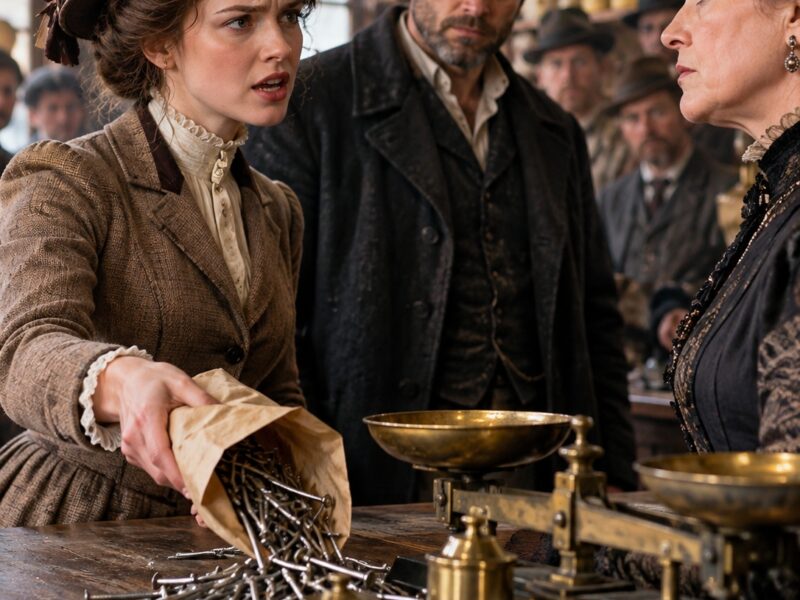
But when the young clerk placed the paper cone in her hand, Philippa felt its weight settle against her palm and knew immediately that something was wrong.
She looked at the nails.
Then at the iron weight still sitting on the brass scale.
Then at the clerk.
“I’m sorry,” she said.
The clerk smiled uncertainly.
“For what, ma’am?”
“This isn’t a pound.”
The smile disappeared.
Around them, the general store continued humming for another few seconds. Men talked beside the stove. A woman inspected a bolt of fabric. Someone laughed near the flour barrels.
The clerk swallowed.
“It most certainly is.”
Philippa weighed the paper cone once more in her palm.
“No,” she said quietly. “I would put it at approximately fourteen ounces.”
That was when the store went silent.
Not suddenly.
The silence spread outward from the counter, one person at a time, until every face in the room had turned toward the stranger in the gray traveling dress.
Philippa felt heat climb her neck.
She had been in Dakota Territory less than an hour.
In Marlo’s Ford less than eleven minutes.
And the man she had traveled nearly fourteen hundred miles to marry had failed to meet her train.
This was not how she had imagined beginning her new life.
A woman stepped from behind a display of dry goods.
She was perhaps fifty, handsome and broad-shouldered, dressed in black bombazine with silver threaded through her dark hair.
Her expression was perfectly controlled.
“My dear,” she said, “you are mistaken.”
Philippa glanced again at the iron weight.
“I don’t believe I am.”
“That scale has served this store for twelve years.”
“I don’t doubt it.”
“Then perhaps,” the woman said, “you might consider that the error is yours.”
Something old and painful moved inside Philippa.
A man’s voice from four years earlier.
You correct everything, Philippa.
She almost apologized.
She had spent years learning to apologize for being certain.
But her hand still held the nails.
And her hand knew.
So she raised her eyes.
“Ma’am,” she said, as gently as possible, “there are many things about which I may be mistaken.”
She placed the packet on the counter.
“Weight is not one of them.”
The woman’s face hardened.
Someone near the stove muttered something.
Philippa heard the words Eastern woman.
She straightened.
What she could not know was that the woman facing her was Dorcas Pettibone.
She could not know that Dorcas and her husband, Lucius, were loved more deeply in Marlo’s Ford than almost anyone.
She could not know that half the families staring at her had survived the previous winter because the Pettibones had allowed them to buy food they could not afford.
And she certainly could not know that the little iron weight sitting between them carried a secret almost eight years old.
A secret that would nearly destroy her marriage before it properly began.
The station platform had been empty when Philippa stepped from the Northern Pacific train that afternoon.
April 9, 1881.
Mud, melting snow, and a wind sharp enough to cut through her traveling coat.
She had stood beside her trunk with one gloved hand gripping her hat while steam rolled along the tracks behind her.
No Duncan Whitlow.
No wagon.
No welcoming husband-to-be.
Only a stationmaster who looked uncomfortable when she asked whether Mr. Whitlow had been there.
“The James came over the wagon road last night,” he explained. “Whitlow may be stuck on the far bank.”
Philippa stared at him.
“May be?”
The stationmaster hesitated.
“Could have lost a wheel.”
Another hesitation.
“Could have lost considerably more.”
Philippa understood.
“Oh.”
He offered coffee.
She declined.
He offered a chair.
She declined that too.
Her trunk latch had broken somewhere west of Fargo and was currently being held together by a hairpin, so she crossed the muddy street to purchase nails and thread.
Eleven minutes later, she had apparently insulted the moral foundation of the entire town.
It was, she thought, a remarkably efficient beginning.
Philippa had been raised among scales.
Her father, Albert Northrup, owned an apothecary on State Street in Rochester, New York. Behind his long oak counter sat a set of brass balances sensitive enough to register the weight of a human hair.
He taught his daughter grains before geography.
Scruples before poetry.
Drams before dancing.
By nine years old, Philippa could lift a folded medicinal packet and estimate its contents within a grain or two.
Her father would verify it.
Usually she was right.
Then he would give a small, solemn nod.
She had lived for that nod.
“Accuracy,” Albert once told her, “is another word for caring what happens to people.”
A druggist who mismeasured medicine could kill someone.
To Philippa, exactness had never been coldness.
It was love stripped of sentimentality.
Unfortunately, other people did not always see it that way.
At twenty-four, she became engaged to Dr. Leopold Pell.
He was intelligent, ambitious, handsome in the polished way young physicians sometimes were, and he seemed to admire Philippa’s mind.
Until he had to live beside it.
At a dinner given by his mother in 1877, Leopold told a story about a professor they both knew.
He got the year wrong.
Philippa corrected him.
Nothing dramatic happened.
No argument.
No broken dishes.
Just a small silence around the table.
A week later, Leopold came to her father’s parlor.
He stood near the mantel with his hat in his hands.
“You correct everything,” he told her.
She stared at him.
“I corrected a date.”
“That isn’t the point.”
“What is the point?”
He looked tired rather than angry, which hurt worse.
“A man would like to come home to someone who doesn’t know exactly how far he has fallen short.”
Then he returned her letters.
Philippa remembered watching the door close behind him and thinking that truth had finally demanded payment.
Her father died two years later.
The pharmacy was sold.
She spent the next two years working in a hospital dispensary where men less experienced than she was gave instructions and she learned to keep her observations to herself.
Slowly, she began to believe Leopold had been right.
Perhaps accuracy was useful in a bottle and unbearable in a woman.
Then, one evening, she opened a church newspaper and found the strangest matrimonial advertisement she had ever seen.
WANTED: A WOMAN WHO CAN COUNT.
Below it:
My wagon scale is the only honest thing in Marlo’s Ford, Dakota Territory, and nobody here can read the beam. D. Whitlow, Freight.
Philippa read it three times.
Then she laughed.
She had not laughed properly in months.
She answered with six pages explaining the difference between avoirdupois and Troy weight.
After posting the letter, she spent two days regretting it.
Duncan Whitlow replied with four lines.
The last two were:
You sound like exactly the woman I meant.
Please come.
Their correspondence lasted five months.
Duncan wrote badly and honestly.
He owned six freight wagons.
He had a boarding house for teamsters.
He was thirty-nine.
He did not drink much because whiskey made him sleepy.
He disliked poetry because he could never tell when it was finished.
He had once owned a dog named Moses who stole an entire ham and buried it beneath a church step.
And when Philippa asked what he expected from a wife, he answered:
Someone I do not have to pretend with.
That sentence brought her fourteen hundred miles west.
And now he was missing.
Forty minutes after the confrontation over the nails, the general store door opened.
A man filled the doorway.
He was broad enough to make it seem smaller.
Mud covered his boots to the knees. His dark coat was wet, his brown hair plastered against his forehead, and he carried his hat in one hand.
He looked around the unnaturally quiet store.
Then his slow gray eyes found Philippa.
Something in his face changed.
Not dramatically.
Just enough.
“You’re Philippa.”
She studied him.
“You’re late.”
A tiny smile appeared.
“The river disagreed with my schedule.”
“You might have drowned.”
“I considered it.”
“That would have been extremely inconvenient.”
“For both of us, I expect.”
Several people stared.
Duncan looked toward the counter.
Then toward the packet of nails.
“I hear you counted them.”
Philippa narrowed her eyes.
“How could you possibly have heard already?”
Duncan glanced around the store.
“Town’s not large.”
For the first time that day, Philippa almost smiled.
Duncan took her trunk himself.
As they stepped outside, Dorcas Pettibone watched them through the store window.
Philippa could feel that gaze between her shoulder blades.
She did not yet understand why.
Duncan’s freight yard sat at the edge of town.
Two long sheds.
A corral.
The boarding house.
Six wagons.
Stacks of crates and barrels waiting for spring roads to harden.
But Philippa barely noticed any of them.
Because in the middle of the yard stood a Fairbanks platform scale.
Its great brass beam caught the afternoon light.
Philippa stopped walking.
Duncan watched her face.
“Well?”
She stepped closer.
“Is it certified?”
“Railroad standard.”
“When was it last tested?”
“January.”
“Against what?”
“Northern Pacific test weights.”
Her expression softened.
Duncan smiled.
“You look happier seeing that scale than you did seeing me.”
“I know more about scales.”
“That seems fair.”
Then Philippa noticed that he had become serious.
“Why did you really place that advertisement?”
Duncan looked toward the yard.
He took a long time answering.
Finally he said, “Most of my freight goes to Pettibone’s.”
“The store?”
“Sixty wagonloads in a good season.”
“And?”
“Six years ago, I started noticing something.”
Philippa waited.
“Flour would leave my wagon at one weight,” Duncan said, “and somehow leave their store at another.”
The wind moved between them.
Philippa looked back toward town.
“You think their scales are false.”
“I think something is wrong.”
“For six years?”
His jaw tightened.
“Yes.”
“Why didn’t you say anything?”
Duncan looked at his wagons.
“Pettibone financed five of those.”
Philippa understood immediately.
Debt.
“You were afraid.”
“Yes.”
No excuses.
No pride.
Just the truth.
“I’ve been polite for six years,” Duncan said. “I have felt every one of them.”
Philippa looked at him differently after that.
Three days later, they were married.
The ceremony took place in the front room of the boarding house with Reverend Norbert Upshaw officiating, the stationmaster and one of Duncan’s teamsters serving as witnesses, and a pot of coffee going cold on the stove.
When Reverend Upshaw accidentally reversed two lines in the vows, Philippa corrected him.
The minister blinked.
Duncan’s eyes began to shine.
Afterward, when they were briefly alone, he leaned toward her.
“I have never in my life been so well corrected.”
She looked horrified.
Then he added, “Please continue.”
It was the first time a man had made that part of her feel welcome.
The feeling frightened her more than marriage did.
The next morning, Philippa borrowed Pettibone’s one-pound iron weight.
She carried it to Dr. Selwyn Fairchild, Marlo’s Ford’s only physician.
Dr. Fairchild owned a medical balance and certified brass weights from his years practicing in Philadelphia.
“I need to settle a wager,” Philippa told him.
The doctor looked over his spectacles.
“In my experience, Mrs. Whitlow, a lady who brings an iron weight into a physician’s office at eight in the morning already knows who won.”
She placed Pettibone’s weight on one side.
The certified pound went on the other.
The beam dropped hard.
Dr. Fairchild’s amusement disappeared.
They tested it again.
Same result.
The Pettibone “pound” weighed fourteen and a half ounces.
Philippa tested the two-pound weight.
Short.
The five-pound weight.
Short.
Every one.
She turned the five-pound piece over.
Her blood went cold.
Metal had been removed from underneath.
Not damaged.
Not worn.
Filed.
Deliberately.
Someone had taken a rasp to the weights and shaved them down in careful proportion.
The doctor removed his glasses.
For a long time, he said nothing.
Then he polished them.
“Mrs. Whitlow.”
“Yes?”
“Do you understand what you have found?”
“Fraud.”
“I understand the arithmetic.”
“Then what am I missing?”
He looked at her.
“The winter.”
The winter of 1880–81 had nearly killed Marlo’s Ford.
Blizzards began in October.
Rail traffic stopped for weeks at a time.
Snow buried fences.
Fuel disappeared.
Families burned chairs, fence rails, even pieces of barns to keep children warm.
And through all of it, Lucius and Dorcas Pettibone kept their store open.
They sold flour at cost.
Coal on credit.
Beans without payment.
Medicine to people who could promise nothing except that someday they would settle their account.
Lucius never pressed a widow.
Never refused a hungry child.
“There isn’t a family in this town,” Dr. Fairchild said quietly, “that doesn’t owe Lucius Pettibone something.”
Philippa stared at the false weight.
“And if he has been cheating those same families?”
“That is precisely the difficulty.”
She walked home slowly.
Duncan was repairing harness in the shed when she placed the weight beside him.
“Fourteen and a half ounces.”
He stopped working.
“The pound?”
“Yes.”
He looked down.
“I thought it was about half a pound short in ten.”
Philippa froze.
“You knew.”
“I suspected.”
“For six years.”
“Yes.”
Her anger came so fast it frightened her.
“You knew people were being cheated?”
“I knew the numbers didn’t agree.”
“And said nothing.”
His face tightened.
“I owed them money.”
“So that made dishonesty acceptable?”
“No.”
“Then what did it make it?”
Duncan looked at her.
“Mine.”
That stopped her.
“My cowardice,” he said. “My debt. My silence. All mine.”
Philippa wanted to remain furious.
Instead, she saw something more difficult than an excuse.
Shame.
The following morning, she wrote Lucius Pettibone a private letter.
No accusation.
No public spectacle.
She explained the measurements and suggested that he would surely wish to investigate.
She delivered it personally.
Dorcas read it behind the counter.
Her face changed one line at a time.
When she finished, she folded the letter into a square.
Then another.
Then another.
“Mr. Pettibone will be informed.”
“Thank you.”
Dorcas slipped it into her apron.
No tea was offered.
By sunset, the whole town knew.
Thursday morning, the stationmaster’s wife crossed the street rather than greet Philippa.
Friday afternoon, women from the church circle who had welcomed her with molasses cookies returned and asked for their plate.
Saturday, someone drew a crude picture of a woman holding scales on Duncan’s freight shed.
Two customers canceled hauling contracts.
By Monday, the freight yard had become eerily quiet.
Philippa understood why.
That made it worse.
To the town, she was not a truth-teller.
She was an outsider who had arrived during the thaw and accused the man who had fed them through the winter.
If Lucius Pettibone was a thief, then every act of kindness people remembered became contaminated.
Every sack of flour.
Every bucket of coal.
Every unpaid account.
People did not merely have to reconsider Lucius.
They had to reconsider their gratitude.
It was easier to hate Philippa.
That night, she lay awake beside Duncan.
“If I’m wrong,” she whispered, “I’m a fool.”
Duncan said nothing.
“And if I’m right, I may have destroyed a good man.”
Still nothing.
Then his large hand found hers beneath the blanket.
He held it.
Philippa stared into the darkness.
She was beginning to understand that Duncan often said the most important things without words.
Two nights later, she sat at the kitchen table examining the one-pound weight beneath her father’s jeweler’s glass.
The file marks bothered her.
She had assumed they were recent.
But under magnification, they did not look recent.
The sharp edges were worn smooth.
Patina had darkened the exposed iron.
Those marks had been there for years.
Then she saw something else.
Two tiny stamped letters near the base.
Almost buried beneath grime.
I.P.
Philippa stopped breathing.
Lucius Pettibone.
L.P.
Not I.P.
She woke Duncan.
“Did Lucius ever have a business partner?”
Duncan rubbed sleep from his face.
“His brother.”
“What was his name?”
“Ignatius.”
Philippa stared at him.
“When did he die?”
“Fall of ’79.”
“Who kept the books before that?”
“Ignatius.”
Suddenly the story changed.
The store had opened in 1869.
The weights had existed long before Lucius became sole proprietor.
For days Philippa had been imagining a living thief.
Now she had to consider a dead one.
She went to Pettibone’s after closing.
Lucius was alone behind the counter.
He was fifty-eight, short and round, with gray hair, ink-stained cuffs and the exhausted eyes of a man who had spent a week watching his reputation burn.
He did not order her out.
Philippa placed the weight on the counter.
“I owe you an apology.”
His eyes lifted.
“For what?”
“I assumed you altered these.”
“Didn’t I?”
“I no longer think so.”
She showed him the old file marks.
Then the initials.
Lucius stared.
“I.P.”
“Yes.”
His expression closed.
“My brother is dead.”
“I know.”
“He cannot answer you.”
“I know that too.”
“You are very certain of yourself, Mrs. Whitlow.”
Philippa swallowed.
“On this subject, Mr. Pettibone, I’m afraid I am.”
Lucius looked at the lamp.
Then at the weight.
For a moment Philippa saw not the town benefactor, not the accused merchant, but an older brother being asked to reconsider a dead man he had loved.
Finally Lucius spoke.
“Saturday night.”
“What?”
“Town meeting.”
He looked directly at her.
“Whitlow’s freight shed is the only room large enough.”
Philippa said nothing.
“Bring the weights. Bring the doctor. Use Duncan’s railroad scale.”
His voice trembled slightly.
“Prove it in front of everybody.”
“And if I’m wrong?”
Lucius’s eyes hardened.
“You leave Marlo’s Ford.”
Philippa extended her hand.
“Agreed.”
The following week nearly destroyed Duncan’s business.
His remaining customers withdrew.
Two teamsters quit.
Even Mrs. Eley, the boarding house cook who had fed Philippa pie on her first night, stopped lingering in the kitchen when she entered.
Tuesday morning, Philippa found Duncan sitting on a wagon tongue.
The yard around him was empty.
She sat beside him.
“I can leave.”
He did not move.
“I mean it.”
Silence.
“You can tell everyone I was mistaken. I’ll take the Saturday morning train to Rochester.”
His head turned.
“You’d do that?”
“If it saves your business.”
“Would it save you?”
“That isn’t relevant.”
His eyes sharpened.
“It is to me.”
She looked away.
“I will not be the reason you lose everything.”
Duncan stared at the mud.
For a long time, neither spoke.
Then he stood.
He walked into the house.
And the next morning, he was gone.
Philippa woke before dawn and touched the empty side of the bed.
Cold.
On the kitchen table was a note.
Back Friday night. Do not worry. D.
She read it eleven times.
Then she worried until Friday.
Because she had finally spoken the fear underneath every other fear.
That perhaps Leopold had been right.
Perhaps being married to Philippa meant paying constantly for truths nobody wanted.
And Duncan, after hearing her offer to leave, had disappeared.
Friday midnight, a freight train screamed into Marlo’s Ford.
Philippa heard it from bed.
She ran to the station in her nightgown, boots and shawl.
Duncan climbed down carrying a long wooden crate.
His face was gray with exhaustion.
But his eyes were alive.
“Where have you been?”
“Jamestown.”
“What is that?”
He set the crate down.
“Proof.”
Inside were certified Northern Pacific test weights.
Sealed.
Stamped.
Official.
Duncan had gone to the railroad freight office and begged to borrow them.
“They refused.”
“And?”
“I asked again.”
“Duncan.”
“I put up two horses as bond.”
Philippa stared at him.
“You risked two wagon horses?”
“For weights.”
“You’re insane.”
“Possibly.”
“Why?”
He looked at her as though the answer were obvious.
“Because Saturday we do this right.”
They worked through the night.
Two lanterns burned inside the freight shed while Duncan lowered certified weights onto the platform and Philippa recorded every measurement.
Fifty pounds.
Perfect.
Twenty-five.
Perfect.
Ten.
Perfect.
Again.
Again.
Again.
At four in the morning, Philippa finally sat on a keg.
Her hands began shaking.
Duncan sat beside her.
For several minutes they watched the lantern flame.
Then he said, “I saw you before you saw me.”
“When?”
“First day.”
“At Pettibone’s?”
He nodded.
“I came through that door and there you were. Whole store staring at you.”
Philippa smiled weakly.
“I was making an excellent first impression.”
“You were standing there with your chin up, telling everybody the truth.”
“About nails.”
“Didn’t matter.”
He turned toward her.
“You told the truth in eleven minutes.”
His voice dropped.
“I’ve lived here eleven years.”
Philippa looked at him.
“I was polite for six of them when I knew something was wrong.”
He flexed his hands.
“I don’t want to be polite anymore.”
Something inside Philippa broke open.
She told him about Leopold.
About the dinner.
About the returned letters.
About standing in her father’s parlor while a man she loved explained that knowing precisely where he had fallen short made her impossible to love.
Duncan listened.
When she finished, he remained silent for so long that she almost regretted telling him.
Then he cleared his throat.
“I would like you to correct me for the remainder of my natural life.”
Philippa blinked.
Duncan continued gravely.
“It would save me a considerable amount of guessing.”
She laughed.
Then she cried.
Both happened at once.
Duncan put his arm around her.
For the first time in four years, someone held Philippa while she was right.
Not despite it.
Because of it.
Gray dawn seeped through the boards.
The brass beam caught the light.
Duncan kissed her slowly.
When they separated, Philippa touched her forehead to his.
“It’s fortunate the scale is certified.”
Duncan almost smiled.
“It may be the only thing in Dakota Territory that is.”
Saturday night, one hundred forty people crowded into the freight shed.
Men stood against the walls.
Children sat between parents.
Windows steamed from body heat.
The stoves roared.
At the center stood Duncan’s platform scale.
Lucius Pettibone sat in the front row.
Dorcas beside him.
Dr. Fairchild stood near Philippa with his medical balance.
Duncan stood behind her.
Reverend Upshaw called the meeting to order.
Philippa stepped forward.
Her mouth was dry.
She could feel the town waiting for her to fail.
So she did what her father had taught her.
She measured.
First, the Northern Pacific fifty-pound test weight.
Duncan placed it on the platform.
The beam rose.
Trembled.
Settled.
Exactly fifty pounds.
A murmur moved through the crowd.
Then Lucius himself carried his store’s fifty-pound iron weight forward.
He placed it on the platform.
The beam rose.
And stopped.
Forty-five and a half pounds.
Nobody moved.
Philippa tested the twenty-five.
Short.
The ten.
Short.
The five.
Short.
Then came the original pound.
Dr. Fairchild placed his certified brass pound on one side of the medical balance.
Philippa placed Pettibone’s iron “pound” on the other.
The beam settled.
Fourteen and a half ounces.
Someone shouted from the back.
“She rigged it!”
Philippa did not turn.
Then she heard Duncan walking.
His boots crossed the plank floor.
He moved beside her and faced the town.
“She didn’t rig anything.”
Silence.
Duncan’s voice had always been quiet.
That made everyone listen harder.
“I weigh freight for the railroad on that scale. So does every farmer who ships from Marlo’s Ford.”
He paused.
Then came the confession Philippa had not expected.
“I knew.”
People shifted.
Duncan swallowed.
“I knew for six years those numbers didn’t match.”
A murmur rose.
“I said nothing because I owed Pettibone money.”
His jaw worked.
“That is my shame.”
The room became absolutely still.
“And I’ll say it tomorrow. And the day after. And every night for the rest of my life if that’s what it takes.”
Then he looked at Philippa.
“I’m not sorry I married her.”
His voice nearly broke.
“I’m sorry I waited for her to make me brave.”
No one spoke.
Then Lucius stood.
He walked toward the table where the one-pound weight rested.
He picked it up.
Turned it over.
Held it toward the lantern.
Philippa watched his thumb find the letters.
I.P.
His entire body changed.
“Ignatius.”
Dorcas rose.
Lucius sank onto the edge of the table.
“He used to say…” His voice faded.
The room waited.
“He used to say a man could shave a sixteenth and nobody would notice.”
Lucius stared at the weight.
“In ’73, when we bought the new set, he told me he’d done something to them.”
Philippa’s heartbeat quickened.
“What did he tell you?”
Lucius looked up.
“That it was a joke.”
He laughed once.
A broken sound.
“I thought it was a joke.”
Then the tears came.
Lucius Pettibone looked across the faces of the people he had fed.
Men whose families he had carried through winter.
Women who had cooked his flour.
Children who had eaten because he refused to close his ledger.
“I cheated every family in this room.”
Dorcas gripped his shoulder.
“I didn’t know.”
His voice cracked.
“But I suppose not knowing doesn’t put the flour back.”
Nobody answered.
“I am sorry.”
A farmer named Gunnar Haldor stood from the second row.
He twisted his cap between his hands.
“I owe Lucius forty dollars.”
Several people turned.
“Flour since February.”
Gunnar swallowed.
“My little girl got sick during the January storm.”
His eyes found Lucius.
“This man rode three miles through a blizzard with a sack tied behind his saddle because I couldn’t leave her.”
Lucius lowered his head.
“I won’t dispute my debt.”
Gunnar looked around the room.
“A good man was fooled by a dead man’s dishonesty.”
Then he said the sentence that changed the room.
“I don’t reckon we need to make him pay for it twice.”
Someone exhaled.
Then another.
The room seemed to breathe.
But Philippa was already doing arithmetic.
She requested the store ledgers.
Lucius brought them.
For twenty minutes, she calculated beneath the lantern.
Four years of shortages in flour, sugar, nails and other weighed goods.
Approximately $2,900.
Then she calculated unpaid credit extended by Pettibone during the brutal winter.
Approximately $3,800.
She closed the ledger.
“If this were mine,” Philippa said, “I would cancel one against the other.”
Lucius stared at her.
She continued.
“I would replace every weight in the store with certified weights.”
Dorcas nodded slowly.
“And on the first day of every month, I would test them publicly against Mr. Whitlow’s railroad scale.”
Philippa looked across the room.
“No secrets.”
Then at Lucius.
“No gratitude used as an excuse.”
Then at the townspeople.
“And no truth used as a weapon.”
For several seconds, nothing happened.
Then Gunnar stood again.
Someone behind him followed.
Then another.
And another.
Marlo’s Ford rose.
Not in applause.
Something quieter.
Something heavier.
The sound resembled ice breaking on a river after a long winter.
By the end of April, Pettibone’s store had a new set of sealed brass weights.
Every first morning of the month, Duncan opened his freight scale to the public.
Anyone could watch.
Anyone could test.
No one had to trust blindly again.
At the next town meeting, Philippa Whitlow was appointed Keeper of Weights and Measures.
Salary: five dollars a month.
She accepted without smiling.
Then went home and cried privately for ten minutes.
Within weeks, people began bringing her everything imaginable.
Scales.
Rain gauges.
Butter molds.
Once, inexplicably, a pig.
The church ladies returned on May 2 with molasses cookies.
Nobody mentioned taking the plate back.
Dorcas Pettibone came last.
She placed a rhubarb pie on the kitchen table.
For a long moment, the two women looked at each other.
Then Dorcas abruptly pulled Philippa into a hard embrace.
“You will never know what it cost me to hear that I was wrong.”
Philippa closed her eyes.
Dorcas smelled of lavender and flour.
“I think I might.”
Dorcas pulled back.
“I told you that you were mistaken.”
“Yes.”
“You weren’t.”
“No.”
Dorcas almost smiled.
“Don’t become unbearable about it.”
“I’ll make an effort.”
That finally produced a laugh.
Duncan’s business returned more slowly.
First came the Pettibone contract.
Larger than before.
Then two farmers returned.
Then another merchant.
By midsummer, Duncan had hired three teamsters and purchased a seventh wagon with cash.
He never celebrated loudly.
Some evenings Philippa watched him crossing the yard from the kitchen window, hands in his pockets, still carrying the faintly bewildered expression of a man expecting happiness to be repossessed.
She understood that feeling.
One Sunday evening in June, Duncan asked her to come outside.
The prairie was gold beneath the setting sun.
He led her toward the great Fairbanks scale.
“What are we weighing?”
“Us.”
“That seems unnecessary.”
“Probably.”
He took her hand.
They climbed the three oak steps and stood together on the platform.
Duncan wrapped one arm around her waist.
The beam moved.
Trembled.
Settled.
Three hundred forty-two pounds.
Duncan studied the number.
“Certified.”
Philippa leaned against him.
“Yes.”
“It doesn’t lie.”
“No.”
He kissed the top of her head.
“So now we know exactly what we’re worth together.”
Philippa smiled.
And because she was Philippa, she corrected him.
“No.”
Duncan sighed theatrically.
“I walked into that.”
“You did.”
“The scale only knows what we weigh.”
He looked down at her.
“And what are we worth?”
Philippa considered the question.
Beyond them stood seven wagons.
Across town, new brass weights waited behind Lucius Pettibone’s counter.
Somewhere inside the boarding house sat a plate the church ladies had finally remembered to leave behind.
She thought of her father.
Of Leopold.
Of the false pound.
Of Duncan confessing his cowardice before one hundred forty people.
Of Lucius holding his dead brother’s secret in his hands.
Of all the years she had confused being accurate with being alone.
Then she understood something her father’s scales could never have taught her.
Some things needed measuring because people deserved the truth.
Other things became smaller the moment you tried to put a number on them.
Philippa rested her head against Duncan’s chest.
“What we’re worth,” she said, “is something else.”
Duncan waited.
For once, she did not give him an exact answer.
The sun slipped lower.
The brass beam glowed above them.
And Philippa Northrup Whitlow—the woman who had crossed fourteen hundred miles believing that being right made her difficult to love—stood quietly in the arms of a man who had finally learned that love was not asking someone to make the truth smaller.
It was becoming brave enough to stand beside them when they said it aloud.
Behind them, the beam remained perfectly still.
Three hundred forty-two pounds.
Not one ounce more.
Not one ounce less.
For everything else, Philippa decided, there was no honest scale.
And for the first time in her life, she was glad.









