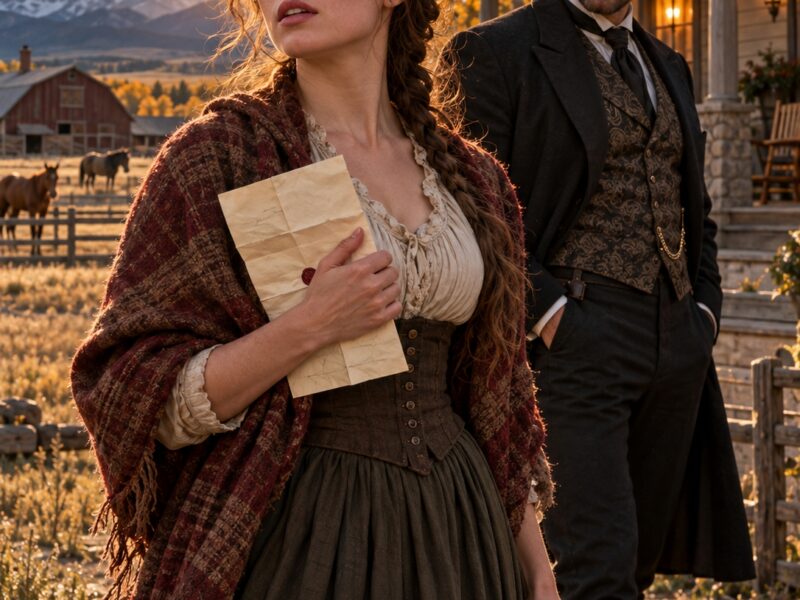
SHE ARRIVED AT THE WRONG RANCH TO MARRY THE WRONG MAN—THEN THE WOMAN HE ACTUALLY CHOSE SHOWED UP

The first man who came to claim Cora Whitfield as his wife looked past her face and asked another man why his property was still inside the house.
That was when Eli Merritt decided he disliked Calvert Webb.
Not because Cora belonged to Eli.
She didn’t.
In fact, Cora had arrived at Eli’s ranch by mistake.
She had stepped off a stagecoach carrying one worn leather bag, eleven dollars she could not afford to spend, and a marriage-agency letter promising her to a stranger eight miles away.
By sunset, that stranger was standing in Eli’s yard saying, “I paid the agency fee. I’ll take her now.”
And Eli—who had spent thirty-five years learning not to interfere in other people’s lives—heard himself answer:
“No.”
The word came out so quietly that Calvert Webb actually smiled.
Then Eli stepped between him and the house.
And the smile disappeared.
Three hours earlier, none of them had known the others existed.
The October stage from Billings had rolled across the Dakota Territory beneath a sky so blue it looked almost artificial, trailing dust across miles of yellow grass.
Cora Whitfield sat by the window.
Twenty-eight years old.
Brown hair pinned beneath a practical hat.
A coat too thin for the northern wind.
A face that might have been called pretty if she had ever learned to arrange it for other people’s approval.
Cora rarely did.
She watched fence lines.
Drainage cuts.
Clouds.
Soil.
Things that told the truth without being asked.
When the driver slowed at Cedar Fork Junction, he pointed toward a road.
“Whitfield?”
“Yes.”
“This is you.”
Cora climbed down.
Her bag followed.
The stagecoach disappeared.
Only then did she unfold her letter again.
CALVERT WEBB
CEDAR FORK ROAD
DAKOTA TERRITORY
Cora looked down the road.
There was no sign.
No house number.
No Calvert Webb.
There was, however, a ranch in the distance.
A barn.
A farmhouse.
Nearly two hundred acres of grass and field.
A long fence that had been repaired carefully in some places and badly in others.
An irrigation channel running beside the eastern plot.
Blocked.
Cora narrowed her eyes.
The water was backing against a root mass because whoever had dug the channel had approached the grade from the wrong side.
She saw that before she noticed the man watching her.
Eli Merritt had been setting a fence post when a woman appeared on his road.
He was thirty-five, broad-shouldered, sun-browned, and built like a man who had spent more years lifting things than explaining himself.
He wore work gloves and a faded brown shirt with the sleeves rolled above his forearms.
He had expected a woman that week.
Just not this woman.
His agency letter described Pearl Lawson.
Twenty-four.
Dark hair.
Town raised.
Experienced in household management.
Good references from three respectable families in Billings.
Eli had written his requirements with the same care he used when ordering seed.
He had told himself that was sensible.
Love had never struck him as sensible.
Love was how people became necessary.
Necessary people could die.
Eli knew that better than most.
So he had asked for compatibility instead.
Reliability.
Temperament.
Skills.
Things a man could put on paper and pretend were safer than wanting someone.
But the woman walking toward him did not resemble the description.
She did not wave.
She did not smile nervously.
She did not appear embarrassed.
She walked toward him while studying his property as if the land itself were introducing him.
That bothered him more than it should have.
She stopped six feet away.
Set down her bag.
Pulled out a letter.
“Calvert Webb?”
Eli stared at her.
“No.”
A pause.
“You’re certain?”
That nearly made him smile.
“Most days.”
She handed him the letter.
He read it.
Then he reached inside his coat and handed her his.
Cora read Pearl Lawson’s description.
They stood there while the Dakota wind moved through the grass between them.
Finally Eli said, “I ordered someone else.”
Cora lifted her eyes.
“I gathered that.”
“Webb’s place is eight miles east.”
She looked behind her.
The stagecoach was gone.
“How often does it return?”
“Ten days.”
Cora looked toward the horizon.
Then at her coat.
Then at her bag.
Then back at Eli.
“I have eleven dollars.”
He said nothing.
“I can’t afford a room for ten days.”
Still nothing.
“So I’ll work.”
That got his attention.
“Work?”
“Your ranch.”
“You don’t know anything about my ranch.”
“The eastern irrigation channel is blocked. Your south row needs harvesting before the first hard frost. That fence post behind you is leaning because the soil wasn’t packed deeply enough, and one hinge on your barn door is carrying most of the weight.”
Eli slowly looked toward the barn.
Then back at her.
Cora shrugged.
“I notice things.”
Apparently.
She continued.
“I need a roof. You need hands. I stay until the situation is corrected. I earn my meals.”
“You always negotiate this fast?”
“Only when I’m cold.”
The north wind pushed through her coat as if to support the argument.
Eli studied her.
Not her face.
Her boots.
Mud-stained but maintained.
Her bag.
Small enough to suggest she had learned not to own anything she couldn’t carry herself.
Her hands.
Work hands.
Then her eyes.
She did not ask him to rescue her.
That, more than anything, decided him.
“Coffee first.”
She blinked.
“What?”
“We’ll argue about the rest where it’s warm.”
He picked up her bag.
Cora almost objected.
Almost.
Then she followed him toward the house.
They had not reached the porch when laughter exploded from the barn.
Not polite laughter.
Not restrained amusement.
Full-bodied, helpless laughter.
An elderly man emerged wiping his eyes.
August Merritt was seventy-one years old, six feet tall despite a slight bend in his shoulders, with white hair and the energy of someone who considered aging an inconvenience rather than an instruction.
He pointed at Eli.
“Four months.”
“Grandpa.”
“Four months this man worked on that list.”
“Grandpa.”
“Hair color. Age. Height. Town experience. References. I told him he was ordering a plow horse.”
Cora pressed her lips together.
August noticed.
His grin widened.
“The Almighty read Eli’s list and sent him the wrong woman just to improve his personality.”
“August.”
The old man extended his hand.
“August Merritt. His grandfather. You look frozen.”
“Cora Whitfield.”
“Coffee’s hot.”
August turned toward the house.
Then called over his shoulder, “And if you can cook biscuits, lie to me until after supper.”
That was how Cora entered the Merritt house.
Not as Eli’s intended bride.
Not as anyone’s intended anything.
Simply as a mistake the weather had temporarily made permanent.
Inside, August poured coffee into three mismatched cups.
Cora wrapped both hands around hers.
The warmth hurt at first.
August asked where she had come from.
“Sioux Falls.”
“Family there?”
“My sister.”
“Parents?”
“Gone.”
“You grow up in town?”
“No. My father had forty acres. I worked them from twelve until he died.”
“And after?”
“School. Office work. Household positions.”
August nodded.
“Never married?”
Cora looked into her coffee.
“I was.”
The kitchen changed.
Not visibly.
But Eli felt it.
August did too.
Cora continued before either could ask.
“My husband had a farm.”
Had.
Not has.
August understood the difference between a closed door and a locked one.
He refilled her coffee instead.
Eli noticed how carefully she placed the cup on the table, always exactly inside the old ring marks in the wood.
As though she had spent years learning how little space she was permitted to disturb.
August noticed Eli noticing.
That interested him.
“Pass the biscuits to your wife,” August said.
Eli inhaled coffee.
Unfortunately, he also attempted to swallow it.
Cora looked at the wall.
“She is not my wife,” Eli coughed.
“Technicality.”
“She is at the wrong address.”
“Still looks hungry.”
“Grandpa.”
August buttered his biscuit.
“Wrong address or not, she walked half a mile in that wind without asking anyone to pity her. That earns a biscuit.”
Cora finally looked at him.
Something warm flickered behind her guarded expression.
She took one.
“Thank you.”
August smiled.
He had seen enough.
At least for one afternoon.
Then hoofbeats came up the road.
Eli heard them first.
He stepped outside.
Calvert Webb rode through the gate wearing a dark wool coat that probably cost more than Cora had brought with her.
He was perhaps forty.
Well-fed.
Clean-shaven.
Confident.
The kind of man who had lived long enough with things going his way that inconvenience felt to him like disrespect.
“Heard the stage came through,” Webb said.
“It did.”
Webb glanced toward the farmhouse.
“My bride inside?”
Eli disliked the sentence immediately.
“There was a mistake at the agency.”
“Simple enough to correct.”
Webb dismounted.
“I’ll take her.”
“No.”
Webb stopped.
Eli’s voice had not risen.
It had dropped.
That was how Eli spoke when a decision was already over.
“She’s staying tonight.”
Webb gave a short laugh.
“I believe you misunderstood me.”
“I didn’t.”
“I paid the agency fee.”
Eli looked at him.
“That buy the woman too?”
Webb’s expression hardened.
“Careful.”
“In this territory, we don’t pull a woman out of a warm kitchen after dark and put her on horseback because some man is impatient.”
“She agreed to the arrangement.”
“She agreed to meet you. She didn’t agree to freeze on the road.”
Webb looked toward the kitchen window.
Eli followed his eyes.
Something cold settled inside him.
Webb had not looked toward the house like a man wondering whether Cora was comfortable.
He had looked toward it like a man checking where someone had put his luggage.
“Tomorrow,” Webb said.
“Tomorrow.”
Webb mounted.
He rode away.
When Eli returned to the kitchen, Cora stood at the window.
She had heard everything.
Neither mentioned it.
She merely said, “Your south row really does need to come in.”
Eli looked at her.
“Tomorrow.”
Cora turned back toward the darkening field.
“That seems to be everybody’s favorite word.”
But tomorrow arrived carrying an agency contract.
Webb came at first light.
This time he rode directly into the yard.
Eli met him before he reached the porch.
Webb pulled folded papers from inside his coat.
“I paid the fee. The agreement was accepted. She comes with me this morning.”
“She doesn’t.”
“You have no standing.”
The kitchen door opened.
Cora walked outside.
Her hair was tied back.
Her coat buttoned.
Her expression calm.
She was done allowing men to discuss her from twenty feet away.
“I’ll honor the arrangement,” she told Webb.
Something inside Eli dropped.
Webb smiled.
“Good.”
“In three days.”
The smile disappeared.
“I beg your pardon?”
“I travel Thursday. In a wagon. With my belongings packed properly.”
“Today.”
“No.”
Webb stepped toward her.
Eli moved.
One step.
That was all.
Suddenly he stood between them.
“You heard her.”
“This has nothing to do with you.”
“You’re standing on my property.”
Webb’s jaw tightened.
“I’ll bring the sheriff.”
Eli nodded.
“Bring breakfast too.”
August coughed into his coffee on the porch.
Webb pointed at Eli.
“Thursday at dawn. If she isn’t at my gate, this becomes legal.”
“My wagon brings her Thursday by noon.”
“Dawn.”
“Noon.”
Webb stepped closer.
Eli did not.
“Try moving me,” Eli said.
Silence.
Webb calculated.
Then folded the contract.
“Thursday.”
He rode away.
August took a sip of coffee.
“Well.”
Eli turned.
“What?”
“You’re having an interesting week.”
The next three days should have felt temporary.
Instead, they became dangerous.
Because Cora fit.
Not elegantly.
Not romantically.
Not in any way Eli had prepared himself for.
She simply began noticing what needed doing.
The kitchen shelf had sagged for six months.
Cora repaired the bracket with wire before breakfast.
The pantry latch stuck.
She adjusted it.
One hen had stopped laying because another bird was bullying it away from feed.
Cora separated them.
August watched her work.
Eli pretended not to.
Then came the biscuits.
August placed flour on the counter with ceremonial seriousness.
“There is a method.”
“There always is,” Cora said.
Twenty-five minutes later, the biscuits emerged from the oven looking like ammunition.
Cora stared at them.
August picked one up.
Bit.
Chewed thoughtfully.
“They’re terrible,” she said.
August continued chewing.
“They’re committed.”
Cora laughed.
It escaped before she could stop it.
Eli heard it from the hallway.
He stopped.
For the first time since she had arrived, Cora did not look guarded.
Her head had tipped slightly backward.
Flour marked one cheek.
August was attempting to eat a second biscuit despite obvious danger.
Eli stood there longer than necessary.
Then walked away before either saw him.
That afternoon August told Cora why.
“His mother died here.”
Cora looked up.
August stared through the kitchen window toward the field.
“Winter. Eli was seventeen.”
He rubbed one thumb across his knuckle.
“His father buried her in March. Worked himself half-dead trying to save the farm afterward. By December, he was gone too.”
Cora said nothing.
“Eli ran this place at seventeen. Two hundred acres. Debt. Livestock. Winter.”
August’s voice softened.
“He learned early that needing people was dangerous.”
Cora looked toward the barn.
“So he ordered a wife from a list.”
August smiled without humor.
“Exactly.”
“Practical.”
“Terrified.”
Cora looked at him.
August continued.
“When he finally decided he wanted something besides work, he asked for everything except love.”
“Maybe he doesn’t want love.”
“Oh, he absolutely doesn’t.”
August stood.
“That’s how I know he needs it.”
The next morning Cora found Eli clearing the irrigation channel.
From the west.
Wrong.
“You’re pushing the roots into the narrow grade,” she said.
Eli kept digging.
“I know this channel.”
“You know how your father dug it.”
His shovel stopped.
Cora immediately knew she had stepped somewhere private.
But she did not retreat.
“That isn’t the same as knowing where the water wants to go.”
“Mind yourself.”
Cora picked up the spare shovel.
Walked around him.
Drove the blade into the eastern bank.
Once.
Twice.
Three times.
Water shifted.
Only a little.
Enough.
She put down the shovel.
“There.”
Then walked away.
Eli stared at the cuts.
At the moving water.
At his own hands.
He spent another hour doing it his father’s way.
Because sometimes knowing you are wrong and becoming willing to change are two different events.
That night, Cora woke after midnight.
She could not breathe inside the spare room.
Thursday was coming.
Webb was coming.
A different house.
A different man.
Another place where her value would be measured by how efficiently she filled whatever empty space someone had hired her to fill.
She went outside.
A lamp moved in the field.
Eli.
At the irrigation channel.
On the east side.
Cora walked toward him.
He stopped digging.
She looked at the fresh cuts.
“You changed sides.”
Eli stared at the ground.
“My father spent three weeks digging this channel.”
The wind moved between them.
“I kept thinking if I changed it, I was saying he’d been wrong.”
Cora looked at the water.
“He was wrong.”
Eli raised his eyes.
She softened.
“That doesn’t erase what he built.”
Something in his face shifted.
Not healed.
Not solved.
Just opened.
“Thursday morning,” he said.
“Thursday morning.”
Cora walked back toward the house.
Eli watched her go.
Inside, August sat beneath the kitchen lamp with the agency papers in front of him.
He reread the description he had helped Eli write months earlier.
Someone who sees land for what it is.
Someone patient.
Someone with her own opinion.
Someone who does not need managing.
August stared at those words.
Then at the window.
Then back at the contract.
Slowly, he drew a line through the agency terms.
Turned the paper over.
And began writing something that would cause considerable trouble by sunrise.
Webb returned with the sheriff.
He rode into the Merritt yard like a man arriving to collect a debt.
August waited beside the gate drinking coffee.
The sheriff dismounted.
“Morning, August.”
“Could be.”
Webb held up his contract.
“We’re here for Miss Whitfield.”
August reached into his coat.
“No, you’re not.”
He handed the sheriff another document.
The sheriff read it.
His eyebrows moved.
He read it again.
CORA WHITFIELD
CONTRACTED RANCH MANAGER
MERRITT PROPERTY
THIRTY DAYS
Signed.
Dated.
Three days before Webb’s agency paperwork had been officially filed.
The sheriff looked at August.
Then Webb.
Then back at the paper.
“Looks like the lady’s employed.”
Webb’s face reddened.
“This is fraudulent.”
August sipped his coffee.
“You’re welcome to spend money proving that.”
“I’ll contest it.”
“Wonderful.”
Webb looked toward the house.
August smiled pleasantly.
“Cedar Fork Road is eight miles east.”
Webb rode away furious.
Eli emerged from the barn.
He looked at his grandfather.
August held out a second cup of coffee.
Nothing was said.
Some acts of love become smaller when explained.
But their victory lasted less than twenty-four hours.
Because on Wednesday, another letter arrived.
Pearl Lawson was coming Friday.
The woman Eli had actually chosen.
Cora stood at the kitchen window while he read the letter.
She watched his face.
“What does it say?”
Eli folded it.
“Pearl arrives Friday.”
The words landed more quietly than pain usually did.
Cora nodded.
“Good.”
Eli looked at her.
She pointed toward the east field.
“The root mass shifted again.”
“I’ll handle it.”
“If we wait another week, the eastern plot won’t get enough water before the ground freezes.”
“I said I’ll handle it.”
His tone was sharper than necessary.
Cora’s expression closed.
“Of course.”
She walked away.
Eli immediately regretted it.
But regret was one more thing he had spent his life experiencing silently.
Thursday afternoon he found Cora knee-deep in mud at the channel.
Of course she had started without him.
She was pulling roots with both hands.
He stood watching.
Then returned to the barn.
For one ugly second, Cora thought he had decided to leave her to it.
Then he came back carrying the long-handled fork.
He climbed into the west bank.
No apology.
No speech.
He simply began working.
Cora attacked the east.
Eli pulled west.
The root mass had grown through two seasons.
It resisted like something convinced it belonged there.
They worked until their hands hurt.
Until Cora’s braid loosened.
Until Eli’s shirt stuck to his back despite the cold.
Neither spoke.
Then something cracked beneath the water.
“Again,” Cora said.
They pulled.
The obstruction broke free.
Water surged forward.
Fast.
Clear.
Alive.
It spilled down the grade and into the eastern field.
Cora stumbled backward laughing.
Eli caught her forearm.
For one second they were close enough that neither could pretend not to feel it.
His hand around her arm.
Her palm against his chest.
Water rushing between their boots.
Then both stepped apart.
August appeared at the edge of the field carrying two coffees.
He looked at the channel.
At Cora.
At Eli.
At the mud covering both of them.
He placed the cups on a fence post.
Turned around.
“August,” Eli called.
“Busy.”
“You’re walking toward the house.”
“Extremely busy.”
Cora smiled.
Eli handed her one coffee across the channel.
Their fingers touched.
Neither commented.
The next afternoon, Pearl Lawson arrived.
And Cora understood immediately why Eli had chosen her.
Pearl was beautiful.
Not dramatically.
Worse.
Naturally.
Dark hair.
Clear eyes.
Graceful posture.
A navy traveling dress without a wrinkle despite the road.
She was polite to August.
Warm to Eli.
Kind to Cora.
That last part hurt most.
Because Cora could have hated a cruel woman.
Pearl gave her nothing to hate.
At supper, Eli pulled out Pearl’s chair.
Cora passed the bread.
Pearl asked about the ranch.
Eli answered.
Cora refilled the coffee.
August watched everyone.
Nobody mentioned that Cora knew exactly how Eli liked his coffee.
Nobody mentioned that Pearl did not.
Nobody mentioned that Cora had repaired the chair Pearl was sitting on two days earlier.
After supper, Cora stood.
“I have mending.”
“You don’t have to—” Eli began.
“I know.”
She went upstairs.
In the spare room, she sat on the bed.
Looked at her hands.
And finally admitted the truth.
She had made the oldest mistake of her life again.
She had confused being needed with being chosen.
Cora had been useful everywhere.
On her father’s farm.
In her sister’s house.
In her marriage.
After her husband died, people had praised how well she managed everything.
What a strong woman.
What a capable woman.
What would everyone have done without Cora?
Nobody had ever asked what Cora wanted after everyone finished needing her.
Now the Merritt ranch needed her too.
The channel proved it.
The kitchen proved it.
August adored her.
Even Eli relied on her.
But Pearl was the woman whose name had been on his letter.
Cora’s name had been on someone else’s.
That was the difference.
And she would not humiliate herself by pretending otherwise.
Over the next two days, Pearl noticed something.
Not jealousy.
Not competition.
Absence.
Whenever something needed doing, Cora seemed to already know.
When Pearl reached for salt in the wrong cupboard, Cora moved it within reach without embarrassing her.
When Pearl could not find the bread tin, it appeared beside her hand.
When August forgot his scarf before walking outside, Cora hung it over the chair where he would see it.
When Eli came in late, his coffee appeared.
She made life easier without announcing that she had touched it.
Pearl watched.
And understood.
Sunday morning Eli showed Pearl the east field.
“The channel was almost useless last month,” he said.
Pearl looked at the running water.
“You repaired it?”
Eli hesitated.
“We did.”
Pearl glanced toward the farmhouse.
“Cora?”
“Yes.”
Pearl studied him.
Something became clear.
Not pleasant.
But clear.
That evening the town held a church social.
Pearl belonged immediately.
People liked her.
Women drew her into conversation.
Men tipped their hats.
A little girl gave her late-season flowers.
Cora worked the coffee table.
Found Widow Hartley’s missing shawl.
Fixed a swollen back door that was letting cold air into the room.
Moved chairs.
Carried plates.
Solved problems.
Near the end of the evening, an older woman squeezed Cora’s hand.
“You are such a help.”
Cora smiled.
“Thank you.”
She had heard that sentence all her life.
You are such a help.
Never:
I was hoping you would come.
Never:
Sit down. Someone else can do it.
Never:
I missed you.
Useful things were kept until better ones appeared.
Cora knew that lesson too well.
On the wagon ride home, Pearl sat beside Eli.
Cora sat in the back with August.
The temperature dropped.
Cora had not brought a winter coat.
Eli noticed her folding her arms tighter.
He looked forward.
Then backward.
Then forward again.
“Grandpa.”
August heard the particular tension in his voice.
“Yes?”
Eli said nothing.
He did not need to.
August looked at Cora.
Then at Pearl sitting beside Eli.
Then back at his grandson.
The old man removed his coat and placed it around Cora.
She startled.
“August, you’ll freeze.”
“I’m seventy-one. Everything hurts anyway.”
She almost laughed.
August faced forward.
“Stars are something tonight.”
Eli’s hands tightened around the reins.
He had just asked his grandfather to give Cora the coat he wanted to give her himself.
Because Pearl was beside him.
Because propriety mattered.
Because fear mattered.
Because he was still trying to live according to a list written by a man who had not yet met Cora Whitfield.
And suddenly that list felt like the most cowardly thing he had ever written.
The next morning August found Cora’s bag beside the bed.
Not packed.
Waiting.
He sat in the chair.
“One question.”
Cora kept folding a blouse.
“Then I’ll leave you alone.”
She waited.
“Are you leaving because you think Eli doesn’t see you?”
Her hands stopped.
“Or because you’re afraid of what happens if he does?”
Cora looked at him.
August nodded slowly.
Her silence had answered.
He stood.
At the door he paused.
“The coat last night?”
Cora frowned.
August smiled faintly.
“It wasn’t my idea.”
Then he left.
An hour later Pearl found Cora in the kitchen.
“You fixed that shelf.”
Cora looked at the bracket.
“Yes.”
“First day?”
“Yes.”
Pearl sat down.
“When Eli showed me the house, he stopped there.”
Cora said nothing.
“He just looked at it.”
Pearl folded her hands.
“I think he was remembering you.”
“Pearl—”
“I’m not angry.”
“You should be.”
“No.”
Pearl’s voice remained gentle.
“I came here looking for a life. I think I came to the wrong ranch too.”
Later she found Eli beside the irrigation channel.
Water moved steadily through the east field.
“She showed you this,” Pearl said.
Eli did not pretend ignorance.
“Yes.”
Pearl watched the water.
Then him.
“You look at her the way my father looks at my mother.”
Eli finally turned.
“They’ve been married thirty years.”
“I know.”
Pearl smiled sadly.
“That’s my point.”
“Pearl—”
“You look at me like a decent man trying to honor an agreement.”
She swallowed.
“And I appreciate that.”
He said nothing.
“But you look at Cora like you’re trying to memorize something before it disappears.”
The words struck harder than accusation.
Pearl stepped away.
“I’m taking the morning stage.”
“You don’t have to.”
“Yes, I do.”
“I’m sorry.”
“Don’t be. Neither of us did anything wrong.”
She walked several steps.
Then stopped.
“Eli?”
He looked at her.
“Don’t let her leave because you couldn’t say the thing.”
Pearl’s eyes moved toward the house.
“That would be a terrible waste of a good woman.”
She left the next morning.
By afternoon, Cora’s bag was packed.
August saw it first.
He stood when she entered the kitchen.
“Cedar Fork Junction,” she said. “Not Webb’s.”
August nodded.
“I’ll arrange my own passage.”
He looked at her for a long time.
Then said the one thing Cora had spent her entire life avoiding saying to herself.
“You’ve never been anyone’s first choice, have you?”
Her face changed.
Barely.
Enough.
August’s voice broke around the edges.
“You should have been.”
Cora looked down.
“August—”
“Every time.”
She picked up her bag.
If she hugged him, she might stay.
So she did not.
She walked out.
Down the porch.
Onto the road.
She never looked back.
August watched until the grass swallowed her.
Then he went inside.
The kitchen was silent.
On the table sat Eli’s coffee.
Cora had poured it that morning.
Even with her bag packed.
Even after deciding to leave.
Habit.
Care.
Love, perhaps, though she would never have called it that.
August had lived seventy-one years.
He knew the difference between silence and absence.
This was absence.
At dusk, Eli came home.
He entered the kitchen.
Stopped.
The spare-room door stood open.
He looked at the repaired shelf.
At the chair.
At the coffee cup.
Cold.
“Where is she?”
August sat on the porch.
“Cedar Fork Junction.”
Eli was already turning.
“North Cut gets you there in two hours.”
Eli ran toward the barn.
August heard the saddle hit the horse.
Hooves struck the yard.
Then disappeared into the dark.
The old man lifted his cold coffee.
“About time.”
Eli rode harder than he had ridden in years.
He did not rehearse a speech.
There was no speech.
There were only facts.
Cora had arrived by mistake.
She had repaired his shelf.
Argued with his irrigation channel.
Insulted his father’s engineering.
Burned biscuits.
Changed the sound of August’s laughter.
Put coffee at his place every morning.
Made the house feel inhabited instead of maintained.
And Eli had spent two weeks calling all of that temporary because temporary things could not abandon you.
He finally understood the bargain he had been making with grief.
If he never chose anyone fully, he could never lose anyone fully.
It had worked.
Until Cora.
At Cedar Fork Junction, Cora waited beside her bag.
The stage would not arrive until morning.
Then wheels approached.
Calvert Webb.
Of course.
He stopped his buggy.
“Miss Whitfield.”
Cora closed her eyes briefly.
“Mr. Webb.”
“I heard Pearl left.”
News traveled fast.
Webb smiled.
“I also heard Merritt didn’t marry you.”
There it was.
The humiliation beneath the politeness.
“My offer still stands.”
“Your offer?”
“A large house. Security. You wanted a marriage. I wanted a wife.”
Cora looked at him.
“Do you know anything about me?”
“I know enough.”
“No. You know what work I can perform.”
Webb frowned.
“What difference does that make?”
Cora almost laughed.
Her whole life lived inside that question.
Then hoofbeats thundered across the northern road.
Webb turned.
Eli appeared through the gold morning light.
He pulled his horse hard.
Dismounted.
Walked toward them.
Webb sighed.
“Merritt.”
Eli looked at him once.
“Drive on, Calvert.”
“I’m speaking with Miss Whitfield.”
“Not anymore.”
“This is her decision.”
Eli looked at Cora.
“Yes.”
Then back at Webb.
“And she already told you.”
Webb studied him.
Whatever he saw ended the argument.
He climbed into his buggy.
“Good luck.”
Cora watched him leave.
Then she looked at Eli.
Her bag remained between them.
“You came because August told you where I was.”
“August told me which road.”
Eli took a breath.
“I was already riding.”
Cora looked away.
“Pearl left.”
“I know.”
“So now I’m convenient.”
“No.”
The answer came so quickly she looked back.
Eli stepped closer.
“Don’t do that.”
“Do what?”
“Turn yourself into the second choice before I can tell you the truth.”
Her throat tightened.
Eli pointed vaguely toward the ranch, miles behind them.
“The morning we cleared that channel, you were already working before I got there.”
“That field needed water.”
“I know.”
“You needed help.”
“I know.”
“The shelf needed fixing.”
“I know.”
“The south row—”
“Cora.”
She stopped.
Eli’s voice softened.
“That is exactly what I’m trying to say.”
The Dakota wind moved through the grass.
“You think people keep you because you solve things.”
Cora’s eyes hardened.
“That has generally been my experience.”
“I don’t want the things you solve.”
“You need a ranch manager.”
“I can hire one.”
“You need someone who understands the land.”
“I managed before you came.”
“You need—”
“I need you.”
Silence.
Not your work.
Not your hands.
Not your cooking.
Not your usefulness.
You.
Nobody had ever stripped away Cora’s usefulness and found a reason for her to remain underneath it.
Eli continued.
“You came to my ranch because somebody made a mistake.”
His voice roughened.
“And every morning since, that house has felt more like home than it has since I was seventeen.”
Cora could barely breathe.
“I saw your coffee on the table today.”
She looked at him.
“You were leaving me and you still poured it.”
“I wasn’t thinking.”
“I know.”
That was what destroyed him.
Eli stepped closer, but did not touch her.
“I realized I was about to become another man who took everything you gave him and let you walk away because asking you to stay frightened him.”
His jaw tightened.
“I won’t be that man.”
Cora’s eyes filled.
She hated that.
She looked toward the road.
“What about Pearl?”
“Pearl deserved someone who chose her.”
“And?”
“So do you.”
A tear escaped.
Cora wiped it angrily.
Eli almost smiled.
Almost.
“I ordered Pearl because I thought I could design a life that wouldn’t hurt me.”
Cora looked at him.
“And then?”
“You showed up.”
The laugh that broke through her tears surprised both of them.
Eli’s expression changed.
There she was.
Not the worker.
Not the mistake.
Not Calvert Webb’s bride.
Not the useful woman standing quietly at the edge of someone else’s life.
Cora.
Just Cora.
Eli waited.
He did not reach for her.
He had finally learned there were some things a man could not drag toward himself merely because he wanted them.
Cora looked down at her bag.
Then toward the road leading away.
Then toward the road leading back.
For most of her life, those had seemed like the only choices available to her.
Stay where she was useful.
Or leave before she became unnecessary.
For the first time, there was another possibility.
Stay because someone had asked for her.
Not her labor.
Her.
Cora picked up her bag.
Eli’s face fell for half a second.
Then she turned toward the Merritt road.
“You carrying that?” she asked.
He stared.
“The bag.”
Eli took it from her.
“Yes.”
She started walking.
After a moment, he walked beside her.
Neither said anything.
The October sun rose behind them, pouring gold across the Dakota grass.
Ten years later, the light looked almost exactly the same.
Their daughter came across the eastern field with her braid swinging behind her.
She was nine and already had the irritating Merritt habit of examining everything as though the world had personally requested her opinion.
She stopped beside Eli.
“The south row needs to come in.”
Eli looked down.
“Does it?”
“Before the frost.”
“Your mother tell you that?”
“No.”
From the porch, Cora laughed.
Eli looked toward her.
She had changed.
So had he.
There were lines beside her eyes now.
A wedding band on her hand.
Mud on her boots.
A life she had not entered because anyone required her labor.
A life she had chosen.
Beside her sat an empty wooden chair.
August’s chair.
Three years empty.
Cora had never moved it.
She never would.
Sometimes their daughter sat there.
Sometimes Eli put a coffee cup on the arm without thinking.
Sometimes, on cold October evenings, Cora still remembered an old man taking off his coat in the back of a wagon and pretending he had done it because the stars were beautiful.
August had not lived long enough to see everything.
But he had seen enough.
His handwriting remained in a drawer inside the house.
The thirty-day ranch-management contract.
The agency description.
The line he had drawn through Eli’s careful list.
All those papers trying to decide where people belonged.
None of them had managed it.
Cora looked across the yard.
Eli was listening to their daughter explain his own field to him.
He caught Cora watching.
Their eyes met.
No dramatic declaration passed between them.
No great promise.
They had learned years ago that the important things rarely arrived that way.
Sometimes love looked like coffee placed beside the right chair.
Sometimes it looked like a repaired shelf nobody had asked you to fix.
Sometimes it was a man changing the direction of a channel his dead father had dug because honoring the past did not require repeating its mistakes.
And sometimes it was an old wooden chair left empty on a porch because absence was also a form of love.
Their daughter pointed toward the east channel.
“The water’s slowing again.”
Eli sighed.
Cora smiled.
“Come at it from the east.”
He looked at her.
After all those years, the answer was still the same.
The water had always known where it wanted to go.
They had simply needed enough courage to stop blocking it.
Above them stretched the enormous Dakota sky.
Below it stood the ranch where a woman had once arrived carrying the wrong letter for the wrong man.
And somehow, through error and winter and fear and one stubborn old man who refused to let paperwork decide everything, she had finally reached the one place in her life where nobody loved her because she was useful.
They loved her because she was there.
The road had been wrong.
The address had been wrong.
The letter had been wrong.
But Cora Whitfield had not been.
And in the empty chair on the porch, in the water running east, and in the gold October light falling across the family August Merritt had once feared he would never live to see, the mistake remained quietly visible.
It had found its way home.









