She Arrived One Day Before His Wedding—Then His Daughter Screamed From the Burning Barn
Mara Ruskin had traveled nearly two thousand miles to marry a man she had never met.
She arrived one day before his wedding to someone else.
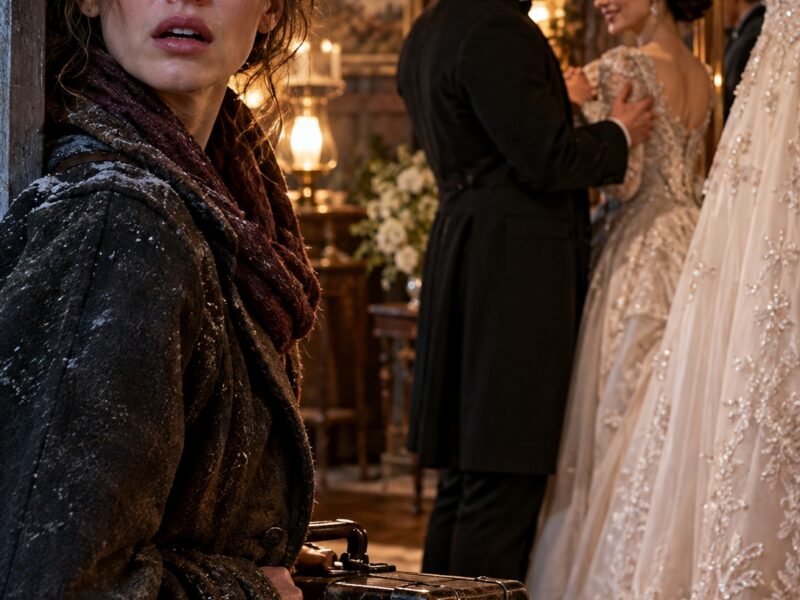
For several seconds, she simply stood outside the gate of the Ames Ranch, one gloved hand wrapped around the handle of her battered trunk, watching the life she had crossed half a country to claim unfold without her.
November 30, 1888.
Blue dusk pressed low over the Yakama Valley, flattening the mountains into dark shapes beyond the fields. Frost silvered the fence rails. The borrowed wool coat around Mara’s shoulders was too large for her, and the cold had already worked through her boots.
Behind her, the hay wagon that had carried her the final eleven miles was disappearing toward Autanum Crossing.
Ahead of her, the farmhouse windows glowed gold.
And through the largest window, Mara could see Gideon Ames.
She knew it had to be him.
Tall.
Broad-shouldered.
Thirty-six, according to his letters.
Dark hair touched with the first suggestion of gray near his temples.
He wore a black coat good enough for church.
Or a wedding.
Beside him stood a woman Mara had never seen.
The woman was sturdy and handsome rather than delicate, perhaps thirty-four, with capable hands and dark hair pinned firmly away from her face. She had several straight pins between her lips.
At first Mara couldn’t understand why the woman was kneeling.
Then Gideon moved aside.
Mara saw the dress.
Gray silk.
High collar.
Long sleeves.
A wedding dress stood on a dress form in the center of the parlor while the woman carefully adjusted its hem.
Mara’s fingers went numb around the trunk handle.
Not from the cold.
Her five letters were inside the breast pocket of her coat.
The last one had been written at a miserable railway station high in the mountains.
The line is still blocked.
I don’t know when this will reach you.
But I am coming.
If you will still have me when I arrive, I am yours.
She had read those words so many times during the journey that she could see the shape of her own handwriting when she closed her eyes.
Apparently, Gideon had never seen them.
Or he had stopped believing them.
Inside the farmhouse, the woman rose and held the skirt against the dress form.
Gideon said something.
She laughed.
Mara couldn’t hear the words through the glass.
She didn’t need to.
A bride.
A groom.
A wedding dress.
The night before December first.
There were some truths a woman didn’t need explained.
Mara swallowed.
“Well,” she whispered.
Her voice disappeared into the wind.
She had imagined this arrival differently.
Not romantically.
She was too old for foolishness, or so she had repeatedly told herself.
At twenty-eight, Mara understood that marriages beginning through newspaper advertisements were not fairy tales. Gideon Ames had advertised for a wife because he had a ranch, a motherless daughter, and a house that needed another adult inside it.
Mara had answered because she had spent nineteen years understanding what it meant to be the child no one came back for.
Their correspondence had begun practically.
Then something had changed.
He had written about Ren.
She had written about loneliness.
He had told Mara how his daughter spoke to horses when she could not speak to people.
Mara had told him she sometimes sat beside dying hospital patients after her shift ended because no one should have to leave the world staring at an empty chair.
Somewhere between August and October, Gideon Ames had stopped feeling like a stranger.
Apparently, she had not stopped being one to him.
Mara looked once more through the window.
The woman touched Gideon’s sleeve.
He looked down at her.
Mara forced herself to breathe.
Five weeks.
That was how late she was.
Five weeks was not a small delay.
Five weeks was long enough for hope to become embarrassment.
Long enough for neighbors to stop asking whether the bride was coming.
Long enough for a widower raising a child alone to decide he had been foolish.
Mara could not walk into that parlor carrying a trunk and five useless letters and demand that a man choose her over a woman already hemming his wedding dress.
Whatever pain she felt belonged to her.
Gideon had done nothing wrong.
“Go back to town,” she told herself.
She had almost no money.
No job.
No room waiting for her.
No clear idea how she would get back to Portland.
But dignity did not require a plan.
Only a direction.
Mara lifted her trunk.
She turned away from the gate.
And then she saw the child.
A small figure slipped from the back of the farmhouse.
The girl wore a long white nightgown beneath a man’s heavy overcoat. A brown braid bounced against her back as she ran across the frozen yard carrying a lantern.
She wasn’t running toward Mara.
She was running away from the house.
Toward the barn.
Mara stopped.
The girl pulled open the enormous red barn door, squeezed through, and disappeared.
A faint yellow light moved behind the boards.
Then upward.
Toward the loft.
Mara remained at the gate.
She told herself the child lived here.
She told herself this was none of her concern.
Then the sound came through the cold.
Crying.
Not loud crying.
That would have been easier to ignore.
This was the careful, strangled crying of a child trying desperately not to be heard.
Mara slowly set down her trunk.
There were moments when a person’s life changed because someone opened a door.
There were other moments when it changed because someone refused to walk away from one.
Mara looked back at the farmhouse.
Then at the barn.
She left her trunk beside the gate.
Whatever else she had crossed two thousand miles to become, she thought, she could at least become the person who did not leave a crying child alone in the dark.
She crossed the yard.
And without knowing it, Mara Ruskin walked toward the fire that would decide the rest of her life.
Five weeks earlier, she had been sitting in a railway carriage heading east from Seattle with a new pair of boots, forty-three dollars hidden inside her corset, and Gideon Ames’s last letter folded inside her Bible.
The first three days of the journey had gone exactly as planned.
Then the mountain came down.
Wet snow, stone, trees and mud crashed across the railroad near Stampede Pass, burying the tracks and trapping passengers on both sides.
Mara and seventeen others were put off at a way station consisting of one drafty hotel, a storage shed, a telegraph office and a stove that smoked whenever the wind turned east.
The telegraph wire went down the same night.
For twenty-two days, no reliable message entered or left.
At first Mara waited.
Then she worked.
Her money began disappearing into meals and lodging, so she persuaded the hotel keeper to let her wash dishes, scrub floors and change beds in exchange for staying.
Every morning she asked whether the line had opened.
Every morning the answer was no.
Every night she wrote another version of the same letter.
Dear Mr. Ames,
I have not changed my mind.
Please don’t think I have.
She entrusted five letters to a railway clerk who promised they would be sent the moment communication resumed.
None reached Gideon.
Mara did not know that.
She knew only that waiting was something she had been trained to do almost from childhood.
Her mother died when Mara was nine.
The boarding house in Tacoma caught fire after midnight.
Even nineteen years later, Mara remembered the event in fragments rather than sequence.
Lamp oil.
Heat.
Smoke crawling beneath the bedroom door.
Her mother’s voice somewhere she couldn’t reach.
The staircase disappearing into orange.
And a stranger.
A man in a leather coat had come through the smoke, wrapped Mara against his chest and carried her down burning stairs.
She never learned his name.
He disappeared before anyone could thank him.
For years afterward, Mara dreamed about those stairs.
She would wake convinced that somewhere above her, someone was still calling for help.
She spent the rest of her childhood in a church home and later worked as a nurse’s aide in Portland.
There she learned practical things.
How burns changed color.
How smoke damaged lungs.
How panic could kill before flames did.
How frightened people needed instructions more than reassurance.
She also learned that people remembered who stayed beside the bed.
That was why Gideon’s advertisement caught her attention.
Widower. Thirty-six. Horse rancher. One daughter. Seeking respectable woman willing to marry and help raise a child who lost her mother.
Mara read the final sentence three times.
Then she wrote to him.
Gideon Ames had been waiting too.
At first, reluctantly.
Then eagerly enough that he hated himself for it.
His ranch spread across six hundred acres near the Naches River, with irrigated pasture below and bunchgrass climbing toward the hills.
He raised saddle horses for cavalry buyers.
He understood mares, weather, fences, money and stubborn men.
He understood very little about grief.
His wife, Lenora, had died three winters earlier.
A fever took her in two days.
Their daughter Ren was five.
For nearly a month afterward, the girl did not speak.
Gideon tried everything.
Stories.
Candy.
Anger, once, for which he hated himself immediately.
Doctors.
Prayer.
Nothing.
Then one morning Ren walked into the stable, pressed her face against an old mare’s neck and whispered the horse’s name.
From then on, she spoke again.
Mostly to horses.
By eight, Ren had become a small, fierce creature with a long braid and her mother’s eyes.
She kept Lenora’s silver thimble hidden in a stocking beneath her pillow.
No one was allowed to touch it.
Gideon understood why.
What he didn’t understand was how frightened Ren had become of losing everything else.
Old Aldis Fen, the ranch foreman who had known Gideon since childhood, finally told him what everyone else was too polite to say.
“You need a wife.”
Gideon had stared at him across the stable.
“I had one.”
“I know.”
“Then don’t say it like I’m buying another horse.”
Aldis leaned on the stall door.
“I’m saying your daughter needs more than you know how to give.”
That had hurt because Gideon knew it was true.
So he placed the advertisement.
Mara’s first letter arrived in August.
Her second came in September.
She wrote differently from the other women.
She asked what Ren ate when she was sick.
Whether she liked books.
Whether thunderstorms frightened her.
Whether Lenora’s name was spoken in the house.
That last question stayed with Gideon.
He answered every letter.
Then Mara wrote that she would come.
He began watching the road.
October passed.
No Mara.
The railroad reported delays.
Then worse weather.
November came.
Still nothing.
Gideon kept waiting long after his neighbors stopped expecting anyone.
He hated the humiliation of it.
Every wagon made him look toward the gate.
Every knock after dark tightened something in his chest.
Ren noticed.
Everyone noticed.
Eventually even hope became something he was ashamed to be seen carrying.
Then Delphine Quarrels came over from the neighboring dairy with an apple pie and a proposition.
Delphine was thirty-four, widowed, practical and incapable of pretending life was more romantic than it was.
“I need a husband eventually,” she told him.
Gideon nearly choked on his coffee.
“And you need somebody who knows how to keep a house without setting it on fire.”
“I’ve managed not to burn it yet.”
“Barely.”
He smiled despite himself.
Then she became serious.
“Ren needs stability.”
His smile disappeared.
“I know.”
“So do you.”
“Is this a proposal?”
“Yes.”
“Delphine—”
“I’m not asking you to fall in love with me.”
Her voice remained steady.
“Neither of us is sixteen. I like you. You respect me. I care about Ren. We could build a decent life.”
A decent life.
Gideon had been exhausted enough to hear mercy in those words.
He said yes.
The wedding was set for December first.
He didn’t sleep properly afterward.
And now, on the night before that wedding, the woman he had waited for was climbing into his barn without his knowledge.
Mara found the ladder by following the lantern glow.
She climbed carefully.
At the top sat the child.
Ren had pulled her knees beneath the enormous coat and was staring at the hay.
A small silver object moved between her fingers.
Mara recognized a thimble.
The girl didn’t turn.
“I’m not having a new mother.”
Mara stopped.
Ren sniffed.
“Papa’s marrying Miss Delphine tomorrow. She’s nice. She makes good pie. But she’s not my mother.”
Mara said nothing.
“You can tell her I won’t come to the wedding.”
Still nothing.
Finally Ren glanced sideways.
“Did she send you?”
“No.”
“Papa?”
“No.”
“Then who are you?”
Mara sat on the boards several feet away.
“My name is Mara.”
The girl’s fingers tightened around the thimble.
Mara continued softly.
“I heard someone crying.”
“I wasn’t crying.”
“Then I must have heard a barn owl.”
Ren looked offended.
“There aren’t barn owls here.”
“That explains my mistake.”
For the first time, the girl’s expression shifted.
Only slightly.
But enough.
Mara folded her hands.
“I thought whoever was making that sound might want someone nearby.”
“I don’t.”
“All right.”
Mara stayed seated.
Ren frowned.
“You said you’d go.”
“I said I’d go if you wanted me to.”
“I do.”
Mara nodded.
She stood.
Then Ren asked, “Where?”
Mara looked toward the ladder.
“Down.”
“After that?”
The question was different.
Mara heard it.
“I don’t know.”
Ren studied her.
“Are you lost?”
“Possibly.”
“Adults aren’t supposed to get lost.”
“Who told you that?”
“Papa.”
“I suspect your papa was simplifying.”
Ren almost smiled.
The thimble caught the lantern light.
Mara nodded toward it.
“That’s beautiful.”
Ren’s hand closed instantly.
“You can’t touch it.”
“I wasn’t going to.”
“It was my mother’s.”
Mara lowered herself again.
“I had my mother’s brooch once.”
Ren looked at her.
“What happened to it?”
“I lost it.”
“How?”
“Carried it in my shoe for almost a year.”
“Why would you do that?”
“Because I was nine and thought thieves would search my pockets.”
Ren considered this.
“That’s foolish.”
“Very.”
“What did it look like?”
Mara smiled faintly.
And that was the moment the barn cat woke.
The gray tom had been sleeping on a beam above them.
Something startled it.
A horse stamping below.
A gust against the roof.
Perhaps nothing at all.
The cat leapt.
Its hind leg struck the lantern.
Mara heard glass break.
Then smelled oil.
She turned.
A bright ribbon ran through the hay.
“Ren.”
The flame caught.
Orange raced across the floor.
For one frozen heartbeat, Mara was nine years old again.
Tacoma.
Midnight.
Smoke beneath a door.
Her mother’s scream.
The staircase burning.
Then Ren screamed.
And nineteen years of fear became something else.
Something cold.
Useful.
Precise.
Mara dropped to her knees.
“Ren, look at me.”
The girl was sobbing.
“LOOK AT ME.”
Ren did.
“Get down.”
Smoke was already collecting overhead.
Mara pulled her flat.
“Air is cleaner near the floor. You’re going to hold my skirt. You do not stand up. You do not let go. Understand?”
Ren nodded wildly.
Mara grabbed the borrowed coat, plunged it into the water bucket near the ladder and wrapped it around the child.
Fire cracked across the loft.
The way to the ladder was shrinking.
“Crawl.”
They moved.
The smoke thickened.
Ren coughed.
Mara felt heat against the left side of her face.
The ladder appeared through the smoke.
Its bottom was already burning.
Mara looked down.
Too far.
No other exit.
She turned to Ren.
“I’m going first.”
“No!”
“You are coming with me.”
The girl clutched her.
Mara climbed backward, half carrying her.
One rung.
Two.
Three.
The wood groaned.
“Don’t look down.”
A burning beam crashed somewhere behind them.
The horses began screaming.
Then a rung broke.
Mara fell.
She twisted instinctively so Ren landed against her rather than beneath her.
Pain exploded through Mara’s back.
A burning ember struck her forearm.
She smelled skin.
She nearly screamed.
Instead she shoved Ren toward the door.
“RUN!”
Ren stumbled outside.
Mara crawled after her.
Cold air hit her face.
She should have stopped.
Then she heard the horses.
Eleven broodmares were trapped inside.
Their screams tore through the barn.
Mara looked toward Ren.
The child was safe.
The roof above the stalls had not yet caught.
She had perhaps seconds.
She ran back inside.
Outside, Gideon Ames heard his daughter screaming his name.
He burst from the farmhouse.
Delphine behind him.
Men came running from the bunkhouse.
Gideon saw flames through the barn roof.
Then he saw Ren.
Alive.
Barefoot.
Wrapped in a soaking coat.
He reached her and dropped to his knees.
“Ren!”
She slammed into him.
“Papa!”
“Are you hurt?”
Ren shook her head.
“Who got you out?”
The girl turned.
At that moment the barn doors flew open.
A mare exploded into the yard.
Then another.
Then three more.
Behind them came a woman.
Her dress was torn.
Her face was black with soot.
Her left sleeve had burned away near the forearm.
She staggered into the cold and nearly collapsed beside the water trough.
Ren pointed.
“Her.”
Gideon stared.
“She came up the ladder for me.”
His heart stopped.
Ren sobbed against his chest.
“She said her name was Mara.”
For a moment the burning barn disappeared.
The shouting disappeared.
The entire world narrowed to the soot-covered stranger struggling to breathe twenty yards away.
Mara.
Gideon had imagined that name spoken a hundred different ways.
Never like this.
They fought the fire until midnight.
Neighbors arrived from every direction.
Men formed bucket lines.
Aldis directed crews cutting away burning sections.
Delphine worked the pump until her hands bled.
They saved half the barn.
They saved every horse.
And after the worst had passed, Gideon found Mara sitting on the porch step with a wet cloth wrapped around her burned arm.
He approached slowly.
She looked exhausted.
Smaller than he had imagined.
Stronger too.
“You are Miss Ruskin.”
Mara looked up.
“Yes.”
Gideon’s jaw tightened.
“You came.”
“I did.”
“Five weeks late.”
“Yes.”
He closed his eyes briefly.
“I gave you up.”
“I know.”
“No. You don’t.”
His voice broke.
“I watched that road every day.”
Mara looked away.
“I saw the dress.”
Gideon stopped.
“Through the window.”
She attempted a smile.
“I understood.”
He crouched in front of her.
“You crossed two thousand miles.”
“The train was trapped.”
“I know that now.”
“I wrote.”
His eyes lifted.
“What?”
“Five letters.”
Gideon stared at her.
“I never received them.”
Mara touched the pocket of her coat.
“The last one said I was still coming.”
Neither spoke.
The fire behind them hissed under buckets of water.
Gideon looked at the woman who had crossed mountains to reach him, arrived believing she had lost him, and then entered a burning barn for his daughter before even introducing herself.
“I don’t know how to thank you.”
“Don’t.”
“You saved Ren.”
“I heard her crying.”
“That isn’t an answer.”
Mara’s eyes met his.
“It is to me.”
Neither noticed Delphine standing at the foot of the porch.
She had heard enough.
And unlike Gideon, Delphine understood immediately what had happened.
Not in the barn.
Between them.
She stepped forward.
“Give her this.”
She handed Gideon a cup of water.
Mara drank.
Then Delphine folded her arms.
“Gideon.”
He stood.
“Delphine—”
“No.”
Her voice was calm.
“Don’t start apologizing before I’ve said anything.”
Mara stiffened.
“I should leave.”
“You should sit,” Delphine said.
Mara obeyed mostly because she lacked the strength to argue.
Delphine looked toward the blackened barn.
“I stood at that pump for two hours.”
Nobody spoke.
“I watched this woman go back inside after your daughter was safe.”
Mara lowered her eyes.
“For the horses,” Delphine continued. “Eleven of them.”
Gideon said quietly, “I saw.”
“I wouldn’t have done it.”
Mara looked up.
Delphine shrugged.
“I’m sensible.”
Something almost like laughter escaped Mara.
Delphine looked at Gideon.
“I offered to marry you because Ren needed a woman in this house.”
“Delphine—”
“I said don’t interrupt.”
He shut his mouth.
“I thought I was the best answer available.”
Her gaze moved to Mara.
“Apparently I was mistaken.”
Mara shook her head.
“No. Please. I didn’t come here to—”
“I know exactly why you came.”
Delphine’s voice softened.
“You came because he asked you.”
Silence.
Then she looked at Gideon again.
“You never wrote me letters.”
His face changed.
“You never watched the road for me.”
“Delphine.”
“You did for her.”
She swallowed once.
“And I’m not going to stand at an altar tomorrow knowing that.”
Gideon stared at her.
“The wedding is off.”
Mara rose despite the pain.
“No.”
Both looked at her.
“You cannot cancel a marriage because I arrived at an inconvenient moment.”
Delphine actually laughed.
“Darling, you arrived in a burning barn. There was nothing convenient about it.”
Mara’s eyes filled.
Delphine picked up her shawl.
“I’ll alter the dress.”
“What?”
“For you.”
Mara stared.
“You cannot possibly—”
“It’s good silk.”
Delphine walked down the steps.
Then stopped.
“I’ll bake the cake too.”
She glanced back.
“But don’t either of you make me regret being noble.”
For the first time that night, Gideon laughed.
Delphine did not.
Not until she had turned away.
Mara slept for nearly two days.
Her burn was painful but not deep enough to cripple her.
Ren appointed herself nurse.
No one challenged the appointment.
The girl carried broth upstairs.
Then tea.
Then stewed apples.
She sat beside Mara’s bed reading aloud from a horse-breeding journal with such seriousness that Mara drifted in and out of sleep listening to descriptions of bloodlines.
On the third evening, Ren climbed onto the bed.
She held something inside her fist.
“Mara?”
“Hm?”
The girl opened her hand.
The silver thimble lay in her palm.
Mara went still.
“You may touch it.”
Mara looked at the child.
Then at the thimble.
She gently closed Ren’s fingers around it.
“No.”
Ren frowned.
“Why?”
“Because it’s yours.”
“I thought you’d want it.”
“I do.”
The girl looked confused.
Mara smiled.
“That’s why I won’t take it.”
Ren stared at her for a long time.
Then the words came in a rush.
“I thought if Papa married somebody, I’d have to stop remembering Mama.”
Mara’s smile disappeared.
“I thought the new wife would put her things away. And Papa would stop saying her name. And then maybe after a long time everybody would act like she wasn’t here.”
“Oh, Ren.”
“Are you going to make him stop?”
Mara thought about Tacoma.
About the brooch.
About nineteen years of wishing someone would say her mother’s name without becoming uncomfortable.
“No.”
Ren searched her face.
“Never?”
“Never.”
Mara shifted against the pillows.
“Listen to me. A heart isn’t a house with only so many rooms.”
Ren remained very still.
“Your father loved your mother. You love her. Nothing I do should change that.”
“But if you stay—”
“If I stay, I don’t take her place.”
Mara touched the blanket between them.
“I stand beside it.”
Ren’s lower lip trembled.
“You won’t put the thimble away?”
“No.”
“You won’t make Papa take down her picture?”
“No.”
“I can tell stories about her?”
“Every day, if you want.”
Ren climbed against Mara’s uninjured side.
For several minutes, neither spoke.
Then the girl whispered, “Could you stay?”
Mara closed her eyes.
Tears slipped into her hair.
“I think,” she whispered, “I might.”
The barn was rebuilt in four days.
The valley came.
Forty men raised beams.
Women arrived with bread, meat pies, coffee and baskets of food.
Delphine organized the entire operation as though commanding an army.
Old Aldis stood on a stump shouting orders through a speaking trumpet no one remembered giving him.
At night, after the workers left, Gideon and Mara sat on the porch.
They finally talked without paper between them.
About Lenora.
About Ren.
About Mara’s mother.
About loneliness.
About fear.
About the five letters Gideon had never received.
“I kept yours,” Gideon admitted.
“All of them?”
“Every one.”
“Why?”
He looked embarrassed.
“Because I liked reading them.”
Mara smiled.
“That’s almost romantic.”
“Don’t spread it around.”
She laughed.
It was the first time Gideon heard the sound without fire nearby.
He found himself wanting to hear it again.
On the fourth evening, they watched new rafters cut black lines against the stars.
Gideon spoke quietly.
“When I agreed to marry Delphine, I told myself Ren needed a woman in the house.”
Mara waited.
“But I think I knew when I first wrote you that wasn’t what I wanted.”
“What did you want?”
He looked at her.
“This.”
She glanced around.
“A half-burned ranch?”
“No.”
His mouth moved slightly.
“Someone beside me at the end of the day.”
Mara’s expression changed.
“Someone I could tell the truth to.”
He reached carefully for her bandaged hand.
“I wanted someone who would know Ren wasn’t a problem to solve.”
Mara looked toward the barn.
“And now?”
“Now I know what I’m asking.”
She looked back at him.
“What are you asking?”
Gideon took a breath.
“Stay.”
Mara’s eyes filled.
“Because I saved Ren?”
“No.”
“Because Delphine released you?”
“No.”
“Because you need a wife?”
“No.”
“Then why?”
He looked at her for so long that Mara finally stopped trying to protect herself from the answer.
“Because every time I imagined you arriving,” he said, “I imagined opening that gate.”
His thumb moved lightly over the edge of her bandage.
“And when you finally came, you opened it yourself.”
They married December eighth.
In the new barn.
Ren insisted.
No one dared argue.
Fresh-cut beams still smelled of pine.
Evergreen wreaths hung from the stall doors.
The horses were turned into the pasture for the ceremony.
Delphine altered the gray silk dress herself.
When Mara protested, Delphine put three pins between her lips and said, “Good cloth shouldn’t suffer because people are foolish.”
The dress fit.
Gray, Delphine announced, suited a woman who had walked through fire.
Ren wore green wool.
She appointed herself flower girl, maid of honor and official witness.
And when the reverend asked who gave Mara to be married, Ren stood before anyone else could answer.
“I do.”
Laughter moved through the barn.
Mara looked down at her.
Pinned to Ren’s collar was Lenora’s silver thimble.
Not hidden.
Not surrendered.
Carried forward.
Gideon saw Mara notice it.
Their eyes met.
Something passed between them that required no words.
When the vows ended, Gideon kissed Mara beneath the new rafters.
The entire barn erupted.
Ren waited approximately three seconds before taking both their hands.
“Can we see the horses now?”
Thirty years later, Mara would still laugh whenever she told that part.
She lived forty years beside the Naches River.
She and Gideon had two sons and another daughter.
The ranch grew.
So did the family.
Ren grew tall and determined, with Gideon’s steadiness and Lenora’s eyes.
She studied animals with the same fierce concentration she had shown as a child and eventually earned a veterinary credential, entering a profession few women of her generation were permitted to imagine.
Delphine never married.
She remained part of the Ames family anyway.
Every Christmas, they ate at her table.
The first pie from the oven was always placed in front of Mara.
“For the late guest,” Delphine would say.
Mara never again dreamed about the burning staircase in Tacoma.
Years later, she told Gideon she believed the barn fire had finally burned the nightmare out of her.
He disagreed.
They were sitting on the porch, older then, watching grandchildren chase each other near the pasture.
“You spent your whole life waiting for that man in the leather coat,” Gideon said.
Mara looked at him.
“What do you mean?”
“The stranger who came upstairs for you.”
She was quiet.
Gideon took her hand.
“I think that night in the barn, you stopped waiting for him.”
Mara looked toward the rebuilt barn.
“And?”
“You became him.”
She never found a better explanation.
The gray wedding dress remained in a cedar chest at the foot of their bed.
Thirty years after Mara wore it, Ren wore it at her own wedding.
Delphine’s hands shook badly by then.
She altered the dress anyway.
Mara stood at the back of the barn as Ren walked between two rows of horses.
The silver thimble was pinned to her collar.
Just as it had been when she was eight.
Mara cried before Ren reached the middle of the aisle.
She cried for Lenora.
For her own mother.
For the stranger in Tacoma.
For the girl in the loft.
For every person whose life had once depended on somebody deciding not to walk away.
And over the oldest stall in the Ames barn hung a small iron bell.
Gideon had it cast from metal recovered from the hinges of the barn that burned.
Every December first at dusk, the family rang it.
Children eventually asked why.
Mara never gave them the long version.
She would look toward the gate.
Then toward the loft.
And she would say:
“A woman once came very late to a place she thought no longer wanted her.”
The children would grow quiet.
“She was going to leave. Then she heard somebody crying.”
“What happened?” one of them would inevitably ask.
Mara would smile.
“She climbed the ladder.”
That was usually enough.
Because Mara Ruskin had crossed two thousand miles believing she was traveling toward a man.
She wasn’t.
She was traveling toward a frightened little girl sitting in a dark loft with her mother’s thimble clenched in her fist.
Toward a widower who had stopped waiting one day too soon.
Toward a woman kind enough to surrender a wedding she understood had never truly belonged to her.
And toward the fire Mara had been running from since she was nine years old.
The strangest thing was that almost everything Mara wanted had been waiting behind the gate that November evening.
Love.
Family.
A home.
A daughter.
Forty years of ordinary mornings.
But none of it began when Gideon saw her.
It began several minutes earlier.
When Mara saw the wedding dress through the window.
When she understood she had arrived too late.
When she picked up her trunk.
When she turned toward the road.
And then—
when a child cried in the dark.
Because sometimes the most important door in a person’s life does not open when someone invites them inside.
Sometimes it opens when they are already leaving.
And somewhere beyond that door, someone is crying.
Someone is frightened.
Someone believes no one is coming.
Mara spent the rest of her life knowing exactly what to do then.
Whoever is crying, someone should climb the ladder.









