She Arrived With 40 Cents and a Sewing Machine—A Year Later, the Man Who Laughed at Her Was Leaving Town
The first thing Cedar Gap noticed about Esther Bloom was that she had brought almost nothing.
The second was that the nothing weighed nearly two hundred pounds.
When the noon stagecoach groaned to a stop on Main Street in the spring of 1882, half the town seemed to be sitting on the porch outside Webb’s General Store with nowhere better to be.
That was what poverty did to a place.
It gave people time to watch strangers arrive.
Esther stepped down alone.
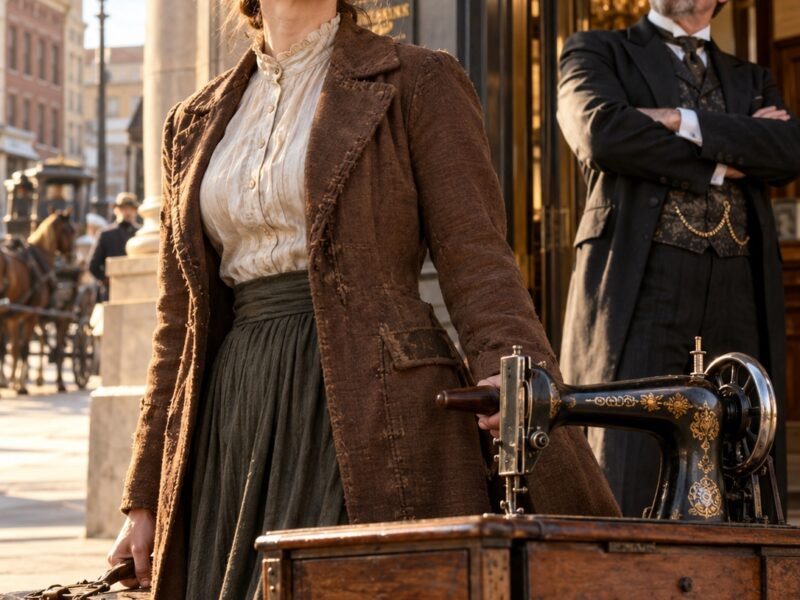
She was twenty-nine, a widow, and wore a brown traveling coat that had been mended so carefully at the elbows that only another woman who knew sewing would have noticed.
Her purse contained forty cents.
Her luggage consisted of one small carpetbag, a wooden case of personal things, and a crated treadle sewing machine so heavy the stage driver swore under his breath while lowering it.
The men on the porch stared.
One of them spat tobacco juice into the dust.
Another leaned toward his neighbor.
“That the bride?”
“Must be.”
“What’s in the crate?”
The driver answered loudly enough for everyone.
“Sewing machine.”
Someone laughed.
It wasn’t a cruel laugh exactly.
Cedar Gap had almost forgotten how to afford cruelty. Mostly, people laughed because the alternative was admitting how frightened they were.
Two winters earlier, the lead vein that had built the town had pinched down to nothing.
The mine closed.
Then came a hailstorm that flattened much of the next harvest.
One disaster might have been survivable.
Two had turned Cedar Gap into a town waiting to die.
Storefronts stood boarded along Main Street. Horses needed shoeing, but men delayed because they had no money. Roofs leaked because shingles cost cash. Families stretched flour with cornmeal and soup with water.
Men sat on porches because there was no work to stand up for.
Women stayed home because there was nowhere worth walking to.
And into all of that had come a widow with forty cents and a sewing machine.
A tall man emerged from the general store.
He was thirty-four, lean from worry rather than hard labor, with dark hair that needed cutting and the exhausted expression of a man who had spent two years watching numbers shrink.
He stopped when he saw Esther.
Then he looked at the crate.
Then back at Esther.
She knew immediately who he was.
“Marcus Webb?”
“Yes, ma’am.”
“Esther Bloom.”
For one strange second they simply regarded each other.
They had exchanged twelve letters.
He knew she preferred coffee to tea, had been widowed three years, could keep accounts, disliked unnecessary compliments, and had once owned part of a tailoring business in Ohio.
She knew he owned the general store, had never married, attended church irregularly, owed money on the building, and had placed a marriage advertisement because, in his own painfully honest words, loneliness makes a house larger every winter.
But letters had weight only in imagination.
Now they were real.
Marcus glanced toward her baggage.
“Is that trunk yours?”
“It isn’t a trunk.”
He looked again.
“No?”
“It is my living.”
There was no smile when she said it.
Marcus looked at the enormous sewing machine crate.
Then at the sky.
Clouds were gathering.
“I suppose we’d better get your living out of the rain.”
Something changed in Esther’s face.
Not warmth.
Not yet.
Perhaps only the smallest revision of judgment.
They took opposite ends of the crate.
Marcus expected her to let him bear most of the weight.
She didn’t.
Together they hauled two hundred pounds of iron, wood, gears and possibility down the boardwalk while Cedar Gap watched its storekeeper and his mail-order bride arrive at marriage looking less like lovers than hired freight hands.
Inside, Marcus showed her the store.
There wasn’t much to impress.
Shelves held flour, beans, lamp oil, buttons, coffee, salt, boots, nails and a collection of goods that had stopped moving months earlier.
He apologized.
“I may have made things sound better in my letters.”
Esther turned.
“What things?”
“The store. The town. My circumstances.”
“Why?”
He blinked.
“I beg your pardon?”
“Why would you make them sound better?”
Marcus seemed embarrassed.
“I suppose I didn’t want you to change your mind.”
“And now?”
“Now you’re here.”
“That doesn’t answer me.”
He studied her.
Perhaps that was the first moment he understood that the woman he’d invited to Missouri had no interest in polite lies.
Finally he said, “Now I’d rather you know exactly what you’ve come to.”
Esther looked around again.
Nearly empty till.
Dust gathering on unsold merchandise.
Two cracked panes.
A stove with a patched pipe.
A good man ashamed of things he hadn’t caused.
“I didn’t come for comfort, Mr. Webb.”
“Marcus.”
“Marcus.”
He waited.
Her eyes shifted toward the sewing machine.
“I learned some time ago what comfort is worth when it belongs to somebody else.”
He heard something underneath the sentence.
A wound.
He had enough decency not to ask who had made it.
Instead he showed her the back room he’d cleared.
It was small, square and ugly.
A cot stood against one wall.
He had placed wildflowers in a chipped pitcher beside it.
Esther noticed them.
She said nothing.
Marcus mistook her silence for disappointment.
“I can move some things upstairs tomorrow. Make more room.”
She walked to the window.
Measured it with her eyes.
Then she paced from one wall to another.
Marcus watched.
“What are you doing?”
“Measuring.”
“For what?”
She ignored the question.
“How well does that stove draw?”
“Fairly well.”
“How cold does this room get in January?”
“Cold enough.”
“Does that window face east?”
“Yes.”
“Floor level?”
“Mostly.”
“How many women live within walking distance of Main Street?”
Marcus frowned.
“What?”
“How many?”
“Twenty? Thirty? More, counting the edge of town.”
“How many can sew?”
“Probably most.”
“How many have work?”
He almost answered immediately.
Then stopped.
Outside, three men sat doing nothing.
Across the street, a woman shook a rug from a second-story window and disappeared inside.
Marcus looked back at Esther.
“Almost none.”
She nodded.
There it was.
The first number that mattered.
That evening, Marcus counted the store till while Esther unpacked and oiled her sewing machine.
The metal was worn smooth in places.
She handled it differently from everything else she owned.
Not like equipment.
Like history.
Marcus pretended not to notice.
Eventually he said, “About the marriage.”
Her foot stopped.
He continued carefully.
“I don’t expect anything tonight.”
Esther’s expression hardened slightly.
“I should hope not.”
“I meant—”
“I know what you meant.”
Marcus rubbed the back of his neck.
“I am making this worse.”
“A little.”
That almost made him smile.
He pulled out the chair opposite him.
Esther sat.
Marcus folded his hands.
“I wrote for a wife because I was lonely. That’s true. But I don’t expect affection because you stepped off a stagecoach.”
“Good.”
“I don’t expect obedience either.”
That caught her attention.
“What do you expect?”
“Honesty.”
She watched him.
“And partnership, if we can manage it.”
“What if love never comes?”
His answer came surprisingly easily.
“Then I’d rather have an honest partner than a pretend sweetheart.”
For the first time since arriving in Cedar Gap, Esther had no immediate reply.
Marcus looked away first.
She had spent years learning to identify the price hidden inside generosity.
But she could not yet find the price inside Marcus Webb.
And that frightened her more than if she had.
The following morning, she showed him why she had measured the back room.
She set the lamp on a barrel.
“One woman with one sewing machine is a seamstress.”
Marcus nodded.
“A seamstress can starve.”
He gave her a puzzled look.
Esther continued.
“Forty women trained properly are not forty seamstresses.”
“What are they?”
“A factory.”
Marcus laughed.
He couldn’t help himself.
The sound escaped before he saw her face.
“I’m sorry.”
“No, you’re tired.”
“That too.”
“You think I’m foolish.”
“I think Cedar Gap can barely buy flour.”
“Exactly.”
She stepped closer.
“Your mistake is thinking I’m talking about selling dresses to Cedar Gap.”
“Aren’t you?”
“No.”
“Then who are you selling to?”
“I don’t know yet.”
Marcus stared at her.
She continued calmly.
“But I know this town has labor nobody is paying for. Skill nobody is counting. Buildings nobody is using. Men with wagons sitting idle. Women with hands that know how to make things. Your store has a loading entrance. There’s a freight depot fourteen miles east.”
“You’ve been here twelve hours.”
“I had twelve hours.”
Something in her certainty silenced him.
She picked up a pencil.
“Tell me something. How many families are living off savings?”
“Most.”
“How long before those savings are gone?”
Marcus didn’t answer.
“Exactly,” Esther said.
That first week she barely touched her machine.
Instead she knocked on doors.
She sat in cold kitchens with miners’ wives, farmers’ daughters, widows and mothers.
She asked strange questions.
What can you do faster than anyone you know?
What do people ask you to mend?
Can you cut from a pattern?
Can you keep accounts?
How many buttonholes can you finish in an hour?
Can you work six hours?
Four?
Two?
At first the women looked at her as if she were selling religion.
Then they began answering.
Martha Bell could turn a collar so cleanly the seam nearly disappeared.
Louisa Grant made buttonholes faster than anyone Esther had ever seen.
Ada Cooper’s fingers had stiffened from arthritis, but she could count inventory without losing track while three people spoke to her.
Esther wrote everything down.
Name.
Skill.
Speed.
Availability.
Not charity.
Value.
That distinction mattered.
Women who had spent two years being described as dependents watched Esther write down what they were good at as though she were recording proof that they still existed.
By Friday, people were talking.
By Saturday, the banker had heard.
Silas Pile was fifty-one years old and wore prosperity like a moral achievement.
He had survived Cedar Gap’s collapse by doing what he had always done best.
Risking nothing.
His bank still had money because almost nobody else did.
That made him powerful.
When he heard that Marcus Webb’s mail-order bride was talking about opening a garment workshop, he smiled into his coffee.
“A woman playing businessman,” he told his clerk, “is usually a problem winter solves.”
The clerk laughed because Pile signed his paycheck.
Pile forgot the matter by lunch.
Three days later, Esther walked into his bank.
She wore her one good collar.
Her notebook rested beneath her arm.
“Mrs. Webb,” Pile said pleasantly.
“Bloom.”
He paused.
“I understood you came here to marry Mr. Webb.”
“I did.”
“Then Mrs. Webb seems appropriate.”
“We haven’t married yet.”
Another pause.
Pile smiled.
“Of course.”
Esther sat across from him.
“I need two hundred dollars.”
His eyebrows rose.
“For what?”
“Cloth. Thread. Five used treadle machines if I can find them at the right price.”
Then she laid out her numbers.
Pile listened for perhaps thirty seconds.
After that, he merely waited for her to stop talking.
When she finished, he folded his hands across his vest.
“My dear Mrs. Bloom—”
“Esther is fine.”
His smile tightened.
“Esther. Cedar Gap Bank doesn’t generally make commercial loans to married women.”
“I’m not married.”
“Soon enough.”
“Then we have solved the first problem.”
His smile vanished.
“The collateral would effectively be Webb’s store.”
“Yes.”
“A failing store.”
“A store with positive turnover once wages begin entering the town.”
Pile leaned back.
“You would do better to concern yourself with making a household comfortable than turning the back of a general store into a workhouse.”
There it was.
Not arithmetic.
Not risk.
Not collateral.
Her sex.
Marcus’s failure.
Pile had reduced an entire business plan to two facts that had nothing to do with whether it could work.
Esther closed her notebook.
“May I ask one question?”
“Certainly.”
“If a man walked into this bank with my exact figures, would you lend him two hundred dollars?”
Pile’s mouth opened.
Then closed.
Esther waited.
His silence was the only honest thing he had given her.
She stood.
“Thank you for your time.”
Marcus was waiting outside.
He read the answer on her face.
“I’m sorry.”
She kept walking.
“My credit hurt you.”
“No.”
“Esther—”
She stopped.
“Don’t apologize for another man’s smallness.”
Marcus went quiet.
She looked toward the bank.
“He did me a favor.”
Marcus almost laughed.
“How?”
“A loan is a leash.”
“Most businessmen call it financing.”
“Most businessmen haven’t had everything they built taken from them.”
The words came out sharper than she intended.
Marcus heard them.
Again, he did not ask.
Esther exhaled.
“We build without him.”
“With what money?”
She looked toward his store.
“Let’s find out.”
The answer was humiliating.
Eight dollars and seventy-three cents.
A bolt and a half of muslin.
Some thread.
One machine.
Marcus sat behind the counter staring at the ledger.
Finally he disappeared upstairs.
When he returned, he carried a small wooden box.
He opened it.
Silver.
Old spoons.
A serving piece.
A sugar bowl.
“My mother’s.”
Esther looked at him.
“We could sell it.”
“No.”
“It’s mine.”
“Exactly.”
“Esther—”
“I will not begin a partnership by melting down your grief.”
He stared at her.
No one had ever described those objects that way.
She closed the box.
“We don’t need to buy our first job.”
“How do we get it?”
“We earn it.”
They printed handwritten notices.
MENDING.
WORK SHIRTS.
REPAIRS.
FAIR PRICES.
PAYMENT GUARANTEED.
Esther sent word to farms in every direction.
She offered the first women wages in store credit because there wasn’t enough cash.
Some refused.
Twelve came.
Mostly, Esther suspected, to watch her fail.
On Monday morning, six borrowed kitchen tables filled the back room.
Twelve women stood around one treadle machine.
Esther said nothing grand.
She sat down.
Threaded the needle.
Placed cut cloth beneath the presser foot.
Then she worked.
The machine began to hammer.
Fabric moved beneath her hands.
Seam.
Turn.
Press.
Stitch.
Collar.
Cuff.
Button placket.
The women stopped whispering.
By the time the quickest among them would normally have finished pinning a shirt, Esther had nearly completed one.
She clipped the thread.
Held it up.
Then rose.
“Who’s next?”
Nobody moved.
Finally Martha Bell stepped forward.
Martha’s husband had worked the lead mine eighteen years. Since it closed, she had become famous for refusing pity with enough force to make pity regret approaching.
She sat.
“Show me.”
Esther did.
That was how it began.
Not with money.
Not with a bank.
With one woman sitting down.
Esther divided labor.
Martha did collars.
Louisa did buttonholes.
Three women cut.
Four ran long seams.
Ada kept counts and inspected finished work.
Nobody made an entire shirt.
Everybody performed the task she did best.
At first they complained.
“It doesn’t feel like sewing,” Martha said.
“Good,” Esther replied.
“What does that mean?”
“It means we’re not running twelve sewing rooms. We’re running one workshop.”
Within a week, production quadrupled.
Then orders began returning with notes.
Send three more.
Can you repair overalls?
My brother in Franklin County needs twelve work shirts.
Marcus’s ledger changed.
Small marks appeared beside women’s names.
Credit.
Then larger marks.
Women came into the store and bought flour with money they had earned.
Boots for children.
Lamp oil.
Coffee.
A ribbon once.
Marcus watched Louisa Grant pick up a blue ribbon, consider the price, and place it on the counter.
Her husband had been unemployed fourteen months.
“You sure?” Marcus asked gently.
Louisa lifted her chin.
“I earned it.”
Marcus understood immediately why the ribbon mattered.
It wasn’t blue cloth.
It was dignity.
He began staying late.
He hauled water.
Split kindling.
Cleaned ash from the stove.
Kept lamps filled.
One evening he set a cup of coffee beside Esther.
She startled.
Marcus noticed.
“You all right?”
“Yes.”
“You looked frightened of coffee.”
“I’m not accustomed to someone bringing me things without wanting something afterward.”
The joke died between them.
Marcus sat across from her.
“You don’t have to explain.”
She looked down at the machine.
“My husband bought this for me.”
Marcus waited.
“Aaron?”
She had mentioned his name once in a letter.
“Yes.”
Her fingers traced a worn edge of the table.
“It was the only machine I kept.”
“Kept from what?”
The door appeared behind her eyes.
Marcus saw it close.
He stood.
“Never mind.”
Esther looked up.
“You aren’t curious?”
“Very.”
“Then why don’t you ask?”
“Because you don’t want to answer.”
He returned to stacking flour.
Esther watched him longer than he knew.
Three weeks later, a man arrived from St. Louis.
His name was Edwin Sloat.
He wore a city suit, polished shoes and an expression Esther recognized instantly.
The expression of a man who enjoyed discovering desperation because desperation could be purchased cheaply.
He toured the workshop.
“Charming.”
Esther disliked the word.
“Remarkable little operation.”
She disliked little more.
Finally Sloat removed papers from his case.
“My company requires four hundred work shirts.”
Silence.
Four hundred.
The number moved through the room like electricity.
Sloat smiled.
“Eight weeks.”
Marcus stared at Esther.
That order could change everything.
Then Sloat named the price.
Esther felt the room change again.
Martha didn’t understand immediately.
Marcus did.
His face fell.
At that price, material costs would consume almost everything.
The women would work brutal hours for pennies.
Sloat knew it.
That was the ugliest part.
He smiled because he knew it.
Esther folded her hands.
“I’m afraid we can’t accept.”
Marcus looked at her.
Sloat blinked.
“Excuse me?”
“Your price.”
“You’re refusing four hundred shirts?”
“Yes.”
Sloat glanced around the room.
At patched dresses.
At worn shoes.
At women whose husbands were unemployed.
Then back at Esther.
“I don’t believe you’re in a position to refuse.”
“Yet I just did.”
His smile became thin.
“Mrs. Bloom, winter has a way of clarifying arithmetic.”
“So does exploitation.”
A few women inhaled sharply.
Sloat leaned closer.
“Be careful.”
“About arithmetic?”
“About pride.”
Esther’s expression did not change.
“If I accept your price, I have to cheat my workers to make your profit.”
“Your workers have no jobs without me.”
“They had jobs before you arrived.”
Sloat gathered his papers.
“You’ll send for me.”
“No.”
“When the credit runs out.”
“No.”
“When winter comes.”
Esther met his eyes.
“If winter changes my arithmetic, I’ll write you.”
He left laughing.
Marcus waited until the stagecoach disappeared.
Then he shut the door.
“Four hundred shirts.”
“I heard him.”
“Esther.”
She turned.
“Say it.”
“We need cash.”
“Yes.”
“That was cash.”
“No. That was ownership disguised as an order.”
Marcus ran both hands through his hair.
“People are hungry.”
“Which is exactly why he offered that price.”
“What if you’re wrong?”
The question landed.
Esther’s face changed.
Not anger.
Fear.
Marcus saw it.
He lowered his voice.
“What if this town can’t afford your principles?”
For several seconds neither spoke.
Then Esther pulled a feed bill toward her.
“Sit down.”
“What?”
“Sit.”
Marcus did.
She began writing figures.
Cloth cost.
Thread.
Freight.
Labor.
Retail price in St. Louis.
Wholesale margin.
Sloat’s likely markup.
She worked for nearly an hour.
When she finished, she pushed the page toward Marcus.
He stared.
“He’d make that much?”
“Yes.”
“Just for placing the order?”
“For standing between the hands and the customer.”
Marcus looked toward the dark workshop.
“So what do we do?”
Esther’s eyes sharpened.
“We remove the man standing in the middle.”
“How?”
She looked at Sloat’s abandoned world of city contracts, freight and bulk purchasing and suddenly understood something larger.
Businesses bought hundreds.
Governments bought thousands.
She stood.
“The Army.”
Marcus stared at her.
“The United States Army?”
“They need shirts.”
“They probably already have suppliers.”
“Then we’ll become one.”
“You don’t know anyone in Washington.”
“I didn’t know anyone in Cedar Gap six weeks ago.”
Marcus almost smiled.
But Esther didn’t.
Because she knew what she was asking.
She was about to gamble the workshop.
The women’s trust.
Marcus’s store.
A town’s fragile hope.
And she was still keeping the most important truth about herself hidden.
That night, after everyone left, Esther sat beside the banked stove.
Marcus was preparing to leave when she said, “Aaron and I owned a tailoring shop.”
He stopped.
She turned the old wedding ring she still sometimes wore on her right hand.
“Ohio?”
“Yes.”
Marcus sat.
Esther stared into the coals.
“We built it together. At least I believed we did.”
Her voice remained steady.
“Aaron was good with customers. Charming. People liked him. I handled orders, cloth, accounts, workers. I was better at the business.”
Marcus said nothing.
“When he died, he was thirty-one.”
“I’m sorry.”
“Fever. Three days.”
Her thumb moved around the ring.
“One week later, his brothers came.”
Marcus’s jaw tightened.
“With a lawyer.”
The stove cracked.
“Everything was in Aaron’s name. The building. Accounts. Machines. Business registration. Even the sign.”
Marcus understood before she finished.
“They took it.”
“They said it belonged to the family.”
“You were his family.”
Esther looked at him.
“Not on the papers.”
The words were quiet.
That made them worse.
“I had worked there seven years. I had negotiated contracts. Trained apprentices. Kept us profitable through two bad seasons.”
Her voice finally broke slightly.
“None of it existed legally.”
Marcus stared at the floor.
“They took everything?”
“Almost.”
Her eyes moved toward the treadle machine.
“I told them Aaron had given that machine to me personally.”
“Had he?”
“Yes.”
“They believed you?”
“No.”
A humorless smile.
“I took it anyway.”
Marcus looked at the machine differently.
Not as equipment.
As the one surviving piece of a stolen life.
“That is why I came here,” Esther said.
“Because of the advertisement?”
“Because of how you wrote it.”
“What did I write?”
“That the store was failing.”
Marcus gave a small, embarrassed laugh.
“That doesn’t sound especially romantic.”
“It wasn’t.”
“Then why?”
“Because rich men wrote too.”
He looked at her.
“One offered a large house. One had land. One had servants.”
“And you chose Cedar Gap.”
“I chose the man who admitted what he didn’t have.”
Marcus’s expression softened.
Esther’s did not.
Not yet.
“I will never build another business that a man can sign away from me.”
“You won’t.”
“You can’t promise that.”
“Yes, I can.”
“How?”
Marcus leaned forward.
“Whatever we build, your name goes beside mine.”
She went still.
“Equal?”
“Equal.”
“Not as your wife.”
“No.”
“Not because you are being generous.”
“No.”
“As owner.”
“Yes.”
“And if we marry?”
“Still yours.”
“If we don’t?”
“Still yours.”
Esther searched his face for the trap.
There wasn’t one.
Marcus held out his hand.
“If anyone ever comes to take it, you’ll be standing in the door.”
He paused.
“And so will I.”
Esther looked at his hand.
Then placed hers over it.
Three breaths.
That was all.
But Marcus understood what she had given him.
The next morning they wrote to the Army.
The quartermaster’s reply was intimidating.
Specifications.
Samples.
Bid requirements.
Delivery guarantees.
Esther read every line twice.
They made one shirt.
Then destroyed it.
Made another.
Rejected it.
A third.
Martha groaned.
“That seam is straight.”
“It is one eighth of an inch wrong.”
“No soldier will notice.”
“The inspector will.”
They started again.
When the final sample lay on the table, it was as close to perfect as human hands could make it.
Esther submitted the bid.
Then Cedar Gap waited.
Silas Pile stopped laughing.
A government contract was different.
A silly women’s workshop could fail.
A government supplier could become independent.
And independence was dangerous to men whose influence depended upon everybody needing them.
Pile called in an old debt Marcus owed.
The amount wasn’t enormous.
The timing was.
Marcus came into the workshop holding the bank notice.
Esther read it.
“When?”
“Ten days.”
“How much can we cover?”
“Not enough if we buy cloth.”
Pile had made his move.
Then suppliers began refusing them credit.
One after another.
Esther rode twelve miles to one merchant.
“No stock.”
She could see bolts stacked behind him.
Another apologized.
Another wouldn’t meet her eyes.
By the fourth refusal she understood.
Pile.
Then Marcus heard Sloat had visited the bank.
The pieces locked together.
Sloat wanted the government contract.
Pile wanted Esther dependent.
Their plan was elegant.
Sloat could bid for the Army contract, then subcontract the sewing back to Cedar Gap at starvation rates.
Esther would become exactly what she had refused to become.
Cheap hands beneath another man’s name.
For the first time since arriving, she nearly broke.
Marcus found her after midnight sitting alone.
The perfect sample shirt lay beside the ledger.
“I may have done it again,” she whispered.
“What?”
“Built something someone can take.”
“No.”
“If we can’t get cloth, there is no workshop.”
“We’ll get it.”
“From whom?”
Marcus had no answer.
Esther looked exhausted.
“I told forty people I could make this work.”
“You didn’t promise forty.”
“They heard it anyway.”
“Esther.”
“I cannot watch another business disappear.”
Marcus crouched beside her chair.
“You once told me a middleman is only useful if you need him.”
She looked at him.
“So?”
“So stop needing them.”
The sentence sat between them.
Esther slowly straightened.
The merchants.
Pile.
Sloat.
All middlemen.
She stood so suddenly Marcus moved aside.
“Where are the old trade directories?”
“What?”
“The directories.”
He found them.
She opened one.
Manufacturers.
Textile mills.
Eastern suppliers.
If local merchants wouldn’t sell cloth because Pile controlled their credit—
she would buy from the people who made the cloth.
Directly.
Three letters went out before sunrise.
Nine days later, a mill answered.
Their price was lower than anything Cedar Gap’s merchants had ever offered.
Esther read the figure twice.
Then she laughed.
Marcus looked up.
He had never heard her laugh like that.
“What?”
She handed him the letter.
He read it.
Then laughed too.
Pile and Sloat had built a cage.
They had simply forgotten Esther knew how to find doors.
Two mornings later, Marcus saw the government envelope.
He didn’t open it.
He ran across Main Street with it.
“Esther.”
She looked at his face.
The workshop went silent.
He handed her the envelope.
Her fingers suddenly seemed unable to work.
Martha whispered, “Open the damn thing.”
Esther tore it.
Read.
Stopped.
Marcus couldn’t bear it.
“Well?”
She looked up.
“Six hundred.”
Nobody moved.
“Six hundred what?” Louisa asked.
Esther’s eyes filled.
“Shirts.”
The room exploded.
Women screamed.
Martha grabbed Louisa.
Someone began crying.
Marcus laughed so hard he had to sit.
Six hundred Army fatigue shirts.
Eleven weeks.
A government advance.
Real wages.
Winter secured.
Esther allowed exactly sixty seconds of celebration.
Then she struck a spoon against the stove.
CLANG.
Everyone turned.
“Six hundred shirts is not a victory.”
Groans.
“It is a deadline.”
More groans.
“Eleven weeks.”
Martha raised a hand.
“Can we celebrate another minute?”
“No.”
“Half?”
“No.”
Martha grinned.
“Yes, ma’am.”
The workshop transformed.
One machine became five.
Paid for with Army money.
Not one dollar from Pile.
Esther trained teachers instead of workers.
Fast seamstresses taught slower ones.
Ada developed inspection stations.
Men were hired to build cutting tables, unload cloth, pack finished goods and haul freight.
Something happened that Esther had not predicted.
Cedar Gap began waking up.
A cobbler reopened.
Then a blacksmith.
Someone repaired the church roof.
The general store began running out of flour because people could afford flour.
A child got new boots before the old pair completely fell apart.
A woman planted flowers outside a shop that had been boarded for eighteen months.
Tiny things.
But dying towns return to life through tiny things.
One lamp at a time.
One paycheck.
One repaired roof.
One unnecessary ribbon.
Marcus watched Esther move through the workshop one evening.
Her sleeves were rolled.
A pencil sat behind one ear.
She corrected a seam, settled a disagreement, checked a shipment and made a young worker laugh in less than five minutes.
And Marcus realized he loved her.
There was no thunder.
No music.
No dramatic revelation.
Just certainty.
He waited another three weeks before telling her.
They were walking home beneath a sky full of cold stars.
Their breath hung white.
Behind them, Cedar Gap glowed with more lit windows than it had when Esther arrived.
At her door, Marcus stopped.
“Esther.”
She turned.
“I love you.”
She froze.
He continued before she could defend herself.
“I don’t expect you to say it back.”
“Marcus—”
“I don’t love you because you saved my store.”
Her eyes flickered.
“Or because of what you’re doing for Cedar Gap.”
“Then why?”
“The way you look at a broken thing and don’t see broken.”
Her throat tightened.
“The way you notice what people can do before you notice what they lack.”
He smiled faintly.
“And because somewhere under all that armor, you are kinder than you want anyone to know.”
Esther looked away.
This was more dangerous than Pile.
More dangerous than Sloat.
More dangerous than six hundred shirts.
Those threats wanted her work.
Marcus wanted the part of her she had buried with Aaron.
“I have a deadline,” she said.
“I know.”
“Frost is coming.”
“I know.”
“Six hundred shirts.”
“I can count.”
She almost laughed.
Instead she opened the door.
“I don’t have room for this.”
Marcus nodded.
“All right.”
She stepped inside.
He did not reach for her.
Did not ask when she might have room.
Did not punish her for refusing what he offered.
“Good night, Esther.”
“Good night.”
She shut the door.
Then leaned against it.
Her heart was hammering.
And for the first time in years, Esther Bloom was angry not because a man had tried to take something from her—
but because she desperately wanted to give something away.
Three days before the first hard frost, they finished shirt number six hundred.
Crates were packed.
Numbers checked.
Documents stamped.
Women hugged.
Men shook hands.
Marcus opened a bottle he had been saving.
Esther did not drink.
“Not yet.”
Martha groaned.
“What now?”
“Inspection.”
Silence returned.
Everyone had almost forgotten.
The Army had to approve the shipment.
If it failed inspection, the contract could be rejected.
Worse, the advance might have to be repaid.
That could destroy them.
Then they learned Silas Pile had written to the quartermaster.
He had questioned whether a rural workshop “under female management” could possibly meet military specifications.
He had planted doubt before the inspector ever saw a shirt.
Marcus was furious.
“I’ll go to the bank.”
“And do what?”
“Something I’ll regret.”
“Then don’t.”
“He is trying to destroy you.”
“No.”
Esther looked around the workshop.
“He’s trying to make the Army doubt the work.”
She touched the top crate.
“So the work will answer him.”
The inspector arrived on a gray morning.
Captain Nathaniel Price had the severe face of a man accustomed to finding mistakes.
He set up in the church hall.
Crates lined the wall.
Workers gathered outside.
Pile arrived in his best coat.
Of course he did.
Esther saw him take a seat.
Marcus whispered, “He came to watch.”
“Let him.”
The first shirt was opened.
Captain Price measured the shoulder.
Sleeves.
Collar.
Seam allowance.
Buttons.
Fabric weight.
He checked stitching against the regulation card.
Esther stood at the back.
Hands folded.
Face calm.
Marcus could see the pulse beating in her throat.
“First garment approved,” Price said.
Nobody reacted.
Second.
Approved.
Third.
Approved.
Pile shifted.
Tenth.
Approved.
Twenty-fifth.
Approved.
Price’s expression began changing.
Not much.
But Esther saw it.
Suspicion was becoming attention.
Attention became surprise.
By shirt fifty, he stopped looking as though he expected to find incompetence.
By shirt one hundred, he began asking questions.
“Who developed your production system?”
“I did.”
“You?”
“Yes.”
“Where were you trained?”
“Ohio.”
“What factory?”
“My own shop.”
Pile looked down.
Price continued.
He selected shirts randomly from different crates.
Approved.
Approved.
Approved.
Hours passed.
Nobody left.
By late afternoon, the final inspected garment lay folded on the table.
Captain Price removed his spectacles.
The church became so quiet Esther could hear someone breathing behind her.
Pile leaned forward.
Price looked at Esther.
“Mrs. Bloom.”
“Yes, Captain?”
“I was advised to expect quality concerns.”
Nobody moved.
Esther’s gaze flicked once toward Pile.
Then back.
“I hope the garments answered those concerns.”
Price looked down at the stacks.
“They did.”
Pile’s face drained.
The captain continued.
“This is among the most uniform contract work I’ve inspected this year.”
A murmur spread.
“Including suppliers in St. Louis.”
Martha covered her mouth.
Marcus looked at Esther.
She had not moved.
Captain Price extended his hand.
“Order approved.”
Esther crossed the room.
She shook it.
Then he asked the question Silas Pile had spent months trying to prevent anyone from asking.
“Can Cedar Gap handle another contract?”
Esther finally smiled.
“Yes, Captain.”
“How large?”
She looked at the women.
At Marcus.
At the men who had built tables.
At the town that had stopped waiting to die.
“Send us the specifications.”
Laughter broke through the hall.
Price smiled.
Esther turned just enough to see Pile.
He was staring at her.
Months earlier, he had sat behind his desk and explained what women could not do.
Now he watched that same woman shake hands with the United States Army.
Esther could have humiliated him.
She didn’t.
That would have made the moment about him.
Instead she turned away.
That was worse.
Cedar Gap didn’t destroy Silas Pile.
It simply stopped needing him.
People who had once begged his bank for credit now earned wages.
Merchants found new suppliers.
Marcus paid the old debt.
Families began depositing money rather than borrowing it.
Sloat disappeared back to St. Louis.
By spring, Pile sold his interests and left town.
No mob chased his wagon.
No one threw stones.
No one even bothered to shout.
Esther stood outside the garment works as his wagon rolled past.
Pile looked at her.
She gave him a small nod.
Nothing more.
Marcus came to stand beside her.
“You don’t look happy.”
“I am.”
“Could’ve fooled me.”
Esther watched the wagon shrink down the road.
“I thought beating men like him would feel different.”
“How?”
“Louder.”
Marcus smiled.
“And?”
She looked through the workshop window.
Machines moving.
Women working.
Ada arguing over a count.
Martha laughing.
A young girl watching her mother sew.
“It feels quiet.”
Marcus understood.
Victory was not Pile leaving.
Victory was that his leaving changed almost nothing.
Esther had built something he couldn’t take.
That evening she stayed late.
Marcus found her at the ledger.
He placed a document beside her.
She opened it.
Cedar Gap Garment Works.
Ownership.
Fifty percent: Marcus Webb.
Fifty percent: Esther Bloom.
She read it twice.
“You did this?”
“We did.”
“Marcus.”
“It’s what I promised.”
She touched her name.
There it was.
Ink.
Legal.
Plain.
Equal.
The thing she’d once spent seven years building had disappeared because her name wasn’t on paper.
Now her name was impossible to miss.
Marcus stood opposite her.
“I meant what I said that night.”
“Which thing?”
“All of it.”
Her eyes lifted.
“I still love you.”
She swallowed.
“And I still don’t want gratitude.”
“You don’t have it.”
“Good.”
“I don’t want rescuing either.”
“I know.”
“No ownership disguised as protection.”
“I know.”
“No telling me what is best for me because you’re my husband.”
Marcus paused.
“Could I tell you what I think is best?”
“You may.”
“And you’ll ignore me?”
“Frequently.”
He smiled.
“That sounds fair.”
She tried not to smile.
Failed.
Marcus reached into his pocket.
Esther’s expression immediately changed.
“Don’t kneel.”
He froze halfway down.
Then stood again.
“All right.”
“No diamonds.”
“I couldn’t afford one anyway.”
“Good.”
He held out a simple ring.
“Esther Bloom, would you consider making this partnership unnecessarily complicated?”
She laughed.
Actually laughed.
Then cried.
She hated that part.
Marcus pretended not to notice until she wiped her cheek.
“You’re terrible at proposals.”
“So I’ve discovered.”
She looked at the ownership document.
Then at the workshop.
Then at the old treadle machine in the corner.
Aaron’s machine.
Her machine.
The thing she’d carried from the ruins of one life into the beginning of another.
For years, Esther had believed safety meant never needing anyone.
Never owing.
Never trusting.
Never giving another human being enough power to hurt her.
But Marcus had shown her something she had never considered.
There was a difference between dependence and partnership.
Between surrendering power and sharing it.
Between being rescued and being met halfway.
“Yes,” she whispered.
Marcus didn’t move.
“What?”
“Yes.”
“Are you sure?”
“Don’t ruin it.”
He crossed the room.
When he kissed her, it wasn’t the beginning of her new life.
That mattered.
Her new life had begun the day she stepped off the stagecoach with forty cents and refused to be ashamed of what she carried.
The kiss was simply something good she finally allowed herself to keep.
They married in the spring of 1883.
The church roof no longer leaked.
The building was packed.
Women from the workshop filled two rows.
Their husbands filled another.
Children squirmed.
Someone had placed flowers everywhere.
Outside, the window box on Main Street was blooming again.
Esther wore no extravagant gown.
She had made the dress herself.
Of course she had.
Marcus waited at the front.
When she reached him, he whispered, “You look beautiful.”
She whispered back, “You look terrified.”
“I am.”
“Good.”
“Why good?”
“Means you’re taking it seriously.”
He nearly laughed during the ceremony.
Afterward, Cedar Gap returned to work.
That may have been the most appropriate celebration of all.
The garment works expanded.
More government orders came.
Then commercial ones.
Young women learned skills at Esther’s tables and eventually taught their daughters.
Men found work building, hauling, packing and maintaining machinery.
Marcus’s store survived.
Then prospered.
The cobbler stayed.
The blacksmith hired an apprentice.
The church roof held.
The town never became wealthy in the way cities understood wealth.
But people stopped leaving.
That was enough.
Years later, the first treadle machine still stood in the corner of the workshop.
Newer machines were faster.
Better.
Smoother.
Esther refused to sell the old one.
Sometimes, when everyone had gone home and evening light stretched across the empty tables, she sat at it.
Her foot found the pedal.
The wheel turned.
The old machine began its familiar rhythm.
Clack.
Whir.
Clack.
Whir.
Marcus would occasionally find her there.
He never interrupted immediately.
One evening he leaned against the doorway.
“Thinking about Ohio?”
Esther continued sewing.
“A little.”
“Regret it?”
“What?”
“Losing the first shop.”
Her foot slowed.
“Yes.”
Marcus waited.
She looked around the enormous room.
At the cutting tables.
The account books.
The finished garments.
Her name painted beside his on the office glass.
“But I don’t wish it hadn’t happened anymore.”
Marcus frowned.
“Why?”
“Because then I might still believe ownership is something somebody else lets you have.”
She ran another seam.
Marcus smiled.
“You know, I only wanted a wife.”
Esther looked over.
“That’s your problem.”
“I put one advertisement in a newspaper.”
“And?”
“I got a partner.”
She nodded.
“A factory.”
“Yes.”
“A profitable store.”
“Yes.”
“A future.”
“Yes.”
He folded his arms.
“Feels like a fairly good return on postage.”
Esther raised an eyebrow.
“You forgot something.”
“What?”
She looked through the window.
Outside, Cedar Gap’s Main Street was alive.
Wagons moved.
Doors opened.
Children ran past the church.
A woman stepped into the store carrying money she’d earned herself.
Esther smiled.
“You got a town.”
Marcus laughed.
And perhaps that was the strangest part of the story.
When Esther Bloom arrived in Cedar Gap, everyone had looked at her and seen what she lacked.
Money.
A husband.
Property.
Security.
Connections.
Forty cents seemed to be the measure of her worth.
They had been looking at the wrong thing.
The valuable thing wasn’t in her purse.
It was inside the wooden crate two men had laughed at.
And even that wasn’t quite true.
Because the machine itself never saved Cedar Gap.
Esther did.
Not because she was stronger than everyone around her.
Not because she never doubted.
She doubted often.
Not because she never needed help.
She needed Marcus.
She needed Martha and Louisa and Ada.
She needed twelve women willing to sit at borrowed tables before there was proof the idea would work.
She needed men willing to haul cloth once their pride stopped telling them women’s wages diminished them.
She needed an entire town to believe again.
What Esther understood before the rest of them was simpler.
A dying place is not always empty.
Sometimes it is full of people whose usefulness has merely gone unseen.
The miners had lost the mine, but they had not lost their hands.
Their wives had lost household income, but they had not lost their skills.
Marcus had lost customers, but he had not lost his decency.
Cedar Gap had lost its purpose.
It had not lost its people.
Esther’s gift was seeing the difference.
And perhaps that was why, many years afterward, people still told the story of the afternoon stagecoach that stopped on Main Street.
They remembered the patched brown coat.
The forty cents.
The enormous wooden crate.
They remembered men sitting on a porch wondering what kind of fool brought a sewing machine to a dying mining town.
But the older Esther became, the less she cared about the part where everyone had doubted her.
That wasn’t the lesson she kept.
She kept the machine.
She kept the ledger with the first twelve women’s names.
She kept Marcus’s mother’s silver, because Marcus never had to sell it.
And she kept one other thing.
The original ownership papers.
Two names.
Side by side.
Neither larger.
Neither above the other.
Marcus Webb.
Esther Bloom.
Equal.
Sometimes she unfolded that document and remembered a different piece of paper in Ohio—one that had carried Aaron’s name but not hers.
For years she’d thought the worst thing his brothers had stolen was a business.
She eventually understood they had stolen something more dangerous.
They had tried to convince her that work without legal power was the same as ownership.
That devotion guaranteed fairness.
That being necessary meant being protected.
Cedar Gap taught her otherwise.
Love did not require her to disappear into someone else’s name.
Partnership did not mean surrender.
Trust was not handing another person the keys to your life and hoping they behaved.
Trust was building a door both people could open.
So when Esther sat at the old treadle machine in the fading evening and listened to its familiar clack and whir, she did not hear the sound of what she had lost.
She heard the sound of what had survived.
Outside, Cedar Gap’s windows began lighting one by one.
Marcus was closing the store.
Someone laughed on the boardwalk.
A wagon rattled toward home.
The flowers beneath the church window moved gently in the Missouri wind.
Esther finished the seam.
She cut the thread.
Then she rested both hands on the machine that had once been almost everything she owned.
Forty cents had long since disappeared.
The patched traveling coat was gone.
Aaron was gone.
Pile was gone.
Sloat was gone.
Even the fear that had brought her west had softened with time.
But the machine remained.
So did her name.
So did the town.
And when Marcus appeared in the doorway and held out his hand, Esther looked at it for only a moment before taking it.
Not because she needed him to pull her up.
She had learned how to stand long before he met her.
She took his hand because, after everything, she had finally learned there were some things worth carrying together.









