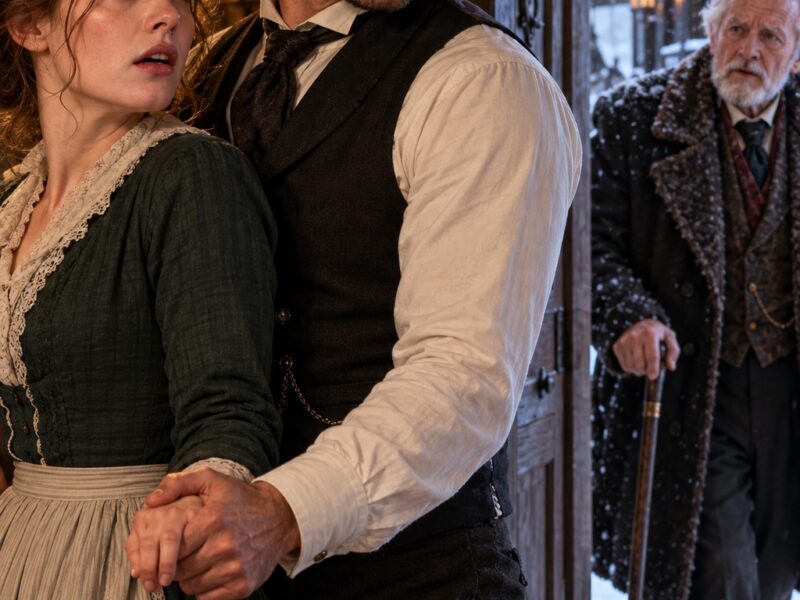
SHE ASKED A STARVING STRANGER TO PRETEND TO BE HER HUSBAND—BUT THE MOMENT HER FATHER ARRIVED, HE REVEALED A SECRET FROM THEIR PAST
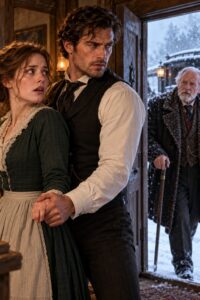
“I need you to marry me.”
Cora Whitmore had never imagined herself proposing marriage to a stranger in the middle of a snowstorm.
Especially not to a hungry drifter she had turned away from her door twenty minutes earlier.
But there she stood, thirty-two years old, clutching an urgent telegram against her chest while the mountain wind tugged at her skirts.
The man beside the woodpile stopped walking.
Snow gathered on the brim of his weather-beaten hat. One of his boots had sunk halfway into a drift, and his patched coat offered little protection against the bitter cold.
He turned slowly.
“Ma’am,” he said, “five minutes ago, you wouldn’t even let me chop your firewood.”
Cora swallowed.
“I know.”
“And now you’re asking me to marry you?”
“Not exactly.”
His eyebrow rose.
“Well, that’s a relief. For a moment there, I thought the altitude had finally gotten to somebody.”
Under different circumstances, she might have laughed.
Instead, she looked down at the telegram in her trembling hand.
Her father was coming.
Tonight.
And he expected to meet a husband who did not exist.
The stranger glanced toward the mountain inn behind her, where smoke rose thinly from the chimney and a loose shutter banged against the wall.
“Maybe you’d better start at the beginning,” he said.
Cora drew a shaky breath.
But explaining how she had arrived at this humiliating moment meant explaining three years of loneliness, two years of lies, and a marriage she had invented out of desperation.
And there was barely enough daylight left to prepare for the consequences.
Three winters earlier, Cora Whitmore had become a widow at twenty-nine.
Her husband had left the inn on a clear morning to help bring supplies from a settlement farther down the mountain. The sky had been bright, the air cold but manageable, and he had kissed her forehead before stepping outside.
He had promised to be home before supper.
By afternoon, the weather had changed.
By evening, the mountain road had disappeared beneath fresh snow.
The avalanche came without warning.
Men from the valley searched for two days before the worsening weather forced them to stop.
When they finally brought her husband’s belongings home, his coat was torn, and one glove was missing.
Cora remembered that glove more clearly than she remembered the funeral.
She remembered standing at the kitchen table, turning it over in her hands, unable to understand how something so ordinary could remain when the man who had worn it was gone.
For weeks afterward, she continued setting two plates at supper.
Sometimes she caught herself listening for his boots on the porch.
And when the wind moved through the old inn at night, she would wake with the foolish certainty that he had finally come home.
But the footsteps never came.
The inn remained.
So did the bills.
There was still flour to purchase, wood to split, a stable to repair, and a roof that leaked whenever the snow melted too quickly.
Cora learned to do the things her husband had once handled.
She learned which boards needed replacing and which could survive another season.
She learned how to stretch a pot of stew across two days.
She learned to smile at travelers while quietly calculating whether their payment would cover the coal bill.
Most of all, she learned how to answer the question everyone eventually asked.
“How are you managing all alone?”
“Perfectly well,” she would say.
It became such a familiar answer that she sometimes almost believed it.
Her father, Edgar, lived far away in a more comfortable town, where the winters were gentler and the streets were regularly cleared.
He had begged her to sell the inn.
“Come home, Cora,” he had written. “There is no shame in needing your family.”
But the inn was the last home she had shared with her husband.
Every floorboard held a memory.
The uneven mantel had been his work. The little bench outside the kitchen was where he used to sit after supper. Even the cracked blue bowl in the cupboard had been something he insisted on keeping because he liked the way she served soup in it.
Selling the inn felt dangerously close to admitting that the life they had built together was truly over.
So Cora stayed.
And her father worried.
He worried through letters, through visitors traveling up the mountain, and through every long winter silence when the roads became impassable.
Then he fell ill.
It was not the kind of illness that could be cured by a single visit from his daughter. He grew weak and stopped eating regularly. His sleep became restless. Every letter Cora received seemed to contain another reference to his failing strength.
She traveled down to see him once and found a man who had always seemed unbreakable sitting near the window, thinner than she remembered.
He took her hands.
“I cannot bear the thought of you alone up there.”
“Papa, I’m not helpless.”
“I know that.”
“Then please stop worrying.”
His eyes filled.
“Knowing you’re capable doesn’t make me any less your father.”
She had no answer.
After returning to the inn, Cora spent an entire evening staring at a blank sheet of paper.
She wanted to tell him something comforting.
Something that would allow him to sleep.
Something that might convince him that his daughter had a future beyond the grief she never discussed.
What she finally wrote was a lie.
A small one, she thought.
She told him she had met a kind gentleman.
His name was Desmond.
He was originally from Boston.
He enjoyed books, music, and long conversations by the fire.
Most importantly, he treated her well.
Her father replied with such immediate happiness that Cora cried over the letter.
For the first time in months, his handwriting looked steady.
He asked questions.
Was the gentleman respectable?
Did he have family?
Did he understand how difficult mountain winters could be?
Cora answered each question.
And with every answer, Desmond became more real.
When Edgar asked whether Desmond intended to marry her, she panicked.
Then she wrote that they already had married quietly.
She told herself it would be easier to explain someday.
Perhaps her father would recover fully.
Perhaps she would find the courage to confess.
Perhaps the entire foolish invention would simply fade from their correspondence.
Instead, Edgar began sending blessings for their marriage.
He wrote about grandchildren they might someday have.
He asked whether Desmond helped with the inn and whether he looked after Cora when the weather turned bad.
Her lies became increasingly elaborate.
Desmond played classical piano.
He read Shakespeare in the evenings.
He spoke a little French.
He preferred chamomile tea with honey to coffee.
He was refined, patient, and gentle.
Cora gave him all the qualities she imagined would reassure her father.
She also gave him qualities that had very little to do with the realities of maintaining an isolated mountain inn.
By the twenty-second letter, Desmond Whitmore had become a remarkably accomplished man.
And Cora had become trapped inside her own story.
She knew she should tell the truth.
Each time she tried, she imagined her father’s face falling, his hands trembling as he read the confession.
She remembered the way he had looked during his illness.
And she postponed the truth again.
Then came the morning Harlan appeared.
The storm had begun shortly after dawn.
Fine snow drifted across the porch while the wind rattled the old windows. The mountain road was still visible, though dark clouds were gathering above the higher ridges.
Cora had been struggling with a sack of flour when she heard the knock.
She wiped her hands on her apron and opened the front door only halfway.
A tall man stood outside.
He was broad-shouldered, dark-haired, and visibly exhausted.
His boots were worn nearly through at the toes. One cuff of his coat had been repaired with thread that did not match the fabric.
He carried a small traveling bundle and wore the cautious expression of someone who had grown accustomed to being refused.
“Morning, ma’am.”
His voice was low and respectful.
“Name’s Harlan. I was wondering if you had any work needing done.”
Cora looked past him.
There was no horse.
No wagon.
No companion waiting on the road.
Only one man standing alone in the falling snow.
“What kind of work?”
“Anything honest.”
He gestured toward the stable.
“Your barn door’s hanging crooked. I could fix that. Split your firewood, too. Maybe mend that shutter before the wind tears it loose.”
Cora’s gaze moved instinctively toward the woodpile.
The logs were heavy, and she had been putting off splitting them for days.
But she had also learned to be careful.
A woman alone in a remote inn could not afford to trust every stranger who appeared at her door.
“What would you charge?”
Harlan hesitated.
For a moment, his eyes moved past her toward the kitchen, where a pot of beef soup simmered on the stove.
He looked away almost immediately.
“A hot bowl of soup would be enough,” he said. “And somewhere dry to sleep tonight, if you’ve got the room.”
Cora felt an unexpected tightening in her chest.
He was hungry.
Not the ordinary kind of hungry that came from missing breakfast.
There was a hollowness beneath his cheekbones and an exhaustion in the way he held his shoulders.
He looked like a man who had been traveling on very little food for several days.
“That’s all?” she asked.
“Yes, ma’am.”
“You don’t want wages?”
“Wouldn’t turn down honest wages. But food and shelter would do.”
She should have found his answer reassuring.
Instead, it made her uncomfortable.
She recognized something in him.
That stubborn determination to ask for as little as possible.
The reluctance to admit how badly help was needed.
She had seen it in her own reflection often enough.
Still, fear and pride were difficult habits to overcome.
“I manage perfectly well on my own.”
Harlan looked at her for a moment.
Not with amusement.
Not with pity.
His gaze moved briefly toward the crooked stable door, then the loose shutter, then the towering stack of logs beside the building.
He plainly understood how much work waited around the inn.
But he did not embarrass her by pointing it out.
“Understood, ma’am.”
He tipped his hat.
“Hope the weather treats you kindly.”
Then he turned and started down the road.
Cora remained in the doorway.
She watched him walk away, his figure growing smaller against the white slope.
Something about the sight troubled her.
Perhaps it was the way he kept his shoulders straight even though he was clearly exhausted.
Perhaps it was the knowledge that she had a pot of hot soup sitting on the stove while a hungry man walked into worsening weather.
She took a step forward.
“Harlan—”
But the wind swallowed her voice.
He did not turn.
Cora stood there for another moment, feeling foolish.
Then she closed the door.
She tried to return to her work.
She lifted the flour sack, carried it to the pantry, and began counting the remaining jars of preserves.
But her thoughts kept returning to the stranger.
His boots.
His hunger.
The careful way he had asked for help without making her feel obligated.
She was reaching for a jar of peaches when she heard approaching hoofbeats.
A rider came up the road, hunched against the snow.
Cora hurried outside.
The man wore the familiar coat of the valley telegraph messenger.
“Mrs. Whitmore!”
He pulled his horse to a stop.
“Urgent message for you.”
She signed for the folded paper and waited until he had turned his horse around before opening it.
The telegram contained only a few lines.
ARRIVING TONIGHT. STOP.
EAGER TO MEET YOUR HUSBAND DESMOND. STOP.
YOUR LOVING FATHER, EDGAR.
Cora read it once.
Then again.
Her fingers went cold.
“No,” she whispered.
The messenger was already riding away.
“No, no, no.”
Her father had never mentioned making the journey.
The mountain road was dangerous even in good weather.
He was older now, and his health had only recently improved.
Yet he was coming.
Tonight.
To meet Desmond.
The nonexistent husband she had described in twenty-two letters.
Cora looked toward the empty road.
Then she saw a dark figure near the woodpile farther down the slope.
Harlan.
He had stopped to adjust the strap on his traveling bundle.
Before reason could intervene, Cora gathered her skirts and ran.
“Harlan!”
He turned.
She nearly slipped on the icy path.
“Harlan, wait!”
He stepped toward her instinctively, reaching out as she caught her balance.
“Careful.”
She seized his sleeve.
“I need you to marry me.”
Now, with the telegram clutched in her hand and the stranger staring at her in disbelief, Cora understood just how absurd she sounded.
Harlan listened without interrupting as she explained.
She told him about her husband’s death.
About the inn.
About her father’s illness.
About the imaginary gentleman from Boston.
And about the twenty-two letters that had turned one foolish lie into an entire marriage.
When she finished, Harlan stared at her.
“So you invented a whole gentleman?”
“Yes.”
“Gave him a name?”
“Yes.”
“Told your father you married him?”
Cora closed her eyes.
“Yes.”
“And you’ve been writing letters about this fellow for two years?”
“Twenty-two letters.”
He removed his hat.
“Lord have mercy.”
“I know how it sounds.”
“Ma’am, I don’t believe you do.”
A nervous laugh escaped her.
It surprised them both.
Harlan studied her for another moment.
“What exactly are you asking me to do?”
“Pretend to be Desmond. Just while Papa is here.”
“For how long?”
“Three days. Perhaps four.”
“And after that?”
“I’ll tell him you’ve gone away on business.”
Harlan gave her a long look.
“Another lie.”
Her face burned.
“I know.”
“Then another one after that, I suppose.”
“Probably.”
He rubbed a hand over his forehead.
“You’re in a mighty deep hole, Mrs. Whitmore.”
“I am painfully aware.”
“And your plan is to keep digging?”
That should have made her angry.
Instead, her eyes filled with tears.
“I don’t know what else to do.”
Something changed in his expression.
Cora looked away, embarrassed by the sudden weakness in her voice.
“My father almost died from worrying about me. When I told him I had remarried, he started eating again. Sleeping again. He began taking walks. He wrote about the future.”
She pressed the telegram against her chest.
“He was happy, Harlan. Truly happy. I couldn’t bear to take that away.”
For several seconds, neither spoke.
Snow settled between them.
Harlan glanced toward the inn.
Its windows looked small and yellow against the gray afternoon.
Then he looked back at her.
“Let’s get inside before you freeze.”
Cora searched his face.
“Does that mean you’ll help?”
“It means you’re shivering, and I haven’t had anything warm to eat since yesterday.”
He paused.
“And I suppose we both have problems worth discussing.”
Twenty minutes later, Harlan sat at the kitchen table with a steaming bowl of beef soup.
Cora placed thick slices of bread beside him, along with butter and a mug of water.
He removed his hat and folded his hands for a brief, silent moment.
Then he began eating.
He did not rush at first.
But after several spoonfuls, Cora noticed how carefully he avoided wasting anything.
He used a piece of bread to collect the last drops of broth.
When she offered a second bowl, he looked almost startled.
“Are you certain?”
“There’s plenty.”
He nodded.
“Thank you.”
The words were simple, but something in his tone made her throat tighten.
She refilled his bowl.
Then she placed a stack of letters on the table.
Harlan looked from the food to the papers.
“What’s all that?”
“My correspondence with Papa.”
“All of it?”
“The parts concerning Desmond.”
He slowly set down his spoon.
“That’s quite a stack.”
Cora pulled out the first letter.
“I thought you should know who you’re supposed to be.”
He read it while continuing to eat.
Then he reached for the second.
By the third, his forehead had begun to crease.
“Your husband speaks French?”
“A little.”
“How little?”
“I never specified.”
“That may be the first sensible thing you’ve done.”
Cora sighed.
He continued reading.
“Plays classical piano?”
“Yes.”
“Beautifully?”
She winced.
“Apparently.”
Harlan looked toward the battered upright piano in the corner.
“Does that thing work?”
“Most of the time.”
“That’s unfortunate.”
He returned to the page.
“Reads Shakespeare every evening?”
Cora nodded.
Harlan held up his scarred hands.
“Cora, I once spent six months in a logging camp where the fanciest entertainment was watching two men argue over a mule.”
Despite herself, she smiled.
He turned another page.
“Desmond dislikes coffee?”
“Very much.”
“Only drinks chamomile tea with honey?”
“Yes.”
“I drink coffee black.”
“I noticed.”
“And he doesn’t hunt?”
“No.”
“Never?”
“He finds it unpleasant.”
Harlan leaned back.
“I’ve lived off the mountains half my life.”
Cora covered her face.
“This is hopeless.”
“Not yet.”
He lifted another letter.
Then stopped.
“Your husband is afraid of heights?”
She peered between her fingers.
“Yes.”
Harlan stared at her.
“We’re on a mountain.”
“I realize that.”
“A very high mountain.”
“Yes, Harlan.”
He looked around the room, then back at the letter.
Finally, he laughed.
It was not the polite sound a gentleman might make after hearing a clever remark.
It came from deep in his chest, sudden and helpless.
He laughed until he had to put the page down.
Cora tried to look offended.
But the absurdity of the situation finally caught up with her.
A laugh escaped.
Then another.
And suddenly, the two of them were sitting across from each other at the kitchen table, laughing like children who had been caught doing something foolish.
Cora bent forward, covering her mouth.
Tears rolled down her cheeks.
For once, they were not tears of grief.
When she finally managed to breathe, Harlan wiped his eyes.
“I’m sorry,” he said. “But you could have invented a blacksmith. Or a farmer. Somebody who knows one end of an ax from the other.”
“I wanted Papa to think I was being cared for.”
“You think a piano player can do that better than a man who chops firewood?”
She looked at him.
The laughter faded slowly.
“No,” she said.
Harlan’s expression softened.
For a moment, neither moved.
The kitchen had become unexpectedly quiet.
But it was not the same silence Cora had grown accustomed to over the past three years.
This one felt shared.
She became acutely aware that another person was sitting at her table, his coat drying beside the stove, his empty bread plate pushed slightly to one side.
For the first time in years, the inn sounded less like an abandoned house.
Harlan tapped the letters into a neat stack.
“Cora, I’ll help you.”
Her breath caught.
“You will?”
“I’ll do my best to play this Desmond fellow.”
She reached across the table and squeezed his hand.
“Thank you.”
He glanced at their joined hands.
His fingers were rough, with small scars across the knuckles.
For an instant, he seemed surprised by the contact.
Then he gently withdrew.
“But understand something.”
“Of course.”
“I’m agreeing to pretend. Nothing more.”
Cora straightened.
“Naturally.”
“Three meals a day, somewhere to sleep, and that silver coin you offered.”
“Yes.”
“And if your father asks something I can’t answer?”
“I’ll help.”
“If he wants me to speak French?”
“Tell him you have a headache.”
Harlan almost smiled.
“If he wants me to play the piano?”
Cora looked toward the instrument.
“We’ll pray he doesn’t.”
He leaned back.
“And what do we do if he wants to know why a refined Boston gentleman has hands that look like he’s been wrestling timber for twenty years?”
She studied his hands.
“We’ll say you enjoy manual labor.”
“I thought I was afraid of heights and disliked hunting.”
“You can still enjoy manual labor.”
“Then Desmond is a complicated fellow.”
“He is.”
Harlan shook his head.
“I hope your father is a forgiving man.”
Cora’s smile faltered slightly.
“He can be.”
There was something in her tone that made Harlan look up.
But he did not ask.
Instead, he stood.
“First thing’s first. If I’m going to be your husband, I’d better stop looking like I slept in a barn.”
Cora glanced at his worn coat.
The thought of dressing him in another man’s clothes gave her a moment’s hesitation.
Her late husband’s belongings were still stored upstairs.
She had never found the courage to give them away.
Some items remained exactly where he had left them.
The best waistcoat hung inside the wardrobe.
A clean white shirt rested in the bottom drawer.
A pair of dark trousers had been folded carefully and placed beneath a spare blanket.
Cora climbed the stairs while Harlan remained in the kitchen.
She opened the wardrobe and stood motionless.
The familiar scent of cedar reached her.
For a moment, she remembered her husband buttoning that very waistcoat before a Christmas gathering, smiling at her because she had insisted he dress properly.
“You’d think we were dining with the governor,” he had teased.
She had straightened his collar anyway.
Now the garment hung untouched.
Cora ran her fingers over the fabric.
She had spent years preserving the things he left behind, as though keeping them unchanged could somehow keep him close.
But downstairs, a hungry stranger was waiting to help her through a mistake she had made entirely on her own.
She took the waistcoat from the hanger.
Then the shirt.
Then the trousers.
When she returned, Harlan stood near the stove, examining the loose shutter through the window.
“These belonged to my husband,” she said quietly.
He turned.
His expression changed.
“Are you sure?”
“They should fit.”
“Cora, I can make do with what I’ve got.”
“No.”
She looked down at the clothes.
“They’ve been hanging upstairs for three years.”
Harlan did not reach for them immediately.
He seemed to understand that the hesitation had nothing to do with their condition.
Finally, he said, “I’ll take good care of them.”
It was such a small promise.
Yet it steadied her.
She handed him the bundle.
“There is warm water upstairs. The washstand is at the end of the hall.”
He nodded.
Then paused.
“Thank you for the soup.”
“You’ve already thanked me.”
“Didn’t make it any less good.”
She watched him climb the stairs.
Only when his footsteps disappeared did she realize she was smiling.
Cora went back to work.
She polished the dining table.
She straightened the curtains.
She replaced the chipped cups with the good china her mother had given her years earlier.
Then she prepared a pot of chamomile tea, even though she suspected Harlan would rather have coffee.
She rehearsed their invented history under her breath.
Desmond from Boston.
Accomplished pianist.
Fond of literature.
Met Cora two years ago.
Married quietly.
She went over the details until they began to sound almost believable.
Yet beneath the frantic preparations lay a more troubling thought.
What kind of woman brought a stranger into her home and asked him to impersonate her husband?
And why had he agreed?
She told herself the answer was simple.
He needed food and shelter.
She needed help.
It was an arrangement.
Nothing more.
But she could not forget the way he had looked at her when she described her father’s illness.
Nor the way he had asked whether she was certain before accepting her late husband’s clothes.
He did not behave like the sort of desperate stranger she had imagined when she first opened the door.
There was a reserve about him.
A carefulness.
Occasionally, his words carried the easy confidence of someone who had once moved through a very different world.
She dismissed the thought.
Hardship could change any man.
And the mountains held more than their share of complicated stories.
An hour later, footsteps sounded on the stairs.
Cora turned from the dining table.
The teapot almost slipped from her hands.
Harlan stood at the bottom of the staircase.
The worn boots were still his, but the rest of him seemed transformed.
His dark hair had been washed and combed neatly back. His face was freshly shaved, revealing a strong jaw and a faint scar near his chin.
The white shirt fit across his broad shoulders.
The waistcoat sat close to his frame.
He had rolled down the sleeves and fastened the cuffs, and though his hands still bore the unmistakable marks of hard labor, he carried himself with a surprising natural dignity.
He looked handsome.
Not in the polished, delicate fashion Cora had imagined when inventing Desmond.
Something more substantial.
There was strength in his posture and a quiet steadiness in his eyes.
For a moment, she could only stare.
Harlan looked down at himself.
“What?”
“Nothing.”
“Something wrong with the clothes?”
“No.”
“Too tight?”
“No.”
He glanced at her expression.
“Cora?”
She found her voice.
“They’re perfect.”
His gaze softened.
“Your husband must’ve been about my size.”
She nodded.
“Yes.”
Neither said anything for a moment.
Cora found herself looking at the waistcoat, remembering the man who had worn it before.
But Harlan did not resemble her late husband.
And strangely, that helped.
The clothing carried a memory.
The man standing before her was someone entirely different.
He seemed to understand that she needed a moment.
So he walked toward the table and glanced at the teapot.
“Chamomile?”
“With honey.”
He sighed dramatically.
“Well, marriage requires sacrifice.”
Cora laughed.
A small, genuine laugh.
Harlan smiled.
Then something outside interrupted them.
The faint clatter of wheels.
Cora stopped moving.
At first, she thought it was the wind shifting a loose board.
Then came the unmistakable sound of horses climbing the road.
A carriage.
She hurried to the window.
Through the falling snow, a dark carriage emerged between the trees.
Its wheels cut deep tracks into the white road.
Two horses strained against the incline.
The driver leaned forward beneath a heavy cloak.
And on the carriage door, barely visible through the snow, was a familiar crest.
Cora’s breath caught.
“Papa.”
Harlan came to stand beside her.
The carriage pulled toward the inn.
“He’s early,” she whispered.
Harlan watched it approach.
“Looks that way.”
Cora pressed one hand against the cold window.
She could already see her father through the glass.
Edgar sat inside, his head tilted toward the passing scenery.
Even from a distance, he looked older.
Smaller.
The sight struck her with unexpected force.
She had spent so much time imagining his reaction to her imaginary husband that she had not prepared herself for what it would feel like to see him again.
The carriage stopped.
The driver climbed down and opened the door.
Edgar appeared slowly.
He wore a dark traveling coat and leaned heavily on a walking stick.
His hair, once thick and dark, had grown almost entirely white.
He placed one boot on the step, paused to steady himself, then descended into the snow.
When he looked toward the inn, his face brightened.
He smiled.
Cora felt something inside her twist.
He had made this difficult journey because he believed his daughter was happy.
Because he believed she had found someone to share the long winters with.
Because she had convinced him that Desmond Whitmore was real.
And now the lie was about to walk through the front door wearing her dead husband’s waistcoat.
“I can’t do this,” she whispered.
Harlan turned toward her.
“You’ve come this far.”
“He looks so old.”
“He made the trip.”
“He shouldn’t have. The road is dangerous.”
“Then we’d better get him inside where it’s warm.”
Cora nodded without moving.
Outside, Edgar spoke to the driver and pointed toward the stable.
The familiar sound of his voice carried faintly through the snow.
It brought back a dozen childhood memories at once.
Her father calling her in from the garden.
Her father reading by the fire.
Her father telling her there was no shame in being afraid, provided she did not let fear decide everything for her.
She closed her eyes.
What would he think if he knew what she had done?
Harlan reached for her hand.
The gesture was careful.
Almost tentative.
“Cora.”
She looked at him.
His fingers closed gently around hers.
“If we’re going to convince him, you need to breathe.”
She took one unsteady breath.
Then another.
“You make it sound simple.”
“It isn’t.”
“Then why are you so calm?”
Harlan glanced toward the carriage.
For the first time since she had met him, his expression seemed genuinely troubled.
“I’m not as calm as I look.”
She frowned.
“What does that mean?”
He did not answer immediately.
Instead, his eyes followed Edgar as the older man began walking toward the porch.
Something in Harlan’s posture changed.
His shoulders stiffened.
The warmth faded from his face.
He looked like a man who had suddenly recognized a danger he had hoped never to encounter again.
Cora felt his hand tighten around hers.
“Harlan?”
He looked down at her.
“Before we do this, there’s something you should know.”
Her stomach dropped.
Outside, footsteps creaked on the porch.
“What?”
He drew a breath.
“I wasn’t entirely truthful about why I came to your door this morning.”
Cora stared at him.
“What do you mean?”
A sharp knock echoed through the inn.
“Cora!”
Her father’s voice was muffled by the heavy door.
“Darling, it’s Papa!”
Cora took an instinctive step forward.
But Harlan did not release her hand.
“Harlan, please. He’s standing outside.”
“I know.”
“Then whatever this is, it can wait.”
His eyes moved toward the door.
“No. I don’t think it can.”
Another knock.
Louder this time.
“Cora? Are you there?”
Harlan leaned closer.
His voice dropped so low she almost missed the words.
“I didn’t come to this mountain by accident.”
Cora stopped breathing.
The room seemed to grow strangely quiet around them.
The ticking clock.
The hissing stove.
The wind rubbing snow against the windows.
All of it faded behind the sudden weight of his confession.
“What are you saying?”
Harlan looked toward the doorway.
Then back at her.
“And if that’s Edgar standing outside,” he said, “then I believe your father and I have met before.”
Cora felt the blood drain from her face.
For a moment, she could only stare.
Then a memory surfaced.
Her father’s last letter.
She had read it hurriedly several days earlier, distracted by a leaking roof and the need to order more flour.
Most of it had been ordinary.
He had asked about the weather.
He had mentioned his improving health.
He had sent affectionate greetings to Desmond.
But near the end, the tone had changed.
There had been a warning.
A brief, uneasy reference to a man from his past.
A man he desperately hoped would never find their family again.
At the time, Cora had dismissed it as the lingering worry of an aging father.
Now those words returned with terrible clarity.
She looked at Harlan’s face.
The freshly shaved jaw.
The scar near his chin.
The tired eyes that had seemed merely sad that morning.
Suddenly, she understood how little she knew about him.
Not where he came from.
Not what he had left behind.
Not even why he had chosen her lonely inn when there were other places to seek shelter.
Outside, her father called again.
“Cora, dear?”
She tried to pull her hand away.
Harlan released it at once.
But the look on his face stopped her.
He was not smiling.
He was not teasing.
And for the first time since she had invited him inside, he looked afraid.
Not of the snow.
Not of hunger.
Of the man waiting outside.
Cora glanced toward the telegram lying on the table.
Then toward the twenty-two letters beside it.
Everything she had done to protect her father suddenly seemed terribly foolish.
She had invited a stranger into her house.
Dressed him in her dead husband’s clothes.
Asked him to impersonate a man who had never existed.
And now he was telling her that he knew Edgar.
That he had come to the mountain for a reason.
That the entire arrangement might have begun long before she opened her door that morning.
A cold draft swept through the hallway.
The latch moved.
Her father’s voice sounded just beyond the entrance.
“Cora?”
And before she could ask Harlan another question, the front door began to open.









