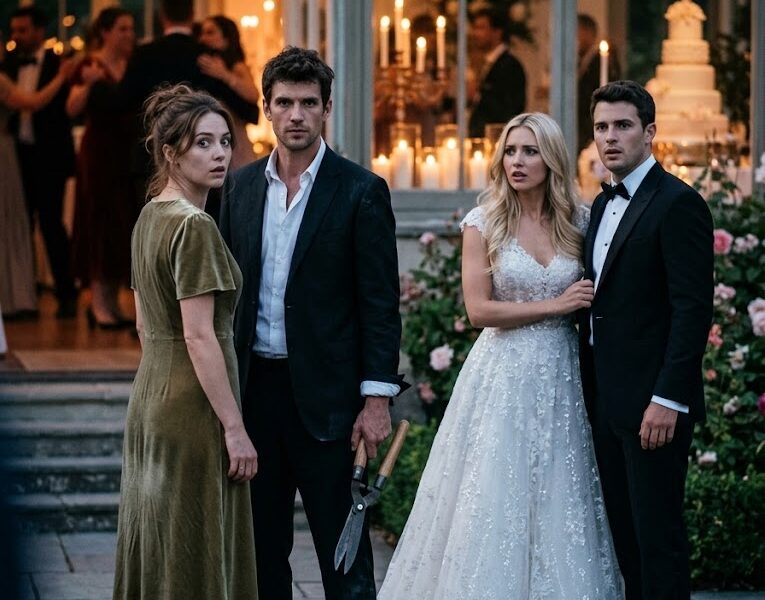
SHE BAKED HER EX’S WEDDING CAKE—THEN THE MYSTERIOUS MAN SHE DANCED WITH SAID, “YOU’RE GETTING MARRIED IN MY HOUSE.”
The last row at a wedding is its own country.
Dela Marsh learned that in the first ten minutes.
She sat in the final white chair of the final white row beneath a sprawling sailcloth tent on a private estate in Connecticut, close enough to the open seam that September air slipped through and lifted the edge of her dove-gray dress.
Two hundred and forty guests leaned toward the altar as though pulled by the same invisible wire.
Dela leaned nowhere.
At the altar stood Julian Crewe.
Her Julian once.
Someone else’s Julian now.
He wore a charcoal morning coat and held his hands loosely in front of him, chin tilted upward in that familiar way he had whenever he was about to say something he wanted people to believe.
Two years ago, Dela had loved that expression.
Two years ago, she had mistaken confidence for certainty, certainty for safety, and safety for love.
Now she pressed her thumb against her forefinger in her lap.
A baker’s pinch.
The gesture her hands made when checking flour.
The gesture they made now when there was no flour at all—only the cold weight of a wedding program bearing Julian Crewe’s name beside another woman’s.
CAMILA BANCE & JULIAN CREWE.
Dela stared at the gold lettering until it blurred.
She should not have been there.
That thought kept rising inside her like a cork someone was trying to hold underwater.
She had not been invited to Julian’s wedding.
She had been hired to bake it.
Six weeks earlier, a wedding coordinator wearing a headset and the expression of a woman permanently three minutes behind schedule had walked into Marsh & Honey, Dela’s small bakery on the unfashionable end of Market Street.
The woman had tasted one forkful of Dela’s brown-butter honey cake.
Her eyes had closed.
“Exquisite.”
Everyone said that word when they wanted something.
Ten minutes later, she had booked Marsh & Honey to provide the centerpiece cake for what she called “one of the most important weddings of the season.”
Dela had signed the contract before seeing the names.
By the time she did, the deposit had already become flour, rent, butter, electricity and a replacement mixer whose predecessor had begun smoking during a batch of brioche.
The deposit was nonrefundable.
So was survival.
Marsh & Honey occupied a narrow storefront between a lingerie boutique and a retail space that had housed three different failures in two years. The sign above Dela’s door still carried her mother’s name because Dela had repainted those letters herself twice and could neither afford a professional sign painter nor bear to erase them.
The bakery smelled better than it looked.
That was how it survived.
People came for brown-butter honey cake and stayed because Dela remembered whether they took cinnamon in their coffee. She knew whose daughter was allergic to walnuts, whose husband had died in February, which teacher wanted the corner brownie and which exhausted nurse needed her order handed over without conversation.
But kindness did not change arithmetic.
The ledger in the back office said they had until February.
March if winter was merciful.
Winter was never merciful.
So Dela had baked Julian’s wedding cake.
Five tiers.
Ivory buttercream.
Gold leaf.
Hand-shaped sugar magnolias.
She had finished the flowers at two in the morning with the radio playing quietly while Ruben Alvarez, her assistant, friend and unofficial guardian against catastrophe, slept sitting upright against sacks of flour because he refused to let her work alone.
At sunrise, they had loaded the tiers into the refrigerated van.
Dela drove forty miles with her heart lodged somewhere behind her tongue, whispering a prayer she did not believe at every pothole.
At Harley Court, she carried the cake through the service entrance in pieces and assembled it beneath a chandelier that probably cost more than her bakery.
Her hands never shook.
Her hands were the one part of her that had never betrayed her.
When she placed the final sugar magnolia on the top tier, she stepped back.
The cake gleamed beneath the crystal light like something from a life she would never be invited into.
She thought they would let her leave.
They did not.
“You’ll stay, of course.”
Dela had turned.
Camila Bance stood in the kitchen doorway wearing a silk bridal robe, her blond hair half pinned and her face already professionally made into expensive serenity.
She was beautiful in the way certain rooms were beautiful—carefully, intentionally, with no object allowed to exist by accident.
Camila looked Dela over.
“Julian told me everything about you.”
Her smile was warm.
Melted sugar warm.
And just as quick to harden.
“It would mean so much if you stayed. We’re all adults now, aren’t we?”
Dela said nothing.
Camila stepped closer.
“Sit in the back. Enjoy yourself. You’ve earned it.”
You’ve earned it.
Those words had governed most of Dela’s life.
Work hard enough and maybe you earn your place.
Be useful enough and maybe people let you stay.
Make yourself easy enough to keep and perhaps nobody asks you to leave.
Camila knew none of that.
Which somehow made the cruelty cleaner.
Dela should have refused.
Instead she thought about the final payment.
The photographs.
The Bance name on Marsh & Honey’s website.
The recommendation that might keep her ovens running through February.
So she washed buttercream from her hands, changed into the emergency gray dress she kept folded in the van, walked around the estate rather than through it, and found the last chair in the last row.
Now the string quartet changed songs.
Everyone stood.
Dela stood too because remaining seated would have been a statement, and she had spent two years learning not to make those.
Camila appeared at the end of the aisle on her father’s arm.
Forty thousand dollars of silk whispered across the grass.
Julian’s chin lifted.
Dela’s body checked itself for pain.
The way you test an old burn to see whether it still hurts.
It did.
Just not where she had expected.
She did not want Julian back.
That surprised her.
The ache was quieter than jealousy and deeper than anger.
I want to be the person someone walks toward.
The thought appeared so clearly that Dela nearly looked around to see who had said it.
She sat after the vows and folded her hands together.
For the duration of an entire marriage ceremony, she felt completely alone in a tent containing 240 people.
If anyone had asked, she would have said she preferred it.
She would have been lying.
Dela had become very good at that particular lie.
She had been telling it since she was nine years old, in a kitchen that smelled like somebody else’s dinner, being told to make herself useful if she wanted to stay.
Beyond the tent, beside a stone terrace overlooking the estate’s old rose garden, a man stood alone.
Dela noticed him only once.
Tall.
Dark suit.
Hands in his pockets.
He watched the wedding with the detached expression of someone observing a country for which he had no passport.
She assumed he was a guest who had escaped for air.
She was wrong.
Everyone at the wedding was wrong about Adam Hale.
That was largely because Adam had spent most of his adult life arranging things that way.
Harley Court belonged to him.
The Bances had rented the estate for the weekend, although “rented” hardly described the amount they had paid to occupy the conservatory, gardens and west lawn for forty-eight hours.
Guests referred to Adam, when they referred to him at all, as “the owner.”
They said it in the tone used for boilers, landscaping and weather.
Adam preferred that.
He had one request for the wedding.
Do not cut the old roses.
That morning he’d overheard the coordinator relay it through her headset.
“The owner requests that the roses remain untouched, if it isn’t too much trouble.”
Adam almost smiled.
If it isn’t too much trouble.
He still used that phrase himself.
Money had removed many things from his life.
It had never removed that sentence.
His father had used it with people who outranked him.
His grandfather before him.
Adam had grown wealthy enough that he never needed to say it again.
He said it anyway.
Some habits grew beneath money’s reach.
He had come down to the terrace that afternoon for a reason having nothing to do with Julian or Camila.
It was the last Saturday in September.
Forty years earlier, Adam’s father, Thomas Hale, had pushed wheelbarrows of soil along the same gravel path where bridesmaids now struggled in designer heels.
Thirty years earlier, a nine-year-old Adam had been stopped at Harley Court’s kitchen entrance.
Not for people like you.
He could still hear the exact voice.
Four years ago, Adam had purchased the estate from the descendants of the family who had employed his father.
He had bought every acre.
Every fireplace.
Every door.
And still, sometimes, he could not pass that kitchen entrance without his pulse changing.
Inside his pocket was a small brass key that opened a garden gate removed decades ago.
His father’s key.
Adam turned it between his fingers while strangers married beneath his roof.
Then the ceremony ended.
Guests spilled toward the glass conservatory for champagne.
A woman in a gray dress escaped in the opposite direction.
Adam saw her moving quickly, head lowered, the unmistakable walk of someone trying to reach privacy before her face stopped cooperating.
She came toward the terrace.
Toward him.
Apparently without seeing him.
She stopped at the stone balustrade six feet away and placed both palms flat against it.
Then she released one hard breath.
Like someone setting down something she’d been carrying for years.
“The roses held up well.”
Dela jumped.
She turned.
The tall stranger nodded toward the garden.
“The arrangements,” he added. “I heard they gave you trouble with the height.”
Dela stared.
He had calm eyes.
A good suit.
A face that seemed practiced at revealing very little.
He thought she was the florist.
She could have corrected him.
She could have said, I’m the baker.
She could have said, I’m the groom’s ex-girlfriend.
I’m the woman the bride seated in the last row because humiliation looks more tasteful when it wears a smile.
Instead, Dela looked at a stranger who knew none of those things and realized he had accidentally handed her a clean version of herself.
For once, she could be nobody’s history.
She took it.
“They always give me trouble with the height,” she said.
Adam glanced at the conservatory.
“People want flowers to be invisible and overwhelming at the same time.”
“That sounds like most things people want.”
A laugh escaped Dela.
Small.
Unplanned.
Her first of the day.
She pressed her lips together afterward as if apologizing for it.
Adam noticed.
Something in his expression moved by half a degree.
A heavy door pushed gently from the other side.
“You should probably be inside,” Dela said.
“The reception is that way.”
“So is the champagne.”
“The good champagne.”
“I know where it is.”
“You’re avoiding it?”
“Yes.”
Dela looked back toward the tent.
“So am I.”
“Then we have something in common.”
He shifted so they were both facing the roses rather than each other.
Dela would understand much later that it was kindness.
He was giving her time to dry her eyes without admitting he had seen them.
“Adam.”
“Dela.”
No last names.
Florists, Dela decided irrationally, did not require last names.
Florists were free.
They stood there while sunlight softened over the orchard.
Adam did not ask what she did for a living.
Did not ask who she knew.
Did not perform the tiny social audit wealthy people seemed to conduct within minutes of meeting someone.
Instead he asked what she thought about the pear trees trained along the southern wall.
Dela knew nothing about pear trees.
She knew plenty about sugar and improvisation.
“They look overfed and lonely.”
Adam glanced at her.
“Overfed?”
“Like most things at weddings.”
A sound came from him.
Almost a laugh.
Low and rusty, as though the instrument had been left inside its case for years.
Music began inside the conservatory.
“Soon they’ll dance,” Adam said.
“I don’t dance.”
“No?”
“I work weddings. I’m furniture at weddings.”
He looked directly at her then.
Not appraising.
Not flattering.
Seeing.
Dela found that somehow more frightening.
“I find that difficult to believe.”
“Believe it. I’m always in the back.”
Adam extended his hand.
“Then dance with me in the back.”
Dela stared at his palm.
“No one watches the back,” he said. “You told me yourself. Safest country in the whole wedding.”
She should have said no.
She had a cake to watch.
A face barely put back together.
A life built around not being noticed.
Adam was a stranger.
And strangers had become a category she no longer trusted.
But he had said the back as if it were somewhere a person might choose to stand instead of somewhere she had been sent.
No one had ever made the last row sound like a choice.
“May I?”
There was no impatience in the question.
No assumption.
Just an open hand.
Dela took it.
They danced at the dim edge of the conservatory.
Adam was not flashy.
He was careful.
He guided without gripping.
His hand rested so lightly at her back that she could have stepped away at any moment.
That was precisely why she stayed.
“You’re counting,” he murmured.
“I am not.”
“One. Two. Three.”
Dela looked horrified.
Adam’s mouth shifted.
“It’s fine. I count too.”
“You do?”
“Only where no one notices.”
He turned them slowly.
“My father taught me. He said a man who can’t dance can at least learn not to step on someone’s feet. According to him, that was most of dancing and most of life.”
“He sounds smart.”
“He knew everything worth knowing and almost nothing that paid.”
Something closed behind Adam’s eyes.
Dela recognized it.
She had a door exactly like that inside herself.
So she did not push.
For three minutes, Dela Marsh was not furniture.
She was simply a woman in a gray dress being held carefully by a man who believed she arranged flowers.
And the cruelest part was how little it took.
A hand at her back.
An invitation.
The quiet certainty of a stranger that she belonged in the room.
Dela had been hungry so long she’d stopped calling it hunger.
Then the room noticed them.
It began near the bar.
A woman touched another woman’s wrist.
A head turned.
Then another.
Whispers traveled beneath the music.
Margaret Crewe, Julian’s formidable mother, spotted Dela first.
Recognition iced over her expression.
At the head table, Camila saw her next.
The bride’s smile disappeared.
Because the woman she had placed in the last row was dancing with the only man in the county half the room had spent the afternoon trying—and failing—to impress.
Dela stiffened.
“Where did you go?” Adam asked softly.
“What?”
“You disappeared.”
“They’re looking at us.”
“They look at everything.”
He turned them.
Then deliberately positioned his body between Dela and the room.
A wall.
A courtesy.
A gesture she would replay for weeks.
It lasted perhaps ten seconds.
Then fingers closed around Dela’s arm.
“There you are.”
Camila stood beside them.
Radiant.
Furious.
Hardened sugar in a white dress.
“Dela, sweetheart, you must be exhausted. You’ve been working since dawn.”
Her eyes flicked toward Adam.
“Let me have someone walk you back to your van. We can’t have the help fainting in the conservatory.”
The help.
Then Camila gave Adam a completely different smile.
“I’m terribly sorry. Has she been bothering you?”
Adam looked at Dela.
Camila continued before either could answer.
“She did the cake. Marsh & Honey. She’s wonderful with sugar.”
Cake.
The word hit marble.
Dela felt her gray dress turn back into an apron.
She did not look at Adam.
She couldn’t bear to watch the recalculation.
Oh.
Staff.
Service.
Not one of us.
She had seen that little shift on faces all her life.
“Marsh & Honey,” Adam repeated.
His voice had not changed.
“The brown-butter honey cake?”
Camila blinked.
“Yes.”
“I had a piece this afternoon.”
“You did?”
“In my kitchen. Someone left one for the staff.”
Adam’s eyes returned to Dela.
“Best thing I’ve tasted in years.”
Dela finally looked up.
There was no embarrassment on his face.
No disappointment.
Only something reorganizing itself.
“I didn’t know whose hands made it.”
He turned toward Camila and offered his hand.
“I don’t believe we’ve been properly introduced, although half the county has been attempting it all afternoon.”
Camila’s face altered.
“Adam Hale.”
He nodded mildly toward the ceiling.
“You’re getting married in my house.”
Silence.
Real silence.
Even the music seemed suddenly inadequate against it.
Camila’s hand went to her throat.
“You own—”
“The roses you’re not supposed to cut,” Adam said. “Among other things.”
Then he looked at Dela.
He had heard help.
He had heard cake used as a coin tossed onto marble.
And instead of stepping away, Adam said quietly:
“So you’re not actually the florist.”
Dela swallowed.
“No.”
“What are you?”
Her voice came out small.
“I’m the cake.”
For the first time that afternoon, Adam Hale smiled fully.
“Yes,” he said. “You are.”
He said it as though the cake had been the most important thing anyone had been all day.
And against two years of careful training, Dela looked directly into the eyes of the man who owned the mansion.
“I should check it before they cut it.”
Then she walked away.
The cake was served at eight.
Dela packed her tools at nine.
By ten, she was driving home with the heater blasting and both hands gripping the steering wheel.
She told herself the day was finished.
She did not think about Adam Hale.
Because thinking about him felt like opening a door she had no business touching.
Monday brought the final wedding payment.
The promised recommendation did not arrive.
Wednesday brought something else.
A letter.
Cream paper.
No crest.
Square, old-fashioned handwriting.
Miss Marsh,
Harley Court hosts its annual Harvest Festival on the second Saturday of November. Three hundred guests. Proceeds support restoration of the historic orchard.
For years, our desserts have come frozen from a commercial supplier.
This year I would prefer to buy them from someone who builds things at two in the morning with the radio playing.
The proposed fee is enclosed.
I’ve made it generous because I am told that is how these arrangements are properly handled, and because I suspect you will earn every cent.
If it isn’t too much trouble.
Adam Hale.
Dela read it four times.
On the fourth, she looked at the fee.
It wasn’t generous.
It was absurd.
Six months of breathing room.
Six months of rent, payroll and electricity folded inside one cream envelope.
But the most dangerous line was not the number.
It was two in the morning with the radio playing.
Adam remembered.
Everything.
“You have that face.”
Ruben was leaning over her shoulder.
“What face?”
“The owner face.”
“There is no owner face.”
“The man you’ve mentioned eleven times while insisting you’ve mentioned him zero times?”
Dela handed him the letter.
Ruben read it.
Then read the fee.
His joking expression vanished.
“Dela.”
“I know.”
“This is winter.”
“I know.”
“This keeps the lights on.”
“I know.”
He looked at her.
“Why is he doing it?”
There it was.
The question Dela’s childhood had trained her to ask whenever kindness entered a room.
What do they want?
What will you owe?
What will it cost later?
“Pity,” she said.
Ruben stared.
“Or charity.”
“Oh, absolutely.”
She frowned.
“Thank you.”
“No, I’m saying that’s insane.”
“Ruben—”
“He likes you.”
Dela laughed once.
“No.”
“He thought you were a florist, discovered you’re a baker, and then mailed you what is basically a love letter about cake.”
“It is a contract.”
“I returned a sourdough loaf this morning because a man said it was too spiritually dense, Dela. Romance is not my field. But even I know a love letter about cake when I’m reading one over somebody else’s shoulder.”
Dela accepted the festival.
For the fee, she told herself.
Only for the fee.
Harley Court in November was not the estate she remembered.
The wedding tents were gone.
The gold light was gone.
Without silk and champagne, the place showed its bones: honey-colored stone, scaffolding on the east wing, muddy paths, woodsmoke hanging in the cold air.
At the center was a kitchen larger than Marsh & Honey.
Stone floors.
Copper pans.
A black range enormous enough to roast a season.
There Dela met Mrs. Adami, the longtime housekeeper.
Mrs. Adami looked Dela over.
“You’re the cake.”
Dela nearly dropped her bag.
“Excuse me?”
“He told me.”
“Oh.”
“Several times.”
Mrs. Adami placed tea in front of her.
“He mentioned you again this morning. In connection with the weather.”
Dela stared.
“In this house, we usually aren’t told anything twice. Most things we aren’t told once.”
“How is he?”
The question escaped before Dela could stop it.
Mrs. Adami studied her.
“He is the only employer I’ve had who learned the names of temporary staff.”
She took a sip.
“And the only wealthy man I’ve known who eats standing in his own kitchen because some part of him still isn’t convinced he’s allowed in the dining room.”
Dela said nothing.
“Draw your own conclusions. I keep mine in a tin.”
Then Mrs. Adami pointed toward the ovens.
“They’re yours for two weeks.”
She started away, then stopped.
“And don’t let him in while you’re working.”
“Why?”
“He hovers.”
Adam hovered.
For two weeks, Dela baked for three hundred people while Adam Hale discovered a remarkable number of reasons to visit his own kitchen.
He came for coffee he barely drank.
He came to ask about orchard budgets and remained while she worked caramel.
He appeared with rain in his hair and mud on his boots, looking like a man who had walked the entire property in search of a reason that inevitably led him to the same room.
On the first morning, Dela put him to work.
“You’re hovering.”
“I own the kitchen.”
“You own the building containing the kitchen. For the next two weeks, according to your extremely generous invoice, the kitchen is mine.”
Adam leaned against the door.
“That sounds legally questionable.”
“Move away from my light.”
He moved.
“If you’re staying, separate those eggs.”
Adam looked at the bowls.
“Yolks in copper. Whites in glass. Break one yolk into the whites and you start again.”
“Why?”
“Fat keeps the whites from whipping. Then three hundred people don’t get cake because the owner of Harley Court couldn’t follow directions.”
Adam sat down.
A moment later came the careful crack of an egg.
Dela turned.
A man wearing a shirt worth more than her oven was separating eggs with the grave concentration of a child sitting an exam he desperately wanted to pass.
Something turned over inside her chest.
“You’ve done this before.”
“No.”
He broke another perfectly.
“I spent much of my childhood watching people work with their hands while being told not to touch anything.”
His expression shifted.
The door inside him began closing.
Dela did not ask.
So he kept separating eggs.
For an hour, the kitchen held only rain, shells, the whisk and an old radio.
At the end of the first week, Mrs. Adami found Dela alone.
“You have him separating eggs.”
Dela glanced up.
“He’s surprisingly competent.”
“I’ve run this house under four owners. One made me announce lunch with a bell.”
Mrs. Adami set down tea.
“The week Adam moved in, I found him here at midnight. Bread and cheese. Lights off. Standing at this table.”
“Why?”
“I think he wanted to make sure nobody would walk in and tell him he wasn’t allowed.”
Dela’s hands stopped.
Mrs. Adami looked toward the dark doorway.
“There was a woman once. Before you ask.”
“I wasn’t going to.”
“You were.”
Dela surrendered.
“What happened?”
“She loved the idea of owning Harley Court more than she loved the man wandering around inside it. Adam discovered that at the worst possible time.”
Mrs. Adami’s mouth tightened.
“So now he shows women the house before himself. Calls it wisdom.”
“What do you call it?”
“A scar wearing a theory.”
She picked up an empty bowl.
“Don’t fall in love with the house, Miss Marsh.”
“I have no intention of falling in love with anything.”
At that moment, Dela believed herself.
That was the problem.
The house was never the danger.
Adam began bringing her things.
A chair after she’d been standing four hours.
Food when she’d forgotten lunch.
Coffee he made badly.
Once, a single late-season rose.
He placed it beside her on the marble.
“You’re the florist.”
Dela stared.
“I assume you know what to do with this.”
It took her a second.
Then she realized he was joking.
“You cut one of the forbidden roses?”
“I’m the owner.”
“So rules don’t apply?”
“Apparently corruption begins faster than advertised.”
Dela picked up the rose.
“Florists charge extra for sarcasm.”
“Add it to the invoice.”
Adam’s mouth moved.
“Make it generous. I’m told that’s how one proceeds.”
She laughed.
He watched her laugh.
And Dela saw him watching.
The floor beneath her carefully constructed last row tilted toward something without railings.
Her phone buzzed.
Ruben.
How’s the cake?
Dela typed:
Blink twice. The owner is hovering.
She hesitated.
Then added:
He brought me a rose.
He made a joke.
Three dots appeared instantly.
A joke? A rich man made a joke? Call a doctor. Call several.
Then:
You’re okay there?
Dela looked around.
Warm kitchen.
Rain on high windows.
Adam pretending to read orchard accounts.
Her thumb hovered.
The truthful answer frightened her.
It’s the first place I’ve wanted to be in two years.
She deleted it.
It’s work, she typed.
Good fee.
She put the phone facedown.
Adam looked up.
“You don’t have to manage me.”
“What?”
“The tasks. The errands. Keeping the counter between us.”
Dela froze.
Adam turned a page he wasn’t reading.
“I’m not complaining. I’m only telling you I see it. So if you ever decide to stop, you’ll know you didn’t fool me and you don’t have to be embarrassed that you tried.”
No one had ever spoken so directly about the wall Dela had built so beautifully most people mistook it for her personality.
“And if I never stop?”
“Then I’ll have had two weeks of being efficiently managed by the best baker in Connecticut.”
His voice softened.
“Then I’ll send you your generous check and go back to eating standing up.”
He tried to make it light.
He did not quite succeed.
For one second, Dela saw a man preparing in advance to survive her departure.
She recognized the architecture.
It was her own.
That frightened her more than anything.
Then Camila Bance returned from her honeymoon.
Three days before the festival, Dela was unloading flour outside Marsh & Honey when a black Mercedes stopped beside the curb.
The passenger window lowered.
Camila.
Perfect coat.
Perfect hair.
A face that looked strangely unrested.
“Dela.”
“Camila.”
“How sweet of you to accept Adam’s festival.”
Dela’s grip tightened on the flour sack.
“He collects them, you know.”
“Collects what?”
“The helpless.”
Camila smiled.
“Causes. People who’ll be grateful.”
Dela’s stomach changed temperature.
“It’s the saddest thing about him. He can’t distinguish between being loved and being useful.”
The sentence entered exactly where it was designed to.
Camila tilted her head.
“Most of us can’t, eventually.”
The window began rising.
“I thought you should know what you are to him before you become attached to being it.”
Glass sealed between them.
The Mercedes drove away.
Dela remained on the sidewalk holding fifty pounds of flour.
Loved.
Useful.
Two things she had failed to distinguish her entire life.
And Camila had just given her an interpretation of Adam’s kindness that fit perfectly into the oldest lock inside her.
Dela did not drop the flour.
She had been trained better than that.
She carried it inside.
Then, quietly, she began rebuilding her wall.
At Harley Court, she continued working.
She simply stopped letting Adam get close.
When he hovered, she gave him dry tasks.
Carry this.
Bring that.
Check the door.
She kept marble between them.
Adam noticed.
Of course he noticed.
He read emotional weather better than anyone Dela had ever met.
But he did not know where the storm had come from.
That Thursday, Adam hosted a dinner for festival sponsors.
Two dozen of the county’s wealthiest people filled the dining room.
Dela prepared dessert.
While plating in the service corridor, she passed a half-open door.
Inside the dark morning room sat Camila.
Alone.
Shoes off.
Perfect posture collapsed.
Phone in both hands.
There was no audience.
No smile.
No polished cruelty.
Only a woman staring at a black screen as if a door had closed on the other side of it.
Dela stopped.
Camila looked devastated.
And suddenly Dela understood something.
Camila had married Julian.
She had won.
And winning had not made her loved.
Julian’s lifted chin had survived the vows.
Dela backed away before Camila saw her.
Compassion arrived where anger had been.
She resented it.
Then laughter drifted through the dining-room doors.
Dela heard Margaret Crewe’s voice.
“Gardener’s boy.”
Another guest chuckled.
“I heard his father pushed a wheelbarrow down the same path where we arrived tonight. Extraordinary nerve, buying the place.”
More laughter.
The particular laughter money made at the expense of people who polished its silver.
Adam said almost nothing.
Because his entire life had taught him to behave as if he hadn’t heard.
Dela stood behind the swinging door holding dessert.
Something inside her became very still.
Then very hot.
She pushed through.
Conversation softened as “the help” entered.
Dela served each plate without hurry.
When she reached Margaret Crewe, she set the dessert down.
“Brown butter and honey,” Dela said pleasantly.
The table quieted.
“Mr. Hale chose the menu himself. He has the best palate in the county.”
Margaret’s fork paused.
Dela smiled.
“I suppose that’s natural. People who’ve gone without something learn its value.”
Silence.
“The rest of us only learn its price.”
Adam looked down the candlelit table.
At Dela.
The woman from the last row had just done for him exactly what he had done for her at the wedding.
She had put herself between him and the room.
Something in Adam’s careful face came apart.
Dela left before he could speak.
Some kindnesses are too frightening to watch land.
And that—not the dance, not the rose, not the letter—was the moment the festival stopped being about cake.
Three nights later, disaster arrived.
The commercial supplier’s backup truck hit black ice on the interstate.
Nobody was seriously injured.
Four hundred prepared desserts were destroyed.
At midnight, Dela stood in Harley Court’s kitchen with three hundred guests arriving in less than sixty hours.
Her centerpiece cake existed only as sketches.
The old voice inside her rose immediately.
Of course.
You knew this would happen.
The last row was real.
The dance was the lie.
For the first time in years, Dela answered it.
“Shut up.”
Mrs. Adami stared.
Adam appeared in the doorway wearing his coat, snow melting across his shoulders.
Dela rolled up her sleeves.
“Okay.”
Adam waited.
“We have ovens. We have ingredients. I have two good hands.”
She held them up.
“And we have forty hours.”
She pointed at Adam.
“I need every mixing bowl in this house. I need three people who can whisk without complaining. And I need someone strong enough to carry flour and intelligent enough to follow instructions.”
Adam removed his coat.
“Can you do that?”
His brass key stopped turning between his fingers.
“I carried soil down this road when I was nine.”
Dela looked at him.
It was the first time he’d said it aloud.
Not his father.
Him.
The truth beneath the other truths.
“I can carry flour,” Adam said.
Dela nodded once.
“Good.”
Then there was no time for anything except survival.
For thirty-six hours, Dela commanded the kitchen.
Flour by the sack.
Butter by the brick.
Eggs by the dozen.
Mrs. Adami recruited three employees who arrived wearing winter coats over pajamas.
Adam hauled, washed, fetched and carried.
Somewhere around hour six, Dela stopped saying please.
“Butter.”
Adam brought butter.
“Eggs.”
Eggs appeared.
“Door.”
He closed it.
Not having to be polite became its own intimacy.
More intimate than the rose.
More intimate than the dance.
Two people no longer performing for one another because there wasn’t time.
At three in the morning, Adam destroyed his second bowl of sponge batter.
He stared into it as though it had betrayed him personally.
Dela laughed so hard she had to sit on a flour sack.
“It is batter.”
“I noticed.”
“You can’t bankrupt a sponge cake.”
“Apparently I can. Twice.”
Adam looked genuinely offended.
“I would like it recorded that I prefer being bad at things privately. I’ve gone to considerable trouble to be bad at things privately.”
Dela took the bowl from him.
Their fingers crossed on the cold metal.
Neither moved immediately.
“The problem with you,” she said, “is nobody ever let you be bad at something in front of a person who would let you try again.”
Adam’s expression changed.
Dela demonstrated.
“Fold from underneath. Lift. Turn. You’re putting it to bed, not interrogating it.”
He tried again.
The third batch worked.
Adam looked up with the undisguised astonishment of a child who had just balanced on a bicycle.
Dela turned quickly toward the oven so he wouldn’t see her face.
At four in the morning, the kitchen emptied.
Only Adam and Dela remained.
Snow made the windows blue.
An old slow song came through the radio.
Dela was shaping the final sugar pear for the centerpiece cake.
Adam stood beside the marble counter, exhausted, sleeves rolled up, flour to his elbows.
Then he held out his hand.
Palm up.
Same question.
Same patience.
“No one’s watching,” he said.
Dela looked at him.
“You told me the back is the safest part of the room.”
“This isn’t a wedding.”
“Four in the morning is the back of the entire day.”
Dela put down the piping bag.
She placed her flour-covered hand into his.
They danced between the ovens and the marble.
Slowly.
Badly.
Adam counted under his breath.
Dela counted loudly enough to tease him.
On the table behind them stood a five-tier cake covered in sugar apples and pears, an entire restored orchard rendered edible.
Dela would later remember that dance as the happiest moment of her life.
And the moment she felt most certain happiness was about to be taken from her.
Those two feelings should not fit inside the same chest.
They did.
At dawn, they finished.
Three hundred desserts.
One centerpiece cake.
The kitchen glowed gold.
Dela collapsed against the flour sacks.
Adam sat beside her.
Shoulder touching hers.
“When this is over,” he said.
Dela noticed the future tense.
Adam handled the future carefully, like money he wasn’t sure he was allowed to spend.
“When the orchard restoration is finished, I’m opening a tearoom in the old stables.”
Dela turned.
“It’ll lose money for years.”
“Probably.”
“That sounds like a terrible business model.”
“I have others.”
He rolled the brass key between floury fingers.
“I’d like someone to build it who makes things at two in the morning with the radio playing.”
Dela’s heart stopped doing something sensible.
“Just mentioning it for when this is over.”
He glanced at her.
“If it isn’t too much trouble.”
For one golden minute, Dela understood it as the most beautiful offer anyone had ever made her.
Not rescue.
A future.
A place built into the walls of his life.
“The florist doesn’t build tearooms,” she murmured.
“This florist will do anything for the correct invoice.”
“Make it generous.”
She smiled into her sleeve.
It was perfect.
They both knew it was perfect.
That was why the next sentence could hurt so much.
Adam leaned his head back.
Eyes closed.
Defenses gone from exhaustion.
“I invited everyone today.”
Dela looked at him.
“The Bances. The Crewes. All of them.”
Adam smiled without opening his eyes.
“I wanted them in my house to see it.”
A pause.
“To see you.”
Dela became still.
“I’ve waited a long time to see their faces here. You have no idea what it means to me to have you beside me when they walk in.”
To see you.
Their faces.
In my house.
Camila’s words returned.
He collects the helpless.
People who will be grateful.
He can’t distinguish between being loved and being useful.
Dela heard Adam’s sentence through the key Camila had placed inside her.
And suddenly the beautiful future changed shape.
She was not a woman.
She was evidence.
A centerpiece.
Something Adam could put in the middle of the room so Margaret Crewe would understand he’d won.
Dela had spent too much of her life being useful to people holding doors above her head.
She would not become anyone’s proof again.
The festival began that afternoon.
Dela performed flawlessly.
The cake had done nothing wrong.
Three hundred people deserved the work she’d promised them.
Guests arrived.
Margaret Crewe.
The Bances.
Julian.
Adam moved through the conservatory searching for Dela with an openness on his face nobody in the county had ever seen.
Every time he found her, she found a tray that needed carrying somewhere else.
Camila cornered her near the roses.
“You look awful.”
Dela stared.
“I warned you.”
In daylight, Camila’s face beneath its makeup looked like the woman Dela had seen alone in the morning room.
“You can still leave with your dignity.”
Camila’s mouth twisted.
“I never did. I married mine.”
Something in Dela broke open.
Not cruelly.
Clearly.
“He doesn’t lift his chin at you because you’re less than him,” Dela said.
Camila froze.
“Julian does it because you allow him to.”
Dela stepped closer.
“You’re not the help, Camila.”
The bride’s face changed.
“You decided to be.”
Dela’s voice remained quiet.
“Stop sitting in the back and calling it destiny.”
Camila opened her mouth.
Nothing came.
Then she walked away.
Dela stood among the forbidden roses.
Only after the words were gone did she realize she’d been speaking to herself.
Adam found her one minute later.
“You’ve been avoiding me.”
Dela looked at him.
“Since this morning.”
He stopped.
“What did I do?”
Two years earlier, Dela would have said nothing.
She would have smiled.
Gone home.
Made herself smaller.
But she was exhausted enough to tell the truth badly.
“You said you wanted them to see you with me.”
Adam’s expression sharpened.
“Their faces when they came into your house.”
“Dela—”
“I’m not a centerpiece, Adam.”
He went still.
“I spent years being one for people exactly like you.”
The words landed before she could call them back.
Exactly like you.
Adam heard the verdict.
Not the wound underneath it.
The gardener’s son grouped with the families who had once sent him away from the kitchen door.
Dela kept going because pain often mistakes momentum for courage.
“I will not be the expression on Margaret Crewe’s face. I won’t be something you put on a table to prove something to a room.”
Adam’s eyes emptied.
“I’d rather be furniture.”
A long silence.
Then the careful man returned.
Cold.
Correct.
Protected.
“Then I won’t trouble you again.”
Dela’s stomach dropped.
“Adam—”
“The festival is almost finished. Mrs. Adami will arrange your fee as promised.”
He placed both hands in his coat pockets.
“You don’t need to return for the tearoom.”
The brass key turned once inside his pocket.
“I wouldn’t want you to feel like furniture.”
He looked toward the conservatory.
“Thank you for the cake, Miss Marsh. It’s the best this county has ever had.”
Then at her.
“I’m sorry it cost you so much to make it.”
He walked away.
This time he did not place his body between Dela and the room.
She remained alone beside the roses.
She had received everything the last row had always promised her.
Safety.
Distance.
The relief of not being seen.
And standing there in the cold, Dela discovered she had never wanted any of it.
Mrs. Adami brought the payment envelope when Dela loaded the van.
She held the door against the wind.
“Whatever he said,” she murmured, “and whatever you heard him saying are not necessarily the same thing.”
Dela stared at her.
“Adam spent forty years being told what he was. He believes every insult before he believes a kindness.”
Mrs. Adami pressed the envelope into Dela’s hand.
“You might know something about that.”
Then she closed the van door.
Ruben was waiting when Dela returned after midnight.
One look at her face and he put on the kettle.
He didn’t ask about the festival.
Eventually Dela whispered, “I made the best cake I’ve ever made.”
“I never doubted the cake.”
“He wanted them to see me.”
Ruben listened.
“The county. Their faces.”
She wrapped both hands around her mug.
“I’ve been a centerpiece before. I know what it feels like.”
Ruben was silent longer than usual.
Then he leaned forward.
“I am going to say one thing, and I may be wrong.”
“Don’t.”
“Too late.”
He took a breath.
“A boy gets turned away from a mansion’s kitchen door. He grows up, buys the mansion, then meets the only woman at a horrible wedding who doesn’t know who he is.”
Dela looked at him.
“She laughs at his joke. She treats him like a man instead of an estate. And years later—or thirty years later in his head—the people who rejected his family walk into his house.”
Ruben shrugged.
“Maybe he wanted to say, Look what I got.”
Dela flinched.
“Or maybe he wanted to say, Look. I’m not alone anymore.”
Silence filled the bakery.
“You’d know which one it was if you weren’t so trained to hear the first,” Ruben said.
Dela looked down.
“You taught him to fold batter, right?”
“Yes.”
“From underneath. Lift. Turn.”
“Yes.”
“Maybe stop beating every good thing until it confesses.”
He got up.
“You’re allowed to be wrong once, Dela. You’re wrong so rarely it might improve your personality.”
She threw a napkin at him.
But that night, for the first time, she could not completely believe her own version of what had happened.
Nine days passed.
The bakery prospered.
Festival photographs spread.
Orders arrived.
The recommendation Dela had once needed desperately appeared without fanfare.
She should have been happy.
Instead every success felt strangely hollow.
On the tenth day, the bell above Marsh & Honey’s door rang.
Camila Bance walked in.
Alone.
No Mercedes.
No armor.
Just a plain coat damp with cold rain.
She placed both hands on the counter.
“I lied to you.”
Dela’s entire body tightened.
Camila swallowed.
“When I told you Adam collected helpless people.”
Dela stared.
“I made it up.”
The bakery seemed to lose sound.
“There are no causes. No women. No grateful little projects.”
Camila’s eyes filled but did not spill.
“There’s just that lonely man in that enormous house eating standing up in his kitchen.”
She exhaled.
“And a woman in a gray dress he couldn’t stop talking about.”
Dela said nothing.
“I watched Julian look at you in a way nobody has ever looked at me. Then I watched Adam look at you like that too.”
Camila laughed once without humor.
“I decided poisoning it would be easier than surviving it.”
Dela’s fingers turned white against the counter.
“You told me to stop sitting in the back and calling it destiny.”
Camila straightened.
“I haven’t thought about much else.”
“What are you saying?”
“I’m leaving Julian.”
Dela blinked.
“Not because of you.”
Camila’s voice steadied.
“Because of that morning room. Because of his chin. Because I saw forty years of my life and realized winning him was not the same thing as being loved by him.”
She placed a folded sheet on the counter.
The festival guest list.
Margaret Crewe’s name circled.
“Do you know what Adam said when they arrived?”
Dela couldn’t answer.
Camila’s expression softened painfully.
“He pointed you out.”
Dela’s throat closed.
“He said, ‘That’s her. She’s the one who made the cake.’”
Camila shook her head.
“He didn’t want them to see a centerpiece, you idiot.”
The insult carried almost no cruelty.
“He wanted the people who threw the gardener’s son away to see that he grew up and someone chose him.”
Dela stopped breathing.
“You weren’t the thing on the table.”
Camila looked at her.
“You were proof he wasn’t alone.”
The bell rang when Camila left.
Dela remained behind the counter.
Her entire life rearranged itself around one misunderstood sentence.
To see you.
Not:
Look what I own.
But:
Look who stayed.
Dela had taken the deepest gift a guarded man had ever offered anyone and named it after her oldest wound.
She grabbed her coat.
“Ruben.”
He looked up.
“Watch the shop.”
His eyes widened.
“Where are you going?”
Dela was already tying her hair back.
“To make a cake.”
“For who?”
“Nobody.”
“That doesn’t sound profitable.”
“It’s free.”
Ruben smiled.
“Now I’m worried.”
An hour later, Dela drove toward Harley Court with a warm brown-butter honey cake on the passenger seat.
No contract.
No fee.
No county.
No audience.
At dusk, she parked beside the old kitchen garden.
She did not approach the grand entrance.
She went to the low kitchen door beside the roses.
The door that had once been closed to a nine-year-old boy.
Dela knocked.
Adam opened it.
Shirtsleeves.
Tired eyes.
Guarded face.
Dela spoke before he could.
“I returned the tearoom contract.”
His expression closed further.
“I sent it to your attorney this morning.”
“I see.”
“I kept the festival fee.”
Adam’s jaw tightened.
“I earned that with my hands.”
“Yes.”
“But I won’t take the tearoom as something you give me.”
He said nothing.
“Not as a lifeline. Not as a door held over my head. Not as six months of breathing room that makes me spend every night wondering whether I’m loved or merely useful.”
Her voice shook.
For once, she let it.
“I need everything between us to be a choice.”
Adam’s eyes changed.
“And I couldn’t make it one while you held my survival in your hand.”
Dela lifted the cake.
“So I removed the transaction.”
Adam stared at it.
“And I came anyway.”
The smell of brown butter and honey drifted between them.
“I was wrong.”
His gaze lifted.
“You said you wanted them to see you with me.”
Dela swallowed.
“I heard centerpiece.”
A tear slipped down before she could stop it.
“You meant, I’m not alone anymore.”
Adam’s face broke.
Not dramatically.
Just all at once.
Every hinge.
Every lock.
Every carefully maintained door.
“I know the difference now,” Dela whispered.
She held the cake toward him.
“I’m not the florist.”
A faint breath of laughter left him.
“I’m not the cake either.”
“No?”
“No.”
She looked directly at him.
“I’m the woman who came back to the kitchen door.”
Then she used the phrase he had hidden behind his whole life.
“Let me in, please.”
A pause.
“If it isn’t too much trouble.”
Adam looked down at the cake.
Then at her.
Then at the low doorway that had shaped more of his life than the mansion surrounding it.
His voice was not steady when he spoke.
“I named the tearoom after my father.”
Dela froze.
“Thomas Hale.”
Adam swallowed.
“The sign was ordered before the festival. Before the argument. Before I knew whether you would ever come back.”
He looked past her toward the darkening estate.
“My father spent his life tending gardens for people who wouldn’t let him through their front door.”
His mouth tightened.
“So I’m putting his name in stone above the entrance to the house that once wouldn’t let him beyond the pantry.”
For the first time, anger entered Adam’s face without shame.
“The county can choke on it.”
Dela laughed through tears.
Adam carefully took the cake from her.
“I spent four years owning this place while standing at the edge of every room.”
He stepped backward and pushed the kitchen door fully open.
Warm gold light spilled onto the cold stone.
“I thought the house was what I wanted.”
Dela listened.
“I thought owning it was the apology I was owed.”
His eyes found hers.
“It was never the house.”
“What was it?”
Adam’s voice softened.
“I wanted not to be alone inside it.”
Dela’s breath caught.
“Then a florist who wasn’t a florist laughed at a joke I’d forgotten how to make.”
He stepped closer.
“She danced with me in the back where nobody looks.”
Closer.
“And for the first time in my life, I stopped standing at the edge of the room.”
He looked terrified.
Dela had never seen anything braver.
“I love you.”
No grand speech followed.
No perfect confidence.
Just Adam Hale, standing in the kitchen doorway his childhood had taught him not to cross.
“I have absolutely no talent for it,” he said.
Dela laughed softly.
“I’ll probably do it badly.”
“Probably.”
“I will keep saying ‘if it isn’t too much trouble’ to a woman for whom I would burn half this estate.”
“Only half?”
“The historically insignificant half.”
She laughed harder.
Adam’s eyes closed briefly at the sound.
Then he opened them.
“Come inside, Dela.”
She did not move yet.
Adam’s voice dropped.
“You were never furniture.”
The last defenses in her chest gave way.
“You were the only person who ever wanted the man before you knew about the mansion.”
He opened the door as far as it would go.
“Come in.”
Dela stepped across the threshold.
Adam placed the cake on the marble counter where they had made three hundred desserts together.
He turned.
Waited.
Even now, he waited.
So Dela closed the distance herself.
Their first kiss happened in the kitchen beside the low door, with the forbidden roses darkening outside the window.
It was not spectacular.
It did not need to be.
It was clean.
Chosen.
True.
Mrs. Adami entered carrying a tea tray.
She stopped.
Looked at them.
“About time.”
Then she turned around and walked out again.
Dela laughed against Adam’s shoulder.
For once, neither of them was standing at the edge of the room.
A year later, on the last Saturday in September, Harley Court hosted another wedding.
Three hundred guests.
White chairs.
A five-tier brown-butter honey cake covered in sugar magnolias.
The old stables had become Thomas Hale Tearoom & Bakery.
The business was losing money beautifully, exactly as Adam had predicted.
It also served the best cake in three counties.
The county had complained about the name.
Then the county had lined up beneath it for pastries.
Resentment, Dela discovered, was rarely stronger than sugar.
She no longer needed the original Marsh & Honey storefront to survive, but she kept it.
Her mother’s name still hung above the door.
Some histories did not need to be erased simply because they had stopped controlling the future.
Camila was at the wedding too.
Three rows ahead.
Alone.
Divorced.
And, from the calmness in her face when she thought nobody was watching, beginning to understand the difference between solitude and punishment.
Julian was absent.
Dela did not ask why.
She no longer needed every closed door explained.
Adam sat beside her in a dark suit.
His hand rested near hers.
The little brass key turned once inside his pocket from old habit.
Then stopped.
“You know,” he whispered, “we could sit in front.”
Dela looked toward the altar.
“I own the place. Technically I can get you an excellent seat.”
“I know.”
“You could have the first row.”
“I know.”
Adam glanced at her.
“Then why are we back here?”
Dela pressed her thumb and forefinger together.
A baker’s pinch.
There was no flour on them.
She leaned against his shoulder.
“Because I’m choosing it.”
Adam said nothing.
He understood.
“It took me thirty years to learn there’s a difference.”
Outside the tent, the last roses of September stood untouched beside the old kitchen door.
No one had cut them.
No one had moved them to make a room prettier.
No one had decided that because they grew at the edge of the garden they mattered less than the flowers placed at the center of the tables.
Dela smiled.
“Besides, this is the best seat in the house.”
Adam looked around the last row.
“Really?”
“Absolutely.”
“Why?”
“Because from back here, you can see everyone come in.”
The ceremony began.
At the altar, two people turned toward each other.
This time, when the groom lifted his chin, it was only because he was trying not to cry.
Dela slipped her hand into Adam’s.
He held it gently.
Never tightly enough to keep her there.
That was why she stayed.
Years ago, Dela Marsh had believed the last row was where people placed you when they had decided how much you mattered.
Then she believed it was a hiding place.
A safe country for furniture, staff, ex-girlfriends, gardeners’ sons and anyone else who had learned that being unseen hurt less than being rejected.
She had been wrong about that too.
The last row was only a row.
A kitchen door was only a door.
A mansion was only stone.
A cake was only cake.
The meaning came from whether you had been sent there—
or whether you had chosen it.
Dela rested her head against Adam’s shoulder as autumn air slipped through the seam of the tent.
Beyond the glass, the roses remained where they had always been told to stay.
At the edge.
Uncut.
Alive.
And for the first time, Dela understood that staying at the edge did not always mean nobody had chosen you.
Sometimes it meant you finally knew you could sit anywhere—
and had chosen the place from which you could see the whole room.









