SHE BEGGED A LONELY COWBOY TO BUY HER—BUT THE SECRET SHE WHISPERED AFTER HE BROKE HER CHAINS CHANGED EVERYTHING
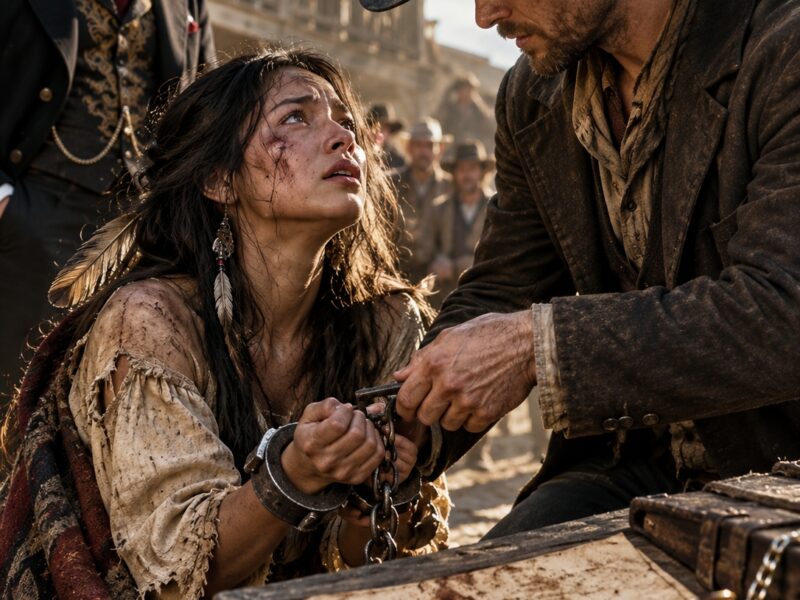
The entire town watched the young Apache woman standing in the dirt with iron around her wrists.
Nobody stepped forward.
Nobody spoke.
Not the sheriff.
Not the storekeeper.
Not the ranch hands who had stopped working to crowd along the boardwalk.
They simply watched as Barrett Crow held the end of her chain like he owned the right to decide whether she ate, slept, lived, or disappeared.
Then a stranger pushed through the crowd.
His hat was sun-bleached.
His boots were splitting at the seams.
He carried everything he owned in two saddlebags and had exactly eighty-seven dollars left to his name.
Barrett looked him over and laughed.
The young woman did not.
She lifted her bruised face toward the stranger.
Their eyes met.
And in a voice so quiet he almost missed it, she whispered:
“Please… buy me.”
The stranger stopped.
Her next four words changed everything.
“Before he kills Toby.”
Clay Callahan had spent most of his thirty-four years learning how not to become involved in other people’s wars.
It was a useful skill on the frontier.
Men who asked too many questions sometimes disappeared.
Men who challenged wealthy ranchers often discovered that sheriffs could be bought more cheaply than cattle.
And men who tried to become heroes usually ended up beneath wooden crosses with nobody remembering why they had died.
Clay had no interest in becoming one of them.
He had ridden into Red Hollow shortly after noon with fourteen cattle, a tired bay gelding named Amos, and enough dust on his coat to make him look twenty years older.
He planned to sell the cattle.
Buy coffee.
Replace a broken cinch.
Maybe sleep in a real bed for the first time in eleven nights.
Then ride north before sunrise.
That was the whole plan.
Red Hollow was supposed to be nothing more than another name behind him.
He should have known something was wrong when he heard no piano from the saloon.
Frontier towns were rarely quiet at noon.
There should have been wagon wheels grinding against dirt, horses stamping beside hitching posts, arguments outside the feed store, somebody laughing too loudly after drinking too early.
Instead, nearly everyone was gathered at the center of town.
Clay tied Amos outside Doyle’s General Store and looked toward the crowd.
“What’s going on?”
The old man beside him didn’t answer.
Clay glanced at him.
The man’s eyes remained fixed ahead.
“Sir?”
“Keep riding, stranger.”
Clay frowned.
“I just got here.”
“Then you’re luckier than the rest of us.”
The old man walked away.
That should have been warning enough.
Clay went toward the crowd anyway.
He saw Barrett Crow first.
Even if Clay had never heard the name, he would have recognized the type.
Crow stood on a raised freight platform in a charcoal vest, white shirt, polished black boots and a silver watch chain stretched across his stomach. He was somewhere in his late forties, broad through the shoulders, gray beginning at his temples.
Nothing about him looked accidental.
Not the clothes.
Not the revolver.
Not the two armed men standing behind him.
And certainly not the woman beside him.
She looked perhaps twenty-five.
Maybe younger.
It was difficult to tell beneath the exhaustion.
Her dark hair had come loose around her face. Dust covered the hem of her faded blue dress. One sleeve was torn near the shoulder.
Heavy iron cuffs surrounded both wrists.
A short chain connected them.
There was dried blood beneath one cuff.
Clay felt something cold settle in his stomach.
Crow raised his voice.
“As I was saying, this matter belongs to me.”
Nobody challenged him.
“She was found trespassing on Crow property after refusing repayment of a lawful family debt.”
Clay looked around.
Nobody seemed to believe him.
That bothered Clay more than if they had.
Crow continued.
“Since neither she nor her family can satisfy what is owed, I am willing to transfer the obligation to any man willing to assume responsibility for it.”
Someone near the back muttered, “Jesus.”
Crow’s head turned.
Silence returned instantly.
Then he smiled.
“Anyone interested?”
Clay stared at the sheriff.
The man wore a badge.
He also wore the expression of someone desperately pretending not to see what was happening three yards away.
Clay had seen that expression before.
Cowardice often looked remarkably similar to patience.
Then the woman’s eyes found him.
Clay didn’t know why.
There were fifty people around her.
But she looked directly at him.
Maybe because his clothes marked him as an outsider.
Maybe because she had already learned that nobody in Red Hollow would help.
Or maybe desperation simply made people gamble on strangers.
Her lips moved.
Clay stepped closer.
“What?”
Crow noticed.
“Well. We have an interested customer.”
A few men laughed nervously.
The woman ignored them.
“Please,” she whispered.
Clay could see the bruising along her cheek now.
“Please… buy me.”
Every instinct he had developed over fifteen years told him to walk away.
Then she added:
“Before he kills Toby.”
Clay’s eyes narrowed.
“Who’s Toby?”
Her face changed.
It was subtle.
But Clay saw it.
Fear could make people tremble.
Love made them forget to.
“My brother.”
Crow jerked the chain.
The woman stumbled.
“Enough.”
Clay’s hand moved before he thought about it.
Not toward his gun.
Just slightly.
But Crow’s two men noticed.
Their hands lowered toward their holsters.
Clay stopped.
Crow smiled again.
“Something troubling you, cowboy?”
Clay looked at the woman’s wrists.
Then at Crow.
“How much?”
A murmur moved through the crowd.
The woman stared at him.
Crow laughed.
“You’re serious?”
“How much is the debt?”
Crow stepped down from the platform.
Up close, his smile was different.
There was no humor in it.
“One hundred and twenty dollars.”
Clay almost laughed.
He had eighty-seven.
His cattle had not been sold yet.
“What kind of debt?”
“Her father’s.”
“How much did he borrow?”
Crow’s smile disappeared.
“You buying the debt or conducting an audit?”
Clay looked at the sheriff again.
Still nothing.
Then he noticed a thin man standing beside the general store.
Rufus Doyle.
Clay knew him.
They had driven cattle together eleven years earlier.
Rufus gave the smallest shake of his head.
Don’t.
Clay understood perfectly.
He turned toward the cattle he had spent four months driving across dry country.
Fourteen head.
They were supposed to buy him a winter.
Maybe even a small piece of land.
For the first time in years, Clay had begun allowing himself to imagine not waking every morning belonging nowhere.
He looked back at the woman.
She was no longer pleading.
That struck him harder than the plea had.
She seemed ashamed that she had asked.
As though hope itself had become another humiliation.
Clay exhaled.
“What will you give me for the cattle?”
Crow blinked.
“What?”
“Fourteen head. Healthy. Three steers ready for market.”
Now the crowd understood.
Rufus closed his eyes.
Crow slowly smiled.
“Eighty dollars.”
“They’re worth twice that.”
“Not today.”
Clay stared at him.
Crow was enjoying this.
He wanted Clay to understand exactly what intervention cost.
“Eighty-five.”
“Eighty.”
Clay reached into his pocket.
Seven dollars remained after supplies he had bought that morning.
Eighty-seven total.
He looked at Crow.
“Take the cattle and seven dollars.”
Crow laughed.
“That’s eighty-seven.”
“You said the debt was one-twenty.”
“I did.”
Clay removed his saddlebag.
Inside was a silver pocket watch.
It had belonged to his father.
The only thing Clay owned that had survived his childhood, the war, three cattle drives, two broken ribs and more lonely nights than he could count.
He placed it in Crow’s palm.
Crow examined it.
Clay’s voice went flat.
“That covers the rest.”
For the first time, the town became completely silent.
Crow turned the watch over.
“Sentimental?”
“Not anymore.”
Crow looked into Clay’s eyes.
Then smiled.
“Done.”
He motioned to one of his men.
The man produced a key.
Crow tossed it.
Clay caught it.
The young woman stared at him as he approached.
He crouched.
The lock on the first cuff was rusted.
His fingers shook slightly.
Not from fear.
From anger.
He opened it.
Then the second.
The iron dropped into the dirt.
The sound was small.
But every person in Red Hollow heard it.
Clay stood.
The woman rubbed her wrists.
Nobody applauded.
Nobody moved.
Clay removed his coat and offered it to her.
She hesitated.
“You don’t have to wear it.”
She took it.
“Thank you.”
Clay turned toward Amos.
Crow spoke behind him.
“You forgot something.”
Clay stopped.
Crow held up a folded piece of paper.
“The debt transfer.”
Clay took it.
He barely looked at the writing before folding it into his pocket.
Crow leaned closer.
“You just traded everything you own for a woman you’ve never met.”
Clay looked at him.
“No.”
Crow’s smile sharpened.
“No?”
“I paid a debt.”
He glanced at the broken iron in the dirt.
“What happens after that isn’t yours to decide.”
Something changed in Crow’s face.
Only for a second.
But Clay saw it.
So did Elisa.
And before Clay turned away, Crow spoke softly enough that only the two of them could hear.
“You won’t make it north.”
Clay stopped.
Crow smiled again for the crowd.
“Safe travels.”
Clay helped the woman onto Amos.
Then he took the reins and walked.
He could feel fifty pairs of eyes following them.
They reached the end of the street.
Only then did the woman speak.
“My name is Elisa Rowan.”
Clay glanced back.
“Clay Callahan.”
“I know.”
That stopped him.
“How?”
She looked toward the town behind them.
Her face had gone pale.
“Because Barrett knew your name before you told him.”
Clay turned.
Crow was still standing in the street.
Watching.
And smiling.
They didn’t ride north.
Elisa insisted.
“Not yet.”
Clay wanted distance between them and Red Hollow, but she could barely remain upright in the saddle.
Six miles outside town stood a roadside inn called the Juniper House.
Clay recognized the owner before Rufus Doyle recognized him.
Rufus had left Red Hollow by the back road and arrived ahead of them.
When Clay entered supporting Elisa by the elbow, Rufus’s face drained of color.
“You really did it.”
“Apparently.”
“You damned fool.”
“Good seeing you too.”
Rufus locked the front door.
That got Clay’s attention.
“What are you doing?”
“Trying not to die because an old friend rediscovered his conscience.”
Elisa swayed.
Rufus stopped talking.
He looked at her wrists.
Then at her face.
His expression softened.
“Upstairs. Room six.”
“I can’t pay,” Clay said.
“You paid enough today.”
The room was small.
One bed.
One chair.
A washbasin.
A cracked mirror.
Elisa stood inside the doorway as if she had entered a cathedral.
Clay set bread, stew and water on the table.
“You’re safe here.”
She looked at him.
“No.”
Clay paused.
“No?”
“Nobody is safe from Barrett because there’s a door between them.”
Rufus, standing in the hall, muttered, “She’s right.”
Clay looked between them.
“Someone want to explain what I bought myself into?”
Elisa’s expression hardened.
“You didn’t buy me.”
Clay immediately understood.
“No. I didn’t.”
Silence.
He pulled the folded debt paper from his pocket and held it toward her.
“This belongs to you.”
She didn’t take it.
“Burn it.”
Clay walked to the lamp.
He held one corner of the document over the flame.
Fire climbed the paper.
Barrett Crow’s signature curled black.
Clay dropped the remains into the washbasin.
Elisa watched until nothing remained except ash.
Something in her face broke.
Not dramatically.
She simply sat on the edge of the bed and covered her mouth.
Clay turned away.
He understood that some kinds of crying deserved privacy.
He went downstairs.
Rufus poured whiskey.
Clay drank it.
“What aren’t you telling me?”
Rufus wiped the counter.
“Crow owns half this county.”
“Men say that about every rich bastard.”
“I’m not talking about acreage.”
Rufus looked toward the ceiling.
“He owns judges. Deputies. Freight contracts. Water rights. The bank. He decides whose cattle get through the southern pass and whose mysteriously disappear.”
“And Elisa?”
Rufus became quiet.
“Her family owned land east of here.”
“How much?”
“Enough.”
“That isn’t an answer.”
“It is if you want to live.”
Clay pushed the glass away.
“I sold fourteen cattle today. I’m past wanting sensible answers.”
Rufus almost smiled.
Then didn’t.
“Her father, Samuel Rowan, married an Apache woman named Mara. Samuel was a surveyor before he became a rancher. People didn’t like the marriage. Crow especially didn’t like the land that came with it.”
“What land?”
Rufus looked toward the window.
“The kind men kill for.”
Upstairs, something crashed.
Clay was moving before the sound finished.
He reached room six with his revolver drawn.
Elisa stood beside the open window holding the washbasin pitcher like a weapon.
A shadow disappeared below.
Clay ran to the window.
A horse thundered away into darkness.
On the floor lay a knife.
A piece of paper had been pinned beneath it.
Clay picked it up.
Three words were written there.
BRING HER BACK.
Elisa stared at the message.
Then she whispered:
“He knows.”
“Knows what?”
Her eyes rose to Clay.
“That I found the ledger.”
Clay waited.
Elisa sat at the table.
For several seconds she said nothing.
Then she looked at her hands.
“My father didn’t owe Barrett money.”
“I figured that.”
“He discovered Barrett was forging land claims.”
Clay leaned against the wall.
Elisa continued.
“Families disappeared. Ranchers lost property. People who couldn’t read English signed documents they didn’t understand. Some were told they owed taxes. Others were accused of debts that never existed.”
“And your father documented it?”
“Yes.”
“Where?”
Her eyes moved toward him.
“He kept a ledger.”
Clay understood.
“Crow wants it.”
“He thinks I know where it is.”
“Do you?”
Elisa hesitated.
That was answer enough.
Clay sat opposite her.
“Elisa.”
“My father died six months ago.”
“How?”
“They said his horse threw him.”
“You don’t believe that.”
“I saw his body.”
Her voice remained steady.
“The left side of his skull was crushed.”
Clay waited.
“He always mounted from the left. If he had fallen, the injuries should have been different. And his horse came home with blood on the saddle.”
Clay felt the room become colder.
“My mother died three weeks later.”
He looked at her.
“Fever, they said.”
Elisa’s mouth tightened.
“She had no fever.”
Clay said nothing.
“Then Barrett came with papers claiming our ranch belonged to him.”
“And Toby?”
“He hid.”
For the first time, Elisa almost smiled.
“Toby is better at disappearing than anyone I’ve ever known.”
“How did Crow catch you?”
“I made him.”
Clay frowned.
“You what?”
“I let one of his men see me.”
“Why?”
“Because Toby had the ledger.”
Clay stared at her.
She had not been helpless.
Not entirely.
She had sacrificed herself.
“You drew Crow away from your brother.”
“Yes.”
“And now?”
“I don’t know where Toby is.”
The words finally cracked.
“He was supposed to reach a place called Miller’s Crossing. My father’s friend lives there.”
“How long ago?”
“Nine days.”
Clay’s stomach sank.
“You’ve been with Crow nine days?”
“Ten.”
“And nobody helped you?”
Elisa looked toward the floor.
Clay regretted the question immediately.
She answered anyway.
“Some looked away.”
That was worse.
“Some apologized.”
Worse still.
“One woman brought me water when Barrett wasn’t watching.”
Elisa looked up.
“But nobody opened the door.”
Clay thought about the crowd.
Fifty people.
A sheriff.
Men with guns.
People who probably told themselves they were good.
Fear could turn morality into something people practiced only when convenient.
“Get some sleep,” he said.
“We leave before sunrise.”
“For Miller’s Crossing?”
“Yes.”
“You don’t have to do this.”
Clay gave her a tired look.
“You’ve said that twice.”
“Because it’s true.”
He walked toward the door.
“So is what I told you.”
“What?”
He looked back.
“We’ll find your brother.”
At 4:12 the next morning, somebody set fire to the barn.
Rufus smelled smoke first.
By the time Clay reached the yard, flames were climbing the dry timber.
Amos screamed inside.
Clay ran through the doorway.
“Clay!”
Rufus grabbed for him and missed.
Smoke swallowed everything.
Clay covered his mouth and followed the horse’s panic.
He found Amos kicking against the stall.
“Easy!”
The latch had been wired shut.
Not stuck.
Wired.
Someone had wanted the horse to burn.
Clay cut the wire with his knife.
Amos burst past him.
A burning beam crashed behind them.
Clay hit the ground.
For one terrible second, he couldn’t breathe.
Then a hand caught his shirt.
Elisa.
“What the hell are you doing?”
“Pulling you.”
Together they crawled outside.
The roof collapsed seconds later.
Rufus stared at the flames.
“They’re not warning you anymore.”
Clay looked toward the road.
Three riders were watching from a distant ridge.
Then they disappeared.
Elisa’s face hardened.
“We should separate.”
“No.”
“He wants me.”
“He wants the ledger.”
“Which means you can still leave.”
Clay coughed soot from his lungs.
“Do you actually think that’s how this works?”
“You don’t owe me anything.”
Clay looked at the burning barn.
“Apparently Crow disagrees.”
They left before daylight.
Rufus gave them two horses, ammunition and a Winchester rifle.
Before Clay mounted, Rufus caught his arm.
“There is something else.”
Clay waited.
Rufus lowered his voice.
“Crow didn’t arrive in Red Hollow because of Elisa.”
“What?”
“He was asking about you two days ago.”
Clay felt the hair rise on his neck.
“Why?”
“I don’t know.”
“You’re sure?”
“He showed people a description. Tall. Thirty-something. Gray hat. Bay gelding. Scar near the right thumb.”
Clay looked at his hand.
A pale scar crossed the base of his thumb.
He had gotten it at seventeen.
Few people knew about it.
Elisa saw his expression.
“What does that mean?”
Clay looked toward the road.
“I don’t know.”
But he did know one thing.
His arrival in Red Hollow had not been an accident to Barrett Crow.
For the next two days, they rode east.
The land changed gradually.
Open grass became broken mesas and dry creek beds. Cottonwoods followed narrow ribbons of water. The horizon seemed impossibly large.
Elisa rode well.
Better than Clay expected.
On the second afternoon, she noticed tracks before he did.
“Three riders.”
Clay dismounted.
“Where?”
She pointed toward a wash.
He crouched.
She was right.
“Maybe four hours old.”
“Crow?”
“Could be.”
She looked at him.
“You don’t trust me.”
Clay stood.
“That’s an interesting conclusion.”
“You keep watching me.”
“I watch everything.”
“No. You watch me when I mention the ledger.”
Clay said nothing.
Elisa folded her arms.
“You think I’m hiding something.”
“You are.”
“So are you.”
That landed.
Clay looked away.
“What am I hiding?”
“You didn’t ask why Barrett knew you.”
“I don’t know why.”
“But you’re afraid you might.”
Clay stared at her.
She held his gaze.
For the first time, he realized how dangerous it would be to mistake her quietness for weakness.
“My father was a deputy marshal,” he said.
Elisa waited.
“Jonah Callahan.”
Recognition flickered in her face.
Clay noticed.
“You know the name.”
“My father knew it.”
Now Clay stepped closer.
“How?”
“I don’t know.”
“You just reacted.”
“Because Samuel Rowan wrote that name in his journal.”
Clay’s pulse changed.
“When?”
“I don’t remember.”
“Elisa.”
“I was trying to keep my brother alive. I wasn’t memorizing every page.”
Clay immediately backed off.
She looked away.
After a moment, she said quietly, “I’m sorry.”
“You don’t owe me that.”
“My father trusted someone named Callahan.”
Clay swallowed.
“My father died when I was fourteen.”
“How?”
Clay looked toward the horizon.
“He was shot.”
“By whom?”
“Nobody ever proved it.”
Elisa said nothing.
Clay remembered the funeral.
Rain.
His mother’s hand gripping his shoulder.
A closed coffin because the undertaker said the damage was too severe.
A marshal telling them Jonah had been killed by cattle thieves.
Clay had accepted that story for twenty years.
Until now.
They reached Miller’s Crossing the following evening.
There was no crossing anymore.
Only ruins.
Clay smelled the smoke before they reached the hill.
Elisa urged her horse forward.
“No.”
Clay caught her reins.
“Elisa.”
She tore free.
Below them stood the remains of a farmhouse.
Burned.
Blackened.
Still smoking.
“Toby!”
She rode down the hill.
Clay followed.
She jumped from the saddle before the horse stopped.
“Toby!”
No answer.
She ran toward the house.
Clay grabbed her around the waist.
“Let me go!”
“The roof could collapse.”
“Toby!”
“Elisa!”
She fought him.
Hard.
Then she saw something near the porch.
A child’s boot.
She stopped breathing.
Clay released her slowly.
Elisa walked toward it.
Her legs seemed barely able to hold her.
She picked up the boot.
“Toby.”
Clay searched the ruins.
He found blood near the well.
Not much.
Then tracks.
Several horses.
A wagon.
And something else.
Small footprints.
Heading toward the trees.
“Elisa.”
She didn’t move.
“Elisa!”
She looked up.
Clay pointed.
“Toby walked away from here.”
She ran toward him.
“You’re sure?”
“Small boots. One missing.”
She looked at the boot in her hand.
Hope returned so suddenly it almost hurt to witness.
They followed the tracks.
Half a mile into the trees, Clay found a strip of cloth tied to a branch.
Elisa recognized it.
“His shirt.”
Another strip appeared farther ahead.
Then another.
“He’s marking a trail,” Clay said.
Elisa smiled through tears.
“He remembered.”
“Remembered what?”
“My mother taught us to do this when we were children.”
The trail led into a narrow ravine.
Clay stopped.
Too quiet.
“Elisa.”
She heard it too.
A rifle clicked behind them.
“Hands up.”
Three men emerged.
Crow’s riders.
The largest one smiled.
“Boss said you’d come.”
Clay slowly raised his hands.
Elisa did the same.
The man approached.
“You’ve caused a lot of trouble, cowboy.”
“I get that often.”
“Where’s the book?”
Clay looked confused.
“What book?”
The rifle barrel struck his stomach.
He doubled over.
Elisa moved.
Another man grabbed her.
“Don’t!”
Clay straightened.
Blood touched his lip.
The leader smiled.
“Crow said you’d play stupid.”
“He knows me well.”
The man hit him again.
This time Clay fell.
The leader crouched.
“Where’s the ledger?”
Clay looked beyond him.
At Elisa.
She wasn’t frightened.
She was watching something.
Clay followed her eyes.
A branch above the leader.
No.
A rope.
Clay understood one second before it happened.
Elisa stamped backward onto the foot of the man holding her.
He shouted.
She drove her elbow into his throat.
Clay rolled.
A rifle fired.
The bullet hit dirt.
Then a stone dropped from above.
It struck the leader’s shoulder.
A child’s voice screamed:
“RUN!”
Toby.
Chaos exploded.
Clay drew his revolver.
One shot.
A rider’s weapon flew from his hand.
Elisa grabbed the fallen rifle.
The third man turned toward the ridge.
Another stone hit him.
Clay tackled him.
Thirty seconds later, two men were unconscious and the third was running through the trees.
A skinny boy emerged from the rocks.
Twelve years old.
Dust-covered.
Terrified.
Alive.
Elisa dropped the rifle.
“Toby.”
The boy ran.
She fell to her knees as he crashed into her arms.
For the first time since Clay had met her, Elisa sobbed without trying to hide it.
Toby buried his face against her shoulder.
“I thought he killed you.”
“He didn’t.”
“I waited.”
“I know.”
“I waited three days.”
She held him tighter.
“I know.”
Clay turned away.
Some reunions deserved privacy too.
Then Toby saw him.
“Who’s that?”
Elisa wiped her face.
“His name is Clay.”
The boy stared.
“Callahan?”
Clay froze.
“How do you know my last name?”
Toby looked at Elisa.
Then back at Clay.
“Because Papa said if anything happened to him, we were supposed to find Jonah Callahan.”
Clay felt the world tilt.
“My father?”
Toby nodded.
“He said Jonah was the only man Barrett Crow ever feared.”
That night they hid inside an abandoned mining cabin.
Toby told them what happened at Miller’s Crossing.
Crow’s men had arrived three days earlier.
The family friend, Henry Vale, had hidden Toby beneath the floorboards.
They demanded the ledger.
Henry refused.
They beat him.
Then shot him.
Toby’s voice became smaller.
“They burned the house after.”
Elisa closed her eyes.
“Did they see you?”
“No.”
“Where’s the ledger?”
Toby looked at Clay.
Then Elisa.
“I don’t have it.”
Elisa stared.
“What?”
“I hid it.”
“Where?”
Toby shook his head.
“Papa said never tell anyone unless you knew who you could trust.”
“Toby, I’m your sister.”
“I know.”
“Then tell me.”
The boy’s eyes filled.
“I told Henry.”
Elisa understood.
Henry was dead.
Toby began crying.
“I thought he would be safe.”
Elisa pulled him against her.
“You did what Papa told you.”
“But now it’s gone.”
“No.”
Clay was looking at the boy.
“You said you hid it before reaching Henry?”
Toby nodded.
“Where?”
The boy hesitated.
Clay reached into his shirt.
He removed a small brass compass.
“My father gave me this.”
Toby stared at it.
Inside the lid were three scratched letters.
J.C.C.
Jonah Clay Callahan.
Toby’s eyes widened.
“I’ve seen that mark.”
“Where?”
“In Papa’s journal.”
Clay’s pulse hammered.
Toby whispered:
“Your father helped him make the ledger.”
For twenty years, Clay had believed Jonah Callahan died chasing cattle thieves.
The truth was uglier.
Jonah had been investigating Barrett Crow’s father, Silas, along with several territorial officials.
Land fraud.
Illegal seizures.
Bribery.
Disappearances.
Samuel Rowan had worked as a surveyor and translator, documenting claims and preserving copies.
The ledger was not simply a book of debts.
It contained names.
Dates.
Payments.
Signatures.
Enough evidence to destroy Barrett’s empire.
Maybe enough to explain Jonah Callahan’s death.
Clay sat outside the cabin long after Elisa and Toby slept.
The moon illuminated the empty country.
Elisa eventually joined him.
“You should sleep.”
“So should you.”
She sat beside him.
For a while neither spoke.
Then Clay said, “I spent twenty years angry at my father.”
“Why?”
“Because he chose his badge over us.”
Elisa waited.
“My mother begged him to quit. He kept leaving. Kept saying one more case.”
Clay looked at the compass.
“When he died, I decided that’s what happened to men who tried to fix the world.”
Elisa’s voice was soft.
“Maybe he wasn’t trying to fix the world.”
Clay looked at her.
“Maybe he was trying to fix one wrong thing.”
Clay almost laughed.
“That sounds familiar.”
Elisa smiled faintly.
“Yes.”
Silence returned.
Then she said, “You can still leave.”
Clay looked at her.
She smiled slightly.
“I know. Third time.”
“And my answer hasn’t improved.”
Her smile faded.
“Barrett will kill you.”
“Probably.”
“That’s not funny.”
“I wasn’t joking.”
She stared at him.
“Why are you doing this?”
Clay could have given her the easy answer.
Because it’s right.
Instead he gave her the true one.
“Because when I saw you standing in that street, I realized I’d spent half my life calling fear wisdom.”
Elisa said nothing.
Clay continued.
“I thought staying out of other people’s battles made me free.”
He looked toward the darkness.
“Maybe it just made me absent.”
Elisa’s eyes shone.
“You stepped forward.”
“Once.”
“Once matters.”
Clay looked at her.
She held his gaze.
Neither moved.
Then Toby screamed inside.
They ran.
The boy stood beside the window.
On the sill was a black crow feather.
Beneath it lay a note.
THREE DAYS.
BRING THE LEDGER TO RED HOLLOW.
OR EVERY FAMILY WHO HELPED YOU BURNS.
Clay read it twice.
Elisa whispered:
“He’s going after the town.”
Clay’s jaw tightened.
“He’s making us come back.”
“No.”
Elisa took the note.
“He’s making me choose.”
Clay looked at her.
“Between what?”
“My brother…”
Her fingers tightened around the paper.
“…and everyone else.”
They found the ledger the next morning.
Toby had hidden it inside the grave of a dog.
His father’s dog.
A weathered wooden marker stood beneath a cottonwood three miles from the burned farmhouse.
Toby dug with his hands until Clay stopped him and used a shovel.
Two feet down, they found an oilcloth package.
Inside was a thick leather ledger.
Clay opened it.
Pages of names.
Numbers.
Land descriptions.
Payments.
Then he found a familiar name.
JONAH CALLAHAN.
Beside it:
$500 — REMOVAL.
Clay stared.
Elisa saw it.
Neither spoke.
There were some truths too brutal for immediate words.
Beneath Jonah’s name was another.
SAMUEL ROWAN.
No payment recorded.
Instead:
PENDING.
Clay closed the book.
“We take this to a federal marshal.”
“The nearest office is two days south,” Elisa said.
“Then we ride.”
Toby shook his head.
“You can’t.”
Clay looked at him.
“Why?”
The boy pointed to another page.
A name.
Marshal Edwin Price.
$1,200.
Elisa’s face changed.
“The federal marshal?”
Toby nodded.
Clay turned pages.
Sheriff.
Judge.
Bank manager.
Land clerk.
Nearly every institution they might have trusted appeared somewhere in Crow’s ledger.
Barrett hadn’t merely bought men.
He had built a cage around the entire county.
And they were standing inside it.
Then Elisa noticed something.
“Wait.”
Near the back was a sealed envelope.
Samuel Rowan had written across it:
FOR JONAH CALLAHAN.
IF JONAH IS DEAD, GIVE THIS TO HIS SON.
Clay couldn’t move.
Elisa handed it to him.
His fingers trembled opening the paper.
The letter was short.
Clay read it once.
Then again.
Jonah Callahan had not died pursuing cattle thieves.
He had discovered Silas Crow’s operation.
Samuel had warned him that someone inside the marshal’s office had betrayed them.
Jonah planned to take the evidence east.
He never made it.
But the final line was what broke something inside Clay.
Your father knew he might die.
He could have walked away.
He stayed because he believed a man becomes responsible for an injustice the moment he has the power to stop it.
Clay lowered the letter.
Elisa watched him.
“Clay?”
He looked toward Red Hollow.
“We’re going back.”
They returned two days later.
Not secretly.
That surprised Barrett.
Clay, Elisa and Toby rode directly down Red Hollow’s main street shortly before noon.
Doors closed.
Curtains moved.
People watched.
The same platform still stood in the square.
And Barrett Crow waited beside it.
Twenty armed men surrounded him.
The sheriff stood nearby.
Crow smiled.
“I knew you’d come home.”
Elisa dismounted.
“This was never my home.”
Crow’s smile thinned.
“Where’s the ledger?”
She held up the book.
The street seemed to stop breathing.
Crow stepped forward.
“Give it to me.”
“No.”
His men raised rifles.
Clay dismounted beside her.
Crow laughed.
“You came back to die for people who wouldn’t lift a finger for you.”
Elisa looked around.
The townspeople were hiding.
Watching again.
Just as before.
Crow spread his arms.
“Look at them.”
Elisa did.
“Not one of them helped you.”
She said nothing.
“They watched me put chains on you.”
Silence.
“They watched me sell your father’s land.”
Silence.
“They watched me drag you through this street.”
His smile widened.
“And you came back to save them?”
Elisa looked at him.
“No.”
Crow blinked.
“I came back so they could decide what kind of people they want to be after today.”
Something shifted behind a window.
Crow laughed.
“Beautiful speech.”
Elisa opened the ledger.
Then tore out a page.
Crow’s expression changed.
“What are you doing?”
She handed it to Clay.
He read loudly.
“Thomas Bell. Forty acres transferred after fraudulent debt. Payment to County Clerk James Mercer: sixty dollars.”
A man stepped from the crowd.
Thomas Bell.
Crow turned.
Clay read another.
“Mary Foster. Widow. Water rights seized. Payment to Judge Ames: one hundred dollars.”
A woman emerged from the general store.
Then another person.
Then another.
Crow’s smile vanished.
“Enough.”
Clay kept reading.
Crow drew his revolver.
The shot exploded.
Clay fell.
Elisa screamed.
For one horrifying second, everything stopped.
Then Red Hollow finally moved.
Rufus Doyle fired from the general store window.
Crow’s gun flew from his hand.
Thomas Bell tackled one ranch hand.
The blacksmith struck another with a shovel.
The sheriff reached for his weapon.
Then hesitated.
Barrett shouted:
“Do your job!”
The sheriff looked at him.
Then at Clay bleeding in the dirt.
Then at Elisa.
Slowly, the sheriff removed his badge.
He dropped it.
“No.”
One word.
But it changed the street.
Crow stared.
“What did you say?”
“I said no.”
Gunfire erupted.
People scattered.
Elisa dragged Clay behind a water trough.
“Clay!”
He opened his eyes.
“I’m fine.”
“You’ve been shot.”
“Shoulder.”
Blood covered his shirt.
“That isn’t fine!”
“Toby?”
“Safe.”
“Ledger?”
She looked.
The book was gone.
Her face emptied.
“Barrett.”
Crow was running toward the livery stable.
The ledger under his arm.
Elisa grabbed Clay’s revolver.
He caught her wrist.
“Don’t.”
“He’ll burn it.”
“Elisa.”
“He killed my father.”
“I know.”
“He killed my mother.”
“I know.”
“He put me in chains.”
Clay’s grip softened.
“Then don’t let him decide who you become after the chains come off.”
She stared at him.
Another gunshot cracked outside.
Elisa pulled free.
Then ran.
Barrett reached the stable.
Elisa followed.
Inside, horses screamed.
Crow overturned a lantern.
Oil spread across hay.
Flames climbed instantly.
He held the ledger above them.
“One more step.”
Elisa stopped.
Crow’s face was streaked with soot.
“You think this book changes anything?”
“It already has.”
“These people are cowards.”
“They were.”
“You’re nothing.”
Elisa looked at the burning hay.
“No.”
Crow smiled bitterly.
“You know what you are?”
She raised Clay’s revolver.
Crow laughed.
“Go ahead.”
Her finger tightened.
“Do it.”
For months she had imagined this moment.
Barrett frightened.
Barrett helpless.
Barrett finally understanding what he had done.
She could kill him.
Nobody in Red Hollow would condemn her.
Maybe nobody anywhere would.
Then she lowered the gun.
Crow’s expression changed.
Elisa said:
“You don’t get to make me carry you for the rest of my life.”
His face twisted.
He threw the ledger into the flames.
Elisa lunged.
So did Crow.
Before either reached it, Toby appeared through the rear stable door.
“ELISA!”
Crow turned.
That moment cost him everything.
Clay came through the smoke and hit him.
Both men crashed against a stall.
Clay’s wounded shoulder gave way.
Crow climbed on top of him.
His hands closed around Clay’s throat.
“You should have kept riding.”
Clay struggled.
Crow leaned closer.
“You could have lived.”
Then a rifle cocked.
Crow froze.
Elisa stood behind him.
But she wasn’t aiming at Crow.
The sheriff was.
So were Rufus.
Thomas Bell.
Mary Foster.
The blacksmith.
Six ranch hands.
A dozen townspeople.
The same people who had once stood silently while Elisa wore chains now surrounded Barrett Crow.
The former sheriff stepped forward.
“Get off him.”
Crow looked around.
For the first time, fear appeared in his eyes.
“You people work for me.”
Nobody answered.
“I own your land.”
Nothing.
“I own this town!”
Mary Foster stepped forward.
“No.”
Her voice shook.
But she did not retreat.
“You owned our fear.”
Barrett looked at the faces around him.
Then slowly released Clay.
They arrested him before sunset.
The ledger survived.
Not entirely.
Several pages burned.
But Toby had done something none of them knew.
While hiding at Miller’s Crossing, he had copied the most important names onto separate sheets exactly as his father had taught him.
Those copies eventually reached territorial authorities outside Crow’s influence.
Investigators came.
Then marshals.
Real ones.
The kind Barrett had not paid.
The inquiry lasted months.
It uncovered fraudulent deeds, bribery, stolen water rights and evidence connected to several unexplained deaths.
Including Samuel Rowan.
Including Jonah Callahan.
Barrett Crow went to trial the following spring.
Elisa testified.
She walked into the courtroom wearing no chains.
Clay sat behind her with his injured arm still stiff.
Toby sat beside him.
Barrett refused to look at Elisa until the prosecutor asked one final question.
“Miss Rowan, did Mr. Crow consider you his property?”
The courtroom became silent.
Elisa looked at Barrett.
“Yes.”
“And what are you now?”
The prosecutor expected a legal answer.
Elisa gave him something else.
“Free.”
Barrett finally looked away.
Months later, Clay stood on the hill above the Rowan ranch.
The property had been restored.
So had the neighboring farms stolen through Crow’s schemes.
Spring grass covered the valley.
Toby was repairing a fence badly and insisting he was doing it correctly.
Clay watched him for a while.
“You’re putting that post in crooked.”
“It’s the ground.”
“The ground isn’t crooked.”
“This part is.”
Clay shook his head.
Toby grinned.
Elisa came from the house carrying two cups of coffee.
She handed one to Clay.
His old pocket watch hung from her fingers.
Clay stared.
“Where did you get that?”
“Rufus.”
“Crow took it.”
“Rufus bought it at the property auction after the trial.”
Clay took the watch.
The silver was scratched.
Still ticking.
He opened it.
Inside, someone had added a tiny folded piece of paper.
Clay unfolded it.
Rufus had written:
Some things should find their way home.
Clay swallowed.
Elisa stood beside him.
“You staying?”
Clay looked across the valley.
For most of his life, that question had frightened him more than any gun.
Staying meant belonging somewhere.
Belonging meant having something to lose.
He had spent twenty years convincing himself that loneliness was freedom because admitting otherwise would have required him to risk being hurt again.
His horse was saddled near the barn.
His bags were packed.
The northern trail remained open.
He could leave.
Elisa did not ask again.
That mattered.
She would not beg someone to stay.
Not after everything she had survived.
Clay looked at her.
Then at Toby arguing with the fence post.
Then at the house.
A repaired window reflected the afternoon sun.
Laundry moved gently on a line.
Somewhere inside, bread was cooling.
Nothing about the scene was grand.
Nobody would write songs about it.
Clay realized that was exactly why he wanted it.
He walked to his horse.
Elisa’s expression remained still.
Clay untied his saddlebags.
He carried them toward the house.
Toby noticed.
A grin spread across the boy’s face.
“You staying?”
Clay dropped the bags on the porch.
“Until you learn how to build a straight fence.”
Toby laughed.
“That could take years.”
“I know.”
Elisa looked away, but not quickly enough to hide her smile.
Clay reached into his pocket.
There was one final thing.
The key.
The small iron key Barrett had tossed to him in Red Hollow.
Clay had kept it without understanding why.
He placed it in Elisa’s palm.
She stared at it.
“The key to the chains?”
“Yes.”
“Why did you keep it?”
“I don’t know.”
Elisa closed her fingers around it.
For a long moment she said nothing.
Then she walked toward the old well.
Clay followed.
She dropped the key.
They listened.
One second.
Two.
Then a faint metallic sound rose from far below.
Gone.
Elisa looked toward the horizon.
“People will tell this story wrong.”
Clay smiled slightly.
“What will they say?”
“That you saved me.”
Clay studied her.
“Didn’t I?”
She turned toward him.
“You opened the chains.”
There was no anger in her voice.
Only certainty.
“I decided what happened after.”
Clay nodded.
“That sounds right.”
She looked back toward the valley.
For months, Elisa had dreamed of freedom as distance.
Far from Barrett.
Far from Red Hollow.
Far from the place where people had watched and done nothing.
Now she understood something different.
Freedom was not merely getting away from the person who had hurt you.
Sometimes freedom was returning to the place where they had tried to erase you…
and building a life there anyway.
The sun lowered behind the hills.
Toby called from the fence.
“Clay!”
“What?”
“If you’re staying, does that mean I have to listen to you?”
Clay shouted back:
“Unfortunately.”
Toby groaned.
Elisa laughed.
It was the first time Clay had heard her laugh without fear hiding beneath it.
He wanted to remember the sound.
Years later, people in Red Hollow would still argue about the day Clay Callahan walked into town with eighty-seven dollars, fourteen cattle and no intention of becoming involved.
Some said he was brave.
Others said he was reckless.
A few insisted destiny had brought him there.
Clay never believed that.
Destiny was too convenient.
It removed responsibility from the choices people made.
The truth was simpler.
Clay had been afraid.
The townspeople had been afraid.
Elisa had been terrified.
Courage had not arrived because fear disappeared.
It arrived when someone acted while fear was still there.
First Clay stepped forward.
Then Rufus.
Then the sheriff.
Then Mary Foster.
Then Thomas Bell.
Then an entire town that had finally become ashamed of its silence.
One action had not changed everything.
It had simply made the next action possible.
And perhaps that was how the world changed most often.
Not through heroes who never felt fear.
But through frightened people who saw someone else step forward and realized they could do the same.
Years afterward, when Toby was grown, he would sometimes tell visitors about the iron key at the bottom of the Rowan well.
They always asked why Elisa had thrown it away.
Toby would smile.
“Because my sister didn’t need proof that she’d once been chained.”
Then he would point toward the ranch.
Toward the house she rebuilt.
The land she reclaimed.
The family she chose.
“That was her proof she became free.”
And if the visitors asked about Clay Callahan—the lonely cowboy who had supposedly ridden into Red Hollow and rescued her—Toby always corrected them.
“No,” he would say.
“That’s not quite how it happened.”
Then he would glance toward the porch where Clay and Elisa had spent countless evenings watching the sun disappear beyond the hills.
“He opened the lock.”
Toby would pause.
“But she was the one who walked out.”
And that was the part of the story Red Hollow never forgot.









