SHE BEGGED THE COWBOY NOT TO SAVE HER—THEN HE LEARNED WHY HER FAMILY WANTED HER BACK
“PLEASE… DON’T TAKE ME BACK.”
Silas Whitaker almost didn’t hear her.
The Montana wind tore across the ravine with the sound of something alive and furious, throwing snow against his face until his eyelashes froze together. Somewhere behind him, his gray gelding screamed into the storm.
Silas dropped to one knee.
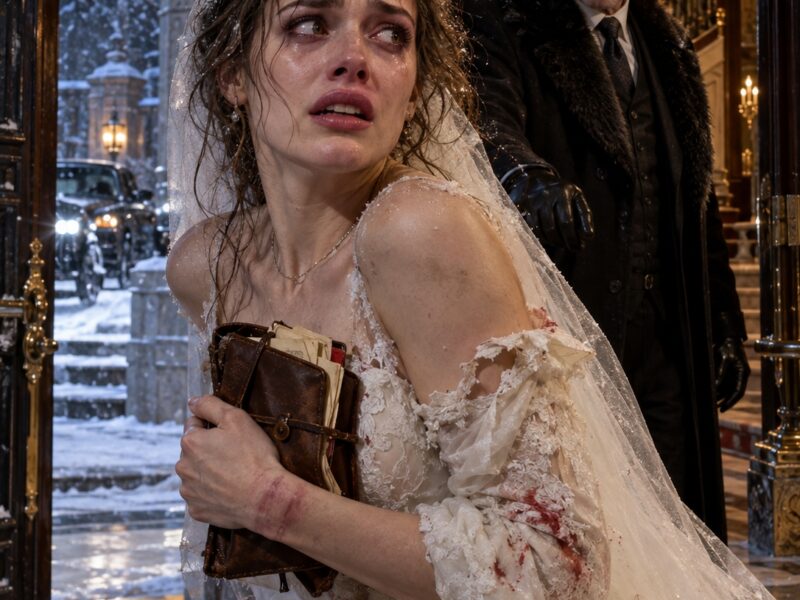
The woman lying beneath the snow was wearing a wedding dress.
Or what remained of one.
White satin disappeared beneath streaks of mud and blood. The lace along her left side had been ripped nearly to the waist. One sleeve hung from her shoulder. Her lips had turned blue, and when Silas pressed two fingers beneath her jaw, he found a pulse so faint he wondered if he had imagined it.
“Ma’am?”
Her eyes opened.
They were gray.
Beautiful.
Terrified.
Her hand shot from beneath the snow and closed around the front of his coat.
Silas flinched at the strength of it.
“Please,” she breathed.
“I’m getting you out of here.”
“No.”
“You’ll freeze to death.”
Her fingers tightened.
“That’s better than going back.”
Silas stared at her.
A second later, she whispered the words that changed everything.
“If they find me alive… they’ll finish what they started.”
Then her eyes rolled back.
Her hand fell away.
For several seconds, Silas remained motionless.
He had found injured travelers before. Broken wagons were not unusual in Montana winters, and storms killed people faster than bullets.
But this was different.
The carriage rested twenty feet below the trail, half crushed against a stand of pine.
One wheel had broken away.
Two horses lay dead in the snow.
The door stood open.
Silas looked at the tracks around the wreck.
His expression changed.
There should have been panic in those tracks.
People running.
Men attempting to free horses.
Someone trying to help the injured woman.
Instead, there were hoofprints.
Several horses.
They led away from the wreck.
Someone had survived.
Someone had left her here.
Silas carefully lifted the woman from the snow.
That was when he saw the symbol carved into the carriage door.
An eagle above two crossed sheaves of wheat.
His stomach tightened.
He knew that crest.
Everyone from Helena to Bozeman knew it.
Waverly.
Harlon Waverly owned more cattle than some counties, controlled freight routes across western Montana, and reportedly knew which territorial judges could be bought before those judges themselves knew it.
Men lowered their voices when they said his name.
And Silas Whitaker was holding what appeared to be a Waverly bride.
“Damn it,” he whispered.
The smart thing was obvious.
Ride to the nearest settlement.
Tell the sheriff.
Let wealthy people solve wealthy people’s problems.
Three years earlier, Silas might have done exactly that.
But three years earlier, Catherine had still been alive.
And the last time Silas had chosen the sensible thing during a winter storm, he had spent every night since wondering whether sensible had killed his wife.
He looked at the unconscious woman.
Snow was already gathering in her hair.
“Not today,” he said.
He lifted her higher against his chest.
“You’re not dying today.”
Dutch carried them home through a storm that seemed determined to bury Montana.
Twice the horse stumbled.
Once Silas thought the woman had stopped breathing.
He pulled Dutch to a halt, tore off his glove, and pressed his fingers against her neck.
Nothing.
“Come on.”
He leaned closer.
“Come on.”
Then he felt it.
One weak beat.
Silas shut his eyes.
Suddenly he wasn’t thirty-eight years old.
He was thirty-five again.
Catherine was burning with fever.
Her damp hair was against his wrist.
The doctor was three hours away.
Stay with me, Cat.
Please.
Stay with me.
Silas opened his eyes violently.
“No.”
He tightened his arm around the stranger.
“You don’t get to do that.”
He kicked Dutch forward.
“You hear me?”
The unconscious woman said nothing.
Silas swallowed.
“I already buried one woman in winter.”
His voice cracked.
“I’m not burying another.”
He didn’t realize he was crying until the tears froze against his cheeks.
By the time the lights of his ranch appeared through the snow, darkness had swallowed the valley.
Silas carried the woman inside.
The cabin was warm but painfully quiet.
Catherine’s blue cup still sat on the shelf where Silas had never been able to move it.
Her photograph remained above the fireplace.
And at the end of the hallway was a door Silas had not opened in almost three years.
He laid the stranger near the stove.
“Forgive me.”
He removed her soaked outer clothing carefully, leaving her undergarments untouched while wrapping blankets around her.
That was when he saw the bruises.
Four dark marks circled her right wrist.
Finger marks.
Someone had grabbed her.
Hard.
There was another bruise near her shoulder.
Silas’s eyes narrowed.
Then he noticed the torn dress.
The fabric had not ripped from the carriage accident.
Someone had cut through several stitches and pulled the lining apart.
Searching.
“For what?” Silas murmured.
He examined the torn seam.
Nothing.
Then the woman jerked violently.
“No!”
Silas pulled back.
Her eyes remained closed.
“No, Edmund…”
She twisted beneath the blankets.
“I won’t sign it.”
Silas froze.
“Clara?”
He didn’t know her name yet.
But she whispered another word.
“Father…”
Then she began screaming.
Silas grabbed her shoulders.
“Wake up!”
Her eyes flew open.
For one horrifying second, she looked straight through him.
“Don’t let him lock the door.”
Then unconsciousness took her again.
Silas sat beside her until sunrise.
He told himself it was because she might stop breathing.
It wasn’t.
Something about the fear in her voice had awakened a part of him he had spent three years trying to kill.
The part that still cared what happened to another human being.
For two days, the woman drifted between fever and sleep.
Silas fed her broth when she could swallow.
He changed the cold cloth across her forehead.
He slept in a chair beside the stove.
Sometimes she spoke.
“No.”
“Please.”
“I won’t marry him.”
Once she whispered, “Margaret knew.”
Silas remembered the name.
On the third morning, he woke to the sound of metal scraping wood.
His eyes opened.
The woman stood across the room holding his fireplace poker like a weapon.
She was pale and unsteady.
But awake.
“Where am I?”
Silas slowly raised both hands.
“My ranch.”
“Where?”
“About eleven miles north of Red Creek.”
Her face tightened.
“How long?”
“Three days.”
“Did anyone come here?”
“No.”
“Did anyone see you bring me?”
“Unless the deer have started gossiping, no.”
She didn’t smile.
“Your name.”
“Silas Whitaker.”
Her eyes moved toward the rifle near the fireplace.
Then toward the windows.
Then the door.
She was measuring escape routes.
Silas recognized the behavior.
He had seen frightened horses do the same thing.
“You can put the poker down.”
“I’ll decide that.”
“Fair enough.”
She stared at him.
“You could be lying.”
“I could.”
“You could work for my father.”
“I don’t.”
“You know who my father is?”
“Not yet.”
That seemed to surprise her.
Silas nodded toward the chair.
“You’re going to fall over.”
“I’m fine.”
“You’re swaying.”
“I said—”
Her knees buckled.
Silas crossed the room and caught her before she hit the floor.
She fought him immediately.
“Don’t touch me!”
Silas released her.
She dropped into the chair.
Silence filled the cabin.
“I’m sorry,” he said.
She looked up.
There was no anger in his face.
Only exhaustion.
And something sadder.
Her eyes moved to the photograph above the fireplace.
A young woman with dark hair stood beside Silas, laughing at something outside the frame.
“Your wife?”
Silas followed her gaze.
“Yes.”
“Where is she?”
“Dead.”
The answer was so simple that it hurt more than a speech could have.
The woman lowered her eyes.
“I’m sorry.”
“So am I.”
Neither spoke for a while.
Finally Silas poured coffee.
“What do I call you?”
She hesitated.
“Clara.”
“Clara what?”
Her expression hardened.
“Just Clara.”
Silas handed her the cup.
“All right, Just Clara.”
Something happened then.
The corner of her mouth moved.
Not quite a smile.
But close.
It was the first small crack in the wall between them.
Neither understood yet how dangerous that crack would become.
Clara recovered slowly.
On the fourth day she tried making breakfast.
Silas entered the kitchen and found smoke rolling toward the ceiling.
“What happened?”
“The stove is defective.”
Silas looked at the blackened cornbread.
“The stove didn’t attack that bread.”
“I followed your instructions.”
“My instructions included removing it before cremation.”
Clara glared at him.
Then Silas smiled.
It surprised both of them.
He had forgotten what his face felt like when it did that.
A few days later, Dutch snorted directly beside Clara’s ear.
She screamed.
Silas laughed so hard he had to lean against the barn.
“I hate that horse.”
Dutch nudged her shoulder.
“He likes you.”
“He attempted murder.”
“He sneezed.”
“He did it maliciously.”
Silas laughed again.
Clara stared at him.
Then she started laughing too.
The sound stopped him.
For three years, the ranch had known only wind, animals, tools, and silence.
Now there was laughter inside the barn.
That evening, Silas found himself standing in the kitchen doorway while Clara washed dishes.
She was humming.
Catherine used to hum.
Not that song.
But enough.
Silas turned away.
Clara noticed.
“Silas?”
“I’m fine.”
He went outside.
She found him ten minutes later sitting on the porch.
“You don’t have to explain.”
“Good.”
“But I think you want to.”
He looked across the snow.
“Catherine was pregnant.”
Clara said nothing.
Silas rubbed his hands together.
“We built another room.”
His eyes moved toward the dark hallway.
“The door at the end?”
He nodded.
“She got sick before the baby came.”
Clara’s breathing changed.
“I rode for the doctor. Catherine told me not to. Storm was too bad.”
He stared at the mountains.
“I went anyway.”
“What happened?”
“Doctor couldn’t make it.”
Silas swallowed.
“When I got back, she was worse.”
His voice became quieter.
“She died before morning.”
“And the baby?”
Silas looked down.
Clara understood.
“Oh, Silas.”
“For three years I’ve wondered whether I should’ve stayed with her.”
“You were trying to save her.”
“I left her alone.”
“You loved her.”
“That didn’t save her.”
Clara sat beside him.
“No,” she said softly. “Sometimes love doesn’t save people.”
Silas looked at her.
She stared into the darkness.
“But being loved when you’re afraid still matters.”
Something passed between them then.
Quiet.
Dangerous.
Neither named it.
Two nights later, Clara finally told him the truth.
“My name is Clara Waverly.”
Silas had been repairing a saddle strap.
His hands stopped.
“Harlon Waverly?”
“My father.”
Silas slowly set the leather aside.
“I figured the carriage wasn’t borrowed.”
She almost smiled.
Then it vanished.
“My father arranged my marriage when I was nineteen.”
“To Edmund?”
Clara looked sharply at him.
“You said his name while you were sick.”
She wrapped both hands around her coffee.
“Edmund Holl.”
Silas knew the name.
Older than Harlon.
Mining interests.
Land.
Banks.
A widower twice over.
“He’s sixty-one,” Clara said. “I’m twenty-six.”
Silas’s jaw tightened.
“He wanted the marriage. My father wanted Edmund’s rail access.”
“So you were the contract.”
“Yes.”
She said it without self-pity.
That made Silas angrier.
“I refused.”
“What did your father say?”
Clara gave a bitter laugh.
“He asked when I had begun confusing obedience with choice.”
Silas looked toward the fire.
“And the wedding?”
“Three weeks ago, Edmund moved the date forward.”
“Why?”
Clara hesitated.
“I didn’t know then.”
Silas caught the wording.
“Then?”
Her eyes met his.
“I found something.”
Silas waited.
But Clara shook her head.
“Not yet.”
“Clara—”
“If I tell you everything, you’re involved.”
“I carried you out of a Waverly carriage.”
“You don’t understand.”
“I understand enough.”
“No.”
She stood.
“You understand men who fight with fists and rifles. Edmund doesn’t fight that way. He owns people before they realize they’ve been purchased.”
Silas rose too.
“What did you find?”
Clara stared at him.
Before she could answer, Dutch screamed outside.
Silas turned.
Not a frightened whinny.
A warning.
He crossed to the window.
Two riders stood beyond the fence.
A third appeared through the snow.
Clara came beside him.
All color left her face.
“Garrett.”
“Who?”
“My father’s chief enforcer.”
The third rider dismounted.
Tall.
Black coat.
Silver-topped cane.
Clara stumbled backward.
“No.”
Silas looked at her.
“Edmund?”
She nodded.
A fist struck the door.
“WHITAKER!”
Silas reached for his rifle.
“OPEN THIS DOOR!”
Clara grabbed his arm.
“Don’t.”
Silas checked the chamber.
“I wasn’t planning to invite them for coffee.”
“Silas.”
He looked at her.
Tears stood in her eyes.
“There’s something I haven’t told you.”
Another blow shook the door.
“What?”
“Edmund’s first two wives.”
Silas waited.
Clara whispered, “They didn’t die naturally.”
The door handle began to turn.
Silas raised the rifle.
“Step away from the door!”
The handle stopped.
A man’s voice answered calmly.
“Mr. Whitaker, my fiancée is confused and unwell.”
Clara went rigid.
Edmund.
“Send her outside,” he continued, “and this misunderstanding ends peacefully.”
Silas glanced at Clara.
She shook her head.
“No.”
Edmund apparently heard her.
“Clara.”
His voice changed.
Soft.
Almost affectionate.
“Your father is worried.”
Clara backed away.
“You left me to die.”
Silence.
Then Edmund laughed quietly.
“You always were theatrical.”
Silas felt something cold settle inside him.
“Get off my property,” he said.
“Do you know who you’re speaking to?”
“I know you’re standing on my porch without permission.”
Garrett spoke next.
“Whitaker, you’ve got ten seconds.”
Silas cocked the rifle.
“You’ve got five.”
Clara grabbed his sleeve.
“They’ll kill you.”
“Maybe.”
“Silas—”
“But not before I ruin somebody’s morning.”
Edmund spoke through the door.
“You’re protecting a woman you don’t know.”
Silas answered, “I know she asked you to leave.”
A long pause followed.
Then Edmund said something that made Clara stop breathing.
“Ask her what she stole.”
Silas looked at her.
Edmund continued.
“Ask her why the lining of her wedding dress was torn open.”
Clara’s hand moved unconsciously toward her side.
Silas saw it.
So did Edmund through whatever instinct predators possessed.
“There it is,” Edmund said.
“What did you take?” Silas asked quietly.
Clara’s eyes filled with fear.
“Not here.”
“Clara.”
“Please.”
Outside, Garrett moved.
Silas heard boots crunching through snow.
He fired one round through the doorframe.
The gunshot exploded through the cabin.
Outside, a horse reared.
“Next one’s lower,” Silas called.
Silence.
Then Edmund laughed.
“You have courage, Mr. Whitaker.”
“No. I have ammunition.”
“You also have a barn.”
Silas’s expression changed.
Smoke appeared beyond the window.
“Silas!”
The barn roof had caught fire.
He ran outside.
Garrett’s men had already retreated toward the trees.
Flames climbed one wall.
Dutch kicked against his stall.
Silas sprinted through the smoke and released the horses.
Clara appeared carrying buckets.
“Stay inside!”
“No!”
“Clara!”
“Stop ordering me around!”
Together they fought the fire until Silas’s hands blistered.
By sunset, half the barn was black.
The riders were gone.
But something had been nailed to the fence.
A white envelope.
Inside was a single sentence.
BRING CLARA HOME BY SUNDAY, OR EVERYTHING SHE TOUCHES WILL BURN.
Silas read it twice.
Then he fed it into the stove.
Clara watched.
“You should send me away.”
“No.”
“They’ll come back.”
“Yes.”
“They’ll destroy your ranch.”
“Possibly.”
“They could kill you.”
Silas looked at her.
“Probably should’ve mentioned I’m stubborn.”
“This isn’t funny.”
“I know.”
Her eyes filled.
“Why are you doing this?”
Silas couldn’t answer immediately.
Because the truth frightened him.
He cared.
Again.
After three years of carefully building a life where nobody could hurt him because nobody mattered enough, Clara mattered.
That realization terrified him more than Edmund Holl.
“Because somebody should have helped you before you had to run.”
Clara began crying.
Silas stepped closer.
She rested her forehead against his chest.
He hesitated before putting his arms around her.
When he did, she held him as though she had spent her entire life waiting to discover what safety felt like.
Then she whispered against his shirt.
“I have proof.”
Silas looked down.
“Of what?”
“Edmund murdered his second wife.”
Clara led him to the bedroom.
She picked up the ruined wedding dress.
Then she opened a seam Silas had overlooked.
From between two layers of fabric, she removed a tiny leather packet.
Inside were letters.
Bank records.
And a woman’s diary page.
The handwriting belonged to Margaret Holl.
Edmund’s second wife.
The final entry was dated three days before her death.
If anything happens to me, Edmund knows I discovered the transfers.
Silas looked at Clara.
“What transfers?”
“Money stolen from investors, ranchers, widows. Edmund used shell companies to acquire land from people he deliberately bankrupted.”
Silas turned another page.
One name stopped him.
Whitaker.
His own surname.
Silas stared.
“What is this?”
Clara leaned closer.
Her face changed.
Silas read the line.
Catherine Whitaker — disputed parcel, north watershed.
His hands began trembling.
“No.”
He searched the papers.
There it was.
The Whitaker ranch.
Edmund had tried purchasing it four years earlier.
Catherine had refused.
Silas remembered.
A representative had come twice.
He had forgotten the man’s name.
Then he found another notation.
Pressure through winter access.
Silas stopped breathing.
“What does that mean?”
Clara whispered, “I don’t know.”
But he did.
Four winters earlier, someone had purchased the bridge easement leading toward Red Creek.
That winter, the bridge had been mysteriously closed.
Silas had been forced to take the mountain road when Catherine became ill.
The delay had cost hours.
Maybe her life.
Silas sat down.
Clara knelt in front of him.
“We don’t know that Edmund caused her death.”
“He closed that road.”
“We don’t know.”
“He wanted this land.”
“Silas.”
“He wanted my land.”
His grief transformed before Clara’s eyes.
For three years Silas had blamed himself.
Now, for the first time, there was another possibility.
And somehow it hurt worse.
The next morning Silas rode to Red Creek.
He returned with Sheriff Thomas Bell and Dr. Samuel Price.
Bell studied the documents.
“These won’t be enough.”
Silas stared at him.
“You’re joking.”
“I wish I was.”
“There’s a dead woman’s handwriting.”
“And Holl has lawyers who’ll call it forged.”
Clara stepped forward.
“There are ledgers in his Helena office.”
Bell looked at her.
“How do you know?”
“Margaret wrote where she hid copies.”
“Where?”
Clara swallowed.
“Inside the Holl estate.”
Silas understood immediately.
“No.”
She turned.
“We need them.”
“No.”
“Silas—”
“You’re not going back there.”
“It may be the only evidence that can destroy him.”
“I said no.”
Clara’s eyes hardened.
“You don’t get to decide for me.”
The words struck him.
She continued.
“My father decided who I would marry. Edmund decided what I would become. Every man in my life has called control protection.”
Silas’s face fell.
Clara stepped closer.
“If you care about me, don’t become another one.”
Silence.
Silas lowered his eyes.
“You’re right.”
Clara hadn’t expected that.
He looked up.
“I hate that you’re right.”
She almost smiled.
“So what’s the plan?”
Silas sighed.
“A terrible one.”
Three nights later, Clara returned to the Holl estate.
But not as a prisoner.
She arrived in the same wedding dress.
Edmund stood at the top of the staircase when she entered.
He smiled.
“My bride.”
Clara forced herself not to tremble.
“I’m tired of running.”
Edmund descended.
“Where is Whitaker?”
“Gone.”
“Dead?”
“No.”
“Pity.”
He reached for Clara’s face.
She stepped away.
His smile disappeared.
“Still disobedient.”
“Still breathing.”
“For now.”
The words were quiet.
That was what made them terrifying.
Clara looked directly into his eyes.
“You killed Margaret.”
Edmund’s expression did not change.
“You should be careful with accusations.”
“She discovered the accounts.”
“Margaret discovered many things.”
“And your first wife?”
Something flickered in his eyes.
Clara knew.
That tiny reaction was enough.
“She knew too.”
Edmund stepped closer.
“You remind me of her.”
“Which one?”
He smiled.
“Both.”
Upstairs, Silas entered through a servant’s window.
Sheriff Bell waited with two deputies beyond the property line.
They needed evidence.
Not rumor.
Not suspicion.
Something undeniable.
Silas found Margaret’s former bedroom.
Behind the fireplace molding, exactly where her diary indicated, was a narrow compartment.
Inside sat a ledger.
He opened it.
Names.
Payments.
Judges.
Sheriffs.
Bankers.
Land transfers.
Then he heard a floorboard creak.
Garrett stood behind him.
“Should’ve stayed on your ranch.”
Silas barely ducked the first punch.
The fight crashed through furniture.
Garrett was younger.
Faster.
Silas had spent twenty years wrestling cattle and breaking horses.
Neither man fought clean.
Downstairs, Clara heard the crash.
Edmund smiled.
“You really thought I didn’t know he came with you?”
Her blood turned cold.
“You knew?”
“I knew the moment you stepped through my door.”
He seized her wrist.
Clara gasped.
“Let go.”
“You embarrassed me.”
His fingers tightened.
“You stole from me.”
“You murdered women.”
“They were weak.”
Clara stared at him.
And Edmund realized too late that the study door stood open.
Sheriff Bell was standing there.
So was Harlon Waverly.
Clara’s father looked twenty years older than he had at the wedding.
Edmund released her.
“Harlon.”
Harlon looked at his daughter.
Then at the bruises forming beneath Edmund’s fingers.
“What did you just say?”
Edmund smiled.
“Don’t be sentimental.”
Harlon stared at him.
“You told me the carriage accident was caused by her escape.”
“It was.”
“You told me your men searched until dark.”
Edmund said nothing.
Clara understood.
Her father had not known.
He had sold her into the marriage.
He had treated her like property.
But he had not ordered her death.
That distinction did not make him innocent.
It simply made the truth more complicated.
Silas appeared at the top of the stairs.
Blood ran from his mouth.
He carried the ledger.
Garrett lay unconscious behind him.
Edmund’s face finally changed.
Silas tossed the ledger toward Sheriff Bell.
“There.”
Bell opened it.
Edmund moved for the pistol beneath his coat.
Clara saw it first.
“Silas!”
The gunshot shook the house.
For one second nobody moved.
Then Edmund looked down.
Blood spread across his shirt.
Harlon Waverly stood holding a smoking revolver.
Edmund collapsed.
Clara stared at her father.
Harlon stared at the man he had chosen for his daughter.
“I gave you my trust,” he whispered.
Clara’s voice was cold.
“You gave him me.”
Harlon closed his eyes.
That sentence wounded him more deeply than anything Edmund could have done.
The ledger destroyed men across Montana.
Edmund survived the gunshot long enough to stand trial.
Garrett testified in exchange for leniency.
Bankers resigned.
A territorial judge disappeared before federal marshals reached his home.
Land stolen through fraudulent debts was returned.
And evidence confirmed something Silas had feared.
Edmund’s company had indeed arranged the winter closure near the Whitaker property.
He had not intended Catherine’s death.
But his greed had created the circumstances that helped cause it.
For weeks Silas struggled with that truth.
He had wanted someone to blame.
Instead, he discovered grief rarely offered clean answers.
Edmund had contributed.
The storm had contributed.
Disease had contributed.
And Silas had done what a frightened husband believed might save his wife.
There was no single moment he could rewrite.
Only a life he could choose to continue.
Clara returned to the ranch in spring.
Not because she had nowhere else to go.
Harlon offered her a house in Helena.
She refused.
He offered money.
She accepted only what legally belonged to her.
Before leaving her father’s office, she told him, “I may forgive you someday.”
Harlon’s eyes filled.
“Do I deserve that?”
“No.”
Clara opened the door.
“But forgiveness isn’t always about what someone deserves.”
Then she walked away.
At the Whitaker ranch, snow melted from the valley.
Silas repaired the barn.
Clara planted flowers beside the porch despite Silas insisting Montana deer would eat them.
“They won’t.”
“They will.”
“They have better things to eat.”
“They’re deer, Clara.”
“That sounded judgmental.”
“I’m judging their character.”
She laughed.
Silas stopped hammering.
He still did that sometimes.
Stopped simply to listen.
One afternoon Clara discovered him standing at the closed door at the end of the hallway.
The unfinished room.
Catherine’s room for the baby.
Silas held the doorknob.
“You don’t have to open it,” Clara said.
“I know.”
He turned it.
Dust floated through sunlight.
A small wooden cradle stood against the wall.
Silas walked inside.
He touched it.
Then cried.
Not violently.
Not dramatically.
Just quietly.
Clara didn’t tell him to stop.
She stood beside him until he was ready to leave.
A month later, Silas dismantled the cradle.
He used the wood to build a bench for the porch.
Clara watched him sand the final board.
“You sure?”
Silas ran his hand across the wood.
“Memories don’t disappear because things change shape.”
She sat beside him.
“That’s surprisingly wise.”
“Don’t spread it around.”
“I’ll protect your reputation.”
Summer arrived.
Then autumn.
Silas never proposed dramatically.
There was no ballroom.
No crowd.
No expensive ring.
One evening they sat on the porch while Dutch grazed beyond the fence.
Silas held a simple silver band.
Clara stared at it.
“I need you to understand something first,” he said.
“What?”
“If you say no, nothing changes.”
She looked at him.
“You’ll still have a home here as long as you want one.”
Her eyes filled.
Silas continued.
“If you say yes, you can change your mind tomorrow.”
“Silas—”
“And if someday you decide this life isn’t enough—”
Clara kissed him.
Silas stopped talking.
When she pulled away, she smiled through tears.
“You talk too much when you’re scared.”
“I don’t talk much at all.”
“Exactly.”
He laughed.
Then his expression became serious.
“I love you.”
Clara looked at the man who had found her half-dead in the snow.
The man who had carried her home without asking what her name could cost him.
The man who had eventually learned that protecting someone did not mean owning their choices.
“I know.”
Silas raised an eyebrow.
“That isn’t traditionally the answer.”
She laughed.
Then she held out her hand.
“Yes.”
He slipped the ring onto her finger.
Their wedding took place the following spring.
Small.
Quiet.
No Waverly crest.
No business contracts.
No armed guards.
Clara wore a simple cream-colored dress.
Before the ceremony, she stood alone for several minutes beside the window.
Silas found her there.
“You all right?”
She looked outside.
Snow remained on the distant mountains.
For one moment she remembered another wedding dress.
Blood on white satin.
A broken carriage.
A frozen ravine.
And the certainty that if anyone found her, she would die.
Silas held out his hand.
He didn’t take hers.
He simply offered his.
Clara looked at it.
“You ready?” he asked.
She smiled.
This time there was no fear in her eyes.
“Yes.”
She placed her hand in his.
Years later, people in Red Creek still told stories about the winter Silas Whitaker found a runaway Waverly bride dying in a blizzard.
Some said he saved her life.
Clara always corrected them.
“He saved me from the snow,” she would say.
Then she would look across the porch at Silas, older now, sitting on a bench built from the remains of a cradle that once represented everything he had lost.
“But that’s not the whole story.”
Because Silas had not simply saved Clara.
Clara had walked into a house where grief had been living alone for three years and opened its windows.
She had taught Silas that surviving loss was not the same as betraying the dead.
And Silas had taught Clara something nobody in the Waverly mansion ever had.
A door could be closed to keep danger out without being locked to keep someone in.
Some nights, when winter winds swept down from the Montana mountains, Clara still woke suddenly.
For a heartbeat she would smell blood.
Hear splintering wood.
Feel Edmund’s fingers around her wrist.
Then she would hear Silas breathing beside her.
And she would remember where she was.
One winter morning, many years after the carriage crash, Clara found Silas standing outside while snow gathered on his shoulders.
“What are you doing?”
He pointed toward the trail.
Dutch’s descendant stood stubbornly near the fence, refusing to move.
Clara smiled.
“Runs in the family.”
“Apparently.”
She slipped her hand into his.
Together they looked toward the distant ravine.
Silas had once believed the worst day of his life was the day Catherine died.
Clara had once believed the worst day of hers was the day she was left to freeze beneath a torn wedding dress.
Neither belief was entirely wrong.
But neither was complete.
Because sometimes the day that destroys the life you knew also becomes the road toward the life you never believed you were allowed to have.
Clara rested her head against Silas’s shoulder.
“Do you ever think about that day?”
“The storm?”
She nodded.
“Sometimes.”
“What would you have done if Dutch hadn’t stopped?”
Silas considered the question.
Then he looked at her.
“I don’t know.”
Clara squeezed his hand.
She understood why that answer mattered.
He didn’t tell her fate had brought them together.
He didn’t claim Catherine’s death had happened for a reason.
He didn’t turn suffering into something beautiful simply because beauty eventually followed it.
Some losses remained losses.
Some wounds became scars rather than lessons.
And some people were not saved because destiny chose them.
They were saved because, at one terrible moment, another human being decided not to walk away.
Snow began falling harder.
Silas turned toward the house.
“Coffee?”
“Yes.”
“Cornbread?”
Clara narrowed her eyes.
“If you’re about to mention the first one I made—”
“I wasn’t.”
“You were thinking about it.”
“Possibly.”
“It was the stove.”
“Of course.”
They walked toward the cabin arguing softly.
Behind them, their footprints filled slowly with snow.
Ahead, warm light glowed through the windows.
And above the fireplace inside remained one photograph of Catherine.
Silas had never taken it down.
Clara had never asked him to.
Beside it now stood another photograph.
Silas and Clara on their wedding day.
Not replacing what came before.
Simply standing beside it.
Because that, Silas eventually understood, was what healing really looked like.
Not forgetting.
Not replacing.
Not pretending the winter never happened.
Just making enough room inside a wounded life for something warm to live there again.
And every time Clara crossed the threshold of that house, she remembered the words she had whispered while dying beneath the Montana snow.
Please don’t take me back.
Silas never did.
He didn’t take her anywhere.
He gave her a choice.
And for the first time in her life—
Clara chose where she wanted to stay.









