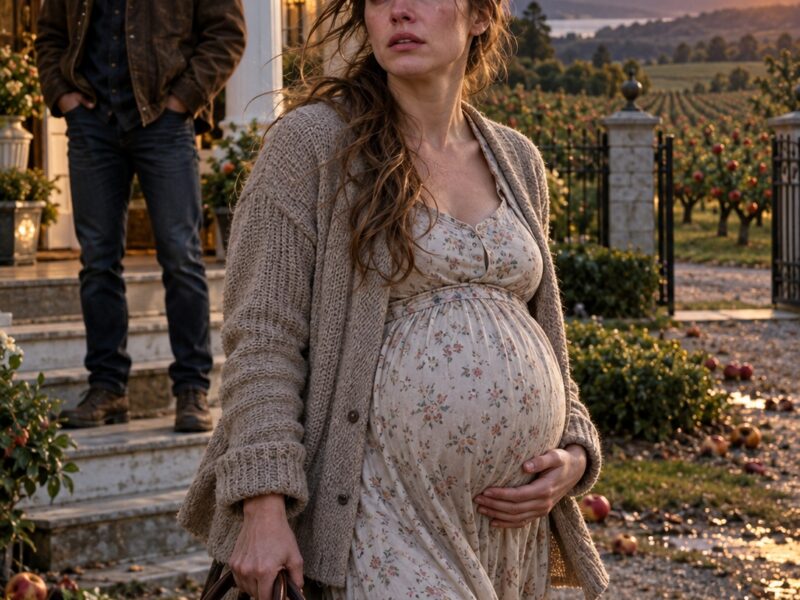
She Begged to Stay Until Her Baby Was Born—But the Silent Orchard Owner Gave Her Something She Never Expected
“If I can feed you, let me stay until the baby comes.”
Mary Bennett had rehearsed those words at three different houses that Friday.
At the first house, the door closed before she finished saying them.
At the second, an older woman pushed a coin through the narrow opening of a screen door, keeping one foot braced behind it as if Mary might force her way inside.
At the third, nobody answered at all.
Mary stood on the porch long enough to hear the deadbolt slide into place from the other side.
That was when she stopped knocking.
She was thirty-one years old, seven and a half months pregnant, carrying everything she still owned in one worn brown traveling bag, and by sunset she had learned something she would remember for the rest of her life:
People found it much easier to pity a desperate woman when they did not have to let her inside.
The baby had barely moved since morning.
Not the frightening kind of stillness.
At least, that was what Mary kept telling herself.
Just tired.
The way babies became quiet when their mothers had walked too far, eaten too little, and spent too much energy pretending they weren’t afraid.
Mary pressed one gloved hand beneath the curve of her stomach as she left the last house behind.
“Just a little farther,” she whispered.
She wasn’t sure whether she was talking to the baby or herself.
The November light was already disappearing when she saw the orchard gate.
The wooden sign hanging above it had once been painted white.
MERCER ORCHARDS.
Most of the letters had faded gray.
Beyond the gate stood rows of peach and apple trees stretching across rolling land toward a dark farmhouse. A barn leaned against the evening sky. A storage shed sat closer to the trees.
And everywhere Mary looked, fruit was rotting.
Peaches lay split beneath the branches.
Apples had gone soft in the grass.
Some were already blackening into the soil.
The smell reached her immediately—sweet at first, then sour beneath it.
Waste.
Mary knew that smell.
She had worked in kitchens for eleven years.
Hotels. Boardinghouses. Restaurants. Private homes.
She knew how many jars could be made from a bushel of peaches. She knew bruised apples could still become butter. She knew overripe pears could be cooked down before they spoiled.
She also knew what an orchard looked like when nobody had the strength to save it.
That was when she noticed the man sitting on the porch.
He wasn’t reading.
Wasn’t smoking.
Wasn’t repairing anything.
He was simply sitting there.
There was something about the stillness of him that Mary recognized immediately.
He looked like a man who had been sitting in the same chair for months because standing up would require deciding what to do next.
Mary pushed through the gate.
His eyes lifted.
He was perhaps thirty-five, broad-shouldered, unshaven, wearing a work shirt beneath an old brown coat. His hands looked strong enough to split wood all day, but his face had the hollow exhaustion of someone who had stopped sleeping properly a long time ago.
His gaze moved to her bag.
Then to her stomach.
Then back to her face.
Mary looked toward the ruined fruit.
“You’re losing your winter stock.”
The man’s expression didn’t change.
Mary swallowed.
“I can save some of it.”
Nothing.
“Preserve it. Dry it. Cook what won’t keep.”
The wind moved through the orchard.
Another peach dropped somewhere behind her with a soft, wet thud.
Mary tightened her grip on the bag.
Then she said the sentence that had failed at every other door.
“If I can feed you, let me stay until the baby comes.”
For the first time, something moved behind the man’s eyes.
Not kindness.
Not yet.
But attention.
He looked at her for a long moment.
Then he said, “There’s nothing available here.”
Mary’s heart sank.
“You should try town.”
She looked back toward the road.
She could have told him she already had.
She could have told him about the doors.
About the coin.
About hearing the bolt slide into place.
Instead, she nodded.
“All right.”
She turned away.
Luke Mercer watched her cross the yard.
He expected her to go back through the gate.
She didn’t.
She walked toward the storage shed.
He frowned.
The door stuck halfway, but Mary put her shoulder against it and forced it open.
Inside were empty crates, old shelves, dust, and forgotten jars.
But there was a roof.
Four walls.
Dry floorboards.
For Mary, that was enough.
She moved two crates aside, laid her coat on the floor, and lowered herself carefully onto it.
Pain burned through her lower back.
The baby shifted once.
Mary curled onto her side, pulling the traveling bag against her stomach.
“Just tonight,” she whispered.
Outside, peaches continued falling in the darkness.
Luke found her before sunrise.
He had expected to find the shed empty.
Instead, light glowed beneath the door.
When he pushed it open, Mary was already working.
Her sleeves were rolled above her elbows despite the cold.
Three piles surrounded her.
Good fruit.
Spoiled fruit.
Bruised fruit.
Luke stared.
Mary didn’t stop sorting.
“About forty percent is still usable.”
He said nothing.
“Maybe more underneath.”
She lifted another peach, turned it in her fingers, and placed it with the fruit for preserves.
“If we start now.”
Luke’s gaze moved from the organized crates to the coat folded in the corner.
That was where she had slept.
A heavily pregnant stranger had spent the night on wooden boards in November and begun working before dawn.
Mary finally looked at him.
She expected anger.
Instead, Luke turned around and walked away.
Her stomach tightened.
So this was it.
She had pushed too far.
She began thinking about how quickly she could repack.
Then she heard movement from inside the farmhouse.
A door opening.
Something heavy scraping across the floor.
Boxes being dragged.
Furniture shifting.
Mary kept working.
Twenty minutes later, when her fingers had grown too numb to continue, she carried a crate toward the house.
A small room beside the kitchen stood open.
Yesterday it had apparently been used for storage.
Now the boxes were gone.
A narrow bed stood against one wall.
A clean blanket had been folded at its foot.
Mary stopped.
There was no note.
No invitation.
Luke was nowhere in sight.
She looked down at her traveling bag.
Slowly, she carried it inside.
But she didn’t unpack.
She placed it beside the bed.
Closed.
Ready.
Then she went into the kitchen and lit the stove.
The house began changing before either of them admitted it.
For eight months, Luke Mercer had lived mostly on bread, cold meat, and coffee.
His mother had owned that kitchen.
She had known which apples kept longest, when the first frost would come, which buyers paid honestly, and exactly how much cinnamon belonged in peach preserves.
Then she died in March.
Afterward, Luke stopped eating at the table.
The silence there was worse than hunger.
But that first morning Mary stayed, he woke to the sound of a spoon scraping against a pot.
Then cabinet doors.
Then water being poured.
Then something he had almost forgotten.
Coffee being made by somebody else.
Luke stood in the hallway listening.
Mary was at the stove when he entered.
She didn’t turn.
She simply reached for a second cup and set it on the table behind her.
No question.
No ceremony.
Just a cup because someone else was in the room.
Luke stared at it.
Then he sat down.
Neither of them spoke.
The coffee was hot.
Outside, the orchard disappeared beneath gray morning fog.
Inside, the stove crackled.
That evening, Luke came home before dark.
He didn’t realize he had done it until he opened the door.
The smell hit him first.
Roasted chicken.
Potatoes.
Onions.
Bread warming near the stove.
Not food assembled because a person needed calories.
Supper.
Mary placed a plate on the table.
Luke sat.
After a moment, Mary sat across from him.
The lamp burned between them.
Forks touched plates.
Wind moved through the trees outside.
Neither said much.
But it was the first supper Luke Mercer had eaten at that table since his mother died.
And somehow that frightened him more than the silence ever had.
Because silence could become permanent.
Warmth could be lost.
Over the next two weeks, Mary saved the orchard one jar at a time.
Fourteen jars the first week.
Then twenty-three.
Then thirty-one.
Peach preserves.
Apple butter.
Dried fruit.
Pear jam.
The kitchen windows fogged each morning from steam.
The shelves filled.
The storage room filled.
And gradually, the orchard stopped smelling like fruit dying in the dirt.
It began smelling like winter being prepared for.
Mary never behaved as if the house belonged to her.
That was what Luke noticed most.
She cleaned.
Cooked.
Worked.
But she never opened drawers unless she needed them.
Never moved his mother’s things.
Never hung her dresses on the hooks.
Every night, her belongings went back into the traveling bag.
Luke discovered that accidentally.
He passed her room late one evening and saw her sitting on the edge of the bed.
The bag lay open.
Across her lap were tiny clothes.
A handmade shirt.
Two blankets.
And socks so small Luke could have closed one inside his fist.
Mary folded each piece carefully.
Smoothed it.
Then returned it to the bag.
The drawers beside her remained empty.
When she finished, she closed the bag and placed it within reach of the bed.
Ready to leave.
Luke stood outside the room longer than he should have.
Then he walked away.
In the kitchen, fourteen jars caught the moonlight.
For the first time in eight months, his house didn’t feel empty.
That realization kept him awake.
There was also the cow.
She had lost her calf months earlier and afterward refused nearly everyone.
Even Orin Hayes, who had worked the Mercer land since Luke was a boy, had stopped trying after she kicked through a stall board.
One evening Luke saw the barn door standing open.
Mary was inside.
She stood beside the cow with one hand against its neck.
She wasn’t pulling.
Wasn’t whispering nonsense.
Wasn’t forcing anything.
She was simply waiting.
The animal’s breathing slowly changed.
Its head lowered.
Its muscles relaxed.
Luke stopped outside the barn.
He watched Mary’s hand remain still against the cow’s neck.
Something about the sight unsettled him.
Perhaps because he understood the animal.
Grief had made it suspicious of anything that came close.
And Mary, somehow, knew not to demand trust.
She only stayed.
The next morning there was milk in the kitchen.
A week later, cream cooled near the window.
Then butter.
Then soft cheese.
Orin noticed.
He picked up one small round, examined it, and returned it carefully.
At supper, for the first time since Mary arrived, he removed his hat before entering the kitchen.
“Ma’am,” he said with a small nod.
Mary almost smiled.
After that, Orin wiped his boots before coming inside.
Luke noticed other things too.
Mary was moving differently.
The baby sat lower now.
She paused on the porch steps.
Pressed one hand against her back when she thought nobody was looking.
Dragged a stool beside the stove when preserving took too long.
One morning Luke entered the kitchen and found her stretching toward a heavy pot on the highest shelf.
Before she could reach it, he crossed the room, took it down, and placed it beside her.
Mary looked at him.
“Thank you.”
Luke washed his hands.
“Was in my way.”
The pot had been six feet above the floor.
Mary glanced at it.
Then at him.
She didn’t challenge the lie.
That became their language.
He repaired the broken porch step without mentioning it.
She made his coffee without asking.
He stacked firewood outside her room.
She started putting aside the crisp end of the bread because she had noticed he preferred it.
Neither thanked the other.
Neither explained.
And neither noticed when these small acts began looking less like an arrangement and more like a life.
Then Luke built the box.
Mary found it beside the warmest kitchen wall one morning.
Clean pine.
Smooth edges.
Flannel lining the bottom.
Small enough for a newborn.
She froze in the doorway.
For several seconds, she couldn’t move.
Luke was outside in the barn.
She could hear the scrape of a bucket.
The cow shifting.
Ordinary sounds.
Mary crossed the kitchen.
She crouched beside the little wooden bed and ran her fingertips across the edge.
Someone had measured this.
Someone had thought about how long a baby was.
Someone had sanded every corner until there was nothing sharp enough to hurt tiny skin.
Mary went to her room.
When she returned, she was holding the little socks.
She placed them inside the box.
Then she lit the stove.
That night Luke said, “Orin says buyers are asking about spring.”
Mary looked toward the shelves.
“They think production will hold?”
“That’s what they’re asking.”
The last jars reflected amber lamplight.
Mary rested a hand on her stomach.
“It will.”
Luke looked at her.
She didn’t notice what she had just said.
Spring.
Not next week.
Not until the baby came.
Spring.
For the first time, Mary had spoken about the future as though she might still be there to see it.
Luke said nothing.
But that night, he slept better than he had in months.
Then Aldis Cole arrived.
He came on a Tuesday wearing clean town clothes and polished boots.
Mary knew his type immediately.
Men like Aldis rarely raised their voices.
They didn’t need to.
He introduced himself as an old friend of the Mercer family and owner of land east of the orchard.
Mary let him inside because refusing would create exactly the kind of story a man like him had come hoping to find.
His eyes examined everything.
The preserves.
The bread.
The wooden box.
The tiny socks.
Then Mary’s stomach.
He drank half his coffee before revealing why he had come.
“Luke’s mother kept a respected house.”
Mary continued kneading dough.
“She did, from what I’ve heard.”
“People notice changes.”
Mary said nothing.
Aldis smiled.
“A decent man can lose business over the wrong kind of talk.”
The dough was already smooth.
Mary kept folding it.
“What kind of talk?”
Aldis glanced toward her stomach.
“Unmarried woman. Child coming. Nobody quite knowing where she belongs.”
There it was.
Mary’s hands stopped.
Only for a second.
Aldis took another sip.
“Buyers prefer certainty.”
“Do they?”
“Business does.”
Mary looked at him.
His expression remained pleasant.
That made the insult worse.
“You seem sensible,” he said. “I’m sure you understand.”
“I understand perfectly.”
Aldis smiled.
“I only mention it because Luke Mercer is a good man.”
He put on his hat.
Then he left.
Mary stood at the counter long after the horse disappeared.
She pressed both hands into the dough.
Folded.
Pressed.
Folded again.
The dough needed nothing more from her.
Her hands kept moving anyway.
That evening Luke knew something had happened before he even sat down.
Mary stayed near the walls.
She moved around him rather than past him.
When he reached for the salt, she whispered, “Sorry.”
Luke stopped.
She hadn’t done anything.
After supper, she washed dishes too quickly.
“Somebody come by?”
Her hands paused.
“A neighbor.”
“Cole?”
Mary turned.
Luke’s face revealed nothing.
“Yes.”
Luke nodded.
That was all.
But the following morning, Mary’s salt jar disappeared from the counter.
So did the spoons she had brought.
So did the cloth she kept beside the stove.
Her possessions were going back into the bag.
Luke saw it.
He didn’t confront her.
Instead, around noon, Mary heard hammering.
For nearly an hour.
When she returned from the storage room, new shelves had been built beside the stove.
Long shelves.
Strong shelves.
Enough room for another season of preserves.
Enough room for far more than preserves.
Mary stood holding a basket.
Through the window, she could see Luke splitting wood.
He never looked toward the house.
Mary stared at the shelves.
Then she placed the salt jar back on the counter.
Next came the spoons.
Then the cloth.
Nothing was said.
But something had been answered.
Three weeks later, Aldis Cole returned.
This time, he brought paper.
Luke met him at the fence.
A debt.
Three years old.
A small amount originally, but not small anymore.
His mother had borrowed it during a bad season.
The signatures were legitimate.
Aldis rested his hands on the saddle.
“I’ve waited out of respect for your mother.”
Luke read the document.
“But?”
“People are questioning the stability of the orchard.”
Aldis looked toward the farmhouse.
“Complicated households make buyers nervous.”
Luke folded the paper.
“I’ll handle it.”
That evening he placed it on the kitchen table.
Mary read it.
Her face changed.
“Will you lose the orchard?”
“No.”
“Luke.”
“No.”
She looked down again.
“How much time?”
“Enough.”
That was another lie.
Mary knew it.
He knew she knew it.
But neither pushed.
That night Luke heard the familiar sounds from her room.
The wardrobe opening.
Clothes folding.
The traveling bag.
He lay awake staring at the ceiling.
For months Mary had been saving his harvest.
His animals.
His kitchen.
Perhaps even some part of him he had assumed was no longer interested in being saved.
And still, at the first sign she might cost him something, she prepared to disappear.
Luke finally understood why.
Mary wasn’t afraid of leaving.
She was afraid of staying long enough for someone to tell her she shouldn’t have.
Before sunrise, Luke saddled his horse.
He returned near dusk.
Mary had supper ready.
Neither spoke while they ate.
Then Luke reached inside his coat and placed a receipt beside her plate.
Mary unfolded it.
PAID IN FULL.
Aldis Cole’s signature beneath it.
Mary read it twice.
“How?”
“Doesn’t matter.”
“It does.”
“Not tonight.”
“Luke, you shouldn’t have—”
“It was my debt.”
She looked at him.
His eyes remained on his coffee.
Mary stood slowly.
She carried the receipt to her room.
Luke expected to hear the bag open again.
Instead, he heard the wardrobe.
Then something being lifted.
Then placed inside.
The door closed.
Mary returned to the kitchen.
The bag did not.
Luke stared at the forty-seven jars lining the wall.
He didn’t smile.
But for the first time, he allowed himself to imagine spring.
Winter came hard.
The night the baby decided to come, Mary initially mistook the pain for wind.
Then it came again.
Low.
Slow.
Tightening across her back.
Mary opened her eyes.
“No.”
Six weeks.
The baby was six weeks early.
She had counted twice.
Then three times.
She knew.
Another contraction came.
Mary sat up.
Her room was cold.
The wardrobe stood across from her.
The bag was inside now.
Not beside the bed.
That should have comforted her.
Instead, fear rose into her throat.
She dressed quietly and went to the kitchen.
The stove had nearly died.
Mary pushed the coals together.
Put on the kettle.
Because boiling water was something she understood.
Because work was something she understood.
Because terror was not.
The next contraction struck while she stood at the counter.
Mary gripped the wood.
Breathed.
Didn’t make a sound.
Luke heard the kettle lid rattling.
Since his mother died, he had become a light sleeper.
He entered the kitchen and stopped.
Mary stood bent over the counter.
“Mary?”
She raised her head.
Her face was pale.
“It’s early.”
Luke crossed the room.
“How early?”
“Too early.”
Another contraction seized her before she could say more.
Luke was already reaching for his coat.
He made it as far as the gate before realizing the road to town was impossible.
Snow had buried the ruts.
Wind was strengthening.
A horse could break a leg before reaching the main road.
Luke turned back.
“Ruth?”
Mary nodded.
Ruth Callahan lived closer.
She had delivered half the babies in the valley.
Luke disappeared into the storm.
Ruth arrived with snow clinging to her skirt and a lantern swinging in one hand.
She entered already rolling up her sleeves.
“How far apart?”
Mary told her.
Ruth’s expression tightened almost imperceptibly.
“Luke. Water.”
He moved.
“Blankets.”
He moved again.
“More wood.”
Again.
Ruth kept giving him tasks because she understood what helplessness did to men outside rooms where women were fighting battles they couldn’t enter.
The storm swallowed the orchard before dawn.
Mary labored quietly.
Too quietly.
Ruth noticed.
Some women screamed.
Some cursed.
Some grabbed whatever hand was near.
Mary did none of it.
She held the mattress.
Breathed.
Listened.
Between contractions, she closed her eyes and gathered herself alone.
Once, Ruth offered water.
Mary drank.
“Thank you.”
Ruth stared at her.
Even now.
Even here.
She was thanking someone for helping her.
Ruth had seen women like Mary before.
Women who expected help reached for it.
Women who had lived too long without it apologized for needing any.
Luke sat in the hallway.
At some point Orin arrived after seeing lights through the storm.
He placed coffee beside Luke.
Neither spoke.
Hours passed.
Then, just before dawn, a cry cut through the house.
Thin.
Sharp.
Alive.
Luke stood so quickly the coffee spilled.
Silence followed.
His heart stopped.
Then the baby cried again.
Luke closed his eyes.
The bedroom door opened.
Ruth appeared.
She looked exhausted.
“Girl.”
Luke stared at her.
“She’s early. Very small.”
“Mary?”
“She’s all right.”
Luke breathed.
Then Ruth added, “Baby needs milk.”
Mary’s milk hadn’t come in sufficiently.
The child was too small to wait.
Luke pulled on his coat.
The barn was bitterly cold.
The cow lifted her head.
Luke approached slowly.
This was the animal Mary had spent months calming.
The animal whose calf had died.
Luke placed his hand against her neck.
“Come on, girl.”
He opened the stall.
The cow followed him through the storm.
Orin stared when Luke led her directly into the kitchen.
Then he silently moved the chairs.
Hooves struck the floorboards.
Ruth emerged carrying the baby.
She looked impossibly small inside the blankets.
A neighbor woman warmed milk beside the stove.
“Slowly,” Ruth instructed. “Small amounts.”
Mary sat upright in bed.
Her eyes never left her daughter.
The baby’s first attempt failed.
Then another.
Her cry weakened.
Mary’s face crumpled.
“Please.”
It was the first time Luke had heard her beg since the evening she arrived at his gate.
“Please, sweetheart.”
The room went silent.
The baby tried again.
A swallow.
Then another.
Tiny fingers clenched.
Her chest fluttered.
She drank.
Mary lowered her head.
She didn’t sob.
She simply covered her mouth.
Luke stood in the doorway with melting snow soaking through his coat.
He had watched an orchard die.
He had watched his mother die.
He knew what it meant to stand helpless while something disappeared.
But now, inside a house he had once thought permanently empty, he listened to the smallest sound he had ever been grateful to hear.
A baby swallowing milk.
Later Luke returned to the hallway.
Orin sat beside him.
From the kitchen came the sound of the cow shifting near the stove.
From the bedroom came tiny restless noises.
Living noises.
Ruth stepped out after sunrise.
“They’re sleeping.”
Orin went outside to care for the cow.
Luke remained alone.
Then he walked into the kitchen.
The little wooden box waited beside the stove.
Someone had placed another layer of flannel inside.
Luke touched the edge.
Down the hallway, the baby woke.
A tiny sound.
Then Mary’s voice.
She was humming.
Luke didn’t recognize the song.
He didn’t need to.
The house was no longer silent.
That was enough.
Spring returned slowly.
First the ground softened.
Then green appeared along the branches.
Then one morning bees returned to the orchard.
Mary stood by the kitchen window holding her six-week-old daughter against her shoulder.
The baby was still small.
But stronger.
Her serious dark eyes followed everything.
Fire.
Hands.
Light.
Movement.
During the day, Mary tied her against her chest while bread rose and work continued.
At night, the baby slept in the wooden box Luke had made.
The orchard recovered too.
Buyers returned.
Contracts were signed.
Orin started working three days each week instead of two.
Nobody announced the change.
Mary simply began setting a third plate at supper.
That was how life established itself in the Mercer house.
Quietly.
One ordinary thing at a time.
Then Mary found a folded piece of paper in a kitchen drawer.
Luke’s mother’s handwriting.
Planting notes.
Which rows held water.
Which trees flowered early.
Where to plant in spring.
Mary placed it beside Luke’s coffee.
She didn’t mention it.
From the window she watched him discover the page.
Luke stood outside reading his mother’s handwriting for a long time.
That afternoon, he planted the east rows exactly as she had instructed years earlier.
Mary watched from the house.
She understood something then.
She had believed she was replacing a dead woman’s work.
She wasn’t.
Luke had never asked her to become his mother.
Never asked her to erase anything.
They were simply making room beside what had been lost.
There was a difference.
Aldis Cole returned once more when the first blossoms opened.
Luke saw him approaching.
He met him at the gate.
Aldis had no papers this time.
No debt.
No polite threat.
He looked beyond Luke.
At the repaired orchard.
The smoke rising from the chimney.
The storage shed waiting for another harvest.
The farmhouse.
Through one window, he could probably see movement in the kitchen.
Mary.
The baby.
A life that had become increasingly difficult to describe as unstable.
Luke said nothing.
Aldis said nothing.
Eventually, Aldis turned his horse around.
Luke watched until he disappeared.
Then he returned to work.
Mary had seen everything from the kitchen.
She stood holding a dish towel.
For reasons she couldn’t explain, her heart began beating harder.
She looked toward the hallway.
Toward her room.
Then she went inside.
The traveling bag sat beside the bed.
Even after the birth.
Even after Luke paid the debt.
Even after the wooden cradle.
Even after forty-seven jars became empty jars waiting for another season.
Even after she had begun thinking of the kitchen as theirs instead of his.
The bag remained ready.
Mary sat on the bed.
She stared at it.
That bag had been beside her through boardinghouses, kitchens, rented rooms, and locked doors.
It had taught her a rule.
Never unpack completely.
Never need too much.
Never assume kindness is permanent.
Never become comfortable enough that leaving hurts.
Mary opened it.
The baby’s clothes were on top.
She lifted the handmade shirt.
Carried it to the drawer.
Placed it inside.
Then the blankets.
Then the tiny socks that had once rested inside Luke’s wooden box before the baby existed outside Mary’s body.
Mary smoothed them flat.
Closed the drawer.
The click sounded strangely loud.
Next came her dresses.
She hung them on the hooks.
Luke’s coat was already there.
Her fingers brushed one sleeve.
She pulled her hand away.
Then changed her mind.
She touched it again.
Just once.
Mary removed the photograph of her mother.
Placed it on the shelf where afternoon sunlight reached.
Her grandmother’s Bible went beside the bed.
A hairbrush.
Two letters.
A sewing kit.
A faded ribbon.
One by one, the things she owned stopped being luggage.
Finally, Mary looked into the bag.
Empty.
She stared at it.
Something inside her tightened.
The first empty thing she had owned in years.
She folded it.
Opened the wardrobe.
Then stopped.
Fear whispered the old rules.
Keep it near the door.
You may need it.
Don’t be foolish.
People change.
Kindness expires.
Homes disappear.
Mary looked toward the drawer containing her daughter’s clothes.
Outside, bees moved among the blossoms.
Somewhere in the yard, Orin called something to Luke.
Luke answered.
The baby slept near the stove.
Mary lifted the folded bag.
She placed it on the highest shelf.
Behind the spare blanket.
Not beside the bed.
Not beside the door.
Away.
She closed the wardrobe.
For a long time, Mary stood motionless.
Her dresses hung beside Luke’s coat.
Her mother’s photograph caught the sunlight.
Her baby’s clothes filled the drawer.
Nothing was packed.
Nothing was ready.
She had spent months telling herself she would leave before she became foolish enough to believe she belonged somewhere.
Now the bag was in the wardrobe.
And nobody had put it there but her.
Mary didn’t hear Luke approaching.
When she turned, he was standing in the doorway.
His hand rested against the frame.
His eyes traveled slowly around the room.
The dresses.
The photograph.
The drawer.
The closed wardrobe.
Then Mary.
Heat rose into her face.
“I was only putting things away.”
Luke looked at the hooks again.
His coat.
Her dresses.
Then back at her.
Mary suddenly felt more exposed than she had the night she begged for shelter.
Luke leaned slightly against the doorway.
“Should I clear more space?”
Mary didn’t answer.
Outside, the Mercer orchard was blooming.
A place that had been rotting when she arrived was alive again.
But so was something else.
Eight months earlier, Luke had buried his mother and apparently decided silence was safer than attachment.
Months earlier, Mary had learned to sleep with a packed bag beside her bed because expecting permanence was another way of inviting heartbreak.
Neither had rescued the other.
Life was rarely that simple.
Mary had not magically cured Luke’s grief.
Luke had not erased whatever roads had brought Mary to his gate alone and pregnant.
The orchard still required work.
The baby was still small.
Winter would come again.
There would be bills.
Bad harvests.
Arguments.
Illness.
There would be mornings when Luke withdrew into silence and nights when Mary woke convinced she had stayed too long.
A home wasn’t a promise that nothing could be lost.
Both of them knew better than that.
Perhaps that was why the question mattered.
“Should I clear more space?”
Mary looked past him.
Through the kitchen doorway she could see the wooden box beside the stove.
Her daughter slept inside it with one fist near her cheek.
Beyond the window, rows of trees moved softly beneath white blossoms.
Luke waited.
He did not tell Mary to stay.
He did not promise forever.
He did not ask for anything she wasn’t ready to give.
He simply offered space.
Mary looked back at the wardrobe.
At the place where the traveling bag had disappeared behind a blanket.
Then she met Luke’s eyes.
“Yes,” she said.
Luke didn’t smile immediately.
Neither did Mary.
But this time, neither of them looked away.
Outside, one blossom broke loose from a branch and drifted across the yard.
Then another.
The orchard had spent an entire winter appearing dead.
Beneath the frozen ground, its roots had remained alive anyway.
Perhaps people were sometimes like that.
Perhaps a home wasn’t the place where someone promised you would never have to leave.
Perhaps it was the place where, one ordinary morning, you finally stopped keeping your bag packed.
And in the quiet Mercer farmhouse, while their daughter slept beside the warm stove and spring moved through the trees, Mary Bennett finally did.









