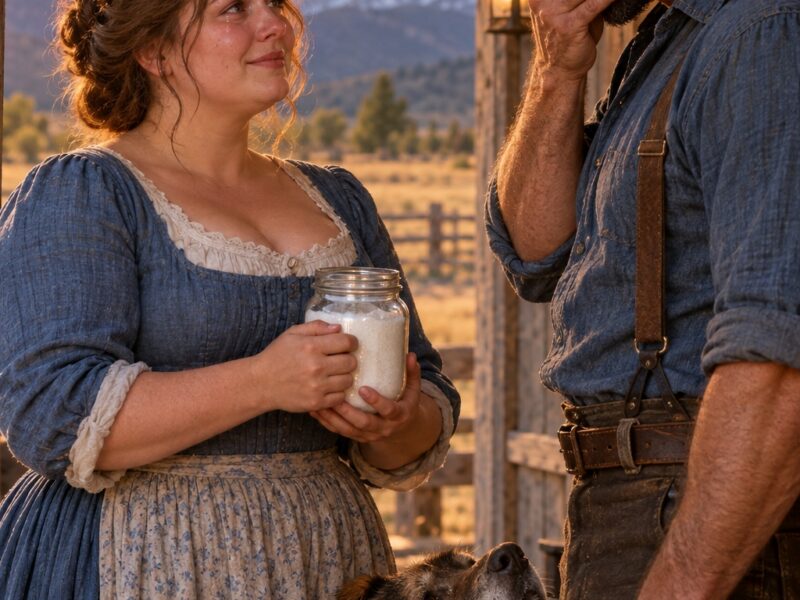
SHE BORROWED SUGAR FROM THE LONELY RANCHER EVERY TUESDAY—BUT AFTER SIX WEEKS, HE DISCOVERED THE HEARTBREAKING REASON SHE NEVER USED A SINGLE SPOONFUL
For eleven years, Garrett Holloway had kept an empty chair beside his supper table.
He told himself it was simply too much trouble to move.
Then a widowed woman began knocking on his door every Tuesday, asking to borrow sugar.
Six weeks later, when Garrett discovered she had never used a single spoonful, he finally understood why she kept coming.
But before he could tell her what those visits had meant to him, she pulled a folded letter from her pocket.
The handwriting was his own.
And the letter belonged to a woman he had buried eleven years earlier.
Wyoming Territory, June 1887.
The chair stood beside the east-facing kitchen window, exactly where Margaret had left it.
Its seat had been worn smooth by years of use. One of its legs was slightly shorter than the others, and if someone leaned back too far, the whole thing gave an irritated little creak.
Garrett knew that sound better than he knew his own laughter.
Margaret used to lean back in that chair after supper, her hands wrapped around a cup of coffee, telling him about things that had happened while he was out with the cattle.
Sometimes the hens had escaped.
Sometimes the milk had soured.
Sometimes there was nothing worth telling at all.
He had listened anyway.
Back then, he had never imagined there could come a day when he would give almost anything to hear her complain about a stubborn chicken.
Now the chair remained empty.
Garrett had become quite skilled at pretending not to notice.
At forty-two, he was a broad-shouldered rancher with weathered hands, silver beginning to show at his temples, and a reputation for being dependable rather than friendly.
His two hundred acres lay along a wide Wyoming valley where the grass turned gold in summer and the winters could kill livestock before a man had time to pray.
He owned a solid farmhouse, a respectable herd, good horses, and enough land to make most men in the territory consider him fortunate.
He was fortunate.
He knew that.
But good fortune did not speak to a man at supper.
It did not ask whether his back was hurting.
It did not laugh when he burned the biscuits or remind him to bring his coat when the evening temperature dropped.
Most nights, the only other living creature inside the house was Judge, an aging shepherd dog with stiff hips and an unfortunate habit of sleeping directly in front of the stove.
Garrett talked to him sometimes.
“You’re getting lazy, old boy.”
Judge would lift one ear.
“Used to be you could chase three coyotes before breakfast.”
The dog would sigh, close his eyes, and go back to sleep.
Garrett understood.
They had both grown older in that house.
They had simply done it without much company.
Margaret had died eleven years earlier, when she was twenty-nine.
The sickness came in winter.
At first, they believed it was an ordinary fever.
Garrett remembered laying cool cloths across her forehead and promising that spring would come soon.
He remembered the physician’s tired expression.
He remembered Margaret reaching for his hand.
Most of all, he remembered how quickly an ordinary room could become unbearable.
He buried her beneath the cottonwood trees beyond the south pasture.
For weeks afterward, women from neighboring ranches brought food.
Men offered to help with repairs.
Someone even suggested that, after a suitable period of mourning, he ought to consider marrying again.
Garrett thanked them all.
He ate their casseroles.
He accepted their condolences.
Then he closed the door.
Eventually, they stopped visiting.
Eventually, he stopped expecting them.
Years passed that way.
One winter became another.
Calves were born.
Fences broke.
Horses grew old.
And Garrett kept setting one plate on the table.
Until the spring Willa Bennett moved onto the neighboring property.
The first thing Garrett noticed about his new neighbor was that she did not know how to surrender.
He saw her struggling with a fence post on a windy April afternoon.
She had planted her boots in the mud, wrapped both hands around the post, and was trying to straighten it while a brown milk cow watched with apparent disapproval.
Garrett stopped his horse beside the fence.
“Need a hand?”
The woman looked up.
Her chestnut hair had escaped its pins, and there was a streak of dirt across one cheek.
“No, thank you.”
Garrett studied the leaning post.
“That thing’s going to fall over again.”
“Then I suppose I’ll put it back up again.”
He almost smiled.
“Ground’s too soft.”
“So I’ve discovered.”
She gave the post another determined shove.
It moved perhaps half an inch.
Garrett waited.
At last, the woman stepped back, wiped her forehead, and regarded the crooked fence with an expression of deep personal offense.
“You may be right.”
“Usually am about fences.”
“Are you equally knowledgeable about cows?”
“Depends on the cow.”
She glanced toward the animal beside her.
“That one has spent twenty minutes watching me work and hasn’t offered the slightest assistance.”
Garrett laughed before he could stop himself.
The sound startled him.
It had been a long time since a stranger had made him laugh.
The woman turned toward him with a smile.
“I’m Willa Bennett.”
“Garrett Holloway.”
“I know. Mrs. Talbot told me you own the ranch over the hill.”
“She tell you anything else?”
Willa considered him.
“That you mind your own business.”
“Good.”
“And that you don’t talk much.”
Garrett looked at the crooked fence.
“She’s right about that, too.”
Willa laughed.
It was an easy sound.
Warm.
Unembarrassed.
The kind of laughter that made a man feel he had stumbled into a happier room than the one he intended to enter.
Garrett dismounted and helped set the post properly.
Willa thanked him twice.
He told her it was nothing.
But when he rode home, he found himself remembering the streak of dirt on her cheek.
And her smile.
Especially her smile.
He disliked that.
Not because Willa had done anything wrong.
Because he had spent eleven years teaching his heart to expect nothing.
And now, without warning, it had begun noticing things again.
Willa’s first visit to his farmhouse came three days later.
Garrett was washing his hands at the kitchen basin when someone knocked.
Judge barked once.
“Quiet.”
Another knock.
Garrett opened the door.
Willa stood on the porch holding an empty flour sack.
“Good morning, Mr. Holloway.”
“Mrs. Bennett.”
“I’m terribly sorry to trouble you.”
He looked at the sack.
“Flour?”
She blinked.
“How did you know?”
“Had a feeling.”
Willa smiled.
“I seem to have miscalculated what I needed for bread.”
“How much?”
“Just enough for tomorrow morning.”
Garrett stepped aside.
“Come in.”
She hesitated.
“Are you sure?”
“Flour’s in the kitchen.”
She entered carefully, glancing around the room without making the sort of obvious inspection that would have irritated him.
Garrett fetched the flour barrel.
He filled her sack with twice what she requested.
“That’s far too much.”
“Then you won’t need to borrow again tomorrow.”
“You’re very generous.”
“Just flour.”
Willa held the sack against her hip.
“Is it always this quiet out here?”
Garrett glanced at Judge.
“Not when he snores.”
The dog looked up.
Willa laughed.
And somehow a simple errand became a conversation.
She asked about the weather.
He told her how quickly storms could come down from the mountains.
She asked about the nearest town.
He explained which road was safest after rain.
She told him about the two cows she had brought west and the chickens she hoped would soon produce enough eggs to justify their feed.
Twenty minutes passed.
Garrett scarcely noticed.
When she finally left, the kitchen seemed oddly larger.
He stood in the doorway, watching her cross the yard.
Judge settled beside his leg.
“Don’t start,” Garrett muttered.
The dog wagged his tail.
Three days later, she returned for eggs.
Garrett opened the door and found her holding a small basket.
“Morning.”
“Good morning.”
He looked at the basket.
“What is it this time?”
Willa pressed her lips together.
“I need six eggs.”
“Didn’t your hens arrive last week?”
“They did.”
“Not laying?”
“Apparently, they’re still considering the matter.”
Garrett laughed.
Willa’s face brightened.
“Well, I’m glad somebody finds them amusing.”
“They’re probably waiting for warmer weather.”
“Then I may have purchased the most delicate hens in Wyoming Territory.”
He gave her six eggs.
She stayed half an hour.
They drank coffee while Judge rested his chin on her boot.
“Does he always do that?” she asked.
“Only when he likes somebody.”
“Then I’m honored.”
“Don’t be. He also likes the butcher.”
Willa reached down and scratched the dog’s ears.
“At least he has good judgment.”
Garrett looked at her hand resting gently against Judge’s graying fur.
He had forgotten what it felt like to have another person move naturally through his kitchen.
Not a visitor determined to be polite.
Not a neighbor delivering bad news.
Just someone who seemed comfortable being there.
When she left, Garrett washed two coffee cups.
He held the second one a moment longer than necessary.
Then he put it away.
The following week, Willa arrived needing a hammer.
Garrett stared at her.
“A hammer?”
“Yes.”
“What kind?”
“The ordinary kind, I suppose.”
He nearly told her about the perfectly serviceable hammer he had seen hanging beside her barn door.
Instead, he went to fetch his own.
Willa accepted it with both hands.
“I’ll bring it back before Friday.”
“No hurry.”
Two days later, she returned.
The hammer was tucked beneath her arm.
In her other hand, she carried a small loaf of warm bread wrapped in a clean cloth.
“I thought I ought to pay interest.”
Garrett looked at the bread.
“For borrowing a hammer?”
“Well, it was an excellent hammer.”
She was smiling when she said it.
He let her inside.
They ate the bread at his kitchen table.
Willa broke off a small piece for Judge, who accepted it with considerably more enthusiasm than he had ever shown for Garrett’s company.
“Traitor,” Garrett said.
Willa laughed.
Then she noticed the empty chair.
Her smile softened.
“Do you usually eat here?”
“Where else?”
“I only meant it’s a nice place to sit.”
Garrett glanced toward the window.
Sunlight had fallen across the chair’s worn seat.
“Margaret liked that view.”
The words escaped before he could consider them.
Willa did not ask who Margaret was.
Perhaps someone had already told her.
Perhaps she knew from the way he said the name.
Instead, she looked outside.
“The cottonwoods are beautiful.”
“She planted the smaller one.”
“Did she?”
“First summer we were married.”
Willa studied the trees for a moment.
“Then she left you something lovely.”
Garrett looked down at his coffee.
“She did.”
For the first time in years, speaking his wife’s name did not immediately make him want to end the conversation.
Willa said nothing more about it.
She did not offer sympathy he had not requested.
She did not tell him it was time to move on.
She simply remained at the table until the bread was gone.
That evening, Garrett realized something peculiar.
He had not looked at the empty chair once while they were talking.
Then came the sugar.
On a Tuesday morning in May, Willa appeared with a small glass jar tucked against her pale-blue dress.
Garrett had been repairing a bridle on the porch.
He looked up when Judge barked.
Willa waved.
“Good morning.”
“Morning.”
“I hope I’m not disturbing you.”
“Just working.”
She lifted the jar.
“I was wondering whether you might spare a little sugar.”
Garrett rose.
“Sure can.”
He led her into the kitchen and opened the wooden cupboard.
The sugar was stored in a covered tin.
He poured enough into her jar to nearly fill it.
“That do?”
“More than enough.”
“You baking something?”
Willa looked briefly at the window.
“Something like that.”
Garrett replaced the lid.
“Coffee?”
She smiled.
“I’d love some.”
They sat together for nearly an hour.
She told him about a stubborn calf that had escaped through her fence.
He described the best way to reinforce the lower rail.
She asked whether he had always lived in Wyoming.
He told her about coming west as a young man with more determination than money.
At one point, Willa laughed so hard that she had to set down her cup.
Garrett watched her.
He could not remember when the kitchen had last felt that alive.
When she finally stood to leave, Judge followed her to the door.
“Same time next week?” she asked lightly.
Garrett looked at her.
“For sugar?”
Her cheeks colored.
“Unless I’ve learned to manage my supplies by then.”
“Wouldn’t count on it.”
She laughed.
He watched her walk away.
And for the first time in eleven years, he looked forward to Tuesday.
The following Tuesday, Willa came back with the same jar.
Empty.
“Already?” Garrett asked.
She gave him a sheepish smile.
“I’m afraid so.”
“Must do an awful lot of baking.”
“Something like that.”
He filled the jar.
She stayed for coffee.
Another Tuesday passed.
Another empty jar appeared.
This time Garrett studied it while Willa stood beside the kitchen table.
“What exactly are you making with all this sugar?”
She adjusted the ribbon on her bonnet.
“Oh, nothing terribly interesting.”
“Preserves?”
“Not at the moment.”
“Pies?”
“Not today.”
“Then what?”
Willa smiled.
“You’re a remarkably curious man, Mr. Holloway.”
“Only when people borrow my entire sugar supply.”
“Well, I promise it’s going to a worthy cause.”
He could not imagine what that meant.
He also found he did not care very much.
Because by then, he had begun waiting for the sound of her footsteps.
Garrett did not notice how his habits were changing until he caught himself shaving on a Tuesday morning.
He stood before the little mirror in his bedroom, razor in hand, and examined his reflection.
There was nothing unusual about a man shaving.
He had done it most of his life.
But he had not previously considered whether his collar was clean enough for a morning spent repairing a gate.
He had not worried about the silver beginning to show in his hair.
And he certainly had not bought a new blue shirt from the general store without a practical reason.
Yet there the shirt hung, freshly washed, beside his bed.
Garrett frowned at himself.
“Foolishness.”
He finished shaving anyway.
Then he swept the porch.
And tightened the hinge on the front door.
And moved his tools from the kitchen table.
Judge watched these activities from his place near the stove.
“You don’t have an opinion worth hearing,” Garrett informed him.
Judge wagged his tail.
By nine o’clock, the dog had stationed himself beside the porch steps.
By half past nine, Garrett had found three separate reasons to walk outside.
At ten, he saw Willa crossing the meadow.
His heart lifted so suddenly that he stopped moving.
She carried the jar in one hand and held the hem of her dress with the other.
The breeze caught loose strands of chestnut hair beneath her bonnet.
She looked up.
Saw him.
And smiled.
Garrett’s carefully prepared greeting vanished from his mind.
“Morning,” he managed.
“Good morning, Garrett.”
It was the first time she had used his given name without hesitation.
He thought about that for the rest of the day.
Their conversations grew longer.
They spoke about cattle and crops, the price of flour, broken fences, and the unpredictable Wyoming weather.
Then, gradually, they began speaking about things that mattered more.
One afternoon, Willa stayed almost two hours.
They sat beneath a cottonwood near the edge of Garrett’s pasture.
The grass bent gently in the warm wind.
Judge slept between them.
Willa had removed her bonnet and was turning it slowly in her lap.
“My husband was named Henry,” she said.
Garrett looked toward her.
She had never spoken of him before.
“He died three years ago. Pneumonia.”
Garrett lowered his eyes.
“I’m sorry.”
“He was a good man.”
She smiled faintly.
“He had terrible handwriting. Could never remember where he left his boots. And he thought putting pepper on everything made him an excellent cook.”
Garrett smiled.
“Sounds like he kept you busy.”
“He did.”
She looked toward the distant mountains.
“When he died, everybody was very kind at first.”
Garrett understood that part.
“The church women brought food. My neighbors checked on me. People said all the things people say when they don’t know how to help.”
She turned the bonnet again.
“Then something changed.”
“What changed?”
“They stopped seeing me as a woman who still had a life to live.”
Garrett said nothing.
“They stopped inviting me to supper because there was no husband to bring along. They stopped asking what I wanted. They spoke softly whenever I entered a room.”
She gave a small, unhappy laugh.
“Some people looked at me as though I might break if they asked how I was doing.”
Garrett studied her face.
“So you came west?”
“I sold nearly everything and bought that little place.”
“All by yourself?”
“All by myself.”
“That takes courage.”
Willa looked down at her hands.
“Sometimes courage is just loneliness wearing its Sunday clothes.”
The words settled between them.
Garrett understood them more deeply than he wanted to admit.
For eleven years, people had admired how well he had managed.
They called him strong.
Independent.
Resilient.
No one saw the evenings when he sat with his coffee until it went cold simply because there was no reason to hurry.
No one saw him glance toward the empty chair when a joke occurred to him.
No one knew how many times he had almost spoken Margaret’s name aloud.
Willa touched the grass beside her.
“Do you ever think about marrying again?”
Garrett’s breathing changed.
He looked toward the pasture.
“Not much.”
“Why?”
He rubbed a thumb across the rough skin of his palm.
“Never saw much reason to.”
Willa waited.
He knew she was waiting.
At last he sighed.
“Suppose I got used to having somebody around again.”
“And?”
“Suppose I lost her.”
Willa turned fully toward him.
For a long moment, neither spoke.
Then she said quietly, “Garrett, being alone doesn’t keep a heart from breaking.”
He looked at her.
There was no pity in her expression.
Only understanding.
That frightened him more than pity would have.
Because pity was easy to turn away.
Understanding made a man want to be known.
Willa’s hand rested on the grass, only inches from his.
Garrett looked at it.
He wanted to reach across that small distance.
He wanted to tell her that he had begun listening for her footsteps.
That he sometimes caught himself smiling before he opened the door.
That the sound of her laughter had changed something inside his house.
Instead, he remained still.
Willa waited a moment longer.
Then she picked up her bonnet.
“I should get home.”
Garrett rose with her.
“I’ll walk you to the fence.”
“You don’t have to.”
“Know that.”
They walked slowly.
At the gate, she looked up at him.
“Thank you for the afternoon.”
Garrett nodded.
“You’re welcome.”
She waited.
He could see it.
An almost invisible pause.
An opportunity.
He could have asked her to stay for supper.
Instead, he opened the gate.
Willa smiled politely.
“Good night, Garrett.”
“Night, Willa.”
He watched her cross the field.
Then he walked home alone.
That evening, Garrett took two plates from the cupboard.
He set the first at his place.
The second he placed across the table.
Only then did he realize what he had done.
He stood motionless.
The room was quiet except for the ticking of the clock.
Judge lay beside the stove.
Garrett stared at the second plate.
It was an ordinary white plate with a small chip near the rim.
He remembered buying the set with Margaret during their second year of marriage.
They had argued good-naturedly about whether they could afford it.
Margaret had won.
She usually did.
Garrett touched the edge of the plate.
For eleven years, he had avoided setting a place for anyone else.
Now he had done it without thinking.
And the realization made his throat tighten.
He was not forgetting Margaret.
He knew that.
He could still remember the sound of her voice.
The way she tied back her hair.
The small scar on her thumb.
What frightened him was something different.
He was beginning to imagine a future that included someone new.
He picked up the second plate.
Carried it back to the cupboard.
Then he returned to his chair and ate supper alone.
But the silence felt different that night.
Not permanent.
Not quite.
Six weeks passed.
Six weeks of borrowed flour, eggs, a hammer, and sugar.
Six weeks of conversations that grew longer than either had intended.
Six weeks of Willa leaving Garrett’s house with an empty coffee cup behind her and another promise to visit.
And six weeks of Garrett gradually becoming a man he barely recognized.
He began keeping fresh coffee on hand.
He found himself checking the weather before Tuesdays, hoping rain would not keep Willa home.
He repaired a loose board on the porch because he did not want her catching her dress on it.
One morning he even washed the kitchen curtains.
When he stood back to inspect them, Judge watched with something suspiciously close to judgment.
“Don’t look at me that way.”
The dog yawned.
Garrett shook his head.
“This is getting ridiculous.”
But when Tuesday came, he wore the blue shirt.
And he smiled when he saw her.
Because loneliness had begun to loosen its grip.
And he was no longer certain he wanted to hold on to it.
The morning that changed everything arrived beneath a cloudless June sky.
Golden sunlight spread across the valley.
Meadowlarks called from the fence posts.
A warm breeze carried the scent of new grass through the open kitchen window.
Garrett had finished breakfast early.
He had washed his plate, fed Judge, and checked the front gate.
Twice.
Now he was standing on the porch, pretending to examine a piece of leather tack.
Judge lifted his head.
His ears pricked forward.
Then he barked.
Garrett looked toward the road.
Willa was coming.
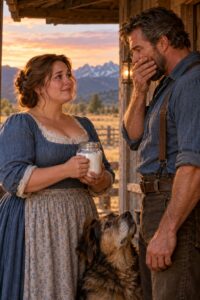
She wore a soft blue dress with white lace at the collar, and her chestnut hair was pinned loosely beneath a straw bonnet.
In her hand was the familiar glass jar.
Empty.
Again.
Garrett felt a smile spreading across his face.
He tried to suppress it.
Failed.
“Morning, Mrs. Bennett.”
“Morning, Garrett.”
She stepped onto the porch.
A little out of breath from the walk, she brushed a loose strand of hair away from her face.
“I was wondering whether you might spare a little sugar.”
Garrett looked at the jar.
Then at her.
For weeks, he had been carrying words he did not know how to say.
He had rehearsed them while mending fences.
Considered them while riding across his pastures.
Rejected them over supper.
He was not a man accustomed to risking embarrassment.
He was certainly not a man accustomed to flirting.
But the sun was warm.
Willa was smiling.
And for once, Garrett Holloway felt brave.
He leaned against the doorway and folded his arms.
“You know, Mrs. Bennett…”
“Yes?”
“Keep borrowing sugar from me like this, and folks are going to start thinking you want me.”
He expected her to laugh.
He expected her to make some clever remark about his considerable supply of sugar.
Perhaps she would blush.
Perhaps she would tease him in return.
Instead, her smile disappeared.
Her cheeks slowly turned pink.
Her fingers tightened around the glass jar.
Garrett’s stomach sank.
He had misjudged the moment.
Of course he had.
Eleven years of living alone had apparently stripped him of what little charm he once possessed.
“Now, Willa, I was only teasing—”
“I don’t use sugar.”
He stopped.
“What?”
She looked at him.
Her voice was barely above a whisper.
“I don’t use sugar, Garrett.”
The breeze moved through the cottonwood branches.
Somewhere behind the barn, a horse stamped its hoof.
Garrett stared at the jar.
“Not at all?”
She shook her head.
He glanced toward the kitchen cupboard.
Then back at her.
“Then what have you been doing with all the sugar I’ve given you?”
Willa lowered her eyes.
“Keeping it.”
Garrett did not understand.
Not immediately.
He thought about the first visit.
The flour.
The eggs.
The hammer she already owned.
The bread she brought in return.
Then the glass jar.
Week after week.
And suddenly, the meaning of every visit shifted.
Willa had not needed the sugar.
She had needed a reason to knock.
Garrett’s heart began beating faster.
He spoke carefully.
“Then why have you been coming here?”
Willa swallowed.
“I thought you might figure it out.”
“Figure what out?”
She looked past him.
Through the open doorway.
Toward the old kitchen chair beside the window.
Garrett followed her gaze.
When he looked back, there were tears in her eyes.
“I know about Margaret.”
His body went still.
“Willa…”
“I know you lost her eleven years ago.”
He lowered his arms.
“I know you’ve spent all that time telling everyone you’re perfectly content by yourself.”
She drew a shaky breath.
“And I know what it feels like to sit down for supper every evening, wishing somebody would ask you to stay.”
Garrett could not speak.
Willa looked toward the floorboards.
“I didn’t want to frighten you.”
“Frighten me?”
“I didn’t want you thinking I was trying to replace your wife.”
She looked up again.
“Because I’m not.”
Something in Garrett’s chest tightened.
“I know you loved Margaret. I can see that in the way you keep this place.”
Her eyes moved toward the doorway once more.
“And the way you look at that chair.”
Garrett’s throat worked.
He had never realized she noticed.
“I thought perhaps if we became friends first…”
She paused.
Her cheeks were wet now.
“If I gave you enough time to know me, you might begin to want my company without feeling guilty about it.”
Garrett took a small step forward.
“Willa—”
“So I borrowed flour.”
A nervous laugh escaped her.
“And eggs.”
He stared at her.
“And that ridiculous hammer I already had hanging in my barn.”
A surprised breath escaped him.
“You knew I saw that?”
“I hoped you hadn’t.”
He shook his head, unable to keep from smiling.
Willa lifted the glass jar.
“And when I couldn’t think of anything else to borrow, I asked for sugar.”
Garrett looked at the jar.
He thought of the Tuesday mornings.
The warm coffee.
The conversations beneath the cottonwoods.
The way Judge followed her through the kitchen.
The way he had begun shaving before she arrived.
He had thought himself foolish for hoping.
All this time, she had been hoping too.
“Willa…”
She shook her head quickly.
“Please let me finish before I lose my nerve.”
He went quiet.
Her hands were trembling now.
“I have walked across that field every Tuesday for six weeks, wondering whether today might be the day you’d ask me to stay for supper.”
Garrett drew a slow breath.
Willa smiled sadly.
“And every time you filled this jar, you looked at me like I mattered.”
Her voice cracked.
“Do you know how long it’s been since a man looked at me that way?”
Garrett wanted to reach for her.
He wanted to tell her she had become the best part of his week.
That the kitchen felt warmer after she visited.
That he had taken two plates from the cupboard one evening without even realizing it.
He wanted to say that loving Margaret had never stopped being part of him, but he was beginning to understand it did not have to be the end of him.
Instead, he managed only her name.
“Willa.”
She took another breath.
And then her expression changed.
The tenderness remained.
But something else entered her face.
A nervousness far deeper than embarrassment.
“There’s something else.”
Garrett frowned.
“What is it?”
Willa glanced toward the cottonwood trees beyond the pasture.
Then she reached into the pocket of her dress.
Slowly, she withdrew a folded piece of paper.
It was yellowed with age.
The edges had softened.
The fold looked as though it had been opened and closed many times.
Garrett stared at it.
There was something familiar about the paper.
Willa held it out.
He could see writing along one edge.
His breath caught.
He knew that handwriting.
He had seen it on bills, notes, and old scraps of paper.
He had written those letters himself.
Eleven years earlier.
“Willa…”
His voice changed.
“Where did you get that?”
She did not immediately answer.
Garrett stepped closer.
He recognized the note now.
Or believed he did.
He remembered writing it during Margaret’s final winter.
He remembered believing it had been placed with her when she was buried.
His eyes lifted sharply.
“That was Margaret’s.”
Willa nodded.
“Yes.”
“It was supposed to be buried with her.”
“I know.”
Garrett stared at her.
The warmth of the morning seemed to vanish.
“How do you know?”
Willa’s fingers tightened around the note.
“Because, Garrett, the first time I came to your door…”
She stopped.
He waited.
“I already knew who you were.”
For a moment, the world seemed impossibly quiet.
The meadowlarks continued singing.
The cottonwood branches moved in the breeze.
But Garrett heard none of it clearly.
He looked at the woman standing before him.
The woman who had borrowed flour.
And eggs.
And a hammer.
And six weeks’ worth of sugar.
The woman whose laughter had made his house feel alive again.
“What are you saying?”
Willa’s eyes filled.
“Margaret left something for you.”
Garrett could not move.
“And I’ve been trying to find the courage to tell you.”
He looked down at the folded paper.
Eleven years.
Eleven years of grief.
Eleven years of believing he knew everything there was to know about the woman he had loved.
“Willa…”
He held out his hand.
“Please.”
Willa slowly unfolded the note.
The old paper crackled between her fingers.
Garrett leaned forward.
His eyes found the first sentence.
And every bit of color drained from his face.









