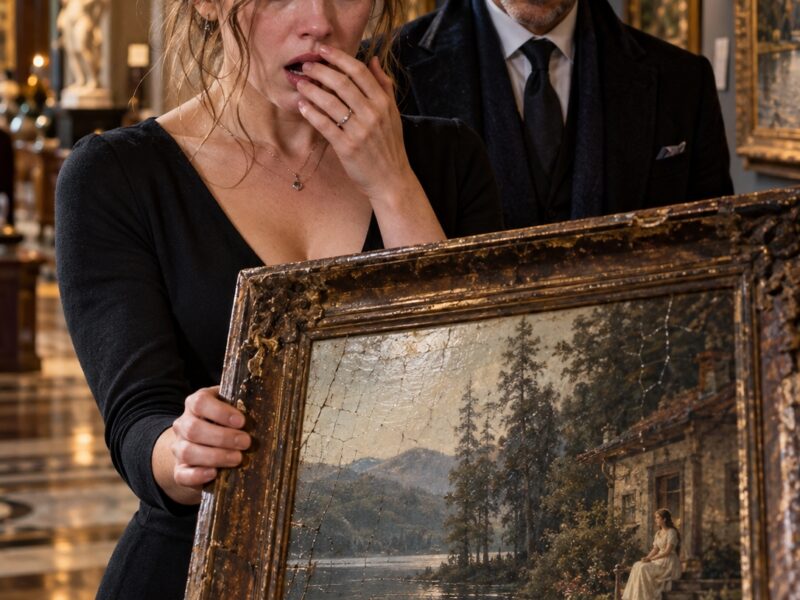
SHE BOUGHT A CRACKED PAINTING FOR $20—THE NEXT MORNING, A BILLIONAIRE OFFERED HER $5 MILLION… BUT HE WASN’T LOOKING AT THE SIGNATURE
The first time someone offered Catherine Turner five million dollars for the painting, she almost said yes.
Almost.
Her mother had medical bills stacked inside a kitchen drawer because looking at them every day made it harder to breathe. Catherine herself lived above a bakery in a Hudson apartment where the ceiling leaked every spring and the radiator sounded like somebody striking a pipe with a wrench.
Five million dollars could erase all of that before lunch.
But the man offering it—Adrienne Mercer, a billionaire whose family name appeared on hospital wings and museum galleries—wasn’t looking at the signature in the corner.
He was staring at the woman painted beside the lake.
And there were tears in his eyes.
That was when Catherine understood something was wrong.
Not with the offer.
With the painting.
Because less than twenty-four hours earlier, Catherine had bought it for twenty dollars.
And the woman who sold it to her had been relieved to get rid of it.
The antique market in Hudson had begun thinning out by noon.
It was one of those pale New York Saturdays when sunlight made everything look warmer than it really was. Tourists drifted between folding tables loaded with tarnished silverware, chipped porcelain, old postcards, brass lamps, costume jewelry, and furniture that sellers described generously as “mid-century.”
Catherine hadn’t planned to buy anything.
She definitely hadn’t planned to spend grocery money.
She was thirty-one, underpaid, careful with cash, and familiar with the small arithmetic of living one unexpected expense away from trouble.
She worked at a private gallery three blocks from Warren Street.
Technically, her title was gallery assistant.
In practice, she answered phones, scheduled deliveries, carried crates, reassured nervous artists, printed labels, made coffee for people discussing six-figure acquisitions, and stood quietly outside rooms where decisions about art were made by people who assumed she knew less than she did.
She had learned not to resent it every day.
Only some days.
Then she saw the painting.
It leaned against the back leg of a folding table beneath two framed botanical prints.
The wooden frame was stained.
The canvas was cracked.
Someone had performed a crude repair near the lower edge, leaving a slight ridge beneath the varnish.
Nothing about it announced itself.
No dramatic mountains.
No storm.
No elegant society portrait.
Just a lake under a washed-out summer sky.
A cottage stood among tall trees.
And on the cottage steps sat a woman in a pale dress.
She faced the water.
Or almost faced it.
Catherine stopped walking.
A couple moved around her.
Someone behind her muttered, “Excuse me.”
She stepped aside but kept looking.
The vendor noticed.
“Twenty dollars,” the older woman said.
Catherine smiled politely.
“I’m just looking.”
“So is everybody.”
The woman laughed.
Her name, written on a paper tag clipped to the table, was Mrs. Hammond.
She had silver hair pinned carelessly behind her head and the exhausted expression of someone who had been bargaining since sunrise.
“Started at sixty,” Mrs. Hammond said. “Then forty. Now twenty, frame included. If nobody takes it, it goes back into storage, and I’m too old to keep moving that thing.”
Catherine crouched.
Up close, the painting became stranger.
Not better.
Stranger.
The cottage was modest, almost plain. The lake contained none of the theatrical reflections lesser painters loved to exaggerate. Even the woman seemed intentionally unremarkable.
But the longer Catherine studied her, the more she sensed that the painter had known her.
Not known what she looked like.
Known her.
There was a difference.
The woman’s shoulders weren’t posed. One hand rested beside her on the wooden step, leaving a small empty space.
As if someone usually sat there.
As if she expected that person to return.
Catherine felt a tightening beneath her ribs.
Her father would have noticed that.
The thought arrived so suddenly she nearly stood up.
Daniel Turner had been dead for four years.
Sometimes grief disappeared for weeks, allowing Catherine to believe it had finally settled somewhere manageable.
Then an old brush, a particular smell of varnish, or the angle of a stranger’s hand would bring him back with humiliating precision.
Daniel had restored paintings for almost forty years.
Never famous ones.
Never the kind protected by armed guards.
He repaired smoke-damaged landscapes from family dining rooms, portraits rescued from flooded basements, church paintings that committees had decided weren’t worth professional conservation.
He used to say damaged things became invisible twice.
First when people stopped looking at them.
Then when people decided they already knew what they were worth.
Catherine touched the edge of the frame.
“How long have you had it?”
Mrs. Hammond shrugged.
“It belonged to my uncle. Sat in his spare room forever.”
“Where did he get it?”
“No idea.”
Catherine looked again at the woman.
Twenty dollars.
She opened her purse.
There were thirty-eight dollars in cash inside.
Twenty of it was supposed to cover groceries until Wednesday.
She imagined soup.
Eggs.
Pasta.
Then she heard Daniel’s voice in memory.
Look twice before you decide.
“I’ll take it.”
Mrs. Hammond blinked.
“Really?”
Catherine laughed softly.
“You’re making me reconsider.”
“No refunds.”
Mrs. Hammond immediately reached for old newspaper.
As she wrapped the frame, Catherine caught one last glimpse of the painted woman.
Her face was turned slightly toward that empty place beside her.
And for reasons Catherine couldn’t explain, she suddenly felt less as though she had purchased something—
and more as though she had interrupted someone waiting.
Her apartment smelled like bread when she got home.
The bakery downstairs closed at six, but warmth traveled upward through the floorboards long after the ovens were switched off.
Catherine rested the painting against the kitchen wall.
She heated leftover soup.
She tried not to look at it.
That lasted four minutes.
Finally, she put down her spoon.
“Fine.”
She carried the painting beneath the kitchen lamp.
Daniel’s wooden tool box was still under her bed.
She hadn’t opened it in nearly a year.
The brass latch stuck the way it always had.
Inside were his soft brushes, cotton swabs, magnifying lens, small palette knife, notebooks and the ridiculous mechanical pencil he refused to replace even after the clip broke.
Catherine sat on the floor holding it.
For several seconds, the painting disappeared.
She saw her father instead.
Bent over their kitchen table.
Glasses low on his nose.
Hands stained with something he insisted would wash off.
“Dad,” she whispered.
Silence.
She swallowed.
Then she took the softest brush.
“Let’s see what I wasted twenty dollars on.”
Dust lifted from the back of the frame.
Near the upper rail, beneath brittle tape, something curled away from the wood.
Paper.
Catherine leaned closer.
She removed only enough dust to read it.
Two words appeared.
Vance Collection.
Beneath them was a handwritten date.
1987.
The brush stopped in her fingers.
“No.”
She said it aloud.
Elias Vance.
She hadn’t heard that name in years.
Yet instantly she was twelve again, sitting cross-legged on the floor while Daniel turned the pages of old exhibition catalogs.
Vance had been one of his obsessions.
An American painter who produced surprisingly few documented works, rejected fashionable publicity, and eventually disappeared from public life almost completely.
Daniel admired him because his paintings looked simple until you understood what you were looking at.
Homes.
Empty rooms.
People waiting.
Places altered by absence.
Catherine could hear her father’s favorite warning.
If you ever find a Vance, Katie, don’t trust the first thing your eyes tell you.
She almost laughed.
“Very funny.”
But her hands had begun shaking.
She tilted the canvas toward the lamp.
Old varnish darkened the bottom corner.
Beneath it—
something curved.
A line.
Then another.
Catherine reached for Daniel’s magnifier.
There was a signature.
Faint.
Partially obscured.
The first letter could have been an E.
The final letters slanted upward.
Her pulse quickened.
“No,” she repeated.
Because now she remembered another thing.
Daniel had owned an old Vance catalog.
She found it in a cardboard box in the closet.
The cover had separated from the binding years ago. Several pages carried Daniel’s penciled notes.
She turned them carefully.
Page thirty-seven.
Catherine stopped breathing.
The photograph was black and white.
But she knew the scene immediately.
The cottage.
The lake.
The crooked branch leaning over the roof.
The woman on the steps.
The title underneath read:
THE LAST SUMMER — ELIAS VANCE.
And below that:
Current location unknown.
Catherine slowly lowered herself into a kitchen chair.
The catalog said the painting had disappeared from a private collection following a family dispute.
Nearly four decades ago.
She looked across the room.
The cracked canvas she had bought between a box of old forks and a stack of postcards seemed suddenly enormous.
Her soup cooled beside her.
Twenty dollars.
For the first time since she’d spent it, Catherine wished desperately that she hadn’t bought the painting.
Because if it was fake, she had been foolish.
But if it was real—
someone had lost it.
Catherine didn’t sleep.
At 2:13 a.m., she was still comparing details.
The shoreline.
The branch.
The cottage steps.
A tiny bird above the lake.
Everything matched.
Which proved almost nothing.
A skilled copyist could reproduce a photograph.
Desire, Daniel used to say, was the enemy of careful looking.
The moment you need something to be authentic, Katie, you become the easiest person in the room to fool.
So she tried to prove herself wrong.
She searched archived exhibition notices.
Old newspaper clippings.
Catalog references.
She found enough to make sleep impossible.
Elias Vance had painted The Last Summer during one of his least documented periods.
It had belonged to the Mercer family.
Then it disappeared.
No verified sale.
No public auction.
No confirmed destruction.
Nothing.
At 6:40 a.m., Catherine wrapped the canvas again.
At 7:25, she was waiting outside the gallery.
Marcus Hail arrived carrying coffee and checking his phone.
He looked at her.
Then at the wrapped frame.
“You’re early.”
“I need you to look at something.”
“That sentence has cost me money before.”
“Marcus.”
Something in her voice made him stop.
Inside, he switched on only the front lights.
Catherine unwrapped the painting.
Marcus stared at it.
Then at her.
“You bought this?”
“Yesterday.”
“Please don’t say Sotheby’s.”
“Antique market.”
His eyebrow rose.
“How much?”
“Twenty dollars.”
Marcus smiled.
“Then perhaps the frame was worth the trouble.”
Catherine didn’t smile back.
She placed Daniel’s catalog on the desk.
Opened it to page thirty-seven.
Marcus’s expression changed.
Not dramatically.
That made it worse.
He put down his coffee.
“Where is the signature?”
She showed him.
He took a magnifying lens from a drawer.
For the first time in the years Catherine had worked for him, Marcus Hail looked at something she had brought him without simultaneously checking his phone.
“How much did you clean?”
“Dust from the frame and back. Nothing from the painted surface.”
“Good.”
“Marcus?”
He straightened.
“Don’t touch it again.”
Her stomach tightened.
“You think it’s real?”
“I think I don’t know.”
He looked toward the office.
“And I think Lydia needs to see it.”
Lydia Brooks arrived forty minutes later.
Unlike Marcus, Lydia did not react emotionally.
She examined.
Measured.
Photographed.
Asked questions.
The gallery archivist brought historical images from locked storage.
Dimensions matched.
Canvas construction was plausible.
The old repair corresponded with damage visible in an archival photograph.
Lydia pointed at a thin irregular line near the cottage window.
“This is interesting.”
Marcus leaned closer.
“What?”
“The same damage appears here.”
She placed the old photograph beside the canvas.
Catherine saw it.
A tiny diagonal scar.
Barely noticeable.
Marcus exhaled.
“So?”
“So either someone copied the painting so obsessively that they reproduced damage most viewers wouldn’t notice…”
Lydia looked at Catherine.
“…or this object has had a very long journey.”
Nobody spoke for several seconds.
Then Marcus asked the question Catherine had known was coming.
“Where exactly did you get this?”
She told him about Mrs. Hammond.
The uncle.
The storage room.
The twenty dollars.
When she finished, Marcus walked into his office and closed the door.
Catherine looked at Lydia.
“What is he doing?”
“Making calls.”
“To whom?”
Lydia removed her gloves.
“If this is what you think it is, Catherine, there are people who have been waiting almost forty years for that phone to ring.”
The phone rang before noon.
But the person on the other end didn’t want to wait forty years anymore.
He wanted to come the next morning.
His name was Adrienne Mercer.
Adrienne arrived at 9:04.
Dark coat.
Gray hair at the temples.
No entourage beyond one attorney.
Catherine had expected the performance of wealth.
Instead, Adrienne walked into the conservation room and stopped.
His face changed.
He didn’t examine the signature.
Didn’t ask about the canvas.
Didn’t check the frame.
He looked directly at the woman beside the lake.
“My God.”
His attorney remained silent.
Adrienne moved closer.
“My grandfather searched for this.”
Catherine watched him.
“He believed it was stolen?”
Adrienne nodded.
“He died without knowing where it went.”
“Do you believe this is genuine?”
“I believe we need to prove it.”
His voice was controlled again.
Businesslike.
Then he turned toward her.
“If you have clear title to sell it, I’m prepared to offer you five million dollars.”
Marcus lowered the folder in his hands.
Catherine thought she had misheard.
“I’m sorry?”
“Five million.”
She stared at him.
Yesterday, twenty dollars had felt irresponsible.
Now the room seemed too small to contain the number.
Five million.
Her mother’s debts.
Gone.
The remaining bills from Daniel’s illness.
Gone.
Her apartment.
Gone.
The humiliating ritual of checking her bank account before buying groceries.
Gone.
She could study conservation full-time.
Travel.
Buy her mother a house.
Sleep.
For one dangerous second, Catherine wanted nothing except a pen.
Then she looked at Adrienne.
He was staring at the woman again.
Not at Elias Vance’s signature.
Not at a five-million-dollar object.
At her.
Catherine heard herself ask:
“Who is she?”
Adrienne didn’t answer immediately.
He pulled a chair closer but remained standing.
“Rose Mercer.”
His voice softened.
“My grandmother.”
And suddenly the five million dollars was no longer the most important thing in the room.
Rose and Thomas Mercer had once owned a cottage beside a private lake outside Claverack.
Not the main family house.
The cottage.
Adrienne described it as the only place his grandparents could escape the machinery of their own name.
No staff.
No dinners.
No guests who wanted favors.
Rose cooked badly.
Thomas pretended to enjoy it.
Elias Vance had been their friend.
During Rose’s final healthy summer, Vance painted her sitting outside the cottage.
She died after a long illness not long afterward.
Thomas placed the painting in his study.
“He wouldn’t lend it,” Adrienne said. “Wouldn’t sell it. Barely let anyone move it.”
“Then how did it disappear?”
Adrienne’s jaw tightened.
“That became the question that destroyed his reputation inside the family.”
After the painting vanished, relatives accused Thomas of secretly selling it during a financial dispute.
Thomas denied it.
He insisted someone had removed it.
But the purchase records had vanished too.
Without the painting or documents, his explanation began sounding increasingly convenient.
“He spent the rest of his life saying the same thing,” Adrienne said. “Eventually people stopped arguing with him.”
Catherine understood.
“Because they thought he was lying.”
“Or confused.”
“Which is worse.”
Adrienne looked at her.
“Yes.”
Catherine imagined an old man repeating a truth to people who had already decided what the truth was.
She knew something about that kind of invisibility.
Then she noticed the chimney.
Or rather—
the absence of one.
“Wait.”
Everyone turned.
Catherine brought the catalog closer.
The historical description mentioned smoke rising above the cottage.
But on the painting in front of them, the roofline was clean.
No chimney.
She moved the canvas beneath stronger light.
A section of sky above the roof looked smoother.
Lydia stepped forward.
“What do you see?”
“Different surface texture.”
Lydia examined it.
Then another area.
Someone had altered the painting.
Not recently.
But after the original layer had dried.
Ultraviolet examination confirmed old restoration.
Infrared imaging revealed something stranger.
Lines emerged beneath the visible landscape.
Straight lines.
Walls.
A doorway.
A fireplace.
Then a rectangle embedded beside it.
Catherine stared at the monitor.
“That’s not another version of the cottage.”
Adrienne moved closer.
“What is it?”
“A room.”
His face went pale.
The infrared image sharpened.
Fireplace.
Paneling.
Recess.
Adrienne placed one hand against the table.
“I know that room.”
Nobody moved.
“It was my grandfather’s study.”
Catherine looked again at the rectangle.
It wasn’t decorative.
It sat exactly where someone might hide something inside a wall.
A safe.
And the painting that had been missing for nearly forty years appeared to contain directions to it.
The Mercer property had been closed for decades.
Legally, the family still owned it.
Practically, it had become a mausoleum nobody visited.
They went the following morning.
Adrienne.
His attorney.
Lydia.
A locksmith.
Two specialists.
And Catherine.
The old house stood beyond a long gravel drive beneath maple trees.
Its shutters were closed.
Leaves gathered on the porch despite the fact that summer had barely begun.
Adrienne unlocked the door himself.
Inside, dust softened everything.
Furniture waited beneath white sheets.
Empty rectangles on wallpaper marked places where portraits had once hung.
Their footsteps sounded intrusive.
Catherine followed Adrienne down a hallway.
He stopped at a walnut-paneled study.
“This is it.”
The room was smaller than Catherine expected.
Adrienne touched the back of an old chair.
“He used to read to me here.”
“What?”
“Anything. Newspapers. Letters. Books I was too young to understand.”
He smiled faintly.
“I thought this room was enormous.”
Lydia held the infrared image beside the fireplace.
The proportions matched.
So did the mantel.
The locksmith examined the narrow panel to the right.
He ran his fingers over the wood.
Stopped.
“There are fasteners behind this.”
Adrienne looked at the attorney.
The attorney nodded.
“Proceed carefully.”
The panel came away.
Behind it was iron.
Nobody spoke.
The locksmith cleared the remaining dust.
A compact safe had been built into the wall.
Adrienne stared at it.
“My grandfather once told me every house had stories hidden in plain sight.”
Catherine looked at him.
“What did you think he meant?”
“Photographs.”
His laugh contained no humor.
The estate inventory contained an old combination.
It failed.
They tried again.
Nothing.
The locksmith recommended removing the safe for controlled opening.
Catherine suddenly turned toward the painting.
“Wait.”
Adrienne frowned.
“What?”
“My father used to say painters repeat important shapes.”
She brought out Daniel’s magnifying glass.
Under angled light, the signature looked different.
Three tiny groups of marks appeared between strokes.
Too deliberate to be damage.
Too regular to be random.
Lydia leaned closer.
“Numbers?”
“Maybe.”
Catherine compared them with details in the infrared sketch.
The locksmith wrote down a sequence.
He approached the safe.
Nobody breathed normally.
The dial turned.
Left.
Right.
Left again.
Click.
The handle moved.
Adrienne closed his eyes.
Then he opened the safe.
Inside was a leather notebook.
A packet of photographs.
Letters tied with faded ribbon.
And a sealed envelope bearing Thomas Mercer’s name.
After nearly forty years, a dead man finally had evidence.
But what they found in his notebook would change the story again.
Because Thomas hadn’t merely believed someone stole the painting.
He knew who had done it.
The name was Raymond.
A cousin.
A trusted relative who had helped manage part of the Mercer estate.
Adrienne read the page twice.
Then a third time.
Catherine watched his expression harden.
“What does it say?”
Adrienne looked up.
“He tried to sell it.”
The notebook described a bitter disagreement over money and control of the family’s art collection.
Raymond had attempted to arrange private sales of several works.
Thomas refused to include Rose’s portrait.
Soon afterward, The Last Summer disappeared.
So did documents proving Thomas had purchased the painting directly from Elias Vance.
According to Thomas, Raymond persuaded a household employee to move the painting into temporary storage.
Then Raymond left the country.
The storage company changed hands.
Records became difficult to trace.
By the time Thomas understood what had happened, the painting had disappeared into a warehouse system he could no longer reconstruct.
The family saw something simpler.
Thomas had opposed a sale.
The painting vanished.
The purchase papers vanished.
Thomas couldn’t produce proof.
Therefore Thomas had probably sold it himself.
Adrienne closed the notebook.
“Why didn’t he tell anyone?”
Catherine looked at the hidden safe.
“Maybe he did.”
Adrienne raised his eyes.
“And maybe everybody was too certain of their own version to listen.”
The safe contained the missing purchase agreement.
Correspondence signed by Vance.
Photographs of Rose.
Documentation of the painting before its disappearance.
Thomas had hidden duplicates when the family dispute began.
Then illness kept him away from the house.
A later renovation covered the safe behind new paneling.
His private notes never reached the attorneys administering the estate.
And the secret image beneath The Last Summer?
That had been intentional too.
Thomas and Elias Vance had created a private authentication system.
The study beneath the landscape.
The marks concealed within the signature.
The combination.
Two friends had built proof into the painting because they apparently trusted paint to survive longer than people.
They were right.
But solving one mystery opened another.
How had the painting traveled from Raymond’s storage arrangement to Mrs. Hammond’s uncle?
And legally—
who owned it now?
Investigators found part of the answer.
An old shipping record carried Raymond’s authorization.
Mrs. Hammond found another piece.
When Catherine returned to the antique market vendor, Mrs. Hammond spent two days searching through her uncle’s papers.
She eventually found a faded estate-sale receipt.
Years earlier, her uncle had purchased a mixed group of household objects from a warehouse clearance.
Near the bottom was a vague description:
Damaged landscape, wooden frame.
Mrs. Hammond read it twice.
“So that’s it?”
“Part of it.”
“I sold you a stolen painting?”
“We don’t know that.”
“I sold you a five-million-dollar painting for twenty dollars.”
Catherine smiled.
“You did do that.”
Mrs. Hammond sat down heavily.
Then she surprised Catherine.
She didn’t ask for money.
She touched the old newspaper she’d used to wrap the frame.
“I thought I was selling something nobody wanted.”
Her eyes became wet.
“I hope it gets home.”
Catherine didn’t know what “home” meant anymore.
Neither did Adrienne.
And that became the next decision.
Catherine expected him to renew the five-million-dollar offer.
Instead, Adrienne placed an old photograph beside the painting.
Rose sat outside the cottage.
Elias Vance stood beside her.
They were laughing.
Not posing.
Laughing.
“I offered you money before I knew what this contained,” Adrienne said.
Catherine waited.
“I want to ask you something different.”
He did not want to lock The Last Summer inside a private residence.
He wanted it conserved.
Studied.
Documented.
Displayed publicly.
Not merely as a valuable Vance.
As a story.
Rose.
Thomas.
The accusation.
The disappearance.
The hidden study.
The decades of silence.
Mrs. Hammond’s market stall.
All of it.
Then Adrienne said something Catherine wasn’t prepared for.
“I want you involved.”
She laughed once.
“You have experts.”
“I do.”
“I answer telephones.”
“No. That’s what Marcus hired you to do.”
The distinction silenced her.
Adrienne continued.
“You saw something everyone else walked past.”
“My father taught me.”
“Then bring what he taught you.”
“I’ve never directed a conservation project.”
“I can hire technical expertise.”
His eyes moved toward the painting.
“I can’t hire your father’s way of seeing.”
Catherine hated how deeply that sentence reached her.
Because five million dollars still existed in her imagination.
She wasn’t noble enough to pretend otherwise.
She could see her mother’s bills disappearing.
Could see Daniel’s medical debt finally becoming a closed file.
Could see a home with a roof that didn’t leak.
But ownership was complicated.
Selling too quickly could create litigation.
And for the first time in years, someone wasn’t asking Catherine to carry a painting into another room.
They were asking what she thought should happen to it.
She wanted time.
Adrienne gave it to her.
She hired her own attorney.
He encouraged that too.
Eventually an independent legal review established a path forward.
Catherine received fair compensation for her discovery and work.
The Mercer family committed the painting to a museum arrangement that preserved its provenance, including the uncomfortable parts.
Professional study would be funded.
So would Catherine’s training.
She would not become a millionaire overnight.
But she would finally do the work she’d spent years standing beside.
Marcus found her after the agreement was finalized.
He looked unusually uncomfortable.
“I owe you an apology.”
Catherine waited.
“I treated you like someone who knew how to answer the phone.”
“You did.”
Marcus winced.
“I was hoping you’d make that easier.”
“No.”
He almost smiled.
“You deserved more trust.”
Catherine thanked him.
She didn’t tell him it erased everything.
Because it didn’t.
That was another thing she was learning.
Gratitude and disappointment could occupy the same heart without canceling each other out.
Restoration took months.
Slowly.
Deliberately.
Nothing like the dramatic transformations people expected.
Lydia taught Catherine to test tiny areas.
To document before touching.
To distinguish deterioration from intention.
Some cracks remained.
They had become part of the painting’s physical history, and removing them would destroy original material.
The hidden study remained hidden.
They would display infrared images rather than scrape away Vance’s lake to expose his secret.
One afternoon Catherine opened Daniel’s toolbox looking for an old note about varnish.
She found a letter instead.
Years earlier, her father had applied to a museum for permission to study Elias Vance’s methods.
The request had been declined.
Daniel had kept the rejection.
On the back he had written one sentence.
Work carefully, even when nobody is watching.
Catherine sat down.
She had not cried when Adrienne offered five million dollars.
She had not cried when the safe opened.
She had not cried when Thomas’s name was partially cleared.
She cried then.
Quietly.
Almost angrily.
Because Daniel had spent his life caring for things powerful people considered unimportant.
And now his daughter was helping restore the artist he’d once been refused permission to study.
Adrienne found her surrounded by papers.
He saw her face.
He didn’t ask what was wrong.
A breeze entered through the open window and lifted several pages.
Adrienne simply bent down and helped her gather them.
Sometimes kindness was knowing which question not to ask.
By autumn, The Last Summer looked different.
Not new.
That mattered.
The yellowed varnish had been reduced carefully.
The lake regained depth.
Rose’s pale dress separated from the cottage steps.
Subtle colors returned to the sky.
The damaged lower corner remained visible.
Catherine loved that corner most.
The painting had survived not because it had remained untouched—
but because it had been damaged without being destroyed.
The museum exhibition expanded beyond the canvas.
Visitors would see photographs of Rose and Thomas.
The purchase agreement.
Correspondence from Vance.
The infrared image of Thomas’s study.
Mrs. Hammond recorded an interview explaining how a lost masterpiece ended up leaning against a folding table for twenty dollars.
Adrienne reviewed the exhibition text personally.
At one meeting he crossed out a sentence describing Thomas as an innocent victim and Raymond as the family’s villain.
The curator looked surprised.
“Isn’t that essentially what the records establish?”
“Not exactly.”
Adrienne put down the pencil.
“Thomas was falsely accused. Raymond moved the painting. Those things are documented.”
He paused.
“But there was a real dispute over money and control. My grandfather wasn’t perfect. Raymond wasn’t born a villain.”
Catherine watched him.
Adrienne continued.
“If we’re going to tell the truth after forty years, let’s not make it convenient now.”
That sentence stayed with her.
Truth mattered most when you resisted polishing it.
The evening before the exhibition opened, Catherine stood alone before The Last Summer.
The gallery lights were low.
Rose sat beside the lake.
Waiting.
Catherine remembered carrying the painting up the stairs to her apartment.
Twenty dollars poorer.
Worried about groceries.
Certain she’d done something stupid.
Her life hadn’t become the fantasy newspapers later preferred.
She didn’t own a mansion.
She still checked prices at the grocery store.
She still called her mother after work.
But her mother no longer faced every bill alone.
And Catherine had accepted a permanent position in conservation research.
For the first time, her job felt connected to the person she had always wanted to become.
Footsteps approached.
Adrienne entered carrying a photograph.
He placed it near the visitor book.
Thomas and Rose stood together beside the lake.
Young enough to believe there would be other summers.
Adrienne stared at it.
“I used to think finding the painting would prove he was right.”
“It did.”
“About the painting.”
He nodded slowly.
“But now I wish I’d asked him about that summer.”
Catherine looked at Rose.
Adrienne’s voice lowered.
“I spent years wanting evidence from a dead man. When he was alive, I could have asked him what she sounded like when she laughed.”
Catherine understood.
There were things Daniel had never told her.
Questions she’d assumed she could ask later.
Later was one of life’s most convincing lies.
“You can’t go back,” she said.
“No.”
“But you can decide what you do with what he left.”
Adrienne looked at her.
“So can you.”
Catherine’s mother arrived early the next evening.
She carried a small cloth pouch.
“What is this?”
“Open it.”
Inside was Daniel’s old magnifying glass.
Catherine stared at her mother.
“He wanted you to have it.”
“I already had his tools.”
“Not this one.”
Her mother touched Catherine’s wrist.
“He kept it separate.”
“Why?”
“He said someday you might find something worth protecting.”
Catherine laughed through tears.
“He really said that?”
Her mother smiled.
“Your father said many dramatic things when nobody asked.”
That sounded enough like Daniel that Catherine believed her.
She put the magnifying glass in her pocket.
Then the doors opened.
People entered.
Collectors.
Students.
Retirees.
Neighbors.
People who had never visited an art museum before.
Catherine stood near the edge of the room and watched them discover Rose.
An elderly couple stopped in front of the painting.
Neither spoke.
After several seconds, the husband reached for his wife’s hand.
He never looked away from the lake.
Catherine had to turn her face.
The museum plaque credited Vance.
The Mercer family.
The research team.
Catherine’s discovery.
But it didn’t lead with five million dollars.
It didn’t even lead with twenty.
It explained that careful observation and preserved records had restored a history nearly lost beneath assumption.
Adrienne came to stand beside Catherine.
“Do you regret it?”
“What?”
“Not taking the money immediately.”
Catherine smiled.
“Sometimes.”
He laughed.
She was serious.
“Five million dollars could buy a lot.”
“Yes.”
“I’d be lying if I said I never think about it.”
Adrienne nodded.
“But?”
Catherine looked at the painting.
“But then I think about what we found.”
For the first time, Rose no longer looked like a woman waiting alone.
She looked like a woman remembered.
Months passed.
Then a year.
Catherine continued visiting The Last Summer early in the morning, before footsteps and voices filled the museum.
Sometimes she stood at the doorway and watched sunlight move across the lake.
The painting hadn’t become beautiful because experts declared it important.
It had always been beautiful.
What changed was that people finally understood what they were seeing.
Catherine thought often about how easily she could have walked past Mrs. Hammond’s stall.
Twenty dollars had felt irresponsible.
The frame had been heavy.
The painting had been damaged.
Nobody else wanted it.
There had been no miracle forcing her to stop.
Only attention.
Then doubt.
Then the willingness to look again.
She didn’t become one of those people who believed every dusty attic object concealed a fortune.
Daniel would have hated that lesson.
Most forgotten paintings were not masterpieces.
Most old objects were not investments.
Her father had spent decades restoring things no billionaire would ever bid on.
A child’s portrait.
A farmhouse.
A cheap painting inherited from a grandmother.
A church mural.
Their value wasn’t determined entirely by scarcity.
Sometimes value was simply the memory an object allowed someone else to keep.
A parent.
A house.
A marriage.
A summer.
Adrienne changed too.
After reading Thomas’s notebook, he began visiting older relatives.
Not interrogating them.
Listening.
He discovered family history wasn’t a courtroom where somebody had to win.
Memories contradicted one another.
People protected themselves.
People misremembered.
People loved imperfectly.
The point wasn’t always to correct them.
Sometimes the point was to ask while someone was still there to answer.
Mrs. Hammond eventually visited the museum.
She arrived with three neighbors and laughed when she saw a security guard standing near the painting.
“They’re guarding the thing I couldn’t sell all morning?”
Catherine hugged her.
Mrs. Hammond looked at Rose for a long time.
“I almost put it back in storage.”
“I almost didn’t buy it.”
They looked at each other.
Neither needed to say anything else.
Lives rarely change because people know they’re standing at a crossroads.
Most crossroads look ordinary.
A market stall.
Twenty dollars.
A cracked frame.
A question you almost don’t ask.
Years later, visitors still asked Catherine the same thing.
“What did you really get from finding that painting?”
They expected a number.
Maybe they wanted her to say five million dollars.
Maybe they wanted a neat moral about choosing history over wealth.
Catherine refused to give them one.
She never pretended money didn’t matter.
It mattered when her mother needed prescriptions.
It mattered when Daniel was sick.
It mattered every month Catherine stood in grocery aisles calculating what could wait.
Another person might have sold the painting.
That wouldn’t automatically make them selfish.
Catherine’s decision wasn’t meaningful because she rejected wealth.
It was meaningful because she had enough time to ask a harder question:
What would this decision preserve—and what might it erase?
On quiet mornings, she sometimes carried Daniel’s magnifying glass into the gallery.
Not because she needed it.
Because she liked its weight.
She would stand before Rose Mercer and remember all the people who had once misunderstood what they were seeing.
Thomas, accused because he couldn’t prove the truth.
Adrienne, wanting evidence when what he truly missed was a conversation.
Marcus, mistaking Catherine’s job title for the limits of her ability.
Mrs. Hammond, believing she possessed something nobody wanted.
Catherine herself, believing for years that because nobody had invited her into the important rooms, she had no right to notice important things.
And Daniel—
a man who spent his life teaching his daughter that damaged surfaces were invitations, not conclusions.
One morning, Catherine stood alone before the painting while pale light spread across the museum floor.
She studied Rose’s hand resting on the cottage step.
That small empty place beside her remained.
Vance had never filled it.
Catherine finally understood why.
The painting had never been about loneliness.
It was about the shape another person leaves behind when they are absent.
Love made visible by empty space.
She slipped Daniel’s magnifying glass back into her pocket.
Then she walked toward the conservation room, where another damaged painting waited beneath a lamp.
No famous signature.
No billionaire.
No hidden safe.
Probably no fortune.
Catherine smiled anyway.
She switched on the light.
Because her father had been right about one thing long before a twenty-dollar painting proved it.
People were too quick to believe the surface.
Too quick to decide what something was worth.
Too quick to trust the story that was easiest to see.
And sometimes the most important thing we could do—for a painting, for a memory, or for another human being—was simply refuse to look away before the whole story had a chance to appear.









