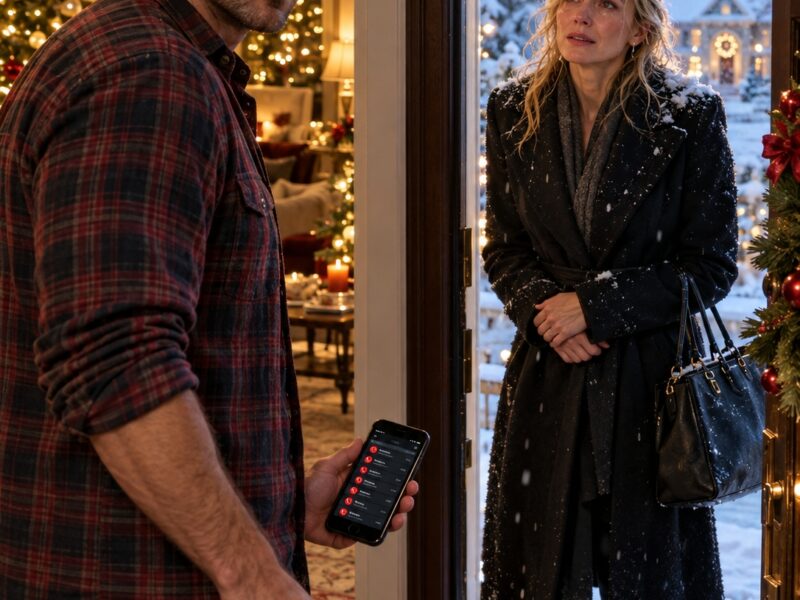
She Called Him 49 Times on Christmas Eve—He Ignored Every Call. At Dawn, His Billionaire CEO Was Standing in the Snow

The phone vibrated for the forty-ninth time at exactly 11:57 p.m. on Christmas Eve.
Nolan Avery didn’t reach for it.
He didn’t even look surprised.
The phone shuddered against the scarred oak kitchen table, rattling beside a bowl of clementines and a half-finished wooden angel wrapped in red ribbon.
Across from him, his nine-year-old daughter stopped cutting a paper snowflake.
“Dad.”
Nolan kept tying the ribbon.
“Dad.”
“I hear it.”
Ren Avery lowered the scissors.
The screen glowed between them.
AUDREY BELLAMY.
Chief Executive Officer of Bellamy Northstar Systems.
A woman whose phone calls could pull vice presidents out of dinner, wake attorneys at two in the morning, and make regional directors suddenly remember deadlines they had ignored for three weeks.
Tonight, she had called Nolan forty-nine times.
And Nolan had answered exactly zero.
Ren stared at him.
“Are you really not going to answer her?”
“No.”
“Forty-nine times?”
Nolan tightened the knot around the angel.
“Especially not the forty-ninth.”
Ren frowned.
Outside their small Vermont house, snow pressed softly against the windows, slowly swallowing the road, the fence, and the dark line of pine trees beyond the porch.
Inside, the kitchen smelled like cinnamon, coffee, pine needles, and the sugar cookies Ren had burned slightly but continued insisting were “crispy on purpose.”
An old Christmas record played quietly from a speaker on the counter.
It should have been peaceful.
It almost was.
Except every few minutes Nolan’s eyes betrayed him and drifted back toward the phone.
He wasn’t asleep.
He wasn’t away from it.
He wasn’t confused about who was calling.
He was choosing not to answer.
Ren watched the screen go dark.
“What if it’s important?”
Nolan looked down at the wooden angel.
“If it’s work, it can wait.”
“And if it’s not?”
His fingers stopped.
Only for a second.
Then he pulled the ribbon tighter.
“That’s enough questions for tonight.”
Ren knew that tone.
It meant he didn’t have an answer he wanted to give.
At 12:03 a.m., the phone finally stopped ringing.
Nolan stared at it longer than he meant to.
For the first time all night, he almost wished it would ring again.
It didn’t.
Seven hours later, three knocks sounded against his front door.
Nolan was awake before the third.
Years of early shifts had trained his body to rise quickly, but something about those knocks made him stop halfway across the living room.
Christmas morning.
Barely seven.
Snow still falling.
No neighbor he knew would come this early.
Ren appeared on the stairs in red Christmas pajamas and fuzzy socks.
“Who is it?”
“Stay there.”
“Dad—”
“Ren.”
She stopped.
Nolan crossed the room.
The Christmas tree cast weak gold and red reflections across the floor. He reached the door, hesitated, then pulled it open.
Cold air rushed inside.
Snow curled across the threshold.
And beneath the pale blue light of a Vermont Christmas morning stood Audrey Bellamy.
No assistant.
No driver.
No black corporate SUV idling behind her.
Just Audrey.
Snow clung to her dark wool coat. Her pale blond hair was damp and loose around her face. One expensive leather shoe was soaked nearly to the ankle.
Nolan had watched this woman silence a conference room without raising her voice.
He had seen executives sit straighter when she entered.
He had once watched a senior vice president apologize three times because Audrey lifted one eyebrow during a quarterly presentation.
But the woman standing on Nolan’s porch didn’t look like the Audrey Bellamy everyone was afraid to disappoint.
She looked exhausted.
Cold.
And strangely uncertain.
For several seconds, neither of them spoke.
Then Audrey looked past his shoulder toward the warm yellow light inside.
Her eyes returned to his.
“You could have answered once.”
Nolan rested one hand against the doorframe.
“You could have stopped calling.”
Her mouth tightened.
“I tried.”
He glanced at her.
“Forty-nine times?”
Something moved across her face.
Not anger.
Not embarrassment.
Something smaller.
More vulnerable.
“No,” she said quietly. “I mean… I tried to stop.”
That changed the silence between them.
Then Nolan noticed what she was holding.
A small paper ornament.
Bent now.
Silver glitter rubbed thin around its edges.
A crooked little house with a yellow square drawn where the front door should have been.
He knew that ornament.
Ren had made it seven days earlier.
And suddenly Nolan understood one thing with absolute certainty.
The forty-nine calls had never been about work.
What he didn’t understand was why one of the most powerful women in Boston had driven more than two hundred miles through a Christmas snowstorm to stand on his porch.
Seven days earlier, Nolan Avery had been nothing more to Audrey Bellamy than another employee number.
At least, that was what both of them had believed.
The first alarm went off shortly after four in the afternoon.
Nolan was kneeling beside an open control panel at Bellamy Northstar’s Vermont regional operations center, tightening a loose terminal, when a second alarm followed.
Then a third.
Across the building, monitors flashed yellow.
Someone shouted from the main control room.
“Backup system isn’t responding!”
Nolan closed his toolbox.
The gray December afternoon had already darkened beyond the windows. Fluorescent lights hummed overhead. Heated air carried the familiar smell of dust, metal, and terrible break-room coffee.
Nolan had worked in the building for six years.
Long enough to know the difference between an alarm people could discuss and an alarm people needed to stop discussing.
This one was real.
By the time he entered the control room, managers and engineers were already talking over one another.
On the main screen, Hollis Crane appeared by video from Boston.
Regional operations director.
Perfect suit.
Perfect haircut.
Very imperfect expression.
“We have a client demonstration in forty minutes,” Hollis said. “I need this system stable now.”
One engineer blamed a software update.
Another suspected a failed relay.
A third recommended rebooting the entire network.
Nolan stayed near the back.
Quiet.
Watching.
Listening.
Then the conference room door opened.
Nobody announced her.
Nobody needed to.
The room changed.
Audrey Bellamy walked in wearing a charcoal coat over a navy suit, her pale hair pinned neatly away from her face.
“Status?”
Three people answered simultaneously.
Audrey raised one hand.
Silence returned.
Hollis began explaining the possible software failure.
The engineers gave their theories.
Audrey listened.
Nolan watched the lights.
Every time the emergency system attempted to switch over, the lights above the west corridor dimmed for less than a second.
Almost invisible.
But machines had habits.
So did failures.
Nolan set down his coffee.
“It isn’t the software.”
Hollis turned toward him on the screen.
“Excuse me?”
Nolan pointed toward the corridor.
“The transfer switch is cycling, but one side isn’t holding the load.”
One engineer frowned.
“Diagnostics show the switch is functioning.”
“Diagnostics show the command is being sent,” Nolan replied. “They don’t tell you whether the mechanical contact is holding under load.”
Hollis’s expression sharpened.
“And you are?”
“Nolan Avery.”
“I mean your position.”
“Facilities technician.”
The room paused.
Then Audrey looked at him.
Not through him.
At him.
“Can you prove it?”
Nolan picked up his toolbox.
“Give me ten minutes.”
Hollis exhaled.
“We don’t have ten minutes for guesses.”
Nolan met his eyes on the screen.
“Then you definitely don’t have forty minutes for the wrong fix.”
Nobody moved.
Audrey’s expression remained unreadable.
Then she said one word.
“Go.”
Nolan went.
Two engineers followed him down the west corridor.
Inside the electrical room, he opened the transfer cabinet, tested the incoming lines, then crouched beside the contact assembly.
There.
A connection darkened by repeated heat cycles.
Holding just well enough to fool the monitoring system.
Failing just badly enough to interrupt the emergency load.
“Found it.”
One engineer crouched beside him.
“That can’t be the whole problem.”
Nolan glanced over.
“You want it to be more expensive?”
The younger man blinked.
Nolan almost smiled.
“Me neither.”
Twelve minutes later, the system stabilized.
Warning lights vanished one by one.
The client demonstration started on time.
No applause followed.
Nolan hadn’t expected any.
He wiped his hands on a shop rag, closed the cabinet, and returned to the control room.
Executives were already congratulating one another.
Hollis was explaining how quickly “the team” had responded.
Nolan reached for the coffee he’d abandoned.
Cold.
Of course.
“Mr. Avery.”
He turned.
Audrey stood beside the doorway.
Everyone else noticed.
That alone irritated him.
“You identified the failure when three engineers didn’t.”
“They were watching the screen.”
“And you weren’t.”
Nolan looked toward the west corridor.
“Machines usually tell you what’s wrong before software does. You just have to pay attention.”
Audrey studied him.
Most employees filled silence around her.
They explained themselves.
Complimented her.
Laughed nervously.
Nolan did none of those things.
“You saved us from a very embarrassing afternoon,” she said.
“I fixed a switch.”
“That switch was protecting a contract worth more than this building.”
“Still a switch.”
Something almost like amusement appeared in her eyes.
“My office will arrange a performance bonus.”
“No need.”
Hollis stared at him from the monitor.
Audrey didn’t.
“You’re declining a bonus?”
“I got paid for today.”
“That wasn’t what I asked.”
Nolan met her gaze.
“Then yes.”
The room went quiet again.
Audrey Bellamy had spent years surrounded by people trying to earn more of her attention.
More money.
More access.
More approval.
Nolan Avery had just been offered a reward and reacted as though she had offered him an extra receipt.
“Why?”
He checked the clock.
5:23.
“Because my daughter has a Christmas program at six-thirty.”
He lifted his toolbox.
Then he walked away.
Audrey remained beside the doorway, listening to his work boots fade down the corridor.
She forgot half the names spoken during the emergency.
She remembered his.
And she didn’t yet understand why that bothered her.
Nolan reached Ren’s elementary school at 6:17.
Thirteen minutes to spare.
The parking lot was packed with pickups and minivans. Parents hurried through the cold carrying flowers, wrapped gifts, and younger siblings bundled in winter coats.
Inside, paper stars hung from the auditorium ceiling.
Nolan found a seat near the back.
A second later, Ren peeked through the curtain.
She saw him.
Her whole face changed.
That was enough.
No bonus could buy that expression.
No promotion could replace being the person she was searching for in a crowded room.
The next morning, Audrey was still thinking about him.
At 8:12, Nolan was called to the temporary executive office.
Hollis was already there.
Audrey sat behind the desk with a personnel folder in front of her.
“Mr. Avery. Sit.”
“I’m good.”
Hollis looked annoyed.
Audrey ignored him.
“I reviewed your personnel record.”
Nolan raised an eyebrow.
“That sounds ominous.”
“It isn’t. Six years with the company. Strong evaluations. No disciplinary history. Multiple recommendations for expanded responsibilities.”
“Sounds like me.”
“Then explain why you’re still in facilities.”
“Because I like facilities.”
Hollis laughed.
“Nobody likes facilities that much.”
Nolan looked at him.
“Maybe that’s why yours keeps breaking.”
Audrey lowered her eyes for half a second.
Hiding a smile.
Then she slid the folder toward Nolan.
“Senior operations supervisor.”
He looked at her.
“Better salary,” she continued. “Better benefits. Company apartment when you’re required in Boston. Performance incentives.”
Nolan read the first page.
Less than a minute later, he put it down.
“No.”
Hollis blinked.
“No?”
“No, thank you.”
“You haven’t heard the salary.”
“I saw enough.”
“It’s nearly double what you make now.”
“I figured.”
“And you’re declining it?”
“Yes.”
Audrey leaned back.
“Why?”
Nolan tapped a line on the page.
“Regional availability. Nights. Weekends. Emergency travel.”
“That’s standard for the role.”
“Then it isn’t my role.”
Hollis folded his arms.
“Do you understand how rarely opportunities like this appear?”
Nolan nodded.
“Good thing I don’t need one every day.”
Audrey’s expression sharpened.
“What exactly do you need?”
This time Nolan didn’t answer immediately.
His eyes drifted toward the wall clock.
“To be home by six most nights.”
Hollis stared at him.
“For what?”
“Dinner.”
“Dinner?”
“With my daughter.”
The room changed.
Nolan looked down at the gloves in his hand.
“Ren is nine. She’s already had enough empty chairs in her life.”
He gave them nothing more.
No explanation.
No tragedy packaged neatly for corporate sympathy.
He picked up his gloves.
Audrey watched him leave.
“He’s wasting his potential,” Hollis said.
Audrey kept looking at the closed door.
“Or maybe he knows exactly what it’s worth.”
That evening, her car slowed near the town school.
Through falling snow, Audrey saw Nolan beneath a string of colored lights.
Ren stood beside him wearing a red wool coat, talking so quickly her hands moved with every sentence.
Nolan carried a cardboard star she had made.
He held it as though it were fragile.
Priceless.
Ren said something.
Nolan laughed.
Not the polite laugh Audrey heard in meetings.
A real one.
Warm.
Unguarded.
Then Ren slipped her hand into his.
Nolan bent his head to listen as if nothing else in the world mattered.
“Ms. Bellamy?” her driver asked. “Should we continue?”
Audrey didn’t answer immediately.
Her phone was filled with unread messages.
Calendar alerts.
Market updates.
Invitations.
Inside the warm black car sat everything she had spent her adult life chasing.
Outside stood a facilities technician who had turned down twice his salary because a nine-year-old girl expected him home for dinner.
For the first time in years, Audrey wondered whether she had confused having more with having something worth going home to.
Two days later, a snowstorm closed Ren’s after-school program early.
Nolan was still repairing a frozen circulation pump when the school called.
He appeared at Audrey’s office ten minutes later, coat half-buttoned, wrench still in his back pocket.
“I need to leave.”
Audrey looked up.
“Problem?”
“My daughter.”
That was enough.
“Go.”
Nolan hesitated.
“The pump isn’t finished.”
“It’ll still be frozen tomorrow.”
He almost smiled.
“You’re learning.”
“Don’t make me regret it.”
He was halfway toward the elevator when the doors opened.
Ren stepped out beside a receptionist.
“Dad!”
Nolan stopped.
“How did you get here?”
“Mrs. Keene brought me. She had to pick up her husband.”
Then Ren noticed Audrey.
Children possessed a strange talent for ignoring invisible social walls adults spent decades constructing.
Ren walked directly toward her.
“Are you Dad’s boss?”
Nolan closed his eyes briefly.
Audrey answered.
“Apparently.”
“Is he good at his job?”
Audrey glanced at Nolan.
“Annoyingly good.”
Ren nodded.
“He fixes everything.”
“I noticed.”
Ren opened the paper grocery bag she was carrying.
“We made Christmas ornaments.”
Glitter immediately fell onto the carpet.
Nolan stared at the ceiling.
Audrey crouched slightly.
“They’re beautiful.”
“This one isn’t finished.”
Ren produced a white cardboard star covered unevenly in silver glitter.
A green ribbon ran through the top.
“You can finish it.”
Audrey blinked.
“Me?”
Ren handed her a red marker.
“What am I supposed to write?”
“Where you’re going for Christmas.”
Audrey’s fingers stopped around the marker.
Nolan saw it.
“I haven’t decided.”
Ren tilted her head.
“Your mom’s house?”
“No.”
“Your dad’s?”
Audrey looked toward the window.
“Probably not.”
“Grandma?”
“Ren,” Nolan warned.
Audrey shook her head.
“It’s okay.”
Ren studied her with the serious concern only children could make completely sincere.
“Then who are you having Christmas with?”
Audrey had answers for almost everything.
There were corporate dinners.
Charity galas.
Hotels.
Invitations from people whose last names were engraved on hospital wings.
But none answered Ren’s question.
“I don’t know.”
Ren frowned.
“Nobody should be alone on Christmas.”
Nolan went still.
Audrey attempted a smile.
“I’ll be all right.”
Ren shook her head.
“That’s not the same thing.”
For once, Audrey Bellamy had no reply.
Ren dug into the bag again.
She pulled out a smaller ornament.
A crooked paper house.
On the front was a yellow square representing a door.
On the back, written in purple marker, were three words.
YOU CAN COME.
Audrey stared at them.
“Come where?”
Ren looked genuinely confused.
“Our house.”
Nolan inhaled.
“Ren.”
“We have extra pancakes.”
Audrey looked at Nolan.
He looked back.
Caught between embarrassment and something softer.
“She means well.”
“I know.”
Ren pressed the paper house into Audrey’s hand.
“You should keep it anyway.”
Audrey closed her fingers around it.
“I will.”
Nolan gathered Ren’s things.
At the elevator, Ren waved.
Audrey lifted the ornament in return.
Then the doors closed.
The office became silent.
Audrey stood beneath fluorescent lights holding something that had cost less than a dollar to make.
She had received watches from board members.
Crystal from international clients.
Gifts expensive enough to require security documentation.
None had ever made her afraid to put something down.
She placed the paper house beside her phone.
For the next two days, every time she saw that crooked yellow door, it seemed to ask her a question.
Not where she would spend Christmas.
Whether she still knew how to walk toward a place where nobody needed anything from her.
Christmas Eve arrived beneath a hard silver sky.
By six, Boston was disappearing behind snow.
Audrey’s penthouse sat high above the city, a palace of glass and marble where twelve places had been set around a polished walnut table.
Crystal glasses caught the light of the tree.
Candles burned beside white roses.
The caterers had left.
The apartment smelled of rosemary, warm bread, and an expensive dinner nobody seemed interested in eating.
At 6:14, Hollis sent his regrets.
His wife had surprised him with tickets to visit their son in Chicago.
At 6:28, a board member canceled because her grandchildren had arrived unexpectedly.
Another apologized from an airport lounge.
A third sent wine.
By seven, the table remained perfect.
The apartment remained silent.
Audrey told herself she preferred it.
Then her father called.
She answered immediately.
“Merry Christmas, Dad.”
“Audrey.”
There were voices behind him.
A family gathering somewhere else.
“I wanted to tell you before it got too late. I’m not coming tomorrow.”
Audrey looked at the empty chair at the head of the table.
“You said you would.”
“Plans changed.”
“They always do.”
A pause.
“Don’t make this difficult.”
She closed her eyes.
“I’m not.”
“We can have lunch in January.”
“Of course.”
The call lasted less than three minutes.
Audrey remained beside the window.
Her reflection stared back from the glass.
Behind it, Boston glittered.
Behind her, twelve empty chairs waited for people who had somewhere else they wanted to be.
Holiday messages began arriving.
Season’s greetings.
Digital cards.
Warm wishes composed by assistants.
She set the phone down.
And saw the paper house.
YOU CAN COME.
Audrey picked it up.
More than two hundred miles away, Nolan stood in his kitchen with flour on his sleeve while Ren argued that four tablespoons of cinnamon was perfectly reasonable.
“Your mother used one.”
“Maybe she wrote it wrong.”
Nolan laughed.
“Nice try.”
Their little house glowed beneath mismatched Christmas lights.
A wooden box of old ornaments sat open on the table.
Some chipped.
Some handmade.
Every one carrying a memory.
Nolan’s phone rested face down beside the fruit bowl.
Work notifications were off.
Christmas Eve belonged to Ren.
That had been the rule for four years.
In Boston, Audrey opened Nolan’s contact.
Her thumb hovered.
She invented excuses.
The regional systems report.
Staffing.
The frozen pump.
Anything.
Then she called.
Voicemail.
Two minutes later, she called again.
No answer.
By the fifth attempt, hesitation had become irritation.
By the twelfth, she had abandoned the dinner table.
By the twenty-seventh, the candles had burned halfway down.
The food was cold.
“Answer the phone, Nolan.”
In Vermont, his screen lit again.
Ren looked at it.
“Miss Bellamy.”
“I see.”
“Are you in trouble?”
“Probably not.”
“Then why does she keep calling?”
Nolan watched the screen go dark.
“I don’t know.”
It was true.
That didn’t make him comfortable.
At 10:48, Audrey sat barefoot on the floor beside her Christmas tree.
Her hair had slipped loose.
The paper house rested in her palm.
Thirty-eight.
Forty-one.
Forty-six.
Every unanswered call stripped away another excuse.
This wasn’t about work.
It wasn’t about a report.
It wasn’t even entirely about Nolan.
At 11:57, she called for the forty-ninth time.
In Vermont, Nolan watched the phone vibrate.
“Dad,” Ren said, “are you really not going to answer her?”
Nolan turned it face down.
In Boston, Audrey lowered hers.
The apartment was so quiet she could hear the heating system clicking behind the walls.
She looked at the crooked yellow door.
Who are you having Christmas with?
Audrey stood.
She put on her coat.
Took her keys.
Slipped the paper house into her pocket.
For once in her life, she was done waiting for someone to come to her.
Back in Vermont, Ren was still watching her father.
“Why didn’t you answer?”
“I told you. It’s Christmas.”
“That’s not the whole reason.”
Nolan stopped folding tissue paper.
Four years earlier, Christmas Eve had looked very different.
A hospital room.
A paper snowflake crushed in a five-year-old Ren’s hand.
And Nolan’s wife, Alana, too weak to sit up without help.
Her voice had barely risen above a whisper.
“Don’t let Christmas become another day she remembers waiting for you.”
Nolan had tried to smile.
“I’m right here.”
“Nolan.”
“Alana—”
“Promise me.”
Ren had been asleep against his side.
“Promise.”
So he had.
Every Christmas Eve since Alana died, work stayed outside.
No calls.
No email.
No emergency that belonged to somebody else unless someone was truly in danger.
Ren got all of him.
Not the distracted half.
Not the exhausted half.
All of him.
Now Nolan looked at his daughter.
“Your mom asked me for one thing.”
“That you stay with me.”
“That I’m present.”
“You are.”
“That’s why I don’t answer work tonight.”
Ren glanced toward the phone.
“But what if it wasn’t work?”
Nolan didn’t respond.
“She called forty-nine times,” Ren said. “I counted.”
“I know.”
“People don’t do that about a frozen pump.”
Nolan almost smiled.
“Probably not.”
“And she doesn’t have anybody tonight.”
“You don’t know that.”
“She told me she didn’t know who she was having Christmas with.”
“That isn’t the same thing.”
Ren shook her head.
“Not really.”
Nolan picked up the phone.
A promise on one side.
A question on the other.
“Your mom wanted me here.”
“Then be here.”
Ren’s voice softened.
“But being here doesn’t mean you have to pretend nobody else exists.”
Nolan stared at her.
Children weren’t supposed to understand things adults had spent years avoiding.
Maybe that was why they sometimes said them so clearly.
He turned the phone over.
No new calls.
No message.
Just forty-nine missed ones.
“You think I should call her?”
Ren shrugged.
“Maybe she just needs someone to answer.”
Nolan looked toward the window.
The road had nearly disappeared beneath snow.
“It’s late.”
“So?”
“She’s probably home.”
“That doesn’t mean she’s okay.”
He opened Audrey’s contact.
His thumb hovered above CALL.
Then he stopped.
He thought about Alana.
Promises.
Grief.
And all the ways someone could keep a promise faithfully while still misunderstanding what it meant.
In the end, Nolan set the phone down.
Not because Audrey didn’t matter.
Because he still didn’t know what the right thing was.
“Bed.”
Ren sighed.
“It’s after midnight.”
“Exactly.”
“You’re avoiding me.”
“I’m parenting you.”
“Same thing.”
That made him laugh.
He kissed the top of her head.
Minutes later, the house went quiet.
Nolan stood alone in the kitchen.
He picked up his phone again.
For the first time that night, he wished Audrey would call.
She didn’t.
Because by then, Audrey Bellamy was already driving north.
Boston disappeared behind her within twenty miles.
The beautiful snow she had watched from forty-two floors above became violent against the windshield.
Her wipers worked at full speed.
Navigation estimated three hours.
Then three hours and twelve minutes.
Then eighteen more.
Audrey tightened her grip on the wheel.
She could have called a driver.
Security.
An assistant.
She could have had a hotel arranged in Vermont before sunrise.
Instead she had told no one.
No schedule.
No plan.
Only Nolan’s address from his employee record and a paper house in her coat pocket.
At 1:14 a.m., Hollis called.
“Audrey, where are you?”
“Driving.”
“Where?”
She looked into the darkness.
“North.”
“In this weather?”
“Apparently.”
Silence.
“Do you need me to arrange something?”
The old Audrey would have said yes.
Arrange the car.
Arrange the hotel.
Arrange reality until inconvenience disappeared.
She looked at the snow piling along the highway.
“No.”
“Are you sure?”
“Merry Christmas, Hollis.”
She ended the call.
After two, the interstate narrowed.
Gas stations were dark.
Occasional houses glowed in the distance.
Audrey passed a farmhouse with a crooked wreath.
Another with a cheap plastic Santa glowing beside the driveway.
Ordinary things.
She found herself wondering who was sleeping inside.
Who had waited up.
Who had been expected.
At 3:30, her tires slipped.
Just once.
Enough to make her heart slam against her ribs.
“Easy.”
The word sounded absurd.
She used it before difficult negotiations.
Tonight there was no boardroom waiting.
No contract.
No acquisition.
No victory.
Only a small house.
A man who had ignored her forty-nine times.
And a little girl who had drawn a yellow door.
At 5:46, she reached Nolan’s town.
She passed Ren’s elementary school.
The playground was buried beneath white drifts.
Doubt finally caught up with her.
What was she doing?
She had called an employee forty-nine times.
He had chosen not to answer.
That was an answer.
She could turn around.
Return to Boston.
Tell no one.
Let this become another private humiliation hidden beneath a perfect calendar.
Then her fingers touched the paper house.
You can come.
“A nine-year-old invitation,” Audrey murmured. “Excellent judgment.”
A tired laugh escaped her.
The final road hadn’t been plowed.
Her SUV made it another quarter mile before the tires spun helplessly.
Audrey tried again.
Nothing.
She checked the navigation.
Less than a mile.
She stared at the screen.
Then shut off the engine.
When she stepped outside, snow immediately sank around her shoes.
“Of course.”
She buttoned her coat.
Started walking.
Halfway there, one shoe was wet through.
By the next bend, she couldn’t feel two of her toes.
The irony almost made her laugh.
At Bellamy Northstar, people crossed entire buildings because Audrey Bellamy asked them to.
Tonight she was walking through Vermont snow toward the one man who had refused to cross a kitchen to answer her call.
Then she saw the house.
Small.
Weathered.
Warm yellow light glowing behind one window.
Colored bulbs hung unevenly from the porch.
Nothing impressive.
Nothing magazine-worthy.
Audrey stopped in the road.
For reasons she couldn’t explain, the sight of that imperfect little house hurt.
She reached into her pocket.
The paper ornament’s edges had softened from being held too tightly.
Audrey Bellamy had negotiated billion-dollar contracts without trembling.
Now she was nervous about knocking on a wooden door.
She climbed the steps.
Raised her hand.
Hesitated.
Then knocked three times.
And Nolan Avery opened the door.
“You could have answered once,” she said.
“You could have stopped calling.”
“I tried.”
“Forty-nine times?”
“No.”
Audrey looked down.
“I mean… I tried to stop.”
Nolan’s expression changed.
“What happened?”
She opened her mouth.
Nothing came.
She could explain restructuring plans to thousands of employees.
She could defend quarterly losses before investors.
She could negotiate contracts worth hundreds of millions without notes.
But on that porch, three simple words were almost impossible.
“Nothing happened.”
Nolan waited.
Audrey swallowed.
“That was the problem.”
Snow whispered against the railing.
“Everyone had somewhere else to be. Hollis went to his son. The board went home. My father canceled.”
She gave a small, embarrassed laugh.
“I had dinner set for twelve people.”
Nolan looked at her snow-covered coat.
“You drove here because your dinner guests canceled?”
“No.”
“Then why are you here?”
The corporate polish disappeared.
No rehearsed answer.
No executive armor.
Audrey looked directly at him.
“Because I didn’t want to be alone.”
Nolan didn’t move.
Audrey pulled the paper house from her pocket.
“Your daughter gave me this.”
“I know.”
“I kept telling myself it was just something a child made.”
“It is.”
Audrey nodded.
“That somehow made it worse.”
A small voice came from behind Nolan.
“Why?”
Ren stood in the living room.
Audrey looked at her.
“Because sometimes children mean things adults are too afraid to say.”
Ren considered this.
Then looked at her father.
“Dad, she’s freezing.”
“I noticed.”
“Then why is she still outside?”
“Ren.”
She walked closer.
“Did you walk here?”
“Part of the way.”
“That’s a terrible Christmas plan.”
Audrey laughed.
A real laugh.
Nolan’s shoulders relaxed.
“My car got stuck about three-quarters of a mile back.”
“I’ll help you later.”
Audrey nodded.
Still, neither moved.
Ren disappeared toward the kitchen.
“Where are you going?” Nolan called.
“Cocoa.”
“It’s seven in the morning.”
“It’s Christmas.”
Nolan looked back at Audrey.
She didn’t ask to enter.
That mattered.
Her entire adult life, Audrey’s name had opened doors.
This time she simply waited.
Nolan stepped aside.
“Come in before Ren decides I have no Christmas spirit.”
Audrey crossed the threshold.
Warmth wrapped around her.
Coffee.
Cinnamon.
Pine.
The quiet crackle of Christmas lights.
Ren returned carrying a chipped red mug.
“No marshmallows.”
“Dad ate them.”
“That is slander,” Nolan said.
Ren handed Audrey the mug.
“You can still stay.”
Audrey wrapped both hands around it.
Nothing in the room matched.
The furniture was worn.
The tree leaned.
Half the ornaments had been made by a child.
And something inside Audrey’s chest loosened.
Nobody asked what car she drove.
Nobody asked what she could do for them.
Nobody cared that she was Audrey Bellamy.
Ren pointed toward the kitchen.
“We’re making pancakes.”
Audrey looked at Nolan.
“Am I invited?”
Nolan looked at the battered paper house in her hand.
“Looks like you already were.”
The pancakes burned around the edges.
Ren insisted on flipping them herself.
Audrey ate two.
For twenty minutes, nobody discussed Boston.
Bellamy Northstar.
Forty-nine missed calls.
Or why a CEO had driven through a blizzard to breakfast with a facilities technician.
Ren talked enough for all three of them.
She explained which ornament had survived their old dog.
Which Christmas movie Nolan always fell asleep during.
Why ugly pancakes tasted better.
Audrey listened.
Really listened.
Eventually Ren carried her plate into the living room.
The kitchen became quiet.
Nolan rinsed the skillet.
Audrey held her coffee.
“I owe you an apology.”
“For?”
“The calls. Thinking you owed me an answer.”
Water ran softly.
“You were my employee,” she continued. “I kept telling myself that made it reasonable.”
“Forty-nine times was ambitious.”
A faint smile appeared.
“I’ve always been thorough.”
“That’s one word for it.”
Her smile faded.
“I didn’t understand why you turned down the promotion.”
“You do now?”
Audrey looked toward Ren.
“I think I’m beginning to.”
Nolan leaned against the counter.
“You don’t have to become somebody else because you had one lonely Christmas.”
“I know.”
“And you don’t have to fix this with money.”
Audrey looked down.
“Was it that obvious?”
“You run a corporation.”
“I was thinking about buying you a new truck.”
Nolan looked outside at his aging pickup.
“It starts most mornings.”
Audrey laughed.
Then became serious.
“What do I do instead?”
“Nothing.”
She blinked.
“Nothing?”
“Not today.”
He nodded toward the living room.
“Eat breakfast. Help Ren clean glitter out of every room in the house. Let Christmas be Christmas.”
“That’s all?”
“You don’t have to earn breakfast here.”
The sentence hit harder than Nolan expected.
Audrey’s fingers tightened around the mug.
Her eyes lowered.
Nearly every invitation in her adult life had carried an invisible condition.
Be useful.
Be successful.
Be impressive.
Bring something.
Become something.
Nolan had just offered her a place at the table with no invoice attached.
Ren appeared holding tape.
“Are you crying?”
Audrey touched beneath one eye.
“No.”
Ren looked at Nolan.
“She is.”
“I’ve learned not to argue with her.”
“Good choice.”
Ren handed Audrey the tape.
“Come on. The paper house needs a stronger roof.”
Audrey stood.
“Yes, ma’am.”
Nothing miraculous happened that Christmas.
No one made a grand declaration.
No instant romance began beside the tree.
Audrey stayed until the roads cleared.
Nolan pulled her SUV free that afternoon.
Before she left, Ren hugged her.
Nolan stood beside the driver’s door.
“Drive safe.”
“I will.”
Audrey hesitated.
“Nolan?”
“Yeah?”
“Next time I’ll call once.”
He almost smiled.
“That would be progress.”
What happened after Christmas mattered more.
In January, Audrey personally reviewed Bellamy Northstar’s holiday staffing policies.
She discovered managers routinely scheduled employees across family events because “availability” had quietly become a measurement of loyalty.
She changed it.
Coverage rotated.
Family leave expanded.
Emergency expectations became actual emergencies instead of executive convenience.
Hollis read the new policy twice before walking into her office.
“This is because of Avery.”
Audrey continued signing documents.
“It’s because he was right.”
“About what?”
She looked up.
“Knowing what something costs before you call it an opportunity.”
Nolan heard about the policy from coworkers.
Not Audrey.
That mattered.
She hadn’t changed the company to impress him.
She had changed because she finally saw the people living underneath its policies.
Winter softened.
Spring arrived.
Then summer.
Audrey visited Vermont more frequently.
Sometimes for work.
Sometimes with increasingly ridiculous excuses.
Ren stopped calling her Miss Bellamy around April.
Nolan stopped pretending he didn’t notice when Audrey stayed an extra hour after meetings.
Nothing happened quickly.
That was important.
There was no dramatic confession beneath summer rain.
No sudden proposal.
No promise that grief had vanished because someone new had arrived.
Nolan still kept Alana’s recipe card beside the stove.
Audrey never asked him to move it.
One evening in May, she noticed him looking at an old photograph.
Alana laughing.
Ren as a toddler on her hip.
Nolan started to put it away.
Audrey stopped him.
“You don’t have to hide her because I’m here.”
He looked at her.
“I wasn’t hiding her.”
“You were about to.”
He said nothing.
Audrey sat beside him.
“I’m not competing with someone you loved.”
The sentence stayed with him.
Months later, Nolan finally told her about the hospital promise.
Everything.
How Alana had been dying.
How five-year-old Ren had fallen asleep beside them.
How guilt had turned one promise into a wall around Christmas Eve.
Audrey listened without interrupting.
When he finished, she asked quietly, “Do you think she wanted you to shut everyone else out?”
Nolan looked toward the window.
“No.”
“Do you think she wanted Ren to watch you do that?”
A longer silence.
“No.”
Audrey didn’t tell him what the promise meant.
She didn’t need to.
Trust came slowly.
Like Vermont snow melting from a roof in March.
Drop by drop.
Until one day you looked outside and realized winter had moved on without asking permission.
A year after the forty-nine calls, Christmas Eve returned.
Snow fell softly over Nolan’s house.
Ren decorated cookies with far too much frosting.
Nolan stirred cider.
At 6:04 p.m., his phone rang.
Once.
Then stopped.
Ren froze.
Her eyes widened.
“Was that her?”
Nolan looked at the screen.
AUDREY BELLAMY.
He smiled.
Before he could answer, three knocks sounded at the door.
Ren dropped the frosting bag.
“She learned!”
She ran.
Nolan followed more slowly.
When he opened the door, Audrey stood beneath the porch light.
Snow rested in her pale hair.
In one hand, she carried a pie.
In the other was a small wooden frame.
Inside it, protected beneath glass, was Ren’s crooked paper house.
The silver glitter had faded.
The yellow door had not.
Nolan stared at it.
Then at Audrey.
“One call?”
“I promised.”
Ren pulled the door wider.
“You’re letting all the heat out.”
Audrey laughed.
Then stepped inside.
Nolan closed the door behind her.
Outside, snow slowly erased the road.
The pines disappeared into white.
The world became quiet.
Inside, three mugs waited on the kitchen table.
Alana’s old recipe card was still beside the stove.
Ren’s ornaments still hung crookedly from the tree.
Audrey’s framed paper house rested on the mantel, its little yellow door glowing beneath the Christmas lights.
Nothing had been replaced.
That was perhaps the most beautiful part.
Grief had not been erased.
Success had not suddenly become meaningless.
Nolan had not broken his promise.
Audrey had not stopped being ambitious.
They had simply learned that a life could make room for more than one truth.
That being present did not require shutting every other door.
That strength was not the same as never needing anyone.
That sometimes the people who looked as if they had everything were standing closest to an unopened door, terrified to knock.
And sometimes a second chance did not arrive with a grand speech.
Sometimes it called forty-nine times because it did not yet know how to ask for help.
Then, after learning better, it called only once.
And waited.
And knocked.
This time, someone opened the door.









