She Called Me at 4 A.M. and Said We Had 30 Days Left—So I Turned My Truck Into a Fortress
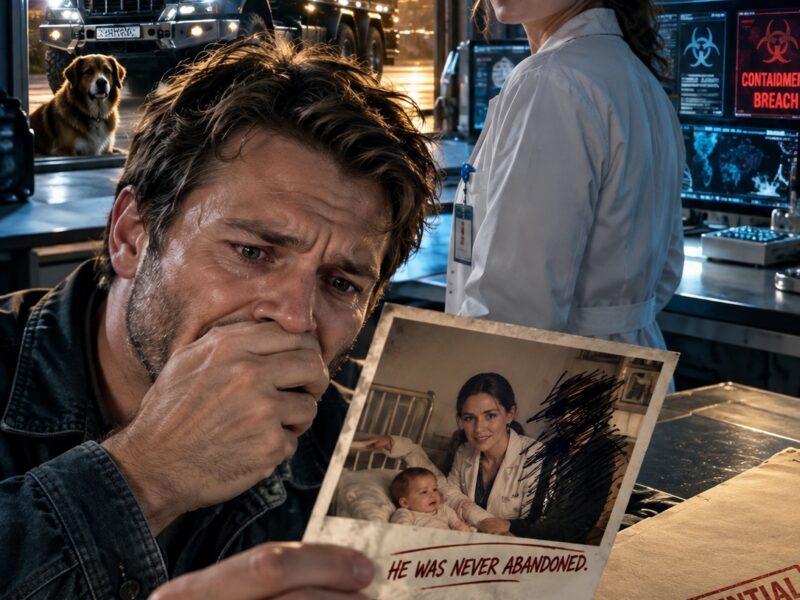
At 4:00 in the morning, the woman who had quietly paid for half my life called me and told me the world might have thirty days left.
Not civilization.
Not the economy.
Not some political administration.
The world as I understood it.
“Riley, listen to me.”
Dr. Eleanor Voss sounded nothing like herself.
I had heard that woman speak after eighteen-hour shifts. I had heard her talk through grief, exhaustion, and once through a fever so bad she could barely finish a sentence.
She never sounded afraid.
That morning, she did.
I sat up inside the sleeper cab of my truck, heart pounding before I even understood why.
Outside, the Texas truck stop was almost completely dark. A few sodium lights threw dirty orange pools across the parking lot. Somewhere three rows over, a diesel engine idled steadily.
Beside my bunk, Scrap lifted his head.
My dog could sleep through thunderstorms.
But something in Eleanor’s voice made him stand.
“Eleanor?”
“Buy canned food. Water. Medical supplies. Antibiotics if you can get them legally. Disinfectant. Fuel. Everything you would need if stores stopped opening.”
I stared at the glowing clock on my dashboard.
4:00 A.M.
“What happened?”
Silence.
Not ordinary silence.
The kind where you can hear someone deciding how much truth they are allowed to give you.
Then Eleanor whispered, “They can’t contain it anymore.”
My fingers tightened around the phone.
“Contain what?”
“Riley—”
“What are you talking about?”
“If it mutates the way we think it will, we may have thirty days. Maybe less.”
A cold sensation moved down my spine.
I looked through the windshield.
Nothing had changed.
The interstate still glowed beyond the truck stop.
A tanker rolled past.
Somebody walked out of the convenience store carrying coffee.
America was sleeping.
And a woman inside a biolab was telling me to prepare for its end.
“Thirty days until what?”
“Until you don’t want to be around people.”
That answer frightened me more than anything else she could have said.
I swung my legs off the bunk.
Scrap came closer and pressed against my knee.
“Where are you?”
“I can’t tell you.”
“Eleanor, what happened?”
“I need you to hide.”
Her voice cracked on the final word.
That was when I knew.
This wasn’t speculation.
Eleanor Voss did not scare easily, and she definitely did not scare me for entertainment.
She was a researcher.
A scientist.
A woman who had spent her entire life believing panic was simply fear without data.
And now she was panicking.
“Tell me where you are,” I said. “I’ll come get you.”
“No.”
“I can be there—”
“No, Riley.”
The force in her voice stopped me.
“You stay away from here. Do you understand me?”
“Eleanor—”
“Promise me.”
I looked down at Scrap.
The dog was watching me as though he understood every word.
“I promise.”
“Good.”
“Now tell me what this is.”
Another pause.
Then, very softly, she said, “I’m sorry I never told you everything.”
My breath stopped.
“What does that mean?”
The line went dead.
“Eleanor?”
Nothing.
“Eleanor!”
A flat tone answered me.
I called back immediately.
The call failed.
Again.
Nothing.
Again.
Nothing.
I tried six times.
Then ten.
By the eleventh call, my hands were shaking.
And that was how the longest thirty days of my life began.
My name is Riley Mercer.
At the time, I was thirty-six years old and drove heavy-haul freight across the lower forty-eight—oversized transformers, drilling equipment, industrial machinery, things so big that normal trucks looked like toys beside them.
I knew highways better than I knew people.
I knew where Interstate 40 iced first in winter, which weigh stations were strict, where diesel was overpriced, which mountain grades punished bad brakes, and which roadside diners served coffee strong enough to keep a man alive through Oklahoma at 3:00 a.m.
People were harder.
I grew up in an orphanage outside Amarillo.
No parents.
No grandparents.
No faded photographs of relatives I supposedly resembled.
When other kids talked about going home for Christmas, I learned to stop asking what home felt like.
Eventually I aged out.
I worked construction.
Warehouses.
Tow yards.
Then trucking.
A cab became the closest thing I had to a permanent address.
There were only two strange constants in my adult life.
The first was Scrap.
I found him a year earlier beside an abandoned gas station outside Abilene.
Skinny mutt.
Scar over one ear.
One paw bleeding.
He growled when I approached him, then ate half my sandwich without asking permission.
I understood him immediately.
We had both learned that needing someone was dangerous.
I opened my passenger door.
He climbed in.
Neither of us ever reconsidered the arrangement.
The second constant was Eleanor.
Technically, she had been in my life much longer.
I just hadn’t known her name at first.
When I was fourteen, somebody anonymously paid for a vocational summer program I desperately wanted to attend.
At seventeen, the same anonymous benefactor covered the cost of my commercial driving preparation.
At nineteen, when I broke my wrist and couldn’t work for weeks, an envelope appeared through the orphanage’s old alumni office with enough money to keep me from sleeping in my car.
For years I tried to discover who was helping me.
Nobody would say.
Then, when I was twenty-eight, I received a birthday card.
No money.
No explanation.
Just a sentence.
You survived the years that were supposed to break you. Don’t waste the ones that come next.
Signed:
Eleanor.
We began speaking after that.
Slowly.
She never explained why she had chosen me.
Whenever I asked, she dodged.
“Some questions matter less than what you do with the answer.”
I hated that sentence.
But I liked her.
Eventually I learned she was Dr. Eleanor Voss, a senior researcher in infectious disease.
No husband.
No children.
No obvious connection to me.
And yet she remembered every birthday.
She knew when I bought my first truck.
She knew when Scrap came into my life.
Once, after I complained that he had chewed through a passenger-seat belt, she mailed me a replacement and included a note:
He has good instincts. That seat belt was ugly.
That was Eleanor.
Dry.
Controlled.
Almost impossible to frighten.
Which was why, sitting in my truck at four in the morning, I couldn’t convince myself that the call had been some misunderstanding.
Scrap watched me pull on my boots.
“What do you think?”
His tail moved once.
“Yeah.”
I looked around the sleeper.
Cabinets.
Bunk.
Mini-fridge.
Tools.
Maps.
Radio.
Then through the windshield at the massive rig attached behind me.
An idea arrived so suddenly that I actually laughed.
It wasn’t a happy laugh.
It was the laugh of a man realizing he already owned the skeleton of his lifeboat.
Eleanor had told me to hide.
But where?
A house could be surrounded.
An apartment could lose water.
A cabin could run out of supplies.
A bunker couldn’t move.
My truck could.
And my truck wasn’t just transportation.
Not anymore.
Not if I could rebuild it fast enough.
I scratched Scrap behind the ear.
“We’re going to make this thing ugly.”
He sneezed.
I took that as approval.
By sunrise, I was driving toward the only mechanic I trusted enough to help me do something insane without immediately calling someone to have me evaluated.
George Maddox had been repairing heavy machinery longer than I’d been alive.
Former Army mechanic.
Sixty-two years old.
Hands permanently stained by grease.
Temper like a bear with a toothache.
George’s shop sat outside Fort Worth behind a corrugated steel gate and a faded sign that hadn’t been repainted since the Bush administration.
When I rolled in just after seven, he was already standing outside with coffee.
He looked at my rig.
Then at me.
Then at Scrap.
“You break something?”
“No.”
George frowned.
“You’re here before eight voluntarily. Something’s broken.”
“I need a custom build.”
“How custom?”
I unfolded a rough sketch across his workbench.
George stared at it.
Then stared at me.
Then stared at it again.
“You planning to invade Canada?”
“I need the driver’s compartment connected directly to the main cabin.”
“Why?”
“So I never have to step outside to move between them.”
His eyebrows lifted.
I continued.
“Reinforce the chassis. High-strength structural support. Independent solar. Battery bank. Water filtration. Additional fuel capacity. Additional freshwater storage. Armored cargo compartment if we can source one.”
George put down his coffee.
“Riley.”
“Full camera coverage. No blind spots.”
“Riley.”
“Floodlights. Heavy front push bar. Roof access. Rainwater capture.”
He slapped one hand onto the sketch.
“What the hell are you building?”
“A polar off-road expedition rig.”
He stared at me.
“For who?”
“Alaskan billionaire.”
“You hate Alaska.”
“The billionaire doesn’t.”
“You hate billionaires.”
“I don’t have to like the customer.”
George narrowed his eyes.
“How much?”
“Whatever it takes.”
“That answer is how mechanics know somebody has lost his mind.”
“I have four hundred fifty thousand available.”
George stopped smiling.
Most of it was savings.
Some came from investments I’d built slowly over years.
Some would be debt.
Nearly all of it represented every mile I had driven while other people slept.
George knew that.
“You’re serious.”
“Yes.”
“Why?”
I thought about Eleanor.
They can’t contain it anymore.
“Because somebody is paying me very well.”
George studied my face.
He had known me for eleven years.
He knew when I lied.
But he also knew when not to force the truth.
Finally he pushed away from the workbench.
“I can’t do all this in a month.”
“You have twenty-five days.”
He barked a laugh.
Then realized I wasn’t joking.
“Absolutely not.”
“Twenty-five.”
“Riley—”
“George.”
He shook his head.
“Even if I agreed, we’d need another engineer.”
“Call whoever you need.”
His expression changed.
A thought.
“No.”
“What?”
“My son.”
“Leo?”
“Don’t say it like that.”
“Last I heard, Leo dropped out of MIT.”
“He did.”
“That’s usually not the part parents advertise.”
“He dropped out because he thought the curriculum was slow.”
I blinked.
George sighed.
“He’s an arrogant pain in my ass. But if you want this monstrosity built before you die of whatever stupidity you’re involved in, we need him.”
Three hours later, Leo Maddox walked into the shop wearing a faded university hoodie and carrying two laptops.
Twenty-six.
Thin.
Messy hair.
Eyes that seemed to calculate everything they saw.
He looked at my plans for six minutes without speaking.
Then he said, “Your weight distribution is terrible.”
George smiled.
“Good morning to you too.”
Leo ignored him.
“This freshwater tank placement will overload the rear axle under full capacity. Your battery bank’s underspecified. Your solar estimate assumes ideal conditions, which is useless. And this air circulation system?”
He looked offended.
“What about it?”
“If you’re worried about airborne contaminants, it’s decorative.”
The shop went silent.
I looked at George.
George looked at Leo.
Leo looked at me.
I said, “I never mentioned airborne contaminants.”
He shrugged.
“You want sealed movement between compartments, filtration, independent power, stored water, armored cargo, exterior cameras, and no need to exit the vehicle.”
He closed the folder.
“Either you’re expecting zombies, civil collapse, chemical exposure, or a really aggressive camping trip.”
George stared at me.
“Alaskan billionaire, huh?”
I forced a smile.
“Rich people are weird.”
Leo’s eyes stayed on mine.
“So are scared people.”
That sentence followed me home.
For the next eighteen days, I barely slept.
The world outside behaved normally.
That was the worst part.
Every morning I checked the news expecting catastrophe.
Instead, the headlines talked about the bull market.
Corporate earnings.
Celebrity divorces.
Football.
Election polling.
Housing prices.
Everything was normal.
Painfully normal.
Sometimes I’d sit in a diner surrounded by people eating pancakes and wonder if Eleanor had finally cracked under pressure.
Maybe she’d misunderstood something.
Maybe the call had been made during an emergency drill.
Maybe there was no countdown.
And if there was no countdown, I was destroying myself financially.
Four hundred fifty thousand dollars.
Years of savings.
Years of hauling steel through storms.
Years of sleeping in parking lots because hotels cost money.
Gone.
For a truck I might never need.
Every morning I considered stopping the build.
Every afternoon I remembered Eleanor’s voice.
Promise me.
So I kept going.
I also began stockpiling.
Quietly.
Never enough in one place to attract attention.
Canned beans from one warehouse store.
Rice from another.
Dried fruit.
Oats.
Powdered milk.
Bottled water.
Electrolytes.
Pet food.
Medical supplies.
Bandages.
Tourniquets.
Disinfectants.
Basic over-the-counter medicine.
Legally obtained emergency medications.
Soap.
Batteries.
Filters.
Tools.
Seeds.
Work gloves.
Spare clothing.
I rotated stores and towns.
Not because I thought I was doing anything wrong.
Because I didn’t want questions.
Fear spreads faster than facts.
Scrap accompanied me everywhere.
He seemed delighted by the process.
To him, the apocalypse apparently smelled like beef jerky.
On day twelve, a cashier looked at my cart.
“You opening a summer camp?”
“Something like that.”
“That’s a lot of beans.”
“I like beans.”
She stared at me.
“Nobody likes beans that much.”
I bought them anyway.
Meanwhile, George and Leo turned my truck into something I barely recognized.
The driver’s area was opened into the living module so I could move throughout the rig without exposing myself outside.
Structural reinforcements strengthened the frame.
Leo redesigned the electrical system from scratch.
High-output solar panels covered most of the usable roof.
A massive battery bank went beneath reinforced flooring.
Freshwater storage was distributed to preserve weight balance.
A triple-filtration system fed the sinks and emergency drinking supply.
Part of the roof became a rain-catchment surface.
Eight cameras covered the exterior.
Front.
Rear.
Both sides.
Upper angles.
No blind spots.
George fabricated a high-strength steel push bar across the front.
“You hit a deer with this,” he said, “the deer will owe you an apology.”
“That’s comforting.”
“It shouldn’t be.”
They added powerful floodlights.
An emergency roof hatch.
Internal fire suppression.
Reinforced doors.
Hidden storage.
Backup communications.
The armored cargo box Leo sourced arrived on day eighteen.
I stared at it when the flatbed dropped it at George’s shop.
“Where did you get this?”
Leo smiled.
“You specifically told me not to tell you.”
“I did not.”
“You were going to.”
George walked past us.
“Don’t ask.”
That evening Leo cornered me beside the truck.
“Triple filtration.”
I kept tightening a storage bracket.
“Yep.”
“Armored cargo.”
“Yep.”
“Reinforced shell.”
“Yep.”
“Independent power.”
I stopped.
“What are you asking?”
“What are you running from?”
His voice wasn’t accusing.
That made lying harder.
“Texas gets hurricanes.”
Leo looked toward the cloudless sky.
“We’re in Fort Worth.”
“Hurricanes travel.”
“Not like that.”
I resumed working.
Leo didn’t move.
“My dad trusts you,” he said.
“I trust him.”
“He thinks you’re in trouble.”
“I’m not.”
“I think you’re expecting trouble.”
I looked at him.
For one second I nearly told him everything.
But what exactly did I know?
A phone call.
A warning.
Thirty days.
No evidence.
No explanation.
No contact since.
I had tried Eleanor every day.
Her phone remained unreachable.
Her email went unanswered.
Finally I said, “Have you ever trusted somebody enough to believe them even when what they’re saying sounds impossible?”
Leo thought about that.
Then glanced toward his father.
“Yes.”
“Then you understand.”
His face changed.
Only slightly.
But enough.
He didn’t ask again.
Three days later, I arrived at the shop and found George’s pickup parked beside my rig.
Half its bed had been dismantled.
Wiring lay everywhere.
I looked at Leo.
“What happened?”
He kept working.
“Nothing.”
“You’re modifying your dad’s truck.”
“Preventative maintenance.”
“With auxiliary fuel?”
“Texas gets hurricanes.”
I stared at him.
Leo finally looked up.
For the first time since we’d met, he smiled without sarcasm.
I couldn’t help it.
I laughed.
Then the laughter faded.
Because if Leo believed me enough to prepare, I had done something I had desperately wanted to avoid.
I had transferred my fear to somebody else.
On day twenty-three, the main build was complete.
I stood inside the cabin and barely recognized the vehicle that had once felt enormous but ordinary.
Now it felt like a ship.
A tiny self-contained world.
Sleeping area.
Compact galley.
Medical storage.
Food compartments.
Water systems.
Power monitoring.
Communication equipment.
Tool lockers.
Scrap’s bed bolted securely beside mine.
The roof was almost completely covered with solar panels capable of producing roughly ten kilowatts under ideal peak conditions.
Leo had installed a battery system with enormous storage capacity.
Rainwater could be captured and routed toward filtration.
The cameras fed into monitors mounted near the driver’s station and the main cabin.
I could sit inside with every door locked and see almost everything around me.
George handed me the keys.
“Congratulations.”
I looked at him.
“On what?”
“Bankruptcy.”
I laughed.
He didn’t.
“Riley.”
Something in his tone made me turn.
“If you’re mixed up in something dangerous, walk away.”
“I can’t.”
“Everybody can.”
“Not from this.”
He studied me.
“You know what I learned in the Army?”
“What?”
“The guy telling everybody he’s prepared usually isn’t.”
He tapped the steel wall.
“The guy quietly preparing before anybody else understands why? That’s the guy I watch.”
I said nothing.
George lowered his voice.
“You’re scaring me.”
That hurt more than I expected.
“I don’t want to.”
“Then tell me I’m wasting my time worrying.”
I couldn’t.
George nodded slowly.
“That’s what I thought.”
Leo appeared from behind the rig carrying a handheld radio.
He tossed it to me.
“Channel fourteen-twelve.”
I caught it.
“What?”
“I kept a copy of your system plans.”
“Leo.”
“Relax. I removed anything identifying.”
“For what?”
“I’m modifying Dad’s pickup properly.”
George turned.
“You’re doing what?”
Leo ignored him.
“If something happens and normal networks fail, channel fourteen-twelve. Same schedule every day.”
I stared at the radio.
This had become real in a way steel and batteries never had.
“Take your dad to Montana.”
George frowned.
“Excuse me?”
“Your farm.”
George’s family owned an old property outside Livingston.
Remote.
Cold.
Far from dense population centers.
I looked directly at Leo.
“If things start going bad, don’t wait. Don’t go into Dallas. Don’t go looking for answers. Don’t play hero. Get him north.”
George folded his arms.
“I’m standing right here.”
“I know.”
“Then stop talking about me like livestock.”
Leo nodded solemnly.
“We’ll put you in the back.”
George threw a shop rag at him.
For a moment, all three of us laughed.
It felt normal.
That almost broke me.
Because I suddenly realized how badly I wanted Eleanor to be wrong.
I wanted George to spend the next decade mocking me.
I wanted Leo to post photographs of my ridiculous apocalypse truck online and tell everybody about the paranoid trucker who wasted half a million dollars because of one phone call.
I wanted strangers to laugh.
I wanted debt.
I wanted embarrassment.
I wanted every consequence of being wrong.
Because the alternative meant Eleanor had been right.
One hour after leaving the shop, I drove to the storage facility I had quietly prepared outside the city.
Rows of supplies waited inside.
Food.
Water.
Fuel stored appropriately.
Filters.
Medical equipment.
Tools.
Spare parts.
Dog food.
Clothes.
Portable cooking equipment.
Everything labeled.
Everything inventoried.
Enough, if rationed carefully, to last far longer than I wanted to imagine.
I loaded the truck methodically.
Heavy items low.
Food separated.
Emergency supplies accessible.
Fuel balanced.
Water topped off.
Scrap wandered around supervising with the authority of a union foreman.
By sunset, I sat on the rear step eating a sandwich.
Twenty-three days.
Seven remained.
Still nothing from Eleanor.
I had started to fear something worse than her warning.
I feared she was already dead.
That night, I drove to a hill outside the city and watched Fort Worth glow in the distance.
Millions of lights.
Millions of ordinary lives.
People ordering dinner.
Parents putting children to bed.
Couples arguing about money.
Teenagers staring at phones.
Nurses starting night shifts.
Bartenders wiping counters.
Nobody knew.
Maybe there was nothing to know.
I desperately wanted that to be true.
Scrap rested his chin on my leg.
“You think I’ve lost it?”
He sighed.
“That’s not a no.”
My phone suddenly buzzed.
I nearly dropped it.
Unknown number.
I answered instantly.
“Hello?”
Static.
Then breathing.
“Eleanor?”
Nothing.
I stood.
“Eleanor?”
A voice came through.
Faint.
Broken by interference.
“Riley.”
My knees nearly gave out.
“Where are you?”
“No time.”
“What happened? I’ve been calling you for three weeks.”
“I know.”
“Are you safe?”
Silence.
“Eleanor?”
“Did you prepare?”
I looked at the truck behind me.
“Yes.”
“How?”
“I converted my rig. Food, water, power, filtration. Enough supplies to stay mobile.”
For several seconds, she said nothing.
Then I heard something that sounded like a laugh mixed with a sob.
“Of course you did.”
“What does that mean?”
“You always were stubborn.”
The words struck me strangely.
Always?
She had known me since I was a child only from a distance.
Hadn’t she?
“Eleanor, tell me what’s happening.”
Her breathing changed.
“I can’t explain everything.”
“Stop saying that.”
“Listen carefully.”
“No. I’ve been listening for twenty-three days. You tell me why you’ve been paying for my life. You tell me why you called me before anybody else. And you tell me what you meant when you said you should have told me everything.”
Silence.
Then a sound in the background.
A door?
An alarm?
Eleanor lowered her voice.
“Riley, there are things about your childhood you don’t know.”
Every muscle in my body went still.
“What?”
“I wanted to tell you differently.”
“Tell me now.”
“I can’t.”
“Why?”
“Because if I say certain things over this line, it won’t only put me at risk.”
My mouth went dry.
“Who else?”
“You.”
Scrap stood.
A low growl formed in his chest.
I looked into the darkness surrounding the truck.
“Eleanor, what are you talking about?”
“Your orphanage records were incomplete for a reason.”
The world seemed to tilt beneath me.
“What reason?”
“I made sure they were.”
I couldn’t speak.
All my life, I had assumed I was nobody.
An abandoned kid.
A missing history.
No family.
No explanation.
And now the woman who had secretly watched over me was saying she had altered the only records that might have told me where I came from.
“You lied to me.”
“I protected you.”
“From what?”
Static swallowed part of her answer.
“From people who would have—”
The connection broke.
“Eleanor!”
It returned.
“—never meant for you to be involved.”
“Involved in what?”
“Riley, please. This isn’t the time.”
“You’ve had twenty years.”
“I know.”
Her voice cracked.
“I know.”
That stopped me.
I’d never heard Eleanor cry.
Not once.
Then she whispered, “I am so sorry.”
A distant alarm sounded behind her.
“What’s that?”
“I have to go.”
“No.”
“Get away from population centers.”
“Where are you?”
“Do not come for me.”
“Eleanor—”
“Promise me again.”
I closed my eyes.
“No.”
“Riley.”
“I already spent my whole life without a family. I’m not going to sit in a steel box while the only person who ever gave a damn about me disappears.”
“You don’t understand.”
“Then make me understand.”
The line crackled.
And Eleanor said something I would remember for the rest of my life.
“You were never nobody.”
Then the call died.
This time the number vanished from my call history.
I stood beneath the open Texas sky staring at my phone.
Scrap pressed against my leg.
Seven days.
I had seven days until Eleanor’s original deadline.
And suddenly I was no longer certain the most dangerous thing coming was whatever had escaped containment.
The next morning I almost drove toward Eleanor.
I knew roughly which research network employed her.
I knew the region.
With enough calls, enough digging, enough recklessness, I might have found the facility.
Instead, I remembered her fear.
Not fear for herself.
Fear that I would come looking.
I drove away from Fort Worth.
Every mile felt like betrayal.
Traffic flowed normally.
Gas stations operated.
Radio hosts laughed.
Markets opened.
Nothing collapsed.
By noon, I had almost convinced myself to turn around.
Then an emergency alert flashed briefly on my phone.
A county several hundred miles away reported an “industrial incident.”
Residents were advised to avoid a restricted area.
No details.
Twenty minutes later, the alert disappeared.
I pulled onto the shoulder.
Scrap stared at me.
I searched the news.
Nothing.
Social media showed a few confused posts.
One person claimed military vehicles had closed a road.
Another said there had been a chemical spill.
Someone else called it a hoax.
Within an hour, people were arguing about whether the event had even happened.
That was the moment I stopped hoping Eleanor had imagined everything.
I headed west.
My destination was deliberately vague.
Remote land.
Far from major highways.
Far from dense population centers.
A place where I could park, conserve fuel, watch the horizon, monitor radio traffic, and wait.
The rig handled differently now.
Heavier.
Slower.
But solid.
For the first time in my life, everything I owned was inside one machine.
My food.
My bed.
My money.
My tools.
My memories.
My dog.
My future.
And maybe my grave.
On day twenty-six, I stopped at a rural fuel station.
A television above the counter played financial news.
The market was still strong.
A smiling analyst discussed record confidence.
The cashier scanned my coffee.
“Big rig.”
“Yeah.”
“You headed north?”
“Eventually.”
“Storm coming?”
“Maybe.”
He glanced outside at the cloudless sky.
“You truckers know something we don’t?”
I looked at him.
For a terrible second, I wanted to tell him.
Buy water.
Go home.
Get your family.
Leave.
But what if I was wrong?
How many people could one frightened man terrify with a sentence?
I paid.
“Take care of yourself.”
The cashier laughed.
“You too, apocalypse man.”
I froze.
He pointed toward my truck.
“Thing looks like it could survive the end of the world.”
I forced a smile.
“That’s the idea.”
I left before he could see my face.
Day twenty-seven passed.
Then twenty-eight.
George radioed me at the scheduled time.
“Fourteen-twelve.”
I grabbed the handset.
“I’m here.”
“You sound disappointed.”
“Where are you?”
“Shop.”
“George still there?”
“He says Montana is stupid.”
In the background, George shouted, “Montana is cold!”
I smiled despite myself.
“Tell him Texas will be worse.”
Leo became quiet.
“You saw the alert?”
“Yes.”
“It disappeared.”
“I know.”
“You still think hurricanes?”
“No.”
A long silence.
Then Leo said, “We’re leaving tomorrow.”
Relief flooded through me.
“Good.”
“Dad wants to know whether we should bring beer.”
George shouted something unintelligible.
“Bring coffee.”
“Dad says you’re dead to him.”
“Get north, Leo.”
His tone changed.
“Riley?”
“Yeah?”
“If this turns out to be nothing…”
“I hope you never let me forget it.”
“Oh, I won’t.”
The channel clicked silent.
Day twenty-nine.
I reached my chosen location.
No skyline.
No interstate noise.
No neighbors close enough to see without binoculars.
Just scrubland, distant ridges, hard earth, and an enormous sky.
I parked the rig so the morning sun would hit the panels cleanly.
Checked the water.
Checked the batteries.
Checked the filters.
Checked the cameras.
Checked the radio.
Then checked everything again.
Scrap wandered outside while I still allowed it.
He sniffed the ground.
Chased something invisible.
Then returned carrying a stick like civilization had not potentially entered its final hours.
I sat beside him.
The sunset turned the horizon orange.
Twenty-nine days earlier, I had been a trucker with savings, debt-free plans, and no idea what I wanted from the next ten years.
Now I owned a fortress.
And I would have traded it all for one ordinary morning.
That night I barely slept.
At 3:57 a.m., I woke without an alarm.
Scrap was already awake.
Three minutes later, the clock changed.
4:00 A.M.
Thirty days.
Nothing happened.
I waited.
4:05.
Nothing.
4:17.
Nothing.
At 5:00, I laughed.
Quietly at first.
Then harder.
Maybe Eleanor had been wrong.
Maybe containment had worked.
Maybe the mutation never happened.
Maybe somewhere she was alive, furious that she had frightened me.
I stepped outside.
Dawn stretched across the empty land.
For the first time in a month, I breathed without counting days.
Scrap trotted ahead.
“Come on, buddy.”
Then the radio inside the truck screamed.
Not spoke.
Screamed.
A burst of static so violent Scrap jumped.
I ran inside.
Every communication channel seemed to come alive at once.
Emergency frequencies.
Civilian chatter.
Broken transmissions.
Voices overlapping.
“…repeat, do not approach…”
“…hospital capacity…”
“…unknown respiratory…”
“…road closure…”
“…stay inside…”
Then silence.
Then another voice.
Calm.
Official.
“Residents are advised to shelter in place pending further instructions.”
My hands froze over the radio.
A second transmission followed from another region.
Then another.
Different counties.
Different states.
Same message.
Shelter in place.
My phone began vibrating.
Alert after alert.
Some disappeared before I could open them.
Others contradicted each other.
A highway closure.
A medical emergency.
An “unverified public safety event.”
A temporary communications outage.
No single message said what was happening.
Together, they said enough.
Eleanor had not been wrong.
She had been early.
I locked every exterior door.
Activated the cameras.
Switched the air system to filtered circulation.
Scrap stood behind me, confused by my sudden movements.
“Inside.”
He obeyed.
I climbed into the driver’s seat.
The engine started with a low, familiar rumble.
For years that sound meant work.
A delivery.
A destination.
A paycheck.
That morning, it meant survival.
I looked at the photograph taped beside the dash.
It was the only picture I had of Eleanor.
She had sent it after I joked that I wasn’t convinced she existed.
Gray hair.
Tired eyes.
A small smile.
She was standing beside a lake somewhere in Colorado.
On the back she had written:
Proof of life. Stop complaining.
I touched the edge of the photograph.
“You better still be alive.”
The radio cracked.
“Riley?”
I grabbed it.
“Leo?”
Static.
Then his voice.
“We’re moving.”
“Where?”
“North.”
“George?”
“Complaining.”
I heard George shout in the background.
That almost made me cry.
“Good.”
Leo’s voice dropped.
“Riley, something’s happening near Dallas.”
“Don’t go near it.”
“We aren’t.”
“Keep moving.”
“We’ll check in tonight.”
“Fourteen-twelve.”
“Fourteen-twelve.”
The transmission ended.
I sat alone in my fortress with Scrap beside me.
Outside, the world looked exactly the same.
That was the cruelest thing about disaster.
You expect the sky to turn black.
You expect sirens everywhere.
You expect some dramatic line separating before from after.
But sometimes the end of one version of your life happens beneath a beautiful sunrise.
I drove deeper into isolation.
For the next several hours, radio traffic worsened.
Hospitals overwhelmed.
Roads closing.
Conflicting instructions.
People asking where to go.
Others begging relatives to answer.
Then came the panic.
Fuel stations.
Grocery stores.
Highways.
Cities that had spent decades assuming tomorrow would function like yesterday suddenly discovered how fragile “normal” really was.
I stayed away.
Exactly as Eleanor told me.
Yet one question hurt worse with every mile.
Where was she?
I kept calling.
Nothing.
By afternoon, I had nearly convinced myself I would never hear her voice again.
Then a notification appeared on a secure messaging application I barely remembered installing years earlier at Eleanor’s insistence.
One unread message.
Timestamped eleven minutes earlier.
Sender:
E.V.
My hand shook as I opened it.
There were only seven words.
Do not come for me. Keep moving.
Below that was an attachment.
A document.
My name appeared on the first page.
Not Riley Mercer.
Another name.
A name I had never seen before.
Underneath it was a date.
My birthday.
And beneath that, a line that made the inside of my steel fortress suddenly feel too small to breathe.
SUBJECT STATUS: SURVIVED.
I stared at those words until they blurred.
Outside, emergency broadcasts continued to fracture across the radio.
Somewhere behind me, cities were beginning to lock down.
Somewhere north, George and Leo were racing toward Montana.
Somewhere I could not reach, Eleanor was either hiding, running, or dying.
And for the first time in thirty-six years, I understood that the mystery of my life and the catastrophe unfolding outside might not be two separate stories.
Scrap rested his head against my arm.
I looked through the windshield at an empty road disappearing beneath a pale American sky.
Thirty days earlier, I thought Eleanor had called to save my life.
Now I wasn’t sure.
Maybe she had called because she had spent decades waiting for this exact day.
Maybe the money, the anonymous help, the missing orphanage records, and the strange distance she had always kept between us had never been acts of charity.
Maybe they had been preparation.
I started the engine.
The massive rig shuddered beneath me, solar panels catching the afternoon light, water tanks full, batteries charged, food secured behind reinforced steel.
Four hundred fifty thousand dollars.
Twenty-three days of construction.
Thirty days of fear.
Everything I had built to survive whatever was coming.
Yet as the road opened ahead of me, I realized the truck was no longer the thing frightening me.
The document was.
Because Eleanor had warned me about what was coming for the world.
She had never warned me that somewhere inside that disaster was the truth about who I was.
I folded the photograph of her into my jacket.
Then I put the truck into gear.
“Come on, Scrap.”
His ears lifted.
“We stay alive first.”
The fortress began rolling.
Behind us, the radio whispered broken warnings from a civilization that still hadn’t found the right words for what was happening.
Ahead of us lay nothing but road.
And somewhere between those two things—between the world I had known and whatever waited after it—was a woman who had watched over an orphan for most of his life and carried a secret she had been too afraid to tell him.
I drove toward the empty horizon without knowing whether I was escaping the catastrophe…
or moving toward the reason I had survived long enough to see it.
And on the dashboard, Eleanor’s last message remained glowing in the darkness.
Keep moving.
So I did.









