SHE CAME TO MY FARM WITH A BROKEN SUITCASE AND ASKED ME TO MARRY HER—THEN SOMEONE TRIED TO BURN EVERYTHING WE HAD
The first time Lydia Harper asked Caleb Thornton to marry her, she had been inside his house for less than an hour.
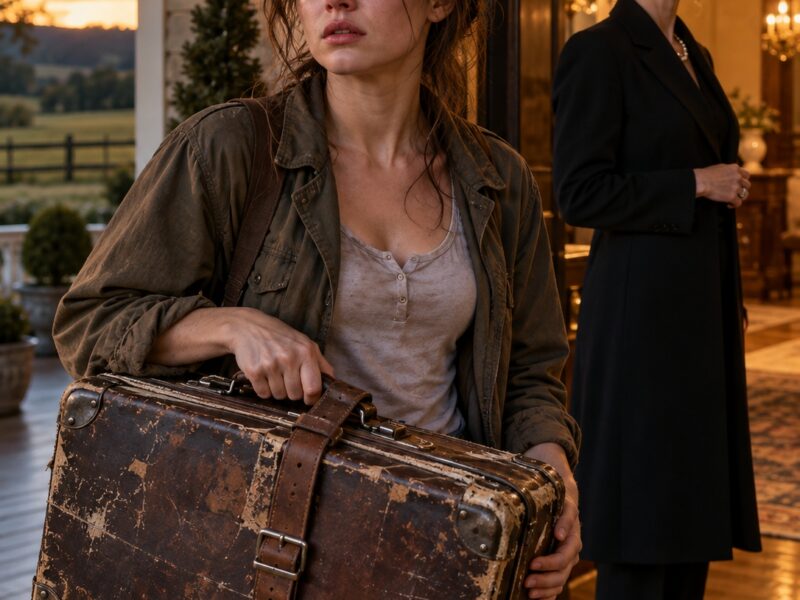
She was twenty-six years old, nearly penniless, accused of stealing from her dead father, and carrying everything she still owned in a suitcase whose broken latch had been held shut with a leather belt.
Caleb had never kissed her.
He had never held her hand.
Until that evening, he had never even met her.
Yet Lydia sat across from him at his kitchen table, wrapped both hands around a cup of tea, looked directly into the scarred half of his face, and said quietly:
“I need a husband.”
Caleb stared at her.
Outside, autumn wind moved through sixty acres of tired farmland in Red Hollow, Colorado. His old cattle dog, Rust, slept beneath the table. Somewhere in the barn, a horse struck a hoof against wood.
Caleb thought he had misheard her.
Then Lydia added the sentence that would change both of their lives.
“And if you say no, I understand. But I have nowhere else to go.”
Three days later, they were married.
Three months later, someone tried to burn down Caleb’s barn.
And by then, the marriage neither of them had intended to make real had become the one thing their enemies had underestimated.
But that came later.
In the beginning, Caleb Thornton was simply a man who had learned how to live without expecting anyone to stay.
At thirty-four, he owned a two-story farmhouse that needed paint, a barn that needed roofing, sixty-odd acres that produced just enough to keep him from losing them, and a kitchen garden that had mostly surrendered to weeds.
It wasn’t much from the road.
To Caleb, it was everything.
His father had left debts behind when he died. Caleb had spent years clawing his way out of them, eating badly, sleeping little, selling equipment, repairing what other farmers replaced, and learning exactly how long a pair of boots could survive after any sensible man would have thrown them away.
There had been a moment when he almost lost the north pasture.
He had been sitting in the county assessor’s office with papers in front of him, preparing to sign away part of the farm, when Gerald Harper walked through the door.
Gerald was a rancher from East Valley.
Respected. Quiet. Comfortable enough financially that he didn’t need to prove it.
Caleb barely knew him.
Gerald pulled out a chair.
“I’ll back the loan.”
Caleb had stared at him.
“You don’t even know me.”
Gerald shrugged.
“I knew your father. He raised you honest.”
“That doesn’t mean I can repay you.”
“No,” Gerald said. “But I think you will.”
That was all.
No speech.
No demand for gratitude.
No favor requested later.
Gerald Harper simply put his name behind a young farmer everyone else had already decided was going under.
Caleb never forgot it.
Especially because a few years later, when an accident left a scar running along one side of Caleb’s face, Red Hollow began treating him differently.
Nobody announced it.
Small towns rarely needed announcements for cruelty.
Invitations stopped coming.
People looked too long, then pretended they hadn’t looked at all.
Women who had once smiled at Caleb suddenly became fascinated by shelves, windows, sidewalks—anything that prevented eye contact.
And Margaret Blackwell, a wealthy widow with enough land, money, and influence to shape public opinion without ever appearing to do so, began quietly suggesting that Caleb preferred isolation.
Soon, his isolation became proof of something.
Nobody knew what.
That was the useful thing about suspicion.
It didn’t require evidence.
So Caleb worked.
He kept his head down.
He stopped expecting anything from people.
Rust grew old beside him.
And by the autumn of 1889, Caleb had become so accustomed to silence that he no longer called it loneliness.
He called it Tuesday.
Then, one evening, he heard buggy wheels coming down his lane.
Caleb was sitting on the porch with coffee and an old newspaper when Rust raised his head.
A rented buggy stopped at the gate.
A young woman climbed down.
She was exhausted.
Caleb could see that immediately.
Her dark hair had been pinned neatly that morning, but strands had escaped during the journey. Her dress had once been carefully pressed. Now every mile of travel showed in the fabric.
Then Caleb noticed the suitcase.
Old.
Scuffed.
A belt wrapped around the middle because the latch no longer worked.
The woman looked at the farmhouse.
Then at Caleb.
Relief crossed her face.
So did fear.
She opened the gate.
“You’re Caleb Thornton.”
It wasn’t a question.
“I am.”
Caleb came down the steps.
He knew exactly when she noticed his scar.
Everybody noticed.
Her eyes widened for half a second.
Then something unusual happened.
Instead of looking away, she looked him directly in the eyes.
Deliberately.
Caleb noticed that.
“My name is Lydia Harper.”
The name stopped him.
“Harper?”
“Gerald Harper was my father.”
Caleb went still.
“Was?”
“He died six weeks ago.”
The words were controlled, but grief lived underneath them.
“Pneumonia. It happened fast.”
Caleb removed his hat.
“I’m sorry.”
Lydia nodded.
“He used to talk about you.”
Caleb almost smiled.
“I doubt that.”
“He said you were one of the few men he’d ever backed who never made him regret it.”
Caleb looked away.
Rust limped down the steps and sniffed Lydia’s hand.
She crouched.
“He’s sweet.”
“He’s old.”
“So can a thing not be both?”
That made Caleb look at her again.
For the first time, something almost resembling humor moved between them.
Then Lydia stood.
“Mr. Thornton, I’ve been traveling since before sunrise, so I’m going to say this badly if I wait much longer.”
Caleb waited.
She swallowed.
“I have nowhere else to go.”
That was how she entered his house.
Not as a bride.
Not as a woman he loved.
Not even as a friend.
As a stranger carrying a dead man’s last request.
Caleb put water on the stove because making tea was easier than deciding what to do with someone else’s ruined life.
Lydia sat at his kitchen table and told him what had happened.
After Gerald’s death, the Harper ranch should have passed cleanly to her.
Her mother had died when Lydia was twelve. Her brother Thomas had left for work in the East five years earlier and hadn’t written in two.
That made Lydia the only child still there.
The ranch was not enormous, but it was sound.
Or it should have been.
Then Lydia began reviewing the accounts.
Money was missing.
At first, the discrepancies looked small.
Then she found more.
And more.
The trail led to Dale Doss, Gerald’s foreman of eleven years.
For three years, Doss had been siphoning money from the ranch, disguising withdrawals and transfers inside falsified records.
Gerald’s eyesight had been failing.
His trust in Doss had not.
That combination had been expensive.
“When I confronted him,” Lydia said, “he didn’t deny it.”
Caleb leaned forward.
“What did he do?”
“He accused me first.”
Doss claimed Lydia had authorized the transfers.
Worse, he produced documents bearing what appeared to be her signature.
Then he went to the sheriff.
By the time Lydia understood what he was doing, Red Hollow’s neighboring county had already heard a cleaner, uglier version of the story:
Gerald Harper’s grieving daughter had stolen from her own father’s estate.
The ranch hands quit.
Neighbors stopped visiting.
The bank froze the accounts.
Gerald’s longtime attorney refused to continue without a retainer Lydia couldn’t access.
“The sheriff believed Doss?”
“He believed paperwork.”
“Forged paperwork.”
“I know that.”
Caleb heard the anger beneath her calm.
“How long until the court decides?”
“I don’t know.”
“Where are you staying?”
Lydia looked into her tea.
“I was at a boarding house in Milfield.”
“Was?”
“I couldn’t pay for another week.”
Caleb said nothing.
Lydia reached into her coat.
“There’s something else.”
She placed a letter on the table.
Caleb recognized Gerald Harper’s handwriting.
His stomach tightened.
The letter had been written shortly before Gerald died.
Part of it concerned Lydia.
Part concerned Caleb.
Gerald had apparently sensed that something around his ranch was wrong, though he hadn’t understood the full scheme.
He knew his daughter.
Knew her pride.
Knew she would exhaust every other possibility before asking anyone for help.
So he gave her Caleb Thornton’s name.
Near the end, Gerald had written something Caleb read twice.
When she comes to you, please listen.
You are a good man.
I have always believed that.
Remember it when it matters.
Caleb folded the letter along its old creases.
“He wrote this before the accusation?”
“Yes.”
“He couldn’t have known.”
“No. But I think he knew something was wrong.”
Caleb looked at Lydia.
“What exactly do you need from me?”
Her fingers tightened around the cup.
“Say it plain,” he told her.
So she did.
“I need a legal situation that stabilizes mine. A permanent residence. Someone who can stand beside me during the investigation.”
She hesitated.
“And I need someone who won’t put me outside the moment this becomes inconvenient.”
Caleb understood before she finished.
“You’re asking me to marry you.”
“A practical marriage.”
The words came quickly now.
“I can work. I was raised on a ranch. I can keep accounts, cook, mend fencing, handle livestock, negotiate purchases. I’m not asking you to support someone who contributes nothing.”
“Lydia—”
“I’m not asking for affection.”
That silenced him.
“I’m not asking for your bed. I’m not asking you to pretend this is something it isn’t.”
Her voice became quieter.
“When the case is settled, if you want the marriage dissolved, we do it quietly.”
She looked terrified now.
Not of Caleb.
Of humiliation.
Of having made herself vulnerable enough to ask.
“I’m not trying to trap you.”
Caleb looked at her trembling hands.
Then he remembered Gerald Harper walking into a government office years earlier and placing his reputation beside Caleb’s when nobody else would.
He remembered one sentence.
Caleb Thornton’s good for it.
Perhaps some debts weren’t meant to be repaid to the person who created them.
Perhaps they traveled forward.
“You’d stay here,” Caleb said.
Lydia blinked.
“There’s a spare room upstairs. Window latch is broken. I’ll repair it.”
She stared.
“Are you saying yes?”
“I’m saying we’d need to do it legally. Properly. I won’t do half of something and have it collapse on you later.”
“Caleb—”
“I start before dawn.”
“I can do that.”
“I didn’t say you had to.”
“I want to.”
Something changed in Lydia’s face.
It wasn’t happiness.
Not yet.
It was the expression of someone who had been underwater and unexpectedly found air.
Caleb stood.
“Get some sleep.”
She nodded.
He reached the doorway.
Then stopped.
“Miss Harper.”
She looked up.
“Lydia,” he corrected.
His voice sounded strange saying a woman’s first name inside his house.
“Your father was a fair man. I can’t be Gerald.”
He paused.
“But I can be fair.”
Her eyes filled.
She refused to let the tears fall.
“That’s all I’m asking.”
Three days later, Caleb Thornton married Lydia Harper.
The ceremony lasted eleven minutes.
Caleb wore his best coat.
It wasn’t particularly good.
Lydia wore the same dress she had arrived in, though somehow she had pressed the travel wrinkles from it.
They stood before Mrs. Gould in the Red Hollow courthouse.
They said the required words.
Signed the registry.
And walked out husband and wife.
No flowers.
No guests.
No kiss.
No wedding supper.
That night Lydia slept upstairs.
Caleb slept downstairs.
For the first few weeks, they behaved like two polite strangers sharing a railway compartment.
Then Lydia started changing things.
Not dramatically.
She cleaned the kitchen garden.
Reorganized the pantry.
Balanced Caleb’s accounts and found two recurring charges he had been overpaying.
She repaired curtains he hadn’t realized needed repairing.
One afternoon he found her standing beside a field studying his crop rotation notes.
“Why do you rotate this pasture every two seasons instead of three?”
“Clay.”
She frowned.
“My father used three.”
“Different soil.”
She considered that.
“What about the east acreage?”
Caleb opened his mouth.
Then stopped.
He had never considered the east acreage from exactly that angle.
“I don’t know.”
Lydia looked surprised.
“You don’t?”
“No.”
Most men Caleb knew would have invented an answer before admitting that to a woman.
Caleb didn’t.
Lydia smiled slightly.
“We could find out.”
So they did.
The arrangement began changing through moments that looked too small to matter.
A second cup beside the coffeepot.
Boots next to his by the door.
A woman’s handwriting on the planting calendar.
A lamp burning in the kitchen when Caleb returned from the barn.
One evening, he sat down to a hot supper and realized the farmhouse no longer felt like somewhere he merely slept between workdays.
Someone lived there.
With him.
The realization frightened him more than he cared to admit.
He went outside.
Rust followed.
Caleb looked back through the window.
Lydia was clearing plates.
“Don’t make this complicated,” Caleb told the dog.
Rust sneezed.
Then Margaret Blackwell heard about the marriage.
Margaret had money.
More importantly, she had influence.
She had spent years defining Caleb for Red Hollow.
Scarred.
Strange.
Withdrawn.
Possibly unstable.
Now she gave the town a new story.
Lydia Harper, a woman under investigation for fraud, had deliberately found Red Hollow’s loneliest man.
She had married him for shelter.
For legal protection.
For access to whatever little property he owned.
And Caleb—poor, lonely Caleb—was too desperate for a woman’s attention to understand he was being used.
Margaret never said all of it to one person.
That would have looked malicious.
Instead, she distributed pieces.
Concern here.
Sympathy there.
A lowered voice.
A regretful expression.
By the time the story reached Caleb, nobody could identify where it had started.
But he knew.
Lydia knew too.
“What do you want to do?” Caleb asked.
“Nothing.”
He looked surprised.
“For now,” she added.
Then the lawyer’s letter arrived.
Lydia had written to an attorney named Marsh in the territorial capital, enclosing copies of the disputed documents.
His reply was four pages.
He would take the case.
More importantly, he believed the signatures could be proven false.
Lydia read the letter twice.
Then sat very still.
“This could take months.”
Caleb poured coffee.
“I know.”
“Our arrangement was supposed to be temporary.”
He looked at her.
“We said it lasts until the matter is resolved.”
“Yes.”
“It isn’t resolved.”
“No.”
“Then it lasts.”
Something passed across her face.
“Is that clear enough?”
“Yes,” she whispered.
It should have made things simpler.
Instead, everything became more complicated.
Because Caleb began looking forward to evenings.
Lydia began waiting for the sound of his boots on the porch.
He taught her things about the valley’s soil.
She showed him weaknesses in his financial records.
He discovered she was funny when she forgot to guard herself.
She discovered his silence was not emptiness.
Then Helen Pratt told Lydia what Margaret Blackwell was saying.
Lydia listened.
Paid for her lamp oil and thread.
Thanked Helen.
Walked outside.
Sat in the buggy.
And remained there for three full minutes.
Then she turned the horse toward the center of town.
That evening, Red Hollow’s monthly Grange meeting was scheduled.
Nearly eighty people would attend.
Margaret Blackwell would be there.
So would the banker.
The farmers.
The merchants.
Everyone currently discussing Lydia’s marriage as though it belonged to them.
When Lydia returned to the farm, Caleb was repairing shingles on the barn.
“I need you to come to the Grange meeting.”
He removed the nails from his mouth.
“I don’t go to those.”
“I know.”
“Why tonight?”
“Because I’m done letting someone else tell our story.”
Caleb studied her.
“What time?”
“Seven.”
“I’ll be ready.”
When they entered the hall, conversations didn’t stop.
Not exactly.
They bent.
Eyes moved.
Whispers changed direction.
Caleb’s shoulders tightened.
Lydia noticed.
“You don’t have to do anything,” she whispered.
“Just be here.”
“I’m here.”
Forty minutes into the meeting, Margaret leaned toward another woman and whispered behind her hand.
The woman glanced at Lydia.
Another leaned closer.
It was subtle.
Designed to be deniable.
Lydia stood.
The meeting chairman stopped speaking.
“I apologize for interrupting.”
Eighty faces turned toward her.
Lydia could hear the wind against the wall.
“I understand there are questions circulating about my husband and me.”
Margaret became very still.
Lydia continued.
“My name is Lydia Thornton. My father was Gerald Harper. Some of you knew him.”
Caleb looked at her.
She had called herself Lydia Thornton without hesitation.
“My father dealt honestly with people in this county for twenty years. After his death, I inherited a situation that had been corrupted by someone he trusted.”
She paused.
“The legal matter is before the courts, so I won’t argue it here.”
Then her voice sharpened.
“But I will address my marriage.”
Nobody moved.
“I came to Red Hollow with nothing. Caleb Thornton offered me a fair arrangement when I needed one.”
Her eyes swept across the room.
“That is the truth.”
She could have stopped.
She didn’t.
“I don’t expect anyone here to trust me because I made one speech. Trust is earned.”
Then she looked toward Margaret.
Only briefly.
“But I expect the same courtesy for my husband.”
Caleb’s breathing changed.
“Wait for evidence before deciding what someone is.”
She sat.
The chairman cleared his throat.
The meeting continued.
Afterward, three people approached them.
Only three.
But three was more than zero.
An older farmer shook Caleb’s hand.
“Good seeing you out again.”
Helen Pratt apologized.
A woman who had known Gerald said Lydia had her father’s spine.
Margaret Blackwell walked past them without speaking.
Outside, Caleb drove for several minutes before saying anything.
“You didn’t tell me you were going to defend me.”
“I didn’t know I was until I stood up.”
“You didn’t have to.”
“Yes.”
She looked at him.
“I did.”
Caleb stared ahead.
“No one’s said something like that about me in a long time.”
Lydia let the silence remain.
Finally, he said:
“Thank you.”
“Don’t thank me.”
She pulled her coat tighter.
“Help me cover the cold frames. Frost is coming.”
Caleb looked toward the dark horizon.
“It is.”
“How do you know?”
“I can smell it.”
She almost smiled.
That night, for the first time, their silence felt intimate.
Then the storm came.
Wind hit the valley hard enough to tear loose roofing.
Rain became sleet.
The cattle panicked.
A tarp broke free near the south pasture.
Caleb ran outside.
Lydia followed with rope.
He didn’t see her at first.
He saw the cottonwood.
An old tree near the fence.
Its roots had rotted during summer.
Caleb had meant to deal with it.
He hadn’t.
Now it was moving incorrectly.
Not bending.
Tilting.
From the root.
Then Lydia appeared beneath it.
“Lydia!”
She turned toward him.
Not the tree.
Caleb ran.
The root system tore loose.
He reached Lydia a second before the cottonwood fell.
He hit her with his shoulder and wrapped both arms around her.
They crashed into mud.
The tree came down behind them with a sound like twenty rifles firing together.
Branches struck Caleb’s leg and shoulder.
Something hit the back of his head.
His vision disappeared.
For three seconds, the world went white.
Then sound returned.
Wind.
Sleet.
Lydia’s voice.
“Caleb.”
Her hands were on him.
“Caleb, look at me.”
He lifted his head.
Her face was muddy.
Blood ran from a cut beneath her chin.
But her expression frightened him more.
The control was gone.
“You’re bleeding,” she said.
“So are you.”
“I don’t care about me.”
The words came out too quickly.
They both heard them.
Something passed between them.
Something neither was prepared to name.
Later, inside the farmhouse, Lydia cleaned the cut on Caleb’s head.
He cleaned hers.
His hand lingered near her face.
Neither moved.
The fire cracked.
Rust slept nearby.
Finally, Caleb lowered his hand.
“The water line needs rerouting.”
Lydia exhaled.
“I know.”
“I can do it after the ground thaws.”
“We can do it.”
Caleb looked at her.
She waited for him to correct her.
He didn’t.
“We can do it.”
It was a small sentence.
But Lydia understood the difference.
A man could tolerate a woman’s help.
Or he could genuinely build her into his plans.
Caleb had just done the second.
Then the legal case changed.
Marsh’s investigation uncovered forged documents connected not only to Lydia.
There were other land transactions.
Other signatures.
Other properties.
The same pattern.
Dale Doss had not been working alone.
Someone had access to county records.
Someone could insert false documents into official systems.
Someone had profited from landowners being financially weakened.
Lydia read Marsh’s letter in the kitchen.
“How much land has Margaret Blackwell acquired in four years?”
Caleb looked up.
“At least three parcels.”
“Below market value?”
“I’d have to check.”
“I’d bet they were.”
“That’s speculation.”
“For now.”
They looked at each other.
Then Caleb understood.
Gerald Harper’s ranch may never have been merely robbed.
Gerald may have been targeted.
And now Caleb’s farm stood between the same people and another piece of land.
Three nights later, Caleb woke at two in the morning smelling smoke.
Orange light flickered beneath the barn wall.
He ran outside.
Someone had started a fire.
It was small enough to stop.
Barely.
Lydia stood beside him afterward, wrapped in a coat over her nightclothes.
“This wasn’t an accident.”
“No.”
“Who knew Marsh’s investigation was expanding?”
“Word travels.”
“Not this specifically.”
Caleb looked at the blackened wood.
A coldness settled inside him.
“Someone feels cornered.”
Lydia nodded.
“If they destroy the harvest, the bank can call your loan.”
Caleb turned.
“What?”
“Think about it.”
She was already moving several steps ahead.
“If the harvest disappears, your financial position weakens. If your wife is under investigation, they call you unstable risk. They force the loan. You lose the farm.”
Caleb stared at the damaged barn.
The scheme was no longer about Lydia.
It had reached his land.
His father’s land.
Everything he had spent years protecting.
“What do we do?”
Lydia looked at him.
“We stop playing defense.”
They filed the arson attempt directly with the circuit court.
Marsh attached it to the fraud case.
Then the bank moved.
Caleb received notice that his loan was being called.
Sixty days.
Pay the balance or face collection.
The justification mentioned changed financial circumstances.
And his marriage to a woman under active fraud investigation.
Caleb read the notice twice.
Lydia read it once.
Then she put it down.
“This is Margaret.”
“We can’t prove that.”
“No.”
Lydia’s eyes hardened.
“But we can prove the pattern.”
Marsh did exactly that.
A document examiner confirmed Lydia’s signatures were forged.
Then another discovery arrived.
Three separate land transfers carried the same filing irregularities.
All had passed through the county records office.
All involved financially vulnerable property owners.
And several ended with land connected to Blackwell interests.
Caleb read the telegram aloud.
When he finished, Lydia sat motionless.
“My father wasn’t unlucky.”
Caleb said nothing.
“He was selected.”
The grief in her voice had changed.
It was no longer only grief.
It was understanding.
Dale Doss had weakened Gerald’s ranch from inside.
Forged records had made Lydia appear responsible.
The accusation against her had isolated her.
Frozen the accounts.
Driven workers away.
Destroyed confidence in the estate.
And when the property became desperate enough—
Someone could acquire it cheaply.
Caleb suddenly remembered Margaret’s campaign against their marriage.
She had not merely been cruel.
She had been strategic.
She needed Lydia discredited.
She needed Caleb isolated.
She needed their marriage to look fraudulent.
Because together, they were harder to break.
The court hearing was scheduled for December 22.
Seven days.
During that week, Caleb and Lydia did ordinary things.
They fed animals.
Checked frost damage.
Read legal documents.
Repaired fencing.
Drank coffee.
Neither spoke much about fear.
There was nothing left to say.
One evening, Caleb found Lydia holding Gerald’s letter.
“My father knew something,” she whispered.
“Maybe.”
“He sent me here.”
“He sent you to a man who owed him.”
“No.”
She looked at Caleb.
“He sent me to a man he trusted.”
Caleb looked away.
“I don’t know if I earned that.”
Lydia almost laughed.
“You married a stranger with a broken suitcase.”
“You asked.”
“That doesn’t make it sensible.”
“No.”
“Why did you do it?”
Caleb thought for a long time.
“Because somebody once helped me when helping me made no sense.”
Lydia’s eyes softened.
“And because?”
He looked at her.
There were other answers now.
Neither of them was ready for them.
“Court’s in seven days,” he said.
Lydia understood the retreat.
She allowed it.
For now.
The hearing room was nearly full.
Margaret Blackwell sat alone on the left side.
Her attorney, Carver, came from the territorial capital.
Expensive.
Polished.
Confident.
The judge was Clara Fitch, a gray-haired woman near sixty whose expression suggested she had spent decades listening to men believe volume could substitute for evidence.
Carver argued first.
The bank’s concern was legitimate.
Caleb’s financial risk had changed.
His wife faced fraud allegations.
The marriage complicated property interests.
The claims against Margaret were desperate speculation.
Then Marsh stood.
He did not perform.
He presented.
Forged signatures.
Financial records.
The Doss transactions.
County filing irregularities.
Blackwell-linked acquisitions.
The timing of Caleb’s loan call.
The attempted barn fire.
The systematic financial weakening of properties later purchased below market value.
Carver fought every connection.
Marsh kept building them.
At noon, Judge Fitch called recess.
Caleb and Lydia sat on a hallway bench.
Lydia’s knee bounced.
It was the only visible sign that she was terrified.
Caleb placed his hand on it.
The movement stopped.
Neither spoke.
When court resumed, Carver made his strongest argument.
Even if irregularities existed in Lydia’s case, he said, they were legally separate from Caleb’s loan.
Marsh stood.
“The two matters share an origin.”
He looked at the judge.
“The systematic financial destabilization of property by parties positioned to benefit from its failure.”
He paused.
“They are not separate matters.”
Judge Fitch wrote something.
Then looked up.
The ruling took seven minutes.
Caleb’s loan call was suspended pending full judicial review.
The bank was prohibited from collection action.
Then Judge Fitch addressed Lydia’s case.
The investigation against Lydia Thornton was closed.
The disputed signatures were forged.
A referral would be made to the territorial attorney general regarding the wider pattern of fraudulent land transactions.
Lydia stopped breathing.
For months, people had called her thief.
Manipulator.
Fraud.
Now a judge had said what Lydia had been saying from the beginning.
She had told the truth.
Judge Fitch mentioned Margaret Blackwell’s name once.
Without drama.
Without anger.
Somehow, that made it worse.
Margaret stood before the room had fully absorbed the ruling.
She walked out.
Caleb watched her leave.
He expected triumph.
It didn’t come.
Justice, he discovered, was quieter than revenge fantasies.
Outside the courthouse, Marsh shook their hands.
“Well done.”
Bill Acres waited near the steps.
“My wife has been cooking enough food for an army because she said there might be something worth celebrating.”
He looked at Caleb.
“Turns out there is.”
Caleb nodded.
“Yeah.”
Then he looked at Lydia.
“There is.”
They drove home in silence.
But it was not the silence of strangers.
That night, the farmhouse felt warmer than usual.
They sat beside the fire.
Rust slept nearby.
Lydia talked about rebuilding the east acreage.
Caleb talked about rerouting the water line.
They discussed spring planting.
Not Caleb’s spring planting.
Theirs.
Eventually Lydia became quiet.
“I came here because I had nowhere else.”
Caleb looked at her.
“I know.”
“I thought I was surviving.”
She watched the fire.
“I didn’t realize how much of myself I’d stopped expecting to get back.”
Caleb understood.
Hard years could do that.
Not always through catastrophe.
Sometimes a person simply received enough evidence that the world expected little from them until they began agreeing with it.
You made your hopes smaller.
Then smaller again.
Until disappointment had nothing left to reach.
And sometimes, if the right person arrived at the right moment, you discovered you had been wrong about yourself.
Caleb reached across the space between them.
He took Lydia’s hand.
She turned hers over.
Held his.
He had been carrying words for weeks.
Maybe months.
“I know this started as an arrangement.”
Lydia looked at him.
“Caleb—”
“Let me finish.”
He stared into the fire because looking at her was harder.
“I know what we agreed to. I know we meant it.”
His thumb moved once against her hand.
“But things changed.”
“Yes.”
“I didn’t say anything because I didn’t know if they changed for you.”
“Caleb.”
“And I thought maybe I’d turned this into something in my head because I’d been alone too long.”
“Caleb.”
This time he looked at her.
Lydia’s expression was almost amused.
Almost tearful.
Almost angry that he could be so intelligent about soil and so helpless about this.
“I love you.”
Caleb stopped.
Lydia did not dress the words up.
“I’m not saying it because we won today.”
She squeezed his hand.
“I’m not saying it because I owe you.”
Her voice softened.
“I’m saying it because it’s true, and I’ve been carrying it long enough that it’s getting heavy.”
Caleb looked at her for a long time.
Then he laughed once under his breath.
Not because it was funny.
Because relief sometimes had nowhere else to go.
“I love you too.”
Lydia’s eyes filled.
“I have for a while.”
“I know.”
“You know?”
“You’re terrible at saying what you feel.”
“I’m aware.”
“You’re improving.”
“Slowly.”
“Very slowly.”
He smiled.
A real one.
Outside, December wind moved across Thornton Farm.
The barn still carried black marks from the attempted fire.
The fence beside the fallen cottonwood still needed repair.
The house still needed paint.
Nothing had become perfect.
That was not what surviving meant.
By March, the bank formally withdrew its call and restored Caleb’s original loan terms.
No penalties.
No collection.
The banker delivered the papers personally.
Caleb accepted the gesture for what it was: the closest thing to an apology he was likely to receive.
In April, the territorial attorney general opened a broader investigation.
Dale Doss cooperated in exchange for consideration at sentencing.
His testimony exposed county officials who had helped falsify records.
Three people were eventually charged.
Margaret Blackwell was not one of them.
Her involvement had been insulated too carefully.
Her name always sat one step away from the document that mattered.
Some people called that injustice.
Others called it proof that money still protected its own.
Caleb eventually stopped needing a clean answer.
Margaret sold her Red Hollow properties within six months and left the area.
Caleb never saw her again.
Spring came.
The north field was planted fully.
The east acreage went back into rotation.
Lydia renegotiated their broker contract and returned with better terms.
On the buggy ride home, Caleb shook his head.
“You’re better at negotiating than I am.”
“I know.”
“You could pretend to be humble.”
“I could.”
“But?”
“I respect you too much to lie.”
He laughed.
Lydia looked out across the fields.
“You grow things better.”
“We’re a pair.”
She turned toward him.
“That we are.”
Months later, Caleb found Lydia’s old suitcase in the attic.
The leather belt was still wrapped around it.
The broken latch had never been repaired.
He carried it downstairs.
Lydia was at the kitchen table working through invoices.
She looked up.
“Where did you find that?”
“Attic.”
She stared at the suitcase.
For a moment, neither spoke.
It looked smaller than Caleb remembered.
Funny how desperation could make an object enormous.
“That was everything I owned,” Lydia said.
“I know.”
“I was terrified when I came down your lane.”
“You hid it well.”
“No, I didn’t.”
“You fooled me.”
She smiled.
“I thought you were terrifying too.”
Caleb touched his scar automatically.
Lydia saw the gesture.
“No.”
She stood.
“Not because of that.”
“Then why?”
“You barely spoke.”
“I still barely speak.”
“You speak more.”
“Occupational hazard of being married to you.”
She came closer.
Caleb looked down at the battered suitcase.
“What do you want to do with it?”
Lydia considered the question.
“Keep it.”
“Why?”
She ran her fingers across the old leather belt.
“Because I want to remember.”
“The bad part?”
“All of it.”
Caleb understood.
People liked to believe healing meant throwing away every reminder of pain.
Sometimes it meant being able to look at the thing that once represented the end of your life and recognize it as the beginning of another one.
Caleb carried the suitcase back upstairs.
He placed it in the attic beneath the window.
Through the glass he could see Lydia’s cold frames.
Beyond them, the barn.
Beyond that, fields waiting for summer.
Rust was asleep in the sun beside the porch.
The cottonwood stump remained near the south fence.
They had decided not to remove it yet.
Not because it was beautiful.
Because scars did not always need to disappear before life could grow around them.
Caleb stood there for a while.
Then he heard Lydia downstairs.
“Caleb?”
“Yeah?”
“Are you planning to spend the entire afternoon admiring my suitcase?”
He smiled.
“No.”
“We have fence posts waiting.”
“I know.”
“And you said you’d help.”
“I did.”
He started downstairs.
Halfway down, he stopped.
The farmhouse smelled like coffee and fresh bread.
Lydia was moving through the kitchen.
Sunlight crossed the floor.
There was nothing extraordinary about the scene.
That was what made it extraordinary.
Years earlier, Gerald Harper had walked into a county office and helped a young man who was about to lose his land.
He had asked for nothing in return.
Years later, his daughter had arrived at that man’s gate with a broken suitcase and asked for something almost impossible.
A home.
A name.
A chance to stand still long enough to fight.
Caleb had thought he was repaying a debt.
He had been wrong.
Some debts were not debts at all.
They were bridges.
Gerald had built one without knowing exactly where it would lead.
Lydia crossed it.
Caleb met her on the other side.
And somewhere between forged signatures, whispered rumors, a falling tree, a burning barn, a courtroom, and countless quiet mornings when two people simply chose to remain beside each other, the arrangement became a marriage.
Not because a courthouse clerk had written their names in a registry.
Not because Lydia needed legal protection.
Not because Caleb owed Gerald Harper.
But because eventually, staying stopped being something either of them had to do.
It became what they wanted.
Caleb entered the kitchen.
Lydia handed him his gloves.
“You’re late.”
“I was thinking.”
“That’s dangerous.”
“So I’ve heard.”
She opened the door.
Spring sunlight flooded the porch.
They walked toward the fence together.
Behind them, the farmhouse door swung closed but did not latch completely.
A warm wind pushed it open again.
Neither of them went back to close it.
For the first time in Caleb Thornton’s life, an open door no longer felt like something waiting for someone to leave.
It felt like proof that someone had finally chosen to stay.









