SHE COLLAPSED AT THE LAST DOOR IN THE SNOW—THEN THE FARMER LEARNED WHY SOMEONE WANTED HER DRAGGED BACK
Emma Collins had been turned away eleven times before she reached Walter Hayes’s farmhouse.
At the twelfth door, she didn’t get the chance to hear no.
She collapsed before the old man could say it.
Her knees struck the frozen porch hard enough to tear her stockings beneath her skirt. One hand clawed weakly at the boards while snow gathered in her dark hair. Her lips had gone almost blue.
Still, when the door opened, the first thing she said was not, Help me.
It was—
“Please, sir… I can work.”
Walter Hayes stood in the doorway holding a tin cup of coffee.
For several seconds, neither of them moved.
The January wind swept snow across the porch between them.
Walter was sixty-seven, tall despite the slight bend in his shoulders, with white hair, a weather-cut face, and the quiet eyes of a man who had lived alone long enough to stop wasting words.
He looked at the young woman lying at his feet.
Torn coat.
Wet shoes.
Cracked fingers.
A bruise fading yellow near one wrist.
Then he asked the strangest question Emma had heard all day.
“Can you stand?”
She stared up at him.
“Sir?”
“Can you stand on your own?”
Her face changed.
Walter saw pride fighting exhaustion.
Emma planted one palm against the porch, dragged a knee beneath herself, and tried. Her first attempt failed. Her second got her halfway upright.
The third time, she caught the doorframe.
Her legs shook violently.
But she stood.
“Yes, sir.”
Walter took a sip of coffee.
“Good.”
He stepped aside.
“Then come inside before you die on my porch. I’ve got enough repairs without replacing boards because somebody froze to them.”
Emma didn’t laugh.
She didn’t know yet that Walter had been trying to make her feel less ashamed.
She only knew the door remained open.
So she walked through it.
And neither of them understood that, within a month, half the county would be arguing over whether Emma Collins was a thief, a liar, or a young woman someone powerful desperately needed to control.
It was January 1883 in the Wyoming Territory, where winter could erase a road in an hour and a person’s reputation in less.
Emma was twenty years old.
She had spent that entire morning walking through snow looking for employment.
Not charity.
Not a free bed.
Not pity.
Work.
She had offered to cook, scrub floors, wash clothes, mend fences, feed livestock, shovel manure, haul water—anything honest.
The first farmhouse had turned her away before she finished speaking.
“We don’t hire strangers.”
At the second, a farmer looked at her muddy hem and called her a railroad tramp.
At the third, a woman had been kinder.
“I’m sorry, dear. My husband wouldn’t approve.”
Emma thanked her anyway.
At the fifth house, she stopped explaining where she had come from.
At the eighth, she stopped meeting people’s eyes.
At the eleventh, a prosperous merchant named Harold Bricks had opened his polished front door and stared at her as though poverty were contagious.
“I can work,” Emma had told him.
“Doing what?”
“Anything you need.”
Harold glanced at the storm behind her.
“You people always say that.”
Emma didn’t understand what you people meant.
She didn’t ask.
“I’m not asking for money I haven’t earned.”
“Move along.”
“Sir—”
“Before you freeze to death on my property. I don’t need the paperwork.”
Then he shut the door.
Emma stood there long enough to hear the bolt slide into place.
That sound stayed with her.
Not the insult.
The bolt.
Because Emma knew what a locked door sounded like from both sides.
She walked another three miles.
Her shoes had holes in both soles. The newspaper she had stuffed inside them that morning had turned to pulp. She had eaten half a heel of bread since the previous evening.
Three times she considered sitting beside the road.
Three times she imagined how warm sleep might feel.
And three times fear made her keep moving.
Because stopping meant freezing.
Going back meant Clara.
So Emma followed the road until daylight began bleeding out of the western sky.
That was when she saw one last light.
A farmhouse stood beyond a broken fence and several bare cottonwoods. Smoke rose from its chimney. A barn leaned into the wind fifty yards behind the house.
It did not look wealthy.
It looked lived in.
Emma told herself she would knock once.
If nobody answered, she would find the barn and sleep with the animals.
She made it to the porch.
Raised her hand.
Knocked.
Then fell.
Now she sat at Walter Hayes’s kitchen table with a bowl of potato-and-beef soup steaming beneath her face.
The warmth hurt at first.
Her fingers tingled so sharply around the spoon that she nearly dropped it.
Walter pretended not to notice.
The kitchen was plain but clean enough. A cast-iron stove ticked softly in the corner. A clock hung beside a faded photograph of a woman with kind eyes.
Emma took one spoonful.
Then another.
Her stomach cramped from receiving food too quickly.
She slowed down.
Halfway through the bowl, she stopped.
“I can wash those dishes.”
Walter glanced toward the sink.
“What dishes?”
“All of them.”
“There are three.”
“I’ll clean the kitchen too.”
“Why?”
Emma looked confused.
“For the food.”
Walter leaned back.
“I didn’t hire you.”
Her spoon lowered.
The fear was immediate.
Walter noticed.
“That wasn’t an accusation.”
“I’m sorry.”
“Stop apologizing every time I speak.”
“I’m sorry.”
Walter stared at her.
Emma realized what she had done.
For the first time that evening, something almost resembling amusement touched Walter’s face.
“Finish the soup.”
“But I haven’t earned it.”
“Young lady, if I make you sign a contract for a bowl of soup, I’ve become a worse businessman than my neighbors already believe I am.”
She looked toward the door.
Walter followed her eyes.
“You expecting someone?”
“No.”
The answer came too quickly.
Walter filed that away.
He showed her a narrow bedroom at the rear of the house after supper.
It had once been used for hired hands. A small bed stood against the wall beneath a quilt. There was a washstand, a wooden chest, and a frost-edged window overlooking the barn.
“Blankets are in there,” Walter said.
Emma remained in the doorway.
“We’ll discuss work tomorrow.”
“I can start tonight.”
“No.”
“I don’t mind.”
“I do.”
She gripped the edge of her sleeve.
Walter saw the panic return.
He softened his voice.
“Whatever you think you owe me can wait until daylight.”
Emma said nothing.
Walter left.
Twenty minutes later, he heard movement downstairs.
He found the dishes washed.
The floor swept.
The stove polished.
Emma had even folded the dish towels.
Walter stood alone in the kitchen looking at the work.
Then he looked toward the back hallway.
Something about it troubled him.
Not because she had cleaned.
Because she had been too frightened not to.
That night Emma slept fully dressed.
She kept her shoes beside the bed.
She placed the wooden chair beneath the doorknob.
Then she lay beneath the quilt and waited for footsteps.
None came.
Nobody shouted her name.
Nobody demanded she get up.
Nobody rattled the door.
Nobody told her she was lazy.
Nobody reminded her how much she owed for being allowed to exist beneath someone else’s roof.
She stayed awake listening to the wind.
Eventually, exhaustion won.
For the first time in weeks, Emma slept until morning.
Walter woke before sunrise and smelled bacon.
He stopped halfway down the stairs.
Coffee.
Eggs.
Something frying in butter.
He entered the kitchen.
Emma stood at the stove wearing yesterday’s dress with the sleeves rolled above her wrists.
“I hope you don’t mind,” she said. “I found eggs in the barn.”
“You went to the barn already?”
“Yes.”
“In this cold?”
“I fed the chickens.”
Walter looked through the window.
The sky was barely gray.
“When?”
“About an hour ago.”
He glanced at the table.
One plate.
“Have you eaten?”
“Yes.”
“What?”
Emma hesitated.
“A piece of bread.”
Walter opened the cupboard, removed another plate, and divided the eggs and bacon.
He put half in front of her.
Emma stared.
“I haven’t earned—”
“Emma.”
She looked up.
It was the first time he had used her name.
“If I hear that sentence every morning, I’m going to charge you for irritating me.”
A tiny smile appeared.
It vanished quickly.
But Walter saw it.
And for reasons he could not explain, the sight of it made the empty kitchen feel different.
That day Emma worked as if someone might measure every minute.
She swept the barn.
Reorganized Walter’s tools.
Carried feed.
Scrubbed buckets.
Mended a torn grain sack.
Then she noticed the north gate sagging from a loose hinge.
Walter found her an hour later with a hammer in her hand.
“That gate’s been crooked eight years.”
“Why didn’t you fix it?”
“Because it still opened.”
Emma looked at him.
“That’s a terrible reason.”
Walter almost smiled.
“Margaret used to say the same thing.”
Emma glanced toward the farmhouse.
“The woman in the photograph?”
“My wife.”
“I’m sorry.”
“Six years.”
Walter looked at the repaired gate.
“She’d also have said you put that hinge two inches too low.”
Emma’s face fell.
Walter pushed the gate.
It swung perfectly.
“She would’ve been wrong.”
This time Emma laughed.
Just once.
Quietly.
But Walter heard it.
That evening, he made her an offer.
“The room is yours while you work here. Meals included. Two dollars a week.”
Emma thought she had misunderstood.
“Two dollars?”
“Unless you’re planning to negotiate.”
“No.”
“Then don’t.”
“I mean… yes. I mean, thank you.”
“Walter.”
“What?”
“That’s my name. Mr. Hayes makes me feel like I’m about to be served legal papers.”
Emma looked at him uncertainly.
“Thank you… Walter.”
She went to her room that night with two dollars promised at week’s end, a bed that belonged to her as long as she worked, and three meals a day.
She should have felt safe.
Instead, she sat on the edge of the mattress staring at the door.
Because experience had taught Emma something Walter didn’t yet understand.
Kindness was often only the first price someone charged.
And every open door eventually closed.
Three weeks passed.
The Hayes farm changed.
Walter noticed it in small ways first.
His tools began appearing where they belonged.
A button missing from his winter shirt for nearly a year mysteriously returned.
The kitchen curtains were washed.
A broken shelf Margaret had asked him to repair in 1876 finally stopped leaning.
Emma discovered jars of dried beans Walter had forgotten he owned.
She found Margaret’s recipe notebook and made biscuits using instructions written in faded pencil.
Walter took one bite and went silent.
Emma immediately worried.
“Are they bad?”
“No.”
“Too much salt?”
“No.”
“Then what?”
Walter looked at the biscuit.
“Margaret made them like this.”
Emma didn’t know what to say.
So she poured him more coffee.
That became their language.
Walter did not ask questions Emma wasn’t ready to answer.
Emma did not ask why his son never visited.
They lived beside each other’s silence without trying to break it.
But Walter observed things.
Emma hid food.
Not much.
A biscuit wrapped in cloth behind the flour tin.
An apple beneath her mattress.
Two pieces of jerky in the pocket of Margaret’s old sewing basket.
Walter discovered the habit accidentally.
He never confronted her.
He simply made sure there was always enough food visible.
Emma also flinched at sudden noises.
A dropped bucket.
A slammed barn door.
A horse kicking its stall.
Once Walter raised his voice at a stubborn mule and found Emma frozen ten feet away, her face drained of color.
He lowered his voice immediately.
“Wasn’t talking to you.”
“I know.”
But her hands were shaking.
Another afternoon, Walter rode into Milford for supplies.
He had mentioned the trip over breakfast.
Emma had been distracted kneading bread.
Apparently, she had not heard him.
When Walter returned near sunset, he saw a figure standing beside the road.
Emma.
No coat.
No gloves.
Just Margaret’s old shawl wrapped around her shoulders.
Walter climbed down from the wagon.
“What are you doing?”
Emma’s expression changed the moment she saw him.
Relief hit her so violently she had to look away.
“I thought…”
She stopped.
“You thought what?”
“Nothing.”
Walter studied her.
Snow had collected in her hair.
“How long have you been standing here?”
“I’m fine.”
“That’s not an answer.”
She looked toward the barn.
Walter suddenly understood.
“You thought I wasn’t coming back.”
Emma’s jaw tightened.
“No.”
“Emma.”
She wrapped the shawl tighter.
“I thought maybe you’d decided I’d been here long enough.”
Walter felt something heavy settle inside his chest.
He took off his gloves.
“Did somebody do that to you?”
Silence.
“Leave you somewhere?”
Her eyes remained fixed on the ground.
Walter waited.
Finally, he asked, “How long were you with the people who hurt you?”
Emma looked up sharply.
“I never said anyone hurt me.”
“No.”
Walter’s voice stayed quiet.
“You didn’t.”
They sat in the kitchen that night while the wind scraped branches against the window.
Emma told him about Clara Marsh.
Not everything.
Not yet.
Clara was her mother’s cousin.
When Emma’s mother disappeared after years of unstable work and illness, Clara had taken fourteen-year-old Emma into her home outside Milford.
Everyone praised her for it.
Clara was respectable.
She attended church.
She donated canned goods to families after fires.
She smiled when people were watching.
Inside the Marsh house, Emma became unpaid labor.
At first, Clara called it gratitude.
“You eat here. You sleep here. Everybody contributes.”
Emma believed her.
Then chores became work.
Work became obligation.
Obligation became debt.
Clara kept a notebook.
Food.
Shoes.
Soap.
Medicine.
Coal.
Every expense was written beside Emma’s name.
At sixteen, Emma asked how much she owed.
Clara showed her the total.
It was more money than Emma had ever seen.
“That’s impossible.”
Clara smiled.
“Then you’d better work hard.”
At nineteen, Emma found employment at Milford Steam Laundry.
For the first time, someone handed her wages.
Seventy-five cents for six days.
Emma hid the money.
Clara found it.
“You stole from this household.”
“It’s mine.”
Clara slapped her.
Emma stopped speaking.
Walter’s jaw tightened across the table.
“Did she hit you often?”
Emma stared into her coffee.
“Only when I was ungrateful.”
Walter’s expression hardened.
“That’s not an answer.”
Emma finally met his eyes.
“Yes.”
She explained that she had tried saving again.
Clara discovered that too.
The argument became worse.
Clara’s husband blocked the kitchen door.
Clara emptied Emma’s small purse onto the table.
Then she said something Emma would remember forever.
“Girls like you don’t survive alone.”
Emma looked at Walter.
“I think she wanted me to believe that.”
“Did you?”
“For a long time.”
“What changed?”
Emma’s eyes dropped.
“I left.”
There was something she wasn’t saying.
Walter could hear it.
But he did not force her.
Instead, he stood and walked toward the hallway.
A warm green wool coat hung beside the door.
Margaret’s.
Walter had been unable to throw it away.
Unable to give it away.
Unable even to move it upstairs.
For six years it had remained there like the outline of a person who might return.
Walter took it from the hook.
He placed it over the back of Emma’s chair.
“Keep it.”
Emma stared.
“No.”
“That’s generally how gifts work. Somebody gives. Somebody keeps.”
“I can’t.”
“Why?”
“It was hers.”
Walter looked at the coat.
“Margaret hated wasted things.”
Emma touched the sleeve.
The wool was soft.
Better than anything she had ever owned.
Her eyes filled.
“I’ll take care of it.”
Walter nodded.
“I know.”
Then hoofbeats sounded outside.
A wagon stopped beyond the fence.
Walter moved to the window.
The warmth left his face.
Emma noticed.
“Who is it?”
Walter watched a well-dressed man climb down.
Harold Bricks.
The same man who had shut the eleventh door.
Walter stepped onto the porch before Harold could knock.
“Evening.”
Harold removed his hat.
“Walter.”
His eyes moved past him.
Through the window.
He saw Emma.
Recognition flickered.
“So it’s true.”
Walter’s voice cooled.
“What’s true?”
“You’ve got that girl living here.”
“Her name’s Emma.”
Harold lowered his voice.
“People are talking.”
“People usually do when they’ve run out of useful work.”
“This isn’t funny.”
“I wasn’t laughing.”
Harold glanced toward the window again.
“You don’t know who she is.”
Walter’s expression barely changed.
“Do you?”
“I know enough.”
“Then say it.”
Harold hesitated.
“Clara Marsh is looking for her.”
Behind the glass, Emma dropped the cup she was holding.
It shattered on the kitchen floor.
Walter turned.
Emma stood completely still.
And for the first time since arriving at his farm, she looked exactly as frightened as she had on the porch.
Harold noticed too.
“See?”
Walter stepped closer to him.
“What did Clara tell you?”
“That the girl ran off after stealing money and jewelry.”
Emma appeared in the doorway.
“That’s a lie.”
Harold’s eyes narrowed.
“There she is.”
Walter moved slightly.
Not dramatically.
Just enough to place himself between them.
Emma noticed.
So did Harold.
“I didn’t steal anything,” she said.
Harold shrugged.
“Then you’ve got nothing to worry about.”
But Emma knew better.
People like Clara did not need the truth.
They needed respectable men willing to repeat their version of it.
The following morning, a county deputy rode onto Walter’s property.
His name was Samuel Pike.
He was young enough to look uncomfortable with the authority pinned to his coat.
Walter met him beside the barn.
Emma watched through the kitchen window.
The deputy removed a folded paper.
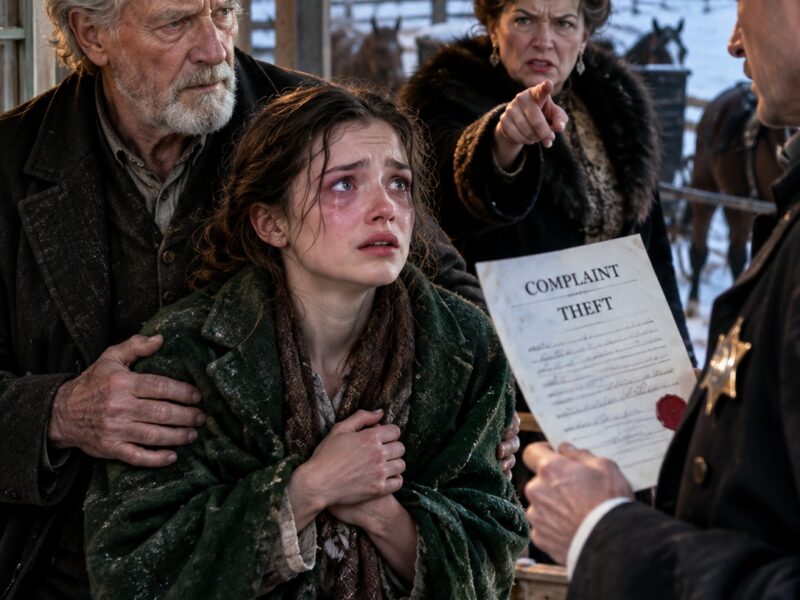
“Walter, I’m here regarding Emma Collins.”
Walter did not take the document.
“What regarding her?”
“Complaint filed by Clara Marsh.”
“For?”
“Theft.”
Emma came outside wearing Margaret’s green coat.
Deputy Pike looked at her.
“Miss Collins?”
“Yes.”
“Mrs. Marsh claims you took thirty-eight dollars in cash, a gold brooch belonging to her mother, and several household items.”
Emma stared at him.
“Thirty-eight dollars?”
“That’s what the complaint says.”
“I’ve never seen thirty-eight dollars together in my life.”
Walter looked at Pike.
“You planning to arrest her?”
Pike shifted.
“I’ve been instructed to bring her into Milford for questioning.”
Emma’s breathing changed.
Walter heard it.
“Is she under arrest?”
“Not exactly.”
“Then she isn’t going.”
Pike lowered his voice.
“Walter.”
“Is she under arrest?”
“No.”
“Do you have a warrant?”
“No.”
“Then get off my property.”
Emma looked at Walter.
Pike sighed.
“This could become worse.”
“For whom?”
“Everyone.”
Walter’s eyes remained steady.
“That’s usually what people say when they want the weaker person to cooperate.”
Pike folded the complaint.
Before mounting his horse, he looked at Emma.
“Mrs. Marsh says she has witnesses.”
Emma’s face changed.
Walter saw it.
Not guilt.
Recognition.
That night Emma finally told him the part she had hidden.
The evening she left Clara’s house, she had found something.
A letter.
It had been tucked inside Clara’s account book.
The letter was from Emma’s mother.
Dated two years earlier.
Walter stared.
“You told me your mother disappeared six years ago.”
“That’s what Clara told me.”
“What did the letter say?”
Emma swallowed.
“That she was alive.”
Walter went very still.
Emma explained.
Her mother, Sarah Collins, had gone east looking for work after becoming ill. She had written repeatedly to Clara, sending small amounts of money whenever she could.
Money intended for Emma.
Clara had never told her.
“How much?”
“I don’t know.”
“You saw the letters?”
“Only one.”
“What happened to it?”
Emma looked toward her room.
“I took it.”
Walter’s eyes narrowed.
“Do you still have it?”
Emma nodded.
She returned with a small piece of folded paper.
Walter read it beneath the lamp.
Dear Clara,
Please tell Emma I haven’t forgotten her. Enclosed is five dollars. It isn’t much, but please buy her proper winter shoes. I hope by spring I can send enough to bring her to me…
Walter stopped reading.
Emma’s shoes had holes in them when she reached his porch.
He looked at the date.
Two winters earlier.
“She sent money.”
Emma nodded.
“Clara kept it.”
Walter read the letter again.
“And now Clara says you stole thirty-eight dollars.”
“I think she knows I found out.”
That changed everything.
Walter had spent sixty-seven years learning that a lie was rarely dangerous by itself.
A lie became dangerous when it wore good clothes, attended church, owned property, and knew which hands to shake.
Clara Marsh had all four advantages.
Emma had none.
So Walter did something Emma did not expect.
He went to Milford.
He visited the laundry.
The owner, Mrs. Patterson, remembered Emma.
“Best worker I had.”
“Did she steal?”
Mrs. Patterson looked offended.
“Emma? No.”
“Did Clara collect her wages?”
Silence.
Then Mrs. Patterson’s face changed.
“Sometimes.”
“How often?”
“More than sometimes.”
Walter asked her to write it down.
She hesitated.
“Clara is well connected.”
Walter nodded.
“So is fear.”
Mrs. Patterson looked at him.
Then she reached for paper.
Walter visited the general store.
Then the post office.
At the post office, an elderly clerk remembered money letters addressed to Clara Marsh from a Sarah Collins.
“Several.”
“How many?”
“Couldn’t say.”
“Could you swear there were more than one?”
The clerk looked toward the door.
“Yes.”
Walter asked him to swear to it where it mattered.
By the time he returned home, Emma was waiting beside the road again.
This time she wore the green coat.
Walter climbed down from the wagon.
“You need to stop waiting out here.”
Emma looked at the papers beneath his arm.
“Where were you?”
“Finding out whether you’re a criminal.”
Her face fell.
Walter let the silence last one second.
“You’re not very good at it.”
Emma blinked.
Then she understood.
He showed her the statements.
For the first time, Clara’s story had cracks.
But Clara moved faster.
Two days later, Walter received notice that Emma was expected before a county magistrate.
Clara would be there.
So would Harold Bricks.
And when Emma entered the small hearing room in Milford, she discovered nearly every bench occupied.
People wanted spectacle.
Clara Marsh gave them one.
She was fifty-two, carefully dressed in dark blue, with gray threaded neatly through her brown hair.
She looked exactly like the woman Emma remembered.
Respectable.
Controlled.
Kind, until no one important was watching.
When Clara saw Emma wearing Margaret’s green coat, something ugly flashed behind her smile.
“My poor girl.”
Emma stopped.
Walter stood beside her.
Clara opened her arms.
Emma stepped backward.
The room noticed.
Clara’s smile tightened.
“I’ve been worried sick.”
“You told them I stole from you.”
“I was frightened.”
“You filed a complaint.”
“You disappeared.”
“You threw me out.”
Clara’s eyes hardened.
“After you robbed us.”
Walter touched Emma’s elbow lightly.
Not to silence her.
To remind her she wasn’t alone.
The magistrate called the hearing to order.
Clara told her story beautifully.
Emma had been troubled.
Ungrateful.
Secretive.
Clara had rescued her from poverty, provided a home, clothes, education, food.
Then Emma had become obsessed with money.
Finally, she stole cash and a family brooch.
Harold Bricks testified next.
He claimed Emma had appeared at his house behaving suspiciously.
“She looked desperate.”
Walter nearly laughed.
“She was freezing.”
The magistrate warned him.
Then came Clara’s strongest witness.
Her husband, Nathan Marsh.
He claimed he had seen Emma near Clara’s bedroom on the night the money disappeared.
Emma listened.
Her hands tightened in her lap.
Walter leaned close.
“Something wrong?”
Emma whispered, “He’s lying.”
“I assumed that.”
“No.”
She looked at Nathan.
“He wasn’t home that night.”
Walter turned.
“Are you certain?”
“He was in Cheyenne.”
The room suddenly felt different.
Walter waited until Nathan finished.
Then he stood.
“Mr. Marsh, what date did the theft occur?”
Nathan repeated it.
“And you’re certain you saw Emma that evening?”
“Absolutely.”
Walter placed a receipt on the table.
“I spoke to a stable owner in Cheyenne.”
Nathan’s face changed.
Walter continued.
“He remembers you because your horse threw a shoe. You paid for lodging that same night.”
Murmurs spread through the room.
Clara turned toward her husband.
Nathan’s mouth opened.
Nothing came out.
One lie had fallen.
Then another.
Mrs. Patterson testified that Clara had repeatedly collected Emma’s laundry wages.
The postmaster confirmed receiving letters containing money from Sarah Collins.
Clara’s composure began to crack.
Finally, Walter produced Sarah’s letter.
The magistrate read it.
“Mrs. Marsh, did you receive money intended for Emma Collins?”
Clara’s lips thinned.
“I used every cent for her care.”
“Then why wasn’t she told?”
“She was a child.”
“She was eighteen when this letter arrived.”
Clara looked at Emma.
There it was.
The face Emma knew.
Not the charitable woman.
Not the concerned guardian.
The woman behind the locked kitchen door.
“You ungrateful little fool.”
The room went silent.
Clara realized too late what she had revealed.
Emma stood.
Her knees trembled.
But she stood.
“You told me my mother forgot me.”
Clara said nothing.
“You watched me believe that for six years.”
“Sit down.”
“No.”
Emma’s voice shook.
But it grew stronger.
“You kept her letters.”
“Emma.”
“You kept her money.”
“Sit down.”
“And when I found one letter, you threw me into a January storm.”
Clara slammed her palm against the table.
“Because you belonged to my household!”
Silence.
Even Clara seemed startled by her own words.
Emma stared at her.
Then something inside the young woman changed.
For years, Clara’s voice had lived inside her head.
Ungrateful.
Useless.
You owe us.
Girls like you don’t survive alone.
Now Emma looked around the room.
At Walter.
At Mrs. Patterson.
At the postmaster.
At Deputy Pike.
At people who had come expecting to see a thief.
And she finally understood something.
Clara’s power had never come from being right.
It came from Emma believing nobody would believe her.
The magistrate dismissed the theft complaint.
But Walter wasn’t finished.
“There’s still the matter of the money.”
Clara glared at him.
“What money?”
“The wages you collected.”
“I provided for her.”
“The money her mother sent.”
“I said I used it.”
“Then you’ll have records.”
Clara went pale.
Walter knew.
There were no records.
The investigation that followed lasted months.
Thirty-eight dollars had never been stolen by Emma.
The gold brooch was eventually discovered in a trunk belonging to Clara’s married daughter, who admitted Clara had given it to her the previous Christmas.
The entire accusation collapsed.
Then the authorities examined Clara’s household accounts.
Walter had expected cruelty.
He had not expected calculation.
Clara had kept nearly every dollar Emma earned.
She had also received more than sixty dollars from Sarah Collins over several years.
She had recorded clothing and food expenses against Emma while using Sarah’s money to pay them.
Emma had been charged twice for her own survival.
The notebook Clara once used to prove Emma’s debt became evidence against Clara.
But one question remained.
Sarah.
Emma’s mother.
Was she still alive?
The answer arrived in April.
A letter came from Nebraska.
Walter found Emma standing beside the mailbox with the envelope shaking in her hands.
She recognized the handwriting.
For several seconds, she could not open it.
Walter stood ten feet away.
“Want me to?”
Emma shook her head.
“No.”
Her fingers tore the envelope.
She read.
Then covered her mouth.
Walter feared the worst.
“Emma?”
She looked at him.
“She’s alive.”
Sarah Collins was living outside Omaha.
She had spent years believing Emma refused to answer her letters.
Clara had written back pretending Emma wanted nothing to do with her.
Two women had been grieving each other because one person found their separation useful.
Emma cried harder that day than Walter had ever seen.
Not delicately.
Not quietly.
Years came out of her.
Anger.
Relief.
Grief.
The child who had waited for a mother who never returned.
The daughter who had believed she was forgotten.
Walter sat beside her on the porch.
He did not tell her everything happened for a reason.
He did not tell her to forgive.
He did not tell her to be grateful.
He simply stayed.
Sometimes that is the only kindness grief can tolerate.
Sarah arrived three weeks later.
Emma waited at the Milford station.
Walter remained several yards behind her.
The train hissed.
Passengers stepped down.
Then a thin woman in a brown traveling coat appeared.
She looked older than Emma remembered.
Smaller.
Her hair had gray in it.
For one terrible second, mother and daughter only stared.
Sarah whispered, “Emma?”
Emma’s face crumpled.
She ran.
Walter turned away when they embraced.
Some moments did not need witnesses.
Later, Sarah thanked him.
Walter shook his head.
“She saved herself.”
Sarah looked toward Emma.
“Maybe.”
Then back at Walter.
“But sometimes people need one door to stay open long enough.”
Spring came slowly to Wyoming.
Snow withdrew from the fields.
Mud replaced ice.
The broken fence was repaired.
Emma planted herbs beside the kitchen window.
Sarah stayed for six weeks before returning to Nebraska to settle her affairs.
She wanted Emma to come with her.
Emma considered it.
Walter told her she should.
“This farm isn’t a prison.”
“I know.”
“You’re twenty years old.”
“I know.”
“You’ve got a mother again.”
Emma looked toward the barn.
“And what do I have here?”
Walter understood the question beneath the question.
He looked away.
“A job.”
Emma smiled sadly.
“Is that all?”
Walter had spent his life avoiding difficult conversations by repairing things.
Fences.
Roofs.
Wagons.
Harnesses.
People were harder.
“I had a son once,” he said.
Emma frowned.
“You still do.”
“Depends who you ask.”
James Hayes had left after Margaret’s death.
Father and son had fought over the farm.
James wanted Walter to sell.
Walter accused him of abandoning his mother while she was dying.
James accused Walter of loving land more than family.
Both said things grief made impossible to retrieve.
James went to Colorado.
Six years passed.
Emma listened.
Then she asked, “Have you written to him?”
“No.”
“Has he written to you?”
Walter hesitated.
“Three times.”
Emma stared.
“You didn’t answer?”
“No.”
“Why?”
Walter looked irritated.
“I hired you to fix fences, not my character.”
Emma folded her arms.
“That gate was easier.”
For the first time in years, Walter Hayes wrote his son.
He received an answer fourteen days later.
James returned in August.
He arrived with a wife Walter had never met and a four-year-old daughter named Margaret.
Walter saw the little girl’s name written on the letter before they came.
He cried alone in the barn.
Nobody knew.
Except Emma.
She found him afterward.
She said nothing.
She simply handed him a handkerchief.
By autumn, the Hayes farmhouse no longer sounded empty.
James did not stay permanently.
Too much life had been built elsewhere.
But father and son began again.
Awkwardly.
Slowly.
Honestly.
Clara Marsh eventually lost far more than the case.
She lost the reputation she had protected more carefully than she ever protected Emma.
Some neighbors defended her.
Others claimed they had always suspected something.
Emma learned not to care.
Justice was not everyone admitting they had been wrong.
Sometimes justice was simply no longer needing them to.
The recovered wages and money Sarah had sent amounted to enough for Emma to make a choice she once could not imagine.
She could leave.
That mattered more than whether she did.
One cold evening the following January, almost exactly a year after Emma collapsed on Walter’s porch, snow began falling again.
Walter sat near the stove repairing a harness.
Emma was making bread.
A knock sounded at the door.
Both looked up.
Emma froze for only a second.
Then she walked toward it.
Walter noticed that.
A year earlier, a knock could make her hands shake.
Now she opened the door herself.
A boy stood outside.
Maybe sixteen.
His coat was thin.
His face red from cold.
He removed his hat nervously.
“Ma’am, I’m sorry to bother you.”
Emma waited.
“I’m looking for work.”
Behind her, Walter stopped moving.
The boy continued quickly.
“I don’t need charity. I can feed horses, split wood, fix fence, anything. I just need somewhere to work for a while.”
Emma stared at him.
Snow gathered on his shoulders.
His boots were wet.
His fingers were cracked.
For a moment, she was twenty years old again, standing on a porch with eleven closed doors behind her.
She heard Harold Bricks.
Move along.
She heard Clara.
Girls like you don’t survive alone.
Then she remembered another voice.
Can you stand?
Emma stepped aside.
“Come inside.”
The boy blinked.
“Ma’am?”
“Before you freeze on the porch.”
Walter lowered his head, hiding a smile.
Emma led the boy to the kitchen.
She placed soup in front of him.
He took two bites, then immediately looked toward the dishes.
“I can clean up.”
Emma’s hand stopped.
Across the room, Walter looked at her.
Neither said anything.
They didn’t need to.
Emma sat opposite the boy.
“Finish eating.”
“But I haven’t earned it.”
Her eyes filled before she could stop them.
The boy looked confused.
Emma smiled.
“We’ll settle accounts later.”
Outside, snow covered the road.
The same road that had nearly killed her.
The same road that had carried her toward the last door she believed she had left to knock on.
Years later, Emma would remember very little about the eleven houses that rejected her.
She forgot the colors of their doors.
She forgot most of their names.
She even forgot the exact words some of them used.
But she remembered Walter’s porch.
She remembered falling.
She remembered the humiliation of lying there, convinced she had finally reached the moment when there was nowhere else to go.
And she remembered the old farmer stepping aside.
Walter had never rescued Emma in the way people later told the story.
He had not given her a new life.
He had done something quieter.
He had given her enough warmth to survive one night.
Enough food to stand the next morning.
Enough honest work to remember her own value.
Enough trust to speak the truth.
And when powerful people tried to drag her backward, he had stood beside her long enough for her to discover that she could stand without him.
That was why, decades later, when strangers asked Emma Hayes Collins why the old farmhouse always seemed to have an extra room ready, an extra plate at supper, and a lamp burning near the window during winter storms, she never told them about Clara.
She rarely mentioned the hearing.
She never spoke about the money.
Instead, she would glance toward the porch where an old green coat still hung from a wooden peg long after Margaret Hayes and Walter himself were gone.
Then Emma would say something simple.
“Once, when every other door had closed, someone opened one for me.”
And on the worst winter nights, when the Wyoming wind buried fences and erased wagon tracks beneath fresh snow, Emma always left the porch lamp burning.
Not because she expected anyone.
Because somewhere beyond that light might be another frightened person walking through the darkness, convinced there were no doors left.
And Emma knew something they didn’t.
Sometimes the last door isn’t the place where your story ends.
Sometimes it’s the first one that finally opens.









