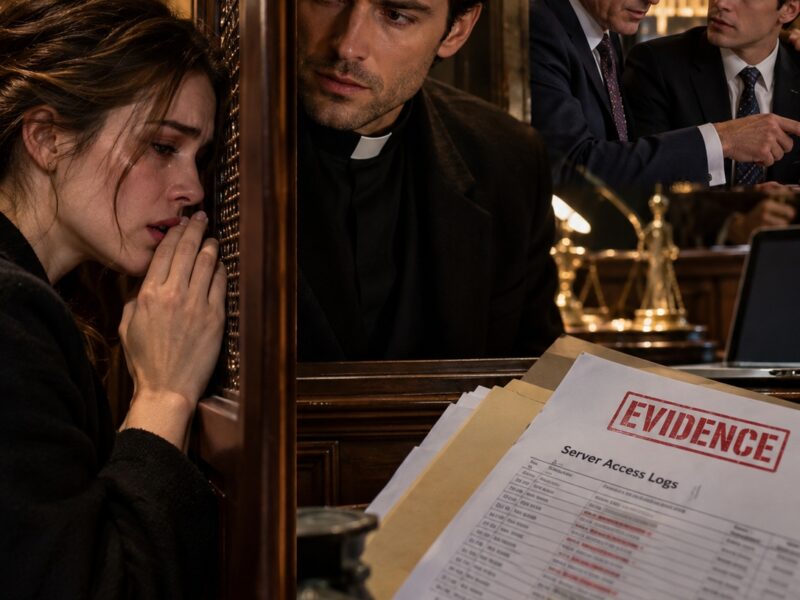
She Confessed Her Darkest Secret to a Priest—Weeks Later, She Recognized His Voice in the Most Powerful Man in the City
“Tomorrow morning, I’m going to destroy the son of a very powerful man.”
Damian Vetti stopped breathing.
Not figuratively.
For one strange second, the thirty-five-year-old businessman simply sat motionless inside the dark wooden confessional of St. Michael’s Church, one hand resting against his knee, listening to a woman he had never met calmly explain how she intended to detonate her career.
The carved screen between them hid her face.
It also hid his.
That was fortunate.
Because Damian Vetti was not a priest.
He had never been a priest.
He had not even intended to be inside the confessional.
Five minutes earlier, Father Michael had shoved him through the narrow door after an investigative reporter recognized Damian near the side entrance of the church.
“Hide.”
Damian had stared at the old priest.
“Excuse me?”
“Unless you want six cameras following you into your mother’s memorial Mass.”
Then Father Michael had shut the door.
“Five minutes,” he had promised.
That had been nine minutes ago.
Now a stranger sat on the other side of the screen believing Damian could forgive sins.
And she had just confessed to possessing evidence that could ruin a powerful family.
“I have proof,” she whispered.
Damian glanced toward the locked door behind him.
“What kind of proof?”
There was a pause.
“Access logs. Original ones.”
His expression changed.
She continued.
“The director’s son altered case files at the legal aid center where I work. Deadlines were missed. Documents disappeared. Authorization records were changed.”
“And someone else is taking the blame.”
“Yes.”
“Who?”
“Mr. Bennett.”
Her voice softened when she said the name.
“He’s sixty-four. He’s handled compliance records for almost thirty years. The audit says his authorization code was used.”
“But it wasn’t him.”
“No.”
“How do you know?”
“Because I found the original server logs.”
Damian leaned forward.
“Does anyone know you have them?”
“Not yet.”
“Good.”
Silence.
Then the woman said cautiously, “That sounded disturbingly pleased, Father.”
Damian closed his eyes.
Priests probably did not say good when someone revealed possession of potentially explosive evidence.
“It means you still have leverage.”
Another silence.
“Are we doing confession,” she asked, “or planning a hostile takeover?”
Against his better judgment, Damian smiled.
“What are you planning to do with the evidence?”
“Submit it tomorrow morning.”
“And then?”
“They’ll suspend me.”
“Probably.”
“Thank you for the optimism.”
“I prefer accuracy.”
“I’m beginning to understand that.”
He heard her shift behind the screen.
Damian should have stopped the conversation.
He should have said there had been a misunderstanding, opened the door, found Father Michael and walked away.
Instead, he asked the question that mattered.
“Are you afraid?”
“No.”
“Of losing your job?”
A longer pause.
“No.”
“Then what?”
When she answered, the faint smile disappeared from Damian’s face.
“I’m afraid I’ll try to save him…and fail.”
Damian stared at the wooden screen.
“Then don’t do it.”
Silence.
A full five seconds passed.
“That,” she finally said, “may be the worst advice a priest has ever given me.”
Damian almost laughed.
Almost.
“Not doing something is still an option.”
“Father Michael usually tells me courage means trusting God when I can’t see what happens next.”
“That sounds like him.”
“And you’re telling me to give up.”
“I’m telling you that you have a choice.”
“A terrible choice.”
“Still a choice.”
A small laugh came through the screen.
“You’re really bad at this.”
“At what?”
“Comforting people.”
“I wasn’t aware that was the objective.”
“I think it’s somewhere in the priest job description.”
Damian rubbed his jaw.
“I’m having a strange day.”
“So am I.”
For a moment, neither spoke.
Outside the confessional, muted footsteps crossed the stone floor. Somewhere near the altar, a microphone squealed and went quiet.
Then the woman spoke again.
“I don’t want to be a hero.”
“Good.”
She sounded surprised.
“Good?”
“People who enjoy being heroes usually create problems for everyone around them.”
This time she laughed openly.
Damian found himself listening to it.
Then her voice changed.
The humor disappeared.
“I’m not actually afraid of losing my job.”
Damian waited.
“I’m afraid I’ll hand over everything…and they’ll bury it anyway.”
There it was.
Not fear of unemployment.
Not embarrassment.
Not even retaliation.
Something worse.
The fear that courage itself might be useless.
“If I stay quiet,” she continued, “I can tell myself I was protecting Mr. Bennett from something worse. I can tell myself there was nothing I could do.”
“You wouldn’t believe yourself.”
“No.”
“Then you already know what you’re going to do.”
“Yes.”
“Why did you come here?”
The answer came quietly.
“Because I wanted somebody to tell me that being afraid doesn’t make doing the right thing any less right.”
Something inside Damian went still.
A memory he had spent years burying surfaced without permission.
A frightened man.
A conference room.
His father’s voice.
Documents Damian knew were false.
And his own silence.
He pushed the memory away.
“If you do it while you’re afraid,” Damian said slowly, “it still counts.”
Silence.
Then she whispered, “That almost sounded priestly.”
“Don’t get used to it.”
She laughed again.
A moment later, he heard movement.
“Thank you, Father.”
He should have corrected her.
Instead, Damian listened as the door on the other side opened and closed.
By the time he stepped out, she was gone.
He had never seen her face.
He knew only four things.
She was twenty-five.
She worked at a legal aid center.
She cared about a man named Bennett.
And tomorrow morning, she intended to challenge someone powerful enough to destroy her career.
Father Michael appeared at the end of the hallway.
“You’re still here?”
Damian looked toward the door through which the woman had disappeared.
“Who was she?”
Father Michael stopped walking.
“That is absolutely not how confession works.”
“I need a name.”
“No.”
Damian turned his head.
The elderly priest folded his arms.
“Don’t look at me like that inside a church.”
For once, Damian let the argument go.
But by nine the next morning, he had a name anyway.
Clara Whitmore.
Twenty-five years old.
Records coordinator at Eastbridge Community Legal Center.
No criminal record.
No influential relatives.
No wealthy boyfriend waiting to rescue her.
Nothing in her background suggested she possessed the kind of protection required to pick a fight with Martin Hale, Eastbridge’s executive director.
Damian read the final line of the report twice.
At 8:10 that morning, Clara Whitmore had submitted copies of the original access logs to the internal review committee.
She had done it.
Damian lowered the file.
Across his desk, Luca Moretti watched him.
“You want us to intervene?”
“No.”
Luca blinked.
“You had me find this woman before breakfast.”
“I wanted information.”
“You usually want information immediately before ruining somebody’s week.”
“Not this time.”
Damian wanted to see what Clara did when there was no confessional screen protecting her from the consequences.
By noon, he had his answer.
Clara was suspended.
Martin Hale summoned her into his office and offered her a choice.
Withdraw the allegation and return to work.
Refuse, and Eastbridge would investigate whether she had illegally accessed confidential records.
It was retaliation dressed as procedure.
Clara refused.
Before she left, Hale gave her one final warning.
“You’re twenty-five years old, Ms. Whitmore. Don’t destroy your career for a man who’ll be retired before Christmas.”
Clara picked up her bag.
“If my career requires sacrificing an innocent man to survive,” she said, “then I probably chose the wrong career.”
When Damian heard those words, something old and ugly moved inside him.
He looked at Luca.
“Get Bennett a lawyer.”
Luca stared at him.
“I thought we weren’t intervening.”
“We weren’t.”
“And now?”
“Now we are.”
Luca sighed.
“I miss yesterday’s Damian.”
“You complained about him too.”
“Yes, but he was predictable.”
Damian ignored him.
“No threats. No visits to Hale’s house. No intimidation.”
Luca looked genuinely disappointed.
“You remove all the joy from my profession.”
“You’re an executive adviser.”
“Titles are subjective.”
“Find Bennett the best employment attorney in the city. Pro bono. Preserve the original server backups before they mysteriously disappear. And find out who saw Hale’s son using Bennett’s credentials.”
Luca headed toward the door.
“Anything else?”
“Yes.”
He turned.
“Clara cannot know this came from me.”
Luca studied him.
“That part seems healthy.”
“Go.”
Within forty-eight hours, Clara realized something was happening.
First came the attorney.
Then an archived server file Eastbridge’s IT department had claimed no longer existed.
Then an employee who had refused to speak for three weeks suddenly contacted Bennett.
By the fourth coincidence, Clara stopped believing in coincidences.
Damian learned this when Luca entered his office holding a phone.
“We have a problem.”
“What kind?”
“The twenty-five-year-old kind.”
Damian looked up.
“She found the attorney.”
“That was inevitable.”
“She discovered who recommended him.”
Damian’s expression tightened.
“And?”
“She traced the document preservation request back to one of our companies.”
“That shouldn’t have been possible.”
“I told you she was a problem.”
“How long do we have?”
The office door opened.
Clara Whitmore walked in.
Damian stood.
For one peculiar second, neither spoke.
He recognized the voice immediately.
She was shorter than he had imagined, with dark hair pulled into a loose knot and an expression suggesting she had spent the morning discovering fresh reasons to be furious.
Her eyes moved from Luca to Damian.
“Which one of you is Damian Vetti?”
Luca pointed instantly.
Damian gave him a cold look.
“What?” Luca said. “She was going to figure it out.”
Then he disappeared.
Clara placed a folder on Damian’s desk.
“I didn’t ask for a lawyer.”
“The lawyer represents Bennett.”
“I didn’t ask you to recover documents.”
“You needed them.”
“I didn’t ask you to contact witnesses.”
“I didn’t personally contact anyone.”
Her eyebrows rose.
“That is not the reassuring distinction you think it is.”
Damian studied her.
Most people became careful when they discovered who he was.
Clara seemed to become less careful.
“You could say thank you.”
“I could.”
He waited.
She waited.
“I’m not going to.”
“I gathered that.”
She folded her arms.
“Why are you helping us?”
“Bennett is innocent.”
“There are thousands of innocent people in trouble. You don’t secretly reorganize their legal cases.”
“No.”
“So why mine?”
Damian should have prepared an answer.
Instead, he made his first mistake.
“I wanted to know whether you’d do what you said.”
Her face changed.
The anger remained.
But beneath it appeared something sharper.
“What I said?”
Damian realized the mistake one second too late.
“Yes.”
“To whom?”
He said nothing.
Clara stepped closer.
“Have we met?”
“Not exactly.”
“That answer is somehow worse.”
“It’s accurate.”
“There it is.”
“What?”
“That thing you do.”
“What thing?”
“Being technically correct and behaving as if it’s a personality trait.”
From the doorway, Luca coughed into his fist to disguise a laugh.
Damian looked at him.
“I thought you left.”
“I’m leaving more thoroughly now.”
The door closed.
Clara returned her attention to Damian.
“Where did you hear me?”
“I can’t tell you.”
“Can’t or won’t?”
“Won’t.”
“Excellent distinction.”
She picked up the folder.
“I’m returning this.”
“It contains evidence Bennett needs.”
Her hand stopped.
Damian had expected that.
Clara hated accepting his help.
But she cared more about Bennett than she hated accepting it.
“That was manipulative,” she said.
“Yes.”
Her eyes narrowed.
“You admit it?”
“Denying obvious things seems inefficient.”
For the first time, Clara almost laughed.
Almost.
“I’ll keep the evidence for Mr. Bennett. That does not give you permission to manage my life.”
“That wasn’t my intention.”
“You found out where I worked, investigated me, interfered with my case and arranged legal representation before introducing yourself.”
“When you list it like that, it sounds excessive.”
“It is excessive.”
“Fair.”
That answer disarmed her more effectively than an argument would have.
Clara walked toward the door.
Then stopped.
She turned.
“Your voice.”
Damian remained perfectly still.
She stared at him.
“I’ve heard it somewhere.”
He gave her nothing.
Clara opened the door.
“I’ll remember.”
Then she left.
Luca reappeared almost immediately.
“That went well.”
“She threatened me.”
“She said she’d remember your voice.”
“Same thing.”
Luca looked toward the closed door.
“Could you simply tell her?”
“No.”
“Why?”
Because the moment Clara learned where she had first heard his voice, she would understand that he had heard everything.
Her fear.
Her uncertainty.
Her private confession.
Words she had believed were protected by wood, darkness and the silence of a priest.
Damian looked at her file.
For the first time, helping Clara no longer felt like watching an experiment.
That was precisely the problem.
“She’ll figure it out,” Luca said.
Damian knew.
And when she did, Martin Hale might become the least complicated problem between them.
Over the next two weeks, the Bennett case forced Clara and Damian into each other’s orbit.
The attorney obtained the preserved server records.
Hale could no longer dismiss the allegations quietly.
Two board members began asking questions.
That should have reduced Damian’s involvement.
Instead, he kept finding reasons to remain.
Some were legitimate.
Most were not.
Clara noticed.
She noticed everything.
The third time Damian caught her studying him across a conference table, he finally asked, “Have you reached a conclusion?”
“Not yet.”
“About my voice?”
“Yes.”
“Could you stop trying?”
She smiled.
“That sounded like a challenge.”
“It wasn’t.”
“It is now.”
He looked back at the document in front of him.
Clara smiled wider.
She was becoming a problem in ways Damian had not anticipated.
One evening, after a meeting ran late, he closed the final file.
“Have dinner with me.”
Clara looked up.
“No.”
He waited.
She gathered her papers.
“That’s it?”
“What else would there be?”
“I don’t know. Powerful men usually have a second phase after being told no.”
“I invited you to dinner. I’m not negotiating the surrender of a country.”
“That is reassuringly specific.”
She left.
Three days later, he tried again.
“Dinner?”
“No.”
“I hadn’t finished.”
“You were going to invite me to dinner.”
“Yes.”
“So I saved us time.”
The third attempt happened outside Bennett’s attorney’s office.
Damian simply looked at her.
Clara sighed.
“Dinner?”
“Yes.”
“Do you get rejected this often?”
“No.”
“Then I’m providing you with an educational experience.”
“It’s becoming very labor-intensive.”
“But free.”
He stared at her.
She laughed.
“Fine. One dinner.”
Damian opened the car door.
“This is not a date,” Clara added.
“Of course.”
She began climbing inside.
“You accepted with suspicious speed.”
Clara froze.
“You’ve been asking me for two weeks.”
“I’ve already gotten you into the car.”
Her eyes widened.
Damian almost smiled.
“That was a joke.”
She stared at him.
“You make jokes?”
“Occasionally.”
“I need a moment.”
Dinner lasted two hours.
For the first time, they discussed almost nothing about Bennett.
Clara discovered that Damian could negotiate contracts worth hundreds of millions of dollars but understood very little about ordinary errands.
“Do you buy your own groceries?”
“Yes.”
“When was the last time?”
Damian thought.
Clara slowly put down her fork.
“You should not need that much time.”
“2013.”
She stared at him.
“You haven’t bought groceries in thirteen years?”
“I have groceries.”
“That wasn’t the question.”
“Then why does it matter?”
“Because I’m trying to determine whether you’re actually human.”
“And?”
“The investigation remains open.”
He laughed.
Not the controlled half-smile she had seen before.
A real laugh.
Clara fell quiet.
“What?”
“Nothing.”
“You’re staring again.”
“You look less terrifying when you laugh.”
“I didn’t know I looked terrifying.”
She stared at him for several seconds.
Damian sighed.
“Fine.”
It should have stayed simple after that.
It didn’t.
Clara began noticing his silences.
Whenever Bennett spoke about losing his reputation, Damian became unnaturally still.
Whenever someone suggested protecting an institution mattered more than exposing the truth, something hardened behind his eyes.
One night, she finally asked.
“Who was he?”
Damian looked up.
“Who?”
“The person you think about whenever Mr. Bennett talks.”
His expression closed immediately.
“You’re making assumptions.”
“You investigate people for a living. Allow me one assumption.”
He said nothing.
Clara waited.
She had learned something important about Damian.
Most people filled his silences because they found them intimidating.
She didn’t.
Eventually, he spoke.
“His name was Victor Salvi.”
Clara’s teasing expression disappeared.
“He worked for my family for almost twenty years. Financial irregularities surfaced. They threatened someone much closer to the family.”
“So they blamed Victor.”
“Yes.”
“And you knew?”
Damian looked at his glass.
“Yes.”
Clara leaned back.
“You knew he was innocent.”
“Yes.”
“And you said nothing.”
“Yes.”
“Why?”
“My father said silence protected the family.”
“That isn’t what I asked.”
Damian looked at her.
It irritated him how easily she distinguished explanation from excuse.
“I was younger.”
“Still not what I asked.”
He could have ended the conversation.
People normally allowed Damian that privilege.
Clara didn’t.
Finally, he said, “Because speaking would have cost me something I wasn’t willing to lose.”
“What?”
His expression changed.
“Not tonight.”
Clara studied him.
Then nodded.
No pressure.
No false sympathy.
She simply allowed the boundary to remain.
Somehow that made Damian want to cross it.
“What happened to Victor?” she asked.
“He lost his job. His reputation. Most of his friends.”
“And your family?”
“We continued as though nothing had happened.”
Clara lowered her eyes.
“That’s why you helped Bennett.”
Damian paused.
“In part.”
The answer disturbed her.
But before she could ask what the other part was, her phone rang.
The moment disappeared.
The days that followed changed something between them.
Clara still challenged him.
Damian still interfered more than she liked.
But she began calling him directly rather than going through Luca.
He began answering even when there was no practical reason to.
Then, one rainy afternoon, they sat outside a conference room while Bennett met privately with his attorney.
Rain tapped against the tall windows.
Clara stared at it for a while.
“I went back to that church.”
Damian’s attention sharpened.
“Why?”
“I wanted to thank Father Michael.”
He said nothing.
“He wasn’t there.”
“That’s unfortunate.”
“Maybe.”
She smiled faintly.
“I’m still deciding.”
“Why?”
“For giving me the worst advice I’ve ever received.”
Damian’s shoulders tightened.
Clara laughed at the memory.
“I told him I was scared, and this man actually said, ‘Then don’t do it.’”
“It was practical.”
The words escaped Damian before he could stop them.
Clara stopped breathing.
The hallway seemed to lose all sound.
Damian knew immediately.
Her amusement vanished.
She looked at him.
Not at his suit.
Not his face.
His voice.
And Damian watched the memory return.
The dark confessional.
The wooden screen.
The stranger asking questions no priest should have asked.
Clara slowly stood.
“No.”
“Clara—”
Her eyes widened.
“No.”
He rose.
She pointed at him.
“You.”
There was no lie left that would help.
Damian remained silent.
Disbelief became horror.
Horror became fury.
“You were the priest?”
“No.”
Clara stared at him.
“I know you weren’t actually a priest!”
“Then technically—”
“Do not say technically.”
Damian closed his mouth.
For several seconds, Clara simply stared at him as though reorganizing every conversation they had ever had.
“You were sitting inside that confessional.”
“Yes.”
“You heard everything.”
“Yes.”
“You asked me those questions.”
“Yes.”
“And then you found me.”
Damian said nothing.
Clara laughed once.
There was no humor in it.
“Oh, this is unbelievable.”
“I can explain.”
“That sentence has never improved anything.”
She grabbed her bag.
Damian stepped forward, then stopped himself.
“Clara.”
She turned.
“I told you things I had never told anyone.”
“I know.”
“That is exactly the problem.”
Her voice dropped.
“You knew I was afraid. You knew about Bennett. You knew what I planned to do. And then you walked into my life knowing all of it while I didn’t even know we had met.”
“I was trying to help.”
“You controlled the board.”
The accusation hit harder than he expected.
“You decided what I was allowed to know about you. You watched me trust you while keeping the one fact that would have changed how I saw everything.”
“I didn’t plan this.”
“No.”
Her eyes glistened, but she refused to look away.
“You just kept choosing it.”
Damian had no answer.
Clara walked toward the elevator.
He could have stopped her.
One phone call could tell him where she went next.
Another could manufacture a reason for them to meet.
That was how Damian Vetti solved problems.
Information.
Leverage.
Control.
The elevator doors opened.
Clara stepped inside.
Damian remained where he was.
For once, he did nothing.
The doors closed between them.
For three days, he contacted her neither directly nor indirectly.
On the fourth, he sent one message.
You confessed. I never did.
It was unfair.
He knew that.
There was no reply.
Damian sent nothing else.
Two days later, Clara texted him an address.
A small coffee shop.
Public.
Neutral.
Very Clara.
When Damian arrived, she was already seated.
“You have ten minutes.”
“I’ll need more.”
“Nine minutes and fifty seconds.”
He sat down.
“There was a man named Victor Salvi.”
“I remember.”
“You don’t know the important part.”
Clara waited.
Damian folded his hands.
“My father knew Victor was innocent.”
“So did you.”
“Yes.”
“Exposing the truth would have implicated somebody close to your family.”
“Yes.”
“And damaged businesses tied to your name.”
“Yes.”
“So your father ordered you to stay silent.”
“Yes.”
“And you obeyed.”
“Yes.”
“Because you were young?”
“No.”
That stopped her.
“Because your father controlled you?”
“No.”
“Then why?”
Damian looked directly at her.
“Because I was afraid, and I chose myself.”
The words sat between them.
They were almost the same confession Clara had once made through a wooden screen.
Except Clara had been afraid and acted anyway.
Damian had been afraid and stayed silent.
Victor had lost everything.
Damian had kept everything.
“I watched an innocent man lose his life without dying,” Damian said. “His career disappeared. People who had known him twenty years stopped answering his calls. His wife left the city because she couldn’t stand hearing people whisper. And I knew the truth.”
Clara said nothing.
“I kept my position. My inheritance. My father’s approval. Every door stayed open for me.”
His voice hardened.
“Victor paid for my fear.”
Clara’s anger softened.
It did not disappear.
“So when you heard me talking about Bennett, you heard somebody standing exactly where you once stood.”
“Yes.”
“And you decided to save me.”
“No.”
Damian lowered his gaze briefly.
“I decided to use you.”
Clara went completely still.
“That is an impressively terrible thing to say to someone you’re trying to win back.”
“I’m not trying to win you back.”
Her expression hardened.
“I’m trying to tell you the truth without deciding what you’re supposed to do with it.”
That stopped her.
Damian continued.
“When I heard you say you were afraid, I wanted to see whether you would do what I didn’t.”
Understanding came slowly.
“If I exposed what happened to Bennett…”
“And survived it.”
“You thought watching me make the decision you failed to make would somehow make yours easier to live with.”
“Yes.”
Clara looked away.
“So I was your penance.”
“At first.”
Her eyes closed briefly.
“That hurts more than the confessional.”
“I know.”
“No.”
She looked back at him.
“You don’t.”
Damian nodded.
“You’re right.”
No defense.
No argument.
Clara stared at him.
“When did it change?”
He answered immediately.
“When I stopped caring whether helping you made me feel better.”
Silence.
“And started caring whether you were okay.”
Clara looked down at her coffee.
Damian did not reach for her.
“I don’t expect you to forgive me.”
“Good.”
“I expected that answer.”
“Also good.”
The smallest hint of a smile almost reached her mouth.
Almost.
Then her phone rang.
Clara looked at the screen and answered.
Her expression changed as she listened.
“What kind of settlement?”
Five minutes later, they were sitting in Bennett’s attorney’s office.
Martin Hale had made an offer.
Bennett would be allowed to retire officially with his pension and benefits intact.
The internal accusations would disappear.
Clara would be reinstated.
No disciplinary action.
No damage to her employment record.
In exchange, the complaint against Hale’s son would be withdrawn.
Everyone would sign nondisclosure agreements.
Clara rejected it immediately.
Bennett did not.
“I’m sixty-four,” he told her.
She turned toward him.
“So?”
“I can leave with my pension and my name intact.”
“Your name isn’t intact if they hide what happened.”
“It’s intact enough.”
“Mr. Bennett—”
“You’re twenty-five.”
He smiled sadly.
“I’m not letting you lose your next forty years protecting my last six months.”
Clara fell silent.
Damian understood immediately what Martin Hale had done.
He had found the only offer Clara could not reject without hurting the man she was trying to protect.
Outside the office, Damian pulled out his phone.
Clara saw.
“What are you doing?”
“Ending this.”
“How?”
“Hale has lenders, business partners and board members. By tomorrow morning, he may have significantly fewer of all three.”
Clara stared at him.
“You’re going to threaten him.”
“I won’t need to.”
“That’s worse.”
“It will work.”
“I know.”
Damian stopped.
Clara stepped closer.
“If you scare him enough, he’ll become quiet.”
“That’s the objective.”
“No.”
Her voice was calm.
“The objective now is the truth.”
Damian looked at the phone in his hand.
Years earlier, he had used silence to protect power.
Now he could use power to impose silence.
Different motive.
Same weapon.
Slowly, he put the phone away.
Clara watched him.
“You’re actually listening to me.”
“I do occasionally.”
“Since when?”
Damian met her eyes.
“Apparently since a woman walked into the wrong confessional.”
For the first time since discovering the truth, Clara smiled.
Barely.
It was not forgiveness.
But it was not nothing.
The attorney opened the door.
Martin Hale had given them forty-eight hours.
For the first time since meeting Clara, Damian did not tell her what to do.
And for Damian Vetti, that might have been the hardest decision of all.
Forty-eight hours later, Clara rejected the settlement.
This time, Damian made no calls.
He did something more difficult.
He made sure the truth could stand without his power holding it upright.
The original access logs went to an independent investigator.
Bennett’s attorney obtained sworn statements from two employees.
Archived server records proved Hale’s son had used Bennett’s authorization code after Bennett had already left the building.
And the witness who had once been too frightened to speak finally did.
Martin Hale tried to stop the investigation.
He failed.
Three weeks later, Eastbridge’s board suspended him.
His son was formally identified as responsible for altering the records.
Arthur Bennett was publicly cleared of wrongdoing.
No quiet retirement.
No confidentiality agreement.
No convenient burial of the truth.
On Bennett’s final morning at Eastbridge, Clara waited outside.
He walked toward her carrying a cardboard box containing nearly thirty years of his life.
A coffee mug.
Three framed photographs.
A desk clock.
A ridiculous ceramic owl Clara had given him when she was twenty-two.
“You realize,” Bennett said, “I could have been retired by now.”
“You’re welcome.”
“I was going to thank you.”
“You looked like you were going to complain.”
“I can do both.”
Clara laughed and hugged him.
Over Bennett’s shoulder, she saw Damian across the street.
He had not come inside.
He had not arranged reporters.
He had not turned Bennett’s vindication into a public demonstration of Vetti influence.
He simply waited.
After Bennett disappeared through the doors, Clara crossed the street.
“You could have come over.”
“It wasn’t my moment.”
She studied him suspiciously.
“Who are you?”
Damian raised an eyebrow.
“And what have you done with Damian Vetti?”
“I’m improving.”
“Slowly.”
“I wasn’t aware there was a deadline.”
“There is now.”
A week later, Eastbridge offered Clara her job back.
She refused.
Damian found out over dinner.
“You fought for months to clear your record so you could return.”
“I fought so they couldn’t decide why I left.”
He considered that.
“What are you going to do?”
Clara slid a folder across the table.
Inside was a proposal for a small nonprofit organization offering legal guidance to lower-level employees facing retaliation after reporting misconduct.
Damian read the first page.
“How much do you need?”
“No.”
“I haven’t offered anything.”
“You were about to.”
“I was going to ask a question.”
“Accompanied by a check.”
Damian closed the folder.
“All right. How much do you need?”
“No.”
“Anonymous donation.”
“No.”
“Interest-free loan.”
“No.”
“Building?”
“Absolutely not.”
“A small building.”
“Damian.”
“Office space.”
She stared at him.
He sighed.
“You are extraordinarily difficult to help.”
“I accept help.”
“Give me one example.”
Clara pointed at herself.
“I kept your evidence.”
“After accusing me of manipulating you.”
“You were manipulating me.”
“Fair.”
She smiled.
Eventually, they negotiated terms.
Damian could contribute exactly what any other donor was permitted to contribute.
No controlling stake.
No private conditions.
No influence over hiring.
And absolutely no Vetti name on the building.
“A plaque?”
“No.”
“In the lobby?”
“No.”
“Parking space?”
Clara gave him a look.
Damian lifted both hands.
“I’m negotiating.”
“You’re losing.”
“I’ve noticed.”
Six months later, the Whitmore Advocacy Project opened its doors.
And something else began too.
Something neither Clara nor Damian bothered pretending was merely friendship anymore.
Damian still had habits Clara hated.
He sometimes tried to solve emotional problems with logistical solutions.
He still believed almost anything could be improved by acquiring more information.
Clara still asked questions he would rather avoid.
But now, when she asked them, he answered.
Even when the answers were uncomfortable.
Especially then.
One Sunday afternoon, Damian drove her back to St. Michael’s Church.
Father Michael met them near the confessional.
Clara told him the entire story.
The elderly priest slowly turned toward Damian.
“I told you to hide for five minutes.”
“I was helping someone.”
“You impersonated a priest.”
“I never actually said I was one.”
Clara groaned.
“Being technically correct is not a defense.”
Father Michael pointed at her.
“Thank you.”
Then he looked at Damian.
“I’ve been telling him that since he was twelve.”
When Father Michael walked away, Clara remained beside the old wooden confessional.
She touched the edge of the dark screen.
“Strange.”
“What?”
“The first time I talked to you, there was a wall between us.”
Damian stood beside her.
“You also thought I could forgive your sins.”
“That was probably my greatest error.”
“Agreed.”
She bumped his shoulder.
“I thought I needed someone to forgive me for being afraid.”
“And now?”
“Now I know fear wasn’t the part that mattered.”
Damian understood.
She had been afraid.
She had chosen the truth anyway.
He had once been afraid.
He had chosen silence.
Clara turned toward him.
“What do you need?”
“For what?”
“Your confession.”
Damian looked at the wooden screen that had once hidden them from each other.
Then he looked at Clara.
“A chance not to make the same mistake twice.”
She waited.
By now, he knew that expression.
There was another answer.
There was always another answer.
So Damian did something the younger version of himself had never known how to do.
He did not hide behind power.
He did not hide behind a technically accurate answer.
He did not decide how much truth another person was allowed to have.
He looked directly into her eyes.
“And you.”
Clara smiled.
“That is considerably better than ‘then don’t do it.’”
“I’ve improved.”
“It took you six months.”
“Still counts.”
“Barely.”
Damian touched her cheek.
Clara leaned toward him.
This time there was no wooden screen.
No borrowed identity.
No carefully controlled distance.
No secret one person possessed while the other stood unknowingly exposed.
“Clara?”
“Yes?”
“Are you still afraid?”
She looked at him for a long moment.
Then smiled.
“Sometimes.”
“So am I.”
“Good.”
His eyebrows lifted.
“Good?”
She nodded.
“Now you know it doesn’t get to make the decision.”
And then she kissed him.
The first time Clara Whitmore told Damian Vetti the truth, she believed darkness protected her.
A wooden screen.
A church.
The presumed silence of a priest.
Instead, her words reached a man who had spent most of his adult life believing secrets were another form of power.
He had built his world around knowing more than everyone else.
Knowing first.
Knowing quietly.
Knowing enough to control what happened next.
Clara had taught him something far more difficult.
Knowing the truth was not courage.
Controlling the truth was not strength.
And protecting someone by taking away their choices was still another form of control, no matter how noble the reason sounded.
Years earlier, Victor Salvi had stood alone while Damian protected himself with silence.
Arthur Bennett had nearly suffered the same fate.
But this time, one frightened twenty-five-year-old woman had refused to let fear decide what kind of person she would become.
And without realizing it, she had forced Damian to make the same choice again.
Not inside a boardroom.
Not in front of his father.
Not while millions of dollars were at stake.
But in front of the one person whose opinion had finally become more important to him than his own comfort.
The church was nearly empty when they walked toward the doors.
Late-afternoon sunlight spilled through the stained glass and stretched across the stone floor.
Clara stopped before they stepped outside.
“What?”
Damian asked.
She looked back toward the confessional.
“Nothing.”
“That usually means something.”
“I was just thinking.”
“Dangerous.”
She elbowed him.
Then her expression softened.
“If I hadn’t gone into the wrong confessional that day…”
Damian looked at the dark wooden booth.
“You would still have submitted the evidence.”
“You sound very sure.”
“You already knew what you were going to do.”
Clara remembered the stranger in the darkness telling her exactly that.
Maybe that was why his voice had stayed somewhere inside her memory.
Not because he had comforted her.
He hadn’t.
Not because he had given her courage.
He hadn’t done that either.
He had simply refused to pretend her fear changed the choice in front of her.
She looked back at him.
“And you?”
“What about me?”
“If I hadn’t walked into that confessional?”
Damian took longer to answer.
Outside, church bells began marking the hour.
“I might still think regret was the same thing as accountability.”
Clara said nothing.
“And I might still believe helping someone gave me the right to control how they were helped.”
“That sounds exhausting.”
“It was efficient.”
She gave him a look.
“Sorry.”
“Better.”
They stepped outside together.
For most of Damian Vetti’s life, power had meant never being the person left without options.
It meant controlling the room before entering it.
Knowing the answer before asking the question.
Keeping enough distance that no one could use the truth against him.
But as Clara slipped her hand into his, he finally understood why none of that had saved Victor Salvi.
And why none of it could have saved Arthur Bennett.
Sometimes the most dangerous thing in the world was not a lie.
It was a truth known by someone who had decided silence was safer.
Damian had made that decision once.
He would carry the cost of it for the rest of his life.
But carrying the past, Clara had taught him, was not the same as being condemned to repeat it.
She squeezed his hand.
“You’re doing it again.”
“What?”
“Thinking so hard you look terrifying.”
“I’m reflecting.”
“You’re brooding.”
“There’s a distinction.”
“Technically?”
Damian looked at her.
Clara began laughing.
And this time, so did he.
They walked down the church steps together, leaving the old confessional behind them.
Not because what happened there no longer mattered.
But because it always would.
Once, a frightened woman had entered that darkness believing she needed permission to be brave.
Once, a frightened man had listened from the other side carrying the memory of the moment when he had failed to be.
Neither of them had known the other’s face.
Neither could have known what would follow.
A ruined career.
A rescued reputation.
An old injustice dragged back into the light.
A betrayal neither expected.
A forgiveness that could not be demanded.
And eventually, something neither of them had been searching for.
Not redemption.
Redemption was too clean a word for what Damian carried.
Some things could not be undone.
Victor Salvi had still suffered.
Years of his life had still been taken.
No romance, donation, apology or good deed could rewrite that.
Damian knew that now.
What he had instead was a choice.
The same choice Clara had faced when she sat behind a wooden screen and whispered that she was afraid.
Tell the truth.
Accept what it costs.
And refuse to let fear make the decision.
So when Clara looked at him at the bottom of the church steps and asked, almost playfully—
“No more secrets?”
Damian did not promise something impossible.
He simply took her hand more firmly.
“No more walls.”
And for a man who had spent his entire life building them, that was the closest thing to a confession he had ever made.









