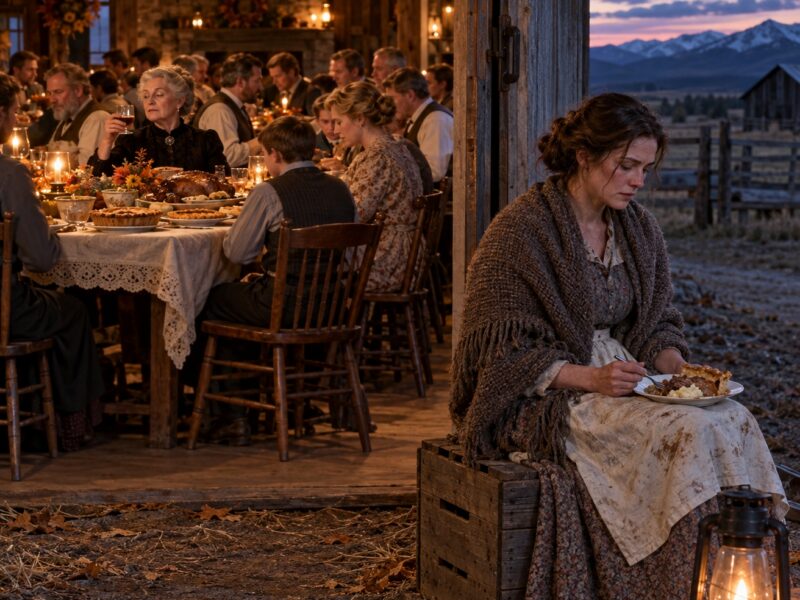
SHE COOKED A HARVEST FEAST FOR 23 PEOPLE—THEN SAT ALONE ON A WOODEN CRATE BECAUSE HER OWN FAMILY REFUSED TO GIVE HER A CHAIR
Sarah Miller had spent fourteen hours preparing a harvest feast for twenty-three relatives when her aunt told her there was no chair at the table for a woman her size.
Nobody protested. Nobody moved. Even the uncle who had promised her a home kept eating.
But someone standing in the barn doorway had witnessed everything—and before the night was over, Sarah would learn that the family who treated her as a burden had been hiding something far more shameful than their cruelty.
Sarah Miller set the last apple pie on the table with trembling hands, turned around, and looked her aunt Ruth straight in the eye.
“I’d like to sit down now,” she said quietly. “I’ve been on my feet since four this morning.”
Ruth Miller didn’t even look up from her glass.
“There ain’t a chair that fits you proper, Sarah. You know that.”
She waved one pale hand toward the barn door.
“Go on outside. Take your plate.”
The room went silent.
Twenty-three members of the Miller family sat around the long harvest table, their faces warmed by lanternlight and their plates crowded with food Sarah had spent the entire day preparing.
Every last one of them stared down at their supper.
And said nothing.
Sarah stood beside the table with flour still caught beneath her fingernails. The heat from the kitchen had left damp strands of brown hair against her temples. Her back ached so badly that standing upright required an effort she hoped nobody could see.
She was twenty-seven years old, broad through the hips and shoulders, with a round face, dark eyes, and hands that had learned to mend almost anything except the damage done by other people’s words.
She had known since childhood that the world did not make much room for women who looked like her.
Not at church socials, where mothers directed their sons toward slimmer girls. Not at town dances, where she was usually asked to help refill the lemonade. Not at the dry goods counter, where the women of Cutters Creek gathered in their neat cotton dresses and stopped talking whenever she approached.
And certainly not at the Miller family harvest feast.
The feast was the largest gathering of the year, held every October at her uncle Harland’s ranch outside Cutters Creek, Wyoming, where the wind descended from the mountains cold and mean, and the afternoon sky often turned the color of a bruise before the first snow.
Sarah had known exactly how her family regarded her since she was nine years old.
She cooked anyway.
That morning, she had risen before the sun.
The kitchen was still black except for the orange mouth of the cast-iron stove when she began rubbing the venison roast with salt, dried sage, and cracked pepper. She had worked the seasoning into the meat until her fingers smelled of smoke and herbs.
Then came the potatoes, the biscuit dough, the onions, the gravy, and three deep-dish apple pies made with the last fruit she had preserved herself.
Those apples had come from four crooked trees behind the abandoned Miller homestead, where Sarah’s parents once lived.
She had gathered them alone.
Two baskets had bruised during the wagon ride, so she cut away the damaged flesh with a small paring knife that had belonged to her mother. She saved every usable piece, simmering the peelings into syrup and turning the remainder into pie filling.
Her mother had taught her that careful hands could make something good from what other people discarded.
Sarah tried not to think about how often she had become the thing being discarded.
At seven o’clock, her cousin Adeline entered the kitchen wrapped in a wool shawl, her blonde hair pinned neatly above a face that seldom looked troubled by anything more serious than a misplaced ribbon.
“Smells good,” Adeline said without looking at Sarah.
“Thank you.”
“Mama wants the gravy thicker than last year. You made it too thin last time. Everyone said so.”
Sarah stirred the pot.
“I’ll make it thicker.”
“And don’t forget the good tablecloth. The white one, not the old cream one you put out before.”
“I haven’t forgotten.”
Adeline lingered.
“You know how Mama feels about presentation.”
Sarah kept her eyes on the gravy.
“I know how your mama feels about most things.”
Adeline’s expression sharpened.
“There’s no call to be unpleasant.”
She left before Sarah could answer.
By ten, the kitchen was crowded with women exchanging gossip, children darting between skirts, and cousins arriving with baskets they expected Sarah to empty and arrange.
Outside, the men stood on the porch discussing cattle prices, winter feed, and the possibility of an early freeze.
Inside, Sarah worked.
Aunt Ruth came through twice to inspect the preparations. On the second visit, she picked up a biscuit, broke it open, and studied the center.
“A shade too heavy,” she said.
Sarah was carrying a roasting pan that burned through the folded cloth in her hands.
“They’ll be lighter once they’ve cooled properly.”
Ruth gave a small, humorless laugh.
“Well, you’ve never had much trouble making things heavy.”
The two women standing beside the pantry smiled.
Sarah lowered her eyes.
At noon, her younger cousin Thomas found her kneading the last batch of dough.
He was nineteen, freckled, and awkward, with the long arms of a boy who had grown too fast for his own confidence.
“Need some wood brought in?” he asked.
“There’s a stack by the stove.”
“I could carry another.”
She smiled faintly.
“Thank you, Tommy.”
He noticed the sweat along her forehead.
“You ought to rest a bit.”
“After the feast.”
He hesitated, then reached for the water bucket.
Sarah watched him disappear through the back door and felt an unexpected sting behind her eyes.
It had been a long time since anyone in that house had asked whether she was tired.
By late afternoon, the barn had been transformed.
White cloth covered the long tables. Lanterns hung from beams darkened by decades of smoke and dust. Dried corn stalks stood in bundles along the walls, and orange pumpkins rested beneath the windows.
Sarah had made the decorations herself.
She had scrubbed the serving platters, polished the old silver spoons, and arranged the tables so the older relatives could sit closest to the stove.
She even remembered to place a cushion beneath Great-Aunt Mabel’s chair because the elderly woman’s hips bothered her in cold weather.
Nobody asked Sarah where she planned to sit.
She noticed the missing place shortly before supper, while counting the plates.
Twenty-three.
She counted again.
Twenty-three chairs, twenty-three plates, twenty-three folded napkins.
There would be twenty-three family members at dinner.
Twenty-four, including herself.
She found Aunt Ruth near the barn entrance, instructing Adeline about the centerpiece.
“Aunt Ruth, I believe we’re one chair short.”
Ruth glanced toward the table.
“We’ve got enough.”
“There are twenty-four of us.”
“Don’t fuss over numbers, Sarah. The food will get cold.”
Sarah looked toward the kitchen.
There was an old straight-backed chair beside the pantry, sturdy enough to support a grown man with a sack of feed on his lap.
She had repaired its loose leg herself the previous spring.
She started toward it.
Ruth caught her sleeve.
“That stays in the kitchen. I won’t have mismatched furniture spoiling my table.”
Sarah looked at the white linen, the polished silver, and the flowers she had gathered before sunrise.
My table, Ruth had said.
Sarah nodded.
For a moment, she believed someone would make room when supper began.
Someone always seemed to find room for one more plate.
She had not yet learned that a person could spend years belonging to a household without ever truly being welcomed into it.
The guests arrived shortly after five.
Uncle Harland came inside wearing his good vest, accompanied by two neighboring ranchers who had been invited as honorary guests. His gray beard was freshly trimmed, and he smelled faintly of tobacco.
“Fine spread,” he said, lifting the lid from the venison.
Sarah brightened.
“Thank you, Uncle.”
“Ruth’s done herself proud.”
He walked away before Sarah could answer.
At the table, people laughed and called for gravy.
Someone praised the biscuits.
Someone else asked who had made the pies.
“Sarah,” Adeline answered, then added, “She does have a talent for baking.”
Aunt Ruth smiled thinly.
“Well, a girl ought to have something.”
The laughter was light enough to be mistaken for harmless teasing.
Sarah had learned that the cruelest remarks often arrived wrapped in the smallest smiles.
She carried the final pie from the kitchen.
Her arms trembled.
Then came the words she had been dreading all afternoon.
“Go on outside. Take your plate.”
Sarah looked around the table.
Her cousin Matthew stared at his knife.
Great-Aunt Mabel studied the edge of her napkin.
Adeline reached for the salt.
Uncle Harland continued cutting his venison into careful squares.
Only Thomas looked up.
“There’s a chair in the kitchen,” he said.
Ruth turned toward him.
“Thomas.”
“It’s a good chair.”
“Your supper’s getting cold.”
He glanced at Sarah, then at his father.
Harland cleared his throat.
“Best not make a spectacle of it.”
Sarah felt something inside her go still.
She had expected cruelty from Ruth.
She had expected silence from Adeline.
But she had spent eleven years working for her uncle after he promised her dying father that she would always have a home.
Harland did not even look at her.
Sarah placed the pie on the table.
Then she took the empty plate Ruth handed her.
“Of course,” she said.
She served herself two potatoes, a small piece of venison, and a spoonful of gravy that had finally reached the thickness her aunt preferred.
Then she walked outside.
The October wind struck her face immediately.
Beyond the barn, the Wyoming hills stretched toward the mountains, their dark slopes fading beneath a sky streaked with violet and iron gray.
Sarah found an overturned wooden crate beside the woodshed.
It was the crate the ranch hands used for carrying horseshoes and broken tools.
She turned it upright, brushed off the straw, and sat.
The wood creaked beneath her.
For a moment, she stared at her plate.
Then she picked up her fork.
The venison had gone lukewarm.
She chewed slowly, unable to taste the sage she had so carefully measured that morning.
Through the barn wall came the sounds of her family enjoying the feast.
Forks scraped plates.
A chair shifted.
Someone laughed.
Her uncle’s voice rose above the others.
“Best harvest we’ve had in three years!”
Sarah pressed her lips together.
She wasn’t crying.
Not yet.
She had grown practiced at swallowing humiliation before it could become tears.
She was halfway through her potatoes when footsteps sounded on the gravel.
She looked up.
A man stood a few feet away, tall and broad-shouldered, with a weathered brown coat, a dark hat, and a face made serious by years of sun and hard weather.
He held an untouched plate.
Sarah recognized him immediately.
Elias Bennett.
The neighboring rancher from Willow Creek.
He was thirty-five, a widower, and a man the local women spoke about in the same careful tones they used for dangerous horses and lonely mountain passes.
He had buried his wife four years earlier and had lived quietly ever since.
Sarah had spoken to him only a handful of times.
Once when he purchased three jars of her apple preserves at the church sale.
Once when his wagon wheel broke outside town.
And once, last winter, when he brought her a sack of flour after hearing that Harland’s supplies had run low.
Now he stood watching her on the crate.
For a long moment, neither spoke.
Then Elias looked at the plate in her lap.
“That’s a mighty poor place to eat a supper you cooked.”
Sarah lowered her gaze.
“I don’t mind the air.”
His eyes moved toward the bright barn windows.
“I expect you do mind the reason you’re sitting in it.”
She said nothing.
Elias placed his untouched plate on the crate beside her.
Then he walked back toward the barn.
Sarah rose halfway.
“Mr. Bennett?”
He stopped.
“You’ve forgotten your supper.”
“No,” he said. “I’ve forgotten something inside.”
He disappeared through the doorway.
Sarah sat down again, uncertain why her heart had begun to beat so hard.
Inside, the laughter continued.
Then it stopped.
She heard Elias’s voice, low and unmistakably clear.
“Mrs. Miller, I’d appreciate an explanation.”
Aunt Ruth answered sharply.
“An explanation of what?”
“Why the woman who prepared this supper is eating outside on a packing crate.”
Silence.
Then Ruth gave a brittle laugh.
“Oh, Mr. Bennett. Sarah prefers the fresh air.”
Sarah closed her eyes.
She knew what would follow.
A graceful lie. An awkward chuckle. Perhaps an invitation for Elias to return to his meal.
Instead, his next words carried through the open doorway.
“Then why was she crying?”
Sarah touched her cheek.
One tear had escaped without her noticing.
Inside the barn, a chair scraped backward.
Elias spoke again.
“And while we’re discussing Sarah, Mr. Miller, there’s something else I believe your family should know.”
The barn went completely quiet.
“I was at the county office yesterday. I saw the tax records on the old Miller homestead.”
Sarah felt the cold air tighten in her lungs.
“The land your brother left his daughter,” Elias continued. “The forty acres you’ve been collecting income from all these years.”
A plate struck the floor.
Sarah stood.
Because until that moment, she had believed her father’s land had been sold to pay his debts.
And from the silence inside the barn, she understood that someone at the table knew it hadn’t.
The barn door swung open.
Uncle Harland emerged first, his face dark with anger.
“Elias,” he said, “I believe you and I ought to speak privately.”
Elias stood near the doorway, his hat resting against his thigh.
“I’ve nothing private to say.”
Harland glanced toward Sarah.
She was standing beside the crate, her plate abandoned.
“Go inside, girl.”
For eleven years, Sarah had obeyed that tone without thinking.
This time, she remained where she was.
“What land?” she asked.
Harland’s jaw shifted.
“Your father had debts. You know that.”
“Mr. Bennett said the land wasn’t sold.”
“Mr. Bennett has no business involving himself in family affairs.”
Sarah looked at Elias.
He did not speak for her.
He merely waited.
Inside, the relatives had begun gathering near the doorway. Adeline stood behind her mother. Thomas lingered beside the empty chair that had been left at the end of the table.
Sarah’s hands were cold.
“Was my father’s land sold?” she asked again.
Harland looked over his shoulder.
“Ruth, take everyone back to supper.”
“Harland,” Ruth said carefully, “perhaps we should settle this tomorrow.”
“No,” Sarah said.
The word surprised even her.
It wasn’t loud.
But she had never used that tone with either of them.
“I want to know tonight.”
Harland drew a long breath.
“Your father left that property in a bad state. The fences were falling. The roof leaked. Taxes needed paying.”
“That isn’t what I asked.”
He stared at her.
Sarah could feel every person behind him listening.
“Was it sold?”
“No.”
The answer was so small that for an instant she thought she had misheard it.
She took one step closer.
“No?”
Harland looked toward the darkness beyond the corral.
“The land remains in the family.”
Sarah’s voice became strangely calm.
“Whose family?”
He did not answer.
Elias reached into his coat and withdrew a folded paper.
“I went to the county office because I’m considering purchasing the neighboring grazing parcel,” he explained. “The clerk showed me a recorded deed that shared a boundary with it. The owner listed is Sarah Elizabeth Miller.”
He held out the paper.
Sarah approached slowly.
She recognized her father’s name near the top.
Benjamin Miller.
Beneath it was a reference to the estate proceedings following his death.
The document was a copy of a recorded instrument, not the original deed, and several lines of legal language meant nothing to her.
But she understood her own name.
She understood the description of forty acres.
And she understood the date.
Eleven years earlier.
Her fingers tightened around the paper.
“Why didn’t you tell me?”
Harland rubbed his beard.
“It was complicated.”
“I asked you after Papa died. I asked whether there was anything left.”
“You were sixteen.”
“You told me there was nothing.”
“We kept a roof over your head.”
Sarah looked at him.
Behind his shoulder, Ruth folded her arms.
“That land barely paid its expenses,” Ruth said. “Some years we were losing money on it.”
“Then why keep it?” Sarah asked.
“Because your uncle has a sense of duty.”
Elias turned toward Harland.
“Have you ever shown Sarah an account of what the property earned?”
Harland’s eyes narrowed.
“I don’t owe you an accounting.”
“No,” Elias replied. “You may owe one to her.”
Something changed in the faces gathered behind them.
Matthew stopped leaning against the doorframe.
Great-Aunt Mabel’s expression hardened.
Thomas looked from his father to Sarah with naked confusion.
Sarah remembered years of carrying water, washing clothes, cooking for harvest crews, tending calves, and sleeping in a narrow room above the pantry.
She remembered asking her uncle for wages when she turned twenty.
He had told her that family did not charge family.
She remembered the winter she needed new boots and Ruth said there was no money for foolishness.
She had mended the old pair with thread and scraps of leather until the soles separated again.
All those years, her name had been written on a deed she had never seen.
“How much?” she whispered.
Harland said nothing.
“How much did the land earn?”
“Sarah,” he began, “this isn’t the place—”
“It was the place to humiliate me.”
The words came out more sharply than she intended.
Her throat tightened.
“Twenty-three people watched me walk outside because there wasn’t a chair for me. You thought this was a fine place for that.”
Ruth flushed.
“Don’t twist things.”
Sarah turned toward her.
“I carried every chair into that barn. I polished every plate. I ironed the white tablecloth you wanted. I cooked the food you’re eating.”
Her voice trembled.
“And I didn’t ask for anything except somewhere to sit.”
For the first time in Sarah’s memory, Ruth Miller had no immediate reply.
Elias stepped aside.
The space between Sarah and the barn door was clear.
She could have gone back inside.
She could have demanded the empty chair.
She could have made the entire family watch her eat what remained of the meal.
Instead, she folded the copy of the deed.
“I’d like my father’s papers,” she said.
Harland stiffened.
“We’ll talk after the guests leave.”
“No. Tomorrow morning, I’ll go to town and speak to the clerk myself.”
“You don’t know anything about property.”
“Then I’ll learn.”
She turned toward the farmhouse.
Ruth called after her.
“Where do you think you’re going?”
Sarah stopped.
“To collect my things.”
The older woman’s face changed.
“Don’t be ridiculous. You live here.”
Sarah looked over her shoulder.
“Do I?”
There was nothing Ruth could say that would make the answer certain.
Sarah climbed the farmhouse steps alone.
Her bedroom was hardly more than a storage room tucked beneath the roof. A narrow bed stood against one wall, beside a washstand, two hooks for dresses, and a wooden chest her father had made.
She lit the oil lamp.
On the chest sat a photograph of her parents.
Her mother was smiling, her eyes crinkled at the corners. Her father stood behind her with one hand resting awkwardly on the back of her chair.
Sarah picked up the photograph.
It was the only picture of the three of them together.
She had been eight when it was taken.
One year later, her mother died of pneumonia.
Her father followed two years after that, crushed when his wagon overturned on an icy road.
At sixteen, she moved into Harland’s house carrying the chest, her mother’s paring knife, and two dresses.
Ruth had looked at her belongings and sighed.
“Well, we’ll find a use for you.”
Sarah hadn’t understood then that the sentence was a bargain she had never agreed to make.
She took out a canvas bag and began packing.
Two dresses.
A wool shawl.
Her mother’s Bible.
A small tin of saved coins.
The photograph.
Then she found the folded letter.
It lay beneath the lining of her chest, where she had kept it since the winter her father died.
Benjamin’s last letter to her had been written from a hospital bed in Cheyenne.
Sarah had read it so many times that the creases had begun to tear.
My sweet girl,
Whatever happens, don’t let anyone convince you that you have to earn your place in this world. Your mother and I made a home because we wanted you in it.
There are things I haven’t explained properly, and I regret that.
Ask your uncle about the property papers if I cannot come home. Everything is meant to be settled for you.
Your loving Papa.
She had shown the letter to Harland after the funeral.
He said her father had been confused by the medicine.
Sarah had believed him.
Now she looked at the words again.
Everything is meant to be settled for you.
Someone knocked softly.
“Sarah?”
Thomas.
She folded the letter.
“Come in.”
He entered carrying her coat.
“You left this in the kitchen.”
“Thank you.”
He looked at the open bag.
“You’re really leaving?”
“Yes.”
His face tightened.
“I should’ve stood up.”
Sarah continued folding her shawl.
“I know.”
“I wanted to.”
She looked at him then.
Thomas swallowed.
“Papa gave me a look. I thought if I argued, he’d just make things worse for you.”
“You may be right.”
That surprised him.
Sarah sat on the edge of the bed.
“Sometimes speaking up does make things worse. But being afraid of that doesn’t make silence harmless.”
Thomas stared at his boots.
“I’m sorry.”
She believed him.
It did not undo what had happened.
He lifted his eyes.
“Where will you go?”
Sarah had no answer.
She had seventeen dollars and sixty cents in her tin.
A few changes of clothing.
A piece of paper that said she owned land she had never been allowed to see.
She did not even own a horse.
“I’m going to figure that out.”
Thomas nodded slowly.
Then he reached into his pocket and withdrew a small brass key.
“I found this in Papa’s desk last spring.”
Sarah stared.
“What is it?”
“There’s a locked drawer in his office. I saw him put papers from the old homestead in there once.”
“Tommy—”
“I don’t know what’s inside.”
He placed the key on her chest.
“But if he’s been lying about your land, I think you ought to know everything.”
Sarah held the key.
She could hear the distant sound of people gathering coats downstairs.
“Don’t take anything from his office,” she said. “I’ll ask for the records properly. I won’t give him a reason to say I stole them.”
Thomas nodded.
He looked ashamed, then relieved.
“I could come with you tomorrow.”
Sarah studied his young face.
“Would you still come if your father told you not to?”
He hesitated.
Then he said, “Yes.”
It was the first brave thing she had heard from her family all day.
Elias waited near the hitching rail when Sarah came downstairs.
The barn had emptied.
Lanterns burned low behind the windows.
Harland stood on the porch with Ruth beside him, both wearing expressions Sarah recognized from childhood: the fixed disappointment of people who believed disobedience was worse than cruelty.
“You’re making a terrible mistake,” Harland said.
Sarah carried her bag to the wagon.
“Perhaps.”
“You won’t last a week on your own.”
She stopped beside Elias’s horse.
“Then I suppose I’ll learn that too.”
Ruth stepped forward.
“After everything we’ve done for you—”
Sarah turned.
For one moment, all the words she had swallowed since childhood rose in her throat.
Every insult.
Every meal eaten after everyone else.
Every dress made from leftovers.
Every winter spent serving a family who called her ungrateful whenever she asked for kindness.
But she was too tired to give Ruth another performance.
“I am grateful for the roof you gave me,” she said. “I am not grateful for how you treated me beneath it.”
Elias placed her bag in the wagon.
Harland looked at him.
“You taking responsibility for her now?”
“No,” Elias said evenly. “She’s responsible for herself. I’m offering her a ride.”
Sarah climbed onto the seat.
The wagon rolled away beneath a sky crowded with stars.
For the first mile, neither she nor Elias spoke.
She held the deed copy beneath her coat and watched the ranch lights disappear behind the hills.
Then Elias pulled a folded wool blanket from beneath the seat.
“Wind’s turning colder.”
“Thank you.”
He handed it over without watching her wrap it around her shoulders.
There was something unexpectedly comforting in that.
He had not made a grand speech about rescuing her.
He had merely noticed she was cold.
After a while, Sarah said, “You don’t have to take me all the way to town.”
“I know.”
“There’s a boardinghouse by the livery stable.”
“Mrs. Ellison’s place.”
“Yes.”
“She’s an honest woman.”
Sarah glanced at him.
“You know her?”
“My wife boarded with her when she first came west.”
The words settled between them.
Sarah remembered hearing about the young schoolteacher Elias had married. Her name was Margaret. She died during a fever that swept through the valley four winters earlier.
“I’m sorry,” Sarah said.
He nodded.
“Thank you.”
A few minutes passed.
Then Sarah asked, “Why did you look up the land records?”
Elias kept his eyes on the road.
“I didn’t go looking for your family business. My south pasture borders the old Miller place. I was checking a parcel description before making an offer on adjoining grazing rights. Your father’s name was on one of the old records.”
“And you saw mine?”
“Yes.”
“Why didn’t you tell me before tonight?”
“I only saw the records yesterday. I intended to speak to you after supper, somewhere quiet.”
His jaw tightened.
“I hadn’t expected to find you eating outside.”
Sarah stared into the darkness.
“I wish you hadn’t seen.”
“Why?”
“Because it was humiliating.”
He turned toward her.
“The humiliation belonged to the people inside that barn.”
She looked away.
Her eyes burned.
Elias did not try to comfort her further.
He seemed to understand that kindness, offered too quickly, could feel almost as unbearable as cruelty.
They reached Cutters Creek shortly before midnight.
Mrs. Ellison answered the boardinghouse door in a faded blue wrapper, her gray hair braided down her back.
She took one look at Sarah’s face and stepped aside.
“Come in, child.”
Sarah paid for a room upstairs.
When she tried to carry her bag, Elias handed it over without argument.
“County office opens at nine,” he said.
“I’ll be there.”
“If you’d like a witness when you speak to the clerk, I can come.”
Sarah looked at the paper in her hand.
“Yes,” she said. “I think I’d like that.”
He nodded.
Then he left.
Sarah’s room held a narrow bed, a pitcher of clean water, and a chair beside the window.
An ordinary wooden chair.
Nothing special.
She set her bag down and looked at it for a long time.
Then she sat.
And cried.
Not because she was alone.
Because, for the first time in eleven years, she had chosen where to be.
The next morning, the county clerk listened carefully while Sarah explained why she had come.
His name was Walter Pierce, a thin, elderly man with spectacles that slid down his nose whenever he leaned over a document.
He remembered Benjamin Miller.
“Your father was a decent fellow,” he said. “Quiet. Worked harder than was good for him.”
Sarah sat opposite him while Elias waited several feet away.
Pierce opened the record book.
“Your father left the homestead to you. The estate proceedings recognized that. You were a minor at the time, so your uncle was appointed to manage the property until you came of age.”
Sarah felt her pulse quicken.
“Twenty-one?”
“Yes.”
“I’m twenty-seven.”
Pierce adjusted his spectacles.
“I can see that.”
“Then why is my uncle still collecting money from it?”
“That’s a question for your uncle. The county records establish title, but they won’t show every private financial arrangement.”
He pulled another file from the shelf.
“What I can tell you is that there have been no recorded transfers of your ownership.”
Sarah looked at the pages.
Her father’s handwriting appeared on one of the older forms.
She touched the edge of the paper but did not move it.
“Is there a house?”
Pierce hesitated.
“There was.”
“Is it still standing?”
“Last I heard, yes, though I couldn’t tell you its condition.”
“What about the land itself?”
“Some meadow. A small orchard. A creek crossing. Most of the acreage is suitable for grazing if properly maintained.”
Elias spoke for the first time.
“I’ve seen cattle on that pasture.”
Sarah turned.
“Whose?”
“Your uncle’s.”
Pierce folded his hands.
“Miss Miller, you’ll need legal advice if you wish to recover any income that should have been accounted for. I can provide certified copies of the public records.”
Sarah took a breath.
“How much would they cost?”
He told her.
She opened her coin purse and counted carefully.
Elias watched without moving.
When she placed the money on the desk, she had less than twelve dollars remaining.
The clerk gave her a receipt.
She tucked the papers inside her shawl.
“Thank you.”
Outside, the sun had risen above the rooftops, casting thin gold light across the muddy street.
Sarah stood beside the wagon.
She had expected to feel triumphant.
Instead, she felt frightened.
Owning land was not the same as being able to live on it.
She had no tools, no horse, and little money.
If the roof leaked, she would have to repair it.
If the well had gone dry, she would have to find water.
If Harland refused to surrender the property peacefully, she would need help she could not afford.
Elias watched her quietly.
“Would you like to see it?”
Sarah looked up.
“The homestead?”
“Yes.”
Her heart gave a painful little beat.
She had not returned since the afternoon Harland loaded her possessions onto a wagon.
She remembered the apple trees.
The white fence.
Her mother’s roses.
The way her father used to whistle while sharpening the mower blade.
“Yes,” she said.
“I would.”
The Miller homestead stood three miles east of Cutters Creek, on a low rise above Willow Creek.
Its roof sagged slightly on one side.
The white paint had peeled away.
The garden lay beneath a tangle of weeds, and the front porch leaned just enough to make stepping onto it a cautious undertaking.
But the house was there.
Sarah saw it through a blur of tears.
Elias stopped the wagon at the gate.
She climbed down slowly.
The earth felt softer than she remembered.
She walked past the collapsed fence, past the weathered rain barrel, and toward the four apple trees behind the house.
Their branches were nearly bare.
A few late fruits clung stubbornly to the upper limbs.
Sarah reached out and placed her palm against one rough trunk.
“My mother planted this one.”
Elias remained near the gate.
“She must have chosen a good spot.”
Sarah smiled through her tears.
“Papa said it would never bear fruit. There was too much wind.”
“Your father was wrong.”
“He admitted it every autumn.”
She laughed quietly.
It startled her.
She had not expected laughter to find her there.
The front door was locked, but the old key from her father’s chest still turned in the rusted mechanism after several attempts.
Inside, dust covered the floorboards.
A bird had built a nest in the kitchen chimney.
The small stove remained beneath the window, though one leg was cracked.
Her mother’s shelves were empty.
Her father’s workbench stood in the adjoining shed, covered in cobwebs.
Sarah walked from room to room.
Each space held memories that had once seemed too painful to approach.
In the kitchen, she remembered her mother teaching her to roll pastry.
In the sitting room, she remembered sitting on her father’s knee while he read aloud from a newspaper.
Beside the front window, she remembered a little blue chair.
Her chair.
Her father had built it when she was six.
He had painted small yellow flowers across the back.
Sarah knelt.
The chair was still there, tucked beneath a dusty sheet beside the wall.
She drew the sheet away.
The blue paint was chipped.
One flower had almost disappeared.
But the chair remained sturdy.
Her hand trembled as she touched it.
Elias appeared in the doorway.
“Something wrong?”
Sarah shook her head.
“My father made this.”
He looked at the little chair.
“Fine work.”
She ran her thumb over one of the painted flowers.
“He made it because I kept trying to climb into his chair at supper.”
Elias smiled faintly.
“What did he say?”
Sarah swallowed.
“He said a girl ought to have a place of her own.”
She sat on the floor, holding the little chair against her chest.
For the first time since the feast, she felt the full weight of what her uncle had hidden from her.
Not merely land.
Not merely money.
Eleven years of distance from the place where she had once been loved without conditions.
The first week was hard.
Sarah did not move into the farmhouse immediately.
Mrs. Ellison allowed her to work in the boardinghouse kitchen in exchange for room and board, with a small wage for additional baking.
It was the first time Sarah had been paid for cooking.
On her second morning, Mrs. Ellison tasted a biscuit and closed her eyes.
“Mercy.”
Sarah froze.
“Is something wrong?”
“Wrong? Child, this may be the best biscuit I’ve eaten since my mother died.”
Sarah stared at her.
Mrs. Ellison broke off another piece.
“Have you ever considered selling these?”
“I’ve never had a place to sell them.”
“Well, you’ve got a kitchen for now.”
By the end of the week, three railroad workers were asking for Sarah’s biscuits by name.
A schoolteacher ordered two apple pies.
The widow of the town blacksmith requested a dozen rolls for Sunday dinner.
Sarah began recording each order in a small notebook.
At first, she was embarrassed to write down the money.
Then she remembered how many years she had spent working without wages.
She started writing carefully.
Every biscuit.
Every pie.
Every cent.
Meanwhile, she sought help with the land.
Walter Pierce directed her to a lawyer named Clara Whitcomb, one of the few women practicing law in that part of Wyoming.
Clara was in her forties, with silver at her temples and a manner so direct that Sarah found herself relaxing almost immediately.
She reviewed the documents.
“Your title appears clear,” she said. “Your uncle may have claims for genuine expenses incurred managing the property, but he also had a duty to account for its income.”
Sarah folded her hands.
“Do you think he’s taken money?”
“I don’t know yet. That’s what the records will tell us.”
“Will he lose the ranch?”
“That depends on the facts. Recovering your property and any money owed to you doesn’t automatically mean taking his home.”
Sarah looked relieved, then ashamed of feeling relieved.
Clara noticed.
“You can protect yourself without wishing ruin on your relatives.”
Sarah stared at the desk.
“I don’t want revenge.”
“What do you want?”
The answer came before she could polish it.
“I want what belongs to me. And I want them to stop telling me I ought to be grateful for things they’ve taken.”
Clara nodded.
“Then we’ll begin with an accounting.”
She agreed to accept a modest initial fee and discuss payment of the balance after reviewing the case.
A formal demand went to Harland that afternoon.
Three days later, the entire town knew.
By Sunday, the rumors had reached the church pews.
Some people said Sarah was trying to steal her uncle’s ranch.
Others said Elias Bennett had put the idea in her head because he wanted her land.
A few claimed Sarah had always been difficult.
Most of the people repeating the rumors had never once asked her whether they were true.
At the church steps, Adeline approached her in a rust-colored dress.
“I hope you’re satisfied.”
Sarah closed her Bible.
“With what?”
“You’ve upset Mama terribly.”
“I’m sorry she’s upset.”
“She hasn’t slept properly in days.”
Sarah studied her cousin’s face.
“Neither have I.”
Adeline lowered her voice.
“Papa took you in when nobody else would.”
Sarah felt the familiar sting.
She had heard the sentence so often that it had become almost sacred in that household.
But now she understood what it concealed.
“I wasn’t an abandoned parcel,” she said. “I was a girl whose parents had died.”
Adeline blinked.
Sarah continued.
“And there was a house waiting for me the whole time.”
Her cousin’s expression shifted.
For a moment, Sarah saw something uncertain beneath the indignation.
But Adeline only tightened her gloves.
“You’ve changed.”
Sarah looked across the street toward the boardinghouse, where Mrs. Ellison was waiting with a basket of fresh bread.
“I hope so.”
She walked away.
Elias began appearing at the homestead on Saturdays.
At first, he brought practical things.
A box of nails.
A length of rope.
A replacement stove leg he had found in his workshop.
He never presented them as gifts she was obliged to accept.
Instead, he asked whether she wanted them and accepted payment in pies or preserves when she insisted on giving something in return.
One afternoon, Sarah found him examining the porch steps.
“That second board won’t survive winter.”
“I know.”
“Could replace it.”
“I’ve been meaning to.”
He looked at her work gloves, stiff with dirt.
“Are you planning to do everything yourself?”
Sarah straightened.
“I’ve done a great deal by myself.”
“I can see that.”
She waited for him to explain why a woman like her needed a man to manage the repairs.
He didn’t.
Instead, he said, “I’ve got a spare afternoon. You know how to mend harness better than I do, and I’ve got three sets needing work. We could trade.”
Sarah considered the proposal.
“How many steps?”
“Four.”
“Two harnesses.”
“Three.”
She narrowed her eyes.
“You’re bargaining with a woman who knows what her work is worth now.”
Elias smiled.
“Then two it is.”
By sunset, the porch was safe.
Sarah brought out coffee and warm bread.
They sat on the steps as the last sunlight caught the creek below.
For a while, they spoke about ordinary things.
The weather.
The wheat harvest.
The stubborn mule Elias had purchased from a man who swore the animal was gentle.
Sarah laughed when he described being dragged halfway through a muddy corral.
Then Elias grew quiet.
“Margaret loved this time of year.”
Sarah looked toward him.
“Your wife?”
He nodded.
“She liked the first cold mornings. Said they made coffee taste better.”
Sarah held her cup in both hands.
“She sounds like she noticed small things.”
“She did.”
His expression softened with an old, familiar sadness.
“She taught school. Came from Ohio. Thought Wyoming was the most beautiful and most unreasonable place she’d ever seen.”
Sarah smiled.
“Both can be true.”
“They certainly can.”
He looked down at his hands.
“When she died, people kept telling me I’d marry again. As though losing someone were an inconvenience a man ought to correct.”
Sarah remained silent.
“I didn’t want another wife,” he said. “I wanted her.”
The simplicity of it made Sarah’s throat tighten.
She knew what it meant to miss someone no one else could replace.
“My mother used to sing when she baked,” she said.
Elias looked up.
“Was she good?”
“Not especially.”
He smiled.
Sarah’s eyes filled.
“But she was happy.”
The silence that followed was not uncomfortable.
They sat together until the shadows swallowed the last light along the creek.
When Elias stood to leave, he noticed the little blue chair beside the doorway.
Sarah had brought it outside to repair the worn paint.
“Keeping that?” he asked.
“Of course.”
“Needs a new brace.”
“I know.”
“I could show you how to cut one.”
Sarah looked at the faded yellow flowers.
“I’d like that.”
The first accounting arrived in November.
Clara Whitcomb spread the records across her desk while Sarah sat opposite her.
Elias was not present.
Sarah had chosen to come alone.
The numbers were more complicated than she expected.
Harland had paid taxes, repaired fencing, and covered certain improvements using money from the property.
Those expenses were real.
But the records also showed cattle grazing, hay sales, and lease income that had never been reported to Sarah.
Some receipts were missing.
Several payments had gone directly into Harland’s operating account.
Clara traced a column with her finger.
“We can’t determine the final amount without further documentation. But these figures don’t support your uncle’s claim that the land earned nothing.”
Sarah stared at the numbers.
She was not a wealthy woman.
The possible amount owed was not enough to make her rich.
But it represented years of labor and opportunity.
Money she might have used to repair her parents’ home.
Money she might have saved.
Money that could have bought boots without anyone calling her selfish.
Clara looked up.
“There’s something else.”
Sarah’s stomach tightened.
“The grazing agreement your uncle signed eight years ago contains a provision identifying you as the landowner. His signature appears beneath it as your representative.”
Sarah reached for the page.
“Then he knew.”
“Yes.”
Sarah sat very still.
She had spent days wondering whether Harland had misunderstood the inheritance.
Whether the papers had been misplaced.
Whether a well-intentioned arrangement had simply continued too long.
Now she could see her name.
Written plainly.
There was no innocent explanation for never telling her.
She placed the paper down.
“What happens next?”
“We request the remaining records. Then we calculate a defensible amount and propose settlement. If he refuses, a court can require an accounting.”
Sarah nodded.
Then she lowered her head into her hands.
Clara waited.
“I kept thinking,” Sarah whispered, “that if I worked hard enough, he’d finally think I belonged there.”
Her voice broke.
“I was already paying for my place. I just didn’t know it.”
Winter arrived early.
The first snow covered the hills before Thanksgiving, and Cutters Creek became a place of icy streets, smoking chimneys, and wagons moving slowly through frozen ruts.
Sarah continued baking at the boardinghouse.
Business grew.
The railroad workers ordered rolls by the dozen. Mrs. Ellison began serving Sarah’s apple cake on Sunday afternoons, and travelers occasionally asked whether they could purchase an extra loaf to carry home.
Sarah bought her first new winter coat with money she had earned herself.
It was dark green wool, warm and plainly cut.
She stood before the boardinghouse mirror for several minutes, adjusting the collar.
Mrs. Ellison watched from the doorway.
“It suits you.”
Sarah smiled.
“I’ve never bought a coat that wasn’t altered from somebody else’s.”
“Then I say you’re overdue.”
Sarah turned toward her.
“Is it foolish to be this pleased over a coat?”
Mrs. Ellison shook her head.
“No, dear. It’s a fine thing to have something that’s yours.”
At the homestead, progress came slowly.
Elias helped her secure the roof before the worst weather arrived. Thomas came twice to haul wood, once without telling his parents and once after telling them plainly where he was going.
He brought Sarah a sack of potatoes on his second visit.
“Bought them with my own wages,” he said quickly.
Sarah smiled.
“Then I’ll make you a pie.”
“You don’t have to.”
“I know.”
He looked at her for a long moment.
“You’re different here.”
Sarah glanced toward the small kitchen, where clean curtains now hung above the sink.
“Am I?”
“You laugh more.”
She said nothing.
Thomas shifted his weight.
“Papa’s angry all the time.”
“I’m sorry to hear that.”
“He says you mean to take everything.”
Sarah wiped her hands on her apron.
“Tommy, I don’t want his ranch.”
“I told him.”
“What did he say?”
Thomas looked embarrassed.
“He told me to mind my business.”
Sarah touched his arm.
“Then perhaps it’s time you decided what your business is.”
He nodded thoughtfully.
On Christmas Eve, Elias arrived carrying a carefully wrapped parcel.
Sarah was at the homestead, where she had finally spent three nights on her own after the chimney was repaired.
A small tree stood beside the window, decorated with dried apple slices and bits of ribbon.
Elias stamped snow from his boots.
“Mrs. Ellison said I’d find you here.”
“Come in before you freeze.”
He handed her the package.
She hesitated.
“Elias—”
“It’s not expensive.”
“That isn’t what I was going to say.”
“What were you going to say?”
She smiled shyly.
“Thank you.”
Inside the parcel was a hand-carved wooden brace.
It had been shaped to fit the little blue chair.
Beside it lay a small tin of yellow paint.
Sarah stared.
“You remembered.”
He looked almost uncomfortable.
“Seemed worth remembering.”
Her eyes filled.
“Elias.”
He moved as though to apologize for making her cry.
She shook her head.
“Don’t.”
He stopped.
Sarah held the brace in both hands.
“My father made that chair because he said I should always have a place at his table.”
Elias looked toward the old furniture beneath the window.
“Sounds like he knew what mattered.”
Sarah smiled through her tears.
“He did.”
Outside, the wind rattled the shutters.
Inside, she invited Elias to supper.
There were two bowls of stew, a loaf of bread, and a small apple tart cooling beside the stove.
It was a simple meal.
But when they sat at the kitchen table, Sarah discovered something she had almost forgotten.
She could eat without waiting for permission.
She could reach for the bread without being watched.
She could laugh with her mouth full and apologize afterward.
And no one would make her feel ashamed for wanting another helping.
The settlement meeting took place in January.
Clara Whitcomb had spent weeks reviewing the remaining records.
Harland’s attorney had finally produced the grazing receipts and bank statements after Clara warned that court proceedings might become necessary.
The resulting accounting showed that Sarah was owed several years of net income after legitimate expenses were deducted.
It was less than she had first imagined.
More than she had ever held.
Enough to restore the farmhouse, purchase basic equipment, and begin a small baking business.
Harland arrived at Clara’s office with Ruth beside him.
Sarah stood when they entered.
Ruth glanced at her green coat.
“You’re looking well.”
“Thank you.”
There was a pause.
Harland sat down heavily.
His face looked older than it had in October.
Clara explained the settlement terms in a steady voice.
Harland would pay the agreed sum in installments, secured by appropriate documents, and surrender any remaining authority to manage the property.
Sarah would take full control of the homestead.
The arrangement would avoid litigation if both sides honored it.
Harland listened without interruption.
Then he looked at Sarah.
“I kept the place from falling apart.”
“I know you paid for repairs.”
“Your father would’ve wanted his land looked after.”
“Yes.”
“I didn’t think you’d know what to do with it.”
Sarah felt the old impulse to lower her eyes.
She resisted it.
“You could have taught me.”
Harland looked away.
For several moments, nobody spoke.
Then he said, “I made mistakes.”
Sarah waited.
He rubbed one hand over his forehead.
“I thought once you married, the land would become somebody else’s concern. Then you didn’t marry. The ranch had expenses, and your property brought in money when we needed it.”
Ruth shifted beside him.
“Harland—”
He raised his hand.
“I’m speaking.”
It was the first time Sarah could remember him silencing his wife on her behalf.
But the gesture did not erase what he had done.
Harland looked at his niece.
“I told myself I was keeping it safe for you. After a while, I stopped thinking about when I was supposed to hand it over.”
Sarah’s eyes burned.
“You let me believe I had nothing.”
He nodded.
“I did.”
“And you let Aunt Ruth treat me as though feeding me was a charity.”
Ruth stiffened.
“We gave you a home.”
Sarah turned toward her.
“You gave me work. There was a roof over it, and I was grateful for that. But you never let me forget what you believed I cost you.”
Ruth’s face reddened.
“I won’t sit here and be accused of—”
“Then don’t,” Harland said quietly.
Ruth stared at him.
For once, he did not retreat.
Sarah watched them both.
She had imagined this meeting many times.
In some versions, she shouted.
In others, she cried until they understood.
But sitting there, she realized there was no sentence powerful enough to make two people regret eleven years of choices all at once.
Harland signed the agreement.
When the meeting ended, he stood beside the door.
“Sarah.”
She looked at him.
“I know this won’t fix things.”
“No.”
He swallowed.
“Would you come to supper sometime?”
Sarah took a moment before answering.
“Not yet.”
He nodded.
And stepped aside to let her pass.
By spring, Sarah had converted the front room of the homestead into a small bake shop.
She named it Willow Creek Kitchen.
The sign was painted by Thomas, who had become surprisingly good with a brush.
Mrs. Ellison supplied her first regular customers.
Elias built sturdy shelves from pine.
And Sarah placed a long wooden table beside the front window, where travelers could sit with coffee and something warm from the oven.
The table had six chairs.
None matched.
One had belonged to her father.
Two came from Mrs. Ellison’s attic.
One was purchased at an estate sale.
The final two were built by Elias.
Sarah tested every chair herself.
She wanted them to be comfortable and strong.
She did not care whether they matched.
On opening morning, she was so nervous that she nearly dropped a tray of biscuits.
Mrs. Ellison arrived first.
Then Thomas.
Then the schoolteacher, the railroad workers, and three neighboring families.
By noon, every chair was occupied.
A little girl stood near the doorway, staring at the table.
Her mother had her hands full with a baby and an overflowing basket.
Sarah approached.
“Would you like to sit?”
The girl nodded shyly.
“There aren’t any chairs.”
Sarah looked around.
Then she brought the little blue chair from beside the kitchen.
It had been repaired, cleaned, and carefully painted.
The yellow flowers glowed against the fresh blue backrest.
She placed it beside the table.
“There is now.”
The girl beamed.
Sarah watched her climb into it.
Something inside her settled.
Not everything that had been broken could be restored.
But some things could.
Elias began coming to supper on Thursday evenings.
At first, their visits were ordinary.
He brought news of the ranch.
Sarah told him about the bakery.
Sometimes they argued about whether coffee tasted better strong enough to stand a spoon in, or whether his habit of feeding biscuits to his dog was creating a spoiled and unreasonable animal.
The dog, a shaggy brown creature named Jasper, considered Sarah the wiser of the two.
By May, Elias was staying after the dishes were washed.
They sat on the porch as the creek moved through the dark.
One evening, he told her about the last day of Margaret’s life.
Sarah listened without interrupting.
When he finished, she placed her hand beside his on the bench.
After a moment, he covered it with his own.
It was not a declaration.
It was the beginning of something quiet and careful.
Sarah had spent much of her life believing that being loved meant becoming useful enough that someone would overlook the parts of her they disliked.
With Elias, she was beginning to understand a different possibility.
Sometimes he came to the bakery after a miserable day and sat at her table without speaking.
Sometimes she was irritable from too little sleep and told him so.
He did not take offense.
He did not expect her to smile because he had arrived.
And when he complimented her, he spoke as often about her judgment or humor as he did about her cooking.
One afternoon, Sarah was repairing the fence near the apple trees when Elias rode up.
She had been working for three hours, and her dress was streaked with mud.
“You’re looking fierce,” he said.
“That fence deserves it.”
He dismounted.
“Need help?”
“I’ve got it.”
He leaned against the gate.
“All right.”
She wrestled the post into position.
It slipped.
She caught it with her shoulder and muttered something that made Elias raise his eyebrows.
He laughed.
Sarah turned on him.
“Are you going to stand there enjoying yourself?”
“You told me you had it.”
She stared.
Then she laughed too.
He came forward and held the post while she drove the nails.
When they finished, he wiped his hands on a cloth.
“Sarah.”
Something in his voice made her look up.
He stood close enough that she could see the small scar beside his left eyebrow.
“I’d like to court you properly, if you’d allow it.”
Sarah went very still.
She had imagined those words spoken to other women.
She had helped them select ribbons, mend dresses, and prepare wedding cakes.
Nobody had ever said them to her.
“Why?”
Elias looked startled.
“Why?”
She felt her cheeks grow hot.
“I didn’t mean—”
“I know what you meant.”
He considered his answer.
“Because I like the way you see things. Because you’re kinder than most people I’ve met, but you aren’t nearly as easy to persuade as they think.”
She looked down.
“Because you make me laugh,” he continued. “Because I can sit beside you for an hour without either of us saying much, and it still feels like good company.”
He paused.
“And because when something frightens you, you do it anyway.”
Sarah swallowed.
“Elias, people will talk.”
“They already do.”
“They’ll say you’re marrying me for the land.”
“I’m not asking you to marry me.”
That made her laugh despite herself.
He smiled.
“I’m asking whether I can take you walking on Sunday.”
Sarah looked at the apple trees.
At the repaired fence.
At the house she had once believed lost forever.
Then she met his eyes.
“Yes,” she said.
“I’d like that.”
The next harvest came with clear mornings and bright gold leaves.
Willow Creek Kitchen had become a familiar stop for ranch hands, travelers, and families passing through Cutters Creek.
Sarah hired a young widow named June to help with the baking.
They began before dawn, working side by side in the kitchen that had once belonged to Sarah’s mother.
Sometimes Sarah still woke frightened.
She dreamed of the Miller barn.
Of carrying a pie toward a table that had no place for her.
Of standing outside with her plate while everyone else laughed.
But the dreams came less often.
And when they did, she woke in a house that belonged to her, beneath a roof she had repaired with money she had earned and recovered.
In early October, Thomas arrived carrying an envelope.
Sarah was rolling pastry.
He stood near the kitchen doorway.
“Mama asked me to give you this.”
Sarah wiped her hands.
Inside was an invitation to the annual Miller harvest feast.
At the bottom, in Ruth’s precise handwriting, was a short note.
We would be pleased to have you join us.
Sarah read it twice.
Thomas watched her face.
“You don’t have to come.”
“I know.”
He shifted.
“Papa says things aren’t the same without you.”
Sarah gave a small smile.
“I imagine the cooking isn’t.”
Thomas looked embarrassed.
“That too.”
She placed the invitation on the counter.
“Tell them I’ll think about it.”
He nodded.
Then he hesitated.
“Sarah?”
“Yes?”
“There’s something else.”
He looked toward the window.
“Last year, when you went outside, I knew it was wrong. I sat there anyway. I’ve thought about it a lot.”
Sarah waited.
“I don’t want to be that sort of man.”
She looked at her young cousin, now taller and steadier than the boy who once brought wood into her kitchen.
“Then don’t be.”
He nodded.
She reached for another apple.
“Now, if you’re going to stand in my doorway looking solemn, you can peel these.”
He grinned.
“Yes, ma’am.”
Sarah did not attend the Miller harvest feast that year.
Instead, she hosted her own.
She invited Mrs. Ellison, Clara Whitcomb, Thomas, June, Elias, and several neighbors who had helped her restore the homestead.
The gathering was smaller than her uncle’s.
There were no polished silver spoons.
The tablecloth was pale cream, with a small patched corner.
The chairs did not match.
The venison roast was slightly overdone because Sarah had become distracted helping June carry in firewood.
Nobody complained.
When supper was ready, Sarah carried the final apple pie into the dining room.
She paused beside the table.
For a moment, a memory rose so sharply that she could almost smell the old barn.
Aunt Ruth’s voice.
The twenty-three lowered faces.
The wooden crate beneath the cold October sky.
Sarah felt her hand tighten around the pie plate.
Then Elias rose.
“Here,” he said.
He pulled out the chair at the head of the table.
Not because she could not move it herself.
Because she had spent the day cooking, and he thought she ought to sit down.
Sarah looked at him.
He smiled.
“Your supper’s getting cold.”
A quiet laugh escaped her.
She set down the pie.
Then she sat.
Nobody stared.
Nobody made a joke.
Conversation continued around her, warm and easy.
Mrs. Ellison passed the potatoes.
Thomas asked for another biscuit.
June told a story about a customer who had mistaken salt for sugar, and Clara laughed so hard she nearly spilled her coffee.
Sarah looked at the faces gathered around her table.
Some were relatives.
Most were not.
All had chosen to be there.
Later, when the dishes were stacked and the guests had gone, Elias remained to help her bank the stove.
He found Sarah standing near the little blue chair, looking at the painted flowers.
“You’ve been quiet,” he said.
“I’m thinking.”
“About what?”
She touched the back of the chair.
“When I was little, Papa told me he had made this because every person deserved a place to sit.”
Elias waited.
“I thought he meant a chair.”
She smiled faintly.
“Perhaps he meant something larger.”
Elias came to stand beside her.
Outside, the mountain wind moved through the apple trees.
He took her hand.
“Would you mind if I kept coming to supper?”
Sarah looked at him.
“You’ve been coming for months.”
“I know.”
“And I suppose Jasper expects his biscuits.”
“He’s grown very demanding.”
She laughed.
Then Elias grew serious.
“I’d like to keep coming for as long as you’ll have me.”
Sarah studied his face.
There was no hurry in his expression.
No expectation that she ought to be grateful for his attention.
Only the steady affection of a man who had learned, through loss, not to take another person’s presence for granted.
She stepped closer.
“I think,” she said softly, “I’d like that very much.”
He kissed her then.
Gently.
Without an audience.
Without promises neither of them was ready to make.
When he left, Sarah stood on the porch watching his lantern disappear along the road.
Then she went back inside.
The fire was low.
The table needed wiping.
There were dishes left to put away.
She would rise early tomorrow, because there was bread to bake and a business to run.
But for a few minutes, she did nothing.
She sat at the head of her own table and looked around the room.
The shelves Elias had built.
The curtains Mrs. Ellison had sewn.
The old photograph of her parents beside the window.
The little blue chair with its yellow flowers.
She thought of the woman who had sat on a crate outside a barn one year earlier, frightened that she had nowhere else to go.
Sarah wished she could reach back through that cold October night and put a hand on that woman’s shoulder.
She would tell her that the road ahead would be difficult.
That reclaiming her home would require more courage than she knew she possessed.
That some people would never apologize in the way she wanted.
And that love, when it finally came, would not arrive because she had become smaller, quieter, prettier, or easier to please.
It would find her exactly as she was.
Still, she did not need to wait for love to give her a place in the world.
She had built one herself.
Sarah reached for the final slice of apple pie.
Placed it on a clean plate.
And ate it slowly, sitting comfortably in her own chair.
This time, nobody asked her to leave.









