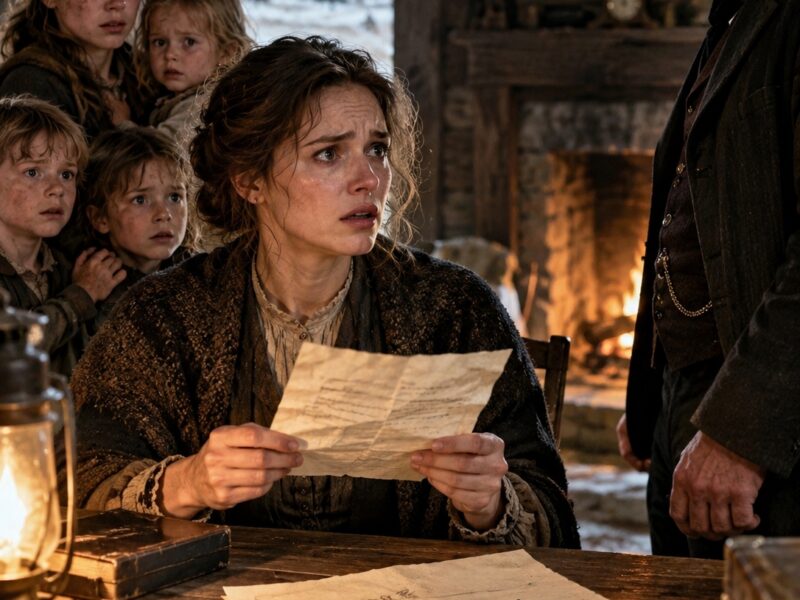
She Crossed 2,000 Miles to Marry a Stranger—But Five Starving Children Were Waiting at His Door
The first thing Marta Kesler saw when she arrived to marry Colby was not her future husband.
It was a knife.
The girl holding it could not have been more than fourteen.
She stood in the doorway of a weather-beaten farmhouse in Deer Creek, Oregon, with a baby balanced against one hip and the kitchen knife pressed low against her faded skirt. Behind her stood three more children, thin and silent, watching Marta as if she were another danger winter had sent to finish what hunger had started.
Marta remained beside the wagon.
Her carpetbag rested in the dirt.
For nearly two thousand miles, she had imagined this moment differently.
A man on a porch.
A nervous smile.
Perhaps flowers if he was sentimental, though nothing in Colby’s letters had suggested he was.
She had imagined awkwardness. Relief. Maybe disappointment.
She had prepared herself to marry a stranger.
She had not prepared herself to discover that the stranger was already dead.
“You Marta Kesler?” the girl asked.
Her voice was steady.
Her hand was not.
Marta nodded slowly.
“Yes.”
The girl’s jaw tightened.
“Then you’re too late.”
Something cold moved beneath Marta’s ribs.
“Where is Mr. Colby?”
The baby whimpered.
The girl shifted the child higher without lowering the knife.
“Pa’s dead.”
For several seconds, Marta heard nothing except the creak of the wagon harness behind her.
“I’m sorry?”
“Three weeks.”
The girl swallowed.
“Wagon went over on North Ridge.”
Marta stared at her.
Three weeks.
While Marta had been traveling west, carrying two dresses, a Bible, twenty-three dollars, and every reasonable hope she still possessed, the man she was supposed to marry had been lying beneath Oregon soil.
The girl pointed the knife toward the road.
“There ain’t anybody here for you now.”
Behind her, an eleven-year-old boy moved closer to a smaller girl.
“You can go back.”
Marta should have.
Every sensible voice inside her said exactly that.
She owed these children nothing.
She had never met their father.
She had never promised them anything.
She had crossed an ocean from Germany, worked until her hands hardened, answered an advertisement from a widowed Oregon farmer because loneliness could make reasonable people gamble with their lives.
The gamble had failed.
That should have been the end of it.
Then Marta looked past the girl.
Inside the house, the hearth was dead.
On a shelf sat three potatoes.
Beside them was the heel of a loaf of bread.
A little boy of perhaps six stood in the shadows chewing the cuff of his coat.
Not playing with it.
Chewing it.
Because he was hungry.
The baby on the girl’s hip had hollow cheeks.
And suddenly Marta understood something much worse than the death of the man she had come to marry.
Nobody had come for his children.
“What is your name?” Marta asked.
The girl frowned.
“Why?”
“Because you know mine.”
A pause.
“Cass.”
“And the baby?”
Cass hesitated.
“Min.”
“How old?”
“Two.”
Marta looked at the darkening sky.
Then at the empty hearth.
Then at Cass’s knife.
“I will not leave tonight.”
Cass’s fingers tightened.
“I told you—”
“I heard you.”
Marta’s English carried the careful edges of Germany even after years in America.
“It is nearly dark. Your baby is cold. That boy is hungry. I will make a fire. I will cook whatever food you have. Tomorrow morning, if you still want me gone, I will go.”
“We don’t need you.”
“No.”
Marta picked up her carpetbag.
“But tonight you need fire.”
Cass did not move.
Neither did Marta.
For several long seconds, the two stared at each other—one a fourteen-year-old child pretending to be a woman, the other a woman who had crossed half a world only to discover that the future waiting for her had already been buried.
Finally, the knife lowered half an inch.
It was not trust.
It was exhaustion.
Marta stepped inside.
And before that night ended, she would make two promises that would change every life in that house.
One was to five children.
The other was to a dead man.
She just didn’t know yet that keeping either promise might get her killed.
By lamplight, Marta learned their names.
Cass was fourteen.
Ned was eleven, serious-eyed and protective, with the manner of a boy who had discovered too early that adults could disappear.
Pru was nine and watched everything.
Georgie was six.
He rarely spoke.
And Min was two, still young enough to reach for Marta’s braid before remembering she was supposed to be afraid of her.
Their mother had died two winters earlier.
Their father had held the family together after that.
Then his wagon had gone over North Ridge.
And Cass had become mother, father, cook, nurse, and guard overnight.
Marta peeled the three potatoes.
She found one soft onion.
She found a little flour.
She made soup that should not have fed six people and somehow did.
The children ate too quickly.
That told Marta more than anything they could have said.
Hungry children ate.
Children who had been hungry for a long time guarded their bowls.
Ned curved one arm around his food.
Pru watched everyone else’s portions.
Georgie scraped the bottom of his bowl before he had finished what was in his mouth.
Cass did not eat.
“Sit,” Marta said.
“I’m not hungry.”
“You are.”
“The little ones—”
“Have eaten.”
Cass looked toward them.
Marta filled another bowl and placed it in front of her.
“I said I’m fine.”
“And I did not ask.”
Cass’s eyes flashed.
For a moment Marta thought the knife might return.
Instead, Marta sat opposite her.
“You have been the mother in this house for three weeks.”
Cass stared at the soup.
“Someone had to.”
“Yes.”
Marta’s voice softened.
“Tonight someone else can be.”
Cass looked up.
Something broke behind her eyes.
Only for an instant.
Then the wall returned.
Marta pushed the bowl closer.
“Eat.”
Cass did.
And halfway through the meal, tears began sliding silently down her cheeks.
She never wiped them away.
That was the moment Marta knew she would not be leaving in the morning.
She simply had not admitted it to herself yet.
Later, after Min fell asleep against her chest and Georgie curled beside the hearth, Ned remained awake.
He fed a stick into the flames.
“There’s something Cass won’t tell you.”
Across the room, Cass appeared asleep.
Marta knew she wasn’t.
“What?”
“A man keeps coming.”
Marta looked at him.
“What man?”
“Dell Corliss.”
The name meant nothing to her.
Ned lowered his voice.
“He owns land north of us.”
“And why does he come here?”
“He says this place is abandoned.”
Marta glanced around the room.
Five breathing children.
A cow in the barn.
Smoke rising from the chimney.
“Does it look abandoned?”
Ned did not smile.
“He says children can’t keep a claim.”
Marta’s attention sharpened.
“He says the county will take us.”
Cass’s eyes opened in the darkness.
“Ned.”
“He ought to tell her.”
“Ned.”
“He says they’ll split us up.”
Silence swallowed the room.
Marta looked at Cass.
The girl stared back.
And now Marta understood why the knife had been in her hand.
It had never been about Marta.
Cass had been standing at that doorway waiting for the whole world to come and take something else.
“Is it true?” Marta asked.
Cass said nothing.
“Cass.”
The girl’s voice finally came.
“County wagon comes for children without guardians.”
“And then?”
“They place us wherever there’s room.”
“Together?”
Cass laughed once.
There was no humor in it.
“Five kids? Nobody takes five.”
Marta looked at Min sleeping against her.
Pru and Georgie lay together near the fire.
Ned stared into the flames.
Five children.
Five destinations.
Five separate lives.
And somewhere outside, a man was apparently waiting for the law to clear them off valuable land.
Marta had come to Oregon expecting a marriage.
Instead, she had walked into a siege.
She looked toward the window.
Blackness beyond the glass.
“How did your father die?”
Cass’s expression changed.
“You already know.”
“The wagon rolled.”
“Yes.”
“Why?”
Cass frowned.
“The road.”
“Had he driven that road before?”
“Hundreds of times.”
Something about the answer settled badly inside Marta.
A careful farmer.
A familiar road.
A wagon suddenly over a ridge.
Maybe it was nothing.
Maybe grief was making patterns where there were none.
But Marta had survived too much by paying attention to the things other people dismissed.
She looked at the children.
Then at the dying fire.
Tomorrow she could still leave.
Nobody would blame her.
Instead, Marta added another log.
In the morning, she unpacked.
Cass noticed.
Neither woman said a word about it.
Three days later, firewood appeared beside the door.
Split oak.
Dry.
Enough for two days.
Beside it sat a sack of cornmeal, four brown eggs, and a slab of bacon wrapped in cloth.
Marta carried everything inside.
“Who brought this?”
Five innocent faces stared back.
Cass’s ears turned pink.
Marta noticed.
She said nothing.
Two nights later, she discovered the answer.
Moonlight lay across the snow-dusted yard when Marta heard movement near the barn.
She rose, wrapped a shawl around herself, and looked through the window.
A rider stood near the woodpile.
He was unloading split logs.
Marta opened the door.
The man froze.
“You.”
He slowly turned.
“You have been leaving food.”
He removed his hat.
He was perhaps thirty-two, broad-shouldered, with a face weather had carved into something older. He looked uncomfortable being caught doing something kind.
“Didn’t mean to wake anybody.”
“Come into the light.”
“Ma’am—”
“If you have been feeding five children for three weeks, you may at least allow me to see your face.”
He stepped closer.
“Abel Rainer.”
Marta knew the name.
Ned had mentioned the ranch south of the creek.
“You knew Colby?”
Abel looked toward the farmhouse.
“He was my friend.”
Something in his voice made Marta study him more carefully.
Not simple grief.
Guilt.
“I promised him once,” Abel said.
“What?”
“If anything happened to him, I’d see his young ones right.”
His fingers tightened around his hat.
“Then something happened.”
Marta waited.
“I should’ve come inside.”
“Why didn’t you?”
Abel stared at the ground.
“You ever walk toward a house where everybody inside has just lost the person holding it together?”
“Yes.”
He looked up.
“Tonight.”
That caught him.
Marta stepped closer.
“You brought food.”
“Wasn’t enough.”
“You brought wood.”
“Wasn’t enough.”
“They are alive.”
Abel said nothing.
Marta understood men who punished themselves because guilt felt easier than grief.
“You did not fail because you were afraid to knock on a grieving family’s door.”
“I promised him.”
“And now I am asking you to keep the promise.”
His eyes met hers.
“We?”
“Yes.”
Something shifted in his face.
Then he said the words Marta had not wanted confirmed.
“Dell Corliss is after this land.”
“Why?”
“Creek bottom.”
Abel nodded toward the dark fields.
“Best soil in this part of the valley. Colby proved up the claim years ago, but Corliss has always wanted it.”
“He told the children they cannot keep it.”
“If there’s no valid patent or guardian to speak for them, he’ll argue abandonment. Circuit judge comes through Deer Creek in six weeks.”
“Six weeks.”
“If those children don’t have somebody lawful standing for them by then, county can place them out.”
“And Corliss?”
“Gets his chance.”
Marta looked toward the farmhouse.
A tiny square of yellow lamplight glowed behind the glass.
“You should leave,” Abel said quietly.
She turned.
“What?”
“You’re not married to Colby. You’ve got no legal standing. Corliss knows it. Once he realizes you’re staying, he’ll come after you too.”
Marta almost laughed.
Not because anything was funny.
Because after an ocean, two thousand miles, a dead groom, five starving children and a fourteen-year-old with a kitchen knife, a land thief seemed almost ordinary.
“I know exactly what I am staying for, Mr. Rainer.”
Abel studied her.
Then nodded.
“All right.”
“What does that mean?”
“It means you ain’t fighting him alone.”
For the first time since Marta had stepped off the wagon, the fear inside her loosened.
Only slightly.
Because four days later, Dell Corliss came riding up the road.
He wore a beautiful coat.
That was what Marta remembered.
Not the horse.
Not his polished boots.
The coat.
Dark wool. Clean collar. Brass buttons.
Cruelty, she thought, should have the decency to look ugly.
Dell Corliss did not.
He smiled from the saddle.
“Mrs. Kesler?”
“Miss.”
“Of course.”
His eyes moved over the barn.
The fence.
The fields.
He was not looking at a home.
He was calculating acreage.
“Terrible business about Colby.”
“So I have heard.”
“Good man.”
Marta said nothing.
“Children ought to have stability after something like that.”
“They do.”
His smile widened.
“Do they?”
Min was on Marta’s hip.
Behind her, Cass stood inside the doorway.
Marta could feel the girl’s fear without turning.
Corliss continued.
“County has procedures for orphaned minors. Proper homes. Families capable of caring for them.”
“There are five.”
“Yes.”
The way he said it made Marta cold.
As if five children were an administrative inconvenience.
“And this property?” Marta asked.
“Land needs working.”
“It is being worked.”
“By whom?”
“Us.”
For the first time, his smile tightened.
“With respect, ma’am, you’re a foreign woman who came here intending to marry a man who’s unfortunately deceased. You have no claim.”
“The children do.”
“Do they?”
There it was.
Marta stared at him.
“You seem very interested in five grieving children’s paperwork.”
“I am interested in seeing land used properly.”
“No.”
Her voice remained calm.
“You are interested in the land.”
A shadow crossed his face.
Then vanished.
“I’d be careful.”
“About what?”
“Confusing kindness with entitlement.”
Marta adjusted Min against her shoulder.
“The stove is warm. The cow is milked. Children sleep in their beds every night. Nothing here is abandoned.”
Corliss leaned slightly forward.
“Six weeks.”
Marta’s pulse changed.
“Excuse me?”
“Judge comes in six weeks.”
He smiled again.
“Enjoy the house until then.”
A voice came from behind him.
“That’s enough, Dell.”
Abel crossed the yard carrying fencing wire.
He did not hurry.
That somehow made his arrival more powerful.
Corliss looked at him.
“Didn’t realize this concerned you.”
“Colby’s children concern me.”
“That’s touching.”
“Leave.”
Corliss’s eyes hardened.
“You giving orders on another man’s property?”
“No.”
Abel stopped beside Marta.
“I’m telling you where the argument happens. In front of the judge. Not on her doorstep.”
The men stared at each other.
Finally Corliss backed his horse.
“Six weeks,” he repeated.
Then he rode away.
Cass appeared beside Marta.
Her face had gone white.
“He’ll come back.”
Marta watched the elegant coat disappear between the trees.
“Yes.”
She understood something now.
Dell Corliss was not threatening them because he believed he would win.
He was behaving like a man who believed he already had.
Which meant he knew something they didn’t.
Marta began searching the house.
Drawers.
Cupboards.
Old boxes.
The barn loft.
Colby’s desk.
Nothing.
No will.
No deed.
No land patent.
No instructions.
“County man already searched,” Cass said.
Marta sat back on her heels.
“Your father was careful?”
“About everything.”
“Money?”
“Hid it.”
“From whom?”
“Everybody.”
That made Marta look at the floor.
In Germany, her father had hidden important papers beneath boards during bad years.
Governments changed.
Tax collectors came.
Thieves came.
But nobody looked beneath the place where a poor man slept.
Marta entered Colby’s bedroom.
She tapped the boards.
One.
Two.
Three.
The third sounded different.
Her heart began beating faster.
“Ned.”
He came running.
“Bring me the pry bar.”
Ten minutes later, Marta lifted the board.
Oilcloth lay underneath.
Cass stopped breathing.
Marta pulled out a packet.
The first document was a land patent.
Colby’s name was written plainly across it.
Proved.
Paid.
Lawful.
Marta nearly laughed from relief.
Corliss could not simply jump the claim.
Then she found the letter.
Her name was on the front.
Marta Kesler.
The handwriting was rough.
She sat on the floor.
The children gathered around her.
The letter had been written the week Colby died.
He apologized for being poor at words.
He wrote about his wife.
About losing her.
About his fear that something might happen before Marta arrived.
Then came the sentence that broke Cass.
If you are reading this, be good to them, whoever you are. They are the best of everything I ever made.
Cass turned away.
Ned put his arm around her.
Marta’s eyes burned.
This dead man had trusted a woman he had never met with everything he loved.
She almost stopped reading.
Then she saw the next paragraph.
And the room changed.
Colby wrote about North Ridge.
Someone had been moving stones near his fence.
A gate had been loosened.
He did not know why.
But he was worried.
If anything happened, he wanted the neighbors told.
Marta read the paragraph twice.
“What is it?” Ned asked.
She looked at Cass.
“Your father knew something was wrong before he died.”
Cass went still.
That evening Marta carried the letter to Abel.
He read it beneath the lamp.
Once.
Twice.
Then his face changed.
“He knew.”
Marta said nothing.
“I told myself the wagon slipped.”
Abel stood.
“I told myself because I needed it to be an accident.”
“The gate.”
“He knew that road better than anybody.”
“And Dell wants the land.”
Abel looked at her.
Neither spoke the next thought.
They didn’t have to.
A wagon had gone over a ridge.
A gate had been tampered with.
And the man who benefited from Colby’s death was already circling his children.
For the first time, Marta was no longer asking how Colby died.
She was asking who had killed him.
Snow came early.
Within forty-eight hours, Deer Creek disappeared beneath white.
Winter narrowed life to simple questions.
Was there wood?
Was there flour?
Was the cow alive?
Were the children warm?
Marta worked before sunrise and after dark.
Abel began appearing every day.
At first, he always had an excuse.
Fence.
Barn roof.
Hay.
Then the excuses became unnecessary.
He broke ice from the trough while Marta milked.
She baked while he repaired hinges.
He taught Ned how to set a rabbit snare.
Marta taught Pru to knead bread.
Min began running toward Abel whenever he entered the yard.
Cass noticed everything.
She said nothing.
Then Georgie became sick.
The fever came after midnight.
By one in the morning, the little boy was burning.
Marta sat beside him with wet cloths.
“Stay with me.”
Georgie’s eyes fluttered.
“Cold.”
“I know.”
“Don’t let county man come.”
Marta froze.
Even half-conscious, that was what the child feared.
Not dying.
Being taken away.
“No one is taking you.”
“You promise?”
Marta held his burning hand.
“I promise.”
Abel rode four miles through the storm for medicine.
When he returned, ice covered his coat.
His eyelashes were white with snow.
Near dawn, Georgie’s fever finally broke.
His eyes opened.
“Marta?”
“Yes.”
“I’m hungry.”
She laughed and cried at the same time.
Abel stood in the doorway watching her.
Something passed between them.
Not passion.
Not yet.
Something quieter.
More dangerous.
Belonging.
He placed a blanket over her shoulders.
Their fingers touched.
Neither moved immediately.
From the ladder, Cass watched them.
And for the first time since her father died, she allowed herself to imagine that maybe the future did not contain a county wagon.
Then Marta found the tracks.
One horse.
Near the far fence.
The rider had stopped there long enough for the snow beneath the horse to be trampled flat.
Watching the house.
Corliss.
He was waiting.
He didn’t have to force them away.
Winter might do it for him.
Marta returned inside and looked at the marks she had scratched into the wall.
Three weeks.
Three weeks until the judge.
Three weeks to keep five children together.
Three weeks to prove the land was theirs.
And perhaps three weeks to prove their father had been murdered.
That night, beside the fire, Marta reached for Abel’s hand.
Only for a moment.
He closed his fingers around hers.
Neither let go quickly.
The next morning, Abel rode for North Ridge.
The wreck site had been left mostly untouched.
Snow covered the slope.
Abel tied his horse and walked.
He found the gate.
One stone anchoring the post had been pried loose.
Abel knelt.
There were marks in it.
Not weather.
Metal.
Chisel marks.
Nearby, half-buried beneath frozen mud, he found glass.
A whiskey bottle.
Colby did not drink.
Then he saw old wheel impressions off the usual line of travel.
Another wagon had been there.
Abel carried everything to the sheriff.
The sheriff listened.
Then read Colby’s letter.
“This proves he was worried,” he said.
“It proves somebody was tampering with the gate.”
“Doesn’t prove who.”
“Ask who was on the ridge.”
The sheriff did.
Quietly.
Two days later, a freighter came forward.
He had been traveling through Deer Creek the day Colby died.
He remembered seeing someone near the gate.
“Who?”
The freighter hesitated.
“Corliss.”
The sheriff leaned forward.
“You sure?”
“Didn’t think anything of it then.”
“What was he doing?”
“Had some kind of iron bar.”
Abel felt his stomach turn.
“When?”
“Maybe an hour before Colby’s wagon went through.”
The open question that had haunted Marta from her first night finally had an answer.
Colby had not simply lost control of his wagon.
Someone had prepared the road to betray him.
And that someone wore a good coat.
Ten days remained before the judge.
Abel spread the evidence across his table.
The land patent.
Colby’s letter.
Notes from the sheriff.
The freighter’s statement.
“We have enough to make him answer questions,” Abel said.
“Enough to win?”
“I don’t know.”
Marta hated those words.
“But we stand together.”
Abel looked at her.
“Together?”
“All of us.”
His hand moved across the table.
Covered hers.
This time neither pretended it was accidental.
Two nights before the hearing, Abel asked Marta to walk outside.
The stars looked sharp enough to cut.
He removed his hat.
Marta almost smiled.
Whenever Abel became nervous, the hat suffered.
“I’ve got something to ask.”
“Then ask.”
“Trying.”
She waited.
“I came here alone,” he said. “Thought that was safest.”
Marta’s smile disappeared.
“Safest?”
“Can’t lose what you don’t have.”
There was an entire history inside those words, but Marta did not force it open.
Abel looked toward the farmhouse.
“Then you got off that wagon.”
He laughed softly.
“Worst day those children ever had, and there you were, looking like you wanted to turn around just as badly as they wanted you gone.”
“I did.”
“I know.”
“But you didn’t.”
“No.”
He met her eyes.
“Marta, I’ll stand in front of that judge as your husband.”
Her breath caught.
Abel continued quickly.
“Not for the land.”
She stared at him.
“Not because it’d help the guardianship. I’d do those things regardless.”
His voice lowered.
“I’m asking because the house you’re in is the only house I want to come home to.”
Marta could hear her own heartbeat.
She had crossed an ocean looking for a husband she had never met.
She had arrived too late.
And somehow, in the ruins of that failed future, another life had quietly assembled itself around her.
Five children.
A broken farmhouse.
A stubborn neighbor.
A grave on a hill.
A kitchen that smelled like bread again.
“My feet have left many homes,” she whispered.
Abel waited.
“My heart is tired of leaving.”
His eyes changed.
“It is here now.”
He swallowed.
“That a yes?”
Marta stepped into his arms.
“Yes.”
There was no dramatic kiss.
No music.
Only two lonely people standing beneath an Oregon winter sky, holding each other as if both had finally reached the end of a very long road.
When they returned, five children were pretending not to watch through the window.
Cass failed worst.
“Does this mean you’re staying?”
Marta looked at her.
“Yes.”
Cass’s eyes filled.
“Both of you?”
Abel nodded.
“For good.”
Cass broke.
The girl who had held a knife against Marta on the first night suddenly became fourteen again.
Marta caught her.
Ned joined them.
Then Pru.
Georgie.
Min.
Seven people tangled together in the doorway.
Marta pressed her face into Cass’s hair.
“Whatever happens in that courtroom, listen to me.”
Cass held tighter.
“You are mine.”
She looked at the others.
“All five of you.”
Outside, the snow kept falling.
And forty-eight hours later, a judge would decide whether those words meant anything under the law.
The church hall was packed.
Dell Corliss arrived in his best coat.
Of course he did.
A lawyer stood beside him.
Corliss smiled when he saw Marta.
That frightened her more than anger would have.
He believed he could still win.
His lawyer spoke first.
He described an abandoned agricultural holding.
Minor children without legal guardians.
A foreign woman with no marriage certificate tying her to the deceased.
Emotional attachment, he suggested, was not legal standing.
Marta felt Cass’s fingers tighten around hers.
Then the lawyer questioned whether Colby’s patent could even be established.
Abel stood.
“We can establish it.”
He placed the document on the table.
Corliss’s expression changed.
Only slightly.
But Marta saw it.
The judge examined the patent.
“Where was this?”
“Under Colby’s bedroom floor,” Marta said.
The judge looked over his spectacles.
“Mr. Corliss, on what basis were you claiming this land was abandoned?”
Corliss’s lawyer rose.
Before he could answer, the sheriff stepped forward.
“There is another matter.”
The room changed.
The sheriff placed Colby’s letter before the judge.
Then came the photographs and descriptions of the disturbed gate stone.
The chisel marks.
The bottle fragment.
The evidence from North Ridge.
Finally, the freighter stood.
He was an ordinary man.
That was what made him devastating.
He had nothing to gain.
Nothing to protect.
The judge asked him one question.
“Did you see someone at Colby’s gate on the day of his death?”
“Yes, sir.”
“Do you see that person in this room?”
The freighter lifted his hand.
Pointed.
At Dell Corliss.
A murmur swept through the hall.
Corliss stood.
“That’s a lie.”
For the first time, his voice was not smooth.
The freighter didn’t move.
“Saw you with an iron bar.”
“Liar.”
“About an hour before Colby’s wagon went over.”
Corliss’s face reddened.
His lawyer whispered something.
Corliss ignored him.
“Paid witness! This whole thing is arranged!”
The judge struck the table.
“Sit down.”
Corliss didn’t.
“The German woman planted those papers. Rainer wants the property. That sheriff—”
“Sit. Down.”
Silence.
For weeks, Dell Corliss had been terrifying because he never lost control.
Now everyone watched him lose it.
The judge reviewed the patent again.
Then Colby’s letter.
Then the sheriff’s report.
When he finally removed his spectacles, the room was silent enough to hear the stove ticking.
“The property is not abandoned.”
Cass inhaled sharply.
“It belonged lawfully to Colby and passes to his heirs.”
Ned grabbed Pru’s hand.
“Mr. Corliss has no lawful claim to it.”
Marta closed her eyes.
One battle.
Won.
Then the judge looked toward the sheriff.
“As for the circumstances surrounding Mr. Colby’s death, I find sufficient cause for further proceedings.”
Corliss moved toward the door.
The sheriff stepped in front of him.
For the first time since Marta had met him, Dell looked afraid.
“You cannot—”
The sheriff took his arm.
“Seems I can.”
Corliss turned toward Marta.
His hatred was naked now.
No smile.
No beautiful manners.
No Sunday clothes could hide it.
Then the sheriff walked him out past every neighbor he had expected to impress.
Cass began crying.
“We keep the farm?”
Marta squeezed her hand.
“Yes.”
But the judge was not finished.
He lifted another document.
“I have before me a petition concerning five minor children.”
Marta’s stomach dropped.
Abel moved closer.
The judge continued.
“The petition requests that the children remain together under guardianship, with adoption to follow.”
Marta looked at Abel.
She knew they had submitted papers.
She did not know what else had happened.
The judge turned the document around.
It was covered in signatures.
Dozens.
Neighbors.
Farmers.
Shopkeepers.
People Marta barely knew.
Half of Deer Creek had signed.
The judge looked at Cass.
“Young lady.”
Cass straightened.
“Yes, sir?”
“Do you wish to remain with Miss Kesler and Mr. Rainer?”
Cass’s voice shook.
“More than anything.”
“Ned?”
“Yes, sir.”
“Pru?”
She nodded.
Georgie shouted, “Yes,” loudly enough to make several people laugh.
Min simply climbed into Marta’s lap.
The judge’s stern expression softened.
“I see.”
He looked down at the papers.
“I find no benefit in scattering five children among separate households when a suitable home already exists.”
Marta stopped breathing.
“Petition granted.”
Cass stared at him.
The judge almost smiled.
“You stay together.”
Cass’s mouth opened.
No sound came.
“You stay home.”
The church erupted.
Cass turned and buried her face against Marta.
And the girl who had carried everyone else’s fear for weeks finally sobbed like the child she had never been allowed to be.
Marta held her.
Abel wrapped an arm around them both.
Ned cried openly.
Pru laughed while crying.
Georgie shouted something nobody understood.
Min clapped because everyone else was making noise.
For a few impossible seconds, grief and relief became the same thing.
Marta looked through the crowd toward the church doors.
Beyond them, snow covered Deer Creek.
Somewhere beneath that snow lay Colby.
The man she had traveled two thousand miles to marry.
The man she had never met.
He had sent for a wife.
Instead, somehow, he had brought his children a mother.
Marta and Abel married before the snow melted.
There was no grand ceremony.
Marta wore a plain gray dress.
Pru pinned dried creek flowers near her collar.
Abel wore his best shirt and spent most of the ceremony staring at Marta as though he still could not understand how she had become real.
All five children stood beside them.
When the preacher asked who gave Marta in marriage, an awkward silence fell.
Then Cass stepped forward.
“We do.”
Laughter moved through the church.
Then tears.
Even Marta laughed.
The winter that had arrived to destroy them became the winter that made them a family.
Abel built chairs for the kitchen.
Six at first.
Then a seventh.
Marta caught him carving the smallest one.
“Min already has a chair.”
“She’ll grow.”
“So why make another small one?”
Abel kept carving.
His ears turned red.
Marta stared at him.
Then understood.
She laughed until he finally looked at her.
“I said maybe,” he muttered.
“You said nothing.”
“Exactly.”
She kissed his cheek.
By spring, the firewood was stacked high.
There was flour in the pantry.
The cow was healthy.
The bottomland waited beneath the thawing soil.
Most importantly, no county wagon ever came.
Ned learned to read longer words.
Pru became fearless with bread dough.
Georgie stopped asking whether strangers were coming to take him.
Min forgot there had ever been a time when Marta had not been there.
And Cass changed most of all.
Slowly, her shoulders came down.
She slept through the night.
She laughed loudly enough to embarrass herself.
She stopped checking the pantry three times a day.
One afternoon, Marta found her sitting beneath a tree doing absolutely nothing.
“What are you doing?”
Cass looked guilty.
“Nothing.”
Marta smiled.
“Good.”
Cass frowned.
“Good?”
“You are fourteen.”
Marta sat beside her.
“You should occasionally be useless.”
Cass laughed.
A real laugh.
Marta turned away quickly because tears had filled her eyes.
Saving the farm mattered.
Exposing Corliss mattered.
Keeping the children together mattered.
But watching a frightened girl learn that she no longer had to hold up the entire world—
That felt like the greatest victory of all.
Years later, Marta would still sometimes wake before dawn and remember that first evening.
The crooked door.
The dead hearth.
The kitchen knife.
Cass’s white knuckles.
Three potatoes.
A hungry boy chewing his sleeve.
She would remember how close she had come to turning around.
One decision.
That was all.
A wagon facing one direction instead of another.
Sometimes a life changed with thunder.
Sometimes it changed because a woman looked at five hungry children and decided not to leave before morning.
One winter night, Marta stood beside the window while snow covered Deer Creek again.
Behind her, the house was loud.
Ned was reading.
Pru was correcting him.
Georgie was asleep on the floor.
Min was curled against Cass.
Abel sat near the fire repairing a harness.
Marta watched snow settle over the fields that Dell Corliss had once believed would become his.
Abel came beside her.
“You all right?”
She leaned against him.
“I was thinking.”
“That sounds dangerous.”
She smiled.
“About the first night.”
His arm went around her.
“What about it?”
“I almost left.”
Abel became quiet.
“I almost climbed back into that wagon.”
“But you didn’t.”
“No.”
She watched the snow.
“I came here believing my life was waiting for me.”
Abel kissed the top of her head.
“Wasn’t it?”
Marta looked behind them.
At the fire.
At Cass laughing.
At Ned struggling over a word while Pru impatiently sounded it out for him.
At Georgie asleep without fear.
At Min safe in her sister’s arms.
Then she looked at Abel.
She thought of Colby’s unfinished letter beneath the floorboards.
Be good to them, whoever you are.
Marta had spent years believing home was somewhere a person finally arrived.
Germany.
America.
Oregon.
A husband’s farm.
A legal name.
A place on a map.
She understood now that she had been wrong.
Home was not where the road ended.
Home was the place you could have walked away from—
and chose not to.
Outside, snow slowly erased the wagon road.
Inside, seven chairs stood around a warm table.
And Marta Kesler, who had crossed two thousand miles to become one dead stranger’s wife, listened to five children arguing beside the fire and realized that the greatest thing waiting for her at the end of her journey had never been the man she came to marry.
It was the family she almost left behind.









