SHE DESTROYED THE WEDDING CAKE AND ORDERED THE BAKER OUT—THEN SHE LEARNED WHO OWNED THE VENUE
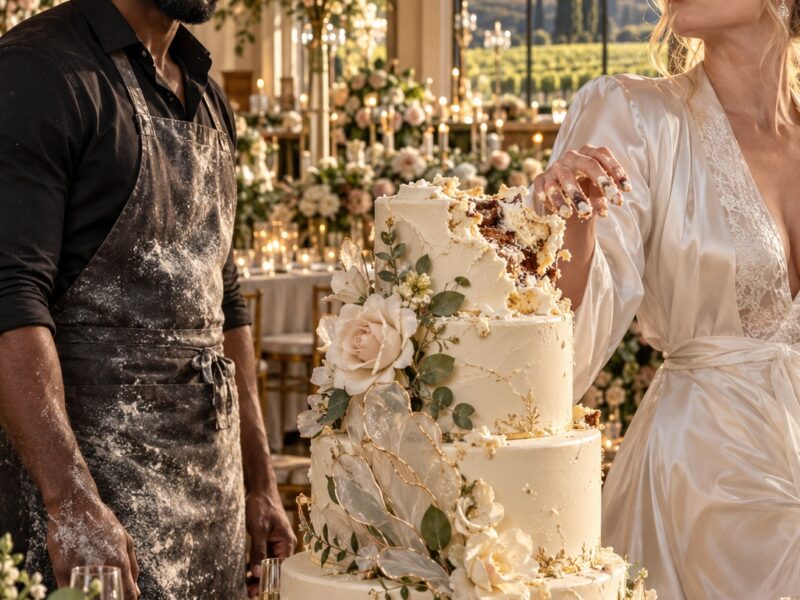
Philippa Wheatley destroyed her wedding cake at 10:17 on the morning she was supposed to get married.
She did it with both hands.
Not accidentally.
Not because she stumbled in her heels or caught the edge of the table or lost her balance beneath the pressure of a day she had been planning for eleven months.
She placed both palms flat against the top tier of the four-tier cake, looked directly at the man standing across from her, and pressed.
The ivory fondant buckled first.
Then seventeen handmade sugar petals folded inward beneath her fingers.
A lattice of spun sugar cracked with a sound so small it should have disappeared beneath the clink of champagne glasses being arranged across the room.
Instead, everyone heard it.
Because everyone had stopped moving.
A catering assistant froze beside a tray of crystal flutes.
The florist near the French doors lowered the ribbon she had been tying.
Heather Monroe, Philippa’s wedding planner, closed her eyes for half a second.
And against the far wall, Suna Adebowale—the pastry artist who had spent nearly two weeks creating those flowers—went completely still.
Four feet from Philippa, Kelechi Amadi watched the cake collapse.
He didn’t raise his voice.
He didn’t rush toward her.
He didn’t even change his expression.
At thirty-nine, Kelechi had learned that there were moments when the face you showed someone mattered more than anything you could say.
This was one of them.
Philippa slowly withdrew her hands.
Buttercream clung to the side of one manicured finger.
Caitlyn, her maid of honor, stepped forward automatically with a linen napkin.
Philippa took it.
She wiped her fingers one at a time.
Then she looked at Kelechi.
“I’d like this removed before my guests arrive.”
Nobody breathed normally.
Philippa glanced at the ruined cake as though it were a floral arrangement that had failed to meet specifications.
“Today, please.”
Kelechi looked at her.
Not angrily.
That somehow made it worse.
“Are you certain you want to do that?”
Philippa’s chin lifted.
“I don’t think I stuttered.”
Heather stared at the floor.
Caitlyn whispered, “Philippa.”
Philippa didn’t look at her.
Kelechi gave one slow nod.
“All right.”
That was all.
No argument.
No threat.
No announcement.
He simply turned and walked out of the ballroom.
Philippa watched him go with the faint satisfaction of someone who believed she had successfully corrected a problem.
She had no idea that the man she had just ordered out of the building owned the building.
Not managed it.
Not worked there.
Owned it.
The ballroom.
The stone manor beyond it.
The twelve acres of vineyards glowing beneath the August sun.
The gardens where 230 guests would sit that afternoon.
The bridal suite where her dress was hanging.
The private road her limousine had used that morning.
Even the room where she would eventually learn exactly what she had done.
All of it belonged to Kelechi Amadi.
It had for seven years.
And Kelechi had no intention of ruining Philippa Wheatley’s wedding.
He was simply going to give her the opportunity to decide whether she would ruin it herself.
Long before people underestimated Kelechi because of an apron, they underestimated him because of his name.
Before that, because of his skin.
Before that, because he was quiet.
At eleven years old, a teacher had suggested to his mother that perhaps advanced mathematics wasn’t “the most appropriate environment” for him.
His mother, Evelyn, had been an ICU nurse working twelve-hour shifts while raising three children and finishing an MBA online after everyone else went to sleep.
She had listened politely.
Then she’d asked the teacher to show her Kelechi’s test scores.
The teacher had.
Kelechi’s scores were among the highest in the grade.
His mother had folded her hands on the desk.
“So we’re discussing his performance?”
“Not exactly.”
“Then what are we discussing?”
Kelechi never forgot the silence that followed.
He was moved into advanced mathematics the following Monday.
Years later, he couldn’t remember the teacher’s name.
But he remembered the lesson.
People frequently decided what you were capable of before you had done anything at all.
Sometimes they were wrong because they lacked information.
Sometimes they were wrong because they preferred their assumptions to information.
And occasionally, if you were patient enough, people revealed exactly which kind they were.
Kelechi became very patient.
At twenty-two, he completed culinary school and began selling custom pastries from a shared commercial kitchen in Oakland.
At twenty-seven, he opened Amadi Atelier in Napa.
The shop occupied a restored brick building on a quiet street and had no enormous sign outside, no celebrity photographs on the walls, no television appearances playing on screens.
Kelechi didn’t care about any of that.
He cared about structure.
Temperature.
Proportion.
Ingredients.
He cared whether a sugar flower looked like someone had actually studied the living flower before trying to reproduce it.
He cared whether chocolate snapped correctly.
He cared whether something beautiful tasted as though the person making it had remembered that food was supposed to be eaten.
His business grew.
Slowly at first.
Then not slowly.
At thirty-two, Kelechi found Thornfield Estate.
The property sat on the edge of Napa Valley, twelve acres behind a line of old cypress trees.
There was a nineteenth-century stone manor, a carriage house converted decades earlier into a ballroom, a walled garden, and vineyard views that could make conversations stop in the middle of sentences.
It was also falling apart.
The roof leaked.
Two sections of the garden wall had collapsed.
The electrical system belonged in a museum.
The carriage house needed structural work.
The previous owners had spent years arguing about what the property should become until financial reality made the decision for them.
Kelechi walked through it on a rainy February afternoon with a real-estate agent who seemed embarrassed to be showing it.
“What do you think?” she asked.
Kelechi stood beneath a ceiling with water stains spreading across it.
“I think everybody else is looking at what it is.”
“And you?”
He looked through the tall windows toward the vineyard.
“I’m looking at what it could be.”
He bought Thornfield.
For four years, he restored it.
Not quickly.
Correctly.
He hired craftsmen instead of contractors who promised impossible timelines.
He restored the stone rather than covering it.
He replanted the gardens.
He preserved the old oak flooring where it could be saved and replaced it plank by plank where it couldn’t.
By the time Thornfield reopened, it looked less renovated than remembered.
Within three years, it had become one of Napa Valley’s most sought-after private event properties.
Wedding magazines photographed it.
Luxury planners recommended it.
Corporate retreats booked it a year in advance.
Kelechi’s name appeared on every ownership filing and every venue contract.
But he rarely introduced himself as the owner.
He found the information surprisingly unnecessary.
And sometimes useful to withhold.
Because people behaved differently around owners.
They became polite.
Careful.
Strategic.
But put Kelechi in a flour-dusted apron beside a delivery entrance and people became themselves.
That was how Philippa Wheatley met him.
Six months before the wedding, Philippa booked Thornfield through Patricia Lau, the estate’s event director.
Patricia was fifty-one, meticulous, elegant, and so calm that Kelechi once watched her handle a drunken best man, a missing officiant, a sprinkler malfunction, and a mother-of-the-bride threatening litigation without raising her voice once.
After Philippa’s third week of emails, Patricia walked into Kelechi’s office carrying her laptop.
“I have a question.”
Kelechi looked up.
“How legal is it to fake my own death?”
He smiled.
“Bad morning?”
She turned the laptop around.
An email from Philippa filled the screen.
The chair sash issue has already been explained twice. I should not have to clarify again what warm ivory means. Please ensure the person handling this has the necessary experience for an event of this caliber.
Kelechi read it.
“Noted.”
“That’s all?”
“What would you like me to do?”
“Tell me I can charge an emotional damages fee.”
“You cannot.”
Patricia sighed.
“Then I regret bringing this to management.”
The cake came through an entirely separate channel.
Months earlier, Philippa had attended a charity gala in San Francisco and seen an installation created by Amadi Atelier.
It was less a traditional cake than an architectural sculpture—translucent sugar panels, suspended botanicals, edible gold, and hand-cast flowers.
She contacted the studio the following week.
Her wedding brief was demanding.
Kelechi liked it immediately.
Four tiers.
Pressed wildflowers in translucent sugar.
Botanicals native to Northern California.
Ivory.
Sage.
A muted gold inspired by late-summer vineyards.
It was the kind of commission where every mistake would be visible.
Suna loved it even more.
Suna was twenty-nine and had joined Amadi Atelier three years earlier after training in New York and Paris.
She possessed the rare ability to work for ten hours without appearing hurried once.
For two weeks, the cake occupied the center of the studio.
Three times they rejected the sage coloring.
Twice Suna remade the sugar panels.
One evening, Kelechi found her staring at a tray of flowers after midnight.
“Go home.”
“They’re wrong.”
“They’re flowers.”
“They’re the wrong flowers.”
“They look exactly like the reference.”
“That’s the problem.”
He waited.
Suna held up a photograph of California yarrow.
“The petals aren’t symmetrical in nature. Mine are too perfect.”
Kelechi stared at her.
“You know nobody at the wedding will notice that.”
“I’ll notice.”
He smiled.
“That’s why you work here.”
On the morning of the wedding, they delivered the finished cake at eight.
Sunlight was just beginning to enter the carriage-house ballroom.
The cake stood on a round linen-covered table near the tall windows.
For several seconds after the final panel was attached, Suna said nothing.
Kelechi came beside her.
“What?”
She folded her arms.
“I think it’s the best thing I’ve ever made.”
Kelechi studied it.
He wasn’t generous with praise simply to make people feel good.
“Yes,” he said. “I think it might be.”
Suna smiled.
Two hours later, Philippa walked into the room.
And destroyed it.
But the destruction hadn’t begun with her hands.
It had begun the moment she looked at Kelechi.
Philippa arrived at Thornfield at 10:02 a.m. with Heather, Caitlyn, and two bridesmaids.
She was speaking before the main door had completely opened.
“The east floral installation is still too low.”
Heather said, “They’re adjusting it.”
“And the chair ribbons?”
“Warm ivory.”
“They looked cream in the photograph.”
“The photograph was under fluorescent lighting.”
Philippa stopped.
“Heather.”
“Yes?”
“I don’t need an explanation. I need it fixed.”
Heather gave a professional nod.
“Of course.”
Patricia stood near reception holding a clipboard.
She met Heather’s eyes.
Nothing was said.
Nothing needed to be.
Kelechi was in the ballroom checking the cake-table placement when he heard Philippa approaching.
Suna had gone to the service area for her equipment case.
He stayed beside the cake.
Philippa entered.
Then stopped.
For the first time that morning, she had nothing to say.
Her gaze moved slowly from the bottom tier upward.
Pressed wildflowers appeared suspended inside translucent sugar.
Hand-painted vines moved almost invisibly through the ivory fondant.
Seventeen flowers curved around the upper tier.
Morning light passed through the panels and scattered faint gold shadows across the linen.
Heather smiled despite herself.
“Oh, wow.”
Caitlyn breathed, “Philippa, it’s gorgeous.”
Philippa said nothing.
Kelechi knew that look.
He had seen it from clients before.
Recognition.
Then recalculation.
Her eyes moved from the cake to his apron.
Then to his face.
The admiration disappeared.
Not completely.
Something covered it.
Kelechi stepped forward.
“Good morning. Kelechi Amadi. I handled your commission personally.”
Philippa blinked.
“You made this?”
It wasn’t curiosity.
It was a verdict disguised as a question.
“My team and I. Suna Adebowale led most of the decorative work.”
Philippa approached the cake.
“The color is wrong.”
Kelechi glanced at Heather.
Heather’s expression tightened.
He looked back at Philippa.
“The sage was matched directly to the swatch you supplied.”
“No.”
“I can have the reference brought out.”
“I know what I approved.”
Caitlyn shifted behind her.
Kelechi remained still.
Philippa circled the cake.
“There’s too much gold.”
“The contract specifies muted gold accents on the botanical framework.”
“Muted.”
“Yes.”
“This isn’t muted.”
Kelechi looked at the cake.
Then at her.
“If there’s a specific element you’d like adjusted, we have time for minor—”
“What experience do you have?”
The question stopped him.
“I’m sorry?”
“With weddings like this.”
Heather looked sharply at Philippa.
Philippa continued.
“I was assured that everyone involved in today would be operating at a certain level.”
Kelechi understood now.
The cake wasn’t the problem.
He had known it perhaps thirty seconds earlier.
Now he was certain.
“My studio has handled private and commercial commissions for twelve years.”
“Your studio.”
“Yes.”
“But you personally?”
“I’ve been doing this professionally for seventeen years.”
Philippa gave a small laugh.
It contained no humor.
“I just find that difficult to reconcile with what I’m looking at.”
Suna had returned.
She stood near the service door carrying her equipment case.
Kelechi saw her stop.
Caitlyn saw her too.
“Philippa,” Caitlyn said quietly.
Philippa didn’t turn.
“I didn’t ask for your input.”
The room tightened.
Philippa picked up one of the sample sugar panels displayed beside the cake.
She turned it over.
Set it down carelessly.
Then she looked at Kelechi again.
“I had a certain expectation regarding the caliber of people involved in my wedding.”
Kelechi said nothing.
She gestured vaguely between him and the cake.
“I’m not convinced this reflects it.”
There it was.
Not explicit enough to quote cleanly.
Clear enough that every person in the room understood.
Kelechi could have challenged her.
He didn’t.
He had learned years earlier that when someone was revealing themselves, interrupting them was often a mistake.
Philippa turned toward the cake.
Then she pressed both hands into it.
Suna made a small sound.
Not a scream.
More like the involuntary sound someone makes when watching something irreplaceable fall.
When Philippa pulled her hands away, one entire side of the top tier had collapsed.
The lattice cracked.
A sugar flower fell to the table.
Suna stared at it.
Kelechi looked at Philippa.
“Are you certain you want to do that?”
“I don’t think I stuttered.”
She wiped her hands.
“Remove it.”
A pause.
“And I’d like the refund processed before the reception.”
Kelechi nodded.
“Give us a moment.”
He looked at Suna.
Her eyes were bright.
That bothered him more than the ruined cake.
Then he walked out.
Philippa believed he was leaving.
Instead, he walked down the east corridor to the estate office.
Closed the door.
Sat behind his desk.
And made three phone calls.
The first was to Howard King, Thornfield’s operations director.
“Pull the ballroom security footage from ten o’clock forward.”
Howard didn’t ask why.
“How soon?”
“Now.”
The second call was to Kelechi’s attorney.
The third was Patricia.
She answered immediately.
“I know,” she said.
Kelechi leaned back in his chair.
“Don’t apologize.”
“I’m not apologizing for her. I’m apologizing because I should’ve been in the room.”
“It wouldn’t have changed anything.”
“Are you canceling the wedding?”
Kelechi looked through the window toward the garden.
Staff members were setting 230 chairs in neat rows.
“No.”
Patricia went silent.
“Not yet,” he added.
“Kelechi.”
“Make sure Miss Wheatley doesn’t leave the property before I speak with her.”
“Should I tell her why?”
“No.”
He ended the call.
On his desk sat the Thornfield event contract.
He opened it.
Section Nine.
Subsection Three.
Conduct toward estate employees, contractors, and vendors.
Intentional damage.
Abusive behavior.
Discriminatory treatment.
Kelechi rested one finger against the page.
The clause had existed for five years.
He had written it after a different wedding.
A different client.
A nineteen-year-old server crying behind the kitchen because a guest had thrown a drink at her and called her something Kelechi still disliked remembering.
That night he had promised himself Thornfield would never again take money from someone as payment for the privilege of humiliating the people who worked there.
Now he looked toward the ballroom.
Philippa had signed the contract.
Initialed every page.
Including this one.
At 12:41, Kelechi went upstairs and changed clothes.
When he came back down, the flour-dusted apron was gone.
He wore a charcoal suit.
No tie.
No vest.
Nothing theatrical.
He didn’t need theatrical.
At 1:06, Howard entered the office carrying a folder and a tablet.
“Everything’s there.”
Kelechi opened the folder.
Statements from Heather.
Patricia.
Two Thornfield employees.
Suna.
Howard set the tablet beside him.
“The footage is clear.”
“Replacement cake?”
“Coming from San Francisco. ETA two fifteen.”
“She arranged it?”
“Yes.”
“How much?”
Howard named the amount.
Kelechi almost smiled.
“That hurt.”
“Apparently principle is expensive.”
Kelechi looked at the frozen security image.
Philippa’s hands were embedded in the cake.
Suna stood against the far wall.
“What does she think is happening?”
Howard leaned against the chair.
“She thinks you’re gone.”
Kelechi closed the folder.
“Ask her to come to the office.”
Howard’s eyebrows rose.
“Now?”
“Tell her there’s an administrative issue with the afternoon schedule.”
“And if she asks what?”
“Tell her it’s easier to explain here.”
Howard reached the door.
“Anything else?”
Kelechi looked at the contract.
“Don’t tell her who she’s coming to see.”
Philippa made him wait nineteen minutes.
At 1:32, the office door opened while she was still speaking to Caitlyn.
“If Heather changes those candles again, tell her I specifically—”
She stopped.
Kelechi sat at the head of the conference table.
Patricia sat on his right.
Howard stood near the window.
The contract lay open on the table.
The security tablet rested beside it.
Philippa looked at Kelechi.
For the second time that day, he watched the calculation happen behind her eyes.
But this time it didn’t end in contempt.
It ended somewhere much closer to uncertainty.
“What is this?”
“Please sit down, Miss Wheatley.”
She didn’t.
“I thought you’d left.”
“I changed clothes.”
“I asked to speak with whoever runs this venue.”
“You are.”
She frowned.
Kelechi folded his hands.
“Howard oversees day-to-day operations. Patricia directs client events.”
He paused.
“Thornfield Estate belongs to me.”
Nothing moved.
Caitlyn, still standing near the door, put one hand over her mouth.
Philippa stared.
“You own this place.”
“Yes.”
Her eyes moved around the office as though the room itself had betrayed her.
The photographs.
The architectural plans.
The framed magazine covers.
A photograph on the wall showed Kelechi standing beside the restored manor seven years earlier, sleeves rolled up, construction dust on his shoes.
Philippa’s gaze stopped there.
Then returned to him.
“You could have said that this morning.”
“I could have.”
“Why didn’t you?”
Kelechi considered the question.
“Would it have changed how you spoke to me?”
Her jaw tightened.
“That’s irrelevant.”
“I think it’s extremely relevant.”
She looked at Patricia.
Patricia didn’t rescue her.
Philippa straightened.
“Regardless, I had legitimate concerns about the cake.”
“You’re allowed to.”
“Then I don’t understand why I’m here.”
Kelechi nodded toward Howard.
Howard tapped the tablet.
The security footage began.
No sound.
It didn’t need sound.
Philippa watched herself enter the ballroom.
Circle the cake.
Gesture at Kelechi.
Pick up the panel.
Then put both hands against the top tier.
She looked away before the cake collapsed.
Kelechi let the footage continue.
When it finished, he said, “The commission satisfied every written specification in your contract.”
“I disagree.”
“You’re entitled to dislike it.”
He slid a document across the table.
“You’re not entitled to intentionally destroy it.”
“It was my cake.”
“No.”
That word landed harder than anything he’d said so far.
Philippa blinked.
Kelechi continued.
“The cake remained property of Amadi Atelier until delivery was formally accepted and final payment cleared. Your balance was scheduled for settlement after installation.”
Philippa looked down.
“You’re splitting hairs.”
“No. My attorney would call them contract terms.”
Her eyes snapped back to his.
“So this is revenge.”
“No.”
“Because I criticized your work.”
“No.”
“You clearly took it personally.”
Kelechi’s voice remained almost gentle.
“Miss Wheatley, I’ve spent seventeen years making things people occasionally don’t like. Criticism is part of the profession.”
He pushed the Thornfield contract toward her.
“What happened this morning isn’t about criticism.”
The paperclip marked Section Nine.
Philippa didn’t touch it.
“Intentional destruction of vendor property. Abusive treatment of contracted personnel. And conduct witnessed by four members of staff that falls within the discriminatory-treatment provision.”
Philippa’s face changed.
“Discriminatory?”
“Yes.”
“That is an outrageous accusation.”
“It’s a contractual classification.”
“You’re calling me racist.”
Kelechi looked directly at her.
“I haven’t called you anything.”
Silence.
“I am describing what happened.”
Her cheeks colored.
“You have no right—”
“I have every right.”
It was the first time his voice sharpened.
Not louder.
Sharper.
The entire room felt it.
“This is my property. Those are my employees and contractors. That was my studio’s work. And this is a contract bearing your signature.”
He touched the page once.
“So let’s not confuse your embarrassment with my lack of authority.”
Philippa stopped speaking.
From the hallway came distant voices.
Guests had begun arriving.
Kelechi could see the first cars through the window.
Black sedans.
A shuttle from the hotel.
Women in summer dresses walking toward the garden.
A man carrying a wedding gift.
The ceremony was less than ninety minutes away.
Philippa looked toward the window too.
Kelechi knew she had finally understood the timing.
“What are you saying?”
“I’m saying Thornfield has grounds to terminate today’s event.”
All color left Caitlyn’s face.
Philippa stared at him.
“You wouldn’t.”
Kelechi said nothing.
“My family has spent—”
“Money doesn’t erase a contract.”
“There are two hundred and thirty people coming here.”
“I know.”
“My parents flew people in from Boston.”
“I know.”
“The caterer, photographer, musicians—”
“I know exactly what is involved. It’s my venue.”
Philippa gripped the back of a chair.
For the first time all morning, she looked frightened.
Not offended.
Not angry.
Frightened.
Kelechi allowed the silence to settle.
Then he said, “I’m prepared to offer you two options.”
She looked at him.
“The first is that Thornfield exercises its contractual right to terminate the event.”
Philippa’s mouth opened.
He continued before she could speak.
“The second is that the wedding proceeds.”
Her shoulders lowered slightly.
“Under conditions.”
There it was again.
The tension returned.
“Full compensation for the destroyed commission.”
She said nothing.
“A formal apology to Suna Adebowale and every staff member present during the incident.”
Philippa’s fingers tightened around the chair.
“And a written acknowledgment of the conduct violation, retained in Thornfield’s internal records.”
“This is humiliation.”
Kelechi shook his head.
“No.”
“What would you call forcing a bride to apologize on her wedding day?”
“Accountability.”
The word sat between them.
Philippa laughed once.
Bitterly.
“You planned this.”
“No.”
“You changed into a suit and brought me into this room thirty minutes before my ceremony.”
“Your ceremony is in eighty-eight minutes.”
“You know what I mean.”
“I changed into a suit because I’m working.”
She stared at him.
“You want me to beg.”
“No.”
“Then what do you want?”
Kelechi leaned back.
“The truth.”
“What truth?”
“That it wasn’t about the color.”
Her face went still.
Behind her, Caitlyn lowered her eyes.
Kelechi saw it.
So did Philippa.
She turned.
“Caitlyn?”
Caitlyn looked exhausted.
Not surprised.
Exhausted.
Philippa’s voice became quiet.
“What?”
Before Caitlyn could answer, another voice came from the hallway.
“What’s going on?”
Everyone turned.
Alistair Fenwick stood in the doorway.
The groom.
Still in his morning suit.
His boutonniere hadn’t been pinned yet.
Behind him were two groomsmen and Heather.
He looked from Philippa to Kelechi.
Then at the contract.
Then the tablet.
“Philippa?”
She stepped toward him.
“Alistair, this is being handled.”
His expression changed.
“What’s being handled?”
“Something happened this morning.”
“What happened?”
“It doesn’t matter.”
Caitlyn closed her eyes.
Alistair noticed.
“What happened?”
Nobody answered quickly enough.
Then the tablet restarted automatically.
The footage looped.
Alistair looked down.
Philippa turned toward Howard.
“Turn that off.”
But Alistair had already seen it.
“Wait.”
He stepped closer.
The room fell silent.
On the screen, Philippa entered the ballroom.
Alistair watched her speak.
Watched her circle the cake.
Watched Kelechi stand across from her.
Then watched his fiancée put both hands into the top tier.
Nobody spoke.
The video ended.
Alistair stared at the darkened screen.
Then at Philippa.
“Tell me that’s not what it looks like.”
“There’s context.”
“What context?”
“The cake wasn’t right.”
He looked back at the screen.
“So you smashed it?”
“I didn’t smash it.”
Caitlyn finally spoke.
“You did.”
Philippa turned.
“Caitlyn, don’t.”
“No.”
The word was barely louder than a whisper.
But something changed.
Caitlyn stepped into the office.
Her eyes were wet.
Not from fear.
From exhaustion.
“I’ve been doing this for months.”
Philippa stared at her.
“Doing what?”
“Cleaning up after you.”
“Caitlyn.”
“Explaining you.”
“Caitlyn.”
“Apologizing to people after you leave the room.”
Alistair’s expression slowly changed.
Philippa’s voice hardened.
“This is not the time.”
“That’s what I keep telling myself.”
Caitlyn swallowed.
“Not now. Not before the engagement party. Not during dress fittings. Not at your shower. Not this week because you’re stressed.”
Her voice broke slightly.
“But there is always a reason why it isn’t the time.”
Philippa looked around.
Everyone was watching.
“You’re seriously doing this at my wedding?”
Caitlyn’s face twisted with disbelief.
“No, Philippa.”
She pointed toward the tablet.
“You did this at your wedding.”
Silence.
Alistair looked at Caitlyn.
“Tell me what happened.”
Philippa stepped between them.
“Alistair—”
“Move.”
He didn’t say it cruelly.
That made Philippa obey.
Caitlyn told him.
Everything.
The complaint about the sage.
The questions about Kelechi’s experience.
The comment about the “caliber” of people Philippa expected.
The way Philippa had looked at him.
The cake.
Caitlyn didn’t dramatize it.
Didn’t interpret it.
She simply described events in order.
Heather confirmed them.
Patricia confirmed the timeline.
Howard confirmed the staff statements.
Alistair listened without interrupting.
When they finished, he looked at Philippa.
She seemed suddenly smaller inside her wedding robe.
Not physically.
Something else.
Something that had always been held upright by certainty.
“Why?” he asked.
Philippa folded her arms.
“It wasn’t like they’re making it sound.”
“Then tell me what it was like.”
“I was stressed.”
“So you destroyed somebody’s work?”
“It was my wedding cake.”
“It wasn’t about the cake.”
She looked at him.
Alistair’s voice lowered.
“Was it?”
Philippa said nothing.
And then Suna appeared in the doorway.
Kelechi hadn’t called her.
She came by herself.
Her hands were clasped in front of her.
Kelechi stood.
“Suna—”
“I need to say something.”
He studied her.
Then nodded.
Suna looked at Alistair rather than Philippa.
“I spent almost two weeks on that cake.”
Philippa looked away.
“I drove three hours one Saturday because the flowers we had weren’t the correct variety. I stayed until midnight three nights because the sugar panels kept setting with bubbles.”
She took a breath.
“I remade seventeen flowers because the first ones looked too perfect.”
Alistair’s jaw tightened.
Suna continued.
“When she walked into the ballroom this morning, she liked the cake.”
Philippa’s eyes snapped toward her.
“You don’t know that.”
“Yes, I do.”
“You have no idea what I thought.”
Suna finally looked at her.
“I saw your face.”
Philippa froze.
“You liked it until you looked at him.”
She nodded toward Kelechi.
The silence became unbearable.
Suna’s voice remained soft.
“Then suddenly the color was wrong.”
Philippa stared at her.
Suna swallowed.
“I just wanted someone to say that out loud.”
Philippa’s voice became sharp.
“Nobody asked you.”
Alistair turned.
“Let her finish.”
Philippa looked at him as if he’d slapped her.
Suna shook her head.
“I’m finished.”
She walked away.
For several seconds, nobody moved.
Then Alistair looked at Philippa.
There are moments in a relationship when nothing visibly dramatic happens, yet the relationship is permanently altered.
No confession.
No scream.
No slammed door.
Just one person looking at another and realizing that the version they loved is no longer the only version they can see.
This was one of those moments.
“Can we have the room?” Alistair asked.
Kelechi stood.
“Of course.”
Philippa looked at him.
“You’re leaving?”
“You asked for privacy.”
Something almost desperate entered her expression.
Perhaps she’d expected him to stay.
Perhaps the conflict with Kelechi had been easier than the conversation waiting behind the closed door.
He didn’t give her that escape.
Kelechi, Patricia, Howard, and Caitlyn stepped into the corridor.
Alistair closed the door.
Fourteen minutes passed.
Nobody outside spoke much.
Suna stood near the window.
Kelechi went to her.
“You didn’t have to do that.”
She stared toward the garden.
“Yes, I did.”
He nodded.
“Okay.”
“Are you angry?”
“At you?”
“At her.”
Kelechi thought about it.
“Yes.”
Suna looked surprised.
“You don’t look angry.”
“I didn’t say I wasn’t.”
That made her smile faintly.
Inside the office, something struck the table.
Then silence.
A minute later, they heard Philippa crying.
Not loudly.
Kelechi walked farther down the hallway.
He had no interest in listening.
At 2:01, the office door opened.
Alistair came out first.
His face looked different.
Older, perhaps.
Or simply stripped of the expression he’d been wearing all morning.
He approached Kelechi.
“I’m sorry.”
Kelechi waited.
“For what happened to your staff. For the cake. For all of it.”
“You don’t owe me an apology for something you didn’t do.”
Alistair glanced toward the office.
“I know.”
A pause.
“But I still need to say it.”
Kelechi nodded.
“I appreciate that.”
“Whatever the damages are, I’ll pay them.”
“That’s between the studio and Miss Wheatley.”
Alistair almost smiled.
“Of course it is.”
Then he asked the question nobody in the hallway had expected.
“Can the wedding still happen?”
Kelechi looked toward the closed office door.
“That depends on Philippa.”
As if summoned by her name, the door opened.
Philippa stepped out.
Her eyes were red.
The immaculate makeup from earlier was gone around the edges.
Something in her posture had changed.
She hadn’t collapsed.
That would have been easier.
She simply looked like a person who had spent fourteen minutes being shown a mirror she couldn’t argue with.
She approached Kelechi.
Stopped.
“I apologize.”
The words were stiff.
Kelechi said nothing.
Philippa tried again.
“To you. And your staff.”
She swallowed.
“What I did this morning was wrong.”
The corridor was silent.
She glanced at Alistair.
Then back at Kelechi.
“It wasn’t about the cake.”
Kelechi watched her carefully.
Philippa looked down.
“I knew the color was right.”
There it was.
Not redemption.
Not yet.
Truth.
Small and ugly and necessary.
“I knew it was beautiful.”
Her voice broke.
“I think that made what I did worse.”
Nobody rescued her from the sentence.
Philippa breathed slowly.
“I walked into that room and saw something extraordinary. Then I saw who had made it.”
Her eyes met Kelechi’s.
“And I made assumptions about you that I wouldn’t have made if you looked different.”
Alistair closed his eyes.
Philippa continued.
“I don’t have a better way to say that.”
Kelechi’s voice was quiet.
“You don’t need a better way.”
She nodded.
Tears gathered again.
“I’m sorry.”
Kelechi didn’t tell her it was okay.
It wasn’t.
He didn’t tell her she was forgiven.
That wasn’t his responsibility either.
He simply said, “Thank you for saying it.”
Philippa turned toward Suna.
For the first time that day, she seemed afraid to approach her.
Suna waited.
“Your work was extraordinary.”
Suna’s face remained unreadable.
Philippa’s voice shook.
“I knew it the second I saw it.”
Suna said nothing.
“And I destroyed it anyway.”
“Yes.”
Philippa flinched.
Suna didn’t soften the truth.
But she didn’t sharpen it either.
Philippa nodded.
“I’m sorry.”
A long pause.
Then Suna said, “Thank you.”
Nothing more.
That was enough.
Kelechi looked at Howard.
“Can we recover the schedule?”
Howard was already reaching for his radio.
“Give me twelve minutes.”
He disappeared down the corridor.
Patricia followed.
Heather checked her watch and almost laughed from sheer disbelief.
“We can actually do this.”
Alistair looked at Philippa.
Neither smiled.
There was still a wedding to decide.
Kelechi walked away.
What happened next belonged to them.
At 3:18 that afternoon, Philippa Wheatley walked down the garden aisle.
The ceremony began eighteen minutes late.
Nobody complained.
Two hundred and thirty guests sat beneath the warm Napa sun while the vineyards beyond Thornfield turned slowly gold.
The replacement cake arrived from San Francisco at 2:14.
It was expensive.
Technically excellent.
Perfectly acceptable.
Nobody stared at it.
Nobody whispered when it entered the ballroom.
Nobody stopped mid-conversation.
It did exactly what a cake was supposed to do.
And somehow that felt sadder than if it had been ugly.
The original cake had been something else.
Suna never saw the ceremony.
She left shortly before three.
Kelechi offered to drive her home.
She refused.
“I want coffee and three hours where nobody says the word wedding.”
“Reasonable.”
At the door she stopped.
“Do you think she meant it?”
Kelechi knew exactly who she meant.
“I think she meant it when she said it.”
“That’s not what I asked.”
“No.”
Suna waited.
Kelechi looked toward the garden.
“I think people sometimes mean an apology before they’re capable of becoming the person the apology requires.”
Suna considered that.
“So we’ll see.”
“We probably won’t.”
“That’s true.”
She smiled.
“See you Monday.”
“Take Monday off.”
Her smile widened.
“Now I know you’re upset.”
Then she left.
The ceremony proceeded.
Philippa and Alistair exchanged vows beneath an arch of white flowers.
But something about their vows had changed.
At one point Philippa’s voice trembled.
Alistair held her hands.
He didn’t squeeze them reassuringly the way he had during rehearsal.
He simply held them.
Afterward, when the photographer asked them to kiss, they did.
Guests applauded.
The band played.
Champagne appeared.
From the outside, it became a beautiful wedding.
But beautiful things can contain fractures invisible in photographs.
Kelechi knew that better than most people.
He spent the afternoon away from the celebration.
There were invoices to reconcile.
A refrigeration problem in the catering kitchen.
A driver who had parked a delivery van in the wrong place.
A guest who misplaced a phone.
At 5:40, Howard found Kelechi in the service corridor reviewing staffing notes.
“She apologized again.”
Kelechi looked up.
“Who?”
Howard gave him a look.
“Suna.”
“No one was there. I saw it from the kitchen.”
Kelechi returned his eyes to the page.
“Good.”
Howard leaned against the wall.
“That’s it?”
“What else should I say?”
“I don’t know. Something profound.”
“I’m doing payroll.”
Howard laughed.
Then grew quiet.
“Would you have canceled it?”
Kelechi stopped writing.
“If she refused?”
“Yeah.”
“Yes.”
“Two hundred thirty guests?”
“Yes.”
“On a Saturday in August?”
Kelechi looked at him.
“Especially on a Saturday in August.”
Howard nodded slowly.
“You really are stubborn.”
“I prefer consistent.”
They walked toward the kitchen.
After a few steps, Howard said, “You know what bothers me?”
“What?”
“If she’d known you owned Thornfield, none of this would’ve happened.”
Kelechi considered that.
“No.”
Howard looked at him.
“That’s not what bothers me.”
“What does?”
“If she’d known I owned Thornfield, she would’ve behaved differently.”
They walked several more steps.
“That’s worse.”
Howard didn’t answer.
He didn’t need to.
At 7:12, something unexpected happened.
Philippa found Kelechi alone near the west terrace.
Dinner had ended.
Music floated from the ballroom.
She had changed into a simpler reception dress.
For several seconds she stood behind him without speaking.
Kelechi eventually turned.
“Everything all right?”
“Yes.”
She looked toward the vineyards.
“I wanted to ask you something.”
“Okay.”
“Why didn’t you tell me?”
“We covered this.”
“No.”
She shook her head.
“Why didn’t you tell me when I started talking to you like that?”
Kelechi studied her.
“You mean why didn’t I tell you I owned Thornfield?”
“Yes.”
“Would you like the polite answer?”
A tiny, humorless smile.
“No.”
“Because I wanted to know how far you’d go.”
Philippa looked away.
“That’s cruel.”
“Maybe.”
She seemed surprised by the admission.
Kelechi continued.
“But I didn’t make you do anything.”
“I know.”
“You could have complained about the cake.”
“I know.”
“You could have asked for another decorator.”
“I know.”
“You could have demanded a refund.”
She nodded.
“You could even have insulted me and walked away.”
“I know.”
“But you chose to destroy something someone else had spent weeks making.”
Philippa’s eyes filled.
“I know.”
Kelechi looked across the vines.
“So I suppose I wanted to know who you were when you thought the person standing in front of you couldn’t do anything about it.”
That sentence hurt.
He could see it.
Philippa didn’t defend herself.
For once.
After a while she said, “I don’t like who that person was.”
Kelechi turned back toward her.
“Then don’t be her again.”
Philippa laughed through a tear.
“You make that sound very simple.”
“It isn’t.”
“Then why say it like that?”
“Because complicated isn’t the same as impossible.”
Music drifted from the ballroom.
Someone cheered.
Philippa wiped her cheek.
“Alistair almost called off the wedding.”
Kelechi said nothing.
“He told me he’d been noticing things for years.”
Her voice became distant.
“Small things.”
She looked toward the reception.
“The way I talk to waiters when something goes wrong. The way I speak to his assistant. A valet last Christmas.”
Kelechi listened.
“He said he kept convincing himself I was stressed.”
Philippa gave a hollow laugh.
“Apparently everyone has been explaining me to myself.”
“People who love us sometimes do that too long.”
She looked at him.
“Did your wife teach you that?”
Kelechi’s expression changed almost imperceptibly.
“I’m not married.”
“I’m sorry.”
“No reason to be.”
“Then who?”
He considered whether to answer.
“My mother.”
Philippa waited.
“She loved people enough to tell them when they were wrong.”
“That sounds uncomfortable.”
“It frequently was.”
For the first time, Philippa genuinely smiled.
It disappeared quickly.
“Alistair made me promise something before he agreed to go through with the ceremony.”
“What?”
“Therapy.”
Kelechi raised an eyebrow.
“Not couples therapy.”
“No?”
“For me.”
She looked almost embarrassed.
“He said he loves me, but he isn’t going to spend the next forty years apologizing to strangers for me.”
Kelechi looked toward the ballroom.
“That sounds reasonable.”
“It hurt.”
“Those things can coexist.”
She nodded.
Then reached into the pocket of her dress.
She held something out.
A small sugar flower.
Damaged.
One petal missing.
Kelechi stared at it.
“I picked it up after everyone left the ballroom this morning.”
He didn’t take it.
“I thought about throwing it away.”
“Why didn’t you?”
“I don’t know.”
Kelechi looked at her.
Philippa closed her fingers around the flower.
“Maybe I wanted something I couldn’t rewrite later.”
That answer surprised him.
He nodded.
“Keep it.”
She looked down at it.
“I think I will.”
Then she walked back toward her wedding.
Kelechi remained on the terrace.
He listened to the music.
He wondered whether Philippa would change.
He didn’t know.
And he refused to turn one apology into a redemption story simply because redemption stories were more comfortable.
People were more complicated than that.
Some apologies were doorways.
Others were performances.
You could only know which one by watching what happened afterward.
Three months later, a handwritten envelope arrived at Amadi Atelier.
Suna found it beneath several invoices.
“Kelechi.”
He looked up from the counter.
“What?”
She held up the envelope.
“You should see this.”
Inside were two letters.
The first was addressed to Suna.
The second to Kelechi.
He didn’t read hers.
She read it silently.
Her expression changed.
“What?”
Suna folded the letter.
“She’s in therapy.”
Kelechi said nothing.
“She wrote that she’s been thinking about what I said.”
“And?”
Suna looked down.
“She said the worst part wasn’t realizing she had hurt me.”
Kelechi waited.
“The worst part was realizing she’d done versions of it before and never remembered the people’s faces.”
Kelechi slowly set down the piping bag in his hand.
Suna continued.
“She says she’s trying to remember them now.”
“How do you feel about that?”
“I don’t know.”
“That’s allowed.”
Suna looked at the letter again.
“She didn’t ask me to forgive her.”
Kelechi nodded.
“That’s probably a good sign.”
Then he opened his.
Philippa’s letter was shorter.
Mr. Amadi,
I have rewritten this letter six times because every version sounded like I was trying to make myself look better.
Maybe that’s part of the problem.
So I’ll keep this simple.
You asked me, without actually asking, who I was when I believed the person in front of me had no power over me.
I hated the answer.
I’m working on changing it.
I kept the flower.
Philippa.
Kelechi read the final sentence twice.
Then folded the letter.
Suna watched him.
“Well?”
“Well what?”
“Something profound.”
He smiled.
“Apparently everybody expects that from me now.”
She laughed.
He placed the letter in the drawer beneath the register.
Not framed.
Not displayed.
Just kept.
Life moved forward.
Thornfield hosted another wedding the following Saturday.
Then another.
Seasons changed.
The vines went bare.
Rain came.
Spring returned.
Kelechi continued making cakes.
Suna became creative director of the studio two years later.
Howard continued complaining that Kelechi needed to take vacations.
Patricia continued threatening to fake her death whenever difficult clients sent emails after eleven at night.
And Thornfield kept standing.
That was the thing about buildings.
They absorbed people.
Arguments.
Promises.
Music.
Apologies.
They witnessed the best day of someone’s life and the worst version of someone else’s character and remained standing after both had gone home.
Years later, Kelechi would barely remember what the replacement cake looked like.
He would remember Suna standing against the ballroom wall.
He would remember Caitlyn saying, You did this at your wedding.
He would remember Alistair watching the security footage in absolute silence.
And sometimes he would remember Philippa standing on the west terrace, holding a broken sugar flower in her palm.
But mostly he remembered the moment before all of that.
A woman in an expensive bridal robe.
Both hands pressed into something beautiful.
Certain that the man watching her was powerless.
That was the mistake people made about power.
They thought it always announced itself.
They thought it wore the suit.
Sat at the head of the table.
Owned the building.
Signed the checks.
Sometimes it did.
But the most important power Kelechi possessed that morning had existed long before Thornfield, before Amadi Atelier, before money or property or contracts.
It was the ability not to become smaller simply because someone else had decided he was.
At 9:46 on the night of Philippa’s wedding, after the last guests were gone, Kelechi walked through Thornfield alone.
The ballroom was empty.
Candles had been extinguished.
Tables were stripped.
The replacement cake had disappeared into boxes.
A few crushed petals remained beneath one chair.
He switched off the ballroom lights.
Then the hallway lights.
At the main entrance, he paused.
Outside, the Napa night was warm and still.
The vineyards disappeared into darkness beyond the stone wall.
Kelechi locked the door.
Seven years earlier, he had stood on those same steps while the estate was half ruined.
Broken roof.
Dead garden.
Cracked windows.
Everyone who had seen the property had told him how much was wrong with it.
He had bought it anyway.
Not because he couldn’t see the damage.
Because he could see beyond it.
Perhaps people deserved something similar.
Not blindness.
Not excuses.
Not endless forgiveness without consequence.
Just the possibility that the worst thing they had done did not have to become the final thing they became.
Kelechi walked down the cypress-lined drive toward his car.
Behind him stood the estate Philippa Wheatley had entered that morning believing belonged to someone else.
Perhaps that had been the smallest of her mistakes.
The larger one had been believing ownership was the reason Kelechi deserved respect.
It wasn’t.
He had deserved it in the apron.
He had deserved it with flour on his sleeves.
Suna had deserved it standing beside the service entrance.
The servers deserved it.
The florist deserved it.
The valet Alistair had mentioned deserved it.
A person’s dignity did not increase when you discovered their title.
Only your understanding of your own behavior did.
Kelechi reached his car.
Before getting inside, he looked once more at Thornfield.
Then he thought about his mother sitting across from that teacher nearly thirty years earlier.
So we’re discussing his performance?
Not exactly.
Then what are we discussing?
He finally understood why he remembered that question more clearly than almost anything else from childhood.
His mother had never demanded that the teacher believe Kelechi was extraordinary.
She had demanded something much simpler.
That he be judged by what was actually in front of them.
Nothing more.
Nothing less.
Kelechi got into his car.
He drove away beneath the dark line of cypress trees.
Behind him, Thornfield disappeared in the rearview mirror.
Tomorrow another couple would arrive.
Another family would fill the gardens.
Another cake would be carried carefully through the service entrance.
People would laugh beneath the windows.
Someone would cry during a toast.
Someone would complain about the temperature.
Someone would dance after insisting they never danced.
And the building would hold all of it without judgment.
Kelechi had learned to do something similar.
Not forget.
Not excuse.
Just keep building.
Because sometimes the strongest answer to someone who has already decided what you are isn’t an argument.
It isn’t revenge.
It isn’t even the moment they finally discover your title, your money, or your name on the deed.
Sometimes the answer is simply to remain exactly where they thought you didn’t belong.
To keep working.
To let what you’ve built speak.
And to wait.
Because sooner or later, the truth has a way of introducing itself.
Even to people who refused to see it the first time.









