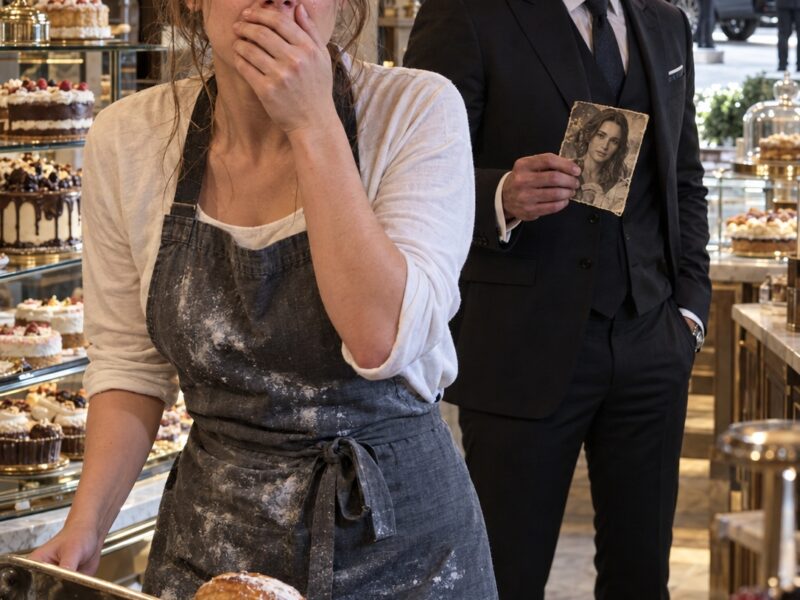
SHE FED A HOMELESS STRANGER EVERY NIGHT—THEN A CONVOY OF BLACK CARS ARRIVED AND CALLED HIM “MR. WHITMORE”
The first time Emily Carter saw Daniel Whitmore, he was asleep beneath a broken streetlamp in a coat worth more than her monthly rent.
She did not know that, of course.
To Emily, the coat was only a ruined black thing soaked through at the shoulders, dust ground into the sleeves, one brass button hanging by a thread. The man inside it was curled against the brick wall of an abandoned storefront on Chicago’s West Side, his knees pulled toward his chest beneath a torn gray blanket that looked far too thin for November.
Rain slid from the rusted awning above him.
Cars hissed through the intersection.
People passed without slowing.
And in his right hand, even while he slept, the stranger held a photograph so tightly that the edges had bent beneath his fingers.
Emily stopped.
That was the first mistake, if you asked the people who loved her.
It was also the decision that changed both their lives.
She stood twenty feet away beneath her umbrella, a paper sack of unsold bread tucked against her hip, watching his chest rise slowly beneath the wet blanket.
A woman in a camel-colored coat hurried past and glanced back at Emily.
“Don’t,” she murmured.
Emily looked at her.
The woman lowered her voice.
“You never know.”
Then she walked away.
Emily almost did the same.
She was twenty-eight years old, five-foot-four, exhausted from ten hours behind the counter at Wilson’s Bakery, with forty-three dollars in her checking account and a younger brother in college who had texted her that afternoon asking whether she could help with a chemistry lab fee.
She was not reckless.
She was not naïve.
She knew what happened in cities after dark.
But she also remembered something her mother used to say whenever Emily was frightened of giving too much.
You don’t need to save someone, Em.
Just don’t train yourself to stop seeing them.
Her mother had been dead four years.
Some nights Emily could barely remember the exact sound of her laugh.
But she remembered that sentence.
So she crossed the sidewalk.
The man woke before she reached him.
His eyes opened sharply, not with the foggy confusion she expected but with instant awareness. For one strange second, Emily had the feeling that he was assessing everything at once—the distance between them, the traffic, the alley to his left, the bakery logo printed on her paper sack.
Then his expression softened.
“Sorry,” Emily said. “I didn’t mean to scare you.”
“You didn’t.”
His voice surprised her.
Low. Clear. Educated.
Not what she had expected, and she immediately hated herself for having expected anything.
She pulled a warm sourdough loaf from the bag.
“We had extras.”
He looked at the bread but did not reach for it.
“I’m all right.”
Emily glanced at the soaked blanket.
“You’re shivering.”
“That’s not the same thing.”
Despite herself, she almost smiled.
“Fine. You’re shivering in an extremely convincing impression of being all right.”
Something moved in his face.
Almost amusement.
Almost grief.
She set the loaf beside him, added two almond pastries, and stepped backward.
“I’m not asking you to perform gratitude,” she said. “Eat them or don’t.”
He stared at her.
Emily turned to leave.
“Wait.”
She looked back.
The man glanced at the bakery bag and then at her.
“What’s your name?”
For a moment she considered lying.
“Emily.”
He nodded.
“Thank you, Emily.”
She looked toward the photograph in his hand.
A smiling young woman stood in front of a lake, dark hair lifting in the wind.
The man noticed Emily looking and folded the picture inward.
He did not offer his name.
Emily did not ask.
She walked home.
By the time she reached her apartment above the twenty-four-hour laundromat on Kedzie Avenue, she had mostly convinced herself she would never see him again.
She was wrong.
The next night, he was beneath the same streetlamp.
And this time he was awake, waiting.
Emily pretended not to notice that.
She also pretended the extra container of chicken soup in her bag had not been packed specifically for him.
“You again,” she said.
He looked at the container.
“You again.”
“That’s how streets work.”
“That’s how stalking works too.”
Emily stared at him.
Then he smiled.
It transformed him.
Not dramatically. Not enough to make him suddenly handsome in some movie-star way. It simply made him look younger, as if ten years had briefly stepped off his shoulders.
Emily handed him the soup.
He accepted it this time.
“Daniel,” he said.
“What?”
“My name.”
She nodded.
“Daniel what?”
His smile disappeared.
“Just Daniel.”
That should have been the first warning.
Instead, it became the beginning of a routine.
The following evening she brought a clean blanket she had found at a thrift store.
Two nights later, coffee.
On Friday, he refused the sandwich she offered and asked instead if she had eaten dinner.
Emily lied.
Daniel stared at her for three seconds.
“You haven’t.”
“I had half a cinnamon roll at four.”
“That is not dinner.”
“You’re the homeless man lecturing me about nutrition.”
His eyebrows lifted.
“You’re the woman feeding a homeless man while skipping meals.”
“That’s different.”
“How?”
Emily opened her mouth.
Nothing came out.
Daniel broke the sandwich in half and held out one piece.
She stared at it.
“This is ridiculous.”
“Probably.”
She took it.
They ate beneath the broken streetlamp while cold wind pushed newspapers down the empty block.
Neither of them knew that two months later Emily would remember that sandwich as the moment she began falling in love with him.
At first, she only knew she liked talking to him.
Daniel never asked for money.
He never asked to come home with her.
He never made her feel responsible for fixing whatever had happened to him.
That was what made him different from every story Emily had built in her head about people who lived on the street.
He seemed less like someone waiting to be rescued and more like someone serving a sentence only he understood.
He read constantly.
Newspapers left behind in cafés.
Library books.
Discarded magazines.
A battered copy of Jane Jacobs’s The Death and Life of Great American Cities that he carried for almost two weeks.
“You like architecture?” Emily asked one afternoon.
They were sitting outside the Harold Washington Library while the first dirty snow of the season drifted between the buildings.
Daniel turned a page.
“I like knowing why cities become what they become.”
“That sounds suspiciously like an answer from someone who has attended meetings with PowerPoint presentations.”
He looked at her.
Emily grinned.
“You don’t talk like a guy who spent his whole life sleeping outside.”
Daniel closed the book.
“What does a guy who sleeps outside sound like?”
Emily winced.
“That came out wrong.”
“It usually does.”
“I’m sorry.”
Daniel studied her for a moment.
Most people, he had learned, became defensive when shame touched them.
Emily did not.
She simply waited.
Finally, he said, “I didn’t always live this way.”
She leaned back on the bench.
“I figured.”
“How?”
“You know too much.”
“About what?”
“Everything annoying.”
He laughed.
Emily counted on her fingers.
“Interest rates. Historic zoning restrictions. Commercial leases. Coffee roasting. Which bridges were renovated in the nineties. Why the brownstones near Logan Square are worth ten times what they were twenty years ago.”
“Eight times.”
She stared at him.
“See? Annoying.”
His smile lingered.
But when she asked where he had learned those things, Daniel’s eyes drifted toward the street.
“Another life.”
It became his standard answer.
Another life.
Emily eventually stopped asking.
That was her gift to him.
Daniel’s gift to her was listening.
Really listening.
When Emily complained that her younger brother, Noah, was changing majors for the second time and pretending not to panic, Daniel remembered to ask about his next exam.
When she mentioned that her mother had once dreamed of opening a bakery, he remembered the name she had chosen for it.
When Emily told him Mrs. Ruth Wilson, the seventy-one-year-old owner of Wilson’s Bakery, had given her a job after her mother died, Daniel understood why Emily treated the bakery like something sacred.
“She saved me,” Emily said one evening.
They sat inside a twenty-four-hour diner because the temperature had fallen below twenty degrees and Emily had refused to let Daniel stay outside.
Daniel wrapped both hands around a cup of coffee.
“How?”
Emily looked out the window.
“My mom died in April. By May, I stopped going to work. By June, I stopped answering calls. I was twenty-four and suddenly responsible for Noah, and everyone kept telling me to be strong.”
Her fingers tightened around the spoon.
“I hated that word.”
“Strong?”
“It usually means ‘please suffer in a way that doesn’t make anyone uncomfortable.’”
Daniel stared at her.
He had spent decades in conference rooms with people who spoke in carefully polished sentences.
Emily sometimes said one careless thing and opened a door in him he had spent years welding shut.
“What did Mrs. Wilson do?” he asked.
“She knocked on my apartment door at six in the morning.”
Emily smiled at the memory.
“She handed me an apron and said, ‘Your mother would haunt us both if I let you rot up here.’”
Daniel laughed softly.
“She sounds formidable.”
“She’s terrifying.”
“And you love her.”
“Completely.”
Emily lifted her coffee.
“What about you?”
Daniel’s expression changed.
“What about me?”
“Who saved you?”
His thumb stopped against the paper cup.
Outside, an ambulance passed, red light flashing across his face.
“No one,” he said.
Emily did not believe him.
She did not know that the photograph he carried was the answer.
Anna Whitmore had been thirty-two when she died.
Daniel’s younger sister.
His last uncomplicated relationship.
His greatest wound.
And the only person in his family who had never been impressed by the Whitmore name.
Their father, Charles Whitmore, had built a real estate empire out of acquisitions, ruthless timing, and the cold certainty that every piece of land had a price.
By the time Daniel was eighteen, he had learned to evaluate buildings before he had learned to cook an egg.
By thirty, he sat on the board.
By thirty-eight, he controlled the company.
By forty-one, his family trust and private holdings touched hundreds of properties throughout Chicago and several other major cities.
Hotels.
Office towers.
Luxury apartment buildings.
Warehouses.
Retail corridors.
Residential developments.
The newspapers called him “Chicago’s invisible landlord.”
He hated the phrase.
But it was not inaccurate.
Whitmore Holdings rarely put Daniel’s name on buildings.
It did not need to.
His ownership lived several layers beneath shell companies, partnerships, investment vehicles and management groups.
Most tenants never knew the man ultimately collecting a portion of their rent.
Daniel had preferred it that way.
Then Anna got sick.
Ovarian cancer.
Stage four.
Fourteen months from diagnosis to funeral.
Money bought specialists.
Private rooms.
Experimental treatment.
Cars waiting downstairs.
Flights arranged within hours.
It bought everything except more time.
During her final weeks, Anna began asking Daniel questions he did not want to answer.
“How many apartments do you own?”
“Technically?”
She rolled her eyes from the hospital bed.
“You’re unbearable.”
Daniel adjusted her blanket.
“A lot.”
“How many people living in them have you met?”
“That isn’t how property management works.”
“Exactly.”
“Anna—”
“How many businesses pay rent to companies you control?”
He sighed.
“Why are we doing this?”
“Because I’m dying.”
“Stop saying that.”
“I’m still dying if I call it transitioning into a bold new phase.”
Daniel looked away.
Anna smiled faintly.
Then her voice softened.
“You own pieces of a city you don’t know.”
Daniel stood.
“I know the city.”
“You know valuations.”
“That’s not fair.”
“No.”
She reached for his hand.
“Fair would have been getting another forty years.”
That silenced him.
Anna turned her face toward the hospital window.
Buildings glowed beneath the evening sky.
“Do you ever think about what success is for?” she asked.
Daniel did not answer.
“You have more money than you could spend in ten lifetimes.”
“I didn’t build all of it.”
“But you protect all of it.”
“It’s my responsibility.”
“To whom?”
“My employees. Investors. Family.”
Anna looked at him.
“What about the people who live inside it?”
He frowned.
“Inside what?”
“Your responsibility.”
Three weeks later, she was dead.
At her funeral, Daniel stood beside relatives discussing trust distributions before the flowers had wilted.
His uncle asked whether the board meeting would still happen Monday.
A cousin wanted clarification on voting rights.
An investor sent condolences followed by a message about a hotel acquisition.
Daniel read them all.
Then he turned off his phone.
Two days later, he disappeared.
Not completely.
Marcus Hail, his chief executive and oldest professional ally, knew Daniel was alive.
The family attorney knew he had taken a leave.
Everyone else received vague statements about exhaustion and private grief.
Daniel moved through the city wearing secondhand clothes and carrying only enough cash to survive.
At first he rented cheap motel rooms.
Then shelters.
Then, deliberately, the street.
He told himself he was observing.
Learning.
Punishing himself.
Some nights, he could no longer tell the difference.
He walked through neighborhoods where his companies owned buildings.
He listened to tenants complain about broken elevators.
He watched elderly shop owners calculate whether they could afford new leases.
He sat near construction sites where men hired by contractors bearing his company’s logo ate lunches in their trucks because there was nowhere warm to sit.
He discovered that suffering became remarkably visible once nobody believed you had the power to change it.
Then Emily gave him a loaf of bread.
And suddenly his experiment became dangerous.
Because she did not know who he was.
For the first time in years, someone’s kindness toward Daniel could not possibly be connected to his name.
He became addicted to that certainty.
Which was why, every night he did not tell her the truth, the lie became harder to forgive.
One evening in early December, Emily arrived beneath the streetlamp twenty minutes late.
Daniel immediately stood.
“What happened?”
She stopped.
It was the first time she had seen him react with obvious fear.
“I’m fine.”
“You’re limping.”
Emily glanced down.
“Oh. Tray fell at work.”
“On your foot?”
“Apparently gravity still works.”
Daniel stepped closer.
“Did you get it checked?”
“I don’t need a doctor because a muffin tray declared war on me.”
He looked genuinely irritated.
Emily laughed.
“You’re weirdly bossy for somebody who technically lives under municipal lighting.”
Daniel’s jaw tightened.
“You make jokes whenever you don’t want anyone to worry.”
Emily’s smile faded.
The comment landed too close.
“So?”
“So maybe let someone worry.”
The street between them suddenly felt smaller.
Emily looked up at him.
Rainwater glimmered on the pavement.
Daniel’s hair had grown longer over the past month. His face was thinner than when she had first met him, beard rough along his jaw, but his eyes were steady.
“You worry about me?” she asked.
Daniel realized too late that he had nowhere to hide.
“Yes.”
One word.
That was all.
Emily’s heartbeat changed.
She looked away first.
“Come on,” she said.
“Where?”
“My apartment.”
Daniel froze.
Emily saw the alarm and immediately raised one hand.
“Relax. You’re sleeping on the couch. It’s supposed to be twelve degrees tonight.”
“I’ll find a shelter.”
“You told me the nearest one fills by seven.”
“I’ll manage.”
“Daniel.”
“No.”
The firmness surprised her.
Emily stared at him.
Daniel could have accepted.
He wanted to.
That was precisely why he refused.
Her apartment would make this real.
He could imagine the small kitchen she described, the leaking bathroom faucet, her mother’s old mixing bowls, photographs on the refrigerator.
He could imagine waking up near her.
And every ordinary thing would become another intimacy built on a lie.
“I appreciate it,” he said quietly. “But no.”
Emily crossed her arms.
“Are you secretly a serial killer with strong personal boundaries?”
“Probably not.”
“Comforting.”
“I’ll be fine.”
She looked angry.
Then hurt.
Daniel almost told her everything.
My name is Daniel Whitmore.
I own the building where you work.
The company that collects Mrs. Wilson’s rent ultimately reports to people who report to me.
I have a penthouse overlooking the lake that I haven’t entered in months.
There are probably people currently looking for me.
I could buy this entire block without visiting a bank.
Instead he said, “There are things about me you don’t know.”
Emily searched his face.
“I know.”
“No. You don’t.”
“Then tell me.”
Daniel looked toward the photograph inside his coat.
He could not.
Emily waited.
Seconds passed.
Finally, she nodded once.
“Okay.”
She turned away.
Daniel felt panic rise.
“Emily.”
She stopped.
“I’m not asking for your secrets,” she said without facing him. “But eventually you have to decide whether I’m a person in your life or just somebody you visit when you’re lonely.”
Then she walked away.
Daniel stood beneath the broken lamp long after she vanished.
That night, for the first time since Anna died, he was afraid not of losing his fortune, his company, or his family.
He was afraid of losing a woman who believed he had nothing.
The next morning, something happened that made telling Emily the truth far more complicated.
At 6:18 a.m., Emily unlocked Wilson’s Bakery and found a white envelope taped across the glass door.
She assumed it was an advertisement.
Then she saw the legal letterhead.
Ruth Wilson arrived ten minutes later and found Emily standing motionless inside.
“What is it?”
Emily did not answer.
Mrs. Wilson took the papers.
Her face changed while she read.
“No.”
Emily swallowed.
“What does it mean?”
“It means exactly what it says.”
The building and three adjoining properties had been transferred to a redevelopment division.
Commercial leases would not be renewed under existing terms.
New market rates would take effect following renovation.
The estimate showed a rent increase of nearly two hundred and eighty percent.
Mrs. Wilson sat down hard in the nearest chair.
Emily had never seen her look old before.
Not really.
Mrs. Wilson had silver hair, arthritic hands and the vocabulary of a retired dockworker. She lifted fifty-pound flour bags even when Emily begged her not to.
But that morning, clutching the notice, she looked seventy-one.
“They can’t do that,” Emily whispered.
“They can.”
“We have a lease.”
“Until February.”
Emily grabbed the papers.
“There has to be something.”
Mrs. Wilson stared at the display case.
“My father opened this place in 1979.”
Emily had heard the story hundreds of times.
Usually Mrs. Wilson told it proudly.
That morning every word sounded like an obituary.
“We survived the recession. We survived chain stores. We survived that gluten-free phase when everyone acted like bread had committed a felony.”
Emily almost laughed.
Mrs. Wilson did not.
“At that rent,” she said, “we’re done.”
The sentence hollowed out the room.
Emily thought of mornings kneading dough beside her mother.
She thought of Noah doing homework at the back table.
She thought of Mrs. Wilson shoving an apron into her hands when grief had made getting out of bed feel impossible.
“This place isn’t closing.”
Mrs. Wilson smiled sadly.
“You planning to rob a bank?”
“I’ll figure something out.”
“Emily.”
“I will.”
Mrs. Wilson reached across the table.
“Some things aren’t yours to save.”
Emily pulled her hand away.
“That’s what people say right before they stop trying.”
She spent lunch calling numbers on the notice.
Property management.
Leasing.
Tenant relations.
Every person spoke politely.
Every person said essentially the same thing.
The redevelopment plan had been approved.
No exceptions could be promised.
By five, Emily’s anger had become desperation.
By eight, she was standing beneath the broken streetlamp telling Daniel everything.
He listened without interrupting.
“What company?” he asked.
Emily gave him the name.
North Harbor Urban Development.
Daniel went perfectly still.
Emily noticed.
“What?”
“Nothing.”
“You recognize it.”
“A little.”
“How?”
He rubbed a hand across his mouth.
North Harbor was a Whitmore subsidiary.
Not merely a company he recognized.
One he owned.
Daniel had approved broad redevelopment capital nine months earlier without reviewing tenant-level details.
This was his company.
His decision.
His signature, buried somewhere behind dozens of reports and projections.
Emily kicked lightly at the curb.
“They say the area is being ‘repositioned.’”
Daniel almost flinched.
He had used that word in meetings.
Hundreds of times.
Repositioned.
Optimized.
Activated.
Words designed to make displacement sound architectural.
“Mrs. Wilson could lose everything,” Emily continued. “There’s a tailor two doors down who’s been there thirty years. Mr. Alvarez’s grocery store is in the next building. Where are these people supposed to go?”
Daniel stared at the storefront.
Buildings his company owned lined the block.
He had walked past them for weeks.
For the first time, he saw them the way Emily did.
Not square footage.
Not yield.
Lives.
“I’m sorry,” he said.
Emily looked at him.
“Why are you apologizing?”
Daniel’s throat tightened.
Because I did this.
Instead he said, “Because it shouldn’t happen that way.”
Emily sank onto the curb.
“I keep thinking if I can just talk to someone high enough up…”
Daniel sat beside her.
“What would you say?”
She laughed bitterly.
“I’d probably get escorted out before I got past the lobby.”
“Pretend you wouldn’t.”
Emily looked at him.
“What?”
“Pretend the person responsible was sitting here.”
Daniel’s voice was strangely quiet.
“What would you say?”
Emily considered it.
“I’d ask if they ever came here.”
Daniel lowered his eyes.
“I’d ask whether they’d ever watched Mrs. Wilson give free rolls to kids whose parents were short on money.”
She continued.
“I’d ask whether they knew Mr. Alvarez keeps a tab for three elderly people on his block because their checks don’t stretch to the end of the month.”
Her anger sharpened.
“And then I’d ask how much profit is enough.”
Daniel breathed slowly.
Emily looked at him.
“Too dramatic?”
“No.”
“What would you say?”
Daniel stared at the buildings.
“I’d say the person responsible should have known better.”
Emily shook her head.
“You always sound like you’ve been in those rooms.”
Daniel did not answer.
She nudged his shoulder.
“You sure you’re not secretly some evil real estate billionaire?”
Daniel turned toward her.
For one insane moment, he thought she knew.
Then Emily smiled.
He forced himself to smile back.
“Definitely not.”
The lie nearly choked him.
At 1:12 that morning, Daniel walked six blocks to a parking garage and removed a cheap prepaid phone from a hidden compartment inside an old backpack.
There was only one saved number.
Marcus answered on the first ring.
“You’d better be bleeding.”
Daniel closed his eyes.
Marcus’s anger covered relief badly.
“I need you to freeze North Harbor Project Seventeen.”
Silence.
“Daniel?”
“All lease actions. All redevelopment notices. Everything.”
Marcus exhaled sharply.
“You disappear for four months, refuse security, refuse transportation, make me lie to the board, and now you call at one in the morning about a neighborhood retail project?”
“Freeze it.”
“Why?”
“Because we’re displacing people.”
Marcus laughed once without humor.
“We own thirty-six thousand residential units and millions of square feet of commercial property. You’ll need to be more specific.”
Daniel looked through the garage opening at the city.
“That’s the problem.”
Another silence.
Marcus’s tone changed.
“What happened to you?”
“I started looking.”
“Daniel—”
“Review every tenant affected by Project Seventeen. I want historical occupancy, rent ratios, complaint history, relocation impact, everything.”
“You know the investment committee approved—”
“I don’t care.”
“The investors might.”
“Buy out the minority position if necessary.”
Marcus went silent again.
That was not a small sentence.
“You’re serious.”
“Yes.”
“What exactly are you doing out there?”
Daniel thought of Emily under the streetlamp.
“Learning how expensive our ignorance has been.”
Marcus sighed.
“Come home.”
“Not yet.”
“Your uncle is circling. Three board members want an emergency governance vote.”
“Let them.”
“You say that now.”
“I’ll deal with it.”
“When?”
Daniel did not answer.
Marcus lowered his voice.
“Does this have something to do with a woman?”
Daniel’s eyes narrowed.
“How would you know?”
“Because I’ve known you fifteen years, and you have never called me at one in the morning because a bakery was sad.”
Daniel almost hung up.
Marcus laughed softly.
“Oh, God. It does.”
“Freeze the project.”
“Done.”
“And Marcus?”
“Yes?”
“No publicity.”
Daniel ended the call.
The next morning, Wilson’s Bakery received another notice.
Redevelopment actions had been suspended pending review.
Two days later, North Harbor offered Mrs. Wilson a renewable ten-year lease with capped annual increases.
The rent would rise.
But modestly.
Manageably.
Mrs. Wilson read the offer three times.
“This doesn’t happen.”
Emily laughed and cried simultaneously.
“Apparently it does.”
“Companies don’t wake up compassionate on Thursdays.”
“Maybe somebody complained.”
“Who?”
Emily thought of Daniel.
Then dismissed it instantly.
Daniel had no phone half the time.
Daniel slept under a streetlamp.
Daniel owned two pairs of socks.
Still, that evening, she watched him more closely.
“Good news?” he asked.
She handed him a coffee.
“You already know.”
He looked surprised.
“Know what?”
“The bakery.”
“No.”
Emily narrowed her eyes.
“Project frozen. New lease.”
Daniel smiled.
“That’s good.”
“Very.”
She kept staring.
“What?”
“You’re terrible at acting surprised.”
He took a drink.
“I’m freezing. My face has limited range.”
Emily sat beside him.
“Daniel.”
“Yes?”
“Did you do something?”
He looked at her.
The truthful answer sat between them.
“Yes.”
One word would have changed everything.
Instead he said, “What could I possibly have done?”
Emily laughed.
“Exactly.”
Daniel smiled.
And hated himself.
Weeks passed.
Christmas lights went up in the windows.
Emily convinced Mrs. Wilson to sell peppermint croissants that Mrs. Wilson called “an insult to France” until they became the bakery’s best-selling holiday item.
Daniel began helping at closing time, carrying flour deliveries, fixing a loose cabinet hinge and somehow repairing an industrial mixer after staring at it for seven minutes.
Emily watched him wipe grease from his hands.
“What homeless shelter teaches appliance repair?”
“The prestigious ones.”
“You’re impossible.”
“So I’m told.”
One evening she placed a paper bakery hat on his head.
Daniel glared.
Emily burst out laughing.
It was the first photograph she ever took of him.
He nearly asked her to delete it.
Then he realized he wanted proof that the moment had happened.
That frightened him more than anything.
By January, they no longer pretended they were only friends.
The change happened quietly.
Emily was closing the bakery during a snowstorm when Daniel appeared in the doorway.
“You walked here?”
“Yes.”
“In that?”
“I’ve experienced weather before.”
She pulled him inside.
Snow covered his hair and shoulders.
“You’re an idiot.”
“That sounds affectionate.”
“It isn’t.”
She grabbed a towel and began drying his hair.
Halfway through, both of them stopped.
Her hands were inches from his face.
Daniel looked at her.
Emily’s breath caught.
“You can’t keep doing this,” she whispered.
“Doing what?”
“Looking at me like you’re about to say something and then deciding not to.”
Daniel’s expression hardened with fear.
“I don’t know what you mean.”
“Yes, you do.”
She dropped the towel.
“I’m not asking you to tell me where you came from tonight. I’m not asking why you know things you shouldn’t know or why you sometimes disappear for hours or why you look like you’re waiting for someone to drag you away.”
Daniel said nothing.
“But if this—”
Emily gestured between them.
“—is something, then stop making me feel crazy for noticing.”
Daniel had negotiated billion-dollar deals with less fear.
“Emily.”
“What?”
“I’m not safe for you.”
Her face changed.
“Are you married?”
“No.”
“Criminal?”
“No.”
“Running from someone?”
“Not exactly.”
“That’s an incredibly suspicious answer.”
“I know.”
“Then what does ‘not safe’ mean?”
Daniel struggled.
“My life is more complicated than you think.”
Emily stared at him.
“So is everyone’s.”
“You don’t understand.”
“No, Daniel. I don’t. Because you won’t let me.”
She stepped away.
“I don’t care if you used to be rich. I don’t care if you went bankrupt. I don’t care if your family hates you or you hate them. But I will not stand here and beg for tiny pieces of you like they’re favors.”
Daniel felt the world narrow.
Then Emily said the one thing he was least prepared to hear.
“I’m falling in love with you.”
Silence.
Snow tapped against the window.
Daniel looked as if she had struck him.
Emily’s eyes filled.
“Say something.”
He moved toward her.
“Emily—”
“Say anything.”
“I’m falling in love with you too.”
Her breath broke.
Daniel kissed her.
It was soft at first.
Almost uncertain.
Then months of restraint vanished at once.
Emily gripped his coat.
Daniel pulled her closer.
For several seconds he forgot the lie, the company, the board, the name Whitmore, every secret waiting outside the bakery.
There was only Emily.
Warm light.
Snow.
The smell of bread.
When they separated, Emily rested her forehead against his.
“See?” she whispered. “Nobody died.”
Daniel closed his eyes.
Not yet, he thought.
Because now he knew the truth had become unavoidable.
He planned to tell her the next day.
Then the next.
Then Sunday.
Every time, fear stopped him.
He had spent his entire adult life surrounded by people who knew what Daniel Whitmore could do for them.
Emily was the only person who had met Daniel when he appeared capable of doing nothing.
He knew delaying the truth was selfish.
But the thought of watching her expression change—the calculations begin, the disbelief, the inevitable distance—terrified him.
So he waited one day too long.
On Tuesday afternoon, four black SUVs stopped outside Wilson’s Bakery.
Emily was arranging blueberry scones when she heard brakes.
Mrs. Wilson looked through the window.
“Either the president wants a croissant or we’re being audited.”
Men in dark coats stepped onto the sidewalk.
Not police.
Security.
Professional enough that people noticed immediately.
Customers turned toward the windows.
Emily’s stomach tightened.
Then a tall man with silver at his temples emerged from the second SUV.
She recognized him.
Marcus Hail.
CEO of Whitmore Holdings.
His face appeared regularly in business news.
Emily had once seen him interviewed about downtown redevelopment while waiting for a dentist appointment.
“What is he doing here?” she whispered.
The bakery door opened.
Marcus entered.
Behind him, two security men remained outside.
Mrs. Wilson stepped forward.
“Can I help you?”
Marcus barely heard her.
His eyes had landed on Daniel.
Daniel was carrying a tray from the back room.
The color drained from his face.
Emily saw it.
Everything inside her went cold.
Marcus crossed the bakery.
Daniel did not move.
“You were supposed to call me yesterday,” Marcus said.
Emily looked from one man to the other.
Daniel’s voice became unfamiliar.
Controlled.
Authoritative.
“I changed my mind.”
Marcus glanced around the bakery and lowered his voice.
“You don’t have that luxury anymore.”
Then he noticed Emily.
Daniel saw the exact second Marcus understood.
“Don’t,” Daniel said.
But Marcus had already turned back.
“Mr. Whitmore, the board meeting begins in forty minutes.”
The tray slipped from Emily’s hands.
It hit the tile.
Metal exploded against the floor.
Every head in the bakery turned.
Daniel closed his eyes.
Emily stared at him.
“Mr. what?”
Nobody spoke.
The room seemed to shrink around her.
Marcus looked at Daniel.
Daniel looked at Emily.
“Emily.”
She stepped backward.
“No.”
“I can explain.”
“Who are you?”
He moved toward her.
She stepped back again.
“Don’t.”
Mrs. Wilson bent to collect the tray.
Emily barely noticed.
Her ears were ringing.
Marcus Hail was standing inside the bakery.
Black SUVs waited outside.
Security men watched the door.
And the man Emily had spent months feeding was being addressed like someone who owned the world.
Then another detail hit her.
Whitmore Holdings.
North Harbor Urban Development.
She stared at Daniel.
His face answered before his mouth did.
“Oh my God.”
“Emily—”
“North Harbor.”
Daniel said nothing.
Her voice dropped.
“Who owns North Harbor?”
He looked at the floor.
“Whitmore Holdings.”
“And who owns Whitmore Holdings?”
“It’s complicated.”
“Who owns it?”
Daniel lifted his eyes.
“My family trust controls—”
“Who?”
“I do.”
The bakery disappeared.
Emily remembered the redevelopment notice.
Daniel asking for the company name.
The sudden freeze.
The new lease.
His smile the next evening.
Sometimes good things happen when people finally pay attention.
Her stomach turned.
“You did that.”
Daniel stepped closer.
“I stopped the project.”
“You lied to me.”
“I wanted to help.”
“You lied to me.”
“Emily.”
“For months.”
She stared at his clothes.
The worn jacket.
Secondhand boots.
The repaired glove she had stitched for him.
Her voice shook.
“Are you even homeless?”
Daniel hesitated.
That hesitation broke something inside her.
“Wow.”
“I have been living outside.”
“That wasn’t my question.”
“No.”
Emily laughed once.
There was no humor in it.
“No, you’re not homeless?”
“No.”
“Do you have a home?”
“Yes.”
“What kind?”
Daniel said nothing.
Marcus looked away.
Emily understood.
“A mansion?”
“A penthouse.”
She covered her mouth.
The memory of offering Daniel her couch flashed through her mind.
The sandwiches.
The blankets.
The thrift-store coat she had almost bought him before he insisted the one he had was enough.
The night she skipped dinner and he split her sandwich.
Every memory suddenly felt contaminated.
“Was this funny?”
Daniel’s face twisted.
“What?”
“Was I funny to you?”
“No.”
“The poor bakery girl feeding the billionaire?”
“Never.”
“Did you tell people?”
“No.”
“Did your friends watch?”
“Emily, no.”
“Was I some kind of test?”
The question hit him hardest because part of it was true.
Daniel lowered his voice.
“In the beginning, I wanted to know what my companies were doing to people when no one knew who I was.”
“That’s not what I asked.”
He could not answer.
Emily’s eyes filled.
“Oh my God.”
“I didn’t plan you.”
“That doesn’t make it better.”
“I know.”
“Did you want to know if I’d be nice to you before I knew you were rich?”
Daniel looked at her.
Silence.
Emily nodded slowly.
“So I was a test.”
“No. Not after—”
“Not after what? After I passed?”
“That’s not fair.”
Her expression changed instantly.
Daniel wished he could pull the words back.
“Fair?”
“Emily—”
“You lied about your name.”
“I gave you my name.”
“Your first name.”
“I never—”
“You let me believe you had nowhere to sleep.”
“I did sleep outside.”
“By choice!”
Customers were staring.
Emily did not care.
“I worried about you during storms.”
Daniel’s face fell.
“I know.”
“I checked weather alerts because of you.”
“I know.”
“I offered you my home.”
“I know.”
“I lay awake wondering whether you were freezing while you had a penthouse?”
Daniel whispered, “Yes.”
Emily stared at him as if she no longer recognized his face.
Then she grabbed her coat.
“Emily.”
She walked toward the door.
Daniel followed.
Marcus caught his arm.
“The board—”
Daniel ripped free.
“Not now.”
Outside, snow had begun falling.
Emily moved quickly down the sidewalk.
Daniel followed.
“Please.”
She turned.
“Stop following me.”
“I need you to understand.”
“What?”
His desperation finally surfaced.
“That none of this was fake.”
Emily’s voice cracked.
“How would I know?”
Daniel froze.
That was the question he had feared from the beginning.
Emily wiped at her eyes angrily.
“I fell in love with a man under a broken streetlamp.”
“You fell in love with me.”
“Did I?”
“Yes.”
“How would I know, Daniel?”
He had no answer.
“Every time I asked who you were, you chose not to tell me.”
“I was afraid.”
“So was I.”
Her voice broke.
“But I showed up anyway.”
She walked away.
Daniel did not follow again.
For six days, Emily disappeared from his life.
She stopped walking past the old corner.
She changed her route home.
She ignored three messages from a number Daniel finally admitted belonged to him.
On the fourth day, a bouquet arrived at the bakery.
Emily read the card.
I’m sorry.
Nothing else.
She threw it away.
Mrs. Wilson quietly retrieved it from the trash and put the flowers in water.
“I’m still angry,” Emily said.
“I didn’t say anything.”
“You’re arranging his apology.”
“I’m arranging roses. They didn’t lie to you.”
Emily glared.
Mrs. Wilson continued trimming stems.
“You want my opinion?”
“No.”
“Excellent.”
Emily sighed.
Mrs. Wilson placed the flowers beside the register.
“What he did was wrong.”
Emily looked at her.
“I thought you were going to defend him.”
“I’m old, not stupid.”
“He made me feel like an idiot.”
“No. He made you feel deceived. Those are different things.”
“He could have told me.”
“Yes.”
“Any night.”
“Yes.”
“I told him everything.”
“Yes.”
Emily’s anger faltered.
Mrs. Wilson finally looked at her.
“But you’re not asking the question you actually care about.”
“And what question is that?”
“Whether the Daniel you knew existed.”
Emily looked away.
Mrs. Wilson wiped her hands on her apron.
“You know what money does?”
“What?”
“It gives people more ways to lie about who they are.”
“That’s comforting.”
“But poverty can do the same thing.”
Emily frowned.
“People pretend when they’re ashamed. They pretend when they’re frightened. They pretend when they think the truth will cost them love.”
“That doesn’t excuse him.”
“I didn’t say it did.”
Mrs. Wilson returned to the dough.
Emily stood quietly.
That night, alone in her apartment, she opened the internet and typed Daniel Whitmore.
Hundreds of results appeared.
The man on her screen barely resembled Daniel.
Clean-shaven.
Tailored suits.
Private conferences.
Charity galas.
Photographs beside mayors, athletes, developers and executives.
There were stories about his holdings.
His father.
His wealth.
His disappearance from public life.
A business magazine estimated his net worth in the billions.
Billions.
Emily closed the laptop.
Then reopened it.
She searched Anna Whitmore.
The results were different.
Foundation volunteer.
Education advocate.
Patient support initiatives.
Then an obituary.
Anna Elise Whitmore, 32.
Beloved sister of Daniel Whitmore.
Emily stared at the photograph.
It was the woman Daniel had been holding beneath the streetlamp the night they met.
Suddenly one piece of him became real again.
Emily read the obituary twice.
Then she found an old interview with Anna from years earlier.
One sentence was quoted near the end.
A city should be judged by whether ordinary people can still build ordinary lives inside it.
Emily stopped breathing for a second.
She thought of Daniel asking her what she would say to the person responsible for the redevelopment.
She understood something then.
He had not only been hiding.
He had been searching for something.
That did not erase the lie.
But it complicated her anger.
The next morning, Marcus Hail came into the bakery alone.
Emily’s entire body stiffened.
Mrs. Wilson glanced at her, then at Marcus.
“I’m suddenly needed in the kitchen.”
“You’re terrible,” Emily muttered.
“Years of practice.”
Mrs. Wilson vanished through the swinging door.
Marcus approached the counter.
“I’m not here on Daniel’s behalf.”
“Then why are you here?”
“To apologize.”
Emily blinked.
“For what?”
“For showing up the way I did.”
“That wasn’t the problem.”
“No.”
Marcus folded his hands.
“But I made it worse.”
Emily studied him.
He looked tired.
“You knew?”
“Where Daniel was? Mostly.”
“Did you know about me?”
“Not until recently.”
“So nobody was watching me?”
“No.”
“You expect me to believe that?”
Marcus took a breath.
“Daniel has security resources. He refused them.”
“That sounds responsible.”
“I did not say it was.”
Emily almost smiled despite herself.
Marcus continued.
“He has spent his whole life assuming everyone has an angle.”
“And that gives him permission to test people?”
“No.”
The immediate answer surprised her.
Marcus looked toward the window.
“But you should know he has been lied to by people who had much better reasons than fear.”
Emily crossed her arms.
“That sounds like an excuse.”
“It would be if I were asking you to forgive him.”
“Are you?”
“No.”
“Then what do you want?”
Marcus looked at her.
“For you to know something true.”
Emily waited.
“The redevelopment project you told him about was not some public-relations gesture.”
“I know he stopped it.”
“He did more.”
Marcus pulled a folder from his coat.
Emily did not take it.
“What is that?”
“A review.”
“Of?”
“North Harbor’s entire neighborhood portfolio.”
Emily stared.
Marcus placed it on the counter.
“Daniel ordered tenant-impact analysis on every comparable property we control. He froze twenty-three pending rent escalations.”
Emily’s throat tightened.
“He doesn’t want credit.”
“Then why are you telling me?”
Marcus gave her a tired look.
“Because I am currently trying to manage the consequences.”
“What consequences?”
“Investors don’t become philosophers simply because the controlling shareholder has a moral crisis.”
Emily almost laughed.
Marcus continued.
“There are board members who believe Daniel has become unstable since Anna died.”
“That’s terrible.”
“It’s business.”
“Same thing sometimes.”
Marcus studied her.
“I see the attraction.”
Emily’s face tightened.
“He lied to me.”
“Yes.”
“And helping tenants doesn’t buy forgiveness.”
“No.”
“Then stop trying to sell him.”
Marcus nodded.
“Fair.”
He turned to leave.
Emily looked at the folder.
“Mr. Hail.”
He stopped.
“Where is he?”
Marcus hesitated.
Then answered.
“Where you first found him.”
That night, temperatures fell below freezing.
Emily stood inside the laundromat entrance for almost ten minutes before she finally walked toward the old street.
She told herself she was only checking.
Nothing more.
Then she saw him.
Daniel sat beneath the repaired awning beside the broken streetlamp.
No security.
No black SUV.
No suit.
His old coat was buttoned against the cold.
Anna’s photograph rested between his fingers.
Emily stopped several yards away.
Daniel noticed her.
He stood slowly.
Neither spoke.
Traffic moved behind them.
Finally, Emily said, “You look ridiculous.”
Daniel glanced down.
“I’ve looked worse.”
“You’re a billionaire sitting on frozen concrete.”
“I’ve been accused of worse judgment.”
Emily almost smiled.
She hated that he could still do that.
“Why are you here?”
Daniel looked at the streetlamp.
“Because this was the last place I remember being honest.”
Emily’s expression sharpened.
“You weren’t honest here.”
“Not with words.”
“Words matter.”
“I know.”
Silence.
Daniel took a breath.
“My full name is Daniel James Whitmore.”
Emily said nothing.
“I’m forty-one. I control Whitmore Holdings through my family trust and direct holdings. I own the penthouse at 88 East Walton. There’s a house in Lake Forest I haven’t slept in for almost three years. My father died five years ago. My mother lives in Palm Beach and speaks to me mostly through attorneys when money is involved.”
Emily watched him.
He continued.
“I have an uncle who thinks grief is a governance problem. A board that thinks empathy is dangerous. A company I spent half my life building without knowing what it was doing to half the people paying us.”
His voice dropped.
“And I had a sister named Anna.”
Emily looked at the photograph.
“She died.”
“Yes.”
“I know.”
Daniel’s eyes lifted.
Emily explained, “I looked you up.”
A sad smile touched his mouth.
“I suppose that was overdue.”
“She was beautiful.”
“She was annoying.”
Emily blinked.
Daniel looked at Anna’s photograph.
“She argued about everything. She corrected menus. She talked through movies. She once called me during a shareholder meeting because she found an injured pigeon and wanted to know whether my corporate counsel knew anyone at an animal hospital.”
Emily laughed before she could stop herself.
Daniel smiled.
Then grief returned.
“She was the only person who could look at everything I had and make me feel poor.”
Emily swallowed.
“Why did you leave?”
Daniel looked toward the buildings.
“After she died, everyone went back to work.”
“What else were they supposed to do?”
“I don’t know.”
His voice roughened.
“But I couldn’t.”
He put his hands into his coat pockets.
“I sat in meetings where people talked about neighborhoods the way surgeons talk about tissue. Remove this. Replace that. Raise value here. Reduce exposure there.”
His jaw tightened.
“I had approved things for years without asking what happened to the people who became the cost.”
“So you became homeless?”
“I wanted to see my company from the outside.”
Emily stared.
“That sounds insane.”
“It probably was.”
“Dangerous.”
“Yes.”
“Self-indulgent.”
Daniel paused.
“Yes.”
She had expected him to argue.
He did not.
“I thought suffering would teach me something.”
“And did it?”
Daniel looked at her.
“It taught me that choosing discomfort is nothing like having no choice.”
Emily’s expression softened despite herself.
Daniel continued.
“Then I met you.”
She looked away.
“You should have told me.”
“Yes.”
“Immediately.”
“Yes.”
“Why didn’t you?”
He did not reach for a clever answer.
“Because I was selfish.”
Emily looked back.
“I had spent years wondering whether anyone loved me or what came attached to my name. Then you gave me bread without knowing it.”
His voice trembled slightly.
“You asked nothing from me.”
“That didn’t give you permission to lie.”
“I know.”
“You let me worry.”
“I know.”
“You let me love somebody who wasn’t real.”
Daniel stepped forward.
“No.”
Emily stiffened.
“That part I won’t agree with.”
“Daniel—”
“The money was hidden. The apartment was hidden. My name was hidden.”
He touched his chest.
“But the man sitting here with you was the most real I have been in years.”
Emily’s eyes filled.
“You don’t get to decide that for me.”
“No.”
He nodded.
“You decide whether you believe it.”
Neither spoke.
After a moment Emily asked, “Why are you still dressed like this?”
Daniel glanced down.
“I didn’t know what else to wear.”
“That might be the first rich-person sentence you’ve ever said that I believe completely.”
Daniel laughed.
Emily’s face softened.
Then she became serious again.
“I can’t forgive you tonight.”
“I’m not asking you to.”
“I don’t know if I can trust you.”
“I know.”
“And I don’t want gifts.”
“You won’t get any.”
“Or money.”
“Understood.”
“Or some bakery bought in my name.”
Daniel almost smiled.
“That specific?”
“I know how men with control issues apologize.”
His smile disappeared.
“You’re right.”
Emily took a breath.
“What are you going to do with the company?”
Daniel looked toward the skyline.
“For the first time?”
“Yes.”
“Pay attention.”
Emily waited.
He continued.
“Independent tenant review. Caps on displacement in legacy properties. Relocation support. Affordable housing requirements on redevelopment projects. Long-term protections for small businesses when possible.”
“And when your investors hate it?”
“They already do.”
“What happens?”
“I’ll probably earn slightly fewer billions.”
Emily stared at him.
Daniel winced.
“That sounded terrible.”
“A little.”
“I’m rusty.”
“You were better when you had two dollars.”
“I had more than two dollars.”
Her eyes narrowed.
“How much cash did you have?”
Daniel hesitated.
Emily pointed at him.
“Careful.”
“About four hundred.”
“You let me buy you coffee.”
“I liked when you bought me coffee.”
“That is not helping.”
“I know.”
For the first time since the bakery revelation, Emily laughed.
Not much.
But enough.
Daniel looked at her as if someone had switched the city lights back on.
She noticed.
“Don’t make too much of that.”
“I wouldn’t dare.”
“Good.”
Emily pulled her gloves tighter.
“Walk me home.”
Daniel blinked.
“That’s all?”
“That’s more than you had yesterday.”
He nodded.
“Yes.”
They walked side by side.
They did not hold hands.
That would come later.
Trust returned in smaller pieces.
Daniel returned to Whitmore Holdings the following Monday.
The boardroom went silent when he entered.
He had shaved.
His hair had been cut.
The suit was navy, simple and perfectly tailored.
It should have made him look like the old Daniel.
It did not.
His uncle, Raymond Whitmore, leaned back in his chair.
“Good of you to remember where the company is.”
Daniel placed a thick folder on the table.
“I remembered exactly where it was.”
Marcus hid a smile.
Raymond did not.
“We have shareholders asking whether you are medically capable of performing your duties.”
“Then reassure them.”
“By telling them you spent four months sleeping on sidewalks?”
“Tell them I conducted an unusually immersive property audit.”
Marcus coughed into his hand.
Raymond’s face tightened.
“This is not a joke.”
“No.”
Daniel looked around the table.
“That’s the first accurate thing you’ve said.”
He opened the folder.
On the screen appeared photographs.
Broken heating units.
Mold.
Small businesses facing triple rent.
Elderly tenants climbing stairs because elevators remained unrepaired.
Buildings Daniel technically owned.
“This is what we look like from the ground.”
One board member frowned.
“We have management companies for that.”
“That sentence is why we have this problem.”
Another executive shifted.
“Our obligation is to maximize shareholder value.”
“Over what period?”
“Daniel—”
“Quarterly? Annual? Ten years? A generation?”
He stood.
“What is the value of a neighborhood after you remove every business that made people want to live there?”
Nobody answered.
“What is the financial benefit of replacing stable tenants with constant turnover?”
Raymond sighed.
“So this is sentimental economics.”
Daniel looked at him.
“No. Sentiment is believing spreadsheets remain true when the world outside them changes.”
The battle lasted months.
Some reforms were approved.
Others were diluted.
A few investors exited.
Daniel bought portions of their stakes.
North Harbor’s operating margins fell temporarily.
Tenant retention improved.
Public criticism remained.
So did praise.
Daniel learned not to trust either one too much.
Emily watched from a distance.
That mattered.
She did not need him to become a saint.
She needed to see whether he could become accountable.
Their relationship rebuilt slowly.
Some nights they had dinner.
Some weeks Emily refused to see him at all.
Once Daniel sent a car to pick her up because it was raining.
Emily called him.
“Do you see the problem?”
Daniel looked out his office window at the storm.
“It’s raining.”
“You sent a chauffeured Mercedes.”
“I thought you’d stay dry.”
“I have a bus pass.”
“The bus is delayed.”
“How do you know that?”
“I checked.”
“That somehow makes it worse.”
Daniel sighed.
“I’m learning.”
“Learn faster.”
He canceled the car.
Emily arrived forty minutes later soaked from the knees down.
Daniel handed her a towel.
Neither mentioned that she was smiling.
Three months later, he brought her to his penthouse for the first time.
Emily stood in the entrance, stunned.
Floor-to-ceiling windows framed Lake Michigan.
The apartment was quiet enough to hear the heating system whisper.
Paintings hung under museum lighting.
There were rooms Daniel had barely entered.
Emily turned slowly.
“You lived here?”
“Yes.”
“And voluntarily slept under a broken streetlamp?”
Daniel looked embarrassed.
“Yes.”
“You need therapy.”
“I have a therapist now.”
She blinked.
“Seriously?”
“Marcus made the appointment.”
“I suddenly like Marcus more.”
Daniel led her toward the windows.
Emily stopped beside a grand piano.
“Do you play?”
“Anna did.”
The answer changed the room.
Emily touched the edge gently.
Daniel opened a drawer beneath a console.
Inside were dozens of photographs.
Anna at seven.
Anna at college.
Anna in hospital scarves.
Anna laughing beside Daniel at some gala where both looked impossibly young.
Emily realized something.
The penthouse was not Daniel’s monument to wealth.
It was a mausoleum.
No wonder he had left.
“You don’t have to stay here,” she said.
Daniel looked at her.
“I know.”
It was perhaps the first time he truly did.
That summer, Mrs. Wilson announced she wanted to retire.
Emily thought she was joking.
Mrs. Wilson threw a flour towel at her.
“I’m seventy-two.”
“You were seventy-one last year.”
“Excellent arithmetic.”
“You love this place.”
“I do.”
“So?”
“So I’d like to love it from a chair.”
Emily laughed.
Then Mrs. Wilson slid an envelope across the table.
Inside was an offer.
She wanted Emily to buy the bakery.
Emily read the number.
Her stomach dropped.
“I can’t.”
“You can.”
“I have maybe twelve percent of this.”
“Then borrow the rest.”
“From who?”
Mrs. Wilson raised one eyebrow.
“No.”
“I didn’t say his name.”
“You thought it loudly.”
Mrs. Wilson sighed.
“Emily, accepting help is not the same as being owned.”
“From Daniel it could get complicated.”
“Then keep it uncomplicated.”
Emily did.
She went to three banks.
Two rejected her.
One offered terms that would have buried the business.
Daniel found out because Emily became quiet over dinner.
“What happened?”
“Nothing.”
“Emily.”
She hated that he could recognize her avoidance now.
“I’m trying to buy the bakery.”
Daniel smiled immediately.
“That’s wonderful.”
“I can’t get financing.”
His expression shifted.
Emily raised a hand.
“No.”
“I haven’t said anything.”
“Your eyebrows just purchased a bank.”
Daniel leaned back.
“What are the rules?”
“You don’t buy it.”
“Fine.”
“You don’t secretly pressure a lender.”
“Fine.”
“You don’t guarantee anything.”
“Fine.”
“You don’t create some fake grant that magically selects me.”
Daniel looked offended.
“I would make the fake grant competitive.”
“Daniel.”
“Kidding.”
She stared.
“Mostly.”
“See why I’m worried?”
He became serious.
“What would feel fair?”
Emily thought.
“Information.”
“What kind?”
“Tell me what I’m doing wrong.”
So Daniel spent three nights helping her rebuild the business plan.
He did not make calls.
He did not sign anything.
He showed Emily how lenders calculated risk, where her projections were weak, why her inventory costs looked inconsistent, and how to separate emotional value from financial value.
“You sound different when you talk business,” Emily said one night.
“How?”
“Scary.”
Daniel smiled.
“Useful scary?”
“Debatable.”
She reapplied.
A community lender approved her.
Not because Daniel Whitmore guaranteed the loan.
Because Emily Carter had become a better borrower.
When she received the approval email, she screamed so loudly Mrs. Wilson dropped a tray.
Daniel arrived an hour later.
Emily met him outside.
“I got it.”
He smiled.
“You got it.”
She threw her arms around him.
For the first time, celebrating Emily’s success did not require Daniel to become the reason for it.
That mattered to both of them.
They renamed the bakery six months later.
Mrs. Wilson protested at first.
“My name has been over that door since Jimmy Carter.”
“That’s exactly why you’re retiring,” Emily said.
The new sign arrived on a Friday morning.
ANNA’S CORNER.
Daniel stood across the street looking at it.
He did not speak.
Emily walked beside him.
“Too much?”
He shook his head.
His eyes were wet.
“She would have loved this.”
“You sure?”
“No.”
Emily smiled.
“Then why say it?”
“Because she would have complained about the font for an hour and then secretly told everyone she knew.”
Emily took his hand.
Daniel looked down at their fingers.
A year earlier, she had been afraid to believe anything about him.
Now she understood that trust was not one grand decision.
It was hundreds of smaller ones.
Truth told when lying would be easier.
Promises kept when nobody was watching.
Space given when control would feel safer.
Anna’s Corner opened on a cool September morning.
Teachers came.
Bus drivers.
Construction workers.
Parents with strollers.
Office employees.
Retired couples.
Mr. Alvarez brought flowers from the grocery store.
Mrs. Wilson stood behind the counter for exactly twenty-two minutes before pushing Emily aside and taking orders because “none of you know how to move a line.”
Marcus Hail arrived without security and bought six croissants.
“You only need one,” Daniel told him.
Marcus looked at him.
“I survived your spiritual awakening. I need carbohydrates.”
Emily laughed.
By noon, the bakery was packed.
Daniel stood quietly near the window.
No one there seemed particularly impressed that he was a billionaire.
Mrs. Wilson ordered him to refill napkins.
A child spilled juice on his shoe.
Emily’s brother Noah asked him to help carry boxes.
Daniel did all three.
At two in the afternoon, Emily finally joined him.
“You okay?”
He looked around the room.
“Yeah.”
“You’re doing the face.”
“What face?”
“The one where you’re thinking something dramatic but pretending you’re normal.”
Daniel smiled.
“I was thinking Anna spent years trying to explain something I could have learned from a bakery.”
“What?”
“That owning something isn’t the same as belonging somewhere.”
Emily leaned against him.
“And do you belong here?”
Daniel looked at her.
“If you’ll have me.”
She smiled.
“For now.”
Years passed.
The changes at Whitmore Holdings did not transform Chicago into some impossible utopia.
Rents still rose.
Buildings were still sold.
Developers still fought with neighborhoods.
Daniel still made decisions that angered people.
Sometimes Emily disagreed with him.
Sometimes publicly.
Especially publicly.
But the company changed.
Affordable units expanded within several redevelopment projects.
Small-business preservation leases became standard in certain legacy neighborhoods.
A tenant emergency fund was established.
Daniel created the Anna Whitmore Foundation, but he refused to place his own name on it.
Scholarships followed.
Shelter grants.
Community kitchens.
Legal aid for tenants facing displacement.
Not every act succeeded.
Not every motive remained pure.
But Daniel never again allowed himself the comfort of believing that numbers were the whole story.
Emily changed too.
Anna’s Corner grew.
Then opened a second location.
She hired teenagers from the neighborhood.
She created a program that donated unsold food every evening instead of discarding it.
She paid off the loan.
Then Noah’s student debt.
Then, finally, she bought herself something she had wanted for years.
A real dining table.
Daniel stared at it the first time he came over.
“You own several restaurants,” Emily reminded him.
“Yes.”
“And you’re impressed by a table?”
“This one matters more.”
She understood.
Three years after the night they met, Emily and Daniel walked down the old street after closing the bakery.
The abandoned storefront had become a small bookstore.
Mr. Alvarez’s grocery remained open.
The tailor had retired and sold his shop to his niece.
The neighborhood had changed.
Some changes were good.
Others remained complicated.
But one thing made Emily stop.
The streetlamp.
It had finally been repaired.
Warm light spread across the sidewalk where Daniel had once slept.
Emily looked at him.
“Someone finally fixed it.”
Daniel smiled.
“I asked them not to replace the pole.”
She gave him a look.
“You interfered?”
“With infrastructure.”
“I knew rehabilitation was temporary.”
He laughed.
Emily stepped beneath the light.
For a moment, she could see the night they met as clearly as if it were happening again.
The torn blanket.
The rain.
The photograph.
A loaf of bread cooling inside a paper bag.
“I was scared of you,” she admitted.
Daniel looked surprised.
“That first night?”
“A little.”
“You hid it well.”
“No, I didn’t.”
“You approached a strange man in the rain.”
“I had bread as a weapon.”
“Terrifying.”
She smiled.
Then her expression softened.
“I thought you had nothing.”
Daniel looked up at the lamp.
“I did.”
Emily shook her head.
“You owned half the neighborhood.”
“That wasn’t what I needed.”
She watched him.
Daniel reached inside his coat.
The photograph was still there.
Older now.
Protected in a clear sleeve.
Anna beside the lake.
Emily touched one corner.
“Do you ever think about what would have happened if I’d walked past?”
“Yes.”
“What?”
Daniel considered the question.
“I think eventually Marcus would have found me.”
“That’s not what I mean.”
“I know.”
He looked at her.
“I probably would have gone back to the company.”
“And?”
“I might have changed a few policies.”
He shrugged.
“Created a foundation. Written checks. Made myself feel useful.”
“But?”
“But I don’t think I would have understood.”
“Understood what?”
Daniel looked through the bakery window across the street.
A young employee was packing leftover bread into donation boxes.
“When you gave me that loaf, you thought I had nothing you needed.”
Emily smiled faintly.
Daniel continued.
“You weren’t networking. You weren’t trying to impress anyone. You didn’t know there could ever be a reward.”
His voice lowered.
“That was almost incomprehensible to me.”
Emily slipped her hand into his.
“You’re making bread sound very profound.”
“It was excellent bread.”
“It was yesterday’s sourdough.”
“Still excellent.”
She laughed.
A bus moved through the intersection.
The city carried on.
Daniel looked down the street.
“Anna used to tell me that wealth changes the questions people ask you.”
“What did she mean?”
“When people know you have money, they ask what you can do.”
Emily waited.
“And when they think you have nothing?”
Daniel looked at her.
“They show you who they are.”
Emily was quiet for several seconds.
Then she said, “That sounds beautiful until you remember you lied to me for months.”
Daniel winced.
“There she is.”
“I’m never letting you rewrite history.”
“I know.”
“Good.”
They began walking again.
At the corner, Daniel stopped.
“What?”
Emily turned.
He looked unusually nervous.
Even after everything, she could still recognize the boy beneath the executive, the grieving brother beneath the billionaire, the frightened man beneath the ruined coat.
“I have something for you,” he said.
Emily’s eyes narrowed.
“If it’s a building, I’m leaving.”
“It isn’t.”
“A bakery?”
“No.”
“A trust fund?”
“No.”
“Good.”
Daniel reached into his pocket.
Emily stared at his hand.
Then at him.
“Daniel.”
“It’s not what you think.”
“You are holding a ring box.”
“Yes.”
“That is generally associated with one particular thought.”
He laughed nervously.
“Would you let me speak?”
“Depends.”
He opened the box.
Inside was not a diamond.
It was a brass button.
Emily stared.
Then recognized it.
The missing button from Daniel’s coat.
The one hanging by a thread the night they met.
He had kept it.
Emily covered her mouth.
Daniel said, “The coat fell apart about a year ago.”
“You kept the button?”
“I kept several things.”
“That’s either romantic or deeply concerning.”
“Probably both.”
He removed the button.
Beneath it was a simple ring.
Emily stopped breathing.
Daniel looked at her.
“I spent most of my life thinking money could protect me from uncertainty.”
His hands trembled.
“It can’t.”
Cars passed behind them.
The repaired streetlamp hummed softly above.
“I can buy buildings. I can hire lawyers. I can control companies.”
He swallowed.
“But I can’t control what you decide.”
Emily’s eyes filled.
“And I don’t want to.”
Daniel lowered himself onto one knee.
Emily laughed through her tears.
People on the sidewalk began noticing.
Daniel ignored them.
“You were the first person in years who looked at me and saw a human being before you saw what I owned.”
His voice broke.
“I hurt you because I was afraid that knowing me fully would make you leave.”
Emily wiped her cheek.
Daniel continued.
“You taught me that being loved is not the same as hiding the parts of yourself you think will ruin it.”
He opened the ring box fully.
“Emily Carter, I cannot promise I will never be difficult.”
She laughed.
“That ship sailed.”
“I cannot promise I won’t occasionally send an inappropriate car.”
“Dangerous territory.”
“I cannot promise we’ll agree about everything.”
“We won’t.”
“But I can promise there will never again be a version of my life that you are expected to love without being allowed to know the truth.”
Emily’s smile disappeared.
That promise mattered more than the ring.
Daniel looked up at her.
“Will you marry me?”
Emily let the silence stretch.
Daniel’s face changed.
“Emily?”
She crossed her arms.
“I have conditions.”
A man nearby laughed.
Daniel looked terrified.
“Of course you do.”
“Separate lawyers for the prenup.”
“Yes.”
“My bakery stays mine.”
“Absolutely.”
“You never buy the building secretly.”
Daniel hesitated.
Emily’s eyes widened.
“You already own the building?”
“No!”
People laughed.
Daniel shook his head quickly.
“I swear.”
“Good.”
“What else?”
Emily looked at the ring.
Then at the streetlamp.
Then at the man kneeling where she had once found him soaked and shivering.
“One more thing.”
“Anything.”
“Every year on the night we met, we bring bread here.”
Daniel’s expression softened.
“For us?”
“No.”
She looked down the block.
“For whoever needs it.”
Daniel smiled.
“Yes.”
Emily held out her hand.
“Yes?”
She pretended to consider.
“Yes.”
Daniel stood so quickly he nearly dropped the ring.
Emily laughed as he slid it onto her finger.
People around them applauded.
She kissed him beneath the repaired streetlamp.
Years later, newspapers would write about Daniel Whitmore in ways Daniel could not control.
Some called him an unusual billionaire.
Others called his reforms strategic.
Some described him as compassionate.
Others argued that no landlord controlling that much property deserved praise for becoming slightly less ruthless.
Daniel stopped trying to correct all of them.
He knew better than anyone that a good act did not erase a harmful one.
He knew transformation did not make the past disappear.
It simply changed what you chose next.
Anna’s Corner eventually became three bakeries, though Emily refused every suggestion that it become a national chain.
“I like knowing the names of people who buy my bread,” she said.
Daniel never argued.
Every November, on the anniversary of the night they met, Emily and Daniel returned to the old streetlamp.
Sometimes they came alone.
Sometimes with volunteers.
They distributed soup, bread, gloves and blankets.
No cameras.
No press releases.
No Whitmore logos.
Daniel insisted on that.
The first year, an older man accepted a loaf and asked Daniel whether he worked for the bakery.
Daniel looked at Emily.
She waited.
He smiled.
“My wife does.”
The man nodded, uninterested.
“Good bread.”
Daniel laughed.
“It is.”
Emily watched him.
There were still moments when she looked at Daniel and saw two men at once.
The billionaire in the newspaper.
And the stranger under the broken light.
For years she had wondered which man was real.
Eventually, she understood she had been asking the wrong question.
Both were real.
The powerful man.
The grieving brother.
The frightened liar.
The man who tried to change.
The billionaire.
The homeless stranger.
The person who had hurt her.
The person she chose to forgive.
Human beings were rarely one clean truth.
Love did not require pretending otherwise.
One late November evening, after the volunteers had gone, Emily and Daniel remained beneath the old streetlamp.
Snow began drifting down.
Daniel looked older now.
Silver had appeared at his temples.
Emily had flour on the sleeve of her coat.
Some things never changed.
She handed him the final loaf.
“No one left.”
Daniel looked around.
“Then what do we do with it?”
Emily smiled.
“Take it home.”
He laughed.
They began walking.
After a few steps, Daniel glanced back.
The streetlamp glowed against the snow.
“What?” Emily asked.
Daniel shook his head.
“Nothing.”
“You’re doing the face.”
“What face?”
“The dramatic-thinking face.”
Daniel smiled.
“I was remembering the first night.”
Emily squeezed his hand.
“You were a disaster.”
“I was mysterious.”
“You were wet.”
“Brooding.”
“Possibly hypothermic.”
Daniel laughed.
Then his expression softened.
“I really thought I had lost everything.”
Emily looked at him.
“You thought?”
He nodded.
“I had money. Buildings. People answering calls at two in the morning.”
He glanced at her.
“But I didn’t know who would stop if I was cold.”
Emily said nothing.
Daniel looked back at the light one last time.
“And then you did.”
They walked toward home.
Behind them stood a repaired streetlamp most people would never notice.
To the city, it was ordinary.
Metal.
Glass.
Electricity.
A tiny circle of light on a street filled with thousands of other lights.
But Emily remembered what it had illuminated.
A stranger with wet shoes.
A photograph of a dead sister.
A woman carrying bread she could barely afford to give away.
A lie that became love.
A love nearly destroyed by the truth.
And two people who eventually learned that kindness alone could begin a story, but only honesty could make it survive.
Daniel Whitmore had spent half his life owning pieces of a city.
In the end, the place that mattered most to him was the few feet of sidewalk where he had once appeared to own nothing.
Because that was where Emily had looked at him before she knew his name, before she knew his bank account, before she knew he could save her bakery with one phone call.
She had simply seen someone who looked cold.
And she had stopped.
Years later, when people asked Daniel which investment had changed his life most, they expected him to name a hotel, a tower, a company, or some forgotten deal worth hundreds of millions.
Daniel always smiled.
Because the truth sounded too simple to belong in a business interview.
It had been a loaf of bread.
Warm from a neighborhood bakery.
Given freely beneath a broken streetlamp.
By a woman who thought she was helping a man who had nothing.
Neither of them understood it then.
But Daniel had been right about one thing.
He had owned almost everything around them.
And still, until Emily Carter stopped that night and saw him as a human being, he had never felt poorer.
Nor had he ever received anything more valuable.









