She Fed a Stranger at Her Door—Then Learned He Owned the Ranch She Had Spent Five Years Saving
Norah Bennett fed the stranger before she knew he had the power to take everything from her.
She gave him stew from the pot she had stretched across three meals.
She cut him bread she had baked before sunrise.
She poured coffee into the blue enamel cup with the chipped rim—the one Chrissy always insisted belonged to “important visitors”—and let him sit on the porch she had rebuilt with her own hands.
The stranger thanked her quietly.
He ate every bite.
And the entire time, folded inside the inner pocket of his coat, was a county notice bearing a name Norah had never seen.
Caleb Holt.
The legal owner of the ranch.
The legal owner of the porch beneath her boots.
The legal owner of the garden behind the house, the barn she had repaired twice, the pasture where her sheep grazed, the kitchen floor where her daughter had taken her first steps.
Every fence post Norah had driven into the earth.
Every board she had replaced.
Every seed she had planted.
Every night she had survived there.
On paper, none of it belonged to her.
And Caleb knew it from the moment she opened the door.
He simply did not tell her.
Not that afternoon.
Not that night.
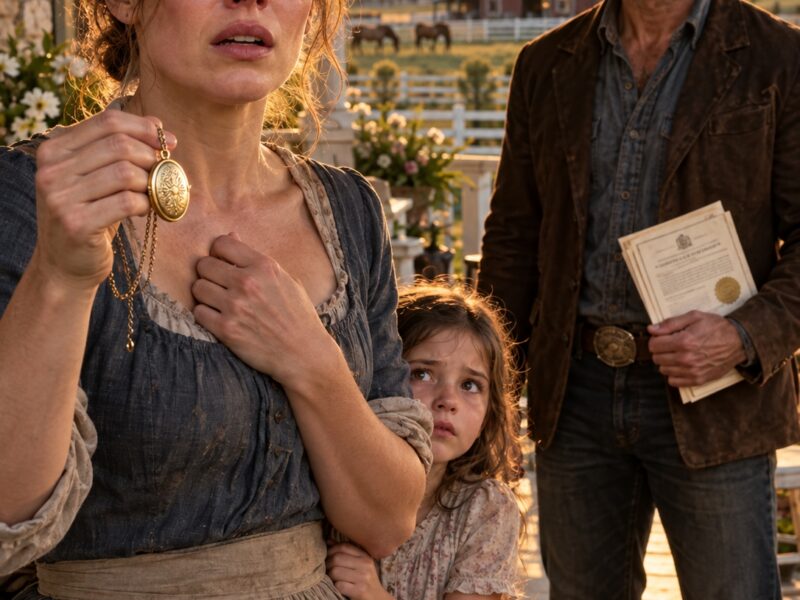
Not even when her five-year-old daughter walked around the barn wearing the one thing Caleb had believed burned with his wife five years earlier.
A small gold locket.
His wedding gift to a dead woman.
The sight of it would stop his heart before Norah ever learned his name.
But by then, Caleb Holt would already have made the first mistake that changed everything.
He would have stayed.
Five years earlier, Caleb had left the ranch with smoke in his lungs and two names he could no longer say aloud.
He had never intended to return.
For the first year, people told him grief would soften.
They were wrong.
The second year, they told him time would make the memories less sharp.
They were wrong about that too.
By the third year, people stopped telling him anything.
Caleb preferred it that way.
He moved twice.
Worked construction in Denver for eleven months, then freight outside Pueblo, then maintenance at a manufacturing plant where nobody knew anything about him except that he arrived early, worked late, and volunteered for every shift other men complained about.
People called him dependable.
What they did not understand was that Caleb was terrified of an empty room.
Work meant noise.
Noise meant not remembering.
Exhaustion meant sleep.
And sleep, when he was lucky, meant no dreams.
So he made himself useful to people he did not love in cities that never became home.
Then, on an ordinary Tuesday morning, a county envelope appeared in his mailbox.
Three forwarding addresses had finally caught up with him.
Caleb almost threw it away.
Instead, he opened it over the kitchen sink.
The letter contained three paragraphs of language designed to make catastrophe sound administrative.
Delinquent property taxes.
Thirty-day final notice.
Public auction.
Holt Ranch.
He read the page twice.
Then he put it on the counter and made coffee.
He told himself the same thing he had been telling himself for five years.
It was land.
Nothing more.
Dirt.
Timber.
Fence wire.
A burned house.
A barn.
A few hundred acres of memories that had already taken enough from him.
Places did not contain people.
Wood did not remember laughter.
Soil did not preserve footsteps.
A house did not become sacred simply because someone you loved had once slept inside it.
He repeated those facts until they almost sounded true.
Seven days later, he was riding toward the ranch.
That told him everything he needed to know about how much he believed himself.
The journey took longer than he remembered.
Maybe the road had changed.
Maybe he had.
Caleb avoided thinking about the difference.
His plan was simple.
Reach the property.
Assess what remained.
Go to the county office.
Pay whatever had to be paid or arrange whatever had to be arranged.
Then leave.
He would not stay overnight.
He would not walk through the ruins unless necessary.
He would not stand where the house had been.
Most importantly, he would not remember.
By late afternoon, he reached the ridge overlooking the Holt property.
And stopped.
The ranch below him was alive.
Caleb remained motionless in the saddle.
For several seconds, his mind refused to understand what his eyes were seeing.
There was a garden along the south side of the house.
Not weeds.
Not wild growth.
A garden.
Rows of beans, squash, tomatoes and late-summer greens spread through dark cultivated soil.
A clothesline ran between two posts.
Work dresses moved in the breeze.
Aprons.
Towels.
And one small child’s shirt.
Smoke rose from the chimney.
A repaired fence divided the lower pasture.
The barn roof had been patched.
Someone had painted the front door.
Blue.
His wife had once wanted a blue door.
Caleb looked away from it immediately.
Then he heard something that hurt more.
A child’s laughter.
It came from behind the barn.
High.
Certain.
Alive.
He had prepared himself for ruins.
For ash.
For silence.
He had spent five years carrying a dead ranch inside his head, and now a child’s shirt was moving in the afternoon sunlight where everything was supposed to be gone.
He almost turned around.
His horse shifted beneath him.
Caleb tightened the reins.
“No,” he whispered.
Whether he was speaking to the horse or himself, he did not know.
He rode down.
The woman who answered his knock was not what he expected.
She was tall, broad-shouldered and strong in the way people become strong when strength is no longer a choice.
Her brown hair was tied loosely at the back of her neck.
There was flour on one sleeve and dirt near the hem of her dress.
She looked at Caleb once, quickly and completely.
His boots.
His coat.
His horse.
His hands.
Then his face.
Her eyes briefly moved toward the road behind him.
Caleb recognized the calculation.
A woman alone did not open a door to a strange man without first determining whether another one was hiding somewhere behind him.
He removed his hat.
“Ma’am.”
She waited.
He had rehearsed several sentences during the ride down the hill.
None of them survived.
“My horse needed water.”
It was not exactly a lie.
She glanced toward the trough.
“Help yourself.”
“Thank you.”
He should have walked away.
Instead she studied his face another second and asked, “Have you eaten?”
The question caught him so completely off guard that he answered honestly.
“Not since before sunrise.”
She opened the door wider.
“I’ve got stew.”
Caleb stared at her.
“You don’t know me.”
“No.”
“That doesn’t concern you?”
“It concerns me plenty.”
Something almost resembling humor touched her mouth.
“But hungry men are usually easier to judge after they’ve eaten.”
Twenty minutes later Caleb sat on his own porch eating another person’s food.
The contradiction lodged somewhere beneath his ribs.
He looked across the yard while he ate.
The porch boards beneath his boots were newer than the ones he remembered.
Someone had reinforced the west railing.
The fence running toward the barn had been rebuilt.
The garden was larger than it had appeared from the ridge.
Nothing was elegant.
Nothing had been done with money to spare.
Everything had been repaired because it needed repairing.
Saved because replacing it was impossible.
Made useful again.
The county notice seemed heavier inside his coat.
The woman came outside.
“Coffee?”
“Yes, ma’am.”
“Norah.”
He looked up.
“My name’s Norah. You can stop calling me ma’am.”
He nodded.
“Caleb.”
Only his first name.
It felt like another lie.
She poured his coffee.
“Passing through?”
He looked toward the hills.
“Something like that.”
That was when Chrissy appeared.
She came around the barn carrying a small wooden bucket, walking with the serious determination of someone who had important work and limited patience for adults.
Behind her walked an enormous ram.
Caleb had seen prize livestock smaller than him.
The ram stopped the instant he noticed Caleb.
His head lifted.
His body went still.
Then he took three deliberate steps and positioned himself directly between Caleb and the child.
Caleb lowered his coffee.
Chrissy stopped.
She studied him openly.
“I’m Chrissy.”
Caleb nodded.
“Caleb.”
She pointed to the ram.
“That’s Solomon.”
“I gathered.”
“He doesn’t like you yet.”
Caleb glanced at Solomon.
“I gathered that too.”
Chrissy seemed satisfied.
“He didn’t like Pastor Reynolds until the third day.”
“Is that good?”
“He likes him now.”
She thought about something.
“He never liked Mr. Hennessy.”
Norah, collecting the empty bowl, said, “Chrissy.”
“What?”
“Don’t frighten our guest.”
Chrissy looked genuinely confused.
“I’m not.”
She turned back to Caleb.
“Mr. Hennessy left.”
Caleb looked at Solomon.
The ram stared back.
“Smart man?”
“Solomon was right,” Chrissy said solemnly.
For the first time in longer than Caleb could remember, a laugh nearly escaped him.
He stopped it before it did.
But Norah saw.
Something in her expression changed.
Only slightly.
And Caleb suddenly became aware of how long it had been since anyone had watched him almost smile.
He stood.
“Thank you for the meal.”
Norah nodded.
“You’re welcome.”
He should have mounted his horse.
Instead he heard himself ask, “Is there somewhere nearby a man can sleep?”
Norah looked toward the road.
“Town’s three hours if you’re riding slow.”
“I need to go to the county office tomorrow. Land matter.”
The words tightened his chest.
She looked back at him.
“We have a spare room.”
Caleb hesitated.
“I can pay.”
“No.”
“At least let me—”
“One night doesn’t require a contract.”
Her tone made clear that the discussion was finished.
Chrissy nodded approvingly.
“Solomon sleeps outside that window.”
Caleb looked at the ram.
“Comforting.”
“He’ll know if you try anything.”
“Even more comforting.”
That night Caleb lay awake listening to life move through the house that should have been dead.
The stove ticked as it cooled.
Wind moved through plants outside the southern wall.
Chrissy talked in her sleep down the hall.
At one point she laughed.
Caleb closed his eyes.
The sound went through him like a blade.
His son had laughed in his sleep.
He had forgotten that.
Or rather, he had buried it so deeply that remembering felt like being told something new.
Outside his window Solomon settled against the wall.
Slow breathing.
Occasional movement.
A guard choosing his post.
Caleb stared at the ceiling.
The county notice sat inside his coat on the chair.
One night, he reminded himself.
Tomorrow he would handle the taxes.
Then leave.
He repeated it until morning.
At dawn, he discovered his horse had thrown a shoe.
Caleb stood in the stable staring at the hoof.
For a long moment, he said nothing.
Then, against every reasonable instinct, he almost laughed.
Of course.
He found Norah at the stove.
“Horse threw a shoe.”
She turned.
“Bad?”
“Can’t ride him.”
“Farrier comes through Tuesdays.”
“What day is it?”
“Monday.”
Caleb stared.
Norah returned to the skillet.
“Sometimes he comes Wednesday.”
Caleb exhaled.
She put a plate on the table.
“Sit.”
After breakfast, Caleb noticed the barn door hanging unevenly.
He told himself he was only looking.
Then he noticed the lower hinge was failing.
Ten minutes later he was back in the kitchen.
“Do you have tools?”
Norah looked up.
“For?”
“Barn hinge.”
“You’re a guest.”
“I don’t like being useless.”
Her eyes remained on him a second longer than necessary.
Then she took a tin toolbox from a shelf.
“That’s fortunate,” she said. “There’s enough uselessness in the world already.”
By midmorning the hinge was repaired.
By noon Caleb had fixed a section of fence.
By early afternoon Norah handed him a basket.
“The beans need picking.”
He looked at it.
“I thought I was fixing things.”
“You’ve been promoted.”
Chrissy was already in the garden.
Caleb knelt beside her.
He reached for a pale bean.
“Don’t.”
His hand froze.
Chrissy pointed.
“He’s sleeping.”
“The bean?”
“Yes.”
Caleb withdrew his hand.
“My apologies.”
“The ones over there are ready.”
She worked quietly for a moment.
“Mama says this side grows slower because the oak shades it.”
Caleb looked toward the enormous tree.
“I asked the oak if it feels bad.”
“What did it say?”
“Nothing.”
“That seems rude.”
Chrissy smiled.
“The oak listens. You can tell because the leaves move after you talk.”
Caleb looked at her.
Children had once made him uncomfortable after the fire.
Not because he disliked them.
Because every child of approximately the right age became a calculation.
His son would be this tall.
His son would be starting school.
His son might have lost his first tooth.
His son would know how to—
Caleb stopped those thoughts before they finished.
Chrissy moved farther down the row.
“The creek’s past those trees. There’s a thinking rock there.”
“A what?”
“A thinking rock.”
“What do you think about?”
She shrugged.
“Things.”
“Helpful.”
“Solomon can’t go there.”
“Why?”
“People thoughts only.”
Caleb glanced toward the pasture.
“What does Solomon think about?”
“Mostly fences.”
That did it.
A quiet laugh escaped him.
Chrissy grinned.
Then she leaned forward to reach beneath a plant.
Sunlight caught something at her throat.
Gold.
Caleb stopped breathing.
The basket slipped from his fingers.
Chrissy looked over.
“What’s wrong?”
He did not answer.
A small oval locket rested against her collarbone.
Thin gold chain.
Tiny scratch near the hinge.
A nearly invisible dent along the bottom edge.
Caleb knew every mark.
He had bought that locket in a jewelry store in Colorado Springs seven years earlier.
He had stood at the glass counter for twenty minutes because he worried the gold was too bright for a woman who preferred muddy boots to expensive dresses.
He had given it to his wife the morning they married.
She had worn it every day afterward.
Including the day she died.
“That necklace.”
His voice barely worked.
Chrissy touched it.
“This?”
“Where did you get it?”
“Mama found it.”
“Where?”
“In the garden.”
Caleb stared at the soil.
“When?”
“When we first came.”
She smiled.
“Mama said the ground gave it to us because it knew we were staying.”
Something inside Caleb folded.
He stood too quickly.
“I’ll be back.”
“Where are you going?”
He could not answer.
He walked until the house disappeared behind him.
At the far fence line he stopped.
His hands were covered in soil.
For five years he had imagined the fire consuming everything.
But it had not.
Something had survived.
Something small enough to disappear into dirt.
Something that had waited beneath the ground until another woman arrived and planted a garden above his dead wife’s home.
Caleb pressed both hands against the fence.
He wanted to be angry.
At Norah.
At the land.
At God.
At himself.
Instead he felt something worse.
He felt grief moving again.
For five years it had been frozen.
Now it had found blood.
When he returned, Chrissy was still picking beans.
She did not ask why his eyes were red.
Children sometimes possessed a mercy adults had to be taught.
Caleb picked up his basket.
They finished the row.
He had told himself he would leave when the farrier came.
For the first time, he understood that he might be lying.
That afternoon, another woman came through the gate.
Caleb was repairing a leaning fence post when he heard footsteps.
The woman stopped when she saw him.
Her face changed.
Recognition.
Then anger.
“So you finally came back.”
Caleb straightened.
“Excuse me?”
“Five years.”
Her voice trembled.
“Five years, and now you walk back onto this ranch?”
Caleb stared at her.
“I think you’ve mistaken me for—”
“She was pregnant.”
The woman stepped closer.
“Do you understand that? She was carrying your child, Calvin, and you disappeared.”
Caleb’s hand tightened around the fence post.
Calvin.
He said nothing.
The woman mistook his silence for guilt.
“I found her that first winter. February. No proper heat. Barely any food. Your family had thrown her out because you were gone and they said the baby wasn’t their responsibility.”
Caleb’s stomach turned.
She kept going.
“She rebuilt this place with a child on her hip. Every fence you see? Norah. That garden? Norah. The roof? Norah. She worked until her hands split because nobody came to help her.”
Caleb looked toward the house.
A shape moved behind the window.
Chrissy.
“She waited?”
“For a while.”
The woman’s voice hardened.
“Then she stopped waiting and started surviving.”
Norah appeared around the barn.
“Lena?”
The woman turned.
The instant she saw Norah’s face, she stopped.
Her gaze moved back to Caleb.
Then Norah.
Then Caleb again.
“Oh God.”
Norah’s shoulders dropped slightly.
“Lena.”
“I thought—”
“I know.”
“I thought he was Calvin. From behind, the way he was standing…”
Lena covered her mouth.
Caleb understood.
Norah’s husband.
Chrissy’s father.
Gone.
The story suddenly rearranged itself.
Norah had not simply occupied an abandoned ranch because it was convenient.
She had arrived there already abandoned by someone else.
“I am so sorry,” Lena whispered.
She was speaking to Norah.
Not Caleb.
Norah crossed the yard.
She squeezed Lena’s hand once.
“Go home.”
“Norah—”
“It’s all right.”
It clearly was not.
Lena left.
Caleb remained beside the fence post.
Norah looked at the hole he had dug.
“The bottom needs another six inches.”
He stared at her.
She pointed.
“Ground’s soft there. First storm will lean it again.”
Then she walked away.
No explanation.
No embarrassment.
No invitation to discuss what he had heard.
Caleb drove the post deeper.
He understood the message.
Her past was not payment for his labor.
Her pain was not his simply because he had overheard it.
That evening, another man came through the gate.
Unlike Lena, he did not knock.
He walked as though he believed the property owed him entry.
Norah stepped onto the porch.
“Derek.”
No surprise.
Only exhaustion.
Caleb remained near the barn.
Derek was unsteady.
Not drunk enough to fall.
Drunk enough to enjoy cruelty.
“Been four months.”
Norah crossed her arms.
“You said six.”
“Things change.”
“They always seem to change when you’re broke.”
Derek smiled.
“I need money.”
“No.”
His eyes moved toward the house.
Caleb saw Norah notice.
Everything about her body changed.
“Don’t.”
Derek’s smile widened.
“Girl’s got Calvin’s blood.”
Norah stepped down from the porch.
“Don’t you say her name.”
“I didn’t.”
“You don’t look at that house.”
“Judge might.”
Silence.
Derek leaned closer.
“A blood uncle. Only family she’s got on her father’s side. Maybe a judge decides she deserves family.”
Norah went pale.
Caleb felt something cold move through him.
Norah entered the house.
She returned with cash.
Derek counted it slowly in front of her.
Then he left.
Caleb waited until the road was empty.
“He comes back?”
Norah did not look at him.
“Every few months.”
“And you pay him.”
“When I can.”
“Why?”
This time she looked at him.
“Because men like Derek don’t need to be right. They only need enough money and enough time to make your life impossible.”
She went inside.
That night the kitchen was quiet.
Norah sat at the table holding a coffee cup with both hands.
She looked tired in a way Caleb had not seen before.
Not physically tired.
Finished.
For five years she had been solving the next problem.
Roof.
Food.
Winter.
Chrissy.
Money.
Derek.
Fences.
Livestock.
Tomorrow.
People mistook competence for invulnerability because it made them feel less guilty about leaving capable people alone.
Caleb understood that suddenly.
He stood.
Norah looked up.
He carried the dishes to the basin.
“You don’t have to.”
“I know.”
He washed them anyway.
Plates.
Pots.
Cups.
The kitchen filled with the small sounds of water and ceramic.
Norah watched his back.
After several minutes she finished her coffee.
“Good night, Caleb.”
“Good night.”
Neither mentioned the dishes the next morning.
But something had shifted.
The farrier came Tuesday.
Caleb’s horse was ready by noon.
At one fifteen, Caleb repaired the water trough.
At three, he climbed onto the small barn roof.
At sunset, he was still there.
Norah stood below.
“Your horse is fixed.”
“I noticed.”
“You said you needed the county office.”
“It’ll be there tomorrow.”
Norah looked up at him.
“So will the roof.”
“Not if it rains.”
“There isn’t a cloud in the sky.”
Caleb glanced upward.
“Could change.”
Her mouth almost smiled.
“You’re a terrible liar.”
He drove another nail.
“I’m improving.”
He stayed.
Days began accumulating.
Not enough to call them anything.
Enough to notice.
Chrissy started leaving small jobs for him.
A loose wheel on her cart.
A broken latch.
A wooden stool Solomon had apparently attacked for reasons known only to Solomon.
Norah stopped asking whether Caleb wanted breakfast.
His plate simply appeared.
Caleb learned that Norah hummed when she cooked but only when she thought nobody was listening.
Norah learned Caleb woke before dawn.
Chrissy learned he could carve animals from scraps of pine.
Solomon learned Caleb carried apple slices in his pocket.
No one discussed this corruption.
One morning Chrissy announced over oatmeal, “Solomon moved.”
Caleb looked up.
“Where?”
“Outside your window.”
“I thought he was already outside my window.”
“No. Before he was watching you.”
Caleb glanced toward Norah.
“And now?”
“Now he sleeps there.”
Chrissy spooned oatmeal into her mouth.
“He decided.”
“Decided what?”
“About you.”
Caleb waited.
Chrissy looked mildly surprised that an adult needed everything explained.
“That you’re all right.”
Norah hid a smile behind her coffee.
Chrissy looked at Caleb.
“When are you leaving?”
The room changed.
Norah’s cup stopped halfway to her mouth.
Caleb looked at her.
She was already looking at him.
“I don’t know.”
Chrissy nodded.
“Solomon doesn’t think you’re leaving.”
“Does Solomon know everything?”
“No.”
She considered.
“Mostly.”
Later that morning Norah drove into town.
At the general store she was reaching for flour when she heard two men near the window.
“Holt place goes to auction next week.”
Her hand stopped.
“Whoever’s squatting there better start packing.”
The second man laughed.
“That Bennett woman?”
“Five years she’s been there.”
“No papers.”
“No claim.”
“Doesn’t matter how many boards she fixed. Someone buys it, she goes.”
Norah slowly lowered the flour onto the counter.
The first man noticed her.
His face changed.
The conversation died.
Norah looked at the shopkeeper.
“I’ll take this.”
No one apologized.
That was almost worse.
She paid.
Loaded the wagon.
Sat holding the reins.
For five years she had known this possibility existed.
She had simply refused to give it a shape.
She had told herself abandoned land was different from stolen land.
She had asked questions when she first arrived.
The property owner was gone.
Taxes were accumulating.
Nobody knew whether he would return.
She had never claimed legal ownership.
She had simply needed somewhere to survive.
Then survival became a season.
Then a year.
Then Chrissy learned to walk there.
Then the garden expanded.
Then the ranch stopped feeling borrowed.
Norah drove home.
Caleb saw her expression immediately.
He helped unload.
“What happened?”
“Nothing.”
It was clearly something.
But he did not press.
That afternoon Caleb walked to the far end of the property.
He had avoided it since arriving.
Past the garden.
Past the barn.
Past the pasture.
Until the grass changed.
The old foundation was nearly gone.
Wildflowers grew through the stones.
One corner remained intact.
Caleb sat on it.
He had laid those stones with Rebecca.
His wife.
Rebecca had rejected the first four stones because she claimed they “looked dishonest.”
Caleb had laughed.
“Stones can’t be dishonest.”
“These can.”
“How?”
“I don’t know yet.”
She had eventually selected each cornerstone herself.
Three years later their son had played on that floor.
Two years after that, the floor burned.
Caleb closed his eyes.
Footsteps approached through the grass.
Norah stopped when she saw him.
“What was here?”
He opened his eyes.
“My house.”
Norah looked around.
She understood immediately.
“The fire.”
“Yes.”
She hesitated.
Then sat beside him.
Neither spoke.
The sun lowered.
For once Norah did not try to repair anything.
And Caleb realized that was exactly why he could sit beside her.
That night, after Chrissy went to bed, Caleb placed the county papers on the kitchen table.
Norah came in carrying two cups of coffee.
She saw the documents.
Stopped.
Caleb remained standing.
“I should’ve shown you these the first day.”
Norah set the cups down.
Her eyes moved to the name.
Caleb Holt.
Then the property description.
Then the auction date.
She did not touch the papers.
Caleb forced himself to speak.
“This ranch belongs to me.”
Silence.
Not shock.
Something colder.
Understanding.
He continued.
“I left after the fire. Never came back. I kept the deed but stopped dealing with the taxes. The county finally found me.”
Norah looked at him.
“When?”
“The letter?”
“Yes.”
“About two weeks ago.”
“And the auction?”
“Next week.”
Her eyes dropped to the papers.
Caleb watched her see the last several days differently.
The meal.
The spare room.
The garden.
The repairs.
The conversations.
The burned foundation.
Everything.
“You knew.”
“Yes.”
“When I fed you?”
“Yes.”
“When I gave you that room?”
“Yes.”
“When Chrissy—”
“Yes.”
Norah’s jaw tightened.
“Every day.”
It was not a question.
Caleb answered anyway.
“Yes.”
She stood.
“This is my home.”
“I know.”
“No.”
Her voice sharpened.
“You know it’s property. I know it’s home.”
Caleb absorbed that.
Norah pointed toward the hallway.
“My daughter was born on that floor.”
Her voice cracked for the first time.
“I planted that garden because we were hungry. I fixed the roof because rain fell onto Chrissy’s bed. I built that fence while she slept in a basket because I couldn’t afford someone to watch her.”
Caleb said nothing.
“I buried animals here. I survived winters here. I taught my daughter to read at this table.”
She pressed her palm against the wood.
“So don’t tell me you know.”
“I came here expecting ruins.”
Norah laughed once.
There was no humor in it.
“I’m sorry to disappoint you.”
“You didn’t.”
That stopped her.
Caleb pulled out the chair.
He sat.
For the first time since arriving, he stopped protecting himself.
“My wife’s name was Rebecca.”
Norah did not move.
“Our son’s name was Eli.”
The name nearly failed him.
He forced it out.
“He was three.”
Norah slowly sat again.
Caleb looked at the table.
“The fire started at night.”
His hands tightened.
“I got out.”
Silence.
“They didn’t.”
Norah’s anger remained.
But now it had somewhere else to stand.
Caleb told her about Rebecca.
How she laughed at inappropriate moments.
How she hated roses because everyone expected women to like them.
How she could repair a saddle better than he could.
How she had worn a gold locket every day for four years.
He told her about Eli.
How the boy had discovered his own name and spent three weeks announcing it to everyone.
“Eli,” he would say.
“Yes, that’s you.”
“Eli.”
“I know.”
“Eli!”
As though identity were the greatest discovery in human history.
Caleb smiled when he told it.
Then the smile disappeared.
He told Norah how he had gotten outside during the fire.
How he had turned around expecting them behind him.
How a human life could split into before and after in less than five seconds.
He told her he had spent five years moving.
Working.
Avoiding silence.
Keeping the ranch deed because selling felt like killing them again.
Ignoring the taxes because paying them meant admitting the ranch still existed without Rebecca and Eli.
“I thought I came back to save the land from auction.”
He looked around the kitchen.
“I think I came back to bury it.”
Norah said nothing for a long time.
Then she stood.
She walked into Chrissy’s room.
When she returned, the gold locket rested in her palm.
Caleb’s face changed.
“Chrissy cried when I took it tonight.”
Norah set it on the table.
“I told her it belonged to someone else.”
Caleb stared.
“I found it the first spring. Right where the beans grow now.”
He picked it up.
Rebecca’s locket.
Still warm from Chrissy’s skin.
Five years of grief collapsed into something small enough to fit inside his hand.
Norah whispered, “I’m sorry.”
Caleb turned it over.
The scratch.
The dent.
Everything.
Then he placed it on the table.
And pushed it toward Norah.
She stared at him.
“What are you doing?”
“Give it back to Chrissy.”
“Caleb.”
“The ground gave it to her.”
Norah’s eyes filled.
“It was your wife’s.”
“I know.”
“You don’t have to give it away.”
Caleb looked toward the dark window.
“I’m not.”
Norah waited.
“Some things belong where they land.”
She closed her fingers around the locket.
The back door opened.
Chrissy entered.
Solomon stopped at the threshold behind her.
The girl looked at her mother.
Then Caleb.
Then Norah’s closed hand.
“Are you why Mama looks like that?”
Caleb nodded.
“Yes.”
Chrissy studied him.
Then said, “Solomon looked like that when he came.”
Caleb blinked.
“Like what?”
“All wrong inside.”
Norah closed her eyes.
Chrissy continued.
“He lost his mama.”
She looked toward Solomon.
“He didn’t know where he belonged.”
Then back at Caleb.
“He stayed.”
A pause.
“Now he’s very bossy.”
Caleb laughed through something dangerously close to tears.
Chrissy turned toward the door.
“I think staying helped.”
Then she left.
Solomon remained.
The ram stared at Caleb for one long second.
Then followed her.
Before dawn, Caleb walked to the old foundation.
He sat on Rebecca’s cornerstone.
For a long time, he watched darkness slowly become morning.
Then he said her name.
“Rebecca.”
The sound broke something open.
He swallowed.
“Eli.”
Five years.
Five years without saying either name aloud.
He cried without hiding it.
There was nobody there to comfort him.
That was all right.
Some grief needed witnesses.
Some grief needed privacy.
When the sun rose, Caleb stood.
A wildflower grew through the floor where his son had once played.
He looked at it for a long moment.
Then walked toward the house.
He heard Derek before he reached the barn.
Loud.
Unsteady.
Angry.
Caleb stopped inside the barn doorway.
Norah stepped onto the porch.
Her body automatically positioned itself between Derek and the house.
“I told you last time. There’s nothing here for you.”
Derek smiled.
“Things changed.”
“No.”
“Whole town knows about the auction.”
Norah went still.
Caleb understood.
She had known.
That was what had happened in town.
Derek stepped closer.
“Few days from now, you’re homeless.”
Norah said nothing.
“And when that happens…”
His eyes moved toward the window.
Chrissy’s shadow passed behind the curtain.
Derek smiled.
“…maybe I finally introduce myself properly to my niece.”
“Don’t.”
“A judge might prefer blood family to a homeless squatter.”
Norah’s face lost its color.
Derek walked toward the porch.
One step.
Then another.
Caleb stepped out of the barn.
He crossed the yard slowly.
Derek noticed him.
“Who the hell are you?”
Caleb stopped between him and Norah.
“This is family business.”
Caleb looked at Derek.
“No.”
Derek scoffed.
“No?”
“I’m the owner of this land.”
Derek’s expression changed.
Caleb continued.
“And that woman is my wife.”
Norah’s breath caught behind him.
“This is our home.”
Derek stared.
Caleb stepped closer.
“And if you ever threaten that child again, a judge will be the safest person you have to worry about.”
Derek’s mouth opened.
Nothing came out.
The auction.
The blood claim.
The threat.
Everything he had carried through the gate disappeared.
He spat into the dirt.
Then left.
Nobody moved until he was gone.
Caleb turned.
Norah stood on the porch.
She stared at him.
“Your wife?”
Caleb’s pulse suddenly felt louder than Derek had been.
He could have taken it back.
Called it strategy.
Said he needed Derek to believe something.
Instead he looked at the woman who had rebuilt a dead man’s ranch while raising an abandoned child.
The woman who had fed him without knowing his name.
Who had sat beside his grief without trying to fix it.
Who had turned the ground above his worst memory into a garden.
“If you’ll have it that way.”
Norah stared at him.
“I didn’t spend five years building a home to belong to a man who isn’t sure.”
Caleb answered immediately.
“I’m sure.”
She searched his face.
Norah trusted slowly because life had taught her what fast promises cost.
Caleb let her look.
Finally she nodded.
Once.
It was not a wedding.
Not yet.
It was not forgiveness.
It was not even a promise that everything would work.
It was simply permission for tomorrow to exist.
Sometimes that was more difficult than love.
That afternoon Caleb rode into town.
At the county office he paid every dollar of delinquent tax.
Penalties included.
The clerk stamped the paperwork.
The auction was canceled.
The Holt ranch remained intact.
On the ride home Caleb reached the ridge where he had first stopped days earlier.
The ranch spread below him.
Smoke from the chimney.
Sheep in the field.
A blue front door.
A small figure running across the yard.
Another larger figure standing on the porch.
For five years Caleb had believed coming home meant returning to what he had lost.
He had been wrong.
Sometimes home was what remained after loss.
Sometimes it was what someone else built in the ruins.
He rode down.
Norah was cooking when he entered.
She glanced over.
Caleb nodded.
Paid.
Done.
She understood.
No speech was necessary.
Chrissy was standing at the Dutch door arguing with Solomon.
“You already ate.”
Solomon stared at her.
“No.”
The ram remained motionless.
“Looking at me like that won’t change the answer.”
Caleb hung his coat.
Chrissy looked at him.
“Tell him.”
“I’m staying out of it.”
“You’re supposed to be helpful.”
“I’ve reconsidered.”
Norah laughed.
The sound filled the kitchen.
Caleb stopped.
For one second he was somewhere else.
Rebecca laughing.
Eli running across a floor that no longer existed.
The memory hurt.
But something had changed.
It no longer demanded that the present disappear.
Caleb sat at the table.
Norah placed a bowl in front of him.
The same blue enamel cup stood beside it.
The important visitor’s cup.
Caleb touched the chipped rim.
“You know,” he said, “I’ve been here long enough to get a regular cup.”
Chrissy shook her head.
“No.”
“Why?”
“You’re still important.”
Caleb looked down.
Norah turned toward the stove, giving him the privacy not to answer.
Winter came.
It was difficult.
Of course it was.
Real lives did not become easy simply because people chose each other.
The smaller barn roof failed during the first heavy snow.
Two sheep got sick.
Derek sent one letter threatening legal action and disappeared when Caleb’s attorney answered it.
Chrissy developed an obsession with spelling and spent three weeks correcting everyone’s speech.
Solomon broke a gate.
Then appeared personally offended by the accusation.
Caleb woke from nightmares.
Sometimes Norah heard him walking outside at two in the morning.
She never chased him.
She left coffee on the stove.
Caleb learned that Norah sometimes sat at the kitchen table after everyone slept, staring at bills.
He never took them from her.
He sat down beside her.
They learned the difference between rescuing someone and standing with them.
Spring arrived slowly.
The first warm morning, Norah went into the garden before breakfast.
The soil was dark and cold.
She knelt at the first row and began turning it.
Six years earlier she had dug into that same ground desperate, pregnant and alone.
Her hands had struck metal.
She had pulled out a gold locket.
At the time she had taken it as a strange blessing.
Evidence that the land had held another life before hers.
Now Chrissy wore that locket every day.
Not because Rebecca had been forgotten.
Because she had not.
Norah heard boots behind her.
Caleb came into the garden.
He did not say good morning.
He simply knelt in the next row.
They worked.
Birds began calling from the trees.
Sunlight reached across the field.
Chrissy stood near the fence explaining boundaries to Solomon.
“You can stand there.”
Solomon stepped forward.
“No.”
Another step.
“That’s the boundary.”
Solomon continued.
“Do you understand what boundary means?”
Caleb glanced at Norah.
Norah smiled.
“He understands.”
“Then why—”
“He disagrees.”
Chrissy groaned.
Caleb laughed.
Norah sat back on her heels.
He was already looking at her.
There were things they had still never said.
Maybe they would.
Maybe some would take years.
Caleb had once believed healing meant reaching a morning when Rebecca and Eli no longer hurt.
He knew better now.
Healing was not forgetting the dead.
It was allowing yourself to love something that had survived them.
Norah had once believed strength meant needing nobody.
She knew better too.
Strength was knowing you could survive alone and still choosing not to.
Caleb leaned across the turned earth.
He kissed her.
Quietly.
No grand declaration.
No witnesses that mattered.
Except Chrissy.
And unfortunately Solomon.
Chrissy gasped.
“Solomon.”
Norah laughed against Caleb’s mouth.
“They’re doing the thing.”
Solomon continued examining the fence.
Chrissy lowered her voice.
“I think that means he’s staying.”
The ram did not look up.
Caleb pulled back just enough to look at Norah.
“Apparently Solomon knew before we did.”
“He usually does.”
Caleb looked down at his hands.
Soil filled the lines of his palms.
Five years earlier those hands had clawed at burning timber trying to reach people already gone.
For years afterward, he had hated them for failing.
Now those same hands were buried in spring soil.
Planting.
Norah returned to her row.
Caleb returned to his.
The old foundation remained at the far end of the property.
They never built over it.
Wildflowers covered most of the stones now.
Sometimes Caleb went there alone.
Sometimes Norah joined him.
Once, Chrissy asked who Rebecca and Eli were.
Caleb told her.
All of it that a child could understand.
Chrissy listened seriously.
Then she touched the locket at her throat.
“Do you want it back?”
Caleb looked at the small gold oval.
For just a second, he could see Rebecca fastening it around her neck on their wedding morning.
Then he saw Chrissy.
“No.”
“Are you sure?”
“Yes.”
She considered that.
“Okay.”
Then she ran toward the barn because Solomon was doing something unacceptable with a bucket.
Caleb watched her go.
Loss had once convinced him that loving what remained was betrayal.
He understood now that grief had lied.
The ranch did not belong to Rebecca because she had died there.
It did not belong to Caleb because his name was printed on a deed.
It did not belong to Norah simply because she had saved it.
Not in the way that mattered.
A home belonged to the people who kept choosing it.
The ones who repaired the fence after winter.
Who washed the supper dishes when someone else had nothing left.
Who sat beside a person at the ruins without demanding a confession.
Who planted beans above buried gold.
Who stayed.
Late that afternoon, Caleb walked toward the old foundation.
The sun was low.
He sat on Rebecca’s cornerstone.
For a while, he said nothing.
Then he told her about Chrissy’s spelling obsession.
About Solomon destroying the gate.
About Norah.
It still felt strange sometimes, talking to the dead.
But silence had nearly killed him once.
He was finished worshiping it.
When he stood, he noticed a new wildflower growing between two stones.
He touched one petal.
Then he heard Norah calling from the house.
“Caleb!”
He turned.
Supper.
Behind her, Chrissy was waving both arms because apparently calling once was insufficient.
Solomon stood beside her with the expression of a creature who had been waiting for Caleb all day despite having seen him twenty minutes earlier.
Caleb looked once more at the foundation.
“I have to go.”
The words left his mouth naturally.
He smiled when he realized what he had said.
Not goodbye.
Not I’m sorry.
Not I should have saved you.
Just—
I have to go.
Because someone was waiting.
Caleb walked toward the house.
Toward the blue door.
Toward the woman who had once unknowingly fed the owner of the land she called home.
Toward the child wearing gold that had survived a fire.
Toward the ridiculous ram guarding a family that had assembled itself out of abandoned things.
Behind him, the old stones remained beneath the wildflowers.
Ahead of him, light spilled from the kitchen windows.
Five years earlier Caleb Holt had ridden away believing the fire had taken his home.
Five years later he returned intending only to stop strangers from buying its ruins.
Instead, he found a woman had planted a garden over his grief.
He had come back to bury the past.
But someone had already put seeds in the ground.
And now, with dirt beneath his boots and supper waiting inside, Caleb finally understood something Rebecca would probably have understood before he did.
The dead did not need him to remain broken in order to prove they had been loved.
He climbed the porch steps.
Chrissy opened the door before he reached it.
“You’re late.”
“By thirty seconds.”
“Still late.”
“Is Solomon keeping records?”
“Yes.”
“Of course he is.”
Caleb stepped inside.
Norah looked over from the stove.
Their eyes met.
Nothing dramatic happened.
No music.
No perfect ending.
Just a tired woman smiling at a tired man in a kitchen both of them had once believed belonged to someone else.
Caleb closed the door behind him.
Outside, evening settled over the ranch.
The garden darkened.
The old foundation disappeared into shadow.
And beneath the soil, roots continued quietly reaching through the earth where fire had once taken everything.
Not erasing what had happened.
Not replacing anyone.
Simply growing around it.
Caleb had spent five years believing that moving forward meant leaving something behind.
He finally understood.
Sometimes moving forward meant carrying it differently.
And for the first time since the night the sky turned red, Caleb Holt was not afraid of tomorrow.









