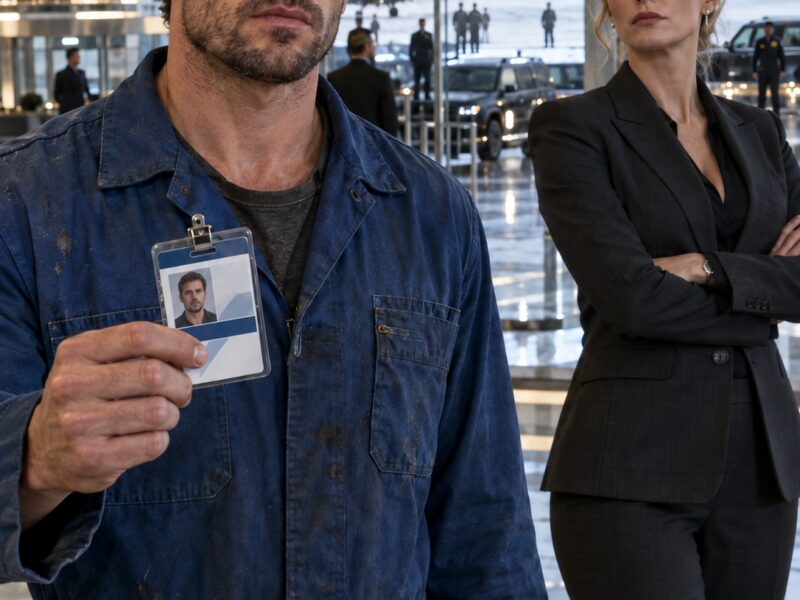
She Fired a Quiet Factory Worker for Breaking Protocol—Three Military Helicopters Landed Before Lunch

At 10:17 on a Thursday morning, Victoria Hail fired the only man in the building who could save her company from a multimillion-dollar disaster.
At 11:43, three military helicopters appeared over the trees.
By noon, a United States Navy commander was standing in her lobby asking one question.
“Where is Dr. Daniel Mercer?”
Victoria did not answer immediately.
Because Daniel Mercer was not a doctor.
At least, not according to the file sitting on her desk.
According to that file, Daniel Mercer was a thirty-four-year-old line technician assigned to Bay 7 at Harrove Industrial in western Pennsylvania. He earned an hourly wage. He wore faded navy coveralls. He drove a ten-year-old Ford F-150 with a starter that sometimes needed two tries.
His employment application listed his previous work vaguely as “general engineering consulting.”
No prestigious companies.
No impressive titles.
No active references.
No advanced credentials anyone at Harrove knew about.
And less than two hours earlier, Victoria had looked Daniel directly in the eyes and told him to surrender his badge.
Now a Navy commander had called him Doctor.
And outside Victoria’s office window, rotor wash was blowing January snow across the parking lot like smoke.
Something was very wrong.
The problem was that Victoria had not yet realized exactly how wrong she had been.
Daniel Mercer had been arriving at Harrove Industrial at 6:47 every morning for two years, three months, and eleven days.
Not 6:45.
Not 6:50.
6:47.
His shift officially began at seven.
Thirteen minutes gave him exactly enough time to cross the parking lot, change into his coveralls, walk to Bay 7, and listen to whichever machine had spent the night trying to tell someone it was about to fail.
Daniel believed machines spoke.
Not literally.
They spoke through vibration.
Heat.
Pitch.
Pressure curves.
Tiny delays between movements that should have happened simultaneously.
A bearing beginning to complain sounded different from a bearing already dying.
A hydraulic system losing pressure had a rhythm.
An electrical fault could sometimes be felt through a housing before a diagnostic terminal knew what to call it.
Most technicians looked at screens.
Daniel listened.
He had learned a long time ago that systems usually whispered before they screamed.
People did too.
That Tuesday morning, the HFP7 hydraulic forming press was already screaming.
Three supervisors stood around it.
One had a phone pressed to his ear.
Another was studying a diagnostic screen as though staring harder might change the error code.
Randall Brock, the floor supervisor, spotted Daniel approaching and waved him over.
“We’ve got a servo fault.”
Daniel set down his coffee.
“How long?”
“Night shift says it started around four.”
“Pressure?”
“Won’t hold.”
“Temperature?”
“Normal.”
“Noise?”
Randall blinked.
“What?”
Daniel was already kneeling.
“What did it sound like before it shut down?”
“I don’t know.”
Daniel looked at him.
Randall sighed.
“I wasn’t here.”
Daniel pulled a flashlight from his chest pocket.
The HFP7 mattered.
It formed titanium bracket assemblies for one of Harrove’s defense contracts, and the current production order had thirty-six hours remaining before the delivery window closed.
The manufacturer believed the servo motor had failed.
Replacement time: at least three days.
Harrove did not have three days.
“Carter’s coming from Pittsburgh,” Randall said. “Maintenance engineer. Should be here this afternoon.”
Daniel held out his hand.
“Five-millimeter hex key.”
Randall stared at him.
“What?”
“Five-millimeter hex key.”
“Daniel, Carter is already—”
“Randall.”
Something in Daniel’s voice ended the discussion.
Randall handed him the tool.
Daniel removed the first access panel.
Then the second.
Then the third.
Pete Callaway stopped working at the neighboring station and wandered closer.
Pete was six-foot-two, broad through the shoulders, and constitutionally incapable of witnessing anything interesting without becoming involved.
“What does the computer say?” he asked.
“Servo motor.”
“So it’s the servo motor?”
Daniel reached deeper into the housing.
“No.”
Pete grinned.
“Of course it isn’t.”
Daniel checked two pressure lines.
Then three.
Then he did something Randall would later describe to management as either genius or insanity.
He placed his bare palm against the servo housing.
And closed his eyes.
Twelve seconds passed.
Daniel opened them.
“Pressure relief valve.”
Randall frowned.
“The diagnostic says—”
“Microfracture in the brass valve seat.”
“You can tell that by touching it?”
“I can tell because the pump is loading correctly but the return vibration is wrong.”
Randall stared.
Daniel pointed toward the diagnostic screen.
“The fault code is secondary. It thinks the servo isn’t reaching threshold because the system can’t build enough pressure. The servo is fine.”
“So what do we do?”
Daniel stood.
“I reshape the valve seat temporarily.”
“Can you do that?”
“Yes.”
“How long?”
“Forty minutes.”
Randall looked at the machine.
Then Daniel.
Then the clock.
“You’re sure?”
“No.”
Randall’s face changed.
Daniel almost smiled.
“I’m never sure. I’m correct often enough that people confuse the two.”
Forty-two minutes later, the HFP7 restarted.
Pressure climbed.
Held.
The fault code disappeared.
The machine resumed forming titanium.
At 8:30, Harrove Industrial was back on schedule.
Nobody applauded.
Nobody from management came downstairs.
Nobody said thank you.
Daniel preferred it that way.
Attention complicated things.
He had spent several years constructing a life in which very little was complicated.
His daughter arrived the following afternoon carrying a burned sandwich.
Lily Mercer was eight years old.
She had dark eyes like Daniel and her mother’s mouth, which meant every time she smiled, Daniel experienced a small collision between grief and gratitude that he had never learned how to explain.
Wednesdays were half days at her school.
Months earlier, Daniel had received permission for Lily to wait in Harrove’s breakroom until his shift ended.
She never caused trouble.
She carried a backpack, a snack, pencils, and books so large that Pete once asked whether she was reading them or using them for strength training.
That Wednesday, Lily arrived carrying a blue thermal lunch bag.
“There’s something in the zipper,” she told Daniel.
He found a folded note.
Dad,
I made the sandwich myself.
I only burned the bread a little.
Underneath was a red crayon drawing of a wrench.
Daniel folded the note twice and placed it in the breast pocket of his coveralls.
He kept things like that.
He had a drawer at home full of them.
Lily sat on a stool while he ate.
The bread was burned on one side.
There was far too much mustard.
It was the best lunch he had eaten all week.
She was reading when she suddenly said, “Dad?”
“Yeah?”
“That man has been watching you.”
Daniel kept chewing.
“Which man?”
“Blue tie.”
Daniel glanced toward the supervisor platform without appearing to glance toward it.
Marcus Webb, Harrove’s operations director, stood beside a woman in a charcoal suit.
Victoria Hail.
CEO.
Thirty-six years old.
Eight months into the job.
Daniel had seen her twice before.
Both times from a distance.
She moved through factories the way some people moved through airports when they were late—fast, direct, already thinking three destinations ahead.
She was looking at him.
Lily turned a page.
“He keeps talking to the lady.”
“Mm-hmm.”
“She looks serious.”
“Most people who are good at their jobs do.”
“You look serious too.”
Daniel looked at her.
“I do?”
“Yes.”
“What’s the difference?”
Lily considered the question.
Daniel waited.
He had learned not to rush his daughter when she was thinking.
Finally she said, “You look serious because you’re thinking.”
“And her?”
“She looks serious because she’s deciding.”
Daniel stopped chewing.
Across the factory, Victoria Hail was indeed deciding.
She had spent fifteen years learning that successful industrial operations depended on discipline.
Not heroics.
Not improvisation.
Not men who believed experience gave them permission to ignore systems.
Process mattered because people made mistakes.
Documentation mattered because memory failed.
Authorization mattered because one brilliant shortcut could become ten stupid shortcuts when repeated by less brilliant people.
Marcus had brought the HFP7 incident to her attention that morning.
“Unauthorized repair,” he said.
“Did it work?”
“Yes.”
“How long was the machine down?”
“About forty minutes.”
“And how long did the manufacturer estimate?”
“Three days if it was the servo.”
Victoria looked at him.
“But?”
“It wasn’t the servo.”
“What was it?”
“Pressure relief valve seat. Hairline fracture.”
“And Mercer diagnosed that?”
“Yes.”
“How?”
Marcus hesitated.
“He touched the machine.”
Victoria looked up.
“He what?”
Marcus almost smiled.
“I’m simplifying.”
“I hope so.”
“He apparently identified the vibration pattern.”
“And then repaired it without a work order?”
“Yes.”
“Engineering approval?”
“No.”
“QA authorization?”
“No.”
“Maintenance supervisor?”
“No.”
Victoria leaned back.
“And this isn’t the first time?”
Marcus opened the file.
“CNC cooling issue in October. Conveyor alignment in November. Secondary pump calibration last month.”
“All unauthorized?”
“Technically.”
Victoria hated that word.
Technically was where accountability went to die.
“Who is he?”
“Daniel Mercer. Bay 7. Two years. Excellent attendance. No meaningful disciplinary history.”
“Qualifications?”
“Application is thin.”
“How thin?”
“Previous employment: self-employed engineering consultant.”
“For whom?”
“Not listed.”
“Education?”
“Not detailed.”
“References?”
“Old numbers. Most disconnected.”
Victoria looked through the glass toward Bay 7.
Daniel was working while his daughter read beside him.
He did not seem nervous.
That bothered her more than nervousness would have.
“Bring me down.”
She watched him for twenty minutes before approaching.
He never performed for her.
Most employees did.
The moment senior management entered a production floor, backs straightened, tools moved faster, people suddenly became fascinated by clipboards.
Daniel changed nothing.
He continued disassembling a secondary pump housing with an almost irritating economy of movement.
Victoria stopped beside him.
“Mr. Mercer.”
He looked up.
“Ms. Hail.”
No smile.
No anxiety.
No false confidence.
Just attention.
“You repaired the HFP7 yesterday.”
“Yes.”
“Without authorization.”
“Yes.”
“You understand Harrove requires a maintenance work order before a repair of that type?”
“Yes.”
“Then you understand why we have a problem.”
“The machine needed to run.”
“That isn’t the issue.”
“The order deadline was thirty-six hours away. Full protocol would have taken at least two days. The repair took forty minutes.”
Victoria felt her jaw tighten.
“That is not the issue.”
Daniel studied her for half a second.
Then said, “The repair worked, so the machine isn’t your problem.”
Marcus glanced at him.
Victoria said nothing.
Daniel continued.
“The precedent is.”
Now the entire conversation changed.
Victoria had expected defensiveness.
Instead, the line technician had identified her argument before she made it.
“Yes,” she said. “The precedent is exactly the problem.”
Daniel nodded.
“If everyone on this floor decides they can bypass procedure whenever they believe they know better—”
“They don’t.”
“Excuse me?”
“They don’t bypass it.”
“You do.”
“Yes.”
“Why?”
Daniel wiped his hands on a cloth.
“Because usually I know what’s wrong.”
The silence around them seemed to deepen.
Victoria looked at him.
There was no arrogance in his expression.
That made the sentence worse.
Arrogance she could dismiss.
Certainty without performance was harder.
“You’ve been lucky.”
“No.”
“Then what would you call it?”
Daniel looked toward the HFP7.
“Experience.”
Victoria held his gaze.
Then she turned to Marcus.
“Formal warning.”
Daniel returned to the pump housing.
Victoria took two steps, stopped, and looked back.
“And Marcus?”
“Yes?”
“Find out who he is.”
The crisis arrived the next morning.
10:14 a.m.
No warning.
No gradual escalation.
One moment the CNC multiaxis lathe was cutting precision threading into titanium housings.
The next, alarms erupted across Bay 7.
The machine stopped.
The diagnostic terminal flashed:
CRITICAL TIMING CASCADE FAILURE.
Carter, the maintenance engineer from Pittsburgh, arrived at the control cabinet first.
Victoria was there three minutes later.
“What happened?”
Carter stared at the screen.
“I’ve never seen this code.”
“Can you reset it?”
“I’m not resetting anything until I know why it triggered.”
“How long to diagnose?”
“I need to contact the manufacturer.”
“How long?”
“German system. They no longer have U.S. support.”
Victoria felt something cold settle in her stomach.
“If the board failed?”
“Replacement?”
“Yes.”
“Six weeks.”
“No.”
Carter looked at her.
“I’m not negotiating with you, Ms. Hail. That’s the lead time.”
“The delivery window closes in thirty-one hours.”
“I understand.”
“The penalty is $2.4 million.”
“I understand.”
“This machine produces the components we cannot replace anywhere else in the sequence.”
“I understand.”
“Then give me something other than six weeks.”
“I can’t fabricate a proprietary control board.”
Someone behind them said, “You don’t need one.”
Victoria turned.
Daniel Mercer was already kneeling beside the machine.
She had not seen him arrive.
He opened the control housing.
“Mr. Mercer.”
No response.
He pulled out a voltmeter.
“Mr. Mercer, step away from the machine.”
“Give me a minute.”
“That was not a request.”
Daniel slid halfway beneath the control cabinet.
Carter looked at Victoria.
Victoria stepped closer.
“This is a proprietary control system.”
“I know.”
“If you damage that board—”
“I’m not touching the board.”
“Then what are you doing?”
The voltmeter beeped.
Daniel became still.
Then he said, “There.”
He slid out.
“The board hasn’t failed.”
Carter frowned.
“What?”
“Secondary input harness has a grounding fault.”
“That wouldn’t generate a timing cascade.”
“It would if the board interprets electrical noise as signal.”
Carter stared at him.
Daniel pointed inside.
“Ground isolation has degraded. The controller is reading interference as timing data. It’s throwing the cascade fault as a protection response.”
Carter moved closer.
Daniel continued.
“If you replace the board without correcting the ground, the replacement will develop the same failure.”
“How quickly?”
“Forty-eight hours. Maybe less.”
Victoria looked at Daniel.
“What does it take to fix?”
“Sixteen-gauge shielded cable. Reroute the grounding circuit through the auxiliary bus.”
“How long?”
“Twenty minutes.”
Carter was no longer looking at the machine.
He was looking at Daniel.
“How do you know the internal architecture?”
Daniel’s expression changed.
Only slightly.
But Victoria saw it.
“I’ve worked with the system.”
“Where?” she asked.
“A previous job.”
“What previous job?”
Daniel stood.
“Engineering.”
“That’s not an answer.”
“It’s the one I’m giving you.”
Victoria felt the entire floor watching them.
She remembered his incomplete file.
Disconnected references.
Vague employment history.
His impossible diagnoses.
The way he had been right every time.
Until that moment, those details had seemed like evidence of an unusually skilled technician.
Now they rearranged themselves into something else.
Something she could not identify.
And unidentified things inside regulated systems were dangerous.
“You have repeatedly bypassed maintenance protocols,” she said.
Daniel remained silent.
“You have accessed proprietary systems without authorization.”
Nothing.
“And you have no verifiable qualifications in your employment record that explain how you know any of this.”
Daniel looked at her.
“You want the machine running or my biography?”
A few men lowered their eyes.
Victoria felt heat rise beneath her collar.
“Both.”
“You don’t need both.”
“I decide what this company needs.”
Daniel nodded once.
There it was.
Not defiance.
Acceptance.
Somehow that irritated her more.
“You’ve violated protocol for the last time.”
Carter looked at her.
“Victoria—”
She raised one hand.
Her eyes never left Daniel.
“You are terminated effective immediately.”
The factory went silent.
Daniel did not argue.
That was the first thing Victoria would remember later.
Not anger.
Not pleading.
Not humiliation.
He simply looked at her for four seconds.
Then bent down, picked up the voltmeter, and handed it to Carter.
“Secondary input harness,” he said quietly. “Junction block J7.”
Carter took it.
“Daniel—”
“Don’t replace the board.”
He removed his badge.
Placed it on the workbench.
Then walked away.
At the breakroom door, Lily was standing with her backpack.
She had heard enough.
Daniel held out his hand.
She took it.
Neither spoke until they reached the truck.
Snow crunched beneath their boots.
Daniel opened the passenger door.
Lily climbed inside.
He walked around, sat behind the wheel, and placed both hands on it.
For several seconds, he did nothing.
“Dad?”
“Yeah?”
“She was wrong.”
Daniel turned the key.
The starter clicked.
Then caught.
He made a mental note about the solenoid.
“She was doing her job.”
Lily frowned.
“She was doing it badly.”
That almost made him smile.
“You don’t know enough about her job to say that.”
“She fired the only person who knows how to fix the machine.”
Daniel looked through the windshield toward Harrove Industrial.
“She doesn’t know that yet.”
Lily studied him.
“Will she?”
“Probably.”
He checked his watch.
10:26.
Then he pulled out of the parking lot.
At 11:22, Marcus Webb received an email.
He did not open it immediately.
That would matter later.
At 11:43, Victoria was standing in her office reading numbers that seemed to become worse each time she looked at them.
Carter could not safely repair the lathe.
Board replacement: approximately $800,000.
Lead time: six weeks.
Contract penalty if Harrove missed delivery: $2.4 million.
Potential secondary penalties: unknown.
Acquisition implications: severe.
Reputational damage with the defense contractor: potentially permanent.
Victoria stared at the report.
For fifteen years she had built a career on entering failing systems and making them work.
She had restructured plants.
Closed inefficient lines.
Rebuilt teams.
Cut costs no one else had been willing to cut.
She knew what operational failure looked like.
But she had never caused one.
Her phone rang.
Marcus.
“What did you find on Mercer?”
There was a pause.
“Something strange.”
“That narrows nothing down.”
“I reached someone who worked with him about five years ago.”
“And?”
“He didn’t want to talk.”
“Why?”
“He wouldn’t say.”
“Marcus.”
“He called Daniel the best propulsion systems engineer he had ever worked with.”
Victoria stopped moving.
“Propulsion?”
“Yes.”
“What kind?”
“He wouldn’t say.”
“Find someone who will.”
Then the windows began to vibrate.
Victoria looked up.
At first, the sound was too low to identify.
A pressure in the glass.
Then a rhythmic pounding entered the building.
Employees began moving toward windows.
Victoria walked to hers.
Three helicopters crossed the southern tree line.
Large.
Dark.
Military.
They descended over Harrove Industrial in formation.
Snow exploded outward beneath them.
Victoria watched doors open.
Uniformed personnel emerged.
Then two men in civilian suits.
Then a tall naval officer carrying a folder.
Her phone rang.
Front desk.
Victoria answered.
“Ms. Hail?”
The receptionist sounded as if she were making a heroic effort not to panic.
“Yes?”
“There are Navy personnel in the lobby.”
Victoria closed her eyes.
“Who?”
“A Commander Harold Yates.”
A pause.
“He says he needs to see Daniel Mercer immediately.”
Victoria looked through the glass at the three helicopters sitting in her parking lot.
Then at Daniel’s thin employment file.
Then at the $2.4 million penalty report.
And for the first time that morning, Victoria Hail wondered whether she had misunderstood the entire situation.
Commander Harold Yates was fifty-one and had the unsettling calm of a man accustomed to situations in which panic could kill people.
He stood in Harrove’s lobby with four uniformed personnel and two civilians.
Employees pretended not to stare.
Nobody succeeded.
“Ms. Hail?”
“Yes.”
He shook her hand.
“We apologize for arriving unexpectedly. We understood time was a factor.”
“Who told you that?”
Yates studied her.
“Dr. Mercer.”
Victoria felt something drop inside her.
“I’m sorry?”
“Daniel Mercer.”
“You called him Doctor.”
“Yes.”
Victoria looked at Marcus.
Marcus looked equally confused.
“Commander, Daniel Mercer was employed here as a line technician.”
Yates’ expression became unreadable.
“Was?”
“I terminated him this morning.”
Silence.
Not dramatic silence.
Worse.
Professional silence.
The kind produced when someone hears information they did not expect and immediately begins recalculating.
“I see,” Yates said.
Victoria hated those two words.
“I need you to tell me who Daniel Mercer is.”
Yates glanced at the people around them.
Then opened his folder.
“What I’m about to tell you is not classified, but some context around his previous work is sensitive.”
Victoria nodded.
“Daniel Mercer holds a doctorate in mechanical engineering from MIT.”
Nobody moved.
Victoria thought she had misheard him.
Yates continued.
“His specialization was propulsion systems dynamics.”
Marcus slowly lowered the folder he was carrying.
“For eleven years, Dr. Mercer served as a senior technical consultant on Naval mechanical and propulsion systems.”
Victoria stared at him.
“In 2019, he designed a diagnostic protocol later adopted for fleet-level predeployment checks.”
Yates turned a page.
“In 2021, the USS Lawrence suffered a catastrophic hydraulic systems failure while operating near the Strait of Gibraltar.”
Victoria heard Daniel’s voice in her head.
The diagnostic reads symptoms.
I read the machine.
Yates continued.
“Mercer led the emergency technical response.”
“How long?” Marcus asked.
Yates looked at him.
“Nine hours.”
“To do what?”
“To restore a vessel whose failure assessment suggested a substantially longer repair.”
“With replacement parts?”
“No.”
The lobby had become completely silent.
“He used materials available aboard ship.”
Victoria could hear the blood moving in her ears.
Yates closed the folder.
“The Navy considers Daniel Mercer one of the most capable mechanical systems engineers we’ve worked with.”
Victoria looked toward the production floor.
Two years.
He had spent two years in Bay 7.
Wearing coveralls.
Repairing pumps.
Fixing conveyors.
Eating burned sandwiches with his daughter.
She remembered telling him he had no verifiable qualifications.
Her face went cold.
“Why?”
Yates tilted his head.
“Why what?”
“Why was a man like that working here?”
“That,” Yates said, “is a question for Daniel.”
They found him seventeen minutes later.
He was sitting on the tailgate of his Ford.
Lily sat beside him reading.
Three military helicopters were parked less than a hundred feet away.
She appeared considerably less impressed than every adult in the building.
Daniel was drinking coffee.
When Yates approached, Daniel set down the thermos.
“Commander.”
“Daniel.”
No salute.
No theatrical reunion.
Just recognition.
The recognition of two men who had once been in rooms where mistakes carried consequences far greater than quarterly earnings.
“You called in a Fourteen Delta,” Yates said.
“I did.”
Victoria looked at Marcus.
Marcus shook his head.
He didn’t know either.
Daniel glanced toward Lily.
“Bug?”
“Yeah?”
“Passenger side for a minute.”
She closed her book and moved without complaint.
Then Daniel turned to Yates.
“CNC multiaxis lathe. Proprietary German control architecture. Secondary input grounding fault is creating signal contamination.”
Yates listened.
“The machine is producing housings connected to the Lawrence-class refit program. Replacing the control board without correcting the ground will reproduce the failure.”
“You have a repair?”
“Twenty minutes.”
“Materials?”
“Already on-site.”
“Documentation?”
“Filed.”
Daniel looked at Marcus.
“Your technical inbox. 11:22.”
Marcus pulled out his phone.
His expression changed.
“I have it.”
Victoria stared at Daniel.
“You sent the repair specification after I fired you?”
“Yes.”
“Why?”
He looked at her as though the answer should have been obvious.
“Because the components still need to ship.”
“You no longer worked here.”
“The Navy still needs the parts.”
Something inside Victoria shifted.
Until then, some defensive part of her had been waiting for the humiliation.
For Daniel to enjoy this.
For the hidden expert to reveal himself and punish the executive who had underestimated him.
But Daniel showed no satisfaction.
That made everything worse.
Because this was not revenge.
He simply cared more about the work than about winning.
Yates turned toward the building.
“Let’s repair the machine.”
Daniel started walking.
Victoria followed.
Then stopped.
“Daniel.”
He turned.
“Why were you here?”
For the first time all day, Daniel hesitated.
Not because he did not know the answer.
Because he was deciding whether she deserved it.
Finally, he looked toward Lily.
“My wife died three years ago.”
Victoria said nothing.
“Lily was five.”
His voice remained level.
That somehow made the words heavier.
“My career took me away for months. Projects. Deployments. Emergencies. Six weeks here. Two months there. Sometimes I couldn’t tell my family where I was.”
Yates lowered his eyes.
Daniel continued.
“After my wife died, I looked at my daughter and realized she was about to grow up with one dead parent and another one who existed mostly as a voice on a phone.”
Victoria felt the cold through her coat.
“So I left.”
“The Navy?”
“Gradually. Fewer projects. Shorter consulting assignments. Then none.”
“And you came here?”
“I needed a job close to home.”
“A line technician job.”
“Yes.”
“You have a doctorate from MIT.”
“Yes.”
“You were one of the Navy’s top engineers.”
“That was another job.”
Victoria stared at him.
“Wasn’t this beneath you?”
Daniel’s expression changed.
For the first time, something like disappointment entered it.
“No.”
The word was quiet.
“The work was honest. Machines needed fixing. People needed the machines. I could leave at the end of my shift.”
He glanced toward Lily.
“I could be home for dinner.”
Victoria had no answer.
Daniel continued.
“I could pick her up when she was sick. Help with homework. Let her come here on Wednesdays.”
He looked toward the factory.
“I didn’t need another important job.”
“You knew about our defense contract.”
“Yes.”
“Before you applied?”
“Yes.”
“Why?”
“I helped design part of the production specification for those housings.”
Victoria actually laughed once.
Not because anything was funny.
Because the alternative was saying nothing.
“You designed the specification?”
“Part of it.”
“And then you came here to make the parts?”
“To watch them being made.”
“Why?”
“Because specifications on paper and production in reality are different things.”
He paused.
“The first week I found three tolerance deviations.”
Victoria looked at Marcus.
Marcus looked stunned.
“What happened to them?”
“I corrected the machining setup and documented it.”
“You documented it?”
“Machine logs.”
Victoria remembered the forty-seven maintenance files no executive had bothered reading.
Daniel met her eyes.
“You thought I was a liability because you saw me breaking procedure.”
She swallowed.
“Yes.”
“I was breaking procedure because the procedure was occasionally preventing the correct work from happening.”
“That doesn’t mean procedure doesn’t matter.”
“I never said it didn’t.”
And there it was again.
The thing she had misunderstood from the beginning.
Daniel was not anti-system.
He understood systems more deeply than anyone she employed.
He simply knew the difference between the purpose of a system and the rules created to protect that purpose.
Victoria had spent her career protecting rules.
Daniel had spent his career protecting outcomes.
“I was wrong about you,” she said.
Daniel looked at her.
“You were working with the information you had.”
“No.”
He waited.
Victoria forced herself to finish.
“I had opportunities to get more information.”
Daniel said nothing.
“I decided before I understood.”
A long pause.
Then he nodded.
“That happens.”
Twenty-three minutes later, the CNC lathe restarted.
Daniel completed the actual reroute in eighteen.
Carter stood beside him.
Three Navy engineers watched.
Nobody interrupted.
When the diagnostic display returned to nominal values, Daniel listened to the machine for several seconds.
Carter watched him.
“What are you listening for?”
“Nothing.”
Carter frowned.
Daniel looked at him.
“That’s what you want.”
Then he stepped away.
The production order resumed.
The $2.4 million penalty disappeared from Victoria’s immediate future.
The components would ship on time.
But the real damage could not be repaired in eighteen minutes.
Victoria found Lily outside.
The girl sat on the truck’s tailgate, her book closed.
“Hi.”
“Hi.”
“Your father is inside.”
“I know.”
Lily looked at her.
“You’re the lady who fired him.”
Victoria almost smiled.
“Yes.”
“And then you needed him to fix the machine.”
“Yes.”
Lily considered that.
“That must have been awkward.”
Victoria laughed despite herself.
“Yes.”
“Dad doesn’t stay mad.”
“I noticed.”
“He gets quiet.”
Lily swung one boot.
“Then he figures out what the next thing is.”
Victoria looked toward the factory.
“Has he always been like that?”
“When our heater broke, he fixed it.”
“That sounds useful.”
“When the truck transmission broke, he learned how to replace it.”
Victoria looked at the Ford.
“He replaced a transmission himself?”
Lily nodded.
Then her expression softened.
“When Mom died, he couldn’t fix that.”
Victoria became still.
“He was sad for a long time.”
Lily looked down at her gloves.
“But he still made breakfast.”
Something about that sentence hurt more than everything Daniel had said.
He still made breakfast.
Not the MIT doctorate.
Not the Navy.
Not Gibraltar.
Breakfast.
The ordinary work no one awarded medals for.
Victoria sat beside Lily, leaving space between them.
“He gave up an extraordinary career.”
Lily frowned.
“No.”
Victoria turned.
“He didn’t give it up.”
“What would you call it?”
“He decided what was more important.”
Children could be merciless in their simplicity.
“He still knows all the same things,” Lily said. “He didn’t lose them.”
“No.”
“He just uses them somewhere else.”
Victoria looked toward Bay 7.
Lily continued.
“When I get mad doing math, Dad says work isn’t the point.”
“What does he say the point is?”
Lily thought.
Then repeated the words carefully.
“The work is just how you show up for the things that actually matter.”
Victoria sat in the cold beside an eight-year-old girl and realized that for fifteen years she had been answering a question nobody had actually asked.
How do you become indispensable?
How do you become successful?
How do you run the system perfectly?
Daniel Mercer had answered a different question.
What is the system for?
Later that afternoon, Victoria returned to Bay 7.
Daniel was completing the repair documentation.
Of course he was.
She stood beside the workbench.
“The Navy signed off.”
“I know.”
“Carter has your specification.”
“Yes.”
“Daniel.”
He looked up.
“I owe you an apology.”
The nearby workers became very interested in not listening.
Victoria ignored them.
“Not for having protocols.”
Daniel waited.
“And not for expecting employees to follow them.”
He nodded.
“I owe you an apology because I saw the violation before I saw the person.”
Daniel said nothing.
“I decided what you were before I had enough information.”
“Okay.”
Victoria blinked.
That was it.
Not “I forgive you.”
Not “Don’t worry about it.”
Okay.
Received.
Accepted.
Nothing erased.
She respected him more for that.
“I want to offer you another job.”
Daniel’s expression did not change.
“Chief Technical Officer for operations.”
Now it did.
Slightly.
“You’d oversee production engineering, maintenance, technical protocols, and systems reliability.”
Victoria continued.
“Compensation would reflect your actual qualifications.”
“No.”
She stopped.
“I haven’t told you the number.”
“It doesn’t matter.”
“It would be significantly more than you’re earning.”
“I know.”
“You’d have authority to change exactly the systems you’ve been criticizing.”
“I know.”
“You could prevent what happened today from happening again.”
Daniel put down his pen.
Then looked through the breakroom window.
Lily was sitting at a table doing homework.
She was chewing the end of a pencil.
“What time would I leave?”
Victoria hesitated.
“It’s an executive role.”
“So not three-thirty.”
“Probably not.”
“Travel?”
“Some.”
“Late meetings?”
“Occasionally.”
“Problems following me home?”
Victoria understood where this was going.
“You could create boundaries.”
Daniel smiled faintly.
“Could I?”
She did not answer.
He looked at Lily again.
“I had that life.”
“And you were exceptional at it.”
“Yes.”
“You could be again.”
“I never stopped being good at it.”
The sentence landed softly.
That was the lesson Victoria kept missing.
He had not fallen.
He had chosen.
Daniel continued.
“I have one chance to be her father while she’s eight.”
Victoria said nothing.
“Next year she’ll be nine.”
His eyes remained on Lily.
“Then twelve.”
A pause.
“Then sixteen.”
He looked back at Victoria.
“I can be a CTO at fifty.”
His voice became quieter.
“I cannot be her father at eight again.”
Victoria felt something rearrange inside her.
“You could balance both.”
Daniel looked at her with kindness now.
That was almost unbearable.
“Ms. Hail, I already have the only job I’m afraid of failing.”
He nodded toward the breakroom.
The helicopters left at 2:27.
Their rotors threw snow against the factory walls.
Then they rose above the tree line and disappeared.
Within minutes, Harrove Industrial sounded normal again.
Machines.
Pneumatics.
Metal.
Footsteps.
Normality was strange that way.
It returned even after your understanding of the world had changed.
Daniel completed his exit paperwork.
No complaint.
No lawsuit.
No demand.
He simply left.
The next morning, Victoria called Marcus into her office.
“Review our hiring system.”
He sat down.
“What specifically?”
“Everything.”
Marcus waited.
“We employed an MIT-trained engineer with eleven years of high-level Naval systems experience as a line technician for more than two years.”
“He deliberately withheld most of that.”
“I know.”
“So what should HR have done?”
Victoria looked through the glass toward Bay 7.
“That’s the wrong question.”
Marcus waited.
“The question is why our system had no way to recognize exceptional capability once it was standing directly in front of us.”
Marcus wrote something down.
“And maintenance?”
“Review that too.”
“Loosen protocol?”
“No.”
Victoria shook her head.
“Improve it.”
She walked toward the window.
“Documentation matters. Authorization matters. But if a process becomes incapable of distinguishing reckless improvisation from demonstrated expertise, then the process is incomplete.”
Marcus nodded.
Victoria turned.
“And pull every maintenance log Daniel filed.”
“All of them?”
“All of them.”
“That’s more than two years.”
“I know.”
“What are you looking for?”
Victoria thought about it.
“The things we weren’t looking for before.”
There were forty-seven notes.
Pressure irregularities.
Tolerance drift.
Bearing wear.
Cooling deviations.
Calibration corrections.
Small observations.
Small interventions.
Small disasters that never happened.
Victoria read every one.
Daniel had documented almost everything.
That surprised her.
The man she had fired for ignoring procedure had been more meticulous about records than half her management team.
He had never rejected discipline.
He had rejected bureaucracy when bureaucracy obstructed reality.
For two years, Daniel Mercer had been quietly keeping Harrove honest.
And almost nobody had noticed.
Victoria had noticed him for three days.
That realization changed her.
Not dramatically.
She did not send an inspirational company email.
She did not hang posters about hidden talent.
She did not transform overnight into a different person.
She remained demanding.
She remained precise.
She still believed systems mattered.
But she began asking one additional question before making decisions.
What am I not seeing?
Supervisors were instructed to review technician notes rather than merely archive them.
Maintenance escalation procedures were revised.
Experienced operators were given a formal route to challenge diagnostic assumptions.
Credentials mattered less during internal advancement reviews.
Demonstrated capability mattered more.
And whenever someone said, “That’s the policy,” Victoria began asking:
“What is the policy trying to protect?”
Sometimes the answer justified the rule.
Sometimes it exposed the rule.
Daniel never knew about most of those changes.
Victoria never called him to tell him.
She understood that changing herself did not entitle her to his attention.
At home that first evening, Daniel made pasta.
Nothing special.
Jarred sauce.
Garlic.
The last surviving basil from the kitchen window.
Lily set the table.
“So what now?” she asked.
“Dinner.”
“After dinner.”
“Dishes.”
“Dad.”
He smiled.
“I know.”
He served her pasta.
“There’s a consulting project I’ve been avoiding.”
“What kind?”
“Civilian shipping company.”
“Machines?”
“Propulsion diagnostics.”
“Secret?”
“No.”
“Helicopters?”
“Hopefully not.”
She smiled.
“Can you do it from home?”
“Yes.”
“During school?”
“Mostly.”
“Then you should.”
Daniel raised an eyebrow.
“Should I?”
“Yes.”
“Good to know.”
They ate quietly.
Outside, snow reflected orange streetlight against the kitchen window.
After several minutes, Lily asked, “Was her apology enough?”
Daniel knew immediately who she meant.
“Yes.”
“Why?”
“Because she meant it.”
“But she still fired you.”
“Yes.”
“She was wrong.”
“Yes.”
“Then why aren’t you mad?”
Daniel wiped sauce from his fork.
“Being wrong isn’t the same as being bad.”
Lily thought about that.
“She made a bad decision.”
“Yes.”
“She hurt you.”
“Yes.”
“So?”
“So people make mistakes when they start from the wrong assumption.”
Lily’s face changed.
“Like my math problem.”
Daniel smiled.
“Exactly.”
“I kept getting the wrong answer because I started wrong.”
“And what did you do?”
“Went back.”
“How far?”
“All the way.”
“And then?”
“Started from the right place.”
Daniel nodded.
“That’s how you fix most things.”
Lily looked satisfied.
Then she smiled.
Her mother’s smile.
For one brief second Daniel saw two people at the table instead of one.
The feeling still came sometimes.
It no longer destroyed him.
It simply passed through.
He handed Lily a napkin.
“You have sauce on your chin.”
Weeks passed.
January became February.
The defense order shipped.
Harrove kept running.
Victoria kept reading.
Daniel began the remote consulting project.
He worked while Lily was at school.
He stopped before she came home.
Nobody called him Doctor.
Nobody saluted him.
Nobody landed helicopters near his house.
And he was happy.
One Saturday morning in late February, six inches of snow covered the neighborhood.
The sky was painfully blue.
Daniel finally decided to replace the starter solenoid on his Ford.
The part had been sitting in its box for two weeks.
Lily came outside wearing an orange parka.
“Can I help?”
“You can hold the flashlight.”
“That’s helping.”
“It is.”
She climbed onto the bumper and peered into the engine.
Daniel pointed.
“That.”
“That little thing?”
“Yep.”
“That’s the solenoid?”
“That’s it.”
“It’s tiny.”
“Most important things are smaller than people expect.”
She considered that.
“What does it do?”
“Lets the starter get the power it needs.”
“And without it?”
“Truck doesn’t start.”
Lily stared at the small component.
“So that tiny thing can stop the whole truck?”
“Yep.”
She looked at him.
“The small thing was the problem the whole time.”
Daniel smiled.
“The small thing is usually the problem.”
He loosened the connection.
Lily held the flashlight exactly where he needed it.
Around them, the neighborhood was quiet.
A dog barked.
Somewhere down the hill, children shouted as a sled crossed packed snow.
No helicopters.
No executives.
No military officers.
No million-dollar machines.
Daniel removed the old solenoid and placed it in Lily’s gloved hand.
She studied it seriously.
“That really is small.”
“I told you.”
She handed it back.
Daniel installed the replacement.
Tightened the connections.
Checked them once.
Then twice.
Closed the hood.
For eleven years, people had trusted Daniel Mercer with machines worth more than houses.
With ships carrying hundreds of sailors.
With systems where a mistake could cost more than money.
He had earned degrees.
Security clearances.
Respect from people whose respect was difficult to earn.
And then life had given him a problem no engineer could solve.
His wife had died.
No diagnostic protocol could reverse it.
No emergency repair could restore what had been lost.
Daniel had spent years believing the most important work was the work with the greatest consequences.
Then grief taught him something different.
Consequences were not always measured in dollars.
Importance was not always measured by how many people knew your name.
Sometimes the most important system in your life was one little girl waiting for you to come home.
Sometimes success meant being there when she burned the bread.
Sometimes expertise meant knowing which problems not to solve.
Sometimes the most courageous career decision looked, from the outside, like failure.
Lily stepped down from the bumper.
“Try it.”
Daniel climbed into the truck.
She stood beside the hood, watching.
He inserted the key.
For a second, he remembered that Thursday morning.
Victoria’s voice.
You’re terminated.
The badge on the workbench.
Three helicopters descending through the snow.
Commander Yates holding the folder that contained a version of Daniel Mercer the factory had never known.
Then he remembered something else.
A five-year-old Lily standing in a black dress after her mother’s funeral, holding his hand so tightly her fingers hurt.
That had been the moment.
Not Gibraltar.
Not MIT.
Not Harrove.
That.
The moment he understood there were machines he could save and years he could not get back.
Daniel turned the key.
The engine started immediately.
Lily threw both hands into the air.
“Yes!”
Daniel laughed.
Not loudly.
Just enough.
He stepped out of the truck.
“Good diagnosis.”
“I didn’t diagnose anything.”
“You identified the problem.”
“You told me what it was.”
“Details.”
She rolled her eyes.
Then started walking toward the house.
Halfway there, she stopped.
“Dad?”
“Yeah?”
“Are you ever going back?”
He knew what she meant.
Not Harrove.
The Navy.
The old life.
The version of himself that arrived in helicopters and repaired impossible things.
Daniel looked at his daughter.
Then at the truck.
Then at the small house behind her, smoke rising from the chimney into the February air.
“Maybe for something important,” he said.
Lily narrowed her eyes.
“More important than me?”
Daniel smiled.
“No.”
She seemed satisfied.
“Then come inside. I’m hungry.”
“What do you want?”
“Grilled cheese.”
“You making it?”
She gave him a suspicious look.
“Why?”
“Last sandwich was a little burned.”
“A little?”
“A little.”
She ran toward him.
Daniel laughed and stepped backward through the snow.
For a moment they were simply a father and daughter in a driveway.
No one watching would have guessed who he had once been.
No one would have known about the doctorate.
The Navy.
The ship near Gibraltar.
The factory.
The three helicopters.
And Daniel would have preferred it that way.
Because Victoria Hail had once looked at him and believed she was seeing a man who had failed to become something greater.
The truth was almost exactly the opposite.
Daniel Mercer had already reached the kind of professional height most people spent their entire lives chasing.
Then he had looked down from it.
Looked at what it cost.
Looked at the little girl waiting for him at home.
And chosen to climb back down.
Not because he lacked ambition.
Because he finally understood where ambition ended.
Inside Harrove Industrial, Victoria would spend years remembering the man she had fired because his file looked ordinary.
She would remember the helicopters.
She would remember Commander Yates calling him Doctor.
But most of all, she would remember something Daniel had never actually said to her.
Something his life had said instead.
A title can tell you what someone does.
A résumé can tell you where someone has been.
A salary can tell you what a company thinks someone is worth.
But none of those things can tell you what a person has chosen to sacrifice.
And sometimes the quietest person in the room is not waiting for a chance to become important.
Sometimes he already knows exactly what is.
Daniel followed Lily toward the house.
Behind him, the Ford sat in the driveway with its new solenoid hidden beneath the hood.
A tiny part.
Almost invisible.
But without it, nothing moved.
Daniel glanced back once.
Then closed the garage.
And went inside to make his daughter lunch.









