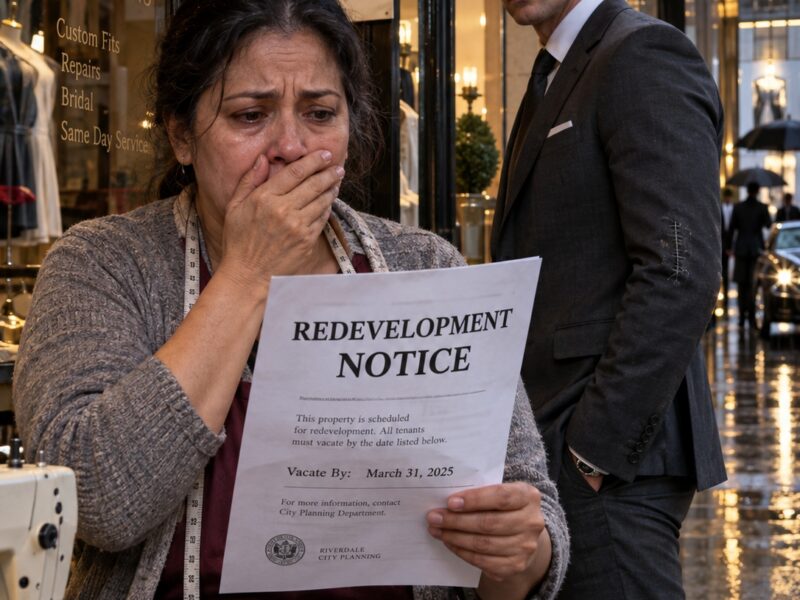
SHE FIXED A STRANGER’S TORN SUIT FOR FREE—THE NEXT MORNING, MEN CAME TO TAKE HER SHOP

The sewing machine died at 6:43 on a Thursday evening.
Not slowed down.
Not jammed.
Died.
The motor gave one tired metallic cough beneath the table, the needle froze halfway through a navy-blue hem, and the little work lamp above Maria’s shoulder flickered as if the shop itself had decided it had endured enough.
Maria stared at the machine for three silent seconds.
Then she reached for the handwheel and started turning it herself.
“Mama.”
Sophia’s voice came softly from the folding chair in the corner.
Maria didn’t look up.
“It still works.”
“You said that the first two times.”
“And I was right the first two times.”
“The motor is smoking.”
“It is not smoking.”
Sophia lowered her algebra book and pointed.
A thin gray thread curled from beneath the old Singer.
Maria leaned sideways.
The smoke disappeared.
She straightened.
“See?”
Sophia gave her the look only a seventeen-year-old daughter could give a mother who had become too proud to admit that a machine was on fire.
Outside, evening rain smeared the streetlights across the front window of Maria’s alterations shop. Cars hissed through wet pavement. The grocery store two doors down had already pulled its metal gate halfway closed, and Mr. Brennan from the shoe repair place across the hall was carrying his sandwich board inside.
Maria should have been closing too.
Instead, she had one customer’s bridesmaid dress hanging from the fitting-room curtain, a pair of uniform pants waiting for new zippers, three unpaid electric notices folded beneath the register, and exactly twenty-three dollars and sixteen cents in the cash drawer.
Rent was eleven days overdue.
The final notice from the property office sat beneath a jar of buttons where Sophia wouldn’t see it.
Maria had fourteen days left before the landlord could begin termination proceedings on the lease.
Fourteen days.
Twenty-two years of her life had been reduced to fourteen days.
She turned the wheel again.
The needle rose.
Dropped.
Rose.
Dropped.
Her fingers knew the rhythm even when the machine did not.
That was what survival became after enough years. You stopped waiting for things to work properly. You learned how to keep them moving by hand.
Sophia closed her textbook.
“I could get more hours at the diner.”
“No.”
“I’m already working Saturdays.”
“No.”
“They said I could do Thursdays too.”
“You have school Thursdays.”
“After school.”
“You have calculus after school.”
“That’s Tuesday.”
“Then you have something else Thursday.”
Sophia stared at her.
“Like what?”
Maria clipped the thread with her tiny silver scissors.
“Like being seventeen.”
Sophia’s expression changed.
For a moment she was not the sarcastic teenager who rolled her eyes when Maria reminded her to bring an umbrella. She was the little girl who used to fall asleep under the cutting table while Maria finished wedding dresses after midnight.
“Mama, I know things are bad.”
“They are not bad.”
“You sold Grandma’s earrings.”
Maria’s hands stopped.
Only for a second.
Then she folded the navy fabric.
“They were sitting in a box.”
“You loved those earrings.”
“I loved your grandmother. The earrings were metal.”
“And your gold bracelet?”
“Too tight.”
“It was adjustable.”
Maria looked at her daughter.
Sophia didn’t blink.
The rain drummed harder against the glass.
Maria could lie to customers. She could tell a bride the stain on her gown would come out. She could tell an elderly man his jacket still had years left in it. She could tell the electric company the check was already in the mail.
But Sophia had grown up watching her face.
She knew where the lies lived.
Maria sighed.
“Finish your homework.”
“That isn’t an answer.”
“It is the answer you’re getting tonight.”
Sophia opened her mouth.
The bell above the front door rang.
Both of them turned.
A man stood in the doorway with rain dripping from the shoulders of an expensive charcoal suit.
Maria noticed three things immediately.
The first was that the left sleeve had been torn nearly twelve inches from the elbow toward the shoulder.
The second was the watch on his wrist.
Maria did not know watches, but she knew craftsmanship. She had repaired enough jackets belonging to lawyers and surgeons to understand the difference between expensive and absurdly expensive.
The watch was absurdly expensive.
The third thing she noticed was his face.
Not handsome, though he was.
Not wealthy, though that was obvious.
Tired.
The man looked exhausted in a way that had nothing to do with rain.
He was perhaps forty-two or forty-three, tall, broad-shouldered, his dark hair damp and pushed carelessly back. There was blood along one knuckle, probably from whatever had torn his jacket, but he didn’t appear to notice.
His eyes moved over the tiny shop.
The aging shelves.
The crooked rack of zippers.
The hand-lettered sign by the register that said ALTERATIONS — CASH PREFERRED.
Then his gaze settled on the sewing machine.
He stopped.
Something flickered across his face.
Maria had spent most of her life learning what people did when they were embarrassed about their bodies. Brides sucked in their stomachs. Men joked about gaining weight. Widows brought in their husbands’ jackets years after funerals and pretended they wanted them altered for someone else.
She knew the small betrayals of a human face.
Whatever this man had seen in her sewing machine hurt him.
“Are you still open?” he asked.
His voice was low.
Maria looked at the clock.
6:51.
She looked at the torn sleeve.
“What happened?”
The man glanced at it as though noticing it for the first time.
“Railing.”
“A railing attacked you?”
The corner of his mouth almost moved.
“I lost.”
Sophia hid a smile behind her textbook.
Maria stood.
“Take it off.”
The man hesitated.
“You can fix it?”
Maria gave him a look.
He removed the jacket.
His white shirt underneath was wet at the shoulders. Without the expensive coat, he looked less like a businessman and more like a man who had been wandering in the rain because he did not particularly care where he ended up.
Maria laid the jacket on her cutting table.
The tear was ugly but clean.
High-quality wool.
Hand-finished lining.
Custom construction.
She ran the fabric between her fingers.
“Someone paid too much money for this suit.”
“That someone was me.”
“Then you definitely paid too much.”
This time he smiled.
Barely.
“How long?”
“Forty-five minutes if the machine cooperates.”
The motor gave a faint burnt smell.
Sophia coughed into her fist.
Maria ignored her.
The stranger reached for his wallet.
“How much?”
Maria looked at him again.
Rainwater had gathered along his collar.
There were dark circles beneath his eyes.
His expensive clothes said one thing.
His face said another.
“How important is tomorrow?” she asked.
He frowned.
“What?”
“You’re not asking whether I can do it next week. You’re asking how long tonight. That means tomorrow matters.”
The man looked down at the suit.
“I have a meeting.”
“Important?”
“They usually think they are.”
“That wasn’t what I asked.”
His eyes lifted to hers.
Something in them tightened.
“Yes,” he said. “Important.”
Maria nodded.
“Sit.”
He glanced toward the narrow plastic chair beside Sophia.
Then at Maria.
“How much?”
“We’ll discuss it when I’m finished.”
He sat.
Maria threaded a needle.
The old Singer groaned but refused to start.
So she turned the wheel by hand.
The stranger watched.
Sophia tried to return to her homework but kept glancing at him.
Maria worked for ten minutes before he spoke again.
“How old is that machine?”
“Older than you.”
“I’m not sure whether I should be insulted.”
“You should.”
Sophia laughed.
The sound surprised everyone.
Even Sophia seemed startled by it.
The stranger looked at her textbook.
“Calculus?”
“Unfortunately.”
“You like math?”
“I like when math behaves logically.”
“That eliminates most business.”
Sophia raised an eyebrow.
“You work in business?”
“Something like that.”
Maria kept sewing.
“What do you do?” Sophia asked.
“Sophia.”
“What? He asked about my math.”
The stranger looked at Maria.
“It’s fine.”
Then he looked back at Sophia.
“Real estate.”
“Like selling houses?”
“Sometimes.”
Maria felt his eyes move around the shop again.
The cracked ceiling tile.
The water stain above the fitting room.
The old radiator.
“Then you probably think this place is a disaster.”
She meant it lightly.
He did not answer lightly.
“I think someone hasn’t taken care of the building.”
Maria gave a dry laugh.
“Tell that to the landlord.”
Something changed in his expression.
“What’s wrong with the landlord?”
“Nothing if you enjoy rent increases and leaking pipes.”
“Mama.”
“He asked.”
The man leaned forward.
“How much has the rent increased?”
Maria stopped sewing.
Then she looked at him.
“That is a very specific question for a man who needs a sleeve repaired.”
“You mentioned it.”
“And I should learn not to complain to strangers.”
He sat back.
“Fair.”
Maria returned to the fabric.
The conversation died.
But the question remained in the room.
Twenty minutes later, Sophia’s phone buzzed.
She looked at the screen and quickly silenced it.
Maria noticed.
“Who?”
“No one.”
“Then no one can wait.”
Sophia sighed.
“It’s the diner.”
“You’re not taking Thursday.”
“They’re short.”
“So are we. We survive.”
Sophia stood.
“How?”
The word landed harder than she intended.
Maria’s hands froze.
Sophia immediately looked guilty.
“Mama—”
“No. Finish what you were going to say.”
“I didn’t mean—”
“You did.”
The stranger looked away, suddenly aware that he was sitting in the middle of something private.
Sophia lowered her voice.
“I’m not a little kid anymore.”
“That does not mean you stop being my child.”
“I know we’re behind on rent.”
Maria felt heat climb her neck.
“Sophia.”
“I saw the letter.”
Silence.
Outside, a bus sprayed rainwater against the curb.
Maria stared at her daughter.
“Where?”
“Under the buttons.”
“You went through my things?”
“I was looking for the blue thread.”
“How much did you read?”
“Enough.”
Maria put down the needle.
The stranger rose.
“I can come back.”
“No,” Maria said.
Sophia turned away.
Her eyes were bright.
“Mama, NYU wants the deposit in six weeks.”
Maria’s chest tightened.
“We said we were waiting on financial aid.”
“And if it’s not enough?”
“It will be.”
“You don’t know that.”
“I know my daughter got into college.”
“That doesn’t magically make tuition disappear.”
“I said it will be handled.”
“How?”
Maria heard the sharpness in her own voice.
“By me.”
Sophia laughed once, but there was no humor in it.
“With what?”
That hurt.
Not because Sophia was cruel.
Because she was right.
The stranger shifted near the door.
Maria wanted him gone now.
Not because she disliked him.
Because poverty was humiliating enough without an audience.
Sophia wiped her eyes.
“I can defer a year.”
“No.”
“I can work.”
“No.”
“I can go to community college.”
“No.”
“Why do you get to decide?”
“Because your father and I decided a long time ago that you would have choices we did not have.”
“Dad is dead.”
Maria went still.
Sophia’s face collapsed.
“Mama, I’m sorry.”
The sentence came too late.
Some sentences always did.
Maria looked down at the torn suit beneath her hands.
Her husband had been gone five years.
Five years since the heart attack in the kitchen.
Five years since Sophia, twelve years old and barefoot, had stood in the hallway while paramedics worked on the man who had taught her to ride a bicycle.
Five years since Maria had discovered that grief still expected the rent on the first of every month.
She swallowed.
“Do your homework.”
“Mama—”
“Please.”
Sophia sat.
The stranger said nothing.
Maria was grateful.
She finished his jacket at 7:42.
She pressed the repaired seam beneath a cloth, trimmed the loose thread, and held the sleeve beneath the light.
The tear had nearly vanished.
Not completely.
Nothing truly damaged vanished completely.
But it could be made strong again.
Maria handed him the jacket.
He slipped it on.
Rolled his shoulder.
Examined the sleeve.
“That’s impossible.”
“No. It is sewing.”
“I can’t see where it tore.”
“You can if you know where to look.”
He ran his fingers along the seam.
“How much?”
Maria turned toward the register.
She looked at the twenty-three dollars inside.
She thought about bread.
Milk.
The electric bill.
Rent.
Sophia’s college deposit.
She thought about the watch on the man’s wrist and how easily she could name any price she wanted.
Eighty dollars.
A hundred.
He would pay.
Maybe two hundred.
He looked like the kind of man who paid two hundred dollars to avoid wasting ten minutes.
Then Maria looked at his face.
Whatever sadness he had brought inside with him had not disappeared.
But it had softened while he sat there.
For forty-five minutes, he had simply been a wet stranger in a broken chair listening to the sound of a sewing machine.
Maria knew what it felt like to need one small thing to go right.
“No charge.”
He stared at her.
“I’m sorry?”
“No charge.”
He reached for his wallet.
“I can pay.”
“I know.”
“Then charge me.”
“No.”
His expression hardened slightly, not with anger but confusion.
“Why?”
Maria shrugged.
“Because you had a bad day.”
“You don’t know anything about my day.”
“I know you walked into a seamstress shop in the rain with blood on your hand and sadness in your face.”
His eyes changed.
Maria continued before he could respond.
“And I know you needed that jacket tomorrow.”
“I can afford another jacket.”
“That’s not what you asked me for.”
He opened his wallet.
Maria closed it with two fingers.
“I said no.”
He looked at the shop.
At the dead sewing machine.
At Sophia’s worn backpack.
At the bucket beneath the ceiling leak.
“You need the money.”
Maria felt something inside her stiffen.
“Everyone needs money.”
“I can pay.”
“And I can choose not to take it.”
He slowly lowered the wallet.
Maria’s voice softened.
“Sometimes people don’t need money first.”
The man said nothing.
“Sometimes,” she continued, “they need one person to make a hard day a little easier.”
For a moment, the rain seemed louder.
The stranger’s face lost its careful businesslike stillness.
He looked at her as if she had said something frightening.
Or familiar.
“Who taught you that?” he asked.
Maria smiled.
“Life.”
His throat moved.
“My mother used to say something similar.”
“Smart woman.”
“She was.”
Maria heard the past tense.
“I’m sorry.”
He nodded once.
“She died in March.”
It was September.
Maria understood the shape of fresh grief.
“I’m sorry,” she repeated, and this time the words meant more.
The man looked again at the sewing machine.
“She had one like that.”
Maria followed his gaze.
“Your mother sewed?”
“For years.”
“Professionally?”
“When I was a kid.”
He smiled faintly.
“At least I think professionally. I was too young to understand why strangers kept coming into our apartment with pants.”
Sophia smiled.
He looked at Maria.
“She fixed clothes for people who couldn’t pay.”
Maria leaned against the table.
“Then I definitely would have liked her.”
“She used to tell me that clothes were easy to repair.”
He stopped.
Maria waited.
His eyes had gone somewhere far away.
“What was harder?” she asked.
The man looked at her.
“Dignity.”
Maria’s smile disappeared.
“My mother said dignity was harder to repair.”
For the first time since he entered the shop, Daniel Carter looked as though he might cry.
He did not.
Men like Daniel had spent too many years learning how not to.
Instead, he buttoned the jacket Maria had repaired.
“What’s your name?”
“Maria.”
“Daniel.”
“Nice to meet you, Daniel.”
He looked toward Sophia.
“And you?”
“Sophia.”
Daniel nodded.
“Good luck with calculus.”
“Good luck with business.”
He walked toward the door.
His hand touched the handle.
Then he stopped.
“Maria.”
“Yes?”
He glanced back at the shop.
“How long have you been here?”
“Twenty-two years.”
His expression was unreadable.
“That’s a long time.”
“It is if the landlord keeps letting you stay.”
Something tightened again behind his eyes.
He opened the door.
Cold rain swept inside.
“Good night.”
“Good night.”
Daniel stepped onto the sidewalk.
Maria watched him disappear beneath the streetlights.
She had no idea that the man walking away owned the building around her.
She had no idea that a demolition proposal bearing his signature was already waiting on his desk.
And she had no idea that by noon the next day, men would arrive at her shop carrying official notices telling her that everything she had spent twenty-two years building was about to disappear.
Daniel did not sleep that night.
At 2:14 a.m., he stood barefoot in the kitchen of his Gold Coast townhouse with the lights off, wearing an old gray sweatshirt and holding a photograph he had not looked at in almost fifteen years.
He had found it in a box marked MOM — PERSONAL.
His mother, Evelyn Carter, sat behind an old sewing machine.
She was thirty-three in the picture.
Daniel was six.
He was beneath the sewing table with a toy fire truck, looking up at her as she laughed at someone outside the frame.
The apartment walls were ugly yellow.
The carpet was cheap.
The curtains did not match.
Daniel had spent his entire adult life trying to get as far from places like that as possible.
Now he would have paid anything to stand inside that room again.
His phone vibrated on the counter.
CLAIRE HOLLOWAY.
Daniel let it ring.
His assistant had been calling since the afternoon.
Three board members wanted his approval on the Mercer Street redevelopment.
The architects were waiting.
Financing had been arranged.
Tenants had been notified months earlier that building ownership was “reviewing future structural improvements,” which was corporate language designed to say nothing until saying something became legally necessary.
Daniel stared at his mother’s photograph.
Mercer Street.
Something about the name scratched at him.
He picked up his phone.
Instead of calling Claire, he opened the Carter Holdings property database.
He typed the address printed on Maria’s faded awning.
1187 Mercer Avenue.
The screen loaded.
Daniel stopped breathing.
CARTER HOLDINGS — ASSET 44-C.
He opened the file.
Purchase date: eleven years earlier.
He remembered none of it.
That was not unusual.
Carter Holdings controlled forty-three commercial and mixed-use properties across Chicago and three neighboring counties. Daniel could recite occupancy rates, debt exposure and acquisition costs for assets worth hundreds of millions of dollars.
He could not remember every laundromat.
Every bakery.
Every woman turning a sewing-machine wheel by hand because the landlord had allowed the building around her to decay.
He clicked PROJECT STATUS.
MERCER REDEVELOPMENT.
Demolition recommended.
Projected luxury residential units: eighty-six.
Ground-floor retail: national tenant mix.
Estimated internal rate of return: 18.7%.
Daniel scrolled.
Current tenants to vacate prior to construction.
His eyes moved down the list.
BRENNAN SHOE REPAIR.
HONG FAMILY MARKET.
MARIA’S ALTERATIONS.
He stared at the name.
A note appeared beside it.
DELINQUENT — ELEVEN DAYS.
A second note:
FINAL DEMAND SCHEDULED.
Daniel slowly sat at the kitchen island.
Maria’s words came back to him.
Everyone needs money.
Sometimes they need one person to make a hard day a little easier.
He looked again at his mother’s photograph.
Then he opened the redevelopment authorization.
At the bottom of the first page was his electronic signature.
Approved six weeks earlier.
He had signed it at 11:52 p.m. while sitting in the back of a car after a dinner with investors.
He did not remember reading Maria’s name.
He probably hadn’t.
That was the problem.
Daniel picked up his phone.
Claire answered on the second ring.
“It’s two in the morning.”
“I know.”
“Are you injured?”
“No.”
“Arrested?”
“No.”
“Then whatever you’re about to say could have waited.”
“Freeze Mercer.”
Silence.
“What?”
“Freeze the redevelopment.”
A longer silence.
Claire’s voice became fully awake.
“Daniel.”
“Nothing moves.”
“The demolition-notice team is scheduled tomorrow.”
“Cancel them.”
“They may already have the documents.”
“Call them.”
“At two fifteen?”
“Yes.”
“Brett is going to lose his mind.”
“Then tell Brett to find it before nine.”
Claire exhaled.
“What happened?”
Daniel looked at the repaired sleeve hanging over a chair.
“I visited the property.”
“You visited Mercer?”
“Yes.”
“Why?”
Daniel stared at the photograph of his mother.
“Because apparently I own something I’ve never bothered to see.”
By eight thirty the next morning, the thirty-seventh floor conference room at Carter Holdings felt like a courtroom.
Brett Lawson, the company’s chief development officer, threw a folder onto the polished walnut table.
“Fourteen months.”
Daniel looked up from the window.
“Excuse me?”
“Fourteen months of environmental reports, zoning meetings, engineering work, legal review and financing.”
Brett was fifty, silver-haired and permanently impatient. He had spent fifteen years turning neglected property into profitable property and considered sentiment a disease people developed when they were not responsible for payroll.
“We are ten days from final tenant clear-out,” he said. “And you freeze the project at two in the morning?”
Daniel poured coffee.
“Correct.”
“Why?”
“I want another review.”
“We have had seven reviews.”
“I want eight.”
“Daniel.”
Claire stood near the wall with a tablet in her hand, deliberately studying the screen.
Brett lowered his voice.
“Is this about your mother?”
Daniel’s eyes lifted.
“Careful.”
Brett sighed.
“I’m not attacking you.”
“It sounded efficient.”
“You haven’t been yourself since March.”
Daniel’s jaw tightened.
“And now you want to stop a thirty-two-million-dollar redevelopment because you walked through the neighborhood yesterday?”
“I walked through our building.”
“A failing building.”
“With tenants.”
“Tenants who were informed the property might be redeveloped.”
“They were informed in language designed to confuse them.”
Brett spread his hands.
“That is what lawyers are for.”
“That sentence is why people hate developers.”
“That sentence is why developers don’t get sued.”
Daniel walked toward the table.
“What happened to the maintenance budget?”
Brett blinked.
“What?”
“Mercer. Roof leaks. HVAC failures. Exterior masonry. Why were repairs postponed?”
Brett glanced at Claire.
She finally spoke.
“Asset management cut nonessential capital expenditures after redevelopment received preliminary approval.”
Daniel looked at her.
“When?”
“About nine months ago.”
“So we stopped maintaining the building because we planned to demolish it.”
“Yes.”
“And tenants continued paying increased rent.”
Brett leaned back.
“Daniel, don’t make this dramatic.”
Daniel’s voice went quiet.
“There is a bucket catching water inside one of our tenants’ businesses.”
“The building is old.”
“Then why did rent go up twelve percent?”
“Market adjustment.”
Daniel laughed.
It was not a pleasant sound.
Brett’s patience thinned.
“You know how this works.”
“Yes,” Daniel said. “That may be the problem.”
Brett stared at him.
Daniel opened the tenant report.
“Who authorized the notices going out today?”
“You did.”
Daniel looked down.
There it was.
Another approval.
Another click.
Another decision made between phone calls.
“Cancel them.”
Brett shook his head.
“We can’t keep reversing decisions every time you have an emotional reaction.”
Claire looked up sharply.
Daniel closed the folder.
“What did you say?”
“You hired me to make difficult decisions.”
“I hired you to advise me.”
“And I’m advising you not to throw away eight figures because one building makes you nostalgic.”
Daniel’s face became still.
Brett immediately realized he had gone too far.
But pride prevented him from retreating.
“Mercer is not your mother’s sewing room,” he said.
Daniel looked at him for several seconds.
Then he turned to Claire.
“Have legal prepare a complete tenant-impact report. I want lease history, rent increases, complaints, code issues and relocation exposure.”
“Daniel—”
He did not look at Brett.
“And Mercer remains frozen.”
Brett stood.
“What about the notice crew?”
“Cancel them.”
“They left an hour ago.”
Daniel turned.
“What?”
Brett checked his watch.
“They start posting at nine.”
Daniel looked at Claire.
She was already reaching for her phone.
Maria was replacing the zipper on a winter coat when three men in orange safety vests entered the building.
She heard them before she saw them.
Boots.
Tape ripping.
The hard snap of a staple gun.
Mr. Brennan shouted from the hallway.
“What the hell is that?”
Maria stepped outside.
A man pressed a white notice against the wall beside the building entrance.
REDEVELOPMENT AND VACANCY NOTICE.
The words seemed too large.
Too black.
Too final.
Maria’s stomach dropped.
“No.”
The worker glanced at her.
“Ma’am?”
“No, no, no. You can’t do this yet.”
“We’re only posting notices.”
“I have fourteen days.”
“I don’t handle leases.”
“My property manager said fourteen days.”
“This is not your rent notice.”
Maria looked again.
The paper shook in her vision.
PLANNED PROPERTY REDEVELOPMENT.
TENANT RELOCATION REQUIRED.
Sophia emerged from the shop behind her.
“Mama?”
Maria barely heard her.
Mr. Brennan was reading another notice.
Mrs. Hong from the market had both hands over her mouth.
“This says everybody,” Brennan whispered.
One of the workers carried notices toward Maria’s shop.
She moved in front of him.
“No.”
“Ma’am, I need access to the door.”
“You are not putting that on my window.”
“It’s required.”
“I have customers.”
“Maria.”
Sophia touched her arm.
The worker looked uncomfortable.
“I’m sorry.”
Maria laughed.
The sound came out broken.
“You are sorry?”
She pointed to the shop.
“I have been here twenty-two years.”
“I understand.”
“No. You don’t.”
She stepped closer.
“My daughter learned to walk behind that counter. My husband installed those shelves. I stitched prom dresses in there until three in the morning because people needed them the next day. I repaired a police officer’s uniform after he was stabbed. I made funeral clothes for women who could barely stand still long enough for measurements. I have been here twenty-two years.”
The worker lowered the staple gun.
“I’m just doing my job.”
“And this is mine.”
A black sedan stopped at the curb.
Maria did not notice.
Daniel stepped out before the driver could open his door.
He saw the notice on the building.
Then Maria.
Then the worker standing in front of her shop.
“Stop.”
His voice cut through the hallway.
Everyone turned.
Maria stared.
The stranger from last night walked toward them wearing the same charcoal suit.
The sleeve she had repaired looked perfect.
Daniel’s face did not.
He looked furious.
The worker recognized him immediately.
“Mr. Carter.”
Maria heard the name.
Carter.
Her eyes moved from the worker to Daniel.
“Mr. who?”
Daniel ignored the question for half a second.
“Who told you to proceed?”
“We were dispatched this morning.”
“This project is frozen.”
“No one notified us until about ten minutes ago.”
“Take them down.”
The worker hesitated.
“All of them?”
“All.”
Brett Lawson appeared behind Daniel.
He had arrived in a second car.
“Daniel.”
Maria looked between them.
Daniel closed his eyes briefly.
This was not how he had intended to tell her.
Maria’s voice became quiet.
“Who are you?”
Daniel turned.
The entire hallway seemed to wait.
Mrs. Hong stood beside a pyramid of rice bags.
Brennan held a shoe in one hand.
Sophia stared at Daniel with sudden understanding.
Daniel looked at Maria.
“My name is Daniel Carter.”
“I know your name.”
“I own Carter Holdings.”
Nothing.
Maria didn’t understand.
Then Sophia did.
Her face changed.
“Mama.”
Maria looked at her daughter.
Sophia whispered, “Carter Holdings owns the building.”
Maria turned back to Daniel.
For several seconds she simply stared at him.
The expensive watch.
The suit.
The questions about rent.
The way he had looked around the shop.
The way he had asked how long she had been there.
Humiliation flooded her face.
“You knew.”
“No.”
“You came into my shop knowing you owned this building.”
“No. Maria, I didn’t.”
“You asked about my rent.”
“After you mentioned it.”
“Were you testing me?”
“What?”
“To see how desperate I was?”
“No.”
“To see whether I would beg?”
“Maria—”
She stepped backward.
“I fixed your suit for free.”
“I know.”
“You sat in my shop and listened while my daughter and I argued about money.”
“I didn’t know.”
“You expect me to believe a man owns a building and does not know he owns it?”
Daniel took the hit without defending himself.
Because the answer was worse than any excuse.
“Yes,” he said.
Maria laughed bitterly.
“How convenient.”
“No. It’s shameful.”
That stopped her.
Daniel looked at the notice still taped to the wall.
“I didn’t know this building was part of the redevelopment project until last night.”
Brett stepped forward.
“We should discuss this privately.”
Daniel turned his head.
“No.”
“Daniel.”
“These people were about to lose their businesses because of decisions made privately.”
Brett glanced at the tenants.
“This is an active commercial transaction.”
Maria suddenly looked at him.
“Transaction?”
Brett softened his voice.
“Ma’am, redevelopment can be disruptive, but relocation packages—”
“This was my husband’s shop too.”
“I understand.”
“No, apparently nobody in your company understands anything.”
Daniel almost smiled.
Brett did not.
Maria looked back at Daniel.
“So what happens now?”
“The project is frozen.”
“For how long?”
“I don’t know yet.”
“That means nothing.”
“You’re right.”
Daniel surprised her again.
He pulled one of the notices from the wall.
“I need time to understand what happened here.”
“While we wait to find out whether you destroy us?”
“No.”
“You just said you don’t know.”
Daniel glanced at the paper.
Then at Maria.
“You gave me something last night when you had no reason to trust me.”
She crossed her arms.
“If you’re about to turn this into some lesson about kindness, don’t.”
“I’m not.”
His voice dropped.
“I’m telling you that because I owe you the same honesty.”
Maria said nothing.
Daniel continued.
“The current project would remove every tenant from this building. The financial return is substantial. Contracts have been negotiated. Investors expect us to proceed.”
Sophia went pale.
Brennan muttered something under his breath.
Daniel looked at all of them.
“But as of this morning, nothing happens until I understand whether that profit depends on my company treating people like numbers on a spreadsheet.”
Brett’s jaw tightened.
Maria studied Daniel.
“And if it does?”
Daniel looked at the repaired sleeve.
Then back at her.
“Then we change the numbers.”
Brett pulled him aside outside the building.
“What the hell are you doing?”
Daniel kept walking.
“You’re making promises.”
“I promised a review.”
“You just undermined me in front of tenants.”
“You posted notices after I froze the project.”
“You called at two in the morning.”
“And you heard me.”
Brett lowered his voice.
“We lose financing if this stalls.”
“Then we replace the financing.”
“You think banks rearrange eight figures because you had a sentimental evening with a seamstress?”
Daniel stopped.
Traffic rushed past them.
“Say that again.”
Brett stared at him.
Daniel stepped closer.
“She has a name.”
“I know.”
“Then use it.”
Brett exhaled.
“Maria.”
“Good.”
“This is business.”
Daniel looked through the rain-streaked window.
Inside, Maria was tearing the redevelopment notice into four pieces.
Sophia stood beside her.
For the first time in months, Daniel remembered the smell of steam from his mother’s old iron.
The sound of quarters dropped into a jar.
His mother counting bills late at night.
The winter she wore the same coat four years because his school needed tuition money.
He had built Carter Holdings partly because he never wanted to feel that helpless again.
Somewhere along the way, he had learned to create that same helplessness for other people.
“I know exactly what it is,” Daniel said.
That evening, Maria found an envelope pushed beneath the shop door.
Her stomach clenched when she saw the Carter Holdings logo.
Sophia stood over her shoulder.
“Open it.”
Maria didn’t move.
“You open it.”
“Mama.”
“I have had enough Carter Holdings surprises.”
Sophia took the envelope.
Inside was a single-page letter.
All rent collection actions for tenants at 1187 Mercer Avenue had been suspended for thirty days pending full property review.
Outstanding balances would accrue no penalties.
No tenant could be removed during the review.
At the bottom was Daniel Carter’s signature.
Handwritten.
Sophia read it twice.
“He did that today?”
Maria took the paper.
“Thirty days is not forever.”
“No.”
“He could change his mind.”
“Yes.”
Maria looked at her daughter.
“Stop agreeing with me.”
Sophia smiled.
Then her expression softened.
“He came back.”
Maria folded the letter.
“So?”
“He didn’t have to.”
“Rich men do many things they don’t have to do.”
“That sentence didn’t make sense.”
“It made sense to me.”
Sophia leaned against the counter.
“You embarrassed him.”
“I did not.”
“You absolutely did.”
“He deserved it.”
“I know.”
Maria looked at her.
“You like him.”
“I met him twice.”
“You are defending him.”
“I’m observing.”
“You are seventeen. Stop observing adults.”
Sophia grinned.
For five seconds they almost felt normal.
Then her eyes moved toward the corner.
The university envelope lay beneath her calculus book.
Maria followed her gaze.
“How much is the deposit?”
Sophia shook her head.
“We don’t have to talk about it.”
“How much?”
“Five hundred.”
Maria looked toward the cash register.
Sophia sighed.
“Mama.”
“I’ll get it.”
“I can defer.”
“No.”
“You cannot solve everything with that word.”
Maria touched the university letter.
“I can try.”
Two days later, Daniel came back.
This time without a torn suit.
Maria saw him through the front window and almost locked the door.
Almost.
He entered holding two coffees.
“I don’t accept bribes.”
“One is tea.”
“That is a more sophisticated bribe.”
He placed the cup on the counter.
“No sugar. You drank tea Tuesday night without sugar.”
Maria looked at him.
“You notice too much.”
“Occupational defect.”
“Your occupation seems to involve not noticing buildings.”
He winced.
“That was deserved.”
She took the tea.
Not because she forgave him.
Because it was cold outside.
Daniel sat in the same plastic chair.
Maria kept hemming a skirt.
“You’re not going to ask why I’m here?”
“No.”
“Why?”
“If I wait long enough, men usually explain themselves.”
Daniel smiled.
“You remind me of my mother.”
“I’m younger than you.”
“You also remind me of her when you insult me.”
“I like her already.”
The smile disappeared.
“I brought something.”
Maria stopped working.
Daniel placed a photograph on the counter.
The image was faded.
A woman sat at a sewing machine.
A small boy played beneath the table.
Maria picked it up carefully.
“That’s you.”
“Yes.”
“You were cute.”
“I’m trying not to be offended by the past tense.”
Maria ignored him.
She leaned closer.
The sewing machine in the photograph had a black cast-iron body with delicate gold detailing.
Her eyes shifted toward her own.
Same curved housing.
Same wheel.
Same distinctive faceplate.
“Singer 401,” Maria said.
Daniel nodded.
“My mother’s.”
“You kept the machine?”
His expression fell.
“No.”
“What happened?”
“When she stopped sewing, we put it in storage. Years later I was moving apartments. I donated almost everything.”
“Almost?”
“The photograph survived.”
Maria looked down at the boy beneath the table.
“You regret losing it.”
“Yes.”
Maria understood.
Regret was rarely about the object.
It was about discovering too late that ordinary things had been carrying pieces of people you loved.
She handed the photograph back.
“Your mother would not care about the machine.”
“How do you know?”
“If she raised you with stories about dignity, she would care what you remembered.”
Daniel folded the photograph into his wallet.
Maria resumed sewing.
After a moment he said, “Tell me about the business.”
“No.”
He blinked.
“No?”
“I already told you too much.”
“I own the property.”
“Exactly.”
“I’m reviewing the leases.”
“Then review them.”
“I want your perspective.”
“My perspective is that landlords like rent.”
“That is remarkably concise.”
Maria set the skirt aside.
“You want my perspective?”
“Yes.”
“Fine.”
She pointed upward.
“That stain has been there eighteen months.”
Daniel looked.
“The management company sent someone twice. First man painted over it. Rain came. Stain returned. Second man said roof repair was scheduled. Nobody came back.”
She pointed toward the radiator.
“That stops working every January during the coldest week.”
She pointed toward the back wall.
“Electrical outlet sparks if anyone uses the steamer and iron at the same time.”
Daniel’s face hardened.
“Why didn’t you report that?”
“I did.”
“To whom?”
“The phone number your company puts on letters.”
“Do you have copies?”
Maria laughed.
“I keep everything.”
She disappeared behind the curtain.
A minute later she returned carrying a grocery bag stuffed with letters, maintenance requests, rent notices and handwritten notes.
Daniel looked at it.
“That is everything?”
“That is the last five years.”
He began reading.
His expression changed by the page.
Maria watched.
“Surprised?”
“Yes.”
“Why?”
“Because half these requests are marked completed in our system.”
Maria folded her arms.
“They were not.”
Daniel pulled out his phone.
She frowned.
“Who are you calling?”
“My office.”
“No.”
He looked up.
“You said you wanted my perspective. You are sitting in my shop. Sit.”
Daniel stared at her.
Then, slowly, he put his phone away.
Maria nodded.
“Good.”
“You enjoy giving orders.”
“I am excellent at it.”
For the next hour, she talked.
Not angrily.
That would have been easier for Daniel.
She told him about Mr. Brennan’s failing shoe business and how he had taken care of his wife through cancer.
She told him Mrs. Hong’s sons wanted her to retire, but the grocery store was the only place she had ever felt fully independent.
She told him about the barber upstairs, the dance studio on the second floor, the tax-preparation office that translated documents for immigrants every spring.
“This building is ugly,” Maria said.
Daniel looked around.
“I have seen better.”
“It smells strange when the heat comes on.”
“I noticed.”
“One window upstairs is held shut with duct tape.”
“I definitely noticed.”
Maria’s voice softened.
“But people know one another here.”
Daniel said nothing.
“You cannot put that on a spreadsheet.”
“No.”
“You cannot move it three blocks away and assume it stays the same.”
“No.”
Maria studied him.
“Do you agree because you mean it or because you feel guilty?”
Daniel took his time answering.
“Both.”
That honesty unsettled her more than a polished answer would have.
He looked toward Sophia’s empty chair.
“Where is she?”
“School.”
“Then diner?”
Maria frowned.
“How do you know about the diner?”
“I was here when you argued.”
Maria’s eyes narrowed.
“You remember everything inconvenient.”
“Usually.”
“She is not going to the diner today.”
“Why?”
“I told her no.”
Daniel almost smiled.
“And seventeen-year-old daughters always obey?”
Maria looked at the clock.
Her expression changed.
The diner called at 4:12.
Sophia had fainted beside the drink station.
Maria arrived at the emergency room fifteen minutes later with Daniel driving because her hands were shaking too badly to use her own car.
“She’s fine,” he kept saying.
“You do not know that.”
“The diner manager said she was awake.”
“People are awake before they die.”
Daniel glanced at her.
“That is not medically accurate.”
“Do not use logic right now.”
“Understood.”
He stopped speaking.
At Northwestern Memorial, Sophia sat upright in an exam bed eating crackers when Maria burst through the curtain.
“Mama.”
Maria crossed the room and grabbed her daughter’s face.
“What happened?”
“I’m fine.”
“You fainted.”
“I stood up too fast.”
A nurse beside the computer spoke gently.
“She’s dehydrated and exhausted. Blood sugar was low.”
Maria looked at Sophia.
“Did you eat lunch?”
Silence.
“Sophia.”
“I wasn’t hungry.”
“You were working after school.”
Another silence.
Maria closed her eyes.
“You lied.”
“I was going to tell you.”
“When?”
“When you stopped saying no to everything.”
Maria stepped back.
Daniel remained near the curtain.
Sophia noticed him.
“Why is he here?”
“He drove me.”
Sophia looked from him to her mother.
Something almost mischievous appeared in her tired eyes.
Maria immediately pointed.
“Do not.”
“I didn’t say anything.”
“Your face did.”
Daniel cleared his throat to hide a laugh.
Maria glared at both of them.
A doctor came in, reviewed the labs and explained that Sophia needed fluids, rest and regular meals.
Nothing more serious.
Maria sat down so abruptly the chair squeaked.
The doctor left.
Sophia stared at her hands.
“I was saving money.”
“For what?”
“The deposit.”
Maria’s chest tightened.
“Sophia.”
“I made two hundred and eighty dollars.”
“You could have told me.”
“I did tell you. You said you’d handle everything.”
“I am your mother.”
“And I live there too.”
The words were not cruel.
That made them worse.
Sophia looked at her.
“I know Dad wanted me to go to college.”
Maria’s eyes filled.
“I know you want it too. But every time you say you’ll handle everything, you look more tired.”
Maria turned away.
She hated crying in public.
She hated crying in hospitals more.
Too many endings had happened in hospitals.
Daniel shifted near the door.
“I’ll give you privacy.”
Sophia looked at him.
“Mr. Carter.”
He stopped.
“Daniel.”
“Whatever.”
Maria almost smiled through tears.
Sophia continued.
“Did you really cancel the demolition?”
Daniel’s face became serious.
“I paused it.”
“So it could still happen.”
“Yes.”
Maria appreciated that he did not lie.
Sophia nodded slowly.
“My mom’s shop is ugly.”
“Sophia.”
“It is.”
Daniel looked at Maria.
“She has said the same thing.”
“But people need it,” Sophia continued. “Not just for clothes.”
Daniel waited.
“Mrs. Brennan used to sit there after her chemo appointments because she didn’t want her husband to see her cry. Mama pretended she didn’t notice.”
Maria looked down.
“Mr. Hong proposed to his wife in front of the shop because that used to be a bakery before Mama moved in.”
Sophia swallowed.
“When my dad died, people from that building brought food for three weeks.”
Daniel looked at Maria.
She said nothing.
Sophia’s voice softened.
“If you tear it down, maybe you build something nicer.”
Daniel nodded.
“Probably.”
“But it won’t be the same place.”
“No,” Daniel said.
“It won’t.”
On Monday morning, Daniel walked into the quarterly investment committee meeting and killed the Mercer redevelopment.
Not paused.
Killed.
The reaction was immediate.
“You cannot be serious.”
Brett shoved his chair backward.
Two outside investors exchanged stunned looks.
A banker from New York removed his glasses.
Daniel remained standing at the head of the table.
“I’m serious.”
The financial model glowed on the screen behind him.
Thirty-two million dollars.
Eighteen-point-seven percent projected return.
Eighty-six luxury apartments.
Six national retail tenants.
All of it disappeared with one click of Daniel’s remote.
A new slide appeared.
MERCER PRESERVATION PLAN.
Brett stared.
“What is this?”
“Adaptive renovation.”
“You approved this?”
“I’m proposing it.”
“You said kill the project.”
“I’m killing demolition.”
Daniel moved to the next slide.
“Structural review says the building can be restored.”
“At what cost?”
“Seven-point-four million.”
“With what return?”
“Lower.”
“How much lower?”
“Meaningfully.”
Brett laughed once.
“This is insanity.”
Daniel kept going.
“Existing tenants receive lease protection during construction. Deferred maintenance is repaired immediately. Vacant upper floors become affordable workspaces and small-business incubator units.”
The banker frowned.
“This isn’t the transaction we financed.”
“No.”
“So you need new financing.”
“Yes.”
“And your preferred retail anchors?”
“Gone.”
“And your return?”
“Reduced.”
Brett leaned forward.
“Why would anyone approve this?”
Daniel looked around the table.
“Because the building is profitable now.”
“Barely.”
“It can be more profitable without removing everyone who made the neighborhood worth investing in.”
One investor tapped his pen.
“That sounds like public relations.”
Daniel nodded.
“It is partly public relations.”
The room went quiet.
“At least you admit it,” Brett said.
“It’s also retention, neighborhood stability, long-term occupancy and lower tenant acquisition costs.”
Daniel looked at him.
“And partly because I have decided I do not want this company making money this way.”
There it was.
Not financial.
Not strategic.
Personal.
Brett stood.
“You are risking investor confidence because one seamstress reminded you of your mother.”
Daniel’s face tightened.
“No.”
“You are.”
“My mother reminded me of my mother.”
“You know what I mean.”
“Yes.”
Daniel walked closer.
“I spent six months after she died signing anything this company put in front of me because work was easier than grief.”
Brett’s anger weakened.
Daniel continued.
“You all knew it.”
No one spoke.
“You brought me acquisitions. I signed. You brought me dispositions. I signed. You brought me Mercer.”
His eyes moved to the dark screen.
“And I signed.”
He looked back at them.
“That is on me.”
Brett shook his head.
“Daniel—”
“But now I have read the file.”
Silence.
“Every maintenance request. Every rent increase. Every complaint marked resolved when it wasn’t. Every decision that made the building worse while we waited to replace it.”
Daniel’s voice dropped.
“If our return improves because we neglect a property until redevelopment becomes the only practical choice, that is not brilliant business.”
Brett’s expression darkened.
“That is an accusation.”
“Yes.”
The room froze.
Claire looked at Daniel.
Brett said, “You think I manipulated maintenance?”
“I think the system rewarded neglect.”
“You approved the budgets.”
“I did.”
Daniel did not flinch.
“That is why I am changing them.”
The banker closed his notebook.
“Then you understand our financing will probably be withdrawn.”
“Yes.”
Brett stared at Daniel.
“You are throwing away millions.”
Daniel thought of Maria’s sewing machine.
Of Sophia lying beneath fluorescent hospital lights because she was trying to save five hundred dollars.
Of his mother in the old photograph.
“No,” he said.
“I think I finally noticed what we were buying with them.”
Daniel returned to Maria’s shop Tuesday afternoon.
She was standing on a ladder replacing a lightbulb.
“Absolutely not,” he said.
Maria looked down.
“Hello to you too.”
“That ladder is unstable.”
“So is my financial future.”
“Maria.”
“If you are here to tell me bad news, let me finish the light first.”
Daniel walked over and steadied the ladder.
“You can come down.”
“You are very demanding for a customer who paid nothing.”
“I brought payment.”
“If it is money, leave.”
“It isn’t.”
Maria climbed down.
Daniel placed a folder on the counter.
She stared at it.
“What is that?”
“The redevelopment plan.”
Her face hardened.
“I don’t want to see it.”
“You do.”
“No.”
“Maria.”
“Daniel.”
He pushed the folder closer.
She opened it reluctantly.
The first rendering showed the same brick building.
Not demolished.
Restored.
New windows.
Fresh masonry.
A repaired cornice.
The old storefront proportions remained.
Maria stared.
“What is this?”
“A renovation.”
She looked up.
Daniel continued.
“No demolition.”
She did not move.
“No mass eviction.”
Nothing.
“Existing tenants remain.”
Maria looked back at the rendering.
Her fingers touched the paper.
“Why?”
“Because it is possible.”
“That is not what I asked.”
Daniel leaned against the counter.
“The honest answer?”
“I have never asked you for anything else.”
“Because I think it is the right decision.”
She waited.
“And because your shop reminded me of something I forgot.”
Maria’s eyes lifted.
“My mother spent her life making small repairs.”
Daniel glanced toward the Singer.
“I spent mine believing big things mattered more.”
His mouth tightened.
“I was wrong.”
Maria looked at the plans.
“Your company agreed?”
“Some did.”
“Some?”
“Brett may attempt to murder me with a spreadsheet.”
She almost smiled.
Daniel pointed to another page.
“Your rent remains at the current base rate for three years.”
Maria immediately looked up.
“No charity.”
“It isn’t.”
“It sounds like charity.”
“It is tenant-retention strategy.”
“That sounds like charity wearing a tie.”
“It is the same deal for everyone.”
That slowed her.
“Everyone?”
“Every existing tenant.”
Maria turned the page.
There were plans for the shoe repair shop.
The grocery.
The barber.
The dance studio.
“Why?”
“Because preserving one business while removing the rest would make me a hypocrite.”
She looked at him for a long time.
Then her expression sharpened again.
“What about Sophia?”
Daniel blinked.
“What about her?”
“You asked Claire for information about scholarships.”
His eyebrows rose.
“How do you know that?”
“Claire called here.”
Daniel muttered something.
Maria crossed her arms.
“You stay out of my daughter’s tuition.”
“I didn’t offer her money.”
“You were going to.”
“I was researching an education program.”
“For Sophia.”
“For people like Sophia.”
“That is how rich people disguise giving money to one person.”
Daniel laughed.
Maria didn’t.
He sobered.
“My mother never finished high school.”
Maria’s expression changed.
“She left at sixteen to work.”
Daniel looked at the old photograph again in his mind.
“Years later, after I started making money, I offered to send her back to school.”
“What did she say?”
“She said the time had passed.”
“Had it?”
“No.”
“But she believed it.”
“Yes.”
Daniel looked toward Sophia’s chair.
“I don’t want to pay for Sophia’s college because you fixed my sleeve.”
“Good.”
“I want Carter Holdings to create a scholarship because I discovered we spend more each year decorating executive offices than some families earn in a decade.”
Maria blinked.
“That is a terrible business slogan.”
“I’ll let marketing fix it.”
She laughed.
A real laugh.
Daniel smiled.
For a moment, neither of them spoke.
Then Maria said, “If Sophia applies, she competes fairly.”
“Yes.”
“No guarantee.”
“Yes.”
“No secret instructions telling anyone she helped the boss.”
“She didn’t help the boss.”
“You know what I mean.”
“Yes.”
“No photograph of her in some company brochure holding a giant fake check.”
Daniel smiled.
“I can promise no giant fake checks.”
Maria extended her hand.
“Then maybe.”
He shook it.
Her hand was rough.
Warm.
Strong.
For reasons he could not explain, Daniel felt more nervous shaking Maria’s hand than he did signing contracts worth fifty million dollars.
Construction began in January.
The first week was chaos.
Plastic sheeting covered half the hallway.
Contractors argued over electrical wiring.
Mrs. Hong threatened a plumber with a broom after he disconnected the wrong sink.
Mr. Brennan complained daily about dust and then brought coffee to the construction crew every morning.
Maria hated everything.
“This is progress?” she shouted over a drill.
Daniel, wearing a hard hat and an expensive coat, raised his voice.
“This is demolition without demolition.”
“They are destroying my wall.”
“They are repairing your wall.”
“With hammers.”
“That is generally how walls work.”
Maria glared at him.
Sophia laughed from behind the counter.
Daniel had become a regular.
At first, he claimed he was checking construction.
Then he began arriving when no construction was scheduled.
Sometimes he brought tea.
Sometimes documents.
Sometimes nothing.
He sat in the plastic chair while Maria worked.
He told her about his mother.
Not all at once.
Grief came in small pieces.
Evelyn Carter had raised Daniel alone after his father disappeared when he was four.
She sewed hotel uniforms, repaired winter coats and altered wedding dresses in the living room of their apartment.
She saved coins in glass jars.
One for rent.
One for groceries.
One marked DANNY SCHOOL.
Daniel had hated the jars.
They represented every limitation of childhood.
Other children had sneakers that came from stores instead of church basements.
Other families went on vacation.
Other mothers did not fall asleep beside sewing machines.
By twenty-eight, Daniel owned his first commercial building.
By thirty-five, he was wealthy.
By forty-two, he had become the kind of man his mother used to complain about.
He had not noticed until she was gone.
“You think too much,” Maria told him one afternoon.
Daniel looked up from the chair.
“You think too little.”
“I own a company. Thinking is most of my job.”
“No. Worrying is most of your job.”
“What is the difference?”
“Thinking finds answers.”
She cut a thread.
“Worrying just walks around the same room.”
Daniel considered that.
“My therapist charges three hundred dollars an hour for things like that.”
“Your therapist is stealing from you.”
“She would probably say this conversation proves I need therapy.”
Maria smiled.
“Then maybe she earns half.”
Sophia received the scholarship email in April.
She read it once.
Then twice.
Then screamed.
Maria dropped a box of pins.
“What?”
Sophia looked at her.
Her face went pale.
“What?”
“Did you do something?”
Maria’s heart sank.
“About what?”
“The scholarship.”
Daniel was not there.
Maria almost wished he were.
“I did not.”
“Did Daniel?”
“No.”
“You swear?”
“I told him you had to compete fairly.”
Sophia stared at the laptop.
Maria stepped closer.
“Why?”
Sophia turned the screen.
CARTER COMMUNITY SCHOLARS PROGRAM.
CONGRATULATIONS.
Sophia had been selected for full tuition support after federal and university aid, renewable for four years.
Maria covered her mouth.
Sophia started crying.
“Did he do this?”
“I don’t know.”
“You said—”
“I know what I said.”
Maria grabbed her phone.
Daniel answered on the third ring.
“Hello?”
“Did you choose my daughter?”
Silence.
“Good afternoon, Maria.”
“Do not good-afternoon me.”
Sophia stared.
Daniel sighed.
“She got the email?”
“Yes.”
“Then congratulations.”
“Did you choose her?”
“No.”
“Daniel.”
“I recused myself.”
Maria stopped.
“What?”
“The final scholarship committee had five members. I was not one of them.”
Sophia leaned closer to the phone.
Daniel continued.
“The applications were anonymized for final scoring.”
Maria looked at Sophia.
“You promise?”
“Yes.”
Sophia whispered, “Ask him if he knew before today.”
Maria repeated the question.
“No,” Daniel said. “Claire told me twenty minutes ago.”
Maria sat down.
For once, she had nothing to say.
Daniel waited.
Finally he asked, “Maria?”
“Yes.”
“Are you crying?”
“No.”
Sophia laughed through tears.
Daniel smiled on the other end.
“Tell Sophia she earned it.”
Maria looked at her daughter.
Sophia was clutching the laptop against her chest.
Maria’s voice broke.
“She heard you.”
Graduation came in June.
Maria bought a new dress for the ceremony.
Not made.
Bought.
Sophia complained this violated everything Maria believed in.
“For twenty-two years,” Maria said, “I have worn things other people did not want. Your graduation gets new fabric.”
She sat in the second row of the school auditorium.
Daniel sat three seats away.
Maria had not invited him.
Sophia had.
When her daughter walked across the stage, Maria stood before anyone else in the row.
“Sophia!”
Half the auditorium heard her.
Sophia laughed from the stage.
Daniel clapped.
Maria cried openly.
She did not care who saw.
Afterward, outside beneath the June sun, Sophia wrapped both arms around her.
“We did it.”
Maria held her tighter.
“You did.”
“No.”
Sophia pulled back.
“We.”
Then she hugged Daniel.
He froze in surprise before awkwardly returning it.
“Thank you,” she whispered.
Daniel shook his head.
“You earned it.”
“I know.”
She smiled.
“But you built the thing I earned.”
Daniel had no answer for that.
Maria did.
“Say thank you.”
Daniel looked offended.
Sophia laughed.
For the first time in years, the future did not feel like something Maria had to survive.
It felt like something waiting for them.
The renovated Mercer building reopened formally in October.
There were no velvet ropes.
Daniel refused.
No giant ribbon.
Maria refused.
No local television crew inside the shop.
Maria threatened violence.
But there was a new brass plaque near the entrance.
MERCER COMMUNITY BUILDING — EST. 1912 — RESTORED 2026.
The bricks had been cleaned.
The leaking roof replaced.
Windows repaired.
Wiring modernized.
The upstairs units had become studios for local artists, tailors, photographers, tutors and small businesses.
Brennan’s shoe repair received new equipment.
Mrs. Hong’s market expanded into the vacant storefront next door.
Maria’s shop had new lighting, new worktables and two modern industrial sewing machines.
The old Singer remained by the front window.
Daniel had insisted.
Maria pretended to object.
He ignored her.
On opening morning, she arrived early.
The shop smelled like new wood and fresh paint.
For twenty-two years she had unlocked that door expecting problems.
That morning she stood alone in silence.
She ran her hand over the old cutting table.
Her husband had built it.
Daniel had offered to replace it.
She had nearly thrown him out.
A photograph of Sophia’s graduation now sat near the register.
Beside it was an older photograph of Maria and her husband outside the shop twenty years earlier.
Maria looked around.
Some things had changed.
Some things had survived.
The bell above the door rang.
Daniel entered carrying a garment bag.
“You are not open yet.”
“I own the building.”
“That excuse is getting old.”
He hung the bag near the counter.
“What is that?”
“A repair.”
Maria narrowed her eyes.
“You brought me work on opening day?”
“You are a seamstress.”
“Daniel.”
He unzipped the bag.
Inside was an old brown wool coat.
Worn elbows.
Frayed lining.
A missing button.
Maria touched the fabric.
“Whose?”
“My mother’s.”
She looked at him.
Daniel swallowed.
“Claire found it.”
“Where?”
“Storage facility in Evanston.”
“I thought you donated everything.”
“I thought I did.”
Maria lifted the coat carefully.
It was not valuable.
Not in the way Daniel’s suits were valuable.
But she understood immediately that it was the most expensive thing he owned.
“You want it repaired?”
“Yes.”
“Why?”
Daniel looked toward the Singer.
“I don’t know.”
Maria waited.
Eventually he said, “Maybe I want one thing from that life not to disappear.”
Her expression softened.
She laid the coat on the old worktable.
“Leave it.”
“How long?”
Maria smiled.
“Some repairs should not be rushed.”
Daniel nodded.
He walked toward the door.
“Daniel.”
He turned.
Maria looked at the coat.
“No charge.”
He laughed.
“Absolutely not.”
“No charge.”
“We have discussed this.”
“I own the shop.”
“I own the building.”
“Get out.”
Still laughing, Daniel left.
Maria worked on Evelyn Carter’s coat after closing.
No customers.
No construction noise.
No Sophia doing homework in the corner.
Just Maria, the old Singer and the soft movement of October traffic beyond the glass.
She replaced the lining by hand.
Reinforced the elbows.
Matched the missing button.
Inside one pocket, she found something.
A folded piece of paper.
Yellow with age.
Maria almost threw it away.
Then she saw handwriting.
She opened it.
A shopping list.
MILK.
BREAD.
COFFEE.
DANNY — NEW SHOES IF ENOUGH.
Maria sat very still.
Four ordinary words.
New shoes if enough.
She looked toward the dark window.
She imagined Evelyn Carter counting bills.
Putting coins into jars.
Choosing between something she needed and something her son needed.
Maria knew that arithmetic.
Every poor mother knew it.
She folded the note carefully and placed it back into the pocket.
When Daniel returned two days later, Maria handed him the coat.
He ran his fingers over the repaired sleeve.
“It looks new.”
“No.”
Maria shook her head.
“It looks cared for.”
He looked at her.
She handed him the note.
His face changed before he even read it.
He recognized the handwriting.
Daniel unfolded it.
His eyes reached the final line.
DANNY — NEW SHOES IF ENOUGH.
He sat down.
Maria turned away.
Some grief needed privacy even in a small room.
For nearly a minute, Daniel made no sound.
Then he laughed once through his nose.
“My shoes.”
Maria looked back.
He was crying.
Not dramatically.
No collapse.
No speech.
Just tears he no longer seemed interested in hiding.
“I remember those shoes,” he said.
Maria waited.
“They were red.”
He smiled faintly.
“Ugly red sneakers. Everyone at school had them.”
“Did you get them?”
“Yes.”
He looked at the note.
“She told me they were on sale.”
Maria sat across from him.
“They probably were.”
“No.”
He shook his head.
“I know now.”
His fingers tightened around the paper.
“She skipped paying the electric bill that month.”
Maria said nothing.
“I got angry at her because they weren’t the exact brand.”
His voice cracked.
“I complained.”
“You were a child.”
“I complained.”
“You were a child, Daniel.”
He pressed his thumb against his eyes.
“She worked until two every morning.”
Maria looked at the old machine.
“And you spent your whole life trying to make sure she never had to again.”
Daniel lowered his hand.
“Yes.”
“You succeeded.”
“No.”
His answer surprised her.
“I made money.”
Maria waited.
“That is not the same thing.”
Outside, headlights moved across the ceiling.
Daniel looked around the shop.
“When she got sick, I tried to solve everything.”
Maria nodded.
“Doctors. Specialists. Private nurses. Different hospitals. I kept thinking there had to be another number big enough.”
His voice grew quiet.
“There wasn’t.”
“No.”
“So after she died, I went back to work.”
“Because numbers obey.”
Daniel looked at her.
She shrugged.
“My husband died in five minutes.”
Daniel said nothing.
“He was making coffee.”
Maria looked toward the back room as if the old kitchen might somehow be there.
“One minute he was complaining that I bought the wrong cereal. The next minute he was on the floor.”
Her face tightened.
“I spent two years angry that he died before I could tell him he was annoying.”
Daniel smiled sadly.
Maria continued.
“Grief makes strange things important.”
Daniel looked at the coat.
“What made you stop being angry?”
“I did not.”
She smiled faintly.
“I simply became tired of carrying it everywhere.”
Daniel nodded.
They sat in silence.
Not uncomfortable.
Not empty.
The kind of silence two people could share only after admitting there were things neither of them knew how to repair.
Years moved.
Not quickly, although memory later made them seem that way.
Sophia left Chicago for college.
Maria cried for three days and denied every minute of it.
She called Sophia every night the first week.
Then every other night.
Then pretended not to be offended when her daughter occasionally forgot.
Daniel visited the shop on the anniversary of Evelyn’s death each March.
The first year, he brought the brown coat.
A button had come loose.
Maria knew perfectly well Daniel could have taken it anywhere.
She repaired it anyway.
No charge.
The second year, he brought one of Evelyn’s scarves with a torn hem.
The third year, an old pair of gloves.
By the fourth year, Maria understood.
He was not preserving clothes.
He was preserving the ritual.
So was she.
Carter Holdings changed too.
Slowly.
Not magically.
Daniel was still a businessman.
Buildings were still sold.
Projects still displaced people sometimes.
Numbers still mattered.
But the company created formal tenant-protection reviews for redevelopment.
Maintenance budgets could no longer be cut simply because a building was marked for future demolition.
Scholarships expanded.
Small-business leases became a separate division.
Brett Lawson resigned six months after Mercer reopened.
Before leaving, he told Daniel the company would become too sentimental to compete.
Three years later, Carter Holdings posted its strongest occupancy numbers in a decade.
Claire mailed Brett the report.
Daniel pretended he did not know.
Maria knew he was lying.
Sophia graduated from college with a degree in fashion design.
Her final collection included eight pieces made from reclaimed fabric.
One jacket had visible reinforced seams running along the sleeves.
A reporter asked why she had chosen not to hide the repairs.
Sophia smiled.
“Because repaired doesn’t mean ruined.”
Maria cried when she watched the interview.
Daniel texted her three seconds later.
STOP CRYING.
Maria replied:
I AM NOT.
He sent:
LIAR.
Four years after that rainy Thursday evening, Sophia returned to Chicago.
Not because she had failed.
Because she had choices.
She had offers in New York.
Los Angeles.
Seattle.
Instead, she rented one of the upstairs Mercer studios and started a small clothing label focused on repairable, long-lasting garments.
Maria complained that the rent was too high.
Daniel threatened to raise Maria’s.
Maria threatened to poison his tea.
Some things did not change.
One March evening, Daniel arrived at the shop after closing.
He was fifty now.
A little gray at the temples.
Still wearing suits that cost too much.
Maria was older too.
Her hair had more silver in it.
Her hands hurt on cold mornings.
The new machines did most of the work.
The old Singer remained by the window.
Daniel placed a navy jacket on the table.
Maria looked at it.
“Again?”
“Torn sleeve.”
“You need better hobbies.”
“I caught it on a railing.”
Maria stared.
Daniel smiled.
“Different railing.”
She inspected the tear.
It was not serious.
Five minutes, maybe ten.
“How much?”
Daniel asked.
Maria looked up.
They both smiled.
“Too much for you.”
He sat in the old plastic chair.
Daniel had offered to replace that too.
Maria had refused.
Sophia had eventually placed a small brass plaque beneath it.
DANIEL’S CHAIR.
He hated the plaque.
Everyone else loved it.
Maria threaded the Singer.
Daniel looked around the shop.
Sophia’s designs hung along one wall.
Photographs covered another.
Graduations.
Birthdays.
Mercer reopening day.
Mrs. Hong retiring.
Mr. Brennan holding his first grandson.
Claire’s wedding.
Sophia beside her first collection.
There was even one photograph of Daniel standing beside Maria with both of them looking irritated because Sophia had forced them to pose.
Daniel pointed.
“You still have that?”
“It makes customers laugh.”
“It damages my reputation.”
“You needed help.”
He smiled.
Maria started turning the wheel.
The old machine still required encouragement.
Metal clicked.
Needle dropped.
Thread tightened.
Daniel listened.
After a moment, he closed his eyes.
Maria noticed.
She did not say anything.
She knew where he had gone.
Back beneath a sewing table.
Back to yellow apartment walls.
Back to a young woman named Evelyn who worked late into the night.
Back to a place where love had often looked like mended sleeves, unpaid electric bills and red shoes purchased when there was barely enough.
Maria finished the seam.
She held up the jacket.
“There.”
Daniel opened his eyes.
He put it on.
Examined the repair.
“You can still see it.”
Maria nodded.
“I’m getting old.”
“No.”
She looked at him.
“I left a little of the seam visible.”
“Why?”
Maria touched the sleeve.
“Because you used to think repairs only mattered when nobody could see them.”
Daniel looked down.
“And now?”
“Now you know better.”
He smiled.
Rain had begun tapping against the window.
Not heavy.
Just enough to turn the streetlights soft.
Daniel looked outside.
“Do you ever think about that first night?”
Maria laughed.
“You mean the night I gave free labor to a millionaire while I had twenty-three dollars in my cash register?”
“You remember the amount?”
“I remember everything inconvenient.”
Daniel smiled.
Maria’s expression softened.
“Yes.”
She looked around the shop.
“I think about it.”
“What would you have done differently?”
“Charged you.”
He laughed.
Then she shook her head.
“Nothing.”
Daniel looked at her.
“You could have used the money.”
“Yes.”
“You almost lost the shop.”
“Yes.”
“You had no reason to help me.”
Maria considered him for a moment.
“That is why it mattered.”
Daniel’s smile faded.
She sat beside him.
“People like to tell stories afterward as if kindness is an investment.”
He listened.
“Be kind because it comes back. Help someone because maybe they will help you. Give because life will reward you.”
Maria shook her head.
“That is not kindness.”
“What is?”
“Doing the small thing when you believe nobody will ever know.”
Daniel looked at his repaired sleeve.
“And if nothing comes back?”
“Then you still did the small thing.”
Outside, the rain grew stronger.
People hurried beneath umbrellas.
A delivery cyclist stopped beneath the awning.
A young woman ran toward the bus with her coat held over her head.
Life moved past the window exactly as it had for decades.
Daniel looked at Maria.
“You saved this building.”
“No.”
“You did.”
“I fixed a sleeve.”
“That changed everything.”
Maria smiled.
“No.”
Daniel frowned.
She pointed at him.
“You changed everything.”
He started to object.
Maria stopped him.
“A person can open a door for you.”
Her voice softened.
“But you still decide whether to walk through.”
Daniel looked around the shop.
At the old machine.
At his mother’s coat hanging in a protective bag near the back.
At the scholarship photograph.
At the building he once intended to demolish because a spreadsheet told him it was worth more dead than alive.
He nodded.
Maria stood.
“Now go home.”
“You are very emotional and then immediately rude.”
“I am consistent.”
Daniel walked to the door.
The bell rang as he opened it.
He stopped.
Four years earlier, he had stood in that exact place wearing a torn suit and carrying grief so heavy that even money had been useless against it.
He had thought he needed a seamstress.
He had thought Maria repaired clothes.
Maybe she had believed the same thing.
Neither of them had understood what was really happening.
“Maria.”
She looked up.
“What?”
“Thank you.”
She rolled her eyes.
“For what?”
He touched the repaired sleeve.
“This.”
Maria knew he was not talking about the jacket.
She nodded.
“You’re welcome.”
Daniel stepped into the rain.
Maria watched him disappear beneath the glow of the streetlights.
Then she returned to the worktable.
The old sewing machine sat exactly where it had always sat, its black paint worn smooth in places where her hands had touched it thousands of times.
Twenty-six years.
Thousands of hems.
Hundreds of wedding dresses.
Funeral coats.
School uniforms.
Prom gowns.
Zippers.
Buttons.
Tears in fabric that seemed impossible until someone sat down long enough to repair them.
Maria rested her hand on the wheel.
There had been a time when she believed her life had become small.
A narrow shop.
An old machine.
A widow counting bills.
A daughter she feared she could not give enough.
She knew better now.
Lives were rarely changed by the things that looked large from a distance.
More often, they turned on small moments nobody planned to remember.
A daughter reading a hidden rent notice.
A grieving businessman walking alone in the rain.
A torn sleeve.
A cup of tea.
A photograph.
A shopping list in an old coat pocket.
A woman with almost nothing deciding that, for one evening, she still had something to give.
Maria turned off the shop lights.
Only the streetlamp remained, casting a soft square of gold across the sewing machine.
Before locking the door, she looked once more at the place that should have disappeared years ago.
The shop had survived.
Sophia had grown.
Daniel had changed.
And Maria finally understood something her husband had tried to tell her when they were young and exhausted and counting coins at the kitchen table.
A life did not become meaningful because it was easy.
It became meaningful because of what you chose to mend when walking away would have been simpler.
Some repairs were visible.
Some were hidden beneath the lining.
And some took years before anyone realized they had happened at all.









