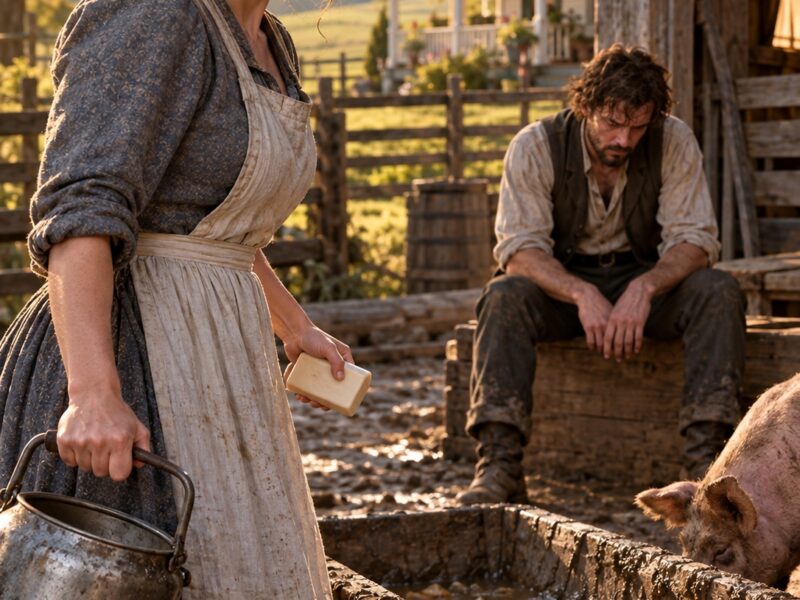
SHE FOUND A STARVING FOUR-YEAR-OLD EATING FROM A PIG TROUGH—THEN WALKED INTO HIS FATHER’S HOUSE WITH A BAR OF SOAP
The little boy was eating from the pigs’ trough when Norah Quinn saw him.
He was only four years old, barefoot in the morning cold, scooping filthy water and scraps toward his mouth with both hands.
And from the other side of the fence, Norah realized that everything she had called patience for the past four months had really been fear.
She stood absolutely still.
The basket of eggs hooked over her arm pressed against her hip. One of the hens scratched beneath the fence rail, looking for something the morning frost had not yet hardened into the dirt. Somewhere behind the Tolliver barn, a horse stamped its feet.
Ordinary sounds.
Ordinary morning.
And a child named Ned Tolliver was eating with the pigs.
Norah had known the boy since he was born. She remembered him as a round-faced baby who used to laugh whenever someone sneezed, a little fellow with a habit of grabbing whatever fingers came within reach.
Now his cheeks were hollow.
His hair was matted against his forehead. The collar of his shirt hung loose around his neck, and his bare feet were red from the cold.
He was hungry enough not to care where the food came from.
Norah tightened her hand around the fence until the rough wood bit into her palm.
“Ned,” she called softly.
The boy looked up.
For one brief moment, he seemed startled to find somebody watching him. Then he lowered his eyes, as though he expected to be scolded.
That expression hurt her more than the sight of the trough.
A child of four should have been embarrassed about muddy shoes or a stolen biscuit. He should not have looked ashamed of being hungry.
Norah opened her mouth, but nothing came out.
She had lived beside the Tollivers long enough to know what their house had once been.
Before Mary died, the windows had stood open whenever the weather permitted. There had been shirts drying on the line, children chasing one another through the yard, and the smell of bread coming from the kitchen on baking days.
Mary Tolliver had been the kind of woman who made hard work look almost cheerful.
She had never been foolish about life. Norah remembered that much.
Mary could complain about a stubborn cow, a leaky roof, or the price of flour as fiercely as anybody. But afterward she would push her hair back, laugh at something her children had said, and return to the work waiting for her.
Then spring came.
Mary died.
And something in the Tolliver household seemed to die with her.
At first, people had been sympathetic.
Neighbors spoke gently whenever Ben’s name came up. They lowered their voices when the children passed. At church, people shook their heads and said it was a terrible thing for a man to lose his wife while his children were still so young.
Norah had agreed.
She had known grief herself.
She understood how a familiar room could become unbearable because one person no longer occupied it. She understood the strange cruelty of ordinary things continuing when a life had ended.
The bread still needed slicing.
The animals still needed feeding.
The sun still came through the windows at the same hour.
And somewhere inside that relentless routine, a grieving person was expected to discover how to live again.
So she had waited.
During the first month, she told herself Ben needed privacy.
During the second, she baked a pie and carried it across the yard, only to leave it on his doorstep without knocking.
She had stood there listening for movement inside.
When she heard none, she went home.
For the rest of that afternoon, she told herself she had been considerate.
During the third month, she watched ten-year-old Sam begin wearing the same dirty shirt day after day.
She saw Ruth, who had once waved from the gate whenever Norah passed, lower her head instead.
The children’s hair grew tangled. Their faces became pinched. They stopped playing loudly enough for her to hear across the fence.
And Ben Tolliver moved through his farm like a man who had learned how to make his body work without asking anything of the rest of himself.
He rose before sunrise.
He tended the fields.
He returned to the house at sundown.
Sometimes Norah saw him sitting at the kitchen table through the window, unmoving while darkness gathered around him.
She wondered whether he had eaten.
She wondered whether the children had.
Then she reminded herself that it was not her place to interfere.
By the fourth month, even that excuse had begun to sound hollow.
And now Ned stood beside a pig trough with filthy water dripping from his chin.
Norah looked at him for another second.
Then she made a decision.
She set her basket of eggs on the ground.
“Go inside, Ned,” she said.
He blinked at her.
“Go on, sweetheart. I’ll be there shortly.”
She did not wait to find out whether he obeyed.
Turning sharply, she walked back across her own yard, past the empty washing line and the little patch of garden she had kept neat all summer.
Inside her kitchen, the stove had already warmed the room.
Everything was where she had left it.
The good lye soap sat on a shelf beside the window.
The washboard leaned behind the stove.
Her largest kettle hung from its hook.
Norah took all three.
She did not stop to reconsider what a neighbor might think.
She did not rehearse the polite conversation she ought to have with Ben.
Politeness had already taken four months from those children.
She would not let it take another day.
Her own home was quiet.
There were no small boots by the door, no children’s coats hanging beside hers, no voices calling from the bedroom.
There never had been.
And now there never would be.
Norah had made a life within that silence because she had no choice. She had learned to keep her kitchen warm for one person and to make a loaf of bread last longer than it ought to.
Most days she managed well enough.
Some evenings were harder.
But there was no room for those thoughts now.
Not while a little boy next door was going hungry.
She lifted the kettle against her hip, gathered the other things under her arm, and headed for the Tolliver house.
She had spent months wondering whether she would be welcome.
That morning, she decided it no longer mattered.
The front door stood closed.
Norah did not knock.
She opened it and walked inside.
The smell struck her first.
Cold ashes.
Unwashed dishes.
Damp clothing.
The sour, stale heaviness of a room where the windows had remained shut for too many weeks.
The kitchen was worse than she had imagined.
Plates sat abandoned near the sink. Dirt had collected in the corners. A thin layer of ash lay across the stove.
Sam and Ruth were sitting on the floor.
Ned had come in from the yard and was standing beside them, watching the door.
All three children looked at Norah with the same tired uncertainty.
At the kitchen table sat Ben Tolliver.
He was a broad-shouldered man, though his clothes hung more loosely than they once had. His dark hair needed cutting. His hands rested on the tabletop, rough from fieldwork, motionless beside an empty cup.
He raised his eyes when she entered.
For several seconds, neither spoke.
Then Norah set the kettle on the stove.
“Morning, Ben.”
He looked from her face to the washboard.
“Mrs. Quinn?”
“I’m going to heat some water.”
His forehead creased.
She took the bucket beside the door, filled the kettle from the barrel, and began building the fire.
“There’s no need for you to trouble yourself,” he said eventually.
Norah glanced over her shoulder.
“There’s every need.”
She returned to the stove.
Ben said nothing more.
His silence might once have frightened her away. That morning, it simply became another thing she worked around.
She carried a washing tub to the middle of the kitchen floor.
She found clean cloths among the household linens and laid them beside the stove. She tested the water with her wrist and added cold until it was safe and comfortably warm.
Then she turned to the children.
“Sam, come here.”
The oldest boy hesitated.
His face reddened.
“I’m not a baby.”
“I know you’re not.”
“Then I can wash myself.”
“Of course you can. I’ll help with the water and your hair. You can manage the rest.”
That seemed to satisfy him.
He stepped toward her with the wary dignity of a ten-year-old who had been trying to manage far more than any ten-year-old should.
Norah gave him privacy where she could, helped him scrub away the dirt, and washed his hair while he kept his eyes firmly on the floorboards.
At first, his shoulders were rigid.
Gradually, as the warm water soaked into his skin, he relaxed.
Norah noticed how thin his arms had become.
She noticed the small bones standing out beneath his collar.
Her hands slowed for just a moment.
She would have liked to ask when he had last eaten a proper meal.
Instead, she continued washing.
There would be time for questions later.
When Sam finished, she wrapped him in a towel and sent him to find clean clothes.
Ruth came next.
The little girl did not protest.
She climbed into the tub and sat very still while Norah gently loosened the knots in her hair.
The tangles were worse than Norah had expected.
She worked slowly, holding each section near the scalp so the comb would not pull.
“You tell me if I hurt you,” she said.
Ruth nodded.
A minute later, tears began slipping down her cheeks.
Norah stopped.
“Does it hurt, honey?”
Ruth shook her head.
“Then what’s the matter?”
The girl looked down at the water.
For a long time, she did not answer.
Then she whispered, “Mama used to do that.”
Norah felt something tighten in her chest.
She set the comb aside and smoothed a damp strand away from Ruth’s forehead.
“I know, sweetheart.”
Ruth’s mouth trembled.
Norah did not tell her not to cry.
She did not say that everything would be all right.
She only continued working, more gently than before, and began humming a tune without quite realizing it.
It was an old, familiar melody, one she used to hum while folding her own laundry.
Ruth’s tears slowed.
By the time her hair was clean, she had leaned against Norah’s arm.
Ned went last.
He climbed into the tub without a word.
His little feet were covered with dried mud. Norah washed them carefully, then cleaned his hands and face.
He watched her with grave, unblinking eyes.
“You have a very serious face, Mr. Tolliver,” she told him.
He considered this.
“I’m four.”
“Well, that explains it.”
For the first time, the corner of his mouth lifted.
Norah smiled back.
She rinsed the soap from his hair, wrapped him in a towel, and lifted him onto the floor.
He caught her sleeve before she could stand.
“Mrs. Quinn?”
“Yes?”
“Are you going to stay?”
The question was so quiet that she almost missed it.
Norah looked into his face.
She thought of the empty house across the yard.
She thought of the four months she had spent watching.
And she thought of how easily she could promise something the boy desperately wanted to hear.
But she would not lie to him.
“I’m going to come back tomorrow,” she said.
“Tomorrow?”
“Yes.”
He tightened his fingers around her sleeve.
“After that?”
Norah paused.
“We’ll see about after that. But tomorrow, I’ll be here.”
Ned thought it over.
Then he nodded as though the promise were something he could put carefully away and keep.
Norah straightened.
Three children stood before her, washed and wrapped in clean towels, their hair damp and their faces pink from the warmth.
She looked across the kitchen at Ben.
He had not moved.
But he was watching her now with a different expression.
Something between confusion and pain.
Norah wiped her hands on her apron.
“You’re next,” she said.
Ben stared at her.
For a moment, she thought he might argue.
Then he looked down at his hands.
He said nothing.
Norah left fresh water warming and a clean cloth beside the tub.
She did not force him.
There were things she could do for his children that he was not yet capable of doing for himself.
And there were other things he would have to choose.
When evening came, she gathered her belongings.
Sam was sitting near the stove in a clean shirt.
Ruth had begun untangling a length of string.
Ned followed Norah to the doorway.
“Tomorrow?” he asked.
Norah reached down and touched his freshly washed cheek.
“Tomorrow.”
She walked home as the sun slipped behind the fields.
Her arms ached.
Her back hurt.
She was more tired than she had been in weeks.
But something inside her felt different.
For four months, she had watched a family disappear behind the walls of a house.
That day, she had finally opened the door.
And for the first time since Mary Tolliver’s funeral, Norah Quinn believed there might be something useful she could do with her own loneliness.
The next morning, she came back.
And the morning after that.
By the end of the first week, nobody at the Tolliver farm seemed surprised to see her arriving before Ben left for the fields.
No formal arrangement had been made.
Ben had not hired her.
Norah had not offered herself as a housekeeper.
There had been no conversation about payment, responsibilities, or how long she intended to continue.
She simply appeared with her sleeves rolled up and set about doing what needed to be done.
At first, the work seemed endless.
She scrubbed the kitchen floor until the boards began to show their old color.
She opened the windows whenever the weather allowed and let the stale air escape.
She beat the dust from the rugs, washed the dishes, cleaned the stove, and carried bucket after bucket of water.
Some afternoons, she found herself standing in the middle of the kitchen, wondering how one room could hold so much evidence of a family’s suffering.
A bowl left where a child had last used it.
A shirt abandoned because no one had thought to wash it.
A wooden spoon resting beside a cold stove.
It was not simply dirt.
It was the accumulation of days when nobody had been able to care about tomorrow.
She recognized that kind of exhaustion.
And she knew it could not be repaired in a single morning.
So she came again.
She cooked thick porridge that stayed warm on the stove.
She made sure Sam and Ruth ate before walking to the schoolhouse.
She packed their lunches herself, wrapping bread and whatever else she could spare in clean cloth.
Then she stood at the gate and watched them go.
The first morning, Sam glanced back twice.
The second, Ruth waved.
By the end of the week, both children were waving before they even reached the road.
Norah did not realize how much she looked forward to that small gesture until one morning when the children were late and rushed away without it.
She stood at the gate longer than necessary.
Then she laughed quietly at herself and went back inside.
Sam’s only good shirt had torn near the shoulder.
She repaired it one evening by lamplight, taking care to reinforce the worn fabric.
Ruth’s hair required nearly a week of patient brushing before the tangles were fully gone.
At first, the girl flinched whenever the comb touched her scalp.
Norah learned to pause when she did.
She waited.
Then tried again.
Eventually Ruth began sitting willingly on a stool beside the fire, handing Norah the brush without being asked.
Ned remained close to her throughout the mornings.
He followed her from the kitchen to the yard, asking questions about everything she touched.
Why did soap make bubbles?
Why did bread rise?
Why did the kettle sing before the water boiled?
Sometimes Norah answered.
Sometimes she admitted she did not know.
When the housework was caught up enough to spare a few minutes, she took him outside and showed him how to make letters in the dirt with a stick.
There was no slate in the house for him to practice on.
The bare earth would do.
“That’s an N,” she told him one morning.
Ned studied the crooked marks.
“For Ned?”
“For Ned.”
He grinned.
Then he carefully dragged his stick through the dirt, making a shape that looked more like a fence than a letter.
Norah pronounced it beautiful.
He spent the next several minutes making more.
Through all of this, Ben remained strangely quiet.
He left for the fields each morning.
He returned for supper.
He ate what Norah prepared.
Occasionally, he nodded when she spoke.
He did not thank her during those first weeks.
Nor did he ask her to stop.
Sometimes she found him standing in the doorway, watching his children at the table with an expression she could not read.
She never asked him what he was thinking.
Not yet.
Grief had made him a stranger to his own household.
She suspected he would have to find his way back gradually.
One afternoon, she nearly made a terrible mistake.
A good tablecloth had been left folded beneath several other linens, stained and creased from neglect.
Norah carried it to the kitchen, filled a basin, and began rubbing soap into the fabric.
Ben came in from the barn.
He stopped in the doorway.
She noticed at once.
His face had lost its color.
His eyes were fixed on the cloth in her hands.
For a second, he looked as though someone had struck him.
Norah followed his gaze.
“Ben?”
He swallowed.
“That was Mary’s.”
Norah looked down.
The cloth was finer than the others. Along one edge ran a narrow line of careful stitching.
She suddenly understood.
Mary had owned it.
Mary had used it.
Perhaps Mary had placed it on that very table the last time the family had gathered happily for supper.
And Norah was standing there scrubbing at it as though it were only another piece of laundry.
“I’m sorry,” she said quietly.
She lifted the cloth from the basin, set it aside, and dried her hands.
Ben did not answer.
He stood there for another moment, looking at the tablecloth.
Then he turned and went outside.
Norah watched him leave.
She did not follow.
She did not touch the cloth again.
That evening, when she folded the clean laundry, she left Mary’s tablecloth in the place where Ben could find it.
Some things, she realized, could be washed clean.
Others could not.
And the fact that she had entered the household to help did not give her the right to decide what ought to happen to every memory inside it.
As autumn deepened, the mornings grew colder.
Norah noticed Ruth’s shoes were wearing through.
The girl tried to hide the worst hole by keeping her foot turned inward when she sat.
Norah noticed anyway.
One evening, while folding clothes at the table, she spoke to Ben.
“I washed the boys’ shirts today.”
He nodded.
“Ruth needs new shoes before winter.”
His gaze shifted toward her.
“Her toes are nearly through the old ones,” Norah continued. “I can take her into town Saturday, if you’ll let me use the wagon.”
Ben sat with his hands resting on the table.
For a moment, Norah thought he had not heard her.
Then he nodded once.
“Thank you,” she said.
It was a small thing.
A nod.
A few seconds of attention.
But as she walked home through the growing darkness, Norah found herself feeling grateful.
She had begun to understand that a man who had lost the person around whom his whole life had been built could not always give as much as others wished.
For now, she would take what Ben was able to offer.
And she would not demand more than he could bear.
The change came one cold October night.
Ben had been checking the far fence line and returned later than usual.
By then the sky had darkened completely, and the wind had begun moving through the trees beyond the barn.
He approached his house expecting the same uneasy silence he had lived with since Mary’s death.
But something was different.
Light shone from the front windows.
Not the dim light of a neglected lamp burning low.
Warm, steady lamplight.
He paused on the porch.
Through the window, he could see a fire glowing in the hearth.
The floor had been swept.
The furniture stood in its proper place.
The kitchen looked like a room where people expected to wake up and live again tomorrow.
He opened the door.
The familiar smell of cold ashes was gone.
In its place came the scent of stew, bread, and burning wood.
Ben remained in the doorway, holding his hat.
From upstairs came no sound at all.
No frightened crying.
No restless movement.
No small voice calling for a mother who would never answer.
His children were asleep.
All three of them.
Peacefully.
For the first time in longer than he could remember.
Norah sat at the table mending a shirt.
A lamp stood beside her.
She looked up as Ben entered.
“Evening.”
He could not immediately answer.
She nodded toward the stove.
“There’s stew. I kept it warm.”
Ben looked at the stove.
Then at the swept floor.
Then toward the stairs.
He had spent months surrounded by the evidence of everything he had lost.
Now, standing in his own doorway, he could see the beginnings of what remained.
Sam.
Ruth.
Ned.
The house Mary had loved.
The life they had made together.
None of it had disappeared when she died.
But he had been so overwhelmed by the absence of his wife that he had barely noticed the people still standing beside him.
Something inside him gave way.
Ben pulled out the chair across from Norah and sat down heavily.
His hat slipped from his fingers.
He covered his face with both hands.
And then he began to cry.
It was not quiet crying.
It was the kind of grief that seemed to tear through a man who had refused to let himself feel anything for too long.
His shoulders shook.
His breathing broke into uneven gasps.
He tried once to stop.
He could not.
Norah laid her sewing in her lap.
For a moment, she watched him.
She could have said she understood.
She could have reached for his hand.
She could have told him Mary would have wanted him to go on living.
But she knew that none of those words would change what had happened.
Mary was still dead.
Ben would still wake up tomorrow without her.
And no amount of kindness could give him back the years they had expected to spend together.
So Norah said nothing.
She rose, crossed to the stove, and ladled warm stew into a bowl.
She placed it beside him with a spoon and a square of bread.
Then she returned to her chair.
She picked up the shirt.
And she continued mending.
The room grew quiet except for the fire and the broken rhythm of Ben’s breathing.
Norah kept her eyes on the stitches.
She did not pretend not to hear him.
She simply allowed him the dignity of being miserable without requiring him to explain himself.
Minutes passed.
Then more.
At last, his shoulders became still.
He wiped his face with his sleeve and stared at the bowl.
Norah pushed it slightly closer.
“You’ll feel less like the floor’s fallen out from under you once there’s something warm inside you.”
Ben looked at her.
His eyes were red.
His face was exhausted.
But for the first time in months, he seemed fully present in the room.
He picked up the spoon.
And began to eat.
Norah returned to her sewing.
She did not smile.
She did not congratulate herself.
But somewhere in the quiet of that warm kitchen, she understood that something important had happened.
Ben Tolliver had finally allowed himself to grieve in front of another person.
And afterward, he had eaten his supper.
It was not a miracle.
It was not the end of his sorrow.
But it was a beginning.
By early November, the farm had settled into a different rhythm.
Ben still worked long hours.
Norah still came each morning.
Sam and Ruth attended school with clean clothes and full stomachs.
Ned had learned several letters, though he insisted that the crooked N he drew in the dirt was better than the one Norah made.
Ruth sometimes laughed again.
And Ben had begun speaking more often.
Not much.
A question about supper.
A remark about the weather.
A quiet word to one of the children.
Sometimes he watched Norah across the table with an expression that made her look away before he could catch her studying him.
She did not mistake any of it for happiness.
Not yet.
But the distance between Ben and the rest of the living world had begun to shrink.
One gray afternoon, Norah was hanging laundry outside when he approached.
He carried a harness strap that needed mending.
For several minutes, he worked nearby without speaking.
Norah pinned a sheet to the line.
The wind lifted one corner.
She caught it, smoothed it, and reached for another pin.
“Mrs. Quinn?”
She glanced toward him.
“Yes, Ben?”
He hesitated.
His hands stopped moving on the leather.
“Why do you do it?”
Norah frowned slightly.
“Do what?”
“All of it.”
He motioned vaguely toward the house.
“The washing. The cooking. Looking after the children.”
Norah took another cloth from the basket.
Ben went on.
“You don’t owe us anything.”
She remained silent.
“You never did.”
The wind moved between them.
Norah stared at the shirt in her hands.
She could have given him an easy answer.
She could have said that neighbors ought to help one another.
She could have told him she enjoyed having the children around.
Both things would have been true.
But neither explained why she had stood behind her fence for four months before finding the courage to enter his house.
She pinned the shirt to the line.
Then turned toward him.
“I watched you from my fence for four months,” she said.
Ben looked up.
“I watched Sam get quieter. I watched Ruth stop smiling. I watched Ned get thinner.”
Her voice was steady, but she could feel the memory of that morning rising inside her.
“And I watched you walk your fields like a man who’d been buried alongside his wife.”
Ben lowered his eyes.
“Norah—”
“Let me finish.”
He said nothing.
“Every day, I told myself it wasn’t my place. That grief needed time. That I ought to mind my own business and respect your privacy.”
She drew a breath.
“Do you know what I finally understood?”
Ben shook his head.
“I was afraid.”
He looked at her again.
“I was afraid you’d tell me to leave. Afraid I’d say the wrong thing. Afraid people would think I was interfering.”
She glanced toward the fence separating their properties.
“And I let myself believe all that fear was kindness.”
Ben’s jaw tightened.
Norah continued.
“Then one morning, I saw Ned eating out of the pig trough.”
Ben went completely still.
“What?”
“He was crouched beside it, scooping food into his mouth.”
The harness strap slipped in Ben’s hands.
For several seconds, he stared at her.
“I didn’t know.”
His voice was barely audible.
“Norah, I didn’t know he’d done that.”
“I know.”
“I didn’t know things had gotten so bad.”
She stepped a little closer.
“I believe you.”
Ben looked toward the house.
The kitchen windows were clean now. A small curl of smoke rose from the chimney.
Inside, Ned was probably waiting for the next opportunity to show somebody his letters.
Ben pressed his lips together.
“I should have known.”
Norah let the words sit between them.
She did not rush to argue.
She knew the children had suffered.
She knew Ben would have to live with the knowledge of what he had missed.
But she also knew that shame alone would not make him a better father tomorrow.
“I’m not telling you this to hurt you,” she said gently.
He looked at her.
“Then why tell me?”
“Because you asked why I came.”
She drew her shawl more tightly around her shoulders.
“And the truth is, I couldn’t bear watching any longer.”
Ben stared at her.
“I hated myself a little more every day I stood behind that fence and did nothing,” she admitted. “And when I saw Ned at that trough, I knew I couldn’t spend another day finding excuses.”
The cold wind rustled the laundry.
Ben looked down at the strap in his hands.
Norah returned to the basket.
“That’s all there is to it,” she said. “Nothing grand. Nothing particularly noble.”
She lifted another shirt.
“I just couldn’t stand it anymore.”
Ben remained silent so long that she began to wonder whether she had said too much.
Then he cleared his throat.
“Well.”
She looked toward him.
He swallowed once.
“I’m glad you couldn’t stand it.”
Norah held his gaze.
There was no smile on his face.
But something in his eyes had changed.
He had heard her.
Not merely the words.
The truth behind them.
And for the first time, Norah felt as though she and Ben were standing in the same moment rather than on opposite sides of a sorrow he could not yet speak about.
She turned back to the laundry.
He returned to his harness.
Neither said anything else.
But the quiet between them no longer felt empty.
By December, Norah had become such a regular presence at the Tolliver farm that the children scarcely remembered to ask whether she was coming.
Her arrival was simply part of the morning.
The stove was lit.
Breakfast was served.
School lunches were packed.
A small boy followed her through the kitchen making determined attempts to read the letters he saw.
And at the end of the day, when the winter dark came early, Ben often returned to find the house warm and his children settled.
Norah sometimes remained after sundown.
There were shirts to mend.
Meals to finish.
Children to comfort when old fears returned.
Once, Ned woke crying and would not settle until she sat beside him.
She stayed.
For Norah, none of these things seemed unusual.
She had begun helping because the family needed her.
She continued because the need had not vanished merely because the windows were clean and the children had shoes.
But in a small town, people rarely allowed a new arrangement to remain unexplained for long.
Mrs. Eunice Barrow lived on the other side of Norah’s property.
She had watched the widow crossing to the Tolliver house throughout the fall.
At first, she had assumed Norah was bringing meals.
Then she noticed how often she went.
Morning after morning.
Sometimes afternoon.
Sometimes well past the hour when respectable people, in Mrs. Barrow’s opinion, ought to have returned to their own houses.
By December, she had developed strong feelings about the matter.
And she had found someone willing to listen.
Reverend Hollis stood outside the church one Sunday morning, exchanging greetings with members of his congregation, when Mrs. Barrow approached.
“Reverend, I think something ought to be said about that Tolliver situation.”
He looked puzzled.
“What situation?”
“Mrs. Quinn.”
His expression changed.
“What about her?”
Mrs. Barrow lowered her voice just enough to suggest she intended to be discreet, though several people standing nearby could still hear perfectly well.
“She’s in that man’s house every day.”
The reverend adjusted his collar.
“I understand she’s been helping with the children.”
“Helping is one thing.”
Mrs. Barrow paused.
“But staying past dark is another.”
A few nearby conversations grew quieter.
“Ben Tolliver is a widower,” she continued. “And Norah Quinn is a widow. Surely you can see how people might talk.”
Reverend Hollis glanced uneasily toward the church doors.
“Mrs. Barrow—”
“I’m only thinking of the children.”
She said it with the confidence of a woman who believed those words settled any question.
“Someone ought to make sure things are being done properly.”
The reverend did not answer at once.
He had visited the Tolliver farm twice in the six months since Mary’s death.
Both visits had been uncomfortable.
He had said a prayer.
He had offered words that sounded inadequate even as he spoke them.
He had accepted that Ben wished to be left alone.
Then he had returned to his own orderly home and allowed himself to believe he had done what he could.
Now, confronted by Mrs. Barrow’s disapproval, he felt compelled to do something more decisive.
Unfortunately, the decision came much later than the help the Tolliver family had needed.
On Tuesday, Reverend Hollis arrived at the farm.
Norah was hanging sheets on the line.
Ben had come into the yard.
The preacher approached with the stiff formality of a man preparing to deliver a difficult message.
“Mr. Tolliver.”
Ben removed his hat.
“Reverend.”
“I hope you’ll understand that I’m here out of concern.”
Ben waited.
The reverend cleared his throat.
“There has been some talk in town about your household arrangements.”
Norah’s hands stopped on the sheet.
Ben looked at the preacher.
“What arrangements?”
“Mrs. Quinn’s daily presence in your home.”
Ben’s face changed.
Reverend Hollis continued before he could respond.
“People have begun questioning whether it is proper for an unmarried woman to spend so much time in a widower’s house, particularly without anyone else present to supervise matters.”
Norah felt heat rise into her face.
The preacher looked uncomfortable but pressed on.
“I believe some adjustment may be wise. For the sake of both your reputations, and naturally, the children.”
Norah slowly lowered her basket.
She knew perfectly well whose voice was behind this visit.
She could almost hear Eunice Barrow repeating the story outside the church.
But she also knew what an argument could mean.
It would spread.
It would grow.
And the children, who had finally begun to enjoy a little peace, would hear themselves discussed as though their family were a public scandal.
She stepped forward.
“Reverend.”
He turned to her.
“I’ll come during daylight hours from now on.”
Ben looked sharply at her.
Norah kept her chin lifted.
“If that’s what will ease everyone’s concerns, I’ll make sure I’m home before dark.”
The words hurt as she spoke them.
Already she was thinking of the cold evenings ahead.
Of supper.
Of Ned’s nightmares.
Of the work that could not always be finished while the sun was up.
But she forced herself to continue.
“I have no wish to bring trouble to this family. Especially not to children who’ve had more than enough of it already.”
The reverend appeared relieved.
“Well, Mrs. Quinn, that would certainly—”
“No.”
The word came from Ben.
Both Norah and the preacher turned toward him.
His hands were clenched at his sides.
“Ben?” Norah said.
He looked at her, then back at Reverend Hollis.
“Daylight isn’t enough.”
The preacher blinked.
“Mr. Tolliver—”
“It isn’t nearly enough.”
Ben’s voice was rough.
Norah had heard him speak more in the past month than in all the months before it.
But she had never heard this particular tone.
Not since Mary’s death.
He stepped forward.
“Do you know what happened here before Norah started coming?”
The reverend shifted uneasily.
“I understand you’ve had a difficult—”
“My children were hungry.”
Silence fell over the yard.
Ben kept his eyes on the preacher.
“My youngest boy was eating from the pig trough.”
Reverend Hollis stared.
“My daughter needed shoes. My oldest was trying to manage a household no ten-year-old ought to be responsible for.”
His voice caught.
For a moment, Norah thought he might stop.
Then he went on.
“And I was so lost in my own sorrow I couldn’t even see how badly they were suffering.”
He looked toward the house.
“I know that now.”
The reverend’s face had gone pale.
Ben turned back to him.
“Where was everybody when that was happening?”
Nobody answered.
“Where was all this concern for my children when they were going hungry in plain sight?”
Norah felt tears gathering behind her eyes.
Ben raised his voice.
“Norah Quinn was the only person in this town who finally came through that door and did something about it.”
The reverend opened his mouth.
Ben did not let him speak.
“And I won’t have her made to feel ashamed for it.”
The wind pulled at the sheets.
A wooden clothespin dropped from Norah’s hand.
She barely noticed.
“I’ve only just begun living again these past two months,” Ben said.
His voice broke.
He paused, swallowed, and spoke more firmly.
“My children have a warm house. They eat. They sleep. They laugh again.”
He glanced at Norah.
“And I’ll not send her away just to satisfy Eunice Barrow’s opinion of what’s proper.”
The reverend stood motionless.
For a few seconds, he looked very much like a man who had come prepared to administer a correction and discovered that he was the one being corrected.
At last, he lowered his gaze.
“I see.”
Ben nodded once.
“I hope you do.”
No one spoke.
The preacher eventually took his leave.
Norah watched him walk toward the road.
When he was far enough away not to hear, she turned toward Ben.
“You didn’t have to do that.”
Ben looked at her.
“Yes,” he said. “I did.”
She tried to answer.
Instead, she looked down at the forgotten basket.
A sheet hung half-pinned on the line.
She reached for the clothespin she had dropped.
Ben bent to retrieve it before she could.
He held it out.
Their fingers touched briefly as she took it.
Neither mentioned what had happened.
But Norah knew something had changed.
For weeks, she had been the one protecting Ben’s household.
That afternoon, he had stood up and protected her place in it.
And the man who had barely been able to lift his head from the kitchen table had found his voice when it mattered.
That night, Ben did not sleep well.
The house was quiet.
The children were safe in their beds.
The fire had burned low.
Everything Norah had worked to restore was around him.
Yet he lay awake replaying the preacher’s visit.
He remembered Norah standing in the yard, offering to shorten her visits for the sake of the family’s reputation.
He remembered the pain in her face when she said it.
And he remembered his own anger at the idea that someone who had done so much good might be driven away by people who had offered so little.
But beneath that anger was something harder to name.
He had begun looking for Norah when he came home.
He knew the sound of her steps in the kitchen.
He knew how she hummed when she was busy.
He knew the way she spoke to Ned when the boy grew stubborn, and the way she gave Sam space to feel older than he was without demanding he carry adult responsibilities.
He knew Ruth laughed more easily when Norah was nearby.
He knew that his house felt different when she was in it.
At first, he had thought that was simply because someone was cooking, cleaning, and caring for the children.
But during the preacher’s visit, he had imagined her no longer being there after dark.
The thought had frightened him.
Not because the work would go undone.
Because she would be gone.
Ben sat up in the darkness.
For months, he had believed that any happiness entering his life would somehow betray Mary.
He had treated grief as though it were the last thing connecting them.
If he stopped suffering, perhaps it meant he was forgetting her.
But he was beginning to see the cruelty of that belief.
Mary had loved their children.
She had loved their home.
She had wanted them safe, fed, and happy.
And because Ben had been unable to imagine a life without her, he had nearly allowed everything they had built together to collapse.
Norah had not erased Mary’s place in the family.
She had treated Mary’s tablecloth with more tenderness than Ben could ever have demanded.
She had listened when Ruth cried for her mother.
She had never tried to tell the children that the past no longer mattered.
Instead, she had helped them live in a world where Mary was still loved, even though she was gone.
That distinction stayed with Ben through the night.
He thought about Norah’s small house on the other side of the fence.
He thought about the courage it had taken her to enter his home uninvited.
He thought about Ned asking, day after day, whether she would return.
And he thought about how quickly he had grown accustomed to hoping she would.
By morning, Ben knew what he wanted.
Not because the town demanded an answer.
Not because Mrs. Barrow wanted to protect appearances.
And not because Norah had somehow become responsible for rescuing a broken family.
He wanted her to be part of that family.
Not as a visitor.
Not as an unpaid housekeeper.
As someone whose happiness mattered as much as the happiness she had brought into his home.
The frost had not yet melted when he left the farm.
He walked the two miles into town.
He passed the fence where Norah had stood watching his house for four long months.
He passed the schoolhouse where Sam and Ruth now arrived each morning with clean faces and full stomachs.
He walked past familiar houses and the little church until he reached the preacher’s home.
Reverend Hollis lived behind the church.
Ben knocked.
A moment later, the door opened.
“Mr. Tolliver?”
“I want you to marry us.”
The reverend stared.
“I beg your pardon?”
“Norah Quinn and me. This Sunday.”
Reverend Hollis looked as though he were trying to decide whether he had heard correctly.
“Mr. Tolliver, this is rather sudden.”
Ben shook his head.
“No, Reverend. It isn’t.”
“But surely you and Mrs. Quinn ought to—”
“I’ll ask her this afternoon.”
The preacher blinked.
Ben continued.
“I’d like the ceremony in the church. In front of everybody.”
He paused.
“And if Eunice Barrow cares to come, she’s more than welcome. She can watch us do everything properly and have nothing left to whisper about.”
The preacher cleared his throat.
“Have you given this matter sufficient thought?”
Ben looked toward the church.
For a moment, Mary came back to him.
Not as a ghost.
Not as a reason to be ashamed.
As the woman who had shared his life, who had brought three children into the world with him, and whose love would remain part of that family for as long as any of them lived.
He would always miss her.
He knew that now.
Missing her was not something he had to recover from.
It was something he would learn to carry.
But carrying sorrow did not require him to refuse every good thing that might still come.
“I’ve had plenty of time to think,” he said.
He turned back to the reverend.
“This started the day a woman came across my fence carrying a bar of soap and decided my children were worth saving.”
He swallowed.
“I was slow to understand what it meant.”
The preacher listened without interrupting.
“But I understand now.”
Ben straightened.
“And I’m not going to wait another day just because some people think love ought to arrive on a schedule that suits them.”
Reverend Hollis stood aside.
For once, he had no advice to give.
That afternoon, Ben returned to the farmhouse earlier than usual.
Norah was in the kitchen.
She had been preparing supper, and the room smelled of onions and warm bread.
A pot simmered on the stove.
From the staircase came the faint sound of whispering.
Sam, Ruth, and Ned had gathered there, pretending to be occupied with something else.
They were making such a poor job of hiding that Norah had already noticed them twice.
Ben entered and removed his hat.
“Norah?”
She looked up.
“You’re home early.”
“I know.”
“Everything all right?”
He nodded.
Then he hesitated.
For a man who had found enough words to challenge a preacher in his own yard, asking one woman a simple question had suddenly become remarkably difficult.
Norah watched him.
“Ben?”
He set his hat on the table.
“I’ve been thinking.”
She smiled faintly.
“That sounds serious.”
“It is.”
The whispering on the stairs stopped.
Ben glanced toward the doorway, then back at her.
“I know what you’ve done for this family.”
Norah began to shake her head.
He raised one hand.
“Please. Let me say it.”
She went still.
“For a long time after Mary died, I didn’t know how to be a father to my own children.”
His voice lowered.
“I could work. I could go out to the fields every morning. But when I came home, I couldn’t seem to do anything that mattered.”
Norah looked toward the stove.
“Ben, you were grieving.”
“I know.”
He nodded.
“And I know you understand that better than most.”
He drew a slow breath.
“But you didn’t just clean up this house.”
She looked back at him.
“You gave my children something they’d stopped expecting.”
“What was that?”
“The feeling that somebody was looking after them.”
Norah’s eyes filled.
Ben moved a little closer.
“And somewhere along the way, you gave me the same thing.”
The kitchen became very quiet.
On the stairs, someone shifted.
Ben almost smiled.
He knew the children were listening.
Perhaps it was better that way.
They had heard too much sorrow in that house.
They might as well hear this.
“Norah,” he said, “I don’t want you going home alone every night.”
Her breath caught.
“I don’t want you to feel like you have to leave because the sun’s gone down.”
He reached for her hand.
“And I don’t want you thinking there’s no place for you here except the one you’ve made by working yourself tired.”
A tear slipped down her cheek.
“Ben…”
“I want you here because I love you.”
He paused.
The words had frightened him before he said them.
Now that they were out, he felt strangely calm.
“I don’t expect you to take Mary’s place. Nobody could.”
Norah nodded, unable to speak.
“But there’s room in this house to love her and to love you, too.”
He looked directly into her eyes.
“Will you marry me?”
Norah made a small, startled sound.
It was half a laugh.
Half a sob.
Then she smiled through her tears.
“Yes.”
Ben blinked.
“I haven’t finished asking.”
“I know.”
She laughed again.
“Yes, Ben Tolliver. I will.”
From the staircase came a sudden thump.
Sam had lost his balance.
Ruth gasped.
And Ned, unable to contain himself another second, appeared around the doorway.
“Is she staying?”
Norah turned toward him.
The boy looked from her to his father.
“For good?”
Ben laughed.
It was a rusty, unfamiliar sound at first.
Then it came again, stronger.
He held out his hand.
“Come here, Ned.”
The little boy hurried across the kitchen.
Ben lifted him into his arms.
Norah reached out and smoothed Ned’s hair.
“Yes, sweetheart.”
She looked at Ben.
“That’s the plan.”
Ned regarded them seriously.
Then he wrapped both arms around Norah’s neck.
Behind him, Ruth began crying.
Sam pretended not to.
The kitchen was suddenly full of voices, movement, laughter, and tears.
Nothing extraordinary had happened to the building itself.
The walls were still the same.
The old stove still needed tending.
There would be bills to pay, fields to work, clothes to mend, and winter nights when the wind found every crack around the windows.
There would still be days when Ben missed Mary so fiercely he could scarcely bear it.
Norah knew there would be times when her own old sadness returned.
But the house no longer seemed like a place where everyone had to carry those burdens alone.
That Sunday, the whole town gathered at the church.
Some came because they were happy for Ben.
Some because they loved the children.
Others because there was nothing more interesting happening that morning than a widower marrying the widow who had been caring for his household.
Mrs. Eunice Barrow attended.
She sat among the congregation with her hands folded neatly in her lap.
Whatever private opinions she held, she kept them to herself.
At the front of the church, Sam, Ruth, and Ned sat together in their cleanest clothes.
Ruth wore her new shoes.
Sam’s shirt had been carefully mended.
Ned’s face was freshly washed, and his hair had been combed into submission, though one stubborn lock insisted on standing up.
The children watched their father with undisguised excitement.
Ben stood waiting.
He had not forgotten Mary.
He had not stopped grieving her.
But as Norah came forward, he felt something he had not expected to feel again.
Hope.
She wore a simple dress.
There was nothing elaborate about the ceremony.
No grand decorations.
No display of wealth.
Only a small church filled with familiar faces and a family beginning a new chapter of its life.
When Norah stood beside him, Ben reached for her hand.
She gave it willingly.
Reverend Hollis spoke the familiar words.
They made their promises.
And when the ceremony was finished, the preacher pronounced them husband and wife.
Ruth clapped before anybody else did.
Sam grinned.
Ned, uncertain about the proper order of church ceremonies, clapped because his sister had.
A ripple of warm laughter passed through the congregation.
Norah looked down at the children.
Then up at Ben.
He squeezed her hand.
Afterward, they walked home together.
The afternoon was cold but clear.
The road stretched past the church, the schoolhouse, and the neighboring fields toward the Tolliver farm.
Sam and Ruth walked ahead, talking excitedly.
Ned stayed close to Norah.
For a while, he said nothing.
Then he tugged at her skirt.
She looked down.
“What is it, sweetheart?”
He considered his question with the solemn care he brought to most important matters.
“Will you still wash us?”
Norah stopped walking.
Ben paused beside her.
“Wash you?”
Ned nodded.
“Now that you’re staying for good and all.”
Norah crouched until her face was level with his.
She took his clean cheeks between her hands.
There was something deeply familiar about the gesture now.
She remembered the first morning.
The filthy water.
His thin little face.
The fear in his eyes when he asked whether she would stay.
At the time, she had promised only tomorrow.
Now, at last, she could give him a different answer.
“Forever,” she said.
Ned studied her.
Norah smiled.
“I plan to keep washing you, Ned Tolliver, for as long as you’ll let me.”
She paused.
“And probably a good while after you’d rather I stopped.”
He thought about this.
Very seriously.
Then he grinned.
“All right.”
He pulled away and ran down the road to catch up with Sam and Ruth.
Norah watched him go.
Ben stepped beside her.
For a moment, they stood together looking at the three children.
“They look happy,” he said.
Norah nodded.
“They do.”
Ben took her hand.
He looked at the house in the distance.
The same house where he had sat for months staring into an empty room.
The same house where his children had gone hungry while he wandered through his grief.
The same house where a widow carrying a kettle, a washboard, and a bar of soap had walked through his door without asking permission.
He would always remember those months.
He would always regret what his children had endured.
But he understood something now that he had not understood then.
A life could be broken by loss without being finished.
A home could hold sorrow and still make room for joy.
And sometimes the first step toward saving a family was not a grand sacrifice or a remarkable act of courage.
Sometimes it was a woman deciding she would no longer stand behind a fence and watch hungry children suffer.
Ben tightened his fingers around Norah’s.
She looked up at him.
Together, they followed the children home.
The chimney was waiting.
The kitchen would need warming.
There would be supper to prepare, school clothes to lay out, and another ordinary day beginning in the morning.
Nothing about that life would be perfect.
But it would be theirs.
And as the five of them walked toward the farmhouse, the windows catching the last pale light of the afternoon, the house no longer seemed empty.
It was simply, quietly, completely full of life.









