SHE GAVE A BROKE STRANGER HER LAST $20—SEVEN YEARS LATER, A HELICOPTER LANDED AT HER DYING GAS STATION
The helicopter arrived forty-five minutes before Ellie Parker was supposed to lose everything.
By then, she had already taken the photographs off the wall.
She had already emptied her father’s tools from the second drawer beneath the register, wrapped his favorite wrench in an old red shop towel, and placed seven years of pay stubs inside a cardboard box that once held motor oil.
She had already accepted that by nine o’clock that morning, the Route 9 service station would no longer be hers to worry about.
The garage would close.
Her health insurance would disappear.
Her mother’s next treatment would become a number Ellie didn’t know how to pay.
And Glattis—the rusted tow truck her father had left behind—would probably be sold for parts to somebody who would never know how many winter nights Ellie had slept in its cab between emergency calls.
At 8:15 a.m., her ex-boyfriend stood near the register in a tailored gray coat, watching her dismantle her life with the bored satisfaction of a man who had spent seven years waiting to be proven right.
Then the windows began to shake.
A deep mechanical thump rolled across the roof.
Coffee trembled inside paper cups.
Tyler’s girlfriend looked toward the ceiling.
“What is that?”
Tyler frowned.
Outside, snow dust and highway grit lifted into a violent spiral.
Ellie stepped toward the glass.
A black helicopter was descending into the empty lot beside pump three.
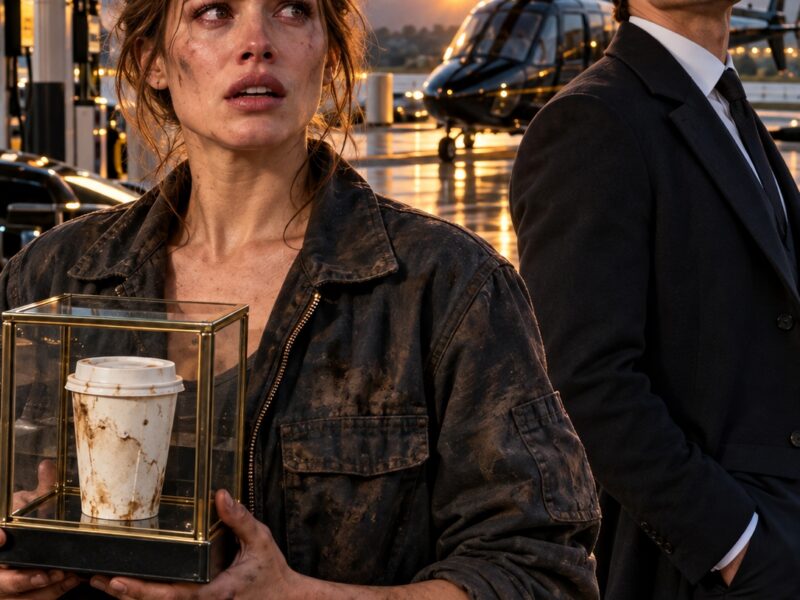
And before its door even opened, Ellie saw the man inside holding something behind glass.
An old paper coffee cup.
Her paper coffee cup.
With handwriting on the bottom she had forgotten seven years ago.
That was when Ellie understood something impossible.
The stranger had come back.
But seven years earlier, on the coldest night of her life, she had been absolutely certain he never would.
It had been just after midnight when the blue sedan limped into the Route 9 station on a ruined wheel.
Ellie heard it before she saw it.
Metal scraped pavement.
Rubber slapped unevenly against asphalt.
The little car rolled beneath the fluorescent canopy with the wounded sound of something surviving on momentum alone.
Ellie Parker was twenty-six then, wearing an oil-stained work jacket over a black dress because Tyler Grant had spent the previous twenty minutes reminding her that they had dinner reservations.
“Five minutes,” he said.
He stood near his spotless SUV, checking his watch.
“Seriously, Ellie. Five.”
She ignored him.
The blue sedan stopped crooked beside pump two.
A man climbed out.
He looked maybe thirty.
His hair was damp with sweat despite the freezing air. His shirt was wrinkled. One sleeve was streaked with grease. His face had the hollow, stunned expression of someone whose body was standing in one place while his mind was already somewhere terrible.
He stared at the damaged wheel.
“No,” he whispered.
Then again, quieter.
“No, no, no.”
Ellie walked closer.
“That rim won’t make another mile.”
He looked up.
For a moment, he didn’t seem to understand she was speaking to him.
Then he said, “I have to make it three hundred.”
“Three hundred miles?”
He nodded.
Tyler gave a humorless laugh behind her.
“Good luck.”
Ellie crouched beside the tire.
The sidewall was shredded. The rim had already kissed pavement hard enough to bend.
“You have a spare?”
“I think.”
“You think?”
“I don’t know. This isn’t my car.”
His hands were shaking.
That was what made Ellie stand.
Not the tire.
Not the car.
His hands.
Mechanics learned to notice hands.
Hands told the truth long before faces did.
This man’s fingers couldn’t stop trembling.
“Where are you going?”
He swallowed.
“County Hospital.”
Something changed in his expression when he said it.
Ellie stopped looking at the wheel.
“My mother is there.”
The highway hummed beyond them.
A truck passed, throwing white light across the pumps before darkness swallowed it again.
The man looked at his phone.
Three missed calls.
Then four.
“She’s dying.”
Tyler exhaled sharply.
“Ellie.”
She didn’t turn.
The stranger continued, almost apologetically, “They said maybe tonight. Maybe morning. I left as soon as they called, but my card got declined at the last station. I’ve got four dollars.”
He laughed once.
There was no humor in it.
“Four dollars and three hundred miles.”
Ellie looked toward the convenience store.
The register had maybe sixty dollars in small bills.
Most of it wasn’t hers.
In her jacket pocket, she had the money she’d brought for dinner.
Tyler had chosen the restaurant.
Of course he had.
Tyler chose restaurants the way other people chose investments—based on who might see him there.
“Don’t,” he said.
Ellie finally turned.
“What?”
“I know that look.”
“What look?”
“The one where you decide somebody else’s disaster is your responsibility.”
The stranger lowered his eyes.
“I didn’t ask her for anything.”
Tyler barely glanced at him.
“Then don’t.”
Ellie felt something harden inside her.
She had known Tyler since high school. Back then, ambition had looked attractive on him. He wanted out of their town. He wanted suits, offices, expense accounts, hotels with marble lobbies.
Ellie wanted things too.
She wanted her mechanic certification.
She wanted a garage with her name over the door.
She wanted her mother to stop worrying about medical bills.
She wanted, occasionally, one whole week where nothing broke.
But Tyler had begun to speak about people as though poverty were contagious.
People like this.
Places like this.
Jobs like yours.
Ellie looked at the stranger again.
“Open your trunk.”
Tyler stared at her.
“Ellie.”
“Five minutes, remember?”
The stranger popped the trunk.
There was a spare.
Barely inflated, but usable.
Ellie grabbed a jack.
“What’s your name?”
“Nathan.”
“I’m Ellie.”
Nathan bent to help.
She stopped him.
“You’re shaking too much.”
“I’m fine.”
“You’re terrible at lying.”
For the first time, he almost smiled.
Ellie loosened the lug nuts.
Nathan watched her hands.
“Where’d you learn that?”
“My dad.”
“He a mechanic?”
“Was.”
“I’m sorry.”
“Don’t be. He was complicated.”
She leaned harder against the wrench.
“Only good thing he left behind was knowing how to fix things.”
Nathan looked at her for a second.
“Then he left you something good.”
The sentence caught her off guard.
Nobody had ever said it that way.
Tyler walked over.
“Are we done?”
“Almost.”
“You said five minutes.”
“Then time me.”
Twenty minutes later, the spare was on.
Ellie checked it twice.
Nathan stood beside the driver’s door, staring at her like she’d performed surgery.
“Thank you.”
“Don’t thank me yet.”
She went inside.
When she returned, she carried forty dollars worth of prepaid fuel authorization, twenty dollars cash, and a paper cup filled with coffee so terrible she privately suspected it violated several state laws.
Nathan stared at the money.
“No.”
“Yes.”
“I can’t take that.”
“It’s not a loan application.”
“Ellie.”
“I’m not giving you gas money.”
He looked at her.
She pressed the bills into his palm.
“I’m giving you a way home.”
Something moved across Nathan’s face.
Not gratitude exactly.
Something deeper.
Something painful.
He closed his fingers around the money.
“I’ll pay you back.”
“Sure.”
“I mean it.”
“Then come back.”
Tyler laughed behind her.
Nathan looked toward him, then back at Ellie.
“I will.”
Ellie handed him the coffee.
“Drive safe.”
He climbed into the sedan.
A few seconds later, the taillights disappeared down Route 9.
Ellie watched until there was nothing left to see.
Then Tyler said, “Our dinner money.”
She turned.
“What?”
“You gave our dinner money to a stranger.”
“His mother is dying.”
“Then he should’ve planned better.”
Ellie stared at him.
She remembered that sentence for the rest of her life.
Not because it was cruel.
Cruelty was usually louder.
It was because Tyler said it casually.
Like it was obvious.
Like human beings deserved whatever happened to them if they had failed to predict every disaster in advance.
“You really believe that?”
Tyler shrugged.
“You can’t rescue everybody.”
“I changed a tire.”
“You gave him sixty dollars.”
“Forty in gas. Twenty cash.”
“Great. Even better.”
Tyler opened his SUV door.
“One day you’re going to look around and realize you gave everything away to people who wouldn’t cross the street for you.”
Ellie stood beneath the gas station lights.
“Maybe.”
“You’ll end up like them.”
“Like who?”
Tyler looked at the old station.
The cracked pavement.
The faded sign.
The highway workers drinking cheap coffee inside.
“People who never get anywhere.”
Ellie felt strangely calm.
“Go to dinner, Tyler.”
He stared at her.
“Are you serious?”
“Very.”
“I’m not waiting around forever while you save strangers.”
She nodded.
“Then don’t.”
That was how their relationship ended.
No screaming.
No dramatic goodbye.
Just Tyler getting into his SUV while Ellie stood beside an empty paper coffee cup and realized she felt more relieved than heartbroken.
Seven years later, she still worked beneath the same flickering sign.
Her father had died.
Her mother had gotten sick.
Her certification exam had been postponed once, then twice, then indefinitely as chemotherapy appointments swallowed her schedule.
The station had become less a job than the scaffolding holding her life together.
Its insurance paid enough of her mother’s treatment to keep them from drowning.
Its garage gave Ellie side work.
Its battered tow truck gave her emergency calls.
Its terrible coffee gave regular customers something to complain about.
And Glattis gave her someone to talk to when she didn’t want her mother to know she was afraid.
Yes, she had named the tow truck.
Her father had called it Glattis for reasons nobody remembered.
The truck was older than Ellie and almost as stubborn.
Every morning she slapped its hood and said, “Don’t embarrass me today.”
Every morning, somehow, it started.
Until Tuesday.
Three days before the station was scheduled to close.
Ellie was underneath a Ford pickup when she heard expensive shoes crossing the garage floor.
She rolled out.
Tyler Grant stood over her.
Seven years had been kind to his wardrobe.
Less kind to his face.
Not that he looked bad.
He looked successful.
Which was somehow worse.
His coat probably cost more than Glattis.
Beside him stood a woman in sunglasses despite being indoors.
“Well,” Tyler said. “Ellie Parker.”
She wiped her hands.
“Tyler.”
“Still pumping gas.”
“Still breathing.”
His smile tightened.
The woman beside him laughed.
Tyler looked around.
“Coffee still terrible?”
“No. We’ve improved it.”
“Really?”
“No.”
The woman laughed again.
Ellie almost liked her.
Then Tyler reached into his coat and removed a folder.
“Regional manager.”
Ellie stared at him.
“Congratulations.”
“Your regional manager, actually.”
Something cold moved through her stomach.
Tyler placed the folder on the workbench.
“Corporate is closing Route 9.”
The garage seemed to go silent around the sentence.
Ellie looked at him.
“When?”
“Friday.”
She laughed because the alternative was falling over.
“This Friday?”
“Nine a.m.”
“My garage is booked for weeks.”
“Transfer the jobs.”
“To where?”
“Not my problem.”
Her hands curled around the shop towel.
“The station makes money.”
“Not enough.”
“We service half the farms within thirty miles.”
“Corporate doesn’t care.”
“I do.”
Tyler’s expression changed.
For half a second, Ellie saw the boy he’d been.
Then it disappeared.
“That’s always been your problem.”
She looked at him.
“My mother’s treatments run through this job’s insurance.”
His girlfriend stopped smiling.
Tyler didn’t.
“Ellie—”
“If I lose coverage Friday, her treatment Monday—”
“That’s not a regional operational concern.”
There it was.
Seven years compressed into one sentence.
Ellie felt twenty-six again.
Standing beneath fluorescent lights.
Holding twenty dollars.
Watching a man decide compassion was an accounting error.
Tyler leaned closer.
“Remember what I told you?”
She said nothing.
“That night?”
Of course she remembered.
He smiled.
“You’d end up like them.”
Ellie looked at his expensive coat.
His polished shoes.
The folder containing the end of her mother’s insurance.
Then she said quietly, “And you ended up exactly like you.”
Tyler’s girlfriend covered a laugh with a cough.
His face hardened.
“Friday. Nine o’clock.”
He turned.
“Bring your own box.”
Ellie waited until their car disappeared before she sat down.
Not dramatically.
Her knees simply stopped cooperating.
She sat on the concrete beside Glattis.
For a long time she stared at the tow truck’s rusted bumper.
“Not today,” she whispered.
The truck said nothing.
“You don’t get to quit too.”
She rested her forehead against the cold metal.
“They’re closing us, Glattis.”
Her voice broke.
“Friday.”
Silence.
“And Mom’s treatments…”
That was the part she couldn’t finish.
Ellie had become very good at solving mechanical problems because machines obeyed logic.
Compression.
Fuel.
Air.
Spark.
Pressure.
Heat.
Friction.
Something failed because something caused it to fail.
Life wasn’t like that.
Sometimes you did everything right and still lost.
Sometimes you postponed school to care for your mother and discovered sacrifice did not earn interest.
Sometimes you worked seven years beneath fluorescent lights and your reward was a cardboard box.
Sometimes the man who once loved you came back carrying the order that would take away the insurance keeping your mother alive.
Ellie wiped her face angrily.
“Crying never fixed an engine.”
From the doorway, an older customer said, “No. But I’ve seen you swear one back to life.”
She laughed despite herself.
That night, Ellie sat at her mother’s kitchen table pretending nothing had happened.
Her mother, Rose, watched her over a slice of pie.
“Tell me.”
“Tell you what?”
“Whatever you’re lying about.”
“I’m not lying.”
“You’ve been my daughter for thirty-three years. You think I can’t tell?”
Ellie stabbed the pie.
“Eat.”
“Don’t change the subject.”
“I’m literally telling you to eat.”
“Ellie.”
Silence.
Rose’s face had become thinner over the past year.
The treatments had taken her hair, then allowed some of it back.
They had taken her appetite.
Her balance.
Her patience.
But not her ability to see through her daughter.
“They’re closing the station Friday,” Ellie finally said.
Rose stopped chewing.
“Okay.”
Ellie blinked.
“Okay?”
“Okay means I heard you.”
“Mom, the insurance—”
“I know.”
“No, you don’t.”
“I do.”
“The treatments—”
“Ellie.”
“I can pick up private jobs. Maybe sell Dad’s tools. Glattis might be worth—”
“Don’t.”
“What?”
“Don’t sell your father’s truck to buy me another month.”
Ellie stared at her.
“I’ll sell whatever I have to.”
Rose’s eyes filled.
“That’s what I’m afraid of.”
Ellie pushed back from the table.
“I didn’t give up school because I enjoy smelling like transmission fluid.”
“You gave it up because of me.”
“You were sick.”
“I never asked you to.”
“You didn’t have to ask.”
Rose reached across the table.
Her hand was warm and frighteningly light.
“Then let me be the mother for once.”
Ellie looked away.
“I don’t know how.”
“Clearly.”
Rose pushed the pie toward her.
“Start with eating.”
Ellie laughed through the ache in her throat.
“Yes, ma’am.”
They ate quietly.
Then Rose said, “Whatever happened to that boy?”
“What boy?”
“The flat tire.”
Ellie frowned.
“Mom.”
“The one you gave your dinner money to.”
“Seven years ago?”
“I have cancer, not amnesia.”
Ellie smiled.
“He never came back.”
Rose considered this.
“You sure?”
“Pretty sure I would’ve noticed.”
“Some people come back.”
“Mom, people don’t.”
Rose lifted one shoulder.
“Sometimes it just takes them a while.”
Ellie looked toward the dark kitchen window.
“Seven years is a long while.”
Three hundred miles away, Nathan Cole was staring at a paper coffee cup inside a glass display case.
His chief operating officer stood behind him holding a tablet.
Nathan barely heard him.
The cup was ugly.
Cheap white paper.
A faded brown stain along the rim.
The logo had nearly rubbed away.
Nathan had carried it through five apartments, three offices, one failed startup, two successful companies, a divorce that never happened because he had been too busy to get married in the first place, and eventually into the corner office of Cole Meridian Holdings.
People assumed it was some eccentric billionaire souvenir.
They were wrong.
It was the most expensive thing Nathan owned.
Because his mother had died two hours after he reached County Hospital.
Two hours.
He had held her hand.
He had apologized for being late.
She had told him he wasn’t.
She had asked whether he’d eaten.
Mothers were absurd that way.
She was dying, and she worried about dinner.
Nathan had stayed beside her until her breathing changed.
Then until it stopped.
And afterward, sitting alone in a hospital hallway, he had looked down and realized he was still holding the paper cup.
Drive safe.
Those were the words written underneath.
He hadn’t noticed them until dawn.
His mother used to say the same thing every time he left her house.
Drive safe.
Not goodbye.
Never goodbye.
Drive safe.
Nathan had tried to return to Route 9 three weeks later.
He couldn’t find the station.
He remembered a red star sign, an old tow truck, terrible coffee, and a woman named Ellie.
That was all.
He had been driving through three states that night.
The receipt had disappeared.
His phone had been replaced after an accident.
And life, cruelly, accelerated.
Nathan built a company.
Then another.
He invested.
Bought.
Sold.
Failed.
Recovered.
Every year he told himself he would find her.
Every year something urgent became more urgent.
Until one Thursday afternoon, his assistant mentioned that Cole Meridian was finalizing acquisition of a regional fuel-and-service chain.
Nathan barely looked up.
“Which chain?”
“Red Star.”
His hand stopped.
“What did you say?”
“Red Star Service Centers. Two hundred fourteen locations.”
Nathan stood.
His COO frowned.
“Nathan?”
“Get me the list.”
“What list?”
“Every location.”
Twenty minutes later, Nathan was scanning addresses.
His finger stopped.
Route 9.
A small service station scheduled for closure the following morning.
He stared at the photograph attached to the property file.
The sign had faded.
The building looked smaller.
But beside the garage sat an ancient tow truck.
Rusty hood.
White door.
Bent front bumper.
Nathan whispered, “That’s it.”
His COO looked over his shoulder.
“What’s it?”
Nathan pointed.
“The station.”
“What station?”
“The reason I’m standing here.”
He picked up the paper cup.
His COO stared.
“You fly to Tokyo tonight.”
“Cancel it.”
“We can’t.”
“Move it.”
“The board—”
“Can complain.”
“The acquisition closes tomorrow morning.”
Nathan looked at the station photograph.
“No.”
His COO frowned.
“What?”
“It closes tonight.”
He grabbed his coat.
“The acquisition closes at seven.”
“And then?”
Nathan smiled.
“Then I have somewhere to be.”
Friday morning arrived without ceremony.
Ellie unlocked the station at five.
She made coffee.
Badly.
On purpose.
At six, three farmers came in.
At six-thirty, a trucker named Benny hugged her without warning and pretended he had something in his eye.
At seven, Mrs. Cooper from the pharmacy brought muffins.
At seven-fifteen, somebody taped a handwritten sign beside the register.
THANK YOU, ELLIE.
She took it down.
Then put it back.
At eight, Tyler arrived.
His girlfriend was with him again.
“Keys at nine,” he said.
Ellie nodded.
“Forty-five minutes.”
“Stop giving away inventory.”
“I’m paying for the coffee.”
“With what?”
“My money.”
“Technically the coffee belongs to corporate.”
Ellie lifted the cup.
“Then arrest me.”
At 8:15, the windows began to shake.
Everyone looked outside.
The helicopter descended.
Tyler’s girlfriend walked to the glass.
“That’s a real helicopter.”
Tyler frowned.
“As opposed to?”
She ignored him.
The aircraft settled beyond pump three.
The door opened.
A man in a dark suit stepped down.
Then another.
Then Nathan.
Ellie didn’t recognize him immediately.
Seven years had sharpened him.
The desperate man in the wrinkled shirt was gone.
This man carried himself differently.
He wore wealth without seeming impressed by it.
But when he entered the station and looked at Ellie, his expression changed.
He became the man with four dollars again.
“You told me to come back.”
Ellie’s fingers tightened around her coffee cup.
“What?”
Nathan smiled.
“Blue sedan.”
Her face went still.
“Flat tire.”
Her breath caught.
“Worst coffee in three states.”
The room disappeared.
For one second, Ellie heard only the refrigerator humming behind the counter.
“Nathan?”
“Hi, Ellie.”
She stared.
“No.”
His smile grew.
“That’s approximately what I said when the tire blew.”
She laughed.
Then covered her mouth.
“You…”
Nathan lifted the glass case he was carrying.
Inside was a stained paper cup.
Ellie stepped closer.
“You kept that?”
“Seven years.”
“Why?”
His smile faded.
“Because it got me to my mother.”
Ellie stopped breathing.
Nathan looked down at the cup.
“She died two hours after I arrived.”
“Oh, Nathan.”
“I held her hand.”
He looked at Ellie.
“I got to tell her I loved her.”
Nobody spoke.
“Because a stranger gave me twenty dollars.”
Tyler stepped forward.
“Okay. Touching reunion. But this property closes at nine.”
Nathan turned.
“And you are?”
“Tyler Grant. Regional manager.”
Nathan’s eyes flicked toward Ellie.
“The Tyler?”
Ellie almost smiled.
Tyler frowned.
“What does that mean?”
“Nothing flattering.”
Tyler’s girlfriend looked at Ellie with sudden fascination.
Tyler straightened.
“Sir, whoever you are, corporate has ordered this station closed.”
“I know.”
“Then—”
“I bought corporate.”
Silence.
Tyler blinked.
Nathan continued, “The acquisition closed at seven this morning.”
Tyler stared at him.
“What?”
“The whole chain.”
Tyler’s girlfriend slowly removed her sunglasses.
Nathan looked around the station.
“Two hundred fourteen locations.”
Tyler’s face lost color.
“You can’t just—”
Nathan nodded toward the man behind him.
“My general counsel can explain which things I can and cannot do.”
Tyler looked at Ellie.
Then Nathan.
Then the helicopter.
His girlfriend whispered, “Babe?”
Tyler snapped, “Not now.”
She picked up her purse.
“Actually, now feels perfect.”
He stared.
“I’ll find my own ride.”
She walked out.
Ellie pressed her lips together.
Tyler pointed at Nathan.
“This isn’t over.”
Ellie finally spoke.
“It was over seven years ago.”
Tyler looked at her.
For once, he had nothing.
He left.
Nathan watched the door close.
Then turned toward Ellie.
“The station is yours.”
She stared at him.
“What?”
“The building. The land. Garage. Equipment. No rent.”
“No.”
His smile vanished.
“Ellie—”
“No.”
“I expected more resistance, but maybe after lunch.”
“I gave you twenty dollars.”
“Sixty.”
“Don’t ruin the symbolism.”
A few people laughed.
Ellie stepped closer.
“I didn’t help you so you’d buy me a gas station.”
“I know.”
“Then you can’t do this.”
“Why?”
“Because it’s insane.”
Nathan considered that.
“Probably.”
“You don’t owe me this.”
“I know.”
“Then why?”
Nathan looked around.
At the cracked floor.
At the ancient register.
At Glattis visible through the garage door.
At the terrible coffee machine smoking faintly behind Ellie.
Then back at her.
“Because twenty dollars isn’t what you gave me.”
Ellie went still.
“You gave me time.”
His voice lowered.
“Two hours with my mother.”
Ellie’s eyes burned.
Nathan continued.
“I’ve bought companies for less than those two hours were worth to me.”
She looked away.
He stepped closer but didn’t touch her.
“So no. I can’t pay you back.”
“Then don’t.”
“Let me try.”
She looked at him.
Nathan smiled slightly.
“Also, apparently I still can’t change a tire.”
That made her laugh.
“You run a billion-dollar company.”
“Several.”
“And you can’t change a tire?”
“No.”
“That’s embarrassing.”
“I’ve been told.”
She nodded toward the garage.
“Start there.”
Nathan glanced at his suit.
Ellie looked him up and down.
“That suit costs more than Glattis.”
“Then Glattis better appreciate the sacrifice.”
For the first time in days, Ellie laughed until it hurt.
Nathan stayed.
That surprised her more than the helicopter.
He stayed after the lawyers left.
After the curious townspeople went home.
After the paperwork was placed on the counter.
After Ellie refused to sign anything until an independent attorney reviewed every page.
Nathan liked that.
“Still don’t trust strangers?”
“I trusted one once.”
“How’d that work out?”
“He came back seven years late.”
“Fair.”
That evening, Ellie took Nathan home to meet Rose.
Her mother opened the door, looked at his expensive coat, then at Ellie.
“This him?”
Ellie groaned.
“Mom.”
Nathan extended a hand.
“Mrs. Parker.”
Rose ignored the hand.
“Are you a serial killer?”
Nathan blinked.
“No, ma’am.”
“That’s what they all say.”
Nathan looked at Ellie.
Ellie shrugged.
“You wanted to meet her.”
Rose stepped aside.
“Come in. Eat pie.”
Nathan obeyed.
Within twenty minutes, Rose had learned more about him than most business journalists managed in two-hour interviews.
Then Ellie went into the kitchen.
Rose leaned toward Nathan.
“She quit school because of me.”
Nathan glanced toward the doorway.
“I know.”
“You asked around.”
“Yes.”
“Seven years at that pump.”
“I know.”
“She won’t take charity.”
“I noticed.”
Rose studied him.
“So I’ll ask you once.”
Nathan waited.
“Are you here to pay her back, or are you here to stay?”
Nathan looked toward the kitchen.
Ellie was arguing with a drawer.
He smiled.
“I came to pay her back.”
Rose’s face remained unreadable.
Nathan continued.
“I’m staying because of who she is.”
Rose leaned back.
“Good answer.”
Ellie returned.
“What did you say to him?”
“Nothing he didn’t know.”
“Mom.”
Rose pointed toward the porch.
“Nathan, porch light’s broken.”
“Yes, ma’am.”
He stood immediately.
Ellie stared.
“You bought a company this morning.”
Nathan paused.
“Apparently I have a new boss.”
Rose smiled.
“Smart man.”
Later, Ellie sat beside her mother.
“I can’t accept it.”
Rose looked at her.
“Why?”
“Because people don’t give people gas stations.”
“You gave him your last twenty.”
“That’s different.”
“How?”
“It was twenty dollars.”
“No.”
Rose took Ellie’s hand.
“It was what you had.”
Ellie became quiet.
Her mother squeezed her fingers.
“You planted something that night.”
“Mom—”
“You didn’t know where it would grow.”
Rose looked toward the window, where Nathan was attempting to inspect the porch light with the confidence of a man who clearly had no idea what he was doing.
“Seven years it grew without you.”
She smiled.
“Let it grow.”
Ellie did.
But she had conditions.
The station stayed a station.
Nobody demolished it for a corporate convenience store.
The garage stayed open.
Local workers kept their jobs.
Glattis stayed.
Nathan agreed to all of them.
Then she added one more.
“You learn to make coffee.”
Nathan stared at her.
“The terrible coffee?”
“Exactly.”
“I’ve negotiated international acquisitions with easier terms.”
“Take it or leave it.”
He held out his hand.
“Deal.”
Three weeks later, Ellie passed the certification exam she’d postponed for seven years.
Nathan waited outside the testing center.
When she emerged, he didn’t ask how it went.
He looked at her face.
“Master mechanic?”
Ellie smiled.
“Master mechanic.”
Nathan said it again.
She laughed.
“Say it one more time.”
“Master mechanic.”
“I’ll never get tired of that.”
Neither would he.
Their relationship didn’t become a fairy tale overnight.
Ellie wouldn’t allow it.
Nathan had spent years living by calendars, flights and acquisitions.
Ellie lived by appointments, broken alternators and whether Rose had eaten enough after treatment.
Nathan tried to solve problems with money.
Ellie occasionally threatened to hit him with a torque wrench for it.
He learned.
Slowly.
He learned that showing up mattered more than sending something.
He learned Rose liked apple pie but lied about preferring cherry because cherry was cheaper.
He learned Ellie became quiet when frightened.
He learned Glattis required two pumps of the accelerator on cold mornings and would flood if you gave it three.
He learned the difference between a torque converter and the “round metal thing.”
Mostly.
And one night, while they were working late in the garage, Nathan found an old radio inside Glattis.
“Does this thing play music?”
“Only static.”
“Romantic.”
“My dad never fixed it.”
Nathan turned the knob.
Static filled the cab.
He held out his hand.
“Dance with me.”
Ellie stared.
“To static?”
“Why not?”
“You’re ridiculous.”
“Probably.”
She took his hand.
They danced beside the old tow truck while static whispered through a broken speaker.
Nathan’s shoes were expensive.
Ellie stepped on them repeatedly.
“Sorry.”
“No, you’re not.”
“No.”
He laughed.
Then he said, “I thought about this place every day.”
Ellie looked at him.
“For seven years?”
“Every day.”
She smiled faintly.
“I thought about you whenever I made the coffee.”
Nathan winced.
“That’s not nearly as romantic.”
“It shouldn’t be.”
Months later, Nathan took Ellie into the helicopter.
She had never flown.
When the station dropped beneath them, she gripped his arm hard enough to hurt.
“If we crash, I’m haunting you.”
“Deal.”
“Forever.”
“Even better.”
She looked down.
Route 9 became a thin gray line.
The garage became a square.
Glattis became a dot.
Her entire life seemed small enough to cover with one hand.
Ellie’s eyes filled.
“It looks so small.”
Nathan looked at her.
“What?”
“My whole life.”
He shook his head.
“It’s not small.”
She looked at him.
“It changed mine.”
The helicopter continued over the highway.
For seven years, Ellie had stood beside that road watching people leave.
Truckers.
Tourists.
Families.
Runaways.
Salesmen.
People chasing better jobs.
People escaping bad marriages.
People going home.
She had believed movement meant progress.
She had believed staying meant failure.
Tyler had taught her that.
Maybe the world had too.
But looking down now, Ellie understood something she hadn’t before.
She hadn’t been standing still.
She had been holding something together.
A mother.
A garage.
A community.
A stranger’s last two hours with the woman who raised him.
Sometimes staying was not the absence of a journey.
Sometimes staying was the hardest journey there was.
Nathan reached into his jacket.
“The cup.”
Ellie smiled.
“What about it?”
“There’s something you never saw.”
He handed it to her.
Not the original.
That remained protected in glass.
This was a photograph.
The bottom of the cup.
Ellie’s faded handwriting.
DRIVE SAFE.
She stared.
“I wrote that?”
“You did.”
“I don’t remember.”
“My mother used to say it.”
Ellie looked at him.
“Every time I left.”
Nathan smiled.
“It was the last thing she ever said to me before that night.”
Ellie turned toward the window before he could see her cry.
Nathan let her.
That was another thing he’d learned.
Not every silence needed fixing.
A year later, Route 9 looked almost exactly the same.
That was intentional.
The paint was newer.
The pumps were repaired.
The garage had modern equipment.
A modest sign beside the door read:
ELLIE PARKER — MASTER MECHANIC.
But the old red star remained.
Glattis remained.
The coffee remained terrible.
Nathan had suggested buying a professional machine.
Ellie threatened the relationship.
He withdrew the proposal.
Rose’s treatments continued.
Some weeks were good.
Some weren’t.
Nobody pretended otherwise.
Nathan stopped trying to purchase certainty.
Ellie stopped pretending she didn’t need anyone.
And on a rainy Tuesday evening, a battered sedan rolled beneath the canopy.
Ellie heard the tire before she saw the driver.
Metal scraping pavement.
Rubber flapping.
She looked up from the register.
A young man stepped out.
Maybe twenty-two.
Wet jacket.
Fear in his eyes.
He opened his wallet.
Counted.
Counted again.
Then approached the counter.
“Ma’am?”
Ellie hated being called ma’am.
“Yeah?”
“I’ve got a flat.”
“I noticed.”
“And six dollars.”
She looked at him.
“I’m trying to get home.”
“Where’s home?”
“Four hundred miles.”
Nathan was standing near the coffee machine.
He looked at Ellie.
She looked at him.
Neither spoke.
The young man said, “I know it’s stupid. I should’ve checked everything before I left.”
Ellie’s chest tightened.
Then he should have planned better.
Seven years later, she could still hear Tyler saying it.
She reached beneath the register.
Pulled out cash.
The young man shook his head immediately.
“No. I can’t.”
Ellie walked around the counter.
“I’m not giving you gas money.”
Nathan smiled.
The young man looked confused.
Ellie placed the bills into his hand.
“I’m giving you a way home.”
His eyes widened.
Nathan looked away for a second.
Ellie grabbed her jacket.
“Come on. Let’s see the tire.”
Nathan followed.
She looked at him.
“What are you doing?”
“Helping.”
“Can you change one yet?”
He looked offended.
“Yes.”
“Without YouTube?”
A pause.
“Mostly.”
Ellie laughed.
Outside, rain tapped against the canopy.
The young man watched Nathan loosen the lug nuts.
“You guys do this a lot?”
Ellie leaned against Glattis.
Nathan answered.
“Not enough.”
The young man noticed the photograph hanging inside the garage.
A paper coffee cup behind glass.
“What’s with the cup?”
Nathan looked at Ellie.
She looked back.
“Long story.”
Later, after the sedan was repaired and the young man had enough fuel to make it home, Ellie handed him a cup of coffee.
He took one sip.
His face tightened.
Nathan burst out laughing.
“Bad?”
The young man tried to be polite.
“No.”
Ellie folded her arms.
“Don’t lie in my station.”
He surrendered.
“It’s terrible.”
“Worst in three states,” Nathan said proudly.
The young man took another sip.
Then smiled.
“Still the best thing I’ve had all week.”
Nathan froze.
Ellie slowly looked at him.
For a moment, seven years collapsed.
Midnight.
A broken wheel.
Four dollars.
A dying mother.
Twenty dollars.
A paper cup.
A promise.
Then Nathan laughed softly.
The young man climbed into his car.
Before he closed the door, he looked at Ellie.
“I’ll pay you back.”
Ellie smiled.
“No rush.”
“I mean it.”
“I know.”
He hesitated.
“What did you write on the cup?”
Ellie glanced at Nathan.
Then back at the stranger.
“Ask me in seven years.”
The sedan pulled onto Route 9.
Its taillights grew smaller.
Then smaller still.
Nathan stood beside Ellie beneath the fluorescent canopy.
“Think he’ll come back?”
Ellie slipped her hand into his.
“Maybe.”
“Seven years?”
“Could be.”
Nathan smiled.
“That’s a long time.”
Ellie rested her head against his shoulder.
Across the garage, Glattis ticked softly as its engine cooled.
Inside, the coffee machine made a threatening noise.
The old red star buzzed above the highway.
Rose would call soon if Ellie didn’t call first.
There would be bills tomorrow.
Repairs.
Treatments.
Bad days.
Good ones.
Nothing had become perfect.
That wasn’t what kindness did.
It didn’t erase loss.
It didn’t stop mothers from dying.
It didn’t guarantee strangers would return.
It didn’t turn twenty dollars into magic.
It simply moved from one pair of hands to another.
Sometimes quietly.
Sometimes for years.
Until one night, when somebody was stranded beside a road believing they had reached the end of everything, it arrived again.
Maybe as a spare tire.
Maybe as twenty dollars.
Maybe as two extra hours beside a hospital bed.
Maybe as a man stepping out of a helicopter carrying an old paper cup.
Ellie watched the empty highway long after the young driver’s taillights disappeared.
Seven years earlier, Tyler had told her that if she kept giving pieces of herself away, one day she would look around and have nothing left.
He had been wrong.
Some things became smaller when you gave them away.
Money.
Time.
Fuel.
Twenty-dollar bills.
But kindness was strange.
It behaved differently.
You could give away the last of it you thought you had and discover years later that somewhere beyond your sight, it had been growing.
Nathan squeezed her hand.
“Ready to go home?”
Ellie looked through the garage window.
At her father’s wrench hanging above the workbench.
At her certification framed beside it.
At the photograph of a cheap paper cup.
At the station she had once believed represented everything she had failed to become.
Then she looked at the highway.
For most of her life, Ellie Parker had thought the people who left were the ones whose stories mattered.
Now she knew better.
Sometimes the person standing beside the road changed the destination of everyone who passed.
She switched off the garage lights.
The old red star remained glowing above them.
“Yeah,” she said.
Then, because some words deserved to survive the people who first taught them to us, Ellie smiled at Nathan and added:
“Drive safe.”
And this time, neither of them heard it as goodbye.









