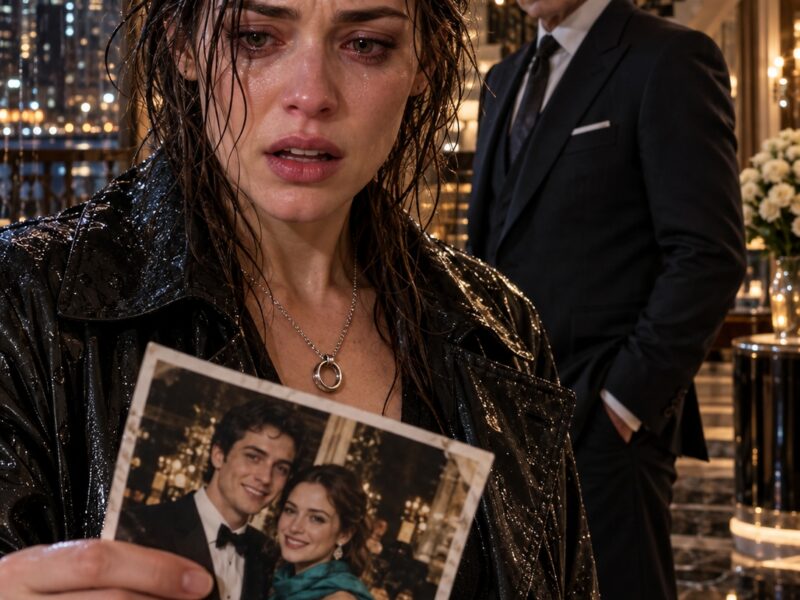
SHE GAVE A GRIEVING STRANGER HER ONLY UMBRELLA—THEN SAW HIS DEAD SISTER IN HER BROTHER’S LAST PHOTO

The first time Iris Harwood watched Everett Callaway destroy the man who had helped raise him, there was a white tablecloth between them.
A silver carving knife lay beside a roast nobody had touched.
Everett’s mother was trembling so badly that her teacup clicked against its saucer.
And Conrad Ashby—the man who had toasted Rosie Callaway every year on the anniversary of her death, the man Everett had called Uncle Conrad since childhood—was staring at a photocopied license plate number as though one line of ink had somehow become a loaded gun.
“They picked him up at two,” Everett said.
Conrad’s smile remained in place.
Barely.
Everett rested both palms against the dining table.
“He started talking at three.”
Something changed in Conrad’s eyes.
Iris saw it happen.
Not fear exactly.
Recognition.
The terrible realization that a secret could survive four years, a dead journalist, a dead young woman, a flooded notebook, a damaged memory card, a fire in a church basement—and still find its way back to the dinner table.
Conrad looked at Catherine Callaway.
Then at Iris.
Then back at Everett.
“He was only supposed to scare her off that road.”
Nobody moved.
Even Conrad seemed surprised by his own words.
The silence that followed was so complete Iris could hear rain beginning against the windows.
Conrad swallowed.
“She wouldn’t stop,” he whispered.
His face twisted.
“None of them would stop.”
The doorbell rang.
Detective Teresa Webb had arrived.
But the truth had begun long before that Sunday night.
It had begun with an old green umbrella.
And two people who thought the dead had already taken everything they could from them.
One year earlier, at 9:40 on a Tuesday night in late September, rain came down over Washington Square Park so violently that Manhattan seemed to disappear behind it.
Delivery bikes cut through standing water. Yellow cabs hissed along Fifth Avenue. People ran toward subway entrances with newspapers over their heads and umbrellas tilted sideways against the wind.
Iris Harwood was thirty-one years old and tired enough to resent every red light between her studio and home.
She had spent eleven hours restoring a water-damaged nineteenth-century hymnal for a small Episcopal church in Brooklyn. The book had been soaked when a basement pipe burst, and every page had to be separated, dried, pressed and stabilized individually.
It was work requiring the kind of patience Iris possessed professionally and had almost completely lost everywhere else.
Her green umbrella leaned into the wind above her.
One rib had been bent since the previous spring.
She kept meaning to repair it.
She kept meaning to do a lot of things.
At her throat, beneath the collar of her raincoat, a man’s ring hung from a thin silver chain.
Simon’s ring.
Her older brother had been dead four years.
She still touched it when she was tired.
Halfway across the park, Iris noticed a man sitting alone beneath the Washington Square Arch.
She almost kept walking.
In New York, that was what you did.
You respected other people’s disasters by pretending not to see them.
Besides, the stranger didn’t look helpless.
He wore a charcoal suit that had probably cost more than Iris’s monthly rent. His shoes were polished leather, though rainwater had soaked them dark. He had no coat. No umbrella.
He sat with his shoulders bent forward, letting the storm hit him.
People passed.
Nobody stopped.
Neither did Iris.
Not at first.
She walked another fifteen feet before something made her look back.
The man was holding a photograph.
He had curled his body around it.
Not himself.
The photograph.
That stopped her.
Four years earlier, Iris had stood inside a laundromat on Bleecker Street pressing Simon’s water-damaged notebooks between paper towels because they were the only pieces of him she could still save.
She had been soaked through.
She hadn’t noticed herself shaking until the laundromat owner placed a towel around her shoulders.
Iris knew what it looked like when someone protected an object because the person attached to it could no longer be protected.
She turned around.
The stranger didn’t notice her until the rain suddenly stopped hitting the photograph.
He looked up.
Iris was standing beside the bench, holding her umbrella over his hands.
Not his head.
His hands.
His photograph.
His eyes were gray and exhausted.
For a second, she saw suspicion move through them.
He expected pity.
Or curiosity.
Instead Iris glanced at the photograph.
“That looks important.”
The man looked down.
“It is.”
“Then it shouldn’t get wet.”
“You’re getting soaked.”
“I’ve been soaked before.”
She pressed the wooden handle into his hand.
He stared at it.
Iris gave him a small smile.
“You can give it back someday.”
Then she walked away.
For four years, almost nothing had surprised Everett Callaway.
Grief had a way of making the world repetitive.
People said the same careful sentences.
She would want you to move forward.
Time heals.
At least you had thirty years with her.
At least.
Everett had come to hate those two words.
Rosie had been his younger sister.
She had been loud where he was quiet, impulsive where he was cautious, stubborn enough to argue with taxi drivers about pedestrian rights and compassionate enough to remember the birthdays of retired factory workers she had met once.
Four years earlier, she had died in what police called a single-vehicle accident on the Merritt Parkway.
That evening, Everett had walked out of the annual family memorial dinner after Conrad Ashby raised a glass and called it “that terrible accident.”
He had wandered downtown without a coat.
His phone showed forty-one unread work emails.
Not one person he wanted to call.
Then a stranger gave him her umbrella.
He looked at the green canopy.
Then at the woman disappearing into the rain.
Before he could think better of it, Everett stood.
“Wait.”
Iris stopped.
He took three steps after her.
“What if I want to see you again?”
She turned.
Rain streamed from her hair into her collar.
For the first time she really looked at him.
There was nothing flirtatious in his expression.
He seemed almost embarrassed by the question.
Then the streetlight above them flickered.
Her eyes dropped toward the photograph protected beneath the umbrella.
A young woman was laughing into the wind.
A teal scarf crossed half her face.
Iris stopped breathing.
She knew that scarf.
Not because she had owned one like it.
Because buried at the bottom of Simon’s storage trunk was the last photograph Iris had of her brother genuinely smiling.
It had been taken at a downtown charity fundraiser months before his death.
Simon stood beside a young woman.
A young woman wearing that exact teal scarf.
Everett saw Iris’s expression change.
“What?”
She didn’t answer.
“What is it?”
Iris stepped closer.
“Who is she?”
Everett’s fingers tightened around the photograph.
“My sister.”
“What was her name?”
“Rosie.”
The rain seemed suddenly louder.
Iris looked at him.
“I don’t know who you are,” she said, “but your sister is in the last photograph I have of my brother alive.”
Everett’s face emptied.
“What?”
“My brother’s name was Simon Harwood.”
He searched her expression as if the name might be hidden somewhere in it.
“He died four years ago.”
Everett looked back at Rosie’s picture.
“So did she.”
Neither of them moved.
Hundreds of people crossed the park around them, hurrying toward apartments, trains, dinners, beds.
But beneath one damaged green umbrella, two strangers suddenly understood that the dead people they had spent four years mourning had known each other.
And neither had any idea why.
There was an all-night diner two blocks away.
Iris suggested it because standing in a storm discussing dead siblings felt like something grief might invent to make people lose their judgment.
“We can walk there together,” she told him. “After that, I’m going home alone.”
“Okay.”
No persuasion.
No wounded charm.
No attempt to negotiate.
Everett simply raised the umbrella so it covered both of them.
He tilted it slightly toward Iris.
His right shoulder remained in the rain.
She noticed.
She said nothing.
The diner smelled of coffee, fryer oil and wet coats.
They took a red vinyl booth near the window.
A waitress brought two coffees without asking.
Everett’s expensive suit dripped onto the floor.
Iris wrapped both hands around her mug.
“So,” he said, “what keeps someone working until ten at night on a Tuesday?”
“A hymnal from 1884.”
He blinked.
“That sentence did not go where I expected.”
For the first time, Iris almost smiled.
“Somebody flooded a church basement.”
“You restore books?”
“Books. Documents. Occasionally photographs.”
“How do you dry a book?”
“Slowly.”
“That’s it?”
“That’s most of it.”
She stirred her coffee.
“You separate the pages. Blot them. Change the blotters. Control humidity. Flatten them gradually.”
“Why gradually?”
“Because wet paper remembers what happened to it.”
Everett looked at her.
Iris continued.
“If you force it flat before it’s ready, it tears.”
He leaned back.
“I’ve never understood people who spend days repairing something most people would replace.”
“Most things can be replaced.”
She glanced toward the photograph beside his coffee.
“The things worth saving usually can’t.”
Everett said nothing.
Outside, rain slid down the glass in silver streams.
Finally he touched Rosie’s photograph.
“She died in Connecticut.”
Iris waited.
“Car accident,” he said.
Then, after a pause:
“That’s what the report says.”
Iris heard the sentence he had not meant to emphasize.
She didn’t question him.
“My brother died that same autumn.”
“How?”
Her fingers moved automatically to the ring at her throat.
“He was found at his desk.”
Everett didn’t push.
That made her trust him slightly more than she wanted to.
Halfway through his second coffee, the waitress said something about his suit looking like it had survived a shipwreck.
Everett laughed.
His hand moved toward his phone.
Stopped.
His face changed.
Iris knew exactly what had happened.
“You were going to text her.”
He looked at her.
“I still do it with Simon,” she said. “Something happens. Something stupid. Something funny. My thumb finds his name before my brain remembers.”
Everett stared at his phone.
“I thought that would stop.”
“It doesn’t.”
“Good to know.”
“I didn’t say it was good.”
That earned another faint laugh.
Then Everett’s phone illuminated.
CONRAD ASHBY.
A message appeared.
Your mother is worried. Where are you, son?
Everett turned the phone facedown.
Iris saw the name.
More importantly, she saw his jaw tighten.
At 10:11, the rain softened.
Everett lifted her umbrella.
“How do I return this?”
Iris tore the bottom off their receipt and wrote an address.
“My studio. Weekdays after ten.”
He folded the paper carefully and placed it in his wallet.
Beside Rosie’s photograph.
Iris walked home alone.
Exactly as promised.
But the moment she entered her dark apartment on Jones Street, she went to the hall closet.
Simon’s trunk sat behind winter coats and a broken vacuum cleaner.
She had not opened it in almost three years.
The hinges complained.
His notebooks were still inside.
So were old press clippings, ticket stubs, two sweaters that no longer smelled like him and the fundraiser photograph.
Iris found it near the bottom.
Simon in a borrowed blazer.
Rosie Callaway beside him.
Teal scarf.
Laughing.
Alive.
Iris sat on the floor.
Then she noticed something.
She turned the photograph over.
A date was written on the back.
Beneath it, in Simon’s hurried red handwriting, was a sentence she had somehow never seen.
If you ever find this, Iris, remember that the Callaway family is not innocent.
She read it again.
And again.
At 2:15 in the morning, Iris searched Everett’s name.
The results appeared instantly.
Everett Callaway.
CEO, Callaway Mills.
Fourth-generation heir.
One of New York’s oldest textile fortunes.
Photographs showed the man from the diner wearing tuxedos beside governors, museum trustees and people whose surnames appeared on buildings.
Then she found another photograph.
Everett beside an elegant silver-haired woman identified as his mother, Catherine Callaway.
Standing beside Catherine was a tall older man with a warm, paternal smile.
Conrad Ashby.
Family friend.
Trustee of the Callaway Mills pension fund.
Iris closed her laptop.
She did not sleep.
Two mornings later, at 10:05, the bell above her studio door rang.
Everett stood outside holding two coffees.
“One sugar. Splash of cream.”
Iris took hers automatically.
Then narrowed her eyes.
“Where’s my umbrella?”
He hesitated.
“By my front door.”
“You forgot it?”
“No.”
“Then why is it there?”
“Because if I brought it back, I wouldn’t have a reason to come again.”
Iris stared at him.
It was annoyingly effective.
She set the coffee down.
“You run Callaway Mills.”
A pause.
“Yes.”
“You neglected that part.”
“The rest of my name changes conversations.”
“So does leaving it out.”
He absorbed that.
“I know.”
“It makes me wonder what else you’re leaving out.”
Instead of becoming defensive, Everett nodded.
“That’s fair.”
Then:
“I’m sorry.”
The simplicity of it disarmed her.
Because three feet away, locked inside her desk drawer, was a photograph accusing his family of something Simon had apparently died believing mattered.
Iris was keeping something from him too.
She looked at Everett standing among linen thread, Japanese tissue and bone folders, careful not to touch anything.
“Keep the umbrella.”
His eyebrows rose.
“Someday isn’t today.”
That should have been the end of it.
Instead, he came back.
Not every day.
Not predictably enough for Iris to accuse him of making a routine.
But often enough that a routine formed anyway.
Coffee between restoration jobs.
Saturday mornings at Union Square Farmers Market.
Everett carrying apples while arguing that cider should not cost nine dollars.
Afternoons moving archival boxes from Iris’s basement.
He never tried to reorganize her shelves.
That mattered more than he knew.
She learned that Everett had not taken a real vacation since Rosie died.
He learned that Iris slept with the television on because silence became too large after midnight.
She learned he ate most dinners standing over his kitchen counter.
He learned she bought Simon a birthday card every October and never knew what to do with it.
Money had not made Everett glamorous.
It had made him insulated.
Insulation, Iris discovered, could resemble loneliness from the inside.
In mid-October, Everett found her making boxed macaroni and cheese on the studio hot plate.
“Emergency dinner?”
“Simon’s birthday.”
He looked at the pot.
“This was his favorite?”
“He had terrible taste.”
“You’re eating the entire box?”
“I make it every year.”
She shrugged.
“Then I throw half away.”
Everett removed his coat.
“Not this year.”
He ate the other half.
They did not call it grief.
They did not call it intimacy.
They simply sat together on the floor while an old radiator knocked behind them.
Sometimes the most dangerous thing two lonely people can do is become safe for each other before either understands what secrets are waiting between them.
The following week, Iris’s landlord ordered the basement storage area cleared.
She spent a Saturday sorting Simon’s remaining possessions.
At the bottom of a pile was his old canvas messenger bag.
She nearly donated it.
Then her fingers touched the lining.
Too stiff.
Iris turned it inside out.
One seam had been restitched by hand.
She cut three threads.
A kraft envelope slid out.
Her name was written across the front.
IRIS.
ONLY IF SOMETHING HAPPENS TO ME.
Her hands began shaking.
She sat there for almost ten minutes.
Then she called Everett.
He arrived twenty minutes later.
Before opening the envelope, Iris placed the fundraiser photograph on the table.
She turned it over.
Everett read Simon’s warning.
The Callaway family is not innocent.
His face gave her nothing.
“I asked you not to keep things from me,” Iris said.
“So I’m not keeping this from you.”
Everett looked at the sealed envelope.
“Open it.”
“What if it’s about your family?”
“Then especially open it.”
Inside were three objects.
A photograph.
A brass key.
And a note.
The photograph showed Simon and Rosie outside a brick warehouse in Red Hook. Above the loading dock, faded paint still read CALLAWAY MILLS.
The brass key was stamped 417.
Iris unfolded the note.
If Rosie or I disappear, don’t believe the accident story.
Conrad knows.
Everett took the paper.
His knuckles turned white.
Iris watched the blood leave his face.
“Everett.”
He didn’t answer.
“The man in the photograph with your mother. Conrad Ashby. Who is he?”
Everett stared at Simon’s handwriting.
Finally he spoke.
“He held Rosie the day she was born.”
Iris felt cold.
“He was my father’s closest friend.”
Everett lifted his eyes.
“He gave the toast at her memorial the night you found me.”
Another pause.
“And he controls every dollar my family has ever trusted to anyone.”
Rosie’s apartment on East 78th Street had remained almost untouched for four years.
Catherine Callaway paid the rent.
She never entered.
“She can’t let it go,” Everett told Iris as he unlocked the door.
“And she can’t walk in.”
Iris understood that contradiction perfectly.
Inside, Rosie’s glasses remained on the kitchen table.
A cardigan hung over a chair.
Vanilla candle wax still sat in glass jars.
It did not feel preserved.
It felt interrupted.
They searched quietly.
Near midnight, Iris opened the bottom drawer of Rosie’s desk.
Spiral notebooks.
Dozens of them.
Rosie had worked with retired employees through the Callaway Mills pension outreach program.
The early pages were ordinary.
Names.
Addresses.
Medication reminders.
Lives alone.
Bad hip.
Loves lemon cookies.
Then the tone changed.
Check reduced by 1/3.
Reduced again.
No explanation.
And finally, underlined twice:
Fund reports say healthy.
Then why are the checks smaller?
Iris stared at the sentence.
Then opened Simon’s messenger bag.
She placed his notebooks beside Rosie’s.
Interview after interview with retired Callaway workers.
Queens.
Brooklyn.
Staten Island.
Different people.
Same complaint.
“My check got smaller.”
“Nobody explains anything.”
“They tell me the fund is fine.”
Iris looked at Everett.
“They were investigating the same thing.”
“From different sides.”
Everett was reading annual fund reports.
He stopped.
His expression collapsed.
“What?”
He turned one page toward her.
A signature appeared at the bottom.
EVERETT J. CALLAWAY.
“That’s mine.”
Iris waited.
“I signed these.”
“How many?”
“All of them.”
“You knew?”
“No.”
His answer came too quickly, but not defensively.
Horrified.
“Conrad handled the pension fund. He’d handled it since my father was alive. Finance prepared the summaries. I signed.”
“You didn’t read them?”
“No.”
He stared at his own signature.
“No.”
Iris did not comfort him.
She knew better than to offer absolution before truth.
“Facts first,” she said. “Blame later.”
One name appeared repeatedly in both sets of notebooks.
Agnes Kowaltic.
Greenpoint.
Agnes was eighty-one and lived on the third floor of a narrow walk-up heated by one struggling space heater.
A crucifix hung above the door.
She had spent forty years working the looms at Callaway Mills.
When Iris showed her Simon’s photograph, Agnes smiled.
“The nice boy with the recorder.”
Then Rosie.
“Oh.”
Her face softened.
“She brought lemon cookies.”
The smile faded.
“They both stopped coming the same autumn.”
Agnes looked down.
“I thought maybe I said something wrong.”
Everett sat across from her.
She never recognized him.
That seemed to hurt him more than if she had.
She had worked forty years for his family.
He had never visited one retiree’s home.
Agnes showed them her pension statement.
The amount was humiliating.
Everett read it twice.
On the sidewalk afterward, he walked half a block without speaking.
Finally:
“I signed the paper that told her everything was fine.”
“You signed a paper.”
“That distinction probably matters to lawyers.”
“It matters to truth.”
He looked at Iris.
“Does it matter to Agnes?”
Iris had no answer.
The brass key led them to a private storage facility on Canal Street.
Unit 417 contained one banker’s box.
Inside were partial ledgers.
Transfer records.
Printouts.
Millions of dollars moved from the Callaway Mills pension fund into Ashby Holdings.
Conrad’s investment company.
Every transfer marked temporary.
None repaid.
At the bottom sat a water-damaged USB drive.
Iris held it beneath the fluorescent light.
“Simon hid this.”
Everett stared at the numbers.
“He was afraid.”
Iris looked at him.
“He had reason to be.”
At 8:30 the following morning, a city inspector entered Iris’s studio.
He had received an anonymous complaint about improper chemical storage.
Iris had kept the same three conservation-grade solvents in the same fire-rated cabinet for six years.
By ten, her landlord emailed a lease violation notice.
At 2:17, Everett’s phone rang.
Conrad.
“Everett, son.”
Warm.
Gentle.
The voice of birthdays and Christmas dinners.
“Your mother tells me the doorman saw you entering Rosie’s apartment with a young woman.”
Everett said nothing.
“A book conservator from Greenwich Village, I believe.”
Everett looked across Iris’s studio.
She was watching him.
“Is that wise, son?”
Conrad asked.
“Some doors are closed for a reason.”
The call ended.
Seconds later Iris received an email from a Midtown law firm.
The trustees of the Callaway Mills Pension Fund demanded the immediate return of confidential corporate documents.
Attached was a photograph.
Iris unlocking her building that morning.
Her phone buzzed again.
Unknown number.
Old paper burns very easily, Miss Harwood.
Simon didn’t know when to close the book.
Do you?
Everett read it.
Once.
Twice.
His face hardened.
“That’s it.”
He grabbed his coat.
“Where are you going?”
“My mother’s.”
“No.”
“Conrad will be there.”
“Exactly.”
“I’m putting the ledgers on the table. Then I’m calling every attorney I know. Tomorrow this goes public.”
“No.”
Everett turned.
“He threatened you.”
“I know.”
“He photographed your home.”
“I know.”
“Then why are you telling me to wait?”
“Because we don’t have enough.”
“We have millions in transfers.”
“Partial records.”
“We have Simon’s note.”
“A dead man’s accusation.”
“Rosie’s notebooks.”
“Questions.”
Everett’s voice rose.
“So we wait until what? He burns the studio down?”
Iris flinched.
Everett saw it.
Regretted it instantly.
But she stepped closer.
“You can’t hurry wet paper.”
“What?”
“You asked why anyone spends days repairing something.”
“This is not a book, Iris.”
“No.”
Her voice cracked.
Then steadied.
“It’s Simon.”
She pointed toward Rosie’s notebooks.
“And it’s Rosie.”
Everett went silent.
“If we force this before we understand it,” Iris continued, “his lawyers will know exactly what we have and exactly what we don’t. Evidence disappears. Witnesses change stories. We get one chance.”
“I’m not standing around while this happens again.”
There.
Iris heard it.
The sentence underneath every sentence.
“You’re not trying to protect me.”
Everett froze.
“You’re trying to get back to that night.”
His eyes met hers.
“You think if you move fast enough now, somehow you can save Rosie then.”
He looked as though she had struck him.
“You can’t,” Iris whispered.
“Neither can I.”
For a long time he stood with his coat in his hands.
Then he hung it back on the hook.
“Okay.”
His voice was rough.
“Show me what slow looks like.”
The next morning they met Detective Teresa Webb at the Sixth Precinct.
She was fifty-two, with reading glasses pushed into gray hair.
Four years earlier, she had been the only detective willing to listen when Iris insisted Simon’s death felt wrong.
“The medical examiner ruled cardiac arrhythmia,” Webb reminded her. “He was found alone at his desk at St. Agatha’s archive. No forced entry. No obvious toxin. I checked.”
She looked Iris directly in the eyes.
“I promise you, I checked.”
Webb spent nearly an hour reading the ledgers.
Then removed her glasses.
“This is ugly.”
Everett leaned forward.
“So you’ll reopen it?”
“I said ugly. Not prosecutable.”
She tapped the records.
“Suspicion isn’t evidence.”
Her eyes moved between them.
“Bring me something a jury can hold.”
That night Iris cleared her largest worktable.
The USB was dead.
Water had corroded the contacts years ago.
So she returned to the damaged notebooks Simon had left behind.
Some pages remained fused together from the night he died.
Four years earlier, Iris had been too devastated to restore them properly.
Now she built a humidity chamber.
Changed blotters.
Weighted sheets beneath glass.
One page at a time.
Everett stayed.
At 3:10 in the morning, Iris tilted a lamp low across what appeared to be a blank sheet.
“Everett.”
He leaned closer.
Indentations appeared.
Numbers.
Rows of them.
Some preceded by letters.
Simon had written on a sheet above this one, then torn the original page out.
Everett stared.
“What are they?”
Iris knew immediately.
“Accession numbers.”
She crossed the studio and began pulling antique books from shelves.
Simon had brought her many of them over the years.
One number matched.
An 1890s Brooklyn city directory.
Simon had given it to Iris for her twenty-seventh birthday.
Its spine had been falling apart.
She had restored it herself.
With a scalpel, Iris opened the spine she had repaired four years earlier.
Something tiny dropped onto the table.
Wrapped in archival tissue.
A microSD card.
Iris sat down hard.
“I’ve had it the whole time.”
Everett looked at the card.
“No.”
Then at her.
“He knew you would.”
The card contained scanned ledgers.
Transfer records.
Emails.
And one audio file.
Dated forty-eight hours before Rosie died.
Iris pressed play.
A young woman’s voice filled the studio.
Everett stopped breathing.
“Simon, it’s me.”
Rosie.
Her voice sounded exhausted.
Frightened.
“I hid the backup where nobody will ever find it. Whatever you do, don’t trust anyone in the executive suite.”
A pause.
Then:
“Not even my brother Everett.”
The recording ended.
Everett did not move.
Iris watched shame cross his face.
Too fast.
Too familiar.
He walked to the window.
Rain blurred the street outside.
Iris waited for him to ask why Rosie would say that.
He didn’t.
That frightened her more.
The following evening, Everett drove alone to Scarsdale.
Philip Granger had served as Callaway Mills’ general counsel for twenty-two years.
He had taught Rosie to ride a bicycle.
When he opened his door and saw Everett, he seemed to age instantly.
“She came to me.”
Everett said nothing.
Philip sat on the stairs.
“Four years ago. Rosie came with notebooks. She was asking about the pension fund.”
“And?”
“I told Conrad.”
Everett closed his eyes.
“Why?”
“To protect the company.”
Philip covered his face.
“That’s what I told myself.”
His voice broke.
“I never imagined what he would do.”
On Sunday, Catherine summoned Everett to dinner.
The good silver was laid out.
White roses stood in the center of the table.
Conrad carved the roast from Everett’s father’s old chair.
“Sweetheart,” Catherine said, “please stop.”
Everett looked at his mother.
“The papers will destroy Rosie.”
“No. Conrad did that.”
Catherine’s eyes filled.
“They’ll turn her into a scandal.”
Conrad put down the knife.
“Let her rest, son.”
Everett looked at the man he had trusted almost as much as his father.
Then folded his napkin.
“Rosie used to say you carved meat like a man who had never been hungry.”
Catherine went pale.
“Everett.”
He stood.
“If you walk out,” she said, “don’t come back until you’ve come to your senses.”
Everett bent and kissed her cheek.
Then walked out.
By Monday, Iris had been served with a civil injunction accusing her of possessing stolen proprietary records.
Tuesday morning, her landlord terminated her lease.
Forty-eight hours.
Four hundred fragile books.
Some older than the Brooklyn Bridge.
Iris stood among the shelves.
Everything she had built after Simon’s death suddenly had an expiration date.
Everett arrived.
He did not say, I can pay for this.
He did not offer a lawyer, a building or a blank check.
He simply asked:
“What do you need?”
Iris looked around.
“Boxes.”
He nodded.
“Tissue.”
“Okay.”
“A place to go.”
“Okay.”
“And someone who won’t drop anything.”
For the first time that day, Everett smiled.
“That one I can definitely do.”
Agnes called her priest.
St. Agatha’s owned an empty storefront in Red Hook.
The rent would be whatever Iris could afford.
They packed through the night.
Everett wrapped books exactly as she taught him.
Corners first.
Spine last.
At two in the morning they ate deli sandwiches sitting on milk crates.
“I could lose everything,” Iris said.
Everett looked at her.
“My studio. My reputation. Everything Simon helped me build.”
He did not tell her everything would be fine.
He had finally learned that reassurance could become another form of dishonesty.
“Whatever you decide,” he said, “I’m staying.”
Iris looked at the boxes stacked around them.
“Then we keep going.”
One accession number remained unresolved.
SA.
Agnes recognized it.
“St. Agatha’s.”
Her face changed.
“That’s how we number the archive.”
Then guilt surfaced.
“Simon left a box.”
Iris stood.
“What box?”
“He made me promise. I wasn’t supposed to tell anyone unless you came asking with those letters.”
St. Agatha’s was where Simon had volunteered.
Where he had died.
They drove there at dusk.
Iris smelled smoke before they reached the church.
Gray curls escaped the basement windows.
Agnes stood on the steps coughing, rosary wrapped around her fist.
“Someone was down there.”
Sirens sounded in the distance.
Iris ran.
Everett ran beside her.
The basement was filling with smoke.
Near the back wall, a cardboard archive box burned on a metal shelf.
Iris wrapped her coat around it.
Everett grabbed the opposite side.
Together they carried it upstairs.
The first fire truck turned the corner as they emerged.
On the sidewalk Iris lifted the scorched lid.
Every page appeared black.
Everett stared.
“It’s gone.”
Iris touched one charred edge.
“Not yet.”
That night, Conrad called her.
No hidden number could disguise the voice.
Warm.
Civilized.
“Miss Harwood.”
Iris said nothing.
“I would like to make this easy.”
“Then confess.”
A small laugh.
“Bring me whatever survived tonight.”
Iris’s grip tightened.
“And?”
“I will quietly restore every retiree’s pension.”
He paused.
“Agnes included.”
“No.”
Silence.
Then Conrad’s voice changed.
Only slightly.
“Ask Everett what Rosie begged him to do three days before she died.”
Iris felt something inside her turn cold.
“And ask him who he sent her to instead.”
The call ended.
Everett was taping boxes in the Red Hook storefront when Iris found him.
“What did Rosie beg you for?”
His hands stopped.
No confusion.
No denial.
He knew.
“She came to my office.”
“When?”
“Three days before she died.”
Iris said nothing.
“She had the notebooks.”
Everett stared at the roll of tape.
“She begged me to audit Conrad.”
“And?”
“I was closing an acquisition.”
His mouth tightened.
“I gave her four minutes.”
Iris felt sick.
“I told her Conrad had managed the fund for decades. I told her she was emotional.”
He swallowed.
“Then I sent her to Philip.”
The recording echoed between them.
Not even my brother Everett.
“She left crying.”
Everett finally looked at Iris.
“That’s why she said it.”
“You knew.”
“After hearing the recording, yes.”
“You knew what she meant.”
“I suspected.”
“And you didn’t tell me.”
“I couldn’t.”
“No.”
Iris stepped back.
“You wouldn’t.”
His face crumpled.
“For four years, I have believed I killed my sister.”
Iris stared at him.
“And you let Conrad tell me.”
“I was ashamed.”
“So was Simon.”
“What?”
“My brother was terrified. He still left me clues.”
“Iris—”
“You asked me to trust you.”
“I know.”
“And the moment the truth made you look guilty, you hid.”
She walked out.
That night, alone in her apartment, Iris played Simon’s last voicemail for the first time in four years.
Hey, it’s me.
Call me back, okay?
It’s important.
She closed her eyes.
That afternoon they had argued.
She had told him his investigation was consuming him.
Simon had accused her of wanting everything difficult to disappear.
Iris had silenced her phone.
He called three times.
She never answered.
He died that night.
For four years she had built an entire private courtroom around those missed calls.
She was always the defendant.
Always guilty.
Iris looked out her window.
Everett stood across the street.
In the rain.
Holding her green umbrella.
He had not buzzed.
He had not called.
He was simply waiting.
This time, Iris went downstairs.
“I have access to an infrared camera.”
Everett nodded.
“A friend at a museum lab.”
Another nod.
“We’re going back.”
“Okay.”
Under infrared imaging, carbon-based ink could sometimes remain visible even when paper appeared completely charred.
They worked after midnight.
Page after page.
Nothing.
Then faint gray letters appeared against black.
Simon’s handwriting.
Iris forgot to breathe.
These were his notes from the final weeks of his life.
One page contained a transcript dated the night Rosie died.
Rosie called from Merritt Parkway.
Gray pickup on her bumper.
No lights.
She read me the plate.
Below it:
A license plate number.
Everett made a sound Iris would remember for the rest of her life.
“She called Simon.”
His voice broke.
“Not me.”
Iris reached for his hand.
Another page emerged.
A voicemail transcript.
Conrad.
You’re both going to regret this.
Then the final page.
Dated the night Simon died.
Iris read.
Iris, you didn’t pick up.
Good.
You were right today.
I’m tired.
Sleep.
You’ve carried enough of me this year.
I’ll tell you everything tomorrow.
Iris read it twice.
Then she broke.
Not gracefully.
Not quietly.
Four years of guilt came apart in one sound.
Simon had not blamed her.
Not once.
Everett held her.
He did not tell her to stop crying.
He simply stayed.
The same way she had once held an umbrella over his photograph without asking him to explain why it mattered.
After a long time, Everett whispered:
“We did the same thing.”
Iris wiped her face.
“What?”
“We decided missing one moment erased everything else we ever did for them.”
She looked at him.
“And Conrad counted on it.”
Everett understood.
“As long as we’re busy prosecuting ourselves…”
“Nobody prosecutes him.”
At dawn, Iris placed Simon’s original pages in Detective Webb’s hands.
Everett opened Callaway Mills’ records to investigators.
Then voluntarily stepped aside as CEO while the audit proceeded.
By lunchtime, Webb had run the license plate.
The gray pickup existed.
So did its driver.
By Sunday afternoon, he was in custody.
At two o’clock, he began talking.
That evening, Everett returned to his mother’s Upper East Side dining room.
This time Iris came with him.
Catherine looked at her as though she were seeing the storm itself enter her house.
Conrad sat in Everett’s father’s chair.
“Son.”
His smile was warm.
“Good to see you’ve come to your senses.”
Everett placed one photocopied page on the table.
A license plate number.
Conrad glanced at it.
Nothing happened.
Not immediately.
“They picked him up at two.”
Conrad looked back at Everett.
“He’s been talking since three.”
The smile weakened.
Conrad looked toward Catherine.
Then the page.
Then Iris.
“He was only supposed to scare her off that road.”
Catherine’s cup rattled.
Conrad heard himself.
But the words were already in the room.
“She wouldn’t stop.”
His composure cracked.
“None of them would stop.”
The doorbell rang.
Detective Webb.
Everett remained standing.
“You held Rosie the day she was born.”
Conrad said nothing.
“You sat in this house every year and raised a glass to her.”
Conrad’s face hardened.
“Everett, listen—”
“No.”
Everett’s voice remained quiet.
“You don’t get to say her name in this house again.”
Conrad Ashby left in the back of a police car.
He did not look at Catherine.
He did not look at Everett.
He did not look at Iris.
Justice came afterward.
Slowly.
Much more slowly than revenge would have.
The driver of the gray pickup cooperated.
Philip Granger accepted a plea agreement and testified.
Investigators reconstructed years of pension theft and concealment.
Conrad was charged with fraud, theft and crimes connected to the circumstances that caused Rosie’s death.
The prosecution took nearly a year.
Paper moved through offices.
Lawyers argued.
Experts testified.
Numbers were reconstructed.
No verdict could return Rosie to the Merritt Parkway before the gray pickup appeared behind her.
No court could put Simon back at his desk before his heart gave out under months of fear and exhaustion.
Truth did not resurrect anyone.
But it changed who had to carry the blame.
Under emergency court supervision, the retirees’ pensions were restored while the criminal case proceeded.
Agnes received her first full check in five years on a Tuesday.
She called Iris before nine.
“I bought butter.”
Iris laughed.
“What?”
“Real butter. Not that fake spread. Real butter.”
That spring, the basement at St. Agatha’s reopened.
New walls.
New shelving.
A proper fire suppression system.
The retirees held a potluck.
Everett sat at folding tables for hours.
For the first time in his life, he listened to people describe what forty years inside his family’s mills had actually meant.
The noise.
The lint.
The winter shifts.
The injuries.
The friendships.
He took no notes.
He remembered.
Agnes brought pierogi.
She watched Everett from across the room.
“Rosie would like him now.”
Iris smiled faintly.
“Would she?”
Agnes nodded.
“He finally showed up.”
In early summer, the bell above Iris’s new Red Hook studio rang.
Catherine Callaway stood in the doorway.
She looked smaller than Iris remembered.
Not physically.
In certainty.
She held something folded in both hands.
Teal silk.
Rosie’s scarf.
“I’ve kept it in a drawer for five years.”
Catherine looked down.
“I couldn’t look at it.”
The scarf was frayed along one edge.
Catherine’s fingers tightened around it.
“Can old silk be repaired?”
Iris understood immediately.
It was not a question about silk.
She touched the damaged edge.
“Yes.”
Catherine’s eyes filled.
“It won’t look new.”
“I don’t need new.”
Iris looked at her.
“It takes patience.”
Catherine nodded.
“I think I’m beginning to understand that.”
Everett eventually returned to Callaway Mills after the board rebuilt the pension system.
Independent trustees.
Outside auditors.
New compliance procedures.
Every pension report crossed Everett’s desk.
He read every page.
He delegated more.
Left before six more often than not.
Learned to eat dinner sitting down.
Frequently at Iris’s table.
They did not rush whatever existed between them.
They had spent too much of their lives confusing urgency with love.
Late September brought the verdict.
When Iris and Everett left the courthouse, sunlight hit the stone steps so brightly Iris had to squint.
For the first time in five years, neither felt they were carrying the case alone.
October waited at the edge of the calendar.
Simon’s birthday was coming.
There would be macaroni and cheese.
Enough for three.
Agnes had invited herself.
Then, exactly one year after the night Iris crossed Washington Square Park in a storm, rain returned to Manhattan.
Her phone buzzed.
Meet me at the bench.
Washington Square.
Iris found Everett beneath the arch.
He was standing where she had once found him sitting alone.
And he was holding her green umbrella.
She stopped.
The bent rib had been repaired.
Professionally, apparently.
The canopy stood straight.
But the wooden handle remained worn smooth.
First by Iris’s hand.
Then by his.
“You took an unreasonable amount of time returning borrowed property,” she said.
“I know.”
Everett looked at the umbrella.
“It hung beside my front door for a year.”
“Very useful place for an umbrella.”
“I walked past it every morning.”
He smiled.
“And every morning it reminded me that somebody once showed me kindness without knowing my surname, my company or how much money I had.”
Rain softened around them.
Iris touched Simon’s ring at her throat.
Everett looked at her.
“I used to think I needed someone to make the past stop hurting.”
Iris waited.
“I don’t anymore.”
He stepped closer.
“Wanting a future with you is different from needing you to erase what happened.”
His eyes remained on hers.
“I finally know the difference.”
Iris looked past him toward the bench.
A year earlier, he had sat there believing grief was something he deserved.
She had understood that feeling better than either of them knew.
“Moving forward doesn’t mean leaving Simon behind,” she said.
Everett nodded.
“No.”
“I finally know that too.”
He extended the umbrella.
“So.”
A faint smile.
“Do you want it back?”
Iris looked at the old wooden handle.
At the repaired rib.
At Everett.
Then she stepped beneath the canopy beside him.
“We can keep sharing it.”
They began walking.
Past the bench.
Neither stopped.
It was only a bench now.
Not a shrine.
Not evidence.
Not the place where one life ended and another began.
Just a bench in a wet Manhattan park.
Simon’s ring remained around Iris’s neck.
Rosie’s photograph remained inside Everett’s wallet, its corner worn almost through.
They did not throw those things away.
Healing had never required that.
The dead remained part of them.
What changed was where they stood.
For years, Iris and Everett had allowed the worst moments of their lives to stand directly in front of every possible future.
Now the past walked somewhere else.
Beside them, perhaps.
Behind them sometimes.
Never gone.
But no longer blocking the road.
Under one old green umbrella, two people crossed Washington Square Park while ordinary rain fell over an ordinary city.
There were no reporters.
No courtrooms.
No accusations.
No secrets left to chase.
Only the sound of water against the canopy and Everett’s shoulder brushing Iris’s as they walked.
A year earlier, she had given a grieving stranger her only umbrella because she saw him protecting a photograph.
She had thought she was saving a piece of paper from the rain.
She could not have known that the woman in that photograph had known Simon.
She could not have known Simon had left a warning behind.
She could not have known that an old book on her shelf contained the evidence two families had spent years searching for.
And she certainly could not have known that the man sitting alone beneath the arch would someday become the person who understood why she still wore her brother’s ring.
But perhaps that was the quiet truth Simon and Rosie had left them.
Some things cannot be saved by pretending they were never damaged.
Some wounds remain visible.
Some silk keeps its frayed edge.
Some photographs keep their worn corners.
Some umbrellas carry the marks of every storm they have survived.
You repair what you can.
You tell the truth about what you cannot.
And when the rain comes again, you stop walking alone.









