She Gave a Stranger a Ride to Save His Job—Then He Learned She Was the CEO Who Took It Away

“Dad, stop the truck.”
Elias Rourke almost didn’t hear his daughter over the sleet hammering the windshield.
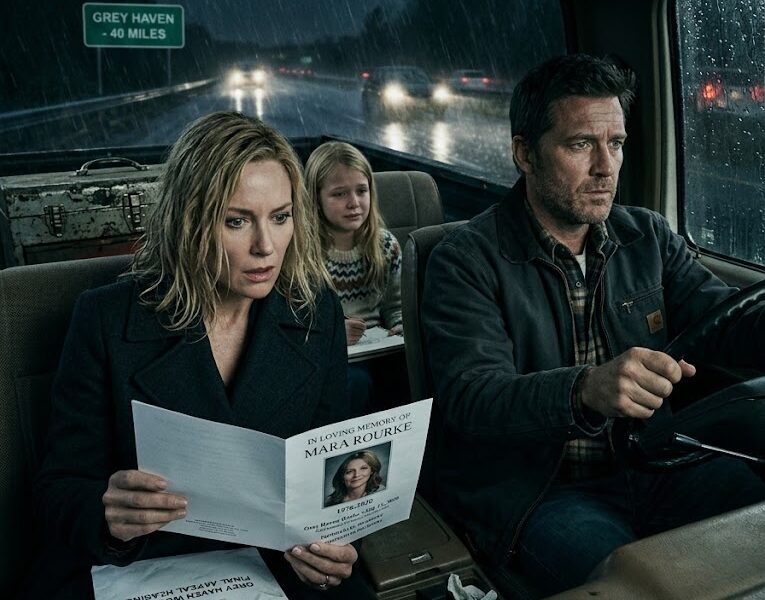
The wipers of his seventeen-year-old Ford fought back and forth against a Pennsylvania storm that seemed determined to erase the highway one gray mile at a time. It was already getting dark, and according to the dashboard clock, they were twenty-three minutes behind schedule.
Tonight was the hearing.
Tonight was the memorial.
Tonight, if everything went badly, Elias might stand in front of half of Grey Haven and embarrass himself for absolutely nothing.
He tightened his hands around the steering wheel.
“We’re already late, Nell.”
“I know.”
“Then why am I stopping?”
His ten-year-old daughter leaned forward between the seats and pointed through the windshield.
A black SUV sat crooked on the shoulder beneath a dead streetlight, its hazard lights blinking red through the sleet.
Beside it stood a woman.
She held the collar of a dark wool coat closed with one hand and lifted a phone toward the sky with the other as if one more inch might somehow produce a signal.
Elias looked at the road.
Then at the clock.
Then back at the woman.
He kept driving.
For about three seconds.
“Mom would’ve stopped,” Nell said.
His foot came off the accelerator.
He hated when she did that.
Not because she was wrong.
Because she almost never was.
Gravel cracked beneath the tires as Elias guided the Ford onto the shoulder.
The woman turned immediately.
Even through the weather, Elias could tell she didn’t belong on the side of this road.
Mid-thirties, maybe thirty-six or thirty-seven. Dark-blonde hair coming loose in the wind. Expensive leather bag tucked beneath one arm. Boots that looked like they cost more than his monthly electric bill.
But it wasn’t the clothes that caught his attention.
It was her expression.
She didn’t look frightened.
She looked irritated.
Like being stranded in freezing rain was not a danger but an administrative failure somebody would eventually have to explain to her.
Elias lowered the passenger window three inches.
“You all right?”
The woman stepped closer.
“Battery’s completely dead. Roadside assistance says at least an hour.”
Elias glanced toward the thin line of ice forming along the pavement.
“Could be longer.”
“That’s what I was afraid of.”
Before he could say anything else, Nell called from behind him.
“You can come with us.”
Elias closed his eyes for half a second.
The woman looked past him.
“That’s very kind, but I don’t want to impose.”
“Where are you headed?” Elias asked.
“Grey Haven.”
His fingers tightened around the wheel.
Just once.
But Nell noticed.
She noticed everything.
“That’s where we’re going,” she announced.
The woman blinked.
“Seriously?”
Elias unlocked the passenger door.
“Get in before you freeze.”
She reached instinctively for her wallet.
“I can pay you.”
“No.”
Her hand stopped.
“I don’t mind.”
“I do.”
Elias pushed the passenger door open.
“You can ride. You just don’t have to buy the seat.”
For the first time, the woman really looked at him.
Not at his old truck.
Not at the faded work jacket.
Not at the scar across his thumb or the grease that never completely disappeared from the lines of his hands.
At him.
Then she climbed inside.
Cold air rushed into the cab with her, carrying the smell of rain and clean wool into a truck that smelled like old coffee, motor oil, and the cinnamon gum Nell liked to leave everywhere.
“Thank you,” she said as she pulled the door shut. “I’m Ardan.”
“Elias.”
He nodded toward the back seat.
“That’s Nell.”
“Hi.”
“Hi, Ardan.”
The Ford rolled back onto the highway.
For the first few miles, the storm did most of the talking.
Sleet clicked against the roof.
The heater rattled beneath the dashboard.
Headlights appeared in the gray distance and disappeared behind them.
Ardan checked her dead phone twice.
Elias noticed.
He didn’t ask.
Nell lasted less than five minutes.
“What do you do?”
Ardan turned around.
“You ask strangers that fast?”
“Dad says you learn more by listening than guessing.”
Elias frowned at the road.
“That one I actually did say.”
Ardan laughed.
It was the first thing about her that didn’t seem controlled.
“I work for a company.”
“What kind?”
“Industrial operations. Transportation. Logistics.”
“Are you important?”
“Nell.”
“What?”
Ardan looked out through the rain.
“Some people think so.”
Nell accepted this as a perfectly reasonable answer.
“My dad fixes industrial stuff.”
“Nell.”
“What? You do.”
Ardan looked at Elias’s hands.
There was a steel toolbox behind his seat, its corners worn silver after years of being dragged through plants, warehouses, boiler rooms, and maintenance tunnels.
“Electrical systems?” she asked.
“Mostly industrial maintenance. Controls. Power systems. Whatever keeps things running.”
“Grey Haven Works?”
Elias glanced at her.
“Used to.”
Something changed in Ardan’s face.
It was small.
A fraction of a second.
But Elias had spent sixteen years diagnosing machinery by noticing what other people ignored.
A vibration.
A smell.
A sound half a pitch too high.
He noticed people the same way.
“What happened?” Ardan asked.
“Company decided people like me cost too much.”
There was no bitterness in his voice.
Somehow, that made the sentence heavier.
Ardan looked down at her hands.
A green sign emerged through the rain.
GREY HAVEN — 64 MILES.
She stared at it longer than necessary.
“Family there?” Elias asked.
“No.”
A pause.
“Business.”
“Something like that?”
Ardan looked at him.
There was the faintest hint of a smile.
“Something like that.”
He nodded.
He didn’t ask for her last name.
She didn’t ask why the words Grey Haven had made his jaw tighten.
And neither of them mentioned the large white envelope wedged beside the dashboard bearing the faded blue logo of Grey Haven Works.
FINAL APPEAL HEARING.
In the back seat, Nell opened her sketchbook and began drawing stars.
Two strangers sat three feet apart, heading toward the same small Pennsylvania town for reasons neither wanted to explain.
And before the night was over, Elias would learn that the woman beside him had helped take away his job.
Ardan would learn that the man driving her through the storm possessed evidence capable of destroying the story her own executives had told her.
But for now, neither knew the other’s last name.
And kindness still felt simple.
The sleet weakened as they traveled west, turning into a steady cold rain.
Ardan began noticing details.
A faded photograph tucked into the corner of the dashboard showed Elias standing beside a dark-haired woman with Nell between them. All three were squinting into summer sunlight.
There were utility bills clipped beneath the visor.
A stainless-steel thermos rolled against Elias’s boot whenever the truck turned.
A child’s purple mitten had been stuffed into the door pocket.
This was not a man performing humility.
This was simply his life.
Elias noticed things too.
Ardan checked a phone she already knew was dead.
Whenever they passed another Grey Haven sign, her hand tightened around her leather bag.
And every time Nell asked where she lived or what company she worked for, Ardan answered carefully.
Never quite lying.
Never quite telling the truth.
“Boston,” she said when Nell asked where home was.
“Do you like it?”
“Sometimes.”
“That means no.”
Ardan turned.
“You always decide what people mean?”
“Only when they make it obvious.”
“You get that from your father?”
Nell thought about it.
“Probably Mom.”
The hint of a smile vanished from Elias’s face.
Ardan saw it.
She didn’t ask.
That restraint surprised him.
A few miles later, Elias’s phone vibrated in the cup holder.
CAL MERCER.
He ignored it.
Thirty seconds later, it rang again.
“You can answer,” Ardan said.
“I don’t need to.”
The phone stopped.
Nell sighed.
“Cal’s going to keep calling.”
“Nell.”
“He always does when you ignore him.”
Ardan glanced at Elias.
“Friend?”
“Something like that.”
This time she smiled at the phrase he had borrowed from her.
Then the Ford struck a broken patch of pavement.
The white envelope slid from beneath the visor and landed in Ardan’s lap.
She caught it automatically.
And saw the words.
GREY HAVEN WORKS.
FINAL APPEAL HEARING.
Elias took it from her and placed it face down beside his seat.
“Sorry,” she said. “I wasn’t trying to read it.”
“You didn’t have to try.”
His tone wasn’t hostile.
That made her more uncomfortable.
“Private?”
“Very.”
Nell suddenly found the dark trees outside fascinating.
Ardan waited.
“You said you used to work there.”
“Sixteen years.”
“Doing what?”
“Electrical maintenance. Controls. Power systems. Emergency shutdown equipment. Pretty much everything nobody thinks about until it stops working.”
“And now?”
“Contract repairs. Industrial jobs when I can find them.”
“Because Grey Haven cut positions?”
“Because somebody in an office decided a spreadsheet looked better without our names on it.”
Ardan’s expression tightened.
Elias noticed.
“That’s business,” he added. “I understand.”
“You don’t sound like you understand.”
“I understand perfectly.”
He looked at her.
“Understanding something doesn’t mean I have to like it.”
The road curved around a wooded ridge.
Below them, small houses glowed through the rain.
Ardan stared at those lights.
Three months earlier, she had approved a restructuring package for Grey Haven.
She remembered the presentation.
She remembered Graham Voss standing in a glass conference room in Boston, clicking through slides.
Labor optimization.
Operational consolidation.
Long-term efficiency.
Projected savings.
Modernization.
Strategic alignment.
There had been hundreds of numbers.
Positions eliminated.
Positions reassigned.
Equipment retired.
Capital redirected.
Everything had been neat.
Everything had been defensible.
Everything had fit inside columns.
She could not remember seeing the name Elias Rourke.
And for the first time, that bothered her.
“Did they offer severance?”
Elias glanced over.
“You ask a lot of questions for someone who just works for a company.”
“Occupational hazard.”
“They offered enough to call it fair.”
“That sounds reasonable.”
“In a press release.”
Nell leaned forward.
“Dad, you’re doing the voice.”
Ardan looked back.
“What voice?”
Nell lowered her own voice and imitated him.
“The one where he’s annoyed but pretends he isn’t.”
Elias sighed.
Ardan laughed.
Against his will, Elias did too.
It lasted only a few seconds.
But something changed.
Then his phone rang again.
CAL MERCER.
This time Elias silenced it immediately.
“Whatever’s waiting for you in Grey Haven,” Ardan said, “it seems important.”
He kept watching the road.
“So does whatever’s waiting for you.”
A sign appeared.
GREY HAVEN — 41 MILES.
Ardan’s hand closed around her bag.
“It is,” she said.
Neither spoke after that.
But the silence had changed.
Elias now knew Ardan was hiding something bigger than a job title.
Ardan knew Elias wasn’t simply traveling home.
And somewhere ahead of them, both secrets were waiting in the same town.
By the time they reached Marlow County, traffic had stopped.
A fallen oak blocked both lanes.
A state trooper waved cars toward a narrow access road.
“How long?” Elias called through the window.
“Forty-five minutes minimum. Maybe more.”
Elias checked the clock.
Ardan did too.
Neither said anything.
Nell did.
“I’m starving.”
Ten minutes later, the red neon sign of Marlow’s Diner appeared through the mist.
Inside, the air smelled of grilled onions, coffee, butter, and old wood.
A jukebox hummed quietly beside the restrooms.
Elias chose a booth near the window.
Nell slid beside him.
Ardan sat across from them, looking strangely elegant beneath the diner’s yellow lights.
“Best grilled cheese in three counties,” Nell announced.
“You’ve tested all three counties?”
“Not yet.”
Nell picked up the menu.
“But confidence matters.”
Elias shook his head.
Before Ardan could answer, a broad-shouldered man wearing a Grey Haven work jacket stopped beside the table.
“Rourke.”
Elias looked up.
“Hey, Dale.”
Dale glanced at Ardan, then Nell.
His curiosity disappeared beneath worry.
“You’re still going through with it tonight?”
Elias’s expression changed.
“Yeah.”
“Even against Bellamy?”
Ardan’s fingers froze around her coffee cup.
Elias didn’t notice.
“Especially against Bellamy.”
Dale lowered his voice.
“Cal says Voss already has three outside reviews lined up. They’re calling Unit 7 obsolete.”
“I heard.”
“People are scared, Eli.”
“I know.”
“If they shut that unit down before the relay problem is settled, somebody’s going to get hurt.”
Ardan looked directly at Elias.
“That’s why I’m going,” he said.
Dale nodded once and walked away.
For several seconds, only silverware and quiet conversations filled the booth.
Ardan placed her coffee down.
“Unit 7?”
Elias looked at her.
“Grey Haven Works.”
“I gathered that.”
“Then why ask?”
“Because he sounded afraid.”
“He should be.”
Nell stopped coloring.
Ardan lowered her voice.
“What’s wrong with it?”
“Depends who you ask.”
“I’m asking you.”
Elias studied her.
“Unit 7 handles part of the plant’s emergency power and shutdown system. Old equipment. Expensive equipment. Management wants operations consolidated before winter.”
“And you disagree.”
“I disagree with pretending an unresolved electrical fault disappears because somebody changes its accounting category.”
Ardan’s face stayed still.
But something behind her eyes tightened.
“You have evidence?”
“Enough to ask questions.”
“That’s not the same thing.”
Elias gave her a faint look.
“You really do work for a company.”
“If independent reviews say the risk is acceptable, what makes you think they’re wrong?”
The waitress arrived with Nell’s grilled cheese and tomato soup.
Elias waited until she walked away.
Then he said, “Because machines don’t care what a report says.”
Ardan looked down.
She remembered the Unit 7 slide.
CONSOLIDATION.
Projected savings.
Graham Voss saying the safety exposure had been reviewed.
She did not remember anybody mentioning a recurring electrical fault.
“You lost your job because of this?”
“No.”
Elias folded his hands around his coffee.
“I lost my job because the company cut positions. This is different.”
“How?”
“If I wanted my job back, I’d be arguing about payroll.”
He nodded toward Dale and two other Grey Haven workers at the counter.
“I’m arguing because those men still have to walk into that building tomorrow morning.”
Ardan said nothing.
Nell dipped the corner of her sandwich into tomato soup.
“Dad says people look different on paper.”
Elias exhaled.
“Nell.”
Ardan looked at him.
“What does that mean?”
Elias watched steam rise from his cup.
“A spreadsheet says labor cost. A report says acceptable risk. A restructuring plan says efficiency.”
He lifted his eyes.
“But none of those words have to go home and explain to a ten-year-old why somebody isn’t coming back.”
Something in Ardan’s throat tightened.
“Would you hate the person who approved it?”
Elias looked surprised by the question.
Then he thought about it.
“No.”
She hadn’t expected that.
“Why not?”
“Because hate’s easy.”
He looked through the window at the rain.
“I’d just hope they had the courage to come here before deciding.”
Ardan lowered her eyes.
For the first time since climbing into Elias Rourke’s truck, she wasn’t afraid he might discover who she was.
She was afraid he might discover what she had already done.
A few minutes later, Ardan excused herself and crossed to the old corded phone near the diner register.
She dialed a number from memory.
Graham Voss answered on the second ring.
“Where are you?”
No hello.
No concern.
Just control stretched thin.
“On my way.”
“The board has been asking for you for forty minutes. Local press is already outside town hall. We need you there before seven-thirty.”
“Graham.”
“What?”
“Did we close Unit 7?”
Silence.
Not long.
Long enough.
“We approved consolidation weeks ago.”
“That wasn’t my question.”
Ardan gripped the receiver.
“Is Unit 7 already being taken offline?”
“Partial shutdown began this morning.”
Her stomach tightened.
“Was the safety review completed?”
“The external review cleared it.”
“All of it?”
Another pause.
“Ardan, don’t start pulling threads from a diner phone because some local mechanic told you a scary story.”
Her eyes narrowed.
“How do you know I’m with a mechanic?”
Silence again.
“You’ve been tracking me?”
“Your phone died. Security lost the vehicle signal after the breakdown. We’re trying to keep the CEO of a multibillion-dollar company from disappearing in rural Pennsylvania.”
“Answer my question.”
“I did.”
“No. You said the risk was acceptable. I asked whether the review was complete.”
“Ardan, don’t do this now.”
Three phrases moved through her mind.
Labor optimization.
Operational consolidation.
Acceptable risk.
She had signed beneath all three.
“Send me the full review.”
“What?”
“Not the summary. Everything.”
“You’re less than an hour from a public hearing.”
“Then you have less than an hour.”
She hung up.
For a moment, Ardan stood there with her hand resting on the receiver.
Behind her, forks touched plates.
Somebody laughed near the jukebox.
A waitress called an order into the kitchen.
Ordinary sounds.
Ordinary people.
Nothing in that diner looked like a line item.
When she returned to the booth, Elias was helping Nell wrap the other half of her sandwich in a napkin.
“Everything okay?” Nell asked.
Ardan sat down.
“I’m not sure.”
Elias studied her.
He didn’t ask.
The waitress dropped the check on the table.
Elias reached for it.
So did Ardan.
Their hands stopped inches apart.
“My turn,” she said.
“You already got the ride.”
“Exactly.”
“You don’t have to.”
“Neither did you.”
Elias looked at her for a moment.
Then pushed the check toward her.
“Fine.”
Nell grinned.
“Progress.”
Ardan almost laughed.
Then a folded paper slipped from Nell’s sketchbook.
Ardan caught it before it landed in spilled coffee.
GREY HAVEN COMMUNITY REMEMBRANCE SERVICE.
Below the heading was a list of names.
One made her stop breathing.
Mara Rourke.
She looked at Elias.
“Your wife?”
His eyes dropped toward the program.
Nell answered.
“Mom.”
Ardan’s voice softened.
“I’m sorry.”
“Thank you.”
“Was she from Grey Haven?”
Nell traced a finger around her cup.
“She worked at the plant.”
Elias looked at his daughter.
“That’s enough, kiddo.”
Ardan felt something cold settle beneath her ribs.
“At Grey Haven Works?”
Elias nodded.
“Twelve years.”
“And tonight…”
“There’s a remembrance service before the hearing. I was asked to say a few words.”
“You never mentioned that.”
“Wasn’t exactly road-trip conversation.”
Nell looked at Ardan.
“Dad gets quiet when people talk about Mom.”
“I don’t hate talking about her.”
“You get quiet.”
“That’s different.”
Ardan wanted to ask how Mara died.
She wanted to ask whether Grey Haven had been involved.
She wanted to ask a dozen questions.
Suddenly, she felt she had no right to ask any of them.
So she said nothing.
Outside, the trooper began waving cars back toward the highway.
The road had reopened.
Elias stood.
“We should move.”
Ardan remained seated for one second longer.
Mara Rourke.
Grey Haven Works.
A memorial.
Unit 7.
An unresolved fault.
The pieces weren’t connected yet.
But she could feel them moving toward each other.
And reaching Grey Haven no longer felt like arriving at a meeting.
It felt like walking toward a truth that had been waiting for her long before she knew Elias Rourke’s name.
They left Marlow’s Diner just after six-thirty.
Nell curled beneath her coat in the back seat.
For fifteen miles, neither adult mentioned Mara.
Then the road climbed into wooded hills.
A barricade appeared.
BRIDGE CLOSED.
DETOUR.
Elias swore quietly.
“How much time?” Ardan asked.
“Official detour? Almost an hour.”
“We don’t have an hour.”
He looked at her.
“You sound very sure.”
“I am.”
“There’s another road.”
Ten minutes later, the Ford was crawling along a narrow county route covered in wet leaves.
The temperature gauge began climbing.
Elias saw it immediately.
“Come on.”
The needle moved higher.
He pulled onto a gravel turnout and killed the engine.
Steam whispered from beneath the hood.
Nell sat up.
“Are we stuck?”
“Temporarily.”
Elias grabbed his jacket.
Ardan opened her door.
“Stay inside.”
“Why?”
“Cold. Rain. Mud.”
“I’ve survived all three.”
He looked at her boots.
“Those probably haven’t.”
Ardan stepped directly into a puddle.
“Now they have.”
Elias almost smiled.
Under the hood, he found a cracked clamp on the upper radiator hose.
Ardan held his flashlight while he worked.
“Lower.”
She adjusted it.
“Like this?”
“Perfect.”
“You sound surprised.”
“I’ve seen people hold flashlights worse.”
“High praise.”
Rain tapped against the raised hood.
Nell drew circles in the fogged window.
For the first time that evening, Ardan didn’t look like she was carrying a boardroom on her shoulders.
Her coat was damp.
Mud stained one sleeve.
A strand of hair clung to her cheek.
She didn’t care.
“Mara worked electrical too?”
Elias stopped turning the wrench.
“Process controls.”
“At Grey Haven?”
“Yeah.”
He resumed working.
“She was better than me at diagnostics. Never let me forget it.”
Ardan heard the affection beneath the grief.
“How long were you married?”
“Thirteen years.”
“What happened?”
Elias became still.
Ardan immediately regretted asking.
“You don’t have to answer.”
“Plant accident.”
The words were too simple.
“Three years ago. Equipment fault during a maintenance shutdown.”
Ardan felt her stomach tighten.
“Unit 7?”
“No.”
She breathed again.
But only briefly.
“Different section.”
He wiped rain from his hand.
“After Mara died, I started looking harder at maintenance records. Things I’d always assumed somebody above me was handling.”
He looked into the engine.
“That’s when I found the repeated faults in Unit 7.”
“And nobody fixed them?”
“They fixed pieces. Replaced parts. Reset alarms. Enough to keep production moving.”
“You reported it?”
“More than once.”
“Then why is it still open?”
Elias gave a tired half smile.
“That’s probably a question for somebody with a better office than mine.”
Ardan looked away.
The shame came quietly.
Not because he accused her.
Because he didn’t.
“Why keep fighting after they fired you?”
Elias closed the toolbox.
Then he leaned against the front of the truck.
“Because Mara’s gone.”
His voice remained calm.
“Nothing I do changes that.”
He looked through the windshield toward Nell.
“But if something’s wrong and I walk away because fighting is inconvenient, someday another kid could be sitting at a kitchen table waiting for a parent who should’ve come home.”
Ardan swallowed.
“You could sue.”
“I don’t want their money.”
“Then what do you want?”
Elias looked directly at her.
“I want the next father to go home.”
The wind seemed to disappear.
Ardan had spent fifteen years hearing arguments about liability, exposure, efficiency, shareholder confidence, market position, fiduciary responsibility.
None had ever sounded as clear as those seven words.
I want the next father to go home.
Elias topped off the coolant.
“It should hold until Grey Haven.”
Ardan still held the flashlight.
“Elias.”
He looked up.
This was the moment.
She knew it.
She should tell him.
My name is Ardan Bellamy.
I’m the CEO of Bellamy Meridian.
I approved the restructuring plan.
My signature is on the document that started shutting down Unit 7.
She opened her mouth.
Headlights swept around the bend.
The moment broke.
“We should move,” Elias said.
Ardan nodded.
But something inside her had already stopped traveling in the direction it had been going.
The first lights of Grey Haven appeared through the trees shortly after seven-fifteen.
Brick row houses.
A closed hardware store.
A white-steepled church.
Football banners hanging from telephone poles.
The old water tower.
Farther down the valley, the red warning lights of Grey Haven Works blinked against the clouds.
Ardan had seen photographs of the facility.
Dozens.
Maybe hundreds.
None had shown the houses built around it.
None had shown the schools.
The diner.
The cemetery.
The children.
The lives attached to the numbers.
Main Street was crowded.
Workers and families walked beneath umbrellas toward town hall.
Reporters stood beside cameras.
Handwritten signs asked Bellamy Meridian to delay the Unit 7 shutdown.
Elias slowed.
“This is the hearing?” Ardan asked.
“Part of it.”
“What does that mean?”
“Memorial first. Hearing after.”
He checked the clock.
“You still need somewhere else?”
Ardan looked toward town hall.
“No.”
He turned.
“You’re going here?”
“Yes.”
Nell leaned forward.
“So we really did have the same destination.”
Ardan gave her a faint smile.
Elias wasn’t smiling.
“You said business.”
“It is.”
“At town hall?”
“Yes.”
He studied her face.
Ardan drew a breath.
“Elias, there’s something I should’ve told you.”
A horn sounded behind them.
He pulled into a narrow parking space beside the municipal building.
“Tell me now.”
Rain ticked against the roof.
Through the windshield, Ardan saw a cluster of executives beneath the awning.
Graham Voss was among them.
Checking his watch.
She had seconds.
“My last name is Bellamy.”
Elias didn’t react immediately.
“Bellamy?” Nell repeated.
Ardan nodded.
“Yes.”
Elias looked toward town hall.
Then back at her.
Recognition entered his face.
Not anger yet.
Something colder.
“Bellamy Meridian.”
“Yes.”
The passenger door suddenly opened.
Graham stood outside beneath a black umbrella.
“Ms. Bellamy. Thank God.”
Silence filled the truck.
“The board is already connected. Legal needs five minutes before the memorial, and the press statement still requires your approval.”
Nell stopped moving.
She stared at Ardan.
“You’re the CEO?”
Ardan turned toward her.
“Yes.”
Elias opened his door.
He stepped into the rain.
He didn’t slam it.
Didn’t curse.
Didn’t raise his voice.
That made it worse.
“You knew who I was?” he asked.
“No. Not when I got into the truck.”
“When did you know?”
“At the diner, I started putting things together.”
Elias nodded slowly.
“At the diner.”
“I was going to tell you.”
“When?”
Ardan couldn’t answer quickly enough.
“When the hearing started?”
“No.”
“After I spoke?”
“Elias—”
“After I told you about Mara?”
Her silence answered.
Graham shifted impatiently.
“Ardan, we really need—”
She ignored him.
“I should’ve told you sooner.”
Elias held her gaze.
There was no rage in his face.
Only disappointment.
“Yes,” he said quietly.
“You should have.”
Nell climbed from the truck carrying her sketchbook beneath her coat.
Ardan stepped toward them.
“I didn’t lie about everything.”
Elias looked at her.
“You didn’t have to.”
The sentence struck harder than an accusation.
“You just let me keep talking.”
Ardan had no defense.
“I didn’t know about the incomplete review.”
“Maybe not.”
He looked back at her.
“But you signed the plan.”
She couldn’t deny it.
“That’s what matters tonight.”
He took Nell’s hand.
“Come on, kiddo.”
“Elias.”
He stopped.
“Please.”
He turned slightly.
“I’m sorry.”
Elias looked at her for a long moment.
“Then listen tonight.”
He walked into town hall with Nell.
Graham came closer.
“You gave him a ride?”
Ardan watched Elias disappear through the doors.
“No.”
Graham frowned.
She looked at the dried mud on her sleeve.
“He gave me one.”
Then she followed him inside.
Nearly every chair was occupied.
Workers sat beside spouses.
Retirees beside teenagers.
Children beside grandparents.
At the front of the room, company attorneys arranged folders while Graham prepared his presentation.
Elias sat three rows back.
Nell beside him.
He didn’t look at Ardan.
That hurt more than if he had.
The remembrance service came first.
Names were read slowly.
People bowed their heads.
When the woman at the microphone said “Mara Rourke,” Nell reached for her father’s hand.
Elias closed his fingers around hers.
Ardan lowered her eyes.
For the first time, Mara wasn’t an entry in an incident archive.
She was the empty chair beside a man.
The hand a little girl could no longer hold.
Ten minutes later, grief gave way to business.
Graham stepped to the microphone.
“Grey Haven Works has served this community for generations. But responsible leadership requires difficult choices.”
A slide appeared.
UNIT 7 — OPERATIONS CONSOLIDATION.
“Unit 7 is outdated, expensive to maintain, and no longer essential to our long-term operational strategy.”
Murmurs moved through the room.
“Three independent technical reviews have classified the remaining risk as acceptable.”
Elias looked up.
Ardan watched him.
Graham clicked to another slide.
Numbers.
Percentages.
Forecasts.
Clean columns.
She had seen every one of them before.
Tonight, they looked different.
A man near the back called out, “How many jobs go with it?”
The council chair raised a hand.
“Everyone will have a chance to speak.”
Graham continued.
Efficiency.
Competitiveness.
Consolidation.
Modernization.
Ardan listened to words she had used herself.
For the first time, she heard how little blood they contained.
Finally, the council chair looked down at her list.
“Elias Rourke.”
The room quieted.
Elias squeezed Nell’s hand.
Then he stood.
He walked to the microphone carrying a thin folder and a small black hard drive.
No suit.
No attorney.
No communications team.
Just a man in a work shirt whose jacket was still damp from the rain.
Graham leaned back.
“Mr. Rourke, perhaps you could clarify your qualifications for the record.”
Elias looked at him.
“Electrical maintenance technician. Sixteen years at Grey Haven Works.”
“You are not a licensed professional engineer.”
“No.”
“You’re not a certified corporate safety auditor.”
“No.”
“You have not conducted an independent engineering review of Unit 7.”
“No.”
Graham folded his hands.
“Then what qualifies you to challenge three professional assessments commissioned by this company?”
The room went still.
Elias placed the hard drive on the table.
“My wife.”
Graham blinked.
Whispers moved through the audience.
“Mara worked process controls here for twelve years. After she died, I went through maintenance archives she had backed up at home.”
“Personal files are not necessarily company records.”
“These are.”
Elias opened the folder.
He removed copies of maintenance logs.
“Relay failures.”
Another page.
“Voltage drops.”
Another.
“Emergency shutdown resets.”
He laid them side by side.
“Same circuit path. Same recurring fault.”
Graham glanced toward the attorneys.
“Those issues were addressed. Parts were replaced.”
“Correct.”
“Then—”
“That’s not the same thing as solving the underlying problem.”
Graham’s voice sharpened.
“According to your interpretation.”
“According to the timestamps.”
Elias placed three pages on the table.
“March eighth.”
Another.
“May twenty-first.”
Another.
“August fourth.”
He looked around the room.
“Three dates. Three failures. Three authorizations for temporary resets.”
Ardan leaned forward.
She recognized one signature immediately.
A regional operations director.
A man whose name had appeared on her restructuring brief.
Graham spoke quickly.
“Isolated maintenance events do not prove systemic danger.”
Elias nodded.
“I agree.”
Graham seemed surprised.
“You do?”
“I’m not here to prove the entire system is dangerous.”
Elias placed his hand beside the hard drive.
“I’m here to prove somebody knew the fault was unresolved before the shutdown plan was approved.”
Silence.
Not uncomfortable silence.
Dangerous silence.
Graham’s jaw tightened.
“That is a serious accusation.”
“It’s a serious record.”
“And you expect this council to trust files stored in your home?”
“No.”
Elias turned his head.
For the first time since arriving, he looked directly at Ardan.
“I expect the company to compare them against its own servers.”
Their eyes met.
There was no plea in his face.
No request for sympathy.
No demand that she save him.
He was simply asking her to look.
Graham turned toward her.
“Ardan, this is exactly why technical decisions rely on qualified reviews rather than emotional testimony.”
Elias looked back at him.
“My wife isn’t my evidence.”
He touched the hard drive.
“This is.”
The room went silent again.
And Ardan understood something.
The question was no longer whether Elias Rourke deserved to be heard.
The question was whether the people who had ignored him still deserved to make the decision.
Graham was the first to move.
“Madam Chair, I suggest we adjourn until these files can be authenticated.”
Elias began gathering his papers.
“That’s fine.”
Graham looked relieved.
Too relieved.
Ardan noticed.
She also noticed that the regional director whose signature appeared on the logs had stopped taking notes.
“Ms. Bellamy?” the chair asked.
Ardan stood.
“Five minutes.”
Graham followed her into the hallway.
The doors had barely closed when he spoke.
“What are you doing?”
“Trying to understand why I’m seeing maintenance records tonight that weren’t in the packet you gave me.”
“They’re unverified.”
“That’s not an answer.”
“You approved the consolidation. The board approved it. Legal approved it. If you stop everything now because a former technician brought a hard drive into a town meeting, you’ll look reckless.”
Ardan stared at him.
“Did you know about the recurring fault?”
“I knew there were maintenance issues.”
“Did you know they were unresolved?”
“The risk was classified as acceptable.”
“By whom?”
“Independent reviewers.”
“Using which records?”
Graham said nothing.
Ardan stepped closer.
“Did those reviewers receive these logs?”
His jaw tightened.
“You’re asking the wrong question.”
“No.”
Her voice became quieter.
“I think I’m finally asking the right one.”
“Ardan, listen to me. If you suspend this shutdown, the board can remove you before morning.”
“Did you know?”
Graham stared at her.
The silence answered before he did.
“We knew there were older records.”
Ardan felt something settle inside her.
Not anger.
Clarity.
“And?”
“We didn’t consider them material.”
She repeated the words slowly.
“You didn’t consider them material.”
“Don’t make this emotional.”
“A recurring emergency-system fault isn’t emotional.”
“This company employs thousands of people. We make decisions based on scale.”
Ardan looked through the narrow window in the doors.
Elias was helping Nell put her sketchbook into her bag.
He wasn’t watching the hallway.
He was preparing to leave.
“Scale,” Ardan said.
Graham softened his voice.
“You can still fix this.”
She looked at him.
“How?”
“We adjourn. Legal challenges the files. The board signs off tonight. By Monday, this is noise.”
“And if his files are real?”
“Then we deal with it internally.”
“After Unit 7 is shut down.”
Graham didn’t answer.
Ardan understood.
She opened the doors.
Conversations faded as she returned to the microphone.
Elias had reached the aisle.
“Mr. Rourke.”
He stopped.
Slowly, he turned.
Ardan looked at the council.
Then at the workers.
Then at the local television camera.
“Three months ago, I approved the Unit 7 consolidation.”
A murmur moved through the room.
Graham stood.
“Ardan—”
She continued.
“I approved it based on information presented to me as complete.”
Silence returned.
“Tonight, I have reason to believe it was not.”
Graham stepped forward.
“This is inappropriate without legal review.”
Ardan looked at him.
“Then we’ll have one.”
She faced the room.
“Effective immediately, the Unit 7 shutdown is suspended.”
Someone gasped.
A woman covered her mouth.
Nobody cheered.
Not yet.
Ardan raised a hand.
“This is not a declaration that Mr. Rourke is correct about every conclusion he has drawn.”
She looked toward Elias.
“It is not a promise that every position will be saved. Grey Haven still has difficult economic decisions ahead.”
She paused.
“But no final decision involving Unit 7 will be signed until these records are independently authenticated and the complete safety history has been reviewed.”
Graham’s face had gone pale.
“The board will not support this.”
Ardan turned toward him.
“Then the board can vote.”
“You could lose your position.”
“Then they can vote on that too.”
The room became completely still.
Ardan looked at Elias.
“You asked us to look.”
Her eyes moved toward the hard drive.
“We should have looked sooner.”
Elias didn’t smile.
He didn’t thank her.
He didn’t nod.
After a long moment, he turned toward Nell.
“Come on.”
Ardan felt the sting.
But she understood.
Respect could be lost in a night.
Trust took longer.
As Elias reached the doors, an older worker stood from the second row.
Then another.
A woman wearing a faded Grey Haven jacket rose.
Nobody applauded.
One by one, people simply stood.
The sound was almost nothing.
Chair legs scraping.
Coats rustling.
A child whispering.
But soon nearly every worker in the room was on their feet.
They had not been promised victory.
They had been promised only that somebody would finally look.
Ardan stood behind the microphone and listened to that quiet.
For most of her career, she had believed leadership meant entering a room with the answer before anyone else could ask the question.
Grey Haven taught her something harder.
Sometimes leadership meant stopping the machine long enough to admit that the answer you had signed your name beneath might be wrong.
Three months later, the first snow of winter settled over Grey Haven.
The independent investigation confirmed that Elias’s maintenance records were authentic.
It confirmed something worse.
Critical fault reports had been excluded from the technical package provided to Ardan Bellamy and the board.
The independent reviewers had not lied.
They had simply been given an incomplete truth.
And an incomplete truth, Ardan learned, could be more useful than a lie because everyone involved could still claim they had been honest.
Graham Voss resigned before the final findings became public.
So did the regional operations director whose signature appeared on the temporary reset authorizations.
There were investigations.
Lawyers.
Board meetings.
Headlines.
Bellamy Meridian’s stock dipped, recovered, dipped again.
Ardan survived the board vote by two votes.
She never told Elias.
Cal Mercer did.
“You know she almost lost the company over this?” he said one morning.
Elias continued tightening a junction-box cover.
“She didn’t almost lose the company.”
“What would you call two votes?”
“I’d call it two votes.”
Cal shook his head.
“You’re impossible.”
Grey Haven still changed.
Some positions were eliminated.
Departments were combined.
Budgets were cut.
No miracle arrived.
No billionaire CEO saved an entire town with a speech.
That wasn’t what happened.
What happened was smaller.
And harder.
Unit 7 was rebuilt instead of quietly abandoned.
New monitoring equipment was installed.
Independent safety oversight became mandatory.
Unresolved faults could no longer be buried beneath temporary resets without documented engineering review.
And every worker in the plant received stop-work authority when a safety condition appeared unresolved.
Elias was offered a position on the new safety modernization team.
The salary was better than what he’d earned before.
The title meant little to him.
One sentence in the job description did.
AUTHORITY TO HALT OPERATIONS PENDING SAFETY REVIEW.
He read it twice.
Then accepted.
Several weeks later, Ardan visited the new control room.
No cameras.
No press release.
No black SUV waiting outside.
Just Ardan in a navy coat standing behind the glass while technicians installed the final monitoring panel.
“We were considering something,” she told Elias.
He looked up from a schematic.
“What?”
“Naming the control room after Mara.”
He stared at her.
“Don’t.”
Ardan seemed surprised.
“I thought it might honor her.”
“She wasn’t a warning sign.”
His voice wasn’t harsh.
“She was a person.”
Ardan looked through the glass toward the technicians.
Then she nodded.
“You’re right.”
Elias glanced toward Nell, who sat at a nearby desk drawing constellations on the back of an old engineering print.
“Keep her name where it belongs.”
“With the people who knew her?”
“Exactly.”
That was the first conversation Elias and Ardan had shared alone since the hearing.
It wasn’t warm.
It wasn’t cold.
It was honest.
Trust returned that way.
Not in one grand apology.
Not because Ardan suspended a shutdown.
Not because Elias decided she was secretly a good person all along.
It came back in pieces.
Ardan began visiting Grey Haven without announcing herself.
She attended maintenance meetings no CEO had attended before.
At first, everyone became quiet when she entered.
She hated that.
So she kept coming until they stopped.
She learned technicians’ names.
She learned which supervisor had a daughter playing varsity basketball and which electrician was caring for an elderly father.
More importantly, when someone disagreed with her, she stopped asking whether they had the right title.
She started asking:
“What did you see?”
Elias noticed.
He never praised her.
He didn’t need to.
One afternoon, she found him standing alone beside Unit 7.
“You still angry with me?” she asked.
He considered the question.
“Sometimes.”
Ardan nodded.
“Fair.”
“You want me to say you fixed it?”
“No.”
“Good.”
She looked at the rebuilt panels.
“I didn’t fix it.”
“No.”
“You did.”
Elias shook his head.
“No.”
She looked at him.
“The records existed before either of us got involved. Mara saved them. Dale kept asking questions. Cal kept calling me when I didn’t want to hear him. You stopped the shutdown.”
He glanced toward the humming equipment.
“A lot of people did one thing when it would’ve been easier not to.”
Ardan smiled faintly.
“That almost sounded optimistic.”
“Don’t tell anybody.”
By late November, the new safety system passed its final independent inspection.
That Sunday marked three years since Mara’s death.
Elias and Nell drove to the cemetery outside Grey Haven.
Nell carried a paper star she made every year.
Elias carried white chrysanthemums.
They stood beside Mara’s grave until the afternoon light began to fade.
Nell told her mother about school.
About a science project.
About the new control room.
About how Dad still burned pancakes whenever he tried to make them without reading the instructions.
Elias protested.
Nell ignored him.
Before they left, she placed the paper star beside the flowers.
Elias stayed a little longer.
There were still things he couldn’t say aloud.
Maybe there always would be.
Grief had changed over three years.
It no longer felt like drowning every day.
Now it was more like living beside an ocean.
Sometimes calm.
Sometimes beautiful.
Always there.
They returned to the Ford.
Snow had begun to fall.
Elias started the engine and turned on the heater.
They had barely reached the cemetery gate when Nell leaned forward.
“Dad.”
“What?”
“Stop the truck.”
Elias looked ahead.
Then he saw her.
Ardan Bellamy stood beside the road.
Simple navy coat.
Hands in her pockets.
No disabled SUV.
No security team.
No assistant.
No obvious reason to be there.
Elias slowed.
He lowered the window.
“Car trouble?”
Ardan smiled.
“No.”
“Phone dead?”
“Fully charged.”
Nell leaned between the seats.
“Then why are you standing out here?”
Ardan looked at Elias.
“I was hoping somebody might stop.”
For a moment, nobody spoke.
The heater hummed.
Snowflakes touched the windshield and melted.
Elias looked down the empty road.
Then back at her.
“You need a ride?”
“Maybe.”
“Where to?”
Ardan hesitated.
Just long enough for Nell to grin.
“Dinner.”
Elias raised an eyebrow.
“That’s not a destination.”
Ardan’s smile softened.
“It can be.”
Nell opened the back door.
“She can sit with me if you’re going to make this difficult.”
Elias sighed.
“I’m surrounded.”
Ardan laughed.
She climbed into the truck.
Cold air followed her inside, just as it had the first night.
But this time she didn’t reach for her wallet.
And Elias didn’t have to tell her not to.
The Ford pulled away from the cemetery.
For a while, nobody spoke.
Grey Haven appeared ahead of them beneath the falling snow, its windows glowing amber against the early winter darkness.
Nell talked about where they should eat.
Ardan argued for the diner.
Elias said he refused to drive thirty minutes for grilled cheese.
Nell accused him of having no loyalty.
Ardan sided with Nell.
Elias realized he had made a tactical mistake by allowing the two of them into the same vehicle.
He shook his head.
And smiled.
Behind them, the cemetery road disappeared beneath the snow.
Mara was still gone.
Nothing could make that beautiful.
Nothing could make it fair.
Grey Haven still had layoffs.
Bellamy Meridian was still a corporation capable of making cold decisions.
Ardan had not transformed into a perfect leader.
Elias had not forgotten what her signature once meant.
Some things did not need to be erased for life to continue.
Perhaps that was the part people misunderstood about second chances.
They imagined forgiveness as a door thrown open.
Sometimes it was only an unlocked door.
Nobody promised you could stay.
Nobody pretended the past had disappeared.
Someone simply stopped holding the door shut.
The first time Ardan Bellamy climbed into Elias Rourke’s truck, they shared a destination by accident.
She had been a powerful woman hiding her name.
He had been an unemployed technician carrying evidence nobody important wanted to see.
Between them sat a little girl who believed kindness should happen before you knew whether somebody deserved it.
Months later, they were in the same truck again.
This time there was no storm forcing them together.
No dead battery.
No hearing.
No board vote.
No secret left that could make the other person suddenly become someone else.
Only snow.
A warm cab.
A child talking too much in the back seat.
And two adults who knew exactly who was sitting beside them.
Elias turned onto Main Street.
“Diner?” he asked.
Nell cheered.
Ardan looked through the windshield toward the warm lights ahead.
“Diner.”
Elias nodded.
And kept driving.
Because sometimes a second chance does not look like victory.
Sometimes it does not even look like forgiveness.
Sometimes it is simply the moment when the road divides, you know everything that happened behind you, and you choose—carefully, imperfectly—to keep traveling in the same direction anyway.









