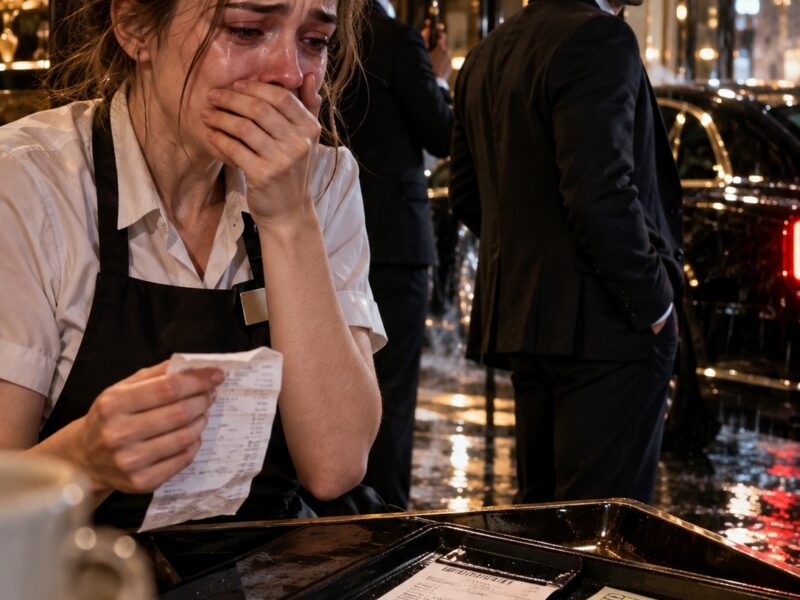
She Gave Her Last $32 to a Broke Stranger—Then a Man at the Hospital Called Him “Mr. Blackwood”

The thirty-two dollars Emily Carter handed to a stranger that night was supposed to help pay for her mother’s heart medication.
She didn’t know that yet.
She didn’t know the man’s credit card had been deliberately disabled.
She didn’t know the worn gray coat, the quiet embarrassment, the hesitant apology at the register—almost all of it had been arranged.
And she certainly didn’t know that the man sitting beneath the flickering pendant light in Booth Seven could have purchased the entire restaurant without checking his bank balance.
All Emily knew was that everyone was staring at him.
And that he looked ashamed.
Outside, a November storm pressed against the windows of Hayes Grill, turning the streets of downtown Chicago into blurred ribbons of headlights and rain. Wind rattled the glass every few minutes. Wet customers crowded near the entrance, shaking umbrellas and stamping water from their shoes.
Emily had been working for almost eleven hours.
Her lower back hurt.
Her feet burned inside cheap black sneakers she’d bought on clearance six months earlier.
And tucked inside the pocket of her apron was a folded note from Northwestern Memorial Hospital reminding her that another portion of her mother’s medical balance was overdue.
She had read it three times during her break.
Then she’d folded it smaller each time, as if making the paper smaller might somehow make the number printed on it smaller too.
It hadn’t.
Neither had the voicemail she’d received that afternoon.
“Emily, this is Dr. Mitchell’s office. Please call us when you can. We need to discuss your mother’s latest results.”
She hadn’t called back yet.
Not because she didn’t care.
Because she was afraid.
There were some phone calls you postponed because you were busy.
And there were others you postponed because some part of you knew your life might look different after you answered them.
Emily was carrying two coffee mugs toward the kitchen when she heard the card reader beep.
Once.
Then again.
The sound was ordinary.
What followed wasn’t.
“I’m sorry,” the man at the register said quietly. “Could you try it one more time?”
Emily turned.
He was perhaps forty, maybe a little older, with dark hair beginning to silver at the temples. His coat was clean but unremarkable. No watch she could see. No expensive shoes. No obvious sign of wealth.
He looked like a man who had come in from the storm because he needed somewhere warm to sit.
Mr. Hayes, the restaurant manager, stared at the screen.
“Declined.”
The stranger swallowed.
“I thought there was enough on it.”
A few customers nearby looked over.
Emily immediately hated that.
Public embarrassment had a particular sound.
It was quieter than laughter.
It sounded like forks slowing against plates.
Conversations stopping halfway through sentences.
People pretending not to look while looking anyway.
The man reached for his wallet again.
“I may have another—”
Mr. Hayes sighed loudly.
“Sir, we’ve already tried the card twice.”
Emily stepped closer.
“Sometimes the connection gets weird during storms.”
Mr. Hayes glanced at her.
“The machine is fine.”
His voice carried farther than necessary.
Emily lowered hers.
“Mr. Hayes—”
“We can’t keep serving people who don’t have money to pay.”
The stranger’s face tightened.
“I made a mistake. I’m terribly sorry.”
“Apologies don’t pay bills.”
Emily saw the man’s eyes move toward the other diners.
That was the moment she stopped seeing a customer with an unpaid check.
She saw a human being trapped in one of those terrible moments when money became public.
She knew that feeling.
She knew what it was like to stand at a pharmacy counter and ask which prescription could wait until Friday.
She knew what it was like to count grocery items before reaching the register.
She knew what it was like to open a banking app and calculate how many days remained until rent was due.
Poverty wasn’t always sleeping under a bridge.
Sometimes it was standing beneath bright fluorescent lights hoping nobody noticed your card had been declined.
“Mr. Hayes,” Emily said, “please lower your voice.”
He stared at her.
“Excuse me?”
“Everyone can hear.”
“And?”
“And there’s no reason to embarrass him.”
Mr. Hayes folded his arms.
“Kindness is wonderful, Emily. But this restaurant isn’t a charity.”
The stranger looked down.
Emily wished Mr. Hayes hadn’t said it.
Because something about the man’s silence afterward felt worse than any argument.
“Someone has to pay,” Hayes continued.
Emily stood still.
Then she reached into her apron.
Her fingers touched the folded hospital notice first.
Behind it were her tips.
Thirty-two dollars.
Almost everything she’d made that night.
She thought about rent.
Groceries.
Her mother’s prescriptions.
The bus pass she needed to reload.
Then she looked at the stranger.
“How much is his bill?”
Mr. Hayes frowned.
“Emily.”
“How much?”
“Thirty-one forty-eight.”
She pulled out the cash.
For one second, her hand refused to open.
Thirty-two dollars wasn’t much to some people.
To Emily Carter, it was three dinners.
A prescription copay.
A week of bus rides.
Part of the electric bill.
Tonight, it was almost everything she had earned.
Then she placed the bills on the counter.
“Mark it paid.”
The stranger looked up sharply.
Mr. Hayes stared at her.
“You’re paying for a complete stranger?”
Emily forced a small smile.
“Maybe someday I’ll need help.”
“Emily—”
“And I hope someone won’t make me prove I deserve it first.”
The restaurant became strangely quiet.
Mr. Hayes took the money.
“Fine. This once.”
Emily gathered the receipt and walked it to the man’s table.
“Everything’s taken care of.”
He stared at her as if she had handed him something far larger than thirty-two dollars.
“You paid for my dinner?”
“It’s okay.”
“You don’t know me.”
Emily picked up his empty water glass.
“I don’t need to know your name to know you deserve to be treated like a human being.”
For several seconds, he said nothing.
Then he asked, “Why?”
Emily looked at him.
“My mother taught me.”
“Your mother?”
“She says having little doesn’t mean you have nothing worth giving.”
The man’s expression changed.
Emily couldn’t explain it.
Something seemed to crack behind his eyes.
Before he could answer, a bell rang from the kitchen.
“Emily!” Mr. Hayes shouted. “Table Twelve!”
She gave the stranger one last tired smile.
“Finish your coffee. Stay until the rain slows down.”
Then she walked away.
She never saw him reach into his coat after she turned.
Never saw the expensive phone hidden inside.
Never heard the message he sent.
And she never noticed the black sedan waiting across the street.
Twenty minutes later, the stranger stepped outside.
A man holding an umbrella immediately approached him.
“Mr. Blackwood.”
The stranger stopped.
“Not here, Daniel.”
Daniel Mercer glanced toward the restaurant.
“Your car is ready. The board has been waiting all evening.”
Ethan Blackwood looked through the rain-streaked window.
Emily was clearing plates.
“The experiment worked, then?” Daniel asked.
Ethan said nothing.
Daniel studied him.
“You wanted to know whether people treated you differently when they thought you had nothing.”
“I know what I wanted.”
“And?”
Ethan looked down at the credit card in his hand.
The card had never been declined because Ethan Blackwood lacked money.
It had been deliberately deactivated.
Ethan was founder and majority owner of Blackwood Holdings, a privately held investment group with interests in commercial real estate, logistics, hospitality, and technology.
He had spent years surrounded by people who knew exactly how wealthy he was.
Investors laughed before he finished jokes.
Executives remembered his birthday.
Strangers became charming when they recognized his name.
Charities photographed his checks.
Politicians returned his calls.
People were kind to Ethan Blackwood all the time.
He had begun wondering whether any of it was real.
So occasionally, against Daniel’s objections, Ethan removed the obvious signs of wealth.
No driver at the door.
No tailored suit.
No watch.
No name.
That night, he’d gone further.
He had disabled his card.
He wanted to know what strangers did when they believed a man couldn’t pay for dinner.
He expected impatience.
Perhaps pity.
Maybe cruelty.
He hadn’t expected a waitress to empty her apron.
“She gave me everything she earned tonight,” Ethan said.
Daniel’s expression changed.
“Everything?”
“Thirty-two dollars.”
“Then let me find her information. We can send fifty thousand. More, if you want.”
“No.”
Daniel blinked.
“Sir?”
“I won’t turn what she did into another transaction.”
“You deliberately created the situation.”
“I know.”
For the first time, Ethan sounded ashamed.
Daniel watched him carefully.
“You’ve done these little experiments before.”
“Not like this.”
“What changed?”
Ethan looked back through the window.
Emily had stopped beside an elderly couple’s table.
She was laughing at something the woman said.
She looked exhausted.
Yet she was smiling.
“She did.”
The following morning, Emily was refilling sugar containers when the bell over the restaurant door rang.
She looked up.
The stranger from the night before walked inside.
For reasons she didn’t understand, she smiled.
“You came back.”
“I hope that’s okay.”
“As long as your card behaves itself.”
He laughed.
It was the first time she’d seen him do that.
“Coffee?”
“Please.”
She poured him a cup.
He placed folded cash on the counter.
Emily immediately pushed it back.
“What’s that?”
“Thirty-two dollars.”
“No.”
“Emily—”
“How do you know my name?”
He nodded toward her name tag.
She glanced down and laughed at herself.
“Right.”
“You shouldn’t have paid for my mistake.”
“I already told you. You don’t owe me.”
“I do.”
“No.”
“Why are you making this difficult?”
“Because you’re trying to turn kindness into debt.”
That stopped him.
Emily leaned against the counter.
“I didn’t lend you money. I helped you.”
“There isn’t a difference?”
“There is to me.”
Ethan studied her.
“Why?”
“My mother.”
“You mentioned her last night.”
Emily smiled faintly.
“She raised me alone after my father left. We never had much. When I was nine, our electricity got shut off for two days.”
Ethan said nothing.
“I remember being embarrassed. Mom lit candles and told me we were camping indoors.”
Emily laughed softly.
“I believed her for maybe ten minutes.”
“What happened?”
“Our neighbor Mrs. Alvarez ran an extension cord from her apartment so our refrigerator wouldn’t shut off. She barely had anything herself.”
Emily slid the money back toward Ethan.
“Mom never forgot that.”
“So she taught you to help people.”
“She taught me that sometimes the person with the least understands exactly what another person needs.”
Ethan looked at the thirty-two dollars.
For the first time in years, money seemed strangely useless.
“Can I at least buy breakfast?”
Emily smiled.
“If your card works.”
It became a joke between them.
Then, somehow, it became more.
Ethan returned two days later.
Then three days after that.
Sometimes he ordered coffee.
Sometimes eggs.
Sometimes nothing except toast and enough conversation to make Emily glance at the clock and realize twenty minutes had disappeared.
He told her carefully edited truths.
He worked in investments.
True.
He traveled often.
True.
He had no children.
True.
His father had been emotionally distant.
True.
He hated being treated differently because of money.
Painfully true.
But he never told her how much money.
Never told her Blackwood Holdings occupied thirty-seven floors of a glass tower less than two miles away.
Never told her the foundation carrying his family name distributed millions each year.
Never told her that when he left Hayes Grill, Daniel often waited around the corner with a driver.
Emily didn’t ask.
That made hiding the truth feel worse.
One Thursday morning, Ethan was drinking coffee when Emily’s phone rang.
She glanced at the screen.
Her smile disappeared.
“Hello?”
Ethan watched her turn away.
“This is Emily Carter.”
A pause.
“Is everything okay with my mother?”
Another pause.
Emily gripped the counter.
“But she was improving yesterday.”
Ethan sat straighter.
“What do you mean another procedure?”
Her face drained of color.
“Please. Is there any other option?”
Mr. Hayes emerged from the kitchen.
“Emily, Table Six.”
She raised one finger.
“I understand. Yes. I’ll come after my shift.”
She ended the call.
For several seconds, she simply stood there.
“Emily?”
“I’m fine.”
She wasn’t.
Ethan had spent decades in boardrooms watching people conceal panic.
He knew the difference between calm and collapse delayed by necessity.
“Was that the hospital?”
Emily looked at him.
“How did you—”
“You mentioned your mother.”
She looked down.
“She has a heart condition.”
“I’m sorry.”
“They thought medication would stabilize things for a while.”
Her voice cracked.
She turned away immediately.
“But now they want another procedure.”
“Can they do it?”
“They can.”
Emily laughed once.
It was a terrible sound.
“I just don’t know how I’m supposed to pay for it.”
Ethan felt something cold settle inside him.
Thirty-two dollars.
He suddenly understood.
The money she had handed him hadn’t been disposable.
It hadn’t been generosity from abundance.
She had given him money while her mother was sick.
“Emily.”
She wiped beneath one eye.
“Please don’t.”
“Don’t what?”
“Look at me like that.”
“Like what?”
“Like you feel sorry for me.”
“I don’t.”
“Good.”
She straightened her apron.
“Because I don’t have time for pity. I have rent due next week, a hospital balance I don’t understand, and a manager who’ll replace me if I miss too many shifts.”
Mr. Hayes called her again.
Emily closed her eyes.
“Coming.”
Before she turned, Ethan said, “Let me help.”
She immediately shook her head.
“No.”
“You don’t even know what I’m offering.”
“If it’s money, no.”
“Why?”
“Because then what I did for you becomes something else.”
“It doesn’t.”
“It will feel like it.”
She walked away.
Ethan sat alone.
For perhaps the first time in his life, he discovered there were problems money could solve immediately and still make worse.
That evening, Emily finished her shift at seven-thirty.
Ethan was waiting outside.
She stopped.
“What are you doing here?”
“Offering something that isn’t money.”
She narrowed her eyes.
“What?”
“A ride.”
“To where?”
“The hospital.”
Emily stared at him.
“You remembered?”
“Of course.”
“I can take the bus.”
“In this weather?”
“I always take the bus.”
“Then tonight you don’t have to.”
She hesitated.
“I’ll pay for gas.”
Ethan almost smiled.
“Fine.”
“Seriously.”
“Absolutely.”
He had told Daniel to leave the Bentley at home.
Instead, Ethan had borrowed an older dark SUV from one of the company’s property managers.
Even that now felt dishonest.
But Emily climbed inside.
During the drive, she stared through the window.
“You know what’s strange?” she said.
“What?”
“Most people disappear when life gets complicated.”
Ethan glanced at her.
“Maybe they’re afraid they’ll be asked for something.”
“Maybe.”
She rubbed her hands together.
“You stayed.”
The words hit him harder than they should have.
Because she was thanking him for staying while he was still hiding the most important truth about himself.
At the hospital, Dr. Mitchell met Emily near Room 14.
“Your mother is stable tonight.”
Emily exhaled.
“But?”
The doctor paused.
“But we shouldn’t delay the procedure.”
“How soon?”
“We’re preparing now.”
Emily’s hand went to her mouth.
“Tonight?”
“We believe that’s best.”
“What about payment?”
“Our financial counseling office will work with you. Treatment decisions aren’t based on whether you can write a check tonight.”
Emily nodded.
But after the doctor walked away, she sank into a plastic chair.
“I’ve worked every shift they offered.”
Ethan sat beside her.
“I know.”
“No, you don’t.”
He didn’t argue.
She stared at the floor.
“I’ve skipped meals.”
His chest tightened.
“I canceled my dental appointment. I stopped buying coffee. I haven’t bought new clothes in almost a year.”
Her laugh was brittle.
“And I still can’t catch up.”
“Emily.”
“How do people do this?”
He had no answer.
She looked at him.
“I don’t need to be rich. I just want my mother to be sick without wondering whether it will destroy us.”
Ethan looked away.
Because he could have erased the balance in seconds.
One phone call.
One transfer.
One signature.
But she had already told him no.
And if he overrode that boundary, his help would become another form of control.
“I may know of some assistance programs,” he said carefully.
“How?”
“My work overlaps with charitable organizations.”
Another technically true answer.
Emily studied him.
“Nothing special.”
“What?”
“I don’t want anyone bending rules.”
“They won’t.”
“Promise?”
Ethan hesitated.
Then said, “I promise.”
He stepped into the hallway twenty minutes later and called Daniel.
Daniel answered immediately.
“Sir?”
“Contact the hospital’s financial assistance office.”
A pause.
“You’re still there?”
“Daniel.”
“Sorry.”
“Find out what programs exist. Nothing private about Emily unless she consents.”
“The Blackwood Foundation supports emergency medical grants through that hospital.”
Ethan closed his eyes.
Of course it did.
“Then determine whether Margaret Carter’s situation can be reviewed.”
“I can call the director.”
“No.”
“Sir—”
“No favors.”
Daniel became quiet.
“She gets the same review as anyone else.”
“Understood.”
“And Daniel?”
“Yes?”
“If she doesn’t qualify, she doesn’t qualify.”
“You’re serious.”
“Completely.”
“Even though you could pay everything yourself?”
Ethan looked through the glass panel toward Emily.
She was sitting beside her mother’s bed, holding her hand.
“Her dignity matters more than my need to feel useful.”
The following hour brought the first real hope Emily had felt in months.
Olivia Grant from Financial Counseling explained that several assistance programs might apply.
Insurance would be reviewed.
Income.
Existing expenses.
Foundation grants.
Payment relief.
Nothing guaranteed.
Nothing manipulated.
Nothing purchased through Ethan.
Emily listened carefully.
“Will applying delay Mom’s procedure?”
“No,” Olivia said. “Medical decisions remain with her physicians.”
Emily finally breathed.
When Olivia left, she turned toward Ethan.
“Thank you.”
He shook his head.
“I didn’t do anything.”
“You found her.”
“I asked questions.”
“For the first time today, I feel like maybe this isn’t impossible.”
Ethan smiled.
And that was when Daniel walked around the corner carrying a leather portfolio.
He saw Ethan.
“Mr. Blackwood.”
Everything stopped.
Ethan’s face changed.
Daniel realized instantly.
Too late.
Emily looked from Daniel to Ethan.
“I’m sorry,” Daniel said.
But Emily was already standing.
“What did he call you?”
Ethan said nothing.
Her eyes narrowed.
“Mr. Blackwood?”
“Emily—”
“Who are you?”
The hallway suddenly seemed too bright.
Too quiet.
“My name is Ethan Blackwood.”
She waited.
He forced himself to finish.
“I own Blackwood Holdings.”
Emily stared at him.
For several seconds, she seemed unable to understand the sentence.
“You own… Blackwood Holdings?”
“Yes.”
“The Blackwood Foundation?”
“My family established it. I chair the board.”
Emily’s face went pale.
Then confusion became something else.
Something sharper.
“If you’re rich…”
Ethan knew what was coming.
“Why couldn’t you pay for dinner?”
He didn’t answer quickly enough.
Emily stepped backward.
“Oh my God.”
“Emily.”
“Was the card even declined?”
“Yes.”
“Why?”
He swallowed.
“Because I had it disabled.”
Her face emptied.
“What?”
“I wanted to understand how people treated someone they believed had nothing.”
Emily stared at him.
“You were testing people?”
“I was.”
“Mr. Hayes?”
“No. He didn’t know.”
“The customers?”
“No.”
“Me?”
Ethan’s silence answered.
Emily’s eyes filled.
Not with sadness at first.
With humiliation.
“I gave you my tips.”
“I know.”
“No.”
Her voice rose.
“You don’t get to say you know.”
A nurse looked toward them.
Emily didn’t care.
“That money was supposed to help my mother.”
Ethan felt the words land.
“You’re right.”
“Thirty-two dollars.”
“I know.”
“Stop saying that!”
Her voice broke.
Ethan fell silent.
“I stood there calculating whether I could afford to give it away.”
Tears finally spilled down her face.
“And you were what? Watching me?”
“No.”
“Evaluating me?”
“I didn’t expect you to pay.”
“But you let me.”
“I did.”
“You could have stopped me.”
“Yes.”
“You could have turned your card back on.”
“Yes.”
“You could have told the truth.”
“Yes.”
Each answer made him smaller.
Emily wiped her face angrily.
“I thought you were embarrassed.”
“I was.”
“Don’t.”
“I mean afterward.”
“Don’t make this about your feelings.”
“You’re right.”
She laughed bitterly.
“You keep saying I’m right like that fixes something.”
“It doesn’t.”
“Was anything real?”
Ethan looked at her.
“Everything I felt after that night.”
“That’s not what I asked.”
He had no defense.
Emily stepped closer.
“It’s not the money.”
“I understand.”
“No, I don’t think you do.”
Her voice dropped.
“You made my kindness feel like part of some cruel game.”
That was the sentence that broke him.
Not because it was dramatic.
Because it was exact.
Ethan had spent years believing he was testing other people’s humanity.
He had never considered what arrogance it required to appoint himself the judge.
“I am sorry,” he said.
Emily shook her head.
“You’re sorry because you got caught.”
“No.”
“How am I supposed to know?”
He couldn’t answer.
Because that was the cost of lying.
Eventually, even the truth sounded suspicious.
“You don’t have to forgive me,” he said.
“I won’t use money or influence to pressure you.”
“Good.”
“I’ll stay away if that’s what you want.”
Emily looked toward her mother’s room.
“I need time.”
“You have it.”
“Right now, my mother needs me.”
Ethan nodded.
Then he left.
Daniel followed him toward the elevators.
Neither man spoke until the doors closed.
Then Ethan leaned against the mirrored wall.
“I can’t buy back her trust.”
Daniel looked at him.
“No.”
Ethan almost smiled at the bluntness.
“Thank you.”
“You don’t pay me to lie.”
“Apparently, I’ve paid a lot of people to make truth optional.”
Daniel didn’t answer.
Ethan looked at his reflection.
The expensive haircut.
The tailored shirt beneath the cheap coat.
The man he’d disguised as ordinary.
“What happens with Margaret’s application?”
“The review continues.”
“Independently.”
“Yes.”
“No prioritization.”
“Understood.”
“No publicity.”
“Of course.”
“No foundation photographer. No press release. No anonymous donor story leaked to anyone.”
Daniel nodded.
Ethan stared at the closing floor numbers.
“If Emily never speaks to me again, her mother still gets a fair review.”
“She will.”
“And if I ever suggest otherwise…”
Daniel raised an eyebrow.
“Remind me who I was tonight.”
Inside Room 14, Margaret Carter woke to find her daughter crying.
“Sweetheart?”
Emily quickly wiped her face.
“Mom. You’re awake.”
“Why are you crying?”
“I’m not.”
Margaret gave her the look only mothers seem capable of giving adult daughters—the look that says I changed your diapers, don’t insult me with amateur lies.
“Emily.”
She sat beside the bed.
For a while, she couldn’t speak.
Then the story came out.
The restaurant.
The declined card.
The thirty-two dollars.
The coffee.
The conversations.
The hospital.
The name.
Blackwood.
When Emily finished, Margaret remained silent.
“The man I helped was a billionaire, Mom.”
“I heard.”
“He pretended to be poor.”
“Yes.”
“To test people.”
Margaret’s expression hardened.
“That was wrong.”
Emily looked surprised.
“You don’t think I’m overreacting?”
“No.”
“He lied to you.”
Emily looked down.
“But?”
Margaret smiled faintly.
“You’ve known me too long.”
“There’s always a but.”
“His dishonesty doesn’t erase your goodness.”
Emily’s eyes filled again.
“I feel stupid.”
“Why?”
“Because I believed him.”
“Trusting someone isn’t stupidity.”
“It feels like it.”
Margaret squeezed her hand weakly.
“Sweetheart, if another person’s dishonesty makes you ashamed of your own kindness, then they’ve taken something from you twice.”
Emily looked at her mother.
“Don’t give him that much.”
The procedure took place early the next morning.
Emily spent nearly three hours pacing the waiting room.
Ethan did not appear.
No flowers arrived.
No giant check.
No private specialist introduced himself as a friend.
No limousine waited downstairs.
And strangely, his absence became the first thing he did that Emily trusted.
Dr. Mitchell finally appeared shortly after noon.
“The procedure went well.”
Emily covered her mouth.
“She’s okay?”
“She’s recovering as expected.”
Emily cried.
Not delicately.
Not quietly.
She sat down and cried like someone whose body had been holding fear for months and had finally been given permission to release a fraction of it.
Later that afternoon, Olivia returned.
“The assistance review isn’t completely finished, but one of the programs has approved a significant portion of the eligible costs.”
Emily stared at her.
“The foundation?”
“Partly. There are several sources involved.”
“Was Ethan Blackwood involved in the decision?”
Olivia shook her head.
“The review was handled under the program’s standard criteria.”
Emily studied her carefully.
“You’re sure?”
“Yes.”
For the first time since discovering the truth, Emily felt something shift.
Not forgiveness.
Certainly not trust.
But uncertainty.
Because manipulation would have been easy for Ethan.
Restraint had cost him something.
Three days later, he came to the hospital.
He carried nothing.
No flowers.
No gift.
No envelope.
He stopped several feet from Emily.
“If you want me to leave, I will.”
Emily looked at him.
“You came to apologize again?”
“Yes.”
“I already heard your apology.”
“I know.”
“Then why are you here?”
“Because apologies can become another way of demanding something.”
She frowned.
“I don’t understand.”
“If I keep saying I’m sorry until you forgive me, then I’m not really apologizing. I’m negotiating.”
Emily stared at him.
That was not the answer she’d expected.
“So what do you want?”
“Nothing.”
“People like you always want something.”
The sentence hurt.
Ethan accepted it.
“I wanted to tell you that I’m ending those experiments.”
Emily’s expression didn’t change.
“Good.”
“They were arrogant.”
“Yes.”
“I convinced myself I was learning about other people.”
“And?”
“Mostly I was creating situations where I got to judge them without letting them judge the real me.”
Emily folded her arms.
“That sounds more accurate.”
“I also told the foundation there will be no publicity around your mother’s case.”
“Thank you.”
“And Daniel asked whether we should prioritize her application.”
Emily stiffened.
“I said no.”
That surprised her.
“Why?”
“Because your mother deserves fair treatment, not a favor tied to me.”
For a long moment, neither spoke.
Then Emily said, “I don’t need grand promises.”
“I know.”
“I don’t need fifty thousand dollars.”
Ethan almost smiled.
“Daniel suggested exactly that the first night.”
Emily stared at him.
“You were going to give me fifty thousand dollars?”
“No.”
“Why not?”
“Because you gave thirty-two dollars to a stranger. Turning around and dropping fifty thousand dollars into your life would have made your kindness something I purchased.”
Emily looked away.
That answer irritated her because part of her understood it.
“I need time,” she said.
“You have it.”
“I need to see whether your actions match your words.”
“That’s fair.”
“And Ethan?”
“Yes?”
“If I never forgive you…”
He waited.
“You don’t get to become bitter and decide kindness isn’t real.”
Something passed across his face.
“I won’t.”
“Because what I did that night was real.”
“I know.”
“No.”
Emily looked directly at him.
“Know it differently now.”
Ethan nodded.
“I will.”
Weeks passed.
Margaret recovered slowly.
Emily returned to work.
Winter settled over Chicago.
Ethan stayed away.
Not completely.
But respectfully.
Once a week, sometimes less, he came to Hayes Grill.
He sat in the same booth.
He ordered coffee.
He paid.
He tipped normally.
He never mentioned money.
Never asked whether Emily had forgiven him.
Never tried to impress her.
Once, Mr. Hayes discovered who Ethan was.
His transformation was immediate.
“Mr. Blackwood! I wish we’d known who you were that evening.”
Ethan looked at him.
“That’s exactly why I didn’t tell you.”
Hayes laughed nervously.
“I’m sure there was a misunderstanding.”
“There wasn’t.”
Emily heard the conversation from behind the counter.
Mr. Hayes lowered his voice.
“I hope you didn’t take anything personally.”
Ethan glanced toward Emily.
“I did.”
Hayes went pale.
Then Ethan added, “But not for the reason you think.”
Afterward, Emily approached his table.
“You enjoyed that.”
“A little.”
“That’s not very enlightened.”
“I’m still a work in progress.”
She almost laughed.
Almost.
By January, Margaret was walking around her apartment again.
One Sunday morning, Emily brought groceries over.
Her mother was making tea.
“You smile when his name appears on your phone.”
Emily nearly dropped a carton of eggs.
“It doesn’t.”
Margaret looked at her.
“Emily.”
“Fine. Sometimes.”
“Have you forgiven him?”
Emily considered the question.
“I don’t know.”
“Good.”
“Good?”
“Forgiveness shouldn’t be rushed just because someone is sorry.”
Emily sat at the kitchen table.
“How do you know when someone deserves another chance?”
Margaret poured tea.
“You don’t.”
“Helpful.”
“You watch.”
“For how long?”
“As long as you need.”
Margaret sat across from her.
“People think forgiveness means forgetting.”
“It doesn’t?”
“No.”
“What does it mean?”
Margaret wrapped both hands around her cup.
“Sometimes it means deciding whether someone’s actions have earned a place in your life again.”
Emily thought about that for days.
On a cold February morning, Ethan entered Hayes Grill shortly after seven.
Emily was working breakfast.
He took his usual booth.
She poured coffee.
“Everything okay?” he asked.
“Mom walked six blocks yesterday.”
“Six?”
“She claims it was four.”
“Which means?”
“Definitely six.”
Ethan smiled.
“I’m glad.”
Emily put his coffee down.
He reached for the menu.
She didn’t leave.
Ethan looked up.
“What?”
Emily folded her arms.
“You’ve been coming here for almost three months.”
“Your coffee is excellent.”
“It’s terrible.”
“It’s improving.”
“It comes from a plastic tub.”
“I’ve developed simple tastes.”
She rolled her eyes.
Then became serious.
“You never asked me again.”
“Asked you what?”
“To forgive you.”
Ethan looked down at his coffee.
“That isn’t mine to ask for.”
Emily pulled out the chair opposite him.
For the first time, she sat down while wearing her apron.
“I still think what you did was awful.”
“I agree.”
“I still get angry when I think about that night.”
“You should.”
“And I don’t know if I’ll ever completely trust someone who could create a situation like that just to see what strangers would do.”
Ethan nodded.
“I understand.”
“But…”
He waited.
Emily looked toward the window.
Snow had begun falling lightly over the sidewalk.
“I also think people can become better than the worst thing they did.”
Ethan said nothing.
“I didn’t say they always do.”
“I know.”
“I said they can.”
He looked at her.
Emily took a breath.
“Maybe we could start again.”
His expression changed.
“Start again?”
“Not billionaire Ethan Blackwood and the waitress who passed your ridiculous morality test.”
He winced.
“Fair.”
“Not rescuer and rescued.”
“Agreed.”
“Not debt.”
“No.”
“Not gratitude.”
“Never.”
Emily extended her hand across the table.
“Just Emily Carter.”
Ethan looked at her hand.
Then took it.
“Ethan Blackwood.”
She narrowed her eyes.
“Do you have a working credit card, Ethan Blackwood?”
He laughed.
“Several.”
“Good.”
“Emily?”
“Yes?”
“No more tests.”
She held his gaze.
“No more secrets.”
“Agreed.”
She released his hand and stood.
“Then let’s see who you actually are.”
Emily walked back behind the counter.
Ethan remained there with his coffee cooling between his hands.
Nothing had been magically repaired.
Trust hadn’t returned because a billionaire apologized.
Thirty-two dollars hadn’t become meaningless because Margaret’s medical assistance was approved.
Emily still remembered the humiliation.
Ethan still had to live with the fact that he had mistaken other people’s vulnerability for something he had the right to manufacture.
And neither of them knew what would happen next.
That was perhaps why the moment mattered.
There was no grand kiss beneath falling snow.
No check with too many zeros.
No announcement that love had conquered everything.
Just a waitress moving between breakfast tables.
A man sitting alone in Booth Seven.
And thirty-two dollars Ethan Blackwood would remember for the rest of his life.
Not because it was the smallest amount of money anyone had ever given him.
But because it was the first money he had received that he could never truly repay.
Months later, he would still remember Emily’s words from that stormy night.
I don’t need to know your name to know you deserve to be treated like a human being.
At the time, Ethan had believed she was talking about him.
Eventually, he understood she had been talking about herself, too.
About her mother.
About Mr. Hayes.
About every frightened person standing at a counter with a declined card.
About dignity that shouldn’t depend on a bank balance.
About kindness that becomes less meaningful the moment someone demands a reward for it.
And about trust—which, unlike money, could not be transferred instantly, inherited, invested, or bought back after it was lost.
Outside the restaurant, snow softened the noise of the city.
Emily looked through the window once.
Ethan was still sitting there.
He wasn’t watching her.
He wasn’t testing anyone.
He was simply drinking terrible coffee like everybody else.
For now, that was enough.
Emily turned back toward the next table.
And Ethan never disabled another credit card again.









