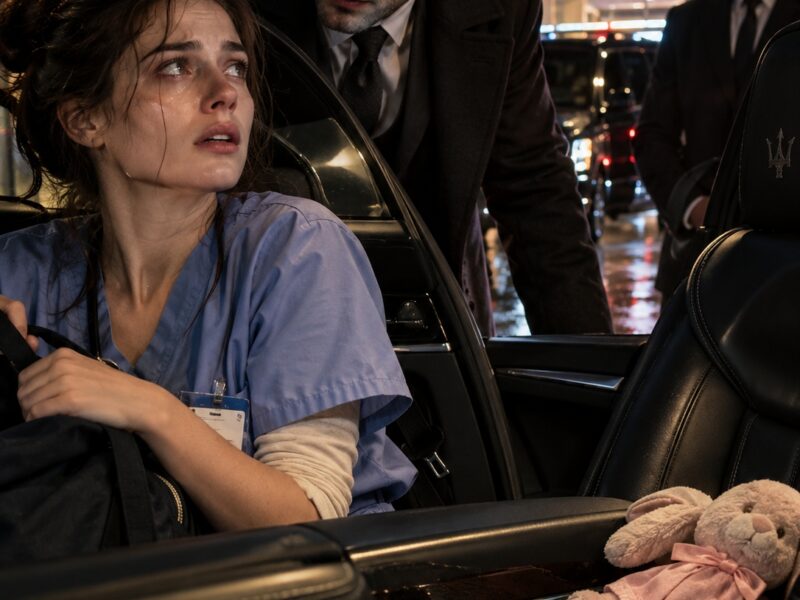
She Got Into the Wrong Car at 4 A.M.—Then the Most Feared Man in Chicago Realized She Was Sitting in His Deadliest Secret
The first thing Nina Kowalski said to the most feared man in Chicago was:
“Please. Just drive me home.”
She didn’t know who he was.
That was the only reason she was still speaking to him like that.
It was 4:09 on a freezing Thursday morning, and Nina had been awake for nearly twenty hours.
Her pale-blue scrubs smelled faintly of antiseptic and hospital coffee. There was a crease from a surgical mask across one cheek, her hair had escaped its bun hours ago, and the soles of her shoes felt as if someone had replaced the padding with concrete.
She stepped through the hospital’s revolving doors into the bitter Chicago darkness, saw the black sedan waiting at the curb, opened the passenger door, and climbed in.
Then she shut her eyes.
“Belmont,” she murmured. “Avondale. Above the laundromat.”
The driver stared at her through the rearview mirror.
The man beside her did not move.
For several seconds, nobody spoke.
Nina opened one eye.
“What?”
The driver looked toward the passenger.
“Boss?”
That word should have warned her.
It didn’t.
Nina rubbed both hands over her face.
“If this is about the route, take Lake Shore if you want. I don’t care. Just please don’t make conversation.”
The man beside her finally turned.
He was perhaps forty, maybe a little older, dressed in a charcoal overcoat over a black suit. He had the kind of face that looked calm only because it had spent years learning not to show anything.
Dark hair.
Tired eyes.
Expensive watch.
No wedding ring.
And hands that were trembling almost imperceptibly.
Nina noticed the hands first.
She always did.
“What did you eat today?” he asked.
She blinked.
“What?”
“Today.”
“Coffee.”
His expression changed.
“Coffee isn’t food.”
“I’m a nurse. Sometimes it is.”
He reached into the center console, took out a small bottle of orange juice, and held it toward her.
Nina stared at it.
Then at him.
“Drink.”
“Are you kidnapping me?”
The driver’s shoulders stiffened.
The man almost smiled.
“No.”
“That’s exactly what a kidnapper would say.”
“Drink the juice.”
She took it.
Not because he frightened her.
Because she was exhausted enough to realize he was right.
She twisted the cap off, drank half, then pointed at the driver.
“And you don’t drive for fifteen minutes.”
The driver glanced into the mirror.
“Excuse me?”
“You heard me.”
“Lady—”
“Your boss’s hands are shaking.”
Silence.
The man beside her looked down.
For the first time, he seemed surprised.
Nina took another swallow.
“Low blood sugar, adrenaline crash, exhaustion. Maybe all three. So nobody drives anywhere until he drinks something too.”
The driver looked horrified.
“Easy, Gus,” the man said quietly.
Nina handed him the juice.
“Finish it.”
Gus stared straight ahead as if witnessing a violation of several laws, some of which might not technically exist.
The man took the bottle.
He drank.
Only then did Nina notice Gus staring at the seat beneath her.
Not at her.
At the seat.
“What’s wrong?” she asked.
Gus didn’t answer.
The man did.
“Nothing.”
Gus’s jaw tightened.
“Boss.”
“I said nothing.”
Nina looked between them.
“You two are making this very weird.”
Gus finally muttered, “Nobody’s sat in that seat in six years.”
Nina froze.
She looked down at the black leather.
Then at the man beside her.
“This isn’t my ride, is it?”
“No.”
The exhaustion vanished from her face.
“Oh, God.”
She grabbed the door handle.
“Wait.”
“I just climbed into a stranger’s car.”
“Yes.”
“A very expensive stranger’s car.”
“Yes.”
“And ordered his driver around.”
“Yes.”
She stared at him.
“Who are you?”
He held up the orange juice.
“Somebody who apparently thinks coffee is a meal.”
Despite herself, Nina laughed.
It was small and tired and completely inappropriate.
Something shifted in the man’s face when he heard it.
Not happiness exactly.
More like surprise that the sound still existed.
A phone buzzed in his hand.
He looked down.
OUT OF SURGERY. STABLE.
His shoulders lowered by less than an inch.
Nina saw it.
“Your friend?”
He nodded.
“Tommy.”
“The gunshot patient?”
That made Gus look at her sharply.
Nina raised a hand.
“I work upstairs. I don’t discuss patients.”
The man’s eyes stayed on her.
“Two in the side?”
“I’m not discussing him.”
“Is he alive?”
“I didn’t say that either.”
“You don’t have to.”
She frowned.
“How?”
“You stopped looking worried.”
That caught her off guard.
He put the phone away.
“Where do you live?”
“I’m not giving a strange man my address.”
“You already told Gus Belmont over the laundromat.”
Nina closed her eyes.
“Right.”
This time he did smile.
Barely.
“Avondale?”
“Yes.”
Gus started the car.
Nina pointed at the man beside her.
“Only because he finished the juice.”
Gus muttered something under his breath.
They drove north through a city that looked almost abandoned.
Nina meant to stay awake.
She lasted eleven minutes.
When her eyes opened again, the black sedan was stopped outside a brick building over a twenty-four-hour laundromat.
Gus looked irritated.
The man beside her looked strangely patient.
Nina straightened.
“Did I fall asleep?”
“For approximately thirty-eight minutes.”
Her eyes widened.
“Belmont isn’t thirty-eight minutes from the hospital at this hour.”
Gus said, “That’s because we’ve been past Lincoln Park Zoo four times.”
Nina turned slowly toward the man.
“You drove around so I could sleep?”
He looked out the windshield.
“You looked tired.”
“That’s insane.”
“So I’ve been told.”
She reached for the door.
Then stopped.
“I’m sorry I sat in your seat.”
His gaze moved toward the empty space between them.
“It’s not my seat.”
Something about the answer felt heavier than it should have.
Nina didn’t ask.
She climbed out, then leaned back through the open door.
“One more thing.”
Gus sighed.
She pointed at the center console.
“Keep juice in the car.”
The man raised an eyebrow.
“You think I’ll need it again?”
Nina looked at his hands.
“Yes.”
Then she shut the door.
Gus waited until she disappeared inside the building.
Only then did he turn around.
“Boss.”
Luca Marchetti kept staring at the entrance.
“Don’t.”
“That’s Sofia’s seat.”
Luca’s face went still.
“And some nurse just climbed right into it.”
“I know.”
“Nobody has sat there since—”
“I know, Gus.”
Across the street, another black car idled in the darkness.
Neither man noticed it.
But someone inside had already made a phone call.
“There’s somebody in Luca’s front seat,” a voice said.
A pause.
Then:
“Find out who.”
Nina’s mother was awake when she entered the apartment.
Of course she was.
Teresa Kowalski was sixty-one, Polish-American, stubborn, and constitutionally incapable of sleeping when her daughter worked overnight.
She sat at the kitchen table with reading glasses low on her nose and a stack of envelopes beside her.
Nina dropped her bag.
“Mom.”
“The loan payment comes out Friday.”
Nina stopped.
Teresa tapped the statement.
“I saw the reminder.”
“I know.”
“We’re short.”
“I know.”
“I can take another shift.”
Nina turned.
“No.”
“Nina—”
“You’re sixty-one.”
“And?”
“And you already work four nights a week.”
Teresa lifted her chin.
“Kowalskis pay their own way.”
Nina hated that sentence.
Mostly because she believed it too.
Six years earlier, her father, Stan Kowalski, had collapsed on a downtown train platform.
Heart attack.
There was surveillance video.
Nina had watched it exactly once.
Thirty-two people walked around him.
Some looked down.
One stepped over his briefcase.
Nobody stopped until the thirty-third person did.
Her father survived, but the bypass surgery left the family with debt that had followed them through his death two years later.
Teresa cleaned offices at night.
Nina became a nurse.
Together, they paid.
Slowly.
Painfully.
Proudly.
“I’m picking up Saturday,” Nina said.
“You worked twenty hours today.”
“I’ll sleep.”
“You always say that.”
“And I’m always incredibly convincing.”
Teresa studied her.
Then narrowed her eyes.
“How did you get home?”
Nina took off her shoes.
“You don’t want to know.”
That was true.
Because if Nina had known exactly whose car she’d climbed into, she probably would have preferred walking.
She learned at work that afternoon.
A nurse named Denise cornered her beside the medication station.
“Is it true?”
Nina didn’t look up.
“Usually no.”
“Luca Marchetti drove you home?”
Nina stopped writing.
“Who?”
Denise stared.
“Oh, honey.”
“What?”
“Luca Marchetti.”
She pointed toward the hallway.
Nina followed her gaze.
The man from the car stood outside room seven.
Same dark coat.
Same unreadable face.
Two men stood behind him.
Everyone else seemed unconsciously to give him more space.
“Half of Chicago crosses the street when he walks by,” Denise whispered.
Nina watched him.
“At four this morning he couldn’t hold a juice box straight.”
Denise nearly dropped her chart.
“Nina.”
“What?”
“Do you know who his family is?”
“No.”
“You should.”
“Why?”
“So you understand why you shouldn’t say things like that.”
Nina looked at Luca again.
“In here he’s family.”
“Nina—”
“And family members stay out of my crash-cart space.”
She walked directly toward him.
Luca watched her approach.
“You,” she said.
One of his men moved.
Luca stopped him with a glance.
Nina pointed.
“You’re standing in front of my crash cart.”
Luca stepped aside.
“Better?”
“Much.”
A second man appeared carrying two white bakery boxes.
Luca took them.
“For the nurses.”
Nina looked inside.
“Cannoli?”
“I was told people like them.”
“Nobody brings night shift anything.”
“Then people are stupid.”
She looked at him for a second longer than necessary.
There was something disorienting about seeing a man everyone feared holding pastries like an awkward relative at Thanksgiving.
An older gentleman approached from behind.
Gray suit.
Silver hair.
Soft voice.
The staff greeted him warmly.
“Professor,” Luca said.
Arthur Kane smiled.
“I got here before they took Tommy up, you know.”
His tone was affectionate.
Paternal.
“I signed his forms myself.”
Nina’s eyes flicked toward him.
Arthur noticed.
“And you must be the nurse.”
“Which nurse?”
“The one who got into Luca’s car.”
Nina glanced at Luca.
“Apparently Chicago has no secrets.”
Arthur smiled.
“Fewer than people think.”
He extended a hand.
“Arthur Kane. I kept the books for Luca’s father. Now I keep them for Luca.”
Nina shook it.
His hand was warm.
Steady.
Too steady.
“Careful whose car you get into, dear,” he said.
The words sounded like a joke.
Nina smiled politely.
But later, she would remember them differently.
Like a warning.
Three days later, Luca Marchetti stood outside the hospital for twenty minutes rehearsing a sentence.
Gus watched from the car.
“You’ve negotiated with union bosses.”
Luca ignored him.
“You’ve sat across from federal prosecutors.”
Silence.
“You once made Salvatore Costa apologize in front of forty people.”
“Gus.”
“And you can’t ask a nurse to breakfast?”
Luca turned.
“I’ve never had to ask.”
“There’s your problem.”
Nina came through the employee exit carrying a canvas bag.
Luca stepped forward.
“You said coffee isn’t food.”
She stopped.
“Yes.”
“I’ve been standing here twenty minutes trying to figure out how normal people say this.”
“Say what?”
“Breakfast.”
Nina stared at him.
“With me.”
She looked toward the bus stop.
Then toward the black sedan.
“No car.”
“I didn’t mention the car.”
“I’ve had enough of your car for one week.”
“Fair.”
They walked.
At a diner two blocks away, Luca learned that Nina put hot sauce on eggs, hated grapefruit, and cut toast diagonally because her father had.
Nina learned almost nothing about Luca.
Until he asked about the loan.
He had seen the payment reminder on the dashboard of her mother’s old Buick when Gus dropped her off after a shift.
Nina should have been angry that he noticed.
Instead, she told him.
“My dad collapsed on a train platform.”
Luca stopped eating.
“Heart attack.”
She nodded.
“There was video. Thirty-two people walked around him.”
His eyes hardened.
“I counted.”
“Why?”
“Because I wanted to know exactly how many people could see someone dying and decide they were too busy.”
Luca looked down.
“He survived?”
“Bypass surgery. We paid for it for six years.”
“We?”
“My mother and me.”
“Your father?”
“He died two years ago. Different thing.”
“I’m sorry.”
Nina shrugged because sometimes grief became easier to carry if you pretended it weighed less.
“My point is, that night in your car, I wasn’t getting out until you were okay.”
“Why?”
“Because I don’t walk past.”
Something changed in Luca’s eyes.
“How did you know?”
“What?”
“That I hadn’t eaten.”
Nina looked at his hands.
“Those.”
“My hands?”
“Faces lie. Hands don’t.”
She smiled faintly.
“My dad used to say that. Thirty years fixing buses for the city. He could tell who was hungover, who was scared, who was about to quit, just by looking at their hands.”
Luca curled his fingers around his coffee cup.
“And what do mine say?”
Nina studied them.
“That you’re carrying something you don’t know how to put down.”
For perhaps the first time in years, Luca Marchetti had no answer.
Two days later, Nina received a call from the loan company.
The balance was zero.
She thought it was an error.
Then she understood.
She found Luca outside the hospital.
“You paid off my loan.”
He didn’t deny it.
“It was nothing.”
Her face changed.
“That was my father’s heart.”
Luca frowned.
“Nina—”
“That was six years of my mother cleaning offices at night. Six years of me picking up doubles. Six years of us choosing which bills could wait.”
“I was trying to help.”
“You don’t get to make that nothing.”
He went quiet.
“I already called them,” she continued. “Every dime is going back.”
“You don’t have to.”
“Yes, I do.”
“Why?”
“Because you didn’t ask.”
Nobody spoke to Luca Marchetti that way.
Gus, standing several feet away, became intensely interested in the pavement.
Nina stepped closer.
“Next time, you ask.”
Luca stared at her.
“And if I ask?”
“I might even say yes.”
Something almost boyish crossed his face.
He cleared his throat.
“May I walk you to your bus?”
Nina fought a smile.
“Yes.”
The next afternoon:
“May I send dinner to your floor?”
“You may.”
The food arrived with a handwritten card.
FOR YOUR CAR.
Nina laughed so hard Denise came running.
The following night Luca called.
“May I talk to you on your break?”
“You have four minutes.”
“Then I’ll talk fast.”
He did.
The conversations grew.
Four minutes became seven.
Seven became twenty.
Nina began recognizing the silence before Luca said something difficult.
Luca began recognizing the exact sigh Nina made when she had skipped lunch.
And across the street from Nina’s apartment, a young man sat in a parked car night after night.
On the third night, Nina crossed the street.
He nearly jumped out of his skin.
She held a thermometer.
“Open.”
“What?”
“Your mouth.”
“Lady—”
“Open.”
He did.
She checked it.
“One hundred and one.”
The young man blinked.
“Three nights sitting in this cold and now you’re running a fever.”
He said nothing.
“Whoever is paying you isn’t paying enough.”
She handed him a thermos.
“Chicken soup.”
He stared at it.
“Bring the thermos back when you’re done.”
She started walking away.
Then turned.
“And tell your boss if he wants to keep an eye on me, he can ask.”
The boy watched her disappear into the building.
Then he whispered:
“What the hell kind of woman is this?”
On Sofia’s twelfth birthday, Luca drove to Evanston alone.
He parked across from Ridgeview Middle School.
He always parked across the street.
Never too close.
Never somewhere she might recognize him.
At 3:11, children poured through the doors.
At 3:16, Sofia appeared.
Luca stopped breathing.
She had grown taller.
Her hair was darker than her mother’s.
She carried a soccer bag over one shoulder.
She laughed at something another girl said, throwing her whole body into it.
Just like when she was six.
Luca’s hands began shaking.
He placed them on the steering wheel.
Six years.
Six birthdays.
Six years of sitting inside a black car while his daughter grew up on the other side of glass.
That evening, he found Nina waiting beside his car.
She opened the passenger door.
“Okay, Marchetti.”
He looked at her.
“You and me are going to talk about your little friend across—”
She stopped.
Her eyes fell to the dashboard.
A tiny faded sticker remained near the glove compartment.
A cartoon star.
The rest of the interior had been restored perfectly.
That sticker had not.
Nina lowered herself into the seat.
“Front,” Luca said quietly.
“What?”
“Please sit in front.”
She did.
For a while neither spoke.
Then Nina asked the question Gus had never dared ask.
“Whose seat is this?”
Luca stared through the windshield.
“My daughter’s.”
Nina’s anger disappeared.
“Her name?”
“Sofia.”
He swallowed.
“It was her sixth birthday.”
He told her.
Sofia had begged for a year to ride in front.
He always said no.
That day he finally gave in.
They were stopped at a light when another car pulled alongside them.
Luca heard the first shot before he saw the gun.
Glass exploded.
Sofia screamed.
A bullet struck her shoulder.
She lived.
That fact had never made the memory easier.
“I had every window replaced,” Luca said. “Every piece of leather. Everything.”
His thumb brushed the faded star sticker.
“Except that.”
Nina said nothing.
“The next morning I signed papers giving her mother full custody. She moved Sofia to Evanston. Changed her last name.”
“Why?”
“Because Arthur told me something.”
Luca laughed once without humor.
“A man with a child is a man on a leash.”
Nina looked at him.
“He wasn’t wrong.”
“No,” she said. “He was.”
Luca turned.
“You had a daughter who could be threatened. That doesn’t make her a leash. It makes the men who threaten children monsters.”
He looked away.
“She turned twelve today.”
Nina understood.
“You were at her school.”
He nodded.
“Every birthday?”
“Every birthday.”
“You talk to her?”
“No.”
“Does she see you?”
“I don’t know.”
“Six years?”
“Six.”
Nina stared at him.
“You’ve been watching your daughter grow up from across the street.”
“I keep her safe.”
“No. Her mother keeps her safe. You’re hiding.”
The words struck harder because she said them gently.
Luca’s jaw tightened.
“She kicks with her left,” he whispered.
“What?”
“Soccer.”
He smiled despite himself.
“She ties her laces twice around before she knots them. Laughs with her whole body.”
His voice broke slightly.
“I can see that from across the street.”
Nina looked down.
Luca noticed her shoes.
Her laces wrapped twice around before the knot.
He almost smiled.
“That’s how you tie yours.”
“My dad taught me.”
Silence.
Then Nina said, “Next birthday, get out of the car.”
“I don’t know how.”
“Then I’ll sit right here while you figure it out.”
Luca turned toward her.
No one had ever offered him something so simple.
Or so terrifying.
Nina was about to say something else when another memory surfaced.
“Luca.”
“What?”
“The man with the cannoli.”
“Arthur?”
“He lied.”
Everything inside Luca became still.
Nina immediately raised a hand.
“I can’t tell you anything about Tommy’s treatment. That’s his information.”
“What can you tell me?”
“What I saw.”
Luca waited.
“The morning you drove me home, you got the message that Tommy was out of surgery.”
“Yes.”
“We pulled away at 4:40.”
“Yes.”
“Arthur’s car pulled into the hospital as we were leaving.”
Luca frowned.
“He said he was there before Tommy went upstairs.”
“I know.”
The silence changed.
“When Tommy wakes up,” Nina said, “ask him who signed those forms.”
Luca’s eyes hardened.
“Arthur is the only person in my organization who knows where Sofia goes to school.”
Nina felt cold.
“Then checking costs you nothing.”
Luca’s phone vibrated.
A message from Gus.
A photograph.
Ridgeview Middle School.
Under it:
NICE SCHOOL. EVANSTON’S A LONG DRIVE.
Luca stopped breathing.
Then his voice changed into something Nina had never heard before.
“Gus.”
“Yes, boss?”
“Two cars to Ridgeview. Now.”
For six years, Sofia’s location had remained secret.
Now someone knew.
Luca called Sofia’s mother for the first time in months.
“It’s me.”
“I know.”
“Listen to me. Don’t let Sofia walk home this week.”
Silence.
“What happened?”
“My people are outside the school.”
“Luca—”
“I’ll explain everything. Please.”
The word please did what authority couldn’t.
She agreed.
Then Arthur arrived.
“Somebody told the Costas, son.”
Luca watched him.
“Six years,” Arthur continued. “Nobody knew.”
His eyes moved meaningfully toward Nina’s name on Luca’s phone.
“Did you tell the nurse?”
Luca didn’t answer immediately.
“About Sofia?”
“Yes.”
“The school?”
“Yes.”
Arthur sighed.
Almost sadly.
“You paid off her loan.”
Luca’s eyes narrowed.
“How do you know?”
“I keep your books.”
“She sent it back.”
“I know. Smart girl.”
Arthur placed paperwork on the desk.
“Then Tuesday, the loan was paid again.”
Luca stared at him.
“By whom?”
“One of Costa’s companies.”
Gus checked.
It was true.
The Costas had paid Nina’s debt.
And suddenly Arthur’s story became terrifyingly simple.
Nina had gained Luca’s trust.
Luca told her about Sofia.
The Costas learned where Sofia went to school.
Then they rewarded Nina by paying off her family loan.
Cause.
Effect.
Betrayal.
Exactly neat enough to destroy a man who lived by suspicion.
Luca went to Nina.
She knew something was wrong before he spoke.
His hands told her.
“You did it again,” she said.
“What?”
“The loan.”
“I didn’t.”
She stopped.
“What?”
“The Costas did.”
He placed the school photograph on the table.
Nina looked at it.
Then at him.
“Sofia’s school.”
“You’re the only person I told.”
There it was.
Not an accusation yet.
Worse.
Fear.
Nina’s face hardened.
“You think I sold your daughter for a loan?”
“I don’t know what to think.”
“I sent your money back.”
“I know.”
“Why would I keep theirs?”
“Nina—”
“No.”
She stepped closer.
“You get to be scared for her. You get to be furious. You get to tear this whole city apart looking for whoever did it.”
Her voice dropped.
“But you don’t get to be scared of me.”
Luca’s face changed.
Nina turned away.
“I want the second payment sent back.”
“What?”
“I don’t care who sent it. It’s not mine.”
Her mother, listening from the kitchen doorway, spoke quietly.
“If Luca didn’t pay it…”
Nina froze.
Teresa looked toward the window.
“…then who sent that boy outside our apartment?”
Luca stared at her.
“What boy?”
Before Nina could answer, his phone rang.
Gus.
“Boss.”
“What?”
“Tommy’s awake.”
A beat.
“He’s asking for you.”
Tommy Russo looked smaller in the hospital bed.
Gunshot wounds did that to people.
They reduced men who had once seemed indestructible to skin, tubes, and monitors.
Luca sat beside him.
Nina remained near the door.
Tommy looked at Luca.
“Night before I got shot…”
His voice was weak.
“…I’m outside Professor’s office.”
Luca didn’t move.
“He’s on the phone with Joe Costa.”
Every sound in the room seemed to disappear.
“He gives him a school.”
Nina closed her eyes.
“Up in Evanston.”
Luca’s hands curled into fists.
“I figured it was business. Then he sees me standing in the doorway.”
Tommy swallowed.
“He says into the phone…”
Tommy looked directly at Luca.
“‘The kid heard me. Handle it.’”
The monitor continued its steady beep.
“Next night,” Tommy whispered, “they get me at the light.”
Luca stood.
“Who signed your hospital forms?”
Tommy frowned.
“Me.”
“Arthur said he did.”
“No. Nurse held the clipboard. Nobody else.”
Everything fell into place.
Arthur had given Sofia’s school to the Costas before Nina ever stepped into Luca’s car.
Then Tommy overheard him.
Tommy had to be silenced.
But he survived.
Arthur couldn’t get near his hospital room because Luca’s men guarded it.
So Arthur needed someone to blame before Tommy woke.
Nina.
An outsider.
A woman Luca trusted.
A woman with debt.
A perfect traitor.
Arthur arranged for Costa money to pay her loan.
Then planted a watcher outside her home.
Then planned to produce that watcher as a witness.
Tommy looked at Luca.
“I’m telling the cops.”
Luca stared at him.
“They shot me, boss.”
For years, Luca would have solved something like this privately.
Everyone in that room knew it.
But Nina was watching him.
And perhaps for the first time, Luca understood that changing didn’t mean becoming weak.
Sometimes it meant refusing to become the man everyone expected.
“Tell them everything,” Luca said.
Tommy blinked.
“And tell them where Arthur will be Sunday at one.”
Gus looked at Luca.
“You want me to get him?”
“No.”
“Boss—”
“The families trust Arthur.”
Luca looked toward the window.
“They need to hear it from his mouth. At our table.”
He turned to Nina.
“I accused you.”
“You were scared.”
“That doesn’t excuse it.”
“No.”
“I was wrong.”
Nina said nothing.
“Sunday. My family’s table. I stop hiding.”
He hesitated.
The most feared man in Chicago, once again struggling with the simplest word.
“You don’t have to come.”
Nina waited.
Luca looked directly at her.
“I’m asking.”
Saturday night, someone knocked on Nina’s apartment door.
Gus stood outside.
Behind him was the young man from the car.
The sick one.
He held Nina’s thermos.
“Benny,” he said awkwardly.
Nina touched his forehead.
“You’re still warm.”
“I’m fine.”
“You’re coughing.”
“I’m fine.”
“You sound like a broken lawn mower.”
Benny almost smiled.
“Keep the thermos another day.”
Gus looked at him.
“Tomorrow—”
Nina interrupted.
“I’m going.”
Benny’s expression changed.
“To Marchetti’s?”
“Yes.”
He shifted uncomfortably.
“Don’t.”
Nina stared at him.
“Why?”
Benny looked at Gus.
Then away.
Nina suddenly understood something.
“Luca isn’t your boss.”
Benny said nothing.
Gus’s eyes sharpened.
Nina looked at him.
“Who is?”
Benny whispered:
“Mr. Kane.”
Sunday dinner at the Marchetti house had settled disputes for thirty years.
No phones.
No weapons at the table.
No raised voices unless somebody intended to live with what came afterward.
Twelve men sat beneath a chandelier older than most of them.
Arthur Kane stood at the head.
Luca sat halfway down.
Nina stood behind him.
Arthur began calmly.
“For six years, our boss has been hiding a daughter.”
Murmurs moved around the table.
Luca didn’t flinch.
Arthur continued.
“You all know what I’ve always said. A man with a child is a man on a leash.”
Luca stood.
“I have one.”
The room went silent.
“Her name is Sofia.”
Arthur’s face barely changed.
Luca had just done the one thing Arthur never expected.
He stopped hiding.
Arthur recovered quickly.
“And somebody handed that child’s school to the Costas.”
His finger pointed toward Nina.
“Luca told that nurse where his daughter goes to school. Tuesday, the Costas paid off her loan.”
Men around the table shifted.
Arthur smiled sadly.
“She’s the traitor.”
He turned toward the doorway.
“And I have a witness.”
Benny entered.
Nina felt Luca tense.
She placed a hand lightly against the back of his chair.
“Before anybody says a word,” Luca said.
Everyone looked at him.
“Thursday, I asked her the same question.”
He glanced at Nina.
“And I was wrong.”
Arthur’s expression tightened.
Luca looked around the table.
“Everybody in this city reads my face.”
His gaze returned to Nina.
“She is the only person who ever read my hands.”
Nina stepped forward.
Arthur laughed.
“We’re trusting nurses now?”
“No,” Nina said. “We’re trusting receipts.”
She placed two documents on the table.
“Paid in full. Twice.”
Arthur stared.
“Once by Luca.”
She placed one sheet down.
“I sent it back.”
Second sheet.
“Once by somebody who wanted everybody at this table to see it.”
She looked toward Benny.
“You stood outside my window three nights.”
Benny nodded.
“You still have my thermos?”
A few men glanced at each other.
Benny almost smiled.
“Yes, ma’am.”
“Tell them what you actually saw.”
Arthur’s face hardened.
“Boy—”
Benny looked at him.
Then at the men around the table.
“Mr. Kane told me nobody would go near the little girl.”
Silence.
“He had me drive him to Evanston.”
Arthur went pale.
“To look at her school.”
Luca didn’t move.
Benny continued.
“I drove the money for the nurse’s loan to Costa’s guy myself.”
A chair scraped.
Arthur raised his voice.
“The boy’s been sick all week. He doesn’t know—”
“I know exactly what I’m saying.”
Benny’s hands shook.
“I was supposed to come here today and say I saw her meeting Costa people.”
He looked at Nina.
“I never did.”
Arthur stared at him.
“What I actually saw was her carrying soup across the street to the guy spying on her.”
For the first time, somebody at the table laughed.
It wasn’t amusement.
It was disbelief.
Benny swallowed.
“I’ll drive you anywhere, Mr. Kane.”
His voice cracked.
“But I won’t help you hurt a kid.”
He glanced at Nina.
“And I won’t lie about her.”
Arthur stood.
“You ungrateful little—”
“You told me you signed Tommy’s forms,” Luca said.
Arthur stopped.
“He did.”
“Luca—”
“Tommy signed them himself.”
Arthur’s face emptied.
“You arrived at 4:40 that morning.”
Luca stepped toward him.
“Not to help.”
Another step.
“To find out whether Tommy could still talk.”
Arthur looked around the table.
Nobody met his eyes.
Luca’s voice dropped.
“He can.”
That sentence destroyed Arthur Kane.
“The night before they shot him, Tommy heard you give Joe Costa the name of Sofia’s school.”
Arthur backed away.
“A full day before Nina ever sat in my car.”
“Luca, listen—”
“Tommy heard you say, ‘The kid heard me. Handle it.’”
Arthur’s face twisted.
“You don’t understand what I was trying to do.”
“I understand exactly.”
“The families were getting weak. You were getting weak.”
“Because I have a daughter?”
“Because you started thinking like a father instead of a leader.”
Luca stared at him.
Arthur stepped closer.
“I protected your father. I built this table. I kept you alive.”
“You sold my child.”
“I gave the Costas leverage.”
“You gave them a twelve-year-old girl’s school.”
“To force you to remember what you are.”
Luca’s face became terrifyingly calm.
Arthur looked toward the doorway.
Then heard it.
Sirens.
Growing louder.
Arthur stared at Luca.
“Cops?”
“Yes.”
“You’re handing me to cops?”
“Yes.”
Arthur laughed bitterly.
“Your father would turn over in his grave.”
“Maybe.”
Luca stepped aside as officers entered the house.
“But I’m not doing to you what you’d do to me.”
Arthur’s eyes moved to Nina.
Luca followed them.
And understood.
“That,” Luca said quietly, “is what changed.”
Officers took Arthur by the arms.
As they led him past Luca, Arthur whispered:
“Careful whose car you get into.”
Luca looked at him.
Then at Nina.
A strange sadness crossed his face.
“I put her in Sofia’s seat.”
Arthur stopped.
Luca continued.
“And somehow she taught me how to get out of mine.”
The officers led Arthur away.
For the first time in decades, the Marchetti table was silent without fear.
Two nights later, Nina sat beside Luca in the black sedan.
Neither knew what to call whatever existed between them.
Friendship felt too small.
Romance felt too easy.
Something had begun.
That was enough.
“I looked at you like you were a Costa,” Luca said.
“Yes.”
“I accused you of selling Sofia.”
“Yes.”
“And I was angry at you for a week because I thought Benny worked for me.”
Nina turned.
“We’re both bad at this.”
“At what?”
“Whatever this is.”
Luca almost smiled.
“I could put people outside your building.”
“No.”
“One person.”
“No.”
“Gus?”
“No.”
“He’s very unobtrusive.”
“Gus drives a black sedan that looks like it carries either a senator or a body.”
From the driver’s seat Gus muttered, “Thank you.”
Nina leaned toward Luca.
“I’m not something you park somewhere safe.”
“I know.”
“I have a job.”
“I know.”
“A mother.”
“I know.”
“And a loan with my name on it.”
Luca frowned.
“You really took it back?”
“Every cent.”
“Why?”
“Because it’s mine.”
He nodded.
“I’m keeping all three.”
“Then I’ll keep asking.”
Nina smiled.
“You’ll get sick of asking.”
“Probably.”
“Good.”
She looked out the window.
Then quietly said:
“Ask her.”
Luca knew immediately.
“Sofia.”
His face changed.
“You’ve been walking past her for six years.”
“I don’t know whether she wants me.”
“Ask.”
Luca’s phone rang.
He looked at the screen.
Sofia’s mother.
His hands began shaking.
Nina noticed.
Faces lie.
Hands don’t.
He answered.
The conversation lasted less than three minutes.
When it ended, Luca stared straight ahead.
“Well?”
He swallowed.
“Sofia’s been asking about the black car.”
Nina stopped breathing.
“What?”
“Across from her school. Soccer games. Birthdays.”
His eyes filled.
“Every birthday since she was eight.”
For four years, Luca had believed he was invisible.
He had thought he was protecting Sofia by staying across the street.
But the little girl had been looking back.
Nina reached for the door handle.
“Where are you going?”
“Giving you the car.”
His eyes widened.
“Nina.”
“Go.”
“I can’t.”
“Yes, you can.”
He looked terrified.
This man who frightened half of Chicago was terrified of a twelve-year-old girl.
Nina sat back.
“Okay.”
“What?”
“You asked me once to sit in front.”
“Yes.”
“Now I’m asking you something.”
He waited.
“Will you get out of the car?”
Luca stared through the windshield.
Then whispered:
“Will you come with me?”
Nina smiled.
“Front seat?”
“Front seat.”
It wasn’t Sofia’s birthday.
That mattered.
For six years Luca had made birthdays into memorials for a relationship that wasn’t dead.
This time they drove to Evanston on an ordinary Wednesday.
Ridgeview’s soccer field was nearly empty.
Sofia stood beside the bleachers with her mother.
Luca parked across the street.
Exactly where he always did.
He gripped the steering wheel.
“I can’t.”
Nina sat beside him.
“Yes, you can.”
“What do I say?”
“I don’t know.”
“You’re supposed to know.”
“I’m a nurse, not a screenwriter.”
“What if she hates me?”
“Then you listen.”
“What if she doesn’t want me there?”
“Then you leave.”
“What if—”
“Luca.”
He looked at her.
She glanced down.
His hands were trembling.
“Faces lie.”
He closed his eyes.
“Hands don’t.”
“You want this.”
Across the street, Sofia turned toward the car.
She stared.
Then she left her mother’s side.
One step.
Two.
Three.
She crossed the grass.
Luca couldn’t breathe.
Sofia stopped at the curb.
She looked directly through the windshield.
Not at Nina.
At him.
Her face was older than the six-year-old he remembered.
But the eyes were the same.
She tilted her head.
Then said something through the glass.
Luca couldn’t hear.
Nina could read her lips.
She looked at him.
“What?”
Nina smiled through tears.
“She said, ‘You’re the black car.’”
Luca’s hand covered his mouth.
Six years of birthdays.
Six years of watching from across streets.
Six years of convincing himself absence was protection.
He opened the door.
Stepped out.
Sofia didn’t run toward him.
This wasn’t that kind of story.
She simply stood there.
Waiting.
Luca crossed the street.
For once, nobody crossed away from him.
Months later, Nina finished another twenty-hour shift.
She walked outside at 4:04 in the morning.
The same black sedan waited at the curb.
She opened the passenger door and dropped into the front seat.
“Please,” she groaned. “Just drive me home.”
Luca looked up from his phone.
“You ate?”
“Don’t start.”
“Coffee?”
“It had milk.”
“That’s not food.”
From behind the wheel, Gus sighed.
“Here we go.”
Nina leaned her head against the seat.
Luca’s phone buzzed.
He read the message.
A smile appeared.
“Sofia says you’re coming to her game Saturday.”
Nina closed her eyes.
“That doesn’t sound like a question.”
“It wasn’t.”
“She is definitely your daughter.”
“You know,” Luca said, “you could sit in the back now.”
Nina opened one eye.
“I get carsick.”
“I know.”
She looked at him.
Something in his voice had changed.
Luca rested his hand on the leather between them.
“That seat was hers.”
Nina’s expression softened.
For a moment she saw the six-year-old Sofia sitting there, sneakers dangling, birthday sticker on the dashboard, laughing before a red light changed everything.
Then she saw the twelve-year-old girl who now called Luca twice a week and had recently informed him that he knew absolutely nothing about soccer despite watching her play for six years.
Luca continued quietly.
“I’d like it to be yours too.”
Nina said nothing.
“At least until she’s old enough to fight you for it.”
He hesitated.
Old habits died slowly.
Then he added the words Nina had taught him mattered.
“I’m asking.”
Outside, Chicago was beginning to wake.
Delivery trucks moved down Belmont.
A laundromat sign flickered.
Somewhere far away, an ambulance siren rose and faded.
Nina looked at Luca’s hands.
They were still.
Not because he had nothing left to fear.
Sofia could still be hurt.
Tommy still had months of recovery ahead.
Arthur’s betrayal had left fractures no Sunday dinner could repair.
Luca still belonged to a world Nina did not pretend to understand, and Nina still belonged to one where hospital bills arrived regardless of heartbreak and people worked double shifts because pride didn’t pay interest.
Nothing had become magically safe.
Nothing had become simple.
Maybe that was why Nina trusted this moment.
She placed her hand over Luca’s.
Then looked toward Gus.
“Ours.”
Gus glanced into the mirror.
“What?”
Nina settled deeper into the front seat.
“The seat.”
Luca smiled.
Not the small, guarded smile she’d first seen at four in the morning.
A real one.
“Ours,” he repeated.
Nina closed her eyes.
“Drive.”
And for the first time in six years, the black car moved forward carrying no one who was hiding.









