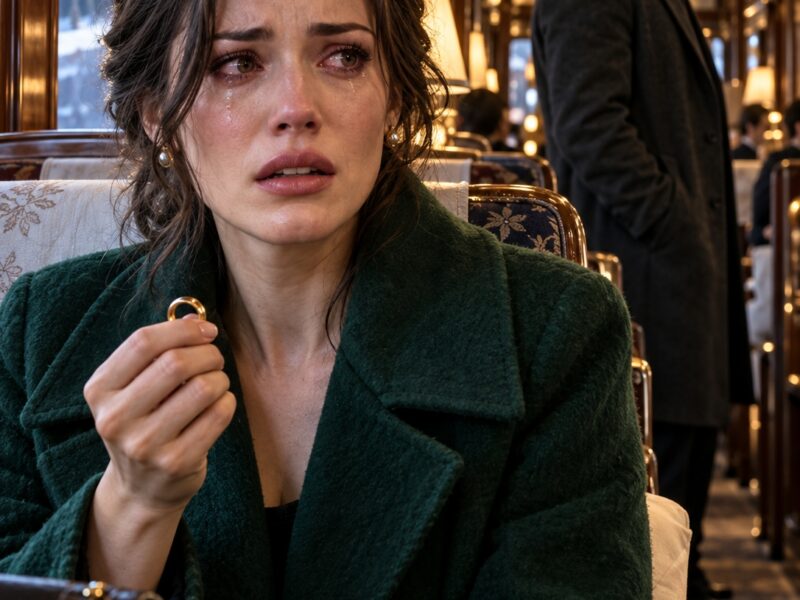
SHE GRABBED A STRANGER ON THE TRAIN AND WHISPERED, “YOU’RE MY HUSBAND FOR THE NEXT THREE HOURS”

The train had been moving for four minutes when a woman I had never seen before dropped into the empty seat beside me, seized my right hand with both of hers, and whispered six words that changed the rest of my life.
“Please don’t pull away.”
I turned toward her.
She was maybe thirty. Dark hair pinned loosely at the back of her neck. Green wool coat. Small gold earrings. No makeup that I could see except whatever was left from a morning she had probably spent trying very hard not to cry.
Her face was composed.
Her hands were freezing.
Then she leaned closer.
“You’re my husband for the next three hours.”
I should have pulled away.
Any reasonable man would have.
Instead, I looked over her shoulder.
Three rows behind us stood a tall man in a charcoal coat. He had just entered from the next car and was slowly scanning the passengers.
When his eyes found the woman beside me, he smiled.
There was nothing openly threatening about that smile.
That was what made it worse.
I had spent eleven years as a paramedic. You learn to notice the details other people dismiss. The wife who says she fell down the stairs but watches her husband before answering questions. The teenager who says he’s fine while keeping one hand pressed against his ribs. The driver who insists he only had one drink but won’t meet your eyes.
Fear has a language.
The woman beside me was speaking it without saying another word.
So I turned my hand over beneath hers.
Then I laced my fingers through hers.
Her eyes widened.
I raised my voice just enough for it to carry.
“There you are,” I said. “I saved you a seat.”
Her breath caught.
The man three rows back stopped walking.
And that was how I met the woman who would eventually become my wife.
Although neither of us knew that yet.
At the time, I was simply Miles Corbin, thirty-four years old, divorced, tired, and exceptionally good at keeping strangers alive while having almost no idea how to live my own life.
I was on that particular train because of my father.
My dad, Thomas Corbin, had worked that rail line for thirty years. He wore the same gray conductor’s uniform until the elbows shined and carried peppermint candies in his breast pocket because he’d quit smoking before I was born and apparently needed something to do with his mouth.
When I was a kid, he sometimes took me to the station before his shift.
I remembered diesel.
Hot brakes.
Coffee.
His hand resting heavily on my shoulder.
And peppermint.
Always peppermint.
He knew the regular passengers by name.
He remembered whose daughter was applying to college, whose husband was sick, whose son had come home from Afghanistan, whose mother needed help getting her suitcase down from the rack.
I once asked him why he cared so much.
“They’re passengers, Dad. You’ll probably never see half of them again.”
He had looked at me as if I had missed something obvious.
“That doesn’t matter.”
“What doesn’t?”
“Whether I see them again.”
Then he tapped two fingers against the silver badge on his chest.
“My job is simple, Miles. While strangers are on my train, they’re mine to look after. I make sure they get home safe.”
He died three years before I met Elise.
An ordinary Tuesday.
No dramatic final words.
No warning.
One moment he was carrying groceries into his kitchen.
The next, he was on the floor.
By the time I got there, another paramedic was kneeling beside him.
I remember that detail more clearly than the funeral.
Someone else was doing my job.
Someone else was saying, “Sir, can you hear me?”
Someone else was putting pads on my father’s chest while I stood six feet away and knew exactly what every sound meant.
There are things knowledge cannot save you from.
My father died anyway.
Afterward, something inside me went quiet.
Not broken.
Quiet.
Breaking would have required feeling something.
My wife, Rachel, stayed for almost a year.
She tried.
God, she tried.
She left meals in the refrigerator.
Asked me to take weekends off.
Asked me to talk to somebody.
Asked me to talk to her.
One night she finally stood in our bedroom with a suitcase on the bed and tears running silently down her face.
“You disappeared, Miles.”
I stared at her.
“I’m right here.”
“No.”
She shook her head.
“You’re breathing. You go to work. You come home. You sleep next to me. But you left two years ago, and I don’t know how to follow you wherever you went.”
I didn’t argue.
That may have hurt her more than anything.
She left the following morning.
And she wasn’t wrong.
I became excellent at arriving during the worst ten minutes of another person’s life.
Heart attacks.
Car wrecks.
Overdoses.
Children who couldn’t breathe.
I could kneel in blood and tell someone, “Stay with me,” with absolute conviction.
But when my shift ended, I went home to an apartment where nothing waited for me except silence.
Every year on the anniversary of my father’s death, I rode his old train line from one end to the other.
I wore his wedding ring on my right hand.
Not because it fit perfectly.
It didn’t.
Not because I believed jewelry could keep someone alive.
It couldn’t.
I wore it because grief makes fools of otherwise rational people.
For a few hours, with that ring against my skin and the tracks humming beneath me, I could almost imagine my father somewhere in the next car.
That was the man Elise Warner sat beside.
A man riding a dead man’s train.
A man who had spent three years feeling almost nothing.
And now a stranger was holding his hand as if letting go might kill her.
The tall man began walking toward us.
Elise’s fingers tightened.
“Is that him?” I murmured.
She barely nodded.
“What’s his name?”
“Grant.”
“Ex?”
Another tiny nod.
That was all I got.
Grant stopped beside our row.
“Elise.”
His voice was warm enough that anyone listening casually would have heard friendliness.
I heard possession.
Elise looked up.
“Grant.”
“I thought that was you.”
His gaze moved toward me.
Then down.
Our hands were still intertwined.
“Small world,” he said.
“So it seems.”
“You’re headed to the wedding?”
“Yes.”
Grant smiled.
“Wouldn’t miss it, huh?”
Elise’s nails pressed into my hand.
“No.”
His attention returned to me.
“And who’s this?”
I’m not a quick liar.
I should make that clear.
I deal in facts.
Blood pressure.
Respiration.
Pulse.
Airway.
You tell me a man has been unconscious for seven minutes, and my brain starts building decisions from measurable information.
But something about Grant’s eyes bothered me.
He wasn’t looking at Elise like an old lover unexpectedly meeting someone he had once cared about.
He was studying her.
Measuring her.
Checking what had changed while he wasn’t watching.
Then his gaze dropped to my father’s wedding ring.
An idea arrived fully formed.
I slipped my hand from Elise’s.
For half a second, panic flashed across her face.
Then, hidden by the seat in front of us, I removed my father’s ring.
I pressed it into her palm.
Her eyes met mine.
I closed her fingers around it.
Then I looked at Grant.
“I’m the husband.”
Silence.
Elise stared at me.
Grant stared harder.
“Miles,” I added.
Then I put my arm along the back of Elise’s seat as though I had done it a thousand times.
“She’s told me approximately nothing about this wedding, so I’m guessing you’re someone she’d rather not discuss.”
Elise recovered faster than I expected.
Her thumb found the ring in her palm.
She slid it onto her left hand.
The gold band was slightly too large.
She curled her fingers so Grant wouldn’t notice.
His entire expression changed.
Not dramatically.
Just enough.
“Husband?”
Elise lifted her hand.
“Surprise.”
“You got married.”
“I did.”
“You never mentioned it.”
She looked directly at him.
“I don’t mention a lot of things to you anymore, Grant. That’s generally what happens after people stop being engaged.”
Something hard appeared behind his eyes.
Then it disappeared.
“Well.”
His smile returned.
“Congratulations.”
“Thank you.”
Grant looked at me.
“Take care of her.”
It sounded like advice.
It felt like a warning.
“I intend to.”
He held my gaze another second.
Then walked away.
Only when he reached the next car did Elise breathe.
Not normally.
It came out in a trembling rush.
“Oh my God.”
I looked toward the darkened window.
Grant had taken a seat three rows ahead beside a polished-looking blonde woman who was scrolling through her phone.
His reflection was visible in the glass.
He was watching us.
Elise started pulling the ring off.
“I am so sorry. I shouldn’t have done that.”
“Leave it.”
She stopped.
“He’s watching.”
She followed my eyes toward the reflection.
Grant looked away immediately.
Elise swallowed.
“I saw him boarding. I panicked.”
“I gathered that.”
“I’ve been dreading this trip for a week. Three hours trapped in the same train car with him, and then the wedding…”
Her voice faded.
“You were the only person sitting alone.”
“That’s flattering.”
Despite everything, the corner of her mouth moved.
“I mean—”
“I know.”
“And you looked…”
She hesitated.
“Safe.”
That word landed somewhere strange inside me.
She rubbed her thumb over my father’s ring.
“I’ll give this back as soon as he stops watching.”
“Keep it on.”
“Miles—”
“You selected a husband. Unfortunately, you’re stuck with him until further notice.”
A sound escaped her.
Half laugh.
Half sob.
I glanced at Grant’s reflection again.
“Might as well tell me what I married into.”
That time she actually laughed.
Quietly.
And because we had three hours to maintain a ridiculous lie, and because strangers sometimes tell each other truths they would never risk telling people they love, Elise Warner told me why she was afraid.
She had been engaged to Grant Holloway for two years.
Eight months earlier, three weeks before their wedding, she had ended it.
Everyone believed she had cheated.
Everyone believed she had humiliated him.
Everyone believed she had suddenly panicked about marriage and destroyed a good man for reasons nobody could understand.
None of it was true.
“Grant cheated,” she said.
The train rocked gently beneath us.
“For how long?”
“Most of our second year together.”
“You know that for certain?”
“I saw the messages.”
Her jaw tightened.
“Hotel reservations. Photos. Transfers. Everything.”
“And you confronted him?”
“Yes.”
“What did he say?”
She gave a small, humorless laugh.
“That I was invading his privacy.”
I almost smiled.
“That’s ambitious.”
“He said the relationship had been difficult. That I’d been distant. That he’d made mistakes because I wasn’t giving him what he needed.”
She stared at her hands.
“He had a reason for everything except why any of it was his fault.”
“So you ended it.”
“Immediately.”
“Good.”
Her eyes lifted.
“You’re the first person who has ever said that without asking what I did to drive him there.”
My stomach tightened.
“What happened after?”
“He got to everyone before I did.”
Grant had called both families.
Their mutual friends.
People from work.
Members of the wedding party.
He told them Elise had been having an affair.
That she had confessed.
That she had broken the engagement when he discovered it.
“He cried to my father,” she said.
“Grant?”
“He cried beautifully.”
There was bitterness in her voice now.
“Apparently better than I did.”
By the time Elise realized what he was doing, Grant’s version had become the accepted version.
She had screenshots proving the truth.
Emails.
Receipts.
Enough evidence to destroy him.
“So show them.”
Her expression changed.
“I can’t.”
“Why?”
“The wedding.”
“What about it?”
She looked out the window.
“My little sister is the bride.”
I waited.
“Katie is marrying Grant’s cousin, Andrew.”
Now I understood.
“The families are joining.”
“Yes.”
“And if you expose Grant…”
“I don’t just expose Grant.”
Her voice dropped.
“I drop a bomb into the middle of my sister’s marriage before it even starts.”
“That doesn’t make Grant innocent.”
“I know.”
“Or you guilty.”
“I know that too.”
“Then why protect him?”
“I’m not protecting him.”
She turned sharply toward me.
“I’m protecting her.”
There it was.
Not weakness.
Choice.
“Katie is twenty-six. She’s loved Andrew since college. Their parents are close. Their grandparents are close. Half the wedding party overlaps. If I release everything Grant did, there won’t be a wedding. There will be two families tearing each other apart while my sister stands in the middle of it.”
“Elise—”
“Our mother got sick when Katie was eleven.”
Her voice softened.
“I practically raised her through high school. I packed her lunches. Drove her to orchestra practice. Sat beside her during Mom’s chemo because Dad couldn’t be in two places at once.”
She swallowed.
“If protecting Katie’s wedding means letting people think I’m the bad guy for a while, then fine.”
“A while?”
“It’s been eight months.”
Her eyes filled.
“I have spent eight months being the villain in a story I didn’t write.”
That sentence stayed with me.
Maybe because I understood more of it than I wanted to admit.
She turned my father’s ring around her finger.
“Tonight there’s a rehearsal dinner. Tomorrow there’s the wedding. Sunday brunch. Three days of people looking at me like I’m unstable, bitter Elise who threw away the perfect man.”
“And Grant?”
“He’ll be charming.”
“Of course.”
“He’ll probably bring a date.”
I glanced three rows ahead.
“I believe he has.”
She closed her eyes.
“Perfect.”
“You knew he might.”
“Knowing something and seeing it are different things.”
I understood that too.
She took a breath.
“I could have handled the whispers. I could have handled Grant. But I couldn’t walk in alone and give everyone exactly the picture they expected.”
“What picture?”
She looked at me.
“The lonely woman who ruined her own life and still hasn’t recovered.”
Her voice cracked on the final word.
“So I saw Grant boarding, saw you sitting alone, and apparently lost my mind.”
She tried to smile.
“I grabbed a stranger and made him my husband.”
I sat quietly.
Outside, November fields slid past beneath a gray sky.
For three years, people had described me with different versions of the same word.
Distant.
Closed.
Numb.
Unavailable.
Rachel’s word had been gone.
But Elise didn’t look gone.
She looked exhausted from carrying something enormous without letting anyone see the weight.
I knew that posture.
“My father worked this line,” I said.
She blinked.
“What?”
“Thirty years.”
I looked at the ring on her hand.
“That was his.”
Her face drained.
“Miles.”
“He was a conductor.”
“You gave me your dead father’s wedding ring?”
“It sounds worse when you phrase it like that.”
She immediately started removing it.
“No. Absolutely not.”
I caught her hand.
“Leave it.”
“I can’t wear this to fool my ex.”
“My father spent thirty years making sure strangers got where they were going safely.”
“That doesn’t mean—”
“He used to tell me that while someone was on his train, they were his responsibility.”
Her eyes softened.
“I ride this line every year on the anniversary of his death.”
Understanding moved across her face.
“Today?”
I nodded.
“Oh, Miles.”
“Don’t.”
“I’m sorry.”
“So is everyone.”
I looked toward the window.
“I’m tired of being sorry.”
She said nothing.
“My father died three years ago. My marriage died afterward. Not because Rachel was cruel. Because I disappeared.”
I had never told a stranger that.
I had barely told myself.
“I became very good at keeping other people alive and completely useless at being alive myself.”
Elise watched me.
No pity.
That mattered.
She simply listened.
“So here’s what I think,” I said.
“What?”
“I think you’re not the villain.”
Her mouth trembled.
“I think you’re the only person in this entire mess who has sacrificed anything to protect somebody else.”
She looked down.
“And for the next three hours, you’re going to stop apologizing.”
“Miles—”
“Nope.”
“Is this how you always talk to your fake wives?”
“You’re my first.”
That got another laugh.
A real one.
“And,” I continued, “if we’re going to convince Grant, we need a story.”
“A story?”
“How did we meet?”
Her eyebrows lifted.
“You’re taking this very seriously.”
“I’m a professional.”
“At fake marriage?”
“At emergencies.”
“This qualifies?”
I glanced toward Grant.
“Absolutely.”
And so we built a marriage.
We decided we had met at a hospital.
Elise had sprained her ankle.
I had been the paramedic who treated her.
“How romantic,” she said.
“You screamed when I touched your foot.”
“I would never.”
“You absolutely did.”
“You’re inventing this.”
“That’s literally what we’re doing.”
We decided we had dated for a year before marrying quietly in the spring.
We shared an apartment.
We were considering getting a dog.
“What kind?” she asked.
“Labrador.”
“No.”
“What’s wrong with Labradors?”
“Nothing. Which is why it’s suspicious.”
“What do you want?”
“Rescue mutt.”
“Fine.”
“Name?”
“Walter.”
She stared.
“You cannot name a dog Walter.”
“Why?”
“Because he’ll sound like someone’s accountant.”
We were both laughing now.
And somewhere between inventing an apartment and arguing over a dog that didn’t exist, we stopped pretending to talk.
Elise taught elementary-school music.
Violin mostly.
She had twenty-three students and could identify almost all of them from a single badly played note.
She hummed when nervous.
She didn’t know she did it.
I noticed within an hour.
I took my coffee black.
She considered that evidence of emotional damage.
I told her about the calls that followed me home.
She told me about caring for her mother.
She told me Katie used to crawl into her bed whenever thunderstorms came.
I told her my father carried peppermints because he had quit cigarettes at twenty-nine.
She asked about Rachel.
I told her the truth.
No blame.
No excuses.
“She wanted you back,” Elise said.
“I was sitting in front of her.”
“That’s not what I said.”
I looked at her.
“She wanted you back.”
The distinction hurt.
“Yes.”
“Did you love her?”
“Yes.”
“Do you still?”
“No.”
I was surprised how easily the answer came.
“I think I mourn what I ruined.”
“That’s different.”
“You always this wise?”
“Only with people I’ll never see again.”
For some reason, neither of us smiled after that.
Halfway through the journey, Grant returned.
He claimed he was going to the café car.
He stopped beside us.
“So.”
I looked up.
“So.”
“How long did you say you two have been married?”
Elise and I answered simultaneously.
“Since April.”
Grant’s smile tightened.
“And how did you meet?”
“At work,” Elise said.
“At the hospital,” I said at exactly the same moment.
Grant’s eyebrows rose.
I didn’t hesitate.
“My work. Hospital.”
Elise leaned against me.
“I was his most annoying patient.”
“Still is.”
Grant studied us.
Then he looked at the ring.
I covered Elise’s hand with mine.
Something changed in his face.
He moved on.
When the door closed behind him, Elise stared at me.
“You’re disturbingly good at this.”
“I’m good when someone’s world is falling apart.”
“No.”
She shook her head.
“You’re good at making people feel safe.”
I went still.
“That’s different,” she said. “And rarer.”
Rachel had called me numb.
Elise called me safe.
Two women looking at the same man.
Two completely different words.
Only one made me want to remain inside my own skin.
Her eyes moved toward the ring.
“Miles?”
“Yeah?”
“Why do you wear it?”
“My father’s?”
She nodded.
“I started after he died.”
“You never took it off?”
“Not until today.”
Her eyes filled instantly.
“Miles.”
“Don’t make it dramatic.”
“You took off the one thing you’ve worn every day for three years and handed it to a stranger.”
“You were having a bad afternoon.”
She laughed through her tears.
Then she tried again to remove it.
I stopped her.
“Three hours.”
“What?”
“That’s all.”
I looked at the passing tracks.
“My dad used to say you only had to keep someone safe until they reached their stop.”
I closed her fingers around the ring.
“So let him do his job one more time.”
That was when Elise began crying.
Quietly.
No dramatic collapse.
She turned toward the window, embarrassed.
And I did something I had not done in three years.
I held someone’s hand while they hurt.
Not because I could fix it.
Not because there was a protocol.
Not because a monitor was telling me what to do.
I just stayed.
And somewhere inside my chest, something rusted shut began to move.
Three hours became twenty minutes far too quickly.
Then ten.
Then the train began slowing.
Neither of us spoke.
The lie had existed inside the train.
Outside waited reality.
Grant.
The wedding.
My empty apartment.
Her family.
Our separate lives.
Elise removed the ring.
The absence of it on her finger felt strangely wrong.
She placed it in my palm.
“Thank you.”
“You don’t owe me anything.”
“I know.”
She closed my fingers around the ring.
“You have no idea what you did for me.”
“I pretended to be married.”
“No.”
Her eyes held mine.
“For three hours, I wasn’t the crazy ex.”
Her voice softened.
“I wasn’t the villain. I wasn’t someone everyone had already decided something about.”
The train slowed further.
“I was just Elise.”
She smiled sadly.
“I’d forgotten what that felt like.”
The brakes hissed.
She stood.
“Go home safe, Miles.”
Then, after a moment:
“Your father would be proud of you.”
She walked down the aisle.
I sat there holding my father’s ring.
The doors opened.
Cold air entered the car.
Elise stepped onto the platform.
And I watched the first person who had made me feel truly awake in three years walk out of my life.
The doors began chiming.
I heard my father’s voice.
Not literally.
Grief doesn’t need ghosts to make dead people speak.
While they’re on my train, they’re mine to look after.
I looked through the window.
Elise stood alone on the platform, green coat pulled tightly around herself.
She wasn’t safe yet.
Not really.
She still had three days to survive.
I grabbed my bag.
The doors were closing when I reached them.
I slipped through.
“Elise!”
She turned.
“Miles?”
I walked toward her, suddenly aware that I had no plan whatsoever.
“What are you doing?”
“Making a questionable decision.”
“The train—”
“Gone.”
“Miles.”
“You have three days.”
She stared at me.
“Three days of that wedding.”
Understanding dawned.
“No.”
“Yes.”
“You cannot possibly be suggesting—”
“I have vacation days.”
“That’s not the point.”
“I have a rental-car app.”
“Miles.”
“And absolutely nowhere I need to be.”
She stared at me as though I had escaped a psychiatric facility.
I opened my hand.
My father’s ring lay in my palm.
“Let me be your husband for three more days.”
Her mouth fell open.
“Separate rooms,” I added quickly. “No expectations. No strings. If it gets weird, I disappear. But you shouldn’t have to walk into that place alone.”
“Why?”
That stopped me.
Because there were many answers.
Because she had trusted me.
Because Grant made my instincts scream.
Because I hated imagining her facing two hundred suspicious eyes alone.
Because I could still feel the warmth of her hand.
But only one answer was completely true.
“Because I’m not ready to go back to being numb.”
The platform went quiet around us.
I held out the ring.
“And I have a feeling my dad isn’t done looking after you.”
Elise stared at it.
Then at me.
And suddenly she laughed while crying.
“You are the strangest man I have ever met.”
“You keep saying that.”
“You got off a train.”
“Yes.”
“For someone you met three hours ago.”
“Yes.”
“You’re insane.”
“Possibly.”
She looked at the ring again.
Then took it.
“You know this is an unbelievably bad idea.”
“Almost certainly.”
She slid the ring onto her finger.
I smiled.
“You married me anyway.”
That was how three hours became three days.
And three days became the beginning of everything.
The wedding was being held at an old lakeside resort outside Madison, the kind of place with stone fireplaces, polished oak floors, white tablecloths, and staff who seemed trained to appear the moment someone needed champagne.
The moment Elise and I entered the rehearsal dinner, conversations changed.
Not stopped.
Changed.
That was worse.
People looked.
Looked away.
Then looked again.
Elise’s spine stiffened beside me.
I touched the small of her back.
“Breathe.”
“I am breathing.”
“You’re doing it badly.”
“Helpful.”
“Occupational observation.”
Across the room, Grant saw us.
His expression was almost worth the rental car.
Almost.
Katie reached us first.
She was smaller than Elise, blonde where Elise was dark, with the same eyes.
“Elise!”
They hugged.
For several seconds, neither let go.
Then Katie noticed me.
Her face transformed.
“Oh.”
Elise froze.
I extended my hand.
“Miles Corbin.”
Katie stared at the ring.
Then at Elise.
Then back at me.
“You got married?”
“Quietly,” Elise said.
“How quietly?”
“Extremely.”
Katie’s eyes narrowed.
“You didn’t tell me?”
The hurt was real.
I felt Elise shrink beside me.
So I stepped in.
“My fault.”
Both sisters looked at me.
“I asked her to wait until after your wedding. She wanted this weekend to be about you.”
It wasn’t part of our story.
But it was exactly the kind of thing Elise would have done.
Katie’s expression softened.
“Oh.”
Elise looked at me.
I squeezed her hand.
Later she whispered, “You didn’t have to do that.”
“Yes, I did.”
“Why?”
“Because husbands take the blame.”
“Is that in the manual?”
“Page twelve.”
For the first hour, we survived.
Then Grant began working the room.
He didn’t confront Elise.
He didn’t need to.
He whispered.
Smiled.
Raised eyebrows.
He was very good.
At dinner, a woman named Margaret asked how Elise and I met.
“Hospital,” we answered together.
Another asked how long we had dated.
“One year.”
Another asked why nobody had seen wedding photographs.
“Because she cried through most of them,” I said.
Elise kicked me beneath the table.
“I did not.”
“You absolutely did.”
People laughed.
And slowly, something shifted.
A lie works best when people already want to believe it.
Grant’s lie about Elise had survived because she had disappeared.
She had allowed shame to make her small.
But now she was sitting beneath warm lights wearing a wedding ring, laughing beside a man who knew when she was nervous because she hummed under her breath.
People began looking at her differently.
Not because having a husband proved her innocence.
It didn’t.
But because the woman in front of them did not resemble the unstable wreck Grant had described.
The contradiction created questions.
And questions are dangerous to liars.
Grant noticed.
The following afternoon, he cornered me outside the hotel bar.
“You know she cheated on me, right?”
I looked at him.
“I know what you say happened.”
His jaw tightened.
“You think she told you everything?”
“No.”
That surprised him.
“I think people tell things when they’re ready.”
“You barely know her.”
“True.”
“And you married her?”
“So you keep pointing out.”
He stepped closer.
“Elise destroys things.”
There it was.
The mask slipping.
“She gets emotional. Makes decisions. Then rewrites what happened so she can live with herself.”
I watched him carefully.
“You know what I find interesting?”
“What?”
“You’re the man who supposedly escaped a cheating fiancée.”
His face changed.
“And yet you have spent this entire weekend watching her.”
Silence.
“If she destroyed your life, Grant, why are you so worried about whether she’s happy?”
“I’m not.”
“Then stop following us.”
His eyes hardened.
“You have no idea what you married.”
I smiled slightly.
“I know exactly what I’m standing beside.”
“Three days and you think you know her?”
“No.”
I glanced toward the ballroom where Elise was helping Katie with flowers.
“But I’ve spent eleven years treating frightened people.”
I looked back at him.
“And I know which one of you flinches when the other enters a room.”
Grant said nothing.
I stepped closer, lowering my voice.
“People are starting to notice too.”
His face went pale.
He stayed away after that.
But the real turning point came at the reception.
Two hundred guests.
Crystal chandeliers.
A live band.
Katie and Andrew had finished their first dance when the singer invited married couples onto the floor.
Elise froze.
“No.”
“What?”
“I can’t dance.”
“You’re a music teacher.”
“That is completely unrelated.”
“It feels related.”
“Miles.”
People were already looking toward us.
She whispered, “I’m serious.”
“So am I.”
“I’ll step on you.”
“Then step on me.”
“I hate you.”
“No, you don’t.”
Her eyes widened slightly.
Neither of us moved.
The sentence had landed differently than intended.
I stood.
Held out my hand.
“Three hours on a train.”
“What?”
“We survived three hours.”
I nodded toward the dance floor.
“We can survive three minutes.”
She stared at my hand.
Then took it.
The room seemed to follow us.
I put one hand at her waist.
She put hers on my shoulder.
“You’re shaking,” I whispered.
“I’m going to kill you.”
“After the song.”
“I mean it.”
“I know.”
The music started.
We moved.
Badly.
Within twenty seconds, Elise stepped on my foot.
I winced.
“I warned you.”
“That was attempted murder.”
“Shut up.”
She stepped on me again.
I laughed.
And then she laughed.
Not the careful laugh from the train.
Not the nervous laugh from dinner.
A full, bright laugh.
Heads turned.
She noticed.
Her smile disappeared.
“Everyone’s watching.”
I moved closer.
“Look at me.”
“Miles—”
“Not them.”
Her eyes found mine.
“Just me.”
The ballroom blurred.
“You’re not on trial.”
Her breathing slowed.
“You don’t have to convince anyone.”
Her hand relaxed against my shoulder.
“You don’t owe this room a defense.”
Something broke open in her face.
Not sadness.
Relief.
And for one song, Elise Warner stopped carrying everybody else.
She wasn’t Grant’s ex.
She wasn’t Katie’s protective older sister.
She wasn’t the woman people whispered about.
She was simply a woman dancing badly with a man who had gotten off a train because he wasn’t ready to lose her.
And I knew.
I knew before the song ended.
The lie had become dangerous.
Because I wanted it to be true.
Elise rested her cheek near my shoulder.
“They’re not looking at me the same way.”
“No.”
“I can feel it.”
“I know.”
She was quiet.
Then:
“Miles?”
“Yeah?”
“This isn’t pretend for me anymore.”
My heart stopped behaving like a professional organ.
She continued before I could answer.
“I don’t know what happens Sunday. I don’t know what happens when we drive back. I don’t want to trap you into anything.”
“Elise.”
“But somewhere between the train and this dance, I stopped pretending.”
She pulled back enough to look at me.
“I needed you to know.”
I could have lied.
I could have protected us both.
Instead I said, “I know when it stopped for me.”
Her lips parted.
“When?”
“When you found out whose ring you were wearing.”
She looked at the gold band.
“You tried to give it back immediately.”
“Miles…”
“Because you couldn’t stand the idea of using something that mattered to me.”
My hand tightened slightly at her waist.
“That isn’t something a cruel person does.”
Her eyes shone.
“That’s the opposite of who Grant says you are.”
She held me tighter.
We finished the dance without speaking.
Across the ballroom, Grant stood alone.
And for the first time since I had met him, nobody was looking at Elise like she was the broken one.
On the final night, Katie pulled her sister aside.
I didn’t hear the entire conversation.
Elise told me later.
Katie had looked across the room toward me and said, “I don’t know your husband very well.”
Elise almost laughed at that.
“But?”
“But he looks at you like you hung the moon.”
Elise said nothing.
Katie continued.
“Grant never looked at you that way.”
A pause.
“And I’ve been thinking about that all weekend.”
It wasn’t an apology.
It wasn’t the truth finally coming out.
But it was a crack.
Sometimes a crack is enough.
Sunday afternoon, Elise and I left the resort.
The drive home should have taken three hours.
We made it last four.
Neither mentioned it.
We stopped for coffee we didn’t need.
Took a slower highway.
Argued about music.
She put her feet on the dashboard until I told her paramedics hate that because of what airbags do to knees.
She immediately lowered them.
“Thank you for ruining road trips forever.”
“You’re welcome.”
Eventually we reached her apartment.
I parked.
Neither of us moved.
“So,” she said.
“So.”
“I suppose this is where my husband goes home.”
“Technically.”
She looked at the ring.
Slowly, she began removing it.
My chest tightened.
Then she stopped.
“Do I have to?”
I looked at her.
“My father always liked you.”
“You never saw him with me.”
“I have instincts.”
She smiled.
“Can I keep it tonight?”
“Yes.”
“Tomorrow?”
“Yes.”
She looked at me carefully.
“What if I don’t know when I’m ready to give it back?”
For the first time in three years, the future did not feel like an empty hallway.
“Then I guess I’ll have to see you again.”
Nothing happened quickly after that.
That was how I knew it was real.
One month later, I could identify several of Elise’s students from the sounds coming through her apartment door.
“There’s Sophie,” I said one evening.
Elise stared.
“How?”
“She rushes the same section every time.”
“You’re terrifying.”
“Occupational skill.”
At two months, my coffee mug lived permanently beside hers.
At three, she met Rachel by accident at a grocery store.
I was terrified.
Rachel wasn’t.
She looked at Elise.
Then at me.
And smiled.
Not sadly.
Not bitterly.
Just knowingly.
Later she hugged me.
“You came back,” she whispered.
I understood what she meant.
At four months, Grant’s story collapsed.
Not because Elise exposed him.
He did it himself.
People like Grant eventually repeat themselves.
The woman from the train discovered he had been seeing someone else.
Then another woman came forward.
Then dates overlapped.
Messages surfaced.
Hotel receipts.
The same explanations.
The same accusations.
The same pattern.
Truth didn’t explode.
It accumulated.
Katie called Elise late one night.
I was in the kitchen when the phone rang.
Elise answered.
Within seconds, she sat down.
I watched her face change.
“Okay,” she whispered.
Then:
“No, Katie.”
A pause.
“No. Don’t say that.”
She started crying.
I crossed the room but didn’t interrupt.
Finally she put the call on speaker.
Katie’s voice came through broken.
“I’m so sorry.”
Elise covered her mouth.
“I believed him.”
“Katie—”
“I believed him over you.”
“You didn’t know.”
“I should have.”
“You were getting married.”
“That’s not an excuse.”
“No.”
Elise wiped her cheek.
“It’s not.”
There was a long silence.
Then Katie asked:
“Can you forgive me?”
Elise closed her eyes.
Eight months.
Eight months of whispers.
Judgment.
Isolation.
Eight months carrying a lie because exposing it might hurt the little sister she had practically raised.
She could have made Katie suffer.
She had earned the right.
Instead she said:
“I already did.”
I turned away because suddenly I was crying too.
At six months, I transferred to a station closer to Elise.
My coworkers noticed the change before I did.
“You laugh now,” one told me.
Apparently this was remarkable.
I started riding my father’s old line to work.
For years, that train had been a memorial.
Now it became transportation again.
I think Dad would have liked that.
A year after Elise grabbed my hand, we stood inside a small courthouse.
Katie was there.
So was Rachel.
So were several paramedics.
There were no chandeliers.
No ballroom.
No two hundred guests waiting for a scandal.
Just morning sunlight through courthouse windows and Elise wearing a simple ivory dress.
When the judge reached the rings, Elise smiled.
She lifted her left hand.
My father’s wedding ring was already there.
She had never returned it.
Not once.
I had bought her another ring.
A new one.
Hers.
But the old gold band remained beside it.
The judge laughed.
“Looks like we’re ahead of schedule.”
Elise looked at me.
“We’ve been rehearsing.”
Afterward, we took the train home.
Of course we did.
We found two seats together.
Four minutes after leaving the station, Elise reached over and took my hand.
“Remember this?”
“I remember being assaulted by a stranger.”
She gasped.
“You volunteered.”
“Under duress.”
“You could have pulled away.”
I looked at her.
That was the whole story, really.
I could have pulled away.
From her hand.
From the platform.
From the wedding.
From life.
For three years, pulling away had been the one thing I knew how to do.
Then a terrified woman in a green coat sat beside me and asked me not to.
I looked down at my father’s ring on her hand.
For most of my life, I thought my father’s greatest lesson was about helping strangers.
I had misunderstood him.
His lesson wasn’t that you save everyone.
You can’t.
I learned that beside his body on an ordinary Tuesday.
His lesson was that while someone is beside you—while their life has crossed yours—you do not pretend you cannot see them.
Sometimes all you can do is stay until their stop.
Sometimes you hold a hand.
Sometimes you lend someone a ring.
Sometimes you step off the train.
And sometimes the stranger you think you are rescuing turns around and saves the part of you nobody else knew was dying.
Elise never needed me to rescue her.
That is the one part of our story I have never told her.
She was always going to survive Grant.
She would have walked into that wedding alone if she had needed to.
She would have lifted her chin while people whispered.
She would have protected Katie.
She would have gone home afterward, taken off her shoes, cried where nobody could see her, and gotten up Monday morning to teach eight-year-olds how to hold a violin bow.
That was Elise.
She didn’t need a hero.
I did.
Three years after my father died, I boarded his train carrying his wedding ring and believing I was there to remember him.
Maybe I was wrong.
Maybe, in whatever way the dead remain inside the people they raised, my father had one final passenger for me.
Not because she needed to get home.
Because I did.
She dropped into the seat beside me four minutes after the train left the station.
She took my hand.
She whispered, “Please don’t pull away.”
She thought she was asking me to save her from three hours with a man who had rewritten her past.
She had no idea she was asking something much bigger.
Don’t pull away from me.
Don’t pull away from grief.
Don’t pull away from the world.
Don’t pull away from the possibility that after everything you lost, there might still be something ahead of you worth reaching for.
So I didn’t.
I turned my hand over.
I laced my fingers through hers.
And years later, when our train passes the old station and Elise falls asleep against my shoulder, I sometimes catch the faintest smell of peppermint from the candy I still carry in my coat pocket.
I look at my father’s ring on my wife’s hand.
I think about a gray uniform.
A quiet Tuesday.
A green wool coat.
And a stranger who chose the saddest man in the train car because, somehow, she thought he looked safe.
Then I finally understand what my father had been trying to teach me all those years.
You cannot always decide who leaves.
You cannot always stop death.
You cannot force truth to arrive before people are ready to hear it.
You cannot keep every promise forever.
But when another human being reaches for your hand in the dark, you get to decide whether you pull away.
I didn’t.
And that is how a woman who asked me to be her husband for three hours became my wife for the rest of my life.
She thought I got her safely through the wedding.
But whenever I think about that train, I know the truth.
Elise was never the passenger my father sent me to save.
I was.
And she was the one who finally got me home.









